Two-thirds of enterprises have hedged their AI model strategy, and the past few weeks of controversy around Anthropic’s Claude Fable 5 model showed why that posture has gone mainstream.
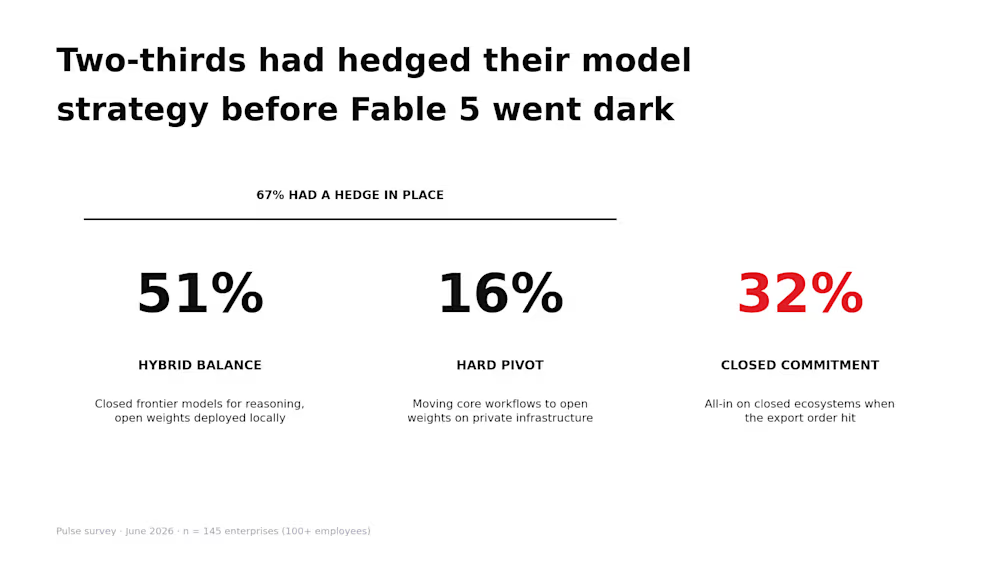
On June 12, a U.S. export-control order pulled Anthropic’s Claude Fable 5 — the most capable model on the market — offline for every customer, with no warning and no timeline. It returned this week wrapped in tighter safeguards, after China’s Z.ai released its open-weights GLM-5.2 into the vacuum. New VentureBeat Pulse Research, which surveyed 145 enterprises across these last few weeks, shows that two-thirds had already hedged their model strategy before the order came down: 51% blend closed frontier models with open-weight models deployed on their own infrastructure, and another 16% are moving core workflows off closed APIs entirely. The remaining third was all-in on closed ecosystems when the lights went out.
The blackout put a spotlight on vendor dependency, by showing what happens when the model you rely on disappears. But vendor dependency is only the most visible piece of a deeper problem: Most enterprises lack the monitoring to know when an AI system they’ve put into production stops working correctly.
Just 1 in 10 enterprises has automated monitoring that would catch an AI model drifting, misbehaving, or failing in production. Roughly a quarter would learn of a production failure only when end users — internal or external — report it, or lack the visibility to detect it at all. And 79% of enterprise organizations have already taken a real financial or operational hit from autonomous agents — most often shadow AI, unauthorized agentic work run by enterprises’ own employees on corporate credit cards, outside anyone’s oversight.
Advertisement
We call this the “Control Gap,” or the distance between how aggressively enterprises are deploying AI and how little of it they can see, own, or govern. June’s blackout turned this into a live stress test.
About this data: VentureBeat Pulse Research surveyed 145 qualified respondents at organizations with 100 or more employees in June 2026, with fielding spanning the Fable 5 blackout that began June 12. The sample is self-selected and directional: 41% work in technology/software, 20% are consultants or advisors, and the respondent base skews senior and technical — CIO/CTO/CISOs (18%), directors of engineering/IT (14%), enterprise architects (12%). More than half of the respondents were from companies with 2,500 employees or more.
While our sample is not huge, what you can trust more than the exact percentages is the pattern: Every question in the survey, independently, points the same way, with deployment running ahead of governance, visibility, and cost control.
How the Fable 5 export order rewrote enterprise AI risk
Fable 5 launched June 9 to immediate acclaim — and sticker shock, at $10 per million input tokens and $50 per million output. Three days later, the U.S. government issued an emergency export-control directive barring access by foreign nationals. Anthropic, with no way to verify nationality in real time, suspended the model for everyone.
June added the harder lesson: The model your workflows depend on can vanish overnight, by government order, through no decision of yours or your vendor’s. And Chinese companies like DeepSeek were releasing hugely disruptive, powerful models, driving down costs to a fraction of Western ones.
Advertisement
Brian Craig, senior director of architecture at Liberty IT, the Ireland-based engineering arm of Liberty Mutual, one of the world’s largest insurance companies, saw both lessons collide in real time. Craig is Irish, which meant the export order hit him directly as a foreign-national user.
Onstage at VentureBeat’s AI Impact event in New York on June 24, mid-blackout, I asked him about it. “Fable arrived, and immediately you saw the sticker price of using it, and you went, ‘Ooh, goodness, it better be really good,’” Craig said. “But luckily enough, we didn’t get to use it enough to get to fall in love with it.” Then it was gone.
The hedge was already built before the blackout hit
Craig’s company was built to route around exactly this kind of disruption. Liberty IT runs what it calls an AI backbone — roughly 50 components spanning security, governance, observability, and orchestration, each independently replaceable.
“You can’t lock in right now in one vendor and even one framework,” Craig told the room. “You need to keep being able to have the flexibility with that backbone to be able to hook into different models, different vendors, depending not so much on who’s the flavor of the day, but on what you can feel confident about for the next six months.”
Advertisement
The survey shows Craig has plenty of company. A 51% majority of enterprises run a hybrid posture — closed frontier models for general reasoning, open-weight models deployed locally for specialized execution — and 16% are making a hard pivot, moving core workflows onto open weights running on their own hybrid or private cloud. The 32% holding a closed commitment are candid about why: The operational overhead of self-hosting still outweighs the savings for them. After June, that calculus has a new variable in it.
Defection is now the active posture, and the target may surprise you. Asked which primary AI vendor they are most likely to downsize or phase out over the next 12 months, respondents named Microsoft first at 30% — most citing cutbacks to Copilot and Azure AI frameworks in favor of direct model access — ahead of the 28% who plan to trim no vendor at all. OpenAI drew 21%, largely on pricing volatility, with Anthropic at 15% and Google at 6%. No vendor faces an exodus. But loyalty by inertia has ended: Among these enterprises, actively cutting at least one provider is now more common than expanding across all of them.
Just 1 in 10 enterprises would catch a failing production model automatically
How would an enterprise know if one of its production AI models was drifting, behaving unsafely, or failing to complete tasks? We asked directly. Forty percent say they are very confident they would detect it. The question also asked what that confidence rests on, and respondents split into two camps: 30% rely on humans reviewing critical AI outputs, and just 10% — 14 of the 145 organizations — have automated monitoring and alerting running against production systems. The remaining respondents hold weaker positions still: 32% expect to catch most issues “eventually,” 19% say they would likely hear about a failure from end users first, and 8% report no systematic visibility into production AI behavior at all.
That distinction matters because the two approaches are very different. Human review may seem like the gold standard, but it only reaches the outputs someone designates as important for such a review — and it happens at the pace humans can move at, with the inconsistency any manual process carries. Automated monitoring watches everything the system produces, continuously, and flags anomalies as they happen — for the same reason enterprises stopped depending on manual checks for uptime and security a decade ago.
As agentic workloads multiply output volumes far beyond what any review team can read, the manual approach starts to fall behind. The leaders at our June 24 event in New York treat human review as a designed control with automation underneath it. “Nothing gets deployed into production unless it’s a human actually reviewing it and signing off,” Craig said of Liberty’s agentic software factory, where planning, coding, testing, critic, and librarian agents ship features from epic to production.
“It always has to be risk-based. That’s why we work for an insurance company.” Todd Johnson, the Morgan Stanley managing director who runs agentic AI across the bank’s end-of-day P&L controller process, described the same principle from finance: “One of our strong principles in our AI governance generally is that there always has to be human accountability, even if there’s a degree of automation.” VentureBeat covered Morgan Stanley’s new results around its P&L resolution agent system separately.
Liberty Mutual and Morgan Stanley chose manual sign-off deliberately, layered on top of observability, identity, and governance infrastructure. Whether the human-review camp has similar infrastructure underneath is more than a single-select question can establish. The 16% who separately named missing observability tooling as their biggest governance barrier are the ones saying outright that it hasn’t been built.
Advertisement
The top governance barrier is organizational: no single owner for AI across platforms
Why does the AI visibility tooling never get built? The respondents’ answers suggest it is an organizational shortcoming. The single most-cited barrier to governing AI across platforms is the absence of a single owner or accountable team, at 32%. Vendor opacity follows at 25%, missing tooling at 16% — and a lack of talent lands dead last at 5%.
The skills exist, but the organizational mandate does not: Only 38% say a central team actually governs AI behavior across their platforms today, 21% say ownership is unclear or actively contested between teams, and 17% say no role holds formal accountability at all.
The AI surface being governed makes the vacuum worse. Fully 85% of enterprises run two or more platforms each claiming to be the “primary” AI layer — ERP, ITSM, productivity suite, data platform, each with its own AI, its own controls, and its own assumptions. 36% describe an open contest between four or more. Just 8% have consolidated to one. Asked in a free-text question what one thing they would fix, respondents converged from different directions on the same answer: a single accountable owner, and a control plane that abstracts cost, drift, and model choice away from the end user.
79% have already paid for an agent control failure — led by shadow AI
The cost of the vacuum is showing up on corporate cards.
Asked to name the most severe financial or operational control failure they have experienced from autonomous agents, 49% of enterprises cite shadow AI — departmental teams running unauthorized agentic pipelines on corporate credit cards, bypassing central financial oversight entirely. Another 25% have been hit by an infinite-loop bill, an uncaught recursive workflow racking up thousands in token costs in a single incident, and 6% by an agent that degraded production databases with unthrottled queries. Only 21% report guarded stability, with hard token throttling and budget caps at the infrastructure layer. Add it up: 79% of these enterprises have already paid for an agent control failure in real money or real downtime.
Advertisement
Finally, the economics of tokens suggest the pressure will keep rising. Per-token inference costs are falling 70 to 80% a year, and agentic workloads consume 100 to 500 times the tokens of the LLM tools they replaced.
Brian Gracely, senior director of portfolio strategy at Red Hat, told our New York audience the answer starts with right-sizing: “If I’m simply trying to resolve an insurance claim, I don’t need to know about the history of Western civilization in my model. I don’t need to know soccer scores.”
Enterprises are pairing smaller, specialized models with semantic routing, he said, so the platform decides which requests genuinely need frontier-scale reasoning — and which are burning premium tokens on commodity work. (One adjacent data point from the survey underlines the appetite for pragmatism: 73% of enterprises report little or nothing to show for their custom fine-tuning investments of the past 18 months — a reckoning we’ll examine in its own report.)
The bottom line: Replaceability is spreading faster than ownership
The survey describes enterprises moving fast on AI with weak controls underneath. 58% are adding more AI initiatives than they retire. 85% run multiple platforms that each claim to be the primary AI layer. Three times as many enterprises rely on human review to catch a failing production model as have automated monitoring in place. And 79% have already paid for an agent control failure — most often unauthorized agent spending on corporate cards, outside IT’s oversight.
On one problem, enterprises have clearly adapted: model dependency. Two-thirds hedge their model strategy, either running open-weight models alongside closed ones (51%) or moving core workflows off closed APIs entirely (16%). The Fable 5 shutdown showed the value of that position — the hedged companies could route around a model that a government order made unavailable overnight.
Advertisement
The remaining problems are internal, and no purchase fixes them: 32% name the lack of a single accountable owner as their top governance barrier, and 17% say no role holds formal accountability for AI at all. Assigning an owner costs nothing and requires no vendor. It still hasn’t happened at most of these companies.
Our coming Q3 wave of research will measure whether June changed this — whether enterprises assigned owners and installed automated monitoring, or just added a second model and moved on.
The themes in this report — agent orchestration, governance, and cost control — are the agenda at VB Transform, VentureBeat’s flagship event, July 14-15 at Hotel Nia in Menlo Park, with technical leaders from Visa, GM, Waymo, Intuit, Instacart, LangChain and others. Details and registration here.
Advertisement
Disclosure: VentureBeat’s June 24 AI Impact event in New York was sponsored by Red Hat and Intel. Sponsors have no input into VentureBeat Pulse Research survey design, findings, or editorial coverage.
“Space.com and The Guardian are reporting that the Falcon 9 upper stage leftover from the launch of the Firefly Blue Ghost-1 lander on Jan. 15, 2025 is due to impact the Moon on Aug. 5, 2026,” writes longtime Slashdot reader fahrbot-bot. From a report: Onboard the same flight was the Hakuto-R Mission 2, called Resilience, a robotic lunar lander developed by the Japanese company ispace. According to a new study by an international team, the resulting impact plume may briefly be bright enough to see against the dark sky near the moon’s edge. That means it might be visible to moongazers with sufficiently sensitive telescopes. This head-on collision of the errant stage is expected to occur near the Einstein and Bell craters near the western lunar limb. It may well be visible to ground and space-based assets.
Using special physics simulations to model the impact, William Jo, a graduate research assistant at the University of Texas, Austin and colleagues predict the debris plume from the impact will have the central ejecta spike reaching roughly 47 miles to over 60 miles (75 kilometers to 100 kilometers) altitude. “Our calculations suggest the plume should be several orders of magnitude brighter than the dark-sky background for the first few minutes after impact,” Jo told Space.com. “So the plume should be visible, though I’d stress this is a single nominal case. The real one will look different, and the numbers are on the optimistic side. But the point worth making is that the flash isn’t really the story here.” Jo emphasized that there’s great slam-dunk science to be had. “Watching this one gives us a rare chance to open up ejecta-plume science and calibrate those models against a real event, which matters for every future thing we deliver to the moon,” Jo said.
Weary travelers making their way through airports have enough to contend with these days without some Microsoft borkage popping up over departure information.
A Heathrow Terminal 5 flight information display shows a Windows activation watermark above airport check-in signs showing where to drop your bags.Supplied
Spotted by an eagle-eyed Register reader identifying themselves as Ethel Grapefruit (Mrs), one of the information boards at Heathrow Terminal 5’s check-in area has decided that whatever is running behind the scenes does not meet with Microsoft’s approval, and requires activation.
The message is familiar to many Windows users, and appears as a watermark when something has made the knickers of the computer behind the scenes get a bit twisty. Perhaps there’s been a hardware replacement, and Windows needs to be reactivated. Or an update that sent the operating system into a tizzy. There are any number of reasons the watermark may appear, and any number of ways to remove it.
Advertisement
The good news is that, while annoying, the presence of the watermark is unlikely to have much adverse effect at a technical level. There’ll be nagging. There won’t be much in the way of customization to make the computer your own. And, of course, Microsoft won’t be offering much – if anything – in the way of support (other than security updates).
Not that any of that matters much for a sign showing where to go to check in for a flight and hand bags over to be weighed by a member of staff.
However, it might matter for a passenger already a little tense about being flung through the air in a metal tube at ludicrous speed after passing through multiple (and occasionally performative) security gates. If, after stepping through the airport doors, the first sight a person has is of an approach to IT that would have the head of their home tech team given a stern talking-to by The Boss, what hope is there for the rest of the journey?
Heathrow and British Airways are names that rarely feature in sentences that include the words “competent IT.” There was the 2024 British Airways luggage whoopsie or last year’s Heathrow fire-related closure. Digital signage indicating that some IT contractor has not done their work to the required standard is therefore the least of their worries.
Advertisement
And it’s not as if either entity couldn’t afford a Windows license. Let’s face it, the cost of some baggage tipping the scales would probably go a long way toward acquiring a license key (if that is indeed the issue).
However, for an already jumpy customer, a Windows activation message is unlikely to assuage nerves already jangling over EU passport queues and overly complicated airplanes doing some odd things on approach. Perhaps the moral of today’s bork is that it is better to forget all this traveling malarky. Instead, how about a nice sit-down, a beverage, and a delicious biscuit? ®
The next major milestone is making Windows 11 run smoothly on Windows PCs with just 8GB of RAM. That directly means entry-level and budget laptops will at least get the basics right, even if that means sacrificing the on-device AI bells and whistles. Let’s face it. The increasingly AI-first approach to computing on a Windows 11 machine is a little too taxing on the hardware at hand.
At last
Varun Mirchandani / Digital Trends
Running the full OS experience without any jitters on a desktop or laptop PC with just 8 GB of RAM is proving to be increasingly challenging. The situation is not too different for Apple’s famously well-optimized macOS. Running the latest AI-heavy wheels of macOS Golden Gate or macOS Sequoia on older MacBooks with 8 GB of RAM, or even the new MacBook Pro, is an exercise in frustration until you decide to switch off the AI processes completely.
Pavan Davuluri, EVP of the Windows and Devices portfolio at Microsoft, says the company’s next target is memory optimization for devices with 8GB of RAM. “Reducing Windows memory footprint to deliver a fast and responsive Windows experience across the PCs customers use every day,” he wrote in a blog post. Additionally, the out-of-the-box set-up experience will also get smoother, and parental controls will also be fixed.
As a result, the average selling price of laptops has kept climbing, and even the likes of Apple had to raise prices a few weeks ago. Analyst predictions are pretty disheartening, too. “The sub-$500 entry-level PC segment will disappear by 2028,” Ranjit Atwal, Senior Director Analyst at Gartner, said in a research note. “PC memory costs are expected to peak at 23% of the total bill-of-materials (BOM) up from 16% in 2025,” the report adds.
A huge step forward
This is where the situation gets tricky. The makers of operating systems are increasingly pushing AI into the workflow, whether it’s a desktop on your table or on a phone in your palm. Microsoft is no different, and over the past couple of years, it has tried to push the Copilot AI experience into every corner of the Windows experience and the apps that it ships.
Microsoft
The company even had to create a baseline hardware requirement (an NPU that goes over 40TOPS and 16GB of RAM) for a PC to qualify as a Copilot+ machine. But the company soon realized its mistake as well. Owing to the higher asking price of its latest Surface hardware and how increasingly inaccessible they are becoming, the company launched a watered-down version of its latest Surface laptops, packing just 8 GB of RAM and lacking the Copilot+ AI branding, because it’s just not feasible to serve all those on-device AI features on a laptop with just 8 gigs of memory.
But Copilot is not the only hurdle that makes budget laptops a testing experience on a foundation with just 8 GB of RAM. There are a whole bunch of background processes and redundancies that keep Windows running slower on the same amount of RAM, whereas macOS does a much better job. I have used Apple’s MacBook Air and Neo laptops with the same RAM allowance, and they perform far more reliably than a budget Windows laptop with a similar memory allowance.
I’m glad that Microsoft is finally realizing the mistake and trimming the bloatware that could allow laptops and PCs with 8GB of RAM to perform smoothly. Given the current state of the market, laptops with 8GB of RAM — and a more affordable price tag — are desperately needed. Intel is chasing that dream with Project Dragonwing. Let’s hope Microsoft can pull off some magic. I’m not too confident, but I am certainly hopeful!
RFK Jr. has a lot on his plate at the moment as the head of HHS. America is currently dealing with a record breaking outbreak of the measles, for instance. His agency has had a very hard time getting people confirmed for key roles. There’s that whole cyclosporiasis thing going around, which you’ll know you’ve caught it by the simple fact that you won’t be able to stop shitting yourself. There’s a huge self-inflicted talent vacuum at HHS and its child agencies. Pertussis cases are on the rise. Court orders keep blocking Kennedy’s committees.
With all of these crises and chaos, Kennedy became very angry at news reports that he was mostly checked out of the HHS work he should be doing to address all of this. It’s hard to take that anger all that seriously, though, given that Kennedy also became the very first sitting cabinet secretary to host a podcast while in office. And I have to assume it is also a first time a sitting cabinet secretary will — checks notes — host a cooking show with celebrity chefs.
Health and Human Services (HHS) Secretary Robert F. Kennedy Jr. has launched a show geared toward teaching Americans how to cook healthy, inexpensive meals.
“Thanks to President Trump, we flipped the food pyramid and put real food back where it belongs: at the center of the American plate,” Kennedy said in a video he posted Wednesday to YouTube touting “The Real Food Show.” “I’m traveling across America, connecting with renowned chefs to show families how to cook delicious, nutritious meals with real ingredients, and all at affordable prices,” the HHS secretary added. “America, it’s time to eat real food. Let’s get cooking.”
Cute. How about instead you travel the country on a mass vaccination campaign for measles? Maybe some lower level member of HHS can rub elbows with celebrity chefs while you, oh, I don’t know, do literally anything concrete when it comes to cyclosporiasis. Maybe you could fill the open roles in your agencies with competent people you can get confirmed by Congress. Or maybe you could get your agencies running smoothly and with high morale.
Advertisement
It’s not that cooking isn’t important. It’s not even that all of Kennedy’s thoughts on food and health are wrong, because they certainly are not. But there is other, real, important work that needs to be done, leadership that needs to be demonstrated, and confidence building that needs to happen with the public. All of that is a better place for the Secretary of HHS to be spending their time, compared with cosplaying as a daytime cooking show host.
Kennedy told USA Today his new cooking show aims to convince Americans that eating healthier does not cost more.
The price of food at home and away from home both rose by 0.2 percent from May to June, according to the consumer price index, a popular measure of inflation.
It’s actually worse than that and looking at the CPI for food on a monthly basis doesn’t tell the whole story. Year over year CPI for food is up by roughly 3%. All of that is to say that if Kennedy wants to focus on the affordability of fresh food, part of the solution would be for him to get his current boss to not play stupid games with tariffs and to stop starting the very foreign wars that he promised to keep us out of.
So, as you continue to see headlines for the very real health issues the country is currently facing, just remember that RFK Jr. is hard at work baking crab cakes and getting his plating skills just right.
Does It matter?: Intel is providing a startup with significant access to its chip design schematics as part of a rare licensing deal involving the x86 instruction set architecture. RosaicLabs could now theoretically build its own x86 CPU, although speculation points to more cutting-edge applications such as robotics and AI.
Reuters sources claim that Intel is entering into a secret agreement with RosaicLabs Inc., a company incorporated in Delaware just a couple of months ago. The agreement covers the register-transfer level (RTL) code for Intel’s Atom CPUs, although we don’t have any specific clues about which generation of Atom chips – or which computing core technology – is involved.
Atom chip technology is based on the x86 ISA, although it is designed to operate within significant power and form-factor constraints. In circuit design, RTL code provides a design abstraction that models data transfers between hardware registers and logical operators. In theory, RosaicLabs could use Intel’s RTL IP to develop a brand-new x86 CPU or even design something more complex based on the ISA that has powered most PCs since the IBM PC era.
A few significant hints about RosaicLabs’ business prospects come from the people actually involved in the deal. Reuters reports that the company’s CEO is Amarjit Gill, a longtime business partner of Intel CEO Lip-Bu Tan. Gill and Tan previously worked at Rivos, a chip company that was later acquired by Meta. Amit Parikh, Rivos’ former top financial officer, is also part of the new Rosaic venture.
Advertisement
Besides a long-standing cross-licensing agreement with AMD, Intel is not known for freely sharing official design documents for x86 CPUs with third-party organizations. Incorporation documents filed in Delaware state that RosaicLabs is seeking an initial funding round of $10 million, with executives free to invest up to $5 million without seeking approval from investors or the board.
It’s safe to say that one potential outcome for RosaicLabs is adapting Atom’s peculiar low-profile “skills” to this brand-new world of chip scarcity and data center overprovisioning. The “lesser” x86 processor could find a new role in edge-computing infrastructure, robotic AI, or other emerging applications. In the worst-case scenario, Lip-Bu Tan’s Intel could simply swoop in and acquire whatever RosaicLabs develops a few years down the line. Although, then again, there would be nothing particularly revolutionary about that.
An illustration of a protein created by Accipiter Bio that has two active sites, shown in light and darker green, that can simultaneously bind two targets. (Accipiter Bio Image)
Less than a year after emerging from stealth operations with $12.7 million and partnerships with pharmaceutical giants, Seattle-based biotech startup Accipiter Biosciences has added $10.5 million to its funding total. The new cash will let the company move faster on promising drug candidates.
“We could have stuck with the original plan and been just fine,” said Matthew Bick, Accipiter Bio’s co-founder and CEO. “But we thought we’d rather capitalize on the progress we’ve made now and diversify our clinical portfolio.”
The team has grown to 22 people and includes researchers who worked at the University of Washington’s Institute for Protein Design under Nobel laureate David Baker.
The company uses artificial intelligence tools developed at the institute to engineer proteins with the unusual ability to bind multiple cellular targets at once, potentially amplifying their ability to fight illnesses.
“We’re not just trying to replicate what antibodies can do,” Bick said. “We’re unlocking some really interesting biology.”
Advertisement
Accipiter Bio has a collaboration and license agreement with Pfizer to research and engineer new molecules. The deal provides an upfront payment and the potential to earn more than $330 million through milestones and royalties. The startup has a similarly structured agreement with oncology drug company Kite Pharma, owned by Gilead Sciences, to design proteins for use in cell therapies.
The startup also runs its own in-house drug-development programs. It originally planned to advance one or two into the clinic, but the extra cash will allow it to bring three or four programs forward into clinical trials. Bick said the company is now primarily focused on immunology-related conditions, alongside its lead oncology program.
Matthew Bick, CEO and co-founder of Accipiter Biosciences. (Accipiter Bio Photo)
The company launched in March 2023, emerging from stealth in November 2025. The new funding is an addition to Accipiter Bio’s seed round and includes only existing investors. Flying Fish Partners and Takeda co-led the seed round, which included Columbus Venture Partners, Cercano Capital, Washington Research Foundation, Alexandria Investments, Pack Ventures and Argonautic Ventures.
The new funding will help grow the team, bringing in additional scientists and reaching a headcount of about 30 people over the next six months to a year.
Interest continues to grow in AI’s potential to speed up the creation of new drugs. But Bick cautions that the process isn’t as simple as some might suggest, particularly for more complex therapeutics.
Advertisement
He knows this firsthand: he and two of his co-founders worked at Neoleukin, a biotech company co-founded by Baker that spun out of the UW in 2019. The startup’s lead drug candidate, an engineered protein used in cancer treatment, underperformed in a Phase 1 trial. Neoleukin laid off many of its employees before merging with another company.
“There’s an impression with AI methods that you can just hit a button and you get your molecule out, but it’s not that easy — and certainly when you’re pushing the methods to their limits, it’s really not that easy,” Bick said.
The process still requires asking the right therapeutic questions, manual engineering and a deep understanding of the molecules, he said. “There’s still protein intuition that comes into it.”
The funds raised will enable CoreMap to develop more precise data-driven tools to assist atrial fibrillation ablation.
CoreMap, a US-based medtech, has announced the closure of an oversubscribed Series C funding round, which was led by Medtronic and included participation from existing and new investors.
The organisation, which was established in 2016 and is headquartered in Burlington, Massachusetts, focuses on advancing the diagnosis and treatment of atrial fibrillation. This is a common heart rhythm disorder in which the beat is irregular.
CoreMap will put some of the funds raised towards further developing its electrophysiology mapping system, which is designed to provide physicians with atrial fibrillation (AF) ablation guidance, based on large datasets of highly accurate electrical activation data.
Advertisement
Ablation is a technique that targets tissue in the heart, creating tiny scars via radiofrequency or pulsed field energy; this works to block the faulty signals that result in the irregular heartbeat.
Commenting on the funding announcement Sarah Kalil, the CEO and co-founder of CoreMap, said: “The successful completion of this financing is a significant milestone for CoreMap.
“AF remains one of the most significant unsolved challenges in electrophysiology and physicians need better data to guide treatment decisions and improve patient outcomes. This investment provides the resources to accelerate CoreMap’s next-generation AF mapping platform’s time to market.”
Chris Eso, the global head of corporate and business development, M&A and ventures at Medtronic, said: “CoreMap is addressing one of the critical unmet needs in AF treatment with a differentiated technology platform and strong clinical support. We are excited to support Sarah and the CoreMap team as they advance the company through its next stage of growth.”
Advertisement
SiliconRepublic.com previously spoke with Ronan Rogers, the senior R&D director for cardiac ablation solutions at Medtronic. Alongside his colleague Ruth Callanan, who is Medtronic’s director of site quality, Rogers discussed how the Ireland’s west is building real depth not just in medtech, but across key areas such as pharmaceutical science, advanced analytics and digital technology.
Don’t miss out on the knowledge you need to succeed. Sign up for the Daily Brief, Silicon Republic’s digest of need-to-know sci-tech news.
To confirm that the observed signal was indeed caused by a moon, the research team also examined other possible factors. These included apparent periods resulting from errors in corrections for Earth’s orbital motion, seasonal variations in atmospheric conditions, and the effects of the brown dwarf’s own rotation.
An artist’s concept of a moonlike object (center) orbiting the brown dwarf CD-35 2722 B (right). Researchers refer to this object as an “exosatellite” and describe it as a massive gas giant with a mass at least equal to that of Jupiter.
Video: ESO/M. Kornmesser
Furthermore, calculations of the Roche limit—the boundary beyond which a satellite would be torn apart by the brown dwarf’s tidal forces—and the Hill radius—the radius of the brown dwarf’s gravitational influence—confirmed that the satellite’s orbit falls within a range where it can exist in a physically stable manner.
Advertisement
According to the researchers, this is the first evidence of a satellite orbiting a brown dwarf companion obtained using this method. A few months earlier, another team had gathered clues suggesting the presence of a satellite during observations of the HD 206893 star system using the VLT Interferometer but had not yet achieved a definitive detection.
The object discovered in this study occupies a unique position that cannot be fully understood using the conventional framework for moons in our solar system. “We have a clear delineation between the planets and the Sun in the Solar System, so defining things like moons is simple,” says Alice Zurlo, an astrophysicist at Diego Portales University, in a news release. “In the CD-35 2722 system, where we are blurring the lines between stars, planets, and moons, the whole thing becomes more complicated to describe.”
It remains unclear whether this object should be called a moon. ESO also notes that there is no officially recognized definition for exomoons and the researchers use the term “exosatellite.” The paper itself acknowledges that it is uncertain whether this object will meet future criteria to be considered a moon, but that the discovery is a step toward creating a definitive detection.
Researchers believe this discovery will serve as a catalyst for identifying new directions in future theories of planet formation and celestial mechanics. Furthermore, if there are smaller, rocky moons like the one in the new paper, they could be subjected to tidal heating from brown dwarfs, potentially creating environments suitable for life even at greater distances from their stars—a development that might also have implications for the search for extraterrestrial life.
Advertisement
It’s also possible that once the next-generation Extremely Large Telescope equipped with a 39-meter primary mirror is completed, it will be possible to detect even smaller exomoons.
This story originally appeared onWIRED Japanand has been translated from Japanese.
For years, India was the world’s largest app download market but one of its toughest places to make money. That is beginning to change as Indian consumers spend more on AI, entertainment, and other premium apps.
India’s mobile app market generated a record $345 million in consumer spending during the second quarter of this year, up 35% from a year earlier, according to a new report by Sensor Tower. The app-market intelligence firm said the gains were increasingly driven by generative AI, streaming, and productivity apps rather than gaming, as Indian consumers became more willing to pay for digital subscriptions.
The record quarter builds on a broader trend of rising app monetization. India’s revenue per download has more than doubled over the past three and a half years, while quarterly app downloads have remained at around 6.3 billion since 2023.
“We would describe India today as a rapidly evolving mobile market with a large user base and growing willingness to pay for digital services,” Eve Chen, an insights analyst at Sensor Tower, told TechCrunch.
Advertisement
Chen attributed the change to the wider adoption of digital payments, including India’s Unified Payments Interface (a system that lets people pay directly from their bank accounts) and digital wallets, which have reduced friction for in-app purchases, alongside growing acceptance of app-based subscriptions and premium digital services.
The trend also stands out globally. India’s app revenue saw its fastest growth in Q2 among major app markets, generating more than $200 million in quarterly consumer spending, per Sensor Tower’s data shared with TechCrunch. In contrast, Mexico grew 30% and Turkey 25%, while U.S. app revenue actually declined 3% over the same period.
“These figures suggest that India is no longer just the world’s largest market by downloads, but is also emerging as one of the fastest-growing markets for app monetization,” Chen told TechCrunch.
India still trails more mature app markets by a wide margin. Revenue per download stands at about $4.60 in the U.S., $3.90 in South Korea, and $6.10 in Japan, compared with a small fraction of that in India. Nonetheless, Chen said the trajectory matters more than the absolute level, with India’s steadily improving monetization suggesting significant room for long-term growth.
Advertisement
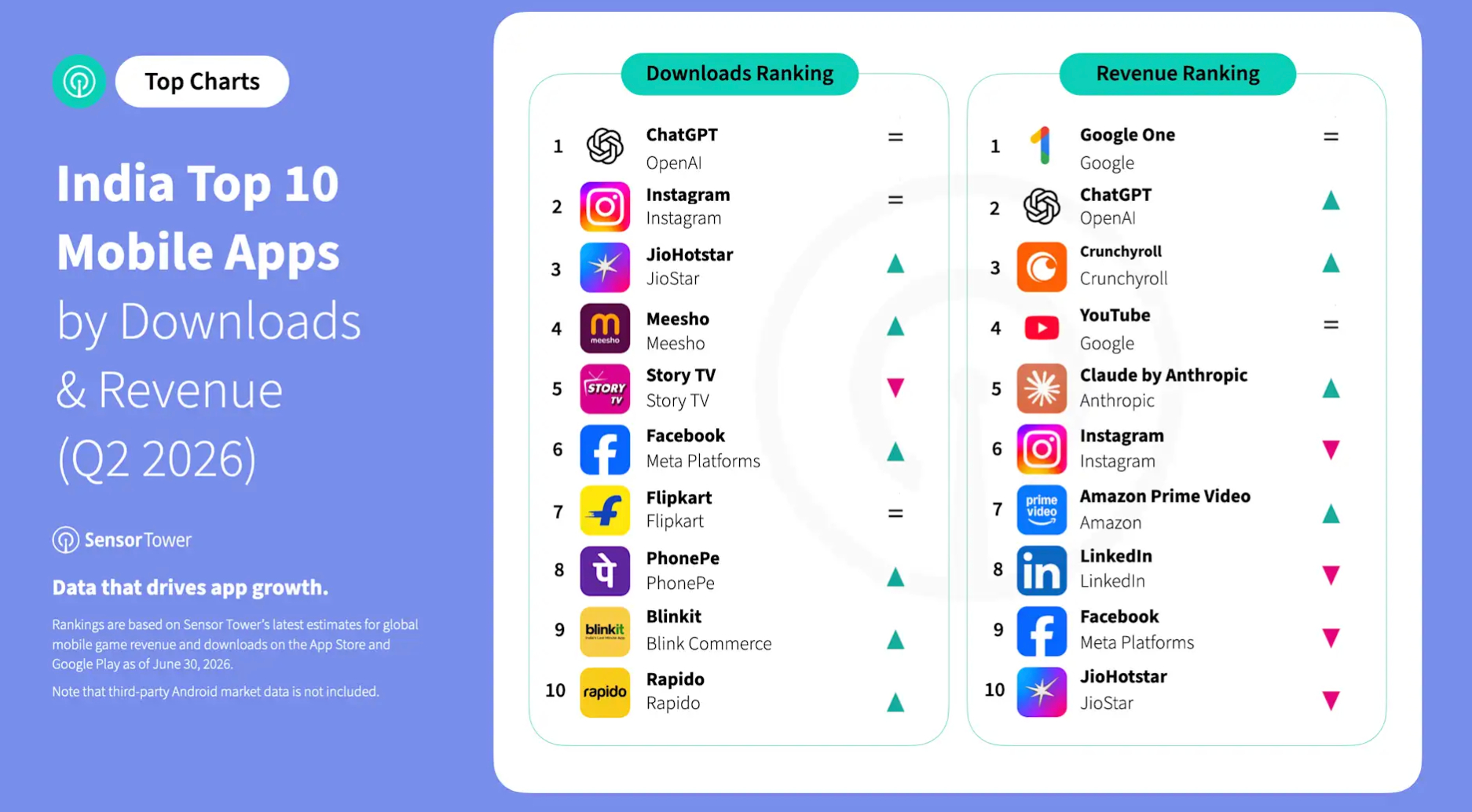
Generative AI has emerged as one of the fastest-growing segments, with OpenAI’s ChatGPT and Anthropic’s Claude together accounting for nearly 83% of India’s AI app revenue in Q2, according to Sensor Tower’s data shared with TechCrunch.
Much of India’s app revenue growth is also being driven by non-gaming apps. Non-gaming categories, Sensor Tower said, accounted for 68% of India’s mobile app revenue in the first half of 2026, up from 58% three years earlier.
The latest data also suggests global subscription apps continue to be among the biggest beneficiaries of rising app spending in India, with Google One becoming India’s highest-grossing mobile app during the quarter. Streaming platforms such as Amazon Prime Video, Crunchyroll, Sony LIV, and JioHotstar also saw growing consumer spending. Gaming also bucked the global trend, with revenue rising 3.7% from the previous quarter despite a worldwide decline, per Sensor Tower.
Image Credits:Sensor Tower
App intelligence firm Appfigures also sees India’s app subscription market continuing to grow, although it says the pace has slowed after an AI-fueled surge over the past two years. Subscription revenue is still rising, but much of the initial excitement around AI has abated, Ariel Michaeli, the company’s founder and CEO, told TechCrunch.
“The numbers are still staggering,” Michaeli added. Appfigures estimates that ChatGPT generates about $60,000 a day in India and attracted around 1.8 million downloads over the past month, although that’s down from roughly $80,000 a day last October.
Advertisement
When you purchase through links in our articles, we may earn a small commission. This doesn’t affect our editorial independence.

























































You must be logged in to post a comment Login