If you take a video of a spinning wheel, you’ll probably notice that the spokes appear to turn more slowly than the wheel is actually rotating, and sometimes in the wrong direction. This is caused by a near match in the frame rate of the camera and the rate of rotation of the wheel – each time the camera captures a frame, the wheel has rotated a spoke into nearly the same position as in the last frame. If you time the exposures carefully, as [Excessive Overkill] did in his latest video, this effect can seemingly freeze moving objects, such as a fan or saw blade.
Most cameras only allow relatively coarse, fixed adjustments to frame rate, making it difficult to synchronize the shutter to an object’s motion. To get around this, [Excessive Overkill] used an industrial camera (previously used in this aimbot), which has fine frame rate control and external triggering. He connected the external trigger to a laser sensor, which detects a piece of retroreflective tape every time it passes by (for example, on one blade of a fan). When the laser sensor sends a signal, it also triggers a powerful LED flash. The flash is so powerful that dark materials create a hum when exposed to it, as pulses quickly heat the material, but each pulse is also so brief that the flash board doesn’t require any cooling.

Even to the naked eye, these stroboscopic pulses make rotating objects seem to stand still – an effect which made [Excessive Overkill] extra cautious when working around a lathe. When using a suitably long exposure time to avoid rolling-shutter distortion, the effect worked even using a normal camera without frame-rate matching. [Excessive Overkill] took videos of debris flying away from a seemingly motionless bandsaw, milling machine, chop saw, and jigsaw, though it was harder to freeze the rotation of a weed trimmer and a drone.
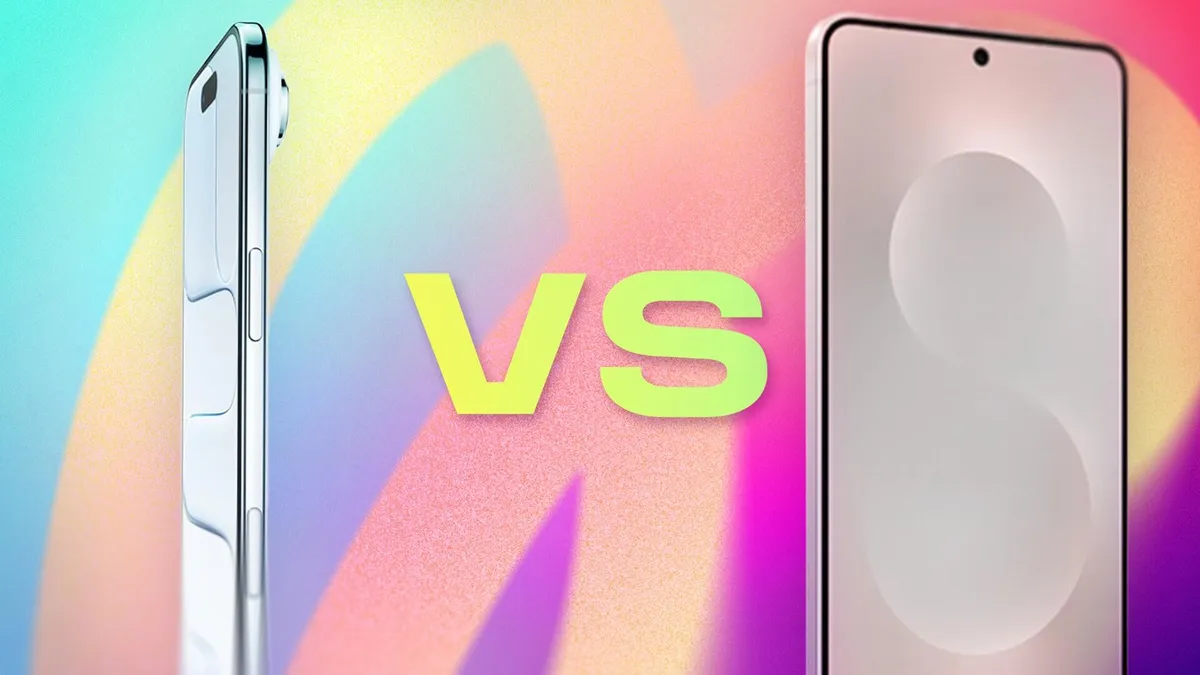
They may not be the highest-selling smartphones out there, but don’t sleep on the advantages that a thin and light phone can give you. Lighter than most, more comfortable to hold — and just plain appealing in terms of design — the Apple iPhone Air and Samsung Galaxy S25 Edge are the future of slim phones (and the foundation for foldables like the Galaxy Z Fold 7 and rumored iPhone Fold).
But are you giving up too much else for a slim phone? If you press them together, are they much thicker combined than a regular iPhone 17 or Galaxy S25 (or the new Galaxy S26)? And do they overcome trade-offs in battery life, camera and sound quality that come with a thinner design? I’m here to do the math and compare features for you.
Looking to order the iPhone Air? Check out our order guide to learn if you can get it free and other great deals.
Advertisement
Want to buy the Samsung Galaxy S25 Edge? Find out which carriers and retailers are offering the best deals on Samsung’s slim phone.
The iPhone Air starts at $999.
Apple
iPhone Air vs. S25 Edge price comparison
iPhone Air: $999. The iPhone Air takes the place formerly held by the iPhone 16 Plus, making it the only model with a screen larger than the iPhone 17 that isn’t an iPhone 17 Pro.
Galaxy S25 Edge: $1,100. The S25 Edge joins the S26 and S26 Ultra in this year’s Galaxy lineup.
The iPhone Air includes fewer features than the iPhone 17, such as the number of cameras. However, it features a larger display, an A19 Pro processor, and is equipped with 256GB of storage to begin with. Additionally, Apple has consistently applied premium pricing for minor design changes. The original MacBook Air fit into an inter-office envelope and cost $1,799, despite being underpowered compared to the rest of the MacBook line. (Over a few generations, it would eventually become Apple’s entry-level affordable laptop at $999, where it still resides.)
Advertisement
The Galaxy S25 Edge’s higher price ($101) could be an attempt to capture more dollars from customers looking for a phone that sets them apart, but we’re already seeing occasional steep discounts on it.
The Samsung Galaxy S25 Edge comes in three colors.
Advertisement
Carly Marsh/CNET
iPhone Air vs. S25 Edge dimensions and weight
Now it’s time to go deep — as in, just how thin is the depth of each phone?
No phone manufacturer describes its phones as bulky or chunky, even for extra-large models like the iPhone Pro Max. Yet, the difference between the depths of the iPhone Air and the S25 Edge, as well as the standard phones of each respective family, is stark.
Not counting the camera assembly, which Apple refers to as the “plateau,” most of the iPhone Air’s body is 5.64mm thick. The S25 Edge, at its narrowest point, is a hair thicker at 5.8mm. (Both companies list only the thinnest measurement, not including the cameras.) Compare that to 7.9mm for the iPhone 17 and 7.2mm for the Galaxy S25.
Advertisement
The iPhone Air is 5.64mm thick.
Celso Bulgatti/Zooey Liao/CNET
The Galaxy Z Fold 7 is actually thinner when open, at 4.2mm, but it also has a larger surface area to accommodate its battery and other components. Other foldables from Chinese companies, such as Huawei, Oppo and Honor, also boast thinner bodies than the iPhone Air or S25 Edge, but only when opened.
And when you press the two thin phones together, do they really match up to the typical phone slab you’re carrying now? Combined (and again, excluding the camera bumps), the iPhone Air and S25 Ultra are 11.44mm thick, which is thicker than either the iPhone 17 or Galaxy S25, and even the iPhone 17 Pro Max at 8.75mm. However, if you want to achieve a more vintage feel, the original first-generation iPhone, released in 2007, measured 11.6mm.
Advertisement
Stacking the iPhone Air (top) and the S25 Edge (bottom) gives you the same thickness as the original first-generation iPhone (if you ignore the camera bumps, and the awkwardness of not seeing either screen).
Abrar Al-Heeti/CNET
Surprisingly, the less depth translates to only a slight decrease in weight compared to the other models in each lineup. The iPhone Air weighs 165 grams versus 177 grams for the iPhone 17, while the S25 Edge pips in at just 163 grams but gets barely undercut by the Galaxy S25 at 162 grams.
How big is each phone in the hand? While both are similar, the iPhone Air is slightly shorter and narrower, measuring 156.2mm tall and 74.7mm wide, compared to the S25 Edge’s dimensions of 158.2mm tall and 75.6mm wide.
iPhone Air vs. S25 Edge displays
Apple calls the iPhone Air’s 6.5-inch OLED screen a Super Retina XDR display. It features a high resolution of 2,736×1,260 pixels at a density of 460 ppi (pixels per inch) and can output a maximum of 3,000 nits of brightness outdoors, as well as a minimum of 1 nit in the dark.
Advertisement
The iPhone Air’s display can output 3,000 nits of brightness on a sunny day.
Jesse Orrall/CNET
Samsung packed a larger 6.7-inch QHD+ Dynamic AMOLED 2X screen into the S25 Edge, which translates to a high-resolution display measuring 3,120×1,440 pixels at 513 ppi. Its brightness goes up to 2,600 nits.
Both phones’ screens feature adaptive 120Hz refresh rates for smoother performance.
Advertisement
The Galaxy S25 Edge display has a more dense resolution.
Jesse Orrall/CNET
Comparing the iPhone Air and S25 Edge cameras
So far, many of the specs have been close enough to weigh each phone fairly evenly. Then, we get to the cameras.
The iPhone Air includes a single rear-facing 48-megapixel wide camera with a 26mm-equivalent field of view and a constant f/1.6 aperture. In its default mode, the camera outputs 24-megapixel “fusion” photos that result from an imaging process where the camera captures a 12-megapixel image (using groups of four pixels acting as one larger pixel for improved light gathering, known as “binning”) and a 48-megapixel reference for additional detail.
Advertisement
The iPhone Air includes just a single 48-megapixel rear camera.
Jesse Orrall/Zooey Liao/CNET
Apple also claims the iPhone Air can capture 2x-zoomed (52mm-equivalent) telephoto images that are 12 megapixels in dimension and represent a crop of the center of the image sensor.
The S25 Edge features two built-in rear cameras: a 200-megapixel wide-angle lens and a 12-megapixel ultrawide lens. There’s no dedicated telephoto camera, so the S25 Edge also offers a 2x-zoomed crop that shoots photos at 12 megapixels in size.
Advertisement
The Galaxy S25 Edge has dual cameras.
Jesse Orrall/CNET
The front-facing selfie cameras on each phone differ significantly. The iPhone Air introduces a new 18-megapixel camera with an f/1.9 aperture. But the increased resolution over the S25 Edge’s 12-megapixel selfie camera isn’t what’s notable.
Apple calls it a Center Stage camera because it features a square sensor that can capture tall or wide shots without requiring the user to physically turn the phone, unlike the 4:3 ratio sensors found in typical selfie cameras. It can adapt the aspect ratio based on the number of people it detects in front of the camera: a traditional portrait orientation when you’re snapping a photo of yourself, for example, or switch to a landscape orientation when two friends stand next to you in the frame.
Advertisement
iPhone Air vs. S25 Edge batteries
When it comes to concerns, the battery life of thin phones is at the top of the list. The insides of most phones are packed with as much battery as will fit, so making a phone slimmer naturally means removing space for the battery. With either model, you end up sacrificing battery power for design. But how much?
Apple doesn’t list the iPhone Air’s battery capacity, but claims “all-day battery life” and up to 27 hours of video playback. It also sells a special iPhone Air MagSafe Battery add-on that magnetically snaps to the back of the phone and works only with the iPhone Air. In her review, CNET’s Senior Tech Reporter Abrar Al-Heeti drained the battery in 12 hours over a phone-intensive day, but did end a more typical day with 20% remaining.
The Samsung Galaxy S25 Edge vs. iPhone Air.
Advertisement
Jesse Orrall/Zooey Liao/CNET
The S25 Edge features a 3,900-mAh battery, which Samsung claims will support up to 24 hours of video playback. (Come on, phone manufacturers, our phones aren’t televisions left running in the background.)
In her S25 Edge review, Al-Heeti noted that the phone also generally lived up to Samsung’s own “all-day battery life” boast, saying, “Ultimately, you’ll get less juice out of that slimmer build, but S25 Edge offers just enough battery life to make me happy…But the S25 Edge has shifted my priorities. I’m enjoying the sleek form factor so much that I’m willing to make some compromises, even if that means I have to be sure to charge my phone each night, which is something I tend to do anyway.”
It’s worth noting that both phones support fast charging when used with a 20-watt or higher wired power adapter, allowing them to reach around 50% charge in 30 minutes from a completely discharged state.
iPhone Air vs. S25 Edge processor, storage and operating system
The iPhone Air is powered by Apple’s latest A19 Pro processor, the same one found in the iPhone 17 Pro models (compared to the A19 in the stock iPhone 17). Apple doesn’t list the built-in memory, but we suspect it includes 8GB of RAM (which is recognized as the minimum amount to run AI features such as Apple Intelligence). The base storage configuration is 256GB, with options to order the iPhone Air with 512GB or 1TB capacity. It ships with iOS 26, the latest version of the operating system that Apple released widely this week.
Advertisement
The S25 Edge is powered by a Snapdragon 8 Elite processor, the same one that powers the other S25 models. It includes 12GB of RAM and is available in storage capacities of 256GB and 512GB. The phone comes preinstalled with Android 15.
Up to 27 hours video playback; up to 22 hours video playback (streamed). Up to 40 hours video playback, up to 35 hours video playback (streamed) with iPhone Air MagSafe Battery
3,900 mAh
Fingerprint sensor
None (Face ID)
Under display
Connector
USB-C
USB-C
Headphone jack
None
None
Special features
Apple N1 wireless networking chip (Wi-Fi 7 (802.11be) with 2×2 MIMO), Bluetooth 6, Thread. Action button. Apple C1X cellular modem. Camera Control button. Dynamic Island. Apple Intelligence. Visual Intelligence. Dual eSIM. 1 to 3,000 nits brightness display range. IP68 resistance. Colors: space black, cloud white, light gold, sky blue. Fast charge up to 50% in 30 minutes using 20W adapter or higher via charging cable. Fast charge up to 50% in 30 minutes using 30W adapter or higher via MagSafe Charger.
IP88 rating, 5G, One UI 7, 25-watt wired charging, 15-watt wireless charging, Galaxy AI, Gemini, Circle to Search, Wi-Fi 7.
US price starts at
$999 (256GB)
$1,100 (256GB)
Watch this: iPhone Air Review: A Joy to Hold, at a Cost
Clippy almost deserves an apology, now that we’ve seen what came next. (Original cartoon: Amadeo Garcia III for GeekWire)
Longtime GeekWire readers might recognize my byline from my frequent coverage of the PNW’s video game industry, as well as occasionally dipping into the arts. I am also not a fan of artificial intelligence; if you see my name on an article, that’s a guarantee that no AI was used in its production, at least not deliberately.
To briefly summarize my feelings on the topic: I did not ask for these tools, I do not speak to these machines, I find them to be of little if any use in my day-to-day, I refuse to use them no matter how often their praises are sung, and I resent their intrusion. At least Clippy understood when he wasn’t welcome.
(Whenever I air this opinion in a public venue, someone usually pops up to tell me that this is the future and I risk being left behind. These inevitably turn out to be people who are heavily invested in that future; I am being told that only fools bet on red by people who borrowed money to put all their chips on black. Cool story, slop bucket. Discard the draft and sit back down.)
Towards the end of last year, I hit a saturation point where many of the programs and websites that I use on a daily basis had either pivoted to AI to some degree or were actively threatening to do so. This was often just obnoxious, like YouTube’s unnecessary video and chat “summaries.” At other times, it actively made the experience worse, such as the entirety of modern LinkedIn, which has come to look like MySpace after the robot revolution.
I’d finally had enough, and as one of my New Year’s resolutions for 2026, I’ve done my level best for the last four months to switch to as many LLM-free apps and options as is realistically possible. This is my trip report on the experience, as a hand towards those of you who’re as sick of this as I am.
Advertisement
Vivaldi – Nobody really seems to like Chrome
Vivaldi, by Vivaldi, in Vivaldi. (Vivaldi screenshot)
Google Chrome is the fossil fuel of the modern Internet. We know it’s wasteful and that alternatives exist, but somehow it’s still at the center of everything. There are a number of sites I visit regularly, both on and off the clock, that don’t work, or don’t work as well, in any other browser.
As Chrome continued to gradually force Gemini into every individual aspect of its user experience, I tried to ignore it at first. Then, as I installed an extension specifically to remove the “AI Mode” prompt that I kept clicking on by mistake, I realized the time had come to switch to a new browser.
As it turns out, I was spoiled for choice, although many of the available Chromium options (Arc, Maxthon) are just as obsessed with AI. Brave looked good for a while, but its emphasis on crypto makes me suspicious.
After some experiments, I ended up on Vivaldi. It has a few quirks I’m still getting used to (for example, your active tab is the dark one, which is precisely the opposite of how it works in most other browsers), but it’s responsive, privacy-focused, doesn’t tank my RAM, and works well enough with almost every website that I used to need Chrome for.
Waterfox – Obvious name, obvious replacement
(Waterfox screenshot)
Mozilla Firefox had been my other primary web browser for quite a while, but in recent years, I’d noticed increasing issues with its responsiveness and stability. As it turned out, it wasn’t just me; Mozilla has developed a real problem in recent years with leaving well enough alone.
Then, towards the end of 2025, Mozilla’s new CEO announced that the company plans to go all-in on AI, with an imminent shift to the same kind of integrated agentic model that’s used by other browsers like Opera. While Mozilla’s been careful to say that its AI will be optional, that still struck me as a good excuse to finally throw out Firefox and look for something else.
Advertisement
As it turned out, the solution was fairly close to home. I’d initially checked out Floorp, on the basis that anything with a name that dumb had to be a killer app, but bounced off of it early on.
Instead, I ended up with Waterfox, which is primarily due to the comfort of the familiar. Waterfox is a 15-year-old fork of Firefox that omits many of Mozilla’s recent missteps, as well as addressing a few privacy issues that I hadn’t previously known Firefox had. It is, in many ways, just Firefox, but Not Stupid, which is enough to get it a recommendation.
Paint.net – Because sometimes Photoshop is overkill
(Paint.net screenshot)
Much of writing for the Internet isn’t writing. I am not good at image editing, but it occasionally becomes necessary, so I need to have a decent art program on my machines. I used Photoshop for a while, but for my bare-minimum purposes it’s always been a bit like keeping a jackhammer around in case I need to drive a nail. Worse, it’s an Adobe product, and if there’s something a software company has ever done that’s annoyed you, Adobe did it first or is doing it more enthusiastically.
There are a few decent alternatives to Photoshop out there, such as GIMP, but I’ve gotten the most used to the freeware Paint.net. Some of it is because I appreciate their stubborn refusal to rework their website in the last 20 years – look at that beautiful Web 1.0 design – but Paint.net does everything that I, a permanent novice, need it to do. It’s a welcome dispatch from an era in which programs just worked, instead of trying to ensnare you in their consumer web.
LibreOffice – Open-sourcing my office apps
This article, in production, via LibreOffice. (LibreOffice screenshot)
I’ve been using this open-source replacement for Microsoft Office for years, but before recently, all my recommendations always came with a caveat. LibreOffice did everything I needed it to do – spreadsheets, word processing, direct conversion to .pdf – but played notoriously poorly with other applications in its lane. It couldn’t save a new document as a .docx (.doc, yes, but not .docx) and frequently went haywire whenever someone tried to open a LibreOffice file in another program.
That got quietly ironed out at some point without my noticing. I’d reinstalled LibreOffice on a new computer, and over the course of using it, I noticed that all my previous problems simply no longer applied. It’s now a perfectly viable alternative for all my local word processing needs, and has been working almost flawlessly for the last couple of years. Almost every piece I write starts locally, with a blank LibreOffice document.
Advertisement
Notetab Light – Plain text can be the best text
Another project, in production, via NoteTab Light. (NoteTab Light screenshot)
If I’m not writing in LibreOffice, I’m using this long-running freeware Notepad replacement. Sometimes, such as when you’re writing HTML, coding by hand, or filling out a wiki, plain text is all you need or want.
I had a similar app on my Mac way back in the day. When I made the switch to PC gaming in the 2000s, a pal recommended Notetab Light to me as a solid alternative. They were right, and ever since, NoteTab has always been one of the first things I install on a new computer.
Notetab Light is a useful way to get more customization options out of the most basic text imaginable, such as font size, background color, and automatic backups, with tabbed browsing for easy reference. In a day and age when Microsoft is trying to cram Copilot into everything including Notepad, I can rely on NoteTab to only ever do exactly what I told it to do.
Startpage – Google without the hassles, literally
Google, without modern Google. (Startpage screenshot)
The problem I’ve encountered with finding an adequate replacement for Google Search is that there isn’t one. A couple independent search engines come close, such as DuckDuckGo, but every so often I still have to go back to Google to get the results I need. My hope is that before too much longer, someone will come out with a functional search engine that’s a deliberate throwback to Google from its “don’t be evil” era.
Right now, the closest thing to that is Startpage, which is essentially an anonymizer for Google. It removes the AI overview and the tracking functions in favor of just giving you some semblance of what you’re actually looking for. It’s a little more convenient than simply adding “reddit” or “-ai” to the end of every search you make.
Protonmail – For Gmail refugees
(Protonmail screenshot)
This might be the most painful switch I’ve made, as I was an early adopter on Gmail. My account has fossilized layers of old emails that go all the way back to almost the beginning of my career. My history lived on that website, which is partially my fault for never deleting or locally archiving anything. Google keeps trying to inextricably bind Gemini into Gmail, though, so away I go.
Protonmail is generally marketed on the basis of its privacy measures, such as end-to-end encryption, but it’s also the natural first port of call for anyone swapping off of Gmail. You can set up auto-forwarding with ease, the UI is comparable if not identical, and its spam filters have yet to fail me. The only real drawback is that it gives you a fraction of the space of a new Gmail account, at “only” 1 GB, so now I have to be one of those “inbox zero” zealots.
Advertisement
Bluesky – What Twitter used to be (still terrible)
(Bluesky screenshot)
Microblogging platforms are, of course, a disease. They encourage the worst kinds of useless communication. They are also really good for quickly gathering information, so at least for what I do, they’re a necessary evil.
The ongoing prominence of Grok wasn’t why I stopped using Twitter, but it was a non-trivial factor. I joined the general exodus to Bluesky in 2024 and haven’t looked back, outside of the occasional bout of trainwreck syndrome.
Sadly, the overall Bluesky experience as of now indicates that most of what you hate about microblogging is due to microbloggers, and that’s platform-agnostic. Microblogging is simply a poor format for nuance or extended discussion. Either you try to express something complicated and your thoughts read like a telegram, or you don’t and you’re communicating exclusively in sound bites.
In addition, the Bluesky team has been talking up the benefits of “vibe coding” recently, which suspiciously coincides with the platform’s newfound tendency to crash without warning. It’s likely not a question of whether Bluesky ends up in the same agentic hell as post-Musk Twitter, but when.
For right now, however, Bluesky has its uses. It’s Twitter c. 2014 or so, providing an online home for a murderer’s row of writers, academics, journalists, and scientists. While it’s also got an inordinate supply of humorless wokescolds and troll accounts, Bluesky is still an interesting place to get news, see art, promote projects, and keep up with all your favorite writers. (And me.) While scrolling through Bluesky, however, you have to ignore its slowly burning fuse.
Advertisement
Bring back the dumb Internet
It’s not possible to get AIs all the way out of my digital life in 2026, more’s the pity. Sites like YouTube and LinkedIn constantly put it front and center, my phone’s constantly trying to turn AI assistance back on, and the handful of holdouts against LLM infestation slim down by the day.
At the same time, however, the current environment has given me a new appreciation for certain things that I never used to think twice about. When you can no longer take it for granted that something was produced by a human, there’s a new appeal to any media’s telltale signs of human imperfection: pencil marks, missed notes, filler words, speaker feedback.
That’s my new justification for any mistakes I make, by the way. They’re the proof I’m human.
My primary takeaway from these last four months, however, has been that I don’t feel as if I’ve missed anything. At time of writing, work-related LLMs primarily strike me as a series of solutions in a frantic search for matching problems. They don’t improve my efficiency as advertised, they actively impede my research, they dramatically expand my personal carbon footprint, and they’re being used to bring about an economic crash by an all-dork incarnation of the Legion of Doom. There’s no good reason to use genAI. Whenever I mention my personal anti-AI stance, I usually get told that I’m at risk of losing everything; practically, I’ve lost nothing.
Advertisement
If this story’s got one moral, that might be it. There’s nothing inevitable about AI.
Weatherproofing. Every model needs an IP (weatherproofing) rating to survive outside, so if you don’t see one, don’t buy those lights. There’s usually a lower rating for the control box compared to the rest of the lights, so be sure you can put that somewhere that’s a little less exposed to the elements. (As mentioned above, make sure you have an outdoor outlet, and check if there’s only one on a certain side of your home in case it limits your installation options.)
A range of installation options. You’ll want a set that comes with plenty of options for your own installation, including adhesive and drilled mounting options. What you need will vary based on your home design and materials; e.g., you’ll want adhesive for homes you can’t drill into. WIRED reviewer Kat Merck, who tested a couple of different permanent lights, liked sets with screw-on holders that the puck-style permanent lights can slide onto.
Controls for individual lights. This should be a no-brainer, but some cheaper lights won’t offer this ability or have more roadblocks to customized control. Make sure you’ll have easy individual controls, or you might find yourself frustrated with the design results of these lights. It’s similar to design controls that you’d see on smart bulbs and smart string lights.
A great app. This goes hand in hand with the need for individual light control—a good app determines whether that and other features are accessible. Govee and Eufy, two of our favorite permanent outdoor lights we’ve tried, both have good apps that are easy to use and come with preloaded light themes. These tech companies make more than just outdoor lights, including other favorite gear of ours, so they’re a good brand to trust to make a usable product and app. We also like Lepro’s more affordable lights, though the app had some extra hoops to jump through to get to controls, while Lumary’s app was a brutal experience for our tester.
Advertisement
What Time of Year Should You Use Permanent Outdoor Lights?
Most people are interested in this style of lights for the fall and winter. That’s a great time to set them up and use them, since you’ve got Halloween and Christmas decor that the permanent outdoor lights could complement with colorful holiday scenes. The days are also shorter, so you’ve got more nighttime hours to take advantage of these lights.
They’re a fun way to deck out your home for a sports game, especially for major games like the Super Bowl (WIRED reviewer Kat Merck, a resident of Washington state, was surprised to discover just how many people in her neighborhood had permanent lights this past February) and the World Cup, or for smaller holidays like St. Patrick’s Day or the Fourth of July. They’re a fun way to jazz up your home’s curb appeal in the evening year-round (though if you have an HOA, you might have to check your rules about displaying lights regularly) or add a little pizzazz for your next outdoor party. No matter what you use it for, there’s no wrong way or wrong time of year to use these lights.
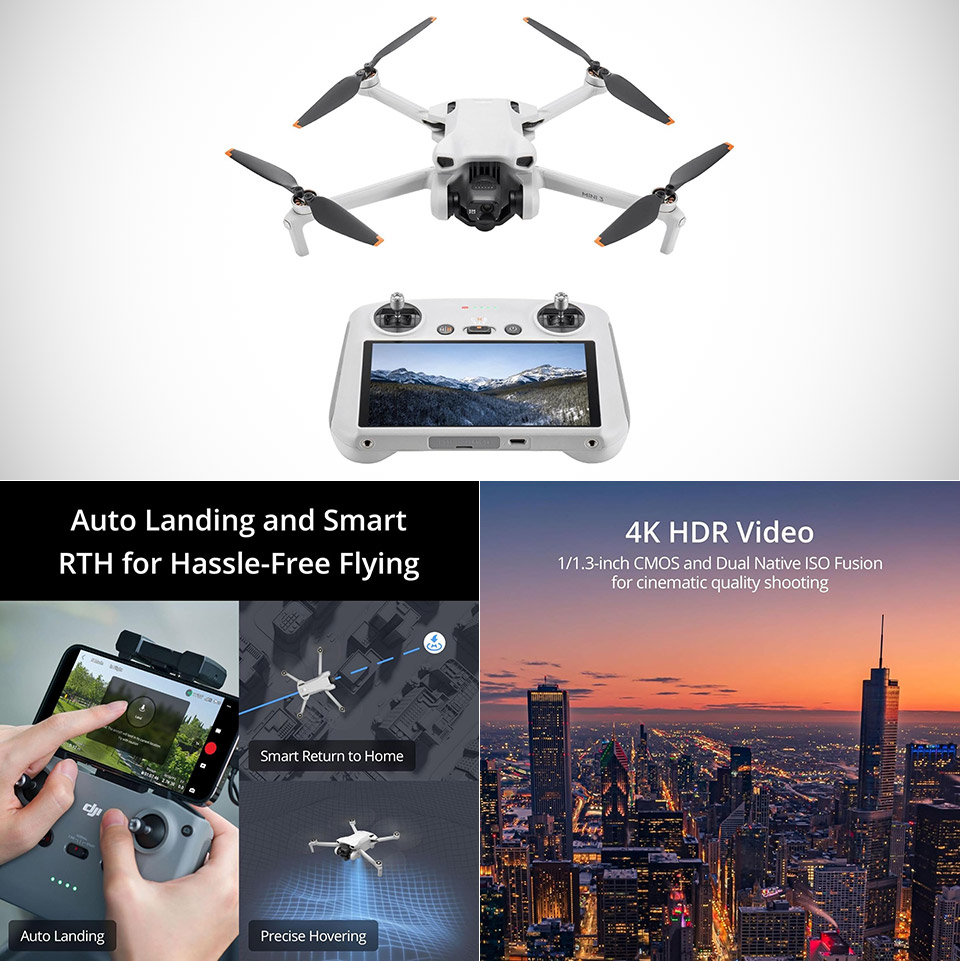
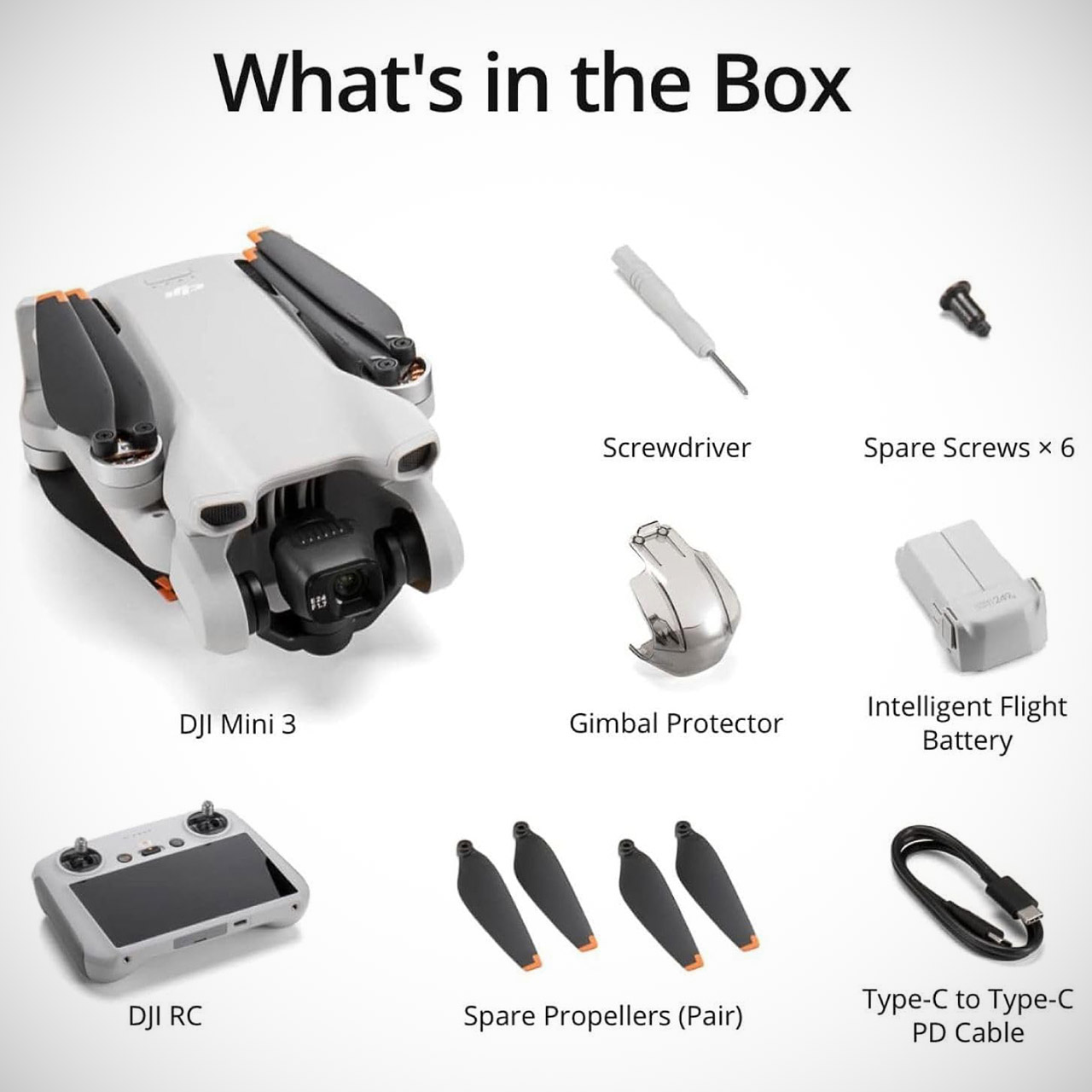
Weighing in at less than 249 grams, the DJI Mini 3, priced at $379 with RC controller (was $549), is in a class of its own for easy transport and hassle-free carry-on in most areas around the world. Grab it and chuck it in a tiny bag; there are no weight restrictions or extra checks at the airport. That super-light construction does not compromise performance; once those propellers start spinning, you’re ready to go.
The battery lasts for 38 minutes on a regular charge, after which you can switch in another pack and continue. Pilots are amazed at how much time they can spend exploring vast fields and city outskirts before having to land and recharge, often for entire afternoons. A 1 inch over 1.3 inch sensor sits behind the lens, producing excellent 4k footage at 30 frames per second with HDR integrated in. The colors jump over the sky and into the shadows, making the movie appear clear and balanced right out of the camera. Still images have a resolution of 12 megapixels, which provides enough detail to trim later or print large without compromising quality.
No Registration Needed – Under 249 g, FAA Registration, and Remote ID are not required if you fly for recreational purposes.
4K UHD Stunning Imagery- Film in 4K HDR Video for crystal clear aerial shots. With Dual Native ISO Fusion, Mini 3 enables the capture of details in…
Striking Vertical Videos are Ready to Share – With True Vertical Shooting, you can easily capture tall landmarks like skyscrapers and waterfalls.
The 3-axis gimbal tilts completely vertical on demand, making it extremely simple to line up flawless phone-style photos that do not require any post-editing. You can also swivel the camera ninety degrees in midair to photograph those towering scenes that look great on your smartphone. That one function alone saves you hours of post-production time and allows you to frame your landscapes or city skylines in a variety of unique ways.
Advertisement
The controls are already set up and ready to use in the supplied DJI RC controller, which has a large screen integrated in. There is no need for phone pairing or other cords; simply turn on the controller and you are ready to go. The display shows live imagery even in direct sunshine, and the buttons are easy to use with your thumbs, allowing you to make quick adjustments without having to glance away from the sky. The signal reaches all the way to 10 kilometers in clear conditions thanks to the reliable transmission method, while GPS guidance locks you in accurate position and triggers the auto return if the signal weakens or the battery starts to run low.
It handles a bit of wind well, and the quiet motors allow you to concentrate on taking the image rather than bothering the locals. Beginners quickly learn the fundamentals, but as they gain confidence, they discover a wealth of options for imaginative pans and orbits. Experienced pilots like the steady responsiveness, which never feels slow or oversensitive.
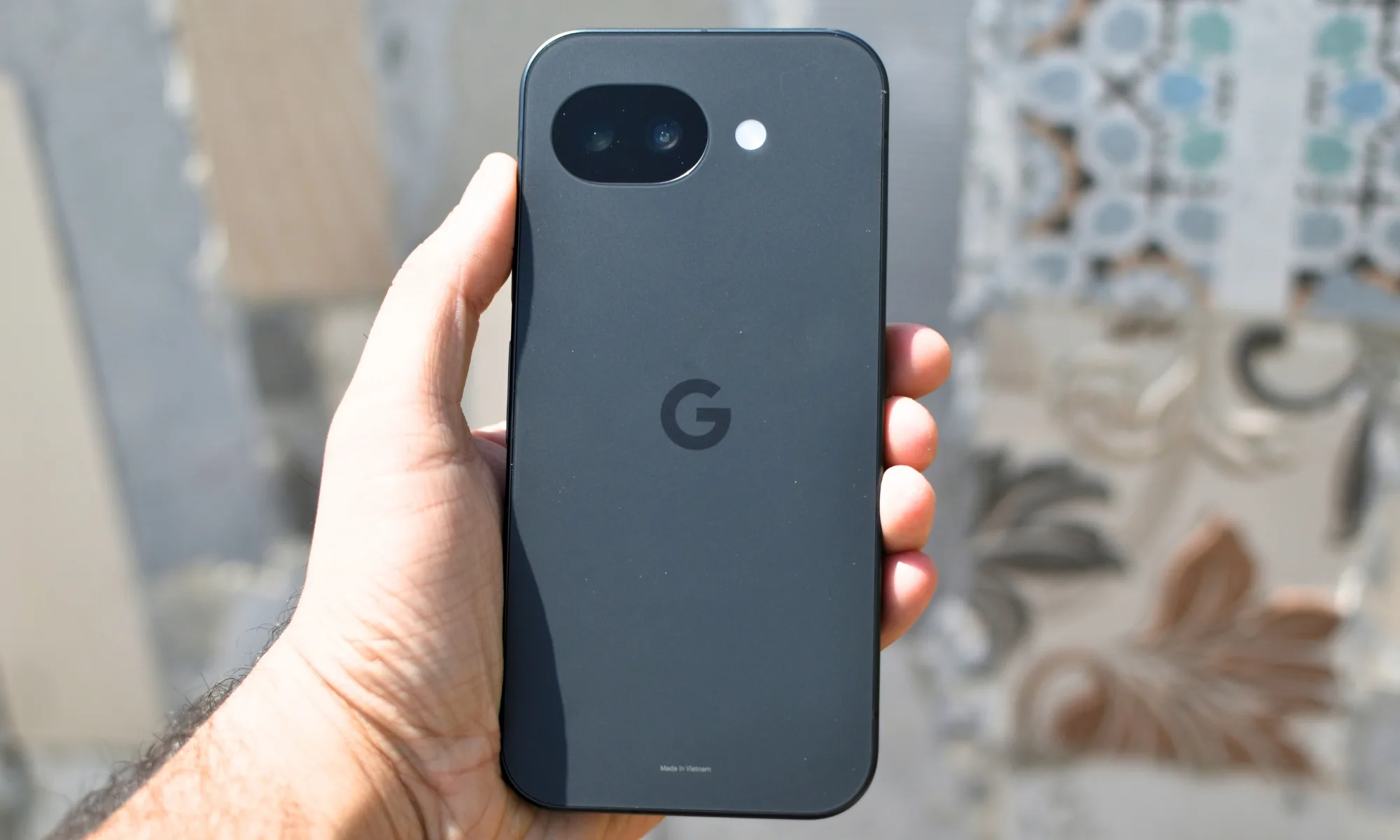
As Google launched the Pixel 10a, I did what everyone else does: opened the sheet, compared the chip with what other smartphones offer at the same price, and felt the familiar unease. I asked myself one question: “Why is Google even doing this?”
The Pixel 10a featured a Tensor G4 chip (from 2024) that didn’t impress in benchmarks, thicker front bezels, a 120Hz display without a truly variable refresh rate, no telephoto camera, and a battery that supported slower charging than the competition. On paper, it looked like a phone that lost a fight before even entering the ring (and for a rumble match no less).
Four weeks later, I’ve arrived at a position that I didn’t think I would, but I want to defend: the Pixel 10a’s spec sheet is the wrong document on which to judge this phone. After weeks of regular usage, I realized that the Pixel 10a isn’t for people who buy phones (especially after reading the spec sheet) ̦— it’s for those who actually live with them.
Shikhar Mehrotra / Digital Trends
A screen that you stop noticing (in a good way)
Let’s start with the display. Yes, the bezels are thicker than what you’d see on rivals, and the phone doesn’t use an LTPO panel that drops to 1Hz when the screen is idle. However, it was only after days of consistent use that I realized app transitions were fluid, navigation gestures were well synced with your fingers (and the speed at which you swipe), and general scrolling felt seamless on the Pixel 10a.
The Pixel 10a was bright enough on a hot, sunny day, so I didn’t have to shield the screen with my hand, and that’s what matters, not just the peak brightness numbers.
Advertisement
The chip doesn’t do well in benchmarks but nails daily usage
Shikhar Mehrotra / Digital Trends
The chipset argument is even easier for me to dissolve at this point. The Tensor G4 trails the Tensor G5 by a significant margin. However, it’s when I used it as a primary device (along with my iPhone 17) that I realized it never feels like it doesn’t benchmark well.
Google, being the name behind the Android operating system, has optimized the chipset (and the supporting hardware) so well that I didn’t notice the difference in day-to-day usage. First-party apps open almost immediately, and Google’s Gemini AI assistant runs seamlessly (since it has a capable TPU).
You could argue that the Pixel 10a’s competitors offer a dedicated telephoto lens for added versatility, but after capturing approximately 800 pictures and some 100 videos with the device, I’ve come to the conclusion that two well-tuned lenses and years of computational photography improvements outperform three mediocre ones.
Great cameras and battery life round out the experience
Shikhar Mehrotra / Digital Trends
Whether you know the Pixel 10a’s primary camera’s resolution or not, it surely captures images that are balanced and natural, with consistently accurate (or near-accurate) skin tones. Features like Night Sight and Photo Unblur, which add to the photography experience, aren’t even bolted to the hardware.
The same is true for the Pixel 10a’s battery, which easily provides me with around seven to eight hours of screen-on time. On 12 to 14-hour workdays, the battery often carries into the next morning. The charging speed is still behind the competition, but I guess the phone isn’t built for last-minute top-ups after all; the focus here is endurance, not speed.
All of this, in my opinion, is rounded up by Google’s flawless Android experience, which does its duty on the device in its purest and most efficient form. The Pixel 10a is clearly an example of how a phone with not-so-impressive hardware can still provide excellent usability through well-optimized software, which is also what the company is basing its seven years of software support on.
Advertisement
Pixel 10a: The phone that simply works
Shikhar Mehrotra / Digital Trends
The Pixel 10a isn’t the phone that wins in spec comparisons. It’s one that wins on Tuesday afternoons, when you need a quick Gemini answer, capture a picture against the light, or a battery that goes a long way even when you’re around the anxious mark of 10%. You can’t run the overall experience through a benchmark, and that’s where the specs debate has stopped bothering me.
This feeder also comes with extra plastic flowers and a little brush for scrubbing them, and the app sends reminders when it’s time to clean. You’ll also find fun, seasonal touches in the app, like the ability to send digital bird holiday cards with the photos your feeder captures, and a tool that superimposes hats, clothes, and various accessories on the birds, which is actually funnier than it sounds. However, as with the Birdbuddy Pro seed feeder, below, the big downside is that the feeder’s sensor doesn’t always pick up every bird that visits, which can definitely be a bummer when you see something interesting out the window but it doesn’t show up in the app.
Best Smart Birdhouse
WIRED
Two cameras show two action views
Pole-mountable solar panel was reliable in my testing
Different hole sizes can be mounted for different species
TIRED
Wood requires upkeep
Birds didn’t like mesh floor (it is removable)
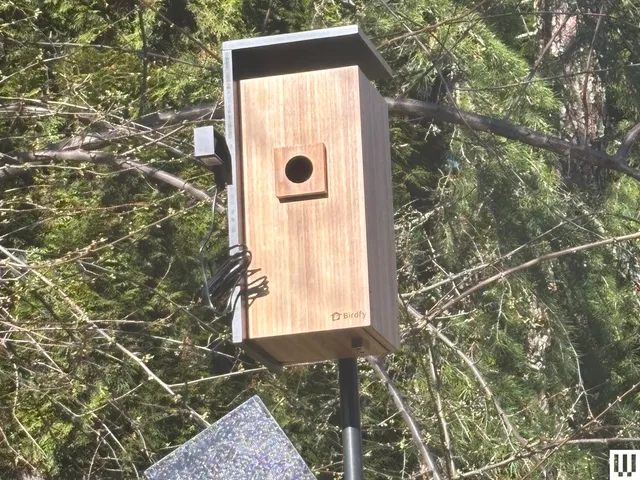
After experiencing another round of connection issues with the Birdfy Polygon (see below), I swapped it out for the newer Birdfy Duo and have had no issues whatsoever. The sleek, contemporary Duo is a fir box fitted with two cameras—one facing the hole and one tucked away discreetly inside the feeder, so you can get a full-spectrum view of what’s going on. Both cameras have night vision (the internal one is infrared). Like the Polygon, the Duo sports a remote for rebooting and recharging the camera (though the separate solar panel, which can be pole-mounted, has kept the cameras reliably charged), as well as different-size holes for different species, each with its own chew-proof predator guard. There’s a metal grate with drainage holes that you can slot into grooves in the lower third of the Nest to make the cavity larger or smaller. The interested chickadees of my yard seemed very put off by the grate, so I covered it with a layer of moss. The Birdfy app will collect images and string them together in a shareable “story,” but I haven’t had any avian takers, so all my images are in the “Nesting” category. So far, the Duo has been rained on a bunch and survived a mild heat wave, but I can tell the wood will need refinishing after this season.
Smart Bird Feeder With the Best App
Screenshot courtesy of Kat Merck
Birdbuddy
Smart Bird Feeder Pro
WIRED
Advertisement
Fun and feature-rich app
Built-in solar panel works great
TIRED
Camera doesn’t always capture all birds
Birdbuddy’s Pro model sports a snazzy new HDR camera that can also shoot 2K video with slow-motion capability. In addition to having a visibly larger and more advanced lens, the camera’s now got a larger focus range, 122-degree field of view, and high-fidelity microphone. (A subscription to Birdbuddy Premium for $70 a year unlocks 2K Ultra with a higher video bit rate, allowing for richer colors, sharper images, and less background noise—plus the ability to set alerts for sick or injured birds, among other things—but it’s perfectly usable without this. )
The photos aren’t nearly as impressive as those by competitors like the Birdfy Pro Duo, Camojojo Hibird, or Kiwibit, and the camera, frustratingly, only captures a small portion of the birds that actually visit. However, Birdbuddy’s app is a consistent standout, with a user-friendly design and plenty of helpful alerts, like if a cat is detected nearby, or if it’s time to clean the feeder.
It also serves you insights gathered over time, like what time certain species seem to prefer to visit. (Finches apparently like to visit my yard at 10 am daily.) The Birdbuddy also “sleeps” at night and does not seem to emphasize capturing photos of people, so it wouldn’t make a good choice to double as a security camera, and there are also unique seasonal features like the ability to send holiday cards or “dress up” visiting birds with hats, glasses, and sweaters. (It is funnier than it sounds, really!) Both Birdbuddys work with 2.4-GHz Wi-Fi only.
Another Birdbuddy downside is the infuriatingly small, hinged opening for filling the 4 cups’ worth of seed. The feeder comes with its own spouted cup, but I have yet to fill the feeder without making an enormous mess. I also tested the 3-in-1 Nutrition Set ($39), which includes a screw-on tray that can variably become a water fountain, jelly dish, or fruit stake for fruit-loving species like orioles. I’ve used it as a jelly dish and water fountain and found that it blocks enough of the perch area that birds tend to shift out of camera view to avoid it. However, this feeder is still worth it for those who like a more streamlined app experience or want to take advantage of some of its unique sharing features, especially Premium’s ability to share your feeder livestream with others.
If You Want to Use an Existing Bird Feeder
WIRED
Flexible design allows you to use an existing bird feeder
High-quality photo and video
Works with 5-GHz Wi-Fi
TIRED
Only has 90-degree field of view
Only comes with a wall mount
Solar panel has to be mounted separately
If you have a non-smart bird feeder you already like, or are interested in building your own and are just looking for a camera, Hibird’s stand-alone DIY feeder camera is what you want. It’s compatible with both 2.4-GHz and 5-GHz Wi-Fi bands—a rarity for bird-feeder cameras—and the cute green owl face streams the same better-than-average-quality 4K HD video and 32 MP pics as the bigger Hibird feeder, above. There is a subscription tier with features like increased storage, but the camera is still usable without it. There’s an auxiliary solar panel included for charging, and you can mount it via its quarter-inch nut on the included bendable arm and bracket, or jury-rig a custom solution. It pairs seamlessly with the Hibird app, with access to AI (which is just OK), livestreaming, and the Dr. Bird ChatGPT-like feature, where you can ask bird-related questions. (The answers are corny and not as granular as they could be, but the function still could be useful for some.)
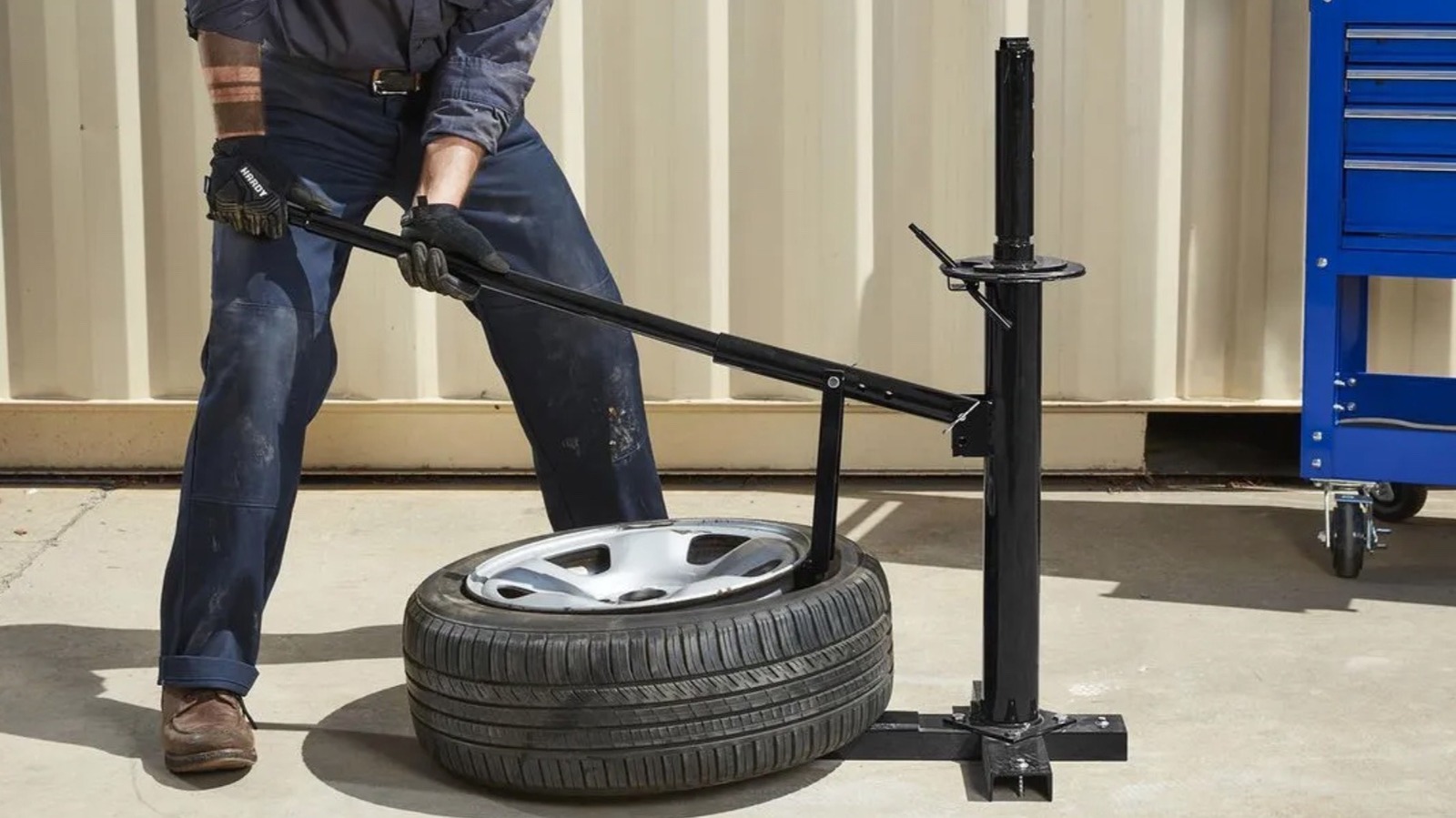
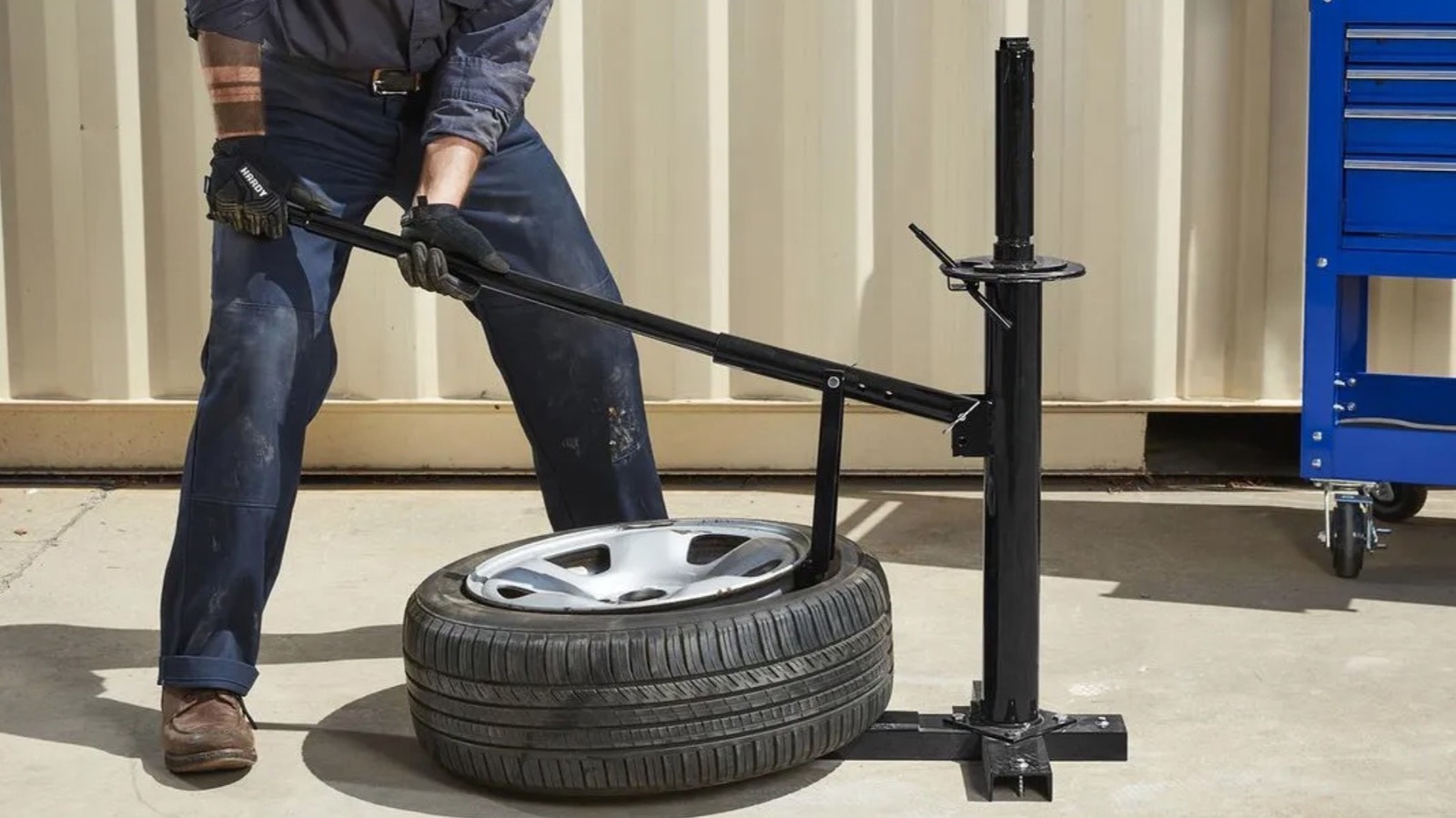
These days, there isn’t much that the do-it-yourselfers of the world cannot purchase at their local Harbor Freight Tool store. Even if you can’t find what you need in-store, odds are the family-owned hardware retailer has a functional option available in its online outlet. While many no doubt flock to Harbor Freight in search of home improvement gear, the retailer also carries a full range of options best fit for use in the garage. In case you didn’t read the headline closely, yes, that does indeed include a DIY Manual Tire Changer.
That potentially game-changing garage fixture comes from Pittsburgh Tools, which is one of many notable brands currently owned by Harbor Freight Tools. At present, that tire changer is selling for a mere $64.99, and according to one customer, that budget-friendly sticker price may save you close to $20 every time you use it, since taking tires to a shop for swapping can get pricey in a hurry. It’s safe to assume the savings would be even bigger if you are looking to swap truck tires.
Advertisement
Thus, the question becomes whether the Pittsburgh Manual Tire Changer is up to that particular task. The answer isn’t entirely cut-and-dried, but according to its Harbor Freight product page, the changer should be able to handle tires for many light trucks. The site also notes that the device tops out at tires with 16-inch rims. Users, however, believe it may be able to handle much larger tires.
Advertisement
Here’s what users are saying about Harbor Freight’s Manual Tire Changer
For the record, the Pittsburgh Tire Changer currently holds a user rating of 4.3 stars from real customers, so some were less than satisfied with their purchase. As for what those customers didn’t like about the tire changer, most noted durability issues, claiming their device broke after little use or even on the first use. Others questioned its ability to function on passenger tires and even light truck tires.
That was hardly the case, however, for the YouTuber at Rock’s Powersports, who put their Pittsburgh Manual Tire Changer to the test with a set of 20-inch truck tires. Though even the tester was uncertain of the changer’s capability, he was ultimately able to swap out the 20-inch tire using the device. It should be noted, however, that it wasn’t exactly a smooth operation. He damaged his rims in the process and inadvertently broke the tire’s pressure monitoring sensor, which had to be replaced before installing the new tire.
As it happens, other consumers claim success in changing truck tires with the Pittsburgh changer in various user reviews. One even claims they successfully changed out a 22-inch tire using their Pittsburgh Tire Changer. They did, however, note that they were only able to do so with the help of a couple of extra accessories purchased separately. A couple of users state that a “duck head” attachment greatly improved the tire changer’s performance. So keep that in mind if you’re considering using Pittsburgh’s Manual Tire Changer to change your own truck tires.
Foundation Future Industries, a San Francisco startup whose CEO previously ran a bankrupt fintech, has secured $24 million in Pentagon research contracts to test humanoid robots for breaching enemy positions. Two Phantom MK-1 units were sent to Ukraine in February for logistics and reconnaissance testing. The company’s chief strategy adviser is Eric Trump, prompting Senator Warren to call the contracts “corruption in plain sight.” Foundation is seeking $500 million at a $3 billion+ valuation, but its production targets of 50,000 units by 2027 from a base of 40 require a 250x scale-up on roughly $21 million in total funding.
Foundation Future Industries, a San Francisco startup founded in April 2024, has secured $24 million in research contracts with the US Army, Navy, and Air Force to test humanoid robots designed to breach enemy positions. The company’s Phantom MK-1 is a 5-foot-9, 176-pound humanoid with 19 upper-body degrees of freedom, five-fingered hands, a camera-first vision system, and an LLM-driven autonomy stack that blends independent operation with supervised teleoperation. Two units were sent to Ukraine in February for frontline testing in logistics and reconnaissance, described as the first deployment of humanoid robots to any theatre of combat. The company is seeking $500 million in new funding at a valuation exceeding $3 billion. Its chief strategy adviser is Eric Trump, the son of the sitting president, a detail that prompted Senator Elizabeth Warren to call the Pentagon contracts “corruption in plain sight.” The company’s CEO previously ran a fintech startup that went bankrupt with tens of millions in consumer deposits unaccounted for.
Advertisement
The machine
The Phantom MK-1 walks at 1.7 metres per second, carries a 44-pound payload, runs on eight cameras with no bulky LiDAR, and uses proprietary cycloidal actuators delivering up to 160 newton-metres of torque. Its AI stack translates high-level task instructions into motion through an LLM pipeline, with operators retaining final authority over lethal decisions. The unit cost is approximately $150,000, with a lease model available at $100,000 per year. The MK-2, expected this month, consolidates electronics to reduce short-circuit risk, adds waterproofing and larger battery packs, increases payload capacity to 175 pounds, and uses cast-moulded bodywork to speed manufacturing and reduce costs. Foundation’s production targets are 40 units in 2025, 10,000 in 2026, and 50,000 by the end of 2027, with a steady-state target of 30,000 per year. Those numbers would require a manufacturing scale-up of 250 times in two years on a total funding base of roughly $21 million.
The company was founded by Sankaet Pathak, previously the CEO of Synapse, a banking-as-a-service platform that filed for bankruptcy in 2024; Arjun Sethi, CEO of Tribe Capital, which led Foundation’s $11 million pre-seed round; and Mike LeBlanc, a 14-year Marine Corps veteran and co-founder of Cobalt Robotics. LeBlanc provides the military credibility and has said the company believes there is “a moral imperative to put these robots into war instead of soldiers.” In June 2024, CNBC reported that Foundation had been fundraising with exaggerated claims about ties to General Motors, including assertions that GM had committed to invest and placed a $300 million purchase order. GM flatly denied all of it. LeBlanc confirmed the denial and said he was “embarrassed” the marketing materials existed. For a company asking the Pentagon to trust its robots in combat, the credibility gap matters.
The contracts
The $24 million in Pentagon contracts includes an SBIR Phase 3 designation, which qualifies Foundation as an approved military vendor, and specific research agreements for testing humanoid robots in breaching scenarios. Some contracts were inherited through the acquisition of a company called Boardwalk, including a US Air Force SBIR award valued at approximately $1.8 million. Eric Trump appeared on Fox Business to tout the contracts. Warren’s response was immediate: “Is the Pentagon a cash machine for Trump’s kids?” The political dimension is unavoidable. A sitting president’s son serving as chief strategy adviser to a company receiving Defence Department contracts raises governance questions regardless of the company’s technical merits. The contracts are real, but they are small.Shield AI recently raised $2 billion to scale its autonomous combat pilot, an AI system called Hivemind that flies aircraft autonomously and has been tested in combat conditions. Anduril secured a landmark $20 billion, ten-year US Army contract in March for its AI-enabled Lattice platform. Foundation’s $24 million is a research agreement, not a production order. The gap between a research contract and a deployed weapons system is measured in billions of dollars and years of testing.
The 💜 of EU tech
Advertisement
The latest rumblings from the EU tech scene, a story from our wise ol’ founder Boris, and some questionable AI art. It’s free, every week, in your inbox. Sign up now!
The Ukraine deployment adds a different kind of credibility. Two Phantom MK-1 units sent for logistics runs and reconnaissance sweeps in February represent real-world testing in a live conflict zone, and Foundation is using battlefield feedback to refine the MK-2 design. But “tested in Ukraine” is not “deployed in combat.” No humanoid robot has fired a weapon in a conflict. The units performed support tasks. The distinction matters because the company’s marketing, its fundraising narrative, and its Pentagon contracts all converge on the idea of a humanoid soldier, and the technology is not there yet.NATO-backed ARX Robotics secured 31 million euros for its autonomous battlefield robots, ground vehicles that perform logistics and reconnaissance without the complexity of bipedal locomotion.ARX Robotics is already scaling production of autonomous land drones to 1,800 units a yearat a new UK plant, a manufacturing reality that Foundation’s targets have not yet approached.
The debate
The Campaign to Stop Killer Robots, a coalition of more than 250 NGOs, has been advocating for a new international legal instrument ensuring human control in the use of force since 2013. Approximately 90 states have called for such an instrument. A minority of militarised states, including the United States and Russia, have blocked its adoption. In November 2025, the UN General Assembly First Committee adopted a resolution with 156 states in favour and 5 against calling for negotiations on autonomous weapons. The Group of Governmental Experts on lethal autonomous weapons systems has sessions scheduled for 2026 and is expected to submit a final report to the Convention on Conventional Weapons in November. This is the last year of the GGE’s mandate, making 2026 a make-or-break year for international regulation of autonomous weapons.
Foundation’s stated policy is that human operators retain final authority over lethal decisions, a “human-in-the-loop” commitment that the Pentagon’s own Directive 3000.09 on autonomy in weapon systems requires for autonomous and semi-autonomous platforms. But the company’s LLM-driven autonomy stack and its stated ambition to “reduce teleoperation needs over time” are in tension with that commitment. An LLM-driven task-to-motion pipeline that learns to operate more independently with each iteration is, by design, moving toward the autonomous capability that the international community is trying to regulate.The AI warfare push that made Helsing one of Europe’s most valuable tech firms, valued at 12 billion euros for military AI software that coordinates drone swarms, shows the scale of capital flowing into autonomous military systems. The ethical guardrails are voluntary. The funding incentives point in one direction.
Advertisement
The race
China demonstrated a motion-controlled humanoid robot for military tasks at an international military cadets event in Nanjing. WuBa Intelligent Tech secured approximately $69 million for its RoboWolf quadrupeds, backed by NORINCO, the state-owned defence conglomerate. The Pentagon added Unitree, a consumer robot-dog maker, to its Chinese Military Companies list in February 2026. War on the Rocks reported on a hidden system turning Chinese technology companies into military suppliers. Viral videos purporting to show a Chinese humanoid robot army were debunked by France 24 as AI-generated fakes, but the fakes themselves reflect the narrative arms race: the perception that a country is building robot soldiers may matter as much as the reality in shaping defence budgets and procurement decisions.
Russia has established an Unmanned Systems Forces as a new military branch, is deploying the Kurier autonomous mortar system that loads and fires without human input, and is rapidly expanding its ground drone fleet in Ukraine. Neither country has deployed humanoid robots in combat. The military robotics that are actually in use, on both sides of the Ukraine war and in US border patrol and base security operations, are wheeled, tracked, or quadruped. They succeed because they are simple, cheap, and expendable. A bipedal humanoid that costs $150,000 and falls over on rough terrain is none of those things. Defence tech venture capital hit a record $49.1 billion in 2025, nearly double the prior year, and Goldman Sachs projects 50,000 to 100,000 humanoid robots shipped globally in 2026 across all sectors.Surging defence stocks that signal huge potential for military tech startupshave created a funding environment where the pitch “humanoid robot soldiers” opens cheque books. Whether the technology justifies the pitch is a question the battlefield will answer, and the battlefield, so far, favours wheels over legs.
On the latest episode of TechCrunch’s Equity podcast, Kirsten Korosec, Sean O’Kane, and I discussed Apple’s big announcement. We reflected on how Apple has changed since Cook took over from Steve Jobs in 2011, and what challenges incoming CEO John Ternus will be facing.
“If you look at a certain camp, it is very much like, ‘John Ternus is a product guy and this is going to be amazing’ and it’s very nostalgic and going back to Steve Jobs,” Kirsten said. “But I think what people forget is that Tim Cook actually made another product, which was completely around operations.”
Similarly, Sean noted that Cook has given Ternus a strong “running start” as “the company’s numbers just sort of keep going up.” But a running start doesn’t guarantee victory: “How much volatility is around the corner? Are we really looking at a situation [with] the breaking apart of a global economy, along with the rise of artificial intelligence changing how business gets done?”
Advertisement
Keep reading for a preview — edited for length and clarity — of our full conversation.
Anthony: The decisions that Apple makes also trickle down to a bunch of other companies, because there are all kinds of startups that maybe don’t build their entire business on the iOS platform, but certainly a significant part of their business comes on the iPhone.
Kirsten: I think it’s been really interesting to see the different pockets of the tech world responding to whether this is a good or bad move and [asking] what were the successes of Tim Cook and what does Apple need now?
Techcrunch event
Advertisement
San Francisco, CA | October 13-15, 2026
If you look at a certain camp, it is very much like, “John Ternus is a product guy and this is going to be amazing” and it’s very nostalgic and going back to Steve Jobs. But I think what people forget is that Tim Cook actually made another product, which was completely around operations. And there has been some really interesting coverage, in even books that have done deep dives into this. His operations strategy is an Apple product. And it changed whole economies.
Advertisement
The question to me is: What happens when a strategist and operations guy leaves? Who is filling that void? Because you can make great products, and that’s very important in the Apple universe for sure. But you need to have an operations strategy. And the world is changing, it isn’t the same as it was when Tim Cook was first building this out.
Sean: It isn’t, but it’s hard to imagine a better running start to get as a new CEO than the company that Tim Cook has built.
As much as people complain about some of Apple’s products stagnating, the iPhone hasn’t really changed the design in many generations, whatever new products you do get are very kind of niche and overthought, like the Vision Pro — for all of that, the company’s numbers just sort of keep going up. They’re bringing in a ton of revenue. They make an incredible amount of money from the services business that Tim Cook spun up.
They’re doing, in some ways, better brand-building than in a while, by even going out and making content, like winning an Oscar for a movie, there’s just so much going on. And it seems like such a sturdy business, even in turbulent times, that Ternus can not have to worry about what the first year looks like.
Advertisement
We should say: Tim Cook is resigning as CEO in September this year. He’s also going to be executive chairman. So I think the idea here is, Tim Cook’s not going away and he’s still going to be your sort of shield against, and also sort of partner with, the Trump administration. Because he certainly has proved his ability to do that — sacrificing, I think, what many people would argue are some of Apple’s values in the process, in order to make sure those relationships are durable enough. Donald Trump even put a Truth Social post out about how Tim Cook kisses his ass all the time, in response to this news.
So the question, with all that said, is: As comfortable a start as this probably is for Ternus, how much volatility is around the corner? Are we really looking at a situation [with] the breaking apart of a global economy, along with the rise of artificial intelligence changing how business gets done? Is that something that’s really going to be easy for him to handle? And who is he going to put alongside him to make sure he’s able to handle it?
Anthony: And I think related to that is the question [is,] Apple seems to have a very durable business right now, both on the hardware side and increasingly on the service side, but to what extent can it continue to have that business just playing the old hits? At what point does it actually need to create a new product category?
I don’t know the exact answer to that. And maybe the iPhone [and] the creation of the smartphone category, in particular, is a once-in-a-generation kind of thing, you can’t really expect that to happen every 10 years or more.
Advertisement
I think there’s also this interesting question around AI. It seems like that is not a category that Apple has had a lot of success in, and maybe that’s okay. Maybe whatever products end up breaking through there, that’s just software on your iPhone, on your MacBook, and Apple is fine not having to build all of that [and] instead doing these partnerships like it’s doing.
But I don’t think that’s guaranteed. I think there’s probably a lot of stress and concern about what that future looks like.
Kirsten: Just really quickly, I was going to say that also Apple can and does have the cash on hand to make some big bets and acquisitions. And I’ll be really curious to see how John [Ternus] executes on that.
I mean, one of the places where I reported on Apple was the special projects team, Project Titan, the supposed Apple car, and that seems to have petered out and a lot of money was spent on that. Is he going to make any big bets?
Advertisement
You guys were talking about cash on hand, and I think it’s more than $45 billion at the end of 2025. So they have a lot of money to play around with. Is he going to do anything with it in the near term?
Sean: The other thing I think we should point out is, as we talk about Apple having a durable business, the App Store is also really crushing it lately. Sarah Perez wrote a really good story this week for us about all the different ways that numbers are up in the App Store — installs, new releases to the App Store, it’s just a really fascinating look for anybody who wants to dig into some data of one of the biggest sort of software marketplaces in the world.
In a world where everybody’s talking about how your ability to vibe code anything is going to remove the need for distributed software, [the App Store] is clearly proving that wrong.
When you purchase through links in our articles, we may earn a small commission. This doesn’t affect our editorial independence.
This is another one of those scenarios where it functionally doesn’t matter if the sponsors/authors of such bills are constitutionally illiterate or maliciously anti-constitutional. The result is the same. It’s at least performative for voters and campaign donors that you’re “doing something,” but if it passes, and it doesn’t get struck down immediately, and it has confusing and contradictory language, that’s a feature, not a bug. If the social media companies can’t figure out how to legally offer their services to children, they’ll opt out of doing so entirely—the same way the demise of Section 230 would require shutting down user input to avoid massive lawsuit damages. That’s a win for authoritarian conservatives who want to control narratives and legitimize only their preferred propaganda outlets. Notice that no censorial conservative legislator writes has their lobbyists write a law targeting Truth Social’s practices.
I expect everyone to read “Atlas Shrugged” when they’re a teenager.
Advertisement
And by the time they’re in their early or mid 20’s, I expect them to have acquired the intellectual maturity to figure out that it’s absolute bullshit from cover to cover.
Those who are incapable of this tend to try to use it as an instruction manual and cast themselves as saviors of the people, fearless leaders whose lofty goals must triumph, blah blah blah. As the best line in a series of bad movies observes: “There are always men like you.”


















































You must be logged in to post a comment Login