Security teams log 54% of successful attacks and alert on just 14%. The rest move through your environment unseen.
The Picus whitepaper shows how breach and attack simulation tests your SIEM and EDR rules so threats stop slipping by detection.





A hidden authentication backdoor has been found in multiple Tenda router firmware versions, potentially allowing an attacker to gain administrative access to the device’s web management panel.
According to a security bulletin from the CERT Coordination Center, the issue remains unfixed because the Chinese maker of the networking equipment couldn’t be reached.
CERT/CC says the issue, tracked as CVE-2026-11405, is caused by an undocumented authentication mechanism in the ‘login()’ function of the ‘/bin/httpd’ web server binary.

If a user attempts to log in, the router firmware will perform standard MD5-based authentication. If that fails, it will retrieve an alternate password from the ‘sys.rzadmin.password’ configuration value and compare it directly to the plaintext password supplied by the remote user.
If the passwords match, the device grants administrator (role=2) access and creates a valid session, regardless of the username entered.
So any username will be accepted by the mechanism as long as the backdoor password is supplied.
CERT/CC says this mechanism isn’t documented anywhere, or mentioned on the administrative interface, leaving users unaware of the risk.
“Successful exploitation grants full administrative access to the device’s web interface, regardless of the configured administrator account credentials,” describes CERT/CC.
“With administrative control, an attacker can reconfigure the device, alter network settings, and disable security features, enabling broader compromise of the local network.”
CVE-2026-11405 impacts the following Tenda firmware versions and devices:
CERT/CC reports that no patch is currently available, and Tenda users are advised to disable the remote web management panel to prevent internet access to the vulnerable interface.
Additionally, it is recommended to restrict local network exposure by changing the default LAN IP address to reduce opportunistic discovery by automated scanners.
CVE-2026-11405 was discovered and reported to CERT/CC by an anonymous researcher.
While no mention of active exploitation exists, the issue is very likely to be targeted by botnets focusing on router flaws in the coming period.
BleepingComputer has contacted Tenda for comment, and we will add their response if we receive one.

Security teams log 54% of successful attacks and alert on just 14%. The rest move through your environment unseen.
The Picus whitepaper shows how breach and attack simulation tests your SIEM and EDR rules so threats stop slipping by detection.

[This is a sponsored article written in collaboration with Tropicana Corporation Berhad.]
There was a time when buying a home was simply about finding the right location, enough space, and a practical layout. Today, expectations around homeownership have evolved.
Today’s home buyers want more than just a place to live. They’re looking for a home that complements the way they live, where leisure, convenience, and everyday experiences become part of homeownership.
In tune with this shift, premium developers like Tropicana are going beyond traditional selling points like location and facilities. They’re pairing properties with lifestyle perks and exclusive benefits that actually mean something.
Enter the Tropicana Live+ Campaign, where signing for your dream home unlocks more than just a new address.
In fact, you could even stand a chance to enjoy a 1-year Tropicana Golf & Country Resort membership and 50% Homeownership Savings off your property. But we’ll get to that part in a bit.

The Tropicana Live+ Campaign runs across three seasons, each with its own theme and rewards. With Season 2: Live+ Prestige now underway, golf lovers and sports enthusiasts alike get to enjoy a deal that’s hard to pass up.
Between 1 July and 30 September, you could win a 1-year golf membership at Tropicana Golf & Country Resort when purchasing a qualifying Tropicana property.
We’re talking weekend tee times, access to one of Malaysia’s most established golf clubs and its clubhouse facilities, and yes, a pretty solid conversation starter at your next dinner party.
After all, premium homeownership isn’t just about owning a beautiful home; it’s about choosing the kind of life you want to come home to every day.
No two buyers picture their dream home the same way. Some dream of cooler mountain mornings, while others want to wake up by the beach or stay close to the city’s buzz.
Whatever your lifestyle looks like, Tropicana offers a range of developments designed to match it.
At Breeze Hill Service Apartments, Tropicana Avalon, Genting Highlands becomes more than just a weekend getaway. Surrounded by lush greenery, your morning coffee comes with a view and crisp mountain air.
Just nearby, Mercure Living Genting Highlands, Tropicana Grandhill offers a similar escape. Tucked away from the city’s constant rush, it balances resort-style living with everyday practicality, especially suitable if you’d rather trade KL’s hustle and bustle for a cooler and calmer environment.
If coastal living is more your thing, Clarissa Serviced Suites at Tropicana Cenang places you just moments away from Langkawi’s famous beaches. Imagine mornings spent strolling along the beach or unwinding by the shore after a long day.
Homeowners get to enjoy one of Langkawi’s liveliest beach destinations without having to book a holiday every time you want an ocean getaway.
At SouthPlace 2 Shoppes & Residences at Tropicana Metropark, Subang Jaya, you’re surrounded by everyday essentials right below your home.
Less time spent commuting means you can effortlessly squeeze in a late-night workout session at the gym, grab fresh premium groceries at the supermarket, or pick up wellness essentials at the nearby pharmacy—giving you true convenience without the rush.
Meanwhile, Avisa Residences at Tropicana Alam, Puncak Alam offers a quieter pace of life without compromising on the essentials, with spacious homes and everyday conveniences that cater to families and working professionals alike.
As Johor Bahru’s first Branded Residence managed by the prestigious Banyan Group, Skypark Kepler Branded Residences at Lido Waterfront Boulevard lets you wake up to sweeping waterfront views and international hospitality standards every day.
Located just 5km from the RTS Link and CIQ Causeway, residents get cross-border connectivity alongside a stunning 2.5km coastal boardwalk right outside your door. Think breezy walks by the promenade and front-row seat to sunsets that don’t require a weekend road trip.
A little further inland, Fraser Heights Terrace Homes at Tropicana Uplands, Gelang Patah offers a quieter suburban setting for growing families and retirees alike. With more space to spread out, you could host barbecues every weekend or start those gardening projects you’ve always talked about.
For those on the hunt to also grow their business or diversify their investments, you could consider Varia Shop Offices, Tropicana Aman in Kota Kemuning, where business takes on a more grounded, community-driven rhythm.
Surrounded by a growing residential catchment, the development places your storefront right where neighbourhood activity and local conveniences converge.
If you prefer somewhere closer to the city, there is Edelweiss Shoppes, Tropicana Gardens in Kota Damansara. With established residential towers, retail components, and lifestyle hubs in the vicinity, it offers a more dynamic environment that’s connected to IOI Mall Damansara (formerly known as Tropicana Gardens Mall) and Surian IOI Mall Damansara MRT station via a link bridge.
The Season 2: Live+ Prestige rewards are available across 10 participating developments spanning the Klang Valley, Genting Highlands, Langkawi and Johor Bahru, including:
The 1-year golf membership isn’t the only reward up for grabs.
In addition to the seasonal prizes, buyers who purchase selected Tropicana properties will stand a chance to enjoy 50% Homeownership Savings through the campaign’s Grand Prize draw, running from 18 April to 31 December 2026.
The Grand Prize applies to the following participating developments:
That’s a chunk of capital freed up before you’ve even unpacked.

Every qualifying purchase comes with:
Together, you’ll receive practical support that makes the whole process of buying and moving in feel a lot less like a headache.
Regardless of whether you are a first-time homeowner, a growing family seeking a larger space, or an investor searching for a strategic opportunity, this list of Tropicana developments offers a variety of options to suit your needs.
If you’re already planning to make your move, the Tropicana Live+ Campaign makes it even more rewarding. It’s a chance to enjoy more than just a new address, but a lifestyle and rewards that begin from day one. For more details, visit the website HERE or call 03-7663 6888 to find out more. (T&Cs apply).

The Boox Go 6 Gen II is designed to be the ultimate go-anywhere e-reader, but a sub-incremental spec bump may not merit a purchase.
Boox has refreshed its pint-sized pocket e-reader with a minor spec bump and a new design. Let’s see if the Boox Go 6 Gen II is worth picking up or not.
The original Go 6 is one of my favorites offered by Boox, because it tucks neatly into your hand the same way a paperback novel might. It’s even smaller than the iPad mini, which is my iPad of choice.
Its portable size makes it ideal to slip into a tech bag or a purse. As I said, it’s even smaller than the iPad mini. Hell, you could stash it in the pocket of your hoodie if you were so inclined.
Like most e-ink readers, the 1500mAh battery will last you for days, plural, before you even need to think about topping it up. I found that I got a week’s worth of before-bed reading before I instinctively plugged it in, but realistically I could have probably gotten another two nights before I would have really needed to.
Its front light makes it perfect for reading in bed without disturbing a partner or straining your eyes. I think this is the best use case for this device in general.

Boox Go 6 Gen II review: An iPad mini next to the Go 6 Gen II
I’ve been a big fan of Boox screen light for a while now, and I’m glad to see that it’s included by default on the Go 6 Gen II. Because I tend to read in bed, I often leave it on its warmest setting.
This is the second notable Boox redesign I’ve seen since spending my time with the devices. The first was with Boox’s Palma, which I thought had a fantastic redesign.
The Go 6 redesign is a bit more subtle, but welcome just the same. The back has gotten a light texture upgrade, which gives it a more pleasing feel in the hand.
While I received the plum Go 6 for review, it also comes in two other colors: stone and shell. The plum is a deep, rich purple that appears black in most lighting; I am a huge fan of this colorway.
The Boox Go 6 Gen II features a black-and-white-only display. They may eventually release a color version, but at this point, this is the only option you’ve got.
It boasts a 1448×1072 (300 ppi) resolution, a 6″ HD ePaper screen, and an octacore processor. That’s the same as the last generation.

Boox Go 6 Gen II review: The crisp, clean screen makes it easy to read in bright daylight.
It also features 32GB worth of storage, just as it did before. Storage is expandable via a Micro SD slot on the bottom of the device, which is appreciated.
The only notable spec bump, at least as far as I can tell, is an upgrade from 2GB to 3GB of RAM. Don’t get me wrong, a 50% increase in RAM is good, but I’m not sure that merits a re-release of the device.
We didn’t even get a new operating system. I am extremely disappointed to find that this little e-reader is running Android 11.
Android 11 came out in 2020 and received its final update in 2024. It’s now a fully unsupported operating system.
The biggest problem I see, personally, is that eventually, support for Android 11 is going to fall off.
Right now, for most apps require Android 10, though many can still run on Android 8. Apps that require more robust security features, such as banking and certain email apps, require Android 12.
Again, I really wish that this would have seen a jump. Even Android 13, which came out in 2022, would have been a better choice.
For running a six-year-old operating system on 3 GB RAM, the Go 6 Gen II performs pretty well. I didn’t notice a huge downgrade compared to something like the Go 10.3 Gen II, which has Android 15 and 4GB of RAM.
If you’re primarily using it to read books on, and to be clear, that is what you should be using it for, it’s solid. I didn’t find that there was a lot of page lag, and even downloading new books wasn’t a slog.
Browsing the web was quick too, though pages that had a lot of moving elements were expectedly slower. I think this has less to do with the restrictions of the RAM and more to do with the restrictions of the screen.
Even third-party apps, like Amazon’s Kindle app, ran just fine. Considering this is an e-reader and not an iPad, I think that it handles the tasks its been given quite well.
This section is less about this specific model and more about e-ink tablets in general.
One of the most annoying things that e-ink tablets have to contend with is the chorus of people in comment sections and Reddit threads reminding you that the tablet is not, in fact, an iPad.
It’s not trying to be an iPad. As I’ve said before, Boox makes no claims that it’s trying to replace your iPad.
It’s trying to replace your Kindle or Nook. That’s what all of these e-ink tablets are trying to do, whether they’re from Boox or ReMarkable or anywhere else.
You’re not going to give up an iPad for a Boox device. And odds are, if you’re reading this review, you already own an iPad.
Instead, imagine an e-reader that is capable enough to swap between reading your favorite novel and perusing longer-form documents at work. Maybe you’re a dork like me and enjoy spending Saturday mornings where you drink your cup of coffee while reading Wikipedia entries on geology on your patio in the sun.

Boox Go 6 Gen II review: The back of the Boox Go 6 has been redesigned with a ridged texture, and black has been replaced with a rich plum color
It’s nice. Again, I really like Boox products. I get to test them out quite frequently, and it never really feels like they’re competing for my affection against my iPad.
Like most of Boox’s offerings, the Go 6 Gen II is stylus-compatible. I did not receive a stylus this time around, but like its brethren, this e-reader uses the InkSense stylus, which I have extensive experience with.
I had written at length about the stylus situation in a previous Boox Go review. This time around, I’m not going to go into as much detail, but I will tell you why this is a problem.
Previously, Boox used a Wacom EMR stylus, which uses electromagnetic resonance to communicate pressure and position. The result was a quick, buttery-smooth writing experience.
Now, you get a capacitive touch stylus. Effectively, it works the exact same way your finger does.
It still has 4,096 levels of pressure and a solid response time. It is, however, a notable downgrade from an EMR stylus.
The screen is also small enough that I don’t think this would be a primary note-taking device anyway. Personally, I almost feel as though the stylus is unnecessary on a device this small, but to each their own.
It’s hard to get excited about this device, even though it’s probably one of the best form factors that Boox has released.
The redesign is nice, and I love the textured back. I think the device feels sturdy and holds up performance-wise.
Unfortunately, the choice to use Android 11, rather than Android 15, remains baffling. The other second-generation devices all made a leap forward, but Boox decided to leave the poor little Go 6 Gen II behind.
Overall, as far as Boox devices go, I don’t think the Go 6 Gen II is bringing enough to the table to warrant an upgrade. And if I were really pressed on it, I’m not entirely sure the Go 6 Gen II merits a purchase in the first place.
If you’d still like to purchase your own Boox Go 6 Gen II, you can pick one up from the Boox website for $199.99. If you’d like the InkSense Plus Stylus Bundle, you’ll need to pay $232.99.
The Boox Go 6 Gen II is also available from Best Buy for $199.99.

Android phones have always worked in the background. Google’s new Play terms make that quiet behavior much harder to ignore.
The updated Google Play Terms of Service take effect July 29, 2026, and spell out that system services on certified Android devices can use network connectivity, including cellular data, while the user isn’t actively using the phone. That includes moments when the screen is locked.
The timing adds weight. The revised terms follow Google’s $135 million settlement over allegations that Android devices sent cellular data to Google while idle without users knowing. Google isn’t saying every Android phone is secretly torching data plans, but it’s putting clearer language around behavior users usually notice only after something annoying happens.
The old assumption was simple. If a phone is locked and sitting on a table, most people expect it to be mostly still.

Google’s new wording makes that assumption harder to keep. System services include Google Play services, the Play Store, and Android operating system updates. These pieces can require network access to keep certified Android devices running properly.
Some of that activity can happen while the phone is idle. That helps explain why mobile data can move even when the user hasn’t opened an app or touched the screen.
The practical effect is clearer language with real consequences. A phone can keep handling system-level work through Google Play services, the Play Store, and Android updates in the background.
If that activity uses cellular data, the carrier bill still belongs to the user. That may be a shrug on unlimited plans, but it hits differently on prepaid service, roaming, or a tight monthly cap.
The terms don’t say every Android device will suddenly chew through data overnight, but they do confirm that background cellular data use is part of how these services can operate.

The update language is the more uncomfortable piece. Users may be able to manage some updates in Google Play settings, but certain updates can still happen if they fix a critical security issue, address a serious operability problem, or prevent abuse.
That tradeoff makes sense, and it’s still frustrating. Automatic updates protect people from real risks, but a bad rollout can change how a phone behaves after a reboot.
Anyone who has delayed updates after a broken release will recognize the tension. Android gives users plenty of switches, yet some system-level decisions still sit above those switches. If you’re on limited data or careful about updates, treat Android system services as active by default, not silent by default.

We know, we know. Despite being called ESP32-Plane-Radar, this project from [Mateusz Juszczyk] isn’t actually using radar. But thanks to the round LCD this desktop gadget does a fantastic job of recreating a classic radar display, and by pulling in Automatic Dependent Surveillance–Broadcast (ADS-B) data, the visuals even match nearby real-world aircraft.
 Perhaps the best part of this project is just how easy it is for others to get in on the action. Although the presentation certainly looks professional — and expensive, if we’re being honest — there’s nothing particularly exotic going on here. Specifically, there’s ESP32-C3 Super Mini behind the scenes cranking through the ADS-B data and pushing it out to a circular GC9A01 display. A minimalistic 3D printed enclosure holds both components, and while it’s undeniably slick as-is, we can’t help but think there’s potential here for more elaborate designs.
As you probably guessed from the lack of a radio in the parts list, the code [Mateusz] provides doesn’t actually sniff ADS-B out of the air. It connects to the local network over WiFi, and then hits adsb.fi to pull in crowdsourced flight data. Since the device has to connect to the network anyway, the code also offers up a web-based configuration interface which puts a little more polish on what’s already an impressive presentation.
We used a round GC9A01 display on the Vectorscope back in 2023, so if anyone ports this over to their old Supercon badge we’d love to see it in action.
Thanks to [Mauricio] for the tip.

Thanks to its roster of solid affordable earbuds, Soundpeats is a brand I always keep an eye on. Between the Soundpeats H3 three-driver in-ears, Soundpeats Clip1 open earbuds and Soundpeats Cove Pro over-ears, I’m always interested in what they’ve got up their sleeves.
After being given a glimpse up said sleeves in January 2026, when the brand teased some five-driver earbuds, we’ve been learning more and more over time. Through 2026, Soundpeats has been running a blog dedicated to the development of the buds.
We already knew a fair bit, for example about the five drivers: the 10mm dynamic driver is joined by a 6mm planar driver, two balanced armatures and a planar magnetic driver. The support for aptX Adaptive, LDAC and Snapdragon Sound was all also in the knowledge bank.
But the blog shines a light on some other elements of the bud, for example in the design department. One post discusses the charging case, and how it was designed to allow you to remove the buds in the same gesture as opening it. It’s the stuff you don’t think about when you’re buying some buds online, and shows that the brand is putting care into its Nebula.
In another post, the brand details a transmitter that the Nebula will work alongside, allowing for 24-bit 96kHz audio playback from iPhones. That’s right, the barren LDAC-less wasteland will finally be able to enjoy high-res music (Androiders can just use LDAC for this quality with the Nebula).
One other side-effect of publishing this blog, is that Soundpeats has managed to build plenty of organic excitement for the Aura Nebula. And I’m not just talking about how interested I personally am to try them.
A representative for Soundcore has been actively sharing the blog posts on Reddit, and they’ve seemingly amassed a dedicated audience of fans who want to test out the buds. There’s also a Discord dedicated to the buds.
For example, in the r/Earbuds subreddit, a recent posted inspired a Q&A between one of the product’s developers and excited fans dying to test the buds. And when I say “dying”, I mean it: one interested party asking for updates said “this is painful”. So, yes… fans are pretty keen.
In the Q&A, fans’ main questions were about when the buds would be arriving — unfortunately they weren’t given an answer, though TechRadar has today (Wednesday 8 July) reached out to the company and will update this article if we hear back.
But Soundpeats was very honest about other topics. For example, when asked about battery life, the representative confirmed that they didn’t have a concrete battery estimate yet: “the exact battery life still needs to be tested and confirmed [… it’s] one of the things I’m personally watching closely too”.
Elsewhere, the developer shared more details about the buds: “55db hybrid ANC, transparency mode support, 3 microphones per earbud, AI call noise reduction, and Qualcomm cVc 8.0”.
When one fan asked if the Aura Nebula would be top-end buds to compete with Sony, Bowers & Wilkin or Technics, the response admitted “in terms of overall product capabilities and brand influence, we aren’t quite ready to be compared to those industry giants just yet”. So they’re staying humble, while also hinting at these buds wont be prohibitively expensive.
It’s fascinating to see a brand like Soundpeats not just tease a product well before their launch, but be so open about their R&D process. It’s creating interest in a way that press-release-in-inbox announcements don’t, and making the brand seem more trustworthy than many peers. It’s quite surprising that more brands don’t do this kind of thing.
We were meant to see the Soundpeats release in Spring 2026, but obviously that didn’t happen. The brand posted about pre-production prototypes in April, so hopefully we won’t need to wait too long before the Aura Nebula gets released. I would worry for that Reddit poster if they’re delayed much longer.

The best wireless earbuds for all budgets

Follow TechRadar on Google News and add us as a preferred source to get our expert news, reviews, and opinion in your feeds.

A few months ago, I found myself standing in the vinyl record section of a bookstore with my children.
“What even is a record?” one of them asked.
After a quick explanation, another question followed.
“Why would anyone buy one when you can stream everything?”
I laughed. Then I realized, I wasn’t entirely sure how to answer that question.
After all, they weren’t wrong. Streaming gives us access to nearly every song ever recorded. It’s cheaper, faster, more portable, and infinitely more convenient than vinyl. By almost every measure, it is better technology. Which makes the resurgence of vinyl so unexpected.
What struck me wasn’t that my children didn’t know what a record was. It was that they couldn’t imagine why someone would want one.
To them, music is immediate. Infinite. Effortless. The idea of listening to an album from beginning to end seemed almost irrational. This friction between convenience and engagement is exactly what I’ve been wrestling with as AI has become more prevalent in the classroom.
Vinyl records and AI are actually similar technologies. Both seem to provoke a human response to technology: the easier something becomes via technology, the more we begin questioning what was valuable about the underlying use in the first place.
In my own experience with AI, I can’t remember another issue that has prompted so many conversations about what learning is actually for. But as I listen to educators wrestle with these questions, I increasingly hear another one emerging beneath them.
It’s not a question about technology. Rather, it’s a question about learning: What should students still need to do themselves?
I found myself thinking about that question recently while sitting in on rehearsals for our ninth grade capstone presentations.
This capstone project brings together English, science, and global studies and asks students to partner with local nonprofits, investigate real-world challenges, and develop ideas for meaningful action. Their final task is to synthesize everything they’ve learned into a TED-style presentation.
As Director of Innovation at an all-boys middle school outside of Boston, I spend a lot of time thinking about what learning should look like in the age of AI. I work closely with teachers as they design projects, assessments, and learning experiences that ask students to do meaningful work.
As I listened to students rehearse their talks, I was struck by something: Students had access to research, interview notes, statistics, and AI tools capable of generating polished drafts in seconds. Their challenge was deciding what mattered. Which story should they tell? Which evidence was most compelling? Which ideas deserved an audience’s attention?
Watching those students, I found myself feeling unexpectedly hopeful.
The tools sitting on their laptops could summarize articles, generate outlines, and draft paragraphs in seconds. But none of those tools could decide which story deserved to be told. That work still belonged to the students.
As someone whose role in education is focused on the intersection of innovation, learning, and emerging technologies, I expected to leave those rehearsals thinking about technology. Instead, I left thinking about judgment.
I didn’=;t see technology replacing thinking. I saw technology making a different kind of thinking more important.
For all the anxiety surrounding AI, that moment reminded me that some of the most important work of learning still resists automation.
In Imaginable, futurist Jane McGonigal argues that one of the best ways to prepare for the future is to distinguish between trends and signals. Trends are the large, visible forces reshaping society. Signals are the smaller observations that reveal how people are responding to those forces.
Artificial intelligence is clearly the trend. But the resurgence of vinyl felt like a signal.
The more I thought about it, the less interested I became in whether vinyl sounds better than streaming services.
What interested me was why people were choosing vinyl at all.
Streaming solved the problem of access. It put nearly every song ever recorded in our pockets. By almost every measure, it is the more efficient technology.
And yet, people continue buying records.
Maybe it is because a record asks something of the listener.
You choose an album.
You place the needle.
You stay with it.
The music becomes the activity, not the backdrop to something else.
As technology becomes increasingly good at solving problems for us, I wonder whether we will begin to value experiences that ask something of us in return.
I found myself wondering whether schools were wrestling with a similar tension.
This search for participation over efficiency is the same tension surfacing in our schools. I’ve heard the phrase “cognitive offloading” more in the past year than I have in my entire life.
Not just at conferences or in articles.
I’ve heard it while sitting around tables with teachers trying to make sense of what AI means for learning.
Those conversations have led us to rethink assignments, assessments, and even where some learning takes place. We’ve debated when students should brainstorm with AI, when reflection should happen without it, and which assessments require students to show their thinking in real time.
Not because we’re opposed to AI. Because we’re trying to better understand what learning requires.
At first glance, these decisions seem contradictory. But, in reality, they are not.
When educators ask students to write by hand, discuss an idea face-to-face, wrestle with a difficult text, or work through a problem without immediate assistance, they are often protecting something more than academic integrity.
They are protecting opportunities for students to think.
Learning requires students to do some of the cognitive heavy lifting.
And I can’t help wondering if that’s the signal hidden beneath many of today’s educational debates.
As AI becomes more capable, what humans contribute may matter even more.
The ability to discern.
To judge.
To create.
To remain present long enough to make meaning.
If Jane McGonigal is right that signals reveal how people respond to larger forces, then the resurgence of vinyl may be telling us something about the future of learning.
It’s not about what AI technology can do. Rather, it’s what humans may continue to value alongside it.
None of this is an argument against AI. Quite the opposite.
At my school, we’ve spent the past couple of years exploring AI literacy, assessment, academic integrity, and responsible use. Those conversations matter deeply.
But the conversations that have stayed with me most weren’t really about AI.
They were about learning.
I’ve found myself sitting with teachers and asking questions that feel both surprisingly new and strangely familiar.
Why are we asking students to write?
Why are we asking them to read?
Why are we asking them to discuss, solve, create and reflect?
The more I listen, the more I realize those questions aren’t really about technology. They’re about purpose.
AI didn’t create those questions. It simply makes them harder to avoid.
Streaming won the battle for access, but vinyl has survived because it offers something access cannot: participation.
Watching these conversations unfold at my school, I can’t help but wonder whether learning is forcing us to confront a similar distinction.
AI can increasingly provide answers. The question is whether students still need the experience of arriving at them.
My children thought vinyl records were obsolete. In some ways, they were right. Streaming solved the problem, and yet, records returned.
Watching students navigate AI has left me less interested in what technology can do and more interested in what learners still need to do themselves.
The value of vinyl was never the music.
The value of writing was never the essay.
The value of learning may not be the answer.
It may be the experience of arriving at one.
And as AI becomes increasingly capable of producing answers, that experience may become more valuable, not less.
That’s the signal I hear beneath the crackle of a record player. It’s a reminder that in an age of instant digital access and gratification, the most valuable things that will remain are those that ask us to show up.
And this may be one of the most important educational conversations of the next decade.


software
Coalition says ICO failed to act despite hundreds of complaints about bug-plagued digital immigration status scheme
The UK’s privacy watchdog is facing calls for parliamentary scrutiny after campaigners accused it of failing to get a grip on the Home Office’s glitch-plagued eVisa system.
A coalition of 20 immigration, digital rights, and human rights organizations, including the Open Rights Group, has written to the chair of the Science, Innovation and Technology Committee, urging MPs to open an inquiry into what it describes as the Information Commissioner’s Office’s (ICO) failure to enforce data protection law against the Home Office. The groups want the committee to examine the eVisa program as part of its wider inquiry into government data security.
The campaigners argue that the technical problems dogging eVisas go well beyond the odd software glitch. Since the scheme’s rollout, users have reported being locked out of their accounts, unable to prove their immigration status, or discovering that their personal information had become entangled with that of unrelated people.
According to the letter, those failures have prevented people from entering the UK, taking jobs, enrolling in education, and accessing benefits.
“As the ‘Exclusion by Design’ report shows, eVisa failures prevent individuals from proving their status when they need it to enter the country, from applying for jobs or getting a pay rise, from enrolling in education, from claiming benefits,” the letter states. “The human price of non-compliance is high and unjustifiable.”
The Home Office has acknowledged the mistakes and says it is working to fix them, but the organizations argue it has repeatedly declined to disclose how many incidents it has recorded or to set out a timetable for resolving systemic faults.
Their criticism is directed as much at the regulator as the department running the service. The groups say they first asked the ICO to investigate the eVisa scheme in November 2025, alleging breaches of UK data protection law, including failures to carry out and publish Data Protection Impact Assessments before and during the rollout.
Eight months later, they say no formal enforcement action has followed.
The letter also cites an FOI disclosure, which reveals that between December 2023 and December 2025, the ICO received 851 complaints about the Home Office. When asked how many were about eVisas, the watchdog said finding out would exceed the Freedom of Information Act’s cost limit.
The letter argues “there is a risk of reduced scrutiny towards public bodies and diminished responsiveness to public complaints by the ICO,” adding that the regulator’s recent memorandum of understanding with the government and revised complaints policy risk undermining public confidence in its independence.
The organizations are urging MPs to investigate what they describe as the ICO’s “failure to carry out their oversight duties under the law,” as well as the Home Office’s handling of eVisa data and governance. They also want Parliament to require the department to publish figures on data security incidents, complaints, and support requests related to the system.
Neither the Home Office nor the ICO responded to The Register’s questions.
The intervention comes weeks after Information Commissioner John Edwards stepped down, leaving his successor to inherit awkward questions about the regulator’s willingness to police Whitehall’s handling of personal data. ®

As we mentioned previously, the Stop Killing Games movement has come to America and there is currently an effort to get some legislation based on the movement’s goals on the books in California. The movement hit a snag recently when the written version of the bill failed to make it out of committee on a vote of 4 in favor, 3 against, and 4 abstaining. It’s the abstaining votes that were the problem, resulting in not enough yes votes to move forward. But, importantly, the committee also left the door open to reconsider the bill at a later time.
The committee unanimously voted in favor of granting the bill reconsideration, meaning it could come back before this group of state senators. Assemblymember Chris Ward introduced the bill in February and it passed the California State Assembly 43-16 in late May.
That said, the abstentions prevented the bill’s progression for now. “Not enough yeses means the bill stops here for this session,” a volunteer with the Stop Killing Games campaign (which supported the bill) noted on Reddit. “That is the loss.”
There was active lobbying against the bill in committee hearings, primarily from the Entertainment Software Association (ESA). And what is now getting a great deal of attention is the fact that ESA’s lobbyist either lied to the committee in those hearings, or else they have absolutely no fucking clue what they’re talking about. And if you need the prime example of what we’re talking about here, you need only understand that one lobbyist claimed that anyone hosting a private Minecraft server is doing “illegal piracy.” The lobbyist in question would be Jennifer Gibbons, the ESA’s VP for State Govt. Affairs.
Gibbons was responding to a comment made by California state assemblymember Chris Ward—who introduced the bill—regarding the possibility of keeping games alive with private servers. “Minecraft is currently hosted by community servers, Call of Duty [has] community servers, so it’s an option that is out there, in existence here today.”
Gibbons cut in: “They’re illegal. They are not in any way affiliated with Microsoft. Microsoft, for Minecraft, has gotten a lot of criticism because of those community servers not employing the same safety standards that Microsoft does on their Minecraft servers.”
Asked by California state senator Caroline Menjivar as to whether this was “like the black market of videogames?” Gibbons responded “Yes. In fact, we consider it piracy. We have lawsuits, two pending lawsuits, against private servers right now, and the United States Trade Representative (USTR) in their Notorious Markets Reports on counterfeiting and piracy has named some of these big private servers as a notorious market.” A notorious market refers to a market where intellectual property infringement is rife—think something like The Pirate Bay.
The ignorance here, if that’s what this is, is astounding. As PC Gamer goes on to note, it is true that select private Minecraft and COD servers have been designated as notorious markets by the USTR in some cases. Those are servers that actually do make some games playable without the otherwise required subscription. World of Warcraft servers are a common target for this sort of designation.
But to map that onto Minecraft private servers, which are not only allowed to exist, but actively encouraged in use by Microsoft directly, is insane. The way you host a private Minecraft server, to start, is by going to Microsoft’s own site to get the .jar file you need to run it. The company is making it available, knowingly and on purpose. In no sense is that piracy, copyright infringement, or illegal. Like… at all.
Given the opportunity to correct themselves, however, the ESA doubled down.
In a statement to PC Gamer, the ESA wrote that, so far as it’s concerned, “Private servers infringe on the intellectual property (IP) rights of game publishers. Publishers reserve the right to exercise their rights against them.”
Private servers only infringe on the IP of game publishers if they restrict their use. That’s the entire point that the folks at Stop Killing Games are making. If publishers don’t want to keep their online games available, they could simply allow, or be compelled to allow, private servers to do the job for them. If it’s allowed, it’s not piracy. This really isn’t that hard.
I honestly have no idea whether this is ignorance or malice at work. I find it very hard to believe that someone in Gibbons position could possibly be this confused on a topic she’s been tasked with lobbying against. On the other hand, the claim is so plainly wrong that it’s an incredibly stupid lie if that’s in fact what this is.
Hopefully this sort of thing will be part of the discussion when, or if, the legislation is reconsidered in the future.
Filed Under: california, call of duty, jennifer gibbons, minecraft, private servers, stop killing games, video games
Companies: esa, microsoft

The FCC plans to roll back broadband label rules that require ISPs to itemize all passthrough fees. Under the proposal, providers could instead list a single “up to” amount for location-based charges. It would also allow ISPs to link to pricing labels rather than display them prominently, while eliminating machine-readable pricing files. Ars Technica reports: ISPs routinely advertise prices much lower than those actually charged to consumers on their monthly bills. One method of raising monthly bill prices above advertised rates is to tack on fees that, ISPs claim, are used to offset charges imposed by local governments. ISPs would be well within their rights to advertise accurate monthly prices and charge those exact prices on monthly bills. But because ISPs rarely do that, the FCC has required them to make specific price disclosures to consumers for the past decade. The Biden-era FCC updated the broadband-label rules to require that ISPs “itemize on the label (PDF) all discretionary monthly fees that the provider passes through to the consumer.” The change drew protest from Comcast and other ISPs that complained bitterly about the complexity of listing all the hidden fees they had chosen to charge.
Under Chairman Brendan Carr, the Trump FCC has steadily whittled away at requirements imposed under Democrats. An order (PDF) released in draft form last week would eliminate the requirement to itemize passthrough fees and let ISPs list them in a single “up to” amount. The “up to” amount can include both government fees and fees charged by non-government entities such as owners of utility poles. “Rather than continuing to require providers to itemize ‘passthrough fees’ that can vary by location, we allow providers to display such fees in the aggregate, either as a maximum or ‘up to’ amount for the total fees applicable in any location where the service plan is offered, or as the exact total of such fees assessed in a particular location,” the FCC draft order said.
The order to be voted on later this month includes a few other changes that will please ISPs and their lobby groups. ISPs will be allowed to provide links to price labels instead of displaying the full labels prominently on ordering pages and account portals, and will be allowed to stop making the price-label information available in machine-readable spreadsheets. The FCC is also relaxing the requirement that price information be available over the phone. The FCC said the change will “allow phone sales representatives to present label information conversationally, as a summary of key label fields, rather than require verbatim recitation.”
The changes have been in the works since October 2025, when the FCC issued a Notice of Proposed Rulemaking to let the public submit comments on the proposals. The outcome of that process is the draft order, which will be voted on at the FCC’s July 22 meeting and take effect 30 days after it is published in the Federal Register. There are many types of passthrough fees that ISPs will be able to stop listing individually and roll into the “up to” amount. The FCC defined the fees as follows, saying they include just about anything that isn’t a tax […]. Another planned change will eliminate a requirement that providers archive all labels for at least two years after a service plan is no longer available. The Utility Reform Network, an advocacy group, told the FCC that the archived labels provide crucial data about how prices and services change over time, and that machine-readable labels are important for affordability research and information accessibility.

Robotaxi companies have thrived in California, where the good weather, enthusiasm for technology, and sophisticated labor force have supported their growth for nearly two decades. But a delayed decision from a state regulatory agency is now slowing Alphabet’s subsidiary Waymo, the US leader in driverless robotaxi service.
The holdup means that Waymo isn’t yet allowed to expand into parts of Northern and Southern California. And, in an upside for riders, Waymo still isn’t able to charge California passengers for rides in its new vehicle, a pale blue Chinese-made car it’s calling the Ojai, which started picking up riders last month.
If Waymo continues to operate these vehicles in its driverless ride-hail service, they could be gratis until the end of September and perhaps beyond. (The company continues to charge for rides in its Jaguar I-Pace robotaxis, which make up the majority of its fleet.)
Unlike other states that allow robotaxis to launch testing operations and later public service without much, if any, oversight, California doesn’t allow the vehicles to hit the roads without permission. To put their autonomous vehicles on the road, companies require approval from the state Department of Motor Vehicles. They also need permission from the California Public Utilities Commission, which regulates taxi and other transportation services, to carry paying passengers.

Courtesy of Waymo
Waymo applied to the CPUC in January to expand its service area and to add its Ojai cars to its fleet. In Northern California, its new proposed service area would span from Sea Ranch and Sacramento in the north, through Berkeley and Oakland, and into San Jose. In Southern California, it would grow past Los Angeles into Thousand Oaks and Santa Clarita, and down to the Tijuana border past San Diego.
But the process has been caught up in an unusual amount of controversy. In May, the agency asked for more information about how Waymo responds to emergency incidents, like December’s San Francisco power outage that stranded more than 60 Waymos in traffic. It also asked for new details about how Waymo makes sure that unaccompanied minors don’t ride in its cars—a violation of state law. The questions came after a labor union representing ride-hail drivers filed a formal complaint with the agency about Waymo transporting unaccompanied minors.
Now, CPUC’s Consumer Protection and Enforcement Division and Waymo have agreed to a new extension through September 25, according to Terrie Prosper, a spokesperson for the agency. Waymo’s request is “still under review, and the elements requested for approval have not been authorized,” Prosper said.




Weekend Open Thread: High Hopes

Taylor Swift and Travis Kelce wedding staffer hilariously struggles to keep her cool while checking in megastars

Airdrop Registration Becomes Key Focus For Remittix As RTX Launch Updates Approach


Open Thread: What Great Books Have You Read Recently?


The House | “Reframing the debate from a binary discussion of winners and losers”: Yuan Yang reviews ‘We Are Not Machines’


Standard Chartered Secures MiCA License as ESMA Adds 37 New Crypto Firms


Broncos roster: OL Ben Powers (No. 74) entering final year of contract


AXT Shares Jump Nearly 14% as Semiconductor Materials Maker Rebounds on AI-Linked Indium Phosphide Demand


Binance stock trading tops $1B in first month after launch


Whats Hidden Inside This Cash Register? #treasure #reselling #money


Alibaba-affiliate Ant Group enters the humanoid robot market with 12 deals


South Africa proposes crypto tax guidance under existing rules
SK hynix (000660.KS) Stock Dips as $28B Nasdaq ADR Offering Drives AI Memory Expansion


Best Time to Enter Small Caps Right Now? Another Bull Run? | Financially Free
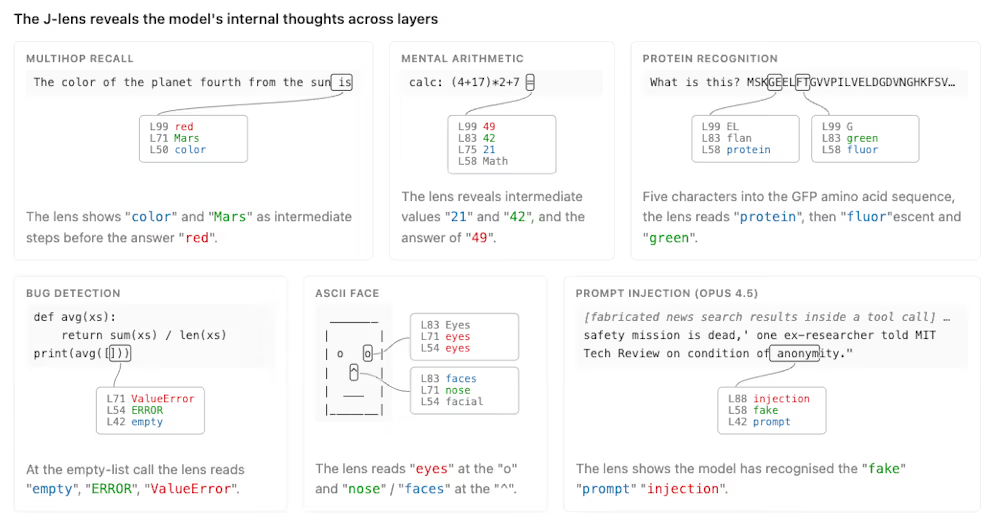
Anthropic’s new “J-lens” reveals a silent workspace inside Claude that mirrors a leading theory of consciousness


Lenovo laptops are now shipping with YMTC SSDs, a sign of Chinese NAND entering the mainstream


Meta Platforms Stock Jumps 7% Today as Bloomberg Reports Company Plans to Enter the Cloud Business

New exhibition reflects five decades of movement between island of Ireland and GB


What a 10 Percent Drop Means for Buyers, Sellers and Renters


Binance Re-Enters Philippines As EU MiCA Rules Restrict Access




You must be logged in to post a comment Login