
Tech
How To Deep Clean Your Workshop Floor So It Looks (Nearly) New Again



We may receive a commission on purchases made from links.
We always strive to keep our house clean. In most cases, however, because keeping our DIY workspace dust and dirt-free is not always at the top of our to-do list, our workshop spaces are often saved for last or skipped entirely. But if you’re serious about woodworking or you love spending time on project cars, you know that one of the biggest challenges DIYers face is keeping their workspace floor clean. After all, it deals with a lot (the occasional coffee spill, oil spills, metal shavings, dirt from shoes, paint stains, and sawdust), and not only will all these ruin the appearance of your garage, but they will also risk making your cordless power tools unusable at a certain point if dirt gums up moving parts or blocks airways.
If you’re like most of us, you’ve probably built small habits that help you stay on top of surface spills, dirt, crumbs, and dust. For instance, you might have set aside one hour a week to wipe down surfaces and sweep away dust, or you might be used to cleaning up oil spills when they happen. Either way, such habits will keep your garage floor looking tidy and safe to walk on. But that’s not to say that they’ll make your workshop floor look all-new, and that’s where deep cleaning comes in handy.
As the name suggests, deep cleaning entails setting aside a few days each year to thoroughly clean your workshop beyond your regular cleans. This allows you to handle oil spills that can get pretty gross when left for too long, and even get into corners and nooks that can go unnoticed on a weekly basis.
Prepare your workshop floor for deep cleaning

Choose an appropriate day to begin deep cleaning your workshop floor. A sunny, dry day will work best because it allows your space to air-dry quickly, preventing mold growth. Then, gather the tools you need to tackle the mammoth task. A thorough workshop cleaning requires specific tools and cleaners, and you’ll want to know which work best for your type of garage flooring to avoid accidentally damaging it. If your workshop floor has an epoxy coating, for instance, you’ll want to skip anything with ammonia or bleach. Instead, opt for a safe cleaner, such as Zep Neutral pH Industrial Floor Cleaner, which is available on Amazon for $12.
The next step is to completely clear the floor by removing all your power tools, furniture, and hand tools. You’ll also want to separate everything into donate, keep, and throw piles. Once you’re done, vacuum or mop the floor to remove loose debris and dirt. It’s worth noting that if your workshop has woodworking tools that are difficult to move, like a table saw or a thickness planer, you’ll want to make sure they’re free of debris and clean before vacuuming your floor.
Deep clean your workshop floor the right way

Once you’re done prepping, the next step is to thoroughly clean your workshop floor. To do so, start by soaking your workshop floor with a warm water and mild soap solution for a few minutes. You can even cover the dirty floor with a degreaser, but remember that some of these cleaners have harsh fumes. Wear personal protective equipment like gloves and make sure your workshop is well-ventilated when using them.
Next, use a soft-bristled brush to scrub the floor and remove stubborn stains. If you have a pressure washer, you can use it instead of a mop. Not only is pressure washing a fun way to clean your workshop floors, but it’s also a quick and easy way to blast away layers of stubborn grime and dirt. If you don’t have one, you can rent a gas-powered pressure washer from Home Depot at around $87 a day. If you need to remove stubborn rust stains from your workshop floor, you can achieve this by using lemon juice and vinegar. Just sprinkle the rusted area with some lemon juice and apply vinegar directly over the lemon. Let it soak for a few minutes, then scrub with a stiff brush.
Finish by rinsing the area well with clean water and drying it thoroughly with a dry mop. It’s a wise idea to let your garage air-dry completely before bringing your power tools back into the workshop. If time is not on your side, however, you can use a dehumidifier or a fan to speed up the drying process. This way, you’ll create a conducive environment that prevents mold and mildew growth.
Remove stubborn oil, grease, and other auto fluid stains from your garage

If you’re a DIY mechanic and you always perform your own car repair or maintenance at home, you know that your workshop floor is an absolute magnet for oil and other fluid spills. While the deep cleaning process of a woodworking workshop floor is still the same as that of an at-home auto repair shop, there are certain things you should know. Getting rid of stubborn oil, grease, and other automotive fluids is going to be a pain. Of course, there are plenty of tips and products that can help remove stubborn oil stains from your concrete, but not all of them will work as well as they claim.
To remove stubborn oil and grease stains from your garage floor the right way, you’ll need an absorbent material like cat litter or cornmeal. Sprinkle it on the affected area and let it soak for about 15 to 20 minutes before sweeping it away and scrubbing the area with a stiff broom and soapy water. Alternatively, you can give a degreaser like Krud Kutter Concentrated Cleaner/Degreaser Stain Remover or WD-40 a try. They’ll safely dissolve grease, oil, and other fluids from concrete without damaging your floor.


Iranian strikes have reportedly knocked out key AWS availability zones in Bahrain and Dubai, leaving parts of both regions effectively offline for an extended period and forcing Amazon to urge teams and customers to shift workloads elsewhere. “These two regions continue to be impaired, and services should not expect to be operating with normal levels of redundancy and resiliency,” an internal Amazon communication memo reads. “We are actively working to free and reserve as much capacity as possible in the region for customers, and services should be scaled to the minimal footprint required to support customer migration.” Big Technology reports: With the war now nearing its sixth week, Iran has made Amazon infrastructure in the Gulf an economic target and is now eyeing its peers. Amazon’s Bahrain facilities have been hit multiple times, including a Wednesday strike that caused a fire. And its facilities in the UAE also sustained multiple hits. The IRGC is threatening multiple other U.S. tech giants, including Microsoft, Google, and Apple.
Amazons infrastructure in Bahrain and Dubai each have three ‘availability zones’ or clusters of compute. Both Bahrain and Dubai have a zones that are “hard down” and and “impaired but functioning,” per the internal communication. “We do not have a timeline for when DXB and BAH will return to normal operations,” the internal post said.
Researchers have determined that Microsoft’s LinkedIn is scanning browser plug-ins and other information without permission, building user profiles using data that the company did not get permission to take.
Safari
A European advocacy group claims LinkedIn is probing browser extensions through its website code. Fairlinked e.V. published its “BrowserGate” report alleging LinkedIn detects installed browser extensions by probing for known identifiers through JavaScript. The group says the technique reveals personally identifiable information.
Safari users are less likely to be affected by this specific mechanism, based on how extension detection typically works across browsers. Apple’s browser model limits fingerprinting surfaces, which reduces how much information sites can infer from installed extensions.
Continue Reading on AppleInsider | Discuss on our Forums
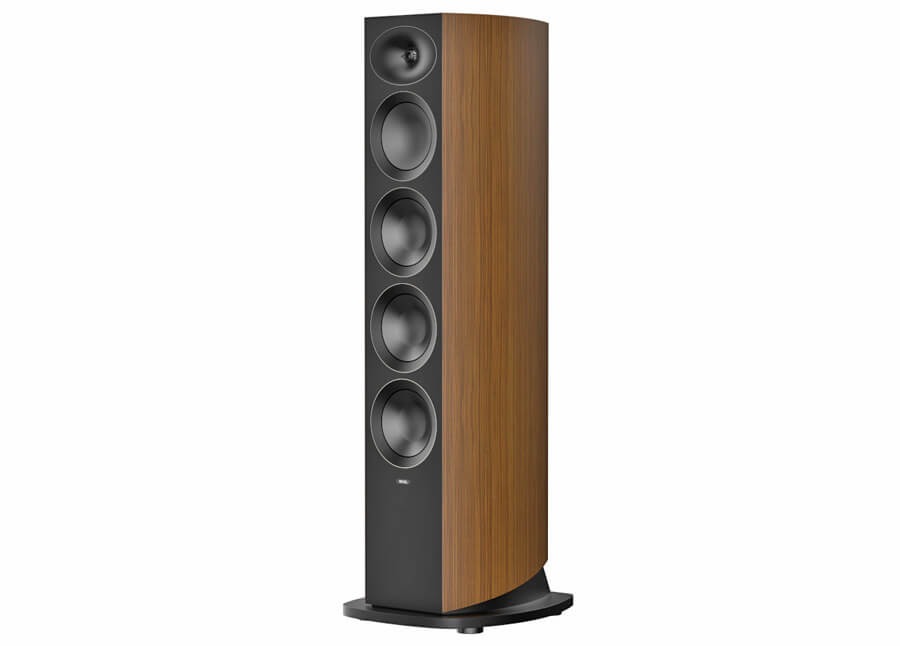
Revel is heading into AXPONA 2026 (April 10-12) with a clear focus: the debut of its new Performa4 speaker series, expected to fall between $2,000 and $7,000 per pair. Under the HARMAN Luxury Audio Group umbrella, which also includes Arcam, JBL Synthesis, Lexicon, and Mark Levinson, Revel isn’t going after statement pricing here. Performa4 is aimed at the part of the market where most serious systems are actually built, and where the competition is crowded, well established, and not particularly forgiving.
Revel Performa4 Speaker Series
Revel’s Performa4 Series is a new loudspeaker line built on the company’s established approach to acoustic design and measurement. It reflects three decades of engineering focused on controlled performance and consistent results in real-world listening environments.
Revel’s Performa4 Series consists of two floorstanding models (F346 and F345), two bookshelf speakers (M146 and M145), a center channel (C245), and a powered subwoofer (B140). With multiple configurations available, the Performa4 lineup can be used in both two-channel music systems and multichannel home theater setups.
“At Revel, science is at the heart of everything we do. The Performa4 series represents the culmination of thousands of hours of research, development, and real-world testing. With our new 7th-generation Acoustic Lens waveguide and advanced DCC and MCC transducers, we’ve raised the bar for what’s possible in this class,” said Jim Garrett, Senior Director of Product Strategy and Planning at HARMAN Luxury Audio.
Acoustic Lens Waveguide, DCC and MCC Transducers Explained
The Performa4 series uses Revel’s Deep Ceramic Composite (DCC) and Micro Ceramic Composite (MCC) drivers, developed to improve stiffness while keeping mass low and reducing unwanted coloration.
Woofer and midrange drivers are built on cast aluminum frames designed with Finite Element Analysis to optimize airflow, control resonance, and maintain structural stability. Each driver also uses an inverted surround and integrated trim ring, which simplifies the front baffle and keeps the layout clean.
Revel’s 7th-generation Acoustic Lens waveguide is paired with a 1-inch DCC dome tweeter to improve integration with the midrange driver. The waveguide is designed to control dispersion more consistently across the listening area, while also supporting higher efficiency and lower distortion, including at off-axis positions.
Revel Performa4 Industrial Design
The Performa4 series adopts a clean, modern design that builds on Revel’s established cabinet approach without adding unnecessary complexity.
All models use magnetically attached grilles for a flush, hardware-free front panel, along with black accent detailing that keeps the visual profile consistent across the range. Cabinets are internally cross-braced to improve rigidity and reduce unwanted vibration.
Curved side panels are finished in real wood veneers, available in Natural Walnut and Black Walnut, offering a straightforward aesthetic that fits into both traditional and contemporary spaces.
Revel Performa4 Models
F346
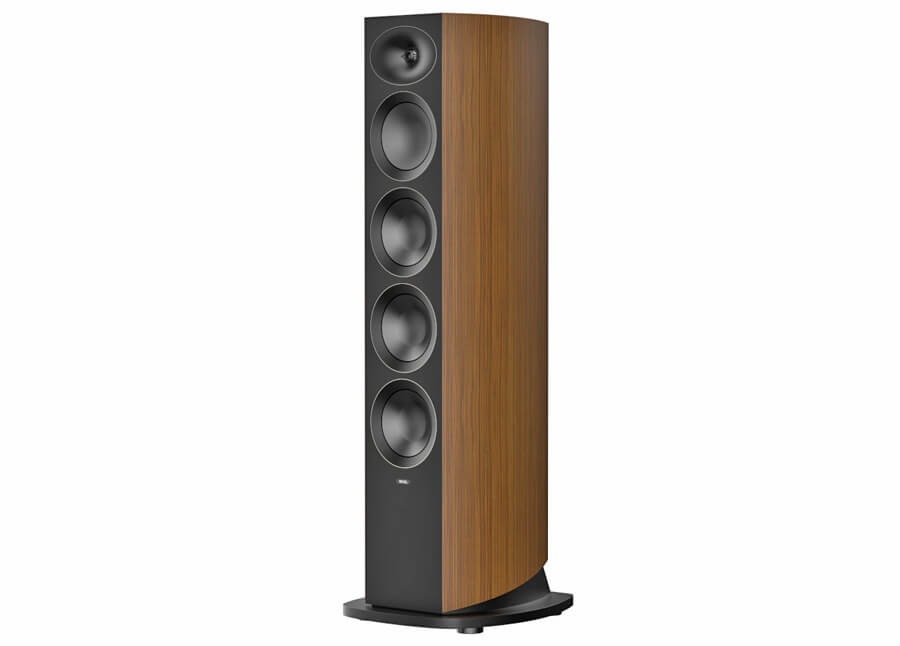
The F346 is a 3-way floorstanding loudspeaker and the top model in the Performa4 series.
It uses three 6.5-inch (165mm) MCC woofers, a 6.5-inch (165mm) DCC midrange driver, and a 1-inch (25mm) DCC dome tweeter paired with Revel’s 7th-generation Acoustic Lens waveguide.
Dual rear-firing ports provide low-frequency extension, while dual 5-way binding posts support bi-amping or bi-wiring. The cabinet is fitted with solid aluminum feet and includes optional floor spikes for added stability.
The F346 is rated for a frequency response of 30Hz to 40kHz (±6dB), with 88dB sensitivity and a nominal impedance of 6 ohms. Recommended amplifier power ranges from 20 to 250 watts.
F345
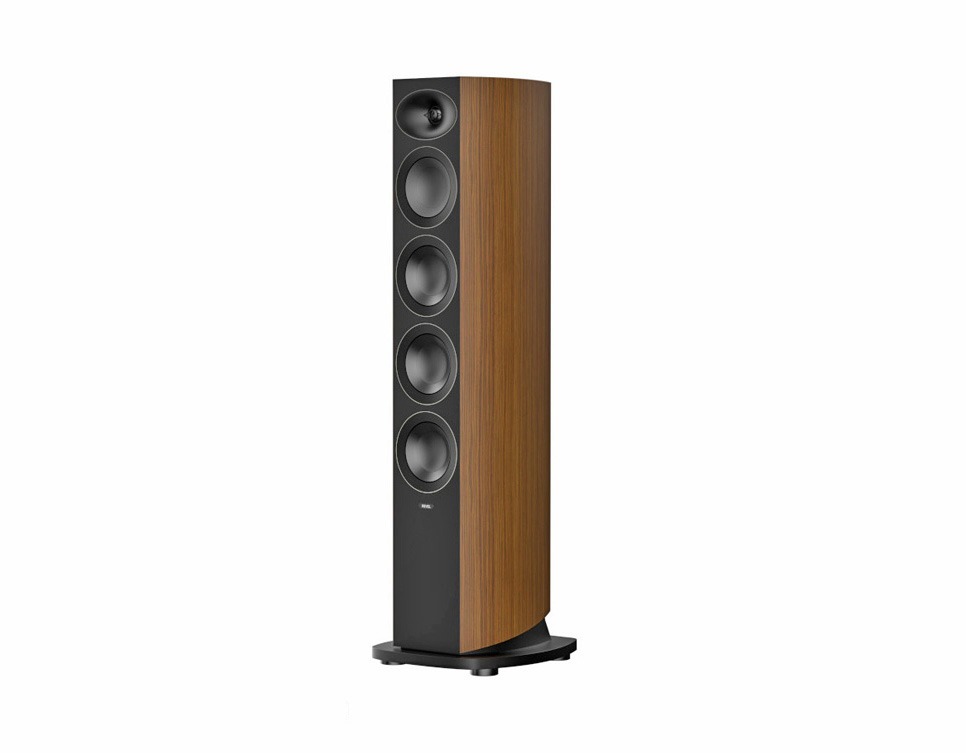
The F345 is a 3-way floorstanding loudspeaker that shares the same core design as the F346, using smaller drivers in a more compact cabinet.
It features three 5.25-inch (130mm) MCC woofers, a 5.25-inch (130mm) DCC midrange driver, and a 1-inch (25mm) DCC dome tweeter paired with Revel’s 7th-generation Acoustic Lens waveguide.
Dual rear-firing ports support low-frequency output, while dual 5-way binding posts allow for bi-amping or bi-wiring. The cabinet includes solid aluminum feet with optional spikes for placement flexibility.
The F345 is rated for a frequency response of 36Hz to 40kHz (±6dB), with 87dB sensitivity and a nominal impedance of 6 ohms. Recommended amplifier power ranges from 30 to 225 watts.
M146
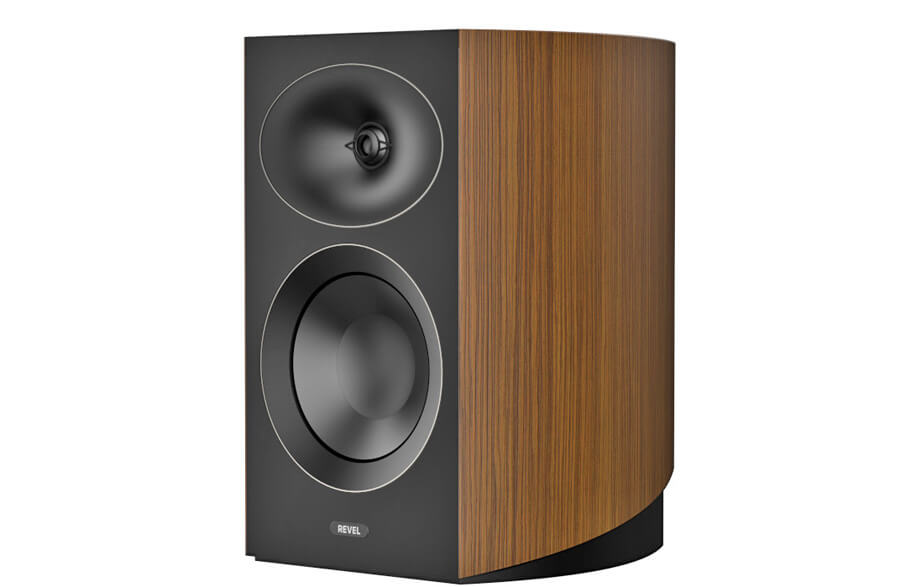
The M146 is a 2-way bookshelf or standmount speaker positioned in the middle of the Performa4 lineup.
It uses a 6.5-inch (165mm) MCC woofer paired with a 1-inch (25mm) DCC dome tweeter and Revel’s 7th-generation Acoustic Lens waveguide.
The crossover network incorporates air-core inductors, and dual 5-way binding posts support bi-amping or bi-wiring. Optional MFS4 floor stands are available for proper placement and listening height.
The M146 is rated for a frequency response of 43Hz to 40kHz (±6dB), with 86dB sensitivity and a nominal impedance of 6 ohms. Recommended amplifier power ranges from 15 to 200 watts.
M145
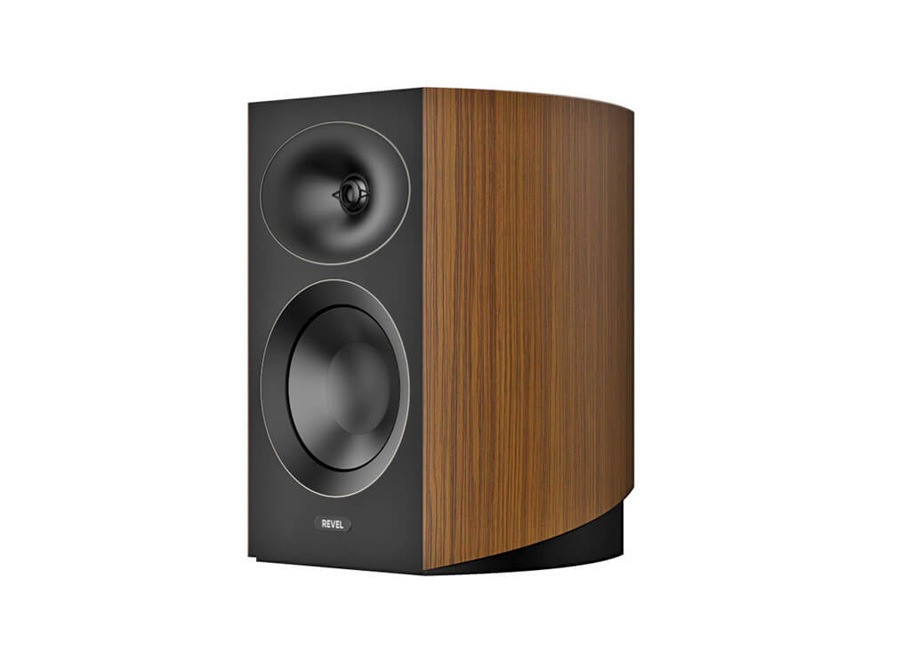
The M145 is a compact 2-way bookshelf speaker and the smaller option in the Performa4 lineup.
It features a 5.25-inch (130mm) MCC woofer paired with a 1-inch (25mm) DCC dome tweeter and Revel’s 7th-generation Acoustic Lens waveguide.
Like the M146, it includes 5-way binding posts for flexible connectivity and is compatible with the optional MFS4 floor stands for proper positioning.
The M145 is rated for a frequency response of 54Hz to 40kHz (±6dB), with 85dB sensitivity and a nominal impedance of 6 ohms. Recommended amplifier power ranges from 15 to 150 watts.
C245
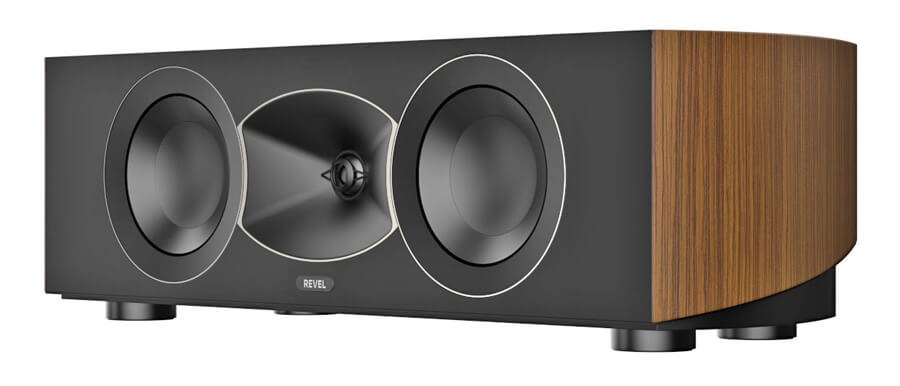
The C245 is a dedicated center channel speaker designed for use in multichannel systems with other Performa4 models.
It features dual 5.25-inch (130mm) MCC woofers flanking a 1-inch (25mm) DCC dome tweeter, paired with Revel’s 7th-generation Acoustic Lens waveguide for consistent dispersion across the front soundstage.
The C245 is rated for a frequency response of 55Hz to 40kHz (±6dB), with 86dB sensitivity and a nominal impedance of 6 ohms. Recommended amplifier power ranges from 15 to 200 watts.
B140
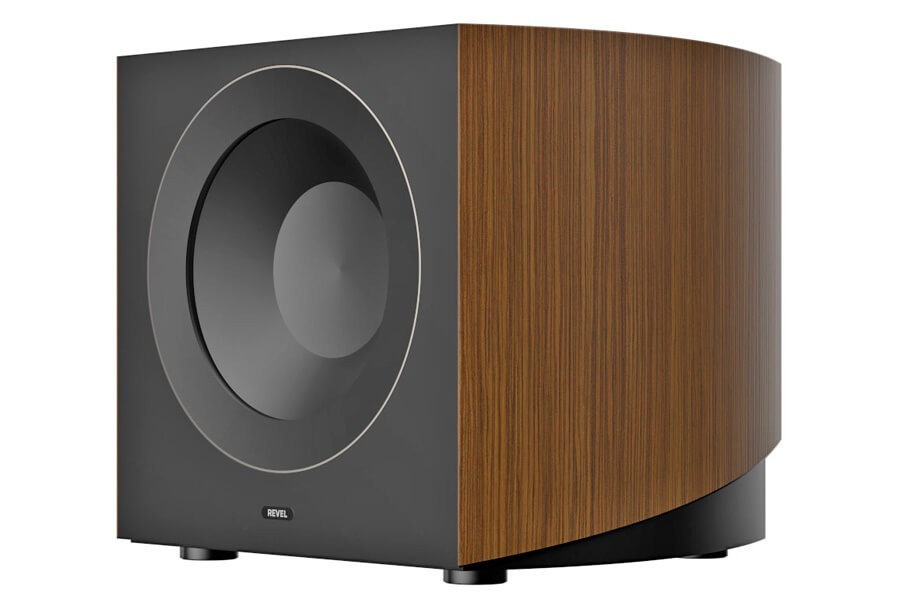
The B140 is a powered subwoofer designed to integrate with the Performa4 series in both two-channel and home theater systems.
It uses a 10-inch (250mm) fiber-composite woofer driven by a 750-watt RMS Class D amplifier, with up to 1,500 watts peak output. The design targets low-frequency extension down to 26Hz.
Rear-panel controls include a variable low-pass filter (50–150Hz), LFE input, phase adjustment, volume control, and auto on/off functionality. A rear-ported enclosure using Revel’s Constant Pressure Gradient design is intended to reduce turbulence and maintain cleaner low-frequency output.
MFS4 Floorstands
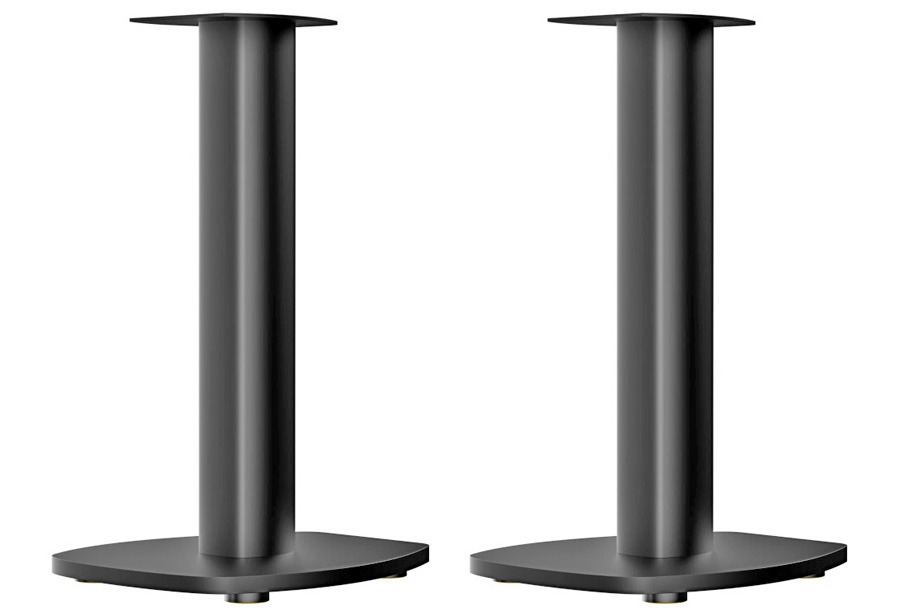
Revel also offers the optional MFS4 floor stands for the M146 and M145 bookshelf speakers.
Constructed from extruded aluminum and steel, the MFS4 stands are designed to position each speaker at an appropriate listening height. They include built-in cable management and optional spikes for use on carpeted surfaces. The stands are sold in pairs.
Revel Performa 4 Comparisons
| Revel Model | F346 | F345 | M146 | M145 | C245 |
| Speaker Type | Floorstanding | Floorstanding | Bookshelf | Bookshelf | Center |
| Price | $6,999/pair | $4,999/pair | $2,999/pair | $1,999/pair | $1,499/each |
| Speaker Configuration | 3-way | 3-way | 2-way | 2-way | 2-way |
| Tweeter | 1-inch (25mm) DCC Dome Tweeter with Acoustic Lens and 7th-Generation Waveguide | 1-inch (25mm) DCC Dome Tweeter with Acoustic Lens and Waveguide | 1-inch (25mm) DCC Dome Tweeter with Acoustic Lens and Waveguide | 1-inch (25mm) DCC Dome Tweeter with Acoustic Lens and Waveguide | 1-inch (25mm) DCC Dome Tweeter with Acoustic Lens and Waveguide |
| Midrange | 1 x 6.5 in (165 mm) Deep Ceramic Composite (DCC) Cone Driver | 1 x 5.25 in (135 mm) Deep Ceramic Composite (DCC) Cone Driver | N/A | N/A | N/A |
| Woofer | 3 x 6.5 in (165 mm) Micro Ceramic Composite (MCC) Cone Woofers | 3 x 5.25 in (135 mm) Micro Ceramic Composite (MCC) Cone Woofers | 1 x 6.5-inch (165 mm) Micro Ceramic Composite (MCC) Cone Woofer | 1 x 5.25 inch (130 mm) Micro Ceramic Composite (MCC) Cone Woofer | 2 x 5.25-inch (135 mm) Micro Ceramic Composite (MCC) Cone Woofers |
| Enclosure Tuning | Bass-Reflex via Dual Rear-Mounted Ports | Bass-Reflex via Dual Rear-Mounted Ports | Bass-Reflex via Rear-Mounted Port | Bass-Reflex via Rear-Mounted Port | Bass-Reflex via Rear-Mounted Port |
| Nominal Impedance | 6 Ohms | 6 Ohms | 6 Ohms | 6 Ohms | 6 Ohms |
| Sensitivity @ 1m, 2.83V | 88 dB | 87 dB | 85.5 dB | 85 dB | 86 dB |
| Recommended Amplifier Power | 20-250W | 30-225W | 15-200W | 15-150W | 15-200W |
| Frequency Response +/-6 dB | 30 Hz – 40 kHz | 36 Hz – 40 kHz | 43 Hz – 40 kHz | 54 Hz – 40 kHz | 55 Hz – 40 kHz |
| Crossover Frequency | 275 Hz / 1.7 kHz | 350 Hz / 2.1 kHz | 1.7 kHz | 1.8 kHz | 1.8 kHz |
| Dimensions | 44.4 x 14.1 x 16.3 inches
1127 x 357.33 x 414.48 mm |
40.9 x 11.9 x 13.9 inches
1038 x 301.86 x 352.46 mm |
14.1 x 9.7 x 12.7 inches
359 x 245.56 x 322.57mm |
11.6 x 7.9 x 9.6 inches
294 x 200 x 245mm |
7.1 x 23.4 x 10.9 inches
181 x 594.5 x 277 mm |
| Product Weight | 87.5 lbs / 39.7 kg | 64 lbs / 29.1 kg | 24.3 lbs / 11 kg | 15 lbs / 6.8 kg | 27.1 lbs / 12.3 kg |
Revel B140 Subwoofer
| Revel Model | B140 |
| Product Type | Powered Subwoofer |
| Price | $2,999/each |
| Driver | 250mm (10-inch) Coated Fibre Composite Cone Driver in a cast-Aluminum frame |
| Amplifier Type | Class D amplifier |
| Power Output | 750W RMS (1500W peak) |
| Enclosure Tuning | Bass-Reflex via Rear-Mounted Port |
| Controls | Auto Power, Crossover, Level, Phase |
| Inputs | RCA LFE/Line Level, 3.5mm, 12V Trigger |
| Frequency Response +/-6 dB | 26Hz – 150Hz |
| Crossover Frequency (Variable) | 50Hz – 150Hz |
| Dimensions | 14.8 x 16.9 x 17.2 inches (376.2 x 429.28 x 436.37 mm) |
| Weight | 61.3 lbs / 27.8 kg |
The Bottom Line
Revel’s Performa4 series is a calculated move into one of the most competitive segments in loudspeakers. The combination of DCC and MCC driver materials, the 7th-generation Acoustic Lens waveguide, and consistent cabinet engineering across the range points to a focus on controlled dispersion, tonal consistency, and predictable in-room performance; areas where Revel has historically been very disciplined.
The lineup is clearly built for flexibility. It can anchor a straightforward two-channel system or scale into a full home theater without mixing and matching across different voicings. That matters for buyers who want system coherence without overthinking every component swap.
What’s less clear is how much separation there is between models beyond size and output, and whether the subwoofer’s pricing will make sense for buyers building out a full system. There’s also no indication of built-in room correction or system-level integration features, which are becoming more common even in passive speaker ecosystems when paired with modern electronics.
This is for listeners who want a complete, measurement-driven speaker system in the $2,000 to $7,000 range without stepping into five-figure territory. Not entry-level, not cost-no-object—right in the middle where most serious systems live.
At AXPONA 2026, the F346 will be demonstrated with an Arcam SA45 integrated streaming amplifier and CD5 CD player, which should give a clear sense of how the top model performs with both streaming and physical sources.
Pricing & Availability
The Revel Performa4 series begins shipping in April through authorized Revel dealers and custom installation installers. All models are available in Natural Walnut and Black Walnut wood veneer finishes.
Suggested retail pricing is as follows:
- F346 Triple 6.5-inch Floorstanding Speaker – $6,999/pair
- F345 Triple 5.25-inch Floorstanding Speaker – $4,999/pair
- M146 6.5-inch Bookshelf Speaker – $2,999/pair
- M145 5.25” Bookshelf Speaker – $1,999/pair
- C245 Dual 5.25” Center Channel Speaker – $1,499/each
- B140 10-inch Powered Subwoofer – $2,999/each
- MFS4 Floor Stands – $699/pair
The Revel Performa4 series will make its official debut at AXPONA 2026, April 10-12, at the Schaumburg Convention Center in Chicago, IL.
For more information, visit www.revelspeakers.com
Related Reading:


The technology is designed to reduce strike zone disputes, long the source of baseball’s most heated arguments. Under the new system, each team receives two challenges per game and only loses a challenge if it is incorrect. In practice, this incentive has quickly reshaped game-day strategy – and last Saturday’s…
Read Entire Article
Source link

French fries are delicious, but notoriously unhealthy. A research team at the University of Illinois, however, has developed a deceptively straightforward method to keep the satisfying taste and crunch without requiring as much oil.
The cooking method combines traditional frying and microwave heating. Adding that microwave step could reduce the amount of oil used in the process, meaning you would absorb less fat with each bite. All the secrets to being able to cook fries in this way have been laid out in two studies published in Current Research in Food Science and The Journal of Food Science.
French Fries and Health
Although popular, fried foods contain high levels of fat, which is linked to several health problems, including obesity and hypertension. “Consumers want healthy foods, but at the time of purchase, cravings often prevail,” says Pawan Singh Takhar, author of one of the two studies. “The high oil content adds flavor, but it also contains a lot of energy and calories.”
It’s precisely with the goal of helping consumers make better food choices without feeling deprived that researchers have been trying to figure out how they can cook healthier french fries, achieving lower fat content without altering their taste and texture.
One of the main difficulties in frying, as the studies explain, is preventing the oil from penetrating the food. In the early stages of the french fry process, in fact, the pores of the potato are filled with water, leaving no room for the oil.
As cooking continues, however, the water evaporates, creating empty spaces that allow the oil to be drawn in by negative pressure. Much of the frying process takes place under that negative pressure, which essentially increases the tendency of the oil to be sucked into the fries
A New Wavelength
In the new study, therefore, the researchers tried to figure out how to extend the time in positive pressure and reduce the period under negative pressure. “When we heat something in a traditional oven, the heat transfers from the outside to the inside, but a microwave oven heats from the inside to the outside because the microwaves penetrate everywhere in the material,” Takhar says.
Specifically, microwaves cause water molecules to oscillate, resulting in increased vapor formation and thus shifting the pressure profile toward positive values that prevent the oil from being easily absorbed.
Microwave frying alone, however, would not produce the desired texture. “If only microwaving is used, the food turns out mushy,” says Takhar. In order to achieve crispness, frying and microwaving should be combined.
To achieve the right balance, the researchers carried out an experiment in which they specially designed a microwave fryer, monitoring temperature, pressure, volume, texture, moisture, and oil content of the chips. “We propose to combine the two methods in the same device. Traditional heating maintains crispness, while microwave heating reduces oil consumption,” the study concludes.


Microsoft is expanding its roster of in-house AI models, releasing a new speech-to-text system and making two existing models broadly available to developers for the first time.
The moves by Microsoft AI (MAI) are part of a broader effort by the company to expand its proprietary AI capabilities beyond its partnership with OpenAI, giving Microsoft more control over its own destiny in the competition against Google, Amazon, and others.
Microsoft announced MAI-Transcribe-1 on Thursday, a speech-to-text model that it says is the most accurate currently available. The company also released its existing voice and image generation models, known as MAI-Voice-1 and MAI-Image-2, for broad commercial use.
It’s Microsoft’s first major model release since a March reorganization, announced by CEO Satya Nadella, in which Microsoft AI CEO Mustafa Suleyman shifted away from day-to-day Copilot oversight to focus on frontier model development and superintelligence.
Suleyman told The Verge that the transcription model runs at “half the GPU cost of the other state-of-the-art models.” He told VentureBeat that the model was built by a team of just 10 people, and that Microsoft plans to eventually build a frontier large language model to be “completely independent” if needed.
Microsoft also recently hired former Allen Institute for CEO Ali Farhadi and other top AI researchers from the Seattle-based institute to further bolster Suleyman’s team, as GeekWire reported last week.
MAI-Transcribe-1 is designed to handle noisy real-world conditions such as call centers and conference rooms, and Microsoft says it is testing integrations with Copilot and Teams. Microsoft says it offers the best price-performance of any large cloud provider, competing directly with OpenAI’s Whisper and Google’s Gemini on the FLEURS benchmark.
In a blog post, Suleyman called the model “not just the most accurate but also lightning fast.”
MAI-Voice-1 generates natural-sounding speech and now lets developers create custom voices from short snippets of sample audio. MAI-Image-2 ranks in the top three on the Arena.ai image generation leaderboard and is rolling out in Bing and PowerPoint.
All three are available on the Microsoft Foundry developer AI platform and MAI Playground.

It’s been more than 50 years since NASA astronaut Harrison Schmitt took the famous Big Blue Marble photograph, showing a breathtaking vision of Earth taken aboard the Apollo 17 spacecraft on its way to the moon. Now, as the four-astronaut crew of the Artemis II mission heads toward the moon, more spectacular images are being released.
This stunning photo is perhaps the most reminiscent of the Big Blue Marble, showing Earth in all its fragile, lovely glory.
“That’s us!” NASA wrote in a post. The post also quoted astronaut Christina Koch as saying of Earth, “You guys look great.”
In a reply to questions on the post, NASA wrote, “Two auroras (top right and bottom left) are visible in this image. Zodiacal light (bottom right), is also visible, as well as airglow from Earth’s atmosphere.”
Another neat photo from the Artemis mission shows the planet neatly bisected, with one side lit up by the sun and the other in darkness.
This image of the Earth was taken by one of the Artemis II crew out the Orion’s window.
“You look amazing, you look beautiful,” Victor Glover, Artemis II pilot, said of the views of Earth in a video call with ABC News.
A view of the Earth from NASA’s Orion spacecraft as it orbits above the planet during the Artemis II test flight.
Another intriguing image shows part of the spacecraft itself. USA Today noted that “the image appears to show the bottom of Orion’s service module where its main engine and auxiliary thrusters are housed.”
We’re tracking the 10-day Artemis II mission with a regularly updated blog.
Keep an eye on NASA’s image repository to see the latest photos.

The total workforce at Tesla’s factory outside Austin, Texas shrunk dramatically last year as the company suffered its second straight year of declining sales, according to a compliance report spotted by Austin American-Statesman.
Tesla went from employing 21,191 people at the factory in 2024 to 16,506 workers in 2025, a drop of 22%. That’s despite the company’s global workforce growing from 125,665 employees in 2024 to 134,785 employees in 2025, according to filings with the U.S. Securities and Exchange Commission.
It’s not clear which teams were most affected by Tesla scaling back its workforce at the plant. But the company has become one of the largest employers in the Austin area since it opened the factory in 2022. CEO Elon Musk also relocated Tesla’s headquarters to the factory in 2021 before it opened. The company has invested more than $6.3 billion in the facility to date, according to the new report.
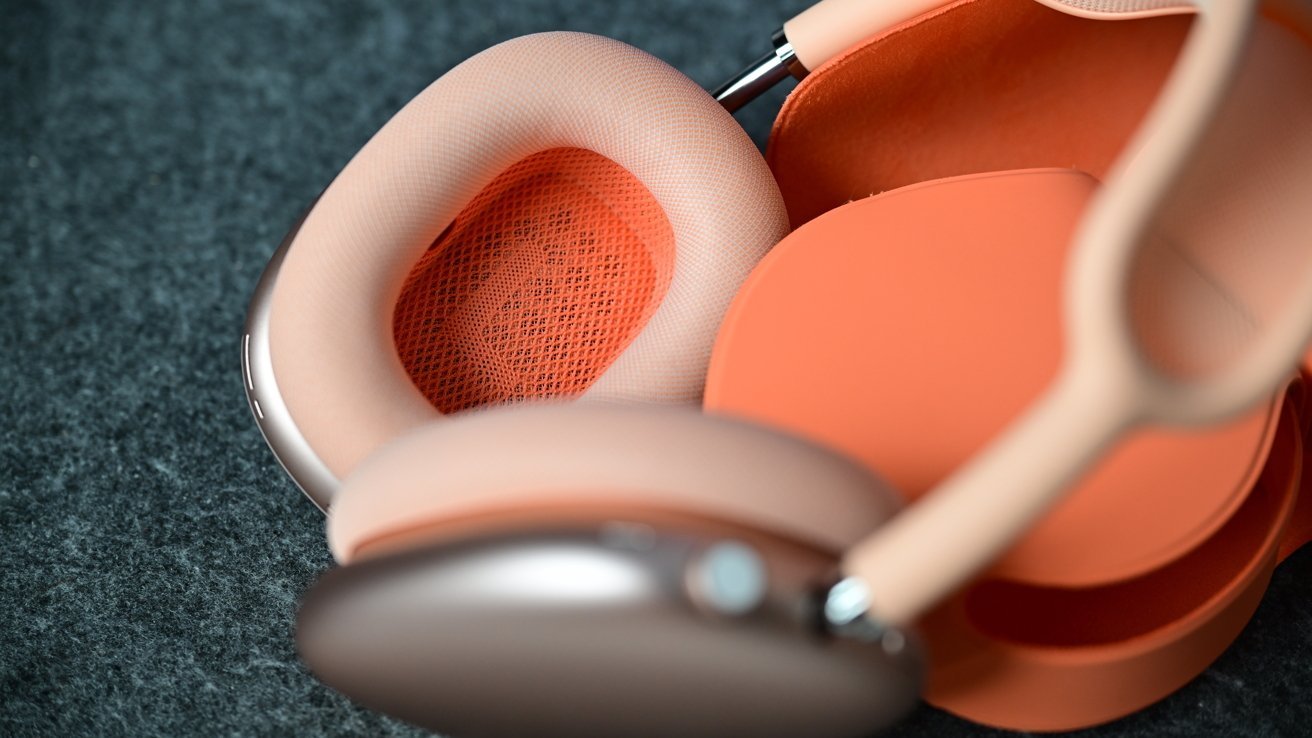
Though the AirPods Max 2 offer new features, a teardown of the headphones shows they’re still plagued by the same flaws of the original 2020 model.
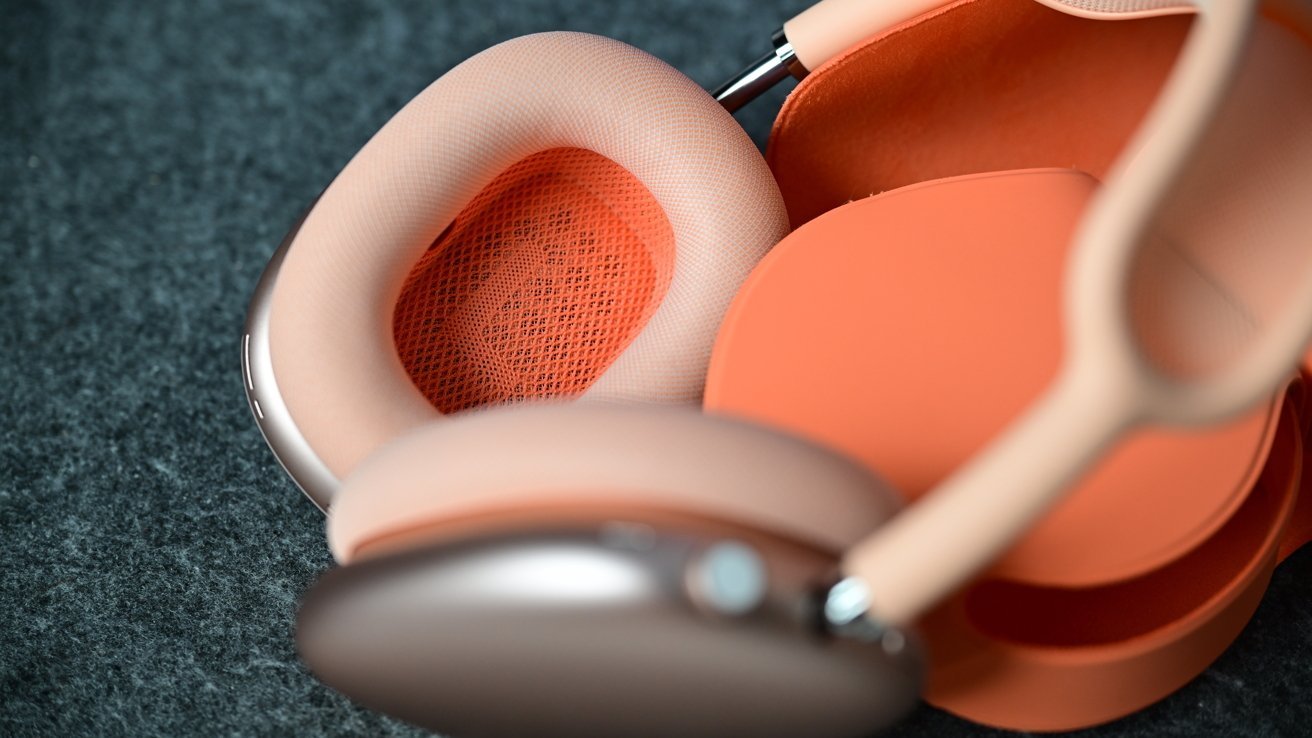
Apple’s AirPods Max 2 gained the H2 chip, but not much else.
Apple’s AirPods Max 2 debuted on March 16, with their core feature being the H2 chip. With it, Apple’s high-end headphones gained capabilities like Adaptive Audio, Conversation Awareness, and gesture controls, among others. Active Noise Cancellation was improved as well.
However, as explained in our review, the AirPods Max 2 are an iterative upgrade, that ultimately leaves something to be desired. New features and ANC enhancements aside, Apple effectively delivered more of the same with its AirPods Max 2.
Continue Reading on AppleInsider | Discuss on our Forums

Meta has paused all its work with the data contracting firm Mercor while it investigates a major security breach that impacted the startup, two sources confirmed to WIRED. The pause is indefinite, the sources said. Other major AI labs are also reevaluating their work with Mercor as they assess the scope of the incident, according to people familiar with the matter.
Mercor is one of a few firms that OpenAI, Anthropic, and other AI labs rely on to generate training data for their models. The company hires massive networks of human contractors to generate bespoke, proprietary datasets for these labs, which are typically kept highly secret as they’re a core ingredient in the recipe to generate valuable AI models that power products like ChatGPT and Claude Code. AI labs are sensitive about this data because it can reveal to competitors—including other AI labs in the US and China—key details about the ways they train AI models. It’s unclear at this time whether the data exposed in Mercor’s breach would meaningfully help a competitor.
While OpenAI has not stopped its current projects with Mercor, it is investigating the startup’s security incident to see how its proprietary training data may have been exposed, a spokesperson for the company confirmed to WIRED. The spokesperson says that the incident in no way affects OpenAI user data, however. Anthropic did not immediately respond to WIRED’s request for comment.
Mercor confirmed the attack in an email to staff on March 31. “There was a recent security incident that affected our systems along with thousands of other organizations worldwide,” the company wrote.
A Mercor employee echoed these points in a message to contractors on Thursday, WIRED has learned. Contractors who were staffed on Meta projects cannot log hours until—and if—the project resumes, meaning they could functionally be out of work, a source familiar claims. The company is working to find additional projects for those impacted, according to internal conversations viewed by WIRED.
Mercor contractors were not told exactly why their Meta projects were being paused. In a Slack channel related to the Chordus initiative—a Meta-specific project to teach AI models to use multiple internet sources to verify their responses to user queries—a project lead told staff that Mercor was “currently reassessing the project scope.”
An attacker known as TeamPCP appears to have recently compromised two versions of the AI API tool LiteLLM. The breach exposed companies and services that incorporate LiteLLM and installed the tainted updates. There could be thousands of victims, including other major AI companies, but the breach at Mercor illustrates the sensitivity of the compromised data.
Mercor and its competitors—such as Surge, Handshake, Turing, Labelbox, and Scale AI—have developed a reputation for being incredibly secretive about the services they offer to major AI labs. It’s rare to see the CEOs of these firms speaking publicly about the specific work they offer, and they internally use codenames to describe their projects.
Adding to the confusion around the hack, a group going by the well-known name Lapsus$ claimed this week that it had breached Mercor. In a Telegram account and on a BreachForums clone, the actor offered to sell an array of alleged Mercor data, including a 200-plus GB database, nearly 1 TB of source code, and 3 TBs of video and other information. But researchers say that many cybercriminal groups now periodically take up the Lapsus$ name and that Mercor’s confirmation of the LiteLLM connection means that the attacker is likely TeamPCP or an actor connected to the group.
TeamPCP appears to have compromised the two LiteLLM updates as part of an even larger supply chain hacking spree in recent months that has been gaining momentum, catapulting TeamPCP to prominence. And while launching data extortion attacks and working with ransomware groups, such as the group known as Vect, TeamPCP has also strayed into political territory, spreading a data wiping worm known as “CanisterWorm” through vulnerable cloud instances with Farsi as their default language or clocks set to Iran’s time zone.
“TeamPCP is definitely financially motivated,” says Allan Liska, an analyst for the security firm Recorded Future who specializes in ransomware. “There might be some geopolitical stuff as well, but it’s hard to determine what’s real and what’s bluster, especially with a group this new.”
Looking at the dark-web posts of the alleged Mercor data, Liska adds, “There is absolutely nothing that connects this to the original Lapsus$.”
Tyler, the Creator scolds TikToker filming him on street: 'I don't f— with that, bro'

NYT Connections Answers and Hints for April 4 2026 Puzzle #1028 Revealed

Cardano Price Prediction Grinds at $0.24 While Pepeto Presale Timing Separates Returns From Regret Before Listing


-

 NewsBeat1 day ago
Steven Gerrard disagrees with Gary Neville over ‘shock’ Chelsea and Arsenal claim | Football
-

 Business24 hours ago
No Jackpot Winner and $194 Million Prize Rolls Over
-
Entertainment4 days ago
Fans slam 'heartbreaking' Barbie Dream Fest convention debacle with 'cardboard cutout' experience
-

 Crypto World2 days ago
Gold Price Prediction: Worst Month in 17 Years fo Save Haven Rock
-

 Fashion5 hours ago
Weekend Open Thread: Spanx – Corporette.com
-

 Tech5 days ago
The Pixel 10a doesn’t have a camera bump, and it’s great
-
 Entertainment6 days ago
Lana Del Rey Celebrates Her Husband’s 51st Birthday In New Post
-
Crypto World3 days ago
Dems press CFTC, ethics board on prediction-market insider trades
-

 Tech5 days ago
Avatar Legends: The Fighting Game comes out in July and it looks pretty slick
-

 Sports3 days ago
Tallest college basketball player ever, standing at 7-foot-9, entering transfer portal
-

 Tech4 days ago
EE TV is using AI to help you find something to watch
-

 Fashion6 days ago
Amazon Sundays: Soft Spring Layers
-

 Business2 days ago
Login and Checkout Issues Spark Merchant Frustration
-

 Fashion7 days ago
When Evening Dressing Gets Colorful for Spring
-

 Tech5 days ago
Elon Musk’s last co-founder reportedly leaves xAI
-

 Tech4 days ago
How to back up your iPhone & iPad to your Mac before something goes wrong
-

 Tech4 days ago
Apple will hide your email address from apps and websites, but not cops
-

 Politics4 days ago
Should Trump Be Scared Strait?
-

 Crypto World4 days ago
U.S. rule change may open trillions in 401(k) funds to crypto
-

 Tech4 days ago
Flipsnack and the shift toward motion-first business content with living visuals
You must be logged in to post a comment Login