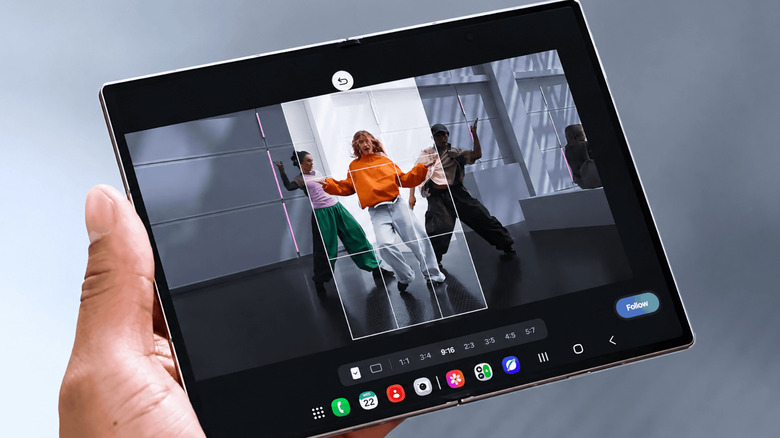
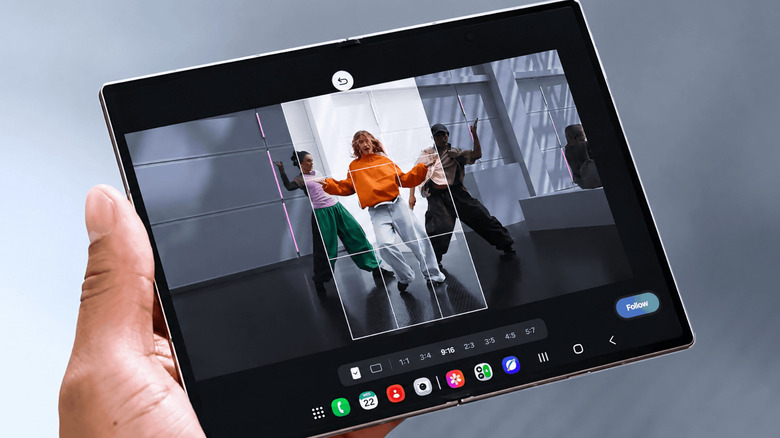
My FanCam works after you record, turning a wider group video into a tighter tracking shot around one person.
Samsung
Samsung’s My FanCam is built for videos where several people are moving through the frame. Instead of trying to keep one person centered while you’re recording, you can capture the wider scene and choose your subject afterward. Galaxy AI then reframes the existing footage around that person in an aspect ratio you select.
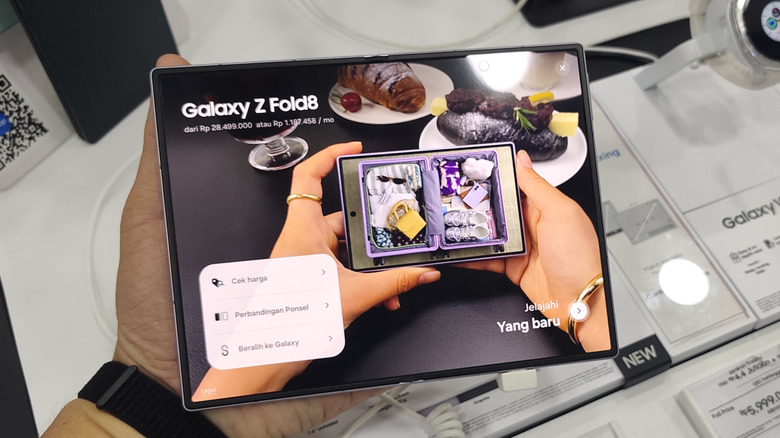
Samsung introduced the feature on the Galaxy Z Fold8 lineup. Because My FanCam works on a video you’ve already recorded, there’s nothing special you need to turn on before shooting.
Advertisement
How to use My FanCam in Samsung Gallery
Samsung
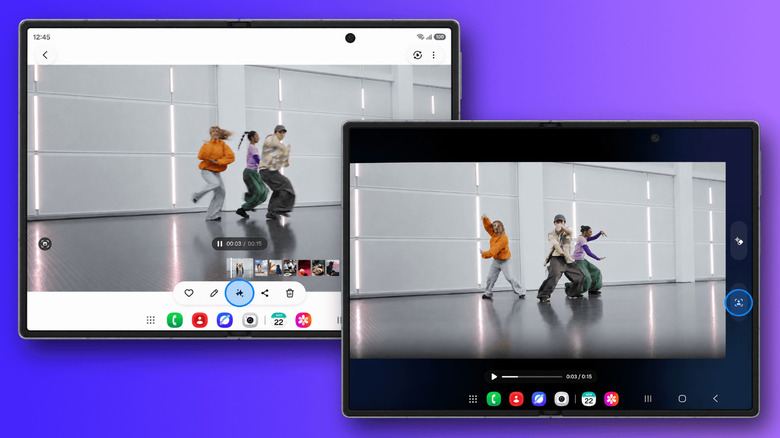
My FanCam lives in Samsung’s Gallery editing tools. On a supported device, start with a video that contains the person you want Galaxy AI to follow.
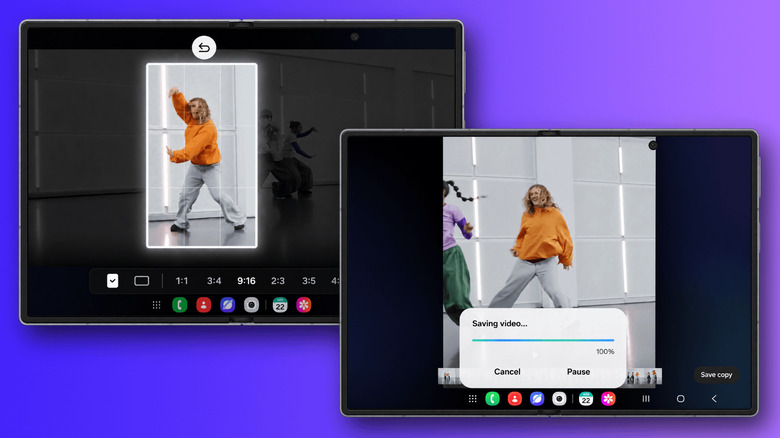
Open Gallery and select the video you want to edit. Then, tap the Galaxy AI icon and select My FanCam. Wait for Galaxy AI to identify the people in the video and select the person you want to follow. Next, choose an aspect ratio for the new clip. Finally, tap Follow to create the reframed video.
The aspect-ratio choice is useful if you already know where the finished clip is going. A vertical crop makes more sense for platforms built around portrait video, while a wider frame may work better if you want to keep more of the original scene visible. My FanCam handles the tracking either way, so you can make that decision after you’ve recorded the footage.
Advertisement
Shoot a wider frame if you plan to use My FanCam
Samsung
My FanCam differs from Samsung’s Auto framing feature in one important way. Auto framing adjusts the composition while you’re recording, while My FanCam does its work afterward. That gives you more freedom to capture the whole scene first, but it also means the feature can only reframe footage that made it into the original recording.
Imagine recording a school performance, a soccer game or a group dance. Rather than constantly moving the phone to keep one person centered, you can keep more of the scene visible and decide who you want to focus on when you edit the clip later.
It helps to think of My FanCam as moving a smaller frame around inside the video you already recorded. If you’re filming several people, keeping the shot reasonably wide gives Galaxy AI more room to reposition that crop as your chosen person moves from one side of the scene to the other. If you start with a very tight shot, there’s simply less surrounding image available for My FanCam to use.
The same limitation applies when your subject moves outside the original frame. My FanCam reframes what the camera captured, but it can’t recover parts of a scene that were never recorded. Samsung also says the feature won’t work when it can’t find a subject to track, and it doesn’t guarantee tracking accuracy. So for something unpredictable, such as a sports game or a group performance, keeping the person you care about comfortably within the wider shot gives the feature a better starting point.
Advertisement
Which Samsung phones support My FanCam?
Jimmy Gunawan/Shutterstock
Samsung currently demonstrates My FanCam on the Galaxy Z Fold8 and Galaxy Z Fold8 Ultra. Both phones launched with One UI 9, which is where Samsung lists My FanCam among its new Galaxy AI features.
One UI 9 isn’t limited to those two phones. Samsung first rolled it out to the Galaxy Z Fold8 Ultra, Galaxy Z Fold8 and Galaxy Z Flip8, with more Galaxy devices set to follow. My FanCam is a little less straightforward, though, since Samsung says individual AI features can vary by device, language and region. So even if your phone gets One UI 9, My FanCam may not come along with it.
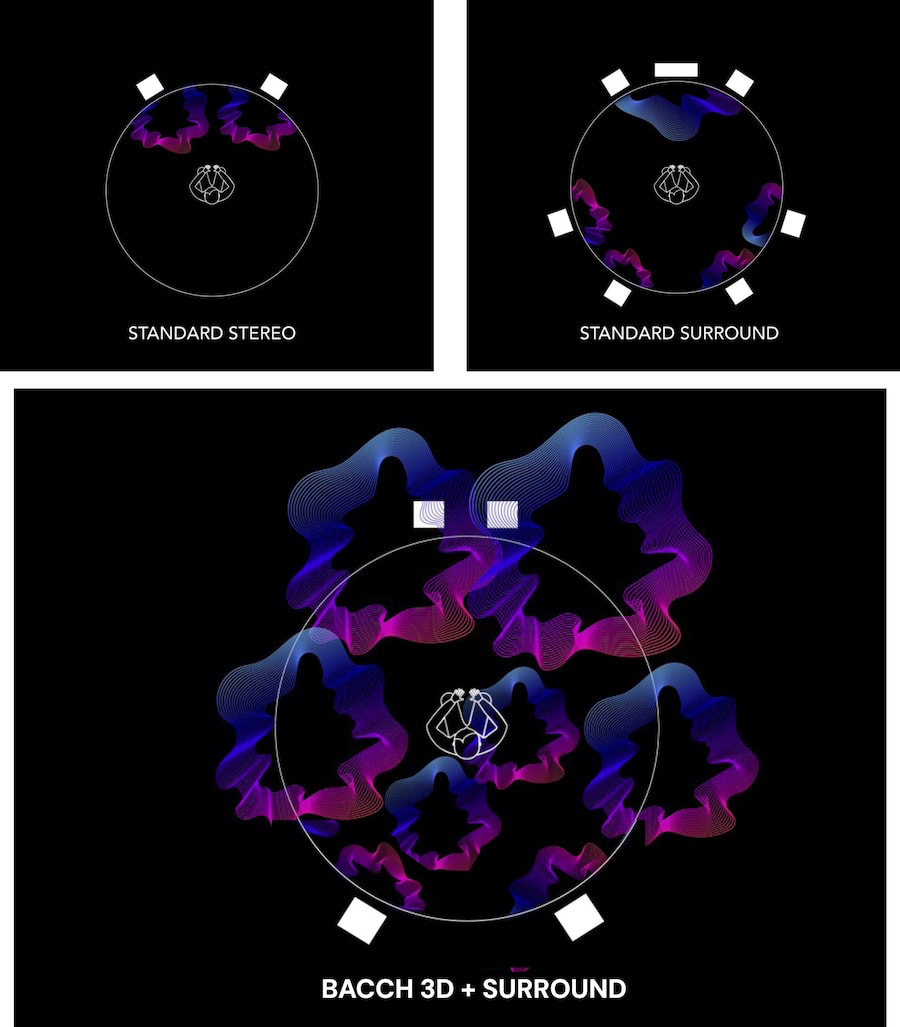
CANVAS HiFi built its reputation around doing something rather unconventional: using BACCH 3D processing and a single, furniture-friendly audio system to create a much larger front soundstage without surrounding the television with separate left, center, right and subwoofer cabinets. At IFA 2026, the Danish company is taking that concept considerably further by adding support for dedicated Dolby Surround and Dolby Atmos channels around and above the listener.
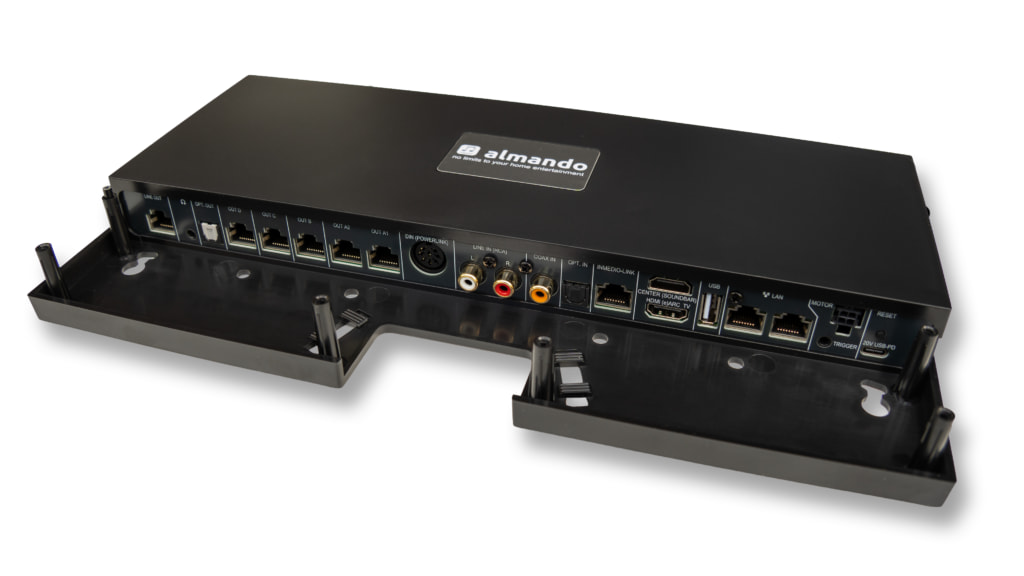
The big change is Almando InMedio, a new component developed with German electronics specialist Almando. It handles surround decoding and signal distribution while allowing CANVAS to remain responsible for the front soundstage. Surround, rear and height duties can then be assigned to compatible active loudspeakers, with both wired and wireless connectivity, including WiSA.
And there is an important distinction here: CANVAS is not introducing its own surround or height speakers. Instead, it is opening the platform so owners can build a multichannel home theater around CANVAS using active or passive speakers from other manufacturers. That makes this much more than CANVAS simply adding a Dolby Atmos badge to the box.
Related Reviews:
What Is CANVAS HiFi and How Does BACCH 3D Work?
Canvas HiFi
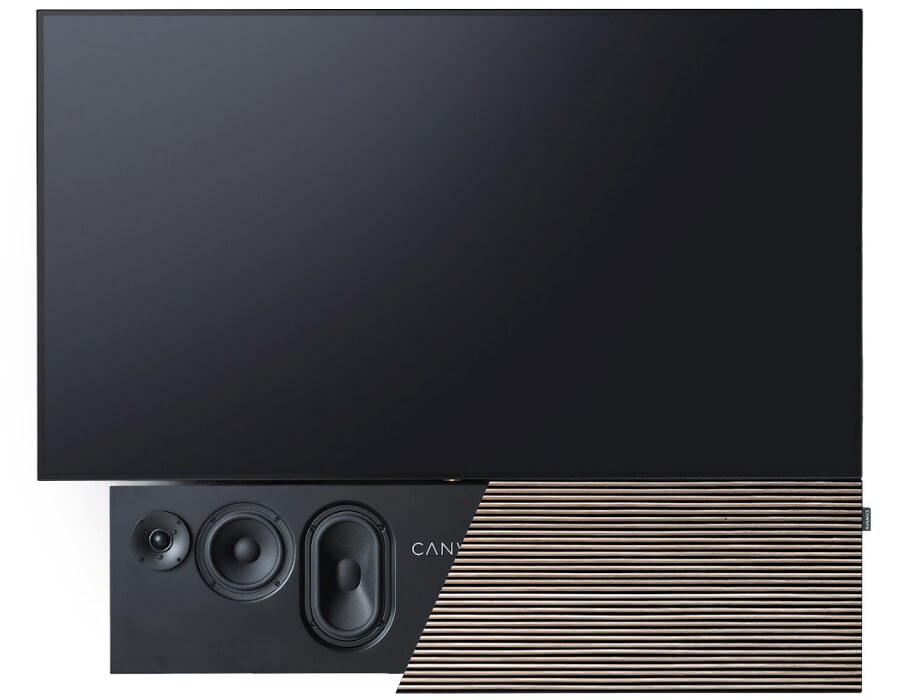
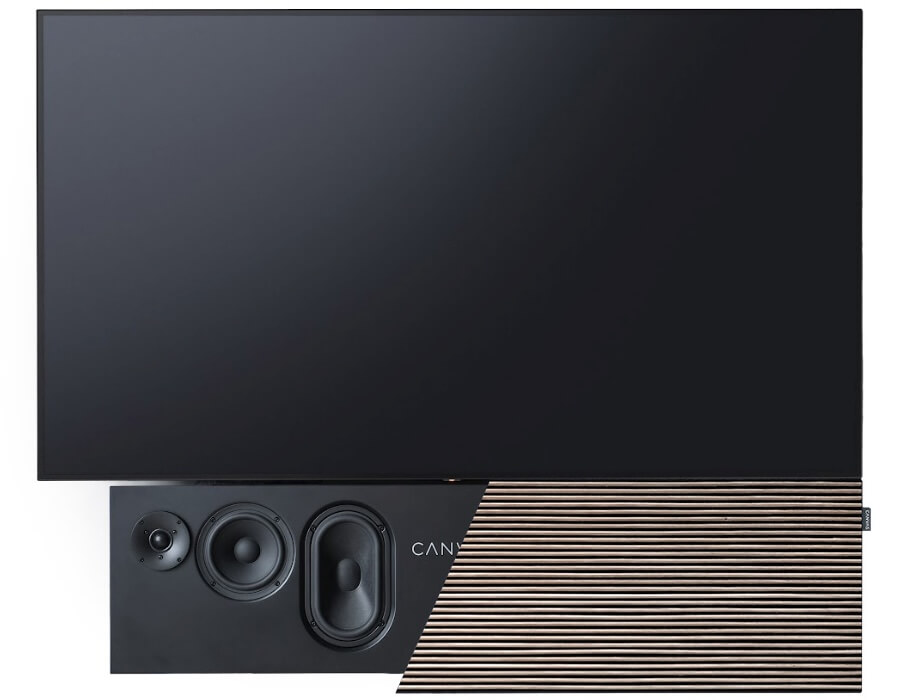
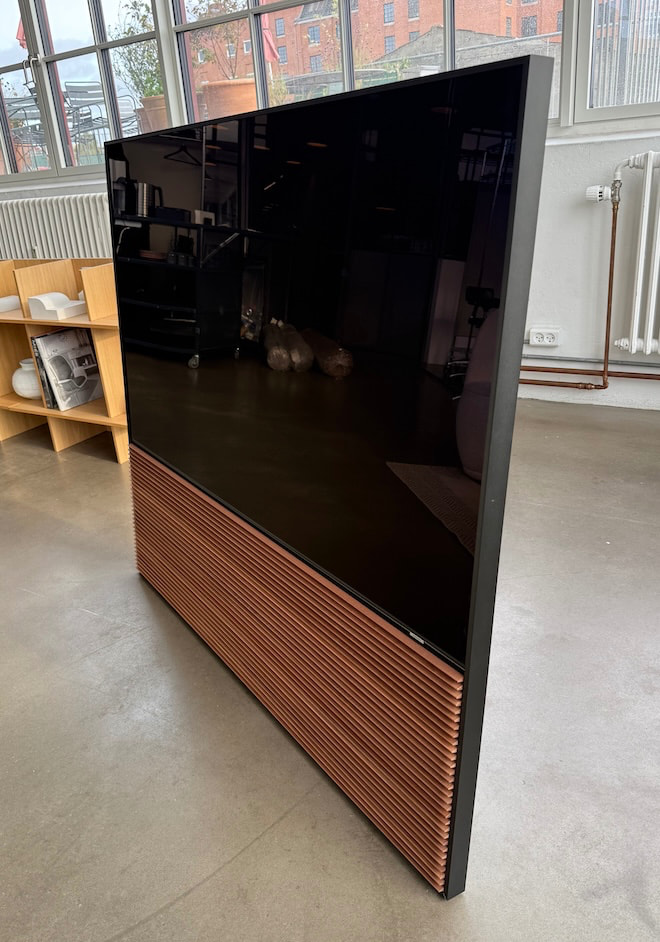
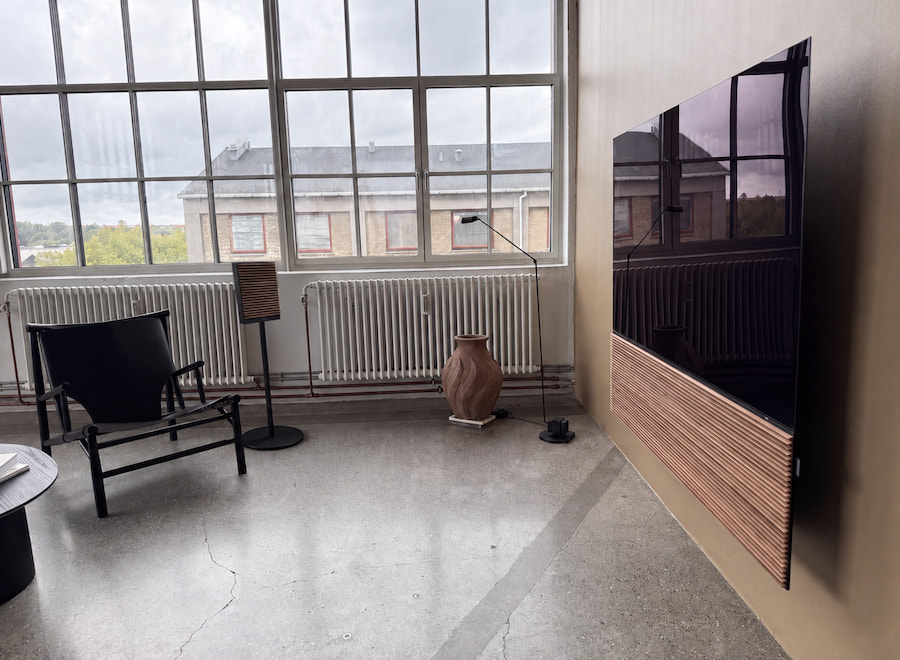
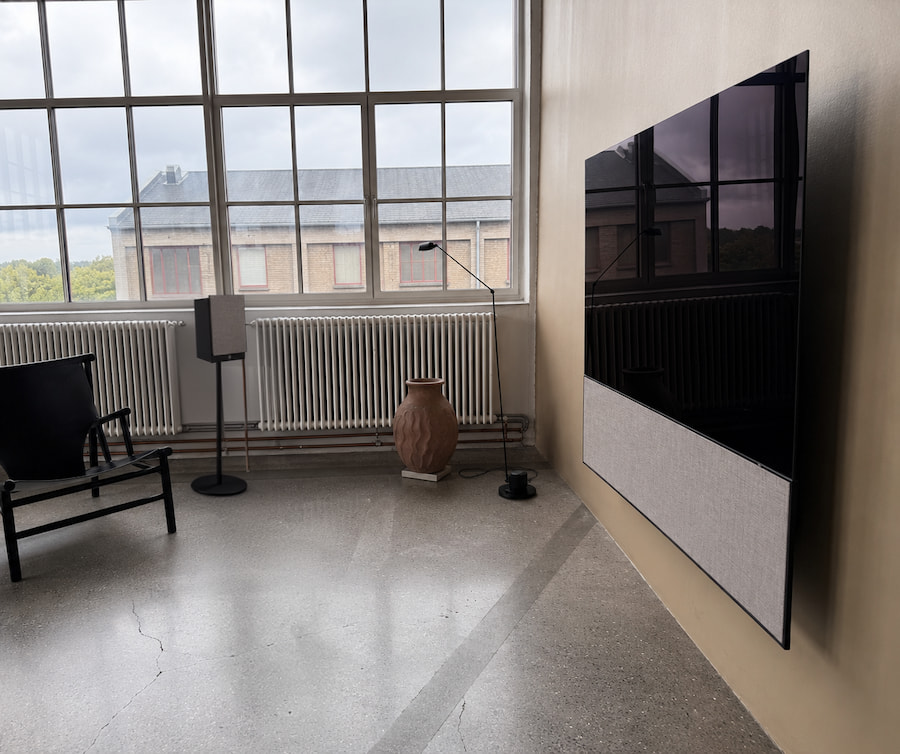
Calling CANVAS HiFi a soundbar has always been somewhat misleading. The Danish company’s original CANVAS is an active stereo loudspeaker system designed to integrate physically with a television, either mounted beneath the display or used as part of a freestanding installation. Its interchangeable fabric and wood fronts can be matched to common TV sizes, giving the television and speaker system the appearance of a single piece of furniture rather than a screen with another black box hanging underneath it.
CANVAS is also deliberately TV-brand agnostic. Its universal mounting system works with flat-panel televisions from multiple manufacturers, and CANVAS specifically lists Samsung, Sony, Panasonic and LG among the supported brands. Current versions are designed to visually match 55, 65, 75, 77, 83 and 85-inch screens, while CANVAS SOLO can be installed independently beneath televisions of other sizes.
Advertisement
Canvas The HiFi Frame includes black (as shown) or silver border for a sleek look.
Samsung represents a deeper relationship. CANVAS and Samsung introduced The HiFi Frame at IFA 2025, initially pairing the audio system with Samsung’s The Frame and The Frame Pro televisions. CANVAS has since expanded that concept to other Samsung displays, giving buyers considerably more freedom over the television they put inside the integrated frame.
The other major piece of the CANVAS formula is BACCH 3D, technology developed from research led by Princeton University Professor Edgar Choueiri. BACCH stands for Band-Assembled Crosstalk-Cancellation Hierarchy, and its purpose is very different from conventional virtual surround processing.
With normal stereo loudspeakers, sound from the left speaker reaches both ears, as does sound from the right speaker. BACCH processing reduces that acoustic crosstalk so the spatial information contained in the recording can reach the listener’s ears more accurately. The result can produce a soundstage that extends well beyond the physical position of the two speakers, including greater apparent width, depth and, with suitable material, a more convincing sense of three-dimensional space.
That is why CANVAS has previously been able to create such an expansive presentation from the front of the room without installing physical surround speakers behind the listener.
The new Dolby Surround and Dolby Atmos expansion changes that equation. BACCH 3D is still responsible for what happens across the front of the room, but CANVAS can now become the front end of a system with real surround, rear and height channels. And that is where the new Almando InMedio becomes important.
Advertisement
What Is Almando InMedio and How Does It Work?
The component that makes CANVAS HiFi’s move into full multichannel home theater possible is the new Almando InMedio, developed in collaboration with German electronics specialist Almando. Rather than forcing CANVAS owners to add a conventional AV receiver or processor, InMedio handles surround decoding, channel distribution and connectivity while allowing CANVAS to remain responsible for the front soundstage.
Advertisement. Scroll to continue reading.
The control box is compact enough to be hidden inside the CANVAS converter bracket, keeping another piece of electronics out of sight beneath the television. InMedio determines which channels are sent to CANVAS and which are routed to the active loudspeakers positioned around or above the listener.
In the configuration CANVAS considers the logical starting point, BACCH 3D continues to handle the front left, front right, center and subwoofer channels through CANVAS, while InMedio provides up to eight additional channels for surround, rear and height speakers. The complete system can therefore support configurations up to 7.1.4 channels, with those eight external channels connected either by wire or wirelessly using WiSA HT.
Owners can also mix the two connection methods rather than committing the entire system to one or the other. Almando lists an 8-channel analog output alongside 8-channel WiSA HT transmission on the WiSA-equipped version of InMedio, while CANVAS receives its signal from InMedio through the latter’s optical digital output. Almando says several versions of InMedio are planned for different system requirements, so not every model will necessarily include every connection option.
Advertisement
InMedio is also considerably more than a surround breakout box. Its current specification includes HDMI eARC/ARC, optical and coaxial digital inputs, RCA analog input, USB-A, UPnP networking and B&O PowerLink, along with an integrated Gigabit Ethernet switch. Almando also lists AirPlay, Spotify Connect, TIDAL Connect, Qobuz Connect, internet radio and podcast support, giving InMedio the potential to become the connectivity hub for a much larger CANVAS-based AV system.
The surround ambitions extend beyond Dolby as well. Almando currently lists Dolby Atmos up to 7.1.4, Auro-3D and MPEG-H 3D Audio, along with WiSA HT and B&O Wireless PowerLink compatibility. There are also separate 12V trigger outputs for audio and video equipment, which could make InMedio useful in more elaborate installations involving external amplifiers, projection screens and other components.
System configuration is divided between two apps. Surround setup, channel assignment and the external loudspeakers are controlled through the Almando Play app, while BACCH 3D continues to be configured through the CANVAS app. Outputs can also be assigned for subwoofer duty, allowing wired or wireless subwoofers to be incorporated into the system.
There is another way to configure the front of the room, but it comes with a significant tradeoff. Users can install separate front left and right speakers and have CANVAS operate primarily as the center channel. According to CANVAS CEO Laust Nielsen, doing so disables BACCH 3D because CANVAS is no longer handling the left and right front channels required for its crosstalk-cancellation processing.
Advertisement
That is why the more interesting configuration keeps CANVAS responsible for everything across the front. Owners retain the BACCH 3D presentation that distinguishes CANVAS from a conventional soundbar or center speaker, but gain physical surround, rear and overhead channels where they can provide a genuine benefit.
There is one important caveat before anyone starts measuring the ceiling for four Atmos speakers. The InMedio being shown at IFA 2026 is the first prototype, not a finished production unit. Almando says the hardware is ready, but software development and certification are still being finalized. The extensive feature list therefore represents the platform Almando is currently developing, and some details could change before commercial availability.
System Audio Is the First Partner, But Not the Only Option
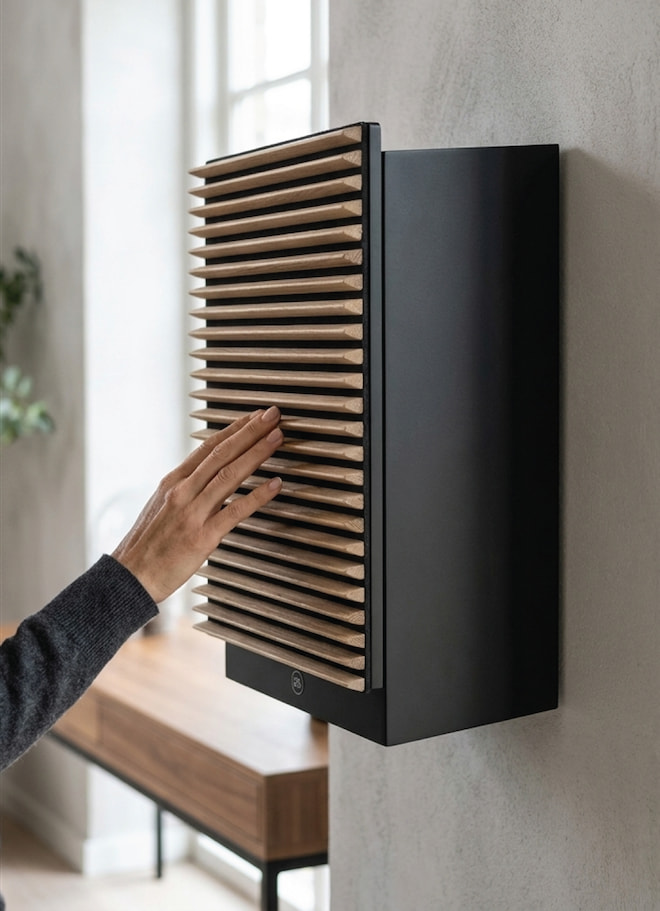
System Audio Silverback On-wall Speaker with Oak Grille
CANVAS HiFi is not developing its own surround, rear or height loudspeakers for this system. Instead, the company is taking a more open approach, and its first loudspeaker partner is fellow Danish manufacturer System Audio.
Selected models from System Audio’s Silverback range of active loudspeakers will be adapted to better match the CANVAS design language, including coordinated Kvadrat textiles, colors and wood finishes. The idea is to provide CANVAS owners with a surround solution that looks like it belongs in the same room rather than a collection of unrelated boxes assembled around the television.
System Audio is also a logical technical partner because its Silverback loudspeakers are already active and support WiSA HT. The compact Silverback 1, for example, incorporates 80 watts of amplification, WiSA HT connectivity and an analog line input, and can be mounted on a wall or placed on a shelf. System Audio already positions the Silverback platform for expandable home theater applications, so adapting selected models for the CANVAS ecosystem does not require reinventing the loudspeaker.
Advertisement
Advertisement. Scroll to continue reading.
But buying System Audio speakers will not be mandatory.
Laust Nielsen explained to eCoustics that owners will be free to use other compatible active loudspeakers, either through InMedio’s wired outputs or wirelessly through WiSA HT. Conventional passive loudspeakers can also be used, although they will require separate amplification between the InMedio and the speakers. That opens the door to considerably more ambitious installations and means existing home theater owners may be able to incorporate loudspeakers and amplifiers they already own rather than starting again from scratch.
That flexibility is important because adding more speakers is not necessarily the starting point for everyone who buys CANVAS. One of the system’s greatest strengths is how effectively it can create an unusually large and immersive soundstage without any surround or height speakers at all.
Advertisement
Canvas HiFi and Silverback On-wall surround speakers with Danish Kvadrat burnt umber fabric grilles.
The Bottom Line
We have experienced CANVAS extensively at audio shows and in a home environment, and BACCH 3D can make the presentation extend well beyond the physical dimensions of the system. With suitable movies and music, the sense of width, depth and spatial placement can be rather startling considering that all of the hardware is sitting beneath the television. CANVAS itself describes BACCH 3D as part of the combination of loudspeaker design, room correction and crosstalk cancellation that allows the system to produce a much larger presentation than its physical footprint would suggest.
That flexibility may ultimately be more important than the System Audio partnership itself. Some buyers will want the cleanest possible installation with matching Silverback speakers, while others may already own active loudspeakers, amplifiers, or passive speakers they want to integrate. InMedio gives both groups a path forward without turning CANVAS into a closed ecosystem.
Adding Dolby Atmos changes the conversation because CANVAS is no longer limited to competing with premium soundbars and all-in-one TV audio systems. It can now become the front end of a genuine 7.1.4 Dolby Atmos home theater while retaining BACCH 3D where it arguably makes the most sense.
Advertisement
With Playback Distribution now handling CANVAS HiFi in North America, the company also has a much stronger route into dealers, custom installers and demonstration rooms on this side of the Atlantic. The InMedio hardware and software still need to reach production, but if CANVAS and Almando deliver what they are showing at IFA 2026, this could turn one of the more interesting alternatives to a conventional soundbar into something considerably more ambitious.
Electric cars took a 25% share of European registrations in July, with sales up 51% year on year against 4.1% growth for the market as a whole. Chinese brands took 34% of plug-in hybrid sales, a segment EU countervailing duties do not currently cover.
Electric cars have stopped being a minority interest in Europe. Registrations rose 51% in July against the same month last year, taking a 25% share of the market, according to Dataforce figures covering 98% of new registrations across the EU, UK, Iceland, Norway and Switzerland.
Electric is now carrying the industry. The whole European market grew 4.1% in July and 5.7% across seven months, while EV sales rose 37% over the same period, after a fifth of EU registrations went electric in the first half.
The volume behind the percentage is 277,006 cars. That is a single month, in a region that was arguing about range anxiety three years ago.
Advertisement
Two markets are doing the heavy lifting. France reached a 35% electric share on more than 44,000 registrations, and Germany 29.3% on nearly 79,000.
The July bestseller list is European. The Skoda Elroq came first, followed by the Volkswagen ID.4 and the Renault 5 E-Tech, in the window Tesla’s slump opened.
Across the year Tesla is still ahead. The Model Y leads on 115,759 registrations, up 55%, with the Elroq second on 67,679 and the Model 3 third on 57,086.
The plug-in hybrid market is a different country. PHEV sales rose 15% to 125,530 in July, and Chinese brands took 34% of them.
Advertisement
They also took most of the top of the table. The BYD Seal U was July’s best seller, the BYD Atto 2 second and the Jaecoo 7 fourth, and the year-to-date podium is entirely Chinese.
The explanation is a gap in the tariffs. EU countervailing duties reach battery-electric cars built in China, at rates running to 45.3% for SAIC, and they do not reach plug-in hybrids, which is why Volkswagen asked for protection.
That gap is closing. The Commission moved in June to extend duties to Chinese plug-in hybrids, having denied any such plan in January, with rates expected to land below the battery-electric levels because batteries are a smaller share of a hybrid’s value.
So July is the last clean photograph of the loophole. A quarter of Europe’s new cars are electric, and the fastest-growing slice of everything else is being built somewhere the tariffs have not yet arrived.
If Sony thought that the outrage over its decision to make the next PlayStation entirely disc-less was going to dissipate quickly, it was wrong. There are actually multiple organic campaigns to protest Sony’s decision to ditch physical media now. We already talked about the plans for a purchase and usage blackout of all things PlayStation in late August. Now we can add to that a social media campaign of sorts going around, called “No disc, no buy.” While the name is self-explanatory as to its purpose, what’s interesting is how this mantra and pushback using it are appearing everywhere.
Choosing to leave chat open for this particular State of Play was a curious move from Sony, given how the forthcoming action-RPG from Chinese team S-Game has already courted controversy when it was revealed its pre-orders are entirely digital, with no disc-based version being touted. That led to much speculation that the October 29, 2026 game may be releasing without a physical version at all, leaping to the front of the pack ahead of Sony’s plan to eliminate discs entirely by 2028. And given there’s nothing PlayStation-related of late that isn’t inundated with furious remarks from those fighting for physical media, you can be sure they were out in force throughout the presentation.
The comments relating to bringing back physical media, or simply repeating the “NO DISC NO BUY” mantra, went on and on and on. Sony since attempted to play hide and seek with all of this by disallowing chat replay on the video, but the damage had already been done.
And this isn’t a one-off. In other game showcases Sony has likewise been inundated with fury over its decision to end physical media for its next console. And, as Kotaku rightfully points out, while digital purchases dominate the American market, that isn’t the case internationally. In other words, the anger overseas is far greater than here in the States.
It’s tempting to write off these respondents, given the reality that now only 15 percent of PlayStation games are ever bought on disc. However, what often goes forgotten is that the 15-percent stat represents the United States, and doesn’t reflect the game-buying habits of players in many other countries. According to a recently published report from Germany, Germans still buy 58 percent of their games on physical discs. In France, disc buyers are also still in the majority at 55 percent. Even Sony’s homeland of Japan sat at 51-percent physical when it came to Resident Evil Requiem. Meanwhile in the UK, reports suggest 40 to 45 percent of games are still sold on real, plastic discs. The end of discs is going to disproportionately affect many countries, and there’s a good chance these people are letting their voices be heard!
Will Sony listen to this sizable percentage of its customers? I doubt it. Surely the company knew this would be a controversial decision and has likely already steeled itself in preparation for all of this anger. Digital games mean more margin for Sony and they’ve done whatever math which has led them to believe that this is the more profitable decision.
Advertisement
This means that game preservation will become much harder. It also means the stories we currently hear about people having their digitally “bought” games ripped away from them are likely to increase exponentially.
The AI boom has disrupted the way engineers work, introducing new tools to learn, raising expectations for what teams can achieve in a workday, and making it harder to get hired in the first place. This makes it difficult to advise students on which specific coding languages or technical skills they should learn. So amidst the uncertainty, advice for young professionals often turns to a common refrain: Be adaptable. But what does adaptability look like in practice?
Engineers often operate on the cutting edge of technology, so dealing with change is a normal part of the job, says Samantha Brunhaver, an associate professor of engineering at Arizona State University, in Tempe. Yet university curricula and training in the workplace often don’t prepare students for this.
“We tell engineers that they need to be adaptable when they graduate, but we don’t actually explain what that means, demonstrate what that looks like, [or] help make sure that they’re developing it,” says Brunhaver, who received a National Science Foundation award in 2020 to study how to foster greater workplace adaptability among young engineers. For this ongoing project, she has interviewed engineering managers, early career employees, and undergraduates about their experiences.
Part of the problem, she says, is that every employer has its own idea of what to be adaptable means. Generally, Brunhaver defines adaptability as “the ability to recognize that a change or uncertainty is occurring, and then respond effectively to that change.” But the skill is context-dependent. In software engineering, that might mean responding to turnover in the tools you use on a daily basis, while aerospace or biomedical engineers may need to keep track of changing procedures and regulations. “Managers are all saying adaptability is important,” Brunhaver says, “but defining it in different ways.”
Advertisement
At the same time, engineers are all contending with changes beyond these industry-specific expectations. Jobs in the technology, media, and telecom sectors are experiencing the fastest pace of skill turnover, according to a June 2026 report on the effects of AI from the professional services network PwC. And the World Economic Forum’s most recent Future of Jobs Report, published in 2025, found that employers across all sectors expect 39 percent of workers’ core skills to change by 2030. This uncertainty can be uncomfortable. But with the right mind-set and support from leadership, adaptability can help keep you afloat.
How to Cultivate Adaptability
The AI transition is a big shift—but not an unprecedented one, says Jenna Butler, a research scientist at Microsoft who studies developer well-being and productivity.
During this type of paradigm shift, there is often a “chaos period” when a new normal is being established, Butler says. In AI’s case, it challenges the understanding of what a computer can do. “I think we’re still in this in-between, difficult period that we’ve seen before, but [it] is maybe moving faster than it has historically.” Software engineers—in one of the fields most affected by AI—are now facing a significant increase in code review. “If you ask 20 developers, you get 23 different ways of working with it. Everyone is trying to sort it out,” says Butler, who describes this period as “the uncomfortable middle.”
“We tell engineers that they need to be adaptable when they graduate, but we don’t actually explain what that means, demonstrate what that looks like, [or] help make sure that they’re developing it.”– Samantha Brunhaver, Arizona State University
Advertisement
Brunhaver says one way educators can help prepare students before they enter the workforce is by offering a diversity of real-world experiences, such as internships, team-based projects, community service, and leadership roles. Each of these teach students to adapt to different challenges, easing their transition from school to work.
It’s also important to encourage reflection, Brunhaver adds, noting that metacognition helps individuals use the skill more effectively. “In order to adapt, you have to think that you have agency and the ability to get through a situation.” Ultimately, it comes down to three steps: Perceive a need to adapt, evaluate your options, and act.
For those already in the workforce, that action may mean taking the time to learn new tools and ways of working. Software engineering, for instance, may soon rely more on prompting models and managing agents than coding line by line. “I think people who went into software because they like solving problems are going to have a lot of fun, and people who just enjoy the art of writing code are not,” Butler says.
The More Things Change…
Although the tools engineers use on a daily basis are evolving, the core responsibilities of the job are more stable than they may seem, says Andy Hunt, a software developer who coauthored The Pragmatic Programmer (Addison-Wesley Professional) in 1999. The book outlines practical coding principles, and has been taught in many computer science classrooms. When Hunt was working on the 20th anniversary edition of the book, he was surprised by how much of the advice still applies. And now, seven years later, he maintains that belief.
Advertisement
“The fundamental part of the job is problem solving and communication, and that’s always going to be there,” he says.
Hunt emphasizes the importance of developing systems thinking over particular tools. To him, identifying as a Java programmer, for instance, is “like a carpenter saying, ‘I’m a hammer user,’ or ‘I specialize in cordless drills.’ ”
He acknowledges that today’s hiring process, in which companies often filter résumés for certain languages or years of experience, makes it harder to embrace a more expansive way of relating to your job. Employers, he says, should recognize that “the tech’s not the hard part, and it never has been. Understanding information theory, understanding systems thinking, understanding what constraints you’re up to—that’s still the hard part.”
With this type of misalignment between employers and employees, AI is also intensifying an old source of tension: How can engineers slow down enough to adapt and learn new tools when the pressure to become more productive keeps mounting?
Advertisement
Who’s Responsible for Enabling Change?
Young engineers need to embrace change. However, educators and employers also play a role in building a successful workforce. From the educator’s perspective, Brunhaver says “we need to be more explicit about what [adaptability] means and why it’s important.” Managers, meanwhile, should invest in their employees’ professional development.
Microsoft research scientist Butler often encourages leadership to set aside intentional time for continuous learning for their engineers—even just an hour a week—without any expectation that they will produce code or progress in their daily work. “I realize that’s difficult,” says Butler. “I would encourage people to do it on their own, but I would really encourage organizations and leaders to do it, because you’re not going to get this sudden change in your people if they don’t have time and space to learn how to work differently.”
This also means providing enough instruction, Butler adds. When developers aren’t given enough guidance on adopting something new, while being pressured to increase productivity, they risk doubling down on the tools they already know and burning out.
“I do imagine the next number of years could be challenging,” Butler says. Engineers will have to adapt to find their place in an evolving workforce—but they also have a say in shaping that future.
Advertisement
“Being adaptable sort of implies that you’re going to change based on what’s happening around you, and I would really like people to realize the change that’s happening is somewhat up to us,” she says. All individuals have a choice in how they use AI, for instance, and which models they use. “We need to be adaptable and go with the flow to a degree, but we also need to be directing that flow. The future with AI is absolutely not predetermined.”
This article appears in the September 2026 print issue as “The Adaptable Engineer.”
The amount of gas-fired power in development for data centers in the US has nearly doubled in less than a year, new research released Tuesday shows. The findings illustrate just how heavily tech companies are relying on building private fossil fuel plants to power data centers—and how fast artificial intelligence’s energy demand has grown.
Global Energy Monitor, a research firm, has been tracking gas-powered projects that have been announced, are in development, or are under construction in the US. In January, the group found that there were 97 gigawatts of gas projects in development exclusively for data centers at the end of 2025, a massive increase from just 4 gigawatts tracked in early 2024. Now, in an update to the research released Tuesday, the group says that as of mid-2026, that demand pipeline has jumped to more than 189 gigawatts. (A gigawatt can power roughly a million homes.)
“Increasingly, the US gas power buildout is getting tied directly to the data center buildout—you can’t talk about one without the other,” says Jenny Martos, a research analyst at Global Energy Monitor who worked on the report.
Over the past two years, data center builders have increasingly turned to private power facilities, known as behind-the-meter plants, to bypass lengthy grid connection times. This approach can also potentially help avoid saddling ratepayers with higher bills, an issue that’s become a flashpoint as data center opposition mounts around the country. The Trump administration has encouraged tech companies to bring their own power, introducing a voluntary pledge that’s been signed by the likes of Microsoft, Meta, Google, and OpenAI, as well as several Republican governors and some of the country’s biggest utilities.
Advertisement
Adding that much natural gas power comes with a hefty climate cost, particularly because many of the facilities are being built with inefficient turbines, which can increase emissions. As WIRED has reported, some of these gas plants are permitted to emit more greenhouse gases each year than many small- and medium-sized countries.
Global Energy Monitor also tracks energy projects in countries around the world, including China, the world’s largest importer of natural gas. Much of that gas is used for producing products like fertilizer and plastic.
But the country does have a modest fleet of natural gas plants, and it’s seen a surge in gas-fired facilities under development in recent years. In the early 2020s, it even outpaced the US in gas plant construction. The data center boom means that the US has again surpassed China as the country with the most gas projects in the pipeline, according to Global Energy Monitor.
The shift illustrates how China, which the Trump administration has repeatedly emphasized as the US’s rival in the AI race, is relying less on gas fueled-sources in its data center buildout.
Advertisement
“Overall, the data center boom in China is really oriented around renewables,” especially solar and hydropower, says Kyle Chan, a fellow at the Brookings Institution. Many data centers being built in China are being sited in rural areas that have an excess of renewable energy production. Chan says that while there have been a few attempts to develop private power for data centers, they’re “smaller projects.”
He adds that the Chinese buildout of renewables on the grid is a deliberate choice by the government to ensure energy independence.
The US building gas power for data centers “in the near term might make sense economically, and especially if you want to power these data centers fast, and you don’t have access to the same kind of cheap renewable energy that you might be able to have in China,” he says. “But over the long term, you pay a price for that—obviously, in terms of emissions, but also, I think in terms of not investing in your own clean energy sector.”
Not all of the projects that Global Energy Monitor tracked will get built, Martos notes. Many of the projects the group has tracked haven’t yet begun construction. “There’s a lot of uncertainty: financing, your local opposition, data, your moratoriums, the turbine constraints to supply equipment—there’s so many factors,” she says.
Advertisement
Still, “if all of these get built, you’re locking in emissions for decades,” she says.
There is a tendency in consumer electronics to justify every new SKU with more features, another chip, three additional listening modes and an app nobody asked for. Meze Audio has gone in the opposite direction with the new ALBA S.
The Romanian headphone manufacturer has taken its existing ALBA wired IEM, removed the bundled USB-C DAC/amp adapter and lowered the U.S. price from $159 to $129. The actual earphones have not been redesigned or retuned. The ALBA S uses the same 10.8mm dynamic driver, 32-ohm impedance, zinc-alloy and anodized-aluminum construction, pearl finish and 3.5mm detachable cable as the original model.
That might not sound especially revolutionary, because it isn’t. What makes the ALBA S interesting is that Meze has removed an accessory rather than compromising the product itself to reach a lower price.
For a lot of headphone enthusiasts, that makes considerable sense.
Advertisement
Related Reviews:
What Changed?
The original ALBA was introduced in 2024 as Meze’s entry-level IEM and included a custom 3.5mm-to-USB-C adapter with an integrated DAC/amp. That made it particularly convenient for smartphones and tablets that had already sent the headphone jack to the same retirement community as the MiniDisc player. We covered the original ALBA when it launched at $159.
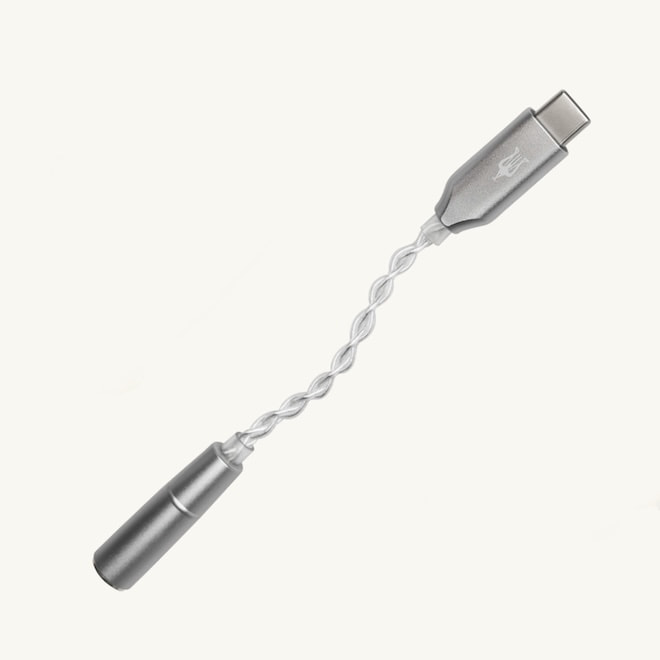
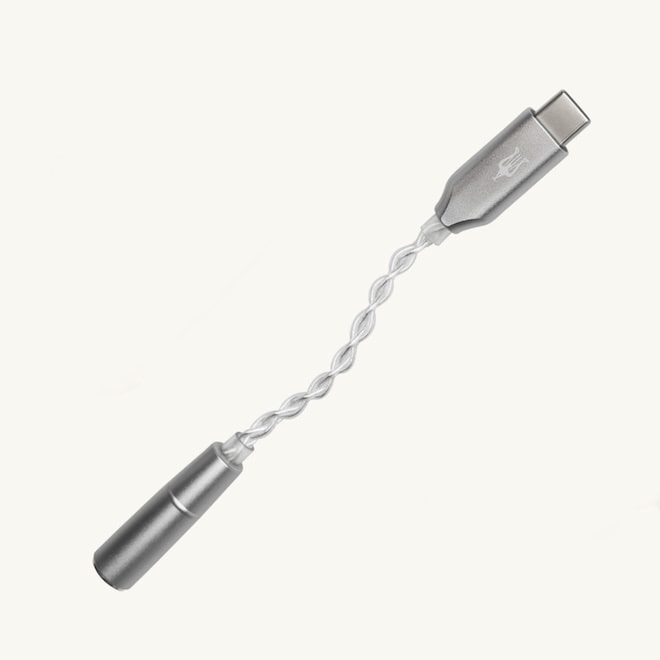
Meze Audio USB-C to 3.5mm Headphone Adapter is NOT INCLUDED with Alba S.
The ALBA S costs $129, and that adapter is no longer included. World Wide Stereo already lists the new model as in stock and ready to ship, confirming that this is not merely a future product announcement.
Inside the box are the ALBA S IEMs, a 1.2-meter braided silver-plated copper cable terminated in 3.5mm, four sizes of silicone ear tips, an eco-leather carrying pouch and documentation. Meze’s USB-C adapter remains available separately for anyone who decides later that they need one.
Nothing about the acoustic specification has been reduced to get there.
Meze ALBA S Specifications
Driver: 10.8mm dynamic
Frequency response: 15Hz to 25kHz
Impedance: 32 ohms
Sensitivity: 109dB SPL/mW at 1kHz
THD: Less than 0.1% at 1kHz
Connector: 2-pin
Cable: 1.2-meter braided SPC, 3.5mm termination
Weight: 14 grams
Included ear tips: S, M, L and XL
Price: $129 USD
Those specifications match the ALBA platform Meze has already been selling, which is the important point here.
Why Does the ALBA S Make Sense?
Anyone already carrying a dongle DAC, portable DAC/headphone amplifier, DAP or laptop with a headphone output was effectively paying for another USB-C adapter with the original ALBA whether they needed it or not.
Advertisement
That group is not exactly small at CanJam.
Advertisement. Scroll to continue reading.
The ALBA S acknowledges that an entry-level IEM buyer and an entry-level audio-system buyer are not necessarily the same person. Someone using an iPhone with no existing audio hardware may still find the regular ALBA package more convenient. Someone with an iFi, FiiO, Cayin, Astell&Kern, Questyle or any number of other portable sources probably doesn’t need Meze to put another dongle in the drawer.
More importantly, Meze did not substitute a cheaper shell, fixed cable or different driver to reach $129. That gives the ALBA S a cleaner value proposition than the usual stripped-down model where the lower price arrives with an asterisk the size of Romania.
Advertisement
Who Should Consider It?
The ALBA S makes the most sense for listeners who already have a source with a 3.5mm headphone output or own a USB DAC/amp they prefer. It is also a potentially strong first wired IEM for someone moving away from wireless earbuds who cares more about sound quality, replaceable cables and long-term ownership than ANC, touch controls or Bluetooth codecs.
It also drops Meze into an extremely competitive part of the IEM market.
The Sennheiser IE 200 remains $159.95 in the U.S., while models such as the Moondrop ARIA2 sell for $99.99 and the Truthear HEXA for $89.99. Those products take rather different approaches to drivers and tuning, but they demonstrate how crowded the sub-$200 IEM category has become.
Meze’s advantage is familiarity. The ALBA has already been on the market for more than two years, and we have also used it as a comparison point in our review of the much more expensive $899 Meze ASTRU. Our reviewer described the ALBA as an excellent “baby ASTRU,” with a related tonal balance despite the enormous price difference.
The ALBA S therefore isn’t asking buyers to gamble on a new tuning simply because the price moved downward.
Advertisement
Hear the Meze ALBA S at CanJam SoCal 2026
There is also an excellent opportunity to hear it before buying one.
CanJam SoCal 2026 takes place August 29 and 30 at the Irvine Marriott in Orange County, California, and attendees will be able to try the ALBA S during the show. CanJam remains one of the best places to compare IEMs because dozens of competing products can be auditioned in the same building without ordering six pairs and explaining the resulting credit-card statement to your significant other.
eCoustics will be at CanJam SoCal throughout the weekend, covering the new headphone, IEM, DAC and amplifier launches and getting some listening time with the ALBA S ourselves.
The Bottom Line
The Meze Audio ALBA S is not a new acoustic design and Meze is not pretending otherwise. It is the existing ALBA presented in a way that makes more sense for listeners who already own the hardware required to drive it.
Removing the USB-C DAC/amp adapter saves $30, brings the price down to $129 and leaves the parts that actually determine how the ALBA fits and sounds untouched.
Advertisement
Advertisement. Scroll to continue reading.
There is still a strong argument for buying the $159 ALBA if you need the USB-C adapter and want everything in one box. But for the growing number of wired-IEM listeners who already have a better dongle DAC or portable source in their pocket, paying less for the same earphones is not a compromise.
Sometimes the most useful product update is the one where the manufacturer has the good sense to remove something.
When the Buchardt Audio E50 arrived in 2024, it quickly established itself as one of the Danish manufacturer’s most ambitious passive bookshelf/standmount loudspeakers, combining premium drivers, careful cabinet construction, and the neutral, controlled presentation that has become central to Buchardt’s identity.
For 2026, Buchardt Audio is expanding the E Series with the new E50-S, but this is not an E50 replacement or a straightforward upgrade. Instead, the E50-S takes the core engineering and design philosophy of the E50 in a different direction, with changes intended to make the speaker a better fit for listeners whose systems, rooms, or tonal preferences may not have aligned with the original model.
That makes the E50-S more interesting than another routine product refresh. Buchardt is effectively offering two interpretations of the same high-end passive speaker platform, giving buyers a choice based on how they actually listen rather than simply declaring the newest version the better one.
The E50-S
The E50-S retains the core DNA of the E50, but Buchardt has been careful not to position it as an upgrade. Instead, it offers a different approach, with changes intended to broaden the E Series’ appeal and make it better suited to a wider range of systems, rooms, and listening preferences.
Advertisement
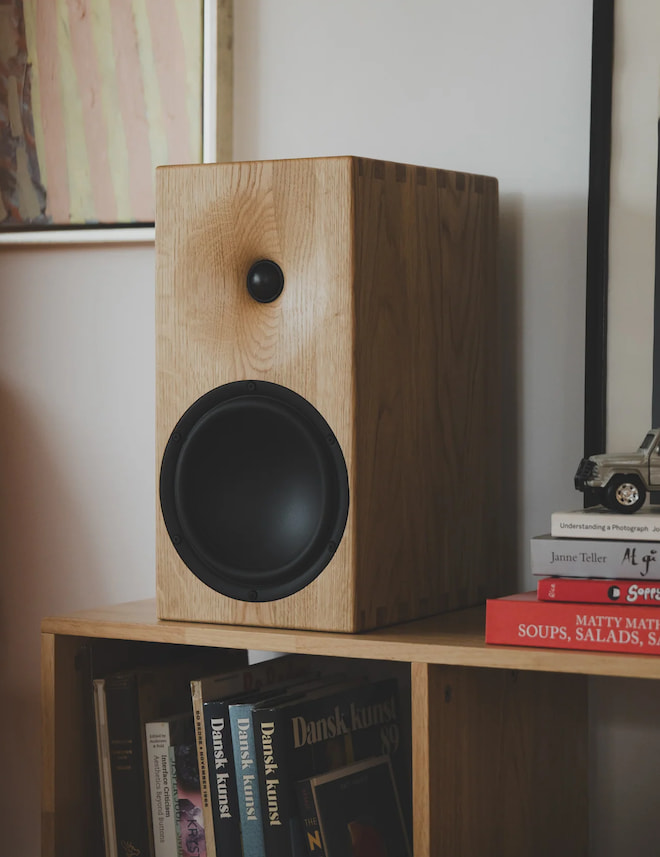
Buchardt E50-S stand-mount speaker in rounded charcoal finish
What’s New
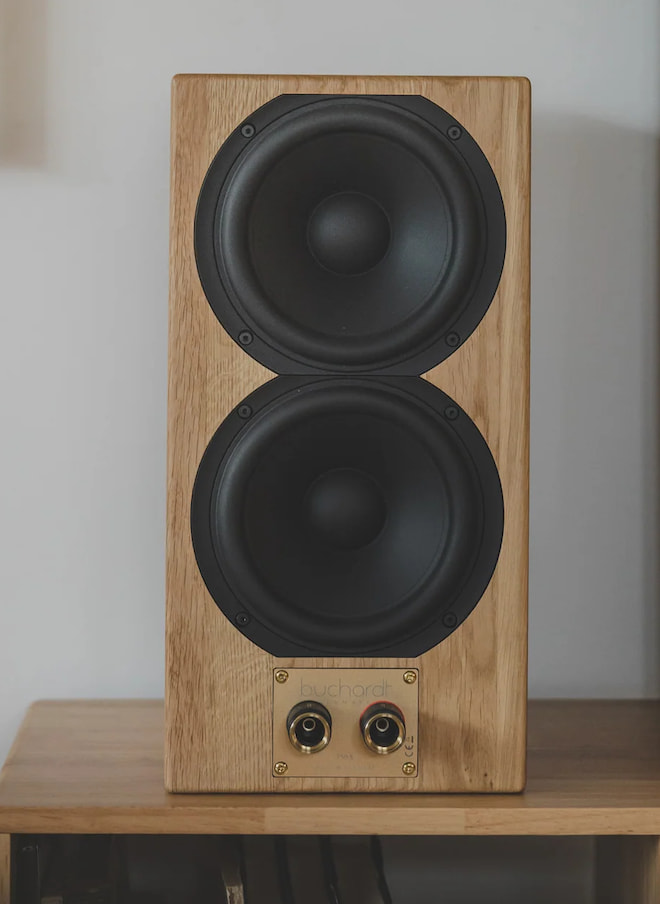
The E50-S (the “S” stands for sensitivity) is slightly larger than the original E50. Its width has been increased by 1 cm (0.4 inches) to accommodate a larger woofer. The new driver is a custom-made 7.5-inch Satori woofer that uses the well-regarded TeXtreme cone material, manufactured by Oxeon AB in Sweden.
In addition to the larger woofer, the E50-S employs a slightly different tweeter and a unique resistor-free crossover.
Another highlight is a custom-designed waveguide tailored specifically to the E50-S cabinet, tweeter, and woofer. Rather than casting the waveguide in aluminum, as Buchardt does with some of its other speakers, the E50-S waveguide is CNC-machined directly into the 28 mm solid-wood front baffle, combining craftsmanship with acoustic precision.
Sonic Differences
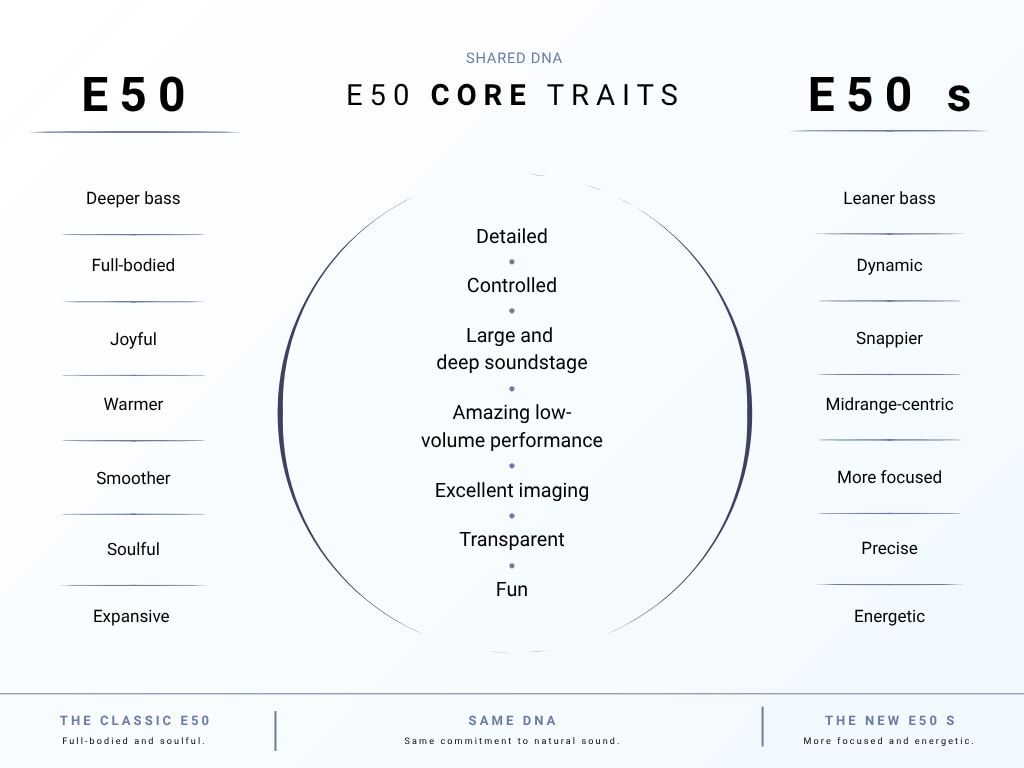
Despite the larger woofer, the E50-S delivers slightly less overall bass output, placing greater emphasis on the midrange. Buchardt says this gives vocals greater presence and creates a more textured presentation, allowing the midrange to occupy a more prominent position in the mix.
The high frequencies remain airy and highly detailed, but are tuned to sound smooth and non-fatiguing. Because treble performance has been one of the most praised aspects of the original E50, Buchardt has retained much of the same overall high-frequency character with the E50-S.
Buchardt also describes the E50-S soundstage as more detailed, clear, and engaging than that of the E50. The presentation is more forward, with greater perceived air around instruments and a stronger emphasis on bringing vocals closer to the listener.
Advertisement
Compared with the E50, the E50-S is intended to sound more energetic, holographic, and responsive, with greater apparent detail and more precise imaging without becoming analytical or cold. The original E50, by comparison, offers a more relaxed and laid-back presentation, with what Buchardt describes as an easygoing “paper-cone” tonal character.
Advertisement. Scroll to continue reading.
No loudspeaker excels in every area, and speaker design inevitably involves choosing which characteristics to prioritize. That is ultimately why the E50 and E50-S can exist side by side rather than one simply replacing the other.
Buchardt E50-S Loudspeaker (rear)
Who is the E50-S For?
Buchardt has indicated that the E50-S is intended for listeners who have heard or already own the E50 but want something slightly less bass-heavy in a similar size and form factor. That could make it a better fit for smaller rooms, setups where the speakers need to be positioned closer to walls, environments where excessive bass can become problematic, or listeners who simply prefer greater emphasis on midrange detail and clarity.
Another reason to choose the E50-S over the E50 is amplifier compatibility. Buchardt says the E50-S can be driven by amplifiers starting at just 15 watts, including lower-powered tube designs, while still producing respectable output levels. The E50 is considerably more demanding and is recommended for use with amplifiers rated between 60 and 200 watts.
Advertisement
The E50 offers the more linear frequency response of the two, although neither follows quite the same tuning approach as the Buchardt S400 Series.
Tuned by Ear
The E Series is designed using objective engineering principles, but the final voicing is ultimately done by ear. Both the E50 and E50-S incorporate a variation of the BBC dip, although it is more pronounced on the E50-S, which also has a slightly lighter bass response. According to Buchardt, this modified tuning is intended to make both speakers easy to listen to over extended periods without becoming fatiguing.
Interestingly, Buchardt has deliberately chosen not to publish performance measurements for the E50-S, despite having done so for the original E50. The company argues that measurements can “color” a listener’s expectations before they have actually heard the speaker.
Buchardt says that during development and A/B testing of the E50-S against its other models, the listening impressions of its team did not always correlate with what the measurements suggested they should be hearing. That experience appears to have reinforced the company’s decision to emphasize listening over published graphs when presenting the E50-S.
Advertisement
As Buchardt Audio puts it rather directly: “Just trust us: if you want a frequency-linear speaker, the E50-S is not what you are looking for!”Buchardt Audio E50
Small room: 15 watts Medium room: 45 watts Large room: 100+ watts All into 4 ohms
Measurements (HWD)
395 x 190 x 284 mm 15.5” x 7.5” x 11.1”
395 x 200 x 284 mm 15.5” x 7.9” x 11.1”
Weight
8.6 kg each (19 lbs)
9 kg each
Speaker grilles
Included
Black grilles included
Warranty
10 years
10 years
Cabinet
19 & 28mm (front baffle) solid european wood
19 & 28mm (front baffle) solid european wood with internal bracing
The Bottom Line
Buchardt Audio has spent more than a decade building its reputation around compact loudspeakers that combine thoughtful engineering with a direct-to-consumer business model, and the E50-S is a good example of why the company has developed such a loyal following. Instead of replacing the E50 with something supposedly “better,” Buchardt has created a genuine alternative with a larger 7.5-inch Satori/TeXtreme woofer, higher sensitivity, a resistor-free crossover, CNC-machined waveguide, and deliberately different voicing.
The E50-S makes the most sense for listeners who value midrange presence, vocal clarity, imaging, and a more forward presentation over maximum bass weight or strict frequency linearity. Its ability to work with amplifiers starting at around 15 watts also makes it a more practical option for lower-powered tube and Class A designs. The original E50 remains the better choice for listeners who prefer greater bass output, a more relaxed presentation, and a more linear overall response.
Neither model is inexpensive, but Buchardt is competing in a category where compact passive loudspeakers can quickly climb well beyond $5,000 per pair. The Radiant Acoustics CLARITY Series is one obvious alternative in a similar price range, while the $7,000-per-pair Dynaudio Legend would normally merit consideration as well. For U.S. buyers, however, Dynaudio’s decision to exit the North American market in fall 2026 makes the Legend a much less straightforward comparison going forward.
What makes the E50-S interesting is that Buchardt has resisted the temptation to declare it the new flagship and make the E50 obsolete. These are two different interpretations of the same basic idea. Your room, amplifier, and listening preferences should decide which one makes more sense.
Advertisement
Advertisement. Scroll to continue reading.
Buchardt E50-S Loudspeaker in natural oak.
Price & Availability
The E50-S Passive Bookshelf/Standmount Speaker is priced at €4,100 per pair and is available directly from Buchardt Audio (contact Buchardt Audio for U.S. pricing). Just as its E50 predecessor, the E50-S is made and assembled in Denmark from in-house and European-sourced parts.
To dig really deep into the Buchardt E50-S story and technologies, refer to the official E50-S product page linked above.
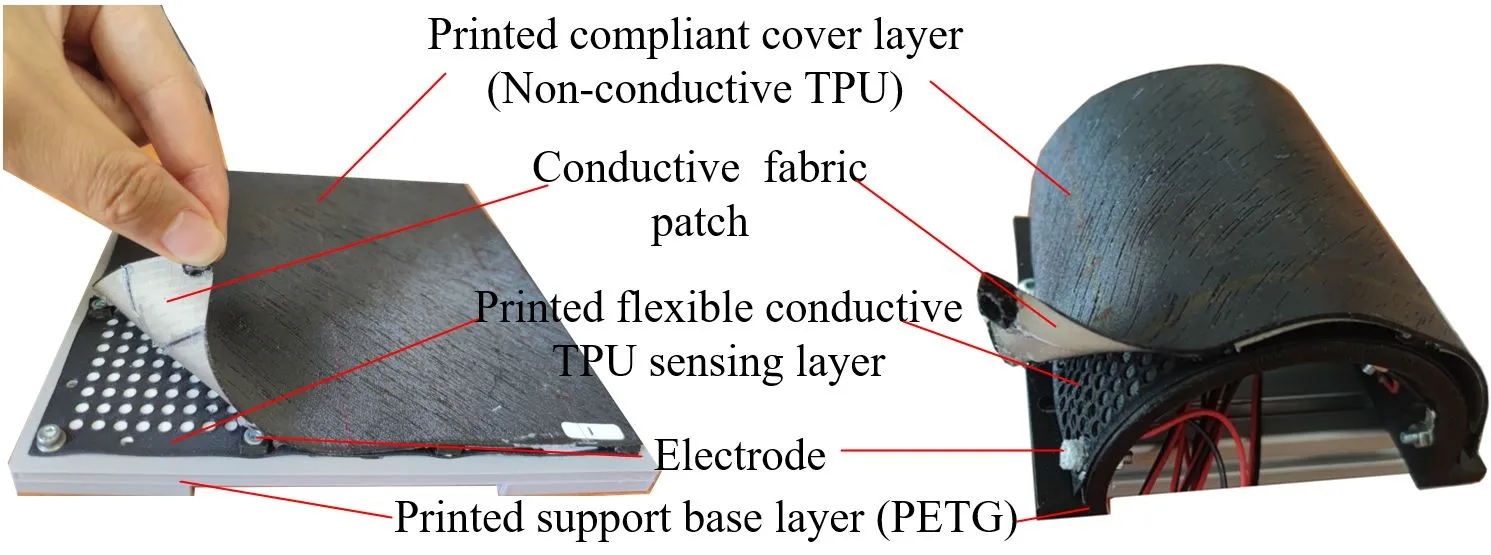
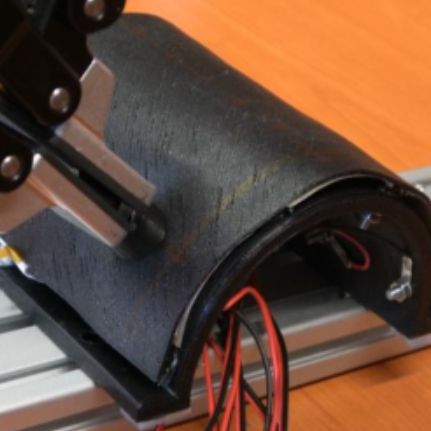
Schematic diagram of the touch-sensitive skin. (Credit: Haofeng Chen et al., ArXiv, 2026)
Hypoesthesia, more commonly referred to as numbness, is one of the more distressing ailments that can affect us humans, primarily because it reminds us of just how much we rely on our sensation of touch in daily life. From experiencing the world around us, handling objects, noticing when you just bumped into that side table again and the comforting hug of a fellow human being, touch is perhaps the most important of our senses.
In that regard the recently published research by [Haofeng Chen] et al. on giving robots a skin that can experience touch seems rather important as it would give especially humanoid robots a more natural way to interact with their environment, using feedback from touch.
Poking the artificial skin. (Credit: Chen et al., arXiv, 2026)
One of the essential parts of biological skin is that it is teeming with sensors, at a density level that provides excellent resolution as required, down to sensing e.g. small surface imperfections with one’s finger tips. Replicating this with an artificial skin for robotics has always been a problem, due to the wiring and/or reliability nightmare this poses with typical approaches. Instead of focusing on many individual sensors, [Chen] et al. focused on effectively creating the equivalent of a resistive touch screen in skin format.
The basic principle underlying the demonstrated artificial skin is electrical impedance tomography (EIT), which uses surface electrodes to form a tomographic image based on measures electrical resistivity. Core here is the flexible TPU layer with electrodes and the conductive fabric patches attached to the top TPU cover layer. The electrodes continuously measure the resistivity, with disturbances from those patches due to touch events on the cover layer altering these values. From this EIT can be used to reconstruct the location and strength of the touch event.
The results from the created prototypes were promising, with only 16 electrodes sufficing to create a fairly accurate pressure map. Hardware-wise this makes it thus quite uncomplicated, with the characterization of the TPU porosity and such along with the EIT algorithm (provided in the paper) probably being the biggest hurdles for hobbyist recreations.
Flashlights used to be relatively simple devices that featured simple on and off switches, a fixed brightness setting, and few other features. Like virtually everything else in the world, technological advances have made flashlights smarter and more effective than ever before. USB rechargeable batteries and upgrades in brightness capabilities have helped brands like our favorite, Fenix, bring new levels of versatility to the flashlight market. Meanwhile, the ability to focus light more directly remains an important feature for many users.
That last advancement isn’t entirely new when it comes to flashlights, of course, as manufacturers have long built that feature into different styles of torches. As the name implies, focusing flashlights do indeed feature the ability to adjust the width and focus of the device’s beam. In essence, it allows users to cast light on specific items and areas in the dark when the need is there. The beam can also easily be adjusted to cast a wider light when you want to illuminate a larger area.
As you can imagine, a focusing feature can be as important as brightness in emergency scenarios, as it allows you to highlight a specific point in the dark. This can help you know exactly what lies ahead if you need to be out and about. The same may be true in a dimly lit basement or crawlspace, or if you’re camping off-grid and need to venture away from the tent in the middle of the night to, well, you know.
Advertisement
How to focus the light on your flashlight
As noted, the addition of a focusing feature is hardly the result of a recent technological breakthrough. In fact, the design behind the feature is pretty simple in principle and requires little more than the addition of an internal lens or reflector in the flashlight’s headlamp. That feature can then change the focus of the torch based on how far or how close it is to the light source itself.
Advertisement
The question then becomes how users can move the lens or reflector when the need to focus or unfocus the beam of the flashlight arises. Lights from the market’s top manufactures tend to feature two different styles of flashlights with focusing abilities. The first style allows users to change focus by simply sliding the headlamp of the flashlight forward or backwards on the shaft. The further away from the light the head is, the narrower the beam will be. The principle is the same with the second style of focusing flashlight, though these move the head forward and backward by way of a twisting motion.
There are no major advantages to one style or the other for focusing flashlights, though a push and pull model may be easier for some to adjust with one hand. Versatility aside, there may be a couple of drawbacks to consider with either model, in that the o-rings used in many focusing flashlights can wear out over time, making them less effective at protecting them from dust and moisture. Likewise, the need for moving parts may make focusing flashlights less durable than their fixed head counterparts.
Upscaling software is getting better all the time, but there are still some caveats to be aware of.
Simpson33/Getty Images
The shift from analogue film to digital video happened quickly. Before you knew it, tape-based video recorders had been replaced with digital video cameras and, later still, smartphones. 4K is now the gold standard for video creation, with 1080p left as its lower-quality sibling.
Despite widespread 4K adoption, there’s still plenty of video being created in 1080p. And that’s not to mention content made in the past, from home videos to old movies, available in standard definition or even lower. That can lead you to thinking about converting video to 4K, giving it a boost to make it look as sharp on a modern 4K OLED display as something you’d shoot today. Converting a video to 4K is possible, but it’s a process with a lot of steps and points to consider first.
Advertisement
Converting a video to 4K means creating millions of new pixels
Klenger/Getty Images
When we talk about 4K and 1080p, or ultra-high and high definition, we’re talking about the amount of pixels contained within each video frame. For ultra-high definition video content, which is what most people usually mean by 4K, that means a resolution of 3,840 x 2,160 pixels, versus 1,920 x 1,080 pixels for 1080p high definition video. Standard definition video, meanwhile, sits at either 480 or 576 vertical lines depending on your region; width can vary depending on how the content was originally filmed. You can also find cinematic 4K resolutions, so-called ‘true 4K’ or DCI 4K, with a resolution of 4,096 x 2,160.
You can upscale any output file to 4K — 4K is just the frame size. To move from 1080p to 4K, you’re going to need three additional pixels on-screen for every original pixel that was recorded, so four times overall. Managing that without losing any quality is the issue. That is almost impossible and simply changing the resolution won’t reveal a hidden version with extra clarity or sharpness, either.
Traditional upscaling software uses interpolation to manage this, scaling up each frame and figuring out what it should look like. How accurate upscaling software can be is the main question. It has to estimate what the pixels should look like, but it can’t recover the real detail if it wasn’t recorded in the first place.
Often, this means that sizing up will make the footage look softer. The “guess-timation” used to add extra pixels often makes it look smooth as a result. Sharpening can help around the edges, but it’s a Goldilocks dilemma: too much, or not enough, can ruin it. The same is true for noise reduction, which can make the final footage look unnatural.
Advertisement
Professional 4K restorations often return to high-quality original source files
Microgen/Getty Images
If you’re a professional looking to convert a video to 4K, you’re going to want to work from the best source data available to you: the original source files. The better that source data is, the better quality a job you’ll be able to achieve.
The HD restoration of Star Trek: The Next Generation proves how tricky this can be if you want to get the process right. That upgrade, commissioned by CBS in 2011, used the show’s original 35mm film negatives, which were described as having a quality equivalent to a 20 megapixel resolution, to remaster all seven seasons of the show from their original broadcast quality to 1080p for Blu-ray release. 25,000 reels of original film stock were used, with visual effects and CGI upgrades to help the process. It took over three years to complete and reportedly cost the studio over $12 million, according to one of its producers.
Ironically enough, the analog film to digital video conversion here makes this type of job easier. If you’re working with an older digital master file with a set resolution, you’re stuck with a fixed number of pixels to work from. The original negatives used in the Star Trek upgrade capture far more detail that wouldn’t have made it into the original television broadcasts.
Advertisement
Unfortunately, when the best source files are already low resolution, you’re not able to work from the real data. All of the missing pixels that are created are guesses. The best result is that this will look pretty convincing, but it won’t be 100 percent true to form.
Home upscaling uses interpolation or AI to fill in the gaps
Bombermoon/Getty Images
Unlike CBS, you’re unlikely to have $12 million to convert your videos to 4K. Home users converting video to 4K will instead have to choose between traditional interpolation or newer AI-based tools. Both methods will create the additional pixels needed to fill out an enlarged 4K frame, but not in the same way.
4K upscalers using interpolation rely on good, old-fashioned math. It takes a pixel from a single frame and looks at the color and brightness of the pixels around it. From there, it’ll try to calculate how the pixels surrounding it will look. At a basic level, it might achieve this by sheer duplication, but more advanced algorithms will focus on trying to preserve edges and avoid jagged lines. The end result is pretty predictable, but one problem is softness. Interpolation can’t magically recreate genuine detail or textures, making it seem slightly fake. Your TV might be able to do this automatically too, with varying degrees of success.
Advertisement
Luckily, AI upscaling looks to solve that problem. These models are trained on examples of low and high-resolution images that allow it to identify how common features should look on your screen. Instead of estimating each pixel, the AI is predicting what a sharper image will look like.
The result can be sharper and more convincing but, like interpolation, it won’t be an exact match for the real world. AI upscalers can also introduce unusual artifacts that interpolation doesn’t. AI models are constantly improving, however, so the quality and consistency you’ll see today might seem antiquated in just a few years’ time.
If you’re working with older video, you may also need to think about interlacing, where video frames were split into two halves by odd and even horizontal lines, with each line refreshing each time the screen refreshes. Modern displays don’t use interlacing, but older broadcasts meant for CRT-like screens would. Converting these kinds of videos will require you to de-interlace before upscaling, although how well you’ll be able to upscale a 480i NTSC video to 4K in a way that maintains a watchable video quality is questionable.
Upscaling tools often feature plenty of configuration to help you get the result you want, whether it’s using AI or interpolation. If a single pass through doesn’t get you the result you’re looking for, you can tweak the settings to have another go (as long as you’ve got the disk space).
Advertisement
Upscaling a 1080p video to 4K doesn’t automatically improve it
Kateryna Onyshchuk/Getty Images
You can’t just whack a 1080p video into an upscaler and expect a perfect 4K video at the end. You can achieve it in the technical sense, by increasing the size of the video frame, but getting the video to scale up without losing quality is difficult. It may take several attempts to get the result to match up to your expectations.
It’s easier to achieve if you’ve got good source material to work from, and the smaller the leap in resolution, the better. Upscaling from 1440p to 4K, for instance, won’t require as many ‘fake’ pixels as 1080p to 4K, or worse, 480p to 4K. 4K upscaling software can only guess what the missing pieces, those extra pixels, should look like. AI is making the process easier, and potentially better, but a like-for-like match isn’t guaranteed.
Resolution isn’t the only factor at play here, though. To save on disk space, video files can be compressed with a lower bitrate, meaning the amount of data saved for each second of video is lower. Upscaling to 4K won’t undo that, and you can’t just lose common compression artifacts like blocks or banding if you’re working from a low bitrate file. It all comes down to the source, and if that’s good enough, upscaling becomes a whole lot easier to handle.


























































You must be logged in to post a comment Login