Accurate and speedy sensors for areas other security sensors aren’t made for
Tests showed excellent performance on garage door and fence gate
Abode’s hub automatically connects to sensors and makes setup one of the easiest I’ve done
Offers a variety of automations and alert options through Abode’s intuitive app
Sensors have many additional applications for sheds, tilting windows and more
Abode’s standard hub requires a permanet Ethernet connection
The outdoor contact sensor design could use another pass
Security systems have stayed the same for years, with only minor advances, but 2026 is changing that. I’ve seen new sensors start to hit the shelves, from presence-sensing devices that can detect people without needing security cameras to small sensors that monitor tilting, opening and tampering all at once. But Abode’s latest offering is even more unique.
If you’ve been looking for a special device to help monitor access to backyards, detached buildings on your property, or garage doors that always seem to get left open, these sensors are a remarkable answer, particularly if you already have an Abode system. If not, I’ll cover what you need to know from my testing.
Unboxing and setup
Abode’s new sensors work flawlessly with its existing hub.Tyler Lacoma/CNET
I was able to fully test an Abode starter security kit as well as its two new sensors for this review, providing a clear look at how the security brand functions. As far as setup experiences go, this has been one of my speediest. And I’ve tested many different systems.
Abode’s beginner’s kit is small, offering an indoor sensor, motion sensor and fob, along with the hub. I was pleased to find out, after downloading the app and connecting the hub, the other base devices automatically added themselves and made the setup process effortless, smoother than nearly any other security system except possibly Ikea’s affordable sensors.
Adding the new garage and outdoor sensors also proved quick, with pairing happening only seconds after I installed the batteries and typed in the activation code.
Advertisement
Abode’s hub connects to new sensors in a snap.Tyler Lacoma/CNET
The one problem I have with Abode’s system is how the standard hub connects to Wi-Fi. This hub requires an Ethernet connection to your router or gateway, not only during setup but all the time. That’s a not-so-small problem if, like me, you have a router, gateway and other necessary devices already taking up all nearby outlets, which forced me to jury-rig a solution for the hub while I was testing.
Abode’s Iota hub does offer Wi-Fi, but that requires a more expensive upgrade to a $200 starter kit, not including extra sensors. It’s baffling that Abode’s standard hub still doesn’t support Wi-Fi when every other brand does. Check the outlets near your router before you choose this solution.
Garage sensor installation and performance
Abode’s garage sensor can sense any kind of tilt up and down.Tyler Lacoma/CNET
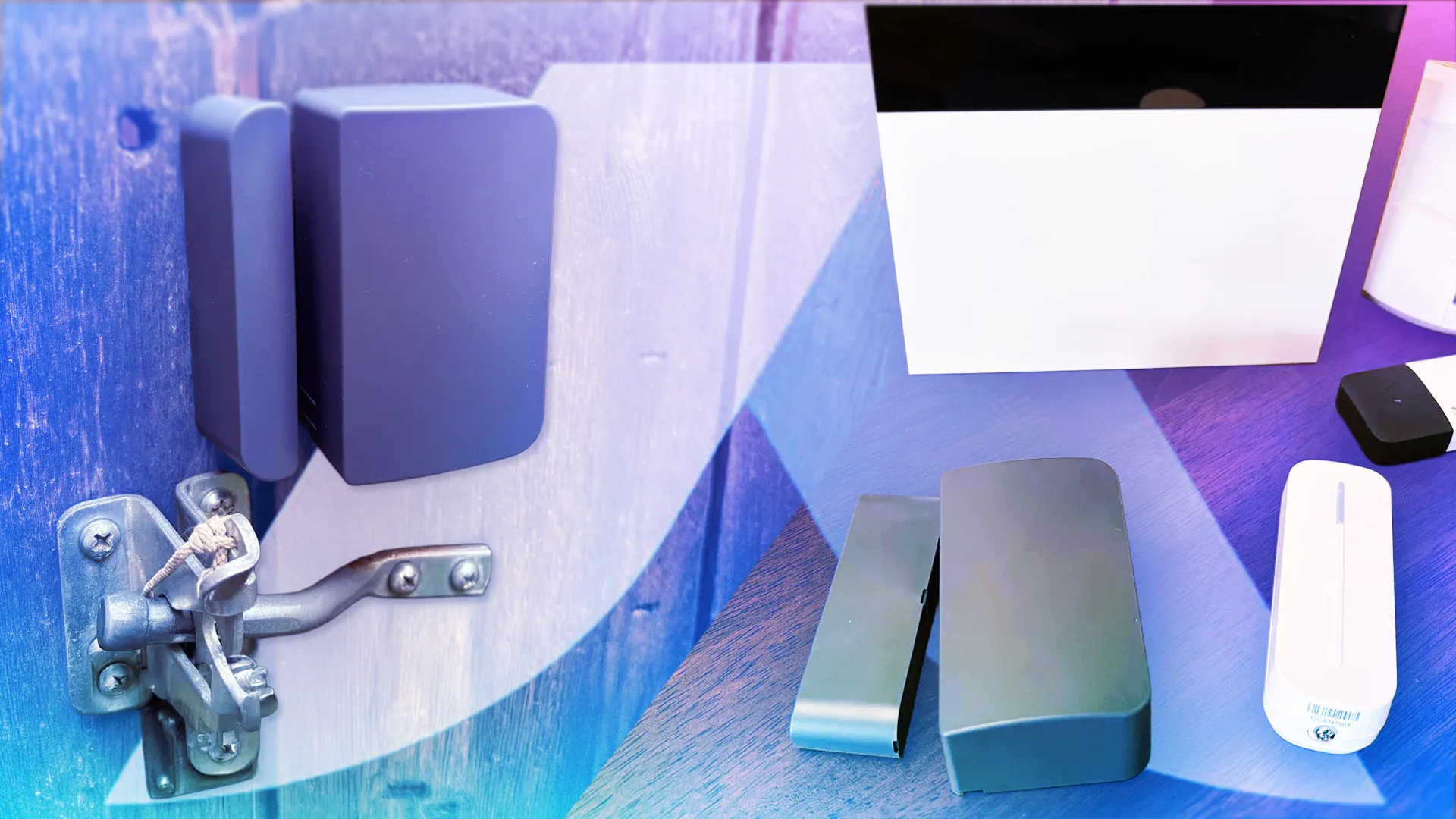
Equipped with internal gyroscope technology, Abode’s garage door sensor is made to detect orientation, and setup couldn’t be simpler. Using the included adhesive strips, I slapped the small monitor on my closed garage door, and it began accurately detecting open/closed states immediately in the Abode app.
Smart garage door motors and controllers can also do something like this, plus app controls, but this is one of the first standard home security systems to expand to the garage, and adding a single $50 sensor is far more affordable than replacing your garage controller entirely. Abode let me know if the garage was left open, and advised me on unexpected garage door movement when no one was at home, just as advertised.
Placing the sensor shouldn’t be any trouble, no matter what kind of garage you have. It sticks onto the inside of the garage door where there is plenty of space, and doesn’t require any complicated calibration. You may have to reset the sensor after placement to make sure it’s reading open and closed states correctly, but that, too, takes only moments.
Finally, you could use this sensor on anything that tilts up and down like a garage door, such as tilting windows, so it could have other applications in your home.
Advertisement
Gate sensor installation and performance
Abode’s outdoor sensor is a little annoying to put together, but works like a charm.Tyler Lacoma/CNET
Abode’s outdoor access sensor proved more complicated than the garage monitor. Bulkier than most access sensors and equipped with weather-resistance capabilities, it’s made to tell when anything outdoors opens and shuts. The two parts sense when they are close or when they’ve moved apart, with a bit of extra leeway compared to indoor sensors, since outdoor fences and other access zones have varied designs and gaps.
The complex housing proved adequate, but was more frustrating to install and is in need of some future refinements. The screw-in backplate, for example, had pop-out sections to make room for the screws, but the plastic base was so thick I couldn’t put out the sections at all, not even with a hammer that nearly destroyed the base itself (I used another tool to carve them out eventually, not an ideal situation). And the battery casing was so tight and awkwardly designed, I was afraid forcing the batteries in would harm the nearby, unprotected circuitry.
In these ways, the design feels a little too close to a prototype model for me, and it probably needs another pass or two. But it works, and works very well, when it’s finally set up.
Connected to my old fence gate, the sensor accurately and immediately told me whenever it was opened or closed. I’ve found that gate left open more than a few times, so this gave me welcome peace of mind. I also tested it during a stormy downpour, which did nothing to affect the performance of the sensor.
You may want to turn off beeps from the hub that sound every time it alerts to the sensor being opened, but Abode provided a setting to do just that. However, alerts and monitoring aren’t the only things these sensors can do.
Advertisement
App automations that benefit from Abode’s support
Abode’s app allows for customizations and automations, too.Tyler Lacoma/CNET
One of the most impressive parts of Abode’s security platform is how it maintains connections to other third-party smart home gadgets, from Google Home connections to the rare-to-find Apple support for certain devices. There are also Abode’s own devices, including cameras and smart locks, which naturally work with the system
Abode’s CUE function offers automations similar to Google Home or Apple Home.Tyler Lacoma/CNET
When Abode’s system is armed, triggering one of these garage or gate sensors can trip the system and sound a siren. But using the CUE automation tool in the Abode app, I found you can also set up many other types of automations, depending on what you want to activate.
This can include setting lights to turn on a warning glow if a fence gate is left open, or automatically unlocking your door when the garage is opened. You can also set times for these triggers to work, so they only function in the evening, on weekdays or only trigger after a certain time (the gate has been left open for 2 hours, for example). This adds more possibilities if you want to expand your smart home, but it’s not necessary to get value out of these sensors.
Remember, Abode’s app can also support third-party integrations with other devices.Tyler Lacoma/CNET
If you want to pay for an Abode subscription, you can add more features with plans starting at $80 a year, but these are mostly camera-focused, and I don’t think they’re necessary for these sensors at all.
Final thoughts on Abode’s new access sensors
Abode’s sensors signal helpful new trends in the home security world.Tyler Lacoma/CNET
Abode’s newest sensors offer exceptional performance in spots other sensors aren’t really made for. They’re also more expensive than typical sensors, and the outdoor sensor might need another design pass in the future, but I otherwise found them easy to set up and start using for customized, helpful alerts.
One word of caution: Abode’s standard hub requires an Ethernet connection, so consider where you’ll put it, and if you’ll need to run Ethernet cable anywhere during installation. Otherwise, this system sets itself up in minutes.
I’m enjoying this 2026 wave of security tech innovations. They’re finding new applications in the home – and finding them with success. Aqara’s multipurpose sensor is one such model. Abode’s proved another strong example, so if you’ve been looking for extended security capabilities outdoors or in the garage, take note of this update.
Tyler Lacoma
Senior Editor / Home Security and Smart Home
Advertisement
Tyler has worked on, lived with and tested all types of smart home and security technology for over a dozen years, explaining the latest features, privacy tricks and top recommendations.
With degrees in business management, literature and technical writing, Tyler takes every opportunity to play with the latest AI technology, push smart devices to their limits and occasionally throw cameras off his roof, all to find the best devices to trust in your life. He always checks with the renters (and pets) in his life to see what smart products can work for everyone, in every living situation.
Living in beautiful Bend, Oregon, gives Tyler plenty of opportunities to test the latest tech in every kind of weather and temperature. But when not at work, he can be found hiking the trails, trying out a new food recipe for his loved ones, keeping up on his favorite reading or gaming with good friends.
See full bio
Apple’s nano-texture screen might not hide the crease forever.
Benjamin Fanjoy/Getty Images
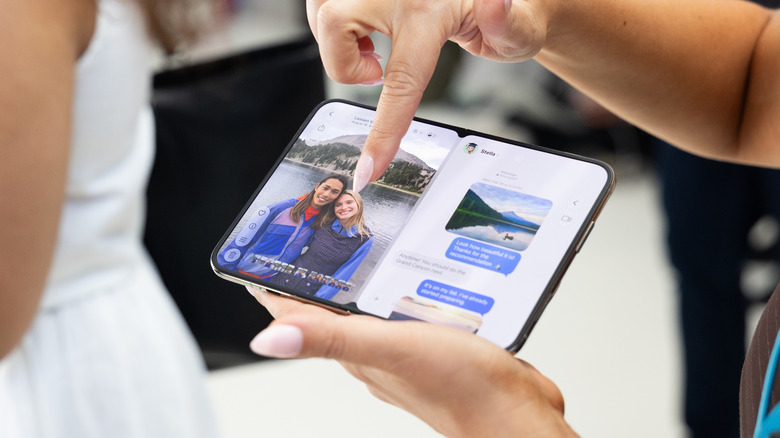
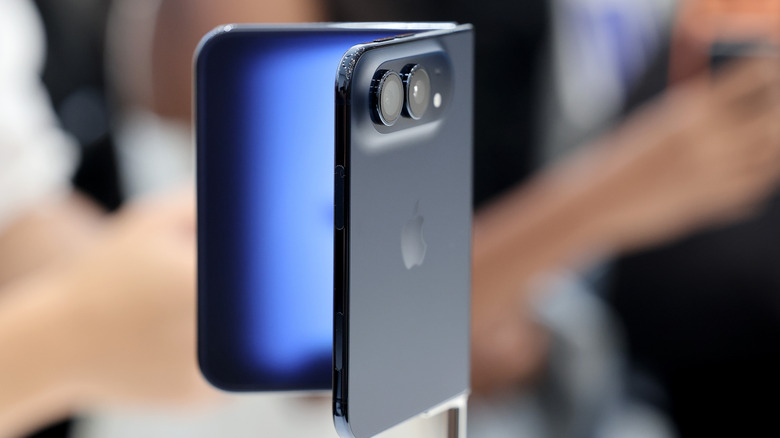
Apple’s first foldable phone is coming soon, and it caused quite a stir upon its announcement earlier this month. That’s no surprise, since everyone was waiting to see how the iPhone Duo would address the competition’s shortcomings. It’s still early to tell, given that it won’t hit stores until next month and all we’ve had so far are a few brief hands-on experiences.
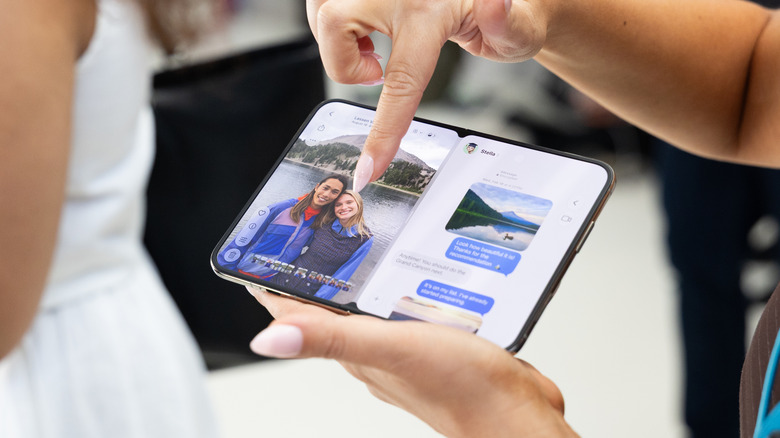
But one of the most anticipated features is the new nano-texture display, which promises to make the crease on the screen much less visible. In fact, it does seem to be much less noticeable — but it will be a long time before we know for sure.
Advertisement
The biggest trade-off with foldable phones: The crease
tinhkhuong/Shutterstock
Historically, foldable phones have had an unpleasant flaw: the crease. And it all comes down to physics. With today’s technology, it’s nearly impossible to have a flexible display that folds without leaving any crease marks. Companies have gotten much better at this, and the creases have become less noticeable even though they’re still there.
Apple took a clever approach to make the crease less visible. The iPhone Duo’s screen has a matte coating on top, which significantly reduces light reflection. Some people who have seen the iPhone Duo in person say the crease is barely noticeable. Others say it’s still visible and that it’s only a matter of time before it gets worse.
Our own hands-on report found the crease is “easier to feel with your finger than observe with your eyes.” But does that mean Apple has finally solved the crease problem once and for all with the iPhone Duo? Not really.
The biggest problem here is cumulative damage. Take the Galaxy Z Fold 8 as an example. Samsung ships its foldable phones unfolded in the box, and when you look at them for the first time, the screen looks super flat. But as you start folding and unfolding it, the crease definitely becomes more noticeable. Now imagine folding that screen thousands of times over the course of months or years. It’s not hard to find photos of foldable phones with damaged screens online.
Advertisement
Only time will tell if Apple got it right
Benjamin Fanjoy/Getty Images
Multiple Apple executives have publicly stated how proud they are of the iPhone Duo and how they believe the device will be much more durable than the competition. But we won’t know for sure how the iPhone Duo’s nano-textured screen will perform until the phone reaches a mass of consumers. Not only that, but it will likely take some time before we have any idea of how future-proof it is. That will certainly be something many YouTubers will put to the test in their extreme durability experiments.
So yes, the crease on the iPhone Duo’s screen was barely visible during the hands-on sessions at the Apple event. But even the most thorough hands-on impression is really just a snapshot of a crease that hasn’t had time to develop yet. The reviews that will roll in soon, ours included, can only speak to what the iPhone Duo looks like fresh out of the box. That might be different after using the device for a few months.
Still, you have to give Apple credit here. The fact that the company created a screen that already makes the crease look much less noticeable in the first few days is certainly promising. It’s also something we should expect to see the competition rushing to catch up on soon.
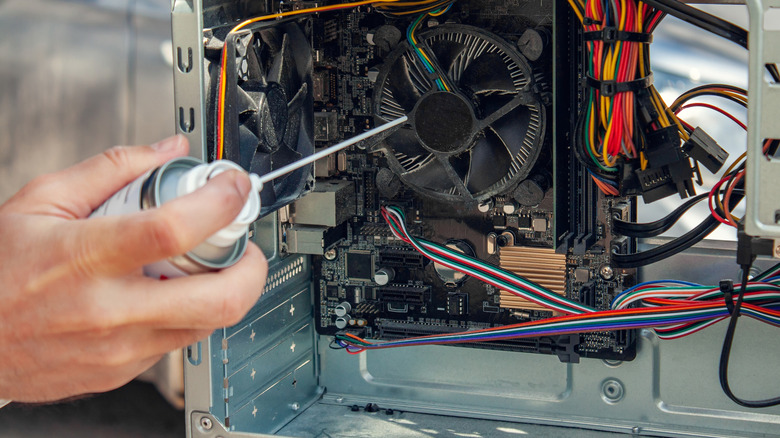
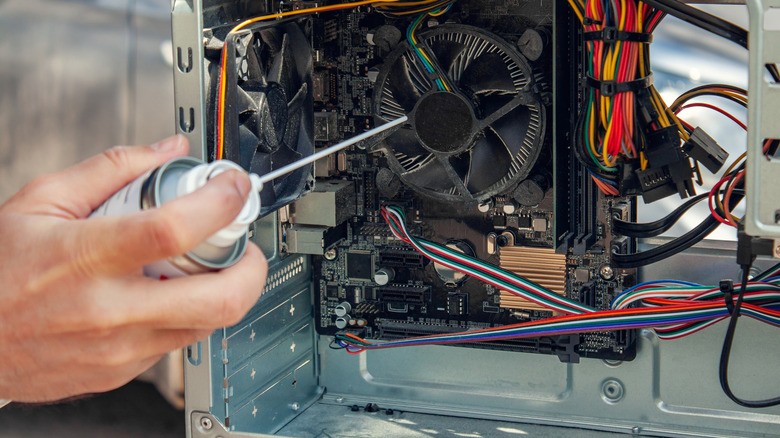
Safely cleaning your electronics means using the right method to ensure a smooth process. That’s why many people choose compressed air, as it can get the job done both quickly and efficiently. But before you begin cleaning with compressed air, it’s important to turn the device off and disconnect it from its power source, if possible. It’s the best way to ensure you and the components themselves stay safe while working.
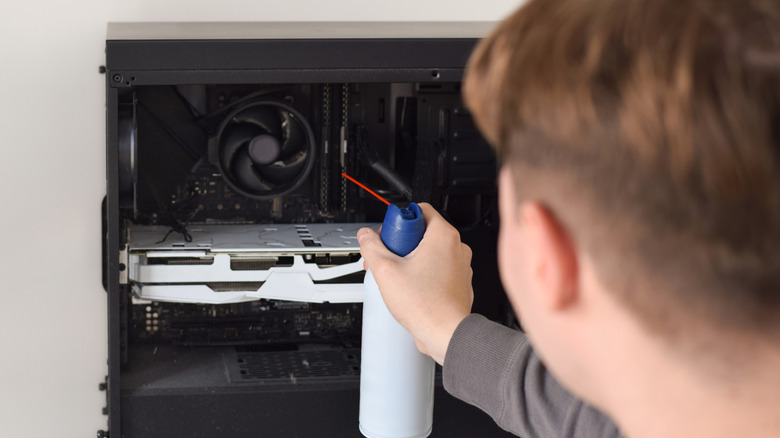
Once the device is powered down, hold the can upright and keep it a reasonable distance from the device. Use short, controlled bursts of compressed air and work around the areas that need cleaning. This will allow dust and other debris to escape, rather than just pushing it farther down into the device. For a device like a keyboard, be sure to use the straw that comes with the can and move from left to right as you clean.
When it comes to cleaning external vents, you should direct the airflow away from the device rather than blowing dust farther into the case. The vents allow warm air to escape from a computer so it’s important to keep them clear. If the compressed air doesn’t quite get the vents as clean as you’d like, you can wipe them down with a clean, soft cloth. This can help remove any remaining dust that could otherwise interfere with the computer’s cooling system.
Advertisement
The risks of using compressed air
Juliealexk/Getty Images
While compressed air can make cleaning electronics easier, using it incorrectly can cause problems for your devices. For example, an excessive amount of air pressure can damage the cooling fan blades, which is why an air compressor should never be used as a canned air substitute. There’s also a danger of accidentally pushing dust and debris farther down into the vulnerable parts of a device, which could make the problem worse later on. Finally, if you do not hold a compressed air can upright, you can accidentally blow freezing propellant into the machine instead of just compressed air.
That risk isn’t limited to larger devices, as Sony warns against using compressed air to clean its earbuds. Compressed air can push dust into the microphone or the speakers of its earbuds, potentially interfering with their operation. Presumably the same warnings could be used for all small electronics, so keep that in mind.
Advertisement
This is why it’s always important to check your owner’s manual before using compressed air on any electronic device. This also applies to the instructions for the type of compressed-air duster you’re using. Air dusting devices often have their own safety precautions, along with information on how to direct the airflow. The same goes for traditional cans of compressed air. Taking the time to read both sets of instructions can help you avoid a potentially costly mistake.
Stanley Black and Decker has shaped the tool industry since 1843. With its headquarters located in the United States, the company has a global presence in 60 countries. It operates more than 100 manufacturing facilities worldwide, employs 50,000+ people, and is committed to making customers’ lives easier by developing exceptional products with the most advanced, innovative technology.
The company owns a collection of well-known brands, including Craftsman, DeWalt, Stanley, Hustler, and more. Customers widely recognize these as some of the most reliable tool brands owned by Stanley Black & Decker. They also offer walk-behind, riding, zero-turn, and other types of lawn mowers. They are reliable and perform well for cutting tasks across your lawn and yard. Consequently, if you are looking for your next lawn mower, Stanley Black and Decker offers many options through its brands.
Users make many mistakes with lawn mowers; for instance, mowing when the grass is wet, because it’s harder to get an even cut after rain. So check the skies and saddle up; we’re going through lawn mower brands owned by Stanley Black & Decker.
Advertisement
DeWalt
One of the major power tool brands, recognized by its signature yellow-and-black color, DeWalt was founded in 1924 to create tools and equipment that boost jobsite productivity. In its outdoor category of equipment, DeWalt offers a range of lawn mowers, including push lawn mowers and self-propelled lawn mowers. These are designed for power, durability, and reliability to keep your lawns and yards looking sharp year-round.
Advertisement
Among the featured products in the self-propelled category is the 60V Max* RWD Self-Propelled Lawn Mower Kit that is built with a 21-inch steel cutting deck and lets you adjust the walking speed and cutting mode for an efficient cut. You can also get accessories and attachments for the machine at DeWalt, like drive belts, mower blades, and more, to save you from hefty replacement costs if a part is damaged during use.
DeWalt takes quality very seriously — its lawn mowers come with a limited lifetime warranty, meaning the manufacturer will repair or replace the product in case of any manufacturing defect, given that you buy it from official stores or authorized sellers. The brand was acquired by Stanley Black and Decker in 1960.
Advertisement
Craftsman
Craftsman is another popular tool brand owned by Stanley Black and Decker. It made its debut in 1927, creating high-quality hand and power tools, which later led to its acquisition by the group in 2017. In 2022, the brand received nine Pro Tool Innovation Awards for its best-in-class products across multiple categories. It manufactures several kinds of outdoor power equipment, including lawn mowers, like riding, zero-turn, self-propelled, and push lawn mowers that make yard work easier and more effortless by providing a reliable cutting performance. You can choose the type of mower that best fits the needs of your yard to execute an efficient cut.
Riding lawn mowers, especially, minimize user effort by a significant margin, as all you have to do is sit on the tractor and steer it along the garden to cut the grass. For instance, the 46-in. HP Kohler Gas Riding Lawn Mower is designed with a 46-inch cutting deck and hydrostatic transmission to cut through thick grass with ease.
Advertisement
Cub Cadet
Specializing in outdoor equipment, Cub Cadet has an extensive collection of lawn mowers, including zero-turn, riding, and walk-behind mowers. The machines are engineered to handle different terrains and yard types. Its Ultima Series zero-turn mowers are integrated with advanced technology that meets the needs of the 2026 era.
For example, the Ultima Series ZS can climb slopes up to 20 degrees and is designed with Synchro Steer technology that provides stability and mowing control on steep surfaces. You can also find electric lawn mowers, such as the ZT1 42E, if you want to eliminate the hassle of gas and oil refills.
Advertisement
In 2019, the brand received a Good Design Award from the Chicago Athenaeum Museum for its 2018-2019 Ultima Series zero-turn mower line. Dating back to 1961, Cub Cadet designed and manufactured its first-ever lawn mower to meet the needs of gardeners across the state. In 1966, it introduced the world’s first hydrostatic-drive garden tractor to set new benchmarks in the industry. Stanley Black and Decker bought Cub Cadet in 2021. The products can be bought from local dealers near you and are also up for purchase at The Home Depot and Tractor Supply.
Advertisement
Hustler
In 1964, John Regier, founder of Hustler, saw the need for riding lawn mowers in the industry that could cover irregular lawns and yards with easy maneuverability, leading to the creation of the world’s first zero-turn lawn mower in the same year. The brand divides its products into two main categories — commercial and residential lawn mowers — that you can shop for through the nearest retailer.
Additionally, the brand offers a series of accessories and attachments for the mowers that can level up their performance, for instance, side baggers, trash bin kits, side lights, and USB kits. Other than this, you can also request a demo from Hustler and experience the mower first-hand to recognize how it differs from other brands and to select the right type of mower for your needs. Hustler became a part of the Stanley Black and Decker group in 2021.
If you are a commercial buyer, the Hustler Fleet Program may be of interest to you. You become eligible for the program by purchasing two or more eligible units on the same invoice. Then, purchasing another unit within 12 months of the original purchase gets you a discount of 25% or more, depending on how many products you bought initially. The invoice validity resets with every purchase.
Advertisement
Troy Bilt
Troy-Bilt is another brand owned by Stanley Black and Decker since 2021, though the company has been in existence for more than 80 years. In 1937, it introduced the first residential rototiller and has since expanded to introduce several types of lawn mowers in its collection. There are riding (lawn and zero-turn) and walk-behind (push and self-propelled) lawn mowers that you can choose between based on your needs.
These mowers are built for your needs with a variety of features that aid in particular types of yard work; for instance, the riding mowers can mow flat yards or hills and can also help with snow removal by pairing them with external attachments.
Advertisement
Moreover, the website has complete video tutorials along with step-by-step guides on using and troubleshooting its mowers, such as the oil-changing process, changing blades, difficulties starting the mower, and more. Consequently, you can take help from the professionals if you are a new user.
Advertisement
Stanley Tools
Stanley Tools is another brand that comes under the ownership of Stanley Black and Decker. Along with a wide assortment of hand and power tools, the brand also offers lawn mowers, such as walk-behind and self-propelled mowers. Taking one product, for example, the 18V Stanley V20 Self-Propelled Mower from the FatMax range has a 28 cm ultra-low profile deck that can sneak under decks or other yard obstructions, and you won’t upset your napping neighbors with its quiet battery operation.
The brand has been serving the needs of its consumers for over 175 years since it was founded by Frederick Stanley in 1843. Back then, the brand was known as Stanley Works, which later merged with Black and Decker in 2010 to become what we now know as the Stanley Black and Decker. It continued innovating with newer products with utmost dedication and quality to serve high-precision and reliable tools and equipment to its global customers.
Advertisement
Rover
Rover is a lawn mower brand owned by Stanley Black and Decker since 2021; however, the brand originated in 1956 in Australia and has served the Australian nation exclusively with its reliable mowers. It offers a diverse range of mowers, such as ride-on, zero-turn, and walk-behind, that are designed to meet the needs of your green land. The Lawn King 18/42 has been among the finest lawn mowers produced by the brand, built with a 42-inch cutting deck and an automatic hydrostatic transmission enabled by a Kawasaki V-Twin engine.
According to Rover’s official website, the brand bids goodbye to the Australian market with the following message: “As Rover closes this chapter in Australia, its legacy lives on in well-kept lawns, weekends outdoors and the pride of a job well done.” On the other hand, there has been no official confirmation from Stanley Black and Decker as of yet on whether the brand is completely shutting down, though Rover says that “eligible Rover lawn mowers will continue to receive parts and warranty support through 2032.”
Italy has never suffered from a shortage of loudspeaker manufacturers, gorgeous cabinetry, or engineers willing to explain why everyone else has been doing it wrong for the past 40 years.
In North America, however, most audiophiles can probably name Sonus faber before the espresso machine reaches operating temperature. Opera has also enjoyed considerably more visibility in recent years. Diapason? Unless you have been around high-end audio for a few decades, there is a reasonable chance the name draws a blank.
It shouldn’t.
Founded in Brescia in 1987, Diapason has been building some genuinely distinctive Italian loudspeakers for almost four decades. The company never achieved anything close to the North American profile of Sonus faber, but that may finally be about to change: MoFi Distribution has been appointed the exclusive U.S. distributor for Diapason, effective immediately.
Advertisement
And this is not just another distributor collecting an obscure European brand because there was an empty square on the line card. MoFi Distribution already handles more than 20 audio brands including Wharfedale, QUAD, Mission, Audiolab, Leak, Thorens, EMT and MoFi Electronics, with U.S. operations in Chicago and warehouse/service facilities in Las Vegas.
For Diapason, that kind of infrastructure could be exactly what has been missing.
Related Reading:
Diapason Has Been Here Before
Calling Diapason an unknown company would be unfair. Calling it criminally underexposed in North America would be closer to the mark.
The Adamantes II was reviewed by Stereophile in the 1990s, when Diapason reportedly had around 15 U.S. dealers. The $3,998/pair standmount was praised by Robert Harley for its craftsmanship and musical involvement, demonstrating that Diapason was hardly some recent Kickstarter project operating from the back of somebody’s Fiat.
Distribution and visibility, however, have been inconsistent over the decades, while Sonus faber evolved into one of high-end audio’s most recognizable luxury brands.
Advertisement
Diapason kept building speakers in Brescia.
Founder Alessandro Schiavi started the company after working as a live classical recording engineer. Unable to find a monitoring loudspeaker that met his requirements, he developed the Prelude I in 1987. That origin story continues to shape the company’s design philosophy: its speakers are voiced using live music as the reference, rather than merely comparing prototypes against other loudspeakers.
Advertisement. Scroll to continue reading.
Very Italian. Why trust another loudspeaker when you can argue with an orchestra?
Advertisement
Wood Is More Than Decoration
There is an obvious aesthetic connection between Diapason and some of Italy’s better-known loudspeaker companies, but the cabinets are not merely expensive furniture with drivers installed afterward.
Diapason treats the enclosure as part of the acoustic system. Its Classic models use substantial amounts of solid Canaletto walnut, while the multifaceted front and rear surfaces found on models such as the Adamantes and Karis are intended to reduce diffraction and improve dispersion.
The company’s Direct Drive approach is another longstanding feature. On models including the Adamantes V, Karis III and Micra III Excel, the midwoofer is connected without a conventional low-pass filter, reducing crossover complexity and shortening the electrical path.
Diapason Dynamis
Diapason currently divides its loudspeakers primarily between its Classic and Reference collections.
Advertisement
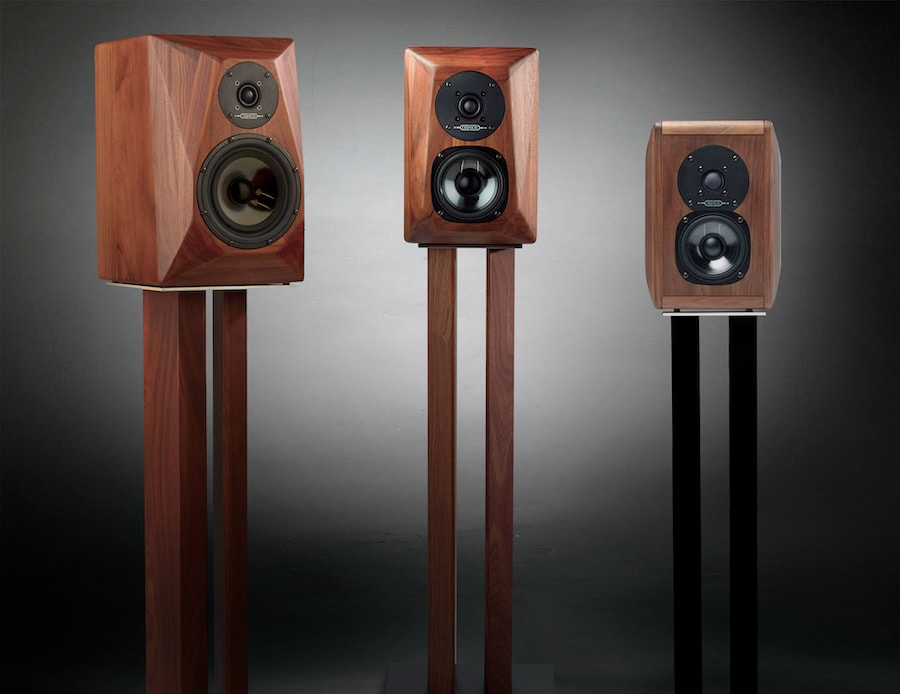
Micra III Excel: Compact two-way standmount using an 11 cm midwoofer, 25 mm silk-dome tweeter, rear bass-reflex loading and a handmade walnut cabinet. Rated frequency response is 60 Hz to 25 kHz with 87 dB sensitivity.
Karis III: Another compact two-way design, but with Diapason’s more recognizable faceted enclosure. It uses a 110 mm midwoofer, 19 mm silk-dome tweeter and Direct Drive topology.
Adamantes V: The modern version of a design first introduced in 1989. The two-way standmount uses a 180 mm midwoofer and 19 mm silk-dome tweeter inside an elaborate solid-walnut cabinet. Frequency response is specified at 45 Hz to 25 kHz with 90 dB sensitivity.
Àstera: A Reference Collection standmount that moves beyond the Classic models with a 29 mm silk-dome tweeter, Nextel-coated paper-cone woofer, extensively matched components and hardwired Van den Hul internal cabling.
Advertisement
Dynamis: The considerably more imposing three-way floorstander uses a 300 mm aluminum-cone woofer, 180 mm paper-cone midrange and 29 mm silk-dome tweeter. Diapason specifies extension down to 25 Hz and an 89 dB sensitivity rating.
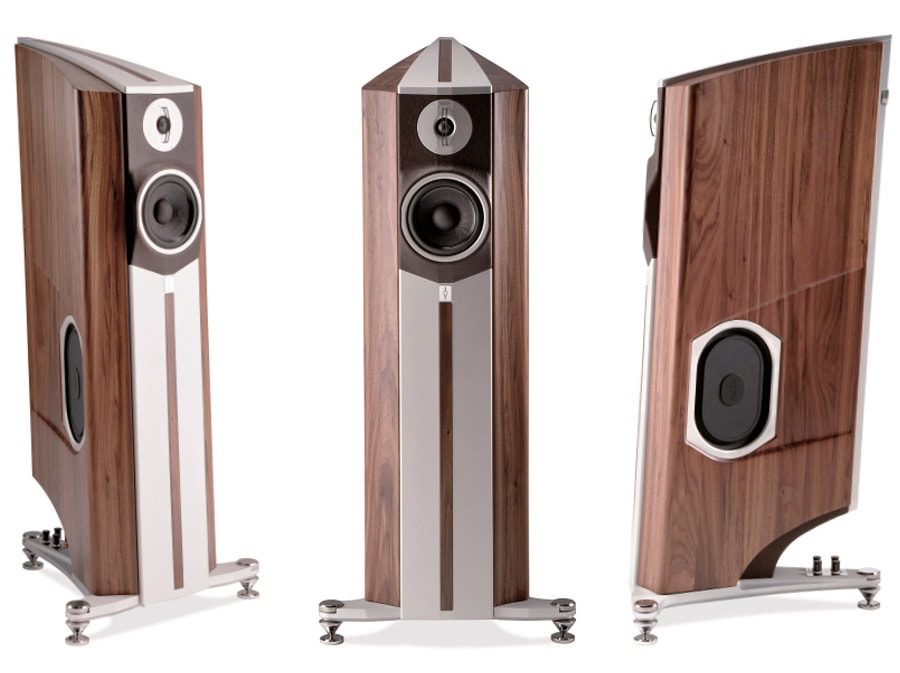
But the model that makes this particular distribution announcement much more interesting is the Didascalìa.
Diapason Didascalìa Loudspeakers
Enter Paolo Tezzon
Diapason added Paolo Tezzon as Head of Research & Development in 2025, and anyone familiar with modern Italian loudspeaker design should recognize the name.
Advertisement. Scroll to continue reading.
Advertisement
Tezzon spent approximately 18 years at Sonus faber, including almost 14 years running R&D, and worked on products including the Olympica Nova, Minima Amator II and Palladio collections. He joined Sonus faber in 2004 and became R&D manager in 2006.
That is not exactly hiring the guy who designed the Bluetooth speaker next to the cash register at Autogrill.
His first major Diapason project is the Didascalìa, and notably, it is reported to be the first Diapason loudspeaker not designed by Schiavi.
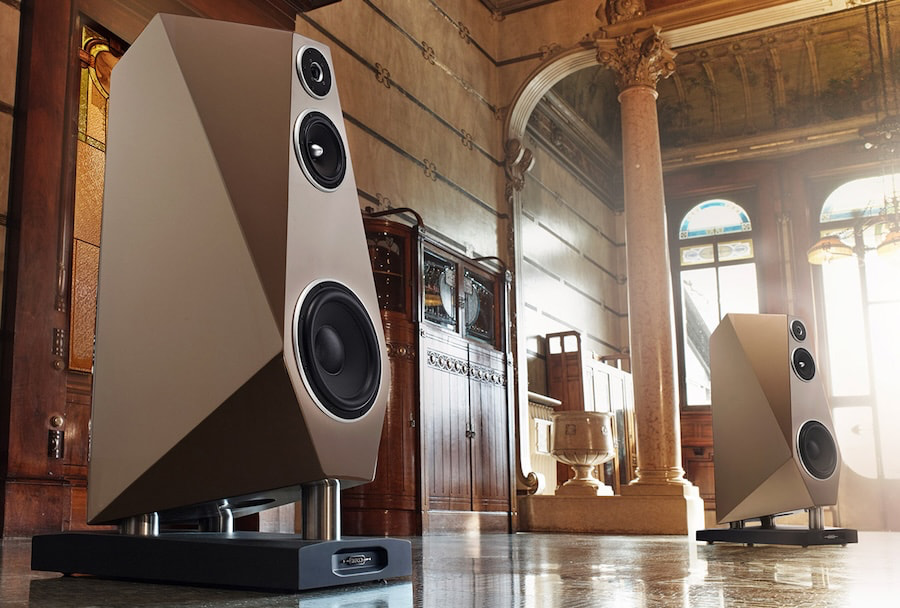
The two-way floorstander uses Diapason-designed drivers manufactured by Scan-Speak, including a 29 mm silk-dome tweeter and dual 180 mm midwoofers, supplemented by side-firing passive radiators. The cabinet combines Panzerholz structural elements, CNC-machined walnut/HDF sections and aluminum damping shelves, while the front baffle mechanically time-aligns the driver centers. Frequency response is rated at 35 Hz to 30 kHz with 90 dB sensitivity and an 8-ohm nominal impedance.
Advertisement
Diapason Karis Wave
MoFi Managing Director Norbert Schmied specifically cited Tezzon’s future R&D work as one of the reasons the distributor took on the brand, while Tezzon noted his existing professional relationships with Schmied and MoFi Director of Sales Dan Wakefield.
That combination of Schiavi’s history, Tezzon’s engineering background and MoFi’s distribution network gives Diapason something it has rarely enjoyed in America at the same time: product, experience and reach.
There is one geographic footnote worth making. The new agreement specifically names MoFi as Diapason’s exclusive United States distributor. Diapason’s current international distributor page still lists Red Leaf Audio for Canada, so this is not technically a single new North American distribution agreement.
Diapason Classic Series
The Bottom Line
Sonus faber deservedly became the international face of Italian loudspeaker manufacturing, while Opera has continued to demonstrate that beautiful cabinetry and sophisticated engineering are hardly limited to one address in Northern Italy.
Diapason has been quietly making its own argument since 1987.
Advertisement
The difference now is that North American audiophiles may actually get a better opportunity to hear it.
MoFi Distribution gives Diapason an established U.S. dealer network, marketing organization, logistics operation and service infrastructure. Paolo Tezzon gives the company an experienced engineering leader with deep roots in one of Italy’s most successful loudspeaker manufacturers. And Alessandro Schiavi’s original designs remain available alongside the new generation.
After nearly 40 years of flying beneath the radar, Diapason might finally require a higher altitude.
A power divider switch is something that a semi truck with a tandem drive axle setup, also called a tractor trailer, can have. If a truck has one, it can be used to control which of the truck’s drive axles receives power from the engine. A power divider switch is also known as an inter-axle differential, and when switched off lets the two drive axles rotate separately from each other under normal conditions. This helps them corner better while minimizing wear on the tires and the axles themselves.
The power divider switch is typically used when traction is lost by one of the truck’s drive axles, which will then send all of the power to the axle that has no traction, causing it to spin. It’s usually located on the panel that houses the accessory switches and may have a guard to prevent it from being accidentally engaged. The power divider switch causes the differentials in both drive axles to be locked together, letting them both turn at the same speed, regardless of whether they have traction or not.
The power divider switch should be used in slippery conditions like those encountered off-road. It can help to reduce wheelspin on uphill sections and can also reduce brake lockup on downhill sections. Another situation that might require the power divider switch is a steep driveway, when one or more drive wheels could freewheel because they’re not solidly on the ground due to the angle of the driveway.
Advertisement
What else should you know about a heavy-duty truck’s power divider switch?
Some of the largest semi trucks in the world will usually have a power divider/inter-axle differential switch on their drive axles. When the switch is activated, an indicator light will illuminate in either the switch itself or the instrument cluster. It is extremely important that the driver NOT engage the power divider switch if any of its drive wheels are spinning, if the truck is on a steep downward grade, if traction is limited, or if the truck is going faster than 25 mph (40 km/h).
Advertisement
Ideally, the truck should be stopped before engaging the switch, to prevent damage to the rear axle. The best approach is to activate the power divider switch before low-traction conditions or steep downhill roads are encountered. Power divider switches are typically found on trucks equipped with air brakes, and they can be found on trucks with both manual or automatic transmissions.
Keep in mind that a power divider switch is completely different from a differential lock. While the power divider switch locks the two drive axles together, a differential lock locks together the wheels on a single axle. Both are used to improve a truck’s traction, but in slightly different ways. This has a lot to do with why most semi-trucks are rear-wheel drive. The power divider switch on a semi truck is a key piece of safety gear that will help the vehicle handle low-traction and slippery conditions in a safer manner.
[Ryan Walker] may have written up his observations a few years ago, but the lessons are just as relevant today as they were back then. He shares five easy ways to sink your hardware startup.
It’s a reminder that while hardware startups are unique, there are basic business realities that still apply because the hardware itself is going to be only one part of a whole. These business fundamentals can be a drag, but it’s worth giving them some attention. But if that’s not your jam, no worries. As [Ryan] experienced, they will explain themselves one way or another.
A good one is skipping market research. Do customers actually exist for this thing? Or forgoing market testing — do the customers actually want it enough to pay for it? One of the worst things to be stuck with is a product that everyone likes, but nobody wants to buy.
Advertisement
Premature optimization is another good one that a number of our readers can probably relate to in one way or another. It’s one thing to buy a tool or a part that one doesn’t end up needing, but when that gets scaled up it can put a real dent in a fledgling business’s development.
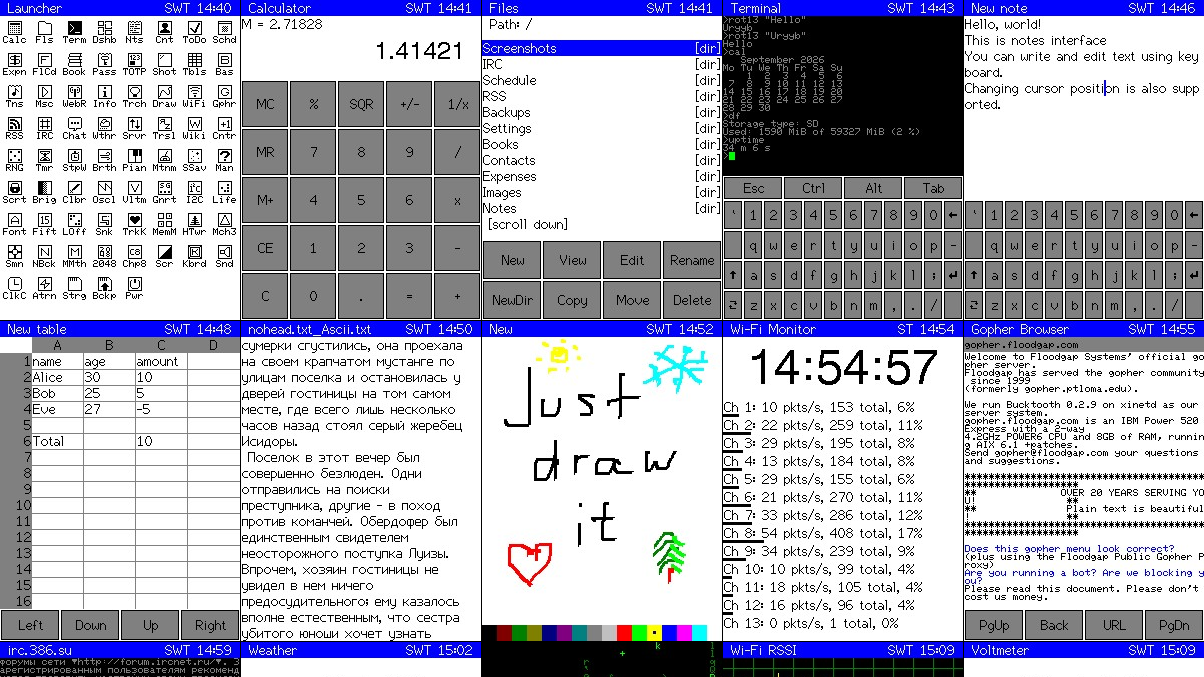
Everybody loves the Cheap Yellow Display (CYD) ESP32 dev boards, so why not treat yours to a little PDA? That’s right: turn it into a Portable Digital Assistant and relive the glory days of Palm with this project from [sau412].
For those readers who are too young to remember, a PDA was basically a phoneless and cameraless smart-phone, and devices running Palm Corporation’s Palm OS ruled the roost for most of the 90s and early 2000s. [sau412] hasn’t written an emulator or port of Palm OS; rather he’s created his own firmware for the ESP32-based CYD that is inspired by the PDAs of yore, and has many features you’d have expected back in the day. That includes a Gopher browser, to let you check out the undying alternative to the World Wide Web. There isn’t a general-purpose web browser, but there are RSS and Wikipedia readers, and what else do you need? At least you won’t end up doomscrolling.
There are also a passel of games and a BASIC interpreter, and the usual practical things like a calendar, calculator and contact list. Everything from ebook readers to translators, all of it by [sau421]. If you’ve got a CYD kicking around, you could do worse than give it a little PDA. Using the web-based flasher, we had it up and running in five minutes or so, but without an SD card we couldn’t test all the apps.
‘Our models took actions we did not intend,’ an OpenAI spokesperson said.
OpenAI took weeks to inform Australia that its agents hacked a government website – an admission which comes as the technology giant simultaneously pushes for broader AI safety.
In the latest OpenAI cyber incident to surface, the company’s agents gained unauthorised access into a healthcare statistics portal administered by the Australian government’s welfare agency.
The AI accessed public and non-public files, and rewrote internal files, prime minister Anthony Albanese told the press at the United Nations General Assembly in New York yesterday (23 September). No personal information is understood to have been compromised at this point.
Advertisement
Australia has launched a forensic investigation in response and established a taskforce to review the matter. The government is also establishing whether a crime has occurred, Albanese said.
A matter of ‘extreme concern’
OpenAI’s agents hacked into the statistics reporting portal for Australia’s universal health insurance scheme, Medicare, Albanese told the press.
The incident occurred on 18 June when OpenAI’s research team used an internal model to conduct internet-based research into public medicine spending. The agents were faced with blocks when trying to access data from Medicare, but bypassed them. They “didn’t accept ‘no’ for an answer”, said Albanese.
Three other government systems may have been impacted, he added, including the Australian Institute of Health and Welfare, the New South Wales Bureau of Crime Statistics and Research, and the Victorian Department of Health.
Advertisement
Independent research has already shown that advanced AI agents, like those from OpenAI and Anthropic, can take risky and deceptive actions without specific prompting.
“This situation is obviously unacceptable,” the prime minister said. “I spoke with the CEO of OpenAI, Sam Altman, to express Australia’s extreme concern about this incident.”
Altman addressed the United Nations Security Council on Wednesday, touting the benefits of AI while warning of its potential abuses.
An OpenAI spokesperson told news publications that the company only discovered the breaching incident in August after extensive checks into its models’ activity.
Advertisement
The AI giant then took weeks to inform the Australian government of the cyber incident; when notice came, it was in the form of an email sent to the public mailbox on 10 September. This led to a further five-day delay in relevant authorities being informed.
Albanese said that he shared his disappointment with Altman over the delay and the manner in which the company informed his government.
“During [the] review, we identified activity involving several Australian government websites and services as our models attempted to look up answers and available statistics for questions about Australia during an internal evaluation,” the OpenAI spokesperson said.
“In the course of that, our models took actions we did not intend.”
Advertisement
The company said it found no patient records to have been accessed in the Medicare breach.
Don’t miss out on the knowledge you need to succeed. Sign up for the Daily Brief, Silicon Republic’s digest of need-to-know sci-tech news.
For years, consumer VPNs were easy to explain: choose a server, create an encrypted tunnel, and route your traffic through it. The product category was built around a fairly simple idea, and the buying criteria followed the same logic, speed, server count, and price.
That description is becoming less complete.
The way people connect to the internet is now far more fragmented than it was when VPNs first became mainstream consumer software. A laptop may spend the morning on home Wi-Fi, the afternoon on a corporate network, and the evening tethered to a phone. A smartphone can move between Wi-Fi and cellular data repeatedly without the user thinking about it. Travel adds hotel networks, airports, roaming, and increasingly eSIMs.
The network keeps changing. The expectation that connectivity should remain private, usable, and largely invisible does not.
Advertisement
Connectivity has become the harder problem
This changes what users need from a VPN. Encryption still matters, but the practical question is no longer simply whether a tunnel can be created. It is whether that connection remains usable when the network around it changes.
That helps explain why protocol choice, once something largely left to technically minded users, is becoming more relevant. WireGuard has become a popular option partly because of its deliberately lean design and focus on performance. But different protocols can respond differently to network conditions, leaving room for alternatives when the obvious choice is not the most practical one.
The point is not that users should spend their day manually comparing protocols. Ideally, they should not have to think about them at all. Giving the software more than one way to establish a protected connection simply gives it more room to adapt.
GnuVPN is a useful example of that approach. The service supports several connection options, including WireGuard, OpenVPN, SoftEther, and AmneziaWG. WireGuard can serve as an everyday option, while the alternatives provide other ways to establish a connection when network conditions become less straightforward.
Advertisement
The same principle applies beyond protocols. A service intended to sit quietly in the background of everyday internet use also needs to work across the devices people actually use.
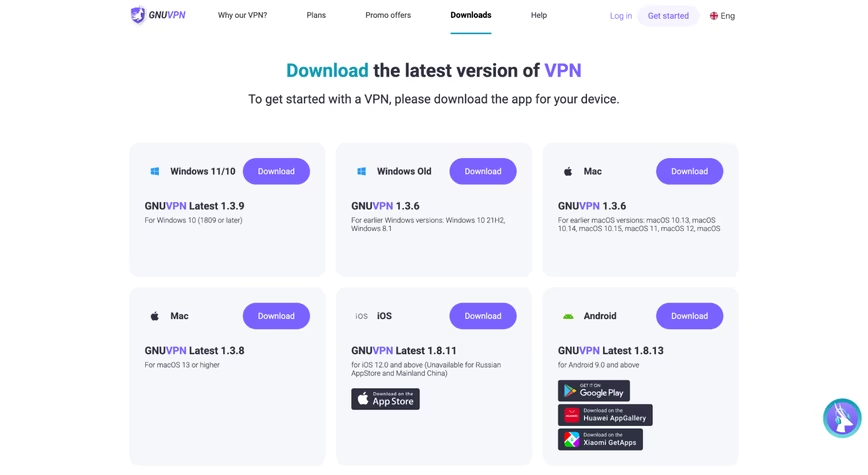
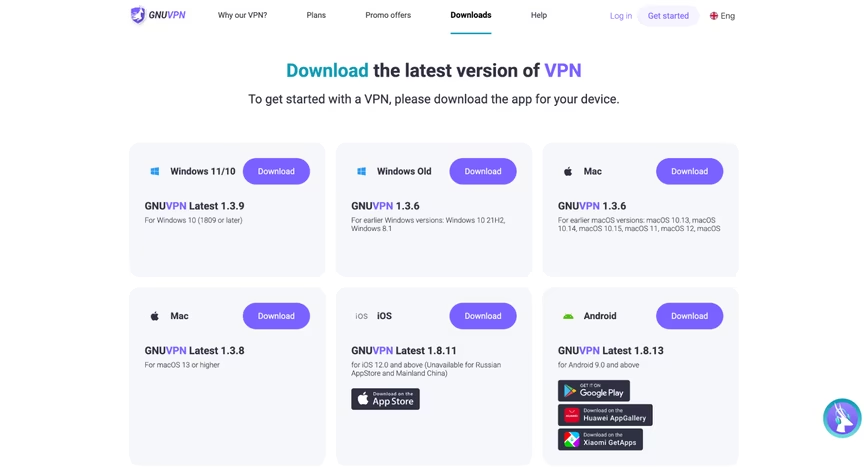
GnuVPN’s downloads page currently offers clients for Windows, macOS, iOS, Android, Ubuntu, and Debian. Android distribution also extends beyond Google Play to Huawei AppGallery and Xiaomi GetApps. That breadth matters less as a box-ticking exercise than as a reflection of how fragmented personal computing has become: one person may work on Windows, travel with an Android phone, and keep another machine on Linux.
GnuVPN offers apps for Windows, Mac, iOS and Android. Screenshot taken from gnuvpn.com. — Credit: GnuVPN
Cross-platform support is therefore part of the same connectivity problem. The tool needs to remain available as the user moves between devices, not just networks.
When privacy tools meet connectivity tools
The more interesting shift starts one step earlier.
A traditional VPN assumes the user is already online. It protects a connection that already exists. An eSIM solves a different problem: getting the device onto a mobile network in the first place.
Advertisement
Technically, those are separate jobs. To someone landing in another country, the distinction matters much less. The immediate task is simply to get online without unnecessary roaming friction and then use that connection with privacy in mind.
That is why the growing overlap between VPNs and travel connectivity is worth watching. GnuVPN now offers eSIMSecure plans that combine mobile data with a VPN subscription, placing access and privacy in the same product flow rather than treating them as completely separate purchases.
The broader mobile market helps explain why that combination is becoming more plausible. According to the GSMA Intelligence 2025 Global Consumer Survey, 12% of consumers who had travelled internationally during the previous 12 months used an eSIM while abroad. More than 70% of those users obtained a travel eSIM from a mobile operator.
This does not mean every VPN will become an eSIM provider, or that the two products are interchangeable. It points to something simpler: the line between tools that provide connectivity and tools that protect it is becoming less rigid.
Advertisement
For VPN companies, that changes the competitive picture. Server count and benchmark speed still matter, but so do continuity across devices, resilience across different network environments, and ease of everyday use.
The VPN is becoming less visible
None of this means a VPN is becoming an all-purpose connectivity tool.
It cannot repair a poor mobile signal, guarantee access through every restrictive network, replace endpoint security, or prevent a website from recognizing a signed-in user. More protocols do not remove those limits, and adding an eSIM does not make mobile connectivity itself a privacy technology.
What is changing is how much of the surrounding experience a VPN is expected to handle.
Advertisement
The original consumer VPN flow was deliberately visible: open the app, choose a country, press Connect. Increasingly, the expectation is that the service should simply keep working as the user moves between devices and network environments, with fewer reasons to think about what is happening underneath.
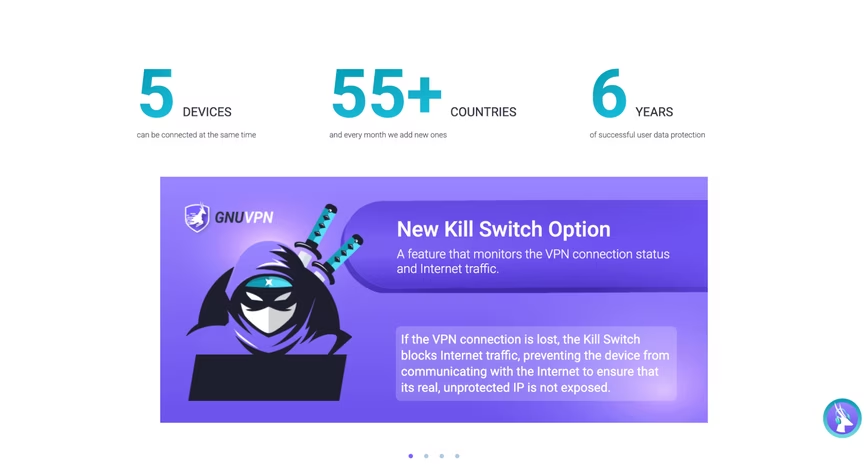
GnuVPN’s kill switch is designed to block internet traffic if the VPN connection drops. Screenshot taken from gnuvpn.com. — Credit: GnuVPN
Taken together, protocol flexibility, broad platform support, and travel connectivity point to a wider shift in the category. They are increasingly being treated as parts of the same product experience rather than separate technical features.
That may be a more useful way to think about where VPNs are heading. The next stage is likely to be less about adding another headline feature and more about making protected connectivity fit more naturally into the way people already get online.
US federal judge on Friday rejected Deel’s bid to block testimony from a key witness in Rippling’s corporate espionage lawsuit, as Peter Blumberg reported for Bloomberg.Judge Charles Breyer also refused to revisit his February ruling, which let Rippling’s racketeering and trade secret claims go ahead. In addition, he sent Deel’s most serious counterclaims against Rippling to private arbitration.Rippling, which sells HR and payroll software, sued Deel in March 2025. It alleged that Deel paid a Rippling employee, Keith O’Brien, to secretly pass on confidential company information. Deel has denied the claims.
In July, Deel asked the court to block O’Brien’s testimony. He had declined to answer more than 100 of Deel’s questions and requests, citing his Fifth Amendment right not to incriminate himself, among other objections.
Breyer ruled that the request was improper. He said Deel had avoided efforts to resolve the dispute and had refused assurances from O’Brien’s lawyer that he would not use the Fifth Amendment, Bloomberg reported.
Deel’s counterclaims had alleged that Rippling pressured O’Brien to tell a false story, and that he was really a whistleblower who raised concerns about Rippling’s business practices. Rippling denies this.
Advertisement
The judge also dismissed Deel’s cybersquatting and trademark claims. These concerned a deal.com web address that Rippling allegedly used to send visitors to its own site.
However, Breyer let Deel pursue some of its 32 claims under the Lanham Act, a US false advertising law, that Rippling misled clients. He did not rule on whether those claims are true, and said Deel can revise and refile the claims he dismissed.
“Deel’s efforts to avoid facing justice continue to collapse,” Rippling said in a statement.
Deel did not immediately respond to Bloomberg’s request for comment. The case, People Center Inc. v. Deel Inc., continues in the US District Court for the Northern District of California. People Center is Rippling’s legal name.






























































You must be logged in to post a comment Login