
Tech
ICE, CBP Knew Facial Recognition App Couldn’t Do What DHS Says It Could, Deployed It Anyway

from the fuck-everyone-but-us-policy-still-in-play dept
The DHS and its components want to find non-white people to deport by any means necessary. Of course, “necessary” is something that’s on a continually sliding scale with Trump back in office, which means everything (legal or not) is “necessary” if it can help White House advisor Stephen Miller hit his self-imposed 3,000 arrests per day goal.
As was reported last week, DHS components (ICE, CBP) are using a web app that supposedly can identify people and link them with citizenship documents. As has always been the case with DHS components (dating back to the Obama era), the rule of thumb is “deploy first, compile legally-required paperwork later.” The pattern has never changed. ICE, CBP, etc. acquire new tech, hand it out to agents, and much later — if ever — the agencies compile and publish their legally-required Privacy Impact Assessments (PIAs).
PIAs are supposed to precede deployments of new tech that might have an impact on privacy rights and other civil liberties. In almost every case, the tech has been deployed far ahead of the precedential paperwork.
As one would expect, the Trump administration was never going to be the one to ensure the paperwork arrived ahead of the deployment. As we covered recently, both ICE and CBP are using tech provided by NEC called “Mobile Fortify” to identify migrants who are possibly subject to removal, even though neither agency has bothered to publish a Privacy Impact Assessment.
As Wired reported, the app is being used widely by officers working with both agencies, despite both agencies making it clear they don’t have the proper paperwork in place to justify these deployments.
While CBP says there are “sufficient monitoring protocols” in place for the app, ICE says that the development of monitoring protocols is in progress, and that it will identify potential impacts during an AI impact assessment. According to guidance from the Office of Management and Budget, which was issued before the inventory says the app was deployed for either CBP or ICE, agencies are supposed to complete an AI impact assessment before deploying any high-impact use case. Both CBP and ICE say the app is “high-impact” and “deployed.”
While this is obviously concerning, it would be far less concerning if we weren’t dealing with an administration that has told immigration officers that they don’t need warrants to enter houses or effect arrests. And it would be insanely less concerning if we weren’t dealing with an administration that has claimed that simply observing or reporting on immigration enforcement efforts is an act of terrorism.
Officers working for the combined forces of bigotry d/b/a/ “immigration enforcement” know they’re safe. The Supreme Court has ensured they’re safe by making it impossible to sue federal officers. And the people running immigration-related agencies have made it clear they don’t even care if the ends justify the means.
These facts make what’s reported here even worse, especially when officers are using the app to “identify” pretty much anyone they can point a smartphone at.
Despite DHS repeatedly framing Mobile Fortify as a tool for identifying people through facial recognition, however, the app does not actually “verify” the identities of people stopped by federal immigration agents—a well-known limitation of the technology and a function of how Mobile Fortify is designed and used.
[…]
Records reviewed by WIRED also show that DHS’s hasty approval of Fortify last May was enabled by dismantling centralized privacy reviews and quietly removing department-wide limits on facial recognition—changes overseen by a former Heritage Foundation lawyer and Project 2025 contributor, who now serves in a senior DHS privacy role.
Even if you’re the sort of prick who thinks whatever happens to non-citizens is deserved due to their alleged violation of civil statutes, one would hope you’d actually care what happens to your fellow citizens. I mean, one would hope, but even the federal government doesn’t care what happens to US citizens if they happen to be unsupportive of Trump’s migrant-targeting crime wave.
DHS—which has declined to detail the methods and tools that agents are using, despite repeated calls from oversight officials and nonprofit privacy watchdogs—has used Mobile Fortify to scan the faces not only of “targeted individuals,” but also people later confirmed to be US citizens and others who were observing or protesting enforcement activity.
TLDR and all that: DHS knows this tool performs worst in the situations where it’s used most. DHS and its components also knew they were supposed to produce PIAs before deploying privacy-impacting tech. And DHS knows its agencies are not only misusing the tech to convert AI shrugs into probable cause, but are using it to identify people protesting or observing their efforts, which means this tech is also a potential tool of unlawful retribution.
There’s nothing left to be discussed. This tech will continue to be used because it can turn bad photos into migrant arrests. And its off-label use is just as effective: it allows ICE and CBP agents to identify protesters and observers, even as DHS officials continue to claim doxing should be a federal offense if they’re not the ones doing it. Everything about this is bullshit. But bullshit is all this administration has.
Filed Under: border patrol, cbp, dhs, facial recognition tech, ice, privacy impact assessment, surveillance, trump administration
Companies: mobile fortify, nec



American consumers are likely considering many different factors when choosing where to go for gas. The cost per gallon is at the top of course, as gas stations often have different prices. Fuel type can be a close second, and even the brand name on the pumps can play a part as well. But the companies behind those brands may not be top of mind, as some US gas station chains are actually owned by British companies. Perhaps the best-known example is BP, which stands for British Petroleum, a company that dates back to the 1920s.
BP, in turn, owns Amoco, a gas station chain that was previously known as Standard Oil, once the largest oil company in the world. Amoco merged with BP in 1998, and while the brand isn’t as prominent as it once was, BP keeps it going in select locations. Another British-owned company, Shell, began as a small antiques shop in 1880s London and grew into a worldwide corporation with thousands of fuel stations across the US.
Another company that operates gas station chains in the US, EG America, is also owned by the Brits. However, you may not be familiar with this subsidiary of EG Group, as they operate under 10 different travel-stop brands throughout America. Those brands include Kwik Shop, Turkey Hill, Cumberland Farms, Tom Thumb, and the Loaf and Jug.
Other foreign-owned gas station chains in the US

In addition to British-owned chains, several US gas station companies are owned by entities based outside America. 7-Eleven began as an American company but is now owned by a Japanese corporation called Seven & I Holdings. This same parent company also owns the Speedway chain of fuel stations. Couche-Tard, a Canadian company, owns Circle K and Lukoil gas stations are owned by a Russian company.
Fomento Económico Mexicano (FEMSA), a Mexican conglomerate, took over a chain of gas stations in the southwest, when it acquired Delek US Retail. FEMSA was already an established player in the industry throughout Europe and Latin America thanks to its OXXO brand of convenience stores. Up until late 2025, Citgo was owned by Petróleos de Venezuela, a Venezuelan company. However, as of this writing, Citgo is in the process of being acquired by an affiliate-backed group of US investors.
Some of these companies have made big moves to grow their US footprint in recent years. Couche-Tard unsuccessfully attempted to buy Seven 7 & I Holdings for $38 billion in 2024, but the offer was deemed to be too low. But that didn’t stop Couche-Tard’s American expansion, as the Canadian corporation acquired a chain of stores from another company in the same year. 7-11 continued to grow as well, thanks to its own convenience store chain purchase, as well as the purchase of a restaurant chain.

The patent troll Optis has been told by a US jury that Apple has not infringed on any of its LTE patents, ending the elongated dispute in the US until yet another appeal is made.

Optis hoped to collect money for every iPhone sold
The latest jury trial occurred after the US Court of Appeals threw out a verdict that would have had Apple paying Optis $300 million in damages. The case was then sent to a trial by jury where the jury members would be asked a single question about the five patents.
According to a report from Reuters, the jury voted unanimously. The question was: “Did Optis prove by a preponderance of the evidence that Apple infringed at least one claim from each of the following patents?”
Continue Reading on AppleInsider | Discuss on our Forums


Seattle-based company Highspot plans to merge with Seismic in a deal that will combine two of the biggest players in sales and revenue enablement software.
The companies announced Thursday that they’ve signed a definitive agreement to merge. Once the transaction closes, the combined company will operate under the Seismic name and be led by Seismic CEO Rob Tarkoff, who was hired in October. Highspot founder and CEO Robert Wahbe will join the board of directors of the combined company.
Permira, the private equity firm that has backed San Diego-based Seismic since 2020, will remain the controlling shareholder. The companies will operate independently until the deal closes. The platforms “will continue to be supported thereafter,” according to a press release.
The deal effectively places Highspot under Seismic’s leadership and brand. Additional terms were not disclosed. We’ve followed up with the companies to learn more about any potential workforce impact and where the combined company will be headquartered. Update: Highspot declined to provide further details.
The merger brings together two longtime competitors in the revenue enablement market. Their software is designed to help sales, marketing, and customer success teams manage content, training, analytics, and performance.
“There is a growing demand for technologies that better connect sales strategy to execution and help organizations drive consistent revenue performance at scale, especially in today’s go-to-market environment,” Tarkoff wrote on LinkedIn.
In the press release, Wahbe said the deal will let the combined company “move the revenue enablement space forward” by giving customers “more innovation” and “more insights leading to actions.”

Highspot is one of Seattle’s most prominent enterprise software companies and has raised $650 million since launching in 2011. It’s held the No. 1 spot on the GeekWire 200, our list of privately held technology companies in Seattle and the Pacific Northwest, and employs more than 1,000 people, according to LinkedIn data.
The company’s most recent publicly disclosed valuation was $3.5 billion in 2022, when it raised $248 million.
Highspot went through layoffs twice in 2023 amid a larger tech slowdown.
Highspot’s valuation in 2022 came at the peak of the software boom. Since then, venture funding has tightened and valuations across the tech sector have reset. PitchBook noted that many once high-flying “unicorns” have seen valuations fall below the $1 billion mark as capital becomes more concentrated. Established enterprise software companies are also under scrutiny amid the AI boom.
B Capital Group and D1 Capital Partners led Highspot’s Series F round in 2022. Other backers include ICONIQ Growth, Madrona Venture Group, Salesforce Ventures, Sapphire Ventures, and Tiger Global Management.
Wahbe is a former longtime employee at Microsoft, where he spent 16 years equipping sales teams with necessary information to craft customer pitches. He founded the company in 2011 with former colleagues Oliver Sharp and David Wortendyke.
“We believe this is a great next milestone and an exciting new chapter for one of Seattle’s longstanding, successful startups,” Wahbe said in a statement to GeekWire.
Seismic, founded in 2010, is best known for its Seismic Enablement Cloud. It reached a $3 billion valuation in 2021 and serves around 2,000 customers worldwide.
Highspot’s customers include Compass, Nasdaq and Stripe. The company said in November that it had more than 40 customers with 5,000 sales representatives each. Its largest deployment exceeded more than 50,000 end users.


Editor’s note: GeekWire publishes guest opinions to foster informed discussion and highlight a diversity of perspectives on issues shaping the tech and startup community. If you’re interested in submitting a guest column, email us at tips@geekwire.com. Submissions are reviewed by our editorial team for relevance and editorial standards.
Washington state is once again fighting about taxes. Business-and-occupation rates are up. Payroll taxes have expanded. Property taxes keep climbing. The Climate Commitment Act has raised everyday costs. Now comes the familiar call for an income tax. Each debate follows the same pattern: Is the tax fair? Is it legal? Is it progressive enough?
That framing is the problem.
Washington argues about taxes one at a time, as if each levy exists in isolation. They do not. What matters to families, workers, and employers is the total burden, how it is structured, and whether the system reflects a coherent plan. By that standard, Washington is failing.
Supporters of an income tax argue the state’s system is too regressive. They have a point. The state relies heavily on consumption taxes and business taxes that are ultimately passed through in higher prices and lower wages. Lower- and middle-income households end up paying a larger share of their income than higher earners. Adding progressivity, the argument goes, would make the system fairer.
Opponents respond that politicians cannot be trusted to stop at “just one tax.” They warn of a ratchet effect: new taxes layered on top of old ones, steadily pushing Washington through the ranks of the highest-tax states. They’re not wrong either. The Paid Family and Medical Leave payroll tax has nearly tripled since 2019. The capital gains tax rate jumped from 7% to 9.9% last year. The gas tax rose again in 2025, putting Washington among the most expensive states to fuel a car.
Both sides have valid concerns. Yet the debate remains a series of narrow, partisan skirmishes rather than a serious discussion of tax policy as a system.

What’s missing is strategy. State leaders are offering revenue ideas, not a tax vision. A strategy begins with an end state. Washington has never articulated one.
What is the state’s target tax burden as a percentage of income? How should it compare to states Washington actually competes with — California, Texas, Colorado, Oregon, Arizona? Should Washington aim to be a low-tax state, a middle-of-the-pack state, or a high-tax state that promises high-end public services? Voters are never told.
Nor is there clarity about the proper mix of revenue. How much should come from consumption? From business activity? From income, if at all? Which taxes should grow with the economy, and which should remain stable? These questions matter. They shape investment decisions, talent retention, and long-term growth.
For small businesses and startups, the consequences of this lack of clarity are immediate. Young companies don’t encounter taxes one at a time; they absorb the full stack at once. Business-and-occupation taxes apply before profitability. Payroll taxes rise the moment hiring begins. Energy and transportation costs flow directly into margins.
Unlike large corporations, startups and small firms cannot shift operations across states, absorb sudden cost increases, or negotiate their way out of regulatory complexity.
The goal is not to avoid paying taxes, but to operate within a system that is intentional and predictable. Sudden changes — such as reclassifying businesses from services to retail for B&O purposes — can render an otherwise viable business model unworkable overnight within Washington.
In practice, uncertainty and compliance churn often matter as much as the rate itself. A tax system without a defined end state makes long-term planning nearly impossible for the very firms the state says it wants to grow.
Instead, Washington’s approach has been incremental and reactive. When spending rises, a new tax appears. When equity concerns emerge, yet another tax is layered on. There is no framework tying these decisions together, only a running justification for why the next increase is unavoidable.
Consider the most recent addition to the tax base: the Climate Commitment Act. Some analysts argue that it functions as a regressive revenue mechanism because compliance costs can be passed through into energy, transportation, and consumer goods prices. If lawmakers are serious about addressing regressivity in the tax system, they should explain how the CCA’s cost impacts fit into the broader tax and mitigation framework and whether adjustments or offsets are warranted.
A more serious administration would approach this differently. It would publish a comprehensive tax strategy. It would define the desired total burden. It would benchmark Washington honestly against peer states. It would identify which taxes should expand, which should contract, and which should be eliminated. And it would explain the tradeoffs plainly, without pretending that revenue comes without cost.
Such a plan would not please everyone. But it would signal competence and demonstrate leadership. It would give voters and businesses something they currently lack: predictability.
There is also a political opportunity being squandered. Comprehensive tax reform is one of the few areas where bipartisan agreement is possible. Democrats concerned about equity and Republicans concerned about growth could meet on common ground — if the goal were a coherent system rather than the next revenue “win.”
Instead, the current approach reinforces public cynicism. Each new proposal confirms the suspicion that taxes rise without limit, that reforms are never finished, and that promises of restraint are temporary.
If Washington wants to be seen as a model of effective governance, the answer isn’t another narrow tax fight. It’s a pause. A reset. A commitment to step back from piecemeal changes and present a full plan worthy of public trust.
The country is tired of partisan trench warfare. One way to lower the temperature is to govern like adults: set goals, measure outcomes, and explain decisions. Washington has the resources and talent to do that.
What it lacks, at least for now, is a strategy.

WP Engine’s third amended complaint against Automattic and WordPress co-founder Matt Mullenweg alleges that Mullenweg had plans to impose royalty fees on 10 hosting companies beyond WP Engine for their use of the WordPress trademark.
The amended filing, based on previously sealed information uncovered during discovery, also claims Mullenweg emailed a Stripe executive to pressure the payment processor into canceling WP Engine’s contract after WP Engine sued Automattic in October 2024. Newfold, the parent company of Bluehost and HostGator, is already paying Automattic for trademark use, according to the complaint, and Automattic is in conversations with other hosts.
The filing challenges the 8% royalty rate as arbitrary, citing Mullenweg’s comments at TechCrunch Disrupt 2024 where he said the figure was based on what WP Engine “could afford to pay.” Internal Automattic correspondence cited in the complaint includes Mullenweg describing his approach to WP Engine as “nuclear war” and warning that if the hosting company didn’t comply, he would start stealing its customers.

Major League Soccer fans will be able to enjoy even more game highlights as part of the Walmart Saturday Showdown, debuting on Apple TV in February 2026.

Walmart Saturday Showdown is coming to Apple TV on February 21.
Apple’s push for sports-related programming continues, as the iPhone maker has now promised additional Major League Soccer content. Throughout 2026, Apple TV subscribers in the United States will be able to watch MLS games for free, with select games highlighted as part of Sunday Night Soccer.
Starting February 21, MLS fans will get to enjoy even more soccer content over the weekend, with Walmart Saturday Showdown games coming to Apple’s streaming service.
Continue Reading on AppleInsider | Discuss on our Forums

A story suggesting Apple was having internal struggles and may delay anticipated new Siri features has been mildly countered with a statement from Apple — “on track to launch in 2026.”

Apple is still aiming for a 2026 release of its revamped AI
A story based on anonymous tipsters claiming internal testing of the refreshed Siri wasn’t going well surfaced Wednesday, sparking dramatic reactions from analysts and the stock market. It didn’t help that at the same moment, Apple was being targeted by the FTC Chair over alleged Apple News bias.
However, after CNBC reached out to Apple for comment, they got back a very simple “still on track to launch in 2026” statement. As AppleInsider mentioned in its coverage on that rumored delay, there were a lot of oddities in the reporting surrounding it.
Continue Reading on AppleInsider | Discuss on our Forums


Modern cars can be quite good at letting us know when something is wrong. Perhaps it will emit strange smells, start shifting slowly, or activate a check engine light on the dashboard. Fluid leaks can also be one of your car’s ways of alerting you to an issue that needs addressing, not ignoring. A transmission fluid leak, in particular, can fill a driver with dread, because it can easily lead to costly repairs or complete transmission failure.
Much like engine oil, transmission fluid keeps the gearbox’s moving parts lubricated and cooled as they spin, shift, and so on. And if your manual or automatic transmission is shifting as it’s supposed to, you’ll probably not think about the transmission fluid until it’s too late. After all, even though modern cars still require transmission fluid change, just not as often, say after every 60,000 – 100,000 miles, depending on the type of vehicle and driving habits.
However, given that transmission fluid doesn’t burn off as much as oil, if you check the fluid level with a dipstick and notice that it is too low, you’ll want to act quickly — especially if that’s followed by a sweet smell around your vehicle and red puddles of fluid on your driveway. Chances are, you have a leak, and driving with low fluid levels is one of those mistakes that can damage your transmission. Since an average transmission repair job costs anywhere from a few hundred dollars to thousands of dollars, it’s understandable that you’ll want to know the most frequent causes of transmission leaks.
A worn-out transmission pan
One of the most common causes of a transmission fluid leak is a worn-out transmission pan. It’s a metal container that serves as a reservoir for transmission fluid. In most cases, the transmission pan can last for an extended period, but it can still be damaged by aggressive driving, such as hitting potholes or speed bumps at full speed. Rust on your car can also cause continuous damage to the transmission pan, which, in turn, will inevitably lead to transmission fluid leaks.
For this reason, if you peek under your car and see a telltale drooling of transmission fluid near the engine, you might want to have the pan checked. Often, the culprit is a poorly installed transmission pan. However, if the pan has a crack or is severely damaged, you’ll want to have it replaced as soon as possible. You can opt to visit a professional, but if you’re at a point in your DIY mechanic journey where you can trust yourself with some automotive projects, you can inspect and replace the transmission pan yourself.
Worn-out and poorly installed transmission pan gaskets

When you’re replacing the transmission pan, make sure you inspect the pan gaskets as well. Unsung heroes of your transmission system, gaskets prevent automatic transmission fluid (ATF) from leaking. And while they’re designed to withstand exceedingly high temperatures and provide a good sealing effect for an extended period, some are made of flexible rubber, while others are cork composites. This means they may be susceptible to wear and tear over time, and when this occurs, the transmission fluid may leak.
There are also times when gaskets leak transmission fluid due to improper installation. Generally speaking, installing a transmission pan gasket is one of the easiest DIY engine maintenance tasks you can do to keep your vehicle functioning properly. But despite not being a complex task, you’re likely to encounter a nasty fluid leak if you engage in simple things like reusing a worn-out washer when closing a drain plug or using excess force when tightening bolts or installing the drain plug.
Whatever the cause of your transmission fluid leak, if it’s due to improper pan or gasket installation, it’s best to have a mechanic inspect the pan and gasket. Sure, the leak won’t damage your car’s transmission outright. But if neglected long enough, you’ll start experiencing tell-tale signs of a failing transmission like burning smells, strange sounds, and a sticky shifter.
Damaged transmission lines

Every transmission system has cooling lines that prevent overheating. This is achieved by circulating fluids from one part of the transmission to another. However, while most fluid lines are built to last hundreds of thousands of miles, extreme temperature changes and road debris can cause wear, potentially leading to cracks, ruptures, or bursts.
If your transmission is shifting hard, overheating more than usual, or you notice fluid on the cooling lines, you likely have damaged fluid lines. And since transmission problems are something that you should not take lightly, you’ll want to call an expert right away to avoid headaches down the road.
Alternatively, if there’s a small hole or crack in one of the fluid lines and you don’t want to schedule a replacement immediately, there are quick and easy DIY remedies you can consider. You can cut out the leaking section and replace it with hose clamps, but keep in mind this is only a temporary fix. You’ll need to visit your mechanic to determine the true extent of the damage.

IBM said it will triple entry-level hiring in the US in 2026, even as AI appears to be weighing on broader demand for early-career workers. From a report: While the company declined to disclose specific hiring figures, it said the expansion will be “across the board,” affecting a wide range of departments. “And yes, it’s for all these jobs that we’re being told AI can do,” said Nickle LaMoreaux, IBM’s chief human resources officer, speaking at a conference this week in New York.
LaMoreaux said she overhauled entry-level job descriptions for software developers and other roles to make the case internally for the recruitment push. “The entry-level jobs that you had two to three years ago, AI can do most of them,” she said at Charter’s Leading With AI Summit. “So, if you’re going to convince your business leaders that you need to make this investment, then you need to be able to show the real value these individuals can bring now. And that has to be through totally different jobs.”

After a career counselor visited one of her classes earlier this year, Lily Hatch found herself asking a chatbot for guidance about college.
A junior at Wake Forest High School in North Carolina, Hatch had taken an in-class career quiz that recommended she pursue dermatology. She had finished quickly and so approached the counselor to find out how to explore that profession further. The counselor gave a couple of suggestions, before adding that Hatch could also play with a chatbot to explore her college options.
So, that’s what Hatch did.
But instead of returning information on which schools rank highly for dermatology, the chatbot — a general-purpose consumer product, rather than an edtech tool — veered off into offering information about climate, telling Hatch to consider the University of North Carolina in Wilmington because it’s near a beach.
It felt a little like a runaway train, with the bot dragging her down a pre-laid track. “I was looking for advice on what colleges would be ideal for me. And it switches into going more into what things in my life I would be looking for in the future, which was not what I was looking for,” Hatch says.
Today’s high school students — who spent years of their academic careers surfing disruptions and the challenges of returning to the classroom after the pandemic school closures — are preparing to enter a labor force and broader economic system that can seem confusing and unstable, as technologies like artificial intelligence are reshaping the career ladders that their parents climbed. Some national surveys show that Gen Z students feel more prepared for their futures now than they did in past years, but for those about to graduate, that’s not always the case. Many students describe a general pessimism about the future.
“There’s a lot of fear there,” says Matthew Tyson, CEO of Tapestry Public Charter School in DeKalb County, Georgia. Tyson notes that many of his students aren’t planning for college, or feel discouraged by the fast-changing nature of life around them.
Navigating these major shifts about starting a career requires both educators and young people to think flexibly, according to experts. Students need honest guidance, Tyson says, adding that adults should be transparent about the reality that they don’t have all the answers.
But new AI tools don’t have all the answers either, not even those purpose-built to offer career guidance. At least, some human counselors don’t think so.
“The AI stuff is kind of crazy to think about,” says Ian Trombulak, a school counselor in Vermont. “That’s not going to help us reverse the trend here of career readiness scores being low.”
Still, some say they are open to the possibility that offloading aspects of their work to AI may, ironically, free them up to offer better support to students contending with the disruptions AI is creating in the labor market.
A Tough Job
Career counseling is a demanding gig these days.
Youth unemployment rates are increasing, and recent assessments reveal dips in college readiness. And two-thirds of parents desire an increase in job skills and workforce training opportunities in high school, according to a figure from the Hunt Institute.
Yet counselors often have to make tough choices between giving academic and career advice or addressing students’ emotional crises, and many students seem to lack support systems, says Tyson, from the Georgia public charter school. Student traumas can spout up to the adults meant to give those students advice.

“A lot of times, there’s only so much water that can be taken out of a glass before the glass is empty,” Tyson says of counselors’ emotional states. Eager to assist students, counselors can burn out.
They also have to deal with staff shortages. Tapestry, Tyson’s public charter, doesn’t suffer from a shortage of counseling educators like some nearby schools. It has three counselors for 300 students, according to Tyson.
But across Georgia, there are 378 students for every school counselor, according to the latest data from the American School Counselor Association, which recommends one counselor for every 250 students. And that’s hardly the worst in the nation, with the ratios sitting at 573 students per counselor in Michigan and 645 per counselor in Arizona.
With human resources strained, schools are now considering how to use AI to create more opportunities to meaningfully advise students on how to approach the future.
Innovative uses of artificial intelligence can amplify the work of human college and career counselors, argues June Han, the CEO of EduPolaris AI, a company which offers Eddie, an AI counseling platform that includes counselor, student and parent portals licensed by schools. The company raised $1 million in early investments, and the company’s platform — which relies, at least in part, on third-party large language models — is being piloted in a handful of Title I high schools, the CEO told EdSurge.
School-support organizations, including the Homeschool Association of California, list the tool as a recommended AI resource, as does the White House.
Tapestry is one of the schools piloting Eddie. The platform has helped, according to Tyson, particularly because the dashboard lets Tyson see useful information such as how many students have completed their reference letters for college applications. From the dashboard, he can send a nudge to students, reminding them to finish. That feature cuts down on the number of meetings he has to take. The data collected by the platform also provides clues about what to focus on when he works with students, and where they need the most help, Tyson says.
The Davidson Institute, a nonprofit that provides educational opportunities to “profoundly gifted” students, uses the “Ask Eddie” chatbot function to counsel families in the Young Scholars Program for students ages of 5 through 18. Many of those students are on “nontraditional paths,” looking at early college, or coming from accelerated grades or homeschool backgrounds, says Megan Cannella, director of outreach.
More than 200 families in the program have used the tool since February 2025, according to Cannella. She says the big selling point is that it’s available 24/7 and in a number of languages. The nonprofit doesn’t offer traditional school counseling, so the AI tool boosts the limited support that staff provides. It’s proven particularly helpful for families just starting their college journey, and for homeschoolers, she adds.
Meanwhile, what students want from a career is also changing, in a way that makes it difficult for career counselors to keep up.
Shifting Interests
In northwest Missouri, students have become more interested in exploring non-college pathways after graduation, such as military service or vocational training, says Geoff Heckman, a school counselor at Platte County High School.
Apprenticeships, internships and alternative credentials feature more prominently in students’ plans these days because these options prepare them to step right into jobs when they leave high school, Heckman says. Indeed, around the country, students are skeptical about college, meaning that high school counselors can’t assume that pathway.

The students Heckman counsels at the public school outside of Kansas City are also starting to find postsecondary guidance resources on their own more often, using AI and social media, he adds.
There have been cultural shifts, sometimes away from the kinds of jobs the school’s infrastructure is set up to support. Not long ago, the career and technical school next door to Heckman’s school had a waiting list for its law enforcement opportunities. Now, there’s much less interest, Heckman reports.
Instead, some of the careers students now desire are hard for Heckman to understand. In the years since he’s become a counselor, students have found jobs as social media influencers and professional gamers. Indeed, the number of students who say their dream is to be a social media star has swelled.
“I want to support a student no matter how wild their dream may sound to me,” Heckman says.
It comes down to helping them construct a plan of attack, teaching them to research the industry of interest, to discern how strong their passion for this dream is and to reach out for mentorship, he adds. For example, last year a student came to Heckman and said she wanted to be a pilot. There was no program for that at the high school. But an effort from the district was able to create a new internship opportunity for the student through the local Air Guard, which has a flight school.
Similar situations occur in schools across the country, and many places are keen to build stronger career pathways.
For instance, Vermont switched over to proficiency-based grading requirements — beginning with the class of 2020 — and it has started to incorporate “self-direction skills” in the assessment of students. It’s a signal for schools to focus on skills that will be useful in a future where counselors can’t predict precisely what jobs students will be working, according to one school counselor in the state.
A lifelong Vermonter, Ian Trombulak came to career counseling after working in a group home after college. It sparked something, he says. After he left the emotionally tense work of a group home, he found himself pulled into schools where he could be the type of person who had helped him through high school.
Trombulak has worked in public education for nine years, and in that time, he’s seen “this continued drumbeat” where public educators are asked to do more with fewer resources, even as core components of education like curriculum have become swept up in political battles. Budgets are too tight to hire enough counselors, and counselors have too many students to feasibly advise, he admits.
“You know, we’re not superheroes,” he says. “At a certain point, you are constrained by the kind of resources that you have at your disposal, and public education is not working with a whole lot right now. Even in the best of times, it can be a struggle.”
Helping students steer through their uncertainty requires a deft approach. At the same time he’s helping ninth graders find their footing in the murky transition from middle school to high school, he’s also advising students on what could happen after graduation. On average, he meets about five to 10 students per day. Some meetings are pre-planned and some are drop-ins. A lot of his job happens outside of scheduled sessions, he says. While stopping in on a teacher, students will pull him aside to check in. There are about a dozen of those encounters a day.
Schools may be turning to AI out of desperation, Trombulak says. But he doubts it will advise students as well as human counselors.
EduPolaris leaders feel that the safeguards on Eddie, the AI counseling platform, position it to boost the human work of counselors. Han, the company’s CEO, argues that Eddie is so human-centric and school-specific that the tool amplifies the human counselor’s efforts, allowing for schools to provide personalized guidance even with limited resources.
Han argues that initial skepticism from counselors stems from a lack of AI literacy. Counselors and educators are afraid of losing control, she says.
Yet even if AI proves adept at providing accurate, useful career information and advice, that may miss the subtler value that can emerge when students sit down to chat with a trusted adult. That type of interaction is essential to building the “social capital” and interpersonal networks that actually help young people secure jobs, some researchers argue.
And much of Trombulak’s work is relational rather than transactional. Mostly gone are the days of relying on personality tests and career quizzes. Instead, Trombulak says, counselors hold open-ended conversations probing what students feel passionate about. It’s more self-exploratory and requires a more human touch. “I’m almost there as a mirror,” Trombulak says, or as a backboard to bounce ideas off.
Ultimately, a powerful lesson Trombulak believes he can teach students is how to find answers on their own. As students try on ideas, counselors teach them about what kind of path they would have to take to end up in a job. It means a lot of Googling with students. He goes through the process of how he, as a well-educated adult, would find answers.
Part of that process now is, yes, verifying information gathered from AI.
Unreliable Narrator
For students, what matters most is the quality of the advice they receive, whether it comes from a human or a bot.
After two or three weeks of back and forth with the chatbot, Hatch, the junior from North Carolina, didn’t return to the human career counselor.
But that doesn’t mean she found the AI useful.
The scraps of information she got could have been easily discovered by a quick Google search, she says. The experience contributed to her overall skepticism of AI, which she acts on as a student leader for her school’s chapter of Young People’s Alliance, which advocates for stronger AI regulations and more job training opportunities for young adults.
She doesn’t know yet where she wants to attend college, or even what she’ll study. Right now, instead of dermatology, Hatch is considering education as a career path.
So, what does she think about using AI for career counseling?
She wouldn’t recommend it. In fact, she’s not so keen on what she sees as an overreliance on technology in general. Students she knows use it to churn out passable school work, and in response, teachers even seem ready to give out good grades for subpar work when they feel it’s not AI-generated.
Students should really slow down, and rely on AI less, she says: “I feel like it overall is not as useful as people make it out to be.”

Phillies release OF Nick Castellanos with $20M remaining on contract

Federica Brignone completes dramatic comeback at Olympics

Trupanion, Inc. 2025 Q4 – Results – Earnings Call Presentation (NASDAQ:TRUP) 2026-02-12

Smart energy pays enters the US market, targeting scalable financial infrastructure

Software stocks enter bear market on AI disruption fear with ServiceNow plunging 10%

Wikipedia volunteers spent years cataloging AI tells. Now there’s a plugin to avoid them.


-

 Politics4 days ago
Why Israel is blocking foreign journalists from entering
-
 Sports6 days ago
JD Vance booed as Team USA enters Winter Olympics opening ceremony
-
 Business4 days ago
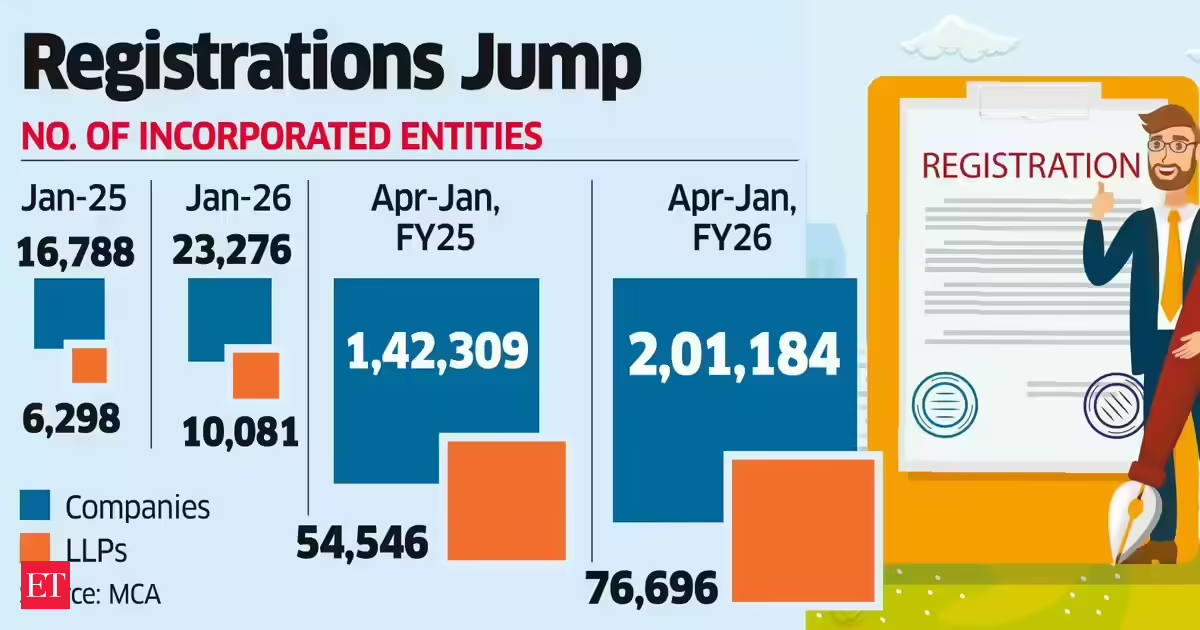
LLP registrations cross 10,000 mark for first time in Jan
-

 NewsBeat3 days ago
Mia Brookes misses out on Winter Olympics medal in snowboard big air
-

 Tech6 days ago
First multi-coronavirus vaccine enters human testing, built on UW Medicine technology
-

 Sports1 day ago
Big Tech enters cricket ecosystem as ICC partners Google ahead of T20 WC | T20 World Cup 2026
-

 Business4 days ago
Costco introduces fresh batch of new bakery and frozen foods: report
-

 Tech2 days ago
SpaceX’s mighty Starship rocket enters final testing for 12th flight
-

 NewsBeat4 days ago
Winter Olympics 2026: Team GB’s Mia Brookes through to snowboard big air final, and curling pair beat Italy
-

 Sports4 days ago
Benjamin Karl strips clothes celebrating snowboard gold medal at Olympics
-
Sports5 days ago
Former Viking Enters Hall of Fame
-

 Politics4 days ago
The Health Dangers Of Browning Your Food
-
Sports7 days ago
New and Huge Defender Enter Vikings’ Mock Draft Orbit
-

 Business5 days ago
Julius Baer CEO calls for Swiss public register of rogue bankers to protect reputation
-
 NewsBeat6 days ago
Savannah Guthrie’s mother’s blood was found on porch of home, police confirm as search enters sixth day: Live
-
 Crypto World1 day ago
Pippin (PIPPIN) Enters Crypto’s Top 100 Club After Soaring 30% in a Day: More Room for Growth?
-

 Video22 hours ago
Prepare: We Are Entering Phase 3 Of The Investing Cycle
-

 Crypto World2 days ago
Blockchain.com wins UK registration nearly four years after abandoning FCA process
-

 Crypto World3 days ago
U.S. BTC ETFs register back-to-back inflows for first time in a month
-
 NewsBeat4 days ago
Residents say city high street with ‘boarded up’ shops ‘could be better’