Connect with us
DAPA Banner

Tech

Matt Taibbi Loses His Vexatious SLAPP Suit As Judge Explains What A ‘Metaphor’ Means

Published

on

from the does-the-vampire-squid-have-a-lawyer? dept

Perhaps Matt Taibbi’s most famous bit of writing ever was his takedown of Goldman Sachs in Rolling Stone (and then in a book that followed) that opened with the highly evocative metaphor:

The world’s most powerful investment bank is a great vampire squid wrapped around the face of humanity, relentlessly jamming its blood funnel into anything that smells like money.

Even now, if you ask anyone about Taibbi’s writing, the phrase “great vampire squid”* is probably the most likely response.

* For what it’s worth, contrary to the what you might think given the name, vampire squids are (1) not actually squids, (2) not bloodsucking as they’re actually described as gentle scavengers, and (3) pretty small.

So, a question: how do you think that Matt Taibbi (who claims to be a giant free speech supporter) would react if Goldman Sachs had sued him back then claiming that they were not, literally, a cephalopod?

Advertisement

I think he would have been rightly outraged at the abuse of the courts to attack his free speech for his use of a metaphor.

So it was pretty shocking back in January when Taibbi sued author Eoin Higgins over his (excellent) book, Owned: How Tech Billionaires on the Right Bought the Loudest Voices on the Left. The crux of Taibbi’s argument was that he wasn’t literally “owned” by billionaires, and thus it was defamatory:

The Book’s title and subtitle “Owned: How Tech Billionaires on the Right Bought the Loudest Voices on the Left” falsely state that Plaintiff was “owned” and “bought” by billionaires.

Even more ridiculously, Taibbi took to the pages of Bari Weiss and David Ellison’s The Free Press to claim that he was suing a journalist for his reporting “to protect free speech.”

Yeah, sure man, whatever you have to tell yourself to sleep at night.

But, no, vexatious SLAPP suits don’t protect free speech; they do the exact opposite. Higgins wrote a thorough and sharp critique of how a bunch of people, like Taibbi, who had been formerly associated with left-leaning views, seemed in recent years to have drifted sharply rightward — frequently with the financial and institutional backing of right-wing tech billionaires.

Advertisement

Taibbi’s lawsuit was weak from the start, repeatedly insisting that obviously metaphorical statements were defamatory because he wasn’t literally “owned” or that he didn’t make that much money by cozying up to Elon Musk with his ridiculously misleading Twitter Files. Even Taibbi’s amended complaint was laughably bad, whining that because he took no direct payments or “financial inducement” from Elon Musk, that it was unfair to associate him with Elon Musk. This despite Taibbi getting the first exclusive batch of internal Twitter documents, which he did discuss on Twitter (this is pre-X) but absolutely used to burnish his own reputation and that of his Substack newsletter.

Thankfully, Higgins and his publisher, Bold Type Books (a Hachette imprint) had strong representation: Elizabeth McNamara and Leena Charlton from Davis Wright Tremaine — McNamara in particular is well known in media and First Amendment circles as one of the best in the business — and the court has issued a pretty quick and pretty thorough dismissal of the case.

Over and over again, the judge, George B. Daniels, patiently explains to Taibbi that metaphors and opinion are not defamatory. Which, you know, is the kind of thing you’d hope a famous writer like Taibbi would have understood already. Alas.

The Book’s Cover and Jacket

None of the statements Plaintiff identifies on the Book’s cover and jacket, standing alone, are actionable. Statements 1 and 2, the words “Owned” and “Bought” on the Book’s front cover, are susceptible to both literal and metaphorical meanings depending on the surrounding context. Plaintiff acknowledges, however, that the contents of the Book cannot support a literal reading, stating that the “[t]he Book contains no evidence of any financial transaction, payment, contract, or quid pro quo involving Plaintiff.” (Opp. at 4.) In this context, “Owned” and “Bought” naturally read as attention-grabbing rhetoric used to signify Higgin’s opinions and the Book’s conclusions. Aside from the scattered words and phrases discussed below, Plaintiff does not dispute the accuracy of the vast majority of the Book’s factual content that informs these views or point to language suggesting the opinions are based on facts other than those disclosed in the book. See Levin v. McPhee, 119 F.3d 189, 197 (2d Cir. 1997) (noting that “hypothesis or conjecture… may yet be actionable if they imply that the speaker’s opinion is based on the speaker’s knowledge of facts that are not disclosed to the reader”). Plaintiff may not like Higgins’s subjective conclusions, or agree with their accuracy, but that does not make them actionable defamation.

Advertisement

And for all of Taibbi’s “but Elon didn’t give me any money!” whining, that doesn’t matter. That’s not how defamation law works. Because if it did work that way lots of journalists wouldn’t be able to report on anything, for fear of vexatious SLAPP suits like the one Taibbi filed. As the judge explains:

Statement 3, that Plaintiff was in “the snug patronage of billionaires,” is also a nonactionable opinion. Just like “Owned” and “Bought,” the language “snug patronage” does not have a readily understood precise meaning, so there is no way for a reader to determine whether the statement is true or false. The statement also appears as a reviewer comment on the back cover under the heading “Praise for Owned.” From this context, a reader would likely intuit this statement as an opinion of the reviewer, supported by the facts disclosed in the Book, and not a statement of fact about Plaintiff. See Hammer v. Amazon.com, 392 F. Supp. 2d 423, 431 (E.D.N.Y. 2005) (“[T]he average person understands that [book reviews] are the reviewer’s interpretation and not ‘objectively verifiable’ false statements of facts.” (quoting Hammer v. Trendl, No. CV 02- 2462 (ADS), 2003 WL 21466686, at *3 (E.D.N.Y. Jan. 18, 2003)).

Rhetorical statements and opinions cannot be defamatory. Just like calling Goldman Sachs a vampire squid couldn’t be. Just like saying you’re someone’s “crony.” Incredibly, there was even an earlier ruling in the very same district specifically on whether or not calling someone a crony was defamatory. A good lawyer would have known that before suing over the word “crony.”

Statement 4 is a passage from the Book’s left flap that states that Plaintiff was one of the right-wing technology billionaires “cronies.” (Am. Compl. 20.) Courts in this district have previously held that calling someone a “crony,” without more, is nonactionable rhetorical hyperbole. See Cassava Scis., Inc. v. Heilbut, 2024 WL 553806, at *5 (S.D.N.Y. Jan. 5, 2024), report and recommendation adopted sub nom. Cassava Scis., Inc. v. Bredt, 2024 WL 1347362 (S.D.N.Y. Mar. 28, 2024) (holding that a presentation which labeled individuals as “cronies” was nonactionable opinion); cf. Biro, 883 F. Supp. 2d at 463 (“[T]he use of the terms ‘shyster,’ ‘con man,’ and finding an ‘easy mark’ is the type of ‘rhetorical hyperbole’ and ‘imaginative expression’ that is typically understood as a statement of opinion.”) (internal citation omitted). The same is true here. The assertion that Plaintiff is a billionaire’s crony is the sort of excessive, unverifiable language that signals to a reasonable reader that they are reading the speaker’s opinion, and not a statement of fact.

Also a fail: claiming that more general statements not directly about Taibbi could be defamatory about Taibbi. In this case, Taibbi claimed that Higgins book flap saying that the book “follows the money, names names” is somehow defamatory to Taibbi, despite not being directly about him. Again, making claims about general statements like that is a hallmark of vexatious, speech-suppressing SLAPP suits. As the judge notes:

Statement 5 also appears on the left flap and states that the Book “follows the money, names names,” and is a “biting expose of journalistic greed.” (Am. Compl. 24-25.) Plaintiff alleges that “follows the money” and “names names” “represents to readers that the author has traced actual financial relationships and identified specific recipients of improper payments or patronage.” (Id.24.) “In New York, a plaintiff cannot sustain a libel claim if the allegedly defamatory statement is not ‘of and concerning plaintiff but rather only speaks about a group of which the plaintiff is a member.” Chau, 771 F.3d at 129 (internal citation omitted). Statement 5 does not indicate that it is “of and concerning” Plaintiff it describes Higgins’s investigative process for all the Book’s subjects, not only Plaintiff. A reasonable reader would, therefore, not interpret “follows the money” and “names names” as a false statement of fact about Plaintiff.

It’s also not defamatory (and obviously opinion) to call someone “greedy.” You would think that the author of a supposed exposé on Goldman Freaking Sachs would know that. Alas. The judge has to explain it to Taibbi.

Advertisement

Statement 6 states that the Book is an “exposé of journalistic greed,” which Plaintiff alleges “asserts professional dishonesty and unethical conduct.” (Id. 25.) But whether someone is motivated out of greed or ambition is a subjective determination that is not capable of being proven true or false. See Rosa v. Eaton, No. 23 CIV. 6087 (DEH), 2024 WL 3161853 (S.D.N.Y. June 25, 2024) (“[C]ourts have recognized that words like… ‘greedy crooks’ are vague, imprecise statements of hyperbole considered nonactionable opinion.”) Further, the context surrounding the statement, including its placement on the left flap of the Book’s cover, clearly implies that the facts on which this opinion is based can be found within the Book. Cf. Graham v. UMG Recordings, Inc., 806 F. Supp. 3d 454 (S.D.N.Y. 2025) (holding that an album’s cover art shares the same overall context as the recording itself because the cover is “designed to reinforce the message of the [recording.” (internal citation and quotation marks omitted)).

As a kind of SLAPP Hail Mary, Taibbi’s lawyer had admitted that even if all of these statements were protected opinion, you could still claim defamation on the theory of “yeah, but if you lump them all together, people might jump to false and defamatory conclusions” and the judge has to explain that that, for that to be the case, you have to actually show that the statements are really intended to show such a defamatory meaning. And Taibbi’s lawyer couldn’t do that. Because it does not appear to be true.

Plaintiff acknowledges that these statements “might be protected opinion standing alone.” (Opp. at 11.) But he claims that when viewed together, the statements on the Book’s cover and jacket “become implied factual assertions that the accused was actually paid.” (Id.at 12.) Plaintiff is correct that otherwise nonactionable statements may create “false suggestions, impressions, and implications,” and that these false implications can serve as the basis of a defamation claim. See Armstrong v. Simon & Schuster, 85 N.Y.2d 373, 380-81 (1995). But plaintiffs alleging defamation by implication must “make a rigorous showing that the language of the communication as a whole can be reasonably read both to impart a defamatory inference and to affirmatively suggest that the author intended or endorsed that inference.” Stepanov v. Dow Jones & Co., 987 N.Y.S.2d 37, 44 (N.Y. App. Div. 2014) (emphasis added).

Even assuming that Plaintiff has affirmatively alleged a defamation by implication claim-despite not labeling his sole cause of action as such-Plaintiff has failed to allege facts showing that Defendants intended or endorsed the defamatory inference. As stated above, Plaintiff admits that “the Book contains no evidence whatsoever that Plaintiff received payments, sponsorship, or financial inducement from Elon Musk or any other billionaire.” (Am. Compl. 29.) Instead of endorsing the alleged defamatory implication, the Book argues that Plaintiff’s central reason for agreeing to participate in the Twitter Files was to “gain access.” Higgins, supra at 182. Plaintiff also claims that Higgins “admitted contemporaneously that readers expecting proof of who was ‘bought’ would be disappointed.” (Am. Compl. 62.) In short, the Book’s contents and Higgins contemporaneous statements distance the Book from the defamatory implication Plaintiff alleges. See Henry v. Fox News Network LLC, 629 F.Supp.3d 136, 150 (S.D.N.Y. 2022) (finding that a corporate statement did not endorse a defamatory implication because the statement intentionally included “nebulous” phrasing). Without any additional facts pointing to Defendants’ intent, Plaintiff’s defamation by implication claim fails.

There’s more. Taibbi sued Higgins over the phrase “cash in” but the judge points out that doesn’t need to literally mean getting cash:

This context makes clear that the Book’s reference to “cash in” is not referring to literal money, but rather the idea that Plaintiff traded his reputation for access to the Twitter Files. This sort of loose, figurative language would naturally lead a reasonable reader to interpret this as a statement of opinion.

Hilariously, Taibbi had tried to argue that Higgins claiming that Taibbi got a bunch of new Substack followers because of the Twitter Files was defamatory, but Taibbi’s lawyer had to admit during oral arguments that “getting a bunch of new Substack subscribers” is not the kind of statement that injures your reputation. Oh, and also, it turned out to be true.

Advertisement

Similarly, statement 8 is a nonactionable subjective determination. Statement 8 claims that Plaintiff’s Substack “gained thousands of subscriptions” following his work on the Twitter Files, which translated to a “financial windfall.” But as Plaintiff’s counsel acknowledged during oral argument, this statement, “in the abstract,” is not defamatory because it does not tend to injure Plaintiff’s reputation. Oral Arg. Tr. at 44:13-17; see also Chau, 771 F.3d at 127 (“To be actionable … the statement must do more than cause discomfort or affront; the statement is measured not by the sensitivities of the maligned, but the critique of reasonable minds that would think the speech attributes odious or despicable characterizations to its subject.”) And even if one could read a defamatory meaning into these words, Plaintiff admits that he did in fact gain thousands of Substack subscribers following the Twitter Files reporting. (See Am. Compl. 11 38-39 (“The ‘thousands of new subscribers Owned claims Plaintiff gained after publication represented only a small percentage of Plaintiff’s overall readership.”) Whether this “small percentage” of increased subscribers represented a “financial windfall” is a subjective determination.

In other words, the entire case was a garbage, vexatious attack on Higgins’ own speech — and should put to rest forever the idea that Taibbi was ever a true supporter of free speech. He spent years falsely implying that protected speech activities of private companies were an attack on free speech, and now he’s moved on to actually attacking the free speech of others — abusing the power of the courts to cost them time, money, and attention to fight off a vexatious lawsuit.

Honestly, it seems that, if anything, the small, cuddly, vampire squid would likely have a stronger case against Taibbi than Taibbi had against Higgins.


Filed Under: 1st amendment, defamation, elon musk, eoin higgins, free speech, matt taibbi, metaphor, opinion, rhetorical hyperbole, vampire squid

Companies: hachette

Advertisement

Source link

Continue Reading
Click to comment

You must be logged in to post a comment Login

Leave a Reply

Tech

Tata and JSW to spend $1bn building India’s way out of Chinese battery dependence

Published

on

The two conglomerates are funding separate R&D centres focused on next-generation battery chemistries and advanced EV systems. The investment is a hedge: both groups currently buy critical battery components from Chinese suppliers and want options when Beijing tightens export rules again.



India’s two largest steel-and-everything-else conglomerates are putting close to $1bn behind a question that has become urgent for the country’s electric-vehicle industry: what happens when the Chinese suppliers stop picking up the phone?

Tata Group and JSW Group are separately funding research-and-development centres aimed at building in-house expertise in next-generation battery technologies and advanced EV systems, Bloomberg reported on Wednesday, citing people familiar with the plans. The combined commitment is just under $1bn.

Both companies are reasoning from the same exposure. India’s EV industry, including their own businesses, runs heavily on Chinese cells, materials and equipment.

Advertisement

The 💜 of EU tech

The latest rumblings from the EU tech scene, a story from our wise ol’ founder Boris, and some questionable AI art. It’s free, every week, in your inbox. Sign up now!

China’s tightening of export controls on graphite, lithium-processing equipment and battery-making machinery has, over the past year, made that exposure a board-level problem rather than a procurement one.

What each group is funding

Tata’s R&D effort sits inside Agratas, the group’s battery arm, which is already building a 20 GWh gigafactory in Sanand, Gujarat to supply Tata Motors. The new spend goes upstream of that: chemistry, cell design, and process know-how the group has historically licensed or sourced.

Advertisement

Agratas has previously partnered Tata Technologies to fast-track battery solutions for mobility and renewable energy storage; the new funding extends that work into materials and proprietary cell formats.

JSW Group’s track is different but rhymes. JSW Motors, the JV vehicle through which the conglomerate sells MG cars in India alongside SAIC, opened JNEXT, the JSW NextGen Technology Center, in Pune in February through a partnership with Tata Elxsi.

Neither company has confirmed the figures publicly. The Bloomberg sources put the combined investment at “nearly $1 billion”, with the funds spread across multi-year R&D programmes rather than capex on production lines.

The trigger is policy on the other side of the Himalayas. Late last year, executives and engineers from Reliance Industries fanned out across Wuxi looking to lock in roughly $1.1bn of equipment for a planned battery plant; Beijing’s tightening of export controls on key battery-making technology arrived shortly after. Hundreds of equipment shipments to India have been delayed or rerouted since.

Advertisement

Tata Motors itself has had to lean further on Chinese suppliers in the meantime. The Curvv.ev launched with cells from Octillion Power Systems, and the company struck a sourcing arrangement with Envision AESC for higher-density packs.

Each of those deals tightened the supply chain rather than diversifying it. Building a domestic chemistry programme is the obvious medium-term hedge.

JSW’s exposure is structural in a different way. The MG joint venture, of which Sajjan Jindal’s group owns 35%, sources around 60% of its components from China.

JSW has publicly aimed at a million new-energy vehicles by 2030 and a 10 GWh battery plant in partnership with LG Energy Solution.

Advertisement

The new R&D push is what would make those numbers achievable without renegotiating the SAIC stack every time Beijing changes its rules. The dependency picture is the same dependency Europe is grappling with, and it is now driving capital allocation in Mumbai and New Delhi as much as Berlin and Paris.

The competitive backdrop

Tata is no longer India’s runaway EV leader. Mahindra overtook it in EV revenue in the most recent fiscal year, even though Tata still leads on sales volume. JSW MG has doubled its market share in the past twelve months.

The two competing R&D commitments arrive against that shifting hierarchy: each group needs proprietary technology to defend its margins, not just match its rivals on offer.

The pattern is recognisable. Europe’s homegrown battery cell push, spurred by Northvolt’s collapse and the energy-security argument, is the closest analogue. Indian groups have studied it carefully: the same logic of chemistry sovereignty, recycling capacity (UK recycler Altilium’s £18.5m round sits at one end of the same arc), and policy support for domestic cell production now drives the conversation at home.

Advertisement

The difference is that India’s industrial policy, including the PLI scheme for advanced chemistry cells, has been in place for several years; what was missing was private R&D capital. The Tata and JSW announcements move that piece into place.

What is at stake?

Even with $1bn flowing into research, neither group will displace Chinese chemistry leadership in this decade. The realistic ambition is narrower: enough internal capability to specify, validate and customise cells, to qualify alternative suppliers, and to negotiate with Chinese partners from a less precarious position.

That ambition shapes the spending profile. Most of the money will go to talent, lab equipment and pilot lines rather than to gigawatt-scale fabs. Both groups already have, or are building, those at scale; the gap they are closing is the one between buying technology and owning it.

Whether that is enough depends on how aggressively China continues to limit access. The export controls of the past year suggest the line is moving the wrong way, and that India is not the only economy facing it. EU battery industrial policy on much the same arithmetic, and the equity question is whether national champions can build technical depth fast enough to keep up.

Advertisement

Source link

Continue Reading

Tech

What’s Apple TV’s next thriller?

Published

on

James Marsden is to star and executive produce “Disavowed” for Apple TV, a new thriller series following a wrongly disgraced CIA agent.

Apple TV has been cornering the market with prestigious dramas in either science fiction or thrillers, and now the likes of “Slow Horses” are to be followed by “Disavowed.” Created by Art Marcum and Matt Holloway, it is to be an ongoing series following ex-agent Brad Griffin (Marsden).

Marcum and Holloway are writing and producing partners, previously best known for the films “Iron Man,” and “Men in Black: International.” They have been nominated twice for “Worst Screenplay” at the Golden Raspberry Awards.

Marsden is currently starring in the second season of Apple TV’s “Your Friends & Neighbours.

Advertisement

According to Apple, the forthcoming “Disavowed” sees agent Griffin “abruptly fired in the middle of a global hunt for an elusive assassin.” That assassin killed Griffin’s partner, so despite having the whole CIA against him, he sets out to find the killer and also claim the $15 million bounty on his head.

It sounds as if there are elements of Matt Nix’s hit “Burn Notice” as this agent is wrongly fired and tries to use his skills to survive. Like Nix’s show, “Disavowed” is specifically intended to be a continuing, returnable series, rather than a one-off serial.

“Disavowed” comes from Blue Marble, the company that produces the critically acclaimed “Pachinko” for Apple TV.

No details have been released yet of when the show is to stream, or is even entering production. The show looks to be Apple TV’s next thriller following the two-season order for “Down Cemetery Road,” dramatized by Morwenna Banks from the books by Mick Herron.

Advertisement

Source link

Continue Reading

Tech

Sleep Number ComfortNext Lux Smart Bed: Redefining Support

Published

on

Person laying on a large blue and white mattress with a dog on their lap

Photograph: Julia Forbes

Like any Sleep Number smart bed, the ComfortNext Lux offers 100 firmness levels, and the one you select is your “Sleep Number,” or the firmness you prefer to sleep on. I usually skew toward firmer for lumbar support and weight distribution, which has previously been in the 40 to 50 range. Then, a new recommendation popped up in the app—my firmness level was in the mid-70s, but going softer could improve my sleep score, which Sleep Number calls its “SleepIQ score” and reports in its app. I decided to lower it to a much softer firmness level of 35.

The SleepIQ score summarizes your nightly sleep metrics, including heart rate variability, breathing rate, and time spent in each sleep stage. This data is compiled into a score that summarizes your sleep quality. The app’s score always skewed lower than what my Apple Watch SE would track. However, with dogs jumping in and out of bed, the sensors track that motion and take it into account, too. Despite this, my Apple Watch showed a six-day streak of high-80s to 90s sleep scores. Given that my body is always getting used to new beds with a revolving door of mattresses to test, this is extremely rare for me. Previously, while testing other smart beds or standard mattress types like memory foam or hybrid, I’d achieve this kind of quality sleep with medium-firm or true firm mattresses, never soft ones.

What was clear after two weeks of testing was that, even at the absolute firmest 100 setting, the ComfortNext Lux still felt only medium-firm. I started off with firm and went way softer, but the reality is that the ComfortNext Lux’s plush foam layers will always make whatever level you choose feel softer. If you are seeking a truly firm mattress—like one of our favorite firm options, the Plank Firm Luxe—the ComfortNext Lux does not even remotely play in the same league. This is not shocking, as nearly all smart beds I’ve tried lack the rigidity you’d find in coil-based designs.

Advertisement

Got Your Back

If you regularly deal with back pain or have more severe spinal conditions such as scoliosis, I don’t recommend this smart bed for you. My husband is part of this club, and according to him, the ComfortNext Lux is doable for a few days. After a bit, he needs to return to a firmer mattress to get the support his spine needs. To this end, the ComfortNext Lux’s lumbar support is not where it needs to be for full-time stomach sleeping or heavier-bodied sleepers who require lift around their midsections. Some adjustable bases will have lumbar support bars that project from the base, which would be a beneficial remedy here. Unfortunately, this feature isn’t available on Sleep Number bases at this time, and I don’t recommend pairing this smart bed with an adjustable base from another brand.

If not for back pain, you may wonder who the ComfortNext Lux works best for. In short? Side sleepers. As a side sleeper myself, this mattress offers the level of cushioning I often crave for my pressure points, with a satisfying amount of sink-in that makes the joints feel cushioned. You truly feel cocooned, and not in a claustrophobic way. For couples who happen to be side or side-back sleepers, the foam’s prominence in the ComfortNext Lux also helped prevent motion from rocking the bed. However, it is a bit harder to move between sleeping positions because you are working against the softer surface as you roll.

Source link

Advertisement
Continue Reading

Tech

Voter Suppression In South Dakota Is Well Underway, Even Without SCOTUS’s Help

Published

on

from the subtracting-votes-by-adding-confusion dept

It may be almost impossible to devolve this country into a nation of slaveholders, but the Trump administration and all of its MAGA buddies are working hard to make sure a white person’s vote counts more than a vote cast by anyone else.

These bigots recently got an assist from the Supreme Court, which decided minorities can have their votes rendered meaningless so long as the people doing the gerrymandering don’t actually say the quiet part loud. Redistricting for the sole purpose of excluding as many non-whites as possible is perfectly legal if politicians never affirmatively state that the only reason they’re doing this is to make sure minorities can’t vote against their racist asses.

This is all part of what the state of South Dakota is doing now. Governor Larry Rhoden was never elected to his post. He was elevated after Kristi Noem was selected to head the DHS by Donald Trump. (Since she’s about as unemployed as any Trump appointee ever gets, I’m sure she wishes she was back running the state of South Dakota… into the ground.) His most recent brush with the electoral process saw him losing handily to Mike Rounds in the 2014 Senate race.

Rhoden actually needs to win an election if he wishes to remain South Dakota’s governor. And all the MAGA fellatio in the world doesn’t mean much when plenty of other MAGA acolytes are running against him.

Advertisement

So, there’s a mixture of things going on here. There’s Rhoden’s (and the state GOP’s) desire to engage with Trump’s election conspiracies — ones that claim (with zero facts in evidence) that a whole lot of undocumented immigrants are voting in state and local elections.

There’s also a nationwide attempt to deter voting by mail, because these votes more often side with the other team.

In response to completely made-up problems, the GOP passed a bill that Rhoden signed that says state residents must prove their citizenship to engage in local elections. If they can’t, they’re only allowed to participate in federal elections.

According to Rhoden and other GOP alarmists, that’s because too many people who aren’t citizens were granted permission to vote, thanks to what was likely nothing more than a clerical error. South Dakota may be small state in terms of population (~950,000 residents as of 2025), but the “problem” this vaguely written law supposedly addressed was even smaller.

Advertisement

Soulek said only one of the 273 noncitizens had ever cast a ballot. That was during the 2016 general election.

Those are the words of the Director of Elections Rachel Soulek, who works out of the Secretary of State’s office. The Secretary of State blamed this on clerical errors by the Department of Public Safety. The DPS provided the data that Governor Rhoden claims to evidence of widespread election fraud by non-citizens.

One illegal ballot. And that was likely an honest misunderstanding, rather than the criminal intent Rhoden and GOP buddies want to pretend it is.

But the law is on the books. Citizenship must be demonstrated to participate in state and local elections. The problem is that no one running these elections seems to agree what is or isn’t acceptable proof of citizenship.

Hughes County Finance Officer Thomas Oliva, who acts as that county’s auditor, said his office is requiring new voters to show the physical driver’s license.

“The main reasoning behind that is because it’s the back of the license. There’s no other identifying information on the back we can tie back to that person, so we felt it’s in the best interest to see the physical card,” Oliva told News Watch.

Advertisement

Haakon County Auditor Stacy Pinney said she has not run into any issues yet with voter registration but also will require new applicants to physically show the driver’s license.

“I’m going to make it a policy in my office that I want to see the actual card. If I have to verify it, I want to see the real deal,” Pinney told News Watch.

Meanwhile, Harding County Auditor Kathy Glines said her office will accept a photocopy of the driver’s license.

“They would have to send a front and back,” Glines told News Watch.

Advertisement

“I hope they would call before sending it by mail,” she added, referring to the limited hours the office is open.

Everyone appears to be making up their own rules because the law — and the Secretary of State’s office — are being deliberately vague about these requirements, especially in relation to absentee voting. And many people in the state may not know that the law only applies to people who have registered to vote after July of last year, so lots of people are going to be presenting IDs to precinct staffers even if they’re not legally required to do so.

This all adds up to exactly what Governor Rhoden and the GOP want: confusion over who is or isn’t allowed to vote, blended with another law passed by Rhoden that allows pretty much anyone to challenge someone else’s eligibility to vote.

The state could offer much-needed clarification. But it won’t.

Advertisement

As early and absentee voting for the primary election gets underway, Scott-Stoltz hopes officials in Pierre can provide more certainty on the registration process for new voters.

“We’re hoping for more clarification from the secretary’s office before the primary and are looking forward to working with the election board,” she said.

The secretary of state’s office didn’t respond to a request for comment by News Watch.

That’s a feature, not a bug. Those in power definitely prefer incumbent voters over new ones, much like incumbent voters prefer incumbents. They want to keep the jobs they have, rather than allow new voters to upset the incumbent apple cart. They all pretend they love the democratic system, but when it’s time latch onto another 2-4 years in power, they work together to reduce the electorate to the votes they can count on.

Filed Under: bigotry, larry rhoden, south dakota, trump administration, voter fraud, voter id law

Advertisement

Source link

Continue Reading

Tech

GeekWire test ride: Lime’s new bike packs a zippy punch into a compact, easier-to-use device

Published

on

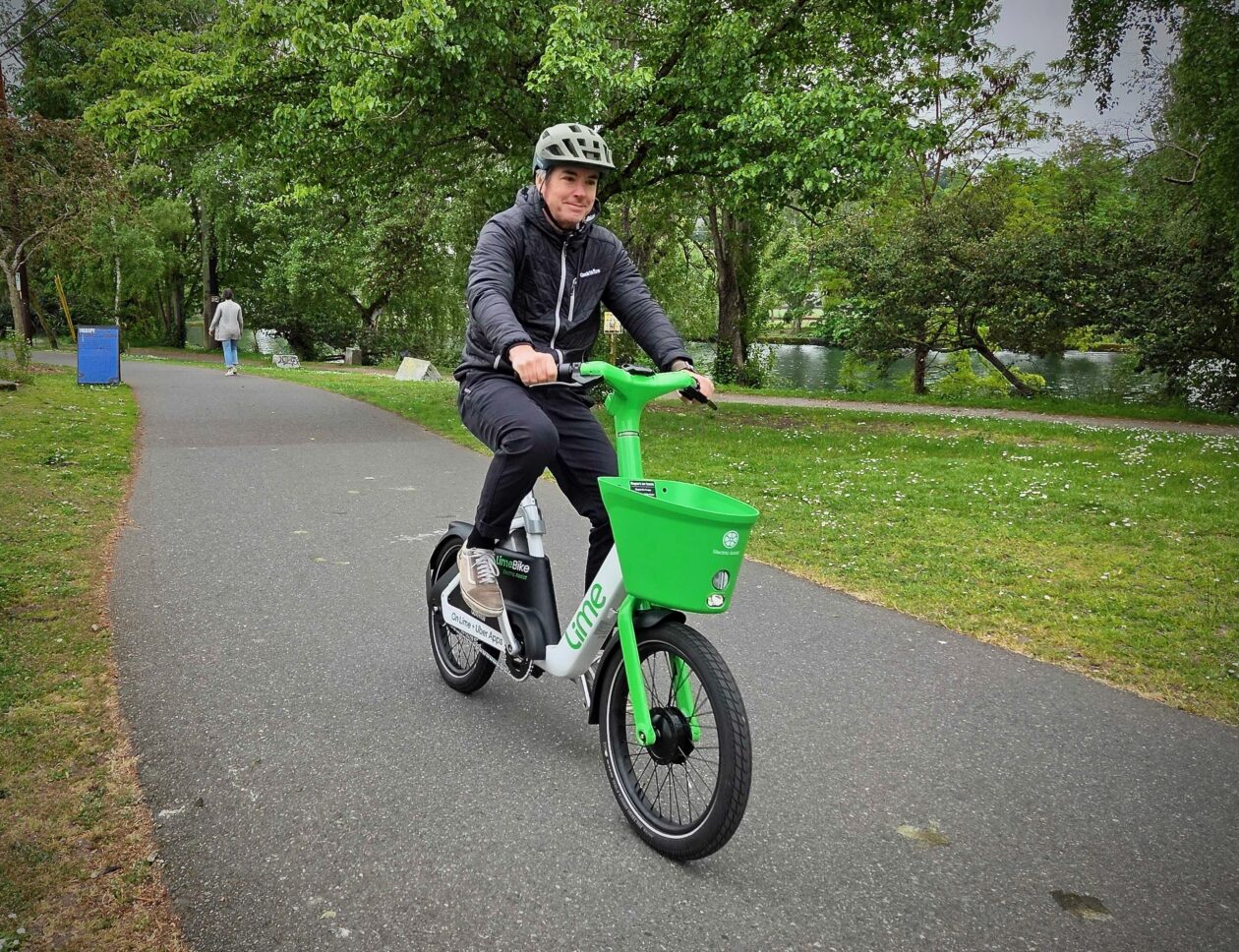
GeekWire’s Kurt Schlosser cruises the Burke-Gilman Trail in Seattle on a new LimeBike electric bicycle from Lime this week. (GeekWire Photo / Todd Bishop)

Lime’s newest electric bike is being billed mostly as an accessibility upgrade, but don’t let that undersell it — this thing is nimble, punchy and genuinely fun to ride.

The new LimeBike, which plays on the company’s original name, is hitting Seattle streets this week, combining some of the comfort and ease of its compact, sit-down LimeGlider scooter with a quick-off-the-line bicycle powered by its throttle and pedal-assist.

The San Francisco-based micromobility company is betting that an easy-on, easy-off bike will bring new riders into the fold, particularly those who’ve found its existing hardware too intimidating or physically demanding.

While GeekWire appreciated the accessibility tweaks, a zippy test ride around Fremont left us equally impressed. The LimeBike accelerates fast, handles hill climbs and feels like a legitimate candidate to replace a car trip or two.

What’s new: The LimeBike features 20-inch wheels — smaller than those on the Gen4 e-bike — giving it a more compact, approachable feel. A step-through frame makes mounting and dismounting easier. There’s even a new seat clamp designed to let riders adjust height more easily. In the U.S., the bike comes equipped with a handlebar throttle, so riders can pedal with electric assist, use the throttle alone, or combine both.

Advertisement

Other upgrades include wider front baskets positioned lower on the frame for easier turning when loaded, ergonomic hand grips designed to reduce fatigue, and a sliding clamp-style phone holder. Lime also repositioned the battery and updated the wheels to lower the center of gravity — a tweak aimed at improving stability, particularly for smaller-statured riders.

“It wasn’t just learnings from the glider,” Parker Dawson, Lime’s senior regional lead for government relations in the Pacific Northwest, told GeekWire. “It was really talking with frequent riders, infrequent riders, and even non-riders in cities around the world, wanting to understand how to make a more accessible and even intuitive experience for more people.”

The LimeBike features smaller wheels, a lower step-through frame, and an easy-to-adjust seat clamp. (Lime Photo)

Who it’s designed for: Lime says the LimeBike is aimed at riders who may struggle with extended pedaling, with a particular focus on making the experience more approachable for women and older riders — two groups the company says have been underserved by existing e-bike designs.

But the target is broader than that. Dawson said the goal is for the LimeBike to be additive to Lime’s fleet rather than a one-to-one swap for a particular trip type or rider — helping more people find more reasons to leave their cars behind.

How it rides: For a rider who has tried everything Lime has to offer, the LimeBike checks a number of the boxes the company was going for when it comes to ease of use. But compared to older model bikes, it’s also just more fun.

Advertisement

Sure, the seat adjusted easily and the step-through frame made getting on and off a breeze. The bike feels more compact thanks to the lower center of gravity, much like the LimeGlider, which GeekWire tested back in 2024.

But the LimeBike also feels lighter and is quick off the line, reaching 15 mph in short order via throttle, pedal assist, or a combination of both. The ability to alternate between the two — coasting on the pedals, then leaning on the throttle — gave the ride a natural feel while still leaving room to actually break a sweat.

The bike handled moderate hills in the Fremont neighborhood without much drama, losing a little speed on the climb but staying comfortable throughout.

And if you’re thinking the last thing Seattle or its bike trails need is another way-too-fast e-machine, the LimeBike is still much slower than the 25 mph speeds (or more) that many modified commercial e-bikes are reaching.

Advertisement
Classic versions of Lime’s electric bikes, in Seattle in 2018. (GeekWire File Photo / Kurt Schlosser)

By the numbers: Lime will roll out 500 LimeBikes to start, slotting them into a Seattle fleet that currently totals around 15,000 devices — including 4,000 Gen4 e-bikes, 7,000 scooters, and 4,000 gliders. Seattle is Lime’s largest shared micromobility market in North America by fleet volume.

The company is also now Seattle’s sole micromobility operator, a status it assumed April 1 following the exit of competitors including Bird, which previously filed for bankruptcy. Dawson said riders had been choosing Lime over rivals well before the field thinned out.

The consolidation hasn’t hurt demand. Lime provided 2.3 million rides in Seattle in the first quarter of this year, up roughly 50% from 1.4 million in Q1 of last year — itself coming off a record 10.1 million rides in 2024.

What’s ahead: With Seattle set to host FIFA World Cup matches this summer, Lime is expecting a surge in demand — but Dawson said the company isn’t planning to dramatically expand its fleet for the tournament. Instead, Lime made a conscious decision earlier this year to request 1,000 additional gliders, prioritizing seated options for Seattle’s regular riders over a one-time influx of hardware.

“We are very confident in our operations team that we can be delivering a great user experience and be a really strong asset to the transportation network on game days,” Dawson said.

Advertisement

Dawson also said progress is being made on Lime Vision, the company’s previously announced AI-powered compliance technology, saying 50% of the standing fleet will be outfitted by June 1. Lime is also continuing to work with SDOT on expanding its network of parking corrals across the city — a key piece of making the overall system more convenient for riders.

Lime’s current contract with SDOT runs through the end of the year, and Dawson said the company, which has been in Seattle since 2017, is eager to compete for a longer-term deal.

“Seattle is one of our oldest, most well-developed markets that we have across the world,” Dawson said. “That’s something of an innovation center. A lot of our tech folks live here. A lot of our new technologies are born and bred here to be exported around the world to other cities.”

Source link

Advertisement
Continue Reading

Tech

Major Homebuilder To Test Placing Mini Data Centers in Suburban Backyards

Published

on

NewtonsLaw writes: According to Realtor.com, a California startup called Span plans to partner with Nvidia, PulteGroup, and other homebuilders to equip new homes with mini-data centers, so as to relieve the need to build and power much larger traditional centers. The article states the company “can install 8,000 XFRA units about six times faster and at five times lower cost than the construction of a typical centralized 100 megawatt data center of the same size.” Could this be the solution to at least some of the problems hindering the rollout of greater data-center capacity for AI systems? “One big reason the XFRA model works is that the average American home only uses about 40 percent of its electrical capacity,” Span said. “As big data center developers struggle to find power sources and distribution capacity, XFRA uses capacity that’s already available.”

The startup says they will launch a 100-home proof of concept within the year to see if the idea is viable.

Source link

Continue Reading

Tech

In 2026, what does a career in data engineering look like?

Published

on

IAS’ Declan Gowran explores his role in the data engineering space and how leaders create cohesive environments.

Senior staff data ops engineer at IAS Declan Gowran’s journey into the data engineering world evolved organically from a broader IT infrastructure and cloud background.

He told SiliconRepublic.com, “Early in my career, I worked extensively on enterprise infrastructure, virtualisation and cloud deployments across multiple platforms, which exposed me to large scale systems and the complexities of managing data at scale. Over time, I became increasingly fascinated with the ways structured and unstructured data can drive decision making and AI applications. 

“That led me to roles at Optum and IAS where I could focus on building secure, scalable data platforms, integrating DevOps, MLOps and data governance frameworks, and supporting enterprise AI workloads. Essentially, my path was shaped by a mix of curiosity, technical challenges and opportunities to work at the intersection of cloud, data, and analytics.”

Advertisement
What is the current data engineering landscape like in Ireland?

Ireland’s data engineering landscape is vibrant and rapidly maturing. With the strong presence of multinational tech companies and data driven organisations, there is a growing demand for engineers who can not only manage cloud infrastructure but also design modern, scalable data platforms. Organisations are increasingly adopting cloud native architectures, Kubernetes based platforms and MLOps frameworks. There’s also an emphasis on governance, compliance and data mesh strategies, particularly for companies handling sensitive or regulated data.

What are the biggest challenges currently impacting the data engineering sector and how might they be addressed?

Data governance and trust at scale. As data powers AI and decision-making, ensuring quality, lineage and secure access, while meeting regulations like GDPR, is critical. This requires strong governance frameworks and centralised metadata to maintain consistency and control. Complexity across distributed environments. Most organisations operate across multi-cloud and hybrid systems, which makes integration, standardisation and orchestration difficult. The focus here is simplifying architectures and using scalable, interoperable platforms to reduce fragmentation. Scaling for real-time and AI-driven workloads. There’s increasing demand for low-latency data and reproducible AI pipelines. This means investing in streaming, automation and reliable infrastructure that can handle both batch and real-time use cases. Overall, the solution isn’t just tooling, it’s aligning these capabilities to clear business outcomes, so data engineering drives measurable value rather than just technical capability.

What are you currently working on and what is its potential?

I’m currently leading the development of a secure, cost-optimised enterprise data platform at IAS, built on Databricks and Kubernetes. It’s designed to centralise governance while enabling scalable, self-serve access to data across the business. In parallel, we’re building AI gateways and services to support secure deployment of LLM and AI workloads, ensuring we can scale these capabilities responsibly. The potential is twofold. Internally, it significantly improves efficiency, teams can access trusted data faster and experiment more easily. Externally, it enables better products and outcomes, from more effective ad campaigns to improved transparency and performance.

What goes into creating a sturdy, cohesive team in data and engineering?

Creating a high performing data and engineering team requires balancing technical expertise with collaboration, culture and shared values. I am a strong believer in investing in people and fostering a positive team environment. It’s not enough for team members to just understand the technology, they also need to get along, communicate effectively and support one another. I focus on mentorship and development, clear communication, aligning the team, cross functional collaboration, breaking down silos, analytics, empowerment and autonomy. As well as providing engineers with the right tools and frameworks to innovate while maintaining accountability. By prioritising people and culture, we create an environment where trust, communication and collaboration are strong, allowing innovation and high performance to become natural outcomes.

Advertisement
How can leaders in dynamic spaces create productive and cohesive working environments?

Leaders need to provide clarity, trust and structured autonomy. This involves setting clear goals, fostering a culture of feedback and encouraging innovation without micromanaging. Leveraging agile practices, automated workflows and transparent dashboards also helps teams measure progress and stay aligned. Equally important is supporting professional development, celebrating achievements and ensuring psychological safety so that team members can collaborate openly and take calculated risks.

Have you any predictions for how the data engineering space might evolve over the course of the next nine months?

Over the next nine months, I anticipate several key trends shaping the data engineering landscape. Firstly, the wider adoption of data mesh and governance frameworks, particularly for enterprises managing AI and agentic workloads, with a strong focus on data lineage, provenance and integrity knowing where data comes from, how it changes and why. The Increased emphasis on data quality and protection against data poisoning, as organisations recognise that “garbage in, garbage out” can compromise AI and agentic model outcomes. The Greater adoption of cloud native and serverless architectures, enabling scalable, flexible and cost efficient platforms capable of supporting large AI workloads, agentic processes and seamless connectivity across systems. 

The Expansion of retrieval augmented generation vector databases and connected pipelines, supporting advanced AI and agentic use cases while ensuring embeddings, knowledge sources, and real time data remain accurate, auditable, and interoperable. A stronger focus on observability, performance, and compliance, with distributed monitoring, automated validation and lineage tracking becoming standard to maintain trust in both traditional data and AI outputs. Lastly the standardisation of AI model deployment and MLOps practices, enabling enterprises to scale foundation models, agentic workloads and intelligent workflows while maintaining governance, reproducibility and operational reliability.

Don’t miss out on the knowledge you need to succeed. Sign up for the Daily Brief, Silicon Republic’s digest of need-to-know sci-tech news.

Advertisement

Source link

Continue Reading

Tech

Amazon cuts S’pore roles, phases out Amazon Fresh & local fulfilment operations

Published

on

The firm will help affected staff find new roles within the company

Amazon is cutting roles in Singapore as it shifts resources toward expanding its international store selection in the market.

In a post on its website, the firm said that a “small number” of roles will be impacted, and Amazon will help affected staff find new roles within the company. Those unable to secure an internal transfer will receive transition support, including severance payments and career services.

“Amazon remains deeply committed to Singapore and our investments across our retail, Global Selling, entertainment, devices, and AWS business lines, employing 2,500 people in the country,” said the company in the post.

At the same time, Amazon is also phasing out its local fulfilment operations in Singapore, including Amazon Fresh and its grocery partner network. The e-commerce giant said it is working with vendors and sellers on alternative ways to continue serving customers in the country.

Advertisement

These changes form part of Amazon’s broader effort to adapt to growing customer demand in Singapore for products from its international stores in the US, Japan and Germany.

“We’re seeing strong demand for products from international stores, and we’re responding by increasing our investment in what customers tell us they want most: great value selection from around the world with fast, reliable delivery,” said Peter Li, Amazon Singapore Country Manager.

Vulcan Post has reached out to Amazon for comment.

  • Read other articles we’ve written on tech giants here.

Featured Image Credit: Jaap Arriens via NurPhoto

Advertisement

Source link

Continue Reading

Tech

How To Better Enjoy VR On Linux

Published

on

Linux folks are used to having to roll many of their own solutions, and better Linux desktop usability is a goal of the WayVR project, which aims to provide desktop control and app launching from within a VR session.

VR applications can already stream from Linux to standalone headsets with projects like WiVRn, but what WayVR does is let one launch programs and access desktop screens within VR. Put another way, instead of the headset being limited to acting as a pseudo-monitor that only receives the output of an already-running VR application, the headset and controllers can now be used to interact with one’s computer as if one were physically sitting at it. Controls and user interface are highly flexible and help users to do anything they need — including clicking, typing, and launching applications. It’s a considerable step forward for convenience and general usability.

Naturally, when it comes to using a computer from within VR there is plenty of unexplored territory regarding user interfaces. It’s fertile ground for experimentation in everything from DIY headsets to ways to input text without a keyboard, so if you enjoy working on the frontiers of such things, it’s a good scene to dive into.

Advertisement

Source link

Advertisement
Continue Reading

Tech

How I Fixed My Webcam Lighting for Zoom Calls (2026)

Published

on

Here’s the problem. We have two young kids at home, and we live in the city in a townhouse that isn’t exactly large. With that comes a lot of “shared space”—also known as partially controlled chaos. The room that we have colloquially named the “office” is hardly a dedicated work space. I couldn’t survive without the blur background function in Zoom and Teams. The closet is a storage space, and in addition to our standing desk, which is typically filled with laptops, monitors, laptop stands, and various peripherals I’m testing, we also have some nonwork items throughout the room. Some of those include a play kitchen, bins of toy food, an entire crate of Duplos, a modular play couch, and an ssortment of other pokey things that hurt to step on.

Moving isn’t an option—at least, not an easy one. I could certainly close the blinds, but that’s also where my 5-year-old displays his Lego creations. And doing so also leaves me exclusively with terrible track lighting on the ceiling—which, again, is behind me. It’s a mixed-use room, and I’m sure some of you can relate to the limitations that creates.

I’m back to buying a webcam. After all, an external webcam doesn’t have to stuff all its parts into a tiny camera module that’s squeezed into the top bezel of a screen. Maybe it’s wrong to expect much from these tiny laptop cameras in the first place. I gathered every possible webcam I could find. There are tons of options out there, ranging from cheap 1080p cameras up to spending hundreds of dollars on 4K options with AI features. But I was less concerned with specs like resolution, megapixels, aperture, and field of view, and simply found myself wanting to improve the dismal situation I faced in my office.

Lights, Camera, Action

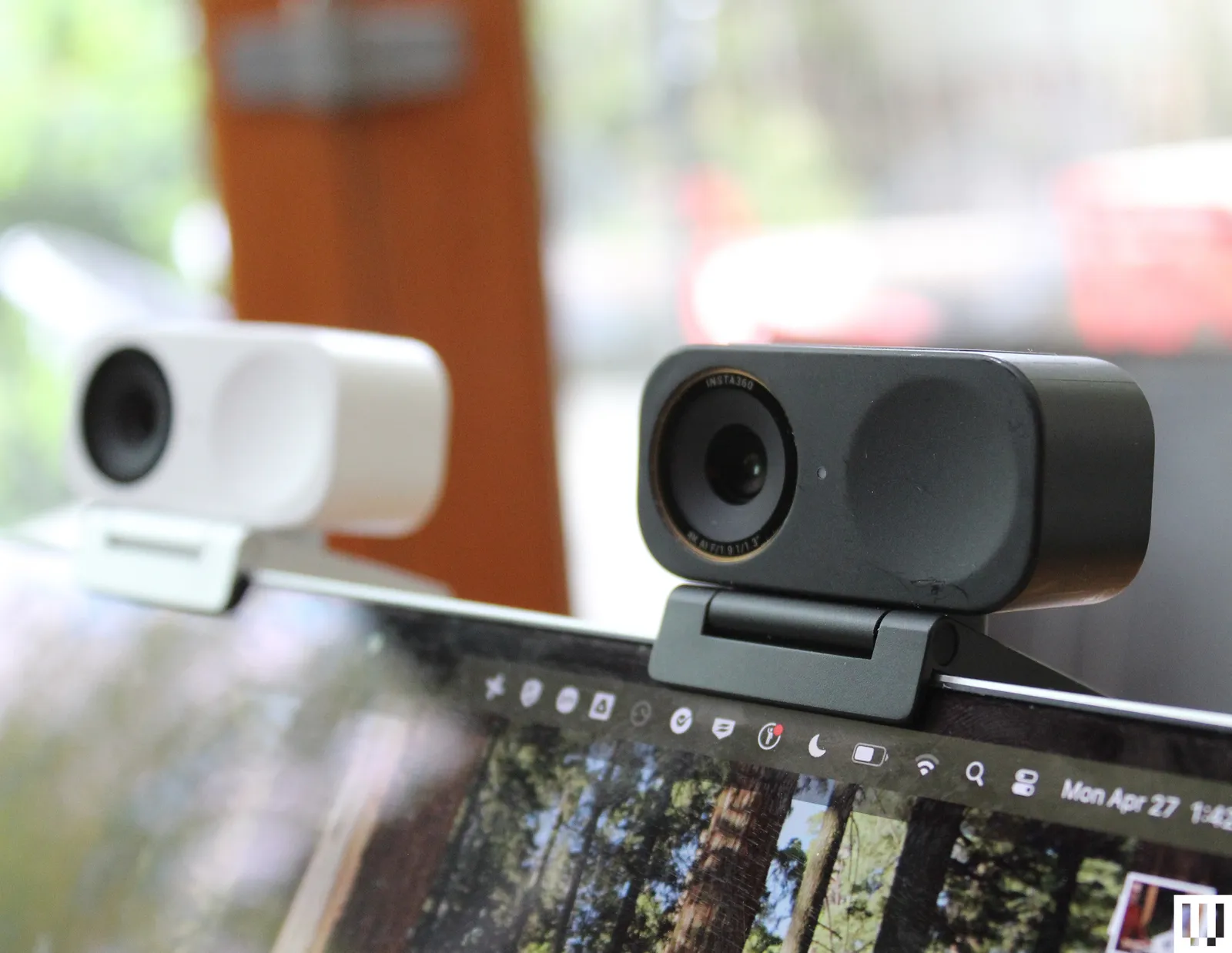
Two small rectangular webcams clipped to the top of a laptop screen one in white and the other black

Insta360 Link 2C (left); Insta360 Link 2C Pro (right)

Advertisement

Photograph: Luke Larsen

Nearly all of the dozen webcams I tried out looked great while under ideal lighting. I spent some time working in a different room next to a window, and the upgrade to an external camera felt significant. With all that light to work with, the higher-end cameras with a larger 1/1.3-inch image sensor handled the situations beautifully. It didn’t need to blow out the direct natural light to get details in my face, showing a wider dynamic range of shadows and highlights. Having more natural light in the room improved just about every webcam I tried, but they also better showcased just how powerful some of these higher-end cameras really are, such as the Insta360 Link 2C Pro or Obsbot Tiny 3. These are the scenarios most webcams are tested in, leaving them all looking more or less adequate.

Source link

Continue Reading

Trending

Copyright © 2025