Meze Audio, founded in 2011 in Romania, has built a strong reputation in high-end personal audio with standout over ear models like the award winning Empyrean II, 109 Pro, and the recently updated 99 Classics 2nd Gen. But while the brand has become one of the more recognizable names in premium headphones, its track record with in-ear monitors has been far less consistent.
We had an early preview of the new Astru at CanJam NYC 2026, where one thing was impossible to ignore: wired IEMs are having a moment and were at the center of the conversation. If you think the category is fading in a world dominated by wireless earbuds, think again. Enthusiasts are doubling down on sound quality, and brands are responding.
The Astru is Meze’s latest attempt to finally lock in a true flagship IEM. Featuring a titanium shell and a single dynamic driver design, it builds on earlier efforts like Advar and Rai Penta, both of which showed promise but struggled to fully land with critics and buyers. The question now is simple. Can Meze translate its headphone success into the IEM space, or is this another near miss?
Key Specifications and What They Actually Mean
The Astru uses a single 10mm dynamic driver with a titanium and PEEK diaphragm, a combo designed to balance rigidity and flexibility for a more natural, controlled sound. With a 32 ohm impedance and 111dB sensitivity, it is easy to drive from a phone or dongle, but still benefits from better sources.
Advertisement
Meze includes a 0.78mm 2-pin cable with a 4.4mm balanced termination, which signals this is meant for serious portable gear, not just casual listening. At 13.4 grams with a titanium shell, it should feel solid without being fatiguing, and at $899, it lands in a very competitive tier where sound quality matters more than design alone.
Who Astru Is For and Who It Is Not
The Astru is aimed squarely at dynamic driver enthusiasts and anyone chasing a flagship IEM experience built around Meze’s house sound. It will appeal to listeners who prioritize cohesion over complexity, delivering a unified presentation that does not sacrifice treble performance, along with a warm, balanced tuning that favors musicality over analysis.
It is not for bassheads, listeners who demand true reference sound, or those chasing maximum top of the line vocal resolution. If your priorities lean toward impact, absolute neutrality, or extracting every last micro detail from a vocal track, this may not be your endgame.
Build
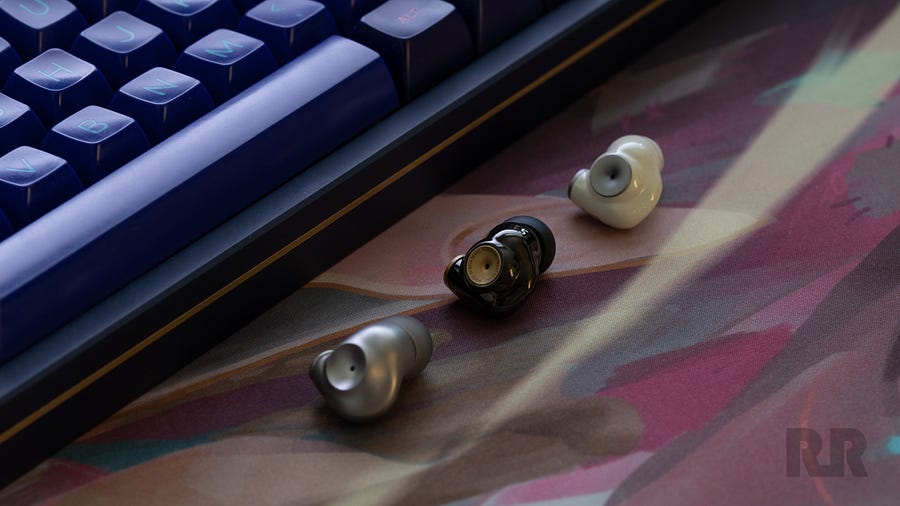
Meze went with titanium for the Astru’s shells. It is an expensive, finicky material, so it makes sense that they also reduced the visual and structural complexity to match. That said, the two-tone character of models like Advar and Alba is missed. This more minimalist approach makes the Astru feel less like a statement piece and more like an unfinished Blender render than a flagship Meze IEM.
Advertisement
Style aside, Meze clearly put real effort into the Astru’s geometric shell design. The titanium nozzles feature precisely cut, integrated debris filters with a clean chamfer leading into a tight lip, giving the whole assembly a more refined, engineered feel.
Like the Alba and unlike the Advar, the Astru uses 0.78mm 2-pin detachable cables, with the sockets housed in smoky black plastic blocks. It works, but it is a step back visually. The Alba at least added a red accent on the right side for quick channel identification, a small but thoughtful detail that is missing here on the more expensive Astru.
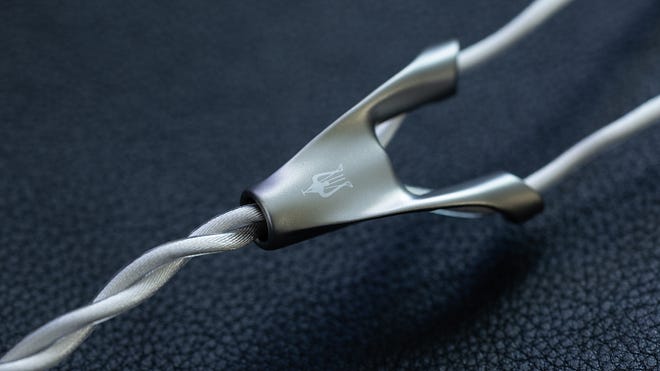
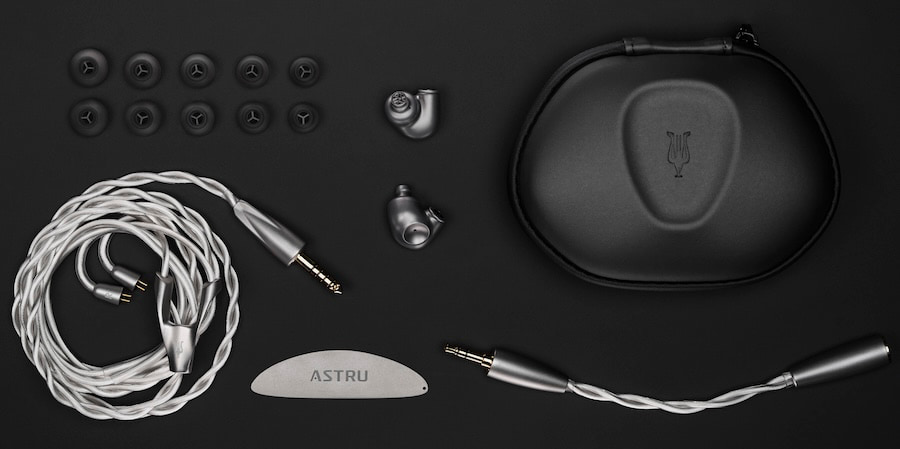
The effort Meze put into the Astru’s cable is obvious, from the soft, premium feeling twisted braid to the custom cut hardware on the Y splitter, giving it a true flagship feel in hand rather than something thrown in to check a box. It uses a fixed 4.4mm termination, with a 4.4mm to 3.5mm adapter included in the box for broader compatibility.
Advertisement. Scroll to continue reading.
Comfort
Comfort is always subjective and heavily dependent on your ear anatomy, so mileage will vary. The Astru is one of the most-comfortable IEMs I’ve used. I was able to listen to it without any discomfort. Its lightweight titanium shells work wonders for long transit rides and intense work sessions, though I did not get the best passive isolation with the stock eartips.
Accessories
Inside the box you’ll find:
1x Semi-hard carrying case
1x 4.4mm-to-3.5mm adapter
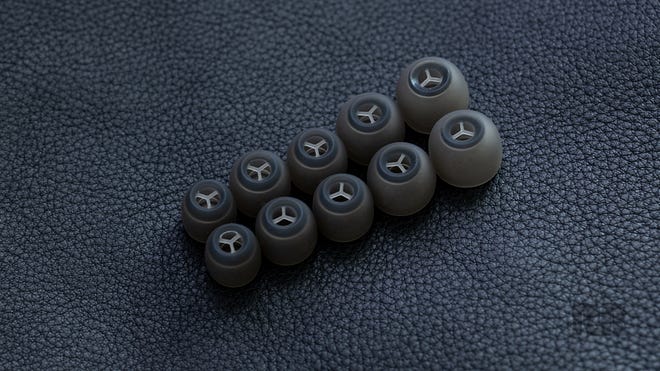
5x Pairs silicone eartips
1x Synthetic leather baggie
1x Metal Astru plate
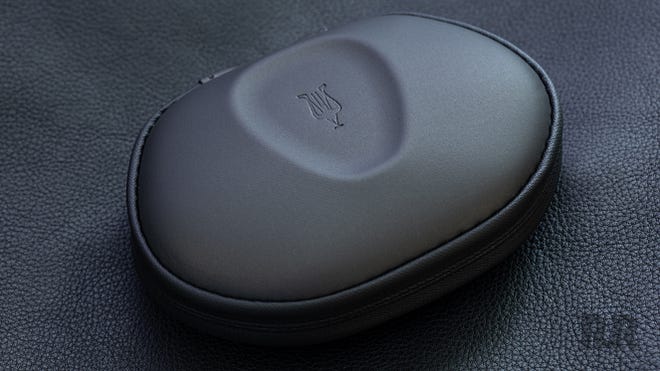
Meze did well with the Astru’s cable. It feels great in hand and is comfortable to use, but the rest of the accessory package does not keep up. The carrying case uses the same overall design as previous Meze flagships, but swaps the glossy black finish for a cheaper feeling satin coating that is more prone to scratches and long term wear like drying or flaking. By comparison, my well used Advar case still looks close to new. At $100 more, this feels like a step backward in overall quality.
Thankfully, Meze has improved on their ear tip offerings since 2022. The Astru’s stock eartips are comfortable and sized-well, but don’t offer the variety and passive isolation found on the sets offered by other brands. Campfire Audio, for example, includes a wider variety on even their entry-level IEMs, including liquid-silicone and foam sets. For $900, it’s fair to expect a more-comprehensive out-of-the-box experience.
Advertisement
Listening
About My Preferences: This review is a subjective assessment and is therefore tinged by my personal preferences. While I try to mitigate this as much as possible during my review process, I’d be lying if I said my biases are completely erased. So for you, my readers, keep this in mind:
My ideal sound signature leans toward competent sub bass, textured mid bass, a slightly warm midrange, and extended treble, though I do have mild treble sensitivity.
Testing equipment and standards can be found here.
The Astru features a gently V-shaped sound signature. It has a warm, healthy lower register, clean upper-midrange lift, and far-extending treble. The Astru exhibits a distinct “balance-first” approach to tuning, deviating from a tonal neutral purely in pursuit of a more-organic presentation. The Astru’s warm and inviting timbre and top-notch performance, blend together to deliver a distinctly “Meze” take on a harmonically-complete version of a modern meta IEM.
The Sweet Meze Sparkle
The Astru, with its single dynamic driver configuration, faces an uphill battle against the maelstrom of audiophile preconception. Single dynamic driver IEMs have long since been maligned as somehow inferior to alternative configurations, even if the objective measurements demonstrated otherwise. The bulk of the general enthusiast population’s disillusionment with dynamic drivers is concentrated around their treble characteristics, often described as grainy, or lacking in upper-end resolution.
Advertisement
For many poorly-implemented IEMs, that’s actually true — but that’s not the case on the entry-level Meze Alba, let alone the new Astru. The Astru exhibits the best treble performance of any single dynamic driver IEM I’ve heard, bar none. Even some multi-driver, planar-based, tribrids don’t resolve subtle textures as cleanly as the Astru does.
I was particularly taken by the Astru’s ability to resolve the tactile decay of the hi hats in “Careless” by Royal Blood (around 1:20 and 1:23). It also does an excellent job with background textures in “WANTED U” by Joji (around 3:00), integrating treble based effects naturally against the track’s dark, empty soundstage.
Meze’s focus on the Astru’s treble pays off, delivering a more elevated take on the brand’s upper register tuning. The result is a sweet, resolving timbre that avoids sharpness and sibilance, making it an easy listen even on rougher masters, including for those with mild treble sensitivity like myself.
Advertisement. Scroll to continue reading.
Advertisement
Vivid and Lush Mids
The core trait shared between Meze’s IEMs is a lush, warm, and inviting midrange. That Meze house sound is certainly present on the Astru, as its lower-mids have a healthy dose of emphasis. They blend organically from the lower mids into the mid bass, allowing the Astru to create a strong sense of atmosphere on tracks like “Lisztomania” by Phoenix. The layering of gentle guitar strumming against punchy drums and fluttering vocals feels dynamic and engaging, exactly what you want from a flagship IEM.
The Astru’s vocal timbre benefits from its rich midrange, with male vocals sounding deep and harmonically complete. Singers with complex tones, like Chris Cornell in “You Never Really Knew My Mind,” come through with a haunting sense of weight and texture. That said, vocal intelligibility in busy tracks does not rise above what similarly priced competitors deliver.
Challenging tracks like “Letter from a Thief” by Chevelle push the Astru close to its limit in terms of vocal presence, and as a result, some of the finer edges of the performance get smoothed over. In the pursuit of maintaining a sense of vocal cohesion, Meze limited the forwardness of the Astru’s upper-mids, and this aspect of its performance is what happens as a result.
Polite, But Firm
As divisive as bass can be, it is hard to imagine anyone putting on the Astru and not thinking this is well tuned low end. It does not lean into basshead levels of emphasis, but there is enough presence to satisfy across a wide range of genres, backed by strong control and texture rather than just quantity.
Advertisement
The Astru held its own in EDM, delivering deep, impactful bass hits in “Fat Cat Adventures” by Tut Tut Child (around 1:20). “Turbulence” by Neddie also comes through with tight, full bodied bass lines, supported by the Astru’s solid and well extended sub bass.
The Astru is just as capable with rock and alternative. It picks up even the faint mid bass drum hits in “Lydia” by Highly Suspect with ease, showing impressive control across the lower register. That control translates into strong contrast and rhythmic drive, and the Astru clearly understands that musical engagement starts with the low end.
That said, some tracks could use a bit more weight. “I Hope You Hate Me” by Dead Poet Society sounds warm enough, but the electric guitar chugs do not hit as hard as they could. The drums in “Bulletproof Heart” by My Chemical Romance are clear and distinct, but they lack the kind of physical impact you get from bassier IEMs.
Comparisons
Comparisons are chosen based on what I find most interesting. If there is something you would like to see added, feel free to drop a request in the comments.
Advertisement
Meze Alba
Left to right: Meze Astru, Advar, Alba
The Alba is Meze’s entry-level IEM. It features slender metal shells and a single dynamic driver per-side. It sells for a fairly-affordable $159, making it significantly cheaper than the Astru’s $899 price-tag.The goal of this comparison is not to decide which one is “better,” especially given the price gap, but to highlight the differences in sound and physical design between Meze’s two newest IEMs.
For $899, Meze includes a five size set of basic silicone eartips with the Astru, while the Alba ships with a lower quality four size set. Both use detachable 2-pin cables, but the Astru’s is clearly the better execution, with a thicker build and a proper 4.4mm termination.
That said, the Alba includes a well designed USB-C DAC, which is notably absent from the Astru. Most flagship buyers will already have a capable 4.4mm source, but it still represents a meaningful loss in out of the box flexibility. The Alba also leans more into design, with a more distinctive two tone look and clearer left and right channel indicators.
Sound wise, the Alba presents hi hats and cymbals more forward, but without pushing the lower treble as prominently as the Astru. The Astru comes across warmer overall, with a fuller lower midrange and a more grounded presentation.
Advertisement. Scroll to continue reading.
Advertisement
Bass is where the gap becomes more obvious. The Alba is lighter and less controlled, while the Astru delivers greater impact and definition. Resolution is also improved on the Astru from top to bottom, especially in how it handles hi hat decay in busy passages. That makes it the better pick for bass heavy music, though the Alba still holds its own, with a tuning that stays close enough to make switching between them feel natural rather than jarring.
All things being equal, I’d say that the Astru, on tonal merits alone, is my choice. The Alba is an excellent “baby Astru,” but doesn’t deliver the depth and lower-register technicality that I’m looking for in electronic music. Even if both IEMs shared identical physical design and price tags, I’d lean the same way.
Meze Advar
Left to right: Meze Astru, Advar, Alba
The Advar is the direct ancestor of the Astru, acting as the Meze IEM flagship back from 2022 until the end of 2024. Meze came back with the Astru, swapping to monochrome titanium shells and dropping much of the Advar’s visual flare. The Advar is a little weightier than the Astru, and looks quite a bit more stately thanks to its high-contrast design. The Astru uses the more-widespread 2-pin standard for its cables, rather than MMCX, which should allow users to more-easily swap to aftermarket cables.
The Astru’s cable is thicker, softer, and less tangle-prone that the Advar’s cable, which is a major quality-of-life improvement. Beyond the improved ergonomic utility, the Astru’s cable is outright nicer to look at and better-feeling in the hand. While some users may find that the decision to move to a fixed 4.4mm termination is kind of annoying, you can always swap the cable or make use of the included 4.4mm-to-3.5mm adapter to compensate.
The Astru includes a better selection of eartips and a nicer cable, but it loses ground with the case. Instead of the more premium finish used on the Advar, you get a matte slate colored version with the same shape but a less refined look and feel.
Advertisement
Sonically, the Advar is fairly similar to the Astru, offering a broadly V-shaped sound signature with a warm lower midrange and enhanced upper-treble. The Advar, however, has less bass emphasis. The Astru, while bassier on the whole, also exhibits a tangibly-improved level of control over its mid and sub-bass, leading to an obviously-better experience with bass-centric tracks.
The intro of “Reminder” by Uppermost sounds noticeably more dynamic on the Astru, with tighter sub bass hits and improved texture throughout.
The Astru also features a retuned treble with reduced peakiness and greater overall resolution. There are plenty of treble-heavy elements on the Advar that can come across as too aggressive. The Astru is not exactly laid back up top, but it avoids that sharp edge and sounds more controlled by comparison. The Astru also demonstrates a greater degree of control over percussion decay. Hi hats and cymbals decay for longer and with a greater sense of identity on the Astru versus the Advar.
For me, the choice between the Advar and Astru is straightforward: the Astru simply sounds better. It costs more and comes with a less appealing case, but where it matters most, its musical performance is clearly superior.
Advertisement
Campfire Audio Alien Brain
The Alien Brain is a $1,000 IEM from Campfire Audio. It features a selection of balanced-armature and dynamic drivers per side and uses a combination of aluminum and plastic for its shells. Coming in at $100 more than the Astru, the Alien Brain features a simple carrying case with a magnetic flap and a pair of flat-braid MMCX cables. The Alien Brain includes a USB-C DAC, which is a utility absent from the Astru’s accessory package. The Astru has a less-robust selection of eartips in the box, notably missing the liquid-silicone and foam varieties found in the Alien Brain’s eartip suite. Campfire Audio also includes a number of tertiary goodies that Meze does not, including a microfiber cleaning cloth, cleaning tool, protective IEM baggie, and lapel pin. And while these are not essential to the core task of listening to music, the level of detail and finish from Campfire Audio feels more in line with a $900 to $1000 experience than what Meze delivers with the Astru.
Sound wise, the Alien Brain leans more into upper treble, with a more forward vocal presentation and punchier mid-bass. The Astru shifts focus slightly lower, with more forward sub bass that lets it dig deeper on drier tracks. The Astru has a warmer, more relaxed lower-midrange, giving it a comforting disposition that contrasts the Alien Brain’s more-analytical timbre. The Alien Brain, though a bit thinner-sounding, has a smoother upper-treble timbre. The Alien Brain’s cooler, more-technical presentation is a lot closer to the tonality you’d get from a classically V-shaped IEM. Its punchier mid-bass, but less-rumble-prone sub-bass, is more immediately-engaging in rock and alternative, though by a slim margin.
Fundamentally, I believe these two IEMs target different audiences. The Meze house sound, imbued into the Astru’s drivers, delivers a warm, moderately V-shaped sound signature with an emphasis on being welcoming and sweet. While I do enjoy the Alien Brain’s stronger vocal intelligibility on select tracks, that’s not enough of a benefit to entirely pull me away from the Astru’s excellent overall timbre. Given the Astru’s lower price tag, I’m gonna have to call a subjective draw between these two well-made IEMs.
Advertisement. Scroll to continue reading.
The Bottom Line
The Meze Astru gets the important things right. It delivers a cohesive, natural sound with excellent treble control, strong bass texture, and a presentation that feels more refined than past Meze IEM efforts. It is easily the brand’s most convincing in ear to date and a clear step up from models like Advar, especially in resolution and overall balance.
It is not perfect. The accessory package feels uneven for the price, with a noticeable drop in case quality and a lack of extras like a bundled DAC that some competitors include. And while the tuning is engaging and musical, it is not built for bassheads or listeners chasing strict reference neutrality or maximum vocal detail.
Advertisement
Against competitors in the $900 to $1000 range, the Astru holds its ground on sound quality but gives up some points on perceived value and finishing touches. This is for listeners who want a flagship-leaning dynamic driver IEM with a warm, cohesive tuning and fatigue free treble, not those looking for the most analytical or feature packed option in the category.
Samsung’s Music Studio 5 speaker supports a range of streaming services through Spotify Connect and similar platforms, but it does not include support for Spotify’s lossless audio tier, which affects its overall playback quality range.
The Music Studio 5 forms part of Samsung’s recent push into standalone wireless speakers, positioning it against competitors such as Sonos that already support higher-quality streaming options across multiple services and devices.
Reports from user discussions show that the lossless setting does not appear when adjusting Spotify streaming quality through Spotify Connect, meaning playback is limited to lower tiers even when higher-quality audio is available.
This absence stands out as Spotify continues expanding its lossless tier across supported hardware, with the feature delivering audio at up to 24-bit/44.1kHz for listeners seeking playback closer to original studio recordings.
Advertisement
Spotify’s lossless streaming option represents a shift toward higher-fidelity audio in mainstream services, as platforms move beyond compressed formats to appeal to users with more capable audio hardware and higher expectations.
Advertisement
The Music Studio 5 supports Spotify Connect, which allows direct streaming from Spotify servers rather than routing audio through a mobile device, a feature typically associated with improved stability and convenience in wireless listening setups.
However, the absence of a selectable lossless option suggests either a limitation in the speaker’s current software implementation or a restriction within its hardware processing capabilities, although Samsung has not confirmed the cause.
Advertisement
This places the device behind some competing speakers in the same price category, where support for higher-resolution formats has become a more common expectation rather than a niche feature.
The Music Studio 5 and Music Studio 7 mark Samsung’s move deeper into premium wireless audio, competing with the best Sonos speakers as the company expands beyond its traditional soundbar and TV-focused lineup.
As streaming services continue to prioritise audio quality improvements, compatibility with features such as lossless playback increasingly influences buying decisions, particularly for users investing in dedicated listening setups.
The current limitation may affect how the Music Studio 5 competes within the broader ecosystem, especially among users who prioritise audio fidelity alongside convenience and multi-platform streaming support.
Advertisement
Advertisement
Samsung has not provided further clarification on whether lossless support could arrive through a future update or remains unsupported on the device, leaving its long-term compatibility with Spotify’s highest-quality tier uncertain.
Spinder Dhaliwal of the Westminster Business School at the University of Westminster explores how graduates can get ahead in a tough landscape.
For entrepreneurs, something that starts out as a simple idea can transform into a thriving business that brings financial rewards, confidence and personal growth. These days, graduates may look at forecasts for a tightening jobs market and decide their future is as an entrepreneur rather than an employee.
The business world is brimming with opportunity. I have researched entrepreneurship for years, and have found that rapid technological evolution, shifting consumer preferences and a growing focus on sustainability are creating an exciting landscape for bold graduates.
However, success is never guaranteed – like anyone else they’ll need to understand their market, and know their competitors, target audience and growth potential. This is where graduates should put the research skills they honed as a student to good use. This can help them to avoid costly mistakes – things like overestimating demand for their business idea or underestimating the level of competition, for example.
Advertisement
My book, The Millennial Millionaire, demonstrates that successful young entrepreneurs tend to share certain traits: resilience, calculated risk-taking and a willingness to learn from failure. These characteristics remain essential in 2026, particularly as markets become more volatile with persistent inflation, shifting interest rate expectations and growing geopolitical tensions.
Graduate entrepreneurship has evolved over the years, and the traditional linear career where someone stayed with one employer, moving up through the ranks through their working life, is a thing of the past. My book highlights how younger entrepreneurs increasingly pursue business ownership not only for financial independence but also for autonomy, creativity and social impact.
However, it can still be tricky for graduates to make a mark. And entrepreneurship is not a level playing field, either. Rising costs for utilities and essential overheads, competitive markets and unequal access to capital disproportionately affect certain groups. Women generally have less access to capital compared to men, and this is more pronounced for some ethnic minority women. Young people may not have enough personal savings.
Entrepreneurship cannot be separated from questions of diversity and inclusion. Graduate entrepreneurs can face both opportunity and inequality when starting a venture. In this context, migrant communities often have a wealth of valuable “rags to riches” stories that they can share.
Advertisement
According to some of my other research, many Asian entrepreneurs in the UK started with virtually no money but used determination and family resources to build multimillion-pound businesses.
For example, the billionaire owner of a string of airport hotels Surinder Arora came from the Punjab as a child. He worked for British Airways and dreamed of being a pilot – but instead invested in a B&B to serve airline crews.
These lessons remain highly relevant: entrepreneurship does not occur in isolation – it is shaped by relationships, identity and experience.
A unique time to go it alone
AI is clearly a game-changer, making this a unique time to launch a business that can be built with AI in mind rather than struggling to keep up. Today’s market is more connected, tech-driven and socially conscious than ever, and tech-savvy graduates are well-positioned to seize these opportunities. Sustainability is no longer optional – consumers expect brands to align with their values and demonstrate social responsibility.
Advertisement
Budding entrepreneurs should use technology to their advantage. This could be for crowdfunding, market research or accessing support networks. My research suggests that entrepreneurs who want to give back to the community and who care about how their business affects the environment are more likely to build long-term trust with their customers.
For graduates, this means aligning business goals with broader societal needs such as poverty reduction or environmental challenges. The resulting venture could take the form of a social enterprise, ethical startup or inclusive business. But these enterprises will still need to generate money and be profitable – you can only give if you have.
Networking is a secret weapon. A strong network is essential, and graduates already have a foundation – they just need to build on it. They should attend industry events, stay informed about economic trends and learn from professionals. A supportive community can help to overcome challenges and accelerate growth.
Securing funding is often the biggest hurdle for new entrepreneurs. What’s key is the ability to start lean – “bootstrapping” (that is, having to start with the bare minimum of capital) is a challenge entrepreneurs are often forced to overcome. Many businesses begin with personal savings or family support. But graduates can also explore competitions and grants. Then eventually, a compelling pitch may attract investors.
Advertisement
Starting a business offers graduates unparalleled opportunities, from harnessing technology to tackling global challenges such as climate change. Success lies in identifying a passion, using resources well and building a strong support network. The future belongs to those who innovate, adapt and take calculated risks. With determination and the right mindset, graduates can turn a vision into a thriving venture.
Spinder Dhaliwal is a reader in entrepreneurship and the director of PhDs for the Westminster Business School at the University of Westminster. Her main area of interest is in ethnic minority businesses, women in business and young entrepreneurs. She has written about entrepreneurship and the business community, compiled information on Britain’s Richest Asians reflecting a long held interest in the field and her previous book, Making a Fortune, Learning from the Asian Phenomenon, explored the journey of Asian entrepreneurs in the UK, the challenges they faced, and how they were overcome.
Don’t miss out on the knowledge you need to succeed. Sign up for the Daily Brief, Silicon Republic’s digest of need-to-know sci-tech news.
When the Uber Black isn’t premium enough, New Yorkers now have the option to call for a Wheely instead. Whimsical name aside, the London-based company is breaking into the US market by offering its chauffeur-hailing services to residents of New York City first, as first reported by Bloomberg. Think of it like Uber, but for business executives and VIPs who prefer better service and riding in Cadillacs and Mercedes.
“New York has long been requested by our customers, whether that be New Yorkers who have traveled with us in Europe and the Middle East, or our international clients who regularly visit the city,” Anton Chirkunov, founder and CEO of Wheely, said in a press release.
Wheely
Besides its black car Business SUV service, New Yorkers can opt for Wheely First that offers a Mercedes-Benz S-Class W223 filled with amenities like Fiji water and towels. For a more dedicated service, Wheely has its Perfect Airport Pickup where drivers will track flights to line up a pickup, and the Chauffeur for a Day option that lets users reserve a chauffeur that will also pick up friends and family or run errands for you. For interested drivers in New York City, Wheely will port over its in-house “Chauffeur Academy,” which is expected to grow to a network of 5,000 qualified drivers over the next five years.
While Wheely currently operates in London, Paris and Dubai, the company plans to expand to five major US cities within the next three years. According to Bloomberg, Wheely is considering markets in Texas, Miami and Palm Beach, Fla. as well as Washington, D.C. Wheely’s entry into the US market comes about a week after the announcement of the Uber Elite program, which targets a similar demographic. However, Uber Elite is only available in Los Angeles and San Francisco currently, with plans to expand to New York soon. However, Uber may have Wheely beat when it comes to hailing a helicopter, thanks to its upcoming Uber Air option.
In the early days of aviation, pilots or their navigators used a plethora of tools to solve common navigation and piloting problems. There was definitely a need for some kind of computing aid that could replace slide rules, tables, and tedious dead-reckoning computations. This would become even more important during World War II, when there was a massive push to quickly train young men to be pilots.
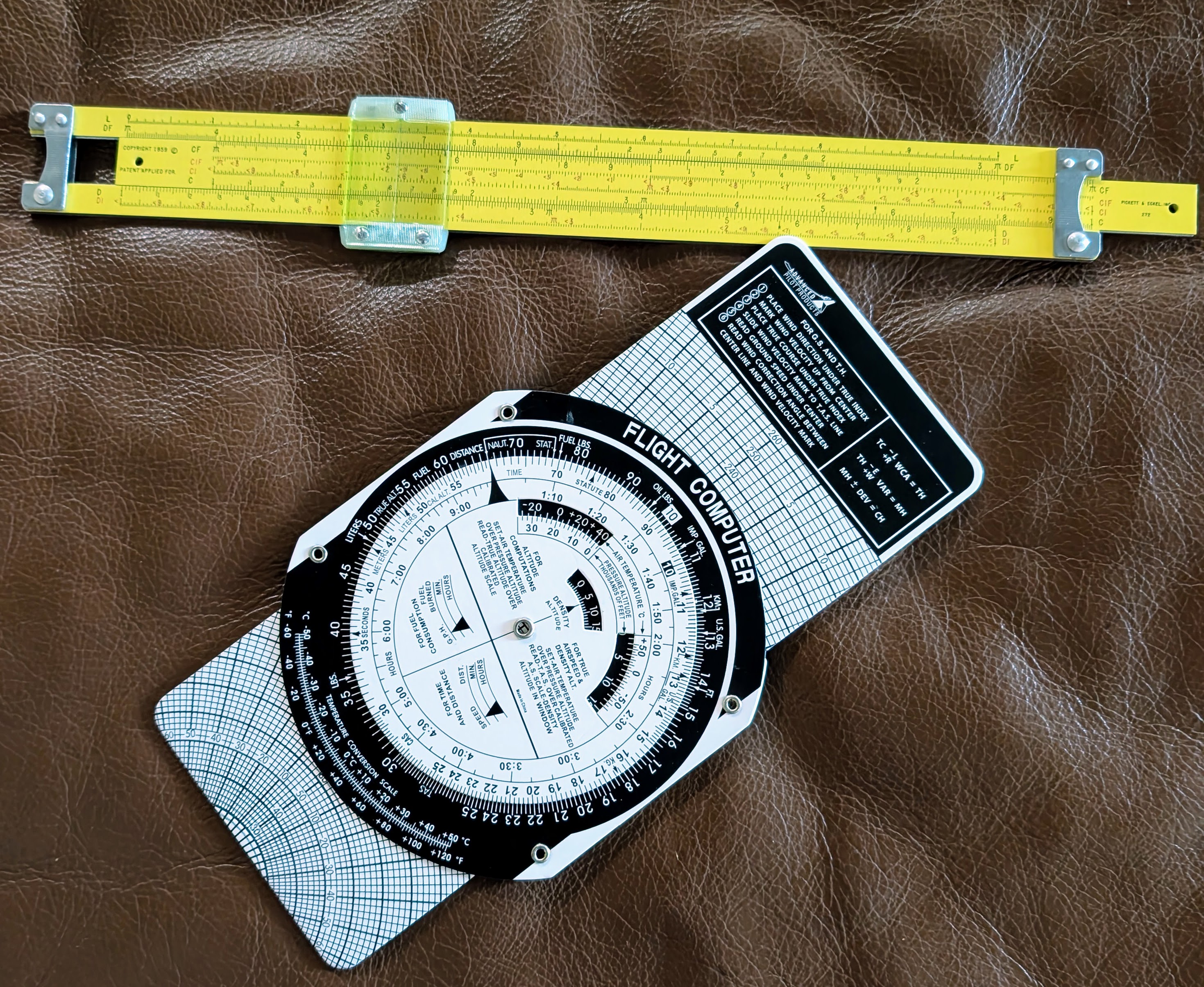
The same, but different. A Pickett slide rule (top) and an E6B slide rule (bottom). (Own Work).
Today, we’d whip up some sort of computer device, but in the 1930s, computers weren’t anything you’d cram on a plane, even if they’d had any. For example, the Mark 1 Fire Control Computer during WW2 was 3,000 pounds of gears and motors.
The computer is made to answer flight questions like “how many pounds of fuel do I need for another hour of flying time?” or “How do I adjust my course if I have a particular crosswind?”
History
There were a rash of flight computers starting in the 1920s that were essentially specialized slide rules. The most popular one appeared in the late 1930s. Philip Dalton’s circular slide rule was cheap to produce and easy to use. As you’ll see, it is more than just an ordinary slide rule. Keep in mind, these were not computers in the sense we think of today. They were simple slide rules that easily did specialized math useful to pilots.
Dalton actually developed a number of computers. The popular Model B appeared in 1933, and there were refinements leading to additional models. The Mark VII was very popular. Even Fred Noonan, Amelia Earhart’s navigator, used a Mark VII.
Advertisement
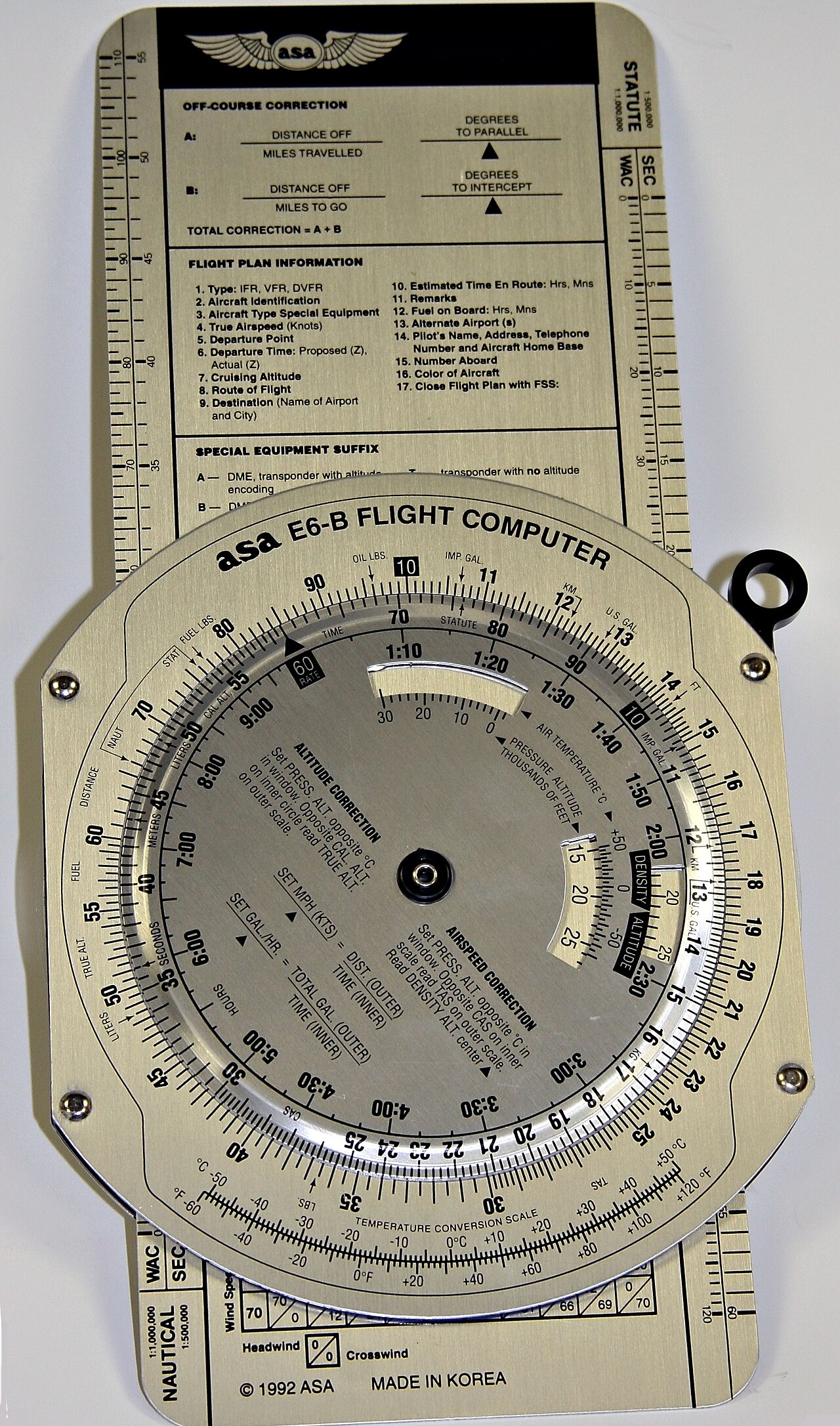
A metal E6B (public domain).
Dalton thought the Mark VII was clunky and developed a way to do vector calculations using an endless belt inside the computer. This proved to expensive to make, so he created a flat wind computer and put, essentially, the Model B on the other side. While he called this the Model H, the Army called it the E6A.
In 1938, the Army Air Corps asked for a few minor changes and adopted the computer as the E6B, although pilots often call it the “whiz wheel” or the “Dalton Dead Reckoning Computer.” Oddly enough, some pilots still swear by the E6B, and flight schools sometimes make you learn them because they help you develop a feel for the math you don’t get with a calculator.
Sadly, Dalton died in a plane crash with a student pilot in 1941. P.V.H. Weems, a well-known navigator and Fred Noonan’s mentor, carried on the work of improving the E6B.
Besides, they are almost a perfect backup computer. Small, light, cheap, not prone to breaking, and they need no power. Some are made of cardboard, some of metal, and others of plastic. Wartime E6Bs were on a plastic that glowed under cockpit illumination. Later, there would be electronic or software E6Bs (see the video below), but a real whiz wheel is something you can hold in your hand, and you never have to change the battery.
Advertisement
Not Just a Slide Rule
The front of the E6B is, essentially, a circular slide rule. What makes it unique, though, is that it has special scales and markings to deal with conversions of things like nautical miles or knots. Even the arrangement of the scales work to make a pilot’s life easier.
For example, the top of the wheel is a big mark that represents 60. Why? Because there are 60 minutes in an hour, and this makes it easy to compute things like pounds of fuel per hour.
It also lets you convert things like knots to nautical miles easily because the conversion factors are marked already.
Advertisement
If you know how to use a slide rule, you are almost immediately proficient on the front side of an E6B. Note that the sliding part of the computer is all about the wind computer (see below). All the calculation parts are just on the wheel, like a traditional circular slide rule.
The Back Side
The back side is a graphical vector solver for wind problems. You essentially use it to plot a wind triangle. You set the wind vector, the aircraft velocity vector, and you can read off the ground track. By moving things around, you can find your groundspeed, your wind correction angle, or your heading.On some E6Bs, you have to flip the slide to do low-speed or high-speed wind problems.
For an example wind problem, consider if you have wind at 200 degrees at 10 knots. Your true course is 150 degrees, and your true air speed is 130 knots. You would like to compute your ground speed, your true heading, and the wind correction angle.
One reason that the E6B remains useful for training is that it helps you develop intuition that is hard to get from a bunch of numbers on a calculator’s LEDs. You get a feel for how much wind will deflect your track 10 degrees, for example.
Advertisement
You can also use the E6B in reverse. If your groundspeed isn’t what you expect, you might set up the problem to put in your true parameters and solve for what the wind must be to make that result correct.
Sure, with GPS, you probably don’t need to figure out whether you have enough fuel to make it to another airport. But without GPS and a real computer, the E6B can do those things just fine.
Learning the E6B
If you actually want to learn how to use the E6B, we suggest watching a YouTube video. There are some short videos, and at least one that has 14 different videos. The good news is that the E6B hasn’t changed in many years, so any video you find should be just fine.
We like [Aviation Theory’s] two videos, which are worth watching (see part 1, below).
Advertisement
If you want to follow along and don’t have an E6B, you can try one virtually in your browser. Or, pick one up. The cardboard ones are fairly inexpensive and widely available.
The Legacy of the E6B
While the E6B isn’t the essential kit it once was, it is still a valuable aid for pilots. It is also a great example of how to turn an ordinary slide rule into something specialized.
We have a feeling Gene Roddenberry, an avid pilot, was very familiar with the E6B. He even thought they’d still use them in the 23rd century, as you can see in the video clip below.
Advertisement
You can also catch a glimpse of these in old US Army Air Corps films like the one below (about the 14-minute mark), although we couldn’t find any training specifically for the E6-B that survived.
Will there be an AI-optimized programming language at the expense of human readability? There’s now been experiments with minimizing tokens for “LLM efficiency, without any concern for how it would serve human developers.”
Cass acknowledged the obvious downsides. (“True, this would turn programs into inscrutable black boxes, but they could still be divided into modular testable units for sanity and quality checks.”) But “instead of trying to read or maintain source code, programmers would just tweak their prompts and generate software afresh.” This leads to some mind-boggling hypotheticals, like “What’s the role of the programmer in a future without source code?” Cass asked the question and announced “an emergency interactive session” in October to discuss whether AI is signaling the end of distinct programming languages as we know them.
In that webinar, Cass said he believes programmers in this future would still suggest interfaces, select algorithms, and make other architecture design choices. And obviously the resulting code would need to pass tests, Cass said, and “has to be able to explain what it’s doing.” But what kind of abstractions could go away? And then “What happens when we really let AIs off the hook on this?” Cass asked — when we “stop bothering” to have them code in high-level languages. (Since, after all, high-level languages “are a tool for human beings.”) “What if we let the machines go directly into creating intermediate code?” (Cass thinks the machine-language level would be too far down the stack, “because you do want a compile layer too for different architecture….”)
Advertisement
In this future, the question might become ‘What if you make fewer mistakes, but they’re different mistakes?’” Cass said he’s keeping an eye out for research papers on designing languages for AI, although he agreed that it’s not a “tomorrow” thing — since, after all, we’re still digesting “vibe coding” right now. But “I can see this becoming an area of active research.” The article also quotes Andrea Griffiths, a senior developer advocate at GitHub and a writer for the newsletter Main Branch, who’s seen the attempts at an “AI-first” languages, but nothing yet with meaningful adoption. So maybe AI coding agents will just make it easier to use our existing languages — especially typed languages with built-in safety advantages.
And Scott Hanselman’s podcast recently dubbed Chris Lattner’s Mojo “a programming language for an AI world,” just in the way it’s designed to harness the computing power of today’s multi-core chips.
This story was originally published by Grist and is reproduced here as part of the Climate Desk collaboration.
Gasoline prices continue ticking higher as the United States and Israel’s war with Iran continues. As of March 23, the national average stands at $3.96 per gallon, nearly a dollar higher than at the start of the conflict. It’s also just shy of a tipping point that could push consumers toward electric vehicles.
When gas prices top $4 per gallon, BloombergNEF estimates that the total cost of ownership for EVs becomes lower than for gas-powered vehicles. The exact crossover point depends on local prices for both gasoline and electricity. “[But] even when I run the model using the more expensive electricity cost, we are still seeing this very similar pattern,” said Huiling Zhou, an electric vehicle analyst at BloombergNEF. In California, for example, where electricity costs are high, gas is also expensive. At more than $5 a gallon, the state has already passed the point at which EVs are the cheaper option.
According to a AAA survey from 2022 — when Russia’s invasion of Ukraine drove a monthslong price spike — $4 a gallon is also the threshold at which a majority of Americans will make changes to their driving habits or lifestyles. Stephanie Valdez Streaty, director of industry insights at Cox Automotive, agrees that “the high gas prices definitely start the conversation with a consumer.”
Advertisement
“There is no meaningful policy tool to mitigate this.”
— Robbie Orvis, Energy Innovations
Edmunds.com has reported an uptick in search traffic for EVs since the war started on February 28. It’s too soon to tell whether that interest will convert to more purchases, said Valdez Streaty. But when prices surged at the outset of the war in Ukraine, sales of electrified vehicles rose as well. From January through March 2022, EVs’ share of car sales in the US climbed 69 percent, with hybrids jumping 32 percent. Robbie Orvis, who directs modeling and analysis for the think tank Energy Innovations, said the general trend pre-dates electric powertrains.
“In the past, when prices have gone up, people would start choosing more fuel-efficient cars,” he said. The oil shocks of the 1970s and 1980s, for example, led to a focus on fuel efficiency and helped make relatively efficient Japanese cars more popular. Avoiding gas guzzlers could become trendy this time, too.
“If you drive an EV, you’re nicely insulated,” Orvis said. “Your retail electricity rate isn’t going to double from one month to the next, like it can with gasoline.”
Advertisement
Still, Orvis highlighted some factors that might mitigate a rush toward EVs. For one, it’s unclear how long high fuel prices will last. Limited availability of chargers for electric vehicles is another barrier to adoption. People also tend to put more weight on upfront costs than long-term financial gains. Then there’s the fact that higher oil prices can put a damper on consumer confidence more broadly.
“The current situation is very likely going to lead to higher prices all around,” Orvis said. That pressure could mean people are more hesitant to make a big purchase like a car. As Valdez Streaty put it, “if they can delay it, they’ll delay it.”
A customer is shown a 2022 Toyota Prius hybrid in El Monte, California.Paul Bersebach/MediaNews Group/Orange County Register/Getty Images
At the same time, EVs are in many ways more attractive than ever. Cox Automotive reported that, last month, the price premium for EVs compared to new gas-powered cars was the lowest on record, at $6,532. The pre-owned market had an even narrower $1,334 gap, with 18 of 26 brands now having an average used EV price below their used gas equivalents.
“If you can have access to charging, now is the perfect time to get an EV,” said Jenny Carter, a professor at Vermont Law School who has researched consumer EV adoption. But higher gas prices, she continued, also put a spotlight on equity issues.
Advertisement
“Low-income people have the most to gain by owning and driving an EV, but they’re the hardest market to reach,” she said. Those households often spend the highest portion of their incomes on gasoline, she explained, but are the least likely to be able to afford alternative vehicles or have access to charging. “It’s a real paradox.”
Orvis thinks that part of the problem is the dearth of information available to prospective buyers. Because dealers generate much of their revenue providing maintenance that EVs don’t need, he said, they may not fully explore the financial benefits of going electric with customers. He suggested that shoppers use one of the many onlinecalculators that can show how, even when the upfront cost of a gasoline car might be lower, the monthly costs of ownership could be higher when you consider fuel and maintenance costs.
“There’s a real issue with how EVs are marketed,” he said. “It’s very hard for a new buyer, especially if you’re not really versed in this stuff, to get a real sense of what the trade-offs are.”
For those who either can’t afford electric cars or don’t have access to charging, Valdez Streaty points to hybrid vehicles, which can be 25 to 45 percent more fuel efficient than their standard counterparts. A HondaCR-V, for example, gets around 29 mpg while the hybrid version gets 37.
Advertisement
Even if soaring oil prices don’t last long, electrified cars can help soften the blow the next time they spike. A report released Wednesday by the energy think tank Ember found that EVs already displace around 1.7 million barrels of oil per day. While a far cry from the roughly 20 million that normally flow through the embattled Strait of Hormuz daily, it represents about 70 percent of Iran’s oil output.
“The main thing to watch is national plans of how to respond to this,” said Daan Walter, a principal at Ember. He is optimistic that many countries will use moments like this to start turning to climate-friendly policies that help reduce their dependence on fossil fuels, including gasoline.
So far, President Donald Trump doesn’t appear poised to lead the United States in that direction. Last summer, a Republican-led Congress gutted the Inflation Reduction Act, which included tax rebates for electric vehicles. But, particularly in the short term, American policymakers also lack levers for keeping rising gas prices in check, so people may very well start to shift on their own.
“There is no meaningful policy tool to mitigate this,” Orvis said. “The only way to do that is to just get off the roller coaster, and EVs allow you to do that.”
In today’s data-driven world, data scientists face mounting challenges in preparing, scaling, and processing massive datasets. Traditional CPU-based systems are no longer sufficient to meet the demands of modern AI and analytics workflows. NVIDIA RTX PROTM 6000 Blackwell Workstation Edition offers a transformative solution, delivering accelerated computing performance and seamless integration into enterprise environments.
Data Preparation: Data preparation is a complex, time-consuming process that takes most of a data scientist’s time.
Scaling: Volume of data is growing at a rapid pace. Data scientists may resort to downsampling datasets to make large datasets more manageable, leading to suboptimal results.
Hardware: Demand for accelerated AI hardware for data centers and cloud service providers (CSPs) is exceeding supply. Current desktop computing resources may not be suitable for data science workflows.
Benefits of RTX PRO-Powered AI Workstations
NVIDIA RTX PRO 6000 Blackwell Workstation Edition delivers ultimate acceleration for data science and AI workflows. These powerful and robust workstations enable real-time rendering, rapid prototyping, and seamless collaboration. With support for up to four NVIDIA RTX PRO 6000 Blackwell Max-Q Workstation Edition GPUs, users can achieve data center-level performance right at their desk, making even the most demanding tasks manageable.
PNY is redefining professional computing with the @NVIDIA RTX PRO 6000 Blackwell Workstation Edition, the most powerful desktop GPU ever built. Engineered for unmatched compute power, massive memory capacity, and breakthrough performance, this cutting-edge solution delivers a quantum leap forward in workflow efficiency, enabling professionals to tackle the most demanding applications with ease.PNY
NVIDIA RTX PRO 6000 Blackwell Workstation Edition empowers data scientists to handle massive datasets, perform advanced visualizations, and support multi-user environments without compromise. It’s ideal for organizations scaling up their analytics or running complex models. NVIDIA RTX PRO 6000 Blackwell Workstation Edition is optimized for AI workflows, leveraging the NVIDIA AI software stack, including CUDA-X, and NVIDIA Enterprise software. These platforms enable zero-code-change acceleration for Python-based workflows and support over 100 AI-powered applications, streamlining everything from data preparation to model deployment.
Advertisement
Finally, NVIDIA RTX PRO 6000 Blackwell Workstation Edition offers significant advantages in security and cost control. By offloading compute from the data center and reducing reliance on cloud resources, organizations can lower expenses and keep sensitive data on-premises for enhanced protection.
Accelerate Every Step of Your Workflow
NVIDIA RTX PRO 6000 Blackwell Workstation Edition is designed to transform the entire data science pipeline, delivering end-to-end acceleration from data preparation to model deployment. With NVIDIA CUDA-X open-source data science cuDF library and other GPU-accelerated libraries, data scientists can process massive datasets at lightning speed, often achieving up to 50X faster performance compared to traditional CPU-based tools. This means tasks like cleaning data, managing missing values, and engineering features can be completed in seconds, not hours, allowing teams to focus on extracting insights and building better models.
NVIDIA RTX PRO 6000 Blackwell Workstation Edition is designed to transform the entire data science pipeline, delivering end-to-end acceleration from data preparation to model deployment
Exploratory data analysis is elevated with advanced analytics and interactive visualizations, powered by NVIDIA CUDA-X and PyData libraries. These tools enable users to create expansive, responsive visualizations that enhance understanding and support critical decision-making. When it comes to model training, GPU-accelerated XGBoost slashes training times from weeks to minutes, enabling rapid iteration and faster time-to-market AI solutions.
Advertisement
NVIDIA RTX PRO 6000 Blackwell Workstation Edition streamlines collaboration and scalability. With NVIDIA AI Workbench, teams can set up projects, develop, and collaborate seamlessly across desktops, cloud platforms, and data centers. The unified software stack ensures compatibility and robustness, while enterprise-grade hardware maximizes uptime and reliability for demanding workflows.
By integrating these advanced capabilities, NVIDIA RTX PRO 6000 Blackwell Workstation Edition empowers data scientists to overcome bottlenecks, boost productivity, and drive innovation, making them an essential foundation for modern, enterprise-ready AI development.
Performance Benchmarks
NVIDIA’s cuDF library offers zero-code change acceleration for pandas, delivering up to 50X performance gains. For example, a join operation that takes nearly 5 minutes on CPU completes in just 14 seconds on GPU. Advanced group by operations drop from almost 4 minutes to just 4 seconds.
Enterprise-Ready Solutions from PNY
Available from leading OEM manufacturers, NVIDIA RTX PRO 6000 Blackwell Workstation Edition Series GPUs are specifically engineered to meet the rigorous demands of enterprise environments. These systems incorporate NVIDIA Connect-X networking, now available at PNY and a comprehensive suite of deployment and support tools, ensuring seamless integration with existing IT infrastructure.
Advertisement
Designed for scalability, the latest generation of workstations can tackle complex AI development workflows at scale for training, development, or inferencing. Enterprise-grade hardware maximizes uptime and reliability.
The weekend morning dread is a real situation, and homeowners know it pretty well. I’ve often woken up with the realization that the next few hours will be spent toiling with the hum of a petrol engine machine and hours of pushing a heavy mower around the yard. We’ve all been there, sweating under the sun, in our quest to achieve a green carpet that looks fine at best, but rarely ever achieves the work done by an expert. A fully automated solution should address all those problems, but finding a reliable one isn’t a cakewalk.
The hassles of setting up boundary wire, mastering the navigation, and requiring constant manual supervision don’t really sound like an autonomous dream. But tech is finally catching up, and one of its best specimens is Yardcare’s N1600PRO. The latest from Yardcare ensures that lawn care no longer means non-stop manual effort, but relaxed efficiency. If you’re a homeowner who is increasingly leaning toward automation to take care of your yard space, Yardcare is here to help you make that smart shift with the N1600PRO.
With over 100k units sold last year, Yardcare is offering the gold standard for landscaping and lawn chores, one that simplifies yard maintenance while delivering professional-level results. By blending cutting-edge robotics with professional landscaping standards, Yardcare has earned the trust of thousands of families globally. The mission is to provide homeowners with the gold standard for yard maintenance, ensuring that achieving a perfectly groomed lawn no longer requires non-stop manual effort or constant supervision. Building on a legacy of reliability and innovation, Yardcare is now launching its most advanced specimen yet: the N1600PRO, a flagship mower that delivers a completely no-strings-attached experience with a totally wire-free approach.
Smart Lawn Care for Smart Households
Yardcare
Precisely designed to meet the standards of modern lifestyle, the N1600PRO delivers results without tiresome effort. Whether it is an uneven terrain, slope, or the need for looking after multiple lawns, this robotic mower can adapt to your layout with ease.
The built-in automated mapping system enables the robot lawnmower to readily learn about the lawn’s structure. This, along with a no-go zone feature, ensures avoiding sensitive areas, like garden beds, pools, or outdoor furniture. Compared to sweating it out with a manual lawnmower, this automated mower can free up your precious time while it perfectly grooms your outdoor space.
Advertisement
How is Yardcare N1600PRO a competitively superior choice
Usability and future-proof technology are two of the key considerations for any buyer. To address those needs, Yardcare N1600PRO offers a few crucial upgrades in comparison to traditional robotic lawnmowers. Competing companies depend on boundary wires for their automated mowers. Adjusting boundaries is time-consuming, a hassle to set up, and leads to long mowing durations that have uneven coverage.
The N1600PRO overcomes those hurdles with its next-gen engineering. Automated navigation, structured mowing plan, and virtual mapping help reduce repetitive lawn coverage. Then you have the automated mapping with multi-zone control, which gives the flexibility of a totally hands-free operation, precisely for segmented or complex lawn types. All you need is the companion mobile app, and you’re good to go.
Yardcare
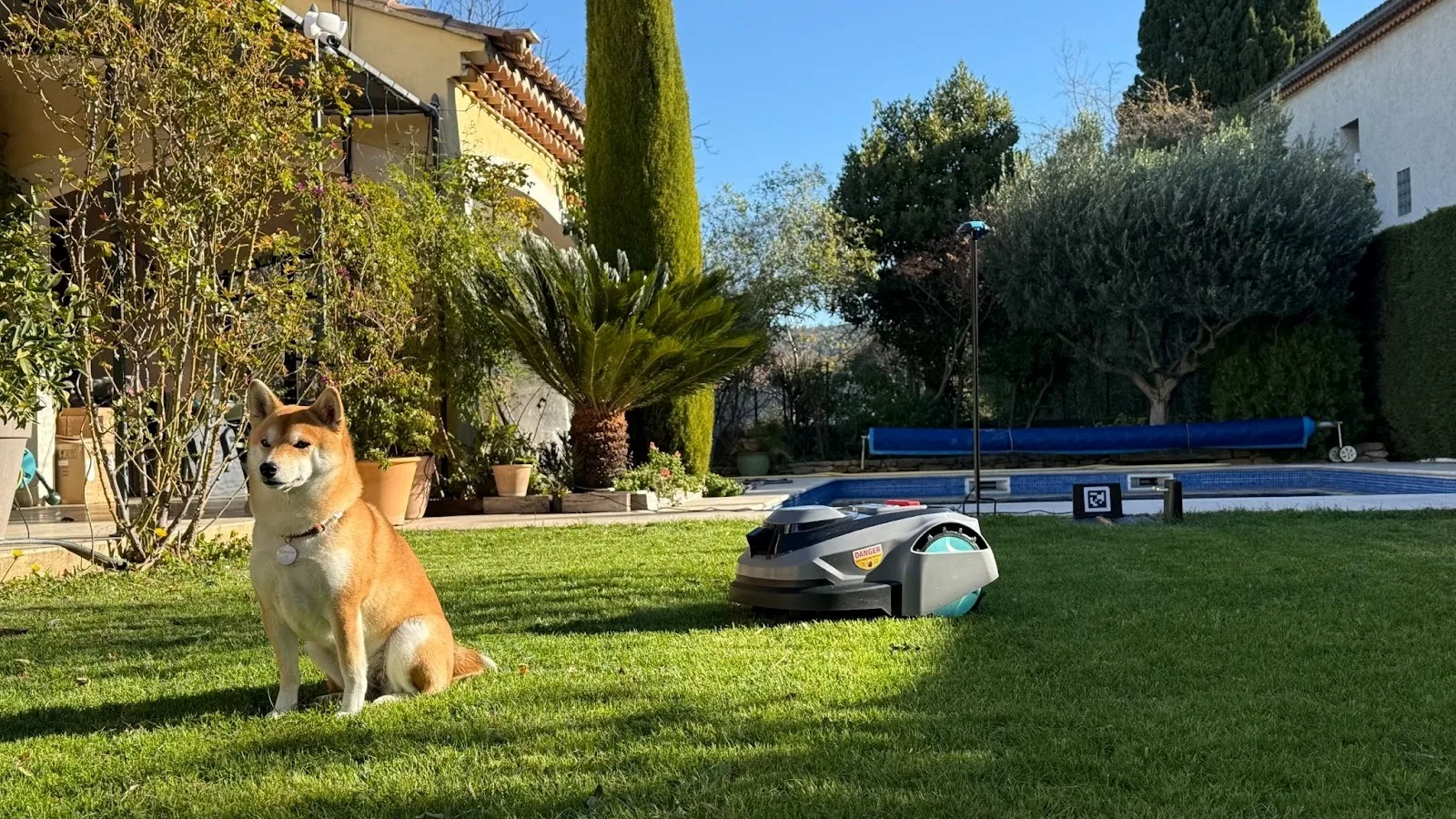
Another core advantage is the RTK+Vision Navigation system, which gives centimeter-level positioning accuracy. When deployed in an open area, the N1600PRO provides the best signal, along with the RTK unit, to achieve precise mapping and navigation of your lawn.
Unlike the rival products that lean only on GPS or RTK, the added vision-based intelligence brings the users improved stability in real-time. So, walls or trees can’t be an obstruction for N1600PRO, with little to no overlapping, and fewer spots missed, for a fresh, clean, and uniform finish.
Mow Your Lawn from Anywhere
Yardcare’s innovative streak with N1600PRO emphasizes convenience, and at the center of it all is the App Smart Control. It’s a simple mobile-first route for yard management when you are not home. For example, you can set a custom mowing schedule or multi-zone management just with one tap. It also brings some much-needed flexibility for lawn care, letting you set your cutting and trimming preferences depending on seasons, while enabling 9 cutting height adjustments between 2 and 6 centimeters.
Advertisement
Image used with permission by copyright holder
Additionally, the Over-the-air (OTA) update for the mower keeps it up-to-date, so a feature like passage creation makes navigation seamless. Next, the U-shape pattern optimizes lawn care through visible lines. The edge-cutting mode precisely grooms your lawn’s boundaries at the start of each session. As long as your edges are level with the grass, you’ll enjoy neat corners and a professional look without the extra effort.
Why This Robotic Mower Might Be The Best Choice
At Yardcare, safety and reliability are a priority, and that approach shines bright on the N1600PRO. The built-in AI-driven obstacle detection system actively avoids moving objects in real-time and can auto-return to its charging dock right as the battery drops below 20%. All it takes is merely over two hours to fully charge, giving it 100 minutes of mowing activity for a large or medium yard.
Image used with permission by copyright holder
For improved safety, N1600PRO has an emergency stop, a lift stop, and a rain sensor for auto-return to the dock. But it doesn’t end here, it’s an intelligent deal that can effortlessly handle up to 20° climbs and has an adaptive low-noise system for quiet operation. Overall, the innovations baked at the heart of N1600PRO by Yardcare are a big win for buyers seeking the best of modern technology, safety, and convenience.
To ensure every yard finds its perfect match, Yardcare has also curated a wide portfolio tailored to diverse modern lifestyles. The E400 serves as the ideal entry point for compact urban yards, offering a streamlined, app-controlled solution that prioritizes simplicity. For those with clear-boundary lawns, the V100 utilizes AI vision for smart edge recognition and includes magnetic strips to easily create “No-Go” zones around flower beds or pools without any digging. Meanwhile, the M800 Plus is designed for larger properties, featuring a hybrid systematic and random mowing pattern to ensure comprehensive coverage and the power to handle slopes with ease.
Microsoft is working to address an ongoing service issue that has intermittently prevented some users from accessing their cloud-based Exchange Online mailboxes via Outlook mobile and Mac desktop clients since Thursday.
After investigating the incident (tracked under EX1256020), Microsoft found that the root cause was a newly introduced virtual account.
On Saturday, began working to revert the change as a possible long-term solution to mitigate the impact, after failing to address the problem by restarting the affected infrastructure.
“This issue may intermittently impact some users who are attempting to access the Exchange Online service through the Outlook mobile apps or the new Outlook for Mac desktop client,” Microsoft said.
Advertisement
“After further assessment, we’ve confirmed that the identified change within the Exchange Online service intended to introduce a new virtual account resulted in impact. To remediate this issue, we’re disabling the change across the affected environments. Once available, we’ll provide a resolution timeline.”
While Microsoft didn’t share which regions or how many users were affected, it flagged this service outage as an incident, which usually applies to critical service issues with noticeable user impact.
One week ago, Microsoft addressed another Exchange Online outage that was preventing customers from accessing their mailboxes and calendars via Outlook on the web, Outlook desktop, Exchange ActiveSync, and other Exchange Online connection protocols.
On the same day, it fixed a separate issue causing Office.com or Microsoft 365 Copilot web sign‑in access problems due to what the company described at the time as “a high volume of traffic,” affecting the Microsoft Copilot desktop app, Copilot in Microsoft Teams, and Copilot in Office apps.
Thinking of freshening up your home this spring? Good news — IKEA has just launched a huge spring sale with enormous savings on storage, decor, and lighting. As TechRadar’s Homes Editor, I’ve browsed through all the offers on lights and lamps to bring you my pick of the very best bargains.
It’s a particularly good time to get started with smart lighting, with deep discounts on IKEA’s already cheap smart switches (which you can use to control its smart bulbs), plus smart plugs (which let you control your existing lights remotely).
Fancy something fun? There are also great savings on battery-powered string lights for both indoors and out, which would look charming draped over a cabinet, or help set the mood when you’re entertaining outside as the weather gets warmer.
And of course, you can also follow TechRadar on YouTube and TikTok for news, reviews, unboxings in video form, and get regular updates from us on WhatsApp too.































![The Real Risk In Tomorrow’s FOMC! [Critical]](https://wordupnews.com/wp-content/uploads/2026/03/1774280076_maxresdefault-80x80.jpg)



































You must be logged in to post a comment Login