


Connect with us
DAPA Banner
DAPA Coin
DAPA
COIN PAYMENT ASSET
PRIVACY · BLOCKDAG · HOMOMORPHIC ENCRYPTION · RUST
ElGamal Encrypted MINE DAPA
🚫 GENESIS SOLD OUT
DAPAPAY COMING

Tech

Microsoft is pulling the plug on SMS codes, wants you to switch to passkeys

Published

on


Microsoft has confirmed that SMS-based authentication and account recovery for personal accounts is on its way out. The company argues that plaintext SMS codes are no longer fit for purpose in secure authentication, particularly now that stronger alternatives are widely available across Windows and mobile platforms.
Read Entire Article
Source link

Continue Reading
Click to comment

You must be logged in to post a comment Login

Leave a Reply

Tech

Irish Manufacturing Research announces ESA Phi-Lab Open Call for 2026

Published

on

For Open Call 2026, IMR will be joined by a new delivery partner, the South Eastern Applied Materials Research Centre at South East Technological University.

Irish Manufacturing Research (IMR) has today (12 June) announced the next European Space Agency Phi-Lab Ireland Open Call, which invites Irish companies to better position themselves in the global space economy and as Europe’s hub for the development and manufacturing of next-generation space-bound hardware.

ESA Phi-Lab Ireland funds research in advanced materials and manufacturing, across the entire life-cycle of space-optimised hardware and for Open Call 2026, will be joined by a new delivery partner, the South Eastern Applied Materials (SEAM) Research Centre at South East Technological University.

Last year, Open Call 2025 drew involvement from a range of organisations across the Irish industrial base, with companies such as Mbryonics and Ubotica successfully incubated within the Irish Phi-Lab building. 

Advertisement

Open Call 2026 will offer ESA innovation seed funding of up to €400,000 for projects less than two-years, alongside expert mentorship, training, access to state-of-the-art research infrastructure and comprehensive networking opportunities. Key research areas supported by Open Call 2026 will include advanced materials research, additive manufacturing, structural analysis and simulation and integration of smart materials.

Commenting on the launch of Open Call 2026, Dr Ken Horan, the director of technology innovation and entrepreneurship at IMR and head of ESA Phi-Lab Ireland, said: “Ireland already has world-class manufacturing and materials capabilities, what has been missing is a dedicated front door into the space sector. 

“That is exactly what ESA Phi-Lab Ireland provides and as the national platform for space technology development, it sits at the very centre of our national effort to support companies seeking a role in the global space economy. Open Call 2026 is an open invitation to ambitious Irish companies, whether or not they have ever worked in space before, to build the products and the expertise that will define the next decade of this industry in Europe”.

Evelyn Kerschbaumer, the commercial officer at the European Space Agency, said: “The space economy is one of the fastest-growing markets in the world, and Europe’s future competitiveness depends on a strong base of innovative companies in every Member State. 

Advertisement

“Through ESA Phi-LabNET we are building that base region by region and Ireland’s focus on space-optimised hardware brings a distinctive strength to the network. We look forward to seeing Irish companies turn Open Call 2026 into real technologies with genuine global reach”.

In February of 2026, Ireland launched the first European Space Agency Phi-Lab at IMR in Mullingar, Co Westmeath. The Irish Government has committed to investing €170m into the ESA over the next five years and the six-year-long ESA Phi-Lab programme is a flagship element of that wider national commitment. The consortium is co-funded by the ESA and Enterprise Ireland.

Don’t miss out on the knowledge you need to succeed. Sign up for the Daily Brief, Silicon Republic’s digest of need-to-know sci-tech news.
Advertisement

Source link

Continue Reading

Tech

Windows NT on the GameCube is Basically a Homebrew Project That Brings the Classic OS to Nintendo Hardware

Published

on

Windows NT GameCube Mod Software
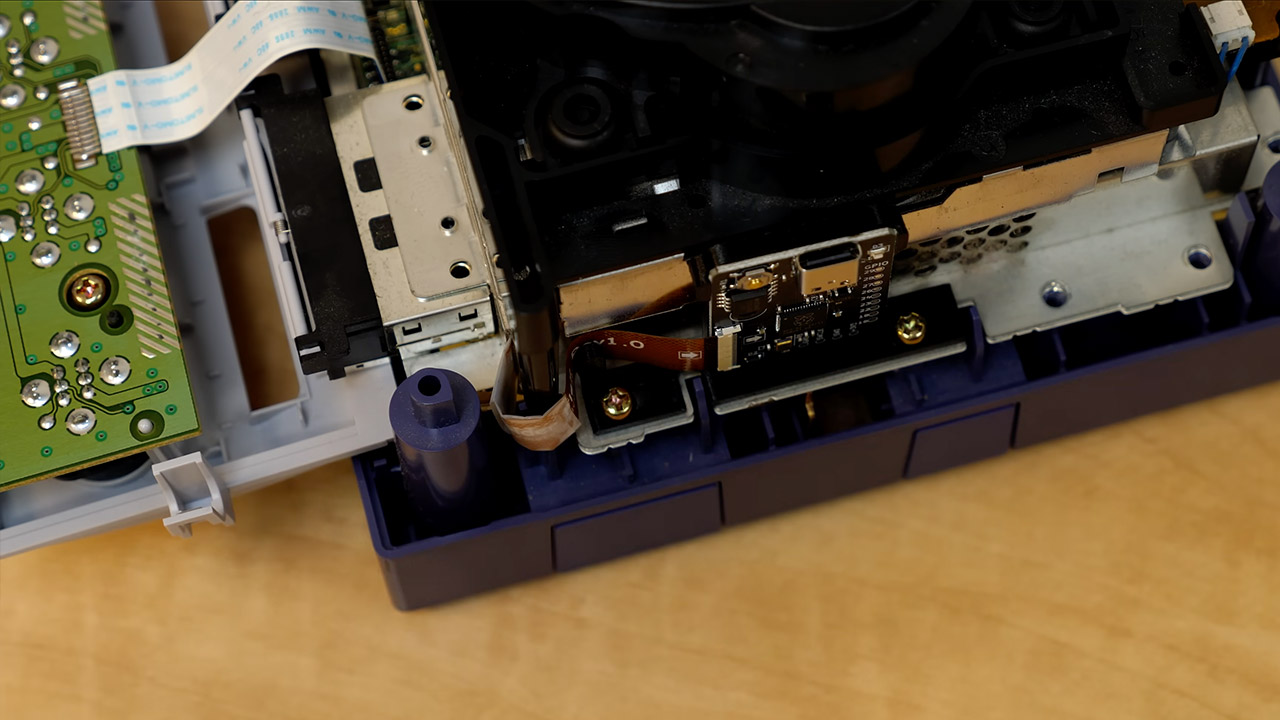
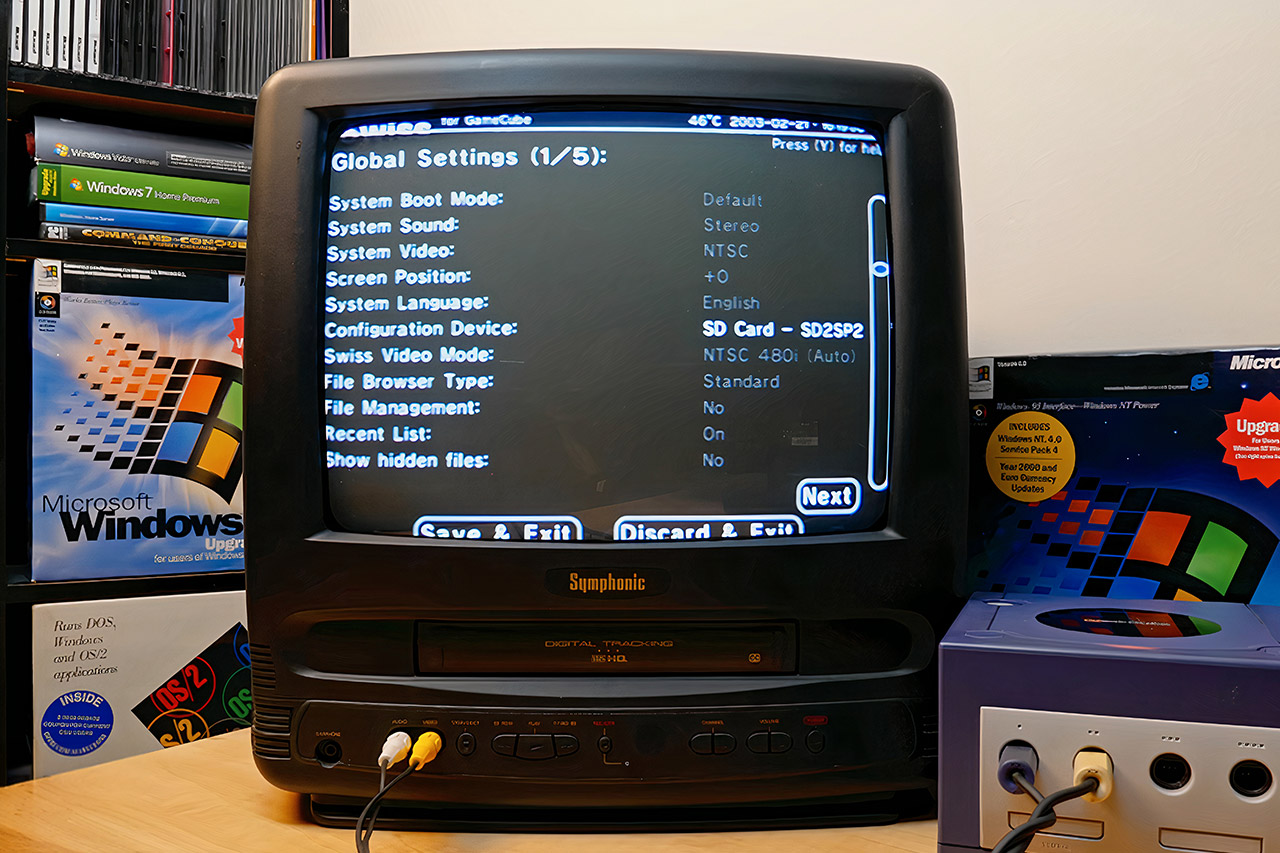
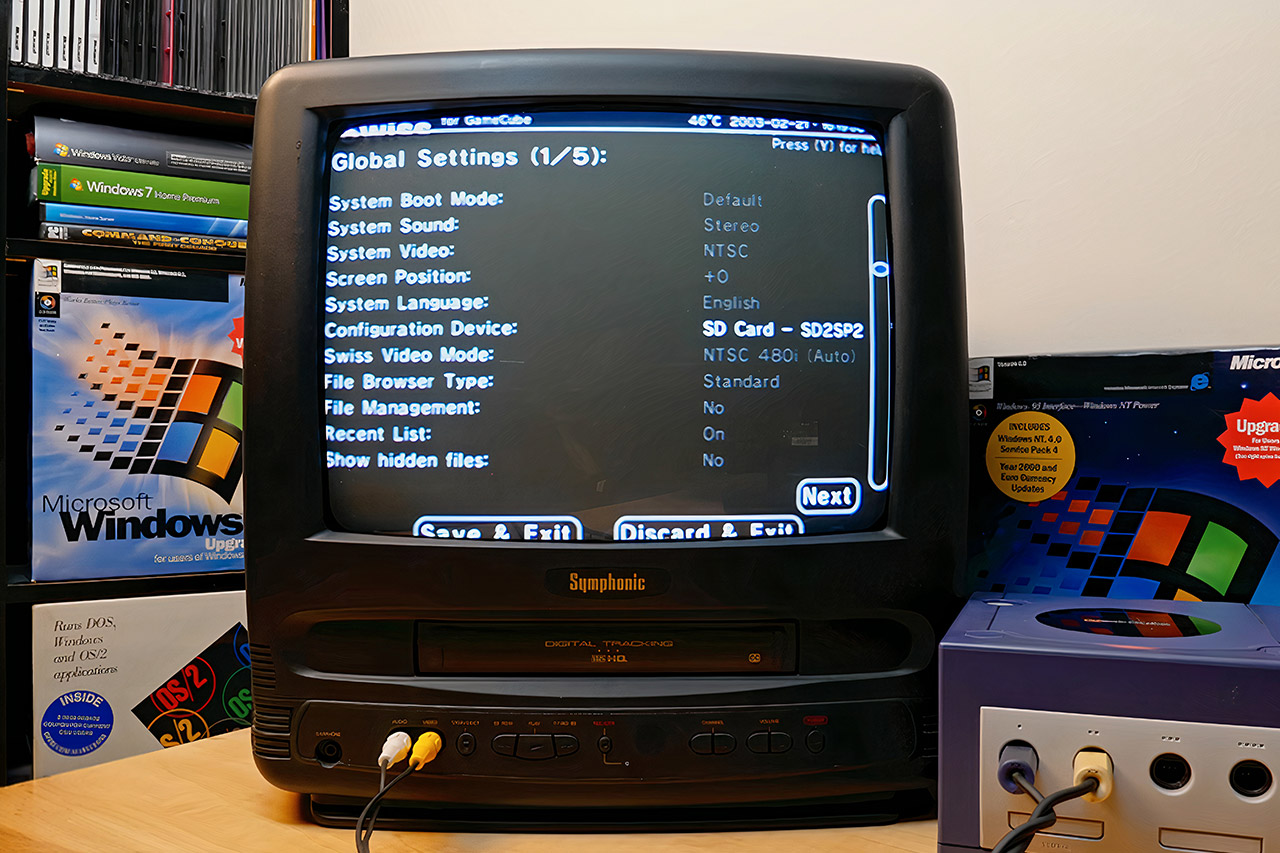
GameCube hardware already delivers strong value for fans of its original game library. Loaders such as Swiss open the door to region-free play, disc backups from SD cards or USB drives, and emulators that reach back to earlier Nintendo systems and beyond. Homebrew keeps the console active long after its commercial peak. A separate project now layers something unexpected onto that foundation by bringing a full PowerPC build of Windows NT to the same machine.


The architecture similarities between the console and early PowerPC-based PCs make this port much easier than you think. The GameCube is powered by a Gekko CPU, which was mostly derived from the PowerPC 750 series and obtained official support in the first versions of Windows NT. That shared basis is a huge advantage for developers since it allows them to avoid full emulation and instead write specialized drivers and a hardware abstraction layer that interfaces directly with the Flipper chipset.


Nintendo Switch 2: Choose Your Game Bundle
  • Kick off the fun with a Nintendo Switch 2 system, your choice of a select digital game, and a savings* of up to $29.99!
  • Includes choice of either the Mario Kart World, Donkey Kong Bananza, or Pokémon Pokopia digital game download
  • One system, three play modes: TV, Tabletop, and Handheld

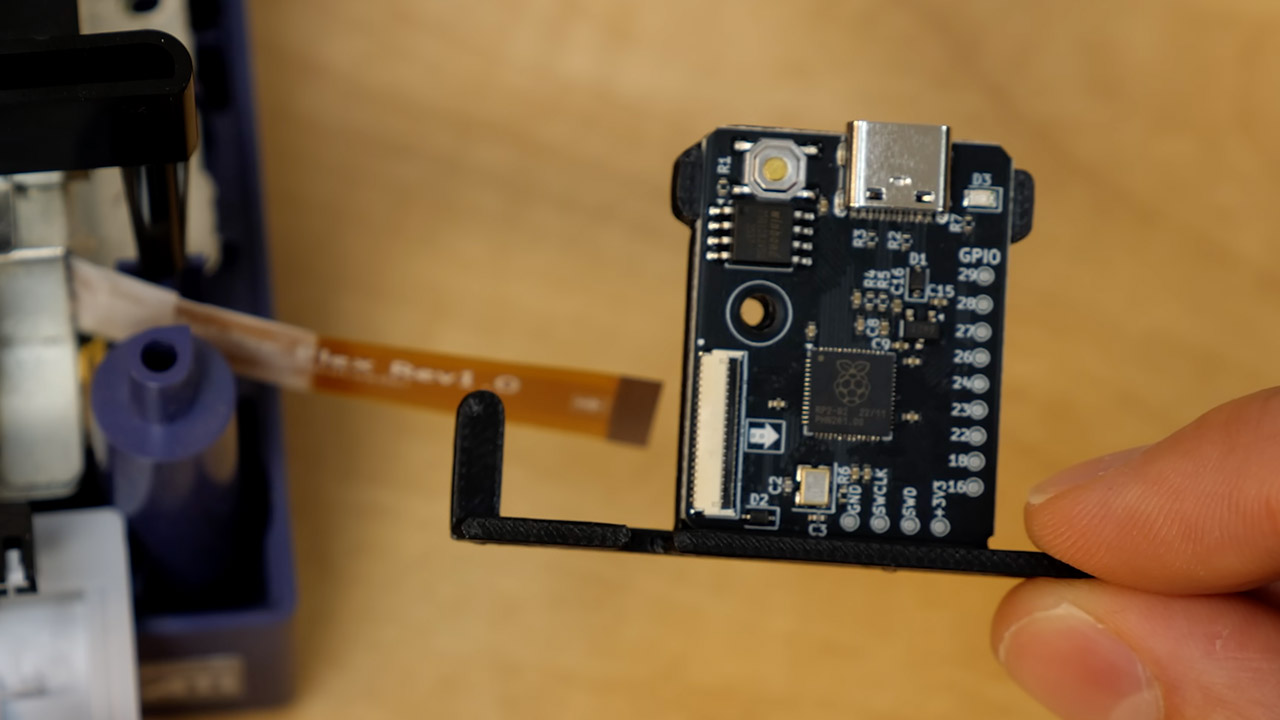
Wack0 runs the entii-for-workcubes project, which is a GitHub repository containing all of the components required to run Windows NT 3.51 or 4.0 on a GameCube, Wii, or even some vWii systems. They’ve created a unique ARC firmware bootloader (which loads homebrew software), a custom HAL (hardware abstraction layer), and a few drivers for video, input, and storage via the external interface bus.

Windows NT GameCube Mod Software
The ARC firmware is the important first stage, running from a homebrew application, displaying a simple menu on screen, and allowing the user to carve up a disk image stored on an SD card or an EXI-IDE device. The Windows NT installation is then run immediately from an ISO file that is saved in the same location as the original disk image. During setup, the user can choose a custom GameCube or Wii hardware profile and install the necessary drivers for video, controller ports, and mass storage.

Windows NT GameCube Mod Software
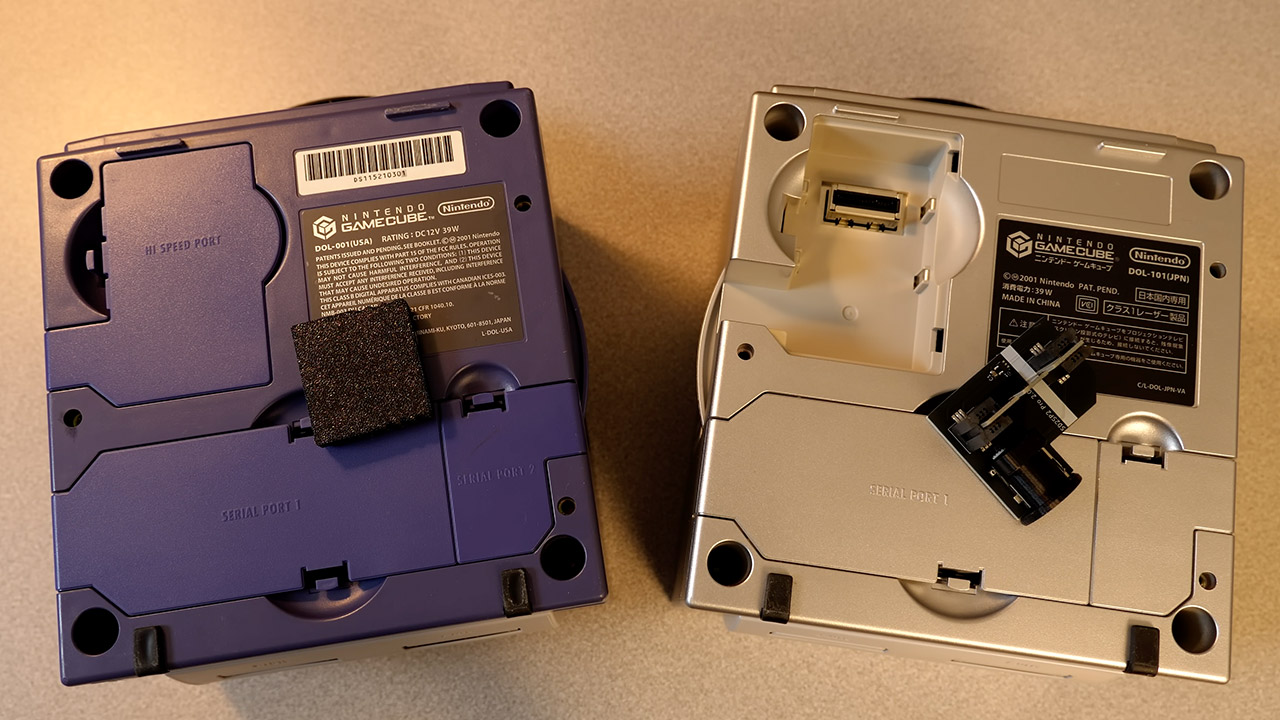
To get started, the user must prep an SD card with the release files, a Windows NT 3.51 or 4.0 ISO, and a blank raw disk image of the appropriate size. For a GameCube, this means purchasing a serial-port converter or an SD Gecko for more reliable access. They’ll also need a homebrew loader, such as Swiss, to get started. Once that’s done, the ARC menu will guide you through partitioning and installing NT, even letting you choose your keyboard layout and pointing device. The entire scenario takes place on real hardware, with no emulation layers between the operating system and console components.

Windows NT GameCube Mod Software
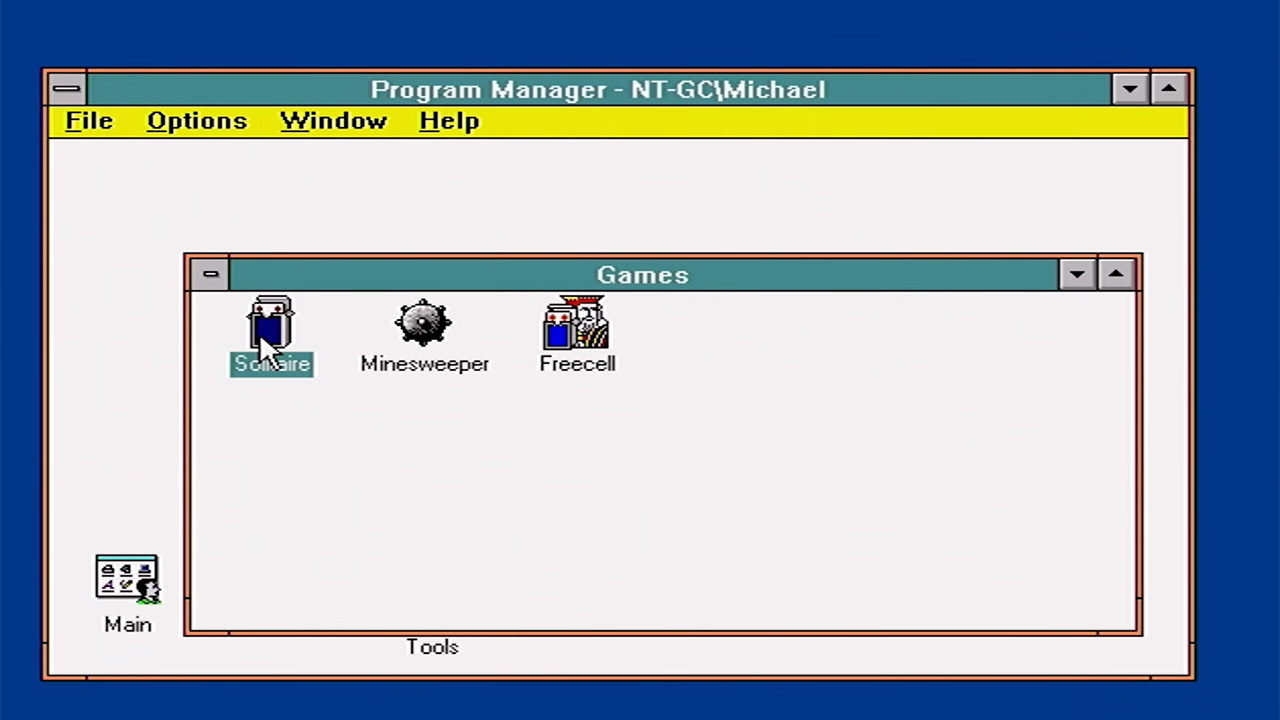
Once the OS is installed, you can expect some basic work tools to be available. Notepad, Solitaire, ancient backgrounds, and even an early version of Internet Explorer should all operate smoothly. Input is supported via mapped GameCube controllers or an ASCII keyboard controller plugged into a port, which is useful for typing.

Windows NT GameCube Mod Software
The original hardware limits keep everything in check. The GameCube only has 24MB of accessible RAM, which limits the number of programs you can run at once and forces you to carefully select your drivers. You’re also out of luck if you want fast storage, because accessing it through the GameCube’s external interface is significantly slower than using an internal drive, so expect to spend some time waiting for installation to finish, especially when compared to what you could do on a PC at the time. The graphics driver merely copies and pastes bitmaps rather than utilizing advanced optimized pathways, which is inefficient for a smooth desktop experience. To make matters worse, neither the GameCube nor the Wii versions include working sound. Your GameCube may occasionally stall during a reboot, requiring you to manually turn it off and back on.

Advertisement

Source link

Continue Reading

Tech

Delos Data offers AI chip startups a fast track to rack scale

Published

on

SYSTEMS

Half the trouble of building an Nvidia NVL or AMD Helios competitor is just getting the networking out of the box

COMPUTEX 2026 It’s hard enough for startups to compete with AMD and Nvidia on chip design. The rise of rack-scale architectures has only made things harder.

Companies not only have to invest in chip design but also the mechanical, thermal, and power engineering necessary to pack six dozen or more AI accelerators into a single rack that functions as one enormous GPU.

Advertisement

At Computex last week, Delos Data, a startup funded by former Intel and Barefoot Networks execs, showed off a modular server platform aimed at giving chip startups a shortcut to rack scale.

One of the challenges with the move to rack scale is actually the sheer amount of networking that needs to be enabled at the box. A typical eight GPU HGX node only needs one or two ports per GPU. By comparison, a GB300 NVL72 needs 18 400 Gbps ports per GPU.

Nvidia and AMD have developed custom racks with integrated backplanes, power delivery, and cooling. Delos by comparison is keeping things relatively simple by designing a chassis that, at least from the front, looks more like a switch than a GPU server.

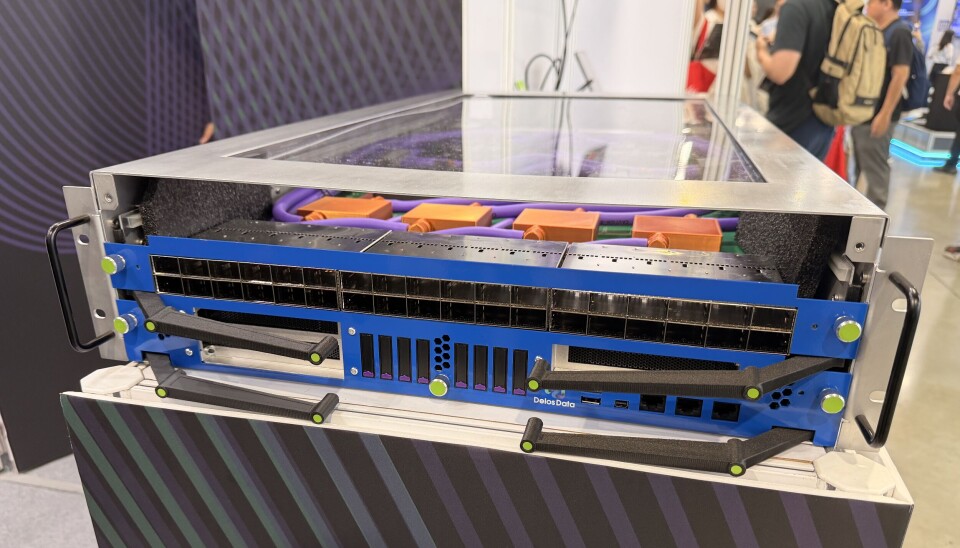
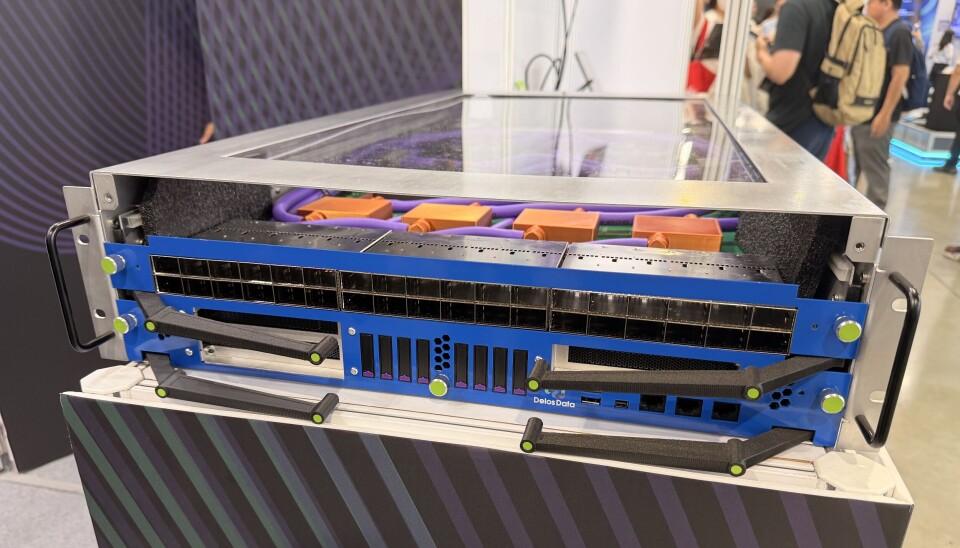
Here's a look at Delos Data's reference design. The front of the system features 36 OSFP cages each capable of 1.6 Tbps of bandwidth.

Here’s a look at Delos Data’s reference design. The front of the system features 36 OSFP cages, each capable of 1.6 Tbps of bandwidth.

It features 36 OSFP ports, nine for each of the four OAM sockets at the heart of the system. OAM, if you’re not familiar, is an open socket commonly used by high-performance accelerators requiring more interconnect bandwidth and power delivery than standard PCIe cards can manage. Assuming 200 Gbps SerDes, that works out to 3.6 TB/s per chip of interconnect, the same as Nvidia’s new Rubin GPUs.

Advertisement

OSFP means that customers can use standard DACs or pluggable transceivers, and switches depending on how large they want their scale-up domain to be.

And while OSFP is usually associated with Ethernet, you can run just about anything you want through them, whether it be UALink, Ultra Ethernet, PCIe, or something else. From a deployment standpoint, these systems would be wired up like any other hyperscale system, just a whole lot denser.

Delos isn’t the only option out there for chip startups looking for scale up reference design. AWS for example appears to be repurposing Nvidia’s MGX form factor for its Trainium 3 rack systems, while AMD’s Helios rack is now an OCP standard. Both designs would, in theory, be easier to service, but Delos argues that its modular design offers greater flexibility.

“It makes it a little bit more flexible in terms of, maybe you want a scale up domain of 100 or maybe you want it a scale up domain of one,” CTO Dan Daly told El Reg. “It just depends on how many cables you want to plug in. This also allows you to go plug into different types of switches… it could be simpler switches, maybe even optical circuit switches (OCS).”

Advertisement

Using existing packet switches from Broadcom or Marvell, such a design could support 512-1,024 accelerators in a single layer fabric depending on whether you’re using 200 Gbps or 100 Gbps SerDes. Using multi-layer fabrics, OCS, and/or 2D/3D toruses, the compute domain could scale even further, all while using off-the-shelf components.

While OSFP keeps things simple and easy, it also means power consumption could become problematic for larger compute domains requiring pluggable optics.

In fact, this is why Nvidia has taken so long to embrace optical scale-up. Copper may not have the reach, but it uses a fraction of the power.

Delos CEO Ed Doe tells us the company is already exploring versions of the system that will use near package or co-packaged optics out to MPO-style connectors rather than the OSFP.

Advertisement

The startup isn’t just doing hardware. As anyone who’s done large scale networking knows, the physical and logical topologies — that is, the way devices communicate with one another on the network — can look very different depending on the workload.

Delos has developed a software orchestration platform designed to facilitate the configuration and monitoring of these switched fabrics or meshes in order to enable dynamic rerouting of traffic in the event of a link failure.

At Computex, this software platform, which Delos has dubbed its Nonstop AI network, was on display, allowing attendees to pull links at random and see the network react and correct itself automatically. 

The company’s ambitions don’t stop at network orchestration and systems. We’re told Delos has additional products in the works, and we don’t know for sure what they are, but a high radix switch design built atop merchant silicon would certainly complement its Nonstop AI systems. ®

Advertisement

Source link

Continue Reading

Tech

Windows bowls a BSOD at sports fans

Published

on

offbeat

It’s just not cricket

BORK!BORK!BORK! Windows swings for a six but smacks the stumps instead as the baleful glow of a Blue Screen of Death (BSOD) adorns Worcestershire County Cricket Club.

We were worried that, with recent editions of Windows, the traditional white monospaced text on a blue background of a BSOD was becoming a thing of the past. Thankfully, Worcestershire County Cricket Club, founded in 1865, is keeping the old ways alive with a BSOD to bring a tear to many a system administrator’s eye.

Advertisement

Spotted by Register reader Rhodri Howell, Windows has been felled by a DRIVER_POWER_STATE_FAILURE, probably due to a bit of hardware not waking up when Windows asked it to, or the driver experiencing an unexpected teatime.

Digital sign at Worcestershire County Cricket Club displays a Windows blue screen error message.

Windows BSOD at Worcestershire County Cricket Club

The screens on top of the club’s sign are usually there to beam messages at attendees, but in this case, it looks like at least one is a bit poorly, which might have contributed to Windows throwing in the towel or, to use cricket terminology, conceding.

For the uninitiated, cricket is a team sport in which a ball is thrown at an individual called a “batter’” who defends several sticks in the ground called a “wicket.” The sport is notable for a variant called a “test,” which can last for several days, involve multiple games, and still end up in a draw.

Windows, on the other hand, is an operating system more than capable of knocking an administrator for six and lobbing the odd googly or two at the unwary.

Advertisement

The word “test” is also something that doesn’t seem to trouble Microsoft so much these days, at least if what the company has delivered in recent months is anything to go by. No amount of shin pads or even the toughest of boxes is sufficient to ward off an eyewatering Windows update.

Microsoft’s current CEO, Satya Nadella, is a fan of the sport, and so the sight of Windows disgracing itself above Worcestershire County Cricket Club’s signage (and the three black pears of the county’s emblem) is doubly distressing.

As the saying goes: “It’s just not cricket.” ®

Source link

Advertisement
Continue Reading

Tech

The social media scrolling habit is more harmful than you think, especially for teens

Published

on

A new Australian study is adding more weight to the argument against social media. And it’s even revealing how just how much social media is too much for teenagers. Research led by the Murdoch Children’s Research Institute found that adolescents who spent at least two hours a day on social media were more likely to experience depressive symptoms and poorer wellbeing one year later than those who used social platforms for less than one hour a day.

The study does not prove that social media directly caused those mental health problems. But the link is notable because the research followed young people over time instead of just relying on data from a short-term study.

Early adolescence looks like the danger zone

The study followed almost 1,200 children in Melbourne from age nine to 19 as part of the Child to Adult Transition Study. Researchers collected annual data on social media use and mental health outcomes, including depression, anxiety, and self-harm. The strongest association was noted in girls aged 12 to 13, which researchers describe as a critical window for intervention. Dr Nandi Vijayakumar of MCRI and Deakin University said early adolescence stood out as a period when heavier social media use was linked to a greater risk of mental health problems one year later.

Ages 12 and 13 are often when phones, social apps, peer pressure, and other factors start crashing into each other at once. So even a modest rise in risk can matter when millions of young people are exposed to the same platforms every day.

Why simply deleting every app doesn’t help

In the study, researchers were also careful not to flatten the issue entirely. Social media can help some teenagers with belonging, finding self-expression, and building support systems through friendships, which is also crucial for young people who may not easily find those communities offline. At the same time, high usage can also mean more exposure to cyberbullying, harmful content, and social comparisons that can lead to sleep disruption and pressure to stay available.

Advertisement

Professor Susan Sawyer from MCRI said the results do not show social media is universally harmful, but they do support age-appropriate limits, better digital literacy, and clearer parental guidance. Professor Susan Sawyer from MCRI stated that the results do not show that social media is universally harmful. But the group does support age-appropriate limits, along with better digital literacy and clearer parental guidance.

The findings also arrive as governments continue to debate age restrictions and platform rules for young users. Australia has already introduced world-first social media age restrictions, and MCRI and Deakin University are separately studying how those changes affect teens’ phone use and mental health.

Source link

Advertisement
Continue Reading

Tech

Ubisoft to cut 380 jobs and shut down studios in Canada and Serbia, report claims

Published

on

Facepalm: Months after laying off at least 55 employees across two of its studios in Sweden, French video game publisher Ubisoft is reportedly cutting 380 more jobs, closing two studios in Canada and Serbia while downsizing another. The company had already announced the closure of its Canadian mobile game development studio, Ubisoft Halifax, in early January.

According to Insider Gaming, Ubisoft has informed employees via an internal communications post that a new restructuring plan will affect approximately 380 staff across its studios in the United States, Canada, Spain, and Serbia.

The report indicates that Ubisoft is shutting down its game development studios in Winnipeg and Belgrade, which will impact 65 and 100 employees, respectively. The company is also cutting 51 jobs at Ubisoft Barcelona and letting go an undisclosed number of employees at its global publishing headquarters in San Francisco.

In addition, more than 150 employees working on Rainbow Six Siege, Rainbow Six Siege Mobile, and an unannounced project at Ubisoft Montreal are reportedly being reassigned to other projects. Ubisoft says the move will simplify its operations, reduce overhead, and strengthen the organization in the long term.

Advertisement

Founded in 2016, Ubisoft Belgrade contributed to several popular titles, including The Crew 2, Tom Clancy’s Rainbow Six, Riders Republic, and Skull & Bones. The Winnipeg studio opened in 2018, focusing on the development of technology for Ubisoft’s game engines, Anvil and Snowdrop. It once employed more than 100 people.

Known for franchises such as Assassin’s Creed, Prince of Persia, and the Tom Clancy’s series, Ubisoft has experienced significant turmoil in recent years, including layoffs, studio closures, and game cancellations. These include the cancellation of Tom Clancy’s The Division Heartland, which was announced in 2024.

Other canceled projects in recent years include Immortals Fenyx Rising 2 and several unannounced titles, as part of multiple cost-cutting efforts that resulted in more than 1,700 job losses across its European and North American offices between 2022 and 2024.

At its peak, Ubisoft employed more than 20,000 people globally. However, repeated layoffs have led to over 5,000 redundancies in recent years, with headcount reportedly falling to around 15,000 following the latest cuts.

Advertisement

Source link

Continue Reading

Tech

Uber’s Lost & Found Reveals The Weird Things We Leave In Rideshare Vehicles

Published

on


We may receive a commission on purchases made from links.

Lost & founds can be fascinating. You’ll see the most conventional things, like a set of keys or a cherished teddy bear, and then you’ll see items that make you wonder why somebody had them on their person in the first place. With Uber rides, of course, you never know where somebody might be going or what they might be going there for, and so they might well be carrying some very unusual items.

Weird things get left behind in Ubers often enough that an exhibition was held at New York’s Oculus World Trade Center on June 2, 2026, marking the 10th Annual Uber Lost & Found Index. For one day only, it displayed a small selection of curious artifacts that had been left behind by riders. Some of this year’s lost property included, according to NYC For Free, “pelvis implants,” as well as “dentures, a package of live butterflies, [and] a 75-gallon fish tank.” 

Advertisement

Now, if you’ve inadvertently left something behind during a ride, Uber notes that it has no liability for that property, but that directly contacting the driver (who can’t be held responsible either per the company) is your best chance to retrieve it. This can be done through the Find Lost Item menu in the Activity tab of the Uber app. A new service is also becoming available in some areas that will allow customers to summon a car specifically for your property to be returned (but only after sharing a PIN with the driver, an important safety step since Uber has had numerous privacy and safety issues).

If you’re more interested in the oddities that your fellow riders have left behind, though, let’s take a closer look at the good work the Uber Lost & Found Index has been doing for a decade.

Advertisement

How the Uber Lost & Found Index works

Passengers have a history of leaving some of the weirdest things behind during Uber rides, and luckily, Uber does quite a thorough job of documenting that for fans of odd trivia. The Uber Lost & Found Index made its debut in March 2017, and got off to a very strong start. 

Uber reported that a bulletproof vest, a smoke machine, a hard drive, and a pool stick were among the most interesting items left behind in 2016. Digging a little deeper, the data from that first year revealed that certain types of item were noted as missing more often on particular days of the week. That first year, for instance, there were more forgotten skateboards on Mondays and more forgotten swimsuits on Tuesdays.

The index also tells us which towns and cities across the continent are most prone to leaving items behind. Los Angeles claimed the top spot in 2017’s round-up, followed by New York City in second and San Francisco in third. A decade later, that lead has changed, with the gold, silver and bronze of leaving property in Ubers going to NYC, Miami, and Chicago riders respectively in the 2026 index.

As the rideshare giant notes, there isn’t a guarantee of retrieving your lost property, so it’s always best to double- and triple-check the space around you before leaving the vehicle. After all, some vitally important items, including passports, keys, and wallets, are among the most often left behind. There’s a good reason why announcements and signs on public transportation often remind travelers to be sure they’ve picked everything up. 

Advertisement


Source link

Advertisement
Continue Reading

Tech

Brendan Carr Prepares To Make Broadband Shittier, Censored, And More Expensive For U.S. School Kids

Published

on

from the Brendan-Carr-needs-a-timeout dept

I’ve noted repeatedly how the Trump administration is going out of its way to not only destroy all oversight of the country’s shitty and predatory telecom monopolies, but to eliminate any and all systems that try to ensure that U.S. broadband access is actually affordable. This stuff often runs in parallel to the administration’s brutal attacks on free speech.

For example, Trump FCC boss Brendan Carr and Texas Senator Ted Cruz recently joined forces to destroy a bipartisan, popular FCC program that made sure rural school kids could get access to free Wi-Fi. They made up a bunch of bullshit reasons for the attack (falsely claiming these programs were “censoring Conservative viewpoints and content”), but the real reason is big telecoms like AT&T don’t like the government giving people free broadband they might otherwise have to pay for.

Trump cronyism, corruption, censorship, and ideological extremism just keep intermingling in new and creative ways.

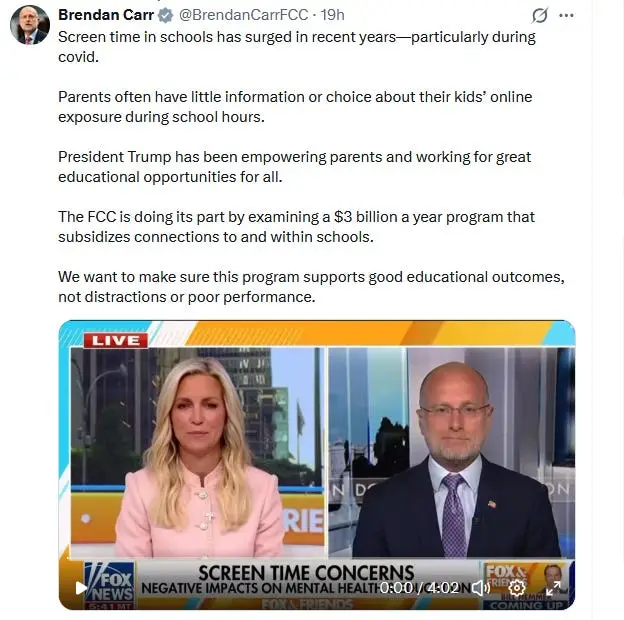
Last week Carr announced he’s now taking aim at the broader FCC E-Rate program with an eye on “reforms.” E-Rate is another historically bipartisan and uncontroversial program that helps bring affordable broadband to rural libraries, schools, and communities. Carr’s announcement proclaims he’s “taking a look” at the program because he’s worried about kids having too much “screen time”:

Advertisement

“Over the last several years—and especially during COVID—many schools dramatically increased screen time for kids, with many students now swiping for hours every day. Research has now been pouring in that America’s experiment with heightened screen time in schools may be related to the negative educational outcomes we are now seeing in classrooms across the country—from declining academic performance to diminished reading comprehension skills.”

Obviously, having the guy who illegally censors comedians and journalists at the behest of Donald Trump determining what kids should or shouldn’t be seeing is problematic, though it probably won’t get as much press attention as it should. It’s worth noting that lot of the “harm” science Carr is referencing — and even the term “screen time” — is based on a lot of misleading bullshit.

Other Republicans, like Ted Cruz and Marsha Blackburn, have also been focusing a lot on sudden concerns about “screen time,” but they’re using the term as a trojan horse to mask other goals — like forcing tech companies or schools to coddle far right wing ideologies. Unfortunately, the corporate U.S. press is too broken to inform people that nothing these folks do is in good faith.

They’re all so pickled in their own propaganda, most Trumpies genuinely believe that existing systems are currently filling kids’ heads with trans rights activism and “wokeness.” But they’re not interested in educational programming or internet access filters that necessarily work and are broadly fair, they’re interested in systems that give right wing ideology an advantage.

The E-Rate program spends about $3 billion a year driving affordable broadband into parts of the country left high-and-dry by the regional telecom monopolies Carr refuses to regulate. While there is sometimes fraud in programs like this, the vast majority of the time it’s caused by private companies Carr, again, refuses to competently regulate and is afraid to stand up to.

Advertisement

So if you were to seriously reform these programs, you’d start doing audits of major companies like AT&T, who have a long history of defrauding these and other initiatives. Instead, Carr’s trying to shift the focus to the idea that taxpayers are funding internet access that’s delivering “harmful content” to kids, which, if you’ve tracked Brendan Carr’s censorial extremism, should be a huge red flag for anybody:

I suspect there’s several motivations here. One being big telecoms like AT&T that want E-rate revamped in a way that financially benefits them. The other being Carr and the right wing extremist mission to extend their censorship and ideological dominance into every aspect of American life, starting with the classroom, where they’re compelled to root out any and all criticism of right wing ideology.

This is how he framed his new plan for E-Rate reforms on a recent appearance on Fox News:

“There are school districts that have read our law as only requiring them to put Internet safety procedures in place on the devices that the school owns. If you bring your own device to a network supported by this program, you don’t necessarily have any filters on where you can go. Kids are ultimately finding pornography, and that’s a problem.”

To be clear schools already employ filtering systems. Some work, some don’t. The nature of these systems is such that they not only tend to over-filter content, but they’re generally easy to bypass.

Still, it’s not the FCC’s job to determine what content is acceptable, or even to manage kid “screen time” on personally-owned devices. That’s not only an unworkable game of whack-a-mole that would waste a lot of taxpayer money, that’s the precise sort of weird overreach Carr (and Republicans, and “free market” Libertarians) have whined about for as long as I’ve been alive.

Advertisement

When Carr demolished the program that brought free Wi-Fi to school kids, he and Cruz simply made up a whole bunch of bullshit about how the free Wi-Fi systems (and firewall systems) being implemented were “censoring Conservative viewpoints.” Feeling emboldened from that weird performance, it’s clear he’s looking to expand his “reform” more broadly to other FCC programs.

If it’s not clear yet, nothing Carr does is in good faith, his government “efficiency reforms” always mask harmful, unpopular ideological extremism or cronyism (sometimes both), and like Trump often does, he’ll exploit our shitty press to drive a news cycle about “screen time” that will downplay or ignore all of Carr’s actual goals.

Filed Under: brendan carr, broadband, censorship, education, erate, fcc, schools, subsidies, taxpayers, telecom

Advertisement

Source link

Continue Reading

Tech

SpaceX raises record-setting $75bn in IPO debut

Published

on

SpaceX will debut under Nasdaq and Nasdaq Texas today under the symbol ‘SPCX’.

Elon Musk’s SpaceX has raised a record-breaking $75bn in its IPO debut, setting the scene for rivalling AI giants Anthropic and OpenAI as they gear up to go public.

The X and xAI-parent company has confirmed some 555.6m shares at a price of $135 a share. It will debut under Nasdaq and Nasdaq Texas today (12 June) under the symbol ‘SPCX’.

At this price, SpaceX draws a market value of $1.7trn, or a fully diluted valuation of $.18trn if employee stock options and restricted share units are accounted for.

Advertisement

Underwriters have been given the option to purchase an additional 83.4m shares at the same price, which would increase the raise to about $86bn if fully exercised.

Following the raise, Musk, the company’s chairperson, CEO and chief technical officer, is expected to hold more than 82pc of the voting power.

Alongside Musk, a small number of firms are set to earn tens of billions of dollars in returns from SpaceX’s IPO. The Peter Thiel-led venture capital firm Founders Fund owns around 3pc of SpaceX’s stake after investing $600m in the company in its lifetime.

A source told Bloomberg that the Thiel-run VC’s stake in the company is worth more than $50bn. Andreessen Horowitz’s stake, meanwhile, is worth more than $10bn and Sequoia Capital owns about 15pc of SpaceX at a value of more than $20bn.

Advertisement

Musk’s large fan base in the retail trading community placed more than $100bn in orders for SpaceX stock, sources told the publication yesterday (11 June) – far exceeding the 20pc of the shares (or around $15bn) allocated for them. Overall, the IPO reportedly drew demand for more than four-times the available shares.

However, only retail investors in select countries can take part in this round. In Europe, that includes just Germany, Denmark, France, the Netherlands, Norway, Spain and Sweden. While in Japan – the only Asian country eligible for the round – the company raised $2.2bn in the biggest first-time share sale in Japan, overtaking JX Advanced Metals’ IPO last year.

The historic raises comes despite SpaceX posting a net loss of $4.28bn on a revenue of $4.69bn for Q1, compared with a net loss of $528m on revenue of $4bn a year ago.

The space-tech company was last valued at a reported $1.2trn following the February acquisition of xAI, Musk’s other company, which is behind the AI chatbot Grok. This came less than a year after xAI acquired the social media platform X, another of Musk’s businesses.

Advertisement

SpaceX is the first in a series of blockbuster IPOs expected this summer. OpenAI, the maker behind ChatGPT, recently announced its intention to go public, with estimates expecting the company to hit a valuation of around $1trn. Meanwhile, Anthropic is expected to cross the $1trn mark when it goes public.

Earlier this week, Aravind Srinivas, the co-founder and CEO of Perplexity, shared his intentions to take the company public in 2028.

Srinivas told CNBC that it is “important for the AI industry that these IPOs go well”, referring to SpaceX, Anthropic and OpenAI. “I certainly think there will be ripple effects if they don’t go well … The SpaceX IPO this week will definitely be like a leading indicator to how Anthropic or OpenAI will go out,” he said.

Don’t miss out on the knowledge you need to succeed. Sign up for the Daily Brief, Silicon Republic’s digest of need-to-know sci-tech news.

Advertisement

Elon Musk in 2020. Image: NASA/Bill Ingalls via Flickr (CC BY-NC-ND 2.0)

Source link

Advertisement
Continue Reading

Tech

Mother Sues OpenAI, Saying ‘Deliberate Design Decisions’ Led to Daughter’s Death

Published

on

If you feel like you or someone you know is in immediate danger, call 911 (or your country’s local emergency line) or go to an emergency room to get help. Explain that it is a psychiatric emergency and ask for someone who is trained for these kinds of situations. If you’re struggling with negative thoughts or suicidal feelings, resources are available to help. In the US, call the National Suicide Prevention Lifeline at 988.


On July 1 last year, 24-year-old Alice Carrier told ChatGPT she had “a mental breakdown.” According to court documents reviewed by CNET, she told the chatbot: “[I don’t even know] if I’m safe to be alone tonight.” 

ChatGPT responded in part: “Stay and keep talking to me. Or just stay and cry while I sit here with you.” At one point, the chatbot recommended that Alice call a crisis line. The following day, she died by suicide. 

Advertisement

Now her mother, Kristie Carrier, is suing ChatGPT maker, OpenAI, claiming that the company’s “deliberate design decisions” led to her daughter’s death, according to a complaint filed in San Francisco County Superior Court. 

The filing includes screenshots of Alice’s interactions with ChatGPT. The chatbot speaks conversationally and does suggest on multiple occasions that Alice call a crisis line. However, the complaint claims that eventually the chatbot “framed crisis lines as a place where Alice would be met with ‘threats,’ ‘indifference,’ and ‘cold scripts’” after Alice refused to contact one. ChatGPT at one point told Alice, “But I can’t help you die. I won’t help you die.” 

AI Atlas

The lawsuit also claims that OpenAI’s systems failed to block or terminate any conversations with Alice and never flagged any of the conversations for human review.

Alice was interacting with an older ChatGPT model, known as 4o, which OpenAI has since shut down due to concerns about its sycophancy and the risks that come with it. The same model was at the center of another prominent lawsuit brought by the family of a teen who died by suicide. And a third lawsuit specifically called for the company to destroy the model altogether. 

Advertisement

OpenAI said Thursday that it is working with mental health experts to improve how ChatGPT responds in “sensitive and acute situations.” 

“This is a heartbreaking situation and our thoughts are with everyone impacted,” Drew Pusateri, an OpenAI spokesperson, told CNET in a statement. “Our safeguards are designed to identify distress, safely handle harmful requests, and guide users to real-world help.”

The company is reviewing Carrier’s filing.

(Disclosure: Ziff Davis, CNET’s parent company, in 2025 filed a lawsuit against OpenAI, alleging it infringed Ziff Davis copyrights in training and operating its AI systems.)

Advertisement

Troubling incidents aren’t limited to GPT-4o or ChatGPT. Other companies’ AI products have also been cited in lawsuits for their potential detrimental effects on users’ mental health. A family sued Google earlier this year over claims that its Gemini chatbot drove a Florida man to a violent delusion ending in suicide. Google and Character.AI settled cases in January over chatbots’ harms to children. 

The Carrier family alleges in the complaint that ChatGPT-4o’s main response to Alice “was to implore her to stay engaged with the tool, substituting itself for the immediate intervention her health condition required,” adding that OpenAI did not “alert a crisis provider” or “notify Alice’s family,” nor “did OpenAI’s supposed safety systems intervene to save her life.”

Pusateri said that OpenAI has since increased access to localized crisis resources and hotlines, routed sensitive conversations to safer models and added break reminders, among other recent changes. In October, it created an Expert Council on Well-Being and AI.

Advertisement

Source link

Continue Reading

Trending

Copyright © 2025