Connect with us
DAPA Banner
DAPA Coin
DAPA
COIN PAYMENT ASSET
PRIVACY · BLOCKDAG · HOMOMORPHIC ENCRYPTION · RUST
ElGamal Encrypted MINE DAPA
🚫 GENESIS SOLD OUT
DAPAPAY COMING

Tech

Multicolor 5-Axis 3D Printing | Hackaday

Published

on

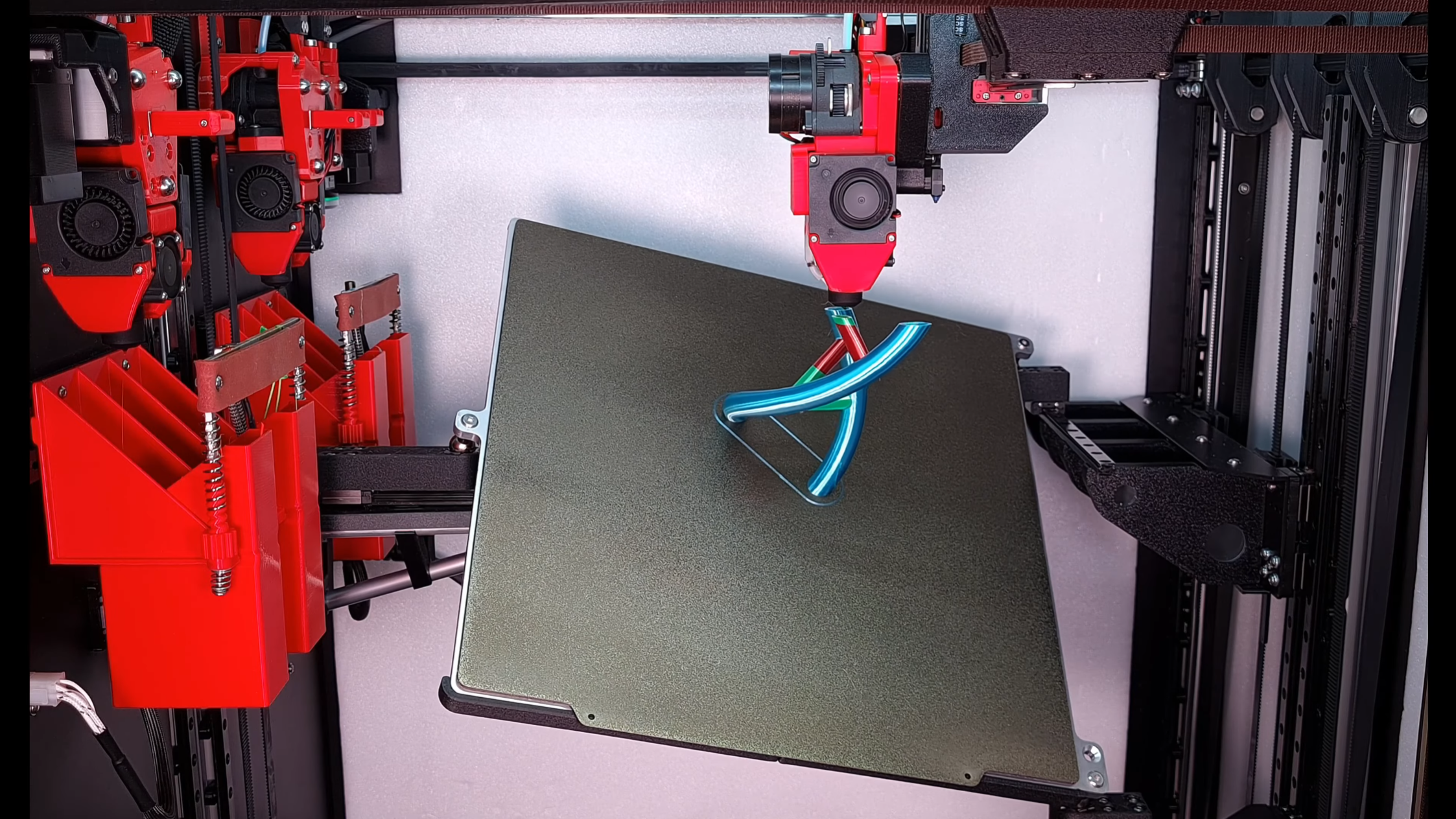
Usually, when we see non-planar 3D printers, they’re rather rudimentary prototypes, intended more as development frames than as workhorse machines. [multipoleguy]’s Archer five-axis printer, on the other hand, breaks this trend with automatic four-hotend toolchanging, a CoreXY motion system, and print results as good-looking as any Voron’s.

The print bed rests on three ball joints, two on one side and one in the center of the opposite side. Each joint can be raised and lowered on an independent rail, which allows the bed to be tilted on two axes. The dimensions of the extruders their motion system limit how much the bed can be angled when the extruder is close to the bed, but it can reach sharp angles further out.

The biggest difficulty with non-planar printing is developing a slicer; [multipoleguy] is working on a slicer (MaxiSlicer), but it’s still in development. It looks as though it’s already working rather well, to the point that [multipoleguy] has been optimizing purge settings for tool changes. It seems that when a toolhead is docked, the temperature inside the melt chamber rises above the normal temperature in use, which causes stringing. To compensate for this, the firmware runs a more extensive purge when a hotend’s been sitting for a longer time. The results for themselves: a full three-color double helix, involving 830 tool changes, could be printed with as little as six grams of purge waste.

As three-axis 3D printers become consumer products, hackers have kept looking for further improvements to make, which perhaps explains the number of non-planar printing projects appearing recently, including a few five-axis machines. Alternatively, some have experimented with non-planar print ironing.

Advertisement

Source link

Advertisement
Continue Reading
Click to comment

You must be logged in to post a comment Login

Leave a Reply

Tech

Cybercrime Crew Claims It Hacked Mike Lindell’s MyPillow

Published

on

The United States military has known for years that enemies could use location data to track troops’ phones—and it’s also long been aware of easy fixes for the problem. The Pentagon adopted almost none of these protections, though, in spite of admitting in a letter exposed this week that US adversaries are actually using the data to target soldiers in war. Meanwhile, US law enforcement warned this week about “anti-tech extremism” as AI backlash grows around the country.

After a nearly 90-day internet shutdown, connectivity started to trickle back into Iran this week amid internal political power struggles and ongoing negotiations with the US to end its war with Tehran. Researchers cautioned that it is unclear how extensive the restoration will be and whether connectivity will only return temporarily.

As cybercriminals and offensive hackers ramp up their use of AI to exploit vulnerabilities and develop hacking tools, the technology is also radically changing the dynamics of how security researchers hunt for vulnerabilities. And scammers are using real hotel reservation data and other travel details to conduct effective spear-phishing campaigns, potentially accessing customer data from 350 hotels and vacation rentals around the world.

And there’s more. Each week, we round up the security and privacy news we didn’t cover in depth ourselves. Click the headlines to read the full stories. And stay safe out there.

Advertisement

Play, a Russian-language ransomware operation that has affected more than 900 organizations since 2022, posted to its dark-web leak site on Monday claiming it had pulled “private and personal confidential data, clients’ documents, budget, payroll, IDs, taxes,” and other financial records from MyPillow. The Minnesota-based home goods company is run by Mike Lindell, who is among at least 10 Republicans seeking the party’s nomination for governor of Minnesota in August’s primary. Lindell is also one of the most prolific backers of Donald Trump’s false claims of victory in the 2020 election.

Play reportedly set a Friday deadline for MyPillow to make contact before publishing the data online. Lindell told Straight Arrow News, which broke the story of the ransomware claims on Tuesday, that his company was not hacked and that allegations that it was are a political hit job.

“This is another hit job by outside sources because I’m running for governor,” Lindell said. “I guarantee it. We do not have any breaches in our data at all.”

Lindell has been on the losing end of two recent defamation rulings over his 2020 election claims: A federal jury in Colorado last year found that he had defamed Eric Coomer, a former Dominion Voting Systems director, and ordered Lindell and his media platform, FrankSpeech, to pay $2.3 million in damages; a federal judge in Minnesota separately ruled in September that Lindell had defamed Smartmatic through 51 false statements about its voting machines, with damages still to be set at trial.

Advertisement

In recent years, ransomware groups have become more aggressive and ruthless in their efforts to obtain money from victims. Most of these criminal hackers now focus on stealing data and extorting companies rather than using malware to lock computer systems. But in rare occasions, ransomware groups have been seen directly threatening executives, or contacting people named in stolen data, to try to obtain payment. The FBI said this week that one ransomware group is going even further: sending people to steal data directly from companies IRL.

Among more traditional social engineering techniques, the FBI says the Silent Ransom Group (SRG), which is targeting law firms, has sent people to company offices to directly get access to computers. “By sending someone in person to the victim’s location to facilitate the intrusion, SRG actors exfiltrate data to an external hard drive or USB drive inserted by the threat actor into the victim’s computer,” the FBI said in an alert. Security researchers say the tactic has not been seen before. The FBI did not provide any information about who the Russian-speaking ransomware group was sending to conduct its attacks, but researchers believe they could be paying freelancers who do not necessarily know who they are working for.

The AI surveillance company BusPatrol, which has installed its cameras in tens of thousands of US school buses, says that it will now turn those cameras into automatic license plate readers that will record the location of every vehicle a BusPatrol school bus passes and make the data available to law enforcement without a warrant. The initiative would turn the familiar yellow buses into what 404 Media aptly described as “roaming surveillance vehicles.” BusPatrol technology, and school bus surveillance tech more broadly, was originally intended to be used for ticketing vehicles that illegally pass stopped buses—a critical safety issue for children.

University of Chicago sociology professor Rob Vargas found this month that the Chicago Police Department was four minutes faster in responding to the most urgent non-gunshot 911 calls in the six-month period after Mayor Brandon Johnson shut down ShotSpotter gunshot detection tech in 12 neighborhoods in September 2024. Analyzing Chicago city data as well as data obtained through public records requests, Vargas compared the time period with the preceding six months during which ShotSpotter was still active. The data couldn’t be used to assess response times for calls specifically related to gunshots, but it indicated that ShotSpotter alerts may have been occupying officers with false positives and delaying them in responding to other types of critical 911 calls. “It is clear that ShotSpotter wasted officers’ time by sending them on wild-goose chases,” Vargas told WTTW News.

Advertisement

Source link

Continue Reading

Tech

Wikipedia editors plot strike and banner sabotage after Wikimedia layoffs

Published

on

Software

Foundation sparks revolt after disbanding team responsible for many community-requested fixes and moderation tools

The Wikimedia Foundation (WMF) has sparked a revolt among Wikipedia editors after disbanding the engineering team responsible for many community-requested fixes and moderation tools.

The Register was tipped off this week to growing unrest inside the Wikipedia editing community following the WMF’s decision to disband its Community Tech team, the group responsible for triaging and developing editor-requested bug fixes, moderation tools, and workflow improvements through the long-running Community Wishlist process.

Advertisement

Wikimedia’s internal forums have turned into a running argument over how editors should respond. Some are calling for editing strikes, while others want volunteers to stop handling vandalism cleanup for a period of time. There have also been discussions about replacing fundraising banners with messages criticizing the layoffs.

The foundation confirmed to The Register that the restructuring affected six staff roles connected to the Community Wishlist program, including engineers and a manager. 

It said the decision came after months of internal reviews that started last year. According to the foundation, leadership concluded that relying on a single dedicated team to process editor requests was no longer working well.

“We learned from these assessments that it is rarely possible to fulfill community wishes through a single team due to the vast breadth of the software we support and the number of channels through which we receive wishes,” a spokesperson for the foundation said.

Advertisement

Under the new structure, responsibility for Community Wishlist requests will be spread across the wider Product and Technology department rather than handled by a dedicated team.

The foundation said affected employees remain employed for now while being considered for other internal roles. Staff who are not placed elsewhere inside the organization will leave next month with severance packages.

That explanation has gone down badly with parts of the editor community, where some contributors accuse Wikimedia leadership of becoming increasingly disconnected from the unpaid volunteers who maintain Wikipedia itself. Several editors have also questioned why an organization reporting nearly $300 million in assets in its latest annual report is restructuring an engineering team dedicated specifically to editor support.

The situation has become even messier because several affected employees were reportedly involved in early unionization efforts linked to a newly created labor group called Wiki Workers United. One of the laid-off engineers created the union page on Wikimedia Meta earlier this month, fueling accusations from some editors that the restructuring amounted to union busting.

Advertisement

The foundation denied that outright, telling The Register: “The decision to disband the Community Tech team is not in any way connected to discussions about unionizing, nor have we terminated any staff for their participation in those discussions.”

The WMF also stressed that no formal request for union recognition has been submitted and said it would respect the legal process if staff eventually vote to unionize.

Meanwhile, editors continue to discuss protest options that could create highly visible problems for the world’s largest online encyclopedia. Since much of Wikipedia’s moderation infrastructure is maintained by volunteers rather than foundation employees, even a temporary pullback in anti-vandalism work could turn parts of the site into an open sewer of spam, hoaxes, and defacement. ®

Source link

Advertisement
Continue Reading

Tech

Apple could be about to launch a Spotify-like free tier, but users are worried there might be a major downside

Published

on


  • There’s evidence for a new free tier for Apple Music
  • It will no doubt come with certain limitations
  • Users are worried that there will be adverts involved

The streaming, unlimited listening component of Apple Music differs from Spotify in that you can’t use it for free — you have to pay a monthly subscription. According to code spotted in the latest Apple Music app for Android, that might be about to change.

Discovered by tipster Aaron Perris (via 9to5Mac), the code snippets mention limits on track skipping, and a “Premium access required” message, which are both consistent with some kind of subscription-free tier for the Apple Music streaming catalog.

Source link

Advertisement
Continue Reading

Tech

Tello Mobile Plan Review (2026): Low Cost, Reliable Service

Published

on

But Tello’s latency was significantly higher in general—not enough to affect a game of Royal Match, but maybe you have higher demands. The download speeds were also lower for Tello in any given location, but not by a whole lot.

At home, my cellular 5G data speeds tend to run at about 800 to 900 megabits a second on T-Mobile. With the Tello phone, it was around 30 percent slower. But both these speeds are well into 5G territory. They’re also a full order of magnitude faster than you’d ever need for 4K video. I had no problem streaming my usual dose of Josh Johnson comedy, if that’s what you’re wondering.

Image may contain Text Electronics Mobile Phone and Phone

Curiously, upload speed was actually faster with the Motorola Razr using Tello than with the old iPhone using T-Mobile. After consulting with my colleague Julian Chokkattu, who has covered phone advances for years, I’m likely to chalk this up to improved modem performance by the newer Motorola, not a secret backdoor to faster uploads by Tello.

It’s only in areas with degraded or 4G reception that I started to see real lapses in Tello’s performance. In the outskirts of Portland near its forested northwestern ridge, Tello got fewer bars than T-Mobile—and the data arrived at speeds slow enough to bother me. A couple of speed tests timed out. Uploads also began to crawl in low reception areas as compared to my T-Mobile phones, sometimes dipping down into only a quarter of the speed of T-Mobile’s network.

Which is to say: Most of the time, Tello worked just as well as T-Mobile. Except for the stray moments when it didn’t. The moments when Tello’s performance is noticeably worse are usually the moments at which you’re demanding the most from your phone: clinging to a stray bar of reception, or streaming a video while riding a train.

Advertisement

When Would I Want Tello Instead of T-Mobile?

Whether the trade-off is worth it will depend on what type of phone user you are. Family discounts are better with the big providers. Frequent international travelers should also probably stick with the big boys. International roaming will cost you with Tello, as will texts to and from most countries outside Latin America and Europe. Travel is also when you’re most likely to use up lots of data outside Wi-Fi networks.

The other big financial differentiator is how often you upgrade your phone. With Tello, you’re on your own when it comes to procuring a device, while T-Mobile and other postpaid plans keep you hooked to their high-priced plans by offering you the latest and greatest gee-whiz phones at steep discounts.

Source link

Advertisement
Continue Reading

Tech

Keychron K2 HE Concrete Edition Review: Rock-Solid Typing

Published

on

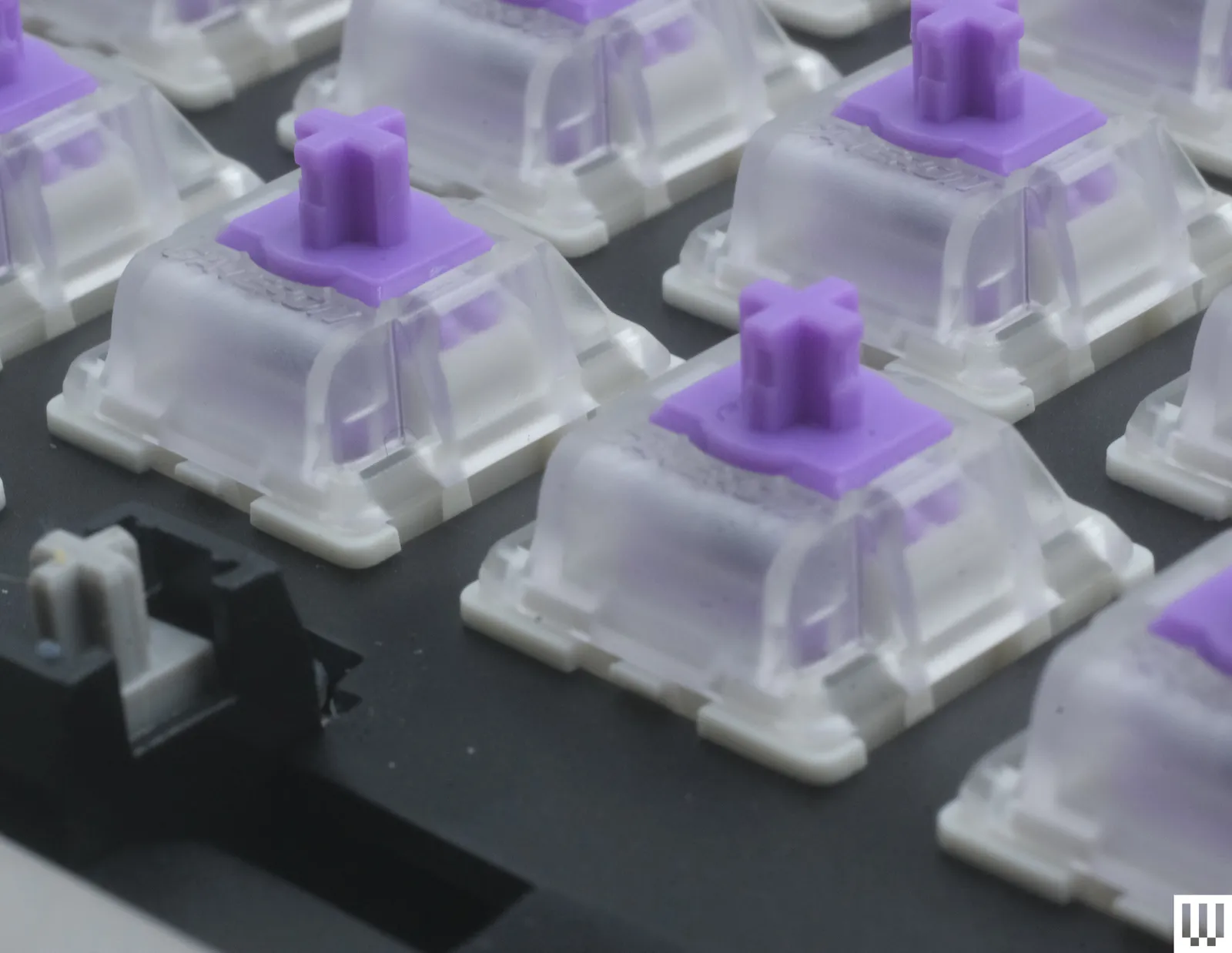
The stabilizers are PCB-mounted, which is preferable to the typical plate-mounted units that many keyboards use, and are lubricated from the factory. The lube on these stabilizers, while a bit excessive (there were small clumps of lube visible on the outside housings, which is not typical), feels great. The stabilized keys are smooth and consistent, with no audible rattling or sticking when typing.

But as it turns out, the greatest downside of this keyboard is, also, the material choice. As much as unsealed, raw concrete is quirky and fun, it is ultimately a utilitarian material: It’s heavy, has an inconsistent texture, and stains easily. During my time with this keyboard, it gathered quite a few smudges and stains, nearly all of which had unknown-to-me origins. Maybe they came from cleaning sprays, or from something on my hands, but I honestly have no clue. Depending on your perspective, this can be a flaw or a bonus. What some consider dirty, others will see as “patina.” But as someone who likes keeping their electronics squeaky-clean for as long as possible, it’s definitely a bit of a bummer to me.

(Being concrete, I would assume there are dozens of ways to get nearly any stain out of this keyboard, such as a power washer or a can of brake cleaner. However, I didn’t have the gumption to try it out for myself, and as such, I can’t guarantee that it’s possible.)

Gaming on Granite

Despite my multiple complaints about Keychron’s all-ceramic keyboard, I was still fond of the Tunneling Magnetoresistance (TMR) switches inside. They were innovative, functional, and novel, with notable advantages over standard Hall Effect (HE) switches. Because of that, I was surprised to see this keyboard going back to standard HE switches. They’re still great switches, of course, but going back to an inferior option for a similarly unique keyboard doesn’t quite make sense to me.

Advertisement

Regardless, these switches are still impressive by any other standard of comparison. They feel smooth, have a reasonable weight, snap back quickly when pressed. This keyboard both feels good to type on, and is responsive enough for gaming, especially with the 1,000 Hz polling rate.

Plastic parts of keyboard buttons

Photograph: Henri Robbins

Source link

Continue Reading

Tech

How I used technology to help with my daughter’s epilepsy

Published

on

When my daughter was diagnosed with juvenile myoclonic epilepsy (JME), it meant a lot of changes for us to help manage her condition. While epilepsy is different for each person, and it can change over time and with medication, we knew that we’d have to help manage it.

My daughter’s epilepsy started suddenly one morning when, out of nowhere, she had a seizure while we were on holiday in August 2025. We hoped it would be a one-off, but every six or seven days, she’d have another seizure, always in the morning after waking.

After a full diagnosis of JME, the medication has worked, although we did have a period of breakthrough seizures at the start of January 2026, which meant that we had to reapproach her routine. Here’s what we did.

A wireless doorbell

When she had first had seizures, my daughter would know she was about to have one. Not everyone gets a sense, but she did. It was important that she didn’t have to move, and that we could come to her. The easiest way to alert us was with a wireless doorbell, which we picked up from Argos.

Advertisement

This came with the wireless press, a plug-in chime that we put downstairs, and a wireless chime that we put in our bedroom. Any morning that she woke up and felt funny she could press the button, and we’d come to her, reducing the dangers of her falling over and hitting her head.

The benefit of this system is that it’s cheap, and all of the bits are portable. So, my daughter can move the wireless press around with her, and the entire system can go with her. When she stayed at her grandparents’, for example, she took the system with her, and we’ve taken it to a hotel, too.

Advertisement

Since going on medication, she no longer gets any indication that a seizure is about to come, so we’ve had to change how we manage things, but we leave the doorbell with her as a precaution.

Advertisement

Gentle wake-up

A trigger for my daughter is being woken up with a start. When she can wake naturally and easily with as little stimulation as possible, she doesn’t have seizures. We get her to stay in bed for 30 minutes after waking, as that’s the danger period for having a seizure based on previous patterns.

To wake her up, we use a Philips Hue smart light in her bedroom and the wake-up automation. This slowly brightens the light, gently waking her naturally without the harsh buzzing of an alarm. 

Philips Hue A19 colour three pack dealPhilips Hue A19 colour three pack deal

This really seems to work for us and for her, and it’s easy to adjust if she needs to wake up at a different time. At the weekend, she can sleep in longer, for example, before she has to wake to take her medication.

Advertisement

Eero to control screen time

We have an Eero Wi-Fi system at home, and it has some of the best parental controls. It’s particularly useful, as we don’t let our daughter use screens 30 minutes before she has to go to sleep. With Eero, I have a profile set for her, and her internet time automatically shuts down 30 minutes before bedtime. That stops her from streaming anything to the TV and avoids us forgetting to tell her to turn the TV off.

Advertisement
Eero Max 7 heroEero Max 7 hero
Image Credit (Trusted Reviews)

For her phone, we have Apple Screen Time, which puts her phone into downtime when it’s time to shut down for the evening.

Homey for monitoring

Outside of a school day, we let her wake up a bit later, but it’s useful to know what time she did wake up, so we can judge when we’re past that initial period when she’s more likely to have a seizure. 

Thanks to the smart light, which she turns on when she wakes up, I can use Homey to record when the light turns on and, therefore, roughly when my daughter wakes up. It’s a handy extra check.

Things change, but we’re ready

Having spoken to other people, epilepsy is individual, and patterns of seizures and triggers change person-to-person, and through life, and through medication. Routine seems to be important, and the tech we’ve got helps to gently manage that, while giving flexibility to adapt.

Advertisement

Advertisement

Source link

Continue Reading

Tech

A Special Type Of Mower For Rocky Fields

Published

on

Ever since wealthy European landowners started displaying vast, unused swaths of turfgrass as status symbols, regular folk have been chasing that perfectly mown and tended lawn for similar reasons. In the modern era, most mowers used to maintain these spaces use a spinning blade attached to a motor of some sort, but this can be dangerous especially on rocky fields like [Greenhill Forge] needs to mow. For these fields it’s best to use a different type of mower, and he’s built one from scratch.

This type of mower is called a flail mower, which has hinged, sharpened hammers attached to a central rotating drum. Since the flails have less rotational speed at the ends, they are less dangerous if they strike solid objects like rocks. To build one, he first builds the central drum and flails, then the enclosure to mount it to his tractor, and then a drivetrain to attach it to the tractor’s PTO. Since everything is getting built in [Greenhill Forge]’s metalworking shop, many of the parts needed to be fabricated from scratch, which involved several jigs for the plasma cutter as well as forging some steel to make some of the thicker parts.

Although not many of us have fully-stocked metalworking shops like this, it shows that almost anything can be built with the right tools. A forge is actually fairly accessible for those looking to start smithing; we’ve seen them built from little more than an off-the-shelf unmodified microwave or from a propane torch and some cookware.

Advertisement

Source link

Continue Reading

Tech

Your power bank is probably overheating, but TORRAS fixed that

Published

on

Fast charging has a heat problem.

You’ve felt it before: your phone gets hot while navigating in the car, your MagSafe battery pack turns into a hand warmer during a Zoom call, or charging suddenly slows because thermal throttling kicks in. As smartphones become more powerful, portable chargers are struggling to keep up.

That is the pitch behind the new MiniMag Pro from TORRAS, a magnetic power bank built around an idea most accessory makers rarely talk about: cooler charging.

And surprisingly, the company’s solution borrows from the same battery conversation happening inside the EV industry.

Advertisement

Portable chargers have hit a wall

The 💜 of EU tech

The latest rumblings from the EU tech scene, a story from our wise ol’ founder Boris, and some questionable AI art. It’s free, every week, in your inbox. Sign up now!

For years, power banks competed on one thing: capacity. Bigger numbers won. More mAh, faster charging, thinner designs.

But modern smartphones have changed the equation.

Advertisement

Phones now run AI-powered photo tools, console-level mobile games, 4K video workflows, always-on navigation, and constant background syncing. That creates more power demand and more heat, especially during fast charging.

The issue is not just comfort. Heat is one of the biggest long-term stressors on lithium batteries. The hotter a charging system gets, the harder it becomes to maintain efficiency, battery health, and consistent charging speeds.

Most accessory brands still treat that as a tradeoff.

TORRAS does not.

Advertisement
PHOTO CREDIT: TORRAS

Photo credit: TORRAS

The MiniMag Pro’s big idea: stay cool

According to TORRAS, the MiniMag Pro maintains a surface temperature around 98°F (37°C) during sustained charging sessions, even under heavier loads.

That matters because magnetic wireless charging is convenient, but it is also notoriously prone to heat buildup. Anyone who has used a magnetic battery pack while traveling or multitasking has probably noticed it.

The MiniMag Pro approaches the issue differently by using a semi-solid-state battery architecture instead of a traditional lithium-ion setup.

Advertisement

That sounds like marketing jargon until you realize semi-solid-state batteries are becoming one of the most talked-about technologies in next-generation electronics and EV development.

Wait, semi-solid-state? In s power bank?

Traditional lithium-ion batteries rely on liquid electrolytes. Semi-solid-state batteries replace part of that structure with a more stable gel-like material designed to improve thermal stability and reduce internal risks.

In plain English: less heat, better stability, and a lower chance of things going sideways under stress.

The technology also allows for denser battery packaging, which helps explain why the MiniMag Pro feels unusually thin for a magnetic charger.

Advertisement

The 5000mAh version comes in at just 8.5mm thick. The larger 10000mAh model is still only 14mm thick while supporting faster charging speeds and PPS support.

This is where the product starts to feel less like another Amazon accessory and more like an early example of where mobile power is headed.

Because the real innovation here is not necessarily faster charging. It is smarter charging.
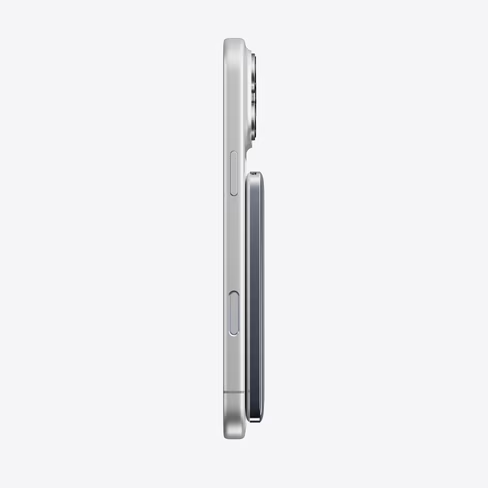
Photo Credit: TORRAS

Advertisement

The era of “Invisible” tech accessories

The best tech accessories are increasingly the ones you stop noticing altogether.

Nobody wants to carry extra cables, bulky battery bricks, or overheating chargers anymore. Consumers want accessories that integrate into their lives with as little friction as possible.

That shift helped make magnetic charging mainstream. Snap a battery onto the back of your phone and keep moving.

The MiniMag Pro leans hard into that behavior. Its magnetic alignment system is designed for secure attachment during movement, allowing users to keep texting, navigating, filming, or streaming while charging one-handed.

Advertisement

Combined with the slim profile, it feels built for modern everyday carry culture rather than emergency-only battery backup.

That distinction matters.

Portable charging is evolving from “just in case” tech into an always-on companion product.

Safety is quietly becoming the new premium feature

There is another reason companies are suddenly investing more heavily in battery architecture: consumers are paying attention.

Advertisement

As devices become thinner and charging speeds get more aggressive, battery safety is no longer an invisible engineering problem. It is becoming part of the buying decision.

TORRAS says the MiniMag Pro underwent puncture testing and extreme pressure testing to validate thermal stability and structural integrity under stress.

Most consumers will never watch those test videos. But they will notice when a charger stays cooler in a backpack, charges more consistently during travel, or does not feel like it is cooking their phone battery over time.

That is increasingly where the premium accessory market is moving.

Advertisement

Not necessarily toward maximum power, but toward smarter thermal management, better materials, and products that feel more reliable over the long run.

Portable charging is entering its next phase

For years, portable power felt stagnant. Every new release promised the same thing: more battery, faster charging, smaller footprint.

Now the conversation is shifting.

Consumers are starting to care less about spec-sheet races and more about real-world experience. Does it overheat? Is it annoying to carry? Does it feel safe? Can it keep up with how people actually use smartphones today?

Advertisement

The MiniMag Pro feels designed around those questions.

And if semi-solid-state battery tech continues moving into mainstream accessories, this may be the beginning of a much bigger shift than just one magnetic power bank.

Source link

Advertisement
Continue Reading

Tech

Dell Alienware AW2726DM Review: QD-OLED Gaming for $350

Published

on

The Dell Alienware AW2726DM makes OLED gaming more accessible than ever with its aggressive $350 price point, while still delivering excellent motion clarity, deep contrast, and 240Hz refresh rates.

Read Entire Article
Source link

Continue Reading

Tech

‘Backrooms’ Takes You Deeper Inside the Internet’s Most Uncanny Horror Myth

Published

on

The 20-year-old filmmaker Kane Parsons has risen to the top so fast that he’s had zero time to process how far he’s come.

“It’s been go, go, go,” Parsons tells WIRED. “Even the tiniest bit of a break,” he says, would give him some better perspective on everything that’s happened over the past few years. But for the moment, he’s soaking up the limelight—and thinks it’ll be at least another month before he has the space to reflect on his big break.

Backrooms, a moody horror piece that stars Chiwetel Ejiofor and Renate Reinsve, is a cerebral expansion of Parsons’ atmospheric YouTube web series of the same name. It marks his feature debut as A24’s youngest director to date, at the helm of a movie long anticipated by a huge and hungry internet fan base. You could hardly ask for a better kick start to summer blockbuster season.

Yet Parsons makes his meteoric success sound like something of an accident. “I never went into making that first short or making the series with the intention of, ‘I want to do this so I can prove to Hollywood that this is an engine that is viable for a film,’” he says.

Advertisement

That original nine-minute video, titled “The Backrooms (Found Footage)” and uploaded by Parsons in 2022, was inspired by—of all things—a sinister 4chan meme that spawned a collaborative mythology. The 2019 post on the notorious image board’s /x/ forum included a disquieting photo of an empty hallway bathed in sickly light. An anonymous user described being transported into “the Backrooms, where it’s nothing but the stink of old, moist carpet, the madness of mono-yellow, the endless background noise of fluorescent lights at maximum hum-buzz, and approximately six hundred million square miles of randomly segmented empty rooms to be trapped in.”

“God save you if you hear something wandering around nearby, because it sure as hell has heard you,” the 4chan user added.

Other people took up the concept, creating spinoff imagery and stories on various social platforms. Parsons encountered these, as well as then-popular memes about surreal liminal spaces—the Backrooms being a paranormal extension of this phenomenon. He was intrigued by what this material evoked but felt it hadn’t been fully explored.

“It was clearly scratching something that I didn’t really see much other media scratching,” he says. “I think there was an element of like, I wish there was more for me to engage with here.”

Advertisement

To that end, Parsons decided to see whether he could conjure an immersive vision of the Backrooms with Blender 3D graphics software and Adobe After Effects. That initial video, in which a person is chased through the Backrooms by a malevolent life-form, went massively viral, with viewers marveling at Parsons’ technical skill and the chilling suspense he’d created. Fans excitedly speculated on the larger mythology of the uncanny setting. Within a month, studios were approaching Parsons with hopes for a full-length movie.

Although still a teenager at the time, Parsons knew enough to be wary of the offers. “I was very distrustful of pretty much everything that was happening, just because I feel like it’s a very common experience for that sort of event to turn into nothing,” he says. “Or you end up with less than nothing.”

Ultimately, however, he got what a young filmmaker dreams of: the chance to pursue his vision, in this case with top talent at his side. The feature film has a script by Homeland and Westworld writer Will Soodik, and its producers include horror maestros Osgood Perkins and James Wan.

Source link

Advertisement
Continue Reading

Trending

Copyright © 2025