Connect with us
DAPA Banner
DAPA Coin
DAPA
COIN PAYMENT ASSET
PRIVACY · BLOCKDAG · HOMOMORPHIC ENCRYPTION · RUST
ElGamal Encrypted MINE DAPA
🚫 GENESIS SOLD OUT
DAPAPAY COMING

Tech

Netflix invented binge-watching. Now it may have outgrown it.

Published

on

A buzzy Bloomberg report citing Netflix data suggests viewers are increasingly abandoning popular shows before the second season. The likely reasons aren’t hard to guess: Netflix frequently cancels shows, there’s too long a wait in between seasons, and much of Netflix’s content is designed for an algorithm instead of for the sake of art.

But the data also points to a shift in how people are consuming entertainment. Netflix’s defining innovation – the binge — was built for an era when streaming was competing with traditional TV. Today, Netflix is competing with TikTok, YouTube, Reels, and various microdrama apps. That shift makes Netflix’s binge model feel like a dated relic from another era.

Bingeing helped Netflix beat TV

When Netflix first dropped an entire season of “House of Cards” in February 2013, it was a revelation.
Ad-free, internet-connected TV meant we could be unshackled from the traditional routine of once-per-week shows punctuated by commercials. Instead, bingeable shows meant viewers could be entertained for hours on end, quickly forming a bond with titles and their characters that would have otherwise taken years to develop. Plus, you could drop in on them at any time — not only the day the network decided to air them, as with linear television.

This way of viewing made sense in a world where Netflix was largely still competing with traditional TV like broadcast, cable, and satellite. But Netflix won that fight. Nielsen in June 2025 announced that the TV era reached a new milestone, when the Netflix-style streaming format for the first time eclipsed broadcast and cable viewing — a milestone that made clear Netflix’s original competition was no longer the threat.

Advertisement

Now Netflix’s competition isn’t the TV of old, but what has become the TV of today: video apps.

TikTok and YouTube are today’s threats

Thanks to the rise of TikTok, Reels, and other short-form video platforms, there’s no need for you to visit Netflix when you have a couple of hours to kill with mindless entertainment. There’s an endless, free supply of video you can turn to instead.

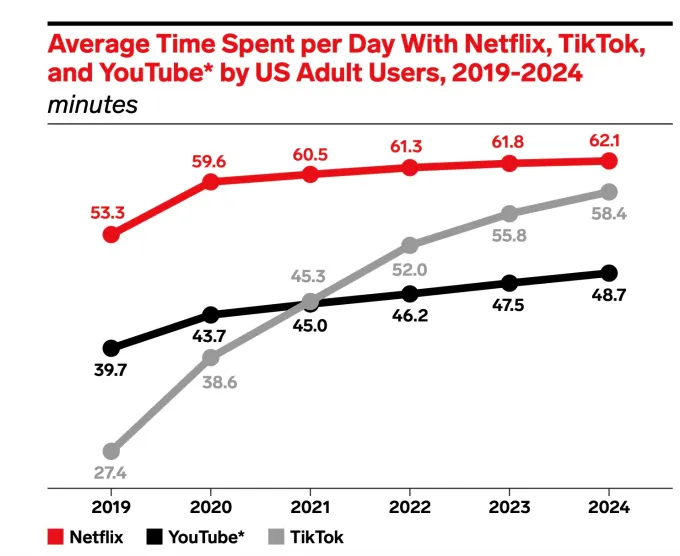
According to eMarketer analysts, TikTok was already nearing Netflix in terms of time spent back in 2024, when U.S. adults were spending an average of 62.1 minutes per day streaming from Netflix and 58.4 minutes per day on TikTok. In 2024, the Financial Times reported that, globally, TikTok users spent an average of 95 minutes per day on the app, the highest engagement rate among major social networks.

Image Credits:eMarketer

Then there is YouTube, which offers a combination of both short and longer-form content. Per a report released this year by Digital i, YouTube surpassed Netflix in average daily viewing for the first time, with 99.1 minutes daily in 2025 compared with Netflix’s 93.4 minutes.

These market reports use differing methodologies and demographics, so they should be taken with a grain of salt — but directionally, they point the same way. YouTube and apps like TikTok are Netflix’s real competition, not TV.

Advertisement

Netflix has even acknowledged this existential threat by way of a product redesign in April that added a TikTok-like feed based on Netflix content.

Where Netflix gets the feed wrong is that it’s still pitched as a way to help you find something to watch, rather than being the thing you watch. It’s understandable why Netflix went this route, given its library, but it’s not necessarily what the end user wants. Today, many people with dopamine-drained attention spans are instead seeking out microdrama apps in growing numbers when they want a serialized storyline they can consume in minutes.

Image Credits:ReelShort

According to data from the app intelligence firm Appfigures, one top microdrama app, ReelShort, saw roughly $1.2 billion in gross consumer spending in 2025, up 119% from 2024, TechCrunch’s Amanda Silberling previously reported. Meanwhile, another leading app, DramaBox, generated $276 million in gross consumer spending last year, more than doubling its 2024 numbers. Even TikTok acknowledged the competition, launching a microdrama app of its own to test the market appetite for this type of content.

Where does Netflix go from here?

Where does that leave Netflix, whose claim to fame has been full seasons dropped at once for rapid consumption?

Likely, it will have to rethink how it’s greenlighting, producing, and releasing what it considers a “TV show.”

Advertisement

That doesn’t mean that the Netflix model has to pivot entirely to short-form to keep up with the competition, but it may need to reconsider how people want to stream. Viewers may no longer want to commit the hours and weeks it takes to get through a show and all of its subsequent seasons, for instance. They want something that feels more “finishable,” the way you can easily get through a YouTube video or TikTok series from a creator.

A simple fix could see Netflix try prioritizing single-season shows, traditionally known as miniseries or limited series, allowing people to tune into a completed work without having to worry whether it would end on a cliffhanger and never be renewed.

Netflix could also experiment with breaking up shows into smaller chunks, like the before-its-time Quibi model.

The Jeffrey Katzenberg-backed startup, Quibi, had bet that people would eventually gravitate towards TV content designed to be consumed in shorter sessions. Unfortunately for Quibi, the pandemic hit, and people suddenly had a lot of time to watch TV, leading to its demise.

Advertisement

Many Netflix shows could be easily revamped for shorter viewing sessions, particularly lightweight competition shows like “Nailed It,” “Is It Cake?,” or “Squid Game: The Challenge.” Meanwhile, Netflix could surely produce better microdramas than the ones currently on the market with their awful acting and ridiculous storylines.

To generate interest in its higher-quality content, some Netflix shows could be shifted to the weekly release model. This is something Netflix has already proven works in specific cases. For instance, it drops new episodes of its reality show “Love Is Blind” in weekly dumps, making it great watercooler fodder as everyone is watching the new episodes around the same time. (Faster consumption models could work, too. For instance, Peacock’s “Love Island USA” is the reality hit of the summer, as there’s a new episode almost daily).

But instead of experimenting with different types of short-form content for quick entertainment, combined with slower releases for seasons, or focusing more heavily on miniseries worth watching, Netflix has been dabbling in other areas.

As of late, it’s expanded its lineup with podcasts, which reportedly no one is watching, and live content, which can be hit or miss. In terms of the latter, Netflix investments in live sports have generally done well, but its recent entry into live reality competition shows, “Star Search,” has already been canceled despite a clever real-time voting feature. More work here is still needed.

Advertisement

Bloomberg’s report framed the problem facing Netflix as a failure to create loyal TV viewers who tune into a Season 2, but the underlying issue facing the streamer is much bigger. Netflix may need to rethink whether it still needs to focus on competing with traditional TV and its long-running shows, or whether it should focus on entertainment projects whose storytelling arcs have less filler and wrap up more quickly.

To find the right balance between viewers ditching cable and those who just want something better than TikTok, Netflix is finding itself needing to reinvent TV all over again.

When you purchase through links in our articles, we may earn a small commission. This doesn’t affect our editorial independence.

Source link

Advertisement
Continue Reading
Click to comment

You must be logged in to post a comment Login

Leave a Reply

Tech

AirPods firmware beta lets developers use new iOS 27 features

Published

on

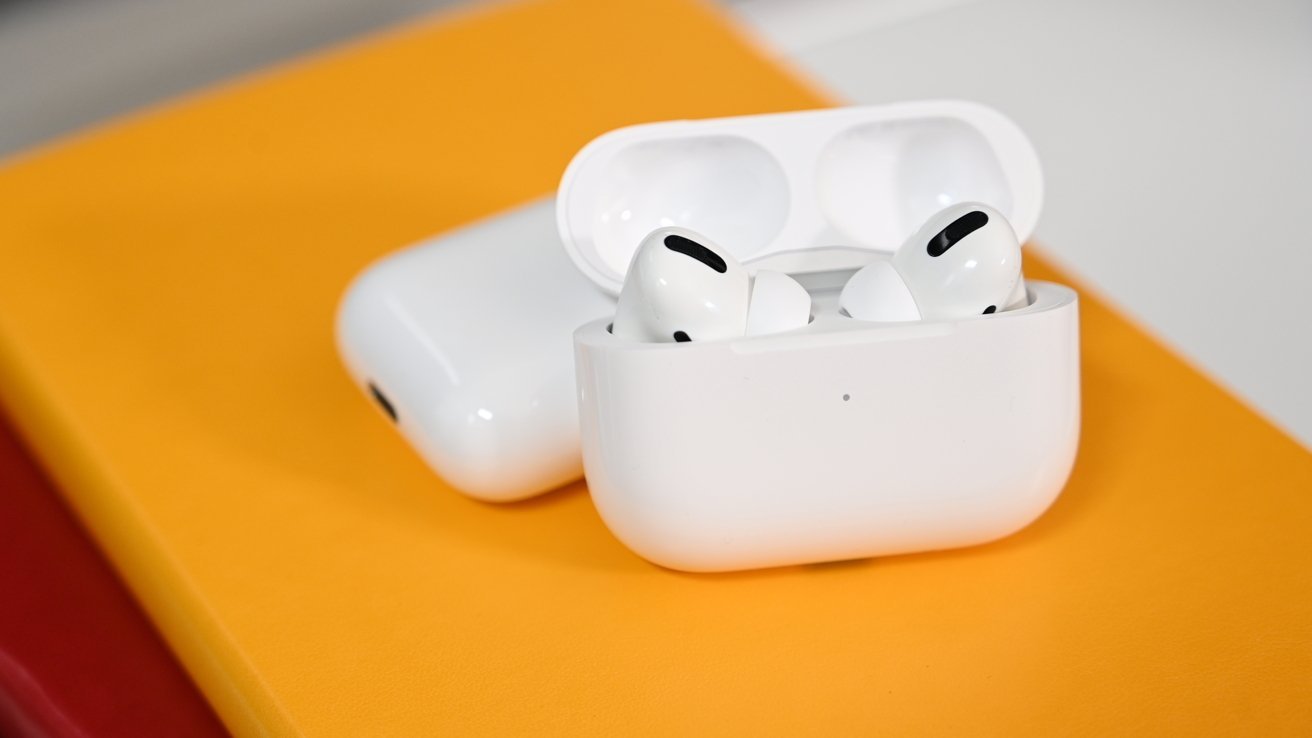
Apple has released a new firmware developer beta build for AirPods and AirPods Pro, preparing the personal audio devices for upcoming iOS 27 changes.

Apple periodically updates the firmware of its accessories and peripherals to account for new features being added to its operating systems. With iOS 27, macOS 27, and others undergoing testing, that same process also happens for firmware updates.

Tuesday’s new firmware, build 9A5314b, is for the AirPods 4, AirPods Pro 3, and AirPods Max 2. The firmware is only available to developers, not to the general public.

The firmware can be downloaded by using the AirPods with an Apple device running iOS 26 or later, iPadOS 26 or later, or macOS 26 or later. There is an option under the AirPods settings interface to enable beta firmware installation.

Advertisement

After enabling it, the update process happens automatically, while recharging and within range of the host device.

Audio changes

While Apple doesn’t state what the firmware is for, it is almost certainly going to enable Apple’s personal audio devices to work properly with changes in its 27-generation operating systems.

Those changes include a redesign of the AirPods settings submenu, including easy-to-read labels and groupings similar to other Settings elements.

A new customizable EQ is also on the way, found under Settings, AirPods, Audio and Routing, then Equalizer.

Advertisement

Apple Watch users will also be able to use Find My to track down a pair of missing AirPods Pro. Lastly, for AirPods Pro 3, the heart rate tracking will now sync with GymKit on supportive exercise equipment.

Source link

Advertisement
Continue Reading

Tech

Mysterious Metal Spheres Identified as Rocket Debris on Queensland Beach After Ocean Journey

Published

on

Metal Spheres Queensland Space Debris Australia Beach
Photo credit: Australia Space Agency
Over the weekend, visitors wandering along Australia’s Forrest Beach, just north of Townsville, came across something pretty unusual. A host of shining, metallic spheres began washing up on the beach, attracting attention due to their unique shapes and fittings in an area of the coastline where little else happens. Six of these appeared on Friday, Saturday, and Sunday, each almost twice the size of a basketball.


The news of the discovery spread quickly throughout the normally calm community, and before long, Queensland officials and police had established 50-meter safety zones around each of the orbs to keep everyone safe. The men in the big, heavy suits entered and began cleaning up the debris, depositing it into large bins, while they searched for any rocket chemicals that could cause problems. Researchers eventually concluded that the spheres were safe to be around.


LEGO Icons NASA Artemis Space Launch System – DIY Rocket Model Building Set for Adults, Ages 18+ – Gifts…
  • NASA rocket model kit – Launch into a creative project with the LEGO Icons NASA Artemis Space Launch System model building project for adult space…
  • What’s in the box? – This creative building set includes everything you need to craft a multistage rocket with 2 solid-fuel boosters, an Orion…
  • Features and Functions – This NASA-themed rocket model features retractable launch tower umbilicals, rocket support and crew bridge, detachable…

The Australian Space Agency arrived to take a closer look, and their researchers compared the shape, material, and construction of these orbs to every spacecraft component they could find, quickly concluding that these were essentially pressure tanks holding fuel or gases under extreme pressure to help the rocket lift off the ground and into the atmosphere. The agency has already determined which launch it most likely came from, and they are working with other countries to validate the exact rocket and who shot it.

Metal Spheres Queensland Space Debris Australia Beach
Apparently, these small orbs serve as pressure tanks, keeping the propellants or oxidizers at the proper pressure so that the engines can fire properly as the rocket takes off and zooms across space. They’re rather well protected by thick walls and strong metals that can withstand the heat of re-entry, while the lighter pieces blast away. Over the next two days, ocean currents brought them closer to the Queensland shore.

Metal Spheres Queensland Space Debris Australia Beach
Similar fragments have already been found on the beach, including an Indian rocket component discovered in Western Australia in 2023, and parts from NASA’s Skylab space station landed in the same state in 1979. Even with all of the new launches taking place across the world, it is extremely rare to locate parts of re-entry gear on land since, let’s be honest, the majority of it breaks apart or splashes into the water. When it comes to dealing with space trash, Australia follows the usual international guidelines. The components that survive re-entry are kept by the country that launched the rocket, and the government must request their return.
[Source]

Advertisement

Source link

Continue Reading

Tech

Mysterious Compound Detected on Pluto and Titan

Published

on

A look at the dwarf planet Pluto and Titan, Saturn’s largest moon, baffled astronomers after the James Webb Space Telescope (JWST) detected a chemical signature on their surfaces that does not match any recorded in spectroscopic databases. Researchers believe this is not an instrument error, but rather the signature of a compound whose identity remains a mystery—a mixture of materials never studied in a laboratory, or even a compound whose chemistry has not yet been characterized.

The finding appears in a study awaiting publication in the journal Astronomy & Astrophysics. Scientists identified an absorption band centered at 5.113 micrometers on both Titan and Pluto—two worlds separated by billions of kilometers and with very different physical conditions. The signal appeared in observations made with two different instruments on the JWST, leading the team to rule out the possibility that it was a calibration issue or some other type of technical error.

Plutón visto desde la nave espacial New Horizons.

Pluto, the dwarf planet.

Heritage Images/Getty Images

The key to the discovery lies in a technique known as spectroscopy. Each element or molecule interacts with light in a unique way, absorbing certain wavelengths and leaving a characteristic pattern, like a fingerprint. For decades, scientists have compiled vast catalogs of these spectral signatures to identify compounds such as water, methane, carbon dioxide, or ammonia on planets and moons, as well as on other bodies outside the solar system.

Advertisement

In this case, the comparison yielded no convincing matches. Furthermore, at this stage, discovering a chemical signature that cannot be linked to a known compound is highly unusual. Therefore, figuring out what is happening on Titan and Pluto could become the new fundamental question for planetary science.

Researchers have already explored several possibilities. They examined laboratory spectra of ices and organic compounds that might exist on these worlds, including acetylene, benzene, ketene, and a family of molecules known as alenes. None of them exactly match the observed signature. The most likely explanation is that it’s from a known compound that exists in a physical state or mixture never before studied in the laboratory, although the authors do not rule out the possibility that the signal comes from a material whose chemistry has not yet been characterized.

The fact that the same signal appears in two such different places makes the mystery even more intriguing. Titan has an atmosphere rich in nitrogen and methane with a surface pressure of approximately 1.5 bar—higher than Earth’s—as well as rivers and lakes of liquid methane and a temperature of about –180 degrees Celsius (–292 Fahrenheit). Pluto, on the other hand, retains only a tenuous atmosphere of about 10 microbars (some 150,000 times less dense); has an ice-covered surface composed of nitrogen, methane, and carbon monoxide; and reaches temperatures close to –235 C (–391 Fahrenheit).

Source link

Advertisement
Continue Reading

Tech

Corruption Showdown: Verizon, SpaceX Square Off Over Cell Phone Unlocking

Published

on

from the the-lobbyist-with-the-most-money-wins dept

Earlier this year I noted how the Trump FCC, at the direct request of wireless phone giants, destroyed popular phone unlocking rules that would have made it easier and cheaper to switch wireless carriers. The rules, applied via spectrum acquisition and merger conditions after decades of activism, required that Verizon unlock your phone within 60 days after purchase so you could easily switch to competitors.

Verizon, as I’ve long established, hates competition, and early last year immediately got to work lobbying the Trump administration to destroy the rules (falsely) claiming, without evidence, that the modest phone unlocking requirements were a boon to criminals and scammers. Since the rollback they’ve slowly been making unlocking more annoying, hoping a slowly boiled frog approach would keep it on the down low.

Enter one of Trump Corp’s other biggest constituents: Elon Musk and Space X.

I’ve already explained how the SpaceX IPO includes all sorts of fantastical claims related to Starlink (the only profitable company in the prospectus). Musk Corp insists Starlink will grow extremely quickly from 10 million current subscribers to 300 million. As I explain here that’s simply not happening, for a long list of reasons authoritarian pump and dumpers don’t actually care about.

Advertisement

But there’s an interesting wrinkle: to grow, Musk’s Starlink is hoping to increasingly tether Starlink to existing cellular providers. Starlink has increasingly partnered with companies like T-Mobile to extend connectivity for customers when they’re outside of the range of traditional towers.

So in a filing last month sent to the FCC, SpaceX joined a bunch of other smaller providers in pushing the FCC to adopt a new 180 day phone unlocking rule:

“…we write to urge the Commission to adopt a clear, uniform requirement that mobile devices be automatically unlocked within 180 days after activation. Automatic mobile device unlocking is essential to protecting consumer choice, promoting competition, and lowering costs in the mobile marketplace. Allowing a “lock period” of 180 days gives providers enough time to protect against the significant fraud concerns identified by the FCC and to ensure mobile devices are not exploited for criminal acts.”

So for one thing, the 180 day locked phone rule would be much worse (and far friendlier to giants like Verizon) than the 60 day lock window the Biden FCC proposed (but never actually implemented because our regulatory structures are too corrupted to function). You’d also have to doubt whether Brendan Carr, who largely supports big telecom positions across the board, would ever enforce them.

Another point of note is that the FCC’s claims that they had to destroy unlocking rules to “fight crime” are bullshit. They’ve provided zero hard evidence to support that idea. The destruction of unlocking rules was just blatant regulatory capture in service to Verizon lobbyists, using “crime” as flimsy justification.

Advertisement

Still, it’s interesting to see SpaceX suddenly on the other side of the table to Verizon in support of something that could, for once, actually help people.

Musk Corp appears to also have convinced three Republican Senators (Cynthia Lummis, John N. Kennedy, and Eric S. Schmitt) to send a letter to the FCC also supporting a new 180 day unlocking plan. You’ve also got people traditionally lined up against consumer rights — like former FCC Ajit Pai staffer Evan Swarztrauber — suddenly writing op-eds in favor of phone unlocking.

Swarztrauber crafts a bizarre alternate reality in his op-ed where Brendan Carr didn’t destroy popular unlocking rules, U.S. wireless is hyper cheap and competitive (despite his former boss Pai rubber stamping the Sprint-T-Mobile merger), and Republicans aren’t doing everything in their power to undermine internet access affordability. But he does make the correct point that arbitrary phone locks are anti-competitive:

“But mobile locking weakens all the pressure to reduce prices and improve service—and that’s by design. Reasonable waiting periods for phone unlocking to guard against fraud are fine—no one opposes that. But unlocking should otherwise be automatic once devices are paid off, and customers shouldn’t be forced to pay fees or jump through hoops to take their phones—their own property—to a competitor that could be saving them up to $1,000 annually.”

I think SpaceX simply wants to ensure its path into the cellular market expansion through partnership and acquisition, and knows unlocked phones lead to more competition. I think the sudden flood of Republican interest in phone unlocking comes primarily as a byproduct of SpaceX lobbying. I would not be surprised if SpaceX would consider a T-Mobile acquisition to grow very quickly and keep the valuation hype rolling down the road.

Advertisement

That said, I’d want to see the final, actual unlocking proposal before getting too excited. Republicans have historically opposed nearly every telecom consumer benefit policy that matters, their proposals uniformly include loopholes to ensure the biggest companies are well coddled, and it’s entirely possible that the finished proposal could have more than its share of bad ideas. Stay tuned.

Filed Under: brendan carr, cellular, consumers, fcc, phone unlocking, smartphones, telecom, unlocking, wireless

Companies: spacex

Source link

Advertisement
Continue Reading

Tech

Sick of trying to find a USB and Windows key? Microsoft has just made reinstalling Windows 11 less painful

Published

on


  • Microsoft’s new Windows 11 recovery method is available for Windows Insiders
  • Cloud Rebuild allows users to reinstall Windows 11 and necessary drivers via the cloud, without a USB drive
  • The feature should begin rolling out to users on stable Windows 11 builds

Microsoft is continually making adjustments to its Windows 11 operating system through patches that address user pain points, and, fortunately, its latest move is certainly welcome.

As reported by Windows Central, Microsoft has implemented a new recovery method for Windows 11, known as Cloud Rebuild, which is available to Windows Insider users. Cloud Rebuild allows users to reinstall the operating system and drivers from the cloud without the need for a USB drive.

Source link

Advertisement
Continue Reading

Tech

New Study Cites Growing “Crisis” of Healthcare Costs on School Di

Published

on

Public school districts appear to be at a near tipping point when it comes to the impact of healthcare costs on school budgets. Premiums are rising so rapidly that healthcare obligations are threatening the ability of districts to deliver critical educational programs, materials, and services, hire, pay, and provide benefits to educators and make improvements to facilities.

A new study conducted by The School Superintendents Association (AASA) and the Association of School Business Officials International (ASBO International) surveyed more than 750 public school district leaders in 42 states about the impact of healthcare costs on their budgets. Findings from the study, summarized in the report “Rising Premiums, Falling Opportunities: The Budgetary Impact of Healthcare Costs on School Districts,” reveal that 98% of district leaders report that rising healthcare costs are having a measurable impact on their budget.

To offset their healthcare obligations, 46% of school districts have modified employee benefit packages, 34% have delayed hiring staff, 31% have reduced or postponed spending on instructional materials and technology and 28% have cut back on the levels of insurance coverage they are able to offer.

These budget impacts are making it hard for schools and districts to remain competitive in recruiting and retaining a high-quality workforce. If not resolved, the problem will quickly become a “crisis,” if it isn’t already, say report authors Sasha Pudelski, director of advocacy at AASA, and Elleko Yost, director of advocacy and research at ASBO International.

Advertisement

How Did Things Get This Bad?

The reason things have reached this point is simple. During the 2025–26 fiscal year, nearly all districts (92%) spent up to 30% of their budget on employee insurance benefits. The leading causes of rising premium costs are increasing prescription drug costs (cited by 60% of survey respondents), more claims for expensive treatments (cited by 56%) and increased utilization of high-cost specialty drugs such as GLP-1s (cited by 56%).

“We are at the tipping point of a cost trend that has been occurring for decades,” explains Lisa Marceau, founder and president of Boston-based advisory firm Alpha Millennial Health and author of “Breaking the System: How Digital Innovators Shape the Future of Healthcare.”

The study findings are alarming, but they are not new, Marceau explains. Rather, they are an added burden on an already stressed system. She says there is sufficient research connecting strong education systems to the health of students, families and communities. When education systems are strained, programs are cut, and teacher benefits are reduced, the impact ripples not just to families and communities but to the future health status and earning potential of students.

Advertisement

Zahava Stadler, director of New America’s Education Funding Equity Initiative, agrees that the study findings reflect a very tough reality facing far too many school districts.

“We want district leaders to use their resources to support students and advance their learning. And we want to be able to hold decision-makers accountable for those spending choices,” Stadler says. “But as these numbers show, lots of school district dollars are spent before they even come in the door, on health benefits whose costs district leaders don’t control. How can we ask leaders to do better with their funding when so much spending is predetermined by factors that have nothing to do with educating kids?”

Taking a Clue From Business Sector Actions

A trend to watch is the growing number of private sector employers eliminating healthcare benefits entirely, something that was once unheard of, Marceau explains. The question for future public education contracts is whether rising healthcare costs will eventually force districts to reduce or eliminate healthcare benefits for educators to manage financial risk?

Advertisement

Right now, we’re seeing the first phase of this, where school boards are hitting the pause button on ongoing contracts and any new projects to assess what current expenditure are necessary and how to improve their investment strategies, explains David DeSchryver, senior vice president and co-director of research at Whiteboard Advisors, a research and policy firm in Washington, D.C.

There is another healthcare-cost factor set to squeeze education budgets soon, Stadler says. The big federal cuts to Medicaid are going to fall hard on states, leaving them to either fill huge new gaps in healthcare funding or let people lose access to care.

In some states, hundreds of thousands will lose their insurance if the state doesn’t step in and spend more on healthcare, Stadler says. That money will have to come from somewhere. States have to balance their budgets. The biggest pot of state spending outside healthcare is education, and he says there’s real reason to worry that states will freeze or cut education funding as the federal government dumps more healthcare costs onto them.

“Rising health care costs create pressure on school districts, but this is not a singular issue,” DeSchryver explains. “If it were only healthcare costs, we wouldn’t hear about it, but it’s not. It’s healthcare costs, plus operational costs, plus gas and transportation, plus salary-schedule pay raises, plus rising special education and clinical service needs, and on and on. All of these are magnified by flat or declining revenues.”

Advertisement

A Successful Funding Strategy in Montana

Pudelski and Yost are quick to point out that there is a lot that individual states can do to counter the healthcare cost challenge. They cite the example of Montana’s school healthcare transformation as “one of shifting from a state of crisis to a position of collective power.”

Montana faced a financial nightmare that would become the catalyst for change, Pudelski and Yost explain. The district in eastern Montana, then part of the Montana Unified School Trust, was hit with a staggering 72% insurance premium increase in a single year. It was the second-highest spike in the state, far exceeding the already painful average annual increase of 35%.

In 2023, a coalition of education groups in Montana helped draft HB 332, a bill designed to create a unified statewide health insurance trust, Pudelski and Yost explain. The results of this coalition building were transformative: 7 out of the state’s 8 largest districts joined the trust. A total of 180 districts opted in, bringing in more than 16,000 employees — far more than the 12,000 required.

Advertisement

This massive pool provided the bargaining power needed to negotiate more competitive rates with hospitals and clinics while effectively buffering against the risk of high-cost claims, Pudelski says.

Long-Term and Short-Term Steps Districts Can Take

Alleviating these pressures is part of a larger system of school funding challenges, explains Rachel White, associate professor of educational leadership and policy at the University of Texas at Austin and founder of The Superintendent Lab, an online research hub focused on the school district superintendency.

“For example, at the federal level, the government must fully fund the Individuals with Disabilities Act and Title I to free up local dollars that are currently paying for these unfunded mandates,” White says. “At the state level, legislatures need to continue to modernize funding formulas so they reflect the real rising costs of operating a school — including healthcare. Beyond the K-12 sector entirely, the nation has to have a real conversation about rising pharmaceutical costs.”

Advertisement

In the short term, education systems can explore alternative benefit models that provide employees with greater flexibility while reducing employer exposure to cost risks, Marceau says. One option becoming attractive is shifting from a defined benefit model, similar to a pension, to a defined contribution model, similar to a 401(k). There are emerging forms of this new model from individual coverage and health reimbursement, direct primary care plus catastrophic care and the shift to self-funded plans that permit more flexibility.

Public school systems are some of the largest health insurance purchasers, Marceau continues. States with large education systems and growing populations generate significant revenue for the health system. From this perspective, education systems can engage in negotiations that leverage this purchasing power.

“State agencies aren’t in a good position to really drive this forward,” DeSchryver explains. “It falls upon local districts, in regional collaboration and cooperatives, to identify best practices and share benchmarks and examples of what successful organizations look like.”

There are decades worth of research available about performance-based management, Drucker-like approaches to organizational efficiency, and outcomes-based contracting, DeSchryver says. It’s not new, but it’s something that schools now have to consider incorporating in their own unique way.

Advertisement

Source link

Continue Reading

Tech

Trump’s Reflecting Pool Failures To Be Taken Out On US Olympic Canoeist David Hearn

Published

on

from the pettiness-of-evil dept

Yet another way Trump was going to make America great again was by giving one of his pool boys a no-bid contract to make the Lincoln Reflecting Pool even greater than it always had been. Rather than allow it to remain — at the very least — serviceable, Trump insisted the bottom needed to be “painted” a completely made up shade of “American flag blue” and then refilled to better reflect Trump’s glory upon himself.

What followed this combination of no-bid contracts and Trumpian hubris was completely expected. The redo underperformed while going over budget. And the water piped back into the pool was exactly the color one would expect given the circumstances. It sure as shit wasn’t “American flag blue.” Instead, it was stagnant-hot-water green, thanks to a surplus of algae that drowned out the blue paint/sealant/liner applied to the bottom of the pool.

Having been sufficiently embarrassed by his own actions, Trump decided to blame everyone else. If he had left it at blame, we probably wouldn’t even be writing about it. But he took it further, claiming everything from the peeling liner to the presence of algae itself were the actions of vandals and anti-Trump agitators.

Nobody honestly believes these claims, not even the guy making them. But plenty of people who have hitched their wagon to this childish bully are not only expected to give these wild theories credence, but expand and expound upon them from their federal offices. That’s why Interior Secretary Doug Burgum is debasing himself during interviews:

Advertisement

Speaking to Dana Bash on CNN’s “State of the Union,” Burgum said, “We’ve got all the photographs we can see” to prove that vandals cut portions of the pool bottom.

Not stupid enough? Try this:

“If people are defaming our monuments, they should face the consequences of that,” Burgum said.

Your monument looks like shit and was fucked up by a dipshit who shouldn’t be trusted to fill his own bathtub. That’s “defaming” a monument. It’s not like “defaming” was so close to the correct term that Burgum just accidentally hot-swapped some English while being casually questioned by a member of the press. That’s just the sort of sloppiness that’s to be expected from people who don’t really believe what they’re saying, nor care what anyone thinks about their bogus assertions.

As I said earlier, Trump being mad about not being able to make a pool better despite knowing the best pool guys isn’t news. That’s just Trump being Trump. What makes it news is when the administration threatens journalists for reporting on the pool revamp failure. What makes it fascism is when the administration starts arresting people because Trump refuses to admit some errors might have been made during his command performance of Make America But Especially This Pool American Flag Blue Again (For The First Time) With No Bid Contracts.

In the space of a single, distended paragraph, Trump inflated the size of the “slit” in the pool liner from 150 feet to 350 feet. In the length of a single press conference, the DOJ claimed 14 reports of vandalism had resulted in five arrests.

Advertisement

Arresting five randos for imaginary crimes won’t satisfy Trump’s desire to see his feverish federal crimes dreams made a reality. The administration now has a scapegoat just famous enough to redirect a bit of the spotlight away from its outlandish claims and childish behavior.

U.S. Olympic canoeist David “Davey” Hearn was indicted Thursday on a single count of destruction of property after he was accused of causing more than $1,000 worth of damage to the Lincoln Memorial Reflecting Pool.

Hearn was indicted on the felony charge in D.C. Superior Court.

Jeanine Pirro, the U.S. attorney for the District of Columbia, said National Park Service employees saw Hearn “forcefully and violently pulling up and removing the bottom liner” of the pool with both hands on June 19.

Whoa smol if true! Here’s what gets you a felony charge if you’re being prosecuted by a Trump puppet who absolutely has to buy into Trump’s pool vandals conspiracy theory:

Advertisement

Pirro alleged that Hearn damaged about 2 square feet of the sealant from the bottom of the pool.

TWO. SQUARE. FEET.

The total square footage of the reflecting pool is ~339,000 square feet. If you choose to believe this allegation, this means Davey Hearn “damaged” 0.00059% of the reflecting pool’s underbelly. You also have to believe Hearn was “forcefully and violently” yanking at this 0.00059%, rather than simply doing what she said he was doing, which was pulling up a floating chunk of separated liner to get a better look at it.

Stupider still:

“A parks employee actually told Hearn to stop, to stop his behavior and stop what he was doing,” Pirro said at a news conference Thursday. “Hearn reacted by shouting at the parks employee, saying that she cared too much about the Reflecting Pool, and why did she even care, since it wasn’t her pool.”

OH MY GOD. The Lincoln Reflecting Pool is our pool. While the Interior Department may oversee it, it belongs to the public. And it seems a lot of Americans care more about this botched makeover than Mr. America himself — someone so narcissistic he demanded it be redone to his specifications. And when those specifications went man-tits up, he decided to pretend vandalism, rather than no-bid contracts handed out to his pool buddies, was to blame for the algae bloom and the refusal of the lining to remain attached to the bottom of the pool.

Advertisement

The Department of the Interior continues to insist the lining was vandalized shortly after the project was completed and refilled. So do Trump and Jeanine Pirro, who will say anything Trump tells her to say. But it’s impossible to believe large-scale vandalism occurred without anyone gathering any supporting evidence, like video recordings or multiple sworn statements by witnesses. This was yet another one of Trump’s self-glorification projects, so of course it was going to be a target. But without more than Trump and his sycophants simply saying something happened, there’s no reason to believe what has been alleged has actually happened.

And in the case of Hearns, someone yanking on a small bit of dislodged lining isn’t anything anyone would seriously consider to be felonious vandalism. I mean, at least not normally. But nothing is normal anymore. This is a government that will destroy citizens’ lives, rather than take any responsibility for its failures.

Filed Under: asshats, david hearn, dc, department of interior, donald trump, failure, jeanine pirro, reflecting pool, trump administration

Advertisement

Source link

Continue Reading

Tech

Aoostar’s mini PC completely destroys the Steam Machine on raw performance but you will have to add memory and storage

Published

on


  • This Steam Machine alternative offers more power at a lower price
  • The Aoostar GODY 7600XT is a barebones unit
  • It is suitable for both gaming and enterprise-level design and rendering

Gamers and creatives looking for a cheaper alternative to the Steam Machine might just have found the answer. The Aoostar GODY 7600XT isn’t only more powerful on paper than the Steam Machine, it is also more suited to squeezed IT budgets.

That’s definitely a bonus, but it does come with a key caveat: you’re going to need to provide your own DDR5 RAM and M.2 storage.

Source link

Continue Reading

Tech

Chicago software company plants flag in Seattle area as new leadership team seeks AI talent

Published

on

LogicGate CEO Diego Panama. (LinkedIn Photo)

Enterprise software company LogicGate is establishing a Bellevue, Wash., office and rapidly expanding its Seattle-area executive team, betting on the region’s deep technology talent pool as it embarks on a new chapter under newly appointed CEO Diego Panama.

The Chicago-based governance, risk and compliance software company recently signed a lease in Bellevue with space for up to 25 employees and expects to have about 20 people working there by the end of the year.

It also recently recruited two Seattle-area executives to its leadership team: veteran marketing executive Michael Schultz as chief marketing officer and David Rostov as chief financial officer, whose appointment is being announced today.

“The tech talent market here is really second to none,” said Panama, the former LiveRamp and Microsoft sales leader who took the helm of the company in April. “As we looked to create a hub with a vibrant office culture, Bellevue is really a stand-out option.”  

The expansion comes as Panama succeeds co-founder Matt Kunkel in a planned leadership transition that the company hopes will position LogicGate for its next phase of growth.

Advertisement

“We are eyes wide open — this is hard to get right — and really proud/excited about how we are going about it,” said Panama. One of his main goals as CEO is to transform LogicGate from a cloud-based software-as-a-service business into an AI-centric company where agents and humans work seamlessly together.

David Rostov, the newly appointed CFO at LogicGate.

Founded in 2015 and now employing about 200 globally, LogicGate develops governance, risk and compliance software used by enterprises to manage regulatory, cybersecurity and operational risk.

Rostov is a longtime Seattle technology finance executive who previously served as CFO at Avalara and Identity Digital before co-founding Aurion Biotech. Based in Seattle, he will oversee LogicGate’s finance and legal organizations while helping expand the company’s Pacific Northwest operations.

“We have a leadership team that can match the ambition of what we’re creating at LogicGate,” Panama said in a statement.

Rostov said he was drawn by both the market opportunity and the company’s strategy around AI.

Advertisement

“Enterprise GRC is at an inflection point, and companies need a trusted AI-focused platform that scales alongside their risk and compliance demands,” he said in a statement.

The Bellevue office reflects the company’s belief that the Seattle region’s concentration of enterprise software, cloud computing and AI talent can help fuel its next stage of growth as it expands both its leadership team and its AI capabilities.

LogicGate’s investment also adds another enterprise software company to a growing roster of firms choosing the Seattle area as a base for executive leadership, alongside engineering and product talent. GeekWire’s engineering center list now includes more than 100 companies with outposts in the region.

Source link

Advertisement
Continue Reading

Tech

Enterprise AI still smarting from leaping before looking

Published

on

AI and ML

Majority report AI-related security incidents or vulnerabilities

The majority of companies that deploy AI systems end up shooting themselves in the foot with security, according to DigiCert.

Seventy-eight percent of enterprises report “experiencing AI-related security incidents or identifying AI-related vulnerabilities,” the digital identity biz said in a commissioned survey.

Advertisement

Among respondents, 27.7 percent experienced one incident, 21.9 percent experienced multiple incidents, and 28.4 percent had no incidents but identified vulnerabilities, a company spokesperson told The Register. Incident details were not disclosed, but they were caused by AI agents that were unauthorized or misconfigured rather than flaws arising from AI-generated code.

Consistent with its business focus, DigiCert attributes the survey’s findings to lack of AI governance.

“We wouldn’t allow an employee to operate without a verified identity,” said DigiCert CEO Amit Sinha in a statement. “AI agents should be no different.”

That’s become a common refrain. There are several initiatives underway to establish identifiers for bots, such as Private Access Control Tokens (PACTs), Estonia’s digital IDs for agents, and Microsoft’s Agent ID. But bot badging infrastructure remains a work-in-progress, leaving AI agents to run amok in many organizations.

Advertisement

DigiCert’s findings [PDF] echo a similar report two weeks ago from Spacelift that found 93 percent of organizations experienced AI-caused infrastructure incidents while only 19 percent had a governance plan in place. 

The survey stands in stark contrast with picks-and-shovels seller Nvidia’s State of AI 2026 report, which gushes, “Across every industry, AI is helping increase annual revenue and drive down annual costs while boosting productivity.” 

The DigiCert Q&A involves responses from 1,001 IT and cybersecurity leaders in the US, UK, and Australia, from various businesses. The survey shows that businesses are deploying AI first and asking questions later.

While 90 percent of organizations surveyed have discussed AI governance at the board level, just 50 percent have dedicated AI governance budgets and formal governance programs. This allows operational blind spots to persist. Just 53 percent of respondents said their organization could trace AI decisions back to the models and source data that produced those results.

Advertisement

“That becomes a problem the moment an AI system produces an unexpected or controversial result,” the report says. “Customers, executives, and regulators will all ask, ‘Why did it do that?’”

And perhaps at some point, companies will ask, why did we deploy that? ®

Source link

Advertisement
Continue Reading

Trending

Copyright © 2025