Security teams log 54% of successful attacks and alert on just 14%. The rest move through your environment unseen.
The Picus whitepaper shows how breach and attack simulation tests your SIEM and EDR rules so threats stop slipping by detection.





A new data-extortion group called Helix is using identity-focused tactics such as voice phishing (vishing), device code phishing, and multi-factor authentication (MFA) abuse to steal data from SharePoint environments.
Initial contact is made through vishing. In some cases, the threat actor called employees while impersonating their manager, using either the manager’s name or caller ID spoofing to appear legitimate.
The purpose is to trick the target into device-code phishing schemes to gain access to their accounts.

Once inside, Helix operators quickly register a new multi-factor authenticator app for persistence, then browse and enumerate SharePoint before exfiltrating files.
According to researchers at cybersecurity firm ReliaQuest, the stolen data is typically used to extort victim organizations by threatening to publish it unless a ransom is paid, or it is sold to other cybercriminals.
The SharePoint exfiltration behavior is Helix’s strongest technical fingerprint.
“Automated enumeration and collection were identical across incidents and represent the most reliable fingerprint. Enumeration ran from 179.43.185[.]230 using the python-requests/2.28.1 user-agent,” the researchers note.
“The operator issued contentclass:STS_Site and wildcard (*) SharePoint searches to inventory all reachable content, then bulk-downloaded from the same IP and user-agent.”
ReliaQuest believes that Helix emerged from the ShinyHunters and BlackFile data extortion groups based on the techniques and infrastructure used, although the researchers did not find a definitive connection.
Over the past month, Medtronic, Nissan, NAIC, Kodak, Infinite Campus, and Nottingham University confirmed data breaches previously claimed by ShinyHunters.
The now defunct BlackFile data extortion group targeted organizations using identity-based attacks and social engineering before ceasing operations in April.
ReliaQuest’s research found that one Helix attack used an exfiltration IP address in the same autonomous system (AS 51852) that hosted a confirmed BlackFile IP address, suggesting shared resources.
Additionally, Helix emerging shortly after BlackFile shut down may indicate a potential continuation of the extinct operation. ReliaQuest also mentions Pink and Redact as potential successors.
Concerning the link to ShinyHunters, Helix demonstrates a very similar social engineering playbook, including vishing, employee impersonation, targeting Microsoft 365, and stealing SharePoint data.
A second clue is the use of the NICENIC registrar, which has also been seen in past ShinyHunters campaigns.
As a highest-impact defensive measure against Helix attacks, the researchers recommend that device code authentication be disabled where possible.
Other recommendations include restricting SharePoint access to only managed devices and blocking exchanges with newly registered domains, which Helix typically uses in its attacks.

Security teams log 54% of successful attacks and alert on just 14%. The rest move through your environment unseen.
The Picus whitepaper shows how breach and attack simulation tests your SIEM and EDR rules so threats stop slipping by detection.


SAP has talked its way out of an EU antitrust fine. The European Commission said it would accept a set of commitments from the German software group, closing an investigation into how SAP handles maintenance and support for its on-premise enterprise software and sparing it a penalty that could have run into the billions. It is the kind of negotiated exit that has become Brussels’ preferred outcome in complex tech cases.
The case dates to September 2025, when regulators opened a probe into concerns that SAP’s practices restricted competition in the aftermarket for maintenance and support of its software.
The worry was familiar in enterprise software: once a customer is locked into a core system, the terms attached to keeping it running can quietly foreclose rivals who might otherwise offer cheaper or better support.
SAP’s answer was a package of concessions rather than a fight. The company agreed to offer an alternative method for calculating the licence fees on which maintenance and service charges are based, a technical change that goes to the heart of how customers get priced into staying.
It also agreed to scrap reinstatement fees and to reduce back-maintenance charges for customers who leave and later return. Those fees are the sort of friction that makes switching support providers expensive enough that many customers simply do not bother, which is precisely the effect regulators objected to.
A further commitment lets customers terminate their licences in specific circumstances, including insolvency or bankruptcy, giving businesses in distress an exit they did not previously have. Taken together, the measures are designed to make leaving, pausing or switching SAP support a real option rather than a theoretical one.
The commitments will apply globally and run for 10 years, an unusually long and broad undertaking that turns a European settlement into a worldwide change in how SAP treats its customers. For a company whose installed base spans most of the world’s large enterprises, the reach matters as much as the substance.
The outcome fits a pattern in the Commission’s recent enforcement. Rather than litigate to a fine and years of appeals, Brussels has increasingly used commitment decisions to extract behavioural change quickly, the same instrument it has reached for while probing hardware and medtech markets from chips to dental aligners.
The company avoids a penalty and an admission; the regulator gets enforceable promises without the delay of a full case.
For SAP, the calculus is straightforward. A fine would have been a one-off cost, but a formal infringement finding would have handed ammunition to customers and rivals for years.
Settling on commitments removes the legal overhang while letting the company frame the changes as a customer-friendly gesture rather than a defeat.
The concessions are not costless. Making it easier to leave, and cheaper to come back, chips away at the recurring maintenance revenue that has long been one of the most dependable parts of SAP’s business. How much it actually loosens customers’ grip depends on whether third-party support providers can now compete on terms that were previously stacked against them.
There is a strategic backdrop, too. SAP has spent years steering customers off on-premise systems and onto its cloud subscriptions, and the aftermarket the Commission scrutinised is tied to the older, installed-software world the company is trying to move beyond. Loosening its grip on legacy support is easier to concede when the future is meant to be somewhere else.
That is the open question the settlement leaves behind. The Commission has changed the rules of the aftermarket on paper; whether customers use their new room to move, or stay put out of habit, is something the next decade will decide. For now, SAP keeps its money, its market and a ten-year promise to behave.


Presented by Oracle NetSuite
Every major technology transition produces a set of assumptions about where the market is headed. The assumptions are often directionally correct, but they tend to underestimate the degree to which organizations adapt new technologies to their own circumstances. AI is following a similar trajectory.
Many current discussions about enterprise AI assume a future in which employees interact with business systems through a common interface. The details vary depending on the prediction, but the destination often looks similar: a conversational system that becomes the primary way people access information, complete tasks, and interact with software.
The history of enterprise technology suggests a more complicated outcome. Organizations rarely adopt new capabilities uniformly because different parts of the business operate under different constraints. A finance team responsible for reporting accuracy, controls, and approvals approaches technology differently than an analytics group exploring operational data. Both groups have different requirements than a customer service organization focused on response times and case resolution. Even when there is broad agreement that a technology is valuable, the path to adoption tends to vary across functions.
The shift to cloud software followed this pattern — some organizations moved aggressively while others spent years operating hybrid environments. Different departments often modernized on different timelines, reflecting the priorities of the work itself rather than any industry consensus about the correct pace of adoption.
AI has accelerated many aspects of technology development, but it has not changed this underlying dynamic. Organizations still evaluate new capabilities through the lens of existing processes, responsibilities, and operational requirements.
For some employees, the most useful AI capabilities may be the least visible ones. A finance manager closing the books is often less interested in a new interface than in shortening a reporting cycle. An operations leader dealing with inventory issues is usually focused on identifying problems earlier and resolving them more quickly. In these situations, the value of AI comes from reducing the amount of effort required to complete existing work.
At the same time, another group of users increasingly wants direct interaction with AI systems. Analysts, planners, and operational teams often benefit from the ability to explore information conversationally, compare scenarios, and investigate questions that do not fit neatly into predefined reports. For these users, the interface itself becomes valuable because it provides a more flexible way to work with business information.
A customer service representative handling a high volume of inquiries has different requirements than a financial analyst investigating a trend in operating expenses. One benefits from information appearing automatically within an existing process while the other may benefit from the freedom to ask follow-up questions, explore alternative explanations, and move through data more dynamically.
Many organizations are discovering that both patterns exist simultaneously, which reflects a broader reality about how businesses evolve. Operational complexity accumulates gradually, systems multiply, and processes become fragmented. Information becomes distributed across applications, reports, spreadsheets, and workflows and employees spend increasing amounts of time locating information before they can begin acting on it.
Much of the value created by enterprise software over the last several decades came from reducing that fragmentation. Bringing financials, operations, inventory, customer information, planning, and reporting into a common system created a more complete picture of how the business was operating.
AI is beginning to address a related problem. Once information exists within connected systems, employees still need to find it, interpret it, and apply it. Reporting cycles consume time. Routine questions require investigation. Managers often spend considerable effort assembling information before they can make decisions. As organizations grow, these activities become increasingly expensive because they consume attention from people whose expertise is often in short supply.
AI’s promise is to reduce the effort required to move from information to action.
At Dura Software, AI-connected workflows are helping automate portions of revenue reporting that previously required manual preparation during each reporting cycle. Sloan Session, CFO at Dura Software, described the arrangement in practical terms: “The agents handle the pull. The humans handle the judgment and the personal touch.”
That observation captures an important aspect of current AI adoption. Most organizations are not attempting to remove judgment from business processes. They are trying to reduce the amount of time spent gathering, organizing, and preparing information so that experienced employees can focus on the decisions that require expertise.
A similar pattern emerged at S&B Filters. Employees previously spent several minutes during customer interactions collecting backorder information from multiple systems. By connecting AI to operational data, the company reduced that process to seconds and eventually extended the capability directly to customers through self-service.
In both cases, the benefit comes from reducing the friction associated with finding and using information rather than introducing a new interface. The moment information becomes easier to access, questions about access itself become more important. Permissions, approval structures, and security policies exist because businesses need mechanisms for controlling access to information and managing risk. Those requirements do not disappear when employees begin interacting with data through AI systems. If anything, they become more important because AI can make information easier to access.
Berry Carter, CEO of S&B Filters, described the principle clearly. If a user cannot access specific information within NetSuite, that user should not gain access to the same information through an AI assistant. The statement sounds obvious. Implementing it consistently across systems, workflows, and models requires considerably more discipline than the statement itself suggests.
Lauren Polasek, former NetSuite administrator and board member of the Texas NetSuite User Group, recently made a related point. Connecting technology is often the easier part. Organizations still need to determine which tools should be used, who should have access to them, and how governance should evolve as adoption expands.
This is one reason predictions about a single AI interface are difficult to reconcile with how enterprises actually operate. The requirements of a finance organization closing the books are different from those of a customer service team handling thousands of interactions each day. Some AI capabilities will be embedded directly into business processes where employees may barely notice them. Others will provide more direct access to operational information through conversational systems. Many businesses will end up using both approaches because the underlying work is different.
That perspective has shaped how we think about AI at NetSuite. Some customers want AI embedded directly within operational workflows. Others want the ability to connect NetSuite data to external models and assistants so they can interact with business information through tools that are already part of their daily work. Increasingly, organizations are asking for both.
The NetSuite AI Connector Service and our support for Model Context Protocol (MCP) were designed with that reality in mind. The goal is to allow organizations to connect business information securely to the workflows and systems that make sense for them while continuing to benefit from AI capabilities built directly into NetSuite.
The history of enterprise software suggests that adoption rarely follows a straight line. As organizations adopt AI, business leaders should identify the business objective and the workflows involved so they can match the solution to the reality of the work.
Sponsored articles are content produced by a company that is either paying for the post or has a business relationship with VentureBeat, and they’re always clearly marked. For more information, contact sales@venturebeat.com.


With over 200,000 residents and 35,000 college students, Worcester, Massachusetts, is the second-largest city in New England. Worcester’s history stretches back even further than this country’s birth date of July 1776. It was first incorporated as a town in 1722, making it a true 300-year-old tercentennial municipality. In 1848, it surpassed the required 12,000 residents and officially became a “city.”
In January of 1849, the Board of Aldermen and the Common Council came up with the city’s first official seal — “a circular form, having in the center as a device, the figure of a heart.” A motto that read “With Heart and Hand” was also proposed. The motto failed, but the seal passed with some tweaks (like the wreath). What’s more, Worcester is located in the center of the state, all of which led to it becoming known as the “Heart of the Commonwealth.” It’s for this reason that street signs in Worcester today are adorned with hearts.
However, 1848 was an altogether interesting year. Aside from Worcester becoming an official city, uprisings and insurrections were happening all around the world. There were so many, in fact, that it eventually became known as the “Year of Revolutions.” Even amidst all that chaos, an interesting phenomenon was taking shape in the region that would help make the beating heart of this little burgh, shall we say, all the more lovely. It’s also a source of confusion regarding why hearts were placed on its street signs.
The Valentine’s Day that we all know today began in England in the mid-17th century, long before people were shopping for romantic gifts online. According to Worcester’s historical society, some smart entrepreneurs in the area began creating the Valentine card industry here in the U.S. Worcester resident Esther Howland began making them and used her friends to put them together, in … you guessed it — 1848, and became known as the “mother of the American valentine.” Oddly, you won’t find the color red or any hearts adorning Howland’s early creations.
Despite the coincidental timing, the success of Esther’s cards had absolutely nothing to do with why the city’s modern street signs have hearts on them. Still, it’s easy to see why folks, even today (e.g., the NPR affiliate WBUR in Boston), assume they’re meant to honor the Victorian-era entrepreneur rather than the city’s “Heart of the Commonwealth” moniker.
In the historical scheme of things, Worcester’s heartfelt street signs are a fairly recent development – and, unlike some confusing road signs, their meaning is rooted in civic identity rather than traffic rules. Exactly when they first officially appeared can’t be tracked, but accounts from residents claim they started popping up around 2009 or 2010. That’s when the city’s Department of Public Works (DPW) began experimenting with new signage, placing a red heart before the street name to better reflect the “Heart of the Commonwealth” moniker.
Govee has been on a roll lately introducing new lights with interesting designs and abilities. The Smart Ceiling Ultra is a decent addition, even with limited Apple ecosystem functionality.
I’ve tested several Govee lighting solutions previously, and none were a disappointment. My biggest issue then, which continues to today, is Govee’s insistence on using its app for most functions.
The Govee 21-inch Smart Ceiling Light Ultra is a large circular light with an LED panel that faces the user and a separately addressable ring of lights at the top. The LED panel is low resolution, so while it can display images, they’re blurry and non-distinct.
The images are shown through Govee’s scene functionality found in the Govee app. Users can choose from plenty of options offered by Govee and other users, or make some themselves.
Since the Govee 21-inch Smart Ceiling Light Ultra is Matter certified, it can be added to Apple Home. The only problem is that it shows up as a single addressable light.
Govee doesn’t offer its capabilities as scenes, nor does it split out the upper and lower lights as separate units. I’m glad it’s in Apple Home at all, but requiring me to open the Govee app for specific actions is frustrating.
Let’s get into the details.
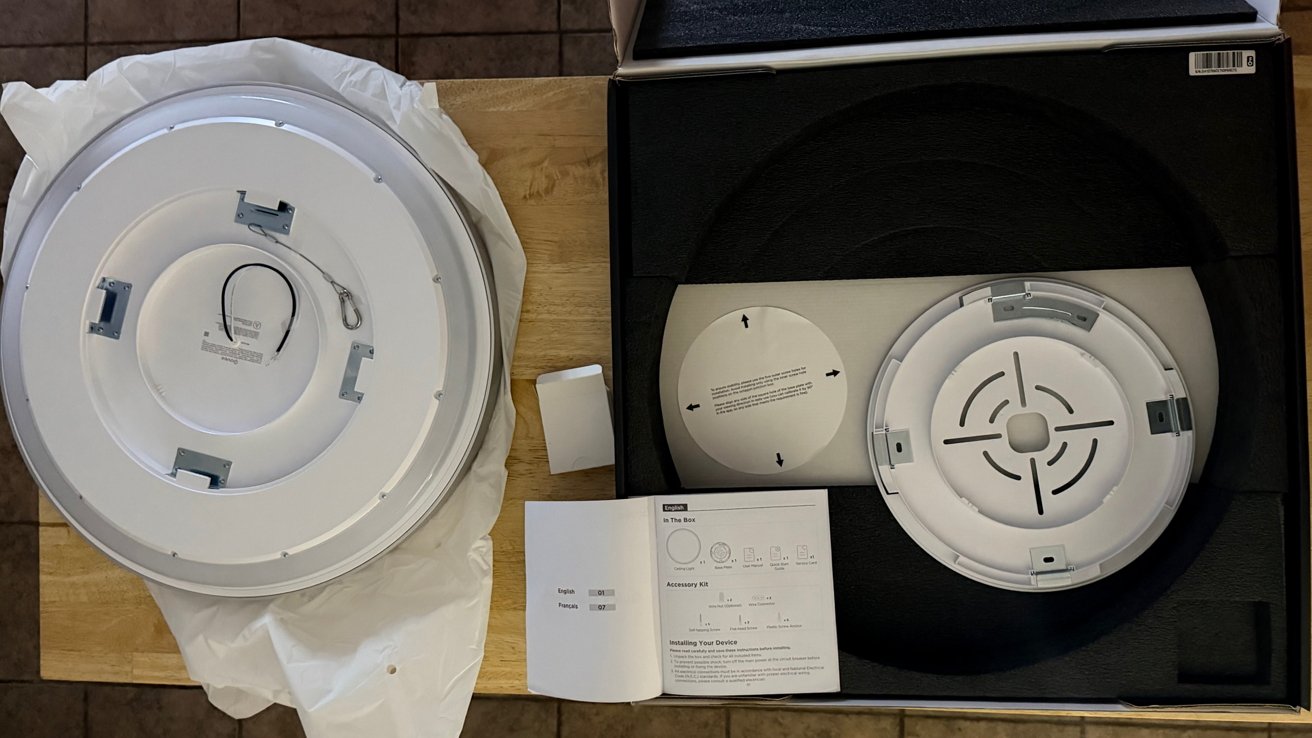
Installation of the Govee Smart Ceiling Light is very easy and straightforward. There are plenty of holes for screws and the weight is well distributed.

Govee 21-inch Smart Ceiling Light Ultra review: a simple installation
A cable attached to a carabiner keeps the light suspended from the ceiling even when not mounted. It screws into place, but it can be a bit awkward to line up so it fits and the cable doesn’t get in the way.
Once you’ve got it attached, that’s it. It is ready to use and calibrate in the app.
Users can set which direction the light is facing, but it isn’t granular like you might think. It can only be set to one of four cardinal directions, so be sure to line up the light when mounting.
The light looks great with its minimalistic outward design. When on bright white or other temperatures, it resembles a nice ceiling light.

Govee 21-inch Smart Ceiling Light Ultra review: turn off the bottom light in the Govee app
Turn off the bottom light in the Govee app and the separate top ring light can provide some warm ambient lighting. Sadly, the separate lights can’t be addressed individually in Apple Home.
The bottom light is capable of producing hazy images and animations. It’s neat that it works at all, but I do wonder about the utility.
This is one of the most party tricks of party tricks in smart home lighting I’ve seen in a while. It’s not that it isn’t interesting, but like all novelties, it wears off quickly.
I can get a response from guests by showing them how it can do more than illuminate the room. The presets for a sunset, rainbow, and a blurry Mona Lisa are simple demos.

Govee 21-inch Smart Ceiling Light Ultra review: that’s one blurry painting
Users can design their own patterns or upload photos for use in the light. It works well enough, but the feature works best with images that are already quite distinct and identifiable.
This image in a light thing is cool, and is an evolution of how Govee’s other smart lights work. For example, I can get Snake or Galaga to animate on the light curtain.
Sure, the Ceiling Light doesn’t necessarily need to be mounted to the ceiling. But I wouldn’t buy this as an image display either.
At over $200, triple the cost of other smart ceiling disc lights, I’m not sure “blurry Mona Lisa” is enough.
I remember loving tinkering with smart home devices just as much as I liked playing around with clock widgets on Android. But in both situations, at some point, you just need to get on with using the device.

Govee 21-inch Smart Ceiling Light Ultra review: not much control in the Home app
My life gets busier by the day, somehow, and I don’t exactly want to have a bunch of overhead for everything in my tech world. It’s one of the many reasons I chose Apple products.
Sure, you can get fiddly with Apple stuff these days, but it all just works out of the box. I’m not having the same experience with Govee.
There’s enough overhead to everything that I often default to powering the thing on and letting it run at whatever it was doing before. Or, at the least, I set a color or temperature in Apple Home.
The Govee app has some options for automation and quick actions, though the app’s more advanced functions aren’t the easiest to navigate. For example, to set up a quick action that turns off the bottom light, I can’t simply set that up within the provided device actions.

Govee 21-inch Smart Ceiling Light Ultra review: not the most friendly app to navigate
Instead, I have to know that I need a device snapshot. You go to the light, turn off the bottom light, select your color or temperature of the top light, then tap a snapshot button hiding on the right side.
Then, I can use that snapshot to create a quick action, which can then be donated to Siri and Shortcuts. It’s simply too many steps that I had to figure out on my own to get what should be a simple task done.
I can use these donated Shortcuts to create my own automations tied to other Apple Home products, so it’s at least possible. However, these automations are found in Shortcuts, not the Home app, thus creating yet another silo to manage.

Govee 21-inch Smart Ceiling Light Ultra review: a special Shortcut would be needed to make this rainbow appear without the Govee app
I could also automate how the light displays scenes, colors, or brightness from the Govee app. Again, I don’t want yet another place to manage automations.
It isn’t really a problem when you have one or two devices in an ecosystem with a couple of apps to manage. The issue is that if I want to automate the full functionality of everything in my home, I need access to several separate apps.
Instead of everything working in Apple Home thanks to Matter, as is the promise, I’m now having to remember which light bulb or fixture belongs to which app. If an automation goes wrong, I could end up in one of six apps trying to find the culprit.
The situation isn’t Govee’s fault, but given the specific functionality of this ceiling light, and its price, it is Govee’s problem. If I buy this light, install it, and almost never use the scenes because they’re buried in a third-party app, then that image and animation functionality may as well not exist.

Govee 21-inch Smart Ceiling Light Ultra review: the Other folder is doing a lot of smart home heavy lifting
If the whole point of Matter is to allow interoperability across device manufacturers, then it should be the full operation of a device’s capabilities. Not just the ability to turn the device on and off.
I’m encountering similar problems with SwitchBot, which I’ll get into with a later review.
Matter has definitely made it so everything in your smart home can show up in the Apple Home app. But if I still have to manage device connection, updates, and features in a separate app, I don’t really understand the point.
No, Home Assistant isn’t really an option either.
Let me put it another way. Okay, I can manage scenes or the separate lights from the Govee app, specific Siri phrases, or Shortcuts, but not the Home app.
As the designated smart home power user, fine, I might even try to deal with that situation through complex automation. However, I’m not the only one who lives here.
Let’s say I set up an automation to turn off the bottom light and set the top ring light to red at 9 p.m. If my wife Natalie walks into the kitchen and needs the overhead light to turn on, it isn’t exactly obvious what needs to happen.

Govee 21-inch Smart Ceiling Light Ultra review: making the light red is easy, turning off just one of the two lights here is not
Sure I can teach her that she simply needs to power off the light then power it back on, select a new color or temperature, then set the brightness, but that’s silly. Telling Siri to turn on the kitchen light won’t work either because technically, in the Home app, it is on.
I could create a specific Shortcut with a specific phrase for setting the bottom light to on at a specific color and brightness. Sure, one light, one app, or one phrase is easy to remember, but not when it’s 50 lights, six apps, and dozens of possible phrases.
That’s not how this should be operating in 2026.
Apple Home and Matter are meant to make this unified and simple. I don’t know what Apple, Govee, or Matter need to do to get this right, but today, it isn’t good enough.
Most of the issues with the Govee 21-inch Smart Ceiling Light Ultra aren’t its fault. Apple hasn’t made it easy for developers to get their device functionality into Apple Home as scenes.

Govee 21-inch Smart Ceiling Light Ultra review: share your own photos for use in the light
Apparently, in Nanoleaf’s case, it took a lot of work directly with Apple to get scene support for its shape lights. Nanoleaf also recently released a 14-inch disc ceiling light for $80.
It is smaller than Govee’s, but it will integrate with your Apple Home better. Between the two, I’m not sure why I’d choose Govee’s unless I was using their app more versus Apple Home.
Govee’s offering is great fun and interesting, but I’m increasingly aware of just how many smart home apps I have installed on my iPhone. At least Shortcuts lets me tie more advanced features together where Apple Home falls short.
While this overhead light has cool image and animation support, 90% of the time it’s a plain white light for my kitchen. I’m happy Matter allows that much, but it’s the bare minimum, and that’s increasingly not enough to justify high prices.

Govee 21-inch Smart Ceiling Light Ultra review: a blurry Starry Night
I hope Govee can find ways to bring more of its device functionality to Apple Home. I don’t want to be fussed with a separate app every time I want to turn on just the ring light on top or set a specific image in the bottom.
Shortcuts and Siri are Govee’s saving grace here. They are both older systems based on donated actions, but are better than nothing.
Really, I’d probably complain much less if Govee had split up the two lights in Matter and Apple Home. At least then the only real problem is lack of scene control from the Apple Home app.
Power users can get by with automations, multiple apps, and loose connections across ecosystems. That’s not viable for a light in a living space that everyone needs to control.
This is an excellent light that will look great in your den, kitchen, or living room. Its ability to show low-resolution images and animations makes it unique.
If you’re all-in on Apple Home, you might find it frustrating that most of the device’s functionality is tied to Govee’s app. From that angle, it earns this average score.
Get the Govee 21-inch Smart Ceiling Light Ultra for a discounted $209.99 from Govee, down from $259.99. It is also available on Amazon for $219.99.


Certification came through in spring 2026 for something pilots of small planes have wanted for decades. Shark Aero’s Shark 600 now carries the first active turbulence-cancelling system approved for a light aircraft. The optional setup cuts the jarring effects of rough air by more than 80 percent, according to the developers. A 600-kilogram-class machine suddenly behaves as if it carries the mass and stability of something far heavier.
Shark Aero’s aircraft production facility is located in Senica, Slovakia. The design team chose a carbon-fiber and glass-fiber composite construction, integrating the components in a sandwich design to attain the ideal combination of strength and lightweight. With a low-wing configuration, retractable tricycle landing gear, and a tandem cockpit, it resembles a pint-sized fighter or an extremely high-performance sailplane. The canopy is wide open for visibility, and the pilot benefits from side-stick controls as well as a cockpit arrangement that is purposely modeled after those found in jets to cut the effort to a minimum. The seats may be changed in any direction and are made of carbon shells with aviation-grade leather or Alcantara trim.
Sale

The dimensions are quite compact, with a wingspan of 7.9 meters, a length of 6.85 meters, and a height of 2.5 meters, while the wing area is 9.5 square meters. The wing loading is 63 kilograms per square meter, or around 13 pounds per square foot, resulting in an empty weight of 350-361 kilos for a well-equipped model. The maximum takeoff weight is 600 kilograms, which leaves you with a useable load of 230 to 250 kilograms, depending on the options and fuel you choose.

A 100-hp Rotax 912 ULS flat-four engine provides power. That gives you 5,800 rpm for launch, but it reduces to 92 horsepower for continuous cruising. A two-blade constant-speed Woodcomp propeller provides power to the thrust. You have the option of starting with a 100-litre fuel tank or a 150-litre tank. If you want to take things to the next level, the Shark 600 T has a more powerful engine that allows for faster cruise speeds and better performance at high altitudes.

The actual story here is the new turbulence cancellation technology that they’ve installed, which has been years in the making. Turbulence Solutions worked on it for seven or eight years before receiving Austrian certification for the Shark 600, making it the first aircraft in its class allowed to fly with active cancellation. They are now selling the arrangement as a factory option for new builds, including the turbo model.

The system is quite innovative, as it employs a probe to measure the vertical air motion approaching the wing and a computer to calculate how that would push or drop the aircraft. Then there are these little surfaces known as turbulence flaplets, which appear on the existing flaps and move to create opposing forces, canceling out the bump. The entire process occurs quickly enough to cancel out the majority of the vertical acceleration before the pilot or passenger realizes what’s going on. Demonstrations and test data indicate a significant reduction from ±0.5 g to 0.1 g under the same settings.

While Skullcandy has had a rather quiet 2026, that all looks set to change in a few days. On the Utah brand’s website, it’s begun teasing a brand-new audio product.
But what? Well, I’ve turned into that Charlie Day It’s-Always-Sunny corkboard meme, and I think I’ve figured it out. No, Skullcandy hasn’t secretly tipped me off; I’ve just written about it long enough to know a few things.
Let’s review the evidence. A timer at the top of the page counts down to ‘Mission Launch’; this is set to run down at 7:45pm ET on July 15th (that’s 4:45pm PT, or a quarter to 1am on July 16th in the UK). So we know when the new launch will take place.
A video on the page shows a group of people crowded around a TV, while a presenter tasks them to “make the greatest headphone ever”, emphasizing “give the people something they can feel”. The video looks a little AI-y, but maybe that’s just a style now.
Elsewhere on the website, a link pointing to the aforementioned page refers to “A collaboration. A breakthrough. Something that has never existed before”.

From the evidence, we can glean that these are headphones, as opposed to earbuds, ruling out a Method 540 successor. This is because the website literally says so. I know, give me my Sherlock hat already.
The reference to giving people “something they can feel”, to me, all but guarantees these are part of the Crusher line, as those headphones have bass sliders to boost bass to wild levels. The Crusher 540 Active nearly shook my head off.
It’s also been a while since we saw new Crusher headphones. The Crusher Evo came out in 2020 and the Crusher 2 in 2023, but other than the aforementioned Active pair in 2025, we haven’t seen a proper release since then. Other pairs of cans from the brand, like the Aviator 900, have seen updates more recently. So it’s Crushin’ time.
That all means it’s the Skullcandy Crusher 3 coming, right? Uh — the brand might actually have skipped one, two or 1,077 numbers. As a Redditor noticed a couple months ago, a Crusher 1080 was recently certified by the FCC (as well as a Crusher 720).
The Skullcandy Crusher 1080 ANC passed FCC certification from r/Skullcandy
Skullcandy’s same teaser mentions ‘Sound powered by Bose’ which could well be the collaboration in question, as a few recent Skullcandy devices have been tuned by the noise-nixing giant.
However, that might not be the only collab, because Skullcandy often sees brands design unique skins for its headphones. For example, camo company Realtree has created some funky, nature-inspired models of Method and Crusher devices, and we could see this continue with the 1080.
In terms of actual features, audio specs or the design of the Crusher 1080 we don’t have much at all, as not much more has been leaked. Sorry. At least you won’t have to wait long to find out, as the 15th is getting ever closer.


A former employee of cybersecurity incident response company DigitalMint was sentenced to 70 months in prison for targeting U.S. companies in BlackCat (ALPHV) ransomware attacks.
The FBI linked the BlackCat ransomware gang to more than 60 breaches between November 2021 and March 2022, adding in a separate advisory that the cybercrime group had collected at least $300 million in ransom payments from more than 1,000 victims through September 2023.
41-year-old Angelo Martino was charged and pleaded guilty to his role in some of these attacks, along with two other Sygnia and DigitalMint ransomware negotiators, 28-year-old Kevin Tyler Martin and 33-year-old Ryan Clifford Goldberg.
Martin and Goldberg pleaded guilty in December to conspiracy to obstruct commerce by extortion and were also sentenced to four years in prison each in May.
While Martino was initially identified only as “Co-Conspirator 1” in an October 2025 indictment, he was named in court documents unsealed in March.
According to the court documents, between April 2023 and April 2025, Martino was directly involved in BlackCat ransomware attacks alongside accomplices Ryan Goldberg and Kevin Tyler Martin.
While operating as BlackCat affiliates, the three former Sygnia and DigitalMint employees demanded ransom payments and threatened to leak stolen data before encrypting their systems. The three accomplices paid the BlackCat admins a 20% share of all ransom proceeds for access to the ransomware and extortion portal.
Prosecutors added that Martino had also shared confidential information about victims’ insurance policy limits and negotiation positions with BlackCat ransomware operators while working as a negotiator for five victims, allowing the cybercriminals to extort the maximum possible amount.
Their victims include at least five U.S. organizations, including a financial services firm that paid $25,660,000 and a nonprofit that paid a $26,793,000 ransom, as well as school districts, medical facilities, law firms, and other financial services companies.
DigitalMint CEO Jonathan Solomon previously told BleepingComputer that the company condemned Martin and Martino’s malicious conduct, noting that they were fired immediately after their actions were discovered.
“We strongly condemn these former employees’ criminal behavior, which violated our values, ethical standards, and the law. When we learned about the conduct, we immediately terminated both individuals,” Solomon said.
Security teams log 54% of successful attacks and alert on just 14%. The rest move through your environment unseen.
The Picus whitepaper shows how breach and attack simulation tests your SIEM and EDR rules so threats stop slipping by detection.

The Home of Cricket awaits as it prepares to host its first-ever women’s Test match, with England taking on India in a one-off encounter. Both teams will be looking to bounce back after disappointing Women’s T20 World Cup campaigns. England finished as runners-up after being outclassed by Australia in the final (again), while India failed to progress beyond the group stage.
The head-to-head record slightly favors the tourists. India have won three matches, while England have managed just one victory in the 15 Tests between the two sides. Most recently, India claimed a dominant 347-run win in the one-off Test in December 2023, while the previous Test in England, played in June 2021, ended in a draw.
Adding to the occasion, Tammy Beaumont, one of England’s most prolific batters, has announced that she will retire from international cricket after this match. Led by Harmanpreet Kaur, this will be India’s first Test since their 10-wicket defeat to Australia at the WACA in March. Prior to that, India had not lost a women’s Test since the 2005-06 season, with that defeat also coming against Australia.
England, meanwhile, are also playing their first Test since suffering a crushing innings-and-122-run defeat to Australia in the 2024-25 Ashes. Led by veteran Nat Sciver-Brunt, the hosts will be eager to carry their momentum into the longest format after an emphatic 3-0 sweep of India in the recently concluded T20I series.
Read on to find out how to watch the England vs India women’s test from wherever you are, including free options.
Cricket fans in India are in luck! DD Sports will be providing free coverage of the entire ENG-W vs IND-W test match at Lord’s.
Just keep in mind, though, that DD Sports is a TV channel only available via cable TV – meaning cord-cutters are out of luck.
Cord-cutters in Australia, meanwhile, have a sneaky trick they can use to watch the game live: Kayo Sports offers a 7-day free trial to new users, letting you catch all the four days’ action live and free.
Outside any of these countries right now? No worries, you can still stream the action by using a VPN. More details below…
If you’re keen to watch cricket but you’re away from home and your preferred coverage is geo-blocked, you could always use a VPN to access it (assuming you’re not breaching any broadcaster T&Cs, of course). You may be surprised by how simple it is to do.
The best VPN right now? We recommend NordVPN – it does everything and comes with a 75% discount, and three months for free.

🟩 NordVPN – get the world’s best VPN
Not having a VPN is like leaving your front door wide open in a busy city – anyone can walk right in and take a peek.
TechRadar regularly reviews all the biggest and best VPN providers and NordVPN is our #1 choice.
✅ Up to 75% off today
✅ 3 extra months free
✅ Unlocks international streams
Get NordVPN and stream the England vs India women’s test match from anywhere, even for free.View Deal
Using a VPN is incredibly simple, just follow these steps.
1. Install the VPN of your choice. As we’ve said, NordVPN is our favorite.
2. Choose the location you wish to connect to in the VPN app. For instance if you’re visiting the U.K. and want to view an Australian streaming service, you’d select a location from Down Under (like Perth) from the server list.
3. Sit back and enjoy the action. Head to Kayo Sports and watch England vs India women’s test just like you would at home.

Cricket streaming service Willow TV is the place to watch the England vs India women’s test match in the US.
If you don’t have it as part of your cable package, you can watch Willow coverage through your choice of Sling TV’s Desi Binge Plus or Dakshin Flex plans – starting from $10 per month.
Outside the US right now? You can make use of NordVPN to catch the action.

The England vs India women’s test match at Lord’s in London is exclusive to Sky Sports in the UK.
Sky Sports packages start from £22 per month. Or you can use a more flexible streaming option, Now (formerly Now TV). Now Sports memberships start at £14.99 for a day pass, or £34.99 monthly.
If you’re on holiday outside the UK, you can use NordVPN to access Sky Sports’ coverage.

As mentioned earlier, the England vs India women’s test is available on the free-to-air TV channel DD Sports.
Cord-cutters can watch the game live on Sony Sports 1 and Sony Sports 2, with live streaming available on the SonyLiv app and website.
SonyLIV plans in India start at ₹299 ($3.14) for a monthly subscription, with annual mobile-only plans at ₹599 ($6.28) and premium annual packs at ₹999 ($10.48 USD) or ₹1499 ($15.72 USD).
If you’re currently out of India but want to watch the match live, you’ll need to get yourself a VPN, as per the instructions above.

The England vs India women’s test is being shown on Fox Cricket via Foxtel in Australia, with live streaming available via Kayo Sports.
Kayo Sports starts at AU$30 per month after a 7-day free trial. Or you can get your first month for AU$1.
Outside Australia right now? Use NordVPN to access your favorite live cricket streams.

Kiwis can watch the England vs India women’s test on Sky Sport and live stream it online via the Sky Sport Now service.
Prices start from $59.99/month or $549.99/year, and there’s also a $29.99/day option.
Outside New Zealand right now? Use NordVPN to access your preferred women’s cricket coverage.
England: Nat Sciver-Brunt (c), Tammy Beaumont, Lauren Bell, Maia Bouchier, Alice Capsey, Tilly Corteen-Coleman, Sophie Ecclestone, Lauren Filer, Amy Jones (wk), Heather Knight, Emma Lamb, Grace Potts, Ellie Threlkeld, Mady Villiers, Issy Wong.
India: Hamanpreet Kaur (c), Smriti Mandhana, Yastika Bhatia (wk), Shree Charani, Harleen Deol, Kranti Gaud, Richa Ghosh (wk), Sneh Rana, Pratika Rawal, Jemimah Rodrigues, Sayali Satghare, Deepti Sharma, Nandani Sharma, Renuka Singh, Shafali Verma.
The one-off 2026 England vs India women’s test match starts at 11am BST / 3:30pm IST every day from Friday, July 10 to Monday, July 13 at the iconic Lord’s in London.
We test and review VPN services in the context of legal recreational uses. For example:1. Accessing a service from another country (subject to the terms and conditions of that service).2. Protecting your online security and strengthening your online privacy when abroad.We do not support or condone the illegal or malicious use of VPN services. Consuming pirated content that is paid-for is neither endorsed nor approved by Future Publishing.


Europe’s merger and acquisition activity also experienced a boost in the first quarter, with that momentum continuing into Q2.
New data from Crunchbase has shown that in Q2 of 2026, European start-ups reported the strongest quarter in four years for venture funding. The region’s start-ups raised roughly $24bn in Q2, with figures having risen by a third, quarter on quarter and two-thirds higher than the $14.4bn during the same period in 2025.
Europe’s merger and acquisition activity was also shown to be improving steadily. Despite public market exits remaining subdued, in Q1 mergers and acquisitions picked up, with the momentum moving on into the second quarter.
The UK in particular was found to have had a successful second quarter for VC funding, as start-ups based in the region raised $10.4bn. This figure is not too far off the UK’s peak of $10.8bn in 2021 and also marks the third-largest funding quarter for the UK on record.
Other countries with a strong start-up performance for the quarter include Germany, which trailed behind the UK with $3.2bn, France with $2.4bn and Sweden with $2bn.
Early-stage funding reached $8.6bn across more than 250 start-ups in Europe last quarter according to Crunchbase, whose data indicated that large Series A and Series B rounds were raised by London-based Isomorphic Labs, London’s AI self-learning lab Recursive, Germany’s fusion energy company Focused Energy, London’s semiconductor developer Fractile and London-based quantum processor provider QuantWare.
Late-stage funding, for Europe-based organisations, totaled $12.1bn in Q2, up 90pc year over year. Among the large Series C and D rounds were German robotics developer Neura Robotics, the Netherlands’ Nearfield Instruments, which makes inspection tools for semiconductor manufacturing, UK quantum computing start-up Oxford Quantum Circuits and Germany’s satellite launcher Isar Aerospace.
Notably, European seed funding totaled $3.2bn for the last quarter, with 1bn of that raised by a single organisation, Ineffable Intelligence, which is a UK-based AI start-up building a ‘superintelligence’ platform. It was founded by former Google DeepMind researcher David Silver.
Other notable seed funding rounds for the period include efforts made by Inherent, a London-based AI lab for science, Italy’s autonomous driving technology producer Niulinx and Stockholm-based defense tech company Swebal.
Crunchbase’s report said, “European startup investment has now steadily increased since the fourth quarter of 2024, with increased momentum in the just-ended quarter, driven by larger rounds of $100m and over.
“The region’s startup ecosystem shows particular strength in deep tech and financial services as well as the formation of new AI labs and M&A activity has fueled liquidity for the next batch of startups. Now the question remains, will it be enough to keep Europe competitive with the frontrunners, the US and China?”
Don’t miss out on the knowledge you need to succeed. Sign up for the Daily Brief, Silicon Republic’s digest of need-to-know sci-tech news.

One of the key tools in the tool belt of the anti-vaxxer has long been VAERS, the voluntarily reporting system for adverse events following vaccinations. People who don’t really understand how any of this works often get very, very confused about what VAERS is and is not. It does not contain confirmed outcomes caused by vaccines, it does not provide any medical advice as a result of the reports within it, and it is not a controlled reporting mechanism. Instead, it is a system that is wide open to reports of adverse events by any member of the public or healthcare community. In other words, it’s just a raw reporting tool.
And the problem is that people who report to VAERS can lie, be confused, misreport details, and so on. Anti-vaxxers, for instance, can flood the system with false or misleading reports. And, by some accounts, they do that very thing. The point of all of this very long opening is this: you can’t trust an individual report that claims an adverse vaccine effect to be accurate or true.
Take Andrea Shaw of Idaho, for instance. Shaw has been very public on the internet and podcasts after the death of her two 18 month old twins with claims that they were the result of adverse effects of vaccines. Shaw also reported the deaths in VAERS, claiming an association with several childhood vaccines received a week before their deaths. As a counterpoint to that claim, she also has now been charged with purposefully suffocating her children to death.
The Payette Police Department announced the indictment of 23-year-old Andrea Shaw, formerly of Payette, on two counts of First Degree Murder in connection with the deaths of her 18-month-old twins. Shaw was arrested by Boise Police on June 30th.
The newly released indictment accuses Shaw of suffocating both of her twins to death. Both charges are of Murder in the First Degree, meaning the prosecution is alleging that Shaw deliberately, with premeditation and with malice aforethought, killed both of her children, meaning she will be eligible for the death penalty, though the prosecution has not yet announced whether they intend to seek it.
This is an investigation that’s been going on for nearly a year. While that was happening, Shaw appeared on the podcast for Children’s Health Defense (CHD), the disgusting anti-vaxxer organization that RFK Jr. used to head up. Not happy to merely pump out misinformation via podcast, CHD teamed up with Shaw to file a lawsuit against the American Academy of Pediatrics, claiming that AAP had misled the public about the safety of vaccines.
The charge is first degree murder for Shaw. I, of course, will not claim that police and prosecutors are perfect when it comes to their work, but the length of the investigation and the charges sure point to a prosecutor who is confident in their evidence. Shaw is, of course, innocent until proven guilty, but anyone with any sense can see where this is most likely headed.
Children’s Health Defense should be ashamed of itself. But it won’t be. In fact, I have little doubt that it, or its fans, will claim that any evidence against Shaw and that her prosecution has been bought and paid for by the vaccine industry. That’s just how they roll.
That’s how they lie.
Filed Under: andrea shaw, anti-vaxxers, murder, vaccines, vaers
Companies: children’s health defense




Weekend Open Thread: High Hopes

Taylor Swift and Travis Kelce wedding staffer hilariously struggles to keep her cool while checking in megastars


Standard Chartered Secures MiCA License as ESMA Adds 37 New Crypto Firms


Open Thread: What Great Books Have You Read Recently?


The House | “Reframing the debate from a binary discussion of winners and losers”: Yuan Yang reviews ‘We Are Not Machines’


Loro Piana Fall 2026 Enters Houston’s Art Scene


Whats Hidden Inside This Cash Register? #treasure #reselling #money

Anthropic’s new “J-lens” reveals a silent workspace inside Claude that mirrors a leading theory of consciousness

ESMA Expands Crypto Register by 37 Firms Following MiCA Transition Period


AXT Shares Jump Nearly 14% as Semiconductor Materials Maker Rebounds on AI-Linked Indium Phosphide Demand


Joshua Pacio ‘more complete’ ahead of ONE rematch vs Malachiev


South Africa proposes crypto tax guidance under existing rules
SK hynix (000660.KS) Stock Dips as $28B Nasdaq ADR Offering Drives AI Memory Expansion


Best Time to Enter Small Caps Right Now? Another Bull Run? | Financially Free


Lenovo laptops are now shipping with YMTC SSDs, a sign of Chinese NAND entering the mainstream
We have punished the disrespect


Avoid entering in FOMO #bitcoin #cryptocurrency #trading #scalping


$1,000 Credit Alert! BlockDAG X Exchange Pre-Registration Now Officially Open, Polkadot Dips & Zcash Rebounds


Anthropic brings Claude Cowork to mobile and web as usage data shows most users aren’t coding


Neuralink Threads Its Way Straight Through the Brain’s Armor



You must be logged in to post a comment Login