Connect with us
DAPA Banner
DAPA Coin
DAPA
COIN PAYMENT ASSET
PRIVACY · BLOCKDAG · HOMOMORPHIC ENCRYPTION · RUST
ElGamal Encrypted MINE DAPA
🚫 GENESIS SOLD OUT
DAPAPAY COMING

Politics

Politics Home Article | What Is Keir Starmer’s Legacy?

Published

on

What Is Keir Starmer's Legacy?


3 min read

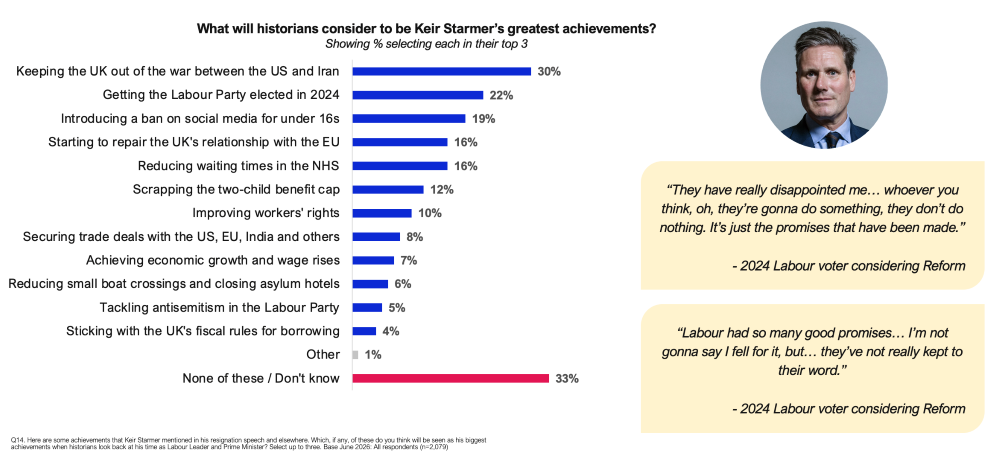
Keeping the UK out of the war between the US and Iran is seen as Keir Starmer’s greatest achievement in office, new research for PoliticsHome has found.

Advertisement

Thirty per cent of people selected this option when research organisation Thinks Insight & Strategy asked what historians will consider to be the outgoing PM’s greatest achievements.

The second most selected option was getting the Labour Party elected at the 2024 general election (22 per cent), and third was introducing a social ban for under-16s (19 per cent), according to an online survey of 2,079 people carried out between 24-25 June.

However, the largest share (33 per cent) said “none of these / “don’t know” in response to twelve options put to them.

Ben Shimshon, co-founder and CEO of Thinks Insight & Strategy, said the findings indicate that Starmer has struggled to persuade the public that he has delivered in areas that were core to his premiership.

Advertisement

“At the moment, few of the claims Starmer made in his resignation speech are supported by the public. Only small minorities are prepared to acknowledge any improvement in the economy, the NHS, or even immigration numbers (where the official numbers do indicate significant falls),” he told PoliticsHome.

“For the two-thirds who acknowledge any achievements at all, getting Labour elected is the most established, alongside two relatively late, but relatively popular decisions: the social media ban for under-16s, and most strongly, keeping the UK out of the US/ Iran war.”

The joint fourth-most-selected achievements, at 16 per cent, were starting to repair the UK’s EU relationship and bringing down NHS waiting times. Reducing small boat crossings and closing asylum hotels was selected by just 6 per cent.

Advertisement

Thinks Insight & Strategy

The survey was carried out after Starmer’s resignation speech on 22 June and Andy Burnham’s emphatic victory in the Makerfield by-election a few days before.

It is now almost certain that Burnham will become the UK’s seventh prime minister in a decade later this month after well over 300 Labour MPs, a comfortable majority of the party, nominated the former Manchester mayor to succeed Starmer in No 10 on Thursday.

Elsewhere, the Thinks Insight & Strategy research found that a Burnham leadership boosts Labour’s chances of keeping hold of voters who supported the party at the last general election, especially those who are considering Zack Polanski’s Greens.

However, the findings also suggested that Burnham will not have long to impress the public.

Advertisement

Over half of respondents (54 per cent) said they would know within six months whether a new prime minister was doing a good job, and only 19 per cent said they would give them longer than that. Twelve per cent said they would know straight away. 

Just over half of respondents (51 per cent) said that if Burnham is effective as PM, they would see real improvements within a year of him entering office, while 37 per cent said it would take at least a year or two.

“The direction of travel needs to be clear within 12 months, and whatever it is, that direction needs to feel like change,” said Shimshon.


Advertisement

Source link

Advertisement
Continue Reading
Click to comment

You must be logged in to post a comment Login

Leave a Reply

Politics

The Viral ‘Tanmaxxing’ Trend Is Ruining Teen Skin

Published

on

The Viral 'Tanmaxxing' Trend Is Ruining Teen Skin

There have been plenty of social media trends that end with “maxxing” thus far – looksmaxxing, sleepmaxxing, jestermaxxing and fibremaxxing, to name a few.

But the latest trend adopting the much-used suffix is certainly one to be wary of – tanmaxxing is, as the name suggests, about achieving the most optimal tan possible.

Skin health experts are understandably worried about the repercussions of this – especially on young skin.

Dermatologist Dr Rachel Nazarian told CBS Mornings that the trend for getting a dramatic tan – whether by using sunbeds or sitting in the midday sun without sunscreen – is “very dangerous”.

Advertisement

She highlighted how lots of these trends are doing the rounds on social media, where misinformation is rife. She’s right – a quick look online and there are videos where people are suggesting getting a tan is safe (spoiler: it isn’t).

Dr Zainab Laftah, consultant dermatologist and British Skin Foundation spokesperson, told HuffPost UK: “The ‘tanmaxxing’ trend is concerning because there is no such thing as a safe tan.”

Basically, a tan is visible evidence of your skin being damaged. Or as Dr Laftah puts it: “A tan is the skin’s response to UV radiation causing DNA damage.”

The risks of ‘tanmaxxing’

Advertisement

There are two main risks to teens and young adults hopping on the tanmaxxing trend. The first is an obvious one: skin cancer. Your risk of melanoma – a potentially deadly form of skin cancer – doubles with a history of five or more sunburns, according to the Skin Cancer Foundation.

Sun burn is also the leading cause in most cases of basal cell carcinoma, squamous cell carcinoma and melanoma.

As for tanning beds, they emit up to 15 times more UV radiation than the midday sun – and people who start using tanning beds before the age of 35 have a 75% increased risk of developing melanoma, according to the Skin Cancer Foundation.

The second risk is more of a cosmetic one, but it’s one that Dr Nazarian flagged in the hopes it will deter people from jumping on the trend: sun damage ages you. In fact it can cause wrinkling, loss of skin elasticity, pigmentation, sun spots and redness, according to Yale Medicine.

Advertisement

“It happens when ultraviolet (UV) light hits skin unprotected by sunscreen, causing DNA changes at a cellular level. Because photodamage happens in the deepest layers of the skin – the dermis – it can take years before the damage surfaces and becomes visible,” reads the site.

How to talk to teens about ‘tanmaxxing’

This is the tricky bit because you can tell kids to wear sun cream until the cows come home, but will they actually do it?

Tanning culture is huge – and the desire to fit in can outweigh the desire to stay safe (we see this time and time again with teens jumping on risky trends).

Advertisement

The key is education, but not in a lecturing way (as that rarely works either). “Conversations about skin health, rather than appearance, can help teenagers develop healthier attitudes towards sun safety,” said Dr Laftah.

The dermatologist urges parents to encourage teens to question social media trends and explain “that influencers often overlook the long-term consequences of UV damage”.

Reinforce practical habits during these informal chats, such as using broad-spectrum SPF 30+ sunscreen, wearing protective clothing, seeking shade during peak UV hours, and avoiding intentional tanning.

Lastly, offer safer ways to achieve the look. Mary Wu Chang, associate professor of Dermatology and Pediatrics at UConn Health, recommended self-tanning lotions and spray tans, for instance.

Advertisement

Dr Laftah agrees: “If teens want a bronzed look, self-tanning products are a much safer alternative to tanning in the sun or using sunbeds.”

Source link

Advertisement
Continue Reading

Politics

What Do Tiny Bumps Near Your Eye Mean?

Published

on

Milia

That shows up as tiny, incredibly itchy, usually flesh-coloured bumps on your hands and feet. It should always be investigated if it’s new and/or if you suspect infection.

But what does it mean if you have little white or yellow lumps by your eye?

Sometimes, these can be milia, or “milk spots,” the Cleveland Clinic said.

Advertisement

Interestingly, they can affect up to 50% of newborns, though they can happen in adults too.

Here’s what chartered chemist and founder of SOS Serum Skincare, Bruce Green, said about them:

What are milia?

These “are tiny, white or yellowish bumps that usually appear on the face, most commonly around the eyes or cheeks. They’re formed when keratin (a protein in the skin) becomes trapped beneath the surface,” Green said.

Advertisement

Milia aren’t formed in the same way as spots and whiteheads, which occur when oil and bacteria gather in a clogged pore.

Instead, dead skin cells slowly build up and can’t escape your skin.

Milia are “completely harmless, but can be frustrating cosmetically,” Green continued.

They’re especially common among newborns – hence the nickname “milk spots” – and adults with thicker, drier skin.

Advertisement

“They can also appear after skin trauma, such as burns, or even from using heavy skincare products that clog the surface of the skin. People with sun-damaged skin may also be more prone,” the expert said.

Milia

What should I do if I think I have milia?

Luckily, Green told us, most milia will resolve on their own over time.

Still, if you want to speed the process up, “regular gentle exfoliation using chemical exfoliants (like AHAs or BHAs) can help them to clear up and to prevent new ones forming,” Green shared.

Retinol can also increase the rate at which your skin cells turnover, which may help.

Advertisement

“It’s important never to pick at milia, as this can damage the skin. For stubborn or long-lasting milia, professional extraction by a dermatologist or trained aesthetician is the safest option,” the expert continued.

To keep them at bay, maintain a good skincare routine, involving a gentle cleanser, hydrating moisturisers, SPF, and up to twice-weekly gentle exfoliation can help.

“If milia persist or you’d like them removed, it’s best to seek professional help from a dermatologist or trained aesthetician. Trying to extract them at home can damage the skin and increase the risk of scarring or infection,” Green ended.

Watch out for yellow, waxy bumps (xanthelasmas)

Advertisement

These can also develop around the eye area. They’re cholesterol deposits that develop in the skin around the lower eye area and on the eyelid and typically appear as little, pale yellowish bumps.

They can be a sign you have familial hypercholesterolemia (FH), a genetic condition that means your liver can’t process cholesterol properly.

Xanthelasmas are harmless in and of themselves, but they’re linked to an increased risk of heart disease.

You can get a genetic test if you think you may have FH.

Advertisement

Source link

Continue Reading

Politics

Critics Are Calling Netflix's Little House On The Prairie A Cosy 'Must-Watch'

Published

on

Little House On The Prairie is now streaming on Netflix
Little House On The Prairie is now streaming on NetflixLittle House On The Prairie is now streaming on Netflix

Little House On The Prairie is an American institution, and it’s now back in Netflix’s cosy new adaptation.

Based on author Laura Ingalls Wilder’s semi-autobiographical accounts of growing up on the American frontier in the 1870s and 1880s, the streamer’s new eight-part series follows a beloved book and the original TV show, which ran in the late 1970s and early 80s. 

So, can this new take on the source material live up to its predecessors?

This new adaptation, which follows the Ingalls family as they leave Wisconsin to start a new life on the frontier in Kansas, modernises the source material for a contemporary audience.

Critics have mostly praised these updates, which fix some of the more problematic depictions of women, minorities and Native Americans.

Advertisement

While plenty of reviews have praised the show’s performances, production value and script, it’s fair to say that the wholesome and twee nature of Little House Of The Prairie isn’t for everyone. 

Here’s what critics are saying about the 2026 reimagining Little House Of The Prairie so far…

The Hollywood Reporter

“Over eight episodes, most running under 50 minutes but never dull even in the longer instalments, Little House On The Prairie captures a tumultuous year in the life of the Ingalls family, a year with danger, romance, heroism and the learning of many important lessons. 

“I don’t gravitate toward ‘wholesome’ or ‘earnest’ as attributes in most of my favourite shows, but I bought into Little House On The Prairie and I’m relieved that Netflix has already renewed it for a second season.”

Advertisement

Radio Times (4/5)

“An undeniably heartfelt family drama that, for all its coming-of-age anxieties and sweeping vistas, also dares to ask some difficult questions about the true price of progress.”

Luke Bracey as Charles Ingalls and Crosby Fitzgerald as Caroline Ingalls in Little House On The PrairieLuke Bracey as Charles Ingalls and Crosby Fitzgerald as Caroline Ingalls in Little House On The Prairie

Variety

“Overall, for those who loved the original show and books, and for viewers being introduced to the Ingalls for the first time, Little House illustrates the beauty of community, the horrors of encroachment and displacement, and the cost of being an American.”

Collider (9/10)

“A must-watch Western masterpiece […] throughout the course of the series, the town of Independence grows and changes, reflecting the slow growth of the community across a span of seasons, and that change is visible in the set pieces and props, both close to the camera and in the deep background. All of these small details help to build a fully realised world that feels tactile and familiar, in the same way that the book series inspired a generation of children to pretend they were a member of the Ingalls family travelling across the American frontier.”

The Guardian (3/5)

“It is exactly the revamp you would expect. The new LHOTP is a precision-tooled and well-oiled machine. All children’s and most adult problems are solvable within a one-to-three episode arc. 

“Kansas may contain malaria, medicine-hoarders and mentions of how hard the war was but ultimately the vibe is the one we recognise: faith, hope and the American way will carry us cosily through.”

Advertisement

Financial Times (3/5)

There is comfort to be found, too, in the show’s familiar, episodic structure, which plays out in a knowingly soapy style. Over eight episodes, the Ingalls are together, something bad happens to them or their newfound community, and then they sort it out. Job done.”

Tech Radar (3/5)

“This is also the closest Netflix has come to straying into Hallmark territory in its original content. What I mean by this is that the drama is often so twee that you’d expect someone to randomly burst into song like it’s a production of Oklahoma! It can be grating, but if you look past the form, the content is meaningful.”

The Herald (3/5)

“Is there such a thing as enjoyable trauma? If so, Little House On The Prairie perfected it.”

The Telegraph

“Anyone old enough to remember the 1970s series will regard it with misty-eyed nostalgia. Anyone young enough to be in the market for children’s programmes will prefer the streamer’s more garish options to a wholesome story of pioneer life in pretty bonnets. It’s the reboot that nobody needed.

Advertisement

AV Club

“The first season of Netflix’s Little House On The Prairie is less of a revival than it is a well-intentioned yet stiff CliffsNotes version.

“It’s fine enough, finding a couple of solid episodes when it slows down to delve into its characters and the way that the remote community they find themselves in is growing.”

Time

“Although it’s been updated for the streaming era with a serialised plot and revisionist overtones, this Little House suffers from the same cloying excesses as its predecessor. More childlike mischief might’ve helped.

“Yet instead of contorting the Ingallses into the people we wish they’d been, maybe it’s simply time we acknowledge that theirs may not be the enduring story we once imagined it to be.”

Advertisement

Roger Ebert

“Netflix’s Little House On The Prairie is the kind of remake that’s essentially designed in a lab to appeal to the broadest possible swath of viewers. That’s not necessarily a criticism – the experience of watching the show is perfectly enjoyable. But it’s difficult not to wonder what a version of this show that wasn’t quite so aggressive…adequate might have been like.”

Little House On The Prairie is now streaming on Netflix.

Source link

Advertisement
Continue Reading

Politics

Bonnie Tyler Dead: Total Eclipse Of The Heart Singer Dies Age 75

Published

on

Bonnie Tyler Dead: Total Eclipse Of The Heart Singer Dies Age 75

Singer Bonnie Tyler has died aged 75.

On Thursday morning, a statement was published on her official website, which read: “Bonnie’s family and team are heartbroken to announce that Bonnie unexpectedly passed away last night in hospital in Portugal as a result of the illness that she was being treated for.

“We will issue a further statement shortly but for now ask for privacy to deal with this tragedy.”

The Total Eclipse Of The Heart singer was rushed to hospital near her home in Faro in May, to undergo emergency intestinal surgery.

Advertisement

On 6 May, the Holding Out For A Hero singer’s team released a statement on Instagram informing fans that Bonnie had “been admitted to hospital in Faro, Portugal, where she has a home, for emergency intestinal surgery”.

The Welsh-born performer, who turned 75 earlier this year, had been due to tour Europe in 2026 to mark 50 years since the release of her 1976 breakthrough hit Lost In France, which charted across Europe.

A week later, it was confirmed she’d been placed in an induced coma “to aid her recovery”, with her digital team sharing a new statement on her official website last week, following speculation about her condition on social media.

Last month, her spokesperson said she was out of the coma but remained “very unwell and in intensive care”.

Advertisement

The spokesperson thanked fans for their “huge outpouring of love and support” from around the world, adding that Bonnie was aware of it and grateful for the good wishes.

Bonnie – whose legal name is Gaynor Hopkins – first shot to fame in the late 1970s thanks to singles like Lost In France and It’s A Heartache.

In the years that followed, she became known for hits including Holding Out For A Hero, the number one single Total Eclipse Of The Heart and a cover of Creedence Clearwater Revival’s Have You Ever Seen The Rain?.

Her massive hit Total Eclipse Of The Heart, written by Meatloaf lyricist Jim Steinman, saw Bonnie become the first ever Welsh person to bag a number one spot in the US.

Advertisement

The song was inspired by, and written for a Nosferatu musical originally, with the singer telling The Guardian back in 2023 that she “understood immediately what an incredible song it was”.

She later added: “He told me he had started writing the song for a prospective musical version of Nosferatu years before, but never finished it.

“Around the time we were recording, Meat Loaf had lost his voice, and after it was a hit he always used to say: ‘Dang. That song should have been mine!’ I poured my heart out singing it.”

Over the course of her music career, Bonnie released 18 studio albums, most recently in 2021, and was nominated for three Grammy Awards and three Brit Awards.

Advertisement

She also represented the United Kingdom at the Eurovision Song Contest in 2013 with her song Believe In Me, and was awarded an MBE by the late Queen Elizabeth II for her services to music in 2022.

This is a developing story, check back for more updates.

Source link

Advertisement
Continue Reading

Politics

I Just Learned What Total Eclipse Of The Heart Was Written About And I’m In Shock

Published

on

Bonnie Tyler in the Total Eclipse of the Heart music video.
Bonnie Tyler in the Total Eclipse of the Heart music video.Bonnie Tyler in the Total Eclipse of the Heart music video.

Bonnie Tyler’s song Total Eclipse of the Heart (Turn Around) is one of those tracks that is just completely timeless. Every generation can appreciate the theatrics, the vocals and that intense music video.

Despite being released over 40 years ago, the song still resonates with music fans and karaoke aficionados alike, with striking lyrics such as: “Together we can take it to the end of the line/your love is like a shadow on me all of the time” scattered throughout the lyrics.

An unkind reading of the song could place it as a situationship that got out of hand, while others may see it as longing for a lost love but, uh, the inspiration was actually a lot more spooky than that.

The inspiration behind Total Eclipse of the Heart

You may want to hold onto your fangs here because actually, this song was inspired by, and written for a Nosferatu musical.

Yes, really.

Advertisement

In an interview with The Guardian back in 2023, Bonnie revealed that when she wanted to make the move from country rock to rock, she hoped to work with Jim Steinam, who wrote and produced for Meat Loaf at the time.

Fortunately for her, Jim really loved her voice and played Total Eclipse of the Heart to her. Bonnie muses: “I understood immediately what an incredible song it was.”

She later added: “He told me he had started writing the song for a prospective musical version of Nosferatu years before, but never finished it.

“Around the time we were recording, Meat Loaf had lost his voice, and after it was a hit he always used to say: “Dang. That song should have been mine!” I poured my heart out singing it.”

Advertisement

40 years later, and the lore just solidifies the legend status of the song.

Source link

Advertisement
Continue Reading

Politics

2025's Most Popular Baby Girl Names Were Vintage And Nature-Inspired

Published

on

2025's Most Popular Baby Girl Names Were Vintage And Nature-Inspired

There are two common themes running through the Office for National Statistics’ (ONS) latest baby name data for girls born in England and Wales.

So-called “old lady” baby names continued to dominate in 2025, according to the data, with Florence, Elsie, Ivy, Evelyn and Mabel sitting within the top 20 – all names that would’ve been popular a century ago.

In addition to vintage baby names, nature-inspired names like Lily, Willow, Ivy, Poppy and Daisy are also increasingly popular for girls, will them all making an appearance in the top 20. 

Eliana made huge gains in popularity

Mair Garland, a baby naming celebrant, noted that Eliana – which previously wasn’t in the top 100 list – also made “huge gains”, moving to 62nd place.

HuffPost UK recently reported that BabyCentre data showed Eliana is currently more popular than Olivia – which has been the top girls’ name choice for years – as a baby name option in 2026. 

Advertisement

When asked how they determined this, BabyCentre told me the rankings are compiled using data provided directly by users when they join the site – as part of this process, parents share what they called their baby. And so far, in 2026, Eliana is reigning supreme. 

“Other new names for girls in the top 100 are Gracie (though Grace is still more popular), Anaya, Alba, Marnie, Lilah and Frankie,” added Garland. 

Here’s the full list.

The top 100 baby names for girls in 2025

1 Olivia

Advertisement

2. Lily

3. Amelia

4. Isla

5. Florence

Advertisement

6. Freya

7. Poppy

8. Elsie

9. Ivy

Advertisement

10. Isabella

11. Ava

12. Evelyn

13. Sophia

Advertisement

14. Phoebe

15. Sienna

16. Mabel

17. Sofia

Advertisement

18. Daisy

19. Matilda

20. Willow

21. Mia

Advertisement

22. Arabella

23. Harper

24. Rosie

25. Charlotte

Advertisement

26. Maeve

27. Grace

28. Maya

29. Hallie

Advertisement

30. Margot

31. Lottie

32. Delilah

33. Penelope

Advertisement

34. Aria

35. Evie

36. Millie

37. Violet

Advertisement

38. Ruby

39. Aurora

40. Ada

40. Mila

Advertisement

42. Ayla

43. Maisie

44. Emily

45. Esme

Advertisement

46. Ella

47. Olive

48. Bonnie

49. Elodie

Advertisement

50. Layla

51. Emilia

52. Alice

52. Maryam

Advertisement

54. Isabelle

55. Ottilie

56. Eleanor

57. Iris

Advertisement

58. Eva

59. Harriet

59. Luna

61. Lyla

Advertisement

62. Eliana

63. Sophie

64. Orla

65. Eliza

Advertisement

66. Thea

67. Rose

68. Nova

69. Imogen

Advertisement

70. Lyra

71. Hazel

72. Erin

73. Zara

Advertisement

74. Elizabeth

75. Nora

76. Robyn

77. Clara

Advertisement

78. Nancy

79. Fatima

80. Eden

81. Ophelia

Advertisement

82. Raya

83. Eloise

84. Gracie

85. Emma

Advertisement

86. Anaya

87. Lola

88. Maria

89. Chloe

Advertisement

90. Athena

91. Bella

92. Darcie

93. Scarlett

Advertisement

94. Myla

95. Alba

96. Rosa

97. Marnie

Advertisement

98. Lara

99. Lilah

100. Frankie

Advertisement

Source link

Continue Reading

Politics

Martin Freeman ‘Annoyed’ By Ricky Gervais’ Claim About The Office

Published

on

Ricky Gervais as David Brent in the original UK version of The Office

Martin Freeman has something to get off his chest about his time appearing in The Office.

The Love Actually star played Tim in the original British sitcom, which ran for two seasons in the early 2000s, ending with a two-part Christmas special.

It’s now been 25 years since The Office premiered on the BBC, and to mark the occasion, Martin and his co-star Mackenzie Crook recently took part in a one-off BBC special reflecting on their time on set.

During the conversation, the Sherlock actor recalled how creators Ricky Gervais and Stephen Merchant were always quick to dismiss the suggestion there was any improvisation in the game-changing mockumentary, which Martin has a different view on.

Advertisement

“When it became the monster that it did, and people would say it sounded improvised, then understandably, Ricky and Stephen went, ‘No, none of it’s improvised’, which is not true,” he said.

Martin continued: “What slightly annoyed me at the time – but only slightly, at the time – is when the scripts were published, they weren’t the scripts. They were the transcriptions of what had been on television.

“So, that annoyed me a little bit, because… well… anyone who knows any of us knows that that line came from you in that moment, that line came from me…”

Ricky Gervais as David Brent in the original UK version of The Office

The Marvel cast member praised Ricky and Stephen’s “brilliant” writing, but pointed out that the original scripts were “loose”, which allowed the cast to play with the material somewhat.

“I can understand why there was a little bit of protection about that, because otherwise people would’ve gone, ‘Hey, you just rock up and you just make it all up’, which clearly was not the case,” he added.

Advertisement

“The writing on it that they did was brilliant. But you only need to know us a little bit or know the process of it. We’re also in there, you know? It doesn’t mean it’s a co-credit. Doesn’t mean [the whole show was] improvised, but it’s nicely loose.”

HuffPost UK has contacted Ricky Gervais’ team for comment.

Ricky previously told The Independent that he was invited to take part in the BBC’s special, but turned it down as he was “not available” at the time.

A video in which Ricky shares his own memories of working on The Office has since been uploaded to the comedian’s YouTube page.

Advertisement

During a new interview with Empire about the show, the After Life creator also claimed: “It was so important [for the cast] to be naturalistic. Some people thought The Office was ad-libbed. And that’s a testament to the actors, making it look like they came up with it off the top of their heads.”

Source link

Advertisement
Continue Reading

Politics

UK Heatwave: Some Schools Still Don’t Allow Sunscreen, Experts Call For Change

Published

on

UK Heatwave: Some Schools Still Don't Allow Sunscreen, Experts Call For Change

With summers getting hotter and rates of skin cancer rising, it might come as a surprise to hear some UK schools have policies in place that do not allow children to bring in their own sunscreen for reapplication throughout the day.

At some UK primary schools, for instance, parents are encouraged to apply sunscreen to their children before school – and that’s it.

Yet even sun creams claiming to be long-lasting wouldn’t last the entire school day, nor would it outlast after-school clubs.

Dr Emma Wedgeworth, consultant dermatologist and British Skin Foundation spokesperson, said if kids are in direct sunlight (which they typically will be at break and over lunch) “sunscreen should be reapplied every three hours”.

Advertisement

Government guidance says that in early years childcare settings (typically under-4s), sunscreen should be applied generously and reapplied every two hours. The NHS advises the same.

But for children in primary school, there is no blanket guidance.

Marie Tudor, CEO of national skin cancer prevention charity SKCIN, told HuffPost UK that applying sunscreen before school, while important, “is highly unlikely to provide adequate protection throughout an entire school day, especially during the summer months when UV levels are highest”.

Why do some schools not let kids take sunscreen in?

Advertisement

There are a few factors to consider: one is the application of sunscreen. For those teaching younger children in particular, they simply wouldn’t have time to apply sun cream to 30+ students.

There’s also a safeguarding consideration. The National Education Union (NEU), for example, advises teachers not to apply sunscreen to pupils, “mainly because of the potential for allegations of abuse but also because allergies”.

NEU guidance is that if schools do opt to let teachers apply sun cream, parental consent should be obtained – and staff should only apply sunscreen to the face, neck and arms of pupils.

One way to navigate this is that children could apply it themselves – and some schools do allow this, but not all. Roll-on sun creams and applicators like Solar Buddies can be useful for teaching younger kids in particular how to apply it themselves.

Advertisement

Allergies are also a cause for concern – although allergic reactions to sunscreens are pretty uncommon.

Anne Biggs, deputy head of clinical services at Allergy UK, said that while some sunscreens can cause an itchy reaction, “it is more likely to be that the skin is sensitive and irritated by that product rather than an allergy”. For children with eczema and sensitive skin, this may be more likely.

The charity SKCIN launched a Sun Safe Schools programme in 2012 and, since then, has focused on embedding preventative sun safety education into UK primary schools.

Tudor, the CEO, said most reactions are linked to specific ingredients rather than sunscreen itself, and these can often be avoided through careful product selection.

Advertisement

“Parents can support schools by providing clearly labelled sunscreen suitable for their child, informing schools of any known allergies and carrying out patch testing where there are concerns,” she explained.

“Schools can minimise risk by having clear sun protection policies, obtaining parental consent where appropriate and encouraging children to use their own named products rather than sharing sunscreen.”

She added: “In our experience, the risks associated with inadequate sun protection and sunburn far outweigh the relatively low risk of adverse reactions when sensible precautions are in place.”

Skin cancer’s on the rise in the UK

Advertisement

Melanoma, the most deadly skin cancer, is now the UK’s fifth most common cancer and deaths from melanoma skin cancer have risen by 150% since the 1970s, according to Cancer Research UK.

A person’s risk of developing melanoma doubles with a history of five or more sunburns.

SKCIN is calling for UK schools to adopt practical sun protection measures that reflect current public health guidance – especially as data shows UK summers are getting hotter, and around 90% of melanoma cases are linked to UV exposure.

Data shared by the Children’s Burns Trust shows severe child sunburn injuries increased sharply in 2025, when 252 sunburn cases in children were admitted to a Specialist Burns Unit – a 46.5% rise from 172 cases in 2024. Ken Dunn, vice chair at the charity, said sunburn is “painful, distressing and entirely preventable”.

Advertisement

Schools have a duty of care to safeguard children’s health and wellbeing, and sun protection should be viewed no differently from other measures taken to protect pupils from avoidable harm,” said Tudor.

“While schools routinely manage medicines, allergies and a wide range of health and safety considerations, sunburn remains one of the few entirely preventable health harms that many children still experience during the school day.

“Given the well-established link between childhood sunburn and future skin cancer risk, this is an issue that deserves greater attention.”

The charity is calling for school policies to be amended so that children can bring sunscreen to school for self-application, where age-appropriate, or with support from staff where required.

Advertisement

“This should sit alongside other important sun safety measures such as providing shade, encouraging the use of hats and protective clothing, and avoiding prolonged exposure during peak UV hours,” Tudor added.

“Ultimately, the goal is to prevent sunburn and establish lifelong sun-safe habits that can significantly reduce future skin cancer risk.

“By normalising sun protection in schools, we have an opportunity not only to protect children today, but to reduce the burden of skin cancer for future generations.”

Advertisement

Source link

Continue Reading

Politics

Farage’s By-Election Decision Sparks LBC Callers Criticism

Published

on

Farage's By-Election Decision Sparks LBC Callers Criticism

Callers to a radio phone-in savaged Robert Jenrick as he defended Nigel Farage’s decision to trigger a by-election in Clacton.

Reform UK’s Treasury spokesman was standing in for regular presenter James O’Brien on LBC.

Farage unexpectedly quit as an MP on Tuesday amid controversy over the £5 million gift he received from a crypto billionaire, which is being investigated by parliament’s commissioner for standards.

The Reform leader said he was triggering a “people versus the establishment” by-election, but so far his only confirmed opponent is Count Binface after Labour, the Tories, the Lib Dems and Greens all refused to take part.

Advertisement

Jenrick said Farage had shown “balls” by putting his political career on the line, despite the fact that he won his Clacton seat with a majority of 8,400 just two years ago.

He also said the other parties were “cowards” for not putting up their own candidates.

But the vast majority of people who rang in during the hour-long debate took a different view.

Al in Glasgow said: “I think Farage is throwing toys out of his pram.

Advertisement

“He cannot deal with challenge, and so he has to have some kind of primadonna reaction. It’s nothing to do with democracy.

“His democratic vote has already been taken, the other parties shouldn’t rise to the bait, he’s just being a child.”

John in Sheffield said: “I think that Nigel Farage isn’t a sensible candidate, even when compared to Count Binface.”

But Jenrick hit back: “I do think Count Binface is an interesting character. Nigel has been in the House of Commons now for two years, so he’s used to people who’ve got robotic voices and a head full of rubbish, so I’m sure he’ll be able to take on Binface.”

Advertisement

Another caller, Ben from Leigh-on-Sea, said Farage was “insulting the voters of Clacton by not waiting for the commission to produce their report and their findings, and then there potentially being a by-election when they’ve got all the facts in front of them”.

“Do you not think he’s being cowardly by trying to get out in front before we know the full facts and evidence against him,” he said.

Even Reform member Nicola from Horsham did not agree with Farage’s move.

She said: “What’s happening now is leaving me in despair. I don’t like this by-election sideshow nonsense.

Advertisement

“Nigel is giving the media exactly what they want. No matter what channel you turn to – TV, radio, they’re loving it. All slagging off Nigel, when really all this is going on and Andy Burnham is sliding straight into No.10 unchallenged.

“I just feel if Nigel wasn’t doing this, perhaps people would be on Andy’s case.”

Lisa in Brentwood said Farage was “a vile, repulsive individual”.

“Everything that comes out of his mouth is a lie,” she told Jenrick, who defected from the Tories to Reform earlier this year.

“The fact that you’re sticking up for him just shows what a person you are because you didn’t have a by-election, you were quite happy to just walk across the floor without giving the people of Runcorn a chance to decide whether they wanted Reform.”

Another caller, Tom from Bury St Edmonds, said the by-election “does nothing for the people of Clacton”.

Advertisement

“At the end of the day these are constituents who have genuine concerns and genuine issue and they need help and support from their member of parliament, and they’ll be lacking that if there’s by-election after by-election,” he said.

“That to me makes this feel like a political stunt.”

Bea in Northampton said Farage and Jenrick were trying to “muddy the waters” by deflecting attention away from the standards probe.

Simon in Taunton told Jenrick: “How do I follow those earlier callers who absolutely wiped the floor with you?

Advertisement

“As you sit there as Nigel’s foot soldier trying to gaslight Reform supporters and the poor unsuspecting electorate of Clacton-on-Sea, have you got your fingers crossed behind your back? Do you actually believe anything you’re saying?

“You know and I know that this by-election is completely unnecessary. It is a complete circus show that Nigel Farage is putting on as part of his usual theatrics to garner the spotlight.”

Reform MP Lee Anderson this morning kick-started the by-election process by “moving the writ” in parliament.

It confirms that Farage is no longer Clacton’s MP, and that a date for a by-election will now need to be set.

Advertisement

Reform want it to take place on August 6, but it may end up being on August 13.

Listen to Commons People, the podcast that makes politics easy. Every week, Kevin Schofield and Kate Nicholson unpack the week’s biggest stories to keep you informed. Join us for straightforward analysis of what’s going on at Westminster.

Source link

Advertisement
Continue Reading

Politics

Arthur Reynolds: The civil service will prepare ‘day one’ briefings for Burnham’s new ministers but nobody’ll read them

Published

on

Arthur Reynolds is a journalist, a former civil servant and government speechwriter.

Changes in leadership animate Whitehall like nothing else. With Andy Burnham set to become Prime Minister and carry out a swinging reshuffle in 10 days’ time, officials will be scrambling around to prepare for their new masters.

In my six years on Whitehall, I witnessed this process eight times, and it reveals everything that is wrong with the modern civil service.

Even the most obscure teams in each department spend hours contributing to ‘day one briefing packs’ for new ministers. These tomes are hundreds of pages long, riddled with jargon, and full of indecipherable statistics. Despite the department’s most senior officials poring over their contents and writing twee cover notes advertising how wonderful their work is, I am convinced not a single minister read them.

Advertisement

I never bothered to make that point internally, because I know the answer I would have received: “But that’s the process. It doesn’t matter if they read it, we’ve done our bit.”

From replying to every rambling letter from a member of the public to advertising jobs nationally when an internal candidate is already nailed on for the role, our civil service excels in work for work’s sake.

So much behaviour around a reshuffle is performative, designed to maintain the illusion that our bureaucracy is a ‘Rolls-Royce machine’. A flurry of notes is passed between departments to relay how a minister likes their coffee, their go-to lunch order, the font they like for speeches, whether their submissions should be single or double-spaced. All vitally important information that couldn’t possibly be gleaned by asking them.

Officials believe they are smoothing the way for their new bosses, when in fact, they are infantilising them. As Liz Truss has observed, the position of a minister – particularly a junior one – is akin to that of a child emperor: their smallest personal preferences are pandered to, but their ability to change the country is practically zero.

Advertisement

As Andy Burnham’s charges are set to find out, this Whitehall charm offensive belies a desire to control the course of policymaking. As I have written about elsewhere, reshuffles and changes of government are perfect opportunities for bureaucrats to resurrect policies their last boss killed off.

From cutting the winter fuel allowance to introducing the family farms tax, many of Keir Starmer’s most unpopular policies were Whitehall plans the Conservatives resisted. Burnham’s team should keep their guard up and avoid surrendering decision making to the ‘experts’.

But he has had less than a month to prepare for government, and has pledged to honour the 2024 manifesto. His devolution revolution, meanwhile, will have had no visible effect on voters’ lives by the end of his term. That leaves continuing Starmer’s stodgy social democracy as the only path available.

The public are not fools.

Advertisement

They will not hear a Prime Minister with a northern accent and think all the country’s ills are solved. Coupled with the inevitable implosion of Reform, this leaves the next election in play.

As absurd as this might have sounded a matter of months ago, the Conservatives have the opportunity to return to government in some form. They’re ahead of Labour in the polls and trail Reform by little more than the margin of error on data taken before the George Cottrell affair fully unravelled.

Kemi’s patient, policy-first approach is looking wiser by the day. The Conservatives can only avoid Starmer’s fate by making a bulletproof plan and imposing it on the Whitehall machine.

Legislation to break up Blairite structures that put power in the hands of unaccountable quangocrats should be prepared ahead of time and enacted in the first 100 days. So too should measures to revive drilling in the North Sea and scrap the Public Sector Equality Duty – the legal basis that underpins the DEI state.

Advertisement

Resistance will inevitably come from the permanent bureaucracy. That’s why the Conservatives must not be shy of borrowing ideas and bringing in experts from the outside.

Reform has suggested replacing Whitehall’s permanent secretaries – the officials who, in effect, run government departments – with political hires who support its programme. This is a common-sense proposal. And it’s not like Reform hasn’t adopted ideas from the Tory right on leaving the ECHR and rolling back net zero.

Candidate selection, though, offers a chance to differentiate from both Reform and Labour. The former hasn’t lived up to its rhetoric on bringing in outside experience, as the disastrous choice of Robert Kenyon to contest the Makerfield by-election demonstrated. The latter has proved that a party made up of ex-charity workers, lobbyists or political staff cannot meet the mood of the nation.

Professional politicians who know how to work the system have a place, but we need entrepreneurs and innovators who can transform it too. The local champions who made up much of the 2019 Conservative intake won’t make reforming ministers.

Advertisement

Faced with a new Labour leader who’s accustomed to a complete lack of scrutiny, and a Reform party whose only electoral asset is mired in scandal, there is a real chance Kemi Badenoch could become Prime Minister after the next election.

She should plan accordingly and prepare to do battle with Britain’s bureaucracy.

Source link

Advertisement
Continue Reading

Trending

Copyright © 2025