As AI becomes profitable, Jensen Huang claims companies are hiring more engineers
Jensen Huang isn’t worried about AI taking your job. In fact, he thinks the opposite is happening.
Speaking at Nvidia’s GPU Technology Conference (GTC) at Computex 2026 in Taipei—where thousands packed the venue, and 70 simultaneous watch parties broadcast across Taiwan—the CEO pushed back against concerns about AI-driven unemployment with a blunt dismissal.
People talk about AI reducing jobs. Complete nonsense. It’s causing more software engineers to be hired.
Jensen Huang
His reasoning is straightforward. A software engineer who uses AI well can now produce the economic output of three engineers. That doesn’t make engineers redundant—it makes them more valuable. Companies want more of them, not fewer.
Advertisement
Huang estimates that the world’s 30 to 40 million software developers, who collectively earn around US$3 trillion in salaries annually, are now producing what amounts to US$9 trillion in productive output, effectively tripling their productivity.
“If that line were flat, then obviously people will hire fewer software engineers,” he said. “But because the output is so incredible, people want to hire more.”
AI has crossed from experimental to profitable
The broader argument behind Huang’s jobs claim is that AI has finally become genuinely useful—and genuinely profitable.
He pointed to the rise of agentic AI as the turning point. Unlike traditional chatbots that simply answer questions, agentic systems can observe, plan, and execute tasks using tools such as browsers, spreadsheets, and code compilers, much like a human worker would.
Advertisement
“Today we can say that agentic AI has arrived, that useful AI has arrived.”
As AI becomes more capable, businesses are finding more ways to deploy it commercially. “Tokens are now profitable units of revenue,” he added, referring to the basic units of data processed by AI models. “Because it is now profitable, AI companies want to build a lot more.”
That, Huang argued, is creating demand for more software development, not less.
Pointing to GitHub data, he noted that developer activity has continued to surge despite rapid advances in AI. GitHub’s Octoverse 2025 report found that developers pushed nearly 1 billion updates to software projects in 2025—a 25% year-on-year increase—while more than 36 million new developers joined the platform in a single year.
Advertisement
With agentic AI now entering the picture, Huang argued, that trajectory is only going to steepen.
The effects are already rippling through entire economies. Nowhere is that more evident than in Taiwan, the epicentre of the AI hardware boom.
The country’s GDP is forecast to grow 9.64% in 2026—its fastest pace in 16 years—powered largely by demand for AI chips and computing infrastructure. In the first quarter alone, GDP expanded 14.55%, the fastest quarterly growth in nearly 48 years.
Reinventing the PC
Beyond the jobs debate, Huang saved a major product announcement for the keynote.
Advertisement
Nvidia and Microsoft have co-developed a new superchip—the RTX Spark—that Huang says marks the biggest reinvention of the PC in four decades.
Image Credit: Nvidia
Built with MediaTek, the chip features a Blackwell GPU, a 20-core CPU, and 128GB of unified memory on a 3-nanometre process, powerful enough to run 120-billion-parameter AI models entirely on a laptop with no internet connection required.
Microsoft, Dell, HP, ASUS, Lenovo, and MSI are all expected to launch devices this fall, with Huang claiming “100% of the world’s PC industry” has signed on.
The vision goes well beyond a faster laptop. Huang imagines a dedicated AI computer sitting in your home like a TV or games console, running personal agents around the clock—managing your calendar, booking travel, monitoring your home, and getting smarter over time.
“I could totally imagine that someday there’s actually an AI supercomputer in your house, running all of your agents,” he said. “And these in time become a lot more like R2-D2 to you than a PC.”
Advertisement
Huang also said that the same agentic computing technology powering cloud AI today will eventually run in robots, satellites, factory floors, and base stations.
“There is no question this reinvention of the computer is as big a deal as the reinvention of the phone into the smartphone,” he said. “And this is the beginning of that journey.”
If you’ve grown tired of relentless price hikes from your favorite streaming platforms, it’s nice to know that free TV streaming services such as Tubi, Kanopy and Pluto TV can be counted on for all kinds of great shows and movies. New films and TV shows arrive on these platforms every month, making them fantastic options if you don’t want to pay for another service.
This June, Tubi debuts the fun new thriller Night Shift, about a museum guard who is forced to participate in a heist to save her husband’s life. The streamer also has a few other great titles to catch up on this month, including Challengers, Independence Day and Don’t Tell Mom the Babysitter’s Dead. You should get right on top of that, Rose. (IYKYK.)
A couple of other big blockbusters are also arriving this month: you can catch Dungeons & Dragons: Honor Among Thieves and Teenage Mutant Ninja Turtles: Mutant Mayhem on Pluto TV, as well as a batch of Mary Kate and Ashley Olsen flicks.
Advertisement
Kanopy has some great new releases this month too, from old favorites like Spaceballs to new indie films like Pools, Tow and Hot Milk. There are also lots of great A24 films dropping this month across Kanopy, Pluto, Plex and more, including The Whale, Uncut Gems, Aftersun and more.
Here’s a look at the best films arriving on free streaming platforms this June.
Free movies on Tubi in June
Tubi
Advertisement
Former Love & Hip-Hop Hollywood cast member Apryl Jones stars in the newest Tubi original thriller, Night Shift. In the movie, Jones plays a security guard at an art gallery who encounters a group of thieves who give her an ultimatum: help them with their heist, or else her husband will be killed. The film arrives on June 5.
Other movies arriving on June 1 (unless otherwise noted):
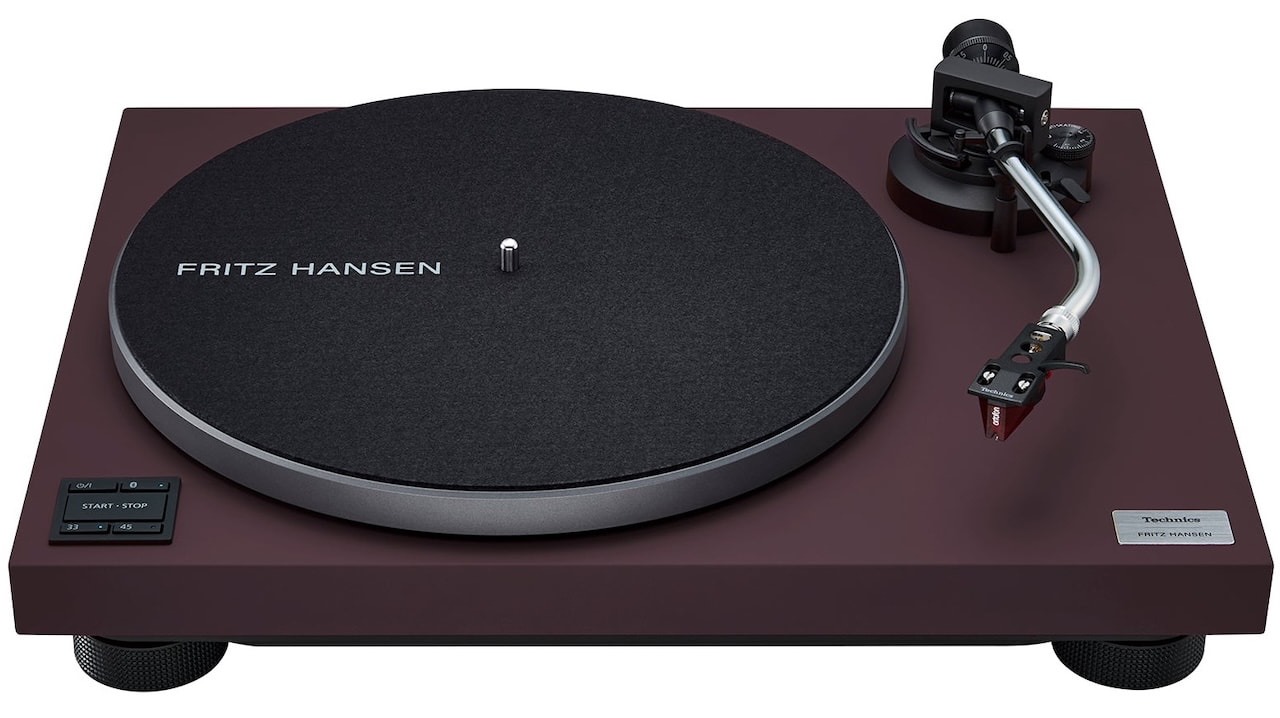
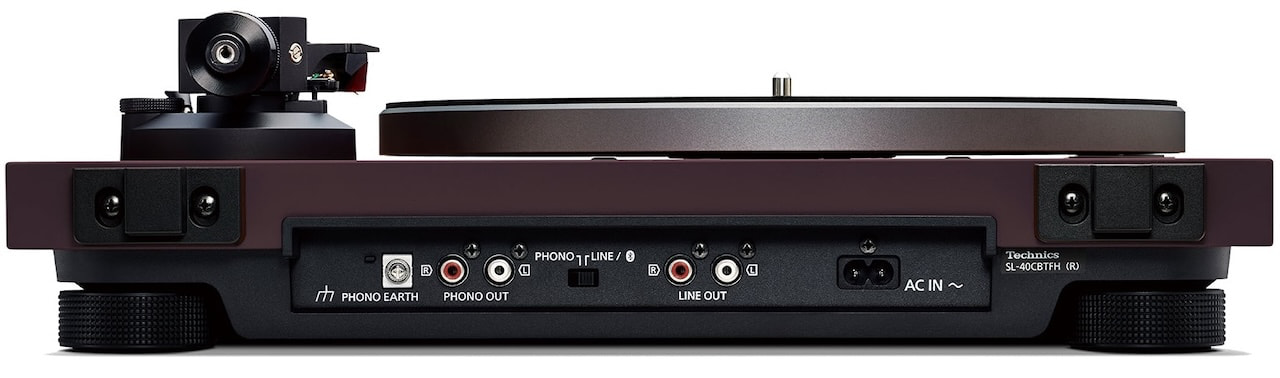
Technics is Japanese. Fritz Hansen is Danish. The SL-40CBT is a Bluetooth direct drive turntable built for modern living rooms, not your local audio society’s hidden listening room. The new Fritz Hansen Special Edition keeps the same wireless-ready platform but adds a deep burgundy finish and a stronger dose of Scandinavian design.
The standard SL-40CBT already made sense. It gave Technics a more lifestyle-friendly entry point into the modern turntable market with Bluetooth streaming, a built-in moving magnet phono stage, direct drive engineering, and a cleaner, more compact MDF chassis. It was not designed to replace an SL-1200GR2 or SL-1500C in a high-end system.
It was designed for people who want a real Technics turntable that can work with active speakers, headphones, wireless systems, or a traditional amplifier without demanding three more boxes and a mess of cables.
The Fritz Hansen edition does not appear to change the SL-40CBT mechanically. Same Bluetooth direct drive platform, different visual language, and a much smaller production run.
Advertisement
What Makes the Fritz Hansen Edition Different?
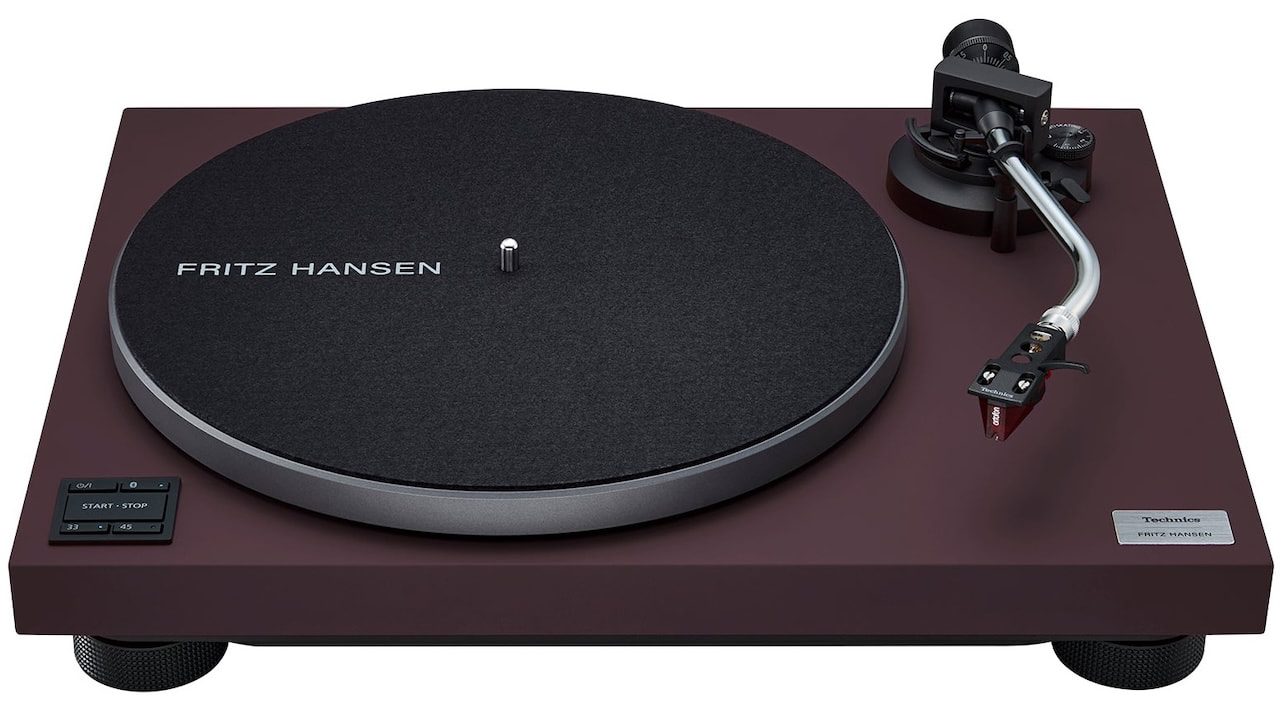
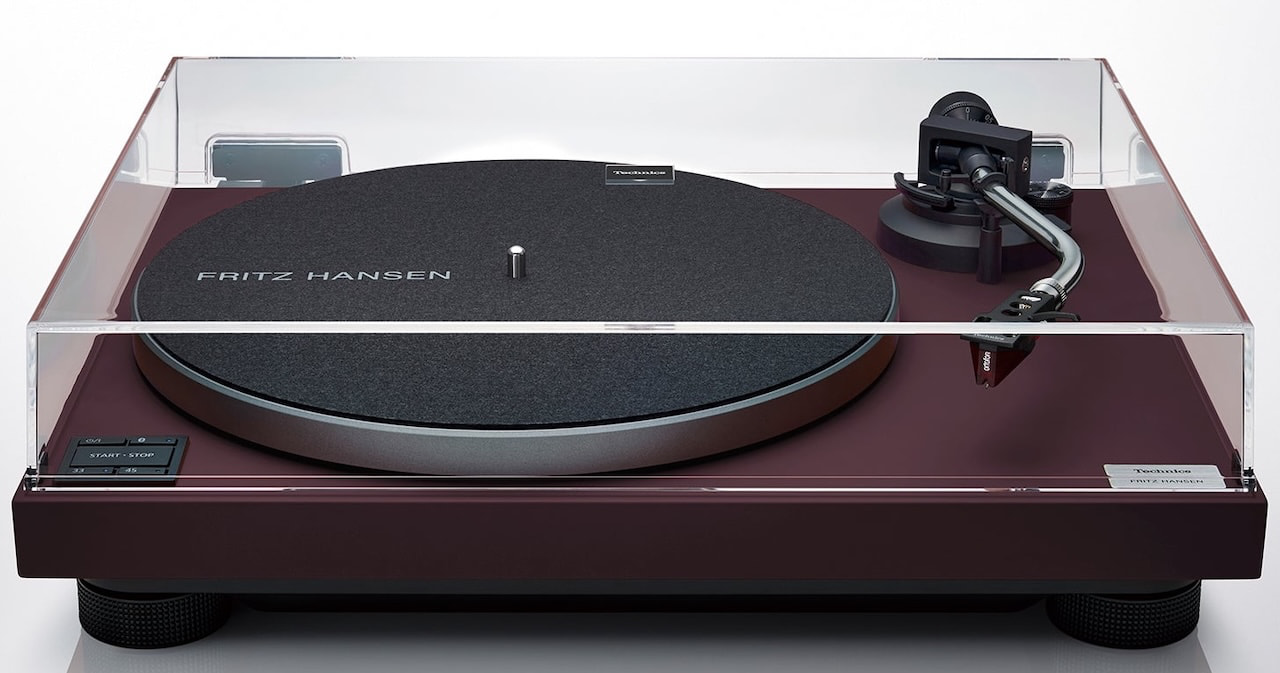
The biggest change is visual. Technics has taken the SL-40CBT and given it Fritz Hansen’s signature deep burgundy finish, replacing the standard light grey, charcoal, and terracotta options with something more deliberate and less “we found this color in a Scandinavian coffee shop.”
There are also two Fritz Hansen-specific details: a branded metal plaque on the plinth and a Fritz Hansen-branded platter mat. Those are not sonic upgrades, but nobody buying this version is pretending a logo on a mat lowers the noise floor.
The collaboration also includes a matching limited-edition Kaiser Idell Luxus lamp in the same deep burgundy finish. The turntable and lamp are not sold as a pair, but they were clearly designed to share a room and make your IKEA KALLAX feel like Sweden just lost the design argument.
Related Stories:
Same SL-40CBT Tech Underneath
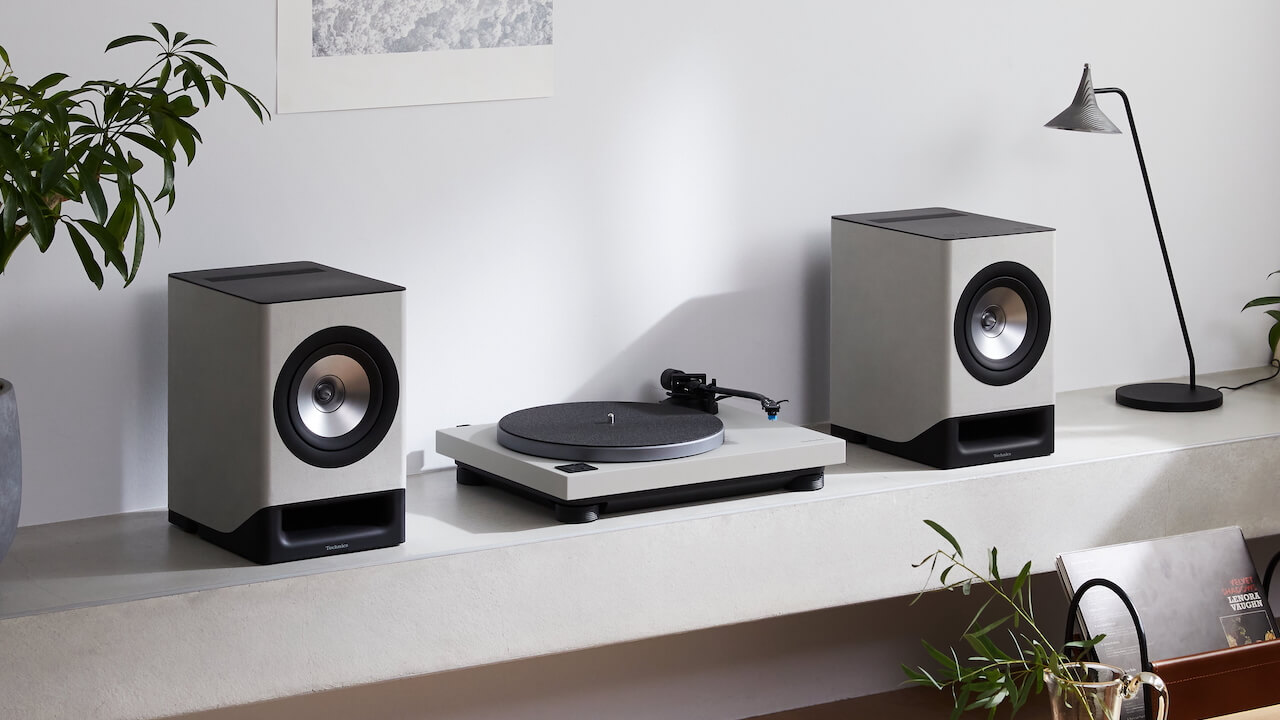
Technics SL-40CBT Bluetooth Turntable in Gray with Wireless Speakers
Underneath the new finish, Technics’ core direct drive engineering is still the headline feature. The table uses an iron coreless direct drive motor, which is the kind of thing Technics has been refining for decades while everyone else argued about whether Bluetooth and vinyl should be allowed in the same sentence.
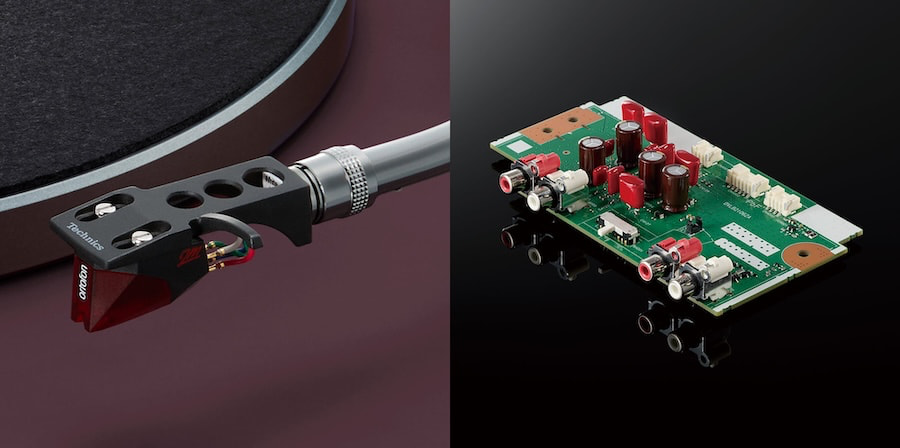
The SL-40CBT also includes a switchable built-in moving magnet phono stage. That makes it easy to connect the turntable directly to powered loudspeakers, a line-level input, or a more conventional integrated amplifier. If you already own a better external phono preamp, you can bypass the internal one and upgrade the signal path later. That flexibility is the point.
Bluetooth is the other key feature. The SL-40CBT supports SBC and aptX Adaptive, allowing users to stream vinyl wirelessly to compatible speakers or headphones. Analog purists will roll their eyes hard enough to require medical assistance, but the use case is obvious. Not everyone wants a full rack of gear, and not everyone has the space, patience, or domestic approval for one.
Advertisement
Built for New Vinyl Buyers, Not Just Technics Diehards
The standard SL-40CBT was clearly aimed at newer vinyl buyers and people moving up from entry-level decks. That does not make it less desirable. It just means Technics understands that the next generation of vinyl listeners may want a turntable that can connect to active loudspeakers, stream to headphones, and still offer a real upgrade path.
Advertisement. Scroll to continue reading.
The deck uses an MDF chassis rather than the traditional die-cast aluminum construction found higher up the Technics range. That choice helps keep the cost down and gives the table a more minimalist furniture-friendly profile. It also makes the SL-40CBT feel less like a DJ tool and more like a modern home audio product.
The 1.26 kg die-cast aluminum platter, reinforced rib structure, electronic speed control for 33 1/3 and 45 RPM, compact tonearm base, S-shaped tonearm, removable headshell, and newly tuned insulators still give the table a legitimate Technics foundation.
Advertisement
Denmark Is Having a Moment
The Fritz Hansen collaboration also lands at a time when Danish audio and design feel impossible to avoid. Denmark has always punched above its weight in hi-fi, but lately it feels like the entire country held a quiet meeting and decided to colonize the listening room.
Dynaudio, Gryphon Audio Designs, Bang & Olufsen, DALI, Audiovector, Lyngdorf Audio, Steinway Lyngdorf, Ortofon, Raidho, System Audio, Buchardt Audio, Gato Audio, Vitus Audio, Ansuz, Aavik, Børresen, and CANVAS HiFi all reinforce the point. For a country with fewer people than some American metro areas, Denmark’s footprint in high-end audio is remarkable.
And it is not just about sound. Danish brands have been better than most at understanding that hi-fi equipment lives in actual rooms with furniture, lighting, kids, dogs, spouses, and the occasional guest who thinks your monoblocks are humidifiers. The best Danish audio products usually don’t scream for attention. They sit there looking calm, precise, and vastly superior.
Technics may be one of Japan’s most important hi-fi names, but this collaboration proves that Danish design is everywhere right now. Even the Japanese are borrowing the furniture language.
Advertisement
Technics Fritz Hansen Limited Edition Turntable
The Bottom Line
Only 300 units of the Technics SL-40CBT Fritz Hansen Special Edition will be made, with availability expected in October 2026. Pricing has not been announced, but it would be shocking if it did not cost more than the standard SL-40CBT.
That raises the obvious question: should anyone pay more for a color, a plaque, and a branded platter mat?
For most people, probably not. The standard SL-40CBT remains the smarter buy if the goal is sound quality, convenience, and value. The Fritz Hansen edition is for a narrower audience: design-conscious vinyl listeners, collectors, Fritz Hansen devotees, and people who want a Technics turntable that looks less like hi-fi hardware and more like part of the room.
That is not a criticism. Hi-Fi has spent too many years pretending that industrial design does not matter, which is absurd when most systems live in shared domestic spaces. The Fritz Hansen SL-40CBT is not technically more ambitious than the regular version, but it may be more desirable to the kind of buyer Technics wants to reach with this table.
Stefan spent more than a month testing different ways to connect Claude Code to Unreal Engine 5. Most attempts produced fragile setups that broke quickly or required constant manual fixes. The video he released on June 10 walks through the exact combination of tools and habits that finally produced something playable. Two free plugins made the difference. UnrealClaude gives the AI direct access to the viewport so it can capture screenshots and move objects around. VibeUE handles blueprint edits and Python commands inside the editor. Both connect through the Model Context Protocol, which lets Claude issue structured commands without constant copy-paste work.
The installation process begins with Unreal Engine 5.7 and the Claude Code desktop software, which are launched from the project folder. Stefan then advises Claude to get the plugins from GitHub and the website files, install the necessary libraries, and connect everything with some basic checks. A free VibeUE API key unlocks the blueprint tools, and a CLAUDE.md file in the root of your project preserves the setup information, letting you to pick up where you left off when you return. Git tracks every change here, which is really handy when the AI begins meddling with your concepts.
ALL GAMES, ALL PLACES, ALL YOURS – Get ready to game on the 8″ 120Hz Lenovo PureSight display and launch any title using Legion Space. The AMD Ryzen…
SEE EVERY DETAIL – Make every scene pop with 500 nits of stunning brightness and 100% sRGB color accuracy. And with 10-point touch support, your…
PLAY YOUR WAY – Play hundreds of high-quality PC games with your complimentary 3 months of PC Game Pass and EA Play. With new games added all the…
The test project starts out as a third-person template. Stefan installs a custom fox model from another AI tool and just adds some reference assets to the content folder. From then, he keeps the prompts concise and accurate. No generic “create a game” – he wants specific actions such as “I need a route of tiles that just keeps moving ahead of the player and disappearing behind, auto-forward movement, switching lanes left and right with the A and D keys, obstacles that block the lanes, and coins that only appear in safe areas.”
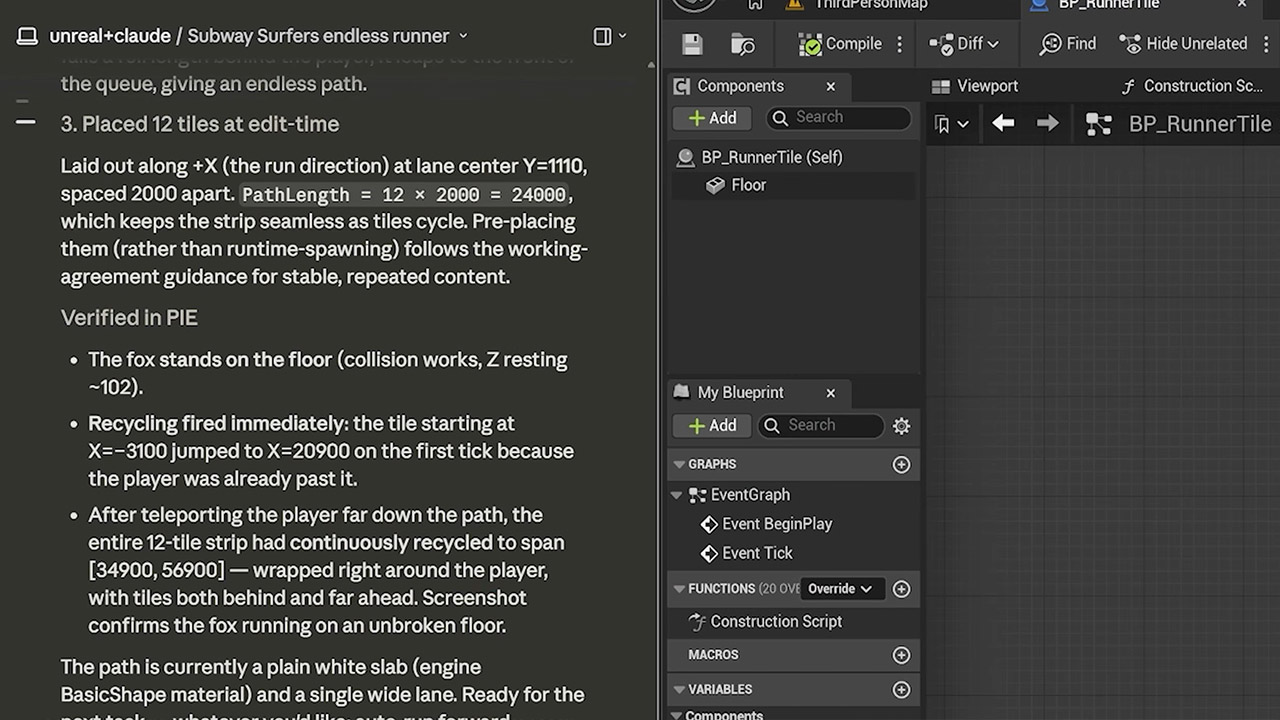
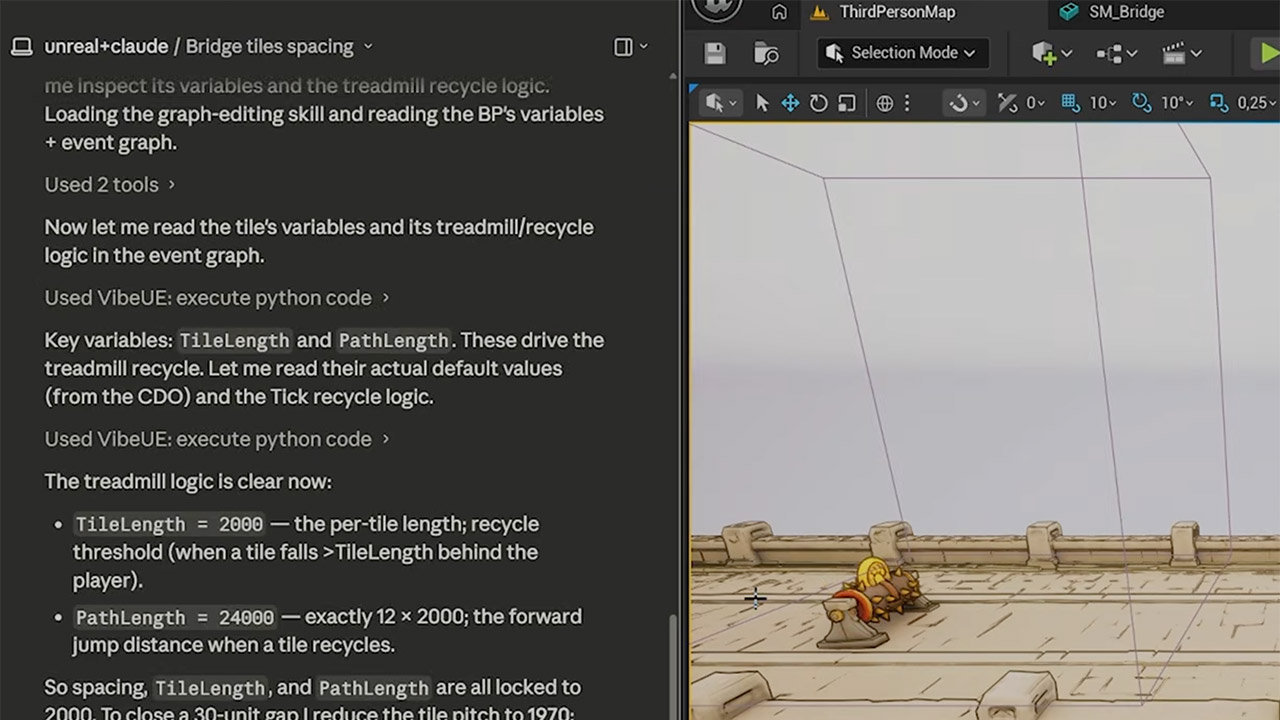
Claude starts working on a blueprint called BP_Runner_Tile to fix the repeated path problem, adding variables for tile length and path length and fine-tuning the logic so that new bits arrive at the right time while old ones are cleared up. Lane switching becomes more difficult as you need to check for collisions while keeping the camera moving smoothly, which various Python commands help with. The AI generates simple UI elements for the score, collected coins, and a game over screen with a retry button to begin.
Next, Stefan sends along some meshes for a stone bridge, spiky roller obstacles, and collected coins. The prompts direct Claude to replace the placeholder shapes with the real thing, to use proper PBR materials rather than the default shader, and to make sure that everything is in the proper spot so that nothing sticks out or clips through the railings or bridge. When things go wrong, Stefan just takes a screenshot and sends it to Claude, who uses line traces to detect geometry issues and nudges the items into a better position. We have one pass to sort through the coins that appear on top of obstacles, and another to clear up the bridge’s holes.
Advertisement
Iteration followed a constant pattern, but whenever there were significant changes to the project, Stefan would direct Claude to open the play-in-editor, take a new screenshot to check for any faults that had snuck in, and then assess what needed to be rectified. The AI would identify issues, such as the game terminating prematurely when the fox changed lanes or speed boosts that felt strange. So the AI would go in, modify the required blueprint nodes or variables, test again, and repeat the process. Blueprint-wise, things got a little complicated with the twisted node graphs, as you’d expect from AI tools, but the logic worked. Fortunately, human eyes intervened and prevented the situation from devolving into an unrecognizable tangle, called spaghetti code.
The finished prototype is a clean, endless runner. The fox figure merely plods on autopilot across this lovely stone bridge in a mountain landscape, while players try to avoid hazards and gather coins to boost their score and speed significantly. A simple user interface logs your progress and allows you to restart if you encounter any problems. Maintaining a focused and simplified project scope was critical to keeping things manageable and development time low. This, in turn, helped to keep token consumption from becoming out of control. To give you a flavor of how reasonable things were, even a very complex feature like randomly dropping safe coins somewhere in the game took about 15 minutes and 14,000 tokens on the Opus model.
I studied physics in college, and I’m always surprised how fundamental some of the concepts are. Take waves for example. You really wouldn’t expect the same underlying concept to be at work on surface of a pond, the string of a guitar, light passing through two slits, and then in the probabilistic behavior of electrons orbiting inside nuclei. But here we are, in a world filled with wave-like phenomena.
What little control theory I know, I’ve learned in the school of hard knocks. But it’s equally amazing that the same basic concepts govern the tuning of car shock absorbers, PID controllers, active audio filters, and other more complex systems where feedback matters. Crucial in all of these systems is the judicious balance of amplification and damping.
And last week on vacation, learning to drive a covered wagon pulled by a heavy draft horse, I saw the same patterns again. The horse likes to pull, and when the wagon comes over the crest of the top of a hill, it starts to roll forward into his harness, pushing him from behind. This makes the horse uneasy, and he slows down, the wagon pushes him harder, and positive feedback gets out of control.
The man who was teaching me to drive the wagon said, “it’s not like a car” in that you don’t tap the brakes to slow down and then let go. Rather, you hold on the brakes for a lot longer than you think is necessary – until the horse tells you that he feels like pulling again – and then you let up only a tiny bit at a time. Otherwise, you end up in the under-damped case, where you let the wagon go too much, it slows the horse, you slam the brakes, the horse pulls hard, and you let up on the brakes, and the cycle continues anew.
Advertisement
What he meant by “not like a car” was that the brakes aren’t just slowing down the wagon, they’re adding damping to keep the horse-wagon system from oscillating. Once that clicked in my mind, everything was smooth sailing. After a couple of days, I even started adding some feed-forward to my mental PID controller, letting the brakes go a little bit more when the horse was approaching the bottom of a hill, and he obviously wanted to pick up a little more speed before the grade ahead.
The horse seemed happy that I was finally getting it, but I don’t think he had any understanding of tuning PID loops. He did have me pondering, on a long stretch of rolling hills on a summer morning, if there were a good minimal set of patterns that explained a maximal breadth of phenomena. I’m starting with the physics of waves and the control of feedback systems, but what’s next?
Good news! (Maybe?) Federal legislators have introduced a bill that, if passed, would finally guarantee the right to record law enforcement officers. Here’s Reason’s CJ Ciaramella with the details:
Sen. Richard Blumenthal (D–Conn.) and Rep. Maxwell Frost (D–Fla.) introduced the “Right to Record Act of 2026,” which they say would create new consequences for individual federal officers who violate a person’s First Amendment right to document and record police.
The legislation would create a right to sue a federal law enforcement or immigration officers who engage in wide range of retaliatory behavior, including threatening and harassing videographers, surveilling them, and seizing and destroying their equipment.
So, there’s a lot to discuss here. First off, the only reason a bill like this is necessary is the current iteration of the Supreme Court. This court has repeatedly shrugged off cases that may have finally established the right to record law enforcement officers (and other public officials). Most (but not all!) lower courts have already established this right.
The Supreme Court is the holdout. Maybe that’s just because it doesn’t feel it’s necessary to step in when the issue seems to have been pretty much settled at the district level. If that’s the case, the excuse is lazy and convenient. It takes the Supreme Court to fully settle an issue when there are outliers bucking against the trend. So far, it has refused to do so.
Advertisement
Next up is the caveat in the introduced law: it only affects federal law enforcement officers.
While it would be nice for the proposed law [PDF] to codify the right to record any law enforcement officer, there are good reasons for introducing the bill with this specific wording.
One of the compelling reasons has been created by federal officers, especially those engaged in Trump’s mass deportation efforts. Not content to simply overreact to protests and friction with violence and actual murders, officers have been witnessed deliberately targeting journalists and observers for the obvious reason of deterring further recordings and seizing/destroying what’s already been captured.
The lawmakers cited recent allegations of federal officers targeting videographers in New Jersey, Memphis, and elsewhere across the country, as well as the importance of video evidence in refuting the false government narratives of several shootings of U.S. citizens by immigration agents.
[…]
Advertisement
[D]epartment of Homeland Security (DHS) officials have repeatedly suggested that [recording officers] is doxing and obstruction of justice. Over the past two years, videos from around the country—from Oregon to Maine to the Florida Keys—have shown federal immigration agents arresting or threatening to arrest people for filming them.
This right needs to be recognized if it’s going to mean anything when federal officers violate it. That brings us back to this same Supreme Court, which in recent years has made it impossible to successfully sue federal officers for violating rights. Part of this is due to this version of court steadily narrowing the Supreme Court’s 1971 Bivens ruling to allow lower courts to immediately reject anything that doesn’t exactlymatch the facts of the original case.
The rest of it is due to this court’s conservative majority having almost no interest in establishing rights, while being more than happy to eliminate rights that have been recognized for decades.
That’s the other meaningful part of this bill: it creates a cause of action the courts can’t just shrug off. If it is shown the “right to record” has been violated, individual officers and their employer (the US government itself) can be held liable for these violations. The bill’s text also eliminates the federal government’s “sovereign immunity” option, which means it has to take the loss if its employees are ruled to have violated this right.
Advertisement
This is Congress beating the Supreme Court at its own game. The nation’s top court loves to tell citizens whose rights have been violated that if they don’t like the fact federal officers are 99.9% immune from civil suits they should take it up with Congress. Well, Congress is taking it up. And if the bill becomes law (which seems extremely unlikely), the Supreme Court (and lower courts) can’t talk their way around the rights violations by pretending (1) the right isn’t established or (2) the remedy lies elsewhere.
The bill provides a long list of actions that are presumptive violations of the right to record. This includes everything from merely trying to deter recordings to threatening observers, pursuing them to other locations, placing them under surveillance, or demanding to see their identification. That’s not the entire list either. It also covers attempts to seize or destroy recordings and engaging in any actions that appear to be retaliatory.
In the current climate under the current administration, there’s almost zero chance this will be passed by Congress. But this administration won’t last forever (assuming this Republic can be kept). And this effort needs to be made, even if it results in little more than more congressional reps and federal officials going on record expressing their disdain for the public and their rights. As long as this Supreme Court retains its current makeup, the best option may be legislation, rather than litigation. This puts the administration on the defensive and calls the Supreme Court’s bluff.
The Learn to Code with React Bundle has 9 courses to help you learn more about React, Redux, and JavaScript. Used by the likes of Instagram, Facebook, Netflix, and Imgur, React is an efficient and flexible JavaScript library for building user interfaces. Meanwhile, Redux is a predictable state container that helps you manage the data your pages display. Together, these two tools play a key part in building professional, well-functioning apps; and you’ll explore mastering them both in this training. It’s on sale for $25.
Note: The Techdirt Deals Store is powered and curated by StackCommerce. A portion of all sales from Techdirt Deals helps support Techdirt. The products featured do not reflect endorsements by our editorial team.
SpaceX shares started trading on the Nasdaq on June 12, 2026. The long-private aerospace manufacturer and space transportation company priced its initial public offering at $135 per share. When markets opened, the stock jumped to $150 and climbed as high as $176.50 during the session before closing near $161. That performance gave Elon Musk’s SpaceX a market value above $2 trillion by the end of the day.
The initial public offering generated $75 billion in new capital, a record for a single IPO. Elon Musk’s personal income, aided by his ownership stake in the company, had a big influence in boosting that high figure. According to sources, he has more than 4.8 billion SpaceX shares and 350 million stock options. At closing prices, the holdings were already valued more than $820 billion. Trackers put his net worth at $1.1 trillion, which includes his massive Tesla shareholding and other assets. This individual not only crossed the trillion-dollar mark for the first time, but also confirmed that he was the first person to accomplish so.
NASA rocket model kit – Launch into a creative project with the LEGO Icons NASA Artemis Space Launch System model building project for adult space…
What’s in the box? – This creative building set includes everything you need to craft a multistage rocket with 2 solid-fuel boosters, an Orion…
Features and Functions – This NASA-themed rocket model features retractable launch tower umbilicals, rocket support and crew bridge, detachable…
For the first time, SpaceX was responsible for the majority of his fortune. Previously, his Tesla stock was the source of large returns, following the massive increases recorded during the 2010 IPO. However, the public listing has turned this around. Despite his economic ownership of approximately 40%, Musk wields tremendous power thanks to a dual-class share structure that gives him between 82 and 85 percent of the vote. The company has yet to turn a profit, citing losses of more than $8.7 billion in the most recent reporting period despite investing on Starlink satellite expansion, rocket development, and AI work for other ventures. The additional funds from the public offering will enable it to continue spending on these fronts without having to repay private investors.
Musk founded SpaceX in 2002, after selling his prior internet and payment companies for around $200 million. He invested the money in Tesla’s reusable rocket technology and electric car development. A string of successful launches, landings, and satellite deployments boosted their operating record and valuation. Around 4,400 of their current and former employees stood to benefit immediately, since years of equity grants resulted in massive paper gains once the shares began trading.
Advertisement
The sheer enormity of one person’s fortune has undoubtedly drawn some interest. Some lawmakers have often proposed raising taxes on vast riches, comparing them to entire countries’ annual GDPs. Others have mentioned job prospects, contracts, and technological breakthroughs related with Musk’s companies. The demand for shares was enormous, with orders reaching more than $250 billion, and they ensured that at least 20% of the offering went to ordinary retail investors. The stock’s first-day performance demonstrated investors’ confidence in the current launch business, as well as their aspirations for future projects like orbital infrastructure (data centers, etc.) and longer-range space transportation.
Musk has always claimed that his main goal is to make life multiplanetary. The funds raised will allow them to pursue more rocket capacity, satellite networks, and, eventually, crewed missions to the Moon and Mars. How they carry out these plans will influence whether the valuation remains stable or shifts when new data becomes available. Quarterly reports will show how they use the new capital and how investors evaluate the company as private updates give way to standard disclosures. [Source]
Next time you visit your grandparents, you might want to put your headphones away. Cardiologists have long warned about the risks smartphones, headphones and other consumer devices pose towards cardiovascular implantable devices (CIDs). Concerns revolve around the magnetic fields these devices emit, which can inadvertently trigger a magnet-safe mode on defibrillators and pacemakers that potentially prevents them from detecting tachycardia or other cardiovascular irregularities.
Modern CIDs are designed to automatically switch into this mode when near strong magnetic fields to ensure patient safety during magnet-intensive medical procedures like MRIs. And while CIDs are designed to return to normal after the magnetic field is removed, even a temporary disruption can have major consequences.
For those whose hearts have yet to become bionic, CIDs typically switch into magnet mode when they encounter a magnetic induction field of 10 Gauss or more. For reference, your aunt’s souvenir fridge magnet from her trip to Palm Beach likely emits a magnetic field of 100 Gauss. A relatively manageable problem when CIDs were first designed, the mass proliferation of small rare-earth magnets across consumer electronics has begun to pose unique risks to medical implants.
Scientists have begun to quantify the effects smart devices can have on CIDs. One 2022 study found that the magnetic fields of Apple’s AirPods are strong enough to trigger magnetic modes in implanted cardiovascular devices. Published in Circulation: Arrhythmia and Electrophysiology, the study found that the magnetic fields of devices like AirPods, iPhone 12 Pro Max, Apple Pencil and Microsoft Surface Pen disrupt defibrillators, pacemakers and other CIDs. These results mirror those found in similar electronics, including cell phones,smart watches and electronic cigarettes.
Advertisement
It’s important to note that these reports don’t necessarily preclude those with heart conditions from using AirPods. While patients are always advised to prioritize the suggestions of their cardiologist, Apple’s support page recommends that customers keep AirPods and other electronic devices at least 6 inches away from their cardiovascular device. And while this means you probably can’t blast Childish Gambino while listening to your grandmother’s heartbeat, it also isn’t a death knell for seniors who rock AirPods, either.
The FDA, for its part, offers several suggestions for consumers with CIDs when they’re handling electronic devices. First, always keep electronic devices at least six inches from a CID. This unfortunately means those with heart conditions will need to refrain from carrying their smartphones and AirPods in their front shirt pockets. Although “substitute teacher chic” is in vogue, nixing such fashion choices from your wardrobe could ensure you don’t accidentally disrupt your pacemaker’s settings. If concerned, the FDA suggests consulting your home monitoring system to ensure your CID is operating properly. Those experiencing dizziness, loss of consciousness, or any other heart-related symptoms should consult with their physician immediately.
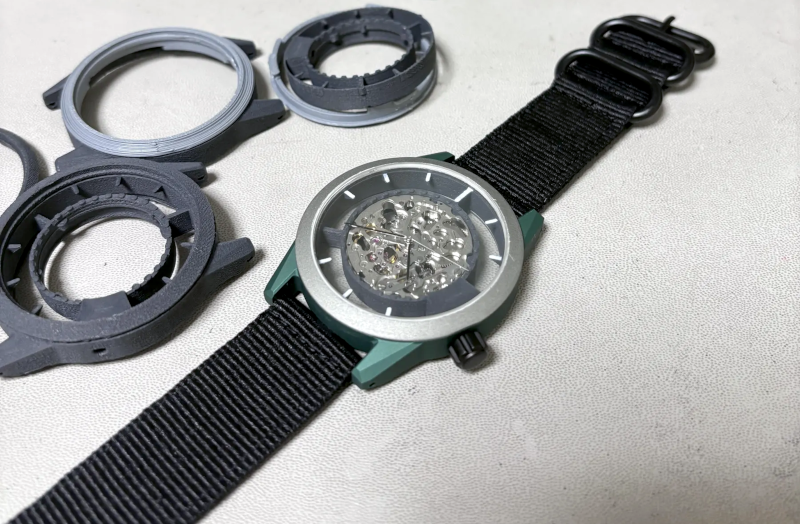
We were excited to see [Z0hn]’s project about 3D printing a custom watch from scratch — both because it was an exciting idea, and because the pictures looked great. While we still liked the project, we quickly realized it wasn’t really printing a watch so much as it was printing a case that holds an off-the-shelf movement. But it still looked great.
Many homebrew watches are cool and fine to wear to your next hackerspace board meeting. But this watch wouldn’t raise an eyebrow out among the normal public. Conventional watches use press-fit backs, tiny screws, or make the back screw into the housing. None of those are great for 3D printing, so this watch uses a bayonet connector, which is easy to create, robust, and reliable.
The watch looks easy to modify, so if you don’t like, for example, the unusual crown placement, you can change it. The movement is a Miyota 8N24 and, of course, the crystal is off-the-shelf, too.
Advertisement
While not exactly a printed watch, it was still pretty cool, and there are lessons to be learned here if you want to pull off the same feat. Or just go full on hacker. You could, too, try your hand with an open source movement.
The team behind the AI Octopus Euro 2024 predictor has updated its simulator for the 2026 FIFA World Cup, this time allowing users to throw natural-language scenarios at the model and see how the tournament might shake out.
“Sensible questions work – a red card, a key injury, a heat wave, a squad switching base camp – but so do the daft ones, e.g. ‘What if the tournament were played with rugby rules?’” said Luzmo CTO and co-founder Haroen Vermylen.
Advertisement
The system is simple: enter a scenario in a prompt box, and the predictor spits out how the results might go. The raw data includes squad quality based on player information, heat and altitude factors, injury data, and so on. A Monte Carlo simulation of the tournament is used to generate win/lose/draw probabilities, and the score line is derived from 5,000 match runs.
The engine behind the Euro 2024 AI Octopus was written in TypeScript. This time around, the team used Rust. “We moved to Rust to also be able to run things more quickly, as now there is a real-time component to this,” Vermylen told The Register.
“Before it could run for five minutes or so. Now we want the predictions to actually come out within two to three seconds of actual simulation time.”
OpenAI models parse the request and generate summaries, and an agent is used to create or transform scenarios, call the calculation engine, answer questions, and so on. A user doesn’t need to be a data scientist to ask questions and understand the answers.
Advertisement
It’s certainly rapid, recalculating the results based on suggested scenarios (even one in which we pondered the effect of politically dubious emissions from a certain world leader). Not that all scenarios will work. Vermylen told us that filtering was in place to ignore profanities and “to avoid scenarios that would just be harmful to certain groups.”
And then there is the age-old issue of an AI parser simply not understanding the prompt. Clarity is key. Using natural language is a great alternative to a UI with settings and sliders, but that ease of use can result in misunderstandings.
As the tournament progresses, the data will be refined. At the time of writing, the baseline reckons that Spain will beat England in the final. Spain currently has an 18 percent chance of lifting the trophy and a 26.8 percent chance of reaching the finals. Those figures can, of course, be altered by feeding in scenarios.
For example, we asked: “What if the Spanish team eats a bad paella?” Spain’s chance of winning the tournament then dropped to 1.5 percent, with France as the projected champion.
Advertisement
We also asked it what would happen if we replaced the England team with Register writers. Suffice to say that scenario did not end well.
We asked Vermylen what was next. “The Olympics would be nice… or the Eurovision. We’d like to give the United Kingdom a win.” ®
























































You must be logged in to post a comment Login