

Connect with us

Tech

Nvidia’s new technique cuts LLM reasoning costs by 8x without losing accuracy

Published

on

Researchers at Nvidia have developed a technique that can reduce the memory costs of large language model reasoning by up to eight times. Their technique, called dynamic memory sparsification (DMS), compresses the key value (KV) cache, the temporary memory LLMs generate and store as they process prompts and reason through problems and documents.

While researchers have proposed various methods to compress this cache before, most struggle to do so without degrading the model’s intelligence. Nvidia’s approach manages to discard much of the cache while maintaining (and in some cases improving) the model’s reasoning capabilities.

Experiments show that DMS enables LLMs to “think” longer and explore more solutions without the usual penalty in speed or memory costs.

The bottleneck of reasoning

LLMs improve their performance on complex tasks by generating “chain-of-thought” tokens, essentially writing out their reasoning steps before arriving at a final answer. Inference-time scaling techniques leverage this by giving the model a larger budget to generate these thinking tokens or to explore multiple potential reasoning paths in parallel.

Advertisement

However, this improved reasoning comes with a significant computational cost. As the model generates more tokens, it builds up a KV cache.

For real-world applications, the KV cache is a major bottleneck. As the reasoning chain grows, the cache grows linearly, consuming vast amounts of memory on GPUs. This forces the hardware to spend more time reading data from memory than actually computing, which slows down generation and increases latency. It also caps the number of users a system can serve simultaneously, as running out of VRAM causes the system to crash or slow to a crawl.

Nvidia researchers frame this not just as a technical hurdle, but as a fundamental economic one for the enterprise.

“The question isn’t just about hardware quantity; it’s about whether your infrastructure is processing 100 reasoning threads or 800 threads for the same cost,” Piotr Nawrot, Senior Deep Learning Engineer at Nvidia, told VentureBeat.

Advertisement

Previous attempts to solve this focused on heuristics-based approaches. These methods use rigid rules, such as a “sliding window” that only caches the most recent tokens and deletes the rest. While this reduces memory usage, it often forces the model to discard critical information required for solving the problem, degrading the accuracy of the output.

“Standard eviction methods attempt to select old and unused tokens for eviction using heuristics,” the researchers said. “They simplify the problem, hoping that if they approximate the model’s internal mechanics, the answer will remain correct.”

Other solutions use paging to offload the unused parts of the KV cache to slower memory, but the constant swapping of data introduces latency overhead that makes real-time applications sluggish.

Dynamic memory sparsification

DMS takes a different approach by “retrofitting” existing LLMs to intelligently manage their own memory. Rather than applying a fixed rule for what to delete, DMS trains the model to identify which tokens are essential for future reasoning and which are disposable.

Advertisement
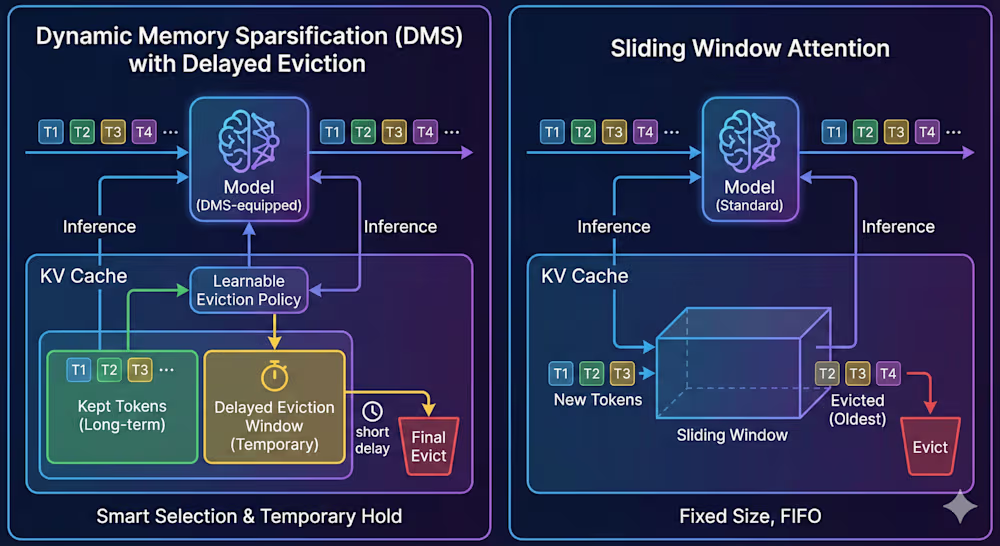
DMS vs sliding window attention

“It doesn’t just guess importance; it learns a policy that explicitly preserves the model’s final output distribution,” Nawrot said.

The process transforms a standard, pre-trained LLM such as Llama 3 or Qwen 3 into a self-compressing model. Crucially, this does not require training the model from scratch, which would be prohibitively expensive. Instead, DMS repurposes existing neurons within the model’s attention layers to output a “keep” or “evict” signal for each token.

For teams worried about the complexity of retrofitting, the researchers noted that the process is designed to be lightweight. “To improve the efficiency of this process, the model’s weights can be frozen, which makes the process similar to Low-Rank Adaptation (LoRA),” Nawrot said. This means a standard enterprise model like Qwen3-8B “can be retrofitted with DMS within hours on a single DGX H100.”

One of the important parts of DMS is a mechanism called “delayed eviction.” In standard sparsification, if a token is deemed unimportant, it is deleted immediately. This is risky because the model might need a split second to integrate that token’s context into its current state.

DMS mitigates this by flagging a token for eviction but keeping it accessible for a short window of time (e.g., a few hundred steps). This delay allows the model to “extract” any remaining necessary information from the token and merge it into the current context before the token is wiped from the KV cache.

Advertisement

“The ‘delayed eviction’ mechanism is crucial because not all tokens are simply ‘important’ (keep forever) or ‘useless’ (delete immediately). Many fall in between — they carry some information, but not enough to justify occupying an entire slot in memory,” Nawrot said. “This is where the redundancy lies. By keeping these tokens in a local window for a short time before eviction, we allow the model to attend to them and redistribute their information into future tokens.”

The researchers found that this retrofitting process is highly efficient. They could equip a pre-trained LLM with DMS in just 1,000 training steps, a tiny fraction of the compute required for the original training. The resulting models use standard kernels and can drop directly into existing high-performance inference stacks without custom hardware or complex software rewriting.

DMS in action

To validate the technique, the researchers applied DMS to several reasoning models, including the Qwen-R1 series (distilled from DeepSeek R1) and Llama 3.2, and tested them on difficult benchmarks like AIME 24 (math), GPQA Diamond (science), and LiveCodeBench (coding).

The results show that DMS effectively moves the Pareto frontier, the optimal trade-off between cost and performance. On the AIME 24 math benchmark, a Qwen-R1 32B model equipped with DMS achieved a score 12.0 points higher than a standard model when constrained to the same memory bandwidth budget. By compressing the cache, the model could afford to “think” much deeper and wider than the standard model could for the same memory and compute budget.

Advertisement
Screenshot 2026-02-12 at 9.40.39 PM

DMS improves model performance on reasoning tasks over vanilla LLMs for equal compute budget (source: arXiv)

Perhaps most surprisingly, DMS defied the common wisdom that compression hurts long-context understanding. In “needle-in-a-haystack” tests, which measure a model’s ability to find a specific piece of information buried in a large document, DMS variants actually outperformed the standard models. By actively managing its memory rather than passively accumulating noise, the model maintained a cleaner, more useful context.

For enterprise infrastructure, the efficiency gains translate directly to throughput and hardware savings. Because the memory cache is significantly smaller, the GPU spends less time fetching data, reducing the wait time for users. In tests with the Qwen3-8B model, DMS matched the accuracy of the vanilla model while delivering up to 5x higher throughput. This means a single server can handle five times as many customer queries per second without a drop in quality.

The future of memory

Nvidia has released DMS as part of its KVPress library. Regarding how enterprises can get started with DMS, Nawrot emphasized that the barrier to entry is low. “The ‘minimum viable infrastructure’ is standard Hugging Face pipelines — no custom CUDA kernels are required,” Nawrot said, noting that the code is fully compatible with standard FlashAttention. 

Advertisement

Looking ahead, the team views DMS as part of a larger shift where memory management becomes a distinct, intelligent layer of the AI stack. Nawrot also confirmed that DMS is “fully compatible” with newer architectures like the Multi-Head Latent Attention (MLA) used in DeepSeek’s models, suggesting that combining these approaches could yield even greater efficiency gains.

As enterprises move from simple chatbots to complex agentic systems that require extended reasoning, the cost of inference is becoming a primary concern. Techniques like DMS provide a path to scale these capabilities sustainably.

“We’ve barely scratched the surface of what is possible,” Nawrot said, “and we expect inference-time scaling to further evolve.”

Source link

Advertisement
Continue Reading
Click to comment

Leave a Reply

Your email address will not be published. Required fields are marked *

Tech

Want two Google Pixel phones for the price of one? Optus is giving away a Pixel 9a with every Pixel 10 series signup

Published

on

Optus is continuing to add sweeteners to its phone plans, and has followed up on its recent iPhone 17/Apple Watch SE 3 bundle deal with this new offer for Android lovers that nets you a free Google Pixel 9a when you sign up for a Google Pixel 10-series on a plan.

The promo comes hot on the heels of Google’s announcement that the Pixel 9a’s successor, the Pixel 10a, will officially launch on February 18, 2026.

The Pixel 9a is one of our favourite cheap phones (and even made it to our list of best phones overall) that you can buy in Australia, thanks to its great camera, useful AI features and the fact that it has the same processor as the main Pixel 9 lineup (Google’s Tensor G4). Rumours have been suggesting that the upcoming 10a will retain the Tensor G4 chip and most of the Pixel 9a’s specs, although nothing official has yet been confirmed by Google.

If that ends up being true, then the Pixel 10a will ostensibly be a slightly updated version of the 9a, and may be a tough sell if it also retains the Pixel 9a’s AU$849 RRP. That also makes this deal more attractive if you were eyeing the budget handset for someone else or as a secondary device, instead of paying full price on launch for a mostly similar phone.

Advertisement

There is one caveat to this deal – Optus is only handing out the 128GB Obsidian (black) model with the qualifying plans, so if you wanted a different colourway then you’re out of luck. You can, of course, choose the Pixel 10 in whatever colour you’d prefer.

If this sounds like a deal that’s up your alley, be quick as this offer is only set to end on March 22, 2026.

Source link

Advertisement
Continue Reading

Tech

Ring calls off partnership with police surveillance provider Flock Safety

Published

on

Ring has canceled its partnership with Flock Safety, after receiving backlash for running a Super Bowl ad touting its Search Party feature. If you’ll recall, Ring revealed back in October 2025 that it was entering a partnership with the surveillance company, which would make it possible for law enforcement to ask smart doorbell owners for videos captured by their devices. In its announcement, the company said that the “planned Flock Safety integration would require significantly more time and resources than anticipated.” The decision to call off the partnership was mutual, Ring added, and Flock Safety’s integration was never launched. Apparently, no Ring customer footage was ever sent to Flock.

Under the partnership, law enforcement agencies using Flock’s Nova platform or FlockOS would have been able to use Ring’s Community Requests to ask for doorbell videos from users. They would have been asked to specify the location and timeframe of the incident, as well as provide a unique investigation code and the details about what is being investigated. Their requests would then be forwarded to relevant users, who could choose to share footage from their doorbell. Ring said the whole process would have been anonymous and optional.

Ring was known to have shared security cam videos to law enforcement without a court order or the device owner’s consent at least 11 times in the past. In 2024, however, it seemed to have walked back its police-friendly stance and said that it would stop sharing videos with the police without a warrant. This alliance with Flock would have marked a return to police collaboration after the company distanced itself from law enforcement. Flock is known for its automatic license plate readers and for centralizing the information it collects into a database that police can search without a warrant. While law enforcement says the system can help them solve crimes like kidnapping. 404Media reported last year that ICE has been using the database, citing immigration-related reasons.

While Ring’s official reason was that the Flock partnership would need more resources than expected, it’s worth noting that the company recently got flak for its Super Bowl Search Party ad. Ring touted it as a way to find lost dogs by using its cameras’ AI to identify pets running across their field of vision and then pooling feeds together to identify missing pets. While Search Party isn’t new and was announced last year, the ad sparked concerns about surveillance and how the tech could be misused, leading users to disable the feature for their cameras altogether.

Advertisement

Source link

Continue Reading

Tech

5 Clever 3D Printer Projects To Upgrade Your Home Office

Published

on


Working from home can give you a lot of freedom. But, with that freedom, you also need to figure out how to sort out a few more things for yourself — such as setting up your own home office with all the gear you need. Once you’ve sorted out your basic furniture and any essential gadgets you need while working remotely, you might still feel like something’s missing without knowing exactly what it is you’re looking for. Alternatively, you might know what your problem is — messy cables, a lack of storage, not enough desk space — without knowing how to fix it.

That’s where 3D printing comes in. Sites like Printables, Thingiverse, and My Mini Factory are like catalogs for projects to help upgrade your home office. There are loads of different user-made solutions out there designed to improve your workspace, from modular cable management solutions that hide away under your desk to tiny shelves you can perch on top of your monitor for bits and pieces you need to keep close by.

The only problem is that there are so many projects out there to choose from that it’s hard to know where to start, what’s worth doing, and what’s a waste of filament, especially when you factor in any remixes and slight tweaks that have been made to other, existing listings. We’ve found some projects that stand out for their ingenuity, clever designs, and high user ratings.

Advertisement

Underware Cable Management Solution

Working from home can quickly turn from a private paradise into a sea of cables and clutter. At least, it can if you don’t have a robust system for managing your wires, chargers, and cords. This 3D printer project shared by HandsOnKatie offers Underware, a solution for eliminating cable chaos using an organizer that hides all your cables on the underside of your desk, so you won’t have to worry about it creating an eyesore or distracting you during your deep focus time.

Advertisement

What’s neat about this particular cable management system is that it’s designed to be completely modular. This means that you can put it together in different formations to suit your needs and set-up, without having to completely rearrange your desk just to tidy it up properly. Instead, you can fit your system to the layout you already have. And, if you decide your set-up doesn’t work for you, it’s designed to be completely reusable, so you don’t have to worry about creating waste or starting over.

Each part of the Underware is ready to print as-is, so you can pretty much just grab it and go. However, you’re in luck if you want to tweak it, as the system is completely open source. So, with time and skill, you can make alterations or add new parts further down the line.

Advertisement

Incastro Desk Organizer

Finding creative ways of storing and organizing odds and ends is one of the biggest challenges when trying to keep your home office neat and tidy. You might not really have a home for all your pen drives, or you might struggle to know where to put your SD cards without losing track of them. Instead of dumping them all in a drawer or leaving them lying around your desk, it might be time to print your own modular desk organizer.

Davideantonello‘s Incastro project offers a way to store small items on your desk without taking up too much room, courtesy of its high-density design. Perhaps the smartest part of the project is the module designed for organizing external storage, which offers several ports for each individual card or drive to slot safely into. That way, you can keep them out of harm’s way without losing track of them — and, if you label or color-coordinate them accordingly, you won’t need to play guess-the-USB-stick any more.

Something else useful about the Incastro is that its modular design means you can decide exactly which parts you want to print for a custom experience. For example, if you don’t want to print out the phone stand component, you can exclude it from your build entirely. It also means you could easily split up your organization after you’ve printed it if you decide you want a different layout further down the line.

Advertisement

Under-Desk Laptop Holder

Working from home looks different for everyone, but one thing’s for sure: there’s never quite as much space at your desk as you think there is. This is doubly the case if you’re juggling multiple computers, like a desktop and a laptop, or if you regularly need a clear work surface for using other tools or working on paper. Thankfully, much like with your cable management, you can make the most of the underside of your desk for stowing your laptop, MacBook, or a light notebook, if you prefer to work analog.

Advertisement

Printables user Spaceman 3D‘s under-desk laptop holder offers a home for most laptops with just a few brackets and screws. It’s a fairly straightforward project, as it’s easy to print and install. You just need to screw a couple of brackets onto the underside of your desk, or wherever you plan on using it, and it’s good to go. Just be sure to pick the right kind of screws, and check that your desk is sturdy enough to hold your laptop.

The holder doesn’t have to just be for when you aren’t using your laptop, either. You could also use it to play around with your whole desk’s layout to create loads of space for your peripherals and useful USB gadgets. For example, you could use your laptop with the lid closed or in clamshell mode while it’s stashed away in the holder by hooking it up to an external monitor, mouse, and keyboard.

Advertisement

Adjustable Monitor Shelf

If the phrase “out of sight, out of mind” rings true to you, then you might want to consider carving out a space in your home office where you keep all the small things you might need often, like your glasses, security keys, or earplugs. One option for making sure that little space is placed somewhere that you can keep an eye on is a monitor shelf, like this one made by GiskardReventlov.

This neat shelf takes a simple concept and turns it into a creative, practical solution to help keep your desk clutter-free while you’re working from home. The support arm that keeps the shelf in place is adjustable, so it should be easy to fit it to most modern monitors, as well as offering a perforated surface to make sure that air can flow safely around your device for ample cooling. You can either print it in place to streamline things, or you can print the shelf as two separate parts.

Besides being a useful spot for keeping track of easy-to-lose knick-knacks, it also offers clever solutions for laying out your desk so that it specifically suits you. For instance, you could use the shelf to place your webcam at a higher angle or keep a mini fan up there.

Advertisement

Office Keyboard & Device Stand

Generally speaking, keyboard stands aren’t the most out-there gadgets. However, Josh Clos‘ multi-tiered keyboard and device stand is a little different, as it offers spaces for you to stack up multiple devices at once while still keeping them accessible and usable. The stand is designed to sit below raised monitors, offering a tilted space to put a tablet or phone onto, a platform for your keyboard, and a gap for your cables to tuck into.

Advertisement

The stand’s lower shelf offers a clever solution for keeping a second screen nearby, without the need to invest in a second monitor. Admittedly, if you’re using a tablet, then the screen will be much smaller than a second monitor, but it could save you some money if it’s not something that you need all the time. It’s also a useful layout if you need to type up and summarize notes from a notebook.

Although the obvious use for the lower shelf is a phone or tablet, the stand was actually designed to accommodate multiple computers on one desk at the same time. So, if you need to use different devices for different jobs, or want to make room at your desk for your personal PC alongside your work-supplied equipment, this project could be a useful option. Alternatively, you could use the lower shelf as a way of keeping any items you need to grab often close to hand. It has a textured surface, so it should be a reasonable non-stick option for organizing any items small enough to fit on it, like notepads or remote controls.

Advertisement


Source link

Continue Reading

Tech

Q&A: Bellevue’s new mayor wants to move at the speed of innovation in growing AI hub

Published

on

“We want people who work here actually be able to live here,” says Bellevue Mayor Mo Malakoutian, center. (City of Bellevue Photo)

Mo Malakoutian has been mayor of Bellevue, Wash., for about a month. He’d like to take credit for the Seattle Seahawks making it to (and winning) the Super Bowl, the World Cup coming to the region this summer, and all of the sunshine of late — not a bad political posture to assume.

A longtime engineer, academic and tech industry veteran, Malakoutian is executive director of the Consulting and Business Development Center at the University of Washington’s Foster School of Business and an affiliate professor in civil and environmental engineering. He spent eight years at Amazon before leaving last fall as a senior manager in learning and development.

Malakoutian was elected to the Bellevue City Council in 2023 and served as deputy mayor in 2024 and 2025 before his unanimous appointment as mayor on Jan. 9, succeeding Councilmember Lynne Robinson, who served as mayor for six years.

Originally from Iran, Malakoutian spent eight years in construction before coming to the U.S. to get his PhD in structural engineering at the UW.

We caught up to talk about how his tech background informs his leadership style; managing Bellevue’s significant growth as a tech hub; his view of the Eastside vs. Seattle debate; transportation; AI; and more. Our Q&A has been edited for brevity and clarity.

Advertisement

GeekWire: How does your tech background — including eight years at Amazon — inform your approach to governance? Can we expect you to lean on the Amazon leadership principles?

Malakoutian: When I started [at Amazon] in 2017 and you hear all of these leadership principles, you say, ‘My God, what’s going on?’ Then, after two or three years, I caught myself because I was using those in my friend conversations: ‘Please earn my trust. … Are we delivering results?’

We are using that day one mindset [from] Amazon. We wanted to be less bureaucratic where we can and work with my partners on the Council and city staff to have a very safe and functional city that moves, hopefully, at the speed of innovation. Innovation and technology are moving super fast, and we should also be nimble and fast to catch up with what is happening around us.

GW: OpenAI just grabbed more office space in downtown Bellevue. Amazon is a huge presence. Now Elon Musk’s xAI is opening an engineering center. What role do you think city policy should play in balancing this tech growth with quality of life?

Advertisement

Malakoutian: We need to make the city safe, clean, functional and with high quality of life — that’s how we are thinking about growth. We are building housing. We are building transit. We care about whether people will be frustrated in traffic. We want people who work here actually be able to live here — that’s related to our affordable housing strategy. We want to be friends with businesses. We want them as an engine that helps pay for our infrastructure, parks, schools and local improvements. If we don’t do that, we cannot achieve all of our goals.

GW: Why do you think Bellevue is a destination for AI companies, especially relative to Seattle? What is Bellevue doing to recruit companies, if anything, and do you like the  “AI hub” label?

Malakoutian: I do think Bellevue has really leaned into being execution focused. When companies choose us, it’s because they value clarity and consistency. They want a city that works, where permitting is predictable, infrastructure is modern, and the streets are safe. When a CEO is trying to recruit the best talent in the world, things like our schools, safety, and parks aren’t just nice to have — they are the competitive advantage.

Our strategy is built on the fundamentals. Through our Economic Development Plan, we’re turning the city into a living laboratory. Whether it’s our Innovation Forum or the Civic Innovation Challenge, we’re letting startups pilot real solutions. We want companies to choose Bellevue because this is a place where they can actually get things done.

Advertisement

AI is a massive engine for the future, but a label doesn’t mean much if it isn’t grounded in community values. We want an ecosystem where our big employers thrive, but also where our small businesses aren’t left behind. Whether it’s managerial training, better access to capital, or opening up new markets, we’re focused on what our local shops and workers actually need to stay competitive. If we build a platform that is safe, vibrant, and innovative for everyone, the “hub” label will take care of itself.

Bellevue Mayor Mo Malakoutian takes his spot in the center of the City Council at City Hall in Bellevue, Wash., last month. (Marcus Donner Photo)

GW: What’s your take on AI as it applies to city government?

Malakoutian: We want all of our community to be part of this innovation economy. We don’t want anyone to get behind, because if they get behind, they are going to be behind for everything. So we are doing a lot. We are using AI for our permitting — developers are asking us to be faster, to be more reliable. We want to bring everyone along. We should all be very fluent in AI. Being able to use that in your day-to-day life is a must.

GW: Do you have a vision for downtown Bellevue over the next couple of years? Is it residential, experiential, or a premier office destination?

Malakoutian: All of the above. Are you familiar with an area named Wilburton? It’s an area on the east side of downtown. As part of our comprehensive plan, we increased the density of that area, mixed use housing and retail. Then we are connecting Wilburton to downtown Bellevue by a bridge over 405. We call that bridge Grand Connection. The vision is people work there, live there, enjoy restaurants and grocery shopping there, and can walk downtown to go to Amazon offices and all of those AI tech companies that we have. We want to make it a 24/7 Bellevue. We want to have a very vibrant city, keeping people after 5 p.m.

Advertisement

GW: When it comes to the Eastside vs. Seattle debate, do you prefer a regional strategy, or do you have a competitive streak where you want to win for Bellevue?

Malakoutian: A regional strategy. We see the success of what Bellevue is doing, and we are going to continue that. We do take pride in being intentional about our planning, about our public safety, about high quality government services that we have. But of course, many of our issues are regional. Seattle’s success is Bellevue’s success. Homelessness is a regional issue. Transportation is a regional issue. I am all about working together as a whole.

GW: You must be especially excited about the East Link light rail and the coming connection over Lake Washington.

Malakoutian: Absolutely. We are ready to make that connection between Seattle and us. Equity, to me, is really important, to connect people and make people move I think is really important for the economy and for the whole benefit of the community.

Advertisement

The success of Bellevue is that anything that comes to us grows — the new light rail, anything. We plan ahead of the game. How we can make it accessible? How can we do activation? How can we provide the safety that people expect from us? This planning and this thinking that the City of Bellevue has is going to be very helpful, and it has been helpful for us.

GW: What’s your perspective on the debates around the state’s tax structure — capital gains taxes, the millionaire’s tax, etc.?

Malakoutian: Last year, we sent a letter from our city, so that’s what I can talk about. Overall, we were thinking that everything is super expensive, more development is happening, businesses are already paying a lot of taxes. Anything more is not good for our economy. We said that we think the Bellevue economy is the Washington economy. If something is bad for Bellevue, it is bad for Washington.

This year, we hope that the state talks to us. We know if they increase the B&O tax, for example, what kind of unintended disadvantages that can bring for the economy. I know they are dealing with a very challenging shortfall of revenue, and they need to manage that. I’m compassionate to that, but we need to protect our economy. We need to protect our small and large businesses.

Advertisement

Source link

Continue Reading

Tech

HP wants you to rent, not own, your next laptop

Published

on

HP has launched a subscription service for its OMEN gaming laptops. 

Instead of buying hardware outright, users can rent devices with fixed monthly fees. The highest tier includes RTX 5080 GPUs for $129.99 per month, but subscribers will never own the laptop.

The service begins with a 30‑day trial, but after that, users are locked in for at least 12 months. Cancellation fees apply if you leave early, with the highest tier charging $1,429.89 in the second month. That fee decreases gradually over time.

HP offers multiple tiers, each with different specifications, with accessories and monitors also available for monthly rental. Prices range from $3.99 for a USB‑C hub to $9.99 for higher‑tier monitors. A headset costs $7.99, while a microphone is $7.99. However, the service currently appears limited to the US.

Advertisement

Advertisement

The upside is that subscribers can upgrade their laptops every year. This ensures access to relatively current hardware without waiting for traditional upgrade cycles, with HP also including 24/7 customer support.

However, it is important to reiterate that ownership is never part of the deal. If you fail to return equipment, HP can charge up to $3,299 for its highest‑tier laptop, roughly equal to retail pricing.

This financial trade‑off raises questions. At $129.99 per month, the RTX 5080 tier costs about the same as buying outright after 16 to 18 months. Yet subscribers end up with no hardware to keep. For some, the appeal lies in avoiding high upfront costs. For others, subscription fatigue makes the model less attractive.

Advertisement

HP’s move comes amid rising hardware demand. AI workloads have driven shortages in RAM and storage, pushing prices higher. Renting hardware may appeal to gamers who want flexibility without waiting for components to stabilise.

Still, the model highlights a broader trend. Companies increasingly push subscription services, from software to entertainment to hardware. Critics argue this erodes ownership, leaving users perpetually paying for access. Supporters see it as a way to stay current without major investments.

Ultimately, HP’s OMEN Gaming Subscription offers convenience but raises long‑term value concerns. Renting ensures upgrades and support in the short-term, but ownership remains off the table. 

Advertisement

Advertisement

This service represents a new experiment on how we access hardware.

Source link

Advertisement
Continue Reading

Tech

Understanding the valuation of intangible assets in tech deals

Published

on


In a technology M&A deal, whether you are acquiring or selling a tech or software business, valuation rarely hinges on a single dimension. Financial performance, growth efficiency, and cash flow durability remain the backbone of any transaction. In practical terms, this means metrics such as revenue and ARR, retention as a proxy for revenue quality, margin structure, and capital intensity continue to anchor how buyers price risk. However, alongside these tangible indicators sits another layer of value, one that does not always surface cleanly in financial statements and may even remain invisible if it is not properly understood or articulated:…
This story continues at The Next Web

Source link

Continue Reading

Tech

Baba Yaga Loads Up as Saber Interactive’s John Wick Game Set to Hit PS5, Xbox and PC

Published

on

John Wick PS5 Game Reveal
Keanu Reeves returns as the man in black, taking on the goons in a brand new John Wick action game from Saber Interactive revealed during the Playstation State of Play event. He’s preparing for a new assault on the streets in a game Saber believes was the ideal project to work on, collaborating directly with Lionsgate, director Chad Stahelski, and the man himself, Keanu Reeves.


The trailer begins with some really nice CGI action, reminding everyone what it takes to be the greatest assassin for hire, which includes a few tricks of the trade like characteristic club shootouts, and the occasional kitchen frenzy. It all leads up to the good stuff, which is actual gameplay footage of Reeves’ likeness slamming people around. The environments are all lighted up like neon nightclubs and rainy streets straight out of a John Wick film, and the camera work is flawless, weaving tight through the turmoil exactly like in the movies.

The true brilliance of the game is in the gun-fu, where shooting and hand-to-hand combat coexist in perfect harmony. You get to sneak into crowded places, popping heads and avoiding knives and chokes. Driving parts will feature several high-speed chases, with Wick evading or hitting pursuers in a huge automobile crash. Saber designed all of these features to fit the pulse of the film’s action scenes, transforming those cinematic moments into actual playable gameplay. The cityscapes on display are reminiscent of a John Wick flick, with crowded nightspots and darkly lit alleys calling for a brutal takedown.

John Wick Game PS5 Xbox Screenshot
Iglesias emphasizes the goal: deliver action that feels pulled straight from the screen. “The style of fighting will feel like an authentic John Wick action scene taken straight from the films,” he writes. “Everything is designed to faithfully mimic the movie experience in a meaningful, fully playable way.” Collaboration ensures the game’s chapter fits seamlessly into Wick’s legend, years before the first film’s events.

John Wick Game PS5 Xbox Screenshot
Within the game, everyone working on it wants to make sure it fits in smoothly with the John Wick tale, which takes place years before the first film was released. This game will be accessible on PS5, Xbox Series X|S, and PC via Steam, meaning that it will be a full-fledged AAA release with no corners cut. Of course, Saber, the team behind World War Z Aftermath and the upcoming Space Marine 2, is no stranger to crafting popular games.

John Wick Game PS5 Xbox Screenshot
There is no release date yet, but you can already start wishlisting it on the PlayStation Store to be among the first to know when it becomes available. The trailer ends with Wick reloading, surrounded by various bodies, before the logo appears on the screen, with Saber promising more information about the title, release date, and where the plot goes from here, all of which will be revealed shortly.

Source link

Advertisement
Continue Reading

Tech

The US Gas Station Chains You Might Not Know Are Owned By British Companies

Published

on


American consumers are likely considering many different factors when choosing where to go for gas. The cost per gallon is at the top of course, as gas stations often have different prices. Fuel type can be a close second, and even the brand name on the pumps can play a part as well. But the companies behind those brands may not be top of mind, as some US gas station chains are actually owned by British companies. Perhaps the best-known example is BP, which stands for British Petroleum, a company that dates back to the 1920s.

BP, in turn, owns Amoco, a gas station chain that was previously known as Standard Oil, once the largest oil company in the world. Amoco merged with BP in 1998, and while the brand isn’t as prominent as it once was, BP keeps it going in select locations. Another British-owned company, Shell, began as a small antiques shop in 1880s London and grew into a worldwide corporation with thousands of fuel stations across the US.

Another company that operates gas station chains in the US, EG America, is also owned by the Brits. However, you may not be familiar with this subsidiary of EG Group, as they operate under 10 different travel-stop brands throughout America. Those brands include Kwik Shop, Turkey Hill, Cumberland Farms, Tom Thumb, and the Loaf and Jug.

Advertisement

Other foreign-owned gas station chains in the US

In addition to British-owned chains, several US gas station companies are owned by entities based outside America. 7-Eleven began as an American company but is now owned by a Japanese corporation called Seven & I Holdings. This same parent company also owns the Speedway chain of fuel stations. Couche-Tard, a Canadian company, owns Circle K and Lukoil gas stations are owned by a Russian company.

Fomento Económico Mexicano (FEMSA), a Mexican conglomerate, took over a chain of gas stations in the southwest, when it acquired Delek US Retail. FEMSA was already an established player in the industry throughout Europe and Latin America thanks to its OXXO brand of convenience stores. Up until late 2025, Citgo was owned by Petróleos de Venezuela, a Venezuelan company. However, as of this writing, Citgo is in the process of being acquired by an affiliate-backed group of US investors.

Advertisement

Some of these companies have made big moves to grow their US footprint in recent years. Couche-Tard unsuccessfully attempted to buy Seven 7 & I Holdings for $38 billion in 2024, but the offer was deemed to be too low. But that didn’t stop Couche-Tard’s American expansion, as the Canadian corporation acquired a chain of stores from another company in the same year. 7-11 continued to grow as well, thanks to its own convenience store chain purchase, as well as the purchase of a restaurant chain.


Advertisement

Source link

Continue Reading

Tech

Third Optis jury trial results in a victory for Apple in the US

Published

on

The patent troll Optis has been told by a US jury that Apple has not infringed on any of its LTE patents, ending the elongated dispute in the US until yet another appeal is made.

An iPhone 17 Pro in orange held against a green out of focus background
Optis hoped to collect money for every iPhone sold

The latest jury trial occurred after the US Court of Appeals threw out a verdict that would have had Apple paying Optis $300 million in damages. The case was then sent to a trial by jury where the jury members would be asked a single question about the five patents.
According to a report from Reuters, the jury voted unanimously. The question was: “Did Optis prove by a preponderance of the evidence that Apple infringed at least one claim from each of the following patents?”
Continue Reading on AppleInsider | Discuss on our Forums

Source link

Continue Reading

Tech

Highspot merging with rival Seismic in major sales software deal

Published

on

(Highspot Photo / David Kennedy)

Seattle-based company Highspot plans to merge with Seismic in a deal that will combine two of the biggest players in sales and revenue enablement software.

The companies announced Thursday that they’ve signed a definitive agreement to merge. Once the transaction closes, the combined company will operate under the Seismic name and be led by Seismic CEO Rob Tarkoff, who was hired in October. Highspot founder and CEO Robert Wahbe will join the board of directors of the combined company.

Permira, the private equity firm that has backed San Diego-based Seismic since 2020, will remain the controlling shareholder. The companies will operate independently until the deal closes. The platforms “will continue to be supported thereafter,” according to a press release.

The deal effectively places Highspot under Seismic’s leadership and brand. Additional terms were not disclosed. We’ve followed up with the companies to learn more about any potential workforce impact and where the combined company will be headquartered. Update: Highspot declined to provide further details.

The merger brings together two longtime competitors in the revenue enablement market. Their software is designed to help sales, marketing, and customer success teams manage content, training, analytics, and performance.

Advertisement

“There is a growing demand for technologies that better connect sales strategy to execution and help organizations drive consistent revenue performance at scale, especially in today’s go-to-market environment,” Tarkoff wrote on LinkedIn.

In the press release, Wahbe said the deal will let the combined company “move the revenue enablement space forward” by giving customers “more innovation” and “more insights leading to actions.”

Highspot CEO Robert Wahbe. (Highspot Photo)

Highspot is one of Seattle’s most prominent enterprise software companies and has raised $650 million since launching in 2011. It’s held the No. 1 spot on the GeekWire 200, our list of privately held technology companies in Seattle and the Pacific Northwest, and employs more than 1,000 people, according to LinkedIn data.

The company’s most recent publicly disclosed valuation was $3.5 billion in 2022, when it raised $248 million.

Highspot went through layoffs twice in 2023 amid a larger tech slowdown.

Advertisement

Highspot’s valuation in 2022 came at the peak of the software boom. Since then, venture funding has tightened and valuations across the tech sector have reset. PitchBook noted that many once high-flying “unicorns” have seen valuations fall below the $1 billion mark as capital becomes more concentrated. Established enterprise software companies are also under scrutiny amid the AI boom.

B Capital Group and D1 Capital Partners led Highspot’s Series F round in 2022. Other backers include ICONIQ Growth, Madrona Venture Group, Salesforce Ventures, Sapphire Ventures, and Tiger Global Management.

Wahbe is a former longtime employee at Microsoft, where he spent 16 years equipping sales teams with necessary information to craft customer pitches. He founded the company in 2011 with former colleagues Oliver Sharp and David Wortendyke.

“We believe this is a great next milestone and an exciting new chapter for one of Seattle’s longstanding, successful startups,” Wahbe said in a statement to GeekWire.

Advertisement

Seismic, founded in 2010, is best known for its Seismic Enablement Cloud. It reached a $3 billion valuation in 2021 and serves around 2,000 customers worldwide.

Highspot’s customers include Compass, Nasdaq and Stripe. The company said in November that it had more than 40 customers with 5,000 sales representatives each. Its largest deployment exceeded more than 50,000 end users.

Source link

Advertisement
Continue Reading

Trending

Copyright © 2025