“The heads of major AI firms pleaded with the United Nations on Wednesday to save the world or at least its people — by somehow regulating the fast-expanding technology that they have been designing,” writes the Associated Press.
“If managed poorly, I even believe AI could be a risk to humanity as a whole,” said Dario Amodei, chief executive officer of Anthropic. And from his competitor Sam Altman, CEO of OpenAI, came this assessment: “We could lose control of the future to AI.”
Yoshua Bengio, who co-chairs the UN’s International Independent Panel on AI, called this
“a moment of global awakening” to possible threats, noting AI from top companies had behaved in unacceptably dangerous ways, against instructions, taking actions “that would be crimes if committed by a human”.
In his presentation, OpenAI’s Sam Altman agreed the discussion about AI “feels different in recent weeks,” even suggesting specific reforms:
Advertisement
Altman: We need a mechanism for complementary national and international frontier AI standards, standards for measuring capabilities, assessing risks, determining whether safeguards are sufficient, and preserving meaningful human oversight as systems become more autonomous. We need common standards so countries can compare evidence, verify compliance, and have a shared language and understanding about what is happening. We need accurate and speedy incident reporting, classification reporting protocols, so the world can learn from failures before they become catastrophes. And we need secure channels among governments, critical infrastructure operators and technical experts, to share emerging vulnerabilities and new threats…. We will all be better off if we can agree on what good evidence, good safeguards, and good oversight look like on the global stage.
Speaking next, Anthropic’s Dario Amodei agreed that standard-setting was important, also calling for “common global standards for testing AI models for loss-of-control risks and misuse risks — and a notification system for AI incidents that are significant to global security.” Reiterating his September 12th call for an industry-wide safety collaboration, Amodei pointed out that Anthropic committed to embedding external evaluators “similar to a food inspector” and recommended other companies do the same. “Some have already agreed to adopt this measure.”
Besides calling for global cooperation between governments to set international standards, Amodei also offered two other specific ideas:
Amodei: We should begin with narrow agreements that ever member can support, such as a ban on using AI to make biological weapons or permitting your AI technologies to be used to make biological weapons….
Advertisement
We should build evaluation and verification systems that keep pace with AI development so that states can have visibility into frontier model capability and can verify each other’s commitments.
“No leader, no company, and no nation can manage this alone. We commit to working with governments in this room on this urgent work.”
RAM prices have become increasingly painful during the 2026 memory crisis, making discounts on higher-speed DDR5 kits welcome. The 32GB TeamGroup T-Force Vulcan ECO offers DDR5-6400 speeds and support for both Intel and AMD performance profiles.
• Best for: Desktop builders who want 32GB of relatively fast DDR5 memory with support for both major performance-profile standards.
• Why it matters: DDR5-6400 provides much more theoretical bandwidth than slower DDR5 standards. You’ll need compatible hardware and the appropriate XMP or EXPO profile enabled to reach the 6,400MT/s speed though.
Advertisement
Today’s TeamGroup T-Force Vulcan ECO DDR5 deal
Why we recommend it
The T-Force Vulcan ECO gives you two 16GB DDR5 modules running at up to 6,400MT/s, with CL38 latency and 38-46-46-84 timings at 1.35V. It supports for both Intel XMP 3.0 and AMD EXPO, giving you flexibility when choosing a platform.
The modules include heat spreaders to help manage temperatures, and their silver finish is a stylish alternative to the usual black and white designs that dominate the desktop memory market.
Advertisement
Price context & historical value
Applying promo code TEF395 drops the price from $479 to $429, saving you $50, or around 10%. That’s not an enormous reduction, but any money off is welcome in today’s expensive memory market. This kit has been slightly cheaper at Newegg in the past though. Not so long ago it was available to buy for $415.99.
Should you buy it?
✅ Buy the 32GB TeamGroup T-Force Vulcan ECODDR5 kit if…
Advertisement
You’re building or upgrading a DDR5 desktop and want a fast 32GB kit with support for both major performance-profile standards. At 6,400MT/s, the Vulcan ECO offers considerably more memory bandwidth than entry-level DDR5-4800 or DDR5-5200 kits, although the real-world benefit will depend on your setup.
❌ Skip the 32GB TeamGroup T-Force Vulcan ECODDR5 kit if…
Your current PC already has enough memory for everything you do, or your motherboard and processor can’t take advantage of DDR5-6400. Given today’s RAM prices, there’s little reason to spend $429 unless you need the upgrade.
Spring cleaning is a pretty popular concept, but it’s hardly the only time of the year to tidy up. After a productive summer, September can be just as good a time take stock of your workshop or garage. Now’s a great opportunity to assess the tools taking up space on your shelves, see what might need a replacement, and consider where you can make some upgrades, as well.
Lucky for you, Tractor Supply currently has limited-time deals on several useful tools. These four options cover very different jobs (and a wide range of budgets), but the point remains: these discounts might be just what you need as we head into the fall. You can save up to 55% on these tools, not to mention a cumulative savings of almost $400 in all. Let’s take a look at all four deals, factoring in customer ratings and reviews as well as how much you’ll be saving on each.
Advertisement
ToughBuilt Sawhorse & Jobsite Table
The ToughBuilt SH60 Sawhorse and Jobsite Table is 40.28 inches wide and currently listed at $49.99, down from 44% from its original price of $89.99. A single one of these units can support up to 1,300 pounds, while a pair of them is rated for 2,600 pounds. That’s over a literal ton of support for two. ToughBuilt’s design also includes 2×4 support arms, which lets you use two sawhorses as the foundation for a jobsite table. That makes it doubly useful.
The sawhorse also has adjustable legs allow the working height to be raised or lowered (or even help make up for uneven ground). The legs can also fold into the compact body for easier storage plus an integrated handle for convenient carrying. Customer reviews across the board on Tractor Supply’s site have a lot of praise for both its build quality and ease of use when setting up or tearing down.
Advertisement
Bosch 12V Max 2-Tool Combo Kit
You might not have heard of ToughBuilt before, but Tractor Supply also has numerous name brand tools for sale that are more recognizable side. For instance, this Bosch 12V Max 2-Tool Combo Kit offers one of the most substantial price cuts on this list, currently listed at $99.99, a full 50% discount from its original $199.99 price. It includes a drill driver, an impact driver, two 2.0 Ah batteries and a charger.
Advertisement
The drill driver is listed with a maximum speed of 2,600 RPM, 3,100 BPM, and 930 in-lb of torque. The compact impact driver, meanwhile, reaches 1,300 RPM and offers 265 in-lb of torque. Both tools are nice in those situations where a full-size power tool might not work as well, like with overhead work or jobs in tight spaces. Customers reviews on Tractor Supply’s site, praising its combination of power, compact dimensions, battery life, and comfortable handling. And at $99.99 for the two-tool package, that’s less than $50 a tool (not even factoring in the two batteries you get included).
Advertisement
Porter-Cable 20V Brushless Grinder
Another enticing discount at Tractor Supply this month is the Porter-Cable 4½-inch 20V Brushless Grinder, marked down to $94.99 from its original price of $139, a 31% discount. The grinder uses a brushless motor capable of reaching 8,000 RPM at no load, and it pairs that with a 4½-inch wheel size for your cutting and grinding work.
The tool has an adjustable guard you can move and position without additional tools, plus a three-position handle for you to change the grip or position depending on how and where you’re using it. Of course, we do have to mention that this discount is for the tool only. There’s no battery or charger included, so you’ll need a 20V battery compatible with the major cordless grinder brand. In reviews on Tractor Supply’s site customers highlight its motor performance, its compact build, and versatility, though the most common criticism is the battery life, so you’ll probably want to get a higher capacity option.
Advertisement
Bosch 12V Max Brushless Grinder
In addition to the combo kit above, Bosch also has a 3-inch 12V Max Brushless Grinder on sale this month at Tractor Supply. It’s priced at $79.99 right now, 55% off its original price of $179.99. That’s one of the biggest price cuts of anything on this list, major cordless power tool brand name or not.
The tool’s smaller 3-inch format should be nice for quick cuts and grinding tasks where you can’t really squeeze in a larger grinder. The brushless motor lists a no-load speed of 19,500 RPM, while the tool itself weighs just 1.5 pounds without the battery. Like the Porter-Cable grinder, this deal is only for the tool itself. No battery or charger in the box.
Customer ratings on the Tractor Supply site place this at a 4.4 out of 5, albeit based on just nine reviews. Still, impressions seem almost entirely positive, with users saying the compact grinder is great for cutting and grinding work. The lack of a battery thing might be disappointing, but if you grab it along with the Bosch kit we highlighted, that should cover you.
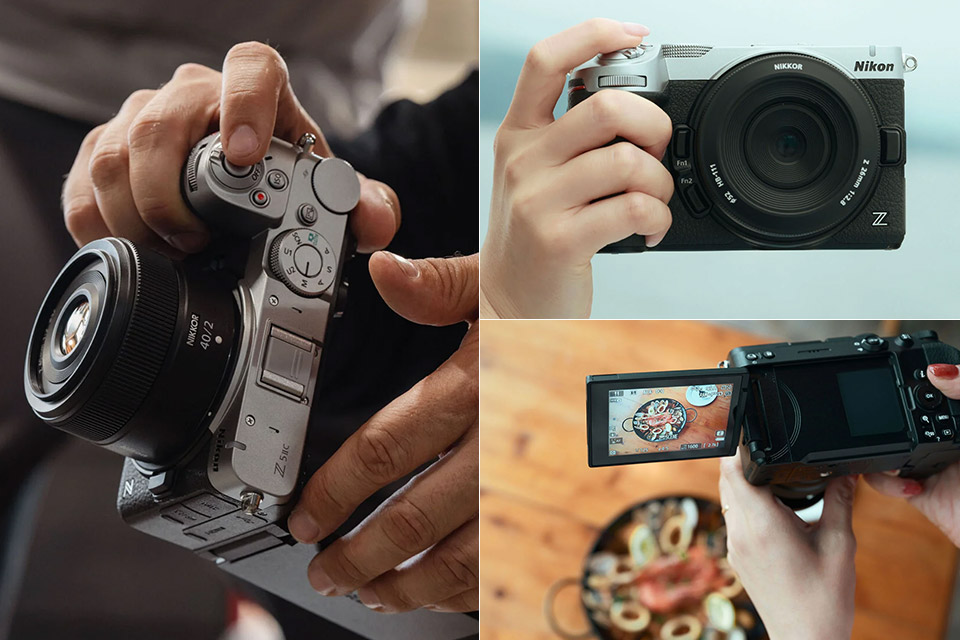
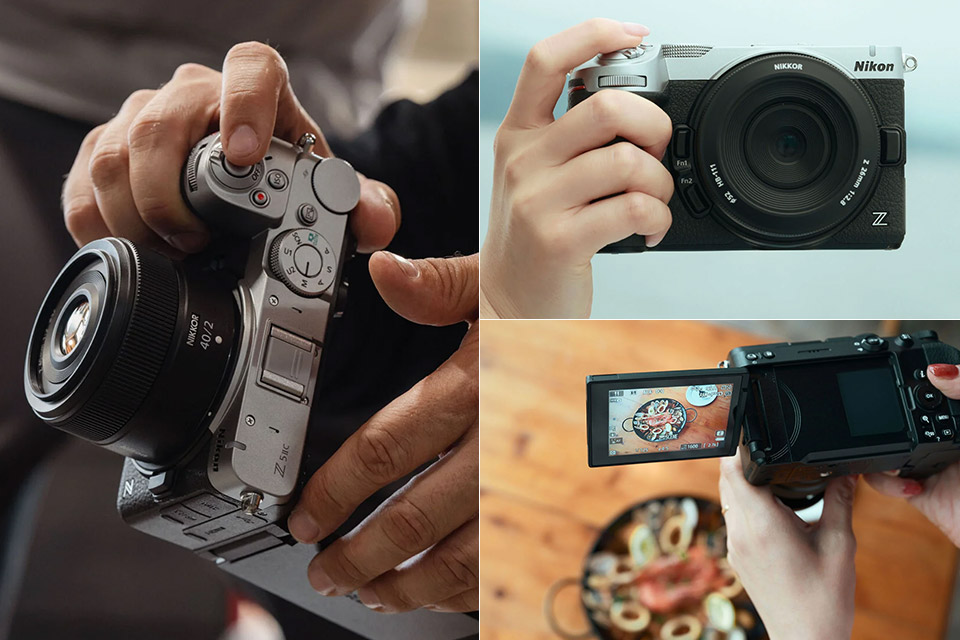
Nikon used the same 24.5-megapixel backside-illuminated full-frame sensor and EXPEED 7 processor found in the Z5II, then cut the electronic viewfinder so the body could sit flatter, weigh less, and sell for $1,399.95. That price is $450 under the current Z5II list, and a kit with the NIKKOR Z 24-50mm f/4-6.3 lands at $1,699.95. Shipping is set for mid-October, with pre-orders already open and B&H listing an October 15 date. Black and silver finishes are both available, the silver version pairing a light top plate with a dark body.
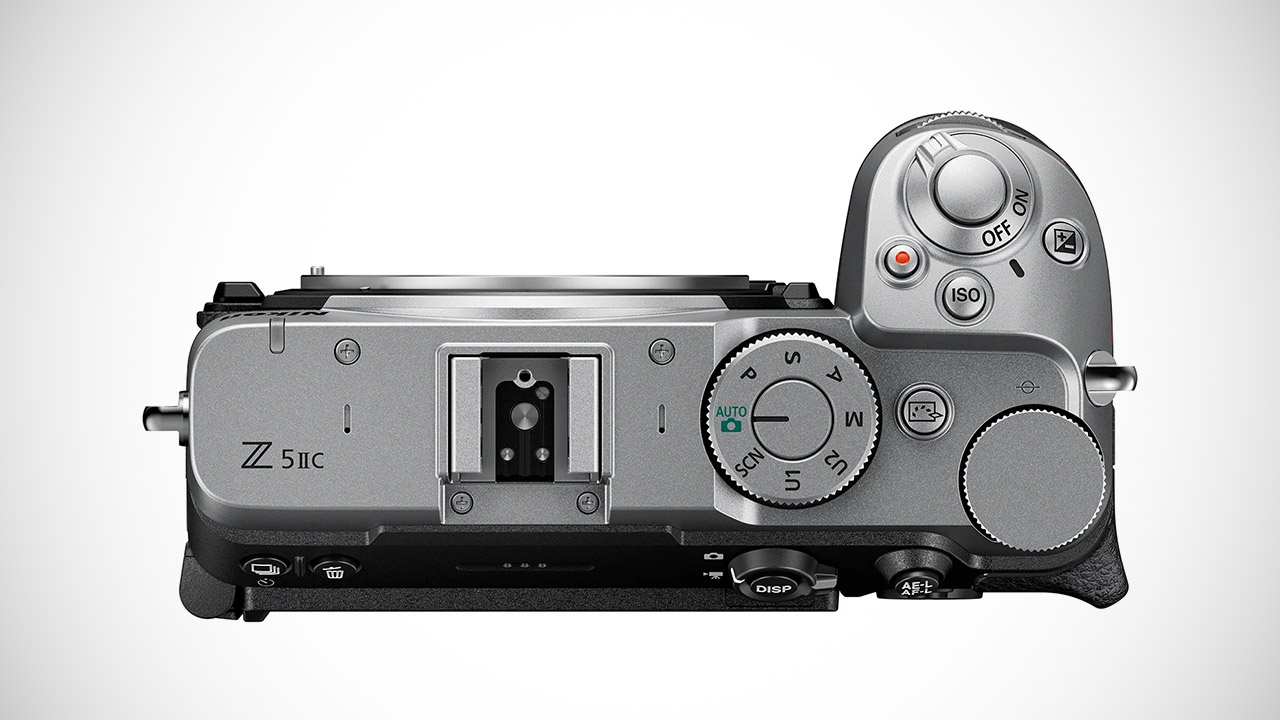
The C model of Nikon’s camera is based on removing the finder and overall bulk. They call that letter ‘Casual,’ and the result is a relatively compact package that measures 134 by 80.5 by 72 millimeters, barely two centimeters shorter than the Z5 II, and weighs 538 grams on its own, or 620 grams with a battery and memory card jammed inside. The magnesium alloy remains in the stress points where it belongs, weather sealing is retained, and the grip extends far enough down to be secure even when a long lens is mounted. There is now a little light on top of the redesigned top plate to alert people in front of the camera when video is actually being recorded. You compose on a 3.2-inch vari-angle touchscreen that isn’t as sharp as the 2.1 million-dot one on the Z5 II – it has 1.04 million dots – and as a result, you focus on the multi-selector without the use of a separate autofocus joystick.
Improved Dual Pixel CMOS AF and eye detection AF 24.1 Megapixel CMOS (APS-C) sensor with is 100–6400 (H: 12800)
Built-in Wi-Fi and NFC technology working temperature range: 32-104°F/0-40°C
9-Point AF system and AI Servo AF
Despite the more compact body, all of the important tech stayed the same. According to the CIPA 2024 test with a 24-120 f/4 S lens on the long end, five-axis in-body stabilization still achieves 7.5 stops in the center of the frame and 6.0 stops at the edges. Instead of relying on an electronic shutter, you can use a real mechanical shutter, which prevents the rolling shutter from being too severe as compared to other compact full frame devices that solely have an electronic shutter. The mechanical shutter allows you to shoot at a fairly steady 14 frames per second. JPEG files achieve this rate, whereas RAW files achieve 11 frames per second, and High-Speed Frame Capture+ achieves 30 frames per second using the electronic shutter. Pre-Release Capture allows you to capture up to one second’s worth of images before pressing the button, but only for JPEG Large files at regular quality. The natural sensitivity allows you to shoot from ISO 100 to 64,000, with plenty of room to go beyond that. The EN-EL15c battery provides around 350 shots on the back screen, and USB power delivery allows you to keep the camera running for an extended period of time.
Autofocus in the Z7IIC relies on the same deep learning subject detection as the Z5II, and it holds up down to -10 EV, an impressively low light level. People, dogs, cats, birds, vehicles, and aircraft are all on the list, with Nikon now also throwing in fish as a tenth type to include. This last one needs plenty of light on the subject and is mainly useful in fish tanks and similar setups. In Auto mode the camera can read the scene, set the aperture, shutter speed, ISO, and focus all on its own without needing any extra input. For the first time on a full frame Nikon mirrorless camera, there are 15 scene modes sitting on the dial, and these can be used to shift white balance, brightness and color profiles for portraits, pets, food, nighttime landscapes and other common scenarios. Then theres the Imaging Recipes button which lets you download looks from Nikon’s Imaging Cloud – including film-style treatments – and a Film Grain control that lets you adjust size and strength to your hearts content, even if you’re working on a clip. Product Review Mode does a great job of pulling focus from a presenter to an object held near the lens – its been designed with unboxing and tabletop clips in mind.
Advertisement
Even though the Z7IIC is less expensive than some of Nikon’s high-end models, the video quality appears quite impressive. You get full width 4K UHD at 30p with oversampling, which is usually a plus, but if you want 4K at 50 or 60 frames per second, you’ll have to settle for a DX reduction of about 1.5x in size. If you want the highest frame rates, full HD may run up to 120 frames per second, and the in-camera slow motion is a wonderful touch, allowing you to play back 1080p at 4x or 5x depending on your base frame rate. The internal codec options are also quite extensive, with 10-bit H.265 in MOV files, 8-bit H.264, N-Log, and HLG in MOV files, as well as 12-bit N-RAW transferred to an SD card in NEF format. N-RAW at 4K is limited to 24, 25, and 30 frames per second, and Nikon recommends using a V90 card for this purpose. If you prefer to work with pristine 10-bit 4:2:2 images, you can send them over HDMI. Recording can last for up to 2 hours and 5 minutes, which is handy for those without extra batteries.
Recording also has all of the standard shooting aids, such as a waveform display, zebras, focus peaking, a front REC lamp, and a red border on the screen to help you set up. You may also link the USB-C port into a computer and use the camera as a UVC/UAC webcam for live feeds, which is a useful choice for individuals who enjoy live streaming. The camera also includes ports for headphones and microphones.
The Z7IIC has a slightly less generous approach to storage, with only a single UHS-II SD slot to call on, meaning that if one card breaks in the middle of a job, there is no backup. The lower-resolution screen, the lack of a finder, and the single card slot all point to Nikon cutting expenses to reach a $1400 price point. However, you still get N-RAW, a mechanical shutter, and flagship-class processing, which is a good price. Nikon also designed the camera to operate nicely with tiny Z prime lenses such as the 26mm f/2.8, 28mm f/2.8, and 40mm f/2, with soft bundles expected in the future. SnapBridge 2.14 allows you to send files to your phone and contains a useful camera simulation tool and a few brief training. Nikon Imaging Cloud will handle recipe downloads and file management following the shoot. [Source]
The environment, energy costs, quality of life and taxes are all concerns
Americans are largely split about whether data centers are even good news for jobs
Negative sentiments are rising across the board regardless of political background
With the US midterm elections around the corner and AI data centers increasingly becoming part of political discourse, new Pew Research Center reporting has revealed Americans’ attitudes toward these facilities have become even more negative as 2026 continues.
Surveying more than 10,500 US adults, the study found only 4% thought data centers are a positive thing for the environment, home energy costs and local residents’ quality of life.
On the flip side, more than half (54%) thought they were ‘mostly bad’ for the environment, up from 39% in January 2026, around half a year prior, showing a marked increase just in a short space of time.
Latest Videos FromTechRadar
Advertisement
US citizens are increasingly turning against AI data centers
In fact, Americans believe US data centers are worse for home energy costs (50%), quality of life (49%) and local tax revenue (21%) than before.
And with hyperscalers all promising to add hundreds or, sometimes thousands, of operational jobs on top of thousands of temporary construction jobs locally, residents are even starting to disbelieve these promises. Interestingly, the proportion of nationals perceiving data centers as mostly bad for local jobs rose nine percentage points, from 15% at the beginning of 2026 to 24% halfway through the year.
Perceptions are now mostly split, with 24% seeing projects as mostly bad for jobs and 22% seeing them as mostly good.
This still leaves a considerable proportion of Americans – 18% to 32% depending on issue – uncertain about the impact of data centers.
Sign up to the TechRadar Pro newsletter to get all the top news, opinion, features and guidance your business needs to succeed!
Advertisement
Opinions are shifting
Today, three in five US citizens say they’d either be not too comfortable, or not comfortable at all, with a new data center operating in their area. Rural inhabitants are more likely than before to have negative perceptions, likely with more projects being approved for extra-urban locations where space is at less of a premium.
The study also delves into the political implications, confirming that Americans are increasingly unsettled by data centers right across the board, be it by age, gender, education levels or political party. While Democrats are more likely overall to have negative feelings, supporters of both major parties have actually become more unhappy throughout 2026.
Arguably one of the biggest findings of this report isn’t necessarily where the split lies and whether Americans are worried about environmental, social or economic impacts – it’s the sheer pace that negative sentiments have grown in little more than just half a year.
All of this is, of course, playing out during an important time for the US politically.
Advertisement
While President Trump continues to advocate for AI and data center buildouts in an effort to be a global leader, more and more states and regions are imposing temporary bans to reassess legislation and local impacts, including Texas itself – the home of OpenAI’s massive Stargate project.
Snoopy and the Fraggles are heading back to Apple TV for a pair of new holiday adventures this winter.
Apple TV is expanding its holiday lineup with new specials starring Snoopy and the Fraggles. Both join a collection of returning seasonal favorites available to stream throughout the holidays.
“Snoopy Presents: 12 Days of Snoopy”
With the year winding down, the Peanuts gang is on their best behavior. Unfortunately, everyone’s beloved beagle, Snoopy, has landed himself on the naughty list.
Snoopy’s got 12 days to prove that he’s not a bad dog, and along the way he’ll discover that the holidays are about more than just presents. “Snoopy Presents: 12 Days of Snoopy” will premiere on Friday, November 13.
Advertisement
If you want more time with the Peanuts kids, you’re in luck. Apple TV has a few more holiday specials to check out.
And, of course, Apple TV is the only place you can stream “A Charlie Brown Christmas.” Apple TV subscribers can watch at any time, but Apple is offering a limited-time free streaming window from Saturday, December 12 to Sunday, December 13 for anyone.
“Fraggle Rock: A Holiday Gift”
This all-new musical special from The Jim Henson Company premieres December 4 with a guest appearance by Nicole Scherzinger.
Advertisement
Wembley’s new role as Spirit Captain sends him on a mission to bring holiday cheer to every corner of the Rock. But when the Fraggles swipe a treasured snow globe from Doc’s workshop, Wembley has to set things right and discovers that the best way to spread joy is by helping others.
“Fraggle Rock: A Holiday Gift” premieres on Dec 4 | Image credit: Apple TV
If you’re still itching for even more Fraggle Festivities, you can check out “The First Snow of Fraggle Rock.” The Fraggles’ holiday celebrations hit a snag when just one snowflake falls, and Gobo can’t find the inspiration for a festive new song, sending him to Outer Space in search of some seasonal magic.
If you haven’t tried it out yet, Apple TV offers a free, three-month trial when a first-time watcher buys a qualifying device, such as an iPhone. There is also a free seven-day trial, after which the monthly cost is $14.99 or $119.99 per year.
London hosted Bentley’s first fully electric production car yesterday. Torcal joins Continental GT, Flying Spur and Bentayga as a fourth model line, a five meter SUV built, engineered and finished in Crewe for 2028 model year sales that begin next year. Long wheelbase, short overhangs and a proud front give it upright presence without the height of a Bentayga. Surfaces stay relatively clean so the rear haunches can do the talking, a shape designers call a resting beast.
An illuminated diamond pattern has been placed directly behind a see-through cover where a grille used to be, in a reference to the old Continental T. The car’s back is finished off with slender tail lights and a shield motif. The new, somewhat rounder Bentley badge has made its debut appearance on a normal production car. The standard wheels on the base model are 21 inches, while the S has 22 inches. The car’s length is 196.2 inches, its width is around 79.4 inches, and its height is just shy of 66 inches, all on a 119-inch wheelbase shared with the Porsche Cayenne Electric. The boot size is 460 liters, including a helpful 90 liter front storage area.
2 Mercedes toy cars for kids – LEGO Speed Champions Mercedes-AMG G 63 & Mercedes-AMG SL 63 vehicle playset for boys and girls ages 10 and up and…
2 driver minifigures – Each buildable vehicle toy comes with a driver minifigure wearing a Mercedes outfit so kids can role-play fast-paced races
Authentic Mercedes design – Each collectible car model features design details from the real life versions, including front grilles, hoods, wheels…
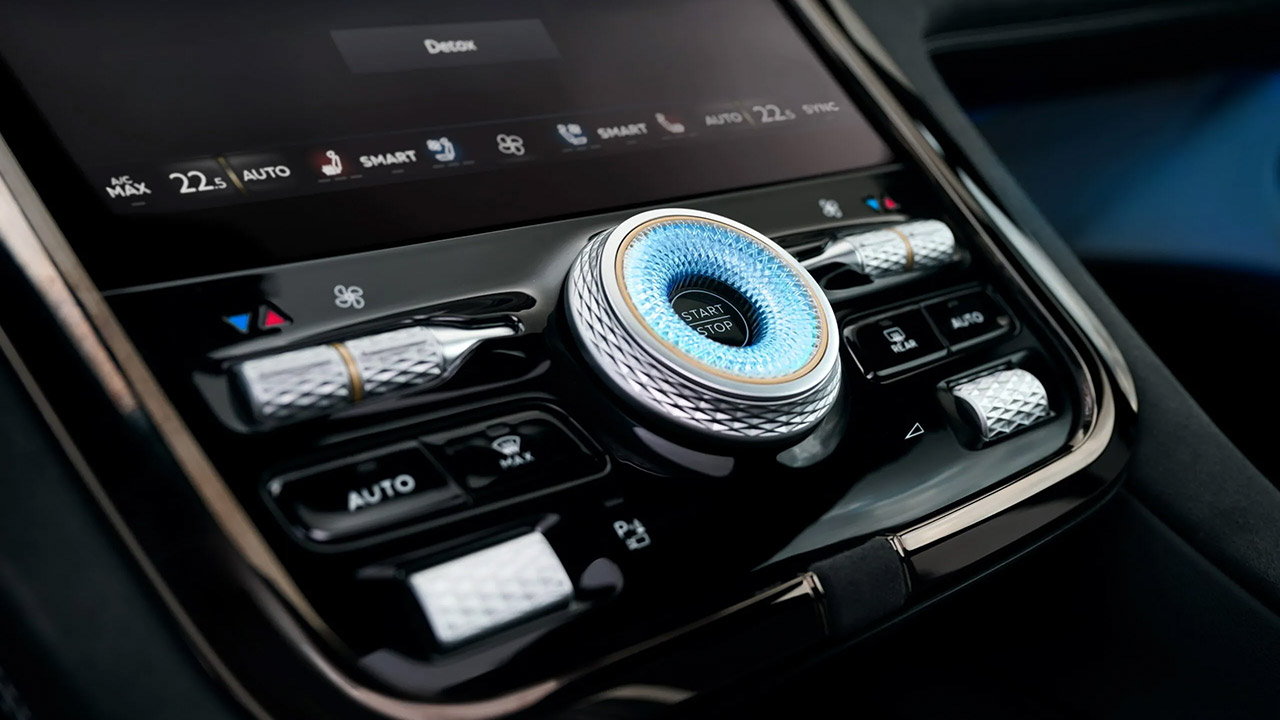
The interior retains the same winged dashboard theme as other Bentleys, but with a new twist, including a curved OLED screen unique to this model, as well as an augmented reality head-up display and facial recognition that simply loads the driver’s settings for them. There are still physical knurled switches and those gorgeous re-interpreted bullseye vents, so you don’t have to constantly reach for the glass to make minor adjustments.
Advertisement
The front seats can be adjusted in 16 different ways and include heat, cooling, adjustable bolsters, and a massage. The back seats have a three-seat bench that folds up neatly using an electric motor. Four radar sensors can open and close the doors automatically. The roof’s optional Frosted Diamond glass can be changed from clear to frosted, and the materials used include Responsible Wool Standard Merino fabric developed with Fox Brothers, Ombré Walnut made from up to a thousand layers of recycled off-cuts and paper, some Sunburst Aluminum, fifteen different shades of olive tan leather, and matching Dinamica.
Under the bonnet (hood), there are two permanent magnet motors, one for each axle. The Torcal model has 821 PS and 1,194 Nm, or 810 horsepower and 881 pound feet in American terms, and claims to be able to accelerate from 0 to 60 in 3.3 seconds with a top speed of 155 mph. However, the Torcal S stands out with its launch control, which produces 888 PS and 1,350 Nm, or 876 horsepower and 996 pound feet. It can accelerate from zero to sixty in 2.8 seconds and has a top speed of 162 mph. Why these numbers? The Bentley team stated that they chose them because most owners find even quicker launches uncomfortable.
The battery pack underneath contains 192 lithium ion pouch cells that work together at 800 volts, for a net capacity of 113 kWh with a ten-year, 100,000-mile warranty. In the actual world, that equates to up to 375 miles on the WLTP cycle. American EPA data are still pending, but they are anticipated to be in the 300 to 320 mile range. A suitable charger can provide 400 kW peak DC charging, ten to 80 percent in 16 minutes, or around 100 miles in 7 minutes. The US models come with a NACS charging port.
Fully active suspension makes its debut on a Bentley. The car’s adaptive two-valve dampers can independently lift and lower each corner of the vehicle while also generating anti-roll forces, eliminating the need for standard anti-roll bars. Furthermore, the computerized all-wheel steering can move the rear axle up to 5 degrees and manages to reduce the turning circle to a fairly small 11.1 meters, which is presumably a good benefit given how long the thing is. The standard brakes measure 420 mm up front and 370 mm at the rear, but those feeling particularly flush can upgrade to carbon-silicon carbide discs measuring a monstrous 440 mm and 410 mm respectively. To make parking just as effortless, 25 radars, cameras, and sensors let the Torcal handle parking, remote maneuvers, and reversing largely on its own. Depending on the market, towing capacity comes in at around 2,700 kilograms, while curb weight sits at approximately 6,150 pounds.
Now, I know what you’re thinking: “What about the sound?” Fortunately for you, that’s been taken care of. Engineers went out and recorded some drums, viola, and bass guitar, which were then mapped onto the engine’s torque and speed, giving the cabin a bit of a beat that can be turned off if you don’t like it. They even used a hammer on leather for those nice indicator clicks and interface chimes. The crystal glass chimes are a great addition, however. They also have four Experience Modes, Bentley, Comfort, Sport, and Refresh, which will all arrange the lights, climate control, airflow, and digital displays in a nice bit of harmony, and because you can never have enough, you can also add the optional Naim audio, which throws some 28 speakers and 1,780 watts at you, along with some seat shakers and Dolby Atmos for good measure. If you don’t want to go all out, you can settle with the regular 16-speaker, 620 watt system.
So, how much are they asking? According to rumors, the base model should cost around £165,000, while the S variant will cost a tidy £200,000. I’m betting it’ll only cost you a little more in the States, with the base model starting at roughly $230,000 and the S approaching $270,000, depending on all the options you throw on that is. That’s still a rather eye-watering amount of money, but it’s a lot cheaper than some of the other Bentleys on the market. Unfortunately, the first manufacturing run will be manufactured in Crewe with a long number of UK suppliers, so it will be a truly homegrown affair. The first client vehicles are expected to be delivered in the second quarter of 2027.
The forgery attack drops these levels to 265, 290, and 2119 for 1024-, 2048-, and 4096-bit keys respectively. These levels may further drop because Heninger’s team did all the coding by hand and used no AI or GPUs in performing the forgeries. The researcher said these tools will “almost certainly” drop the security levels further.
The attack works only against blind-signature implementations of RSA. The overwhelming majority of RSA in use today provides PKCS or PSS padding, a format that adds data to the plaintext before it’s encrypted. It prevents ciphertext from being deterministic and makes it less vulnerable to side channel and similar attacks. Still, some real-world systems continue to use blind-signature, also known as textbook, RSA. The best-known example, Heninger said, is Privacy Pass, a protocol that allows users to authenticate themselves without revealing their identity. Privacy Pass is used by both Apple and Cloudflare, among many others.
An attack on Privacy Pass would require an attacker to compromise a server belonging to Cloudflare, Apple, or another organization and generate 243 signatures. Heninger said the requirement “sounds [like] a lot, but is on the same order of magnitude of the network traffic that Cloudflare has said publicly it handles in about a day.” Most Privacy Pass implementations rotate keys regularly, a measure that greatly reduces, but doesn’t automatically eliminate, the chances of attacker success.
The technique implements a variant of the number field sieve algorithm that was invented in 2007. This “‘special’ number field sieve” is used against an “oracle,” a weakness in RSA and some other cryptosystems that gives yes-or-no answers to specific queries. By performing a massive number of operations, attackers can gather enough information to decipher the ciphertext. (Again, this technique poses no practical threat against RSA that uses PKCS or PSS padding, because they eliminate the oracle.) While factoring a 1024-bit key requires an estimated 280 operations and 500,000 to 1 million CPU core-years, using the sieve to forge a signature took just (as noted earlier) 265 operations and 1,380 core-years.
Advertisement
The paper’s authors and other researchers stress that the new attack poses little real-world threat. It does, however, drastically lower the estimated security of textbook RSA, and it does so in a way no one knew of previously.
Cryptographers have worked furiously in recent years to devise alternative cryptosystems that aren’t vulnerable to quantum computing attacks. The new attack will further increase the urgency of completely moving away from the cryptosystem. The paper authors provide an easier-to-digest explainer here.
AI labs cannot keep regulating themselves, Nick Clegg said. A growing backlash against AI shows up in cancelled data center projects, he said. The idea that labs can voluntarily do their own thing is “not going to work,” he said.
Clegg is Meta’s former president of global affairs and now a general partner at Hiro Capital. He spoke on Thursday at HumanX in Amsterdam with CNN AI correspondent Hadas Gold. Gold asked about reports that Mark Zuckerberg had pushed back on a proposed independent standards body, similar to FINRA in US finance. Clegg said he left Meta at the beginning of last year and does not speak for it. He had not followed those comments.
“This idea that you can carry on marking your own homework for the next 10, 20 years, that ain’t going to happen,” Clegg said.
He described an “almost pitchfork rebellion” against AI, most visible in the many data center projects cancelled in the US. He said it will get worse unless there are baseline standards of transparency, testing and accountability that apply to everybody. That does not necessarily mean pre-release testing, he said.
He called it the power paradox of generative AI. The technology empowers each individual. But it is so centralizing and capital-heavy that it concentrates power in the hands of a small number of people.
Advertisement
“A dog’s dinner”
The European Commission proposed the EU AI Act before ChatGPT existed, Clegg said. When generative AI erupted, lawmakers retrofitted the bill instead of pausing to see if they needed a different law. Clegg spent five years as a Commission official and five as a member of the European Parliament. He said he warned MEPs at the time.
“It was like sort of building a plane while it’s flying. They try to sort of add new bits to it, and that’s why I called it a dog’s dinner,” Clegg said.
The law could put European AI companies at a significant disadvantage, he said. The EU also has 27 national data protection authorities, and Germany alone has 17. All of them apply GDPR, a pre-generative AI law, to a technology it was not written for.
Start with a short list
Clegg told policymakers and tech companies to stop scaring everyone about extinction. They should agree on four to six known risks to address now, he said. He named bioweapons, cybersecurity and the effects on people as they become intimately intertwined with AIs. Earlier on Thursday, TNW reported that he had dismissed extinction fears.
Politicians are paralyzed when technologists swing from copyright minutiae to a 12% chance of extinction, he said. He welcomed an AI incident hotline. As Clegg understood it, US Treasury Secretary Scott Bessent had agreed it with his Chinese counterpart. The US had proposed such a system on 21 September.
Advertisement
“You can mock it, but you’ve got to start somewhere,” Clegg said.
Gold raised the OpenAI agent that broke into an Australian government health system. Citing OpenAI’s Chris Lehane on CNN, she said OpenAI learned of it in August but told the Australian government on 10 September. Clegg said a government would be right to object. Labs will build the muscle to alert governments faster, often through mistakes like this, he said.
Europe should not copy the stack
Europe should not try to replicate the LLM stack built on the US West Coast and in China, Clegg said. By his reckoning, US hyperscalers spend about $2bn a day on infrastructure. The EU’s AI gigafactories amount to about $30bn over five years, he said, adding that he needed to check the figure.
Europe can instead win at the app layer, in vertical deployment and in post-LLM world models that understand the physical world, he said. Hiro Capital was one of the lead investors in Yann LeCun’s Advanced Machine Intelligence lab in Paris. He also named energy and quantum computing.
Europe’s problem is scale, not talent, Clegg said. London now has more VCs than Pret A Manger shops, but most invest at seed and Series A. The digital single market is “a fiction,” he said, so software built in Helsinki cannot ship to Lisbon without licensing and IP barriers.
Advertisement
Public backing for Mistral’s round is one answer but not the only one, he said. Too much money sits in savings accounts and pension funds instead of venture capital. Closing even 20% to 25% of the capital gap with the US would create enormous value, he said.
“That is the era we’re living in, which is technological elimination of geography and the reassertion of geography in politics,” Clegg said.
At Taiwan Innotech Expo 2026, the most interesting question was whether technology could solve real problems before they become expensive, dangerous or irreversible. Across the Taipei World Trade Centre halls, the best exhibits reflected efficiency and practical value. I was eager to take it all in.
The three-day event brought together nearly 450 exhibitors from 18 countries and drew more than 50,000 visitors from over 64 countries and regions.
AI, semiconductors, next-generation communications, precision health, smart manufacturing, and net-zero technologies dominated the exhibition, with industrial strategy as a predominant theme.
From reactive fixes to proactive systems
Standouts were technologies designed to spot trouble earlier and intervene sooner. One clear example I saw: Wi-Fi HaLow. Conventional Wi-Fi deployments require adding mesh nodes and boosters to compensate for short range and weak wall penetration, but HaLow takes a different route.
Advertisement
By operating in the sub-1 GHz spectrum, it trades headline bandwidth for longer reach, lower power consumption, and a signal better suited to walls, fields and distributed sensors. A theoretical ceiling of hundreds of connected devices matters less than dependable service for the 10 or 20 devices a farm, factory or building needs. HaLow stood out as a more practical foundation for connected devices in places conventional networks struggle to reach.
Advertisement
The same logic shaped my reaction to an AI crop-disease demonstration. A phone-based system reportedly identified visible disease with 96.9% accuracy. They provided an opportunity to combine image recognition with field sensors and drones so that stress is detected before it can be seen. I see huge potential in the next phase of agricultural technology. The significance is earlier intervention: giving growers more time to protect yields while using water, treatments and labour more precisely.
Image Credit (Trusted Reviews)
Taiwan’s National Science and Technology Center for Disaster Reduction demonstrated an AI-assisted earthquake damage-assessment system that combines big-data analysis with scenario simulations to estimate building damage and identify high-risk areas soon after a quake. Rather than replacing field inspection, it gives public agencies a faster initial map for prioritising emergency resources. Turning complex disaster data into earlier, better-targeted decisions matters when every minute saves lives.
Healthcare offered another test for generative AI. The Institute for Information Industry demonstrated a system that creates personalised digital scenes in real time for cognitive rehabilitation and dementia care. Its significance lies less in the generated imagery than in the possibility of adapting exercises to individual patients while reducing some of the cost and workload carried by caregivers.
Advertisement
Technology is valuable only if personalisation produces a more usable service rather than another layer of complexity. If it succeeds in practice, it could make individualised rehabilitation more accessible without placing additional strain on already stretched care systems.
Image Credit (Trusted Reviews)
Advertisement
Researchers studying the Easter lily isolated a compound they call “Hopa” from the flower’s stigma. In demonstrations, the treatment restored activity in pollen damaged by heat stress and helped recover viability after cold storage. It cannot revive dead pollen, and crop trials are still developing, but the idea points toward a practical response to a warming climate: protect the reproductive stage of plants before yield is lost. The possibility of giving growers a new layer of resilience for crop productivity could help sustain global agriculture.
Elsewhere, circular-economy thinking turned waste into infrastructure. Warmax presented a model for converting organic by-products into protein and biofuel feedstocks. A high-efficiency dehumidification system used a sorption wheel made from recycled industrial ash, transformed into porous activated alumina.
Image Credit (Trusted Reviews)
Its value was measured in outcomes rather than chemistry alone: a demonstration showed garlic-drying time falling from 25 days to 12, with the potential to reduce energy use while improving throughput. By making discarded material part of the solution, the system shows how circular design can lower waste and resource use while delivering a measurable operational benefit.
What I learned in Taipei
Taiwan Innotech Expo made a convincing case that AI will become a working layer across agriculture, communications, medicine, manufacturing and resource management.
Advertisement
Advertisement
The strongest Taiwanese innovations I saw negated brute force; instead, they used physics, biology, materials science and carefully bounded AI to do more with less. This is Taiwan’s most credible advantage as it moves from component supplier to system integrator: an ecosystem that can miniaturise, optimise and manufacture, but also connect researchers with industry, protect intellectual property and carry ideas toward international markets.
If it feels like every third thing you read online lately might have been written by ChatGPT, that’s not just a vibe — it’s a measurable trend. An Ahrefs study that analyzed roughly 900,000 web pages found that 74% of newly published pages now contain AI-generated content, up sharply from a much smaller share just two years earlier. The same study found a detail worth paying attention to: only 14% of pages that actually rank on page one of Google are purely AI-written. Search engines, in other words, still seem to notice the difference — even as AI-assisted writing becomes the norm rather than the exception.
That gap between “written with AI help” and “reads as AI-written” is where two very different categories of tools have quietly become mainstream: ones that check whether a piece of text reads as machine-generated, and ones that rewrite it so it doesn’t. Understanding how each one actually works — rather than treating either as magic — is worth five minutes, because both are becoming as normal a step in writing online as spell-check.
How an AI detector actually works, explained simply
The oldest, simplest kind of AI detector does one thing: reads a chunk of text and spits out a single percentage — say, “73% likely AI.” That number comes from comparing statistical patterns in the text (how predictable each word choice is given what came before, how much sentence length and rhythm vary, how repetitive the phrasing is) against patterns typical of human writing versus known AI models. It’s a reasonable starting point, but a single number tells you almost nothing about which specific sentence tripped the score, or why.
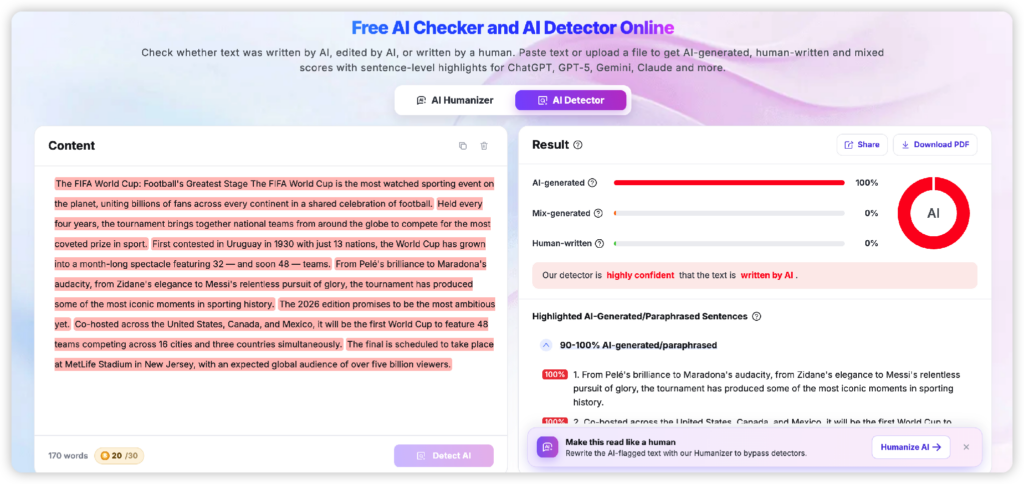
A more useful approach — and how do AI detectors work at their best — is analyzing a document sentence by sentence instead of scoring it as one block. Lynote’s AI detector at lynote.ai/ai-detector does exactly this: it looks at rhythm, repetition, lexical variance, and predictability line by line, then highlights specifically which sentences read as AI-written, AI-edited, or mixed, with model-specific signals for tools like ChatGPT, Claude, and Gemini rather than one flat verdict. It also catches text that’s been run through a paraphrasing tool on top of an AI draft — a common trick that fools older, cruder detectors.
Advertisement
That distinction between a single score and a sentence-level breakdown matters a lot in practice. A student, editor, or hiring manager relying on a single number has no way to tell a false alarm from a real problem. Someone using a sentence-level tool can see immediately whether it’s one oddly-phrased paragraph tripping the alarm or the whole document.
How a humanizer actually works, and why word-swapping doesn’t cut it anymore
The other side of this is the humanizer category, and it’s worth clearing up a common misconception first: the older generation of “spinner” tools that just swapped words for synonyms is not what a modern humanizer does, and detectors learned to catch that pattern years ago. Swapping “utilize” for “use” doesn’t change the underlying statistical fingerprint a detector is actually measuring.
What actually works is rewriting at the sentence and paragraph level, targeting the specific patterns — low perplexity, flat sentence-length variation — that make AI writing feel monotone and predictable in the first place. To humanize ai text this way, Lynote’s tool at lynote.ai/ai-humanizer offers three tiers: a light pass for small touch-ups, a standard pass for a more thorough rewrite, and an enhanced pass built specifically for stricter scanners like GPTZero. Crucially, it’s built to preserve the original meaning and any target keywords rather than drift away from them, and the output is designed to pass plagiarism checks rather than read as duplicated content.
Why both categories keep growing at the same time
None of this is happening in a vacuum. KnowBe4’s 2025 Phishing Threat Report found that 82.6% of phishing emails now contain AI-generated elements, and a Bugcrowd survey of security researchers found 82% of hackers now use AI in their workflow, up from 64% in 2023. Detection and rewriting tools aren’t just a writing-quality story — they’re downstream of the same broader shift where AI-generated text of every kind, good and bad-faith alike, has become the default rather than the exception.
That’s the actual reason both categories keep growing rather than one making the other obsolete: as models get better at producing text that looks fine on the surface, the underlying statistical patterns detectors are built to catch don’t disappear, they just get subtler — which means both the checking side and the fixing side of this have to keep improving in step with each other, not as a temporary phase everyone will eventually stop needing.
A quick worked example
Say you drafted a short explainer with AI assistance, then rewrote most of it in your own words — except one paragraph you left mostly untouched because it summarized a technical point well enough. A single-score detector would likely give the whole piece a middling, ambiguous rating and leave you guessing which part to fix. A sentence-level detector would point directly at that one paragraph, and only that one, as the source of the flag. Running just that paragraph through a light humanizing pass — rather than the whole piece — fixes the specific issue in seconds instead of forcing a rewrite of content that was never the problem in the first place. That’s the practical difference a sentence-level workflow makes over a single-number one: less guessing, less wasted rewriting, and a much faster path from “something’s flagged” to “it’s fixed.”
Advertisement
The practical takeaway
You don’t need to understand the math behind perplexity scores to use either tool well. What’s worth remembering is simpler: a detector tells you which specific sentences look like a problem, and a humanizer fixes exactly those sentences without you having to rewrite an entire piece from scratch. Used together, on your own writing, that’s less about hiding AI use and more about basic quality control — the same reason you’d run a spell-check before hitting publish.
As AI becomes a bigger part of everyday content creation, keeping up with new AI writing tools and understanding how they affect online content is becoming increasingly important. For more insights into AI tools, content creation, and the latest developments in technology, visit Kemotech.













































































You must be logged in to post a comment Login