OpenAI on Monday began emailing more than 8,000 developers who applied for its invite-only GPT-5.5 party with a surprise consolation prize: a tenfold increase in Codex rate limits on their personal ChatGPT accounts, effective immediately and lasting through June 5.
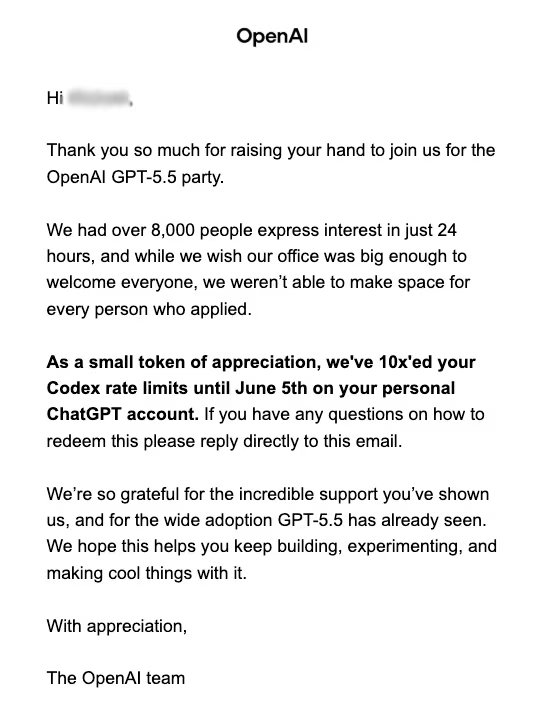
“We had over 8,000 people express interest in just 24 hours, and while we wish our office was big enough to welcome everyone, we weren’t able to make space for every person who applied,” the company wrote in the email, which VentureBeat obtained. “As a small token of appreciation, we’ve 10x’ed your Codex rate limits until June 5th on your personal ChatGPT account.”
The gift is not limited to the lucky few who scored invitations to the party itself. Everyone who raised their hand — whether they were accepted, waitlisted, or turned away — received the rate limit boost, according to the email and confirmed by multiple recipients on social media.
CEO Sam Altman telegraphed the move on X shortly before inboxes started lighting up. “We are gonna do something nice for everyone who applied for the GPT-5.5 party and that we didn’t have space for,” he wrote. “Hope you enjoy!” The post amassed more than 521,000 views within hours.
Advertisement
What a month of supercharged Codex access actually means for developers
The practical implications are huge. Codex, OpenAI’s AI-powered coding agent, operates under daily usage caps that vary by subscription tier. A tenfold increase to those caps gives developers dramatically more room to prototype, debug, and ship code using GPT-5.5 — which OpenAI says matches GPT-5.4’s per-token latency while performing at a higher level of intelligence and using significantly fewer tokens to complete tasks.
The 31-day window is generous enough to reshape habits. By flooding thousands of developers with expanded access during a critical adoption period, OpenAI is effectively subsidizing the kind of deep, sustained usage that turns a curious trial into a daily dependency. It is a bet that once developers experience Codex at full throttle, they won’t want to go back — and that when the limits reset on June 5, a meaningful number will upgrade their subscriptions to preserve the workflow they’ve built.
An email sent to developers who applied for OpenAI’s invite-only GPT-5.5 party in San Francisco. Applicants who didn’t receive an invite were offered 10x Codex rate limits on their personal ChatGPT accounts through June 5 as “a small token of appreciation.” More than 8,000 people expressed interest within 24 hours, according to the email. (Image: Screenshot provided to VentureBeat)
The developer community responded with a mix of glee and regret. “I’m literally not taking my Codex hat off for the month,” one developer declared on X. Others kicked themselves for not signing up. “That’s the last time I don’t sign up just because I’m not in SF,” one wrote.
Advertisement
Several users raised a question OpenAI has yet to answer publicly: does the boost stack with the existing Pro $200 tier’s 20x multiplier? One user reported that OpenAI support said no — users get whichever limit is higher, not a combined total. “The key question isn’t whether the 10x boost is only for party applicants,” they wrote. “It’s whether it stacks with Pro.”
OpenAI did not immediately respond to a request for comment on whether the boost stacks with Pro-tier limits.
Inside the low-key meetup that an AI planned for itself
The rate limit gift is a sidecar to the main event: “GPT-5.5 on 5/5,” an invite-only gathering running tonight from 5:55 p.m. to 8:55 p.m. PDT at an undisclosed San Francisco venue. OpenAI billed the evening as “a low-key meetup with Sam and the team behind GPT-5.5,” promising food, drinks, community, giveaways, and swag — not a product announcement. Even the address remained secret until invitations were confirmed — a touch of exclusivity that generated its own buzz.
In a detail that doubles as a product demo, Altman revealed that GPT-5.5 itself planned the party. The model proposed the May 5 date, suggested that human developers give the toasts rather than the AI, and recommended setting up a suggestion box for the next-generation model. Altman described this as “weird emergent behavior.” Registrations closed shortly after opening due to overwhelming demand, with Codex handling the selection process.
Advertisement
Altman also extended an unlikely invitation. He publicly asked Elon Musk to attend, saying, “He can come if he wants… the world needs more love.” The gesture arrives amid Musk’s ongoing lawsuit against OpenAI seeking up to $150 billion in damages — a fact that makes the invitation read less like diplomacy and more like performance art.
Anthropic’s competing reception turns a scheduling overlap into a Silicon Valley spectacle
Here is where the story gets interesting. VentureBeat has confirmed that Anthropic is hosting its very own invite-only event in San Francisco on Tuesday evening — a “Media VIP Welcome Reception” at nearly identical times to OpenAI’s party. The reception serves as a warm-up for Anthropic’s Code with Claude developer conference, the company’s second annual gathering focused on its API, CLI tools, and Model Context Protocol (MCP). The conference proper takes place tomorrow.
The scheduling overlap is difficult to dismiss as coincidence. Both companies are hosting developer-focused events on the same evening, in the same city, targeting many of the same people. Whether this was deliberate counter-programming or genuine coincidence, the optics neatly capture where things stand in the industry’s most consequential rivalry.
Anthropic’s conference will feature its executive and product teams discussing Claude Code, agent implementation strategies, and the product roadmap — all squarely aimed at the same developer audience that just received a month of free Codex upgrades from OpenAI.
Advertisement
How Anthropic overtook OpenAI in revenue — and what it means for the coding wars
The dueling cocktail hours are a social manifestation of a far more consequential battle playing out in revenue, developer adoption, and investor confidence — one that has tilted sharply in Anthropic’s favor.
According to Counterpoint Research data, Anthropic surpassed OpenAI for the first time in global LLM revenue market share in Q1 2026, capturing 31.4% compared to OpenAI’s 29%. But the headline near-tie obscures a dramatic structural divergence. Counterpoint estimates Anthropic achieved that share with roughly 134 million monthly active users, compared to approximately 900 million for OpenAI — yielding average monthly revenue per active user of $16.20 for Anthropic versus $2.20 for OpenAI. OpenAI commands massive scale; Anthropic extracts roughly seven times more revenue per user. That gap is the central tension in this rivalry.
Anthropic led all large language model providers in revenue during the first quarter of 2026, claiming 31.4 percent of a $20.7 billion global market — narrowly edging out OpenAI, which held 29 percent despite having nearly seven times as many users. (Source: Counterpoint Research)
The enterprise shift has been building for over a year. Menlo Ventures — whose portfolio includes Anthropic — estimates the company now captures 40% of enterprise LLM spend, up from 24% the prior year and 12% in 2023, while OpenAI’s share fell to 27% from 50% over the same period. Anthropic has maintained an almost unparalleled 18 months atop the LLM leaderboards for coding, starting with Claude Sonnet 3.5 in June 2024. That dominance in code — AI’s first true killer app — has become the on-ramp to broader enterprise adoption and the engine behind Anthropic’s revenue acceleration.
Advertisement
The top-line numbers tell the rest of the story. Anthropic said earlier this month that its annualized revenue has topped $30 billion, up from $9 billion at the end of 2025, with more than 1,000 business customers now spending over $1 million annually — a figure the company says has more than doubled since February.
Sources familiar with Anthropic’s financials told TechCrunch the run rate is currently closer to $40 billion, driven largely by demand for Claude Code and Cowork. OpenAI, meanwhile, topped $25 billion in annualized revenue as of February, according to Reuters — but the Wall Street Journal reported that the company has recently missed its own projections for user growth and revenue, with CFO Sarah Friar warning colleagues that if growth doesn’t accelerate, the company could face difficulty funding future compute agreements.
The momentum has carried into fundraising at a pace that could redraw the industry’s power map. Anthropic raised $30 billion at a valuation of $380 billion in February. Bloomberg reported last week that the company has begun weighing a fresh funding round that would value it at more than $900 billion, potentially leapfrogging OpenAI as the world’s most valuable AI startup. OpenAI was valued at $852 billion in late March after closing a record-breaking $122 billion funding round. If Anthropic proceeds at the terms described, the company would not only more than double its valuation but would also surpass OpenAI — a reversal that seemed unthinkable six months ago.
Two parties, two visions, and one city at the center of the AI industry’s defining rivalry
For the 8,000-plus developers who applied for the GPT-5.5 party, the immediate value is straightforward: a full month of dramatically expanded Codex usage, free of charge, during a period when both companies are shipping at a breakneck pace. For the industry, the signal is harder to miss. The two most valuable private companies in the world are competing for developer loyalty with a combination of free perks, invite-only parties, celebrity CEO engagement, and multi-billion-dollar enterprise ventures — all within the same 24-hour window, in the same seven-square-mile city.
Advertisement
The broader stakes extend well beyond cocktail napkins and rate limits. Both companies are barreling toward potential IPOs. Both are courting the same Wall Street backers for enterprise joint ventures. Both are racing to define how the next generation of software gets built — and by whom. The developers caught between them are, for the moment, the beneficiaries of a spending war that shows no sign of cooling.
Tonight in San Francisco, the Anthropic reception starts at 5pm. The OpenAI party starts at 5:55pm. VentureBeat will be at both. And somewhere between the two venues, 8,000 developers who couldn’t get into either room will be burning through their new rate limits — building the future with whichever model they opened first.
Michael Nunez is an editor at VentureBeat covering artificial intelligence. He is attending both the Anthropic Code with Claude Media VIP Welcome Reception and the OpenAI GPT-5.5 launch party tonight in San Francisco.
Integrity360’s Matthew Olney explains the ins and outs of IT and OT security, and the importance of having both secured.
From manufacturing lines and water utilities to transport hubs and energy plants, operational technology (OT) is a prime target for cybercriminals and nation-state actors.
As the lines between information technology (IT) and OT blur, understanding the difference between them and securing both effectively has never been more critical.
IT v OT security
IT securityis the practice of protecting an organisation’s IT assets, including computers, networks, and data, from unauthorised access, attacks and other malicious activity. It involves using a combination of technologies, processes and physical controls to ensure the confidentiality, integrity and availability of information. A key objective is to prevent threats like data breaches, malware and phishing.
Advertisement
OT security, on the other hand, protects the physical systems that keep operations running – machinery, control systems and critical infrastructure. Here, priorities shift: availability and safety come first, because downtime doesn’t just cost money; it can halt production or endanger lives.
Many industrial organisations still treat IT and OT as distinct domains – one governed by corporate IT teams, the other by engineering departments.
Historically, this separation made sense when OT systems operated in isolation. But that’s no longer the case.
Today, nearly 40pc of OT assets are connected to the internet without adequate security, and by 2025, 70pc of OT systems are expected to be integrated with IT networks.
Advertisement
With 72pc of industrial cybersecurity incidents originating in the IT environment before infiltrating OT systems, a unified, cross-functional approach to securing both realms is growing in importance.
Attackers exploit weak segmentation, unsecured remote access, and legacy systems that were never designed with cybersecurity in mind. Once inside, they can halt production, damage equipment, or even threaten human life or cause environmental damage.
The unique challenges of OT environments:
Legacy technology
Many systems run on outdated or unsupported software, sometimes decades old, that can’t easily be patched without interrupting operations.
Advertisement
Proprietary protocols
OT devices use vendor-specific communication methods not recognised by standard IT tools.
Availability over confidentiality
Shutting down a process for security reasons may be more damaging than the attack itself.
Human and safety impact
A compromised industrial controller could affect worker safety or public services.
Limited visibility
Without asset inventories or monitoring, intrusions can go unnoticed for months.
Advertisement
Common weaknesses found in OT networks
Integrity360’s experts regularly uncover recurring issues across industrial environments, including:
Poor network segmentation, allowing attackers to move from IT to OT.
Unpatched systems and default configurations left unchanged.
Weak or insecure remote access used by vendors and contractors.
Lack of asset inventory or real-time monitoring.
No endpoint protection against malware propagation.
These weaknesses make OT environments particularly attractive to threat actors seeking maximum disruption.
When operations depend on continuous uptime, a single breach can lead to production loss, safety risks, reputational damage and regulatory penalties.
By Matthew Olney
Advertisement
Olney is a cybersecurity content and communications specialist with extensive experience translating complex security topics into clear, engaging content for technical and executive audiences. As content marketing and social media lead at Integrity360, he works closely with Integrity360 experts to develop thought leadership, technical blogs, webinars and multi-channel campaigns that help organisations understand and respond to emerging cyberthreats.
The company confirmed to me that it is moving in a direction that other platforms have taken: converting users to the app. Reddit says that the test aims to find out if people like me—those who use the service but aren’t generally logged in—get a better experience with the app.
I often prefer the open web and don’t really want one more app cluttering up my phone. And while I’m open to learning about the “much better” experience in the app, hardball blocking tactics seem an odd way to educate users about something supposedly in their own interests. (After clearing cookies in my browser, I was able to access the mobile website again. It sounds like you can alternately log in to Reddit, though the overlay says nothing about this; I cleared cookies before I could try it.)
User reaction to the move seems somewhat negative. Futurism ran an angry article last week saying that Reddit “Intentionally Breaks Its Mobile Website.” And redditors have posted numerous complaints in places like r/bugs, r/help, and (naturally) r/enshittification. (Representative sample comment: “Reddit is a Website; why is it forcing me to the app?”)
Some of this carping does feel a bit strident for a free and (generally) useful service. Perhaps I should switch to the app. Perhaps I should browse while logged in to enable a truly customized feed. Perhaps I really would love the better search options.
Advertisement
But as I mentioned at the beginning, I often wonder if I could spend my Reddit time in more productive ways; signing up for a more targeted feed that better plays on my dopamine triggers doesn’t actually sound helpful. I think that’s one reason I resist these pushes to log in, to customize, to spend even more time on site. Indeed, if more force continues to be applied, perhaps the better choice would simply be to walk away altogether.
Disclosure: Advance Publications, which owns Ars Technica parent Condé Nast, is the largest shareholder in Reddit.
Martini and Hansi of Nerdforge have long been splitting their time between crafting one-of-a-kind leather bound books and building custom computers. One day, they were wondering what would happen if they combined the two worlds into one project. The end result looks like a large, old book pulled from a dusty library shelf and placed on a desk.
The exterior gives you a clue right away, as the thick vegetable tan leather that wraps around the sides was chosen for its solidity, making every carved line and stamped detail stand out. The hides were soaked in a sealed bag overnight to soften them enough for tooling, and then allowed to dry naturally. Each side panel began as four laser-cut plywood layers joined together to form a solid slab. The corners were routed smooth before the leather was applied, and contact cement was utilized to adhere the heavy hide after standard wood glue couldn’t handle the thickness. The edges fold cleanly together, and after a little sharpening with a thinner leather strip, the finished covers appear very crisp and professional.
HELLO, MACBOOK NEO — Ready for whatever your day brings, MacBook Neo flies through everyday tasks and apps. Choose from four stunning colors in a…
THE MOST COLORFUL MACBOOK LINEUP EVER — Choose from Silver, Blush, Citrus, or Indigo — each with a color-coordinated keyboard to complete the…
POWER FOR EVERYDAY TASKS — Ready the moment you open it, MacBook Neo with the A18 Pro chip delivers the performance and AI capabilities you need to…
Carving on the leather required a lot of patience because it was done entirely by hand, with lines drawn freehand and backdrop stamps used to drive the leather down and provide some wonderful contrast. Then they utilized other stamps to create raised, 3D elements that stand out when light hits them. It took two full days to complete each cover, but it was worthwhile because the finished product seemed handmade rather than mass-produced. The spine was given the same treatment, with curved pieces of leather meticulously molded over a form and tooled with matching patterns. After everything had dried and gotten a faint stain, the tint turned out to be a warm, somewhat aged tone that resembled a genuine hand bound book.
Inside the book form sits the actual computer case, painted to blend perfectly with the leather. The top panel posed the biggest puzzle. Ordinary grates would ruin the illusion, so thin strips of laser-cut MDF were spaced apart and sandwiched between sheets of paper. From any normal viewing angle the surface now looks like stacked book pages, yet air flows freely through the gaps. The spine front keeps its ventilation holes completely open. Nothing blocks the fans or traps heat. RGB lighting tucked within the case casts a soft glow outward, turning the carved leather into something that feels alive at night.
Assembly brought its share of moments where plans had to shift. The leather proved heavier and stiffer than expected once it met the plywood. Clamps ran out, so pieces were weighted down on the workshop floor. Glue dried faster in some spots than others, forcing careful realignment mid-process. Still, every adjustment kept the final shape true to the book idea. Power and reset buttons hide discreetly along one edge. Cables route out the back without breaking the illusion. Once powered on, the system boots like any other machine, ready for work or play.
“For the first time in the history of the Reporters Without Borders (RSF) World Press Freedom Index, over half of the world’s countries now fall into the “difficult” or “very serious” categories for press freedom. In 25 years, the average score of all 180 countries and territories surveyed in the Index has never been so low.”
The study notes that in 2002, 20% of the global population lived in a country where the state of press freedom was categorized as “good.” A quarter century later, less than 1% of the world’s population lives in a country that falls under this category.
At the same time, journalism layoffs continue to be rampant at the hands of corporate media giants dead set on destroying whatever was left of media consolidation limits, public interest reporting, and even archival and journalistic history. The result is a lazy, ad-driven, badly automated engagement ouroborus where anything serving the public interest is a distant and fleeting consideration.
The better performers in the index include Norway, Finland (where they teach kids media literacy and how to identify propaganda starting at the age of three), Sweden, Denmark, and Estonia. While decidedly smaller with vast differences, such countries have strange perks like functional public media and an operational social safety net not yet hollowed out by grotesque levels of corruption.
From the study:
Advertisement
“In the United States (which ranks 64th out of 180 countries and territories) journalists who were already fighting against economic headwinds and dealing with a crisis of public trust—among other challenges—now also contend with President Donald Trump’s systematic weaponisation of state institutions, including funding cuts to public broadcasters such as NPR and PBS, political interference in media ownership, and politically motivated investigations targeting disfavoured journalists and media outlets.”
It can, of course, always get worse. Autocracies start by consolidating media and turning established outlets in to autocratic agitprop bullhorns, but ultimately move on to dominating or destroying whatever’s left of independent journalism through legal harassment and ultimately murder.
There are paths out from under this, but it requires a lot of coordinated efforts the U.S. has historically had an allergy to. Including restoring antitrust reform and imposing not just consolidation limits but diversity ownership requirements. It would also help to drive creative new funding models for journalism, dramatically reshape media literacy policy, and aggressively support real publicly-funded media freed from corporate influence, historically a close ally to maintaining a functioning democracy.
The Federal Trade Commission (FTC) will ban data broker Kochava and its subsidiary Collective Data Solutions (CDS) from selling location data without consumers’ explicit consent to settle charges brought nearly four years ago.
The FTC sued Idaho-based Kochava in August 2022, alleging it collected and sold precise geolocation data from hundreds of millions of mobile devices. This information allowed Kochava’s clients to track the mobile users’ movements to and from sensitive locations, including mental health and addiction recovery facilities, reproductive health clinics, places of worship, and shelters for the homeless and domestic violence survivors.
According to the complaint, the company provided clients who paid a $25,000 subscription fee with access to this data through a user-friendly data feed via the Amazon Web Services (AWS) Marketplace, claiming it delivered “rich geo data spanning billions of devices worldwide.”
Kochava also claimed that its location data feed “delivers raw latitude/longitude data with volumes around 94B+ geo transactions per month, 125 million monthly active users, and 35 million daily active users, on average observing more than 90 daily transactions per device.”
Advertisement
The Commission said at the time that the affected consumers were unaware of and had not consented to the data sharing, leaving them with no means to avoid resulting harms, including stalking, discrimination, and physical violence.
Kochava also sued the FTC for overreaching and said (one day before filing the complaint against the U.S. consumer watchdog) that it would introduce “Privacy Block”, a “privacy-first approach to block health services locations from the Kochava Collective marketplace” to address the privacy issues pointed out by the FTC.
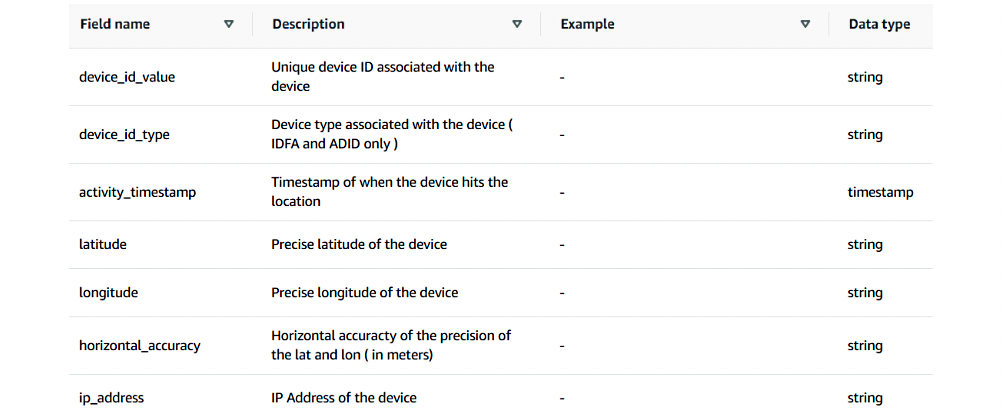
Location data sold by Kochava (FTC)
Under the proposed order filed in the U.S. District Court for the District of Idaho, Kochava and its subsidiary (which has since taken over Kochava’s data broker business) will be prohibited from selling, licensing, transferring, or disclosing precise location data unless they have affirmative express consent, and the data is used to provide a service that the consumers directly requested.
Beyond the sales prohibition, the companies must also establish a sensitive location data program, implement a supplier assessment program to verify consumer consent, allow consumers to request disclosure of who received their data and withdraw consent, submit incident reports to the FTC when third parties misuse location data, and create a data retention and deletion schedule.
This proposed order will carry the force of law upon approval by the District Court judge.
Advertisement
The FTC also announced in August 2022 that it was exploring new rules to crack down on businesses engaged in mass commercial surveillance, in which consumers’ information is collected, analyzed, and monetized. One month earlier, the Commission warned that it would enforce the law if companies illegally shared or used consumers’ sensitive information.
AI chained four zero-days into one exploit that bypassed both renderer and OS sandboxes. A wave of new exploits is coming.
At the Autonomous Validation Summit (May 12 & 14), see how autonomous, context-rich validation finds what’s exploitable, proves controls hold, and closes the remediation loop.
An anonymous reader quotes a report from Ars Technica, written by Andrew Cunningham: As its name implies, the venerable Notepad++ text editor began as a more capable version of the classic Windows Notepad, with features such as line numbering and syntax highlighting. It was created in 2003 by Don Ho, who continues to be its primary author and maintainer, and it has been a Windows-exclusive app throughout its existence (older Notepad++ versions support OSes as old as Windows 95; the current version officially supports everything going back to Windows 7). I’m not a devoted user of the app, but I was aware of its history, which is why I was surprised to see news of a “Notepad++ for Mac” port making the rounds last week, as though it were a port of the original available from the Notepad++ website.
Apparently, this news surprised Ho as well, who claims that the Mac version and its author, Andrey Letov, are “using the Notepad++ trademark (the name) without permission.” “This is misleading, inappropriate, and frankly disrespectful to both the project and its users,” Ho wrote. “It has already fooled people — including tech media — into believing this is an official release. To be crystal clear: Notepad++ has never released a macOS version. Anyone claiming otherwise is simply riding on the Notepad++ name.” Ho repeatedly asked the developer to stop using the brand and eventually reported the trademark use to Cloudflare, the CDN of the Notepad++ for Mac site. “Every day that website remains active, you are in further violation of the law,” Ho wrote. “I cannot authorize a ‘week or two’ of continued trademark infringement.”
Letov has since begun rebranding the app as “NextPad++,” though the old branding and URL reportedly remained available. The name changes is “an homage to NeXT Computer,” notes Ars, “and uses a frog icon rather than the Notepad++ lizard.”
If you’re a frequent flyer, going through airport security checks can feel like a mind-numbing chore standing between you and your destination. You almost go through it on autopilot, letting the airport powers-that-be handle it all. Somewhere in that fugue state, you may forget the very real possibility of making it past every checkpoint minus a phone. And yet, it’s a very real possibility.
In fact, according to the TSA, somewhere between 90,000 and 100,000 items get left behind at security checkpoints on a monthly basis. Obviously, not all of those are phones, but plenty are. Now, TSA’s electronics rules do cover what’s allowed in checked bags versus carry-ons, but those guidelines don’t really help once a device is sitting unattended in a tray.
Travel + Leisure spoke to one flyer who learned about airport theft the hard way. She was sprinting between gates to catch a connecting flight when she dropped her phone in a bin and kept moving without it. The realization only hit her once the plane started to take off. She pinged the airport from her laptop while still airborne but no reply came back. Eventually, the airport admitted it had never turned up.
Advertisement
Forgetfulness isn’t the way you can turn phoneless, though. A viral TikTok from a flier, picked up by the New York Post, has a TSA agent telling her that placing your phone bare in the bin is “the fastest way to get it stolen.” Phones, she relayed, are what agents see vanishing the most.
Advertisement
How to keep your phone safe at the airport
Chalabala/Getty Images
The most basic way to keep your phone safe is rather unglamorous. Just tuck it into a zipped pocket inside your bag before the bag goes anywhere near the scanner belt. That way, anyone with sticky fingers has to fumble through a zipper while standing next to a bunch of TSA agents, which cuts the appeal.
For travelers who have TSA PreCheck (typically US citizens), things get easier. Small electronics can stay inside carry-on bags during screening, which means there’s no reason to leave a phone in a tray to begin with. Unfortunately, this doesn’t apply to most regular passengers, since some TSA checkpoints make you remove your laptop and other bulky devices regardless.
The Travel + Leisure report also features another flyer who once had her camera lifted at an Indonesian security checkpoint. She now sticks to a deliberate loading order. She starts off with her first bin for whatever she cares about least, often just a jacket or a scarf. Then comes the carry-on. Electronics and anything actually worth stealing get loaded last of all.
And if a bag is pulled aside for extra screening, experts suggest asking the agents to gather your other belongings so you can keep them at the inspection table. If a device does still vanish, notify the nearest TSA officer.
If you can’t track it down immediately, the TSA holds recovered items for at least 30 days and lets you file a claim through its website. Try to be quick with that, though, as anything not picked up within that holding period gets its memory wiped or destroyed outright to keep personal data from leaking. After submission, an acknowledgement letter with a control number tends to land roughly four to six weeks later.
Zyg, the agentic e-commerce platform built by five IronSource co-founders, raised $60 million at a $500 million valuation led by Accel, just two months after emerging from stealth with a $58 million seed round. The company automates advertising, retention, support, and inventory forecasting for DTC sellers using AI agents that operate autonomously on platforms like Meta. The structural irony is that the team that built IronSource’s ad tech infrastructure for human media buyers is now building agents designed to replace them.
The founders of IronSource spent a decade building tools that helped mobile app developers monetise their products through advertising. They sold that company to Unity for $4.4 billion in 2022, watched Unity dismantle the ad network they had built, left in 2024, and have now returned with a company whose premise is that the entire category of work IronSource supported, the human management of digital advertising campaigns, can be automated by AI agents. Zyg, their new startup, raised $60 million at a $500 million valuation on Tuesday, led by Accel, with participation from Bessemer Venture Partners and Lightspeed Venture Partners. The company came out of stealth two months ago with a $58 million seed round. In eight weeks it has raised $118 million at a half-billion-dollar valuation without a single public customer case study. The bet is not that AI can assist e-commerce advertising. The bet is that AI agents can replace the people who run it.
Advertisement
The thesis
Zyg describes itself as an agentic operating system for e-commerce scale. The platform automates business functions that direct-to-consumer sellers currently manage through a combination of human operators, fragmented software tools, and advertising agencies: campaign creation and optimisation on Meta and other platforms, customer retention, support, and inventory forecasting. Chief Executive Officer Omer Kaplan told Bloomberg that Zyg’s agents are already running advertising campaigns on Meta’s platforms and are “doing the vast majority of the activity themselves.” The company’s customer base includes businesses with between $2 million and $15 million in annual revenue, the segment of the e-commerce market large enough to need sophisticated advertising but too small to afford the teams that run it.
The irony is structural. IronSource built the infrastructure that app developers used to acquire users and monetise through advertising. The company’s success depended on the existence of a large class of professionals, media buyers, growth managers, and performance marketers, who spent their days optimising campaigns inside platforms like Meta, Google, and the ad networks IronSource itself operated. Zyg’s premise is that those professionals are now a cost centre that AI agents can eliminate. The same team that built the tools human ad buyers used is now building the agents designed to make those humans unnecessary. It is not a pivot. It is a succession.
The market
The 💜 of EU tech
The latest rumblings from the EU tech scene, a story from our wise ol’ founder Boris, and some questionable AI art. It’s free, every week, in your inbox. Sign up now!
Advertisement
Zyg is entering a category that barely existed twelve months ago and is now attracting hundreds of millions in capital. Hightouch raised $150 million at a $2.75 billion valuation last week to build an agentic marketing platform for enterprises, with Goldman Sachs and Bain Capital leading the round. Shopify has launched Agentic Storefronts that let merchants sell products inside ChatGPT, Perplexity, and Microsoft Copilot. Meta itself is moving toward fully automated advertising, where an advertiser inputs a business URL and Meta’s AI handles creative generation, audience targeting, budget allocation, and performance optimisation without human intervention. AI marketplaces are reshaping how advertising is created and distributed, collapsing the distance between an advertiser’s intent and a campaign’s execution to something approaching zero.
The competitive landscape suggests that Zyg’s timing is right but its window is narrow. When Meta completes its own automation of the advertising workflow, the question becomes what value a third-party platform adds on top of a system that already runs itself. Zyg’s answer is that Meta optimises for Meta. A direct-to-consumer brand needs agents that optimise across advertising, retention, support, and inventory simultaneously, making decisions that account for the full business rather than a single channel’s performance metrics. That cross-functional integration is what separates an agentic operating system from an automated ad tool, and it is what justifies the ambition of the valuation.
The speed
A $500 million valuation two months after stealth is not normal, even in 2026’s funding environment. But the velocity reflects a specific dynamic in AI venture capital: repeat founders with a demonstrated exit command valuations that bear no relationship to current revenue. VAST Data raised $1 billion at a $30 billion valuation as AI infrastructure demand accelerated, and the broader funding environment saw $297 billion flow into startups in Q1 2026 alone, with AI capturing 80 per cent of the total. In this market, a team that built and sold a company for $4.4 billion, that understands advertising infrastructure at a technical level, and that is applying that understanding to the single largest category of AI agent deployment, is exactly the profile that commands pre-revenue valuations at scale.
Accel, which led the round, raised a $5 billion fund in April specifically to back AI companies. The firm’s investment in Zyg is consistent with its thesis that the returns from AI will come not from foundational model companies but from vertical platforms that deploy agents in specific industries. Google is turning Chrome into an agentic workplace tool with autonomous browsing capabilities, and every major platform is building agent infrastructure. The venture bet on Zyg is that e-commerce advertising is a vertical where domain expertise, the IronSource team’s specific understanding of how campaigns work, provides an advantage that general-purpose agent platforms cannot replicate.
Advertisement
The talent
Zyg was founded by five of the original IronSource founders: Tomer Bar-Zeev as chairman, Omer Kaplan as CEO, Assaf Ben Ami as CFO and COO, alongside Nadav Ashkenazy and Daniel Shinar. The team also includes cybersecurity and AI specialists from Unit 81, the Israeli military’s elite technology unit. The funding will be primarily used to hire AI talent in Israel, a market where the competition for researchers and engineers has intensified as global companies and domestic startups chase the same pool of specialists. Meta’s raid of the Thinking Machines Lab founders, reportedly including a $1.5 billion engineer, illustrates the premium the industry places on concentrated AI talent. Israeli startups raised $15.6 billion in 2025, with AI-focused companies commanding the majority of capital, and the talent war is the primary constraint on how fast companies like Zyg can build.
The Unit 81 connection is relevant beyond credentials. Building agents that autonomously manage advertising campaigns, handle customer data, and make inventory decisions requires the kind of security architecture that military intelligence backgrounds produce. An agent that runs ad campaigns is also an agent with access to business-critical systems, customer information, and financial data. The governance challenge, how to let an agent operate autonomously while preventing it from making catastrophic errors, is as much a security problem as an AI problem, and Zyg’s founding team is constructed to address both.
The question
Agentic AI is entering specific verticals from construction to logistics to legal services, and in each category the same question applies: does the agent platform become the new operating layer for the industry, or does the incumbent platform absorb the agent functionality into its own product? In e-commerce advertising, the incumbents are Meta, Google, Amazon, and Shopify, each of which is building AI automation directly into its platform. Meta’s Advantage+ suite already handles creative generation and targeting for 8 million advertisers. Google’s Performance Max automates campaign creation across all Google surfaces. Shopify’s AI agents manage everything from SEO to email to ad buying.
Zyg’s wager is that the multi-platform problem is unsolvable from inside any single platform. A DTC brand selling on Shopify, advertising on Meta and Google, retaining customers through email and SMS, and forecasting inventory across seasonal demand curves needs an agent that understands the business as a system, not a collection of channels. That is the same insight that made IronSource valuable: app developers needed a monetisation layer that worked across ad networks, not inside any single one. The founders are running the same play, one abstraction layer higher. The difference is that the previous abstraction layer helped humans manage complexity. This one is designed to eliminate the need for the humans entirely. Whether that works at the scale of the DTC market, for the thousands of mid-sized brands that cannot afford engineering teams but generate enough revenue to justify AI-powered operations, will determine whether Zyg’s $500 million valuation was prescient or premature. The founders have two months of post-stealth existence and $118 million in capital to find out.
Once you peel back the hype and mysticism, large language models (LLMs) are a fascinating application of statistical models, effectively what you get when you dial a basic auto-complete model up to eleven. In order to analyze a mind-boggling amount of text and produce meaningful auto-completion results quite a bit of math is involved, with a recent three-part article series by [Giles] going through the basics of inference, being the prediction step using a trained model.
The text is encoded in the LLM’s vector space as token IDs, each token being a text fragment that has some probability of following another ID, such as when cats may be found on desks, as in the above photo by [Giles]. With inference multiple of such IDs are retrieved in a vector from which in successive steps a sentence can be pieced together. These so-called logits are detailed in the first article in the series, with the second article focusing on vocabulary space and embedding, as well as the matrix operations used for inference.
Finally, the third article puts all of this together and looks at transformers, which is a crucial part of GPT (generative pretrained transformer) LLM architecture. Of note is the attention mechanism, which takes GPTs beyond merely being glorified auto-complete systems by adding pattern matching. Here we can see how the statistical model of the LLM is used to generate a rather plausible output, which is where the human has to ask themselves in how far they feel that it is correct.
Advertisement
Of course, there goes a lot more into making LLMs and GPTs performant, such as key-value caches that massively speed up inference.
Last year, Coinbase Europe was fined nearly €21.5m for failing to monitor transactions.
Coinbase is making 14pc of its workforce redundant to cut cost and adopt AI. According to recent company filings, the layoffs will affect around 700 employees.
The company employs around 150 in Ireland; however, it is unclear how many of them would be affected in this move. Coinbase did not provide SiliconRepublic.com with details when queried.
Restructuring expenses are expected to cost up to $60m. Company shares were up nearly 4pc in pre-market trading at the time of publication.
Advertisement
In a post on X, Coinbase co-founder and CEO Brian Armstrong said that the company is “volatile from quarter to quarter”.
“While we’ve managed through that cyclicality many times before and come out stronger on the other side, we’re currently in a down market and need to adjust our cost structure now so that we emerge from this period leaner, faster and more efficient for our next phase of growth.”
AI is “changing how we work”, Armstrong said. The workforce adjustments are expected to make the company “lean, fast, and AI-native”, he added.
A joint report recently published by Ireland’s Economic and Social Research Institute and the Department of Finance has found that AI adoption in here is likely to lead to job losses, leading to increases in income inequality in the “short to medium term”.
“The biggest risk now is not taking action,” Armstrong continued in his post, calling this an “inflection point, not just for Coinbase, but for every company”.
With a smaller workforce, Coinbase plans to “[concentrate] around AI-native talent” who can manage fleets of AI agents. The company is also introducing “one-person teams” who can manage engineering, design and product management.


































































You must be logged in to post a comment Login