
Tech
S$100K+ to fly with your pet? S’pore’s 1st pet airline is booked out a yr ahead.

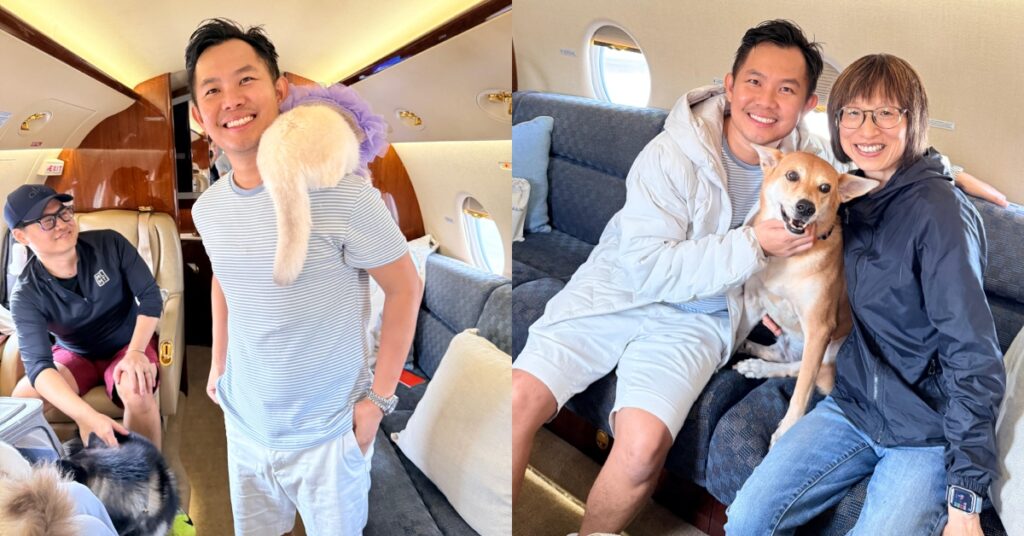
On SingaPaw Air’s flights, pets roam the cabin freely, sit beside their owners & are even offered meal options
There’s no sugarcoating it. A US$84,000 (S$108,000) flight to San Francisco with your pet is likely out of reach for most Singaporeans.
But that hasn’t stopped SingaPaw Air, which bills itself as Asia’s first pet jet-share service, from attracting a small and growing group of people willing to spend tens—and even hundreds—of thousands of dollars for the experience of flying with their pets in comfort and privacy.
On its flights, pets can roam the cabin freely, sit beside their owners, and are even offered meal options, much like any other passenger. Every detail, from check-in to in-flight care, is designed for the well-being of both animal and owner.
One recent customer paid just over US$30,000 (S$38,500) for a one-way trip from Singapore to Hong Kong for two people and four cats. Another spent US$15,000 (S$19,300) to holiday in Hong Kong with her toy poodle. And the airline is receiving more than 100 enquiries a day, with some customers booking up to a year in advance.
There clearly is demand for the service—and it is one that founder Jamie Wong saw coming long before anyone else in the region did.
“For me, animals are family”
Wong’s path to building SingaPaw Air is not a straight line.
The 38-year-old started his career in medicine and used to work as a GP at Raffles Medical. But the pull of entrepreneurship eventually won out. He went on to build a five-branch medical aesthetics business and a telemedicine startup that completed two rounds of fundraising, both of which have since closed.

Throughout all of this, he was running TheAsianPawrent, an online community platform for pet owners in Asia, on the side—not as a business play, but out of genuine love for animals.
Wong shares his home with five cats and three dogs, has rescued birds and sent them to animal welfare charity ACRES for rehabilitation, and actively donates to local pet welfare communities. TheAsianPawrent started as a place where pet owners like him could come together to share knowledge, discuss issues affecting their animals, and find community around modern pet parenting in Asia.
For me, animals are not a side interest. They are family. That belief has shaped the way I think about services, community, and the future of pet-related businesses.
Jamie Wong, founder of SingaPaw Air
The longer he ran that community, the more clearly one pain point kept surfacing: travel.
Pet owners across the region were hitting the same wall—restrictive airline policies, stressful cargo holds, banned breeds, and mountains of paperwork. The infrastructure simply hadn’t caught up with how people actually felt about their animals.
That insight, combined with a very personal moment during COVID-19, when Wong found himself unable to bring his family’s dog along on a private plane to Malaysia, became the spark for SingaPaw Air.
“I realised that while I was able to fly over on a private plane, our dog obviously could not enjoy the same ease of travel,” he said. “That was the moment I realised there was a real-world problem that could potentially be solved.”
The business was initially self-funded
Wong founded SingaPaw Air about three years ago, in 2023. “The concept took shape over time, but that was when we began laying the groundwork to turn the idea into a real operating business,” he said.
The airline was initially self-funded, which meant that Wong had to “build carefully” in the early stages. This was followed by two rounds of angel investment, with the company beginning at a valuation of US$2 million (S$2.5 million), according to the founder.

Today, SingaPaw Air claims to be the first of its kind in Southeast Asia, with only a handful of comparable players globally, such as Bark Air and RetrievAir in the United States, K9 Jets in Europe, and Skye Pets in Australia.
While Wong does not come from a traditional airline background, his experience building businesses in regulated industries proved highly transferable.
He also pursued a personal interest in aviation, spending time in flight simulators to practice piloting and understand aircraft operations. He even took some flight lessons, which helped him grasp the operational side of running an airline.
Although this experience was valuable, getting SingaPaw Air off the ground was far from simple.
Beyond registering the company and sourcing aircraft, a big part of the process involved securing the right approvals, including from Singapore’s Animal & Veterinary Service (AVS) and the Singapore Tourism Board.
At the same time, Wong also spent significant effort building an internal team that truly understood the emotional and practical challenges of travelling with pets.
We intentionally built a team of pet owners because people who live with animals understand the anxiety, the logistics, and the level of care required in a very different way.
Jamie Wong, founder of SingaPaw Air
Prices start at S$7K, and that’s just for a short hop to KL
SingaPaw Air operates on a jet-share model, which allows customers to book individual seats rather than chartering an entire aircraft. This approach, Wong said, makes the experience much more accessible compared to a traditional private charter, which can cost upwards of US$100,000 (S$128,500).
By selling per-seat access, SingaPaw Air brings the entry point down to around US$10,000 (S$13,000) per seat.

Its current routes include Singapore to Kuala Lumpur from US$5,500 (S$7,000), Singapore to Hong Kong return from US$19,200 (S$25,000), Singapore to Tokyo return from US$34,400 (S$44,200), and Singapore to San Francisco one-way from US$84,000 (S$108,000), among others.
For those seeking a fully private experience, the airline also offers dedicated jet charters, where the entire aircraft is reserved fully for you and your pets.
Prices for full charters are significantly higher, often reaching six figures for long-haul trips.
For example, a one-way flight from Singapore to San Francisco costs around US$330,000 (about S$424,000). Even shorter routes, such as Kuala Lumpur, can cost around US$30,000 (S$38,500) one way.
To manage these flights efficiently, SingaPaw Air employs a flexible operational model, including contract charters, membership charters, and block-hour arrangements. This allows the airline to tailor how planes and seats are allocated depending on demand, route, and booking type, while maintaining a consistent, pet-focused experience.
Currently, SingaPaw Air works with several licensed commercial flight operators, including Air7Asia, adjusting aircraft and service setups as needed.
Not just a flight

Onboard SingaPaw Air’s flights, a wide range of pets are allowed to fly beside their humans—there are no weight or size restrictions. The largest animal to board so far, according to Wong, was a Great Dane.
The airline also accepts breeds banned from cargo on most commercial carriers. Many airlines prohibit brachycephalic breeds—dogs with shortened snouts, such as French bulldogs and chow chows—due to a higher risk of respiratory distress in the cargo hold.
That said, SingaPaw Air takes extensive precautions to ensure these pets travel safely. Veterinary checks are conducted before every flight, and a certified canine first responder accompanies all journeys.
Pets also enjoy a streamlined clearance process that mirrors that of human passengers, with no need to arrive early. While animals must remain in carriers in the lounge, the aviation centre does not charge additional fees for them.

What differentiates SingaPaw Air from simply “a charter with a dog on board” is its positioning as an end-to-end travel ecosystem. Beyond flights, the company handles complex paperwork such as vaccination records and import or export permits, processes that can take months for pet owners to navigate on their own.
Travel to Japan, for example, requires an eight-month documentation process, which SingaPaw Air manages in full, completely free of service charges.
It also works closely with the AVS to coordinate inspections for arriving pets. Since SingaPaw Air flights operate from Seletar Airport, which lacks the dedicated animal inspection facilities found at Changi Airport, the team ensures a smooth process by working directly with AVS officers there.
“We work very closely with them to notify them of our arrival date and time, then they will send a team over here to ensure that the whole process, the inspection, is done smoothly,” Wong said in an interview with CNA.
Countries are categorised by AVS based on rabies risk. Destinations deemed rabies-free or low-risk, such as Hong Kong, Japan, and the US, allow pets to travel and return without quarantine.
Meanwhile, countries assessed as rabies-affected, including Thailand, Indonesia, and Cambodia, require a minimum 30-day quarantine on arrival, making them effectively one-way destinations for most SingaPaw Air clients.
It’s still early days for SingaPaw Air, but the runway is long
While trust was initially the biggest hurdle, today SingaPaw Air receives over 100 enquiries a day, with repeat customers and pre-bookings up to a year in advance, showing that demand is genuine.
In the beginning, a lot of the challenge was proving that the model was real, safe, and professionally executed. Once people saw the first flights take place, confidence naturally started to build.
Jamie Wong

Currently, around 70 to 80% of SingaPaw Air’s flights are for relocation purposes. These aren’t frivolous holiday trips, but emotionally significant moves where, for many customers, putting their pet through cargo simply isn’t an option they’re willing to consider.
Wong shared that the most common feedback from customers is how calm their pets are when travelling alongside them. “That sense of calm and closeness is one of the clearest validations that [SingaPaw Air] is solving a real problem.”
For a growing segment of pet owners, this approach resonates. The shift in how people relate to their animals is real and accelerating. Pets today have Instagram accounts, birthday parties, and healthcare plans. The idea that travel should reflect that same level of care isn’t as niche as it once seemed.
With demand building—Wong declined to share specifics, including profit margins—SingaPaw Air has begun expanding its offerings. Its latest addition is the pet discovery flight: a one-hour trip designed to acclimatise animals to altitude changes and engine noise ahead of a longer journey, starting from US$1,300 (S$1,700) for one passenger and one pet, with discounts for existing SingaPaw Air customers.
Looking ahead, the company is in the process of acquiring its own jet, reflecting Wong’s long-term goal to handle everything in-house, not just act as a middleman. The founder also has his eye on domestic pet travel within Indonesia and Malaysia—markets with strong pet ownership cultures but where affordable, regulated pet travel options remain scarce.
To support this growth, another round of fundraising is planned, potentially later this year or next, as SingaPaw Air expands its services and capabilities.
“The market is still in its early stages,” Wong said, “so rather than focusing purely on market share, our goal is to establish SingaPaw Air as one of the most trusted and category-defining names in pet aviation in the region. If we continue to solve real pain points, market share will follow naturally.”
- Find out more about SingaPaw Air here.
- Read other articles we’ve written on Singaporean businesses here.
Featured Image Credit: Jamie Wong/ SingaPaw Air

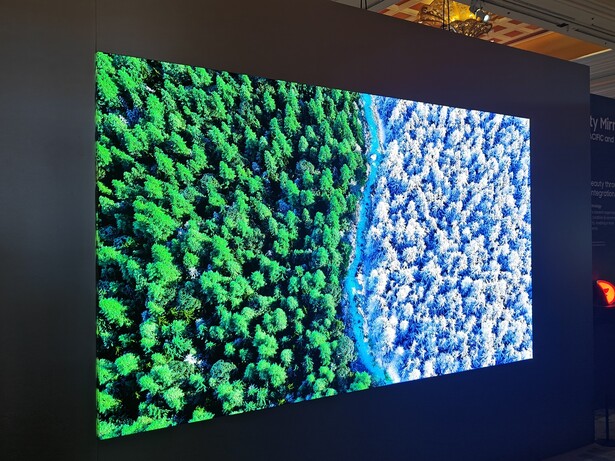
There are many white whales the TV world has tried to conquer over the years. With some, it’s managed to win the battle and bring those concepts to the mainstream market. Others have slowly but surely disappeared.
MicroLED finds itself somewhere in the middle of those two realities. Brands like to show it off as a concept of what the future of TVs in the home could look like. But often it’s a concept piece, as it was when Samsung showed off another MicroLED screen at CES 2026.
But could it move from concept to actual reality? I was invited to Harrods to see Hisense’s 136-inch MX MicroLED TV, and there’s now reason to believe it could exist beyond the show floors of consumer electronics events. But if it does, it’s also unlikely to make its way to your living room any time soon.
The long wait for MicroLED
Launched many, many, many years ago, MicroLED was championed by both Samsung and LG as the technology leading the charge for people’s homes, bringing the TV industry’s obsession with colour and brightness to higher heights.
But instead of gathering pace, its momentum slowed. The technological promise seemed to smash into a cost and effectiveness barrier. Year after year, there were murmurings that MicroLED TVs could arrive sooner than you’d expect, but without any real timescale.

Samsung’s The Wall threatened to become an actual TV, but every time Samsung made an announcement, it was conveyed in vague, nebulous terms. If memory serves, there was a mention of a 75-inch MicroLED being a possibility. Clearly, that never came to fruition.
Others have taken their MicroLED tech and pushed it towards B2B, with massive, modular screens for advertising and the like. But the promise of MicroLED seemed to have faded as TV manufacturers realised the promise of Mini LED as another avenue.
But Hisense is one of the few that’s persisted. The 136MXQTUK I saw is the first MicroLED TV I’ve come across outside of tech events or a company’s HQ. There, in the Harrods in Knightsbridge, you can head up a series of escalators, walk past the many weird and expensive kit that decks the floors and you’ll find one of the biggest TVs on the planet.
In that sense, MicroLED has leapt from tech demo and wish fulfilment to something you can see and touch.
But who is MicroLED for?

But of course, MicroLED TVs come at a price, and it’s the cost that’s been the prohibitive factor to making it a mainstream proposition.
Hisense has made it its mission in recent years to become a leader in the market, whether it’s with Mini LED, RGB Mini LED or large screen sizes.
A good ten years ago when the Chinese brand first entered the UK market, they were a value-led proposition, a TV for those that didn’t want to spend too much. Over the years they’ve evolved, broadened their range and upped their quality. They’re still not up to the standard of a Samsung, a Sony or an LG, but they’re making steps to reach that level.
And now they find themselves in Harrods, alongside the likes of Samsung, Sony and LG.
But who exactly is a MicroLED TV for? Now that it’s a thing, someone has to buy that thing, and the cash required is significant. We’re very far from Hisense being a value-led brand.
At £120,000, the 136MXQTUK is for the few, not the many. A modular TV where Hisense’s installers come to your (lavish) home, or boat, penthouse – you get my point – and install it as you wait. With the frame going up first, filled by the modular pieces that make up the screen, it’s a process that apparently takes up to four hours to complete.
This isn’t a TV likely to come down in price – there will not be any Black Friday discounts – nor do I think there’s going to be smaller sizes. The stage is set, and it’s a very large one, at an expense that makes it for the millionaire crew.
The scale of the screen is impressive in the flesh, and I have to commend Hisense’s persistence for making this a reality where others have stumbled – but in all honestly, I left Harrods in a mood unchanged from how I felt about MicroLED TVs at CES.
The picture quality wasn’t the best I’ve seen, and you could see the lines that marked each module, which is a distraction unless you’re watching from far away. You don’t want to see the seams, especially if you’re paying £120,000.
Perhaps it was the slightly dim setting of the venue, or the picture mode the TV was in (which seemed to be in Standard or Vivid), or the AI processing likely to have been used for a TV of this size, but it didn’t look as clear or as bright as I was expecting.

I expected to be wowed by the colours, depth and brightness, but I felt underwhelmed. It didn’t compare to what I’ve seen from Samsung and LG. There’s something about the colours that’s off to my eyes.
If I had won the Euro Millions, would I spend £120,000 on this TV? My answer would be that I’m not sure, which in itself is probably a ‘no’. Would I spend that amount on a Samsung MicroLED? Having seen it, I think it’d be more of a yes.
I can be a “bah, humbug” type of person, but there’s a whiff of 8K TV about MicroLED TV – a format where there’s just not enough enthusiasm about it, and where I think the excitement for it has naturally passed.
Hisense sees a clear and open path with MicroLED, one in which it believes it can make hay in, and good on them for taking the plunge. But I think the relative lack of interest from other TV brands is a sign that, while the future of TVs is bright and colourful, it’s no longer a MicroLED future.


Power Systems Studies with Simulink and Simscape Electrical
This webinar explores how Simscape™ Electrical™ can be used to model and simulate power systems and power converters across different timescales. Using practical examples, we’ll move from quasi‑static studies such as 8760‑hour simulations to electromagnetic transient (EMT) simulations that include grid integration of inverter‑based resources.
The session demonstrates how simulation can be used to analyze system behavior and performance for modern, converter‑dominated power grids.
The models will be used to:
- Analyse faults and explore network reconfiguration.
- Assess system stability
- Evaluate code compiance
Click ‘Watch Now’ to explore this webinar.
The best iPhone charger depends on several factors. Are you topping off your battery on the go? Do you want to charge your iPhone as quickly as possible? Are you charging it overnight on your nightstand? The best gear recommendation is going to change with the situation. Luckily, the WIRED Reviews team tests iPhone chargers in the field all year long. There’s not a day that goes by that at least one of us is not assessing at least one iPhone charger. I’ve gathered up our favorite picks for every scenario.
Be sure to check out our related buying guides, like the Best Power Banks, the Best 3-in-1 Chargers, and the Best Wireless Chargers.
Table of Contents
The Best iPhone Chargers
Best Wall Charger for iPhone

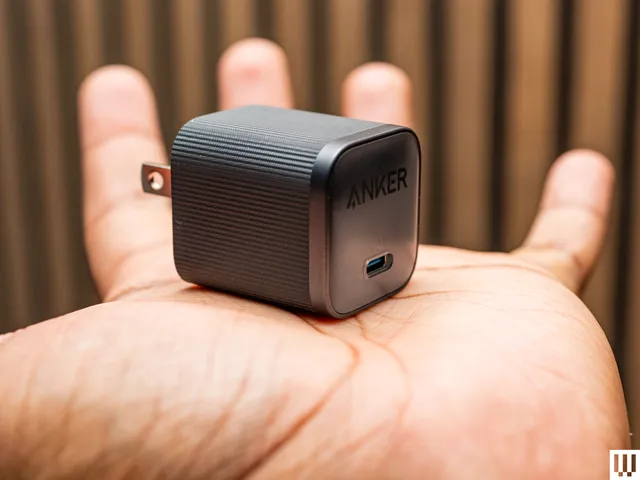
Photograph: Julian Chokkattu
Anker
Nano 45W With USB-C Cable
This Anker charger is slick and has folding prongs so it’s easy to travel with, but the best part is that it can charge your phone at 40 watts (average is 20 to 27 watts). That means you can get up to 50 percent battery life in only 20 minutes. Not all iPhone models support charging this fast—it’s limited to iPhone 17, iPhone 17 Pro, and iPhone 17 Pro Max—but you may as well future-proof your gear if you’re shopping for a wall charger, even if your phone can’t take full advantage of those speeds yet.
Best Power Bank for iPhone
-Portable-Charger-Reviewer-Photo-(no-border)-SOURCE-Simon-Hill.jpg)
We do recommend the Anker Laptop Power Bank as our top-pick power bank, but if you’re only trying to top off your iPhone, this is a very reliable and neat-looking power bank. It’s svelte, smaller than a deck of cards, and can deliver 20 watts to two devices at once. Nimble also makes a slightly larger version, which has a larger capacity and can charge at up to 65 watts. Aside from the cool design featuring speckled colors and a lanyard loop, Nimble also uses bioplastics, recycled materials, and minimal packaging. A USB-C charger is included in the box.
Best MagSafe Portable Charger for iPhone
.jpg)
Anker
MagGo Power Bank (10K) (Qi2)
This 10,000-mAh power bank can charge your device at up to 15 watts, but it’ll also charge older devices at a slower rate. It has a built-in kickstand and an LED display that lets you know how much power is left at a glance. It works in portrait or landscape modes. Be aware that it won’t be able to charge most phones fully more than once, but it’s hard to beat if you’re seeking wireless charging on the go. If you want a bigger capacity or faster charging, you don’t want MagSafe.
Best 3-in-1 Charger for iPhone

Belkin
3-in-1 Qi2 Charging Stand
The Belkin 3-in-1 can charge your compatible iPhone at 15 watts, plus your AirPods and your Apple Watch at the same time. The charging pad can be tilted to your preferred angle, including in landscape orientation if you want to watch a video or put your phone in StandBy mode. The USB-C cable is permanently attached, which you may or may not like. Check our best 3-in-1 chargers buying guide for additional picks.
Best 2-in-1 Charger for iPhone

Photograph: Louryn Strampe
Mophie
2-in-1 Wireless Charging Stand
I love a 3-in-1 charger as much as the next tech nerd, but sometimes they’re overkill. My Apple Watch battery usually lasts all day long, but I can chew through my older AirPods battery before my lunch break hits, and my iPhone battery might be depleted too, depending on whether or not I’m streaming Max Velocity off to the side. This 2-in-1 charger has been my steadfast desktop companion. Mophie makes another version that tops off your Apple Watch and iPhone instead of your headphones, which might be what you want if you’re rocking wired headphones or you’re making intense use of a walking pad throughout the day. There’s a 40-watt wall charger in the box—a rarity these days!—plus a USB-C cable that winds neatly into the base. It’s easy to adjust the angle of your iPhone as well, and I’ve found the base very sturdy. If you want to charge, but not necessarily all of the possible devices simultaneously, these might be what you seek.

Anker
Prime USB-C to USB-C Cable
This braided nylon USB-C cable has a durable exterior made from recycled plastic. The cable is rugged, with Anker promising that it can operate in temperatures ranging from negative 40 degrees to 176 degrees Fahrenheit. It’s backed by a lifetime warranty. It’s got a built-in cable management loop. It’s more than enough cable for your iPhone. Read our guide to the Best USB-C Cables for more picks.

Ugreen
USB-C to Lightning Cable
If your iPhone is still rocking the Lightning cable, this is gonna be way better than whatever shoddy cable Apple sent you. It’s durable and is Made for iPhone-certified, so you won’t have any problems getting it to work. It comes in 3-, 6-, or 10-foot lengths with a two-year warranty. Best of all, the exterior casing will stay intact, unlike what you’d probably get with Apple’s cables.


Demis Hassabis met South Korean President Lee Jae Myung at Cheong Wa Dae on Monday and signed an MOU with the Ministry of Science and ICT. The campus will be operational this year. Hassabis accepted a request to send at least 10 Google engineers from US headquarters. He presented Lee with a Go board signed by himself and Lee Se-dol.
Google DeepMind will open an artificial intelligence campus in Seoul, South Korea, the first facility of its kind in the world for the company, after Demis Hassabis met South Korean President Lee Jae Myung at Cheong Wa Dae on Monday. Kim Yong-beom, the presidential chief of staff for policy, confirmed the agreement.
The Science Ministry and Google signed a memorandum of understanding on the campus at the Four Seasons Hotel in Seoul later the same day, with Minister of Science and ICT Bae Kyung-hoon and Hassabis in attendance. The campus is expected to open within 2026.
The MOU covers joint AI research in science and technology, AI skills development, and the responsible use of AI. Hassabis confirmed he would actively consider dispatching Google researchers to Korea.
Kim quoted him directly: “The CEO instantly accepted our request to send at least 10.” The campus is intended to serve as a hub connecting Google engineers with South Korean startups, researchers, and industrial companies.
The Ministry of Science and ICT framed it as a key element of Korea’s “K-Moonshot” project, which brings together AI and science capabilities to address major national challenges. South Korea has stated its intention to become one of the world’s top three AI powerhouses alongside the United States and China.
The choice of venue and timing carries specific symbolic weight. The 2016 match between Google DeepMind’s AlphaGo and Korean Go grandmaster Lee Se-dol took place at the Four Seasons Hotel in Seoul, the same venue where Monday’s MOU was signed.
AlphaGo’s 4–1 victory over Lee Se-dol in March 2016 is widely credited with catalysing the modern wave of investment in artificial intelligence by demonstrating that deep learning could surpass human expert performance in a domain of extreme complexity.
Hassabis cited it explicitly during the meeting, noting that the AlphaGo match had “inspired many advances in AI, including its work in science like the AlphaFold system for protein folding.”
AlphaFold subsequently solved one of biology’s most important open problems: predicting the three-dimensional structure of proteins from their amino acid sequence.
The achievement led to Hassabis being jointly awarded the Nobel Prize in Chemistry in 2024. As a symbolic gesture, Hassabis presented President Lee with a Go board signed by himself and Lee Se-dol, marking the 10th anniversary of the match.
Hassabis also expressed interest in strengthening cooperation with major Korean companies including Samsung, SK Hynix, Hyundai’s Boston Dynamics, and LG, to start new joint projects.
Those four names span the full breadth of Korea’s technology industrial base: Samsung and SK Hynix in semiconductors and memory (both critical to AI infrastructure), Hyundai’s Boston Dynamics in physical AI and robotics, and LG in consumer and enterprise electronics.
The campus, combined with these industrial partnerships, suggests Google is positioning Korea not just as a market for its AI products but as a node in its global AI development and hardware supply chain.
The announcement is consistent with a broader pattern of major technology companies seeking government-endorsed AI campus arrangements in Asia-Pacific democracies. Microsoft’s A$25 billion investment in Australia, includes similar elements: an MOU with the national government, infrastructure expansion tied to a national AI strategy, and skills training commitments.
The Seoul AI campus adds South Korea to a list of countries, alongside Australia, Japan, Singapore, and the United Kingdom, where Google DeepMind and its peers are embedding their AI development presence at the government-partnership level, rather than purely through commercial market entry.
Hassabis also noted that countries like Korea, the UK, and Singapore urgently need to cooperate to build a broader framework for AI safety, pointing to the campus as part of a responsible AI agenda alongside the commercial and research dimensions.

The race to secure electricity for AI models has reached new heights: Meta has signed an agreement with the startup Overview Energy that could see a thousand satellites beam infrared light to solar farms that power data centers at night.
In 2024, Meta’s data centers used more than 18,000 gigawatt-hours of electricity—roughly enough to power more than 1.7 million American homes for a year—and its need for compute power is only increasing. The company has committed to building 30 gigawatts of renewable power sources, with a focus on industrial-scale solar power plants.
Typically, data centers turning to solar power must either invest in battery storage or rely on other generation sources to operate at night.
Overview, a four-year-old, Ashburn, Virginia, outfit that emerged from stealth in December, has a different solution: The company is developing spacecraft that collect plentiful solar power in space. It then plans to convert that energy to near-infrared light and beam it at sufficiently large solar farms—on the order of hundreds of megawatts—which can convert that light to electricity.
By using a wide, infrared beam to power existing terrestrial solar infrastructure, Overview thinks it can sidestep the technological challenges and safety and regulatory issues that bedevil plans to transmit power to Earth through high-power lasers or microwave beams. CEO Marc Berte says you’ll be able to stare right into his satellite’s beam with no ill effects.
The technology would increase the return on investment from building solar farms and reduce reliance on fossil fuels — if it can be deployed at scale.
Overview says it has already demonstrated power transmission to the ground from an aircraft, and is planning to launch a satellite to low Earth orbit in January 2028 to perform its first power transmission from space.
Techcrunch event
San Francisco, CA
|
October 13-15, 2026
In today’s announcement, Meta said it signed the first capacity reservation agreement with Overview to receive up to 1 gigawatt of power from the company’s spacecraft, although it’s not clear if any money changed hands. Overview developed a new metric for this contract, megawatt photons, which is the amount of light required to generate a megawatt of electricity.
Berte expects to begin launching the satellites that would fulfill that commitment in 2030, with a goal of flying 1,000 spacecraft in geosynchronous orbit, a high orbit in which each satellite remains fixed above the same point on Earth. He expects each of the company’s spacecraft to provide power from space for more than 10 years.
Once in space, Berte says the fleet of spacecraft will be able to cover about a third of the planet, with an initial deployment that will reach from the West Coast of the United States across to Western Europe. As the Earth rotates below and customer solar farms enter evening and night, Overview’s spacecraft should boost their electrical generation with additional light from space.
Berte sees opportunity in combining both generation and transmission, with the flexibility to deliver power to solar farms wherever and whenever it is most valuable.
“There’s a big difference between being in any one energy market, and being in all of the energy markets,” Berte told TechCrunch.
When you purchase through links in our articles, we may earn a small commission. This doesn’t affect our editorial independence.
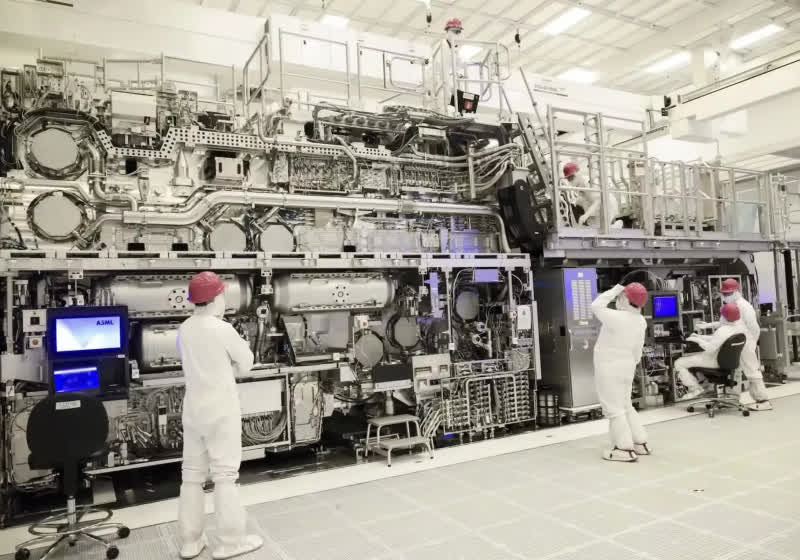
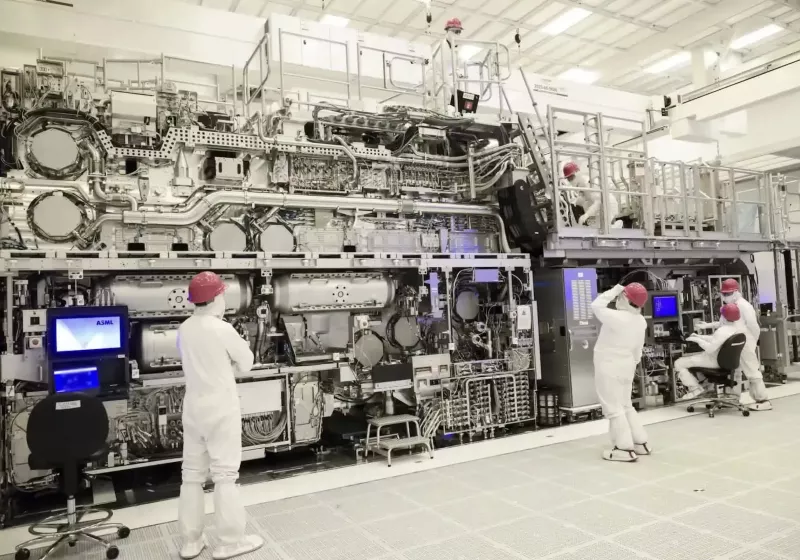
ASML expects to produce at least 60 EUV systems this year, up sharply from 2025, with capacity rising to at least 80 systems annually in the next phase. At the same time, the firm is working to improve throughput, including upgrades that allow some machines to process more wafers per hour.
Read Entire Article
Source link
The round is led by Headline, with new investors Bullhound Capital, Felix Capital, and Daphni. Valuation is undisclosed. Sereact’s vision language action models already run in BMW, Daimler Truck, and logistics customers. The $110M is more than four times the €25M Series A raised just 15 months ago.
Sereact, the Stuttgart-based AI robotics software company, has raised $110 million in a Series B round led by Headline, the international venture firm with offices in Berlin, San Francisco, and Paris. New investors Bullhound Capital, Felix Capital, and Daphni joined alongside several existing backers.
The company declined to disclose its valuation. Funds will be used to develop Sereact’s core AI model, one that “makes robots smarter and more adaptable to different tasks”, and to scale deployment across logistics, manufacturing, and, increasingly, humanoid robot platforms.
Sereact was founded in 2021 by Ralf Gulde (CEO) and Marc Tuscher (CTO), both former AI researchers, at the University of Stuttgart.

The 💜 of EU tech
The latest rumblings from the EU tech scene, a story from our wise ol’ founder Boris, and some questionable AI art. It’s free, every week, in your inbox. Sign up now!
The company’s technical approach is grounded in Vision Language Action Models (VLAMs): AI systems that combine computer vision, natural language understanding, and action planning into a single model, allowing robots to perceive their environment, interpret instructions, and execute physical tasks without requiring complex programming or environment-specific pre-training.
A robot picking a fragile object can, in principle, evaluate whether its planned grip will cause damage before its gripper closes.That capability is the meaningful differentiator in a market where most industrial robotics still operate on pre-programmed sequences that assume a controlled, predictable environment.
Warehouses, manufacturing floors, and logistics facilities are not controlled environments: objects arrive in unpredictable orientations, packaging varies, and edge cases are constant.
Sereact’s software-first approach, explicitly positioned against the hardware-first strategies of most robotics companies, is designed to make robots adaptable to this variation without requiring engineers to reprogram them for each new object type or layout change.
In Gulde’s formulation from the Series A announcement: “with our technology, robots act situationally rather than following rigidly programmed sequences.”
The commercial record behind the Series B is substantive. Customers include BMW Group, Daimler Truck, the Dutch e-commerce fulfilment company Bol, and logistics specialists MS Direct and Active Ants.
The deployment at automotive OEMs is editorially significant: BMW and Daimler Truck are not pilots or proof-of-concepts, they are production environments where the economic cost of a robot failure is measured in line stoppages.
Sereact’s technology reaching production at that tier of customer is the validation signal that distinguishes it from the large number of AI robotics companies still operating at the demonstration stage.
The funding trajectory makes the ambition of the round clear. Sereact raised $5 million in seed funding in 2023, €25 million (approximately $26 million) in a Series A led by Creandum in January 2025, and now $110 million in April 2026, a more than four-times step-up from the Series A in fifteen months.
Creandum’s Johan Brenner captured the investment thesis at the Series A: “most AI robotics companies are currently hardware-first. What sets Sereact apart is their software-first, foundational approach which means they have the potential to become the brain of any robot that requires vision and autonomous capabilities.”
That thesis, a software-first robotics intelligence layer deployable across any hardware platform, is essentially the same thesis that has made Mobileye valuable in autonomous vehicles and that Nvidia is pursuing through its Isaac robotics platform: the idea that the highest-margin position in robotics is not the robot itself but the intelligence running it.
The broader market context is accelerating. Humanoid robot deployments by Figure AI, Boston Dynamics, and Unitree are moving from controlled tests to commercial production at warehouse and manufacturing customers.
The global humanoid robot market, valued at under $1 billion in 2023, is projected to exceed $38 billion by 2030. Tesla’s Optimus production ramp, targeting volume output from July 2026, will require robotics intelligence software at scale.
Sereact’s explicit intention, stated at the Series A, to expand beyond logistics into humanoid robot platforms positions it to compete for that market. The $110 million Series B is the capital raise that makes that expansion credible.
Samsung has come a long way from its humble beginnings as a grocery trading store all the way back in 1938. In addition to being a household name in the appliance world, the brand has become synonymous with mobile phones. Among the major moments in the history of Samsung Mobile is the introduction of the very first Samsung cell phone, which happened way earlier than you might think. While it took until the 1990s and 2000s for handheld mobile phones to truly boom, the first Samsung cell phone was slightly ahead of the curve, debuting in 1988.
Dubbed the Samsung SH-100, this blocky, antennaed phone isn’t much to look at by modern standards. However, it has earned its place in history as not only Samsung’s first foray into the cell phone market, but as the first cell phone ever produced by a South Korean company. It was shown off for the first time during the Seoul summer Olympics, but this major spotlight didn’t translate to incredible sales success. Estimates place the sales numbers on the SH-100 at a mere few thousand units, which is hardly a strong start for Samsung’s cell phone endeavors.
Despite this, Samsung has gone on to become a hugely successful entity in the phone world. Not only is this remarkable given the SH-100’s rocky start, but also because of the less than stellar performance of its even more antiquated predecessor.
While dated, the SH-100 was a huge step up for mobile phone technology
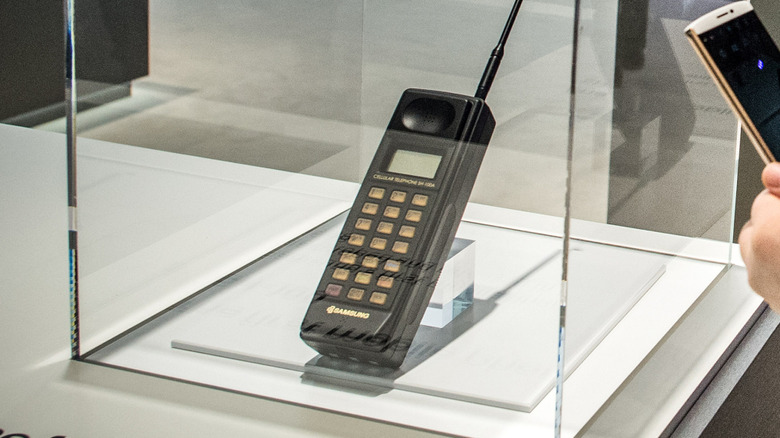
Even with its lack of exciting features and bulky design, the SH-100 is a key player in the history of Samsung mobile phones. It set the stage for future advancements from the company in the following years, such as the release of the world’s first MP3-enabled phone, the Samsung SPH-M2500 in 1999, and Samsung’s first foray into the world of Android, the Galaxy S, which hit the market in 2010. Of course, it’s entirely possible none of these and others would have come to fruition had it not been for the first Samsung phone, the only-somewhat-mobile SC-1000.
Yes, on a technicality, there’s a mobile phone made by Samsung before the SH-100, but calling it a true mobile phone is a stretch. The SC-1000, which released in 1985, was an old school car phone meant to be used while on the move. It couldn’t leave the vehicle, and it was quite cumbersome in size and shape. That’s to say it wasn’t a huge hit and ultimately fizzled out, along with the wider car phone trend, as the 21st century approached and cell phone technology advanced. Still, car phones are a key step in the stunning transformation of cell phones throughout the years, and the SC-1000 was needed to reach the SH-100 and phone models beyond.
Samsung’s SH-100 is a dinosaur from a 2026 perspective, but its place in phone and communication history can’t be denied. It wasn’t the most successful model Samsung has ever seen, but it endures as a major advancement for the company all the same.
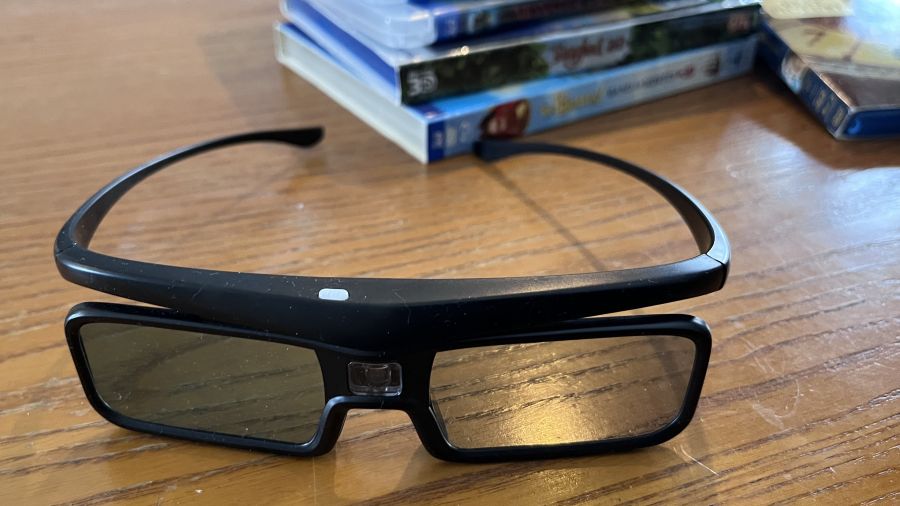
Do you remember 3D TVs? They had a roughly six-year run from 2010 to 2016, a timespan that witnessed the demise of plasma TVs and the ascent of OLED TV technology. At that same time, there was a 3D movie boom in theaters, with nearly every major release getting a 3D-format screening, whether the content benefited from the addition of a third dimension or not.
Booms are usually followed by a bust, and these days most folks don’t even give a second thought to 3D movies. In an ironic twist, however, recent advances in display tech have created fertile ground for 3D viewing, particularly for watching 3D movies at home.
To 3D or not to 3D
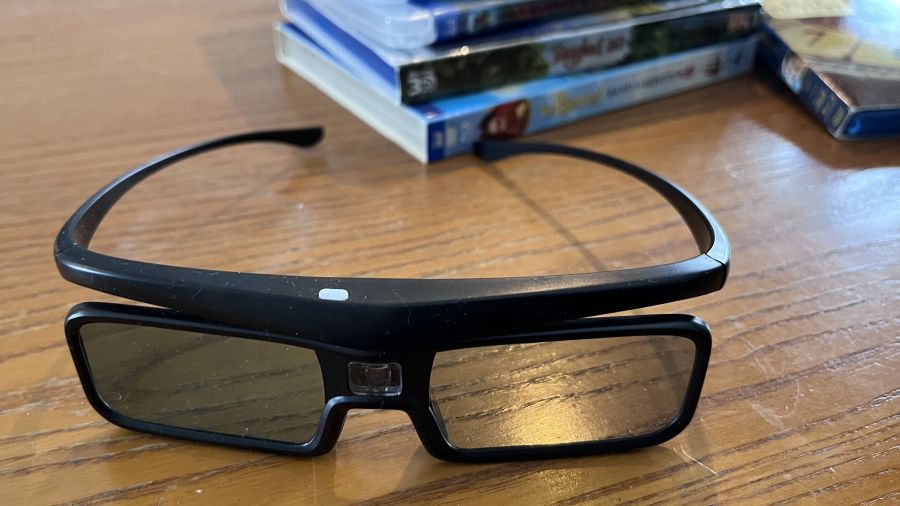
I’ll admit to having geeked out on 3D during the last boom period, partly because I was regularly reviewing TVs at the time, and also because I had young kids who wanted to see the new animated movie releases, most of which were shown in 3D. Consequently, I spent many a weekend wearing 3D glasses in theaters, and also amassed a decent-sized Blu-ray 3D disc library for home viewing.
Looking back at that time, my recollection is that the 3D kinda sucked, both at the theater and at home. In theaters, it was the pre-laser projector era, when the brightness of a typical digital cinema projector was significantly lower than what you get in today’s venues. Put on 3D glasses, and the picture put out by that already brightness-challenged projector could look almost unacceptably dim.
Along with being dim, many movies shown in 3D weren’t actually shot using 3D cameras but instead converted to 3D. Not surprisingly, any 3D effect in these titles was minimal, or even accidental.
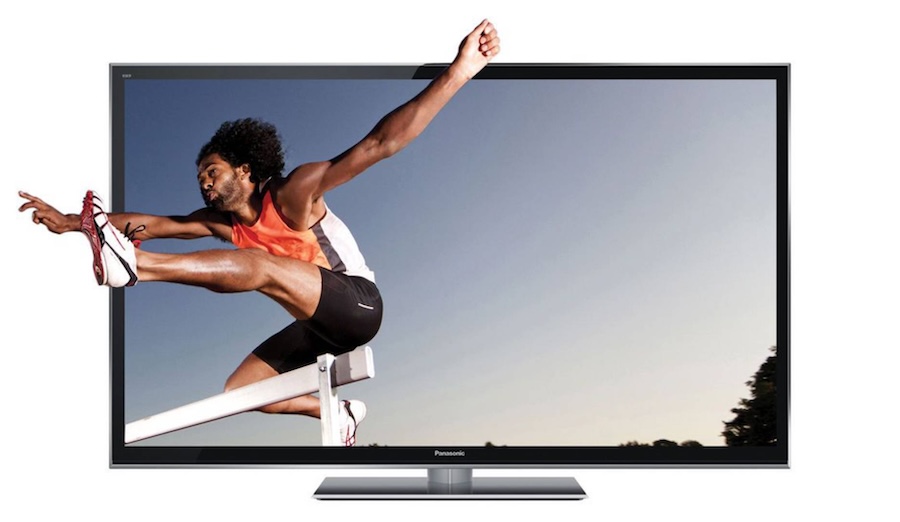
On the home front, the 3D TVs of the time had smaller screen sizes and were significantly less bright than today’s models. Today, a typical lineup from any TV brand ranges from 55 inches up to 98 inches, and peak brightness for higher-end models is in the 2,000-3,000 nits range. Back in 2015, screens generally maxed out at 65 inches, with 55 inches being a more common size. As for brightness, one of the last 3D TVs I measured, a Panasonic LCD model, topped out at a mere 132 nits.
(Looking back at that 2015 review, I was reminded that Netflix at one time streamed 3D content, and that I had actually watched a Wim Wenders 3D movie on the Panasonic. Crazy.)
Most home projectors in that earlier era also supported 3D, which let you watch 3D movies on 100-inch-plus-size screens. But while a bigger screen provided a better and more immersive experience, the brightness of pre-laser, lamp-based home projectors was much less than what you can expect today. To cite one example, the Sony VPL-VW350ES, a 4K SXRD projector that cost $10,000 when I tested it in 2015, had a specified 1,500 lumens brightness. Today, the Sony Bravia Projector 7, the company’s entry-level 4K laser model, lists for the same price and has a specified 2,200 lumens brightness, a near 50% increase.
Surveying the 3D landscape
Today, there are still some 3D theatrical releases, though most are kids-oriented animated movies like the recent Pixar hit Hopper and The Super Mario Galaxy Movie. New Blu-ray 3D discs also continue to trickle out, with the latest entry in the Avatar franchise, Avatar: Fire and Ash, which is scheduled to ship in May 2026, being one notable release.
Anyone who owns a 3D-capable Blu-ray player and picks up Avatar: Fire and Ash on disc will find the 3D at home landscape much improved compared to the 3D boom years, and that comes down to one product category: projectors.
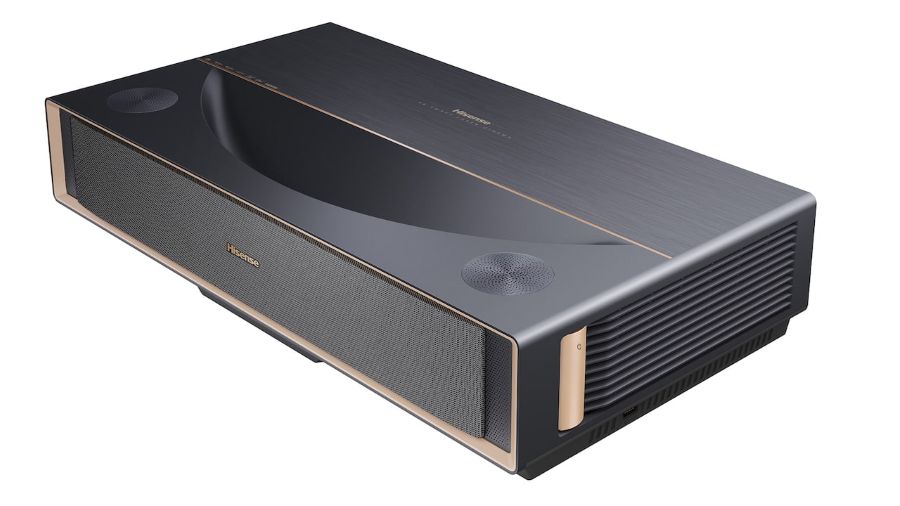
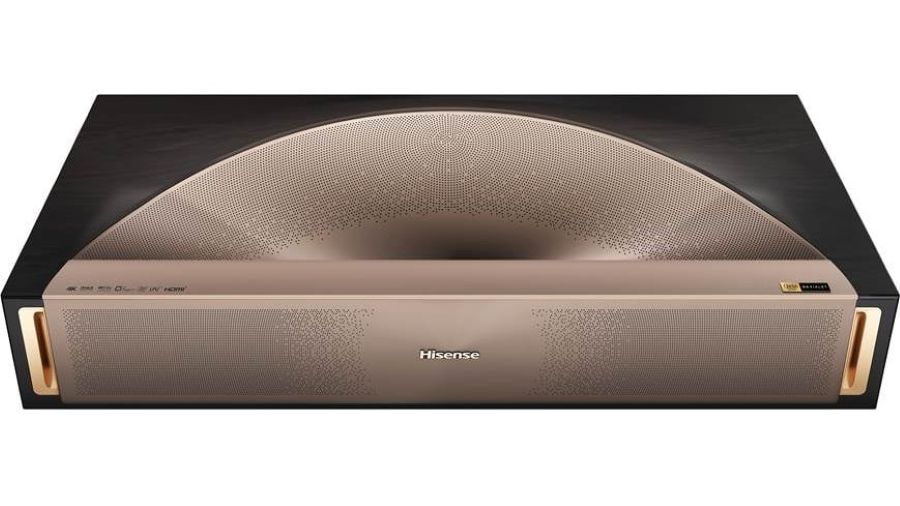
I recently got my hands on the Hisense PT1, a 3D-capable projector. The PT1 is an ultra short throw (UST) model designed for close placement to a screen and it supports screen sizes up to 150 inches. At $2,500, it’s affordably priced for a 4K UST projector, and its 2,500 lumens specified brightness exceeds that of considerably more expensive long throw projectors such as the Bravia Projector 7, a model that, despite its relatively high price, doesn’t offer 3D support.
Having the Hisense PT1 in-house gave me an opportunity to do something I’ve long been wanting to do: revisit my Blu-ray 3D disc collection to see how the experience holds up on a bigger, better, and brighter display than what I was used to in the old days. For my viewing, I paired the Hisense with a 100-inch Elite Pro AV Floor Riser Pro DarkUST 3 projection screen using an Oppo UDP-203 4K Blu-ray player as a source. Active 3D glasses were AWOL Vision DLP Link.
3D Revisited
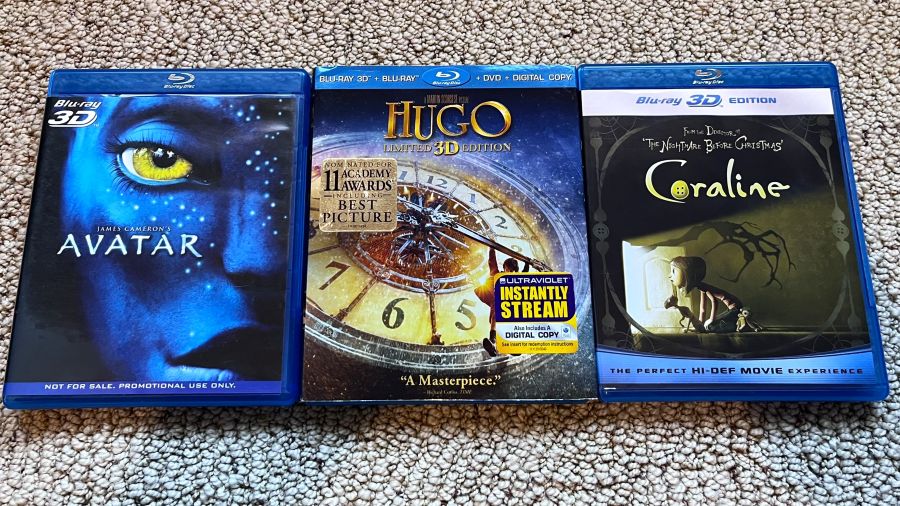
To get the 3D TV party started, I selected three movies that I know were actually shot using a stereoscopic process and not upconverted to 3D: Avatar, Hugo, and Coraline. It didn’t hurt that these are all good movies – very good in the case of Coraline – and that I remembered them as having a pronounced 3D effect when I first watched them, both in the theater and at home.
Avatar is the king of modern 3D spectacles, and it was the disc I was most eager to check out on the Hisense projector. (The next chapter in the series, Avatar: The Way of Water, was also a 3D banger when I watched it at my local IMAX theater, and it looked great on an Apple Vision Pro headset that I briefly had on loan.)
To quickly sum things up, Avatar looked great on the system. The picture had strong contrast and bold color, especially in the luminescent forest scenes early on, and the 3D effects were even more pronounced than I remembered. There really was a sense of being there in the forest with those blue aliens. I found that brightness could have been better – I guess I got spoiled by watching Avatar: The Way of Water in optimal 3D viewing conditions – but the picture wasn’t so dim as to prevent me from enjoying it.

Hugo on the Hisense was another case where the 3D effects were more pronounced than I remembered – the picture was almost too three-dimensional. Unlike Avatar, Hugo is a good enough movie (it was directed by Martin Scorcese) that you don’t need 3D to fully enjoy it, so this is one case where I’d forego the third dimension to get the added picture brightness in 2D.
Coraline (2009) was the first stop-motion animated feature to be shot in 3D, and it received a 4K restoration and 3D theatrical re-release in 2024. Unfortunately, the remastered version didn’t make it to Blu-ray 3D, though a 4K disc version is available.
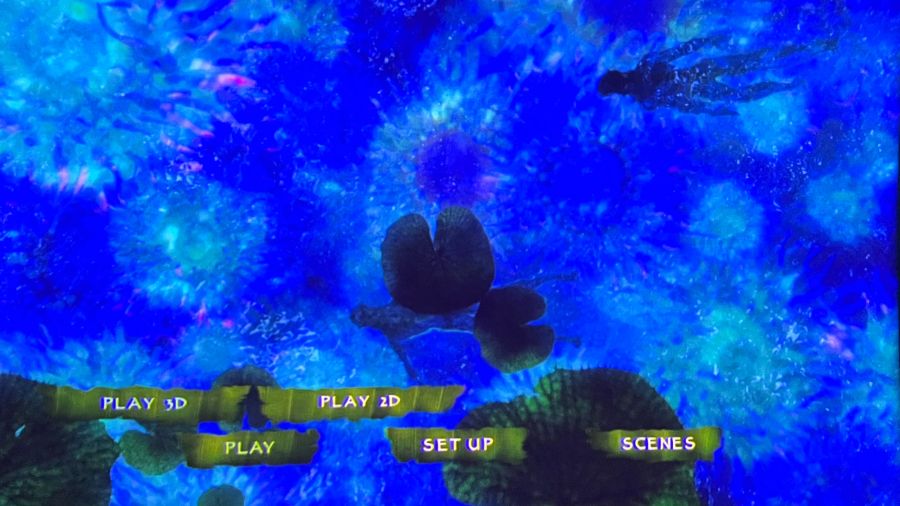
Watched on the Hisense UST projector, my original Coraline disc lacked the 3D depth swagger of Avatar and Hugo, though there were some scenes that strongly benefited from the extra dimension, particularly the ones where Coraline crawls through the passage to and from the Other World. I had caught the remastered 2D version in theaters back in 2024, but watching it in 3D on a 100-inch screen at home was a compelling enough experience that I found myself sitting again through the entire movie.
Plowing through select scenes from the rest of my collection, I was surprised to see how good some of those discs, which I previously hadn’t been impressed by, looked on the big screen. Disney’s Tangled (which even has previews in 3D) and How to Train a Dragon both had subtle, yet impressive depth effects, and the IMAX documentary Deep Sea 3D was a visual delight, particularly the jellyfish segment. The Tsui Hark historical martial arts drama Flying Swords of Dragon Gate, in contrast, was almost too much in 3D given its non-stop over the top, gravity defying action scenes. And the same could be said for Pacific Rim, which had a near-wobbly look due to the shifting spatial perspectives.
Some things are better left in two dimensions.
A 3D TV revival?
The popularity of 3D movies may come and go, but the format will never completely disappear – it’s got way too much sticking power. What I don’t expect to see revived at any time in the near future is 3D TVs. Set manufacturers, and the viewing public, seem pretty much done with that concept.
Fortunately for 3D movie fans, 3D lives on in projectors. That’s not to say that all new projectors support 3D. In fact, Epson, Sony, and JVC have all dropped 3D support in their latest models. But other projector brands such as Hisense, Optoma, AWOL Vision/Valerion, and XGIMI are bullish on 3D, providing broad support for the format across their respective product ranges.
Looking back on my 3D experiment/nostalgia trip, the one thing I would have changed was to use a brighter projector. With a rated 2,500 lumens, the Hisense PT1 has good brightness for the price, and is a great value for an RGB laser projector. But the company’s flagship UST model, the Hisense L9Q, which is rated at 5,000 lumens, twice the brightness, would have been a better choice. The L9Q costs $6,000, and while that price might be high, it is apparently the cost of doing proper 3D business.
Where to buy:
Related Reading:

CNET just launched People’s Picks, a series of surveys where actual real-life humans like you vote for the products and services they use and can’t live without. For our first survey, we want you to weigh in on your favorite headphones and earbuds. We’ll choose winners based on your recommendations and publish a roundup featuring your top picks. So be sure to check back in a few weeks to see if your favorites made it to the list.
Watch this: AirPods Max 2 vs. Sony WH-1000XM6: Which Headphones Are Better?
Why we want to hear from you
Our writers and editors test hundreds of products each year, but your real-world experience with these devices is something we can’t replicate in our labs. You’ve used these headphones at the gym, on your commute to work and on long flights, and that perspective is invaluable. Your voice helps others know about the headphones or earbuds you love, too.
“I review a lot of headphones and earbuds for CNET, and there are plenty of great models from the top brands in this survey that I rate highly. I’m always curious about what models people ultimately choose and why, so I’m excited to get your feedback and learn the results of this survey,” says David Carnoy, CNET’s executive editor and headphones expert.
With our survey, we’ll collect answers from real-world users like you. The headphones and earbuds chosen through our 3-minute survey will be featured in our People’s Picks roundup of the top picks based on your recommendation.
Watch this: AirPods Pro Alternatives. Great Sound for Less, but Is That Enough? | All Things Mobile
Make your voice heard
Whether you swear by a pair of $25 earbuds or love a pair of high-end headphones, your pick counts. The survey takes just a few minutes to complete, and after we gather enough information, we’ll tally the results and publish the winners.
Not sure what to pick? Check out our list of the best headphones to revisit your favorites before voting.

Therapist Explains Why ‘Friendship Breakups’ Hurt As Much As Relationship Split
BREAKING: Tyson Fury vs Anthony Joshua finally signed as fight announcement made

The future of TVs is bright, but I don’t think it’s MicroLED

Manchester United reach agreement with Casemiro over contract clause amid transfer speculation

US brings back mandatory military draft registration

Steven Gerrard disagrees with Gary Neville over ‘shock’ Chelsea and Arsenal claim | Football


-

 Politics7 days ago
Gary Stevenson delivers timely reminder to register to vote as deadline TODAY
-

 Fashion3 days ago
Weekend Open Thread – Corporette.com
-
 Crypto World2 days ago
Hyperliquid $HYPE Rally Builds Momentum as AI Sector Enters Prove-It Phase
-
Crypto World7 days ago
Bank of Hawai’i (BOH) Q1 2026: Net Income Drops to $57.4M as Net Interest Margin Expands
-

 Politics5 days ago
Making troops accountable for war crimes threatens US alliance, ex-SAS colonel warns
-

 Politics5 days ago
Disabled people challenge government SEND proposals over segregation concerns
-

 Business5 days ago
Rolls-Royce Voted UK’s Most Iconic Trade Mark as IPO Register Hits 150
-

 Business4 days ago
Patterson-UTI Energy, Inc. (PTEN) Q1 2026 Earnings Call Transcript
-

 Politics5 days ago
Zack Polanski responds to home secretary’s taser threat
-
 Crypto World6 days ago
Five Value Stocks with Recovery Potential in 2026: PayPal (PYPL), Nike (NKE), and More
-

 Politics5 days ago
Starmer handler McSweeney to be dragged from shadows by Foreign Affairs Committee
-
 Sports1 day ago
IPL 2026: Ruturaj Gaikwad registers slowest fifty of the season, enters all-time unwanted list | Cricket News
-
Politics5 days ago
Wings Over Scotland | How To Get Away With Crimes
-

 Crypto World6 days ago
New York sues Coinbase, Gemini over prediction market offerings
-
 Business5 days ago
HCL Tech share price tank over 9% after weak Q4. JPMorgan, HSBC & 3 others cut target price
-

 Politics5 days ago
‘Iran is still a nuclear threat’
-
Entertainment6 days ago
Sydney Sweeney cameo cut from “The Devil Wears Prada 2”, source explains why (exclusive)
-

 Crypto World6 days ago
Crypto’s great hope in Senate’s Clarity Act still has a path to survive tight calendar
-
 Sports4 days ago
Tim Bradley names the current best in the world: “Better than Inoue and Usyk”
-

 NewsBeat1 day ago
LK Bennett closes all stores after entering administration
You must be logged in to post a comment Login