Samsung Electronics and LG Uplus signed a memorandum of understanding on 27 May to jointly develop Integrated Sensing and Communication, or ISAC, a technology that would allow mobile network base stations to double as environmental sensors. The agreement was signed at LG Science Park in Magok, Seoul, with Samsung Research, the advanced R&D division within Samsung’s Device eXperience unit, leading the development effort.
ISAC works by analysing wireless signals as they reflect off nearby objects, extracting information about an object’s speed, distance, and direction of movement. In practical terms, it means a cell tower could detect a drone, track a vehicle, or monitor foot traffic without any dedicated sensing hardware. The technology uses the same signals that already carry voice and data, turning existing communications infrastructure into a sensing platform.
Why it matters
Environmental sensing today relies on dedicated equipment. LiDAR systems use laser light to measure distance, while radar uses radio waves. Both require separate hardware that must be installed, powered, and maintained independently of the communications network. ISAC eliminates that requirement by piggybacking sensing on the wireless infrastructure that mobile operators have already built.
The International Telecommunication Union’s Radiocommunication Sector, which sets the global framework for mobile standards, has designated ISAC as one of six usage scenarios for IMT-2030, the formal name for 6G. It sits alongside immersive communication, hyper-reliable low-latency communication, massive communication, ubiquitous connectivity, and AI-integrated communication. The inclusion signals that 6G networks are being designed from the outset to sense the physical world, not just move data through it.
Advertisement
What they will test
The 💜 of EU tech
The latest rumblings from the EU tech scene, a story from our wise ol’ founder Boris, and some questionable AI art. It’s free, every week, in your inbox. Sign up now!
The collaboration will initially focus on human detection for safety applications and on improving network operational efficiency. The two companies plan to validate ISAC performance on LG Uplus’s existing 5G networks first, then move to the 7 GHz band, a candidate frequency for 6G that offers a balance between the wide coverage of lower bands and the high bandwidth of millimetre-wave spectrum.
Over time the partnership will combine ISAC-generated wireless data, including location, speed, and density information, with camera imagery to improve detection accuracy. That work will involve developing multimodal AI models that integrate and analyse diverse forms of sensing data. Samsung Research will handle core ISAC and AI technology development, while LG Uplus will provide data and field-testing infrastructure from its commercial network.
Advertisement
The spectrum race behind 6G
The 7 GHz band is increasingly described as the “golden band” for 6G because it offers enough bandwidth for high-speed data while still propagating far enough for practical coverage. South Korea is actively exploring the 7.125 to 8.4 GHz range as a primary 6G candidate. The World Radiocommunication Conference in 2023 identified portions of the 6.425 to 7.125 GHz band for mobile use in several regions, and the 7.125 to 8.4 GHz range is on the agenda for WRC-27.
In the United States, the National Telecommunications and Information Administration must complete its study of the 7.125 to 7.4 GHz band by the end of 2026 before it can be opened to commercial wireless. Europe is pursuing the upper 6 GHz range. The allocation decisions at WRC-27 will largely determine which countries have the spectrum to deploy 6G at scale and which do not. For South Korea, whose economy is deeply exposed to shifts in global tech supply chains, securing early 6G spectrum and standards influence is a strategic priority.
Samsung’s 6G positioning
Samsung has been building its 6G credentials methodically. The company published a 6G white paper outlining its vision for AI-native and sustainable communications, demonstrated 6G technologies alongside global partners at the Silicon Valley Future Wireless Summit in November 2025, and showcased AI-RAN capabilities at Mobile World Congress in March 2026. The ISAC collaboration with LG Uplus extends that work from lab demonstrations to field validation on a live commercial network.
The partnership pairs Samsung’s research capabilities with LG Uplus’s operational infrastructure, a combination that matters because ISAC performance in controlled environments may differ significantly from real-world networks with interference, building reflections, and variable traffic loads. Samsung’s broader ambitions in AI and semiconductor manufacturing give it a vertically integrated stake in 6G infrastructure that few competitors can match.
Advertisement
Commercial 6G deployment is not expected until the early 2030s, and ISAC will need to clear both technical and regulatory hurdles before it replaces dedicated sensing equipment at scale. But the technology represents a genuine shift in what a wireless network can do, and Samsung and LG Uplus are now testing whether the physics holds up outside the lab.
Ever since the first Linux capable single-board computers came out, there have been projects turning them into handhelds. The Raspberry Pi Zero and in particular the Compute Modules are ideally suited to this. While there are more common projects that find their way into our feed we’ve certainly seen a few of them in our time, enough now that a new one has to be special to really catch our eye. Which brings us to the PiBrick from [Ahmad Amarullah], which sets the bar pretty high.
The device is a Compute Module 5 smartphone sized computer with a 3.92″ OLED touch display and the ubiquitous BlackBerry-derived keyboard. It’s drawn together with a PCB that holds all components and peripherals, and this and the 5000 mAH battery fit in a 3D printed shell that gives it the form factor of a chunky smartphone. You can see it at the link above, and also find it in a GitHub repository.
Handheld computers always represent something of a compromise as they can only ever offer relatively small screens and keyboards. But they live or die on their versatility and robustness, both of which this one has in spades. We like it, a lot.
Australia’s Fair Work Commission has announced a process review after an estimated 70% workload increase over three years, partly driven by generative AI tools that enable more people to file longer, more complex, and sometimes inaccurate claims. New Zealand’s Tenancy Tribunal and Australia’s financial complaints authority report similar patterns.
Australia’s Fair Work Commission has announced a review of its processes to cope with what it described as an estimated 70% workload increase over three years, driven in part by the proliferation of generative AI assistance tools. The commission, which handles unfair dismissal claims, wage disputes, discrimination, bullying, and workplace sexual harassment, said the surge is directly affecting its ability to provide timely dispute resolution, according to a statement published on Friday.
Advertisement
The numbers tell the story. The commission received 44,039 lodgments between July 2025 and April 2026, with two months still remaining in the financial year. The full 2024–25 year saw a record 44,075 lodgments. The commission is on pace to exceed that record by a significant margin.
How AI changes what gets filed
The commission attributed the increase to several factors: more people representing themselves in workplace cases, budget constraints, resourcing challenges, and the spread of generative AI tools that make it easy to produce polished-sounding but often generic content. The implication is that AI is lowering the barrier to filing a claim, enabling people who might previously have decided a case was not worth pursuing to generate a detailed submission in minutes.
The 💜 of EU tech
The latest rumblings from the EU tech scene, a story from our wise ol’ founder Boris, and some questionable AI art. It’s free, every week, in your inbox. Sign up now!
Advertisement
The Fair Work Commission published draft guidance in March requiring anyone who uses generative AI in preparing documents for lodgment to disclose that fact. The guidance warned that AI-generated information may be incomplete, inaccurate, or fabricated. A new “Use of GenAI” section will be built into all commission forms.
What the commission is doing about it
The response includes trialling a new system in which senior staff help parties try to resolve disputes informally earlier in the process, before cases consume full hearing time. The commission has also reviewed how it manages applications and is considering deploying an AI voice agent to help triage calls to its helpline.
The irony of a tribunal overwhelmed by AI-generated filings considering an AI tool to manage the influx is not lost. Australia has already backed AI in other parts of its legal system, including a government-supported chatbot that helps splitting couples divide their assets. But the logic is sound: if generative AI is increasing the volume of inbound work, automated triage may be the only way to keep pace without proportional increases in staffing that budget constraints have already ruled out.
Not just an Australian problem
The pattern is emerging across the Tasman as well. Radio New Zealand reported last month that tenants in New Zealand are using AI to support applications to the Tenancy Tribunal, creating extra work and backlog. In one case, a tenant used AI to file a claim for $40,000 over issues including unsafe drinking water and a broken dryer. The tribunal awarded $80.
Advertisement
The case illustrates a recurring problem with AI-generated legal filings. The tools can produce arguments that sound authoritative but cite legal principles that do not apply in the relevant jurisdiction, claim damages wildly out of proportion to the harm, or reference legal frameworks from other countries entirely. Adjudicators then have to work through pages of material to identify which parts are relevant.
The financial complaints parallel
The Australian Financial Complaints Authority, which handles disputes in financial services, told Bloomberg it has also seen increased AI use in how consumers engage with financial firms and lodge complaints. A spokesperson acknowledged that AI can help some people articulate their concerns, but warned that AI-generated complaints “can sometimes include irrelevant, inaccurate or generic information, or may use legal arguments that don’t apply in Australian law.”
AFCA said it encourages people to keep their complaints simple because lengthy AI-generated submissions slow down the resolution process by forcing staff to work through large volumes of material to identify the actual issues. The advice amounts to an admission that more words do not mean a better case, and that AI’s tendency to produce verbose, confident-sounding output is actively counterproductive in dispute resolution.
Access to justice or access to noise
The tension at the heart of the issue is genuine. AI tools can democratise access to legal processes for people who cannot afford lawyers, a point governments and AI companies have promoted as a public benefit. But when the same tools generate filings that are longer, less accurate, and harder to process than what a human would produce unaided, the net effect may be to slow down the system for everyone.
Advertisement
Australia’s Fair Work Commission is the first major tribunal to publicly frame generative AI as a contributing factor in its workload crisis. It is unlikely to be the last. Any institution that accepts written submissions from the public is now dealing with the same dynamic: AI makes it trivially easy to generate text, and institutions built for a world of human-paced filing are not equipped to process the result.
Ctrl-Alt-Speech is the podcast where we make sense of the major debates shaping online speech, platform power, content moderation and the future of the internet. It’s co-hosted by Mike Masnick (Techdirt) and Ben Whitelaw (Everything in Moderation).
Shift is offering to clean homes for free, but there is one important condition. The company will record those chores to build training data for future home robots.
The New York-based startup is currently offering free cleaning services, in which a vetted operator visits a home and wears a camera-equipped device while performing routine household work. The footage can then help AI systems understand how people clean homes outside controlled lab settings.
A robot cannot learn home cleaning only from staged lab videos. Real homes have cluttered tables, dishes stacked in awkward ways, stains in corners, and objects placed where they should not be. That kind of chaos is what makes household footage useful.
Shift is not the only company chasing this kind of physical AI data. In India, startups and data vendors are already building businesses around this demand, paying workers to record first-person videos of everyday tasks and supplying that footage to AI companies. For robotics firms, ordinary human labour is becoming valuable training material.
Advertisement
This is where it starts to feel a bit dystopian
Cleaning may only be the start. In the announcement video, Shift says it eventually plans to move into other areas like plumbing, cooking, and building.
Today, we’re launching shift. We’re starting by cleaning your apartment in New York City, for free.
Here’s how it works. Book a shift cleaning. A vetted shift operator comes to your home wearing one of our devices. They clean. They leave. You pay nothing.
Trades have largely escaped that conversation because physical work is harder to automate. A chatbot can write an email, but it cannot fix a leaking pipe or clean a messy kitchen. Companies like Shift are trying to close that gap by collecting footage of people doing those exact tasks.
AI and robotics may still need time to match the efficiency and precision of a human worker. But watching companies collect this kind of data to train advanced robots feels like the opening scene of the kind of sci-fi movie that does not end well for humans.
A recent hands-on session with a knockoff iPhone Air acquired by Phone Repair Guru offers a clear look at how far these replicas have advanced in matching one of Apple’s most distinctive designs.
The device’s packaging mimics the real item in many respects, but a side-by-side comparison reveals how the fake depends on stickers for some elements on the back rather than printing them directly on. The white is just a little off, and the fake’s bright lettering lacks the high-quality finish you’d expect from Apple. Even with a black light on the box, you can’t find any of the hidden security markings that would reveal the real thing, though the IMEI number from the fake unit somehow manages to pull up information tied to a genuine iPhone Air when checked online, even if the model number isn’t completely correct.
Ultra-Fast 15W Wireless Charging: Harness full 15W charging power, giving your essential devices the quickest charge, consistent with the original…
Compact Charging for 3 Devices: Ideal for clutter-free workspaces, this compact charger fits ideally on any desk, powering everything from phones to…
Certified Fast Charging for Apple Watch: Boasts official certification, enabling you to power your Apple Watch Series 10 from 0 to 100% in just 1 hour…
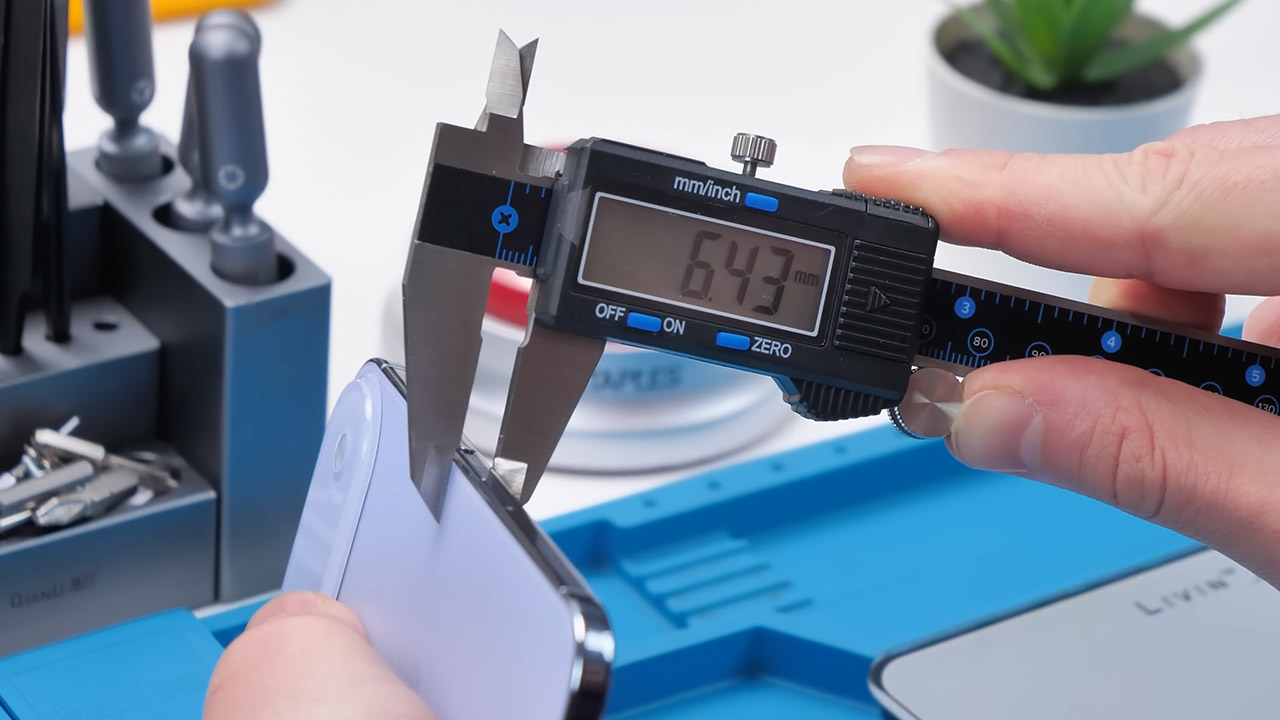
Actually handling the handset gives a strong impression of its slimness and quality. Measuring with a caliper, the fake is around 6.43 millimeters thick compared to the real one measuring in at 6.35 millimeters, resulting in a gap of only 700/1000 of a millimeter. It also weighs less, which contributes to its light and airy sensation in the palm. The camera protrusion is slightly different in shape, but overall the craftsmanship feels like a premium product that far outperforms many of the previous knockoffs he’s encountered.
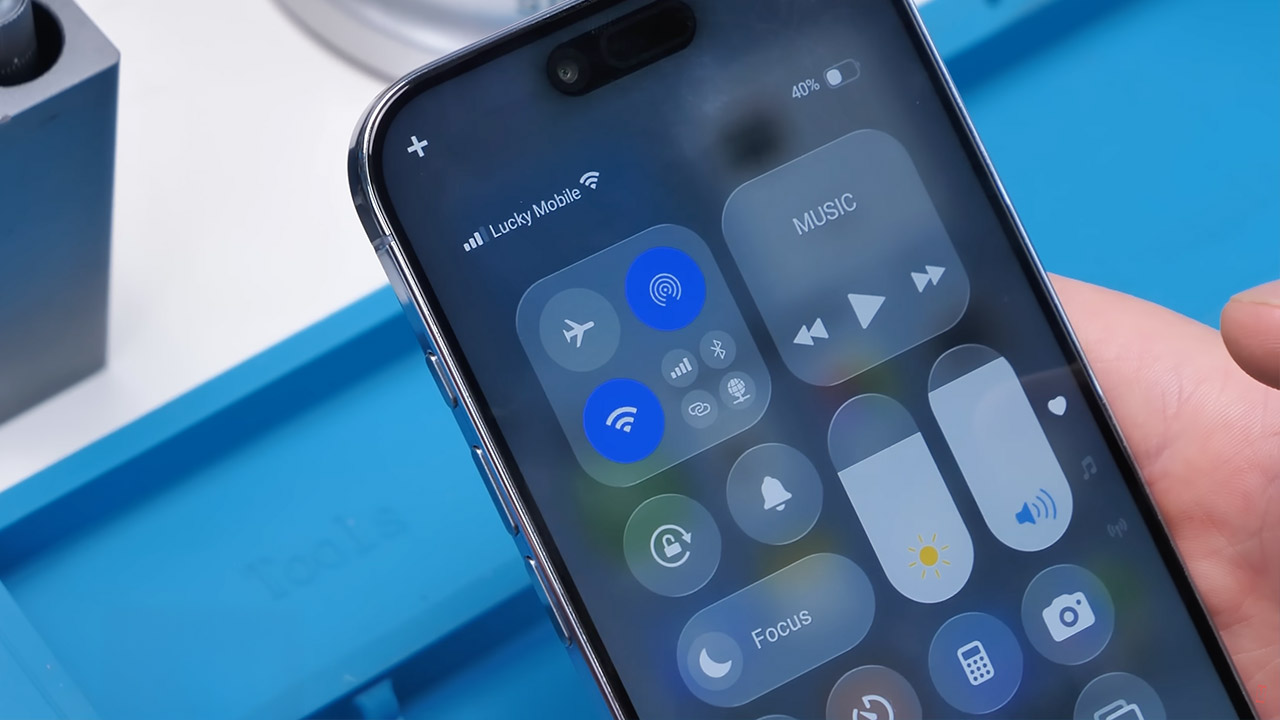
When you first turn it on, the display comes to life, and one of the first things you see is a giveaway. The huge bottom bezel appears throughout the setup process, and it sticks out against the more precise borders of the real thing. The interface is running a faux iOS 26, complete with a Liquid Glass look that seems uneven, and to make matters worse, you can see the underlying Android components popping through in spots, making it much easier to notice once you start exploring.
Function testing was mixed, but one item that impressed was how well it connects to cellular service and handles phone conversations; there were no serious issues there. To be fair, performance was relatively smooth for everyday use and even mild gaming, which is more than some of the other fakes have accomplished. Camera operation relies on a single functional module rather than purely decorative ones. Daylight shots may hold up for casual viewing, but low light conditions expose clear weaknesses in detail and noise handling.
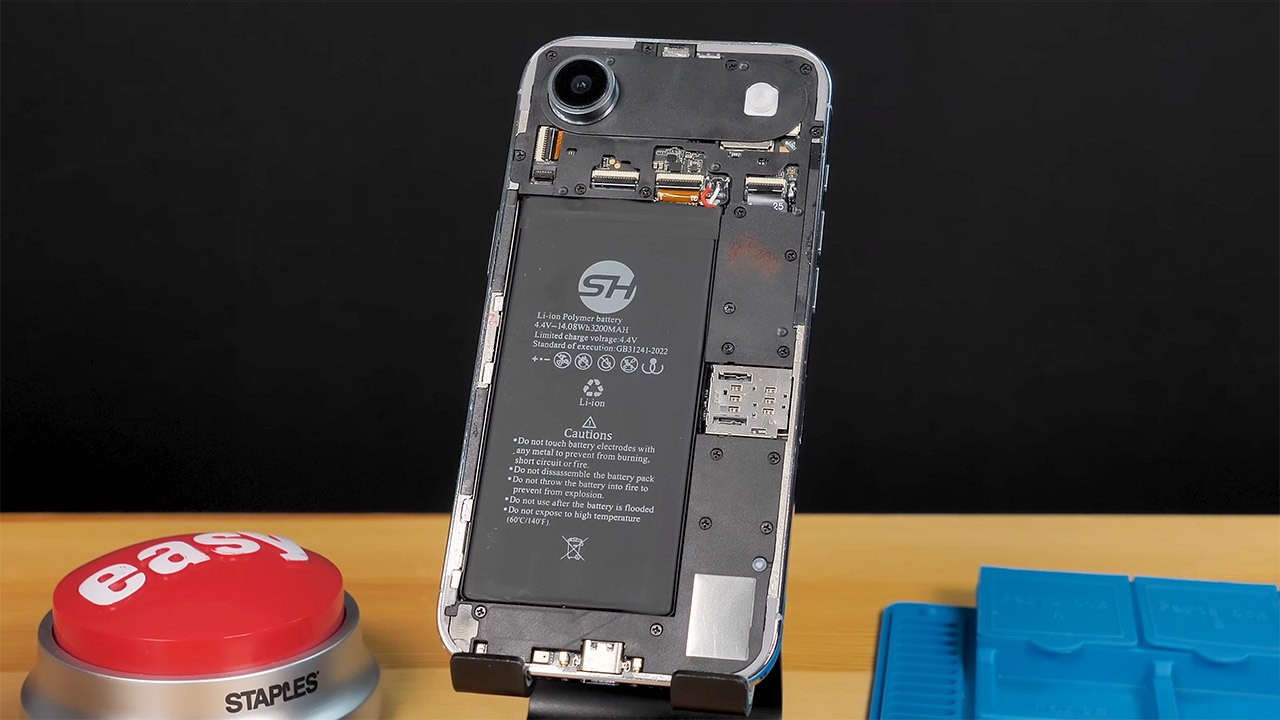
If you take the phone apart, you’ll notice that the internal arrangement is much more clean and well-thought-out than you’d expect from a knockoff, as there is just one working camera system inside, and the battery is actually larger than the one in the genuine iPhone Air.
I am sitting in the sweltering Nevada heat watching a man struggle to lift a bar over his head. If the man manages to do it, he will win $250,000.
The man is Boady Santavy — a two-time Olympic weight-lifting contestant from Canada — and he has muscles that look culled from the Marvel Cinematic Universe: massive, cartoonish arms that might as well belong to a superhero rather than a real human.
Santavy is attempting to beat the world record for the men’s snatch — a lift of 183 kilograms, or approximately 403 pounds. After a tortured few seconds, Santavy drops the bar — an official “no lift” — and, with a look of animated dismay on his face, hobbles away, visibly cursing.
Santavy is one of a small horde of 42 athletic contestants — weight lifters, swimmers, and track runners — that have gathered in Las Vegas over Memorial Day weekend to compete in the Enhanced Games, a unique (and, by now, quite notorious) athletic competition in which almost all of the participating athletes are on performance enhancing drugs.
Advertisement
Broadly derided by critics as the “steroid Olympics,” the games have taken the deeply unprecedented step of juicing many of their athletes to the gills — anabolics, testosterone, peptides, human growth hormones, and more are all in circulation. All of that chemical enhancement has taken place under the watchful eye of a team of medical professionals. Indeed, the competitors — a hodgepodge of athletes from different ages, skill levels, and backgrounds — spent 12 weeks in the United Arab Emirates at an elite compound, where they trained for the weekend’s event while working closely with doctors who tailored their “protocols” — or drug cocktails — to their individual needs.
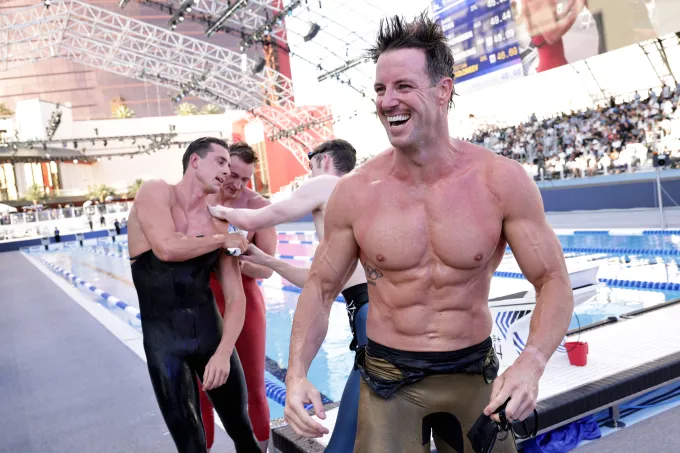
LAS VEGAS, NEVADA – MAY 24: (L-R) Kristian Gkolomeev, Shane Ryan and James Magnussen are seen during the Enhanced Games at Resorts World Las Vegas on May 24, 2026 in Las Vegas, Nevada. Image Credits:(Photo by Greg Doherty/Getty Images for Enhanced)
The athletes are also being paid “appearance fees” just to participate in the contest and, like Santavy, any competitor who happens to break a world record or place first during their competitive feats will be gifted extra cash — up to $1 million in the case of the 100 meter sprint and 50 meter freestyle.
In other words: Enhanced has taken the rulebook for professional athletic competition and aggressively spiraled it out the window.
Why am I, a technology journalist, covering this event?
Odd as it might seem for a place associated with weak-limbed nerds, Silicon Valley is largely to blame for Enhanced. Indeed, the bizarre spectacle is the work of a former startup that was founded by veterans of crypto, AI, and biotech firms, and that has been backed by the likes of mega-investor Peter Thiel and former Coinbase executive Balaji Srinivasan. The event is also at the forefront of a growing industry that Silicon Valley has embraced with open arms — that of human enhancement, in which injectable drugs and ingestible supplements serve as a source of both physical empowerment and good business.
Advertisement
Traditional athletic health organizations, of course, hate it. The World Anti-Doping Agency — the regulatory body for the Olympics — has called the Enhanced Games “dangerous,” and Travis Tygart, the CEO of the U.S. Anti-Doping Agency, describes it as a “clown show that puts profit over people.”
Steroids have long been viewed warily by the international health community, and even federally approved consumer drugs have stirred some concern among health professionals.
However, Enhanced’s organizers argue that they are actually the good guys — that they are trying to fix a persistent bug in organized sports that has existed since forever. That bug is that a whole lot of athletes are already doping — they’re just doing it secretly. The secrecy increases risk, as there may be limited medical oversight of how the athletes are using them. Conversely, in the Enhanced version of sport, athletes self-admittedly do the drugs under the careful supervision of a team of medical professionals.
If Enhanced were merely trying to improve sports safety, that would be one thing. But the truth is that it isn’t just an athletic competition — it’s also a business. The games are the work of Enhanced Group, Inc., a newly public company that enjoyed an IPO earlier this month at a $1.2 billion valuation. Enhanced sells personalized health treatments, including peptides, GLP-1s for weight loss, testosterone injections, and other physically “enhancing” drugs. The company also recently partnered with an AI company, Rezolve Ai, to launch a digital telehealth platform.
Advertisement
Enhanced wants to take what it’s done in Vegas and transform it into a global business: a distribution network for consumers looking to bulk up and make themselves more youthful. The drugs that Enhanced sells have been cleared by the FDA, but there is some concern that by normalizing steroid use, the company could have a trickle-down effect on the wider culture, leading some consumers (notably young ones) to seek less regulated, more dangerous compounds that could end up having disastrous results. This concern hangs over Enhanced’s athletic competition, which has largely been read as a big advertisement for its own business — as well as the peptide industry itself.
One nation, under peptides
I am one of some 200 journalists from around the world who touch down in Vegas two days prior to the games. Enhanced, which provides us with a dedicated workspace, regular meals, and press time with athletes and Enhanced executives, is exceedingly nice to us but one can’t escape the nagging suspicion that it’s because we are an integral part of their business plan. As the skeptical oglers of this Barnum & Bailey-esque curiosity, our job is to report back to the masses, who will then know of its existence. In other words, we are free marketing for Enhanced’s business.
That business is part of an industry that is due for a gold-rush-like boom later this year, should a certain deregulatory deliverance occur.
In February, U.S. Health Secretary Robert F. Kennedy Jr. went on The Joe Rogan Experience and said he was a “big fan” of peptides. Kennedy (who, himself, can look enhanced at times) also implied that he planned to encourage the FDA to make some peptides more accessible to the public. Kennedy appears to have made good on that promise because, in July, the FDA will convene a pharmaceutical advisory committee that considers whether restrictions on certain previously banned peptides will be loosened.
Advertisement
Canadian weightlifter Boady Santavy fails at an attempt to break the world record during the men snatch competition during the Enhanced Games at Resorts World Las Vegas in Las Vegas, Nevada, on May 24, 2026. Image Credits:ETIENNE LAURENT / AFP via Getty Images
Since then, the peptide industry has stood at a bizarre crossroads, in which some startups are reportedly conjuring products based on chemicals that currently reside in a legal “gray” zone, in the hopes of being first-to-market if and when the government eases up on them. Others are sticking to only FDA-approved products. A hot spot of this frenzy has been Silicon Valley, where techies are both using and investing in peptides with mutually aggressive gusto. Companies like Superpower, an AI longevity startup that sells FDA-approved peptides, and Noho Labs, a peptide startup backed by Elad Gil, have risen in prominence, while elite clubs like the AGI House have begun hosting peptide injecting “parties” — as personal use among the valley’s elite booms.
But peptides aren’t just gaining steam in the Bay Area; they’re also seeing a groundswell of use throughout the country, as fitness culture sees an aggressive upswing. Recent reports show that teens and twenty-somethings are turning to peptides to “looksmax” — the trendy new term that denotes any extreme effort to beautify one’s self — while the gym is increasingly seen as one of the key hubs of cultural life for young people. This country-wide push for self-improvement has been fueled by a social media landscape that champions the superficial. The progenitor of “looksmaxxing,” the 20-year-old online influencer “Clavicular,” has been a prominent, not to mention controversial, figure in the popularization of peptides. Yet he is only one in a sea of online voices, including podcasters like Joe Rogan and Andrew Huberman, who have recently promoted or platformed the topic.
This is all about “health,” right?
Peptide producers — including the executives at Enhanced — have sworn that their primary concern is consumer “health.” At the same time, they don’t seem to mind admitting that they’re also interested in money.
Maximilian Martin, the 29-year-old CEO and co-founder of Enhanced, is a calm defender of his company’s unconventional practices. Martin, who previously founded a bitcoin mining company and is always impeccably dressed in a suit and has an affable salesman’s smile, meets with journalists for a press conference on Saturday, where he answers questions with an even-keeled good nature, speaking soberly about how his company plans to monetize the creation of a new generation of chemically-altered mutants.
Appropriately, X-Men comes up.
Advertisement
“People have been using performance enhancements for a long time. If you look at, for example, Hollywood, and you look at Marvel superheroes, they’re all enhanced,” Martin offers. “Like Hugh Jackman doesn’t look like he looks at his age because he has such a clean diet and sleeps eight hours a night, right? So that market is already there. The peptide market in the U.S. today is already 85 million people. Most of that market is served by unsupervised, unregulated substances that people are taking. What we’re doing is we’re entering that market with a pathway for people to get to those benefits that they’re looking for in a safe and medically supervised way.”
Christian Angermayer, Enhanced’s billionaire co-founder and executive chairman, is more succinct. “I’m a capitalist,” he tells journalists bluntly. He doesn’t see a disconnect between profits and health. “There is no reason why something that is good should not also be a business.”
German entrepreneur and Enhanced Games co-founder, Christian Angermayer, talks with the press ahead of the Enhanced Games at the Resorts World in Las Vegas, Nevada, on May 22, 2026. The Enhanced Games is a multi-sport event that allows athletes to use performance-enhancing substances without worry of drug tests. Image Credits:(Photo by ETIENNE LAURENT / AFP via Getty Images)
Let the games begin
May 24th, the actual day of the games, is a sweltering blur of events — all of which take place inside a miraculous $50 million open-air stadium that has been constructed in a matter of weeks for the express purpose of hosting the games. The complex houses a track, swimming pools, and an expansive pavilion for the weightlifters. Surrounding risers are filled with an audience that cheers enthusiastically despite the hot sun.
Yet while the scene may superficially call to mind the Olympics, the vibe is much less a serious sporting event than it is an uncomfortable cocktail of America’s Got Talent, WWE, and Gladiator. Beautiful influencers fill the stands in youthful, colorful herds, and an announcer narrates the day’s events with a sonorous boom that makes it feel vaguely like we’re all sitting court side at WrestleMania. Later in the evening, The Killers — a staple of Vegas entertainment culture — will play a brief concert to close out the games.
The athletes, meanwhile, stalk the grounds like mythical titans, their bulking, unreal muscles glistening in the sunlight.
Advertisement
Martin is seen throughout the day, walking to and fro in his impeccable suit. This suit becomes progressively more wet throughout the evening, as he keeps rushing down to the pool to hug the swimmers who win their races. Angermayer glides about the event with a breezy energy, a tranquil smile affixed to his face. He drops by the press tent briefly to glad-hand.
Other staples of the tech industry — like Bryan Johnson, the mega-wealthy biohacker who plans to live forever — are also involved. Despite no known professional athletic achievements, Johnson spends the night commentating on the spectacle in a Charles-Barkley-esque, retired athlete kind of way. Later he and his girlfriend (whose vagina Johnson regularly tweets about) are seen walking past the media tent; Johnson is dressed in a bizarre outfit that makes him look a little bit like the Sleepytime Bear from Celestial Seasonings.
(L-R) US sprinter Marvin Bracy-Williams, US sprinter Fred Kerley, French sprinter Mouhamadou Fall and Liberian sprinter Emmanuel Matadi in the men’s 100m during the Enhanced Games at Resorts World Las Vegas in Las Vegas, Nevada, on May 24, 2026. Image Credits:(Photo by ETIENNE LAURENT / AFP via Getty Images)
The actual competitions are thrilling enough — and, in general, there seem to be a couple categories of athletes that have come to compete.
There are people like James Magnussen, a retired swimmer from Australia who has won Olympic medals in the past and sees the games as an opportunity to get back in on the action. Magnussen, an image of whose massive body spread virally throughout the web earlier this year, has spoken supportively of the peptide industry, and once said that the combination of peptides and testosterone made him feel like he was “18 again.” He will fail to break any records, however, and places last in two races.
Then there are people like Hafthor “Thor” Bjornsson — a massive Nordic body builder and competitive weight-lifter who has self-admittedly done a lot of steroids in the past and sees this competition as an opportunity to do them under closer, safer supervision.
Advertisement
Bjornsson is recognizable to many because he starred in Game of Thrones as Ser Gregor Clegane, the brutal knight who does the dirty work of the Lannister family and whose go-to fight move is to crush his opponents’ skulls with his bare hands. (On press day, a female journalist asks Bjornsson if he will crush her skull, and he politely obliges with a pantomimed head combustion.) During the games, Bjornsson thrillingly attempts a world record deadlift of 1,135.4 pounds, but ultimately fails to muster the strength.
LAS VEGAS, NEVADA – MAY 24: (L-R) Maximilian Martin, Co-Founder & CEO, Enhanced Games and Cody Miller speak during the Enhanced Games at Resorts World Las Vegas on May 24, 2026 in Las Vegas, Nevada. Image Credits:(Photo by Greg Doherty/Getty Images for Enhanced)
Finally, there are a few competitors like American swimmer Hunter Armstrong, who are abstaining from any supplemental intake altogether. Why is Armstrong even competing? It’s pretty simple: the money, Armstrong tells journalists. That’s the answer that a lot of athletes have given for their participation, in fact. Armstrong has Olympic ambitions and wants to keep himself in the running by not tainting his record. He also has a personal aversion to doping.
“The Olympic movement is something that is very important to me,” Armstrong tells the journalists. “Outside of personal reasons, if I were to go into some kind of protocol I would lose that opportunity.”
Armstrong is one of several competitors who will win their races (in the swimmer’s case, the 50-meter backstroke) despite not being “enhanced.”
The day’s events unfold at a steady pace and, despite organizers’ promise of a titanic extravaganza of unlocked human potential, the event, while entertaining, largely pales in comparison to the Olympics or even, say, a really thrilling football game. The whole thing ends on a weirdly convenient high-point: the competition’s last race of the night — the men’s 50-meter swimming freestyle — culminates with Enhanced’s first and only world-record. Kristian Gkolomeev, a hulking colossus from Greece (he is six feet, eight inches tall), cuts across the pool at a breakneck 20.81 seconds, besting the previous record by 0.07 seconds. The entire crowd erupts in cheers and the venue’s lights blare red in a gameshow-style spasm of celebration. The other swimmers pump their fists in the air victoriously, and Martin again rushes the field in his suit, intent on hugging the dripping Gkolomeev.
Advertisement
LAS VEGAS, NEVADA – MAY 24: (L-R) Maximilian Martin, Co-Founder & CEO, Enhanced Games and Kristian Gkolomeev, winner of the men’s 50m free, are seen during the Enhanced Games at Resorts World Las Vegas on May 24, 2026 in Las Vegas, Nevada. (Photo by Greg Doherty/Getty Images for Enhanced)Image Credits:Greg Doherty/Getty Images for Enhanced
The future is enhanced?
The critics of the Enhanced Games say it isn’t really about health, it’s about money. Yet it’s difficult to escape the sense that the games are also about something else, which is vanity — both that of America and the event’s organizers. America has always been the country where fitness culture extends beyond health into the realm of self-aggrandizement, and the Enhanced Games — a showy pageant embodying that principle — fits right in with the next big era of American self-regard. After all, the location of the event — the nation’s hedonism-fueled “Sin City” — hardly screams “health.” Las Vegas is the locale of spectacle and consumption — of barely-remembered nights in which revelers live for the moment, not the long-term. The organizers could have set the games in the symbolically purifying environs of the Swiss countryside or Joshua Tree, but instead they chose to set it in a place where people commonly risk their futures over a game of cards for a fleeting chance at glory.
Similarly, injecting yourself with drugs to make your muscles big doesn’t necessarily seem to be about long-term wellness as much as it’s about looking good in the moment — tomorrow’s potential health consequences be damned.
The glory for the event’s organizers, meanwhile, resides in their ability to usher in a new industry, commemorating it — as they have — with an extravagant ritual that, in their own words, heralds future “scientific breakthroughs” and “human advancement” (not to mention revenue). The gamble for them is on whether this industry does or does not blossom in the coming months, but like the consumers of their supplements, they appear to be living in the moment.
One place where limited glory is felt is the press corps towards the end of Enhanced’s three-day extravaganza. Around midnight, when the games are finally over and the crowd is dispersing, our hot and tired cohort retreats blearily to the media center — a florescent-lit workroom in the nearby Resorts World hotel. As I’m readying to leave, I make a pitstop to the bathroom and, after some necessary relief, turn a corner and run smack into Martin. He appears to be in a brand new suit (or perhaps the one he’s been wearing has simply dried), and he is admiring it in the bathroom mirror. He is undoubtedly preparing for the late-night press conference that’s scheduled to occur soon.
Having not actually spoken to him yet, I am at a bit of a conversational loss. What sort of patter can two men who are essentially strangers offer one another in a public bathroom late at night? How can I sum up the last 72 hours? “Congratulations,” my tired brain lands on, as I head for the door.
Advertisement
“Thank you,” he says, nodding briefly, then turns back to the mirror.
When you purchase through links in our articles, we may earn a small commission. This doesn’t affect our editorial independence.
We spend hours testing every product or service we review, so you can be sure you’re buying the best. Find out more about how we test.
UGREEN Maxidok 10-in-1: 30-second review
While docking stations aren’t glamorous, they can elevate a laptop or mini PC which has limited external ports. One cable in, everything on. That is the promise, and when it works, it can be transformative.
Ugreen has been steadily building its reputation in the docking station space. Its Revodok line has impressed across multiple price points. Now the company has moved upmarket with the Maxidok series, targeting users who want Thunderbolt 5 connectivity at a price that does not require a corporate expense account.
Advertisement
The 10-in-1 sits below the flagship 17-in-1 in the Maxidok range. It trades the M.2 NVMe storage slot, 2.5GbE networking and extra ports for a smaller chassis and a lower price. On paper, that sounds like a fair deal. In practice, whether it works for you depends heavily on one question: do you actually have a Thunderbolt 5 port?
That question matters more than it might seem. Thunderbolt 5 is not yet common. It is not even particularly close to common. Understanding what this dock can and cannot do for existing Thunderbolt 4 users is essential context before any purchase decision.
If you do this, the Maxidok 10-in-1 TB5 is something of a halfway house between a hub and a full dock, taking a single TB5 uplink and converting it into a 100W charging point with Thunderbolt downlinks, plenty of USB, LAN and a DisplayPort connection for a monitor.
Advertisement
What it lacks is any audio connections or native HDMI, though it does have a card reader that can take SD and Micro SD cards.
If I were deploying these for staff who often work at home, I’d recommend them for the home end of this equation, and they’re 17-to-1 bigger brothers for when they come into the office.
Sign up to the TechRadar Pro newsletter to get all the top news, opinion, features and guidance your business needs to succeed!
It might not have the specifications of the best laptop docking station to feature TB5, but the asking price is remarkably competitive for those lucky enough to have Thunderbolt 5 or USB4v2 on their system.
Advertisement
UGREEN Maxidok 10-in-1: Price & availability
(Image credit: Mark Pickavance)
How much does it cost? $250/£188/€240
When is it out? Available now
Where can you get it? Direct from Ugreen or via an online retailer
The dock is available direct from Ugreen’s websites, where it’s currently discounted down to $249.99 in the US, £187.49 in the UK, and €239.99 across Europe.
That’s cheaper than the MSRP, which sits at $299.99 / £249.99. At this aggressive price-point, the Maxidok 10-in-1 is positioned as the accessible entry point into Thunderbolt 5 docking.
However, it can be found cheaper online, and I noticed that Amazon.com currently has it for $229.98 for US customers. UK Amazon pricing is the same as that directly from the makers.
The competitive landscape is interesting, since many makers still consider TB5 technology to be high-end rather than consumer products.
Advertisement
The CalDigit Element 5 Hub sits at $250/£250 but leans more towards being a hub than a full dock, with fewer ports. The StarTech Thunderbolt 5 Universal Docking Station lands at around $283/£238 and offers triple monitor support, which is a genuine advantage.
The CalDigit TS5 Plus climbs to $475/£470 but provides 10GbE, 20 ports and 330W power. A direct competitor to the Calidigit TS5 is UGREEN’s own 17-in-1 flagship, which retails for $389.99/£356.99/€390.99.
Ugreen also makes a Thunderbolt 5 Dock exclusively for Apple Mac Mini users, but that’s beyond my experience envelope to rate.
Against that backdrop, the 10-in-1 occupies a reasonable position. It delivers genuine Thunderbolt 5 bandwidth at a price meaningfully below the established premium brands. The build quality and finish are strong. Ugreen has a good track record in this space.
Advertisement
However, there is a Thunderbolt 5 caveat to consider. Buying this dock with a Thunderbolt 4 machine means paying a premium for capabilities you cannot yet access. The hardware is forward-looking, but the investment only pays off when the host catches up.
If you aren’t planning to upgrade to a machine with Thunderbolt 5 technology, then this hardware’s best feature will mostly go unused. It will work with Thunderbolt 4, but it won’t have the bandwidth or performance that it would with Thunderbolt 5.
1x TB5 host port (80Gbps / 120Gbps Bandwidth Boost)
Thunderbolt 5 (downstream)
Advertisement
2x TB5 ports
USB-A ports
3x USB-A 3.2 Gen2 (10Gbps)
USB-C ports
Advertisement
N/A
Video
DisplayPort (+ 2xTB5 ports with adapters)
Power Delivery
Advertisement
Up to 100W on upstream
Row 9 – Cell 0
10W each on USB-A ports, 15W on TB5 downstream
Storage Slot
N/A
Advertisement
Card Readers
CF 3.0, UHS-II SDXC, UHS-II microSDXC (170MB/s)
Network
1x 1GbE Ethernet
Advertisement
Audio
N/A
Security
Kensington lock slot (cable lock sold separately)
Advertisement
Thermal
Passive cooling
Construction
Aluminium
Advertisement
Size
13.3 x 13.3 x 5.3 cm
Weight
1.09 kg
Advertisement
UGREEN Maxidok 10-in-1: Design
(Image credit: Mark Pickavance)
Milled aluminium construction
Integrated uplink cable
Idiosyncratic port selection
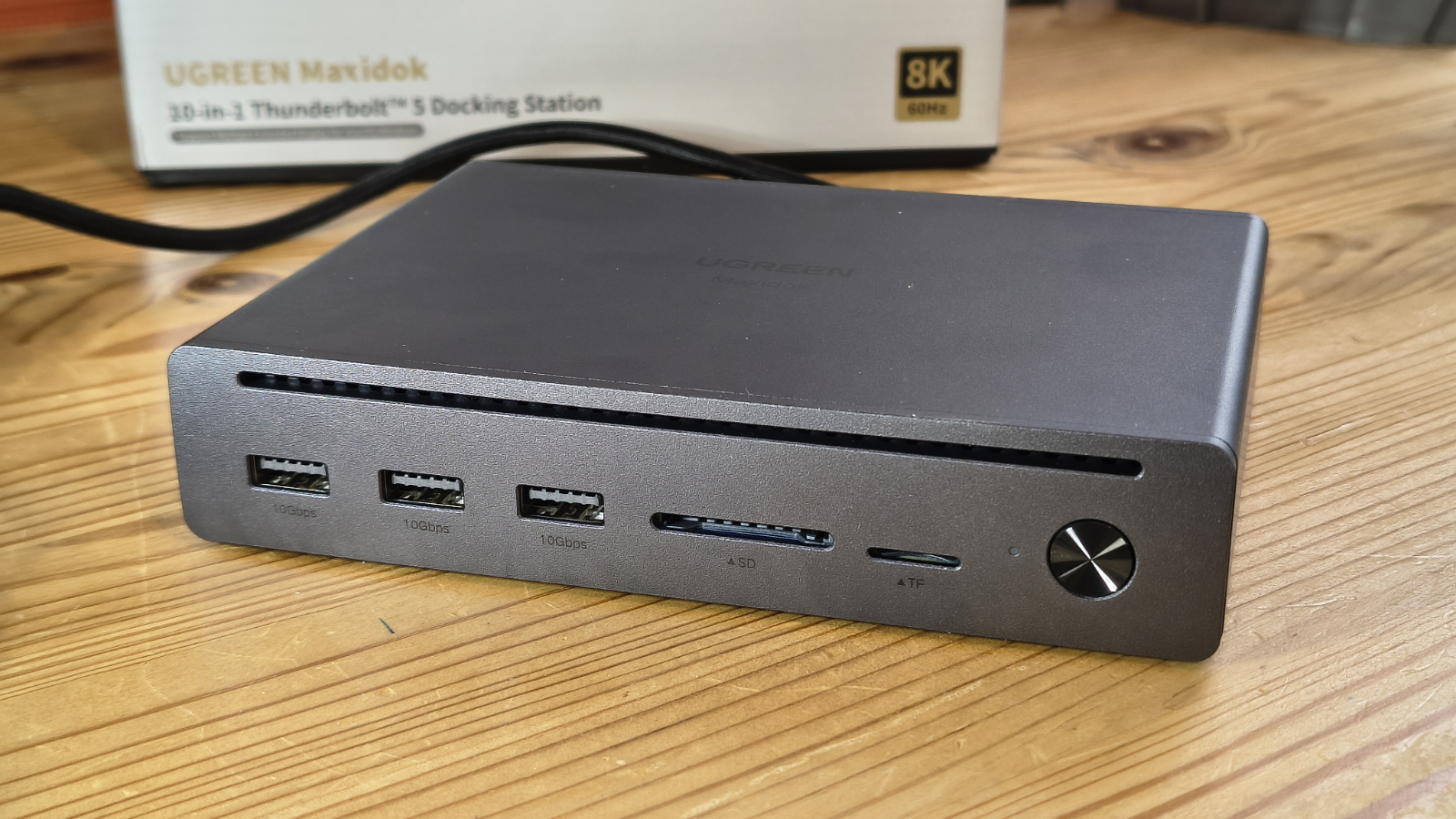
The Maxidok 10-in-1 is a compact unit. Its aluminium shell is finished in dark gunmetal grey, a finish that pairs well with modern MacBooks and some of the nicer mini PCs. The build feels solid, and as this system has passive cooling, much of that mass is designed to move the heat generated internally to the outside. The result is a dock that is completely silent in use, irrespective of what is plugged into it.
There is a narrow slot on the front and a corresponding one on the rear, so that air can flow across the internals.
The upstream Thunderbolt 5 cable is integrated, braided, and runs to approximately 80cm. That is a sensible length for most desk configurations, but fixed cables are always a slight compromise, since you cannot replace them if they fail. Ugreen designers have taken the view that having a high-quality integrated cable that can’t be lost is more important than offering the owner longer alternatives.
For those wondering, the Thunderbolt ports on this device aren’t interchangeable, so you can’t decide to make one of the TB5 downlinks into the uplink.
Advertisement
The 10-in-1 provides sufficient connections for many dock users, with two Thunderbolt 5 downstream ports at the rear, along with one DisplayPort 2.1 output and a single 1GbE LAN port. The LAN port is one of the few significant weaknesses of this design, since there isn’t a good reason why it couldn’t have been a 2.5GbE port. I suspect that Ugreen wanted to keep that feature for its 17-to-1 model, so it was downgraded here to 1GbE.
The front face has three USB-A 3.2 Gen 2 ports at 10Gbps, one SD card reader rated at 170MB/s, one microSD card reader, and an On/Off power button.
What’s missing here is an audio jack and a USB-C for charging phones. Both of these omissions can be addressed with adapters that connect to either USB-A ports or Thunderbolt 5 downstreams.
(Image credit: Mark Pickavance)
Power comes via a barrel-connector DC jack from the supplied 140W power brick.
Advertisement
The two Thunderbolt 5 downstream ports can handle display output and provide up to 15W of power delivery each. That is enough to top up a phone, but not much more.
The quoted downstream power for recharging a laptop is 100W, although when you consider what power each of the USB and Thunderbolt downstreams can consume, and the power overhead for the unit, that number might be reduced depending on what is connected.
Compared to the flagship 17-in-1 design, the compromises are clear. The M.2 NVMe SSD expansion slot is gone. Ethernet drops from 2.5GbE to standard Gigabit. The total power supply falls from 240W to 140W. That 140W brick is just about sufficient for the dock’s needs, though there are reports of minor wattage fluctuations to the host when all ports are loaded simultaneously.
The absence of a front USB-C port is a real-world inconvenience. Most newer peripherals, phones and accessories use USB-C. The dock offers three USB-A ports for a format that is increasingly legacy. A single USB-A to USB-C swap would improve the experience meaningfully should Ugreen ever offer a second generation of this design.
Advertisement
These things said, as a functional dock for use with Thunderbolt 5, there is plenty to like here in both build quality and usability.
Power comes via a barrel-connector DC jack from the supplied 140W power brick.
The two Thunderbolt 5 downstream ports can handle display output and provide up to 15W of power delivery each. That is enough to top up a phone, but not much more.
The quoted downstream power for recharging a laptop is 100W, although when you consider the power each of the USB and Thunderbolt downstreams can consume, and the power overhead for the unit, that number might be reduced depending on what is connected.
Advertisement
Compared to the flagship 17-in-1 design, the compromises are clear. The M.2 NVMe SSD expansion slot is gone. Ethernet drops from 2.5GbE to standard Gigabit. The total power supply falls from 240W to 140W. That 140W brick is just about sufficient for the dock’s needs, though there are reports of minor wattage fluctuations to the host when all ports are loaded simultaneously.
The absence of a front USB-C port is a real-world inconvenience. Most newer peripherals, phones and accessories use USB-C. The dock offers three USB-A ports for a format that is increasingly legacy. A single USB-A to USB-C swap would improve the experience meaningfully if Ugreen ever offers a second generation of this design.
These things said, as a functional dock for use with Thunderbolt 5, there is plenty to like here in both build quality and usability.
Advertisement
UGREEN Maxidok 10-in-1: Features
TB5 Bandwidth
8K monitors and DSC
100W charging
Thunderbolt 5 enables up to 120Gbps of bandwidth in boost mode. With a fast external NVMe enclosure, transfer speeds on Thunderbolt 5 hosts should dramatically exceed those of Thunderbolt 4.
However, those plugging it into a Thunderbolt 4 port will not notice any difference, since the system will effectively be degraded to that standard, and the total bandwidth will be pinned at 40 Gbps.
One important note is that this dock will not work with Thunderbolt 3 or USB-C; it’s exclusively for TB5, TB4 and USB4. I have no specific information on whether it will use the extra bandwidth of USB4v2, but since it’s built on the same architecture as TB5, it should be able to use the 80Gbps baseline mode of those ports or the 120Gbps mode when connected displays are present.
But, I’ve had reports from others that some docks, when they encounter a USB4v2 host, will merely downgrade to USB4 40 Gbps.
There is another way this can go wrong for a user with a USB4 connector on their laptop. Early in the appearance of USB4, some brands decided to launch systems with USB4 ports that only have 20Gbps available.
Advertisement
These are effectively USB 3.2 Gen2x2 devices rebranded as USB4; therefore, it is worth checking whether you have one before investing in any dock hardware. USB4 at 20 Gbps isn’t capable of supporting dual monitors on this dock.
(Image credit: Mark Pickavance)
The dock supports dual 8K at 60Hz on Windows with a Thunderbolt 5 host. On macOS, it tops out at dual 6K, which corresponds to Apple’s Pro Display XDR resolution. Single display operation at 8K is supported on both platforms.
If you are lucky enough to have an 8K monitor, you need to be aware of whether DSC (Display Stream Compression) needs to be enabled to support higher resolutions. And if you have a monitor that won’t work with DSC and you disable it for that hardware, it can use more bandwidth, preventing other displays from reaching their target resolutions.
As a rule, if supported, enable DSC on both the monitor and the host device.
Advertisement
The dock charges the connected host at up to 100W over the Thunderbolt upstream connection. The 140W power brick supplies the dock itself, leaving headroom for peripherals alongside laptop charging.
The snag is that each of the downstream Thunderbolt ports can use 15W, and the USB-A ports will typically allow for up to 7.5 Watts of power (5V at 1.5A), adding more. The ports alone could represent another 52.5W, and that doesn’t include the overhead of running the electronics in the dock.
(Image credit: Mark Pickavance)
UGREEN Maxidok 10-in-1: Performance
80Gbps upstream bandwidth
TB5 Bandwidth Boost for video
(Image credit: Mark Pickavance)
Evaluating the performance of docking stations is always a fraught exercise, mostly because we’re forced to make assumptions about the host system and its connectivity.
Advertisement
What I can say with some certainty is that this dock delivers what you might reasonably expect over Thunderbolt 5, and it also performs well over Thunderbolt 4 and USB4.
As part of these tests, I connected two external drives: the excellent Corsair EX400U USB4 2TB and a Ugreen 40 Gbps NVMe M.2 caddie with a Kioxia Exceria Plus G3 1 TB installed.
The purpose of this pairing was to determine how the extra bandwidth in the dock could be used to run both storage devices simultaneously.
When accessed separately, the Corsair managed 3909 MB/s reads and 3704 MB/s writes, while the Ugreen caddie delivered 3670 MB/s reads and 2155 MB/s writes.
Advertisement
Based on those numbers, I initiated a large file copy from the Ugreen to the Corsair, which peaked at about 1370MB/s. That result implied that the transfer was routed via the PC, which was connected by USB4, reducing the bandwidth by half.
I then tried to copy a pair of 20GB video files to each drive simultaneously, and the peak performance I observed was about 2000 MB/s, with around 1000 MB/s on each drive. Switching to Thunderbolt 5, drive-to-drive transfer performance should be effectively doubled. I suspect that if I had a Thunderbolt 5 external drive, a speed of between 4000 MB/s and 5000 MB/s would have been possible, but I didn’t have one to spare.
In my experience, the latest TB4 and TB5 docks get close to the directly connected speed of external drives, although some speed is lost in the relay. But, if you are using a TB5 dock with USB4 external SSD drives and a TB5 connection, you can get decent performance out of more than one drive being used at the same time.
As this dock is passively cooled, I was curious how warm it would get while moving terabytes of data around, so I broke out the thermal camera to track the temperatures.
Advertisement
After extended use, the dock hit 40.2 °C, but interestingly, both external drives were hotter than the dock, with one reaching 44.1 °C. On this basis, it’s the peripherals that might have thermal issues before the dock throttles to reduce heat build-up.
If you want even more performance from storage on a dock, the only practical way to get it is to use one that mounts an internal Gen5 NVMe drive, like the Maxidok 17-to-1 model.
However, the maximum that can be allocated to a data transfer on Thunderbolt 5 is 80 Gbps, which works out at around 10000 MB/s, but due to the overheads of packaging the data, that is probably closer to 7000 MB/s in practical terms.
Advertisement
UGREEN Maxidok 10-in-1: Final verdict
(Image credit: UGREEN)
The Ugreen Revodok Maxidok 10-in-1 arrives as one of the more accessible Thunderbolt 5 docks on the market. At $249.99, it undercuts much of the competition.
It brings the headline 120Gbps bandwidth of Thunderbolt 5, dual display support up to 8K on Windows or 6K on macOS, and a compact aluminium chassis that sits comfortably on a desk. It charges the host laptop at up to 100W, completing a solid package.
But Thunderbolt 5 remains a genuinely uncommon port. Buying this dock today means you are, to a real extent, buying for the machine you will own next. Thunderbolt 4 users will find that things work, but they will not get the full picture. As USB4v2 is likely to be the more commonplace alternative to Thunderbolt 5, that’s the port Ugreen has pinned its hopes on.
For those who do have Thunderbolt 5, it becomes a choice between one of the other brands and the Ugreen 17-to-1 model.
Advertisement
The 10-to-1 dock drops the M.2 storage slot and 2.5GbE networking that the flagship 17-in-1 offers, which makes it a compromise at both ends. Still, for the person with a Thunderbolt 5 laptop who wants clean desk management without spending flagship money, it makes a reasonable case.
UGREEN Maxidok 10-in-1: Report card
Swipe to scroll horizontally
Value
For TB5 or USB4v2 dock, this is a bargain
Advertisement
4.5 / 5
Design
A beautifully engineered passively cooled dock.
4 / 5
Advertisement
Features
Works with TB5, TB4 and USB4, but not TB3. The 140W PSU gets stretched thin if every port is used.
4 / 5
Performance
Advertisement
80 Gbps data transfers if you have TB5 or USB4v2
4 / 5
Overall
Other than the 1GbE LAN port, the 10-to-1 is a affordable high-performance dock
“We trained the bots. We did the grind. Now we’re being left behind,” chanted a horde of contract workers who gathered outside Meta’s offices in Dublin, Ireland, on Friday afternoon. Waving flags, brandishing signs, and armed with whistles and vuvuzelas, they were out to protest a round of planned layoffs.
The workers are employed by Dublin-based company Covalen, which handles content moderation and data labeling services that help Meta to fine-tune its AI products. In April, Covalen told 700 employees that their jobs were at risk, citing “reduced demand,” WIRED reported.
A large swath of the affected workers won’t receive any severance because they’ve been employed for less than two years. The rest are being offered the minimum payout required under local labor laws—two weeks’ pay for every year of employment—according to the Communications Workers’ Union (CWU), whose members include Covalen employees.
“We’re just getting the crumbs here,” Aadel Obaid, a team manager at Covalen who is part of the planned layoffs, tells WIRED. “Give us a little bit of the pie.”
Advertisement
Photograph: Joel Khalili
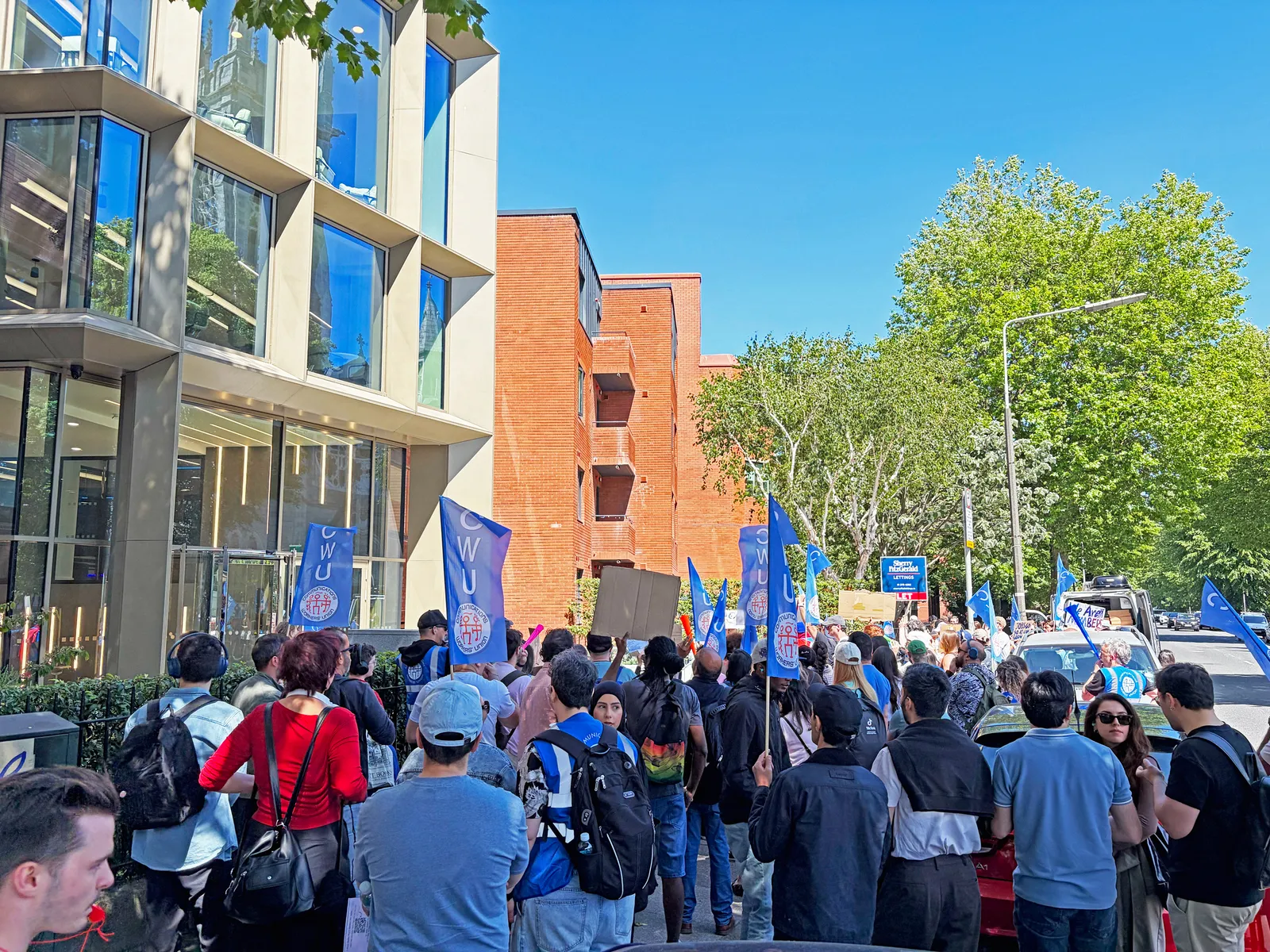
To try to compel Covalen into revising the severance package, workers voted to strike outside the company’s corporate office, before marching to Meta’s nearby European headquarters. According to John Bohan, an organizer at the CWU, Meta could use its leverage as an anchor client to pressure Covalen into offering its employees an enhanced severance package. The workers are asking for double what’s currently being offered—and at least some form of payment for workers who don’t meet the two-year threshold.
The company could also release Covalen workers from a “cooldown period” preventing them from working on another Meta account for six months after being laid off, Bohan says. (Meta previously described the cooldown period to WIRED as an industry standard.)
At 1 pm local time on Friday, the striking workers began to gather outside Covalen’s corporate headquarters, a red-brick office building on an otherwise largely residential street in the heart of Dublin. The protests began with a wall of sound: The workers beat drums, booed, whistled, shouted, and catcalled. Then came a volley of call-and-response chants led by a worker with a megaphone. The building’s security guard watched, bemused, from inside the lobby, hands on his hips.
Two hours later, the group—now more than 150 people—began to march down the center of the mile-long stretch of road to Meta’s campus, slowing the trailing traffic to a crawl. Dubliners enjoying the early onset of summer stopped to gawp; some applauded. When the protesters arrived at Meta’s complex, two security guards stood with crossed arms, blocking the way. The group set up at the gates and began another round of chants: “We scrub the feed. We take the pain. Meta profits from our strain.”
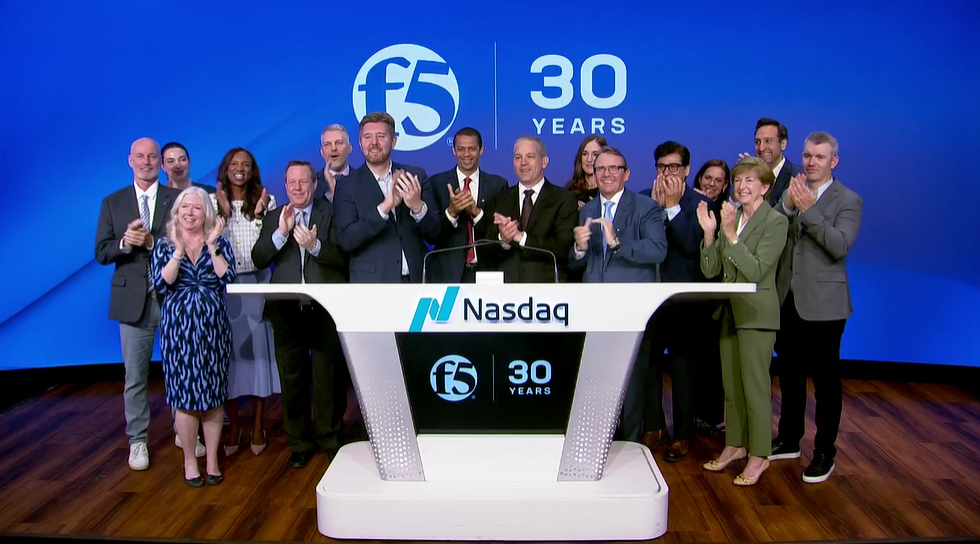
F5 CEO François Locoh-Donou (center) and members of the company’s leadership team with Nasdaq’s Jeff Thomas (in front of F5 logo) at the Nasdaq MarketSite in Times Square on Friday, marking F5’s 30th anniversary by ringing the opening bell. (Screenshot via webcast)
Nearly 27 years ago, in June 1999, a 3-year-old Seattle-based internet traffic-management company called F5 Networks Inc. went public on the Nasdaq, boasting customers such as PSINet, MCI WorldCom, StarMedia Network, Vanstar, Frontier GlobalCenter, and BellSouth.net.
Don’t recognize the names? That’s because they no longer exist. Each ended up bankrupt, acquired, or both within a few years, mostly as casualties of the dot-com crash.
F5 was far from a sure thing itself. The company, with 123 employees at the time, reported an annual loss of $3.7 million on revenue of $4.9 million in its IPO filing. It was a sign of how speculative the late-1990s internet boom had become, with unprofitable companies going public based on sales to other companies that had yet to prove their own business models.
F5 execs including CEO François Locoh-Donou in New York on Friday. (GeekWire Photo / Brian M. Westbrook)
But F5 has outlived most of the customers in its IPO prospectus and the three investment banks that took it public. The former Seattle startup this morning marked its 30th year in business by ringing the opening bell on the Nasdaq in New York City.
“We have evolved from a load balancing startup into a global leader that delivers and secures every app and API anywhere,” F5 CEO François Locoh-Donou said at the Nasdaq podium.
F5 has survived over the years by adapting its business from the early internet to data centers and now the cloud and artificial intelligence — while weathering the dot-com crash, a wave of competitive and economic threats, and more recently, a cybersecurity incident of its own.
Advertisement
Along the way, F5 has evolved from hardware appliances to software and back again, with hardware sales now surging again on demand from AI data centers.
The Seattle Times’ coverage of F5 Networks’ first day of trading, June 4, 1999. (Seattle Times archive)
The company has a market value of $21.9 billion, with revenue of $3.1 billion and profits of $692 million in its most recent fiscal year. Based in downtown Seattle’s F5 Tower, it employs 6,578 people globally and counts more than 80% of the Fortune 500 among its customers.
In an investor presentation in New York on Thursday, F5 said it expects upper-single-digit annual revenue growth through fiscal 2029, with AI as a big driver. F5 projects its addressable market will grow from about $15 billion this year to more than $40 billion by 2030, citing new opportunities in load balancing for AI data centers, AI data delivery, and security for AI apps.
One constant from those early years is the ticker symbol, FFIV. Shares were up about a half-percent in early trading today after the company rang the opening bell.
The fight over who makes the world’s chips is increasingly a fight over the parts of a chip nobody photographs. India has just landed one of them.
Intel and 3D Glass Solutions have signed an agreement to build a roughly $3.3 billion substrate-manufacturing plant in the eastern state of Odisha, the government announced on Friday.
The memorandum of understanding, signed between the Odisha government, Intel Corporation and 3DGS Inc., covers an advanced-packaging glass-core substrate facility in the Bhubaneswar-Khurda region, to be built over five to six years.
India’s electronics and IT minister, Ashwini Vaishnaw, framed it as one of the largest high-technology manufacturing commitments the country has secured.
Advertisement
The 💜 of EU tech
The latest rumblings from the EU tech scene, a story from our wise ol’ founder Boris, and some questionable AI art. It’s free, every week, in your inbox. Sign up now!
Substrates are the unglamorous layer that makes modern chips work. They are the engineered base a processor is mounted on, routing power and signals between the silicon and the circuit board, and as chipmakers hit the limits of shrinking transistors, the packaging around the silicon has become where much of the performance gain now lives.
Glass-core substrates, the technology at the centre of this plant, are seen as a leap over today’s organic materials, offering tighter, faster interconnections for the densest designs.
Advertisement
The plant’s output targets reflect that ambition. According to the government, it is expected to produce around 70,000 glass substrates a year, some 50 million assembled units, and close to 13,000 advanced 3D heterogeneous-integration modules, the stacked, multi-die packages that pack several chips into one.
It is also expected to create more than 1,800 direct high-skilled jobs, with wider indirect employment around it.
The deal does not stand alone. It was approved under the India Semiconductor Mission, the programme through which New Delhi has pledged billions in subsidies to pull chip manufacturing onshore, and the official project cost is put at about ₹1,943 crore, with central fiscal support of roughly ₹799 crore and additional state backing.
The subsidy structure is the mechanism: India is buying its way into a supply chain it has historically had to import.
Advertisement
For Intel, the move is a smaller, sharper bet than a full fabrication plant, and a notable one given the company’s wider retrenchment.
Backing a substrate facility lets it plant a manufacturing flag in a fast-growing market and in a part of the stack, advanced packaging, where it has staked much of its technological case, without the tens of billions a leading-edge fab would demand.
The strategic logic is the same one driving chip policy from Brussels to Washington. The EU’s Chips Act and the US CHIPS Act are both attempts to localise a supply chain that the pandemic and geopolitics exposed as dangerously concentrated, and India is now running the same playbook from further behind.
An MoU is a starting line, not a finished plant, and the five-to-six-year horizon leaves room for the usual slippage. But the direction is unmistakable: the map of where chips, and the things chips sit on, get made is being redrawn, and Odisha has just been added to it.




















































You must be logged in to post a comment Login