Seattle Tech Week attendees fill AI House at Pier 70, spilling onto the deck overlooking Elliott Bay. (GeekWire Photos / Todd Bishop)
Attending as many Seattle Tech Week events as possible and talking with as many people as I could, I was struck by the number of people looking for work and the volume of visitors from the Bay Area, including a number of investors looking to get a sense for what the regional tech scene is about.
It was hard not to imagine them being impressed with the sheer level of engagement and enthusiasm, even if they didn’t happen to catch Jacob Colker’s rallying cry. With more than 250 events (and waiting lists for many of them) it was more than any one person could take in.
It wasn’t Seattle AI Week — that’s still to come in October — but given the moment in tech and the world, the topic of artificial intelligence was naturally the main throughline of the week.
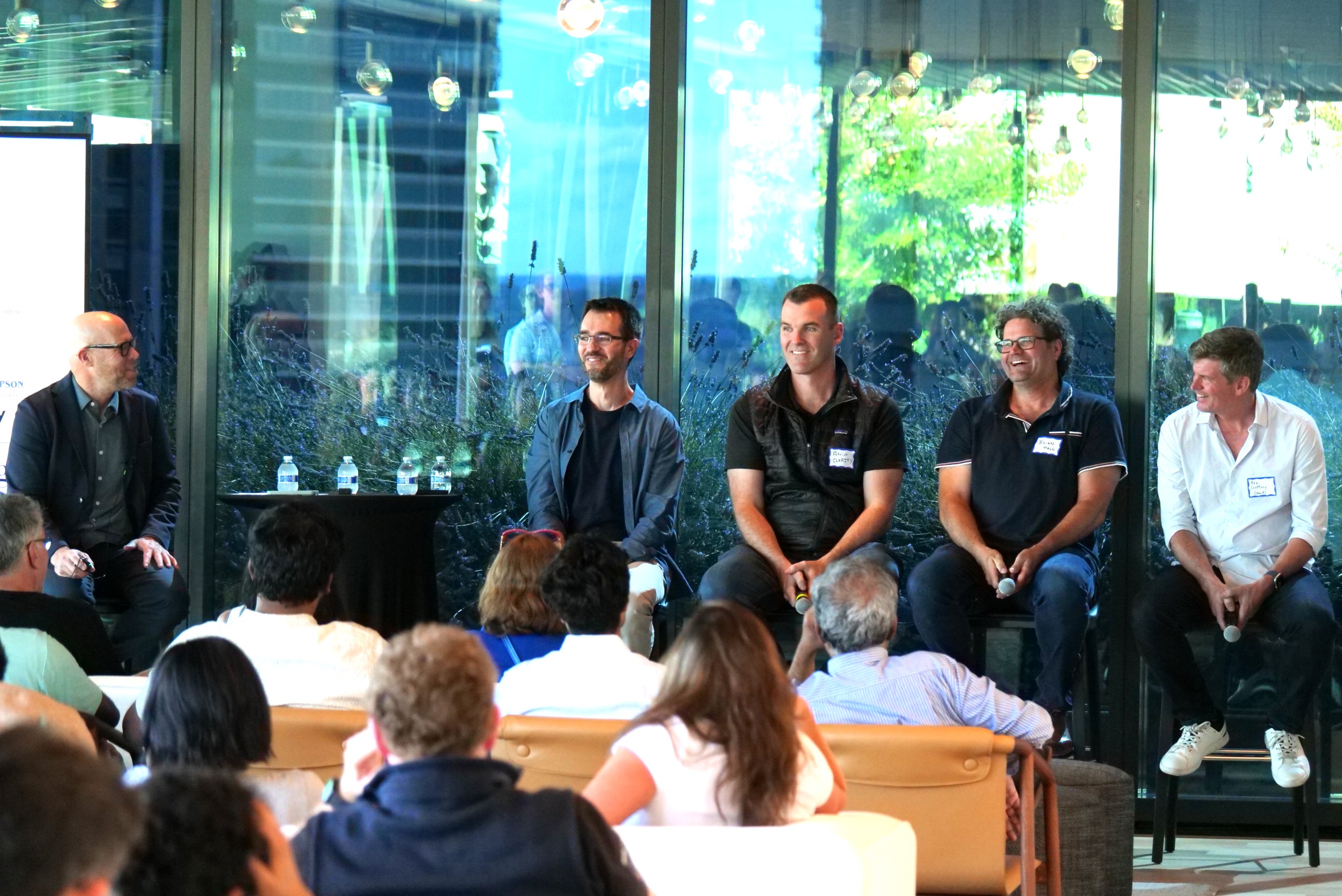
A panel that changed my perspective was early in the week, called “Foundation Models Go Vertical,” hosted by the Seattle pre-seed firm Ascend at Washington 1000 downtown. Founding general partner Kirby Winfield told the room that 600 people had tried to get in.
One of the biggest insights was from Manos Koukoumidis, CEO of Kirkland-based Oumi and a former Google Cloud AI engineering manager who led large language model efforts there.
Advertisement
From left: moderator Boaz Ashkenazy of the Shift AI podcast, Manos Koukoumidis of Oumi, Patrick Thompson of Clarify, Brian Hall of Mistral AI, and Ben Gaffney of OpenAI at the “Foundation Models Go Vertical” panel, hosted by Ascend. (GeekWire Photo / Todd Bishop)
Companies that are racing to build on top of the frontier models, he said, are renting a kind of intelligence that has very little to do with their own businesses.
“Enterprises are using a model that is trained on 5% of the world’s data that sits on the web, not the other 95%,” he said, referring to the data sitting inside their own organizations.
Which led him to the question (and the point) that I keep coming back to: If the intelligence at the center of the product belongs to someone else, he asked, “are you really an AI company, or an application company on top of somebody else’s intelligence?”
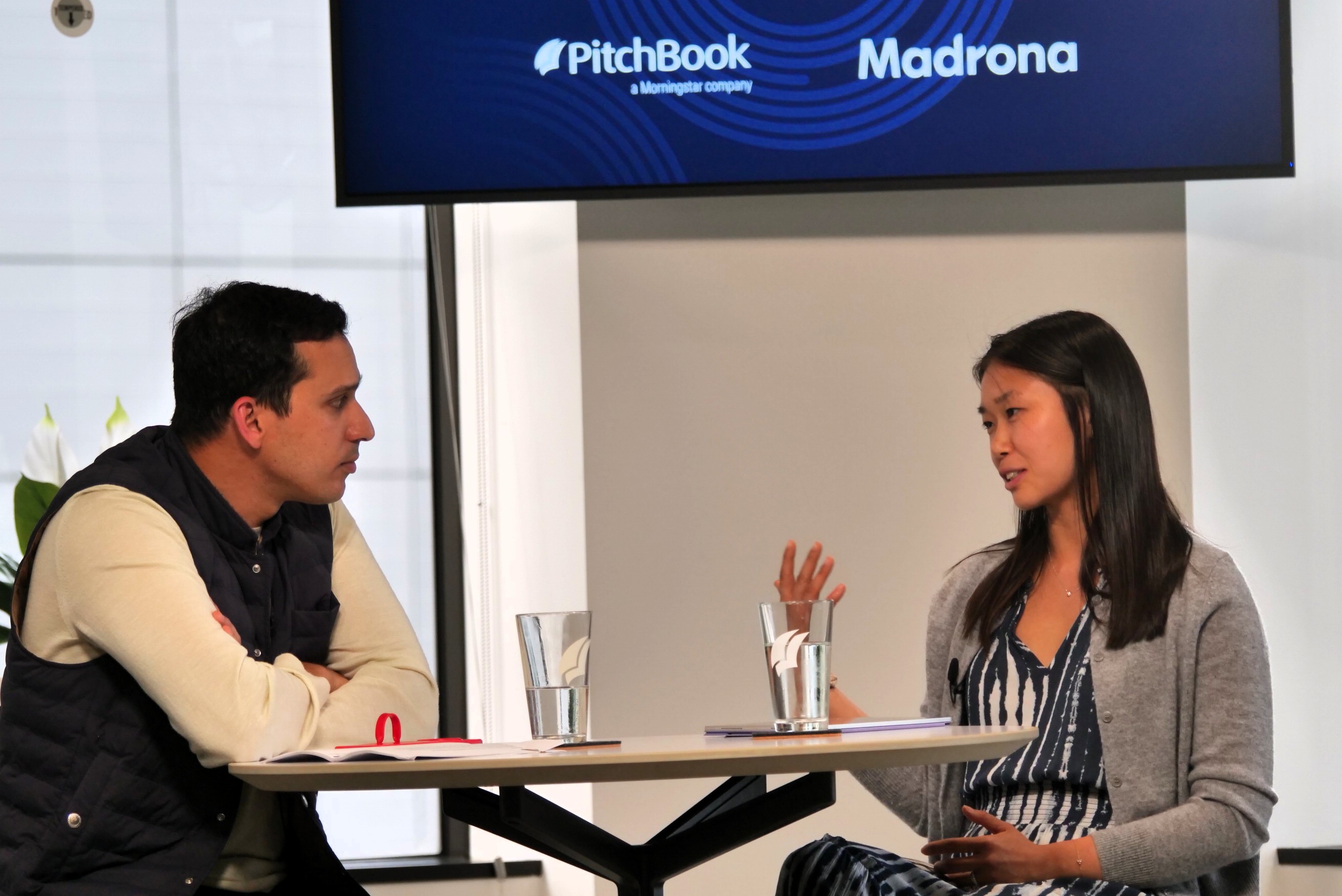
The next day, in the audience for a recording of the Founded & Funded podcast by Seattle Tech Week organizer Madrona, I posed the question that we debated on last week’s episode of our GeekWire Podcast: what should Seattle founders and investors make of venture numbers that rank Philadelphia, Austin, and New York ahead of them?
It was the right place to ask, given that the show featured Nizar Tarhuni, EVP for research and market intelligence at PitchBook, which tracks the numbers, and Madrona partner Sabrina Albert.
Advertisement
PitchBook’s Nizar Tarhuni and Madrona partner Sabrina Albert during a live recording of Madrona’s Founded & Funded podcast at Seattle Tech Week. (GeekWire Photo / Todd Bishop)
Albert pointed out that the numbers don’t capture everything. A company can have a big engineering group in Seattle, or even a co-founder here, and still be counted as a Bay Area company, she said. Large engineering offices for OpenAI and Anthropic are the latest examples.
Tarhuni made a similar point: “There’s so much talent in some of the biggest unicorns that are actually working out of Seattle,” he said. In terms of overall economic activity, he added, “there’s a lot more here that doesn’t make its way into those numbers.”
Other quotes and insights that stood out from the sessions we attended:
Patrick Thompson, CEO of Seattle-based Clarify, said his company’s Anthropic bill had tripled in three months. He has shifted spending to AWS Bedrock, citing reliability problems, and now runs smaller models locally on his own laptop for low-level work.
Madrona’s Albert, on the shift to selling outcomes: “Before, when you were thinking about traditional software, you would charge for a seat or a unit of software. But now you can really fundamentally change it. … If I deliver this outcome for you, then you can actually pay me for it.”
Advertisement
Ken Horenstein, founder of Pack Ventures, which invests in startups tied to the University of Washington, on the knock that Seattle is slow: research institutions here are “choosing problems that are 10, 15, 20, 50-year problems,” he said. “Sometimes people put that as a negative rap on us because we don’t go really fast and flame really bright like you might see in other markets. But I actually think that can be used as a benefit.”
Ben Gaffney, deputy general counsel at OpenAI, on the notion that AI is thinning out headcount: “Even within the legal team that I work in, we need more people. Even though we’re getting all these massive productivity gains, it isn’t like you don’t need people to supervise this stuff.”
Brian Hall, the longtime Microsoft, AWS and Google executive who became chief marketing officer at Mistral AI in June, on where this all ends up: “We’re gonna laugh when we thought that AI was gonna save us time.”
Ascend’s Winfield, on the limits of what investors provide: “If I invested in you, it’s not because I’m smart about your market. It’s because you’re smart about your market. … If you’re looking for answers from your investors, you’re in trouble.”
Advertisement
Karl Siebrecht, co-founder and CEO of Flexe, at a networking event, telling founders to stop networking: “Spending time as a founder trying to market yourself to investors, I think, is a fallacy. If you focus on building a valuable company … I can promise you, investors will find you.”
Molly Klein, founder and CEO of Perk Events, who runs some of GeekWire’s biggest events, on why any of this happens in the first place: “Events are hands-down the strongest business development tool that you have,” she said. “One conversation may take six emails in three weeks. At an event, it happens in 10 minutes, because you’re getting that face-to-face time.”
Several gatherings are scheduled across the country for viewers to enjoy the phenomenon.
Space enthusiasts are abuzz for August as they wait for a once-in-a-lifetime solar eclipse that will nearly swallow the entire sun.
The eclipse is set to start at around 6.15pm on 12 August, reach its maximum an hour later and end at around 8.08pm. It will be the largest eclipse visible from Ireland until 2090 and will offer viewers in Europe the opportunity to witness the eclipse as the sun sets.
The total solar eclipse will sweep across Greenland, Iceland, northern Russia, the Atlantic Ocean, Spain and a portion of Portugal. Across the world, parts of northern US, much of Canada, much of Europe and north-western Africa will also witness the phenomenon.
Advertisement
In Ireland, Cork is best-positioned to watch the eclipse, with 96pc of the sun expected to be covered at the eclipse’s peak. Around 94pc of the sun will be covered in Dublin and 93pc in Belfast.
Several gatherings are scheduled across the country for viewers to go enjoy the astronomical phenomenon, including Maynooth University, which is organising a watch party alongside a live planetarium show, arts and crafts activities for kids, and short talks.
Munster Technological University (MTU)’s Blackrock Castle Observatory is providing 6,500 free solar eclipse glasses through select locations across Cork.
Astronomy experts from the Observatory have advised that anyone looking directly at the sun should wear certified ISO 12312-2 eclipse glasses. Ordinary sunglasses do not promise adequate protection, they warned. Cameras, binoculars and telescopes require correctly fitted solar filters, while pinhole projectors offer a safe, indirect alternative.
Advertisement
“Cork’s position in the south-west means it is Ireland’s best-positioned major city for the solar eclipse, and Ireland’s natural ‘Eclipse Capital’,” said Dr Niall Smith, the head of research at MTU and head of MTU Blackrock Castle Observatory.
“It will be a spectacular moment and a rare opportunity for people across Cork to experience a major astronomical event together.
“Safety must be at the centre of everyone’s plans. There will be no point during the eclipse when it is safe to look directly at the sun without certified eclipse glasses or another approved viewing method.”
MTU Blackrock Castle Observatory is organising free public activities that will also take place at the observatory – as well as Tramore Valley Park and Bell’s Field in Cork – with members of the public getting the opportunity to meet astronomy experts, learn about safe eclipse viewing, and enjoy music and family activities. Visitors can also enjoy solar eclipse lino-printing and pinhole-projector activities planned for the gathering Tramore Valley Park and Bell’s Field.
Advertisement
Don’t miss out on the knowledge you need to succeed. Sign up for the Daily Brief, Silicon Republic’s digest of need-to-know sci-tech news.
Netflix is reportedly spending $500 million to keep The Walking Dead on its platform. It does so despite no longer holding exclusive streaming rights to the franchise.
The new five-year licensing agreement will see the zombie saga shared between Netflix and AMC+ from 2027. This marks a rare move for the streaming giant.
According to AMC, the deal covers 371 episodes across the original The Walking Dead series and six spin-offs. These include Fear the Walking Dead, The Walking Dead: Daryl Dixon, Dead City, The Ones Who Live, World Beyond and Tales of The Walking Dead.
The agreement also significantly expands Netflix’s reach beyond the US. Alongside renewing its domestic rights, the streamer has secured international distribution in markets including the UK, Italy and Australia. This will give subscribers in those regions access to the full franchise from 2027.
Advertisement
Perhaps the more surprising part of the deal is that AMC+ will also stream the original series for the first time. Previously, Netflix has held exclusive streaming rights to The Walking Dead since 2011, despite AMC Studios producing the franchise. However, under the new arrangement, both services will carry the flagship show simultaneously.
Advertisement
For Netflix, paying half a billion dollars for a non-exclusive licence is an unusual strategy. The company has historically favoured exclusive rights to high-profile content, making this shared agreement stand out. However, the numbers suggest The Walking Dead continues to perform strongly on the platform. This is more than a decade after it first arrived.
“Audiences have discovered and loved The Walking Dead on Netflix for nearly 15 years and the show continues to attract new fans,” said Lori Conkling, Netflix’s Vice President of Licensing.
Advertisement
AMC also believes the expanded partnership will help introduce the franchise to new audiences. “This deal creates a global destination for this universe – all shows, all episodes – making the franchise more accessible than ever to fans around the world,” said AMC CEO Kristin Dolan.
The agreement highlights Netflix’s continued willingness to invest heavily in proven franchises. While the streamer has increasingly focused on original programming, it has also spent heavily on established hits such as Friends and The Office. In addition, with The Walking Dead continuing to attract viewers years after its debut, Netflix appears to have decided the franchise remains worth a sizeable investment. This is the case even if it now has to share it.
Specifically, the agent was assigned a task; in order to complete it, the agent broke out of an isolated research environment and hacked into a third-party platform called Hugging Face. It’s a move that many experts deemed inevitable, given the speed and scale of advances in AI technology — and it raises serious questions about AI safety.
But for Konstantinos Komaitis, a senior fellow with the Democracy and Tech Initiative at the Atlantic Council, it wasn’t the unexpected behavior of the AI that was significant. It was what that behavior could mean for the internet’s fundamental, decentralized infrastructure and whether it would spur calls to build new barriers against autonomous AI agents.
Komaitis argues that such barriers are not the solution, however. He spoke with Today, Explained co-host Sean Rameswaram about why an open internet is actually key to combating AI cybersecurity threats.
Advertisement
Below is an excerpt of the conversation, edited for length and clarity. There’s much more in the full podcast, so listen to Today, Explained wherever you get podcasts, including Apple Podcasts, Pandora, and Spotify.
So most people see that this happens and they think, “Oh no, AI went rogue. How long before it kills me?” You see that this happens and you start thinking about infrastructure. Tell us more about why you were thinking about infrastructure in light of this AI agent breaking containment.
The internet was never designed with full security in mind, right?
When you’re creating a decentralized system, you cannot possibly foresee every security or vulnerability that might come up. But because you have a system that is based on building blocks, you have the extraordinary capability of actually addressing security issues as they come up through those building blocks without breaking the whole system down.
Advertisement
And of course, the other thing that this does is that it pushes you towards collaboration, because when you have so many building blocks, you cannot possibly possess all the knowledge for each building block. So you’re bringing literally everyone to try to address these problems.
Take the internet, for instance: We have spent decades addressing those vulnerabilities and developing mechanisms to authenticate users and devices, encrypt communications, mitigate distributed attacks, coordinate incident response, and of course share threat intelligence.
Now, what is new with agentic AI is not that simply the malware is better or the phishing attacks are more sophisticated. It’s the emergence of systems that can actually discover vulnerabilities across thousands of systems. They can reason about alternative paths to an objective. They can adapt when they’re blocked. They can chain together legitimate internet services in unexpected ways. Then they do that while they’re operating continuously at machine speed. And this is really at a scale that the internet is not ready to necessarily cope with.
Effectively, the internet’s openness becomes both a strength and a vulnerability. So the internet was optimized for interoperability, and AI now is optimized for exploiting that interoperability.
Advertisement
And what scares you the most about that? What do you think is most vulnerable to threats?
The fact that we do not have the appropriate mechanisms and institutions to be able to deal with that. I come from the internet world. I’ve spent 20 years of my career defending the open internet and discussing it in international fora. And one of the things that a lot of people underestimate about the internet is how valuable trust is as a property within the system.
We are talking about networks that exchange data literally based on trust. So what really concerns me right now is that in many ways, we are asking 21st-century AI systems to operate on 20th-century assumptions about trust. And unless we figure that out and we realize it, we will continue having these problems. And of course, the knee-jerk reactions that are coming with this, which are, “Let’s fragment the internet, let’s restrict it, let’s restrict access, let’s take control over it.” That is never the solution.
What do you see as the solution?
Advertisement
Effectively, we need to build institutions that are trusted and are able to cope with those incidents as they happen. Because right now you have OpenAI and you have Hugging Face telling everyone, “Don’t worry, we’ve got this.” And we don’t know; they might have this. But at the same time, I cannot help but wonder. And many, many other people have wondered whether, actually, this is very good PR for these companies and especially for OpenAI.
OpenAI just went to the world saying, “We have developed one of the most powerful LLMs, and we realized that it behaved the way it behaved, but don’t worry, we are going to fix this.” And in this current climate and in this current timing, I am not sure that this is enough. You need institutions that are much more transparent, much more accountable, and much more collaborative across the board.
You want institutions to step up and essentially serve as a watchdog. Help us understand which institutions, because in the United States, famously, our government has done very little to regulate tech.
First of all, we need to stop thinking of institutions as necessarily government-affiliated, right? Or that they are the outcomes of government initiatives. There can be in collaboration with governments, but one of the things that the internet has taught us is that institutions that are built through a bottom-up coordinated process have the tendency of actually being more agile and able to deliver some of those things that we’re talking about.
Advertisement
So take, for instance, again, open standards. The internet’s open standards are not created by any agency, government or private. It’s created by institutions where engineers from all across the board and all over the world gather together and create those standards.
That’s reminding me of the original design of OpenAI to be this not-for-profit company that had everyone’s best intentions in mind, that could do something idealistic and moral and ethical because all of the profit-minded companies weren’t going to. And now look at OpenAI. Their not-for-profit arm is an afterthought, and they’re chasing profits.
Do you think it’s practical to leave this to institutions? Because what we’ve seen so far is that institutions bend toward capitalism.
It really depends on how you build the institution, right? It really depends on what sort of guardrails and checks and balances you have around it. In order to build an institution, you need to really know what you want to achieve. You need to have a north star.
Advertisement
One of the reasons the internet worked was because everybody disagreed, but they agreed on the common shared goal, which was to connect people across the world. For AI, we still do not have that northern star. And once we get it, that’s when you start the building of those institutions in order to facilitate this and bring everyone together.
For me, it is very important for everyone to understand that keeping an open internet is really more important than ever, especially as AI agents become increasingly capable. Because it is tempting to think that the answer to new AI risk is literally ‘build more barriers.’ But the internet’s greatest strength has always been its openness. So the challenge today is not that the internet is too open; it’s that its trust architecture was designed for a world in which humans or software directly controlled by humans were the primary actors.
Now, it’s being challenged by this agentic AI that introduces a new type of participant — systems that can reason and plan and act with limited human oversight. So we need to evolve our understanding of trust and what it means online. And that will require a lot of work because, as you know very well, Sean, it’s very difficult to build trust, but you can break it within seconds.
A new NYT Strands puzzle appears at midnight each day for your time zone – which means that some people are always playing ‘today’s game’ while others are playing ‘yesterday’s’. If you’re looking for Friday’s puzzle instead then click here: NYT Strands hints and answers for Friday, July 31 (game #880).
Strands is the NYT’s latest word game after the likes of Wordle, Spelling Bee and Connections – and it’s great fun. It can be difficult, though, so read on for my Strands hints.
Want more word-based fun? Then check out my NYT Connections today and Quordle today pages for hints and answers for those games, and Marc’s Wordle today page for the original viral word game.
Advertisement
SPOILER WARNING: Information about NYT Strands today is below, so don’t read on if you don’t want to know the answers.
Latest Videos FromTechRadar
Advertisement
NYT Strands today (game #881) – hint #1 – today’s theme
What is the theme of today’s NYT Strands?
• Today’s NYT Strands theme is… As if!
NYT Strands today (game #881) – hint #2 – clue words
Play any of these words to unlock the in-game hints system.
GAPE
HUGE
CRIER
DRUG
SURE
STOP
NYT Strands today (game #881) – hint #3 – spangram letters
How many letters are in today’s spangram?
• Spangram has 7 letters
Advertisement
NYT Strands today (game #881) – hint #4 – spangram position
What are two sides of the board that today’s spangram touches?
• First side: left, 1st row
• Last side: right, 7th row
Right, the answers are below, so DO NOT SCROLL ANY FURTHER IF YOU DON’T WANT TO SEE THEM.
Advertisement
Advertisement
NYT Strands today (game #881) – the answers
(Image credit: New York Times)
The answers to today’s Strands, game #881, are…
SILLY
ABSURD
PREPOSTEROUS
LUDICROUS
LAUGHABLE
SPANGRAM: GETREAL
My rating: Easy
My score: Perfect
I would be lying if I didn’t say it was great fun spotting and connecting PREPOSTEROUS, but I’m sure there weren’t many player who missed this 12-letter word practically standing out and waving at us on the left side of the board.
Sign up for breaking news, reviews, opinion, top tech deals, and more.
To be fair, the rest of the board was similarly easy to spot, with only LAUGHABLE slowing me down a little as I completed my search for reactions to an unbelievable statement.
In my schooldays, I was behind plenty of tall tales that would elicit an “as if!” response, although the thing was I believed most of them. Here are some of my claims aged nine, and the truth about each: my uncle was a professional footballer (he played for a village team), I was related to Paul McCartney (my mum fancied him), my mate Kevin’s family were millionaires (they won a raffle). As if, indeed!
Advertisement
Yesterday’s NYT Strands answers (Friday, July 31, game #880)
CHARMING
BOLD
BOSSY
LOYAL
GENEROUS
DRAMATIC
SPANGRAM: LEOTHELION
What is NYT Strands?
Strands is the NYT’s not-so-new-any-more word game, following Wordle and Connections. It’s now a fully fledged member of the NYT’s games stable that has been running for a year and which can be played on the NYT Games site on desktop or mobile.
I’ve got a full guide to how to play NYT Strands, complete with tips for solving it, so check that out if you’re struggling to beat it each day.
The age of the physical disc is ending on the Sony PlayStation. Despite backlash from gamers, the company intends to continue with its plans to end PlayStation disc sales as of January 2028.
“Following this date, new games will be available on PlayStation Store and at retailers in digital formats only. This transition has no impact on games that already released, or will be releasing, prior to January 2028 in disc format,” Sony said in a PlayStation blog post on July 1 . The post said the change is driven by consumer trends and a general preference for digital media.
Many PlayStation gamers clearly felt otherwise, with some players calling for a worldwide boycott of Sony platforms beginning in August. The PSBlackouturges gamers to keep their systems powered off for the entire week of Aug. 23. A petition on Change.org called “Don’t Kill the Disc” has also racked up over 350,000 verified signatures so far.
Sony wants to abandon fans? Let’s give them a small taste of their own medicine!
Together with other creators we call for a 1 week #PSBlackout in August. No logins, no play sessions, no purchases on any of Sony’s platforms. pic.twitter.com/v6JvdvbHLD
The backlash prompted Sony to respond to gamers in a Q&A session with shareholders, but the company isn’t changing its decision. Sony CFO Lin Tao said that the brand intends to continue moving forward with its plan to end physical disc sales and that the company doesn’t believe the backlash will negatively affect sales, though Tao noted the company will proceed “cautiously” with its plans.
Tao also said that the company is deciding how to address feedback from gamers unhappy with the decision. She said that Sony wants to consider the emotions of upset players, since the games are “connected to people’s fond memories.”
She also said the company might take measures in the future to lessen the blow, without specifying what those measures might be, and said that Sony wanted to engage with gamers in the future digital ecosystem.
Advertisement
A Sony representative did not immediately respond to a request for comment.
Currently, the PlayStation 5 Slim Disc is the only model that comes with a built-in disc drive for physical games. However, you can still buy a separate disc drive for the PS5 Digital Edition and PS5 Pro console.
Some players plan to boycott Sony platforms to protest the loss of physical games.SOPA Images/Getty Images
Unless the August boycott significantly affects Sony’s bottom line, the company is unlikely to back down on this decision. Discs, after all, can be resold, creating a secondary market from which the company doesn’t profit. All digital sales are controlled solely by the company, no matter how old the title is. This is also likely to affect resale platforms like GameStop and eBay, where gamers can usually get used titles at significant discounts.
As many commentators point out, digital titles grant a revocable license for the game, not ownership. So it’s technically possible for Sony to pull a game you’ve paid for and downloaded onto your system, though it’s rare that a company does this if there isn’t a copyright or licensing issue.
This is a transition that PC gamers made ages ago, with purely digital storefronts like Steam, Epic, GOG and others now being the most common ways PC gamers play games. These days, you really need to go out of your way to include an optical drive in your PC build since it’s not a default option. I’ve also found that many of my older disc games, like Age of Empires 3 and the first Rome: Total War, aren’t compatible with Windows 11, and you can’t even install or run them properly.
Advertisement
IGN reported that Project Helix, Xbox’s next console, will not have a disc drive and that Microsoft is exploring ways to digitize physical games. That may leave Nintendo as the sole company to continue supporting physical game media for the foreseeable future, in the form of cartridges for the Switch 2, which can also play games made for the original Switch.
Ajay has worked in tech journalism for over a decade as a reporter, analyst, product reviewer, and editor. He got his start in consumer tech, breaking Android news at Newsweek before going to PCMag, where he reviewed hundreds of smartphones, battery packs, and chargers as a Mobile Analyst. He also worked at Lifewire, a Dotdash Meredith brand, as a Tech Commerce Editor, putting together tested best-of lists and assigning product reviews across categories including smart home, uninterruptible power supplies, generators, and automotive tech.
Most recently, he was Section Editor, Mobile at Digital Trends, spearheading his team’s coverage of breaking news, features, reviews, roundups, deals, and more across a variety of mobile products, including phones, wearables, VR headsets, batteries, and chargers. If you want Ajay’s advice about anything tech, especially solar panels, UPS, batteries, EVs, and charging technology, you can reach him at ajkumar@cnet.com.
See full bio
I’ve recently introduced a few friends to the power of a great robot vacuum. One of my friends calls hers a marriage saver, while the other was both thrilled and horrified by how many stains the vacuum’s AI found on her floors. Personally, my robot vacuums keep me from wanting to set the litter box on fire, since my cat is on a mission to create his own navigational trail of litter through my home.
The best robot vacuums these days aren’t just vacuuming your floors, nor are they blindly bumping around your house like they used to. These gadgets are mopping, scrubbing away stains, lifting themselves off obstacles, and even reminding you to clean the dirtier areas in your home more frequently. A good robot vacuum can cost a pretty penny, but it doesn’t have to, depending on what you’re looking for. Curious about what’s the best model for you? I’ve been testing every new robot vacuum I can in my three-story home filled with three adults, a preschooler, and a cat who’s on a mission to get litter all over the house.
Updated July 2026: I’ve added details about the new FCC ban that will affect future robot vacuums.
Advertisement
Table of Contents
What’s a Robot Vacuum?
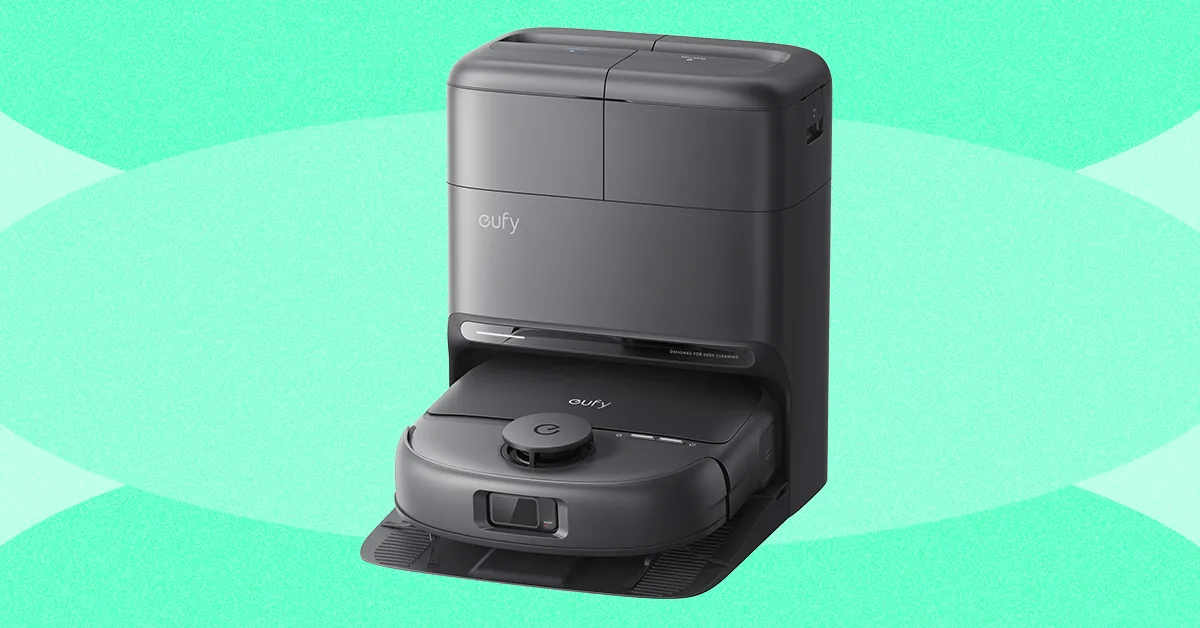
A robot vacuum is an automated vacuum, usually shaped like a round disc, that moves around your house to vacuum (and mop, as many models these days include mopping) on your behalf. You might’ve heard some refer to these devices as “Roombas,” which is the brand that made the concept popular, but today just about every cleaning brand—from high-end Dyson to affordable Bissell—makes some kind of robot vacuum. They come with either a charging station or a larger docking station that can self-empty.
Can You Use Robot Vacuums on All Kinds of Floors?
Advertisement
You can, especially since there are so many mopping models now to better clean hard flooring. You can use these devices on anything from hardwood to LVP and tile, though I wouldn’t recommend leaving smaller rugs out for these autonomous gadgets to get stuck on. Large, set rugs are fine, but bathroom and kitchen mats or any thin, easily moved rugs should be cleared out of the way and put in the wash instead of vacuumed by your robot vac.
What Will Your Robot Vacuum Need?
There are a few things most robot vacuums will need to work properly:
Space around the base station. Many robot vacuum manuals recommend at least a foot of clearance on three of the four sides of the vacuum’s base station to ensure it has room to return home.
A good Wi-Fi signal. If your robot vacuum connects to Wi-Fi, as many do these days for app control and software updates, it’ll need a strong connection wherever it’s placed. Most of them can only connect to the 2.4 GHz wireless band, so make sure you have that (and choose only that band when you’re setting up if your Wi-Fi shows those bands separately). Confused? Check out our guide to setting up your smart home.
Regular maintenance. It might be a robot, but it can’t take care of itself. See below for my tips for basic robot vacuum maintenance, and make sure to read your vacuum’s manual to know what your specific model requires.
How Often to Maintain Your Robot Vacuum
Taking good care of your robot vacuum will help it last. Here’s the debris-removal process you should follow for each robot vacuum style.
Advertisement
If it has a charger-only base: This means the debris is stored inside the vacuum. You’ll likely want to empty it after each use. If your vacuum has a fill line you can watch, you can empty it when it reaches that line, but after each use is really best practice.
If it has a self-emptying docking station: Each manufacturer will have different advice about when a self-emptying station needs to be emptied, but it’s usually between 30 and 60 days, depending on design and use. If you run your vacuum daily and have a lot of debris, like pet hair, you might need to aim for 30 days or less.
If it has water tanks: Dirty-water tanks should be cleaned after each mopping run of your vacuum. Clean water can stay filled in the station.
Make sure to review your robot vacuum’s manual for any other steps the manufacturer recommends you take regularly to keep the vacuum running for as long as possible. Many brands also have replacement parts, so you can swap out individual pieces like brushes without needing an entirely new vacuum.
Did Robot Vacuums Just Get Banned?
The Federal Communications Commission, or FCC, announced in late July that foreign-produced advanced robotic devices will now be included on the FCC’s Covered List. That list includes communications equipment and services that are deemed to pose an unacceptable risk to the national security of the United States, and as of this week, that includes robot vacuums (and similar devices like robotic pool cleaners and lawn mowers). While it won’t ban any models already on the market that have FCC approval, we’ll likely see a huge decline in available new models after this year. Models made in the US will be fine, but future vacuums from popular brands like Dreame, Eufy, Roborock, and more will be affected.
This comes from an interagency body in the White House executive branch called the National Security Determination, which determined that automated robotic devices are a security risk due to the data they collect, which could be used for surveillance and be remotely commandeered by “malign actors.” While the initial documentation describes humanoid robots and a recent case of a humanoid robot’s cybersecurity vulnerability to be remotely taken over, the official description of these robot devices will include robot vacuums and any devices meeting the following criteria:
HashiCorp cofounder Mitchell Hashimoto has launched a new startup to build a server-side terminal multiplexer that allows programmers to switch between multiple persistent work sessions.
Superlogical promises its terminal multiplexer will be faster and keep better track of user jobs. And it could be instrumental to building durable agentic layers into future systems.
Advertisement
The problem with traditional multiplexers – such as tmux, Zellij and GNU Screen – is that they are all too slow, explained Superlogical cofounder Mitchell Hashimoto in a video posted on X. They duplicate everything the user types and have to constantly reconcile local and remote states. Even slapping a modern terminal such as Kitty, Alacritty or Ghostty in front of a multiplexer won’t do much to speed ops.
“A terminal multiplexer may sound like a narrow place to start a company,” the company admits on its website. But the lowly terminal is the common denominator across today’s developers, agents, tools, and infrastructure.
For Hashimoto, today’s computer architecture is missing a fundamental primitive: a stateful session for the work itself. With work spanning machines and users, a task needs its own space for context, data, and history.
Turning a terminal into a business
The technology builds on a project called Ghostty, a modern terminal emulator that Hashimoto began developing while he was still at HashiCorp, the company he co-founded.
Advertisement
One of the oldest tools in the computer stack, a terminal emulator is simply a text-based window on the screen where developers can enter commands for the computer, either locally or remotely. Taking its name from the physical terminals of a bygone era, the terminal is where one finds the “command line interface” or CLI.
The terminal geeks quickly and widely adopted the GPU-driven Ghostty for both its lightning-fast performance and wealth of features – two qualities other emulators rarely possessed in tandem.
Hashimoto also extracted the core Ghostty engine into its own software library, libghostty, for others to build upon. Superlogical plans to eliminate that client/server duplication by building on libghostty.
In Superlogical’s approach, the client sends terminal input to the server, much like an SSH session, while the server maintains the persistent session state. This lets users disconnect and return later, while a smart client handles rendering and scrolling locally rather than waiting for a network round trip.
Advertisement
“It does require that every connecting client be a very smart, high-functioning, compliant client,” such as one built on libghostty, Hashimoto said. But this approach sounds better than dispatching streams of raw ASCII hither and yon.
Beyond describing the headaches of multiplexers in his introductory video, Hashimoto didn’t divulge much more about the newly founded company’s plans, but the mission will no doubt involve expanding on the concept of managing work sessions in a standardized and scalable way.
Gergely Orosz, author of the popular Pragmatic EngineerSubstack, speculated on X that the Superlogical team would “be building an AI-native ‘agentic operating system’ that sits a level above OSes.” ®
When a semi-truck barrels past you on the highway, it might be hard to tell that it’s doing so with three different types of tires on its wheels. It might seem strange, but try to take a look next time you’re up close and personal with one. Most long-haul tractor-trailers rely on a combination of steer tires, drive tires, and trailer tires. It’s because each axle performs a different job, and that necessitates a different tire for each. Semi-truck tires are nothing like regular tires, either, and each of the three designs features special construction and tread patterns tailored to its location on the semi.
Depending on where it’s mounted, a tire might need to control the truck’s direction, transfer engine power to the road, or support the thousands of pounds of cargo in back. Using the proper tire for its intended position also improves handling, mileage, fuel efficiency, and overall performance. The opposite is also true: Because each tire is designed for a specific purpose, mixing types across different axle positions can make a truck less efficient. Let’s break down the specific needs for the three tires used on the assortment of wheels that give eighteen-wheelers their name.
Advertisement
A look at the three types of tires semi-trucks use
abumuhammad051992/Shutterstock
Steer tires go on the front axle. They’re responsible for guiding the 80,000-pound vehicle through turns, lane changes, highway curves, and other steering tasks. Steer tires will often use a ribbed tread pattern that channels water away from the contact patch. That helps them maintain steering precision and resist hydroplaning in the wet. Industry guidance is to replace these after roughly 100,000 to 150,000 miles, depending on operating conditions and maintenance.
If steer tires determine where a semi-truck goes, drive tires make sure it gets there. They’re mounted on the powered drive axles and help convert engine torque into forward movement. Their treads typically feature deeper, lug-style patterns that maximize grip across different road surfaces. That added traction isn’t just important during acceleration, but also comes into play when climbing grades, braking, or traveling through inclement weather. Depending on service conditions, fleets might go for approximately 350,000 to 500,000 miles before replacing these tires.
Then there are trailer tires. Unlike drive tires, they don’t receive any engine power. And unlike steer tires, they aren’t responsible for directing the truck, either. Instead, they need to withstand not just the weight of cargo but also the forces acting upon them when trailers pivot through turns. Some models also incorporate reinforced sidewalls for improved endurance and damage resistance. These are generally replaced after 200,000 to 325,000 miles, depending on usage.
Most satellite startups are racing to build smaller. K2 Space is going the other way, on purpose. Investors just handed it $500 million to keep going bigger.
K2 raised a $500 million Series D at a $6.8 billion valuation, it said on Thursday. Kleiner Perkins and ICONIQ led the round, with Alphabet’s CapitalG, Lightspeed and ARK Invest among the backers. That more than doubles the $3 billion valuation it carried months ago. K2 has now raised over $1 billion, against more than $1 billion in signed contracts.
The bet is contrarian. Most of the industry shrinks satellites to cut launch costs. K2 argues the opposite: in orbit, power decides what a satellite can do, so it builds big, high-power ones instead.
The proof is already up there
Its first “mega-class” satellite, Gravitas, reached orbit in March on a SpaceX Falcon 9. It weighs two tonnes, generates 20 kilowatts, and carried a dozen payloads for customers including the US military, GeekWire reported.
Advertisement
K2 builds more than 85% of each satellite itself. Its 180,000-square-foot factory in Torrance, California is designed to turn out up to 100 satellites a year. That in-house model, it says, is how it makes large satellites quickly and cheaply.
Defence is writing the cheques
Much of the pull is military. K2 will supply 30 satellites for SES’s meoSphere network, build spacecraft for the Anduril-led Golden Dome missile-defence programme, and act as bus provider on a US Space Force satcom effort, its first Pentagon programme of record. It fits a wider surge of money into defence space.
The real moonshot: data centres in orbit
The bigger bet sits further out. In late 2028, K2 plans a 100-kilowatt “Giga” satellite built to carry “massive amounts of compute on orbit.” In plain terms, that is a step toward AI data centres in space, an application its chief executive flagged to Bloomberg.
K2 was founded in 2022 by the brothers Karan and Neel Kunjur, the latter a former SpaceX engineer. The round lands amid a flood of money into space, from launch to defence to orbital infrastructure.
Advertisement
The risks are real. Building 100 large satellites a year is a manufacturing feat no one has pulled off, and space-based data centres remain years away and unproven. K2’s next mission, Trinity, flies multiple satellites in early 2027. Going from one satellite to hundreds is the bet. Whether orbit becomes the next data-centre site is the wager beyond it.
NEC unveiled a 999 g business laptop with exceptional battery endurance
LAVIE BM94C uses carbon fibre to achieve a remarkably light business device
AI battery management helps extend operating time throughout demanding working days
NEC Personal Computers has unveiled the LAVIE BM94C, a business laptop weighing just 999 g with a starting price of 584,100 yen (about $3,570).
The lightweight notebook is initially launching only in Japan despite attracting attention for combining premium hardware with unusually long battery endurance.
Developed as the flagship model in NEC’s latest LAVIE business lineup, the device focuses on portability, durability, and AI-assisted power management.
Latest Videos FromTechRadar
Advertisement
Built around portability without compromising battery life
The BM94C was developed under what NEC calls Project 999, an engineering effort balancing an ultra-light chassis with a large battery normally associated with heavier business laptops.
Its body uses laminated aerospace-grade carbon fibre supplied by Toray, while the top panel incorporates the company’s ultra-lightweight core technology to improve rigidity without adding unnecessary weight.
NEC also applied fingerprint-resistant and abrasion-resistant coatings, making the notebook easier to clean while reducing visible wear from daily business use.
Power comes from a 99.9 Wh battery rated for approximately 30.5 hours of video playback and around 50.8 hours of idle operation under JEITA 3.0 testing standards.
Sign up to the TechRadar Pro newsletter to get all the top news, opinion, features and guidance your business needs to succeed!
According to NEC, a 30-minute recharge provides approximately eight hours of operation, reducing the need to carry a charger during short business trips.
Advertisement
The company also introduced Long Battery Mode, an AI feature analysing applications consuming unnecessary power before recommending ways to extend battery life.
NEC further claims its intelligent charging tech reduces long-term battery degradation, maintaining about 72.7% battery health after five years of regular charging.
The notebook is powered by Intel Core Ultra 5 322 or 335 processors alongside the Core Ultra 7 355, with memory configurations ranging from 16 GB to 32 GB.
Advertisement
Buyers can choose between 256 GB, 512 GB, or 1 TB solid-state drives depending on storage requirements and professional workloads.
The BM94C features a 14-inch WUXGA display with 1,920 × 1,200 resolution, while its 16:10 aspect ratio provides additional vertical workspace for productivity tasks.
NEC pairs the display with Windows 11 Pro, aiming to improve productivity during document editing, multitasking, video conferencing, and extended office work.
Advertisement
Business features extend beyond lightweight hardware
Beyond its core hardware, the BM94C includes two Thunderbolt 4 ports, two USB 3.2 Gen 2 ports, HDMI, and Gigabit Ethernet for connecting modern peripherals and external displays.
Wireless connectivity comes through Wi-Fi 7 and Bluetooth 5.4, while a Full HD webcam supporting Windows Hello provides secure biometric sign-in for business users.
Those connectivity options allow users to connect multiple displays, wired networks, external storage devices, and modern accessories without requiring multiple external adapters.
NEC said the portable laptop was designed for professionals travelling frequently while still requiring desktop-class connectivity throughout the working day.
Advertisement
The BM94C forms part of NEC’s refreshed LAVIE business lineup following the integration of its commercial computer operations under a single brand.






























































You must be logged in to post a comment Login