Connect with us

Tech

Spain’s Ministry of Science shuts down systems after breach claims

Published

on

Spain's Ministry of Science shuts down systems after breach claims

Spain’s Ministry of Science (Ministerio de Ciencia) announced a partial shutdown of its IT systems, affecting several citizen- and company-facing services.

Ministerio de Ciencia, Innovación y Universidades is the Spanish government body responsible for science policy, research, innovation, and higher education.

Among others, it maintains administrative systems used by researchers, universities, and students that handle high-value, sensitive information.

Wiz

The Ministry stated that the decision was in reaction to a “technical incident,” but did not provide additional details. However, a threat actor is claiming an attack on the institution’s systems and published data samples as proof of the breach.

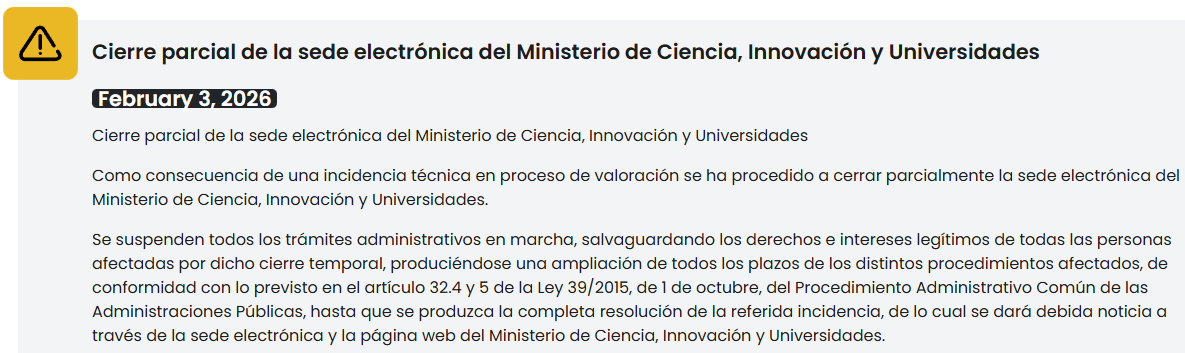
“As a result of a technical incident currently under assessment, the electronic headquarters of the Ministry of Science, Innovation and Universities has been partially closed,” reads an announcement on the main page of the ministry’s website.

Advertisement

“All ongoing administrative procedures are suspended, while safeguarding the rights and legitimate interests of all persons affected by this temporary closure.”

Notice on the Ministry's website
Notice on the Ministry’s website
Source: BleepingComputer

To mitigate the impact of the disruption, the Ministry will extend all deadlines for affected procedures, in accordance with Article 32 of Law 39/2015.

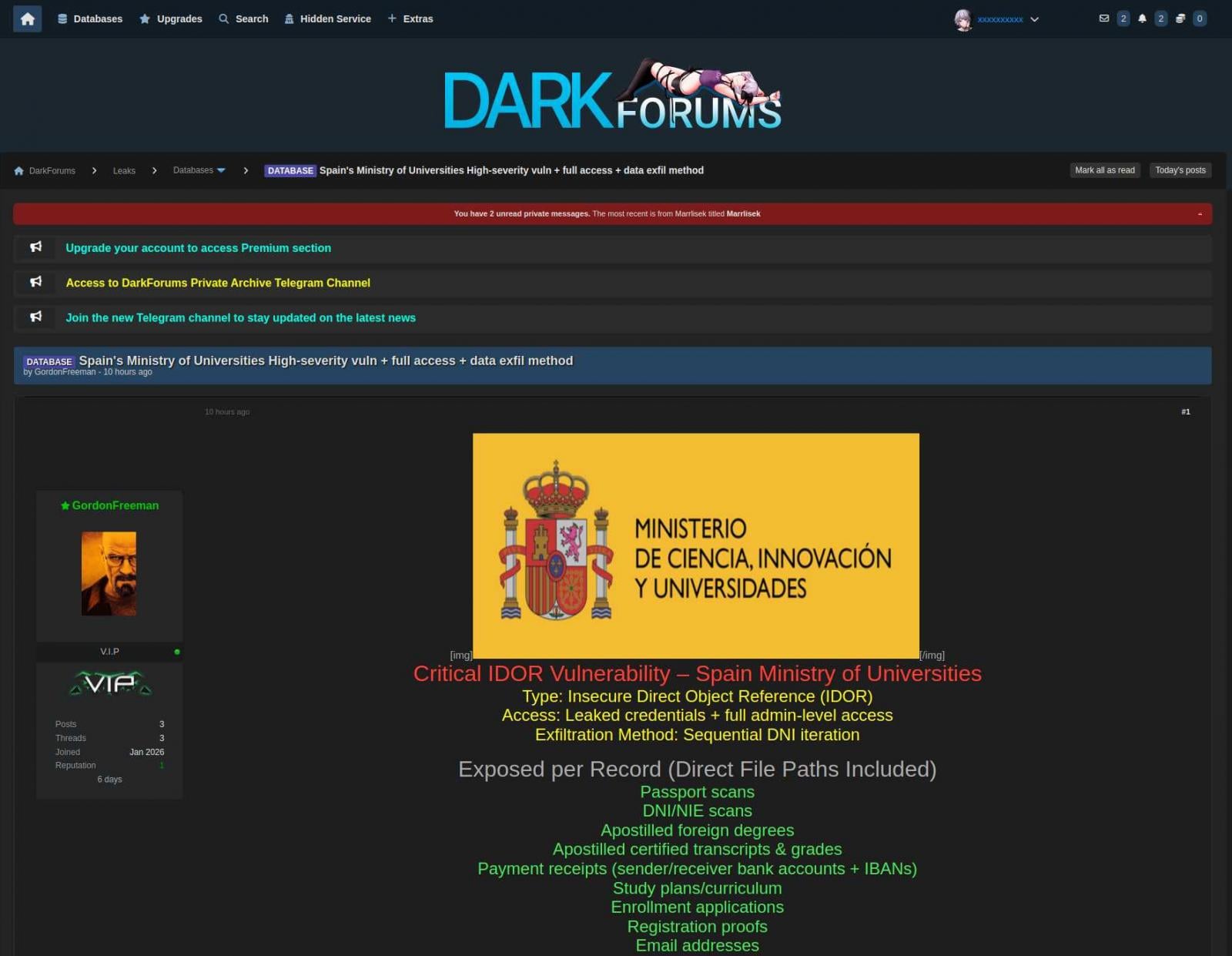
A threat actor using the alias ‘GordonFreeman’ from the Half-Life game title offered to the highest bidder data allegedly stolen from the Spanish ministry.

The alleged hacker leaked on underground forums data samples that include personal records, email addresses, enrollment applications, and screenshots of documents and other official paperwork.

Threat actor's post
Threat actor’s post
Source: Kela

The threat actor states that they breached Spain’s Ministry of Science by exploiting a critical Insecure Direct Object Reference (IDOR) vulnerability that gave them valid credentials for “full- admin-level access.”

It’s worth noting that the forum where the information appeared is now offline, and the data has not appeared on alternative platforms yet.

Advertisement

The leaked images appear legitimate, although BleepingComputer has no way to confirm their authenticity or any of the attacker’s other claims. We have contacted Ministerio de Ciencia about these allegations, but a statement wasn’t immediately available.

Meanwhile, Spanish media outlets report that a ministry spokesperson confirmed that the IT systems disruption is related to a cyberattack.

Modern IT infrastructure moves faster than manual workflows can handle.

In this new Tines guide, learn how your team can reduce hidden manual delays, improve reliability through automated response, and build and scale intelligent workflows on top of tools you already use.

Source link

Advertisement
Continue Reading
Click to comment

Leave a Reply

Your email address will not be published. Required fields are marked *

Tech

Reddit looks to AI search as its next big opportunity

Published

on

Reddit suggested on Thursday that its AI-powered search engine could be the next big opportunity for its business — not just in terms of product, but also as a revenue driver impacting its bottom line. During the company’s fourth-quarter earnings call on Thursday, it offered an update on its plans to merge traditional and AI search together and hinted that although search is not yet monetized, “it’s an enormous market and opportunity.”

In particular, the company believes that generative AI search will be “better for most queries.”

“There’s a type of query we’re, I think, particularly good at — I would argue, the best on the internet — which is questions that have no answers, where the answer actually is multiple perspectives from lots of people,” said Reddit CEO Steve Huffman.

Traditional search, meanwhile, is more like navigation — it’s a way to find the right link to a topic or subreddit. But LLMs can be good at this, too, if not better, he said. “So that’s the direction we’re going.”

Advertisement

The exec also noted that weekly active users for search over the past year grew 30% from 60 million users to 80 million users. Meanwhile, the weekly active users for the AI-powered Reddit Answers grew from 1 million in the first quarter of 2025 to 15 million by the fourth quarter.

“We’re seeing a lot of growth there, and I think there’s a lot of potential too,” Huffman added.

Reddit said it’s working to modernize the AI answers interface by making its responses more media-rich, and pilots of this are already underway.

The company is also thinking about how it can position itself when it’s not just a social site, but a place people come for answers. Reddit told investors on the call that it’s doing away with the distinction between logged-in and logged-out users starting in Q3 2026, as it will aim to personalize the site — using AI and machine learning — and make it relevant to whoever shows up.

Advertisement

The company announced in 2025 it was planning to combine its AI search feature, Reddit Answers, with its traditional search engine to improve the experience for end users. In the fourth quarter, Reddit said it had made “significant progress” in unifying its core search and its AI feature. It also released five new languages on Reddit Answers and is piloting dynamic agents along with search results that include “media beyond text.”

Though Reddit sees value in its AI answers, it’s not been keeping that to itself. The company’s content licensing business, which allows other companies to train their AI models on its data, is growing, too. That business revenue is reported as part of Reddit’s “other” revenues (i.e., its non-ad revenue). This “other” revenue increased by 8% year-over-year to reach $36 million in Q4 and was up 22% to reach $140 million for 2025.

Source link

Advertisement
Continue Reading

Tech

Why the Blink Video Doorbell (2nd Gen) Delivers Real Value in a Crowded Market

Published

on

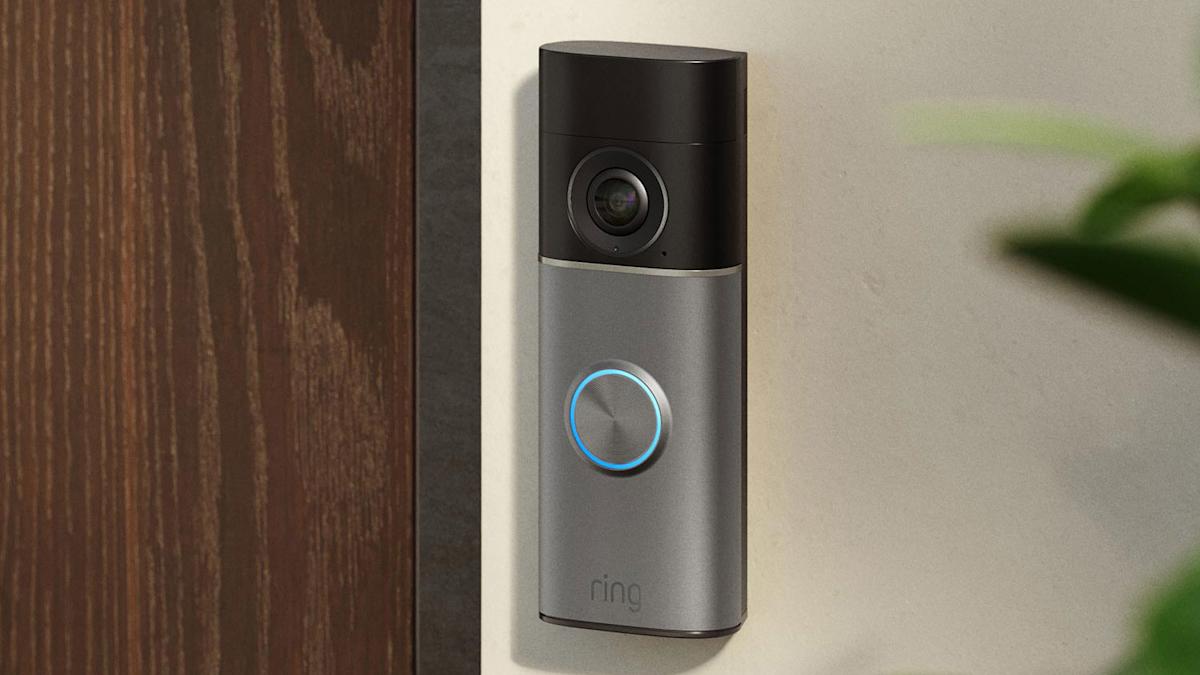
Blink Video Doorbell 2nd Gen Newest Model
People frequently claim that the Blink Video Doorbell (2nd Gen) is the best value around, and recent reviews tend to support this. It’s available in a package with the Sync Module Core for around $35.99, which is almost half the original price of $69.99. Meanwhile, Google Nest and Arlo devices cost $100, $130, or more, and include an additional sensor or two, albeit at a hefty price.


Getting it up and running is rather simple, as the doorbell runs on batteries, or a pair of 3AA lithium batteries that may last up to two years, so there is no need to bother about wiring. Simply install the device on the wall using the provided mounting kit, and they’ll serve as the corner accessory for getting the angles correct, and you can have everything up and running in a matter of minutes using the app. Users frequently mention how easy it is, especially when contrasted to wired setups that require some actual electrical labor.

Sale


Blink Video Doorbell (newest model) – Head-to-toe HD view, two-year battery life, and simple setup….
  • Video Doorbell is our second-generation smart security doorbell with up to two years of battery life, an expanded field of view, and improved security…
  • Last longer with two-year battery life — Experience up to two years of continuous security coverage with three AA Energizer lithium batteries and a…
  • See more at your door — Greet guests and watch packages get delivered, day and night, with head-to-toe HD view and infrared night vision. Use…

The video quality is good enough for pretty much everyday use. The camera gives you a nice overhead shot in a square 1:1 aspect ratio, with a 150 degree view that captures people right up to their feet & spots packages on the ground pretty easily. The resolution is a decent 1080p HD, (although some tests suggest it’s actually got more like 1440p clarity when it counts) & infrared night vision works just fine in the dark. You can even have a two-way conversation with whoever is at the door, and the motion alerts are timely to say the least.

Advertisement


One of the most notable features is the battery life, which may last up to two years, allowing you to avoid needing to twist and spin them every few months as you would with some other products. As an added plus, it’s fairly weather resistant, withstanding a bit of rain and dust in most locations without blinking.

Blink Video Doorbell 2nd Gen Newest Model
You have storage and extras without breaking the bank. The included Sync Module Core allows you to save clips locally on a drive you add separately, eliminating the need for cloud fees for basic recording, but if you want a little more, the Blink subscription is only $3/month for one device or $12 for unlimited – which includes cloud storage, person detection, and all that other good stuff. Which is significantly less expensive than Ring’s $5+ plans or Nest’s higher-tiered options.

Source link

Advertisement
Continue Reading

Tech

Apple Health+ scaled back internally, will focus on incremental features instead

Published

on

The Apple Intelligence-powered Health+ service is reportedly being scaled back now that Eddy Cue is in charge, and will focus on getting features to users sooner with smaller releases.

The Apple Health icon featuring a heart in a white square, set against a red-pink gradient background
Apple Health to get multiple smaller feature updates soon

Apple has never announced Health+ or plans for the initiative, but leaks surrounding the project suggested some kind of AI chat interface was going to be offered. Users would be able to discuss their health data and be directed to professional videos explaining certain topics.
According to a report from Bloomberg, Services chief Eddy Cue is now in charge of Apple Health after Jeff Williams retired, and he’s restructured the plans around its future. Instead of trying to release one big feature set under the umbrella of “Apple Health+” and a new subscription, Apple is allegedly planning on breaking up the planned features into smaller, incremental releases.
Continue Reading on AppleInsider | Discuss on our Forums

Source link

Continue Reading

Tech

Grab a MacBook Air from just $389 heading into Super Bowl weekend

Published

on

Steep discounts on Apple’s MacBook Air have driven prices down to as low as $389.99 heading into the weekend.

M1 MacBook Air on a desk showing colorful app icons, with a black spherical smart speaker beside it and a price cut graphic with scissors over the screen
Grab a MacBook Air from just $389.

Walmart seller VIPOutlet has blowout inventory of Apple’s M1 MacBook Air 13-inch for $389 while supplies last. This seller has a 4-star rating with 23,495 total reviews at press time. While the system has 8GB of memory and 256GB of storage, the budget-friendly price makes it a viable system for casual use like web browsing and streaming content.
Buy M1 MacBook Air for $389
Continue Reading on AppleInsider | Discuss on our Forums

Source link

Continue Reading

Tech

Looking for an inexpensive course to sharpen those soft skills?

Published

on

Soft skills are as important to long-term success as hard skills, and online courses can be a great way to learn.

Since the start of the new year, SiliconRepublic.com has covered soft skills in a variety of ways, for example in pieces covering meta skills and the must-have soft skills for 2026. So, what better way to continue that trend than to explore some of the free and relatively inexpensive courses that can enable a professional to sharpen up those soft skills?

Alison

Online learning platform Alison has a free Soft Skills for Professionals course aimed at professionals looking to either find a role or excel in one via a range of interpersonal skills. The course description states that participation will teach students 10 soft skills that professionals will need in their working lives, for example in communication, adaptability, flexibility and negotiating, among others.

There are four modules and the average time it takes to complete the course is typically between one and three hours. To complete the course and receive a certificate, students will need to achieve more than 80pc in their assessments. 

Advertisement

Coursera

While payment down the line may be required, learning platform Coursera offers several free trials for its soft skills courses. Professionals can avail of courses such as Developing Interpersonal Skills, Foundations for Interviewing with Confidence, People and Soft Skills: Essential for Professional Success, and People and Soft Skills Assessment.

Depending on the course, the time needed to complete learning could range from one week to several months, with the free trial giving you time to figure out if a course matches your ambitions. Courses are aimed at everyone from beginners all the way through to those looking to learn specialist knowledge. 

Great Learning

For professionals in the IT space, Great Learning’s Soft Skills for IT module is an ideal learning opportunity. Modules include: an introduction to soft skills; soft skills and their importance; soft skills to possess; effective communication; and team work, alongside others.

The free course starts at beginner level, takes around 1.5 hours, tests users with a range of quizzes and awards the student with a certificate upon completion of the course. Great Learning states that the course will help professionals to be noticed by recruiters, earn a job and showcase their skills online. 

Advertisement

Skills Connect

Skills Connect, which is an initiative developed by Skillnet Ireland, offers a number of free programmes designed to enable jobseekers to get back into the workplace. The strategy offers free training to help jobseekers develop the technical and soft skills that employers are looking for today. Additionally, some of the programmes offer practical work placements or projects. To apply, participants will have to meet certain criteria, which can be found on the group website. 

OpenLearn

OpenLearn, a free educational platform operated by The Open University, has a diverse range of free soft skills courses open to students and professionals. Courses are relatively flexible, but the website suggests committing roughly three hours a week to study for a period of around eight weeks. However, you can commit as much or as little time as you have available, as materials exist online. Course titles include Succeed in the Workplace and Effective Communication in the Workplace. 

According to OpenLearn, professionals and students will come away able to properly and effectively communicate in the workplace, with the ability to manage different personality traits, social attitudes and scenarios that require emotional intelligence. Its website says: “Everyone can benefit from some focused training and development to help them realise their full potential. OpenLearn has a number of courses you can study to enhance your soft skills right now”.

So, if you have the time and want to expand your professional capabilities and workplace relationships, why not consider taking up a course in soft skills? You might soon find that it gives you an unexpected edge.

Advertisement

Don’t miss out on the knowledge you need to succeed. Sign up for the Daily Brief, Silicon Republic’s digest of need-to-know sci-tech news.

Source link

Advertisement
Continue Reading

Tech

Sapiom raises $15M to help AI agents buy their own tech tools

Published

on

People without coding backgrounds are discovering that they can build their own custom apps using vibe coding — solutions like Lovable that turn plain-language descriptions into working code.

While these prompt-to-code tools can help create nice prototypes, launching them into full-scale production (as this reporter recently discovered) can be tricky without figuring out how to connect the application with external tech services, such as those that can send text messages via SMS, email, and process Stripe payments.

Ilan Zerbib, who spent five years as Shopify’s director of engineering for payments, is building a solution that could eliminate these back-end infrastructure headaches for nontechnical creators.

Last summer, Zerbib launched Sapiom, a startup developing the financial layer that allows AI agents to securely purchase and access software, APIs, data, and compute — essentially creating a payment system that lets AI automatically buy the services it needs.

Advertisement

Every time an AI agent connects to an external tool like Twilio for SMS, it requires authentication and a micro-payment. Sapiom’s goal is to make this whole process seamless, letting the AI agent decide what to buy and when without human intervention.

“In the future, apps are going to consume services which require payments. Right now, there’s no easy way for agents to actually access all of that,” said Amit Kumar, a partner at Accel.

Kumar has met with dozens of startups in the AI payments space, but he believes Zerbib’s focus on the financial layer for enterprises, rather than consumers, is what’s truly needed to make AI agents work. That’s why Accel is leading Sapiom’s $15 million seed round, with participation from Okta Ventures, Gradient Ventures, Array Ventures, Menlo Ventures, Anthropic, and Coinbase Ventures.

Techcrunch event

Advertisement

Boston, MA
|
June 23, 2026

“If you really think about it, every API call is a payment. Every time you send a text message, it’s a payment. Every time you spin up a server for AWS, it’s a payment,” Kumar told TechCrunch.

Advertisement

While it’s still early days for Sapiom, the startup hopes that its infrastructure solution will be adopted by vibe-coding companies and other companies creating AI agents that will eventually be tasked with doing many things on their own.

For example, anyone who has vibe-coded an app with SMS capabilities won’t have to manually sign up for Twilio, add a credit card, and copy an API key into their code. Instead, Sapiom handles all of that in the background, and the person building the micro-app will be charged for Twilio’s services as a pass-through fee by Lovable, Bolt, or another vibe-coding platform.

While Sapiom is currently focused on B2B solutions, its technology could eventually empower personal AI agents to handle consumer transactions. The expectation is that individuals will one day trust agents to make independent financial decisions, such as ordering an Uber or shopping on Amazon. While that future is exciting, Zerbib believes that AI won’t magically make people buy more things, which is why he’s focusing on creating financial layers for businesses instead.

Source link

Advertisement
Continue Reading

Tech

Opinion: The ‘millionaires tax’ is not an existential threat to Washington’s startup economy

Published

on

Editor’s note: GeekWire publishes guest opinions to foster informed discussion and highlight a diversity of perspectives on issues shaping the tech and startup community. If you’re interested in submitting a guest column, email us at tips@geekwire.com. Submissions are reviewed by our editorial team for relevance and editorial standards.

Ben Golden.

I’m an attorney and advisor to many Pacific Northwest startups, investors, and social entrepreneurs, having spent the past two decades in the Washington innovation ecosystem — including as a higher education policy advocate and former co-chair of the WTIA Policy Committee. I love helping transform great ideas into job-creating companies in my community. 

Which is why I’m unmoved by the panic surrounding the proposed “millionaires tax.” Every time Olympia proposes that our wealthiest contribute more, we’re told that this is the final straw for our brightest risk-takers, an existential threat to our state’s economy. But the real threat to the startup community is losing focus on building up our strengths as this catastrophizing becomes a self-fulfilling prophecy. 

America is at a crossroads. In this defining moment, when our duties as citizens are gravely needed, a growing chorus of local startup luminaries are speaking up. Which issue galvanizes them? Civil liberties, or climate, or gilded age cronyism, or divestment from public interest research, or immigration, or the dignity of work amidst AI disruption, or freedom of speech…? 

Disappointingly, much of the startup community’s advocacy efforts have instead been singularly focused on preventing a few very wealthy folks from changing their primary residence to Las Vegas or Jackson Hole or Palm Beach. 

Advertisement

My oh my, what an uninspired civic imagination in this moment of peril. We can do better. 

So chill with the libertarian fever dream. Read the moment. And read the proposal’s fine print, including important small business tax cuts. And remember what’s made Seattle such a dynamic startup community in the first place. 

The tax proposal is (probably) not going to take your money 

This is a proposed tax on net income over $1 million in a single year. The first $1 million of income would be exempt. This point merits emphasis, as it’s often misunderstood: no one will pay a penny of tax on the first $0 to $999,999 of annual net income. There are additional carve outs and deductions to encourage charitable giving and avoid double taxation. The minimum threshold will be indexed upward with inflation. And the proposed tax would not begin collecting revenue until 2029, allowing plenty of time to work through rulemaking, legal challenges, and fine tuning.

If enacted as proposed, less than 0.5% of households would ever be impacted. Imagine 1,000 random Washingtonians in a room: you could count on one hand the number of people with enough luck, talent, and timing to ever pay this tax. 

Advertisement

What about founders and investors? Many will already benefit tremendously from federal tax advantages like QSBS, which can eliminate up to $10 million in federal capital gains taxes on a successful exit. (An unrelated proposal would apply the state’s capital gains tax on profits that are otherwise exempted from federal taxation; with only a handful of sponsors across both chambers, that proposal appears to have far less traction.) 

Further, the same tax avoidance strategies they already deploy, such as staggered sales, deferred compensation, trust and estate planning, and real estate tax shelter investments, will continue to reduce taxes for founders and investors. The idea that a modest state tax on seven-figure net income is going to make entrepreneurship suddenly “not pencil out” is fuzzy math. 

Fixing Washington’s regressive tax structure is good for business 

Washington consistently ranks among the most regressive tax systems in the country. Relative to other states, lower- and middle-income families pay a disproportionate share of their income in state and local taxes due to our heavy reliance on sales, excise, and business taxes. Addressing this problem is essential to building a resilient state, which matters more than ever in this moment of increasingly reckless and unstable federal governance. 

In announcing his initial support for this proposal, Gov. Bob Ferguson tied the tax explicitly to strengthening the Working Families Tax Credit, removing sales taxes on essential personal hygiene products, investing in K-12 education, and greatly reducing B&O taxes for early-stage businesses. In other words, this is a pro-entrepreneurship policy that argues that we’re all better off when we’re all better off. 

Advertisement

Of particular importance for startups, the proposal to provide B&O tax relief for small businesses would be a boon for early-stage companies in their earliest cash constrained years, i.e., when they need it most. The current draft legislation would provide a credit for B&O taxes on annual gross receipts less than $250,000, which would benefit thousands of local startups and small businesses every year. Meanwhile, Ferguson has called to go further by zeroing out B&O taxes up to $1 million on revenue. 

In responding to the initial proposal, the governor said his ultimate support for the proposal is contingent on a much more aggressive small business tax break — “we need to have the largest tax break for small business owners in state history,” he said this week.

Rather than fear-monger, startup advocates should redirect their efforts toward supporting that effort for targeted savings for early-stage companies. 

The Legislative Building in Olympia, Wash. (GeekWire Photo / Lisa Stiffler)

On the pro-millionaire advocates’ counterpoints

There are valid concerns about the proposal’s impact on the business climate and economic growth. 

  • Some argue it “punishes success” by not maximizing exit proceeds. Yet this ignores how the proposal invests in conditions that allow startups to thrive in the first place as well as the urgency of addressing a broken tax system. 
  • A frequent rebuttal to any tax proposal is that the state should cut spending instead. Absolutely, there must be accountability and responsible stewardship of our public resources. But this is not mutually exclusive; as in business, governments can manage their expenses and restructure revenue at the same time. 
  • Critics warn that the income tax minimum threshold will expand in future years. Rep. Jeremie Dufault, R-Selah, calls it “kicking a budget snowball down a hillside. It’s small now, but it will grow as it rolls.” Maybe, but that’s not the proposal under consideration right now. In fact, the current proposal would raise the minimum threshold annually with inflation. 
  • There are also legitimate legal hurdles to implementing the proposed policy. Fortunately, we have multiple branches of government. Jurisprudential ambiguity should not deter legislators from passing policies they deem in the best interest of the electorate. 
  • Large tech companies are downsizing, particularly amongst software engineering teams. Our fizzling “prosperity bomb” is bad news for a local economy supported by so many coders, and those AI-disrupted jobs are not being replaced elsewhere. In this moment of disruption, creating policies that make it easier to be an entrepreneur and live comfortably in a community are more important than ever, regardless of whether a household brings in millions of dollars a year. 
  • Many point to capital flight as the primary concern, though correlation and causation can be muddled on this point. A handful of large tech companies and wealthy individuals have moved operations out of Washington state, and there will likely be a few more (vocal) high net-worth households who will register their primary residence elsewhere to reduce their tax bill — and they may even shift the focus of their investments from local startups to their new neighbors. But the primary cause of capital flight risk is panic; most people do not move to escape tax increases. This tax on outsized annual incomes will not trigger economic ruin, but the outsized investor-class alarm could cause real harm. 

Rather than catastrophize, the startup community ought to celebrate the opportunities that would be unlocked by relieving early-stage businesses of B&O taxes, modestly rebalancing our regressive tax structure, and making targeted investments to keep Washington affordable and thriving. 

The bill is currently open for debate, and critical details remain to be finalized. The startup community should be in these negotiations, rather than adopting an out-of-touch absolutist approach that reduces their influence and credibility. 

Advertisement

Entrepreneurs will build here because we bet on ourselves 

Entrepreneurs want to build something from nothing, test ideas, prove their doubters wrong, and ultimately solve problems. And sure, they want to make loads of money. Their ambition to build, ideate, prove, and solve will not be quashed by a tax that only kicks in after annual net income over $1 million. 

Most creative, ambitious, and educated people are not primarily motivated by marginal tax rate optimization. They want to live in places with access to world-class universities, vibrant cultural and artistic ecosystems, reproductive health care, diverse neighbors, multimodal transportation, LGBTQ+ rights, respect for the natural environment, libraries that don’t ban books, and a basic sense that society has their back. 

The best places in the country to launch a startup include the Bay Area, Boston, New York, and the greater Seattle area. With apologies to the fine folks in Sioux Falls, Houston, and Anchorage (the least taxed large U.S. cities), it turns out startups thrive in communities that invest in themselves and their people. We’ve done that in the Pacific Northwest and are set up for success. Millionaires tax or no tax, the next generation of great companies and scrappy entrepreneurs are primed to emerge from AI House, CoMotion, Foundations, 9Zero, and across our great state. 

At the end of day, most of the loudest critics of this proposal — people I respect and work with daily — will almost certainly continue to live and work here in Washington state. So let’s cool it on the millionaires tax hysteria, recognize the criticality of the moment, and bet on ourselves. 

Advertisement

Disclaimer: Written in my personal capacity. I’m no startup Lorax — I do not speak for my clients.

Source link

Continue Reading

Tech

Watch this snowbot crush 130,000 steps for an Olympic moment

Published

on

Robotics specialist Unitree has been making waves with its humanoid robots, and a new video shows its impressive G1 bipedal bot dealing with incredibly cold conditions.

In a video showing the G1 trudging through deep snow, Unitree describes the feat as “the world‘s first autonomous walking challenge for humanoid robots in a -53.32°F (-47.4°C) extreme weather environment.”

The stunt took place in China’s Altay region, about 1,500 miles (2,400 km) northwest of Beijing, where Unitree’s snowbot trudged through deep snow to mark out the Olympic rings in celebration of Friday’s Winter Olympics opening in Italy.

It’s not clear how long the robot walked for, or how many times its battery needed to be swapped out, but during the course of its sub-zero slog it managed to create an image 100 meters wide and 186 meters long.

Advertisement

Still, the fact that it managed to function at all in such frigid conditions is clearly impressive. Icy temperatures can freeze batteries, stiffen joints, or shut down electronics, but the G1, apparently assisted by its puffer jacket that possibly came with some internal heating, managed to stay alive in the challenging setting.

​The successful demonstration offers a glimpse at how the G1, or robots like it, could one day be deployed for tasks like search and rescue in polar environments, or even operate in faraway places like Mars where average temperatures reach around -76°F (-60°C).

China-based Unitree has emerged as one of the leading players in the increasingly competitive humanoid robotics sector. The G1 robot, which stands at 4 feet 4 inches (132 cm), also has a remarkable ability to regain control if it takes a tumble, and can apparently perform a number of household chores, too.

While many challenges lie ahead for robotics firms when it comes to readying humanoid robots for specific roles that can be performed consistently, reliably, and truly independently, this year is shaping up to be an exciting one in the sector.

Advertisement

Source link

Continue Reading

Tech

Best Cordless Vacuum Cleaner 2026: Convenient, wire-free cleaning

Published

on

If there’s one thing that Dyson knows, it’s how to make hugely powerful motors for cordless vacuum cleaners. The Dyson Gen5detect is the most powerful cordless vacuum cleaner that it has made yet. Putting this cleaner through our tests, we measured it at a massive 369AW on maximum power – the highest, by far, that we’ve ever seen from a cordless cleaner.

Otherwise, it runs at 30AW on its gentle power mode (good for dusting) and 75AW on medium. Well, kind of. As with previous Dyson vacuums, the Gen5detect has a piezo sensor for detecting dust, adjusting its power automatically based on how much dirt it has encountered. In automatic mode, the vacuum ups and downs its power on the fly, so that you get the best clean without having to worry about which power mode you’re in.

Cleverly, the LCD on the back shows the amount of dust being picked up, as well as the battery life remaining in minutes and seconds.

For hard floors, there’s an additional tool, the Fluffy Optic head, which uses a green laser to highlight dust. It works brilliantly, making it easy to see where you have and haven’t cleaned.

Advertisement

On maximum power, we found that this cleaner could collect grains of rice from more than 3cm away. If you’ve got the hand tools attached, this means you can quickly collect dust or suck it out of hard-to-reach areas.

Moving on to our regular tests, we found that this cleaner picked up 98.25% of dust on carpet, which is the best result that we’ve ever seen from a cordless cleaner. Edge performance was the same: 95.3% of dust collected. Hard floor collection was at 100%.

Moving to the anti-tangle tests with human hair, the Dyson Gen5detect refused to get any hair caught up in its brushes.

The only slight issue we encountered was when using the vacuum cleaner on a rubber-backed mat. Here, the Dyson Gen5detect produces too much power and suctions itself to the ground, stopping the brush bar from moving. We had to manually dial down the power. Still, it demonstrates just how powerful this cordless cleaner is.

Advertisement

Measuring battery life in auto mode, we found that the cleaner lasted 26m 13s. Given that you can clean thoroughly with a single pass, that’s more than enough time to tackle an entire home in one go.

Arguably, most people will find that the cheaper Dyson V15 Detect will suit their needs, but if you have the cash and want the absolute best, there’s no other cordless vacuum cleaner that comes close to this one for power.

Source link

Advertisement
Continue Reading

Tech

Gimmick Sunglasses Become Easy Custom Helmet Visor

Published

on

[GizmoThrill] shows off a design for an absolutely gorgeous, high-fidelity replica of the main character’s helmet from the video game Satisfactory. But the best part is the technique used to create the visor: just design around a cheap set of full-face “sunglasses” to completely avoid having to mold your own custom faceplate.

One of the most challenging parts of any custom helmet build is how to make a high-quality visor or faceplate. Most folks heat up a sheet of plastic and form it carefully around a mold, but [GizmoThrill] approached the problem from the other direction. After spotting a full-face sun visor online, they decided to design the helmet around the readily-accessible visor instead of the other way around.

The first thing to do with the visor is cover it with painter’s tape and 3D scan it. Once that’s done, the 3D model of the visor allows the rest of the helmet to be designed around it. In the case of the Satisfactory helmet, the design of the visor is a perfect match for the game’s helmet, but one could easily be designing their own custom headgear with this technique.

The hexagon grid pattern? It’s actually a clear vinyl sticker and doesn’t obstruct vision at all. Another clever touch.

With the helmet 3D printed, [GizmoThrill] heads to the bandsaw to cut away any excess from the visor, and secure it in place. That’s all there is to it! Sure, you don’t have full control over the visor’s actual shape, but it sure beats the tons and tons of sanding involved otherwise.

There’s a video tour of the whole process that shows off a number of other design features we really like. For example, metal mesh in the cheek areas and in front of the mouth means a fan can circulate air easily, so the one doesn’t fog up the inside of the visor with one’s very first breath. The mesh itself is concealed with some greebles mounted on top. You can see all those details up close in the video, embedded just below.

Advertisement

The helmet design is thanks to [Punished Props] and we’ve seen their work before. This trick for turning affordable and somewhat gimmicky sunglasses into something truly time-saving is definitely worth keeping in mind.

Source link

Advertisement
Continue Reading

Trending

Copyright © 2025