Top Kalshi trader Caleb Davies usually speaks to the press about how prediction markets help him rake in money. The Minneapolis-based IT worker estimates he’s made $1.2 million overall across different prediction platforms, with $414,000 in winnings from Kalshi’s culture markets alone. He especially enjoys wagering on music charts, because he carefully analyzes Spotify data to pick winners. “Every single morning, I’m going in, downloading the data, and updating my projections,” he tells WIRED.
This summer, though, he’s become increasingly agitated about what he claims is an obvious, bot-fueled effort to manipulate Spotify-related markets. He recently began compiling and publishing evidence for his theory, eventually becoming so convinced that he contacted Spotify, Kalshi, and Polymarket with his concerns.
This week, the situation hit a boiling point when the song “Earrings” by Malcolm Todd surged to number one on a Spotify chart. In a series of X posts, Davies outlined his suspected culprit: “botting,” or scammers who purchase bots to juice streaming numbers. Davies argued that prediction market traders were botting the charts to influence the outcome of related events contracts. Todd’s song was such an underdog that it wasn’t even listed as an option on Polymarket: “Looking at the dataset of Sunday to Monday changes, it was a 11.24 sigma event, or a roughly 1 in 77 octillion chance of happening randomly,” Davies wrote.
It turns out that he was on to something. Spotify confirmed to WIRED that it investigated suspected manipulation incidents Davies flagged and found evidence of artificial streaming. “All streaming services face ever-changing stream manipulation. Spotify has best-in-class detection and mitigation practices for manipulated streams, and we don’t pay out associated royalties,” spokesperson Laura Batey says. (The company didn’t offer any explanation for the manipulation, however, so Davies’ theory that it was directly tied to a scheme to manipulate prediction markets remains just that.)
Advertisement
Spotify ultimately adjusted its charts to account for the discrepancy, culling over 500,000 artificial streams, which bumped Todd’s song from first to fourth. The process was not immediate, though, and Kalshi had already resolved the market to award traders who selected Todd’s song.
“We’re in touch with Spotify and are actively investigating this matter,” Kalshi spokesperson Elisabeth Diana tells WIRED. Those conversations did prompt a more immediate change: At the Swedish streaming giant’s request, Kalshi removed Spotify’s logo from its markets that relate to the company, and adjusted language that initially suggested Spotify had verified chart results.
When Davies first reached out to Kalshi with concerns, the company’s head of enforcement Robert DeNault told the trader that only Spotify would be able to definitively confirm whether it had been botted, and noted that there could be non-suspicious reasons for the uptick. DeNault also floated a theory that Kalshi traders could be merely copying what peers were doing on Polymarket.
“Nobody from Polymarket profited from the fraud. That’s what undermines Kalshi’s argument, because they didn’t have a Malcom Todd bracket,” Davies tells WIRED.
Advertisement
Polymarket refutes this theory as well. “It’s actually not plausible since we didn’t even have Malcolm Todd as an option on this Spotify market,” said spokesperson Annabel Walsh. The company confirmed it’s reviewing the broader streaming manipulation situation, but hasn’t identified any immediate manipulation thus far.
No one has spoken with the people or group of people behind the streaming manipulation, so their motivations remain unclear. (Todd did not respond to requests for comment, but there’s nothing to suggest he’s anything more than an innocent bystander.)
Qualified immunity — crafted out of thin air by the US Supreme Court — has rarely been anything but an easy way for government employees to duck out of lawsuits before they’re actually asked to defend themselves against allegations of rights violations.
The Supreme Court has continually narrowed this doctrine, pretty much ensuring that if every single fact of an allegation doesn’t perfectly align with precedential rulings, qualified immunity will be awarded. The Supreme Court has ensured no further movement will take place by continually refusing to establish rights violations, even when it (very rarely!) disagrees with a lower court’s granting of qualified immunity.
The doctrine has been memorably pilloried more than once by appellate judges. Most famously, Judge Don Willett of the Fifth Circuit Appeals Court had this to say about the qualified immunity doctrine — something tends to reward rights violators just because they happened to find a slightly different way to violate someone’s rights.
To some observers, qualified immunity smacks of unqualified impunity, letting public officials duck consequences for bad behavior—no matter how palpably unreasonable—as long as they were the first to behave badly.
That was the wind-up. Here’s the pitch:
Advertisement
Section 1983 meets Catch-22. Plaintiffs must produce precedent even as fewer courts are producing precedent. Important constitutional questions go unanswered precisely because those questions are yet unanswered. Courts then rely on that judicial silence to conclude there’s no equivalent case on the books. No precedent = no clearly established law = no liability. An Escherian Stairwell. Heads defendants win, tails plaintiffs lose.
Justice Sotomayor’s dissent [PDF] isn’t as immediately quotable, but it still delivers a stinging indictment of the qualified immunity doctrine. The facts of the case are unpleasant, as they almost always are when government defendants start invoking qualified immunity.
Green Bay, Wisconsin jail staff responded to prisoner Antonio Smith’s refusal to submit to a wellness check (on day 46 of his hunger strike) by pepper spraying him in the face, ordering him to strip naked, and taking him to the health unit. When Smith refused the wellness check, he was dumped clothed in nothing but a small towel into an unheated, unfurnished “control cell” for the next 23 hours. The temperature in the cell ranged from “25 to 57 degrees Farenheit,” according to uncontested testimony.
When Smith was first placed in the cell around noon, Van Lanen told Smith that Smith could request a shower any time and that he would come back to discuss “‘clothing and stuff,’” but he never returned. Ibid. Three and a half hours later, Smith requested clothing, bedding, and a mattress from Lieutenant Timothy Retzlaff and asked to be moved to a warmer cell given the cold. Retzlaff said he would check with Van Lanen. Twelve additional hours went by with no word from Van Lanen or Retzlaff. Then, around 3 o’clock in the morning, a different officer told Smith that if he submitted to future wellness checks, he could have a smock, but that otherwise, “he would remain naked and cold.” Ibid. Smith declined. Another eight hours came and went without any word from Van Lanen or Retzlaff. Smith remained naked and frigid overnight as the temperature dropped below freezing to 25 degrees. After 23 hours, prison staff removed Smith from the cell. Smith later stated that he stayed on his feet for most of those 23 hours because it was too painful to sit, lie down, or sleep.
The Seventh Circuit Appeals Court actually said exactly this in its ruling granting qualified immunity to the defendants.
The Seventh Circuit held that the officers violated Smith’s Eighth Amendment right to be free from cruel and unusual punishment but nevertheless granted them qualified immunity, reasoning that the Circuit “had never held it unconstitutional on closely analogous facts to house an inmate in a cell that ranged in temperature from 25 to 57 degrees over a 23-hour period without clothes or a way to keep warm.”
Yep, that’s how fucking insane this doctrine is. The court even said this was a rights violation, but since it hadn’t said the same thing earlier about a nearly exactly matching set of circumstances, the defendants apparently had no way of knowing tossing someone naked in a freezing cell for nearly 24 hours would violate the prisoner’s rights.
Advertisement
As Sotomayor points out, the Seventh Circuit appeared to willfully disregard its own precedent when handing down this ruling.
As Judge Hamilton explained in dissent, the Seventh Circuit has itself held that intentionally subjecting prisoners to extreme cold conditions without any way to stay warm violates the Eighth Amendment. In Gillis v. Litscher(2006), for example, the Circuit held that a reasonable jury could find that prison officials violated a prisoner’s Eighth Amendment right when they deliberately left him naked in a cell blowing cool air for five days as part of an effort to “conform [his conduct] to the rules.” [S]ee Del Raine v. Williford,(1994) (officers deliberately strip-searched prisoner in cell for 15 to 30 minutes when windchill was 40 to 50 degrees below zero). The Seventh Circuit has also held that, when cold conditions are the product of heating-system failures, officers violate the Eighth Amendment if they are aware of such conditions and fail to take corrective measures such as providing an alternative way to keep warm.
That should have been enough for SCOTUS to review this one and, hopefully, send it back with a reminder that QI readings need to be narrow, but perhaps not so narrow they provoke gasps of disbelief.
But that’s not how this Supreme Court majority operates. Sotomayor calls them out for only reviewing certain QI cases. You know the ones.
This Term… the Court has exercised its discretion to summarily reverse supposed errors that were far less clear than the one here. See, e.g., McCarthy v. Hernandez, 607 U. S. _ (2026) (per curiam); Zorn v. Linton, 607 U. S.(2026) (per curiam); see also Smith v. Scott, 608 U. S. __ (2026) (summarily vacating and remanding denial of qualified-immunity in light of Zorn). If those cases were clear enough for summary action, the Court here should have readily concluded, based on precedent and basic human decency, that it is beyond debate that it is cruel and unusual to lock someone intentionally in a freezing prison cell completely naked for 23 hours.
The Court’s decision not to do so today exacerbates its asymmetrical trend of declining to intervene when courts wrongly afford officers the benefit of qualified immunity, but unflinchingly summarily reversing when it believes courts have wrongly denied officers the protection of qualified immunity.
Advertisement
This would be hypocrisy if it were being carried out by people who actually maintained a pretense of judicial fairness. But it’s being carried out by people who actively believe in the message they’re sending to the public, as well as to the administration they are so clearly devoted to pleasing.
Reversing only denials of qualified immunity sends the regrettable message that, when choosing between shielding government officials from liability and vindicating individuals’ constitutional rights, this Court will almost always choose the former.
Sotomayor is right. The message being sent is “regrettable.” Unfortunately for America, the people sending it have no regrets at all.
As enterprise AI systems scale to handle complex workflows, practitioners face the challenge of routing subtasks to the right tools and skills. Agents can have hundreds of tools and skills and get confused on which one to use for each step of a workflow.
To address this challenge, researchers at Alibaba developed SkillWeaver, a framework that creates an execution graph for a given task and chooses the right skills for each of the nodes. They also introduce Skill-Aware Decomposition (SAD), a novel technique that uses a feedback loop to enable the agent to fetch and vet relevant tool candidates iteratively. This compositional approach and feedback loop mechanism distinguishes SkillWeaver from other tool-routing frameworks that choose tools in a one-shot fashion.
SkillWeaver relates to real-world AI applications where agents autonomously orchestrate multi-tool ecosystems, such as the Model Context Protocol (MCP), to execute multi-step business operations like downloading datasets, transforming information, and creating visual reports.
In practice, the researchers’ experiments with SkillWeaver show that implementing this retrieve-and-route approach significantly increases accuracy while reducing token consumption by over 99% compared to naively exposing agents to an entire tool library.
Advertisement
For practitioners building AI agents, the main takeaway is that the granularity of task decomposition is the biggest bottleneck to accurate tool retrieval.
The challenge of skill routing
Skills are a key pattern in modern LLM agent architectures. A skill is a modular, reusable tool specification that uses structured natural language documentation.
As enterprise agents integrate with massive tool ecosystems, accurately routing user queries to the right skills becomes a difficult task. Exposing an entire library to an LLM to find the right tool is highly inefficient, quickly overwhelms context limits, and consumes hundreds of thousands of tokens.
Most current tool-use frameworks attempt to solve this through API retrieval, documentation matching, or hierarchical structures that treat routing strictly as a single-skill selection or per-step problem.
Advertisement
However, this single-skill paradigm is insufficient for enterprise environments because real-world queries are inherently compositional. A standard business request such as “Download the dataset, transform it, and create visual reports” cannot be fulfilled by one tool. It requires breaking the prompt down and sequencing an API client, a data processor, and a visualization tool into a cohesive, multi-step execution plan.
How SkillWeaver and SAD work
To tackle this, the researchers frame the problem of handling complex tasks that require multiple skills as “compositional skill routing.” Given a complex user prompt and a vast library of tools, an agent must simultaneously figure out how to break the request into a sequence of atomic sub-tasks, how to map each sub-task to the single best available skill, and how to compose those skills into an executable plan.
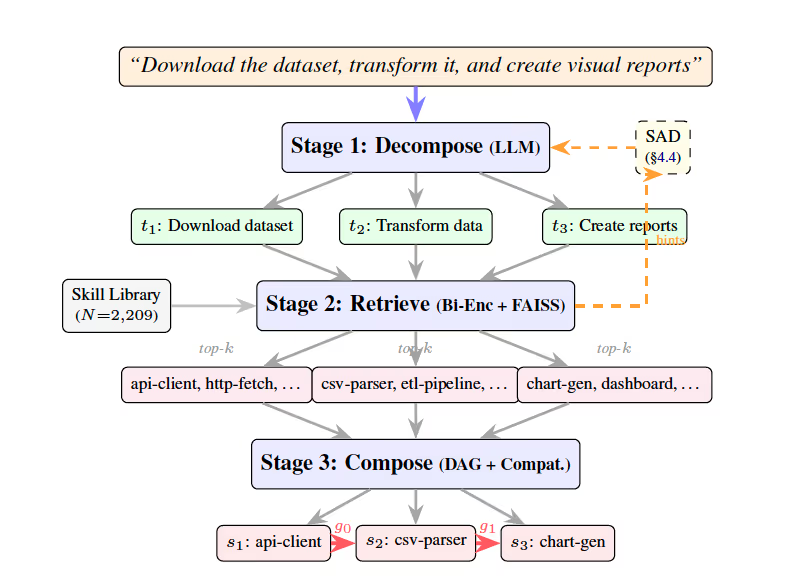
SkillWeaver orchestrates this process through three distinct stages: Decompose, Retrieve, and Compose. In the first stage, an LLM acts as a task decomposer, breaking the user’s complex query down into a sequence of sub-tasks that each require one skill. Once the sub-tasks are clearly defined, the system uses an embedding model to compare each subtask against the skill library to pull a shortlist of the top candidate tools for each step.
In the final stage, a planner evaluates the retrieved candidates based on how well they work together. It checks for inter-skill compatibility to ensure the outputs of one tool naturally flow into the inputs of the next. It then creates a final execution plan as a Directed Acyclic Graph (DAG) that maps out dependencies so independent tasks can potentially execute in parallel.
Advertisement
For example, consider a user asking an AI agent to “Download the dataset, transform it, and create visual reports.” In the decompose stage, the decomposer LLM breaks this into three distinct sub-tasks: downloading the dataset, transforming the data, and creating the reports.
In the retrieve stage, the system searches the library and finds candidates like “api-client” or “http-fetch” for task one, “csv-parser” or “etl-pipeline” for task two, and so on. Finally, the compose stage evaluates these options, selects the specific combination of “api-client,” “csv-parser,” and “chart-gen” that are most compatible, and wires them together into a final, ready-to-execute workflow.
A key challenge of this pipeline is that LLMs often produce generic step descriptions that fail to match the specific, technical vocabulary of the actual skills available in the library. To fix this, SkillWeaver introduces Iterative Skill-Aware Decomposition (SAD), a novel feedback loop. SAD works by having the LLM draft an initial plan, conducting a preliminary search to find loosely matching skills, and then feeding those retrieved skills back into the LLM as hints. This allows the LLM to rewrite its decomposition so the granularity and vocabulary perfectly align with the actual tools that exist.
SkillWeaver in action
To evaluate how SkillWeaver performs in realistic enterprise scenarios, the researchers created a custom benchmark called CompSkillBench. It consists of 300 multi-step queries of different difficulty levels. To mirror real-world environments, they used a library of 2,209 real-world skills sourced from the public MCP ecosystem, covering 24 functional categories like cloud infrastructure, finance, and databases.
For the core engine, the researchers primarily used a lightweight 7-billion parameter model (Qwen2.5-7B-Instruct) for task decomposition, paired with a standard semantic search retriever (MiniLM with a FAISS index) to find the tools. SkillWeaver was evaluated against three main setups: a brute-force “LLM-Direct” method where they stuffed all the tool names into the prompt of a large model, a vanilla LLM-based decomposition without SAD, and a ReAct-style agent loop.
Advertisement
The experiments indicate that task decomposition is the main bottleneck. Standard LLM behavior falls short when dealing with large tool libraries, but the SAD feedback loop dramatically moves the needle. In the vanilla setup, the 7B model achieved a decomposition accuracy (i.e., predicting the correct number of steps) only 51.0% of the time. By activating the SAD feedback loop, accuracy jumped to 67.7% (with the larger Qwen-Max model, the accuracy reached 92%). On “hard” tasks requiring four to five distinct skills, SAD improved accuracy by 50%.
In comparison to the naive approach, SkillWeaver reduces token consumption by more than 99% (source: arXiv)
One fascinating finding was that larger models can actually perform worse when unguided. When tested in the vanilla setup, a larger 14-billion parameter model saw its accuracy plummet below the 7B model’s accuracy because it tended to over-decompose tasks into microscopic, unnecessary steps. Once SAD was introduced, the retrieved tool hints anchored the model back to reality and increased its accuracy. This suggests that aligning an agent with the vocabulary of specific tools is often more impactful than paying for a larger, more expensive LLM.
Another important takeaway is token savings. The LLM-Direct baseline, which used the very large Qwen-Max model, showed that feeding all tools into the prompt of a large model fails. Despite near-perfect task breakdown capabilities, the massive model only retrieved the right tool category 21.1% of the time when flooded with tool options. SkillWeaver’s targeted retrieve-and-route approach vastly outperformed this in accuracy while slashing context window consumption from an estimated 884,000 tokens down to roughly 1,160 tokens per query, a 99.9% reduction. For practitioners, this translates directly to drastically lower API costs and faster response times.
Advertisement
Finally, the traditional ReAct baseline completely failed, achieving 0% decomposition accuracy. Its loop naturally collapses multi-step plans into isolated actions rather than explicitly mapping out a cohesive, multi-tool sequence.
Considerations for developers
While the researchers have not yet released the source code for SkillWeaver, their work was built on off-the-shelf tools that can easily be reproduced.
Skill-Aware Decomposition (SAD), which is the key innovation at the heart of the framework, is a clever prompt-engineering and retrieval loop. The authors have shared the prompt templates in their paper, and developers can implement it themselves quite easily using standard orchestration libraries like LangChain, LlamaIndex, or even raw Python scripts.
As for the retrieval component, the authors built the core framework using all-MiniLM-L6-v2, an open-source embedding model. They found that swapping in a slightly stronger off-the-shelf encoder (BGE-base-en-v1.5) immediately boosted accuracy without any fine-tuning. While an off-the-shelf bi-encoder is great at getting a relevant tool into the top 10 candidates nearly 70% of the time, it struggles to consistently rank the perfect tool at exactly number one, achieving that only about 37% of the time. To bridge this gap, teams will likely need to implement a secondary cross-encoder or LLM-based reranker to re-order those top 10 candidates.
Advertisement
One upfront preparation requirement is vectorizing the tool library and building a FAISS index in advance. In practice, this is a negligible hurdle. Embedding and indexing all 2,209 skills in the benchmark took a mere 15 seconds. Once built, retrieving tools from the index adds less than 15 milliseconds of latency per query. For enterprise environments, syncing the tool index is a trivial background job.
A current limitation in SkillWeaver is the lack of error recovery. While SkillWeaver successfully maps out a compatible DAG for execution, the authors’ pilot study revealed the challenges of multi-step tool chains. For example, if an API call fails in step two, the entire chain breaks. The paper’s core contribution is limited to the routing and planning phase. For a true production deployment, practitioners must build their own error recovery, fallback, and retry mechanisms on top of the compose stage to handle real-world API timeouts or malformed outputs.
Six new F-35Bs entered service carrying ballast inside their noses instead of radar
The APG-85 delay created stealth fighters without their primary sensor
Lot 17 redesign decisions eliminated compatibility with older radar hardware
The United States Marine Corps has accepted delivery of six newly built F-35B stealth fighters carrying ballast weights where a radar should be installed.
The aircraft left production lines without the AN/APG-85 radar that future F-35 variants are expected to rely upon for combat operations.
Instead of delaying delivery, officials accepted aircraft configured with dead weight occupying the nose section reserved for the missing equipment.
Latest Videos From
A new radar arrives before the aircraft can actually use it
The unusual situation emerged because Lot 17 aircraft were redesigned around the forthcoming AN/APG-85 radar architecture and mounting structure.
Advertisement
Those modifications prevent installation of the older AN/APG-81 radar, leaving no interim option while the replacement remains unavailable.
The radar is to be supplied by Northrop Grumman rather than prime contractor Lockheed Martin, further complicating delivery schedules.
Marine Corps Lieutenant General Gregory Masiello informed lawmakers on June 23 2026 that only six Marine aircraft currently lack installed radars.
Advertisement
Sign up to the TechRadar Pro newsletter to get all the top news, opinion, features and guidance your business needs to succeed!
Acceptance testing for those aircraft began in February 2026 after successfully completing production earlier in the year.
Although the Air Force and Navy have not yet received comparable aircraft, similar deliveries are reportedly expected later this year.
Without radars, the aircraft can support basic flight familiarisation and pilot instruction activities while remaining unsuitable for combat operations.
Advertisement
The Joint Program Office defended the decision, stating the Pentagon “deliberately undertook a highly concurrent development and production program for advanced capabilities.”
“This decision was made with full understanding of the risk of having production aircraft ready ahead of the capabilities.”
Advertisement
Delay exposes larger questions around F-35 readiness
The missing radar arrives amid wider concerns surrounding operational readiness across the broader F-35 fleet during fiscal year 2025.
Aircraft capable of performing at least one assigned mission reached 44.1%, although this remained considerably below historical expectations.
Masiello said he would not “dispute their numbers or how they do it” during congressional testimony discussing the findings.
Advertisement
Using Joint Program Office calculations, he argued the mission capable figure stood closer to 56% across operational fleets instead.
The delayed APG-85 radar forms part of the wider Block 4 modernization package that continues encountering schedule and integration challenges.
Future F-35 models will require more cooling capacity, as new systems will draw between 62 and 80 kilowatts, more than double the 32 kilowatts current hardware consumes.
A next-generation engine that could have addressed this cooling gap was developed but ultimately defunded after proving too costly.
Advertisement
Current plans indicate that the APG-85 will enter service around 2028 but meaningful cooling will not arrive until after 2031.
The sight of stealth fighters carrying lead ballast instead of radars may therefore become an enduring symbol of contemporary defence procurement realities.
The Godot Foundation will stop accepting AI-authored code, agent-submitted pull requests, and AI-generated text in contributor communications after maintainers were overwhelmed by low-effort submissions. “It is time for us to recognize that these problems aren’t going away and therefore we need to take steps to reduce the burden on maintainers while ensuring we still have a pipeline to mentor new contributors to become future maintainers,” the Godot Foundation said in a blog post. Contributors may still use AI for limited “menial things” if they disclose it, but humans must understand, own, and be able to fix the code they submit. PC Gamer reports: The Foundation says the pileup of Godot pull requests pending review isn’t all bad: It’s a sign that interest in using and contribution to Godot is increasing. But the influx of contributions authored or submitted by AI is sapping the projects’ maintainers of their willingness to confront the “already tedious” work of reviewing pull requests. “If your feedback on PRs is just being absorbed by a machine and not going towards mentoring a potential future maintainer, it becomes much harder to justify spending your free time on PR review,” the Foundation said.
As the problem becomes increasingly unsustainable, the Godot Foundation says it’s in the process of updating its contribution policies, focusing on “adding barriers to low-effort slop” contributions, encouraging maintainers to review code, developing new contributors into future maintainers, and crucially, requiring that all contributions come from humans who are accountable for their code — and fixing it if it fails. “AI cannot take responsibility, and we can’t trust heavy users of AI to understand their code enough to fix it,” the Foundation said.
The Foundation says we can expect Godot’s contributing policy to soon include explicit rejections of AI-authored code, noting that contributors should only use AI assistance for “menial things” and must disclose its use. Additionally, the Foundation will reject any AI-generated text in human-to-human communications, saying it’s “a basic principle of respect” — though it says machine translations “are still acceptable” if the original text was human-authored. “Things change every day with respect to the current suite of AI tools available,” the Foundation said. “We will continue taking a conservative approach in our policies towards them, but we will re-evaluate as things evolve.”
Sysdig says it has documented the first ransomware attack carried out end to end by an AI agent, which autonomously exploited exposed systems, stole credentials, established persistence, compromised a production database, and destroyed data. The research team named the attacker “JadePuffer” and said it gained initial access to an internet-facing Langflow instance by exploiting CVE-2025-3248. “The most striking characteristic, however, was the LLM’s behavior,” Sysdig director of threat research Michael Clark said in a blog post. An anonymous reader quotes an excerpt from The Register: JadePuffer’s “self-narrating” payloads “contained natural language reasoning, target prioritization, and the kind of detailed annotations that human operators don’t often write but LLM-generated code produces reflexively,” Clark added. “The operation also adapted in real time, retrying failed steps within refined parameters. In one sequence, it went from a failed login to a working fix in 31 seconds.” After exploiting CVE-2025-3248, a missing authentication vulnerability in Langflow that allows remote, unauthenticated attackers to execute arbitrary Python on the host, the AI agent began scanning for and collecting secrets, including LLM provider API keys, cloud credentials “with explicit coverage of Chinese providers” including Alibaba, Aliyun, Tencent, and Huawei, while also scanning for AWS, Azure and Google Cloud Platform, cryptocurrency wallets, and database credentials.
The AI also installed a crontab entry on the Langflow server to maintain persistence and call back to the attacker’s infrastructure every 30 minutes. JadePuffer’s intended target was a separate internet-exposed production server running a MySQL database and an Alibaba Nacos configuration service, we’re told. Nacos is an open-source service-discovery and dynamic configuration platform developed by Alibaba and used in the cloud provider’s microservices applications. The agent connected to the server’s exposed MySQL port using root credentials, although Sysdig doesn’t know how the attacker obtained them. These credentials weren’t stolen from the victim’s environment.
JadePuffer then attacked Nacos via multiple vectors including an authorization bypass flaw (CVE-2021-29441) and forging a valid JSON web token (JWT) using Nacos’s default signing key. Additionally, using its root database access, the LLM injected a backdoor administrator into the Nacos backing database. It ultimately encrypted all 1,342 Nacos service configuration items using MySQL’s built-in AES encryption function, and created an extortion demand, ransom note, Bitcoin payment address, and a Proton Mail contact […]. However, according to the threat hunters, the victim can’t recover the encrypted data, even if they paid the ransom demand, because the agent escalated “from row-level deletion to dropping entire database schemas, narrating its own targeting rationale,” without backing up any of the encrypted data.
We spend hours testing every product or service we review, so you can be sure you’re buying the best. Find out more about how we test.
I’ve said it before, and I’ll say it again: I have tested a vast number of desks. In fact, I would even be able to venture to say that I’m getting close to the arena of saying I’ve tested most of the key desks in the market.
Uplift has been stepping up their game big time. When I saw the Parsons and realized it came in a 48-inch-wide silhouette with those beautiful four legs and a sleek frame, I knew I needed to get my hands on it as soon as possible.
Advertisement
Personally, I was absolutely drawn to the sleek frame that wraps around the real walnut desktop. I chose a butcher-block walnut desktop, and I am absolutely in love with it. The material feels fantastic, and the quality is spectacular, and that’s coming from somebody who has seen a lot of desks. I have seen a lot of what companies consider their premium desktops, and Uplift stands out among the best.
The soft-touch desk legs and the frame around the desk are also a beautiful touch. Also worth mentioning are the four individual legs. Some desks use four legs for stability, but they are really just the same style as the two-legged, blocky look that everybody knows by now. Uplift chose to use more spindle-type legs that retract into themselves, and they look absolutely stunning, even when on wheels, as I have them. They are still stable and still look just as great.
While this desk really only has one potential flaw, it’s not even really a flaw. It’s simply just something to know. I have found my way around it, and you can as well with just some simple planning on the forefront. Without further ado, we can get into the full review
(Image credit: Collin Probst // Future)
Advertisement
Uplift Parsons Standing Desk: Price and Availability
My desk configuration alone was about $2,000, including the desktop upgrade, the wheels, some power and lighting, and a few other accessories.
Sign up to the TechRadar Pro newsletter to get all the top news, opinion, features and guidance your business needs to succeed!
I specifically chose to get the power inlay from Uplift so that it could mount seamlessly to the frame and not have to be bolted into the beautiful wood desktop. I also chose to get the wheels so that I can move this thing around a little bit more easily.
Advertisement
I chose to get the Bluetooth upgrade so that when I wanted to control my Bluetooth from my phone, or when Uplift decides to upgrade their app to be more integrated with my day-to-day technologies, then I could utilize this to its fullest.
The desk was roped in within just a matter of days and assembled quickly as well. I don’t remember the exact time, but I believe it was just under 30 minutes, and then it took me several hours to set everything up on top just right. I’ve been tweaking ever since I built it, which was now, at this point, a hundred days ago or more.
Uplift Parsons Standing Desk: Unboxing and First Impressions
For most desks, I look at the sizing online, estimate the space I have and the features I want to showcase with this desk, and order that way. For this desk, I actually had a very specific spot I could fit it into, so unlike other desks, I measured more than I normally do to make sure it fits perfectly.
Advertisement
Thankfully, Uplift is very true to size, and their desk is exactly 48 inches wide, not 48 in a hair or just over, just under, but it is exactly 48 inches. When I measured and made room for a 48-inch-wide desk, this was spot on. The frame doesn’t jut out past it, nor does the desk overlay the frame to add more width. The one thing that does extend a little bit past it is the wheels, but I can just have those swivel in and out instead of out and around when moving the desk.
Assembly was incredibly easy and straightforward, as all the Uplift desks are. I was even able to assemble it in the small room where I was going to have the desk, because assembly was so straightforward. I didn’t need a ton of space to spread things out and make a mess. I could do it in a pretty tight space and assemble everything to get it up and running.
It was a quick little build session, and then I spent an absurd amount of time tweaking every little thing about the setup on top of the desk when it came to monitors, placement, docks, and the like.
Since I was going with such a small desk, I wanted to make sure that it was of the highest quality that I could find. That’s where I’m thrilled that I was able to get my hands on the Parsons in such a short time. I chose the Walnut Butcher Block, and when I say that this is some of the most beautiful wood I’ve ever seen, I genuinely mean it. Some desk companies use MDF wrapped in laminate walnut or walnut pieces, but Uplift uses genuine materials and makes an absolutely beautiful desk that you can feel and tell the difference in right away.
This smoke-gray or light-black frame is also fantastic. Feels good in the hand and is made of quality materials. It’s not a plasticky frame or something that you feel like is going to chip away, but it’s metal parts that click together, forming a sturdy frame to support the weight of the desktop and everything you put on top.
One of the things that Uplift does really well is the allowed cutouts for grommets or power inlays at the top corners or the middle of the desk. For this desk, I chose to add one grommet hole in each back corner, allowing me to install a storage cup in one grommet and a power inlay in the other.
Another spot where Uplift has added some holes is the front plate of the frame to allow for an inlay control panel. This lays flat against the front face of the desk, and it is super clean. The buttons are easy to press. There are four presets, a height readout on the screen, and it’s quite aesthetic. All Things considered.
Advertisement
Uplift Parsons Standing Desk: In use
(Image credit: Collin Probst // Future)
I’ll start with the two things I wish were different about this desk and get those out of the way.
First, the ledge of this desk, or more like the frame, will make it hard for some monitor arms to mount. Not all, just some. Depends entirely on how the clamp works and what that shape looks like. I was able to get two different models with it. Clearly this is not an all-or-nothing problem, but something worth noting if you already have the monitor arm picked out.
Second, I wish that this desk could go just a little bit higher. This is an edge case and truly not a need in any way, shape, or form, nor even a negative about the desk. If it could go just a little higher, I could slide my chair completely under the desk to make space in a small office.
Advertisement
This could also be solved by removing the headrest from my LiberNovo Omni Pro chair. Again, not a negative on the desk at all, just one very, very niche and specific wish.
(Image credit: Collin Probst // Future)
Now to talk more about my use case with this desk. I have this as my main desk, which I use some on the weekend and then Monday through Wednesday at the church where I work. Currently, until we finish the renovations, my office is a multi-purpose room used for other things on the weekend as well. The space I had to fit into was unique and only 48 inches wide.
When I saw that the Parsons could fit a 48-inch desk, I was absolutely ecstatic! Even though I didn’t have a ton of room to work with, I knew I would still need this desk to be highly functional because of the nature of what I do both at the church and outside.
This desk needed to be able to house:
Advertisement
Two large monitors
My laptop and iPad or two
Accessories like mouse and keyboard
Chargers
Power
Lighting
Plenty of ports which would require a docking station or two
Lastly, I also wanted this to be a hot desk, so a single cable to run it all, with a mouse and keyboard that could switch between whatever was plugged in, which, of course, meant more ports. I chose a Keychron keyboard, the Logitech MX Master 4 mouse, and a Magic Trackpad for some niche scenarios. The keyboard is wired down to a dock that I actually mounted underneath the desk to save space, and so is the dongle for the MX Master 4 mouse. The Magic Trackpad is only used with my MacBook and is wireless over Bluetooth.
Along with those accessories, I have my BenQ RD280UG monitor in landscape on a monitor arm; then I have the brand-new (review coming soon) BenQ MA270UG in portrait off to the right of my main monitor. To the left, I have a Grovemade vertical stand for my MacBook, an air purifier from Uplift, and I still have room for a felt desk pad, and I don’t feel cramped at all.
One thing that helped, of course, was mounting so much underneath the desk and adding a BenQ light bar on top of the main monitor to avoid having another thing on the desk itself.
That’s a lot of material on my desk and a lot more underneath my desk, and still the Parsons shines.
It looks clean and elegant. It’s minimal. It works beautifully. There are absolutely zero issues in my well over a hundred days of testing this desk every single week, at least five to six days a week, with upwards of six to eight hours straight working at this desk, going up and down several times an hour.
Advertisement
If you’re trying to build out an entire workspace, Uplift also has phenomenal shelves, organizers, storage, and other accessories and furniture you should check out. All made from the same incredibly high quality.
Uplift Parsons Standing Desk: Final verdict
(Image credit: Collin Probst // Future)
After 100 days, this is still one of my favorite desks. It’s clean, elegant, simple, and it doesn’t make me feel bad for having a small desk in the slightest. Rather, it makes me feel great about optimizing such a small space to create something amazing, and all that is made possible by the stability and quality of the Uplift desk.
If it weren’t for this quality, I wouldn’t feel comfortable mounting the things I have. If it wasn’t for the slimmest and cleanest design, I couldn’t have put a desk where I did in the first place. Thanks to all of these things, this desk is so incredible.
Advertisement
If you’re looking for a small or simply elegant desk to put in a non-traditional office, or you just care about your design, then you should check out the Uplift Parsons desk in all of its many shades of colors and materials. This desk is high quality. It’s rather pricey, and it holds up to its reputation as a top-tier desk.
The US unemployment rate fell to 4.2% in June largely because 720,000 people left the labor force, pushing participation to 61.5%. Excluding the Covid-era jobs market, that’s the lowest participation rate since June 1976. CNBC reports: The decline in the labor force marks a “massive exodus” driven by multiple factors, said Mike Reid, head of U.S. economics at RBC. “The unemployment rate fell to 4.2% as both the number of unemployed workers and the size of the labor force pulled back,” Reid wrote in a post-report commentary. “This may well be a story of retirements but could also be a story of prior job seekers dropping out of the labor force.”
[…] [T]he rolls of those counted as not in the labor force, a group that includes the unemployed and those not looking for work, jumped by 832,000. And while the establishment survey, which counts jobs filled, showed growth for the month of 57,000, the survey of households, which counts the actual level of those working, tumbled by 507,000. On a year-over-year basis, the labor force is down by just over 1 million, while the level of the employed also has fallen by 1.06 million and the ranks of the unemployed have risen by 40,000. The employment-to-population ratio slipped to 59% in June, the lowest since October 2021. All that has happened while the unemployment rate has risen by just one-tenth of a percentage point to 4.2%.
The drop in participation is sometimes attributed to a shrinking immigrant population and retiring baby boomers and Gen Xers. However, in June the biggest plunge came from what is defined as “prime age” workers, or those between the ages of 25 and 54. That rate fell 0.6 percentage point to 83.3%, its lowest since December 2023. “Looking at the statistics now, that argument doesn’t hold up so well,” North said of the retirement and immigration rationale. “I hate to use the word ‘alarming,’” he added, but said the numbers are cause for concern.
Researchers from LayerX recently unveiled BioShocking, a new type of vulnerability designed to target AI-powered browsers capable of executing autonomous tasks on the open web. The security firm explained that BioShocking can “game” an AI-based browser, causing the system to execute malicious instructions after effectively bypassing its intended security guardrails. Read Entire Article Source link
In the wake of the Sprint T-Mobile merger, wireless carriers immediately stopped trying to compete on price (exactly what deal critics had warned would happen when you reduce sector competition). T-Mobile, which once tried to differentiate itself as the consumer-friendly “uncarrier,” almost immediately began behaving just like AT&T and Verizon, starting with firing 9,000+ people.
It’s how mindless and harmful consolidation always works. We know this, there’s endless evidence of this, and somehow it never seems to matter in a country too corrupt to function.
In the last few years, T-Mobile’s been facing lawsuits and consumer blowback because it’s constantly jacking up the price for customers who believed they were under a “price lock” guarantee thanks to a 7-year-old promotion promising that their price would never change.
More recently, T-Mobile announced it would be kicking roughly 8 million subscribers off of their traditional (and often cheaper plans), and onto more expensive and shittier new T-Mobile plans. These new price hikes have joined a bunch of other price hikes to make everybody’s bills significantly more expensive and all of their connections less feature rich and useful:
Advertisement
T-Mobile frames the current migration as an average $4-per-line adjustment, according to CNET. That sounds modest until you stack it on the $5-per-line hike that already hit many legacy smartphone plans back in April 2025. PhoneArena reports some customers on older grandfathered plans face total increases approaching 60% compared to their original rates. Meanwhile, administrative fees for voice lines climbed from $3.99 to $4.49 per month — raised twice within a single year, according to tmo.report — with mobile internet line fees moving from $1.60 to $2.10.
This must be more of that deregulatory, consolidative innovation my Libertarian friends at “non profit” “free market” “think tanks” have spent years telling me about.
This was, of course, something merger critics warned about, very vocally, for a long time. I wrote repeatedly, at multiple outlets, about how this deal’s pre-merger promises were utterly worthless. It didn’t matter, because the federal government is too corrupt to function in the public interest, antitrust reform no longer exists, and the electorate very clearly has a head full of cottage cheese.
Meanwhile all the folks responsible — whether corrupt politicians, shitty Libertarian free market think tanks, or cocky executives — have long-since moved on to other terrible ideas and memory holed the entire thing, while consumers and labor — as always — are forced to eat all of the real-world costs.
Anthropic is discussing a custom AI chip with Samsung, though the project is early-stage and no design has been finalized.
Anthropic is in talks with Samsung Electronics to explore manufacturing a custom AI chip, The Information reported on Thursday. The project remains at an early stage, and Anthropic has not yet decided what the chip would be used for, how powerful it would be, or how it would fit into a server, according to the report. The company could still abandon the effort entirely.
When asked for comment, Anthropic told TechCrunch that a diversified hardware stack including chips from Google, Amazon, and Nvidia will continue to be central to its compute strategy, and said it had nothing further to add on the Samsung discussions. Samsung already plays a significant role in the AI chip supply chain as a major manufacturing partner for Nvidia, producing chips that power AI training and inference workloads. The two companies are also building an AI chip factory together in South Korea.
The talks follow a Reuters report in April that Anthropic was exploring the idea of building its own chips as Claude’s compute demands outpaced available supply. At the time, the effort was described as preliminary, with no dedicated team assembled and no commitment to a specific design. What has changed since April is that Anthropic has hired Clive Chan, who previously helped build OpenAI’s custom chip programme, a signal that the company is moving from exploration to active development.
Advertisement
The timing also coincides with a move by Anthropic’s main competitor. Last week, OpenAI unveiled its first custom chip, a Broadcom-built inference processor it calls the “Intelligence Processor,” designed to reduce the company’s dependence on Nvidia hardware. Amazon and Google both already offer their own custom silicon through their cloud platforms, and Anthropic currently runs Claude across all three chip families.
Anthropic’s annualized revenue run rate surpassed 30 billion dollars earlier this year, more than tripling from roughly nine billion dollars at the end of 2025, a growth rate that makes the economics of custom silicon increasingly attractive. The company signed a long-term deal with Google and Broadcom in April for roughly three and a half gigawatts of TPU compute starting in 2027, but designing its own chips would give it an additional layer of control over the hardware that runs its models. Whether Samsung or another manufacturer ultimately builds a chip for Anthropic remains an open question, but the direction of travel across the industry, away from total reliance on Nvidia, is now unmistakable.





























































You must be logged in to post a comment Login