Connect with us
DAPA Banner
DAPA Coin
DAPA
COIN PAYMENT ASSET
PRIVACY · BLOCKDAG · HOMOMORPHIC ENCRYPTION · RUST
ElGamal Encrypted MINE DAPA
🚫 GENESIS SOLD OUT
DAPAPAY COMING

Tech

The attack dominating financial services doesn’t steal passwords. It resets MFA and steals the token.

Published

on

The attacker who hit the most financial services organizations over the past 12 months never phished a password. They called an IT support line, convinced an employee to reset their MFA, and registered their own device on the network.

CrowdStrike’s 2026 Financial Services Threat Landscape Report, released this month and covering activity from April 2025 through March 2026, identified Mutant Spider as the single most active threat to the financial services sector. The group’s primary technique was voice phishing over Microsoft Teams. Operators impersonated internal IT support, convinced employees to reset their credentials and multifactor authentication, then registered their own devices on corporate networks. The security control worked exactly as designed — and that was the problem.

Within days, the FBI published a public service announcement warning about Kali365, a phishing-as-a-service platform sold on Telegram for as little as $250 a month. Kali365 captures Microsoft 365 OAuth tokens through the legitimate device code authentication flow. MFA fires on the victim’s device, not the attacker’s. The token grants persistent access to Outlook, Teams, and OneDrive without triggering another MFA prompt.

The Verizon 2026 Data Breach Investigations Report, also released in May, confirmed that credential theft dropped to 13% of breach initial access vectors. Vulnerability exploitation took the top position at 31%, displacing what Verizon called the longtime leading initial-access category. That’s three independent sources, same structural finding. MFA protects password-based authentication, but the attacks dominating financial services increasingly bypass password theft through resets, token grants, and exploitation. The MFA Bypass Exposure Audit Grid at the end of this article maps all five confirmed attack surfaces from the CrowdStrike, FBI, and Verizon reports, what MFA misses on each one, and the specific fix for Monday morning.

Advertisement

The CrowdStrike numbers paint a sector under sustained pressure

Financial services ranked as the fourth most targeted sector by Q1 2026, accounting for 12% of all observed adversary activity, according to the CrowdStrike report. Globally, financial institutions faced 43% more hands-on-keyboard intrusions in 2025 compared to two years earlier. In North America, that figure was 48%.

The e-crime side of the problem grew faster than most defenders expected. Big game hunting operators named 423 financial services entities on dedicated leak sites during the reporting period. That is a 27% increase from the 334 entities named in the prior 12 months. REVENANT SPIDER, which operates the Qilin ransomware-as-a-service program, posted the most financial services victims of any e-crime adversary on its dedicated leak site. The group’s financial services victim count jumped from 14 to 97 over the reporting period.

“Who needs a zero day if all you have to do is call the help desk and say, ‘I forgot my password’?” Adam Meyers, senior vice president of counter adversary operations at CrowdStrike, told VentureBeat. That one sentence captures the structural shift his team documented across twelve months of financial services intrusions.

The interactive intrusion breakdown tells the story of who is actually getting inside these networks. E-crime actors drove 75% of hands-on-keyboard intrusions against financial services. State-sponsored adversaries accounted for the remaining 25%. That ratio has not moved since 2023. What changed is the total volume and the sophistication of the access techniques.

Advertisement

Mutant Spider’s vishing campaigns over Microsoft Teams represent a structural shift in initial access. The group impersonates IT support, manipulates employees into resetting MFA, then deploys custom post-access tools including PrionFlaire, SocksLoader, and SleepyMutagen. CrowdStrike believes the group sells that access to ransomware operators. The Teams call is step one. The ransom note is step five.

“Who needs a zero day if all you have to do is call the help desk and say, ‘I forgot my password’?”

Scattered Spider returned to aggressive ransomware operations against insurance companies from April through July 2025, following a significant operational pause that began in December 2024. The group ran the same playbook it has used since 2022: help desk social engineering; credential and MFA reset requests; then lateral movement through integrated SaaS applications to locate data for extortion. In September 2025, the U.K.’s National Crime Agency arrested and charged two members for allegedly targeting Transport for London. The U.S. Department of Justice separately charged one of them in connection with multiple cyberattacks against U.S. critical infrastructure.

State-sponsored groups added scale and speed

The report’s state-sponsored findings reinforce the identity problem from a different direction. DPRK-nexus adversaries stole $2.02 billion in digital assets in 2025, a 51% increase from the prior year. In February 2025, Pressure Chollima executed the largest single theft ever reported, stealing $1.46 billion in cryptocurrency by compromising Safe{Wallet}, a digital asset management platform supporting the Bybit exchange, after a developer’s machine was infected through a trojanized Python project. China-nexus groups conducted sustained campaigns against financial institutions across multiple continents. Hollow Panda exploited Check Point VPN appliances to target banks in the Philippines, Indonesia, and Brazil. Vault Panda gained initial access through compromised VPN and firewall appliances across four continents. Every state-sponsored campaign CrowdStrike documented shared a common thread. The adversary’s first move targeted an identity, a credential, or a trusted access path.

Elia Zaitsev, CrowdStrike’s CTO, told VentureBeat in April that the speed of these operations is outpacing traditional defense models. “Traditional approaches are just not designed for this sort of behavior,” Zaitsev said.

Advertisement

Kali365 turns token theft into a subscription service

The FBI’s May 21 public service announcement on Kali365 confirmed the second attack path that makes this a compound problem. The platform exploits Microsoft’s OAuth 2.0 device authorization grant flow, a mechanism designed for devices like smart TVs and conference room systems that cannot support interactive login. Kali365 sends phishing emails impersonating trusted services like Adobe Acrobat Sign, DocuSign, and SharePoint. The email contains a device code and instructions to visit a legitimate Microsoft verification page. The victim authenticates normally. MFA fires. The token goes to the attacker.

VB Transform · July 14–15 · Menlo Park · Agentic security & identity

Your agents have email access, credit card access, and terminal access. What happens when they’re compromised?

Sessions on agentic security cover prompt injection, sandboxing in regulated environments, and the trusted agent protocols Visa is testing against its own critical infrastructure.

Advertisement

See the full agenda →

Arctic Wolf, which published a technical deep dive on Kali365 in April, documented a three-tier commercial structure. An admin tier for the developers, an agent tier for resellers, and a client tier for paying affiliates. Subscription pricing runs from $250 for 30 days to $2,000 for a year. The platform supports 14 languages and includes AI-generated phishing lures, automated campaign templates, and a real-time tracking dashboard.

The device code flow is not a vulnerability. It is a feature. Microsoft designed it for devices that cannot support interactive login. The problem is that default Entra ID configurations do not restrict its use, and most organizations have never audited whether any legitimate workflow actually requires it. Kali365 exploits that gap between design intent and deployment reality.

The Verizon DBIR reinforced that assessment from a different angle. The 2026 edition analyzed more than 22,000 confirmed breaches across 145 countries. Vulnerability exploitation at 31% now leads credential abuse at 13%. The median time for full patching increased to 43 days, up from 32. Organizations patched only 26% of critical flaws in CISA’s Known Exploited Vulnerabilities catalog, down from 38% the prior year.

That data creates a clear picture. The industry has spent two decades building defenses against credential theft. The attacks that are actually working in financial services either remove MFA through social engineering or capture tokens through legitimate authentication flows where MFA does not protect the attacker’s session.

Advertisement

MFA Bypass Exposure Audit Grid

Security directors need to run this audit against their environment this week. Each row represents a confirmed attack path from the three reports above.

Attack Surface

Confirmed Event

What MFA Misses

Advertisement

Action

Teams vishing/help desk MFA reset

Most active FS attacker called employees on Teams, got MFA reset, registered own device (CrowdStrike)

Help desk verifies caller identity without out-of-band confirmation. Social engineering removes MFA entirely.

Advertisement

Out-of-band verification for all MFA resets. FIDO2 hardware keys. Callback on a separate channel.

OAuth device code flow

$250/mo tool captures M365 tokens via devicelogin page. MFA does not fire on attacker’s device. (FBI)

Not restricted in default Entra ID configurations. Authentication channel separates user’s MFA challenge from attacker’s token grant.

Advertisement

Restrict device code flow in Entra ID conditional access. Block unmanaged devices.

Token persistence

Both paths end here. Valid tokens can grant weeks or months of silent access depending on token lifetime configuration. (CrowdStrike + FBI)

Traditional credential-theft monitoring does not flag token-based access. Tokens are credential-equivalent bearer artifacts, but most detection tools do not classify them that way.

Advertisement

Monitor OAuth refresh token usage from unfamiliar devices. Token lifetime policies.

Post-access SaaS movement

After reset, attackers pivoted to SaaS apps for credentials and docs. (CrowdStrike, insurance sector)

DLP monitors file downloads, not post-reset session activity or token-based API calls from authorized sessions.

Advertisement

Audit Graph API access. Flag bulk ops from reset or device-code sessions.

Budget misalignment

Credential theft at 13%. Vuln exploitation at 31%. (Verizon DBIR) Patch reverse-engineering within 72 hours. (Ivanti)

Legacy, login-only MFA investment addresses the threat that just dropped to third. Token capture and social engineering sit outside that investment.

Advertisement

Rebalance toward token monitoring, session validation, identity verification for resets.

Mike Riemer, SVP and field CISO at Ivanti, told VentureBeat in an exclusive interview that the speed problem compounds the budget misalignment. “Threat actors are reverse engineering patches, and the speed at which they’re doing it has been enhanced greatly by AI,” Riemer said. “They’re able to reverse engineer a patch within 72 hours. If I release a patch and a customer doesn’t patch within 72 hours of that release, they’re open to exploit.”

The structural problem is clear

“People are forgetting about runtime security,” Zaitsev said. “We’ve done this before, with endpoint and virtualization and cloud. People really focused on, hey, let’s patch all the vulnerabilities. Impossible. Let’s make sure we lo

ck down all the permissions. Somehow always seem to miss something.”

Advertisement

The attackers who matter most in financial services right now are not stealing passwords. They are calling help desks. They are exploiting legitimate authentication flows. They are capturing tokens that persist for months. The defenses that consumed the largest share of security budgets for the past decade are pointed at a threat that just dropped to third place.

The fix is not adding another layer of MFA — Zaitsev and Riemer both said as much. It’s rethinking what MFA actually protects, what it doesn’t, and where the budget needs to go next.

Source link

Advertisement
Continue Reading
Click to comment

You must be logged in to post a comment Login

Leave a Reply

Tech

When A Favicon Becomes The Entire Website

Published

on

Putting hidden data in places where few expect it can be a fun hobby or even a professional career. In the case of [Tim Wehrle] it’s just the former. His most recent project in this area uses a favicon image for storing a HTML-based website and rendering its contents within the browser after the favicon has been downloaded.

To pull this off, a very basic HTML page was turned into a series of UTF-8 encoded bytes that were then declared to be a standard PNG image. The original 208 byte payload plus 4-byte PNG header only used part of a 9×9 pixel favicon. With a larger favicon image as typically used you could thus easily store more data, whether as visual noise like here or a bit more hidden.

Of course there’s a catch, and in this case it’s the Typescript code to unpack the bytes from the “image” and render them; you have to load that separately. But still, in these days of all-singing, all-dancing websites that take forever to render, it’s refreshing to see what you can do with so few bytes that they fit in a favicon.

As for the purpose of such an approach, that’s left as an exercise for the reader, but you’re more than welcome to take a poke at the GitHub project and the demonstration site..

Advertisement


Source link

Advertisement
Continue Reading

Tech

Apple’s new home product releases will stretch into 2028

Published

on

Apple’s home automation updates and new product roadmap powered by Siri AI will kick off in 2026 with HomePod and Apple TV updates, but if you’re excited for the robotic arm for a Home Hub, you’re going to be waiting a while.

It’s no secret that Apple’s new AI push will include several new products like the long-rumored Home Hub. However, the timing of some of those products’ releases remains in question.

According to the “Power On” newsletter from Bloomberg, the new Apple TV and HomePod mini could arrive at any time in 2026, while the robotic arm attachment for HomeHub won’t be ready for some time yet.

The Home Hub itself is expected in 2026 as well, which means an Apple Home-focused release cycle or event could occur in the fall. That device should launch as a standalone display that can be paired with various mounts like speakers, wall mounts, and articulating arms.

Advertisement

The new Apple TV is expected to support Apple Intelligence in some specific capacity and may have a new Siri Remote. The HomePod mini would also gain access to Siri AI, but that’s likely the only major feature of the product.

The robotic arm accessory for the Home Hub, which may include an upgraded AI-focused version of the tablet device, isn’t expected until 2027 or 2028. That device has always been more of a moonshot, with the Pixar Lamp-like device with a personality still in early testing.

It’s sure to be a busy hardware season for Apple given the three new iPhones, two new Apple Watches, and a slew of Macs expected by the end of the calendar year.

It’s not really a question of if these products are coming, but when. With everything else releasing, Apple will need to find time to reveal its new Home Hub product category and sell people on why the new Apple TV and HomePod mini are necessary.

Advertisement

The September keynote will already be packed as it is, and I don’t think these products will fit the “just drop a press release” model. My expectation is that there will be a lengthy Apple Home segment during a primarily Mac-focused keynote in October.

Source link

Advertisement
Continue Reading

Tech

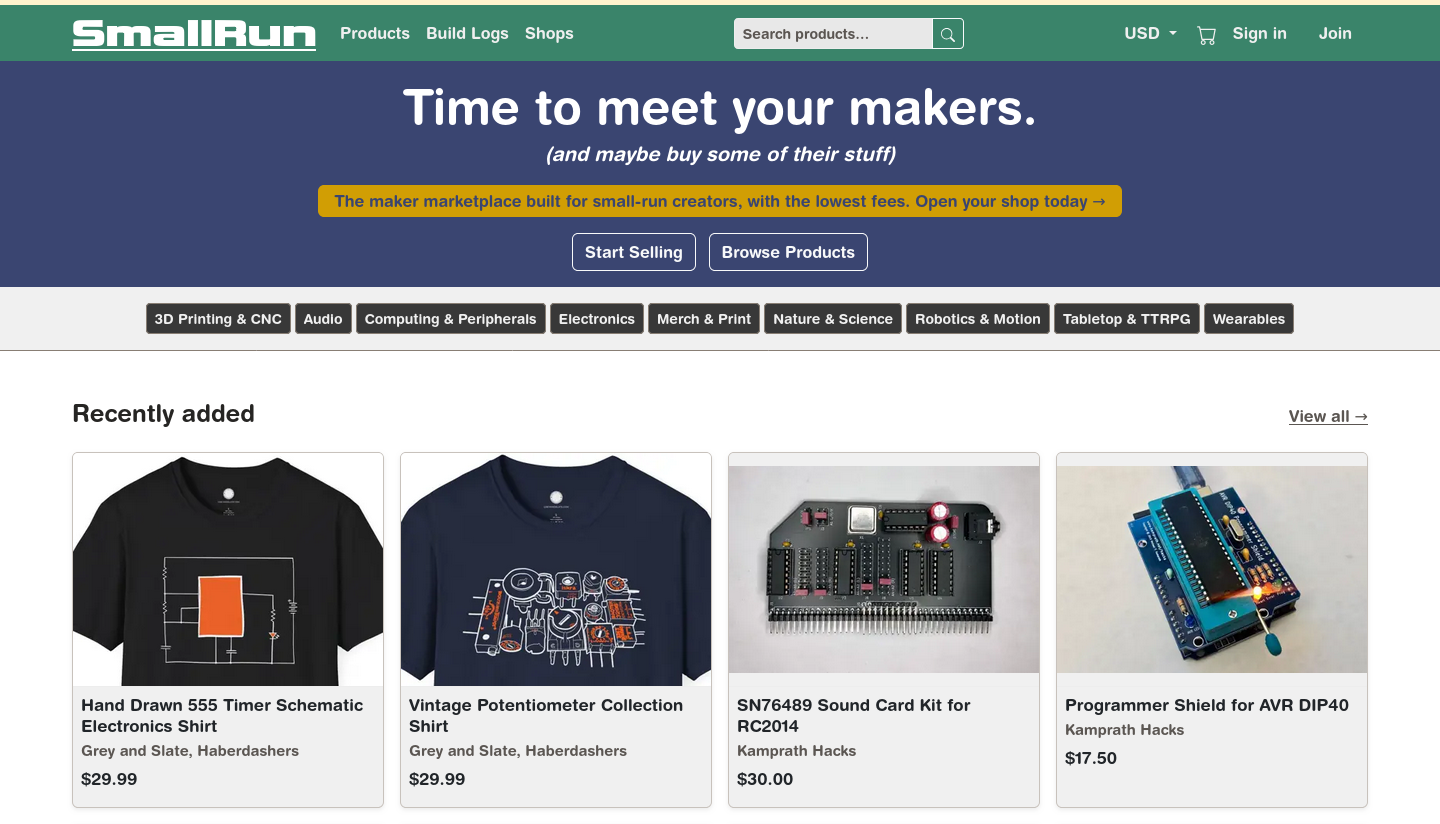
SmallRun.net Enters The Marketplace Market

Published

on

So you have a project that you love, and everyone else loves too. People start saying “you should sell this” but where? Well, there’s a new marketplace you might want to consider called called SmallRun, aiming at makers and their, well, small production runs.

SmallRun will absolutely host your custom PCBs, on-demand 3D prints, and other traditional maker products — but they’ll also happily sell your merch, too. Along with electronics and hardware, they aim to allow you to sell products in categories like tabletop gaming, sciences, and yes, accessories/apparel.

For sellers, they offer automatic payouts and promise to take care of the taxes by integrating with Stripe. That said, they’re still working on getting the whole VAT thing set up for products imported to the EU. EU to EU sales are apparently OK. They’ll host build logs, which may drive engagement with your product. There’s even a handy tool to import your existing listings from eBay, Tindie, Lectronz, Etsy, Shopify, or Crowd Supply if you’re already in the biz. They make their money by taking a cut of your sales: eight percent, plus forty cents per listing.

Depending on your perspective, you might wonder if we need another marketplace, To that we can only say: “Let a thousand flowers bloom!” Competition should drive these marketplaces to continuously improve and we all win.

Advertisement

If you’re selling online, even packaging can become a project. If you’re not, but are interested in starting, our “From Project to Kit” series from ten years back remains surprisingly relevant.

Thanks to [Aron] for the tip!

Source link

Advertisement
Continue Reading

Tech

Apple Vision Pro vs Snap Specs: Two visions of face-worn computing, compared

Published

on

Apple wants you to step into a virtual world, while Snap wants you to stay in the real one. Here’s how their very different approaches to spatial computing compare.

Two futuristic black headsets on a gradient green-to-purple background: a smooth, visor-like VR headset on the left and rectangular smart glasses with reflective lenses on the right
Apple Vision Pro [left] vs Snap Specs [right]

The launch of Snap Specs at Augmented World Expo on June 16 is a big shift forward for the social company. After the previous effort of Snap Spectacles, Snap Specs are a step closer to the augmented reality future by being smart glasses with a built-in display.
This is something that brings Snap’s efforts in line with the Ray-Ban eyewear that Meta has produced, including its yet-to-ship Meta Ray-Ban Display. It’s also a massively different product from Apple’s own head-mounted computing device, the Apple Vision Pro.
Continue Reading on AppleInsider | Discuss on our Forums

Source link

Continue Reading

Tech

When the Trump administration cracks down on Anthropic, who benefits?

Published

on

Anthropic recently took its two newest AI models offline due to an export control order from the Trump administration, prompting broad debates about AI policy and digital sovereignty.

On the latest episode of TechCrunch’s Equity podcast, Sean O’Kane, Rebecca Bellan, and I discussed what actually prompted the administration’s moves against Anthropic, and what this might mean for the broader AI ecosystem.

As Sean put it, “Anthropic has not had the best relationship with the Trump administration in a way that stands apart from the other leading AI labs,” so perhaps other Anthropic’s rivals don’t need to worry about a similar crackdown.

But Rebecca also noted that leading cybersecurity experts have “signed an open letter to ask Trump to revoke the order, and they say it’s actually dangerous to have to pull these advanced cybersecurity capabilities from network defenders in the U.S.”

Advertisement

And we wondered whether this could all end up being good publicity for Anthropic, especially since — in Rebecca’s words — “everybody loves a bad boy.”

Keep reading for a preview of our conversation, edited for length and clarity.

Rebecca Bellan: As I’m sure many of our listeners know, the U.S. government basically just forced Anthropic to pull its two newest models offline — Fable 5, and then there was also Mythos 5, which was the one that was available to current Mythos users, [whereas] Fable 5 was more available to the public.

They sent a letter [last] Friday that cited “national security concerns.” No one knows what those concerns are. That report has not been made public, they gave no specifics and told [Anthropic] that they had to ensure that those models couldn’t be used by any foreign nationals. So Anthropic was like, “Okay, I guess we have to just pull the models entirely, because we don’t know when someone’s a foreign national. A lot of our own employees are foreigners.” 

Advertisement

But really, [reports said] the White House got tipped off to this because of some Amazon researchers that allegedly found a way to bypass Fable 5’s guardrails. Amazon CEO Andy Jassy raised these concerns with the White House, and it just kind of spiraled from there.

Sean O’Kane: This all moved really fast, especially for a Friday afternoon into a weekend. And it’s at the same time that the administration was ostensibly trying to negotiate some sort of treaty for the war that it started in Iran. 

Rebecca: Friday evening for us in New York. They love a distraction.

Sean: Let’s step real far back for a moment. Anthropic has not had the best relationship with the Trump administration in a way that stands apart from the other leading AI labs — I think there’s an element, at least, of that playing here. 

Advertisement

So do you think that this is going to have implications for those other companies? Do you think that the Trump administration would be less inclined to sort of turn off the tap on one of those competitors?

Anthony Ha: Part of the context here is that both the reporting and an analysis from independent security experts suggest that the actual security risk from Anthropic is not that unique. So a lot of this seems to stem as much from parts of the Trump administration and Anthropic just [not getting] along very well. Whatever risks there are, those things are gonna blow up out of proportion just because it seems like they can’t have a civil phone call with each other.

If you’re another company — on the one hand, maybe that’s advantageous to you, because you can say, “Well, we just don’t get these guys mad at us and we can do what we want.” But that’s also not a great regulatory landscape to just [say], “Boy, I hope they don’t get mad at us.”

Rebecca: On the one hand, it definitely feels retaliatory — after the government labeled Anthropic a supply chain risk, there’s this big lawsuit going on between them, it really feels like the White House is just looking out for any excuse to pummel Anthropic. And I feel that way not only because that was my initial reaction, but because of what a lot of cybersecurity researchers have said. They say that this should never have triggered an export control [order]. They’ve all signed an open letter to ask Trump to revoke the order, and they say it’s actually dangerous to have to pull these advanced cybersecurity capabilities from network defenders in the U.S. Anthropic itself said some of the same jailbreaks could have been found in several other AI models. 

Advertisement

Cynically, it’s like: Okay, are you just pausing Anthropic so that others can catch up to where Anthropic was?

But at the same time, I’ve also seen reactions that [say]: Anthropic kinda had this coming. They’re like, “This is too dangerous for anyone to use, but not us, we’re the good guys.” They’re talking out of both sides of their mouth. A week before Fable came out, they were [saying], “Hey, we need to slow down AI, guys. It’s getting really dangerous.” But then boom, “Here’s our most insane ever, super powerful model, go off.” 

Anthony: In some ways this feels like a microcosm of a lot of the discussion around AI, where people like Sam Altman and Jensen Huang are [saying], “Hey, let’s try to lower the temperature. Why is everybody mad at us?” Well, you spent the last couple years essentially saying you’ve built this God machine that will take jobs away from everyone. It’s not exactly a shock that people don’t feel great about this.

And there’s something about the way Anthropic talks about Mythos in particular, where they’re like, “This is the most incredibly powerful model ever, it’s too dangerous to release to the public.” And so on some level, [you say,] “Well, okay, let’s say that we take that seriously then. That means that there’s going to be an incredible level of scrutiny around it.”

Advertisement

And I do wonder — it does seem like Anthropic is not happy about this. I want to be careful about not overstating how this could be beneficial to them. But we also ran some stories about Ramp analysis to highlight the fact that the last big blow-up between Anthropic and the Trump administration was good for the company, in at least some ways. Downloads of Claude shot up. I think a lot of people who maybe had thought of ChatGPT as the chatbot, the AI assistant before, suddenly they were looking at Claude as maybe the more responsible one, the more “resistance” one.

And in the same way, [while] Anthropic is very stressed out about this, this could, again, make their models seem even more powerful.

Rebecca: Definitely. “We’re so dangerous.” Everyone loves a bad boy, right? Everyone’s like, “It’s the most powerful model, even Trump says so. Of course, I’ve got to get my hands on it.”

When you purchase through links in our articles, we may earn a small commission. This doesn’t affect our editorial independence.

Advertisement

Source link

Continue Reading

Tech

The Secret Revolution in Battery Technology: 3-D Printing

Published

on

“There’s a revolution in battery technology hiding in plain sight,” reports The Wall Street Journal. “The 3-D printing of batteries has the potential to put energy storage inside any device.

“This will enable lightweight and long-lasting consumer gadgets, long-range military drones and even nanoscale robots.”
Almost all the innovations we regularly hear about — from cheaper, tougher electric-vehicle batteries to “Holy Grail” solid-state batteries — are about changing the chemistry of batteries. The promise of battery-tech 3-D printing (aka additive manufacturing) is simple: What if batteries could fill any available space, even structural elements of our gadgets, rather than always taking a rigid shape like a pouch or cylinder?

The new approach has obvious appeal. The entire airframe of a drone could be filled with energy storage for increased range. Smartglasses could have sleek battery-packed frames, so they look like everyday eyewear rather than “Revenge of the Nerds” props. One of the biggest advantages of 3-D printing is that it works with any battery, regardless of its cell chemistry. It could advance today’s lithium-ion as well as emerging sodium-ion and solid-state tech… Some [startups] are trying to use 3-D printing to create efficiencies in existing battery manufacturing systems. A brave handful of startups are pursuing radical new designs and approaches. They’re starting with defense applications, where cost and scale are less of an issue…

At Silicon Valley-based Sakuu… [r]ather than trying to 3-D-print whole batteries, the company is working on replacing one of battery manufacturing’s biggest pain points, says Arwed Niestroj, Sakuu’s chief operating officer, who is also a nuclear physicist and former head of Mercedes-Benz Research & Development North America. Existing battery assembly lines include football-field-long ovens for drying layers of material that have been dissolved in solvents. This requires a huge amount of energy and is a significant contributor to manufacturing costs, a big reason EV batteries aren’t cheaper. Sakuu’s process, under development for years, uses additive manufacturing to lay down key battery components without solvents, eliminating the need for ovens, says Niestroj.

Advertisement

Sakuu is currently working to commercialize this tech with a major battery manufacturer…

Source link

Advertisement
Continue Reading

Tech

Hackaday Links: June 21, 2026

Published

on

Today marks the summer solstice, the longest day of the year and the start of astronomical summer in the Northern Hemisphere. This doesn’t really have much to do with hacking hardware or building gadgets other than the fact that from this point on you’ll have progressively less daylight hours to do it in each day. Of course, if you do your best work in the middle of the night this won’t impact things much.

If you’re as likely to find a controller in your hand as a soldering iron in the evenings, you might be interested in a recent filing against Sony. Lawyers representing a group of four gamers allege that the entertainment giant is violating a California law that says digital storefronts need to make it clear that buyers don’t technically own the games in question but are merely licensing them — a license which, as we’ve seen in the past, can be revoked or modified at any time with no restitution made to the purchaser.

Now while we agree conceptually that selling gamers a license rather than an actual copy of the game is clearly a one-sided deal, we’re still not sure this case has a lot of merit. As far as we can tell, Sony does make it clear in the fine print that you’re not really going to own anything once they take your money. Or, at the very least, they make it equally as clear as any other company that’s selling digital downloads these days. Should the court actually find that said fine print is a little too fine, it could conceivably have ramifications throughout the entertainment industry. This is certainly a case to keep an eye on.

If you want to be sure none of your games can be removed from your digital grasp without warning, perhaps your best bet is to stick to the classics. Fans of 1989’s F-15 Strike Eagle II on PC will be excited to hear that there’s an ongoing effort by Neuvieme Porte to reverse engineer the flight sim and re-implement the whole thing in portable C.

This would open up all sorts of possibilities, such as ports to other platforms and the addition of new features and content. But before the project can get to that point however, Neuvieme is looking to recruit some virtual test pilots. Just keep in mind that the goal, at least for now, is to recreate the game exactly. That means bugs present in the original release are to be preserved. As such, it would help to have logged enough hours back in the DOS days to recognize what’s an OG bug and what’s been newly introduced.

Advertisement

From working on virtual jet fighters to the real deal, IEEE Spectrum recently ran an article about a startup called Phoenix Semiconductor that’s looking to produce bespoke pin-compatible replacements of critical chips for the military. They reason that the Air Force won’t mind paying $1,000 for a chip that cost them a buck back in 1975 when the alternative is grounding a $70+ million F-18 that needs the thing to take off. The goal isn’t really to recreate the old parts as they were, but instead to build drop-in replacements that are tailored for specific applications. In other words, Uncle Sam doesn’t care of the IC actually looks like the original, so long as it fits and it gets the jet up in the air again.

Finally, on the subject of aerospace technology, NASA’s Jet Propulsion Laboratory published a blog post earlier this week detailing their work on the Exploration Rover for Navigating Extreme Sloped Terrain (ERNEST). While NASA’s Curiosity and Perseverance rovers have done some incredible work on Mars, they’re slow and have to be operated with the utmost caution to make sure they don’t get stuck. In comparison, ERNEST is several times faster and is designed with an active suspension system that lets it lift each wheel up off the ground independently if needed.

The prototype rover also features improved autonomy that may allow future rovers make more decisions on their own. That may not be a huge time saver on the Moon, but given the communication delays with the Red Planet, a Mars rover that doesn’t have to stop and ask Earth for directions so often will be able to get more useful work done at the end of the day.

Advertisement

See something interesting that you think would be a good fit for our weekly Links column? Drop us a line, we’d love to hear about it.

Source link

Advertisement
Continue Reading

Tech

Polymarket Has Reportedly Been Paying Creators To Post Fake Betting Videos

Published

on

The Wall Street Journal reviewed 1,105 videos along with guidance given to creators for crafting their posts.

In case you needed another reason to be wary of those videos showing people winning big on Polymarket, an investigation by The Wall Street Journal has found that the company is paying social media creators to post misleading content promoting the prediction market. Of the 1,105 TikTok videos the publication reviewed, 778 appeared to show someone placing a bet — but a closer look reportedly revealed that none of the latter featured the actual Polymarket website, instead using dummy sites made to look like the real thing.

For more than half of the videos that appeared to show winning bets, those bets would in reality have been losses, The Wall Street Journal reports. The publication spoke to creators who worked with Polymarket and viewed materials they say they were given to ensure their videos were convincing and engaging. In addition, Polymarket reportedly also enlisted a “social-media army” to repost these videos and help them go viral.

Polymarket has been making headlines this year as governments grapple with how to regulate prediction markets. Minnesota last month became the first US state to ban them. Other states have tried to do the same, but multiple lawsuits have challenged these efforts. Meanwhile, Spain blocked Polymarket and another prediction market, Kalshi, in May as it figures out whether they violate the country’s gambling law.

Advertisement

Source link

Advertisement
Continue Reading

Tech

How to watch New Zealand vs Egypt: Free Streams & TV Channels for World Cup 2026

Published

on

Mo Salah’s Egypt meet Chris Wood’s New Zealand at BC Place in Vancouver, with both teams looking to break away from the Group G bottleneck after all four sides opened their World Cup 2026 campaigns with draws.

Although Egypt performed well, especially defensively, in their opener against Belgium, they led for nearly two-thirds of the match before an own goal by Mohamed Hany, arguably caused by the impact of Romelu Lukaku’s introduction, brought Belgium level.

Advertisement

Source link

Continue Reading

Tech

NYT Connections hints and answers for Monday, June 22 (game #1107)

Published

on

Looking for a different day?

A new NYT Connections puzzle appears at midnight each day for your time zone – which means that some people are always playing ‘today’s game’ while others are playing ‘yesterday’s’. If you’re looking for Sunday’s puzzle instead then click here: NYT Connections hints and answers for Sunday, June 21 (game #1106).

Good morning! Let’s play Connections, the NYT’s clever word game that challenges you to group answers in various categories. It can be tough, so read on if you need Connections hints.

What should you do once you’ve finished? Why, play some more word games of course. I’ve also got daily Strands hints and answers and Quordle hints and answers articles if you need help for those too, while Marc’s Wordle today page covers the original viral word game.

Advertisement

Source link

Continue Reading

Trending

Copyright © 2025