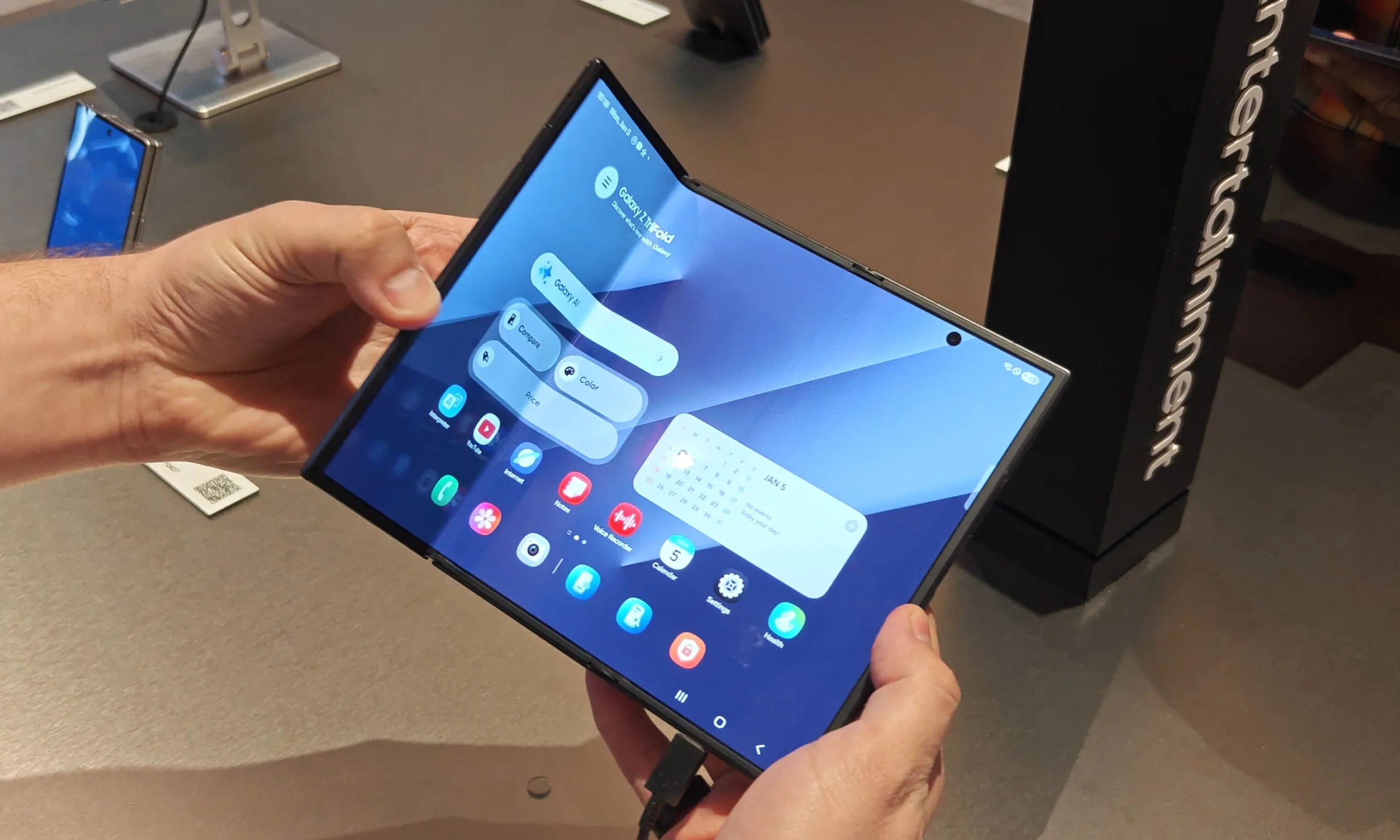
The SamsungGalaxy Z TriFold is, by almost every measure, a phone that shouldn’t exist in the first place, and yet here we are: a massive 10-inch screen, two hinges, and a price tag that might make your wallet cry.
Samsung knew it was a first-generation device, which is why it kept production intentionally limited, a controlled showcase of engineering ambition rather than a full market rollout.
However, “more hits than misses” is not the bar you set for a device that costs almost as much as two or three conventional smartphones. For now, the TriFold is gone, but its successor — the Galaxy Z TriFold 2 — is reportedly on the company’s roadmap, perhaps being sketched, argued over, and stress-tested in a lab.
Spec
Samsung Galaxy Z TriFold
Display
10-inch main (AMOLED, 120Hz) + 6.5-inch cover
Peak Brightness
1,600 nits (main) / 2,600 nits (cover)
Chipset
Snapdragon 8 Elite for Galaxy
RAM / Storage
16GB RAM / 512GB or 1TB
Rear Cameras
200MP wide + 12MP ultrawide + 10MP 3x telephoto
Front Cameras
10MP (cover) + 10MP (foldable screen)
Battery / Charging
5,600mAh / 45W wired, 15W wireless
Ingress Protection
IP48
Dimensions
3.9–4.2mm unfolded / 12.9mm folded / 309g
5 things that the Galaxy Z TriFold 2 desperately needs to fix
When the Galaxy Z TriFold 2 arrives, it needs to arrive differently, not just as a thinner, shinier version of the current-generation foldable, but more as a phone that earns its place in more pockets.
Advertisement
Here is a list of things that need to change in the Galaxy Z TriFold 2, in my frank opinion, as they could seriously make the difference between a phone people admire (from a distance) and one that they actually want to buy.
A thinner, more durable hinge and chassis
John McCann / Digital Trends
The original TriFold’s dual-hinge system was, in my opinion, an engineering marvel, but it was also the most obvious compromise. At 12.9mm thick when folded and weighing 309 grams, the TriFold seemed gargantuan compared to Samsung’s Fold 7. For those catching up, the Fold 7 measures 8.9 mm thick and weighs just 215 grams.
Now, I understand that two hinges will always take up more space than one, which explains the TriFold’s thickness. However, this is where the single-fold Fold 7 feels more like a polished product, and the TriFold doesn’t. The good news is that the company already knows this.
Galaxy Z TriFold’s side profileJohn McCann / Digital TrendsGalaxy Z Fold 7’s thicknessNirave Gondhia / Digital Trends
Recent rumors suggest that Samsung is developing an “entirely new hinge solution” from the ground up for the TriFold 2, with the objective of making it meaningfully slimmer. Thinness alone, however, is not enough. If the phone wants to be considered as a daily driver, it needs to survive the brutal reality of everyday life.
Dust, drops, the unorganized items inside a bag, and the pressure that tight jeans pockets apply on a phone: the TriFold 2 must be able to survive all of this better than the TriFold, and slimming the hinge shouldn’t come at the cost of structural integrity.
Phone
Type
Unfolded Thickness
Folded Thickness
Weight
Samsung Galaxy Z TriFold
Tri-fold
3.9–4.2mm
12.9mm
309g
Huawei Mate XT Ultimate
Tri-fold
3.6-4.8mm
12.8mm
298g
Samsung Galaxy Z Fold 7
Dual-fold
4.2mm
8.9mm
215g
Google Pixel 10 Pro Fold
Dual-fold
5.2mm
10.8mm
257g
A better ingress protection rating
John McCann / Digital Trends
The Galaxy Z TriFold shipped with an IP48 rating, the same as the Fold 7, and already better than the Huawei Mate XT (which came with an IPX8 rating without any dust protection).
However, “better than Huawei’s Mate XT” isn’t exactly a glorifying benchmark, especially when the Pixel 10 Pro Fold has become the first foldable to achieve a full IP68 rating, the same as conventional flagships.
Advertisement
For a device positioned as the pinnacle of Samsung’s engineering, an IP48 feels less assuring. The TriFold 2, in my opinion, needs to match the IP68 as a baseline, and so does the Fold 7.
Phone
Type
IP Rating
Dust Protection
Water Protection
Samsung Galaxy Z TriFold
Tri-fold
IP48
Partial (particles over 1mm)
Up to 1.5m for 30 mins
Samsung Galaxy Z Fold 7
Dual-fold
IP48
Partial (particles over 1mm)
Up to 1.5m for 30 mins
Huawei Mate XT Ultimate
Tri-fold
IPX8
None
Up to 1.5m for 30 mins
Google Pixel 10 Pro Fold
Dual-fold
IP68
Full (dust-tight)
Up to 1.5m for 30 mins
Higher peak brightness for the inner display
John McCann / Digital Trends
Screen estate is the TriFold’s entire argument. It’s the reason you’re paying the premium, for the idea of fitting a large-screen foldable smartphone in your pocket (technically, you can). However, to me, it’s genuinely baffling that the phone’s main 10-inch screen peaks at just 1,600 nits, which is lesser than the Galaxy Z Fold 5’s inner screen from 2023.
For context, the Galaxy Z Fold 7’s inner screen hits 2,600 nits, as does the Galaxy S26 Ultra, and the TriFold’s outer screen. And while these might sound like bare numbers, they’re very important when you’re using the smartphone outdoors, under direct sunlight.
It’s the difference between holding the phone confidently in the street on a bright sunny day, and running into the shade to read the notification and replying. Given the company’s strong hold over its displays, I would really appreciate a brighter display for everyday use, on par with modern flagships and regular foldables.
Phone
Type
Inner Display Brightness
Cover Display Brightness
Samsung Galaxy Z TriFold
Tri-fold
1,600 nits
2,600 nits
Samsung Galaxy Z Fold 7
Dual-fold
2,600 nits
2,600 nits
Google Pixel 10 Pro Fold
Dual-fold
3,000 nits
3,000 nits
A more powerful chip for better multitasking
Chris Hall / Digital Trends
The Galaxy Z TriFold featured the Snapdragon 8 Elite chip, which, at the time, was the most powerful smartphone chip. However, due to thermal constraints, the device ran slower than the other 8 Elite-powered smartphones, such as the S25 Ultra.
While I’m not expecting the TriFold 2 to fix that issue entirely, given that it would also feature a thin chassis with very limited space for a dedicated cooling mechanism, a chipset upgrade could surely improve multitasking, gaming, and overall responsiveness.
Advertisement
This year, the TriFold 2 should feature the Snapdragon 8 Elite Gen 5 chip, the one we’ve seen on the Galaxy S26 Ultra (globally) and the S26 and S26 Plus (in the U.S., China, and Japan). Even with thermal throttling, the chipset could surely unlock a meaningful performance upgrade.
Phone
Type
Chipset
Availability
Samsung Galaxy Z TriFold
Tri-fold
Snapdragon 8 Elite for Galaxy
Global
Samsung Galaxy Z Fold 7
Dual-fold
Snapdragon 8 Elite for Galaxy
Global
Samsung Galaxy S25 Ultra
Slab
Snapdragon 8 Elite for Galaxy
Global
Samsung Galaxy S26 Ultra
Slab
Snapdragon 8 Elite Gen 5 for Galaxy
Global
The TriFold 2 desperately needs better selfie cameras
John McCann / Digital Trends
The Galaxy Z TriFold’s rear camera setup is still better. A 200MP main camera, a 10MP telephoto, and a 12MP ultrawide; all of these let users fiddle with multiple perspectives and zoom levels to get the picture they want without moving around too much. Selfie cameras, however, are a slightly different story.
The TriFold’s selfie camera setup is quite symmetrical: a 10MP (f/2.2) on the cover screen and a 10MP (f/2.2) camera on the main 10-inch foldable screen. But in my opinion, it isn’t something buyers expect to get with one of the most expensive smartphones money can buy.
While the selfie shots might not be the problem for most buyers, I’m not even sure whether they’re looking at it from a quality perspective; it’s the software that’s doing the heavy lifting there.
I appreciate the ultrawide field of view from the inner-screen sensor, I really do, as it helps get more people in a selfie, but I sincerely want Samsung to increase the resolution for both sensors. Additionally, selfie cameras could use slightly larger sensors for better low-light performance.
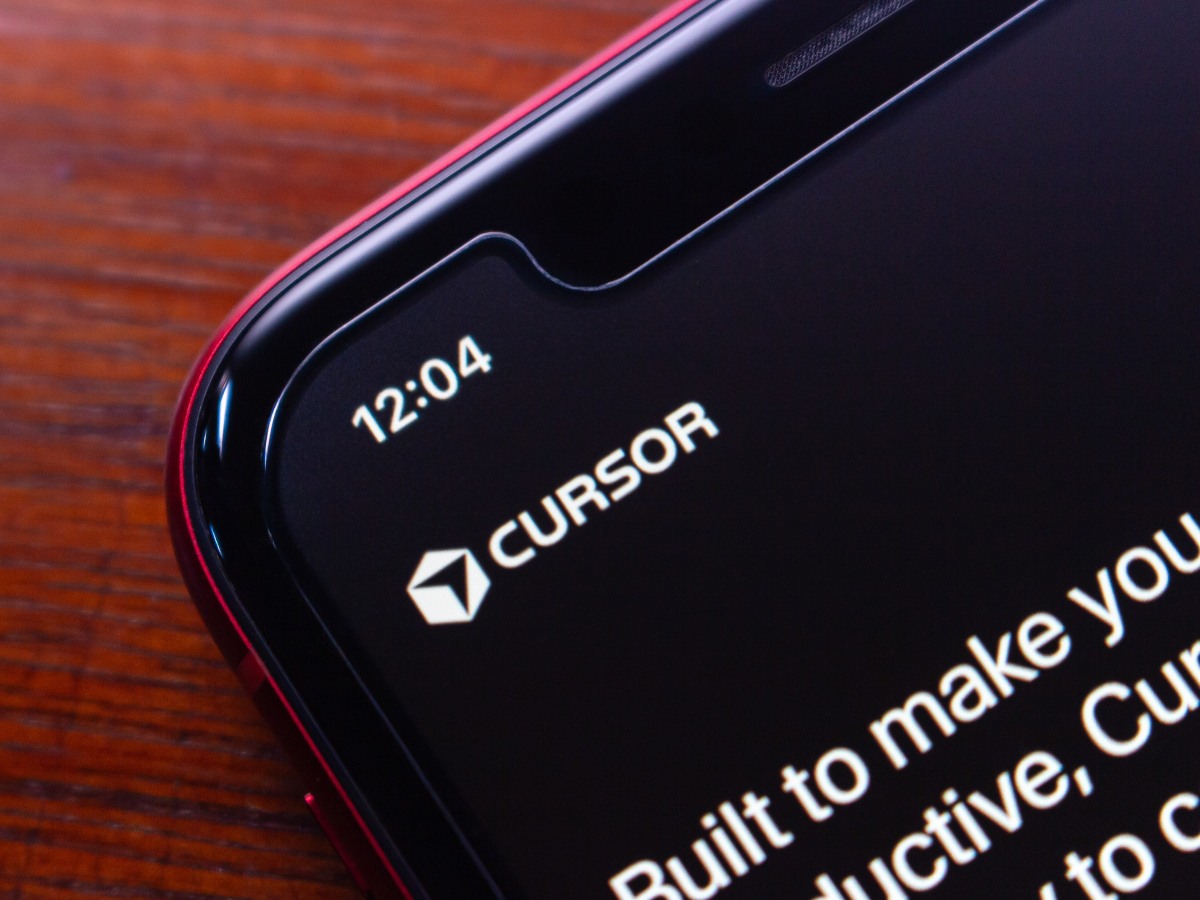
As it vies to catch up with rivals like OpenAI and Anthropic, SpaceX has done a deal to enable purchase of the fast-growing AI coding start-up Cursor.
In a post on X, SpaceX said the companies were “now working closely together to create the world’s best coding and knowledge work AI” and that “Cursor has also given SpaceX the right to acquire Cursor later this year for $60bn or pay $10bn for our work together”.
In its own statement, Cursor confirmed it was partnering with SpaceX “to accelerate our model training efforts”, which it said had been stymied by lack of compute.
“With this partnership, our team will leverage xAI’s Colossus infrastructure to dramatically scale up the intelligence of our models,” it said.
Advertisement
Cursor had been widely reported to be raising a $2bn round at a $50bn valuation in recent days, as it sought investment to increase compute, but that raise will now be halted as the SpaceX deal will offer it all the capacity it needs to expand, according to Bloomberg sources.
It is likely that the reason SpaceX has bought the rights to purchase Cursor, rather than acquiring it immediately, is that the space tech and AI giant is keen to win the race to IPO, and any acquisition of such a size would require it to refile for IPO.
Reports have suggested a SpaceX IPO between April and June, which means it would precede speculated listings by rival AI giants OpenAI and Anthropic in the near future.
Elon Musk has consolidated various businesses over the past year to arrive at a mooted $1.75trn valuation. In February, SpaceX acquired xAI, which in March 2025 had acquired X.
Advertisement
Revenue growth from SpaceX’s Starlink satellite broadband service is widely and largely credited for the foundation of the valuation. Starlink currently dominates the global satellite internet service industry, with more than 9,000 satellites in orbit and roughly 9m customers.
The February merger deal valued xAI at around $250bn, but preceded the departure of all 11 of Musk’s co-founders from that company. Now Musk looks set to buy in the talent he believes he needs to compete with his major rivals.
Cursor is one of the fastest-growing AI start-ups right now, and well-regarded, boasting some very high-profile investors, including Nvidia, Andreessen Horowitz, Google – and indeed, OpenAI’s venture fund. It remains to be seen whether the expensive acquisition goes ahead, or whether both companies could take up the agreed alternative within the deal to pay $10bn for their collaborative work.
Don’t miss out on the knowledge you need to succeed. Sign up for the Daily Brief, Silicon Republic’s digest of need-to-know sci-tech news.
This holder works for Kindles and tablets alike, and even my Nintendo Switch. The clamp base lets you attach it to tables and furniture, and it’s easy to position in front of or even above you if you wanted to lie down and read.
Lamicall
Tablet Pillow Stand Holder
If you want something that’s freestanding, this pillow tablet stand holder works great for a Kindle. I use it on the couch, and I can sit up or lounge back and adjust the stand arm to suit my position. There are also two built-in cup and snack holders. Lamicall says they’re food safe, but I just use it to hold my tea mug and phone.
Advertisement
A Freestanding Charger
Looking to keep your Kindle charged without adding another cord to the floor of your desk or bedside table? Same. Here’s a more stylish solution if you have one of the Signature editions.
Anker
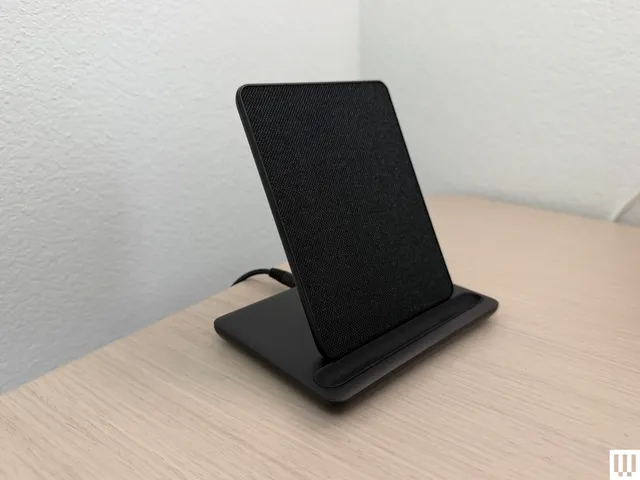
Wireless Charging Dock for Kindle
This wireless charging dock is made by Anker for Kindles, specifically for Kindle Paperwhite and Colorsoft’s seven-inch Signature editions. Those versions have wireless charging capabilities, and this stand takes advantage of that with charging coils that line up with the back of the Kindle, where the wireless charging is. You’ll want to take off any MagSafe cases; leaving mine on made the little light on the charging dock flash until I took it off.
A Kindle Page Turner
Advertisement
The hottest new item to get as a Kindle lover is a page turner. They’re especially handy for holders like the ones above, where your hands aren’t already on the device, and can make for a great accessibility accessory for readers with different needs.
My biggest irritation with these devices so far is that you have to charge them both individually, and if one runs out of battery, the whole thing is useless. I also don’t love that the turner does tend to block at least one letter while I read, and you can’t place it on the lower or upper margins since it’ll activate the menus instead of turning the page. Still, it makes reading ultra comfortable, especially for my strained wrists.
Here’s my favorite one so far, that’s been solid at holding a charge, and next I’m testing this remote ($15) with a wearable ring clicker instead of a remote.
Baby Yoda famously snitched (and later barfed up) some blue cookies in a scene from the hit Disney Plus show The Mandalorian. The folks at Burger King are about to release some Mandalorian and Grogu fast-food menu items and kids’ meals, and they’d probably rather you not think about the barfing part.
The show’s spin-off feature film, Star Wars: The Mandalorian and Grogu, opens in theaters on May 22. Burger King is releasing its Mando-themed kids’ meals on April 28 and the adult meals on Star Wars Day, May 4.
Other than themed packaging, the kids’ meals are pretty standard, except for the real treasure, a Mandalorian-themed toy. The meal itself consists of a hamburger or four chicken nuggets, applesauce, kids’-size fries and your choice of milk or apple juice.
Advertisement
The toys include two versions of Grogu, two of The Mandalorian himself, a Stormtrooper, an AT-RT driver, the Mandalorian’s ship the Razor Crest and the Lasat rebel Zeb Orrelios.
The kids’ meals come with Mandalorian-themed toys.
Burger King
The menu items that arrive on May 4 aren’t in meals, so they don’t come with toys, which seems like a missed opportunity. However, you can nab one of four collectible cups by ordering one of three combos. The cups come in maroon, black, green and navy.
Advertisement
There’s a BBQ Bounty Whopper (burger with Swiss cheese, bacon, lettuce, tomato and barbecue sauce), Grogu’s Garlic Chicken Fries with garlic dipping sauce, and Imperial Cheddar Ranch Tots.
But the item I’m most excited for is Grogu’s Blue Cookie Shake, which blends soft-serve with blue sugar cookie syrup and tops it off with blue cookies. Maybe don’t suck one down and then go for a bumpy, breakneck ride in the Razor Crest.
The platform will offer ‘bite-sized online courses’ that are 30 minutes or less and can be accessed using a tablet or laptop.
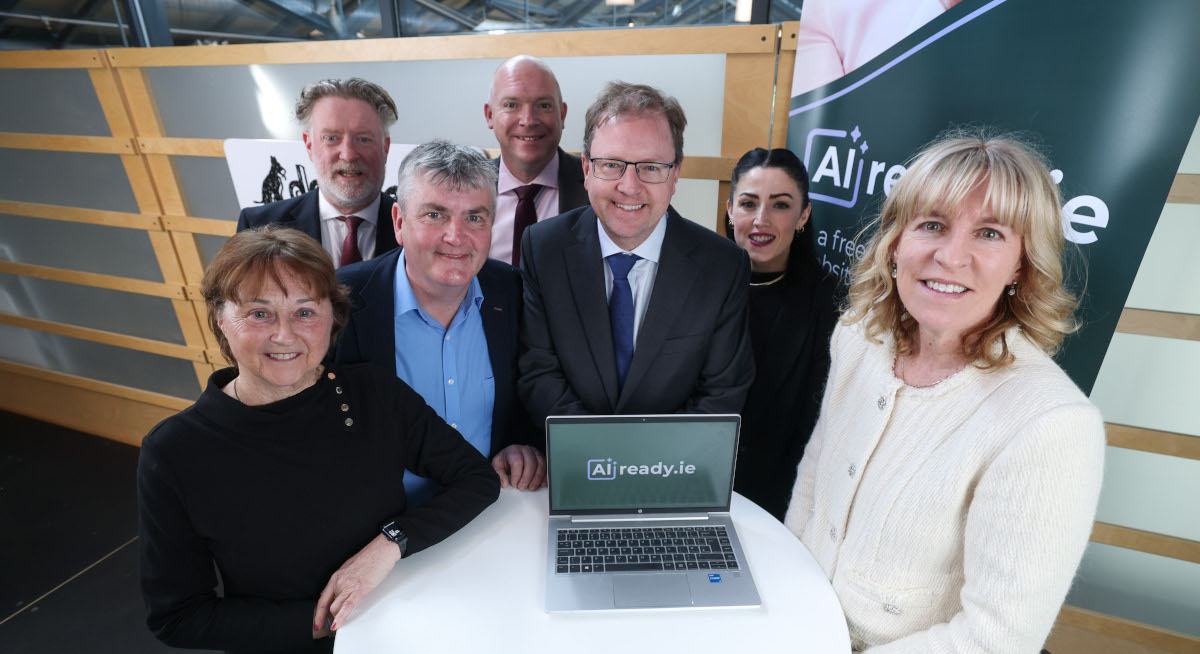
Irish Minister for Further and Higher Education, Research, Innovation and Skills James Lawless, TD has today (23 April), launched AIReady.ie, a new Governmental, national AI skilling platform, designed to provide people across Ireland with the means to learn essential AI skills.
Developed by Solas, in partnership with the National Skills Council, the initiative is free and suited to learners of all abilities. It teaches the fundamentals of AI and can be engaged with at the user’s own convenience via flexible “bite-sized online courses” that are 30 minutes or less and can be accessed using a tablet or laptop.
The curriculum is designed to support people as they work to develop the in‑demand skills needed for work, study and everyday life, regardless of their prior experience or technical background, with the current content focused on building foundational AI literacy and practical digital capability.
Advertisement
To start, the programme will offer four short courses tailored to older people, small businesses such as sole traders and farmers, and those returning to the workforce. The initiative aims to upskill 1m people in AI, which the platform said is “one of the Government’s most ambitious responses to the rapid emergence and impact of artificial intelligence to date”.
Commenting on the launch, Lawless said: “Artificial intelligence is rapidly reshaping how we work, learn and live and ensuring people are ready for that change is one of the most important challenges we face. I strongly believe that everyone should have the opportunity to understand AI and to use it with confidence.
“We are now at a point where AI readiness is no longer optional, it is essential. Being ‘AI‑ready’ is about more than technology, it is about giving people the skills, confidence and understanding they need to participate fully in an AI‑enabled society. AI skills are for everyone, not just experts or specialists.”
Dr Kevin Marshall, the chair of the National Skills Council, added: “I welcome the launch of AIReady.ie, which will support the development of AI skills. We know the biggest risk today isn’t AI, it’s being unprepared to use it.
Advertisement
“We want people to feel like AI is accessible to them, regardless of their background or stage in life and this new platform delivers exactly that, a simple entry point for anyone looking to start their journey with AI. With the launch of AIReady.ie today, we are laying the foundations to build the AI skills our economy and society needs for the future.”
Don’t miss out on the knowledge you need to succeed. Sign up for the Daily Brief, Silicon Republic’s digest of need-to-know sci-tech news.
Apple is at a transformational point in its product history. The company is making a record amount of money with a rich product portfolio, fumbled its AI strategy, and just had a leadership change.
Tim Cook is out as the CEO, and engineering veteran John Ternus is taking over the chief role. Interestingly, it seems Apple is also making the biggest shift in its product development history, with no less than ten categories of devices planned for the coming years.
Apple
What’s next from Apple?
It seems Apple planned the leadership change at a crucial point in its product development phase, with the focus being on Ternus delivering some knockout products early in his leadership tenure. According to Bloomberg, the first of these buzzy product reveals is going to be the iPhone Fold (or the iPhone Ultra), the first foldable smartphone by the company.
Apple is years late to the race, but the excitement around the upcoming “pocketable but not pocket-friendly” phone is pretty high. “Ternus is poised for an even bigger flood of products. Including the foldable iPhone, Apple will enter roughly 10 new product categories within the next few years. That means Ternus could quickly eclipse his predecessor by this measure,” says the report.
The launch of ten product categories is pretty ambitious, as Cook’s tenure only witnessed the launch of three new segments, two being mass-market wearables (AirPods and Apple Watch) and one XR hardware in the misfiring Vision Pro.
Advertisement
iPhone Fold CAD-based renderAI Visualization
A truly transformational roadmap
Apple has played it relatively safe with its wearables, but it seems the company is going all-in across the board. Starting with the AirPods, the company is reportedly planning to launch a camera-equipped version, dramatically boosting their health potential as well as understanding of the world around them using multi-modal AI. Think of Visual Intelligence, but instead of pointing your iPhone’s camera, the earbuds in your ears do the job.
It’s an immensely promising idea that will also be pretty hard to execute. Yet, if products like the Meta-Ray Ban AI glasses are anything to go by, Apple can execute it. And it’s not an outlandish idea, either. Experts at the University of Washington recently showcased the VueBuds, packing cameras on off-the-shelf earbuds that are capable of world-understanding and assisting with translation, among other AI-powered tricks. And let’s not forget Apple’s partnership with Google, which essentially puts Gemini at the foundations of Apple’s AI revival plans.
AI-generation concept of Apple smart-glasses with a holographic display.Gemini AI
Aside from the earbuds, the following is the list of other product categories that are reportedly in development at the company, many of which have been delayed due to Apple’s hobbled AI efforts:
While the iPhone Fold is nearing launch, the future of the often-rumored folding iPad is still in question, as it may never actually make it to consumer hands.
What a large folding iPad could look like – Image Credit: AppleInsider
The rumor mill has been infatuated by the idea of the folding iPhone, which is widely believed to be on the way later in 2026. However, Apple has also been working on another foldable device with less chance of becoming a reality. Writing in Sunday’s “Power On” newsletter for Bloomberg, the foldable iPad is a real thing being developed behind closed doors. Described as a tablet with a super-sized 20-inch display, it has been a priority of incoming CEO John Ternus while in his hardware chief role. Rumor Score: 🤔 Possible Continue Reading on AppleInsider | Discuss on our Forums
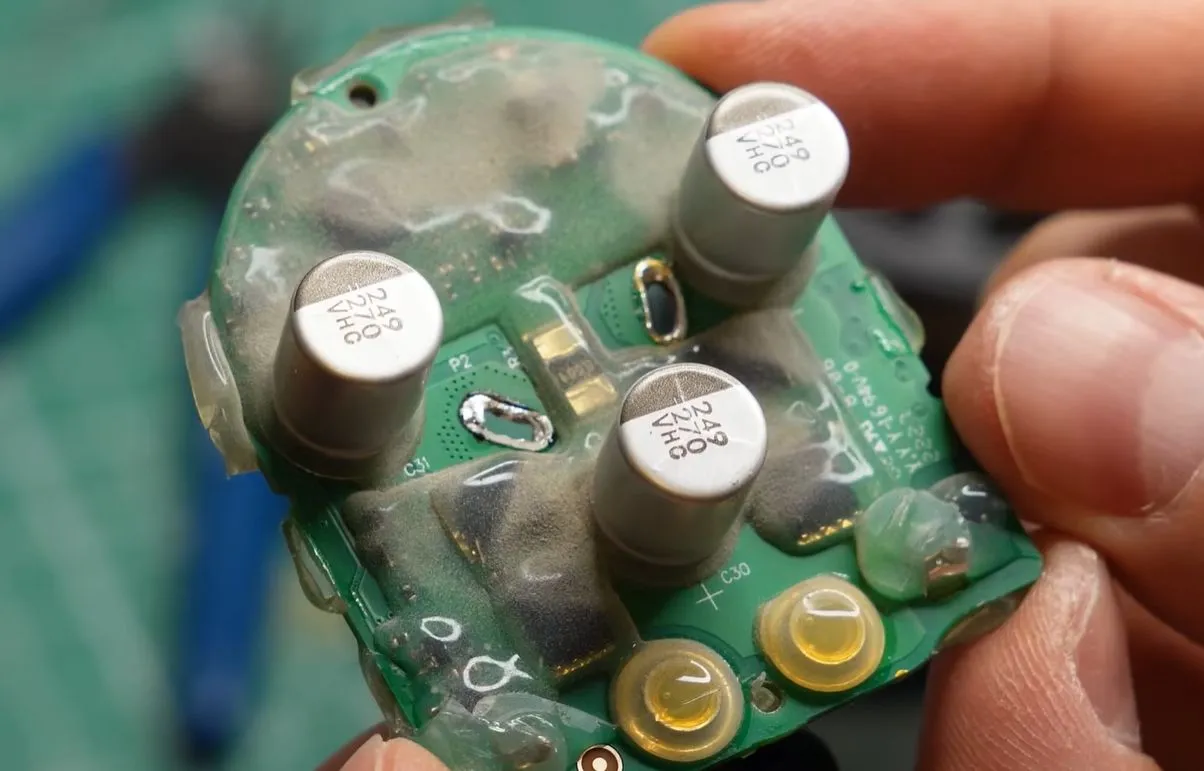
It seems to be becoming a bit of a theme that consumer electronics are dying not due to some critical fault, but due to Cooked Capacitor Syndrome (CCS). Case in point, Dyson handheld vacuums and the capacitors on its driver board. After having his $800 Dyson V15 handheld vacuum die after two and a half years of regular use, [LeftyMaker] found himself elbows-deep in the dusty innards of the vacuum just to replace some capacitors.
After initially trying a new battery and other common troubleshooting steps, he found that lots of people were having the same flaky behavior with their Dyson vacuums, all with the same underlying cause. On the driver board for the DC brushless motor, there are a couple of capacitors that seem to cause issues across models, with the standard response by Dyson being to ‘buy a new body’.
While it’s definitely possible to tear down the vacuum to get to the driver board, you’ll be doing effectively a full disassembly, all to see the capacitors located right next to the hot motor in a very confined space. [LeftyMaker] confirmed a very high ESR on the old capacitors before replacing them with 125℃ rated Rubycon 35PZF270MT810X9 polymer capacitors for $1 a pop.
Advertisement
Unsurprisingly, the vacuum worked fine after that fix, but it shows a trend where CCS has become so commonplace that it’s no wonder that the phrase ‘planned obsolescence’ is being uttered alongside it. For this particular series of Dyson vacuums, the issue is apparently so bad that [Hasan] created a custom driver board that might be superior in multiple ways. Maybe we need an OSHW vacuum cleaner, just to avoid such shenanigans.
Both left and right-wing accounts claimed, without evidence, that the attack was staged.
President Donald Trump, Vice President JD Vance, and dozens of other high-profile administration officials and journalists were attending the dinner at the Hilton hotel in Washington, DC, when a suspect, later identified by media reports as Cole Tomas Allen from California, allegedly ran past security towards the event. He was detained by law enforcement while the president and vice president were evacuated. Police said that they believe Cole acted alone, but did not expand on who his intended target was or what his motive may have been. “We believe the suspect was targeting administration officials,” acting attorney general Todd Blanche told NBC’s Meet the Press on Sunday morning.
On Bluesky, which has a predominantly left-leaning user base, many people simply wrote the word “STAGED” over and over again, echoing the response to the Trump assassination attempt in Butler, Pennsylvania in 2024.
Advertisement
On X, many claimedthe shooting was staged as a way to bolster support for Trump’s plan to build a new ballroom in the White House. The president referenced the ballroom in a press conference after the incident and a Truth Social post on Sunday morning. Many prominent online Trump boosters echoed the need for the ballroom, including far-right podcaster Jack Posobiec, Libs of TikTok creator Chaya Raichik, and Tom Fitton, the right-wing activist who runs Judicial Watch.
Their quick response, conspiracy theorists claimed, was evidence of a coordinated campaign following the shooting. “Is this another staged event,” one X user asked in a post that has been viewed more than 5 million times.
Other social media users who claimed the incident was staged pointed to a Fox News clip that featured the station’s White House correspondent Aishah Hasnie speaking from the Hilton hotel. Hasnie told viewers that prior to the shooting, press secretary Karoline Leavitt’s husband allegedly told her “you need to be very safe,” before the call was cut off.
“Fox News just cut one of their reporters off as they seemed to indicate the shooting was a pre-planned false flag,” one X user wrote in a post that has been viewed more than 2 million times. Hasnie later clarified in an X post that her cell service had cut out in a location with notoriously bad service, adding: “He was telling me to be careful with my own safety because the world is crazy. He was expressing his concern for my safety.”
Advertisement
“I don’t want to be fomenting conspiracies,” wrote Angelo Carusone, the chair and president of Media Matters, on Bluesky about the Fox News interview. “But I mean…this was super weird. Super weird.”
Leavitt herself was also the focus of conspiracy theories after she said “shots will be fired” in an interview ahead of the dinner, referring to the jokes Trump was scheduled to deliver. Following the attack, X users claimed the comment was “strange,” “sus,” or a “curious choice of words,” while sharing memes that suggested the shooting was staged. At least one mainstream outlet appeared to amplify the conspiracy theory as well, describing Leavitt’s comment as “eerie” and “bizarre.”
If you’re a small business selling products to consumers, you’d better have an e-commerce site and operation. But where to begin? You can choose a solution like Shopify or BigCommerce and risk spending top dollar. You can also go the open-source route and use a product like CubeCart.
With CubeCart, you can develop and maintain an entire e-commerce platform and install it on your company server or use a web-based solution like Hostinger. I did this recently when I wanted to set up an online store.
What is CubeCart?
Advertisement
CubeCart is a popular open-source e-commerce shopping cart solution that enables businesses of all dimensions to develop and manage their online commercial platforms. The British company provides a full suite of online store management tools, including product and order management, customer account features, and reporting capabilities. All CubeCart versions are free and don’t require licensing keys.
Article continues below
CubeCart’s primary advantage stems from its ability to adapt to specific business needs. The Smarty engine, together with user-friendly templates, enables users to design and modify their online store appearance with ease. The platform features a responsive design that guarantees both form and functionality across every device, including desktop computers, smartphones, and tablets.
Advertisement
CubeCart allows users to organize their inventory easily, manage products by category, and upload detailed product information and digital download content. The platform’s central order management interface simplifies order processing, order history viewing, and customer information management.
The platform enables global e-commerce because it supports both multi-currency and multi-language functionalities. It also supports secure transactions through various payment gateways, SSL encryption, and payment transaction log capabilities.
The platform delivers improved online visibility through SEO optimization, which produces search engine-friendly URLs alongside manual metadata controls. The CubeCart marketplace provides users with numerous plugins and integrations that help expand platform functionality through shipping methods, social plugins, abandoned cart recovery, and marketing tools.
Sign up to the TechRadar Pro newsletter to get all the top news, opinion, features and guidance your business needs to succeed!
Advertisement
The intuitive admin interface of the system makes managing an online store easy for both beginners and experts. The platform features an analytics dashboard that tracks sales performance and customer activity. You can run CubeCart as a self-hosted system or choose official optimized hosting solutions.
What is Hostinger?
Hostinger provides compelling benefits tailored for small businesses, making it a popular choice for establishing an online presence. One of the most significant advantages is its affordability. Hostinger offers competitively priced plans with essential features such as a free domain name, SSL certificates, and professional email accounts. This combination can significantly reduce initial setup costs, making it an ideal option for budget-conscious entrepreneurs looking to launch their websites without breaking the bank.
In addition to cost-effectiveness, Hostinger prioritizes performance. With features like LiteSpeed web servers and SSD storage, users benefit from fast loading times, crucial for user experience and search engine optimization. A website that loads quickly is more likely to retain visitors, enhance engagement, and improve search engine rankings. This focus on performance ensures that small businesses can create a seamless online experience for their customers, which can be a deciding factor in today’s competitive digital landscape.
Advertisement
Hostinger also makes website creation and management accessible, even for those with limited technical expertise. Their user-friendly hPanel control panel and intuitive drag-and-drop website builder allow anyone to create a professional-looking website without extensive coding knowledge. This ease of use empowers small business owners to focus on their core operations rather than getting bogged down in technical details, enabling them to bring their visions to life quickly and efficiently.
Customer support is another vital aspect in which Hostinger excels. With reliable 24/7 customer support via live chat, small business owners can promptly address technical issues or questions, ensuring minimal downtime. This level of support is crucial for businesses that rely on their online presence to attract and retain customers, as delays can lead to lost sales and damaged reputations.
Security is a top priority for Hostinger. The platform includes robust security measures such as daily backups, malware scanners, and DDoS protection to safeguard valuable business data and customer information. By prioritizing security, Hostinger helps small business owners gain peace of mind, knowing that their websites and customer data are well-protected against potential threats.
Advertisement
Finally, one of Hostinger’s standout features is its scalability. As small businesses grow, so do their online needs. Hostinger offers the flexibility to easily upgrade hosting plans as traffic and resource demands increase. This scalability ensures that businesses do not have to worry about outgrowing their hosting solutions, allowing them to confidently focus on growth and expansion.
Installing CubeCart on Hostinger
(Image credit: Future)
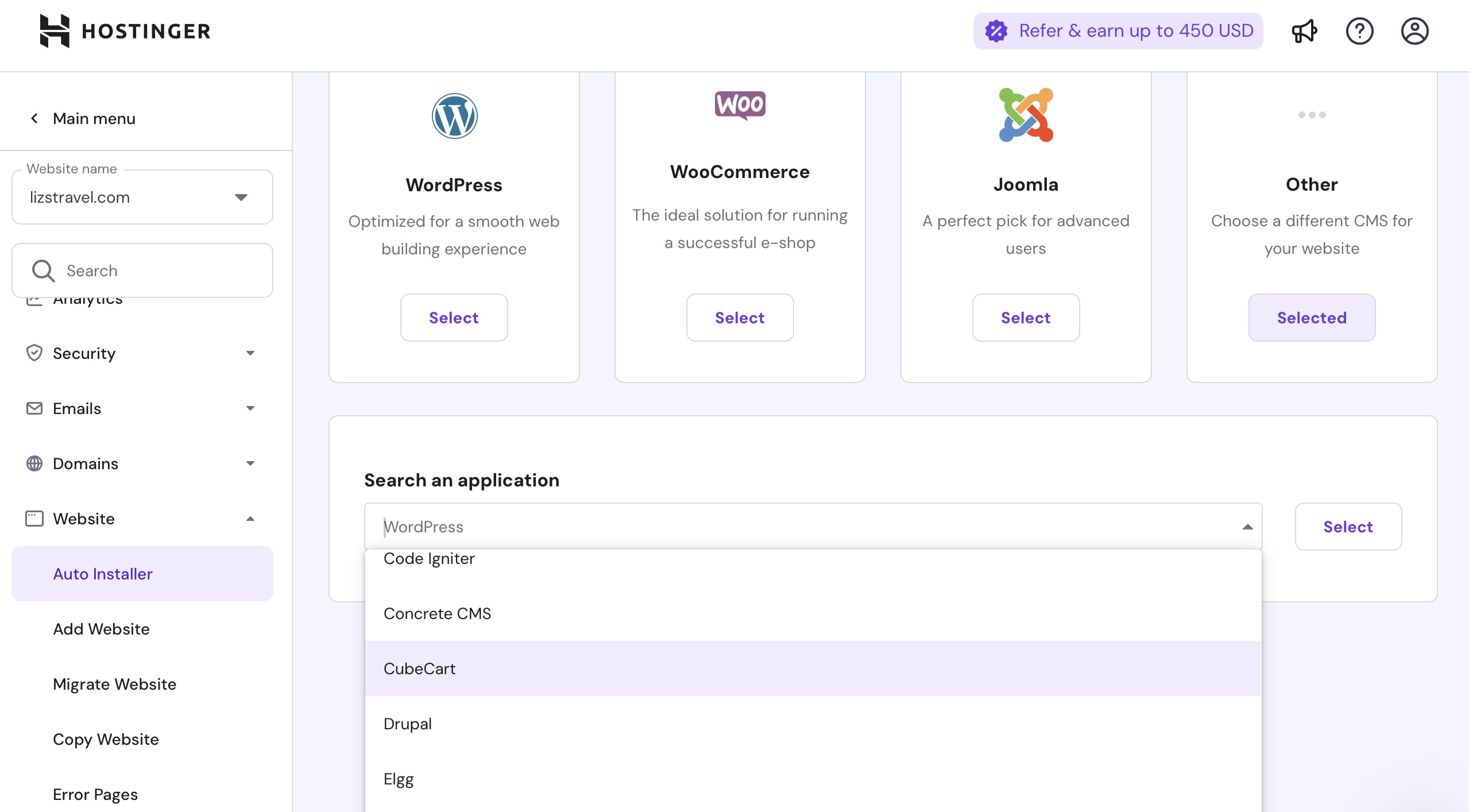
You can install CubeCart manually on a company server or use an auto-installer tool if you are a Hostinger customer.
To get started using the Auto Installer:
Advertisement
Log in to your Hostinger account on the official Hostinger website.
From the left-hand menu, click on Websites.
Next to your account name, click Dashboard.
In the left-hand menu, go to Websites again and select Auto Installer.
Under the “Other” section, click Select.
From the dropdown menu, choose CubeCart.
Click Select.
A pop-up window will appear to configure your CubeCart installation. To keep it separate from your main site, it’s recommended that you install CubeCart in a subdirectory of your website (e.g., `yourdomain.com/store`).
During these next steps, you must assign a Website Title, Administrator Email, Administrator Username, and Administrator Password at the top of the pop-up window.
Next, click Advanced, then:
In the Enter Subdirectory box, type the name you want for your subdirectory (e.g., `ls`, `store`, `cubecart`).
Ensure “Create new database” is selected, and then assign a strong password for this new database.
Advertisement
Final steps
(Image credit: Future)
It’s time to set up CubeCart using the new site’s administrator control panel. This page is tricky to find because of how it’s set up. Many installations include an “admin.php” file for this, but CubeCart does not. For security purposes, it changes the name of this file to something like “admin_xkdlsdf.php.” That’s the location where you’ll find the control panel.
You can go into the FTP section of Hostinger to find the example name of this file.
In my example, I installed CubeCart as a subdirectory for my website called “store.” Therefore, the control panel is located at http://mywebsitename.com/store/admin.xkdlsdf.php.
You can log in from this page using the credentials you created above. On the next page, you can set-up CubeCart to your liking.
Some teachers say the efforts are helping, at least a little… To engage students, teachers say they often feel the need to deliver teaching not only in shorter bursts, but also in more entertaining ways. “The new word is ‘edutainment,’” said Curtis Finch, superintendent of Deer Valley Unified School District in Arizona. “How can you make your lesson applicable, interactive? Teachers are going to have to be more engaging for students….”
In a kindergarten classroom at McKinley STEAM [a K-8 public school], students start the day with a meditation. The classroom of two dozen children is perhaps its quietest during this short activity every morning. Imagine you’re in the Arctic, a voice from a meditation video tells them, with snowflakes melting on your skin. Silently, the children lay down on the carpet and close their eyes for a moment. After the meditation, the students gather in a circle and do a few deep breathing exercises before taking turns proclaiming what they are capable of each day. “I can be a good student,” one little boy said before the child next to him replied: “I can listen to the teacher.” The goal is that these mantras will stay with the children hours later, when they have to sit through the more tedious lessons of the day. An instructional coach at McKinley STEAM says the strategies are working students aren’t reaching for their phones during class and sometimes actually get drawn into lessons.
The article also explains why some teachers find this necessary:
Advertisement
In recent years, educators say, it has grown more challenging to get students to pay attention. Eighty-eight percent of respondents in an international survey from 2025 of more than 3,000 teachers believed their students’ attention spans were getting shorter. In a study published last year about kindergarten through second-grade classrooms in the United States, 75 percent of teachers said attention spans had dropped since the coronavirus pandemic, when the use of laptops and other technology for schooling spread rapidly. A growing body of research says that excessive screen time and short-form content such as TikTok videos are part of the problem. At least 36 states, including Ohio, have laws requiring schools to have some form of a cellphone ban.
There is debate over whether screen time reduces people’s ability to focus or their desire to — many developmental experts lean toward the latter, suggesting that it is possible to help students regain longer attention spans.

















































You must be logged in to post a comment Login