
Tech
The Painful Truth of Exactly How ICE’s New Shock Gloves Work


With the revelation that ICE will spend up to $20 million by March on gloves that can deliver painful electric shocks to subdue an individual, according to a notice published earlier this week by the Department of Homeland Security, it’s worth looking at how this apparel, designated as a nonlethal tool for law enforcement, actually works.
These shock gloves go by the unsubtle acronym of GLOVE (Generated Low Output Voltage Emitter) and are manufactured by Compliant Technologies, based in Lexington, Kentucky. The GLOVE, previously used in jails and police departments in the US, looks and functions like a normal pair of patrol gloves until officers press a switch to activate an electrical mode.
Classified as a CD3 (conductive distraction and de-escalation device), the gloves don’t work like stun guns or Tasers, which shoot out probes or use high voltages to cause neuromuscular incapacitation that overrides the central nervous system. Instead, the GLOVE works using neuro-peripheral interference, essentially shocking the skin to bombard the sensory nerves and temporarily short-circuit the brain’s focus.
Compliant Technologies did not respond to WIRED’s request for comment.
When activated via a one-second press on a wrist switch, conductive pads embedded on the palm and undersides of the fingers of the gloves can transmit high-frequency electrical pulses directly to the wearer’s point of contact on a subject. A rechargeable battery and microprocessor module tucked inside a zippered pouch on the cuff powers the entire system.
The electrical pulse overstimulates nerve endings in the subject’s peripheral nervous system, resulting in pain that inhibits coordinated muscle movement, but without causing systemic muscle lockup. The pain induced is localized to just the area touched by the glove’s conductive pads. The manufacturer claims the gloves result in a subject’s compliance in less than three seconds and leave no burns, marks, or scars.
Because the current flows only between the contact pads on the device and across the subject’s skin, the officer wearing the GLOVE, as well as any assisting officers holding the subject, should not feel electrical shocks. The gloves, capable of operating between 14 and 122 degrees Fahrenheit, come in three versions: Gen 3, 4, and 5. Maximum voltage is capped at 380 V for all, and the minimum voltage for Gen 3 and 4 is 210 V, which rises to 324 V for Gen 5.
Maximum stimulation time on Gen 3 and 4 models is a sobering two hours, though that drops to 90 minutes for Gen 5. The battery is apparently good for 2,000 charge/discharge cycles, and it can recharge to full in two hours. Four LED lights on the gloves display the current charge level, each noting 25 percent battery increments.
Gen 4 and 5 of GLOVE both include mechanisms that record “activation events,” tracking the date, hour, minute, and skin-contact time for audit trails and after-action reporting. Gen 4 stores this data on a removable microSD card, while Gen 5 does away with this in favor of built-in internal memory, accessed via a USB-C cable.
There’s a test function on the gloves, too, where operators can verify they are working by tapping an active pad against their own forearm to feel a minor electrical pulse. According to the manuals, GLOVE users must be certified and then recertified every other year to continue using the device.
GLOVE, which can only be sold to verified professional entities such as the military, correctional facilities, and law enforcement agencies—has some clear usage recommendations in Compliant Technologies’ instruction manuals:
- No more than two GLOVE units (or, in other words, one pair) should be used simultaneously on a single subject.
- Continuous shocks should not exceed 15 seconds.
- Operators must target arms and legs, while strictly avoiding the head, face, throat, chest, and groin.
- The gloves should not be used on the elderly, young children, pregnant individuals, or people with severe disabilities.
- The technology must not be used to counter verbal defiance, as punishment, or for torture.



South Korea’s hills once stood where steel skeletons now climb toward the sky. On a July morning last month, a small group of visitors stepped onto ground that crews had flattened from mountains. What rose around them was the first section of what SK Hynix calls the largest memory factory complex on Earth. Walls already reached halfway up a structure planned to match a 50-story apartment tower. Six cleanrooms will stack inside that single building, connected floor to floor. Production is set to begin in February.
The Yongin Cluster is where corporate representatives gave reporters a behind-the-scenes tour of the unfinished floors while presenting a somewhat ambitious $720 billion plan to increase overall capacity by 2034. Four factories will eventually occupy a large location of approximately 45 million square feet, which is roughly comparable to 600 soccer fields. The fundamental reason for the vertical form is more than just esthetics; roughly 70% of the country is mountainous, making it unfeasible to spread out like some chip facilities in the Arizona desert.
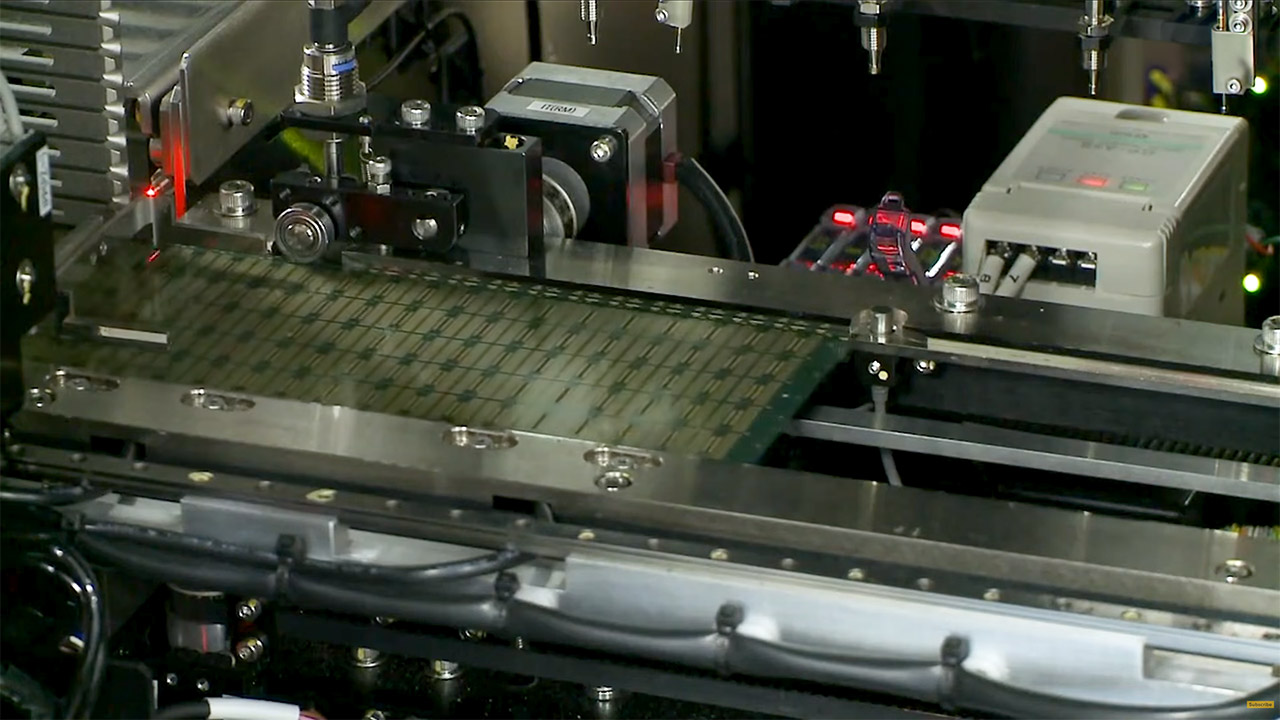
Myeong-jae Park, SK Hynix’s Head of HBM Design, conducted this tour and pointed out the steel and concrete taking shape, recounting the story of how the company placed an early bet on high-bandwidth memory about 7 years before AI processors came up and there was a race for it. They introduced the first commercial version of the technology in 2013, despite the fact that relatively few devices required this stacked design at the time, but they had a strong belief, which propelled the project forward. Fast forward to today, and such stacks now feed the processors that power the large AI models.

Two hours south of Seoul, they rolled out the red carpet for media to have a closer look at a site where work had already been completed. The M15X fab in Cheongju is a 33-floor building that opened in 2025. Visitors must first use an air shower to remove all outside dust before donning a full cleanroom suit. Once inside, the space is like to entering into a chamber the size of 13 football fields. Woo-jin Choi, head of packaging and testing, showed them the ropes as they strolled by these overhead hoist systems that shuttle wafer carriers thru the air; in this one building alone, there are 700 of these machines in use, with each costing up to $70,000. They can transport 25 wafers at once, and the company claims this is the world’s longest cleanroom track, at least in relation to the adjacent Icheon complex.

Choi came to a station where the layers of DRAM are all linked together to form finished high-bandwidth memory, and the process of producing the latest HBM4 takes four months and more than a thousand distinct processes. Now one of those procedures, called bulk reflow mold under fill, is truly unique to SK Hynix. Multiple dies are connected simultaneously under low pressure, and a protective liquid fills the spaces between the layers. Result? A stack that’s around 40 percent thinner than what they used to do it and better at managing heat, and you do that by squeezing in 380 billion tranistors into a single module. The same plant is already running HBM3E alongside the newer generation, and the next chip on the horizon is HBM5, which has been designed with specific clients in mind. Now, NVIDIA and Google have each requested customized versions that match their own processors. This shift is what is causing memory to become less interchangeable and generic than it was previously.

At SK Group headquarters in Seoul the following day, Chairman Chey Tae-won held up a finished HBM4 chip and a wafer that carried a handwritten note from Nvidia’s Jensen Huang: “Please make more.” Chey described the current demand in simple terms. “It’s like a war. Everybody wants the memory chips. Without that, they cannot produce their AI computing and AI chips.”


Donald Trump is allowing government agencies to contract private cybersecurity companies to carry out operations against cyber-enabled transnational criminal organizations (CE-TCOs).
The US President signed a memo on Wednesday confirming a strategy hinted at earlier this year, saying participating companies can support national operations against criminals, including cyber surveillance and technical disruptions of their networks.
The latter, described as “Cyber Effects Operations,” covers activities that cause “the manipulation, disruption, denial, degradation, or destruction of information systems, networks, physical or virtual infrastructure controlled by information systems, or information resident thereon.”
Although the memo establishes a distinction between cyber effects operations and cyber surveillance missions, it acknowledged that the latter will also inevitably involve some disruption or manipulation of systems in order to carry out the surveillance.
Surveillance operations are designed for intel gathering, either to support further snooping or for later use in cyber effects operations, with the intent of remaining undetected.
Trump described CE-TCOs as “any foreign group that conducts cyber-enabled crime against the United States Government, a United States person, or United States interests.”
Crucially, the definition excludes entities directly associated with, or operating wholly on behalf of, foreign governments. No stepping on TAO’s toes, of course.
Participating companies will undergo “rigorous vetting” and will be subject to “strict operational procedures,” the memo adds.
The operational procedures are to be drawn up within 60 days and codified by program executive directors working with the Homeland Security Council.
Companies wishing to be called up for service will have to demonstrate that they have the technical capabilities to carry out the required operations, and be willing to prove this each year via annual evaluations.
Program managers must ensure that the operational procedures open opportunities for highly resourced, large organizations, as well as “smaller, more agile companies” that may prove useful for “specialized or discrete tasks.”
The Justice Department will also play a role in authorizing operations, particularly those targeting US residents or raising domestic legal issues.
Participating companies will also be prohibited from executing operations that could lead to “critical outcomes,” which is shorthand for attacks that result in the loss of life or serious injury, or those that could be seen as an armed attack under international law.
These companies will also be required to maintain a bond or escrow of at least $1 million, which shall be forfeited if they violate the terms of their contracts.
Unleashing Trump’s cyber army
The White House published “President Trump’s Cyber Strategy for America” document in March, which promised to “unleash the private sector by creating incentives to identify and disrupt adversary networks and scale our national capabilities.”
The document [PDF] also stated: “We will leverage the immense talents and ingenuity of our private sector research base.
“We will establish a new level of relationship between the public and private sectors to defend America in peace and war.”
The announcement prompted legal eagles and think tanks to ponder the implications of such a move.
Many wondered how the promise to mobilize the private sector would be put into practice. They did not then have the details contained in this week’s memo, and some assumed participating companies would support operations against nation-states. This particular program, however, excludes entities acting directly on behalf of foreign governments.
Writing for the Royal United Services Institute (RUSI) and citing reporting available at the time, cyber and tech research fellow Gareth Mott said that the US Computer Fraud and Abuse Act (CFAA) might need to be amended before American companies could legally offer such services.
Experts from law firm Skadden, Arps, Slate, Meagher & Flom agreed, despite the US Cyber Strategy not mentioning any plans for legislative changes.
They wrote: “Any attempt to more directly involve the private sector in offensive cyber actions will likely require further legal and regulatory changes before it can be meaningfully implemented.
“Even if the administration were to issue new enforcement guidance redirecting prosecutions away from hack-back cases, the availability of civil penalties under the CFAA and its five-year statute of limitations would likely render such executive actions significantly less impactful.
“Technology companies should consider closely monitoring developments to track how the administration plans to enact such incentives.”
However, Jenner & Block lawyers noted in an analysis published by Lawfare that a provision of the CFAA could limit participating companies’ exposure.
Title 18 of the US Code, § 1030(f), says the CFAA does not prohibit lawfully authorized investigative, protective, or intelligence activity by a US government agency or intelligence agency.
Participating companies might therefore be protected when acting under government contracts and direction. However, no court has determined whether that exemption covers private companies carrying out such work.
“No court has addressed whether this exception provides any protection for private-sector entities engaged to perform these activities on behalf of the US government and, if so, under what circumstances,” the lawyers wrote.
“At the very least, it is unlikely that a court would interpret this provision to extend to private companies engaged in independent offensive operations, without government direction or involvement.”
The last part is key: because the US government will draw up procedures and direct the companies’ involvement, the work may fall within the CFAA exemption.
Whichever way the US constructs its private sector play, it represents a significant shift in the country’s cybersecurity policy, and perhaps that of other nations further down the line.
As Mott points out, US allies will certainly be keeping tabs on the private sector program’s success, and its take-up from the companies it looks to attract. ®
Tech
Netflix Shuts Down Oxenfree Studio Night School Weeks After Praising Its ‘Really Solid Numbers’


In another reshuffle of its video game division, Netflix is closing the first studio it purchased, Oxenfree team Night School, according to Stephen Totilo at Game File. Netflix acquired Night School Studio in 2021, and there it produced Oxenfree II: Lost Signals, the Black Mirror: Thronglets app, and Unhinged, a smartphone-controlled horror game that landed roughly six weeks ago.
Netflix also reportedly plans to shut down Helsinki studio Moonloot Games, which the company founded in September 2022 to build original mobile titles. Additionally, it’s slashing an undisclosed number of jobs from its in-house games team. This is all in the name of prioritizing kids gaming, party games, narrative experiences and mainstream titles like June’s FIFA World Cup: Launch Edition, a Netflix spokesperson told Game File.
The FIFA World Cup game was developed by a third-party studio, Refactor Games, which laid off 85 percent of its staff in early August. The layoffs followed reports that Refactor’s parent company, Delphi Interactive, pulled funding after the game’s release.
In a real salt-rubbing move, Netflix co-CEO Gregory Peters praised Night School’s game Unhinged and FIFA World Cup during the company’s Q2 2026 earnings call on July 16.
“We’ve been building some solid foundations, and now we’re seeing exciting positive signals that help inform and give us increased conviction in our future growth and the nature of that growth here,” Peters said just a few weeks ago. “So you mentioned the cloud-based strategy, those cloud-based TV games, we really see it working. FIFA and Unhinged became our two most successful cloud game debuts, really solid numbers that put it in the top tier of game performance for us.”
Night School co-founders Sean Krankel and Adam Hines were supremely optimistic about the Netflix acquisition when I talked with them at Summer Game Fest 2023, just prior to the release of Oxenfree II. Netflix decided to establish a video game business in 2021, and according to Krankel, that’s when executives wooed the Night School founders with lines like, “What can we do to unblock your team from making your dreams?”
Netflix officially acquired Night School in September 2021. After the purchase, Night School hired more team members and moved into the Netflix offices. In 2023, Krankel and Hines talked about how cool it was to be able to fly in remote workers as needed, and to make Oxenfree II available in 32 languages on day one. The founders discussed how at ease they felt at Netflix.
“Our big concern was the autonomy aspect,” Hines said at the time. “We’ve all worked at bigger studios before, and have just seen and felt how long it would take to get decisions made, how the creative would kind of get choked out of things because there’s too many cooks in the kitchen. But just talking to Netflix a lot before we joined up, we felt really at ease, just like we were talking the same language about how to make games.”
Netflix rapidly expanded its video game division between 2021 and 2024, purchasing a handful of teams including Cozy Grove creator Spry Fox and mobile developer Boss Fight Entertainment, and staffing an internal AAA studio with veterans from Overwatch, Halo and God of War franchises. Then in 2024, Netflix hired former Epic Games executive Alain Tascan to lead its games business, and everything changed.
With this week’s closure of Night School and Moonloot, Netflix has now shut down or sold all but one of its studios. Spry Fox, at least, was able to purchase itself back from Netflix and is still making ambitious, adorable games. The sole survivors at Netflix are Helsinki-based Next Games, which focuses on couch-based experiences, and Netflix Games Studio, which mostly signs deals with external developers.
That group seems to be going strong, with a slew of streamable party games like Overcooked! All You Can Eat and Jackbox titles hitting Netflix in recent months.
Google is rolling out Gemini 3.7 Flash, a new version of its workhorse AI model that puts coding, agentic workflows and knowledge work at the center of the upgrade — while temporarily cutting API prices in half.
The release arrives just three weeks after the release of Gemini 3.6 Flash, an unusually short turnaround that Google attributes to developer feedback and algorithmic improvements.
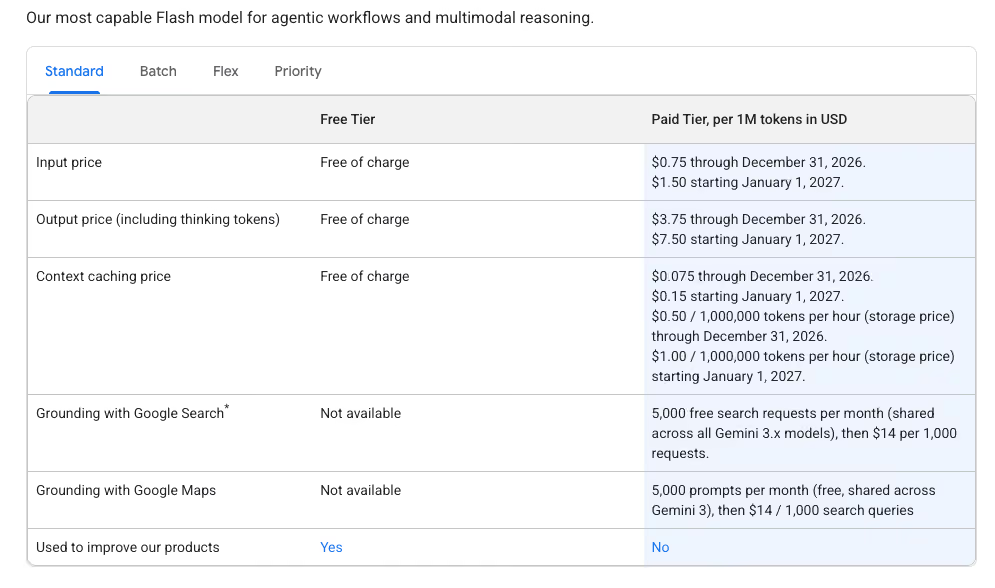
For enterprise developers, the more consequential story may be the combination of those intelligence gains with lower inference costs: through the end of 2026, Gemini 3.7 Flash costs $0.75 per million input tokens and $3.75 per million output tokens.

Starting Jan. 1, 2027, pricing rises to $1.50 per million input tokens and $7.50 per million output tokens. That means the current discount is temporary, but it gives teams deploying high-volume coding and business agents several months to evaluate whether Google’s claimed reductions in retries and manual oversight translate into lower total operating costs.
The launch also underscores Google’s rapid iteration on its Flash line while its next flagship Pro model remains absent. Google did not provide a release date for Gemini 3.5 Pro with Thursday’s announcement, Reuters reported, despite the model having previously been described as undergoing partner testing. Axios similarly noted that 3.7 Flash arrives before the anticipated Pro release.
A three-week upgrade focused on getting work done
Google describes Gemini 3.7 Flash as its “most intelligent workhorse model yet for coding and agents.” The company says the model is better at adapting when it encounters roadblocks, clarifying intent when necessary and following instructions with greater fidelity.
Those improvements matter beyond benchmark scores. In an enterprise coding agent, a model that makes fewer unnecessary changes, recovers from errors and executes multi-step plans more reliably can reduce the number of human interventions needed to complete a task. The same principle applies to business agents operating across documents and applications, where an incorrect tool call or poorly interpreted instruction can derail an otherwise useful workflow.
Google says 3.7 Flash “thinks more diligently,” applying more effort to multi-step planning and tool calls. Its stated goal is more disciplined execution with fewer retries and less manual supervision.
That represents an interesting evolution from Gemini 3.6 Flash. Google’s developer documentation described 3.6 as reducing reasoning steps, conversational turns and tool calls compared with earlier models while attempting to limit execution-loop spiraling. With 3.7, the emphasis shifts toward putting sufficient effort into planning while improving the quality of execution — potentially a more useful optimization than simply minimizing the number of steps an agent takes.
Google DeepMind said in a post accompanying the release that 3.7 Flash shows gains in debugging and issue resolution, generates more functional web layouts and applications with fewer prompts, and improves reasoning and accuracy on real-world business workflows.
Coding gains are substantial, but not universal
Google’s benchmarks show a large generational improvement in several software engineering tests.
On FrontierCode 1.1 Main, which measures production code quality, Gemini 3.7 Flash scores 43.6%, up from 34.4% for Gemini 3.6 Flash. That also narrowly exceeds the 42.7% Google reports for Claude Sonnet 5 and 41.3% for GPT-5.6 Terra.
On DeepSWE v1.1, a long-horizon software engineering evaluation, 3.7 Flash reaches 65.3%, compared with 49.0% for its predecessor. GPT-5.6 Terra remains ahead at 69.6% in Google’s table.
Web development shows another notable gain. Gemini 3.7 Flash receives an Elo score of 1588 on Code Arena, versus 1538 for 3.6 Flash, 1541 for Claude Sonnet 5 and 1523 for GPT-5.6 Terra. Google says the new model can produce more functional layouts and feature-complete applications in fewer prompts while more closely following reference screenshots, images and design systems.
The broader benchmark table is more mixed, which is important for enterprises evaluating the model against particular workloads rather than looking for a single “best” model.
Gemini 3.7 Flash scores 85.8% on Terminal-bench 2.1, compared with 87.4% for GPT-5.6 Terra. Terra also leads Google’s comparisons on Terminal-bench 3.0 and OSWorld-2.0. Claude Sonnet 5 leads the Agent’s Last Exam multimodal desktop and operating-system tasks with a 33.3% pass rate, versus 26.3% for Gemini 3.7 Flash.
In other words, Google’s own results do not show 3.7 Flash universally displacing higher-priced competitors. They instead suggest a model that has become substantially more competitive in coding and agent workloads while occupying a lower price tier.
Enterprise workflows may be the more important test
The gains extend beyond software development.

On AutomationBench, which Google describes as measuring enterprise workflow automation, Gemini 3.7 Flash scores 30.4%, up sharply from 17.0% for 3.6 Flash. Google’s table lists Claude Sonnet 5 at 10.7% and GPT-5.6 Terra at 23.6%.
The model also reaches 34.0% on GDP.PDF, an evaluation of complex PDF comprehension, compared with 22.0% for 3.6 Flash, 28.0% for Claude Sonnet 5 and 24.7% for GPT-5.6 Terra.
That combination is relevant for enterprise agents because many practical deployments require more than generating text or code. An agent may need to interpret a long report, identify relevant information, decide which tool to invoke, update another system and produce a document for a human reviewer. Reliability across that chain can matter more than performance on an isolated reasoning benchmark.
Google is putting that thesis into practice with Gemini Spark. Google AI Pro and Ultra subscribers can use 3.7 Flash in Spark, the company’s personal AI agent. Google says the upgrade improves Spark’s knowledge work and tool use across Google Workspace applications, including workflows that consolidate files, draft emails and update status documents.
For enterprises, 3.7 Flash is also available through the Gemini Enterprise Agent Platform and Gemini Enterprise app.
Price becomes part of the model competition
Gemini 3.7 Flash’s introductory pricing is a notable bid to embed the model into enterprise workflows.
Until Dec. 31, developers pay $0.75 per million input tokens and $3.75 per million output tokens. Context caching costs $0.075 per million tokens during the introductory period. Google says standard prices will double on Jan. 1, 2027, to $1.50 for input and $7.50 for output, with context caching rising to $0.15.
For comparison, Gemini 3.6 Flash’s standard API pricing is $1.50 per million input tokens and $7.50 per million output tokens. Google’s benchmark table lists Claude Sonnet 5 at $2 and $10, respectively, while GPT-5.6 Terra is listed at $2 and $12.
The economics become more pronounced for autonomous agents because a single user request can produce a long sequence of model calls, reasoning tokens and tool interactions. A model that costs less per token but requires substantially more retries may not ultimately be cheaper.
Conversely, Google’s combination of lower introductory token pricing and claimed improvements in first-pass accuracy could materially change the cost of running high-volume coding or document-processing agents if those gains carry over to production.
That is the metric enterprise teams will ultimately need to test: not price per million tokens in isolation, but cost per successfully completed task.
Google’s AI shake-up raises the stakes for Gemini
Gemini 3.7 Flash arrives amid a broader debate over whether Google is losing ground at the AI frontier. The company has not released Gemini 3.5 Pro, despite saying in May that the flagship model would arrive the following month.
By July, Google said it remained in partner testing and would become broadly available when ready; Thursday’s announcement offered no further timetable. Google’s latest released general-purpose Pro model therefore remains Gemini 3.1 Pro, introduced in February.
Reuters reported in July that Gemini 3.5 Pro missed its original target after falling short of internal goals, particularly in coding, even as Google began training what it calls its most ambitious model yet, Gemini 4.
The delay coincides with a major overhaul of Google’s AI leadership announced last week.
Google DeepMind co-founder and Nobel Prize Winner Demis Hassabis has relinquished day-to-day control of the company’s famed DeepMind AI division to become its chair and, simultaneously, to take on the role of Alphabet’s chief scientist.
Meanwhile, former DeepMind CTO Koray Kavukcuoglu now runs the unit as a senior vice president reporting directly to CEO Sundar Pichai.
Kavukcuoglu controls Gemini model development, frontier research, the Gemini app and developer teams—effectively consolidating the full Gemini chain under a more product-focused operator.
Chief scientist Jeff Dean, Gemini co-lead Oriol Vinyals, Quoc Le and Sanjay Ghemawat left to establish the research startup Discovery Loop.
Those exits followed Gemini co-lead Noam Shazeer’s move to OpenAI and Nobel Prize-winning AlphaFold scientist John Jumper’s departure for Anthropic. Reuters reported that internal disagreements, constrained compute allocation and Google’s bureaucracy contributed to slower releases and weaknesses in coding.
Outside interpretations range from organizational repair to a more fundamental retreat.
SemiAnalysis has argued that Google is increasingly prioritizing the highly profitable business of supplying cloud infrastructure to AI companies—including Gemini competitors—over keeping its own models at the absolute frontier. That analysis also claimed Google had effectively canceled 3.5 Pro, although Google has not confirmed that and continues to describe the model as delayed.
The Verge offered a more measured assessment: the departures and model delays are serious, but Google retains enormous advantages through Search, Workspace, Android, Cloud, custom AI chips and consumer distribution. Google says the Gemini app has surpassed 950 million monthly users, giving it a reach that does not depend entirely on owning the highest-scoring model.
Current benchmarks similarly depict a company behind the overall leaders but still firmly competitive. Artificial Analysis places Claude Opus 5 at 63 on its overall model Intelligence Index, while Google reports a score of 56 for Gemini 3.7 Flash—an improvement from 52 for 3.6 Flash but not a return to the top.
Arena’s early human-preference results are more favorable, provisionally ranking 3.7 Flash ninth overall and eighth for web development.
The resulting picture is not that Google has abandoned advanced AI, but that it has become stronger at rapidly shipping efficient Flash models while struggling to deliver the premium flagship required to reclaim broad leadership. Gemini 4 will now serve as the clearest test of whether the leadership reorganization fixes that execution gap.
Available now across Google’s developer stack
Developers can access Gemini 3.7 Flash through the Gemini API in Google AI Studio and Android Studio, as well as Google’s Antigravity environment. Enterprises can deploy it through Gemini Enterprise Agent Platform and Gemini Enterprise, while consumers with Google AI Pro or Ultra subscriptions can access the model through Spark in supported countries.
Google is also shipping updated safeguards covering chemical, biological, radiological and nuclear risks and cyber-offense misuse, according to the company.
The unusually fast jump from Gemini 3.6 Flash to 3.7 Flash points toward a model development cycle in which algorithmic improvements can reach production products without waiting for a new flagship generation. Ars Technica also highlighted the three-week interval between the two releases, while Google says the techniques behind the update will inform future models.
For developers, that faster cadence creates its own operational question. Models can improve quickly, but production teams still have to benchmark new releases against their own repositories, prompts, tool schemas and failure modes before changing a deployment.
Gemini 3.7 Flash gives those teams a particularly strong incentive to run that evaluation. Google’s own numbers show major improvements in production coding, web development, document comprehension and workflow automation without claiming leadership everywhere. At its introductory price, Google is effectively betting that developers will value a model that is competitive enough with more expensive systems while being cheap enough to run repeatedly inside agents.
Whether that advantage survives the return to full pricing in January will depend less on leaderboard positions than on how reliably 3.7 Flash completes real work.
Databricks has closed a $5bn round at a $190bn valuation, led by Coatue, with revenue run-rate past $7bn and growth above 80% year on year. That is a 42% valuation increase in six months, and it comes after chief executive Ali Ghodsi called 2026 a bad year to go public.
Databricks has closed $5bn at a $190bn valuation. Coatue led, joined by Blackstone, MGX, T. Rowe Price and new investor Sixth Street Growth. It is the company’s second round this year.
The growth is the part worth pausing on. Revenue run-rate has passed $7bn, up more than 80% year on year in the second quarter, against 65% growth at a $5.4bn run-rate back in February. Companies of this size do not usually accelerate.
The valuation has moved with it, up 42% from $134bn in February. TNW reported the round at $188bn last month, and it has closed $2bn above that.
Databricks also disclosed figures that rarely accompany a private raise. It says it has been adjusted free cash flow positive over the last twelve months, its data warehousing business is past a $1.5bn run-rate and growing over 100%, and its Lakebase database has passed $100mn.
The customer concentration is heavy at the top. More than 1,000 accounts now spend at a $1mn run-rate, and more than 100 at $10mn.
Set against the public market, the price is less extravagant than it sounds. At $190bn on a $7bn run-rate, Databricks is valued at roughly 27 times revenue, while Snowflake trades near 23 times on $5.03bn of trailing revenue.
The growth rates are nothing like each other. Snowflake grew around 30% last year, Databricks says more than 80%, so a four-point multiple premium is a modest reward for nearly three times the pace.
Read those numbers with care, because they are not the same measure. Run-rate annualises current revenue and flatters anything growing quickly, while Snowflake’s multiple rests on twelve trailing months.
Why this is private money rather than a listing is already on the record. Ghodsi has called 2026 a terrible year to go public, with SpaceX, OpenAI and Anthropic lined up to absorb roughly $200bn of listing capital.
So the company raises at public scale and stays private. The money goes to three products aimed at enterprise AI agents, and Ghodsi’s pitch is that buyers want agents that hold context, stay accurate and respect a budget, rather than another chatbot.

Evergreen Candy Crush is one of the most successful and enduring mobile game franchises ever created. Launched by Swedish video game developer and publisher King in 2012, the original Candy Crush Saga quickly climbed the popularity charts on both Android and iOS. Nearly a decade and a half after its launch, it still boasts millions of users and generates billions of dollars in revenue.
In FY 2025, Candy Crush Saga reportedly generated $876.5 million in revenue, with most of it coming from in-app purchases. While that sounds impressive, it marks a slight dip from the previous six years, when the game generated more than $1 billion in annual revenue.
Candy Crush Saga follows a freemium model, meaning it’s free to play, but players can purchase extra lives, boosters, and special passes to make it easier to progress through its more than 23,000 levels.
While King hasn’t disclosed detailed revenue and profit figures in recent years, it reported surpassing $20 billion in revenue in 2023. That same year, the company also claimed to have reached 5 billion installs across all Candy Crush titles, including the original Candy Crush Saga and its spinoffs Soda Saga, Jelly Saga, and Friends Saga.

Research by David Curry, data editor at app analytics platform Business of Apps, suggests that the original game currently has around 81.5 million monthly active users and was installed more than 190 million times across Android and iOS in 2025.
In its 2014 IPO filing, King claimed that Candy Crush Saga had 93 million daily active users worldwide in December 2013. If Curry’s estimates are accurate, this would suggest that the game has not experienced a massive decline in its user base over the past 12 years.
Candy Crush’s enduring popularity remains something of a mystery among the mobile gaming community. However, some believe its success can partly be attributed to its “turn-based” gameplay, which allows players to put the game down at any time and pick it up where they left off without penalty.
Paula Ingvar, general manager of Candy Crush Saga, attributes the game’s success to giving players “the satisfaction of making progress with small wins” in 10- to 20-minute sessions, rather than forcing them to finish a level in one sitting.
David Nieborg, a professor of media and platform studies at the University of Toronto and a video game researcher, believes the game’s popularity also has a lot to do with the fact that it is “non-place-based, nongendered, nonracialized,” helping it appeal to players across geographical, linguistic, cultural, and socioeconomic boundaries.

Heart Aerospace’s X1, billed as the world’s largest battery-electric aircraft, completed a 27-minute maiden flight in New York using more than 1 MW of power and only about $5 worth of electricity. The 106-foot-wingspan demonstrator is a precursor to the company’s 30-seat hybrid-electric ES-30 regional airliner, targeted for service in 2031. Interesting Engineering reports: Developed by Heart Aerospace, the X1 demonstrator lifted off from Plattsburgh International Airport in New York on Wednesday, August 12. The piloted aircraft remained in the skies for about 27 minutes and made it to a 1,100-foot altitude above ground level (AGL). According to the Swedish aerospace company, the aircraft has a wingspan of 106 feet (32 meters). It’s additionally 76 feet (23 meters) long and has a takeoff weight exceeding 25,000 lbs (11,340 kilograms). “With the first flight of X1, Heart Aerospace has demonstrated electric flight at the scale of a commercial airliner,” said Anders Forslund, Heart Aerospace founder and CEO. “Electric commercial aircraft have the potential to fundamentally reshape airline economics and, ultimately, lower the cost ofÂair travelÂfor passengers.”
“This is at the heart of our vision for abundant air travel, with electrification enabling more affordable, frequent, and cleaner air service to and from airports closer to home.”
You can watch the first flight on YouTube.


Read more of this story at Slashdot.

Apple is expanding its U.S. manufacturing footprint with a new Houston center designed to help bolster American manufacturing with education and resources.
On Thursday, Apple opened its 20,000-square-foot Advanced Manufacturing Center (AMC) in Houston, Texas. The center is offering free training for small and medium-sized businesses.
The AMC is housed in the same facility that produces Apple’s AI servers. The site is also set to begin Mac mini production in late 2026.
Apple has invested hundreds of millions of dollars into the project, bringing it to fruition in less than nine months.
“We believe in American workers and American ingenuity, and we are moving at an incredible pace because we want to build more than great products. We want to build the future of American manufacturing,” said Cook.
As part of the kickoff event, Apple hosted U.S. Secretary of Commerce Howard Lutnick, U.S. Senator Ted Cruz, Houston Mayor John Whitmire, U.S. Representative Christian Menefee, and Harris County Precinct One Commissioner Rodney Ellis, along with other officials and community partners.
“Houston is grateful to Apple for this significant investment in our city. The Advanced Manufacturing Center will create local jobs and will continue improving the quality of life of Houston residents,” Houston Mayor John Whitmire said of the opening.
“The AMC also recognizes our city as a growing technology hub and solidifies Houston’s leadership in the manufacturing sector of the United States.”

The AMC’s holographic table – Image Credit: Apple
To mark the opening, the business leaders will spend the day immersed in hands-on training. Apple engineers will cover techniques like machine-learning-driven quality control and advanced automation.
Participants will learn how to identify and adapt to production challenges. They will also engage with the lab’s holographic table and advanced factory-floor equipment.
“I am proud that Apple chose Harris County for this investment. My office has consistently fought to bring good jobs within reach of working people and ensure small businesses — especially those historically shut out — have a fair opportunity to compete and grow,” said Harris County Precinct One Commissioner Rodney Ellis.
“At a time when rising costs are squeezing families here and across the country, this new center can help create pathways to greater economic security.”
The site is Apple’s second-largest manufacturing site in the U.S. The first is Apple’s Manufacturing Academy in Detroit.
Since announcing the $600 billion commitment in 2025, Apple and its American Manufacturing Partners have invested reshoring a portion its manufacturing. This includes custom silicon, cover glass, and advanced components.
Tech
Spotify Will Label AI Artists and Stop Recommending Them. So Why Is It Letting Fans Remix Real Music With AI?

Spotify would like listeners to know that fake AI artists are a problem.
Unless, apparently, the AI is being used in a licensed product that lets paying subscribers alter music created by actual human beings.
Spotify has announced that it will begin labeling some artist profiles with an AI Persona badge when the public identity presented by that artist does not represent a real person. Beginning in mid-September, those badges will appear on artist profiles, in search results, playlists and individual track listings. More importantly, Spotify says music from AI Personas will not be included by default in editorial or algorithmic recommendations unless listeners have deliberately followed or engaged with them.
That is a meaningful change. It is also the latest turn in Spotify’s increasingly complicated relationship with artificial intelligence.
Related Reading:

Does Spotify Like AI Music or Not?
The answer appears to be: it depends.
Spotify has never broadly banned music merely because AI was involved in creating it. In September 2025, the company explicitly said that it supports artists using AI creatively and that licensed music would be treated equally regardless of the tools used to make it. At the same time, Spotify tightened its rules against unauthorized voice cloning, fraudulent uploads and industrial-scale music spam.
That distinction made some sense.
Using AI during production is not automatically the same thing as generating 5,000 anonymous tracks, impersonating Drake or creating a photorealistic singer who never existed and hoping listeners don’t notice.
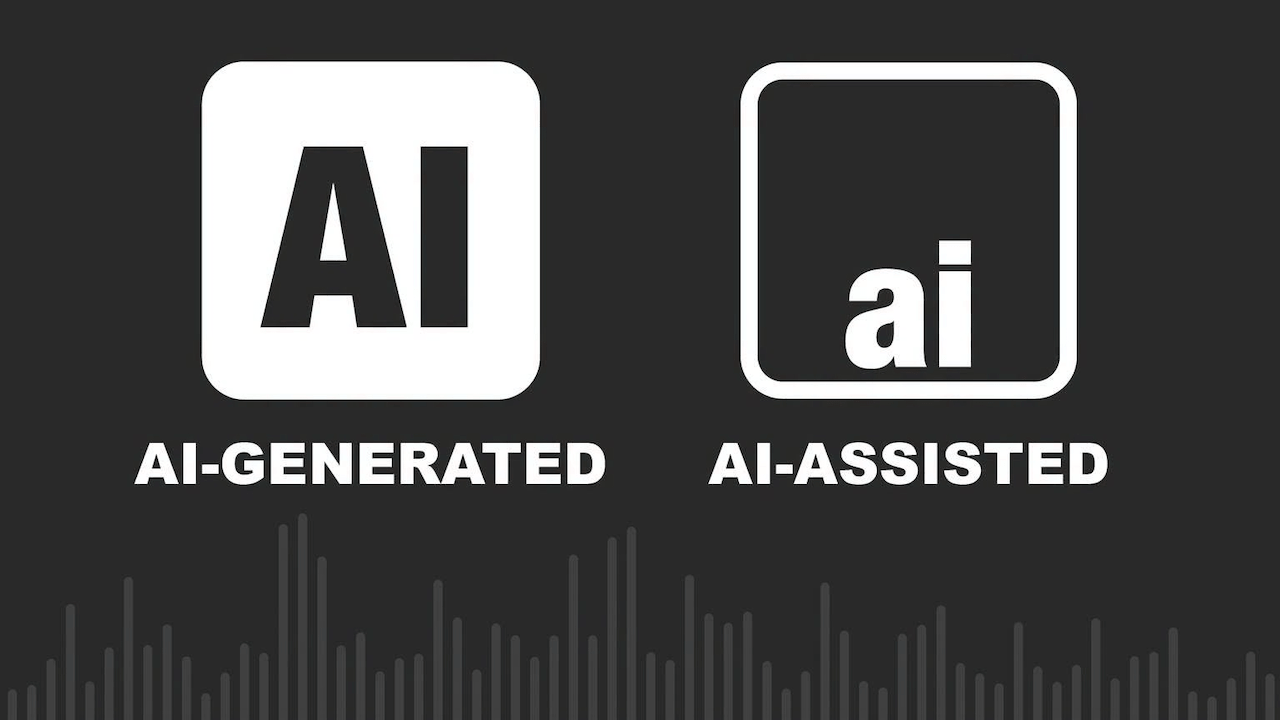
Spotify subsequently introduced AI credits that allow artists and distributors to disclose how AI was used in areas including vocals, lyrics and production. As we reported in July, that industry-wide push toward AI Generated and AI Assisted labeling is ultimately about giving listeners some idea of what they are actually hearing.
Then things became considerably more interesting.
Spotify Decided AI Could Also Be a Business
In May, Spotify and Universal Music Group announced a forthcoming generative AI tool that will allow Premium subscribers to create licensed covers and remixes of music from participating artists and songwriters.
It will be sold as a paid add-on.
Universal signed on first, and Merlin followed on August 4, bringing a large collection of independent labels into the program. Spotify says participating artists will have control over whether their music is included and will receive credit and compensation when fans create new versions.
We recently examined that deal and asked the uncomfortable question: if Spotify is worried about AI undermining musicians, why is it preparing to sell consumers tools that let them modify commercially released music in the first place?
The answer increasingly looks like consent and money.
Unauthorized AI impersonation? Bad.
Mass-generated AI sludge designed to siphon royalties? Bad.
A fictional AI artist pretending to be a real person and being pushed into your Discover Weekly playlist? Apparently bad now as well.
AI used under agreements negotiated with Universal, Merlin and other rights holders, with Spotify charging subscribers for the privilege? Welcome aboard.
That does not necessarily make Spotify hypocritical. There is a legitimate distinction between licensed AI tools used with permission and deceptive AI content designed to fool listeners or manipulate the royalty system.
But from the listener’s side, the rules are becoming awfully complicated.

What Is an AI Persona?
Spotify’s new badge is specifically about identity, not whether the music itself was AI generated.
That distinction matters.
An artist can use AI extensively in making a recording without necessarily receiving an AI Persona badge. Conversely, an artist profile portraying a photorealistic fictional human could receive the badge regardless of precisely how the music was created. Spotify says it will initially review profiles that have reached certain audience thresholds rather than relying entirely on voluntary disclosure. Artists can appeal the designation, and Spotify plans to eventually let listeners report suspected AI Personas.
That is considerably more useful than hiding an AI disclosure six menus deep inside the credits. And keeping AI Personas out of recommendations by default may be the most important part of the entire policy.
Spotify’s recommendation engine does not merely help listeners find music; it determines which artists receive enormous amounts of exposure. Removing synthetic personalities from that pipeline makes it harder for AI content farms to compete for attention simply by generating more material than humans possibly can.
Why Listeners Should Care
Listeners should not need forensic training to determine whether the singer Spotify just recommended is an actual person.
That is the larger problem with AI music. The debate is usually framed around copyright, royalties and artist compensation, all of which matter enormously. But streaming services also have a basic responsibility to tell subscribers what they are listening to.
TIDAL recently went further by deciding that wholly AI-generated music can remain on its service but will not receive royalty attribution. Qobuz has also taken a more human-centered approach to curation and AI-generated content. Spotify is choosing a different path: allow AI, disclose more of it, suppress deceptive uses and monetize the versions it can license properly.
There is a logic to that strategy. It just happens to be a logic that becomes considerably easier to understand once somebody is getting paid.
The Bottom Line
Spotify’s AI Persona badge is a positive move for listeners. Clearly identifying fictional artists and keeping them out of recommendations by default should make the service less susceptible to the flood of synthetic content that increasingly threatens genuine music discovery.
But Spotify cannot have this conversation entirely on its own terms.
The company is telling listeners that authenticity matters while simultaneously building a business that will let subscribers use generative AI to alter recordings made by real musicians. Those two positions can coexist if consent, transparency and compensation genuinely remain at the center of the system.
If they don’t, Spotify isn’t drawing an ethical line around AI.
It’s drawing a revenue line.
Related Reading:
An anonymous reader quotes a report from the Financial Times: Anthropic investors expect the AI startup to float at a valuation of $2 trillion or more in October, a dizzying figure that would eclipse SpaceX and make the AI lab’s debut the largest-ever initial public offering. Half a dozen of the company’s backers told the FT that Anthropic’s rapidly rising revenue would enable it to more than double its current valuation in a planned autumn float. A listing at that level could unlock billions of dollars in gains for the five-year-old company’s early investors but would also test public markets that are growing more nervous about the AI boom.
Anthropic’s backers say booming demand for the lab’s advanced AI models and tools justifies their lofty expectations. Investors expect the Claude maker’s annualized revenue to be between $100 billion and $120 billion by the end of 2026 — using the startup’s preferred measure, which infers full-year sales from recent performance — up by more than 10 times over the course of 2026. “If Anthropic is growing 800 percent a year, you’d think at the incredibly low end they would trade at 30 times [revenue],” said one investor in the group. “That would make them a $3 trillion company.” According to Bloomberg (paywalled), Anthropic is currently in talks to acquire Decart AI for roughly $6 billion.
“Decart develops world models alongside software designed to lower AI training expenses by improving how efficiently chips are utilized,” reports Quartz. “That capability could allow Anthropic to get more out of its current infrastructure as demand grows. If the deal closes, Decart’s team would join Anthropic’s inference and performance organization.”
Read more of this story at Slashdot.

SharpLink Plans $200 Million ETH Allocation to Lido’s wstETH

Blue Door’s chance to outshine rivals in 2026 Rosebud

Clacton by-election result live: Reform chief Nigel Farage awaits fate in bin fight as voting closes


![LISA - 'MONEY' Dance Practice [Mirrored]](https://wordupnews.com/wp-content/uploads/2026/02/1770259125_maxresdefault-80x80.jpg)


-

 Fashion6 days ago
Weekend Open Thread: Mattifying Sunscreen
-

 Fashion6 days ago
Frugal Friday’s Workwear Report: Cap-Sleeve Pointelle Crewneck Sweater
-

 News Videos6 days ago
Can Astrology Help Find Gold and Silver Trends? A Financial Astrology Guide
-

 Tech6 days ago
Rinn Pharma & Biopharma to join NordicPharmaTrain network
-

 Business5 days ago
How to Start a Cleaning Business: A Step-by-Step Guide
-

 Business4 days ago
Datadog: Best Of Breed For Multiple Reasons
-

 Business5 days ago
BDC Weekly Review: Private BDC Q2 Numbers Are Strong
-
 NewsBeat2 days ago
Communication cards help banking customers access services or report scams
-

 Tech7 days ago
Price Hikes May Be Coming for PC Motherboards Next
-

 Business7 days ago
Brightwater secures funding for WA-first dementia projects
-
 Business3 days ago
Oil Price Today (August 11): Crude oil rises to $88 after Trump’s compensation demand dents Hormuz opening. Here’s why
-

 Fashion6 days ago
Weekly News Update, 8.6.26 – Corporette.com
-

 Business7 days ago
Aussie shares lose steam to close record-breaking week
-
 Entertainment7 days ago
Brand New Day’ Characters, Ranked
-
 Fashion7 days ago
The Best Stores Like Ann Taylor
-

 Fashion6 days ago
Irina Shayk Wows in REVOLVE Los Angeles’ Summer Styles
-

 Entertainment7 days ago
Coastal House Media Can Disney Redeem Live Action Dragon Ball?
-

 Fashion6 days ago
Burberry Fall 2026 Takes On Commuter Style
-

 Politics5 days ago
Be quiet, Miriam! – spiked
-

 Fashion4 days ago
Amazon Sundays: Closet Care Before Fall
You must be logged in to post a comment Login