
TL;DR
Only 1% of Firefox users used the AI kill switch. Mozilla launched Smart Window (BYO AI models), a built-in VPN with 1.5M signups, and a fall redesign.



Earlier this year, Lucra Sports founder and CEO Dylan Robbins did something that no one else has ever done.
He landed famed public investor Cathie Wood and her ARK Invest Venture Fund as a lead in a startup fundraising round.
Lucra announced last month that it raised a $20 million Series B, led by the ARK fund, with participation from several other VCs. Robbins attracted ARK even though the fund had previously gotten badly burned on a similar eSports company: Skillz, a skill-based gaming platform in which the fund invested heavily before divesting at a loss.
On top of that, Dylan landed this big fish as an investor even though his company is not in the one area that all VCs are currently chasing: AI.
Lucra offers white-label interactive gaming competitions as a novel kind of loyalty program for businesses that serve consumers. Rather than, say, earning points toward a coupon, Lucra’s clients offer online tournaments for prizes, or supports friendly wagers between their customers on who will win games. Its customers include Five Iron Golf, Dave & Buster’s, and Chess King.
Robbins told us there were two secrets in how he landed a big-name investor against such odds:
1. Be friendly to everyone, anywhere because you never know when a casual conversation will turn into your major investor.
2. Lead your pitch with AI even if you aren’t a famed AI scientist and aren’t building models, agents, or anything AI.
To the first point, the seeds to Lucra’s fundraising journey began when Robbins was playing darts in a New York bar. He met another guy at the dartboard, and they enjoyed a few games together.
“Six months later, we ran into each other at the bar again. The same darts bar. It’s like, ‘Good to see you. How’s it going?’ And we got to talking and I asked him what he did for work. And he told me he worked at ARK,” Robbins recalled.
Robbins told him about Lucra and the contact introduced him to the investment team at ARK, which wound up writing a small check in his Series A round.
“My first piece of advice on all of this is you never know who you’re talking to. Just go around, be nice, meet people, have fun,” Robbins says. Let that lead to good conversations, which will lead to introductions, he said.
Flash forward a few years to the end of 2025, when AI had overtaken venture funding like honeysuckle.
Lucra Sports had really found its lane with its white-labeling service. It was ready to raise a Series B to fuel growth and new ideas like adding mini-games into its offerings. (Lucra just invested in a mini-game development partner to build out this capability.)
But Robbins kept running into an AI-shaped wall.
“We were raising in Q4 of 2025, which was then, like even now, kind of peak AI mayhem,” Robbins said. “One out of every three calls, the first line, they would stop the meeting and say, oh, we’re only investing in AI now, I don’t want to waste your time. To the point where they wouldn’t even let me pitch.”
The rest told him they were only investing in AI after they heard the pitch.
So Robbins tried a new tactic. He adjusted his pitch and his deck to discuss AI right out of the gate. The revised pitch argued that if AI works, people are going to have more free time to play games with friends at the bar or online — hence his business will be a winner — and if it doesn’t, a non-AI bet starts to look like smart diversification. It was a hedge either way.
“It was a small cohort of people that would really take it seriously,” he said of his pitch. ARK, fortunately, was one of them. Once committed, the lead investor made introductions to other VCs to help fill out the round.
Underpinning all of this were good business fundamentals, including “consistent year over year growth, not just one spurt,” he said.
The final lesson Robbins learned was that, especially for a non-AI business, VCs want to hear a big dream. Robbins had one: a total addressable market of anyone who plays games of any kind, from pickleball to Wordle.
“So our TAM is almost every American that’s 18 to 70, right?” Robbins said. Even so, he had one VC send a rejection that he printed out and posted to the wall.
“I sent them our growth chart and our TAM, which was like crazy, up into the right growth potential, huge, big, billions of TAM. And the response was: ‘TAM’s too small.’ That was the response. Like, our growth rate was too slow,” he said.
He said this was a “reminder” to him “to think even bigger.”
“I have to put myself in that mindset and really swing for the fences if I want to raise venture capital money,” he added.
When you purchase through links in our articles, we may earn a small commission. This doesn’t affect our editorial independence.
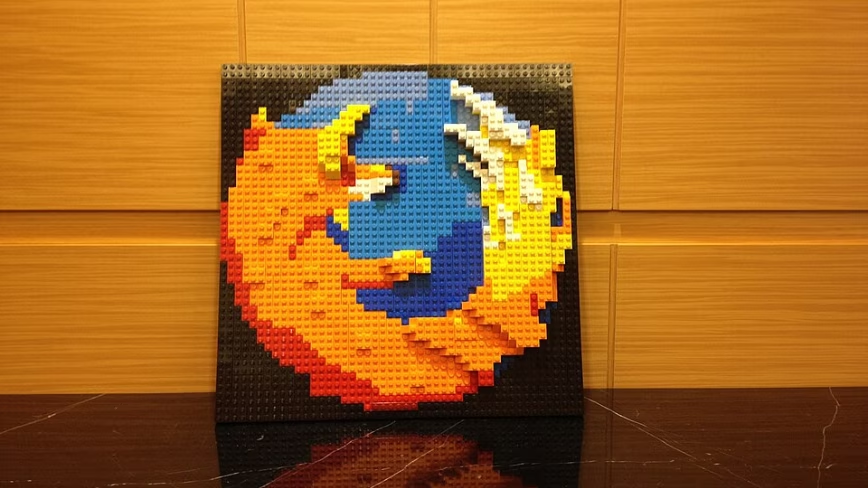
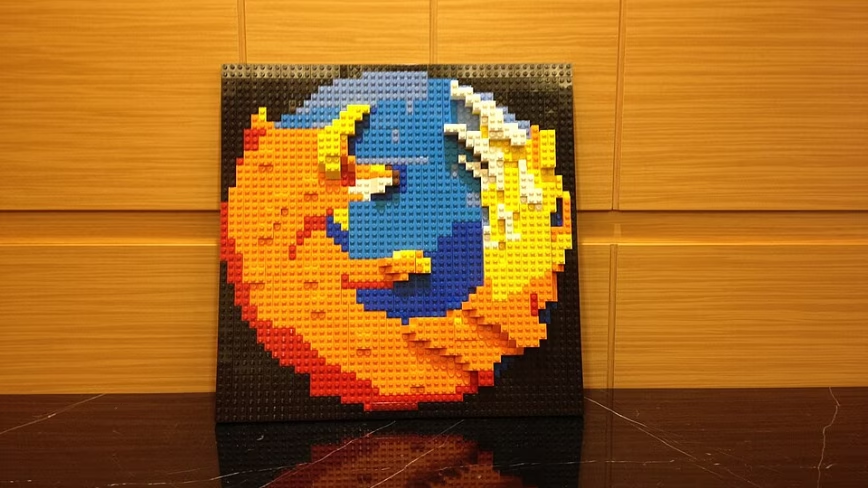
Only 1% of Firefox users used the AI kill switch. Mozilla launched Smart Window (BYO AI models), a built-in VPN with 1.5M signups, and a fall redesign.
Mozilla built an AI kill switch into Firefox after its users demanded one. Only 1% have used it. Another 3% turned off some AI features selectively. The rest left everything on. CEO Anthony Enzor-DeMeo says the point is not the percentage but the choice.
“Our community was pretty vocal, especially during the CEO announcement, that not everyone wanted AI,” Enzor-DeMeo told CNET. “At its core, we want to listen to our users. It was honestly on the roadmap, but I expedited it, given the community feedback.”
The low usage rate suggests that most people who said they wanted an AI kill switch either did not follow through or found specific features, like AI-powered translation, useful enough to keep. Enzor-DeMeo pointed to this as validation that Firefox’s approach works. The differentiator is not removing AI but offering control, something he contrasted with Microsoft defaulting to Copilot on Windows desktops and Google silently downloading a 4 GB AI model onto users’ machines.
Firefox’s newest feature is Smart Window, now available in beta. It lets users choose which AI model to run inside the browser, including ChatGPT, Gemini, Claude, or privately hosted open-source models. “They all excel at different things. Why do I need to be forced into one of them?” Enzor-DeMeo said. Mozilla says it does not use chat data to train models and automatically filters out sensitive information.
The browser also launched a free built-in VPN last month. It has 1.5 million signups and roughly 800,000 active users. Enzor-DeMeo said building VPN directly into the browser was a top priority because clicking a button is easier than opening a separate app. The VPN only encrypts browser traffic, not activity in other apps.
A full redesign, codenamed Project Nova, is coming in September or October. It includes faster page loads (up to 9% improvement), compact mode, rounded UI elements, AI-powered tab grouping, and accessibility features. Firefox has around 200 million monthly users and just over 2% of the browser market, compared to Chrome’s 70% and Safari’s 16%.
Enzor-DeMeo framed the stakes in global terms. He cited data showing 83% of the world’s population has not used AI, and only about 3% of Americans pay for it. He called AI “largely non-profitable” and predicted more ads in AI services soon. “If we actually go the route that AI becomes more centred in the browser, and that’s how people access the internet, you run the risk of the internet becoming more closed off.”
Mozilla’s position is that the browser should be the user’s agent, not the AI company’s distribution channel. Whether 200 million users and 2% market share are enough to make that argument matter is the open question for Firefox. But the 1% kill switch stat tells a more nuanced story than the backlash suggested. People wanted the option. They did not want to use it. That is a distinction the broader AI debate has struggled to make.
Why it matters: The largest IPO in history did two things at once: it made Elon Musk the world’s first trillionaire, and it quietly converted a privately held rocket company into a stock that millions of investors may soon own whether they chose to or not. SpaceX isn’t asking Wall Street to price its launches or its satellites. It’s asking the market to bet that a rocket company is on its way to becoming one of the most valuable AI companies on Earth, and to start paying for that future today.
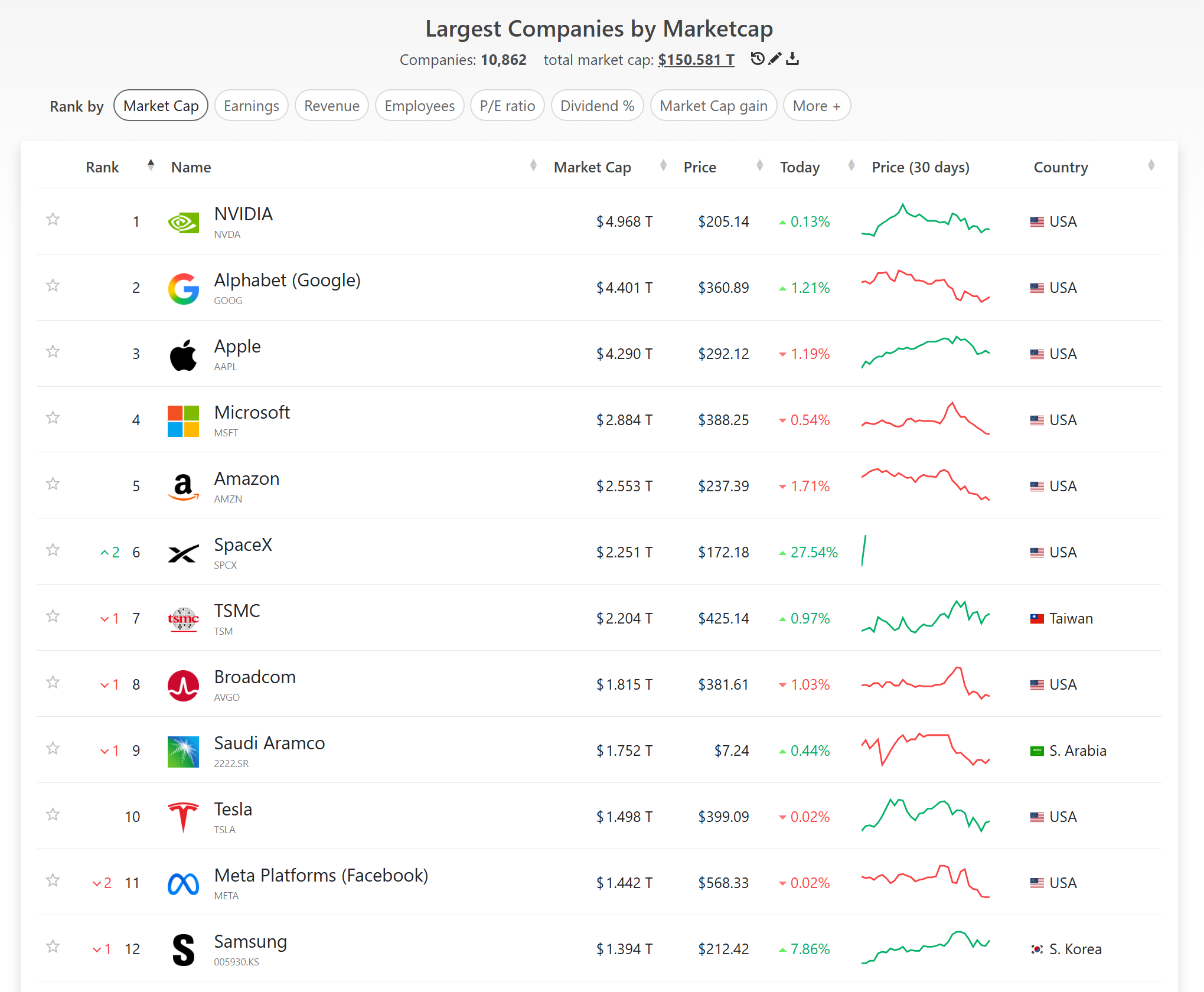
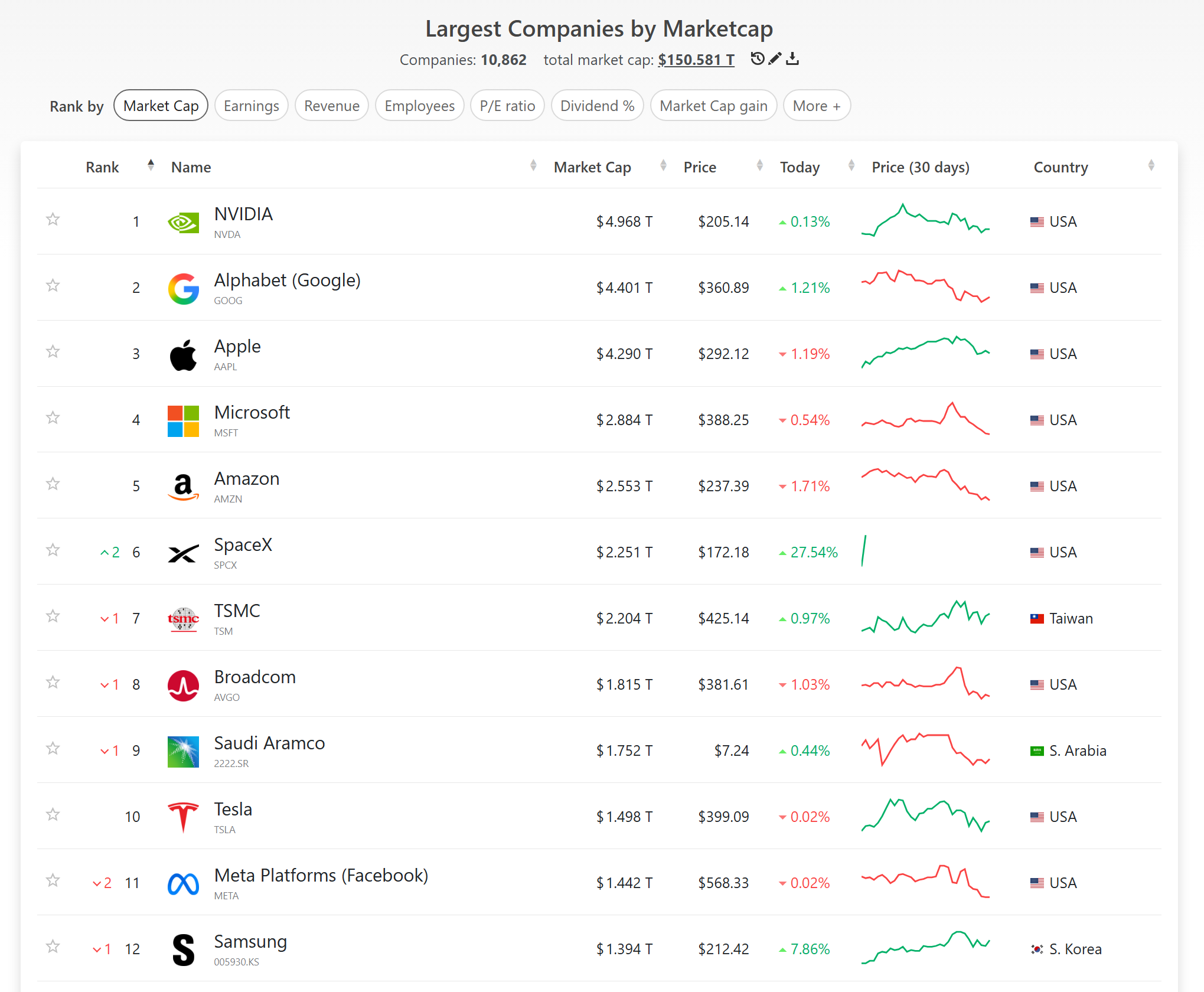
SpaceX began trading on the Nasdaq on Friday under the ticker SPCX, and the numbers attached to the debut are the kind that usually require a footnote to believe. The company priced 555.6 million Class A shares at $135 on Thursday evening, raising roughly $75 billion and valuing the firm at about $1.77 trillion before a single share changed hands. That makes it the biggest initial public offering in history, nearly triple Saudi Aramco’s $29 billion listing in 2019, the record it displaced.
The stock did what hotly anticipated debuts tend to do. It opened around $150, about 11% above the offer price, then swung as high as the $168 to $175 range in the first minutes of live trading before settling near $158 to $165 by midday. At those levels SpaceX briefly carried a market capitalization north of $2 trillion, placing it among the most valuable public companies in the world on day one.
But not to be surprised, the headline most news outlets led with was personal rather than corporate. Elon Musk, who holds an estimated 42% of SpaceX and acts as chairman, chief executive, and controlling shareholder, became the world’s first trillionaire, at least on paper. That wealth is tied up in stock and options across SpaceX and Tesla.
Musk rang the opening bell from SpaceX’s headquarters in Starbase, Texas alongside hundreds of employees, while president Gwynne Shotwell and CFO Bret Johnsen handled the ceremony in New York. “Take the fiction out of science fiction,” Musk said before the session opened, restating the Mars ambitions that have always been part of the pitch.
Strip away the spectacle and the SpaceX’s trillion-dollar valuation rests on a forecast, not a balance sheet. SpaceX reported a net loss of $4.9 billion in 2025 on revenue of about $18.6 billion, so investors are not paying $1.77 trillion for current profits. They are paying for what the company says comes next.
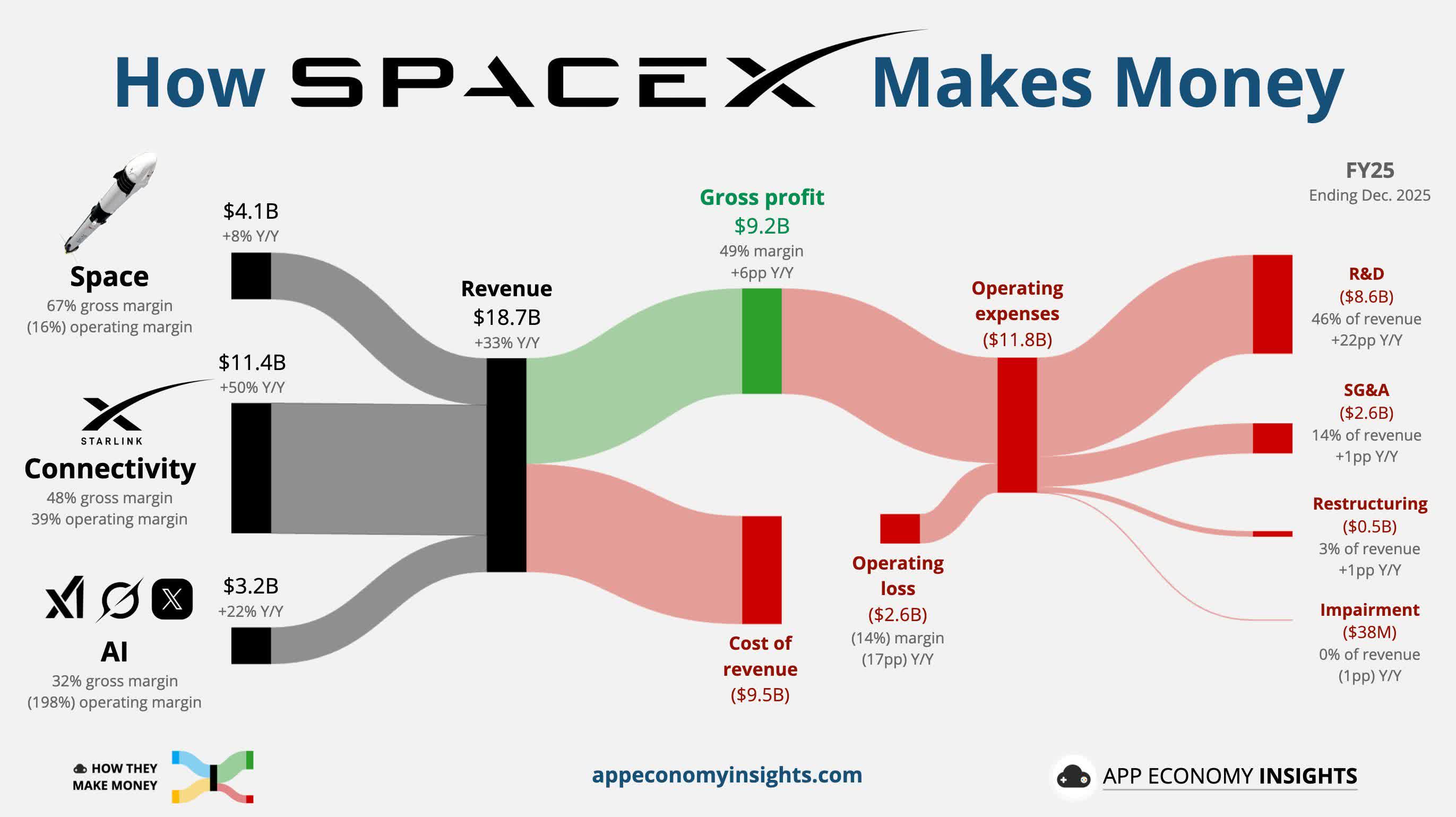
Credit: App Economy Insights
The filing makes that explicit. SpaceX estimates a total addressable market of $28.5 trillion, with roughly $26.5 trillion of it attributed to AI, a category the company entered in earnest after absorbing Musk’s xAI earlier this year. Beyond Starship and Starlink, the SEC documents describe plans for terrestrial data centers, custom AI microchips, and what SpaceX calls orbital AI compute infrastructure.
In other words, the rocket company is asking the market to value it largely as an AI company, which is why the offering is being read as the first in an expected wave that includes OpenAI and Anthropic.
For retail investors, that framing is the appeal. SpaceX targeted about 30% retail participation, well above the 10% typical of a large IPO, and the listing offers one of the few direct routes into a major AI player outside Meta, Microsoft, and Alphabet. Fidelity reported more than 500,000 buy orders within the first hour.
The skeptics are loud, and they are not all anonymous. Morningstar this week pegged SpaceX’s fair value at roughly $63 a share, less than half the IPO price, calling the offering overvalued. That is a striking gap for a name generating this much demand.
The sharper critique concerns who ends up holding the stock. Several index providers, including Nasdaq and FTSE Russell, recently adopted fast-entry rules that could add SpaceX to major indexes well inside the year that benchmarks have historically required after an IPO. Because index funds must mirror their benchmarks, inclusion forces automatic buying, which means millions of savers could gain exposure to an unprofitable company without ever choosing the stock. S&P Dow Jones declined to bend its rules, so the S&P 500 will wait, but the broader point stands.

Economist Paul Krugman put it most bluntly, describing Musk as a “human Ponzi scheme” and arguing that the rule changes effectively conscript ordinary investors into propping up a valuation built on belief rather than fundamentals. He notes that index and index-based funds now hold roughly 52% of mutual fund assets, which is how a debut like this reaches people who never opted in.
That is the tension worth watching. SpaceX has a real and rare asset in Starlink, a launch business with no genuine competitor, and an engineering record that few firms can match.
Whether any of that justifies a two-trillion-dollar valuation, or whether the AI pivot is doing more lifting than the engineering, is a question the next few quarters will start to answer. For now, the most-watched stock chart in the market belongs to a company that is selling tomorrow harder than it is selling today.


The west of Ireland is fast becoming a globally recognised hub of technological activity and achievement.
“Galway punches well above its weight as a tech hub,” explained Siobhán Dervan, a director of engineering at Rent the Runway, Galway. “A vibrant, diverse ecosystem, anchored by big tech names like HPE, Cisco and Genesys, creates the kind of collaborative energy that attracts further investment and talent.”
Home to numerous indigenous and multinational organisations, the west of Ireland – particularly Galway – has built a sturdy reputation as an attractive region for scaling and growing companies with a focus on science, technology, engineering and maths (STEM).
Dervan said: “The PorterShed and Platform94 nurture so many start-ups and scale-ups in Galway, including ourselves at Rent The Runway back in 2019 and the University of Galway and ATU [Atlantic Technological University] deliver a continuous stream of talent into the local market.
“The business case is compelling too. IDA support and Ireland’s favourable tax environment apply nationally, but operational costs in the west are meaningfully lower and Galway’s culture, community and craic make it somewhere people genuinely want to be.”
This opinion was shared by the head of Viatris’ Galway site, David Read, who agreed Galway is a significant hub for talent, noting its large population of indigenous talent, its size, strong transportation links and a great coastal location that attracts a talented migrant community.
He said 30pc of the platform’s workforce were attracted to Galway and the west because of its reputation as an ideal location to raise a family, as well as to grow and develop careers.
Supported by third-level institutions, such as ATU and the University of Galway, Read noted that the region benefits from a homegrown talent pipeline, which is key for organisations looking to recruit and bolster their teams.
“Viatris supports this talent pipeline with our graduate development programme where we support the rotation of successful graduates through different functions, for example quality, manufacturing, science and technology on the site and also support rotations in the other Viatris sites in Ireland,” he said.
“The concept here is that we contribute to talent development and hopefully this talent anchors in the area and continues to grow and develop to more senior roles in the organisation.”
For both Dervan and Read, in addition to the importance of developing a sturdy talent pipeline and meeting future skill needs, it is also vital that technology organisations commit to scale and growth outside of Ireland’s capital.
Dervan said this is “critically important and the data backs it up”.
“Almost 70pc of new jobs created by Enterprise Ireland-backed companies in 2025 were outside Dublin and 88pc of new IDA jobs added in H1 2025 were in regional locations. The case for regions isn’t just about economic balance, it’s talent strategy,” she said.
“Dublin salaries and cost of living create real friction for scaling companies; regions like Galway offer access to the same world-class talent at a more sustainable cost base. And the quality-of-life argument is underrated. My commute to the office is five minutes on a bike and my view is the iconic Long Walk, that’s not a small thing when you’re trying to attract and retain great people.”
“It is important to grow organisations outside of Dublin, so that new emerging talent can live and grow with their families and communities and have great career opportunities,” agreed Read, who further explained that this needs to be supported by sustainable transport to ensure organisations can get staff to and from their place of employment.
He said: “This also means that organisations can harness what’s great about their region and the local talent pool. This vision is why organisations like the IDA and Údarás na Gaeltachta exist.”
But in a diverse landscape, such as the one in Galway, how might organisations ensure that they are contributing to the business and technology ecosystems in the region?
Dervan advised companies to actively engage with local drivers such as ITAG and the PorterShed to create opportunities year-round.
“Invest in local talent development,” she said. “Our local universities provide a strong pipeline of local talent. Rent The Runway offers student internships and actively recruits graduates, hiring a graduate that was previously our intern is a genuine win-win. We also support Teen Turn in guiding girls toward STEM careers.
“Foster internal innovation. Ireland’s 35pc R&D tax credit makes this as commercially smart as it is culturally valuable, good for your people and good for the bottom line.”
For Viatris’ Isobel Foyle, a HR director, Galway benefits strongly from a rich ecosystem made up of both multinational and Irish companies, each playing a critical role in sustaining regional economic stability. In order to remain competitive in this space, organisations need to actively invest in pipeline building via strategic partnerships and third-level institutions.
“This includes shaping future skills through aligned educational pathways and providing meaningful development opportunities via structured co-operative placements and graduate programmes,” she said. “Furthermore, we play a vital role in partnering with innovation hubs such as IDA Ireland and Údarás na Gaeltachta to share best practice and drive innovation and investment.
“In parallel, sustained investment in STEM initiatives at primary and secondary levels is essential to cultivating future talent. This collective commitment is increasingly critical in a highly competitive, rapidly evolving socio-economic and technological landscape, ensuring Galway’s long-term economic resilience.”
Don’t miss out on the knowledge you need to succeed. Sign up for the Daily Brief, Silicon Republic’s digest of need-to-know sci-tech news.


Teachers worry about students using AI to do their homework, publishers worry about novelists using AI to finish their books, but now biosecurity experts have something even bigger to worry about: AI’s ability to design dangerous biological agents. It’s enough to have major tech companies, top scientists, and national security advocates alike all worried about the same thing.
The fear is that AI systems have become capable enough to design biological molecules and assist with other complex laboratory tasks that were once reserved for highly trained specialists alone. Now executives from Microsoft to OpenAI to Anthropic have joined in the calls for Congress to do something. Specifically, the hope is that the government can require mandatory screenings of synthetic DNA and RNA orders to prevent bad actors from pursuing dangerous (potentially deadly) biological weapons.
As it stands, screening programs operated by some synthetic biology companies are largely voluntary. But supporters of drafting new legislation say these screenings need to become a requirement nationwide before AI capabilities advance even further. Lawmakers have already made some headway on similar proposals, such as the Biosecurity Modernization and Innovation Act of 2026. If passed, it would require companies selling synthetic genetic materials to screen both customers and orders while maintaining records to assist with any future investigations that emerge.

Still, opinions differ on how quickly the danger is growing, and what should be done about it. Broadly speaking, biological AI systems can already design proteins, predict viral evolution, and generate new molecular structures. That’s where a lot of the worry is coming from. Scientists are concerned that future versions could be used to engineer toxins, enhance existing pathogens, even develop novel biological threats. It’s not baseless, either. Researchers can point to studies showing that advanced language models can already help users perform specialized biological tasks at levels approaching experienced scientists.
However, designing a harmful organism on a computer is only step one. It’s important to remember that manufacturing, testing, and deploying biological agents still requires specialized equipment, technical knowledge, and various other resources that remain out of reach for most people. That’s why experts argue the most effective defense would be to strengthen oversight at the point where digital designs become physical. (That is, DNA synthesis companies.) No matter if the guardrails ultimately go up on the software or the hardware, the main point remains: industry and researchers need to move fast if they truly want to stop amateurs from mixing AI and weaponry.
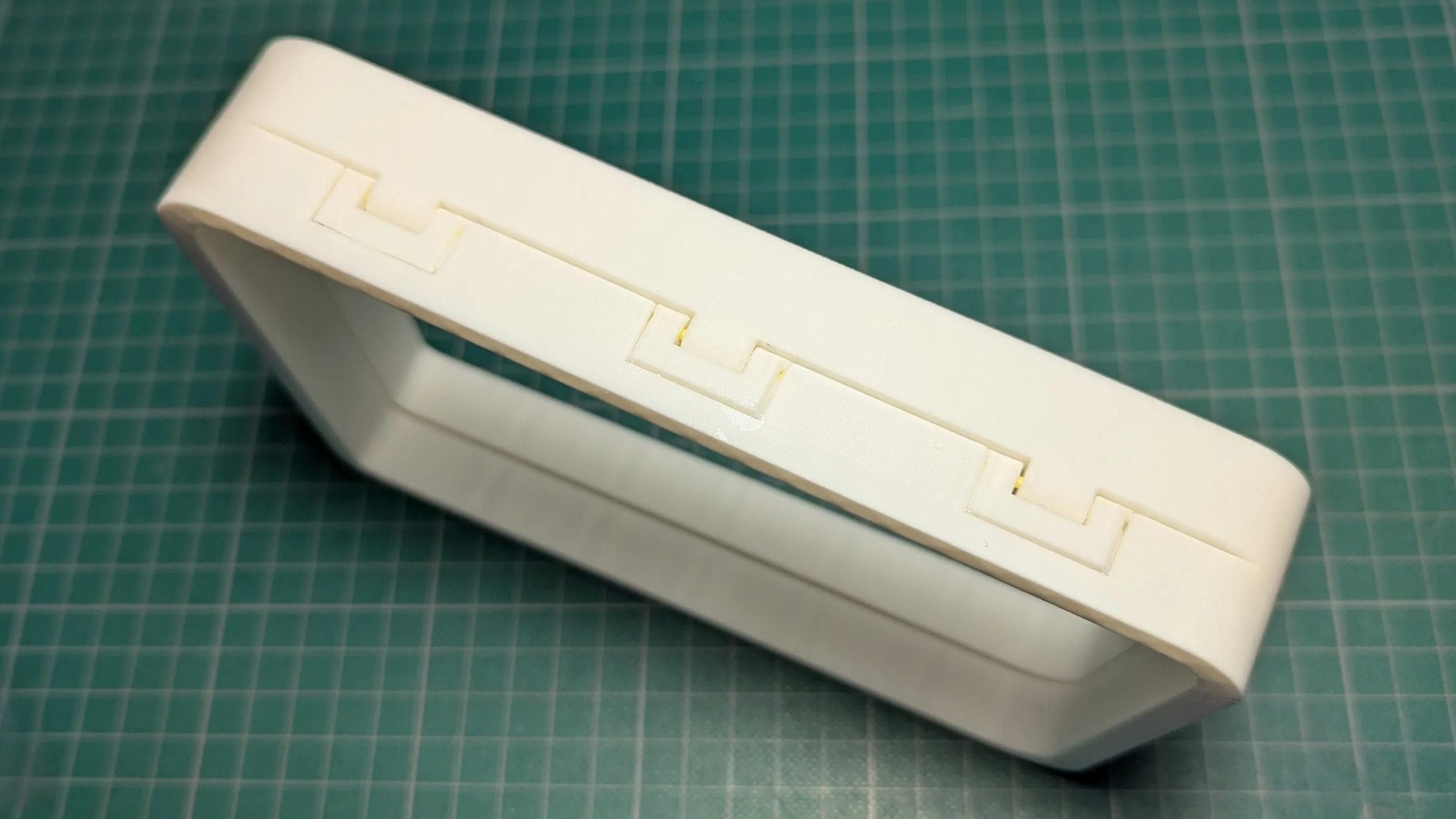
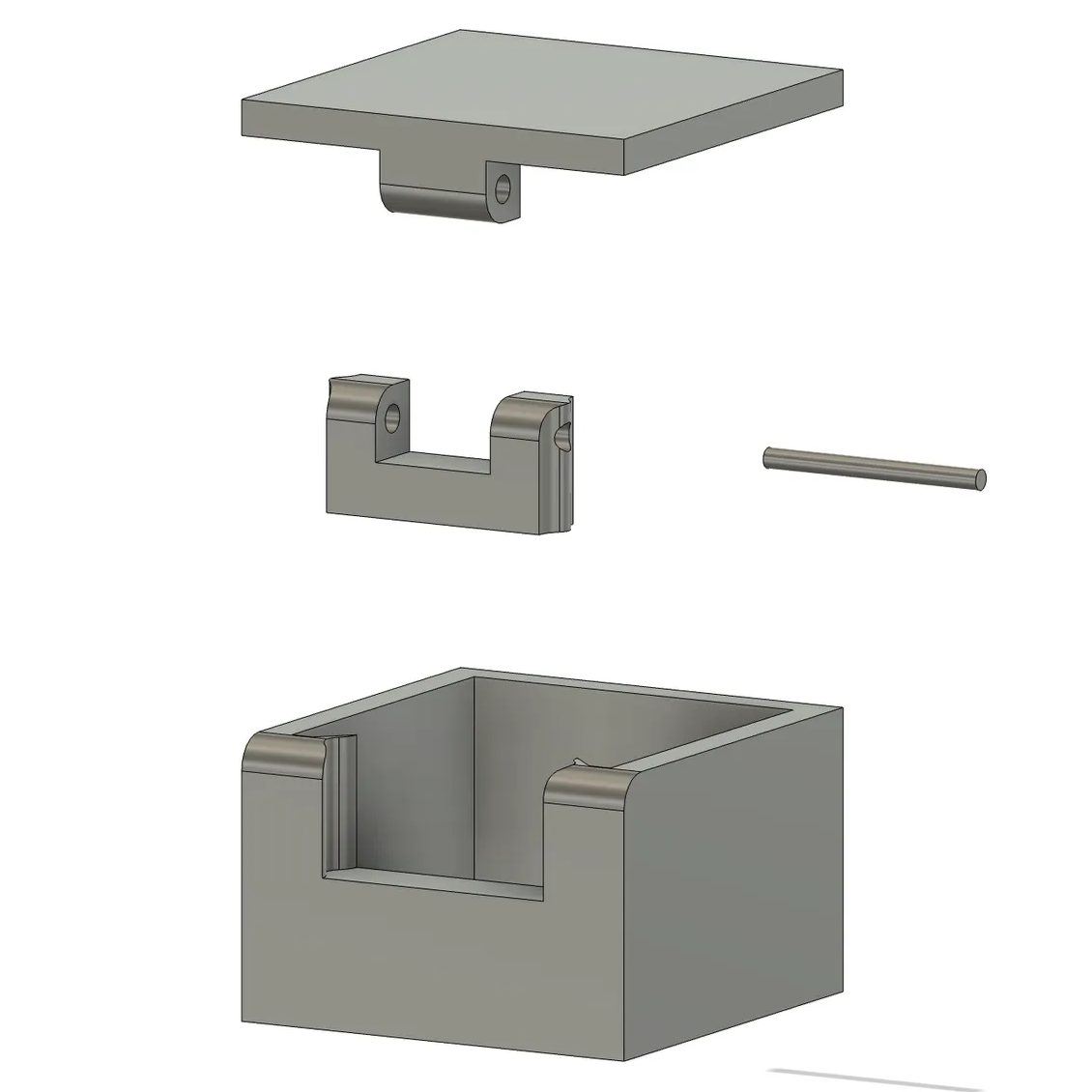
Need a hinge in your 3D printed design and would prefer not to re-invent the wheel? You may find [Alex Krush]’s glue-in filament hinge useful.
This design prints half the hinge as a separate piece — the u-shaped one in the picture to the side — that must be glued into the target object after printing. It’s a bit of extra work, but doing it this way has a couple advantages.
One is that printing some of the hinge elements separately means one no longer needs to choose between a print orientation that best suits the object, and a print orientation that works best for the hinge. Also, the length of 1.75 mm filament used as a hinge pin is held captive after assembly so there’s no need to glue the hinge pin itself.
[Alex] helpfully provides the parts in STEP format, which makes CAD tweaks and adjustments easy. While incorporating the design should be doable even if one is just using .stl or .3mf files because boolean subtraction and merging is all that’s needed, having the model in STEP format is so much better.
Should you need some pointers on incorporating either into FreeCAD, we have you covered.

Sam Bankman-Fried lost his appeal to overturn his FTX fraud conviction and 25-year sentence. Reuters reports: In a unanimous decision, a three-judge panel of the Manhattan-based 2nd U.S. Circuit Court of Appeals said prosecutors’ evidence against Bankman-Fried “was, conservatively stated, robust.” “While he was publicly reassuring customers, investors and regulators that FTX customer funds were safe, he was simultaneously using FTX as his own personal piggy bank, spending customer funds on real estate, political contributions, and investments,” Circuit Judge Barrington Parker wrote on behalf of the panel.
Bankman-Fried’s lawyers did not immediately respond to a request for comment. They may next ask all the active judges on the 2nd Circuit to hear the case, or ask the U.S. Supreme Court to take up the case. Bankman-Fried is also seeking a pardon from President Donald Trump, according to the Justice Department’s Office of the Pardon Attorney. Bankman-Fried was sentenced to 25 years in prison in 2024 for “masterminding one of the largest financial frauds in American history,” wrote US District Judge Lewis Kaplan. He was convicted on all charges, including wire fraud, conspiracy to commit securities fraud, commodities fraud, and money laundering.
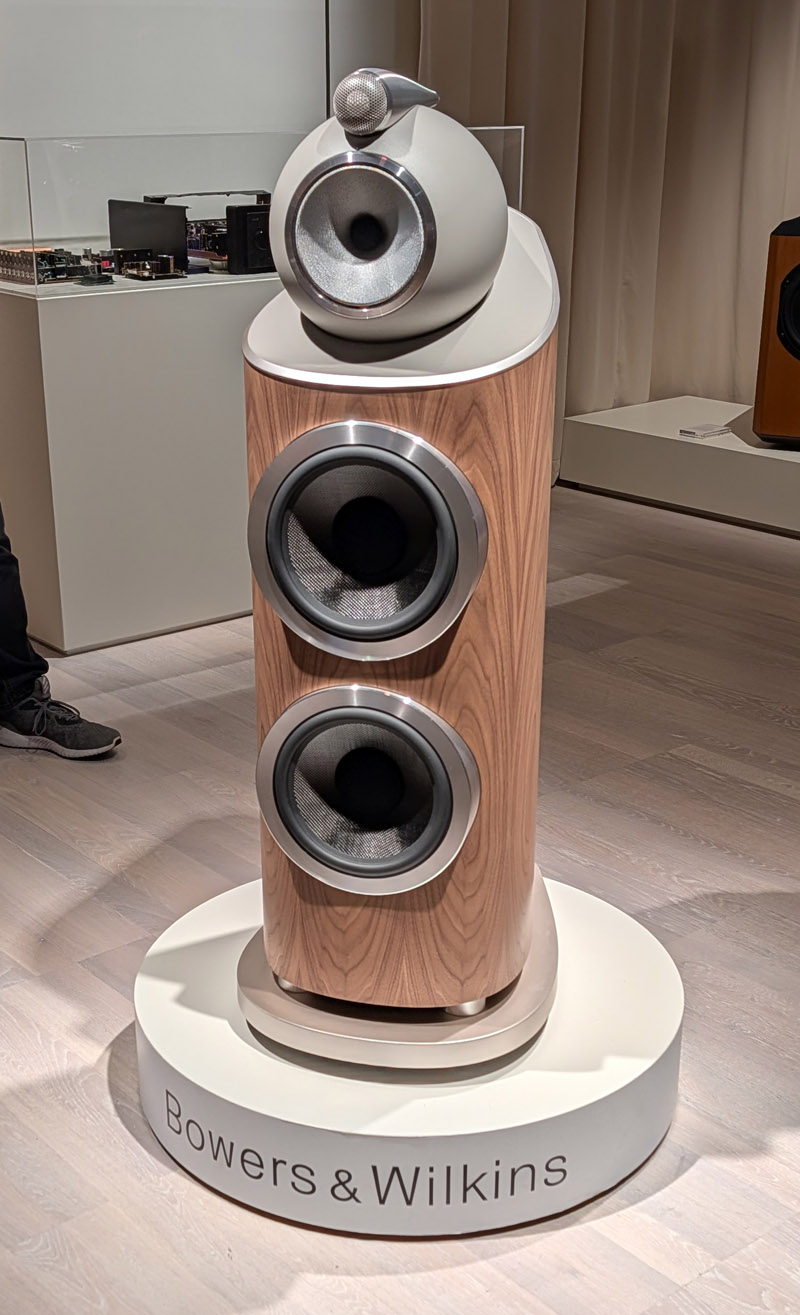
Bowers & Wilkins used High End Vienna 2026 to make a serious statement with the new 801 Diamond D5. It’s the British speaker maker’s flagship floorstanding loudspeaker in the 800 Series Diamond line-up, now in its fifth generation. The company has not been seen at this particular show for several years, but they thought it would be the most appropriate venue to unveil their new top dog. And it certainly made an impression.
Our Bowers & Wilkins 801 D5 launch preview covered the core changes, including the updated Diamond Dome tweeter implementation, revised cabinet architecture, upgraded internal bracing, new crossover network, and the broader refinements B&W says are designed to lower resonance, lower distortion and improve resolution, dynamics, and imaging.
But how do all of these refinements actually sound? Pretty damn good.
We got to hear the Bowers & Wilkins 801 D5 in a proper demo room in Vienna, which matters because show-floor impressions are usually about as reliable as hotel Wi-Fi during press day. Listening in a controlled room to a handful of songs does not turn a trade show demo into a full review, but it does give us a much better sense of what the loudspeaker can do. And this is particularly relevant when the product in question costs $65,000 per pair and sits at the top of one of the most recognizable high-end loudspeaker families in the world.
The 801 has always carried more weight than just its physical footprint. You might say it’s the core of Bowers & Wilkin’s’ identity. The original 801 (known then as the Series 80 Model 801) arrived in 1979 — for just $2,850/pair in those ancient dollars. It quickly became closely associated with Bowers & Wilkins’ studio-monitoring reputation, including its long connection with Abbey Road Studios. The new 801 D5 continues that lineage with an improved Diamond Dome tweeter with newly designed mesh grill, first seen in the company’s even more expensive D4 “Signature” line. In fact, many of the advancements in the D5 series first debuted in the company’s Signature line-up.
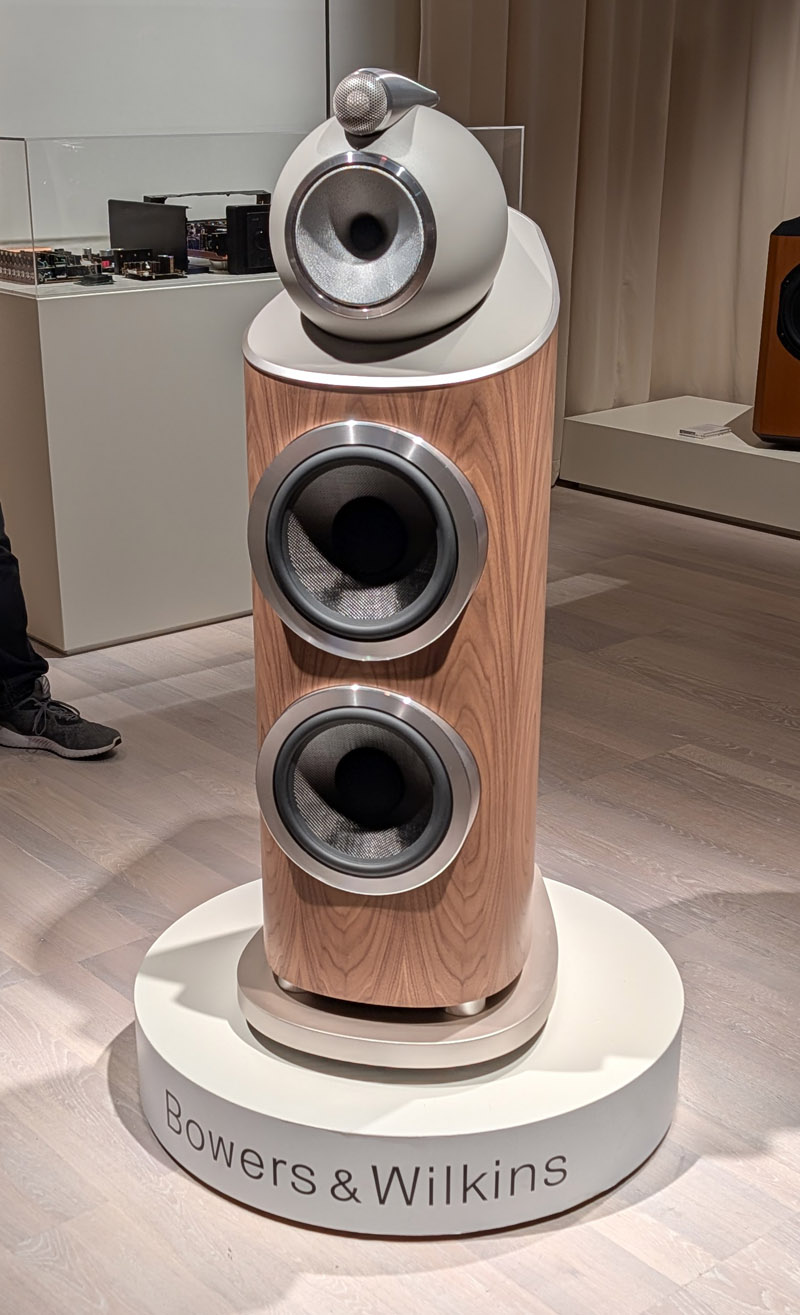
Other notable design features include Bowers & Wilkins Continuum midrange driver, distinctive tweeter-on-top and turbine-head enclosure, and substantial low-frequency architecture. From the outside, the D5 series does not look like a radical reinvention. That is not really the point. Bowers & Wilkins is playing the long game here: refinement, mechanical control, lower cabinet noise, lower resonance, better integration, and a more polished version of a formula that had already worked quite well, thank you very much.
In our first listen at High End Vienna last week, the 801 D5 sounded like a flagship speaker should: large in scale, extended, yet controlled in the bass, precise yet delicate in the highs and supremely present in the midrange. Bowers & Wilkins best sonic trick — the ability to disappear entirely and let the singers and instruments be there with you in the listening room — is still apparent in the D5 series. At least it is in the flagship, but likely in the rest of the line as well, since they share so much in technology, parts and design.
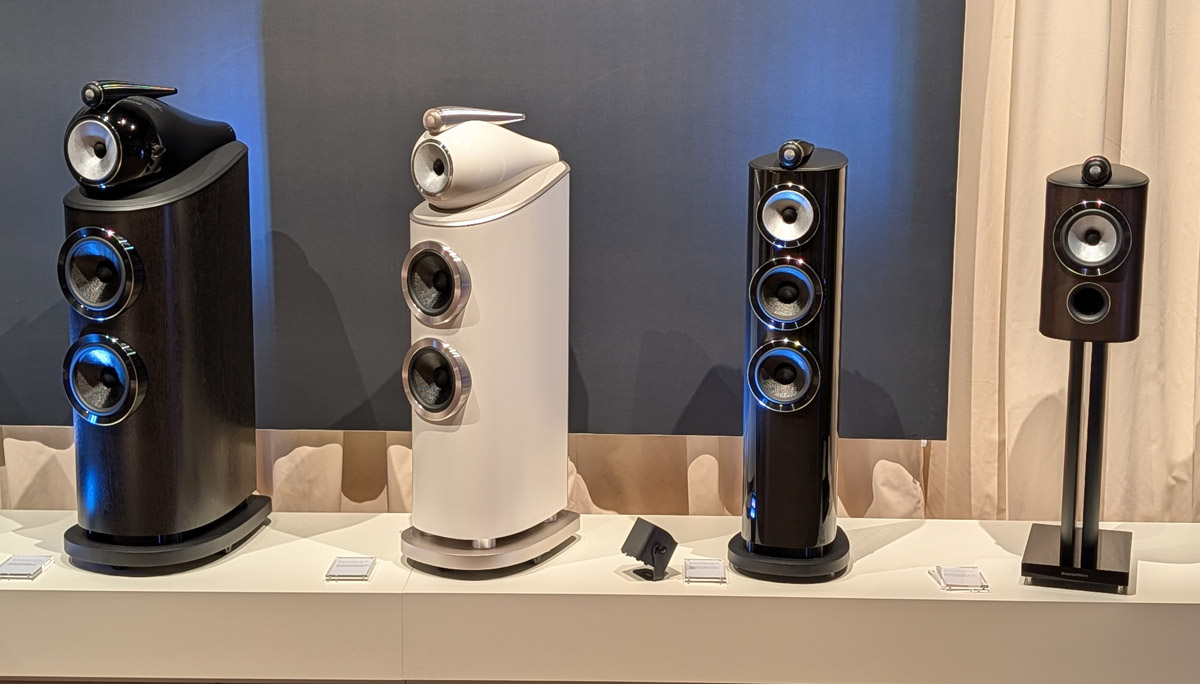
The 801 D5 sounded clean, composed, and physically effortless, with the kind of low-end authority that reminds you why full-range loudspeakers still matter when they are engineered properly. No subwoofers here. You won’t need one.
While many of the revisions in the Diamond D5 Series are invisible to the eyes, they were audible to the ears. It takes the already excellent D4 version and makes everything just a little bit better: a little cleaner, a little tighter, a little more transparent. We certainly saw (and heard) many speakers at HIGH END 2026 that cost more than the 801 D5 (some more than 10X more), but few could come close to it in sonic transparency and realism. And that’s saying something.
The most recent previous generations of the 800 Series may still be available while supplies last:
For more information: bowerswilkins.com


ai and ml
GPTZero claims only 5 of the report’s 45 citations matched their sources, raising questions about how the Big Four’s AI study was assembled
KPMG’s October 2025 report on the wonders of agentic AI has been accused of demonstrating one of the tech’s less desirable talents: making things up.
Research outfit GPTZero claims a forensic review of the Big Four firm’s October 2025 report, “Total Experience: Redefining Excellence in the Age of Agentic AI,” found that only five of its 45 citations correctly pointed to the cited source; the rest ranged from mangled and misleading to partially fabricated or too vague to verify.
The consulting industry has form here. Last year, Deloitte ended up refunding the Australian government after AI-generated content slipped into a taxpayer-funded report.
GPTZero dubbed the phenomenon “vibe citing” – the citation equivalent of vibe coding – where generative AI appears to stitch together fragments of real sources, invent titles, or otherwise produce references that look convincing until someone actually clicks them.
GPTZero alleges that roughly half of the report’s factual claims were false, unsupported, or attributed to the wrong source. Several case studies highlighting supposedly cutting-edge deployments of agentic AI appear to have been particularly creative.
Among the examples highlighted by GPTZero were purported agentic AI deployments at UBS, Swiss Federal Railways, and Transport for London. According to GPTZero, the sources cited to support those case studies either did not substantiate the report’s claims or contained alterations and paraphrasing that undermined their reliability.
“These factual errors are not confined to the report’s footnoted passages,” GPTZero said. “On page 42, the authors claim that Emirates airline has adopted a mobile chatbot named Sara (false) that can converse directly with passengers (partially true) and change their flights (false). In fact, Sara is a robot assistant introduced by Emirates in 2023 (not a chatbot) that lacks the ability to alter flight bookings.”
Not all of the alleged problems involved external sources. GPTZero noted that the report appears to contradict KPMG’s own research, citing a figure of 55 percent of CEOs ranking AI as their top investment priority. KPMG’s 2025 CEO Outlook, released the same month, put the number at 71 percent.
KPMG has since removed the report from some of its websites while it investigates how the publication made it into the wild, according to the Financial Times.
A spokesperson at KPMG told The Register:
“KPMG International takes the accuracy and integrity of its published content seriously. The report has been removed and we are reviewing the circumstances surrounding its publication. We expect all our people to follow our guidelines on the responsible use of AI, including human oversight to validate content and verify independent sources.”
Consulting firms have spent years warning clients about AI hallucinations. According to GPTZero, KPMG may have just provided a live demonstration. ®

Bullying. Isolation. Stress.
Everyone experiences these on the journey from adolescence to adulthood, but new data on the mental health of LGBTQ+ youth shows the additional pressures they face increases their risk of suicide compared to their peers.
The Trevor Project, a nonprofit focused on suicide prevention for LGBTQ+ youth, has released its most recent survey of 16,000 LGBTQ+ young people 13 to 24. Among the most concerning figures was one in 10 participants reporting that they had attempted suicide during the previous year. And more than one-third seriously considered suicide.
Experts also tell EdSurge that the strain of mental health issues and unwelcoming school settings directly harm students’ ability to thrive in, or even attend, their classes.
Despite the sobering results of the survey, the data also reveals solutions — including a role for schools.
“One of the most important findings is that when adults, institutions, and communities become more affirming, the suicide risk of LGBTQ+ young people goes down,” Ronita Nath, the Trevor Project’s vice president of research, says. “Schools play a life-saving support by creating environments where LGBTQ+ young people feel safe, accepted and supported.”
With 2026 on track to be another record-breaking year for anti-LGBTQ+ bills introduced at the state and federal levels, a vast majority of survey respondents said they felt stressed, anxious or unsafe due to the policies and the debates surrounding them.
When those young people are caught in the crossfire of heated political debates, Nath says the negative rhetoric that trickles down has real consequences. Youth who reported experiencing victimization due to their gender identity or sexual orientation — like bullying, physical harm or exposure to conversion therapy — were three times as likely to attempt suicide as their peers.
Those risks dropped among survey participants who said their school affirmed their identity. Support can look like adopting curriculum that counters anti-LGBTQ+ bias and increasing access to mental health services.
NEWSLETTERS
Sign up for EdSurge newsletters for timely news, insights and analysis.
Forty-four percent of survey participants said they couldn’t access the mental health services they needed. Some of the barriers to those services were tangible, like not being able to afford transportation to see a counselor. But many were not: they cited fear of their mental health problems not being taken seriously, not being understood by a mental healthcare provider, or past negative experiences that made young people hesitant to seek services again.
Nath encouraged schools to offer gender and sexuality alliances (GSAs), ensure anti-harassment policies were in place and provide professional development for educators to help ease students’ discomfort. “We know [that] not only improves mental health and well-being for LGBTQ+ youth, but for all their peers,” she says.
Research shows that well-being, engagement and a sense of belonging go hand-in-hand with students’ ability to thrive in school, according to Megan Pacheco, executive director of Challenge Success. The group is a nonprofit focused on increasing student well-being, engagement and belonging that’s based in Stanford’s Graduate School of Education.
The stress that gender-diverse students — including transgender, non-binary and gender-queer youth — experience can become an obstacle to their academic success. If they feel their identity is threatened or lack a sense of belonging, Pacheco says, they’re less likely to reach out for help.
“It’s going to affect their participation, how they show up in the classroom, and it’s going to affect their well-being,” she says.
Challenge Success’ large trove of survey data on the school experiences of middle and high school students reveals that students who identify as transgender, non-binary or gender diverse report more stress than their peers who identify as boys and girls, says Sarah Miles, director of research for Challenge Success.
“Instead of two or three sources of stress — family pressure, or peer relationships, or social media — it is just all the above,” Miles says. “In order to be able to function, use your working memory, be present, be engaged … if you have all those things on board that you’re worrying about, you’re just not able to attend to school in the same way.”
Among LGBTQ+ youth who are in school, about 85 percent said they had at least one adult at school who is affirming of their identity, according to the Trevor Project data. More than half of respondents said school was an affirming place, second to online spaces.
Matthew Rice, who chairs the science department at a New Jersey high school, tells EdSurge that students don’t judge safety by a school’s mission statement — they judge it by how adults respond to situations like harassing comments made in the hallway, classroom jokes, pronoun use and whether discipline is applied consistently among varying groups of students.
Rice has published research on the experiences of transgender and nonbinary educators, but the overall lessons gleaned from his work apply to students as well.
“Students notice who is allowed to exist authentically in schools,” Rice said via email. “Representation is not symbolic: It changes students’ perception of what futures are possible and who belongs in intellectual spaces. For many students, the first openly LGBTQ+ adult they meet is an adult at school.”
When it comes to supporting gender-diverse students, Miles of Challenge Success says she wants to dispel the belief that helping them thrive is a zero-sum game.
“I think there’s sometimes a misconception that if we give these students support, then other students aren’t getting support,” she says. “What’s really important is that, by giving students who identify as gender diverse support, everyone benefits, because all students then feel safe to show up — whatever their identities.”
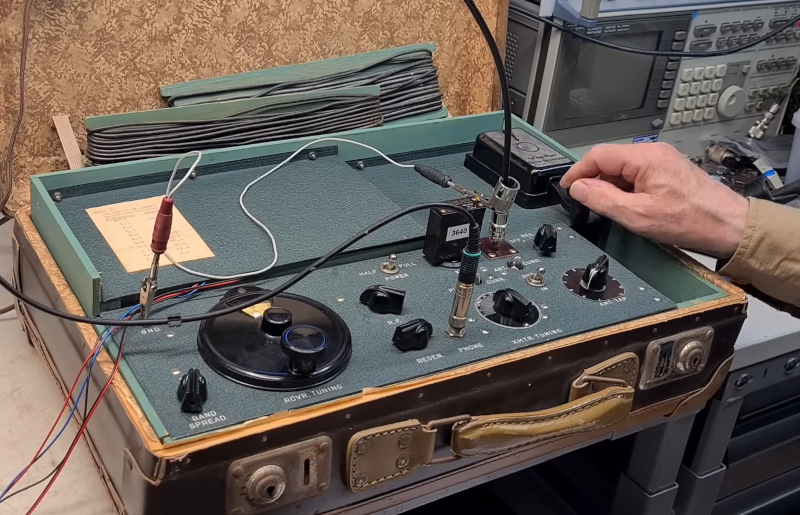
What counts as portable is somewhat a matter of opinion, especially over the years. [Helge Fykse] has a portable spy radio of Swedish origin. For its time, it was considered very portable, crammed into a good-sized suitcase.
You can see the large crystal that sets the transmit frequency and a key to send Morse code. The receiver has a VFO, so it was more agile. Based on the regenerative knob, it appears the receiver was of the regenerative type. The suitcase had its own battery, and with tubes, it could probably put out some kind of signal if connected to anything metal, like bedsprings, a clothesline, or anything. There was a lightbulb to let you see when you were transmitting maximum power.
Speaking of tubes, there were five inside, two for the transmitter and three for the receiver. The radio had storage for spare tubes, and the agent could maintain the radio in the field.
You not only get a peek inside the suitcase, but a look at the schematic. The radio is a model of simplicity, but we are certain it did its job.
We love looking at exotic spy gear, especially radios.




The Best Mystery Series of All Time Is Surging on Streaming 30 Years After It Ended


Alexander Zverev wins the French Open to finally earn a 1st Grand Slam title


Anatomy of the June crypto crash: Fed, Iran, Saylor


Oppenheimer backs SpaceX as $70 billion retail frenzy builds


Suspicious Polyfill login prompts pop up on Toshiba, Muji websites


Markets Rally as SpaceX IPO Looms Amid Iran Tensions and Inflation Surge

Senator Cynthia Lummis Calls CLARITY Act the Most Consequential Financial Legislation of This Generation


Microsoft unveils seven homegrown AI models in new bid for ‘long term self-sufficiency’

Alexander Zverev conquers demons and outlasts Flavio Cobolli to win French Open for first major title


Von der Leyen’s AI envoy pick draws conflict-of-interest fire


High Stakes for Wembanyama as New York Pushes for 3-0 Lead


Hackers now exploit SolarWinds Serv-U flaw to crash servers

The Pain Points Taking a Fragile Tech Rally Down a Notch

Eli Lilly (LLY) Stock Surges 4% Following Breakthrough Sleep Apnea Trial Results


Notion restores access to Anthropic after service disruption


Trump’s AI Ownership Plan Could Benefit Anthropic at OpenAI’s Expense

The investment to transform historic St Helen’s ground in Swansea

Bangladesh beat Australia after 20 years in ODIs, register only their second win over six-time world champions | Cricket News


Forensic Expert Floats Handyman Theory in Disappearance of Savannah Guthrie’s Mother


This Week In Security: Microsoft On Microsoft, Register Your Domains, Linux On ARM, And FreeBSD Joins The File Cache Club


![[KPOP IN PUBLIC] LISA - 'MONEY' | Cover by BN DANCE TEAM FROM VIETNAM](https://wordupnews.com/wp-content/uploads/2026/02/1770893501_maxresdefault-80x80.jpg)
You must be logged in to post a comment Login