Connect with us
DAPA Banner
DAPA Coin
DAPA
COIN PAYMENT ASSET
PRIVACY · BLOCKDAG · HOMOMORPHIC ENCRYPTION · RUST
ElGamal Encrypted MINE DAPA
🚫 GENESIS SOLD OUT
DAPAPAY COMING

Tech

The Sonos Move 2 summer sale is the excuse you needed to finally buy one

Published

on

Twenty-four hours of battery life is not a number you see often on a portable speaker that also sounds genuinely good, and the Sonos Move 2 happens to deliver on both counts without compromise.

Right now, that combination is available for £359, down from the usual £449, saving you £90 on one of the most capable outdoor-ready speakers on the market.

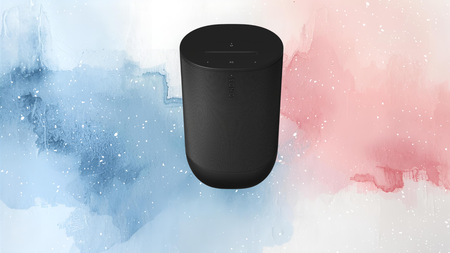
Sonos Move 2 on a pink and blue backgroundSonos Move 2 on a pink and blue background

The Sonos Move 2 has seen two summer price drops, but the offer won’t last long

The Sonos Move 2 easily integrates into existing Sonos home audio setups, and with £90 off, now is the perfect time to buy.

Advertisement

View Deal

The acoustic architecture here is the story worth telling: where the original Move used a single tweeter, the Move 2 introduces two, unlocking a proper stereo soundstage from a speaker small enough to carry by its built-in handle to a garden, a terrace, or a campsite boot.

Advertisement

That stereo upgrade is backed by automatic Trueplay tuning, which uses onboard microphones to analyse the acoustics of wherever the speaker is placed and continuously adjusts the output, meaning the sound you get outdoors at a picnic is genuinely optimised for those conditions rather than a compromise.

The Whatsapp LogoThe Whatsapp Logo

Get Updates Straight to Your WhatsApp

Join Now

Advertisement

Advertisement

The durability credentials are equally considered: IP56 water resistance handles rain, splashes, and dust, while the shock-absorbent enclosure material offers meaningful protection for a speaker that costs this much and is designed to travel with you.

Charging is handled through the included Wireless Charging Base, and the speaker also accepts power via any USB-PD supply, so you are never stranded if the base is left at home.

Advertisement

If you are already invested in a Sonos home audio setup, the Move 2 integrates seamlessly via Wi-Fi, and it pairs over Bluetooth for everything else, making it a natural extension of a multi-room system rather than an isolated portable device.

This deal is well suited to anyone who has been treating outdoor listening as a second-class experience because their current speaker cannot keep pace with a full day out, and at £359 the Move 2 is meaningfully cheaper than it has been, though summer deals at this level rarely hold.

SQUIRREL_PLAYLIST_10148964

Advertisement

Advertisement

Source link

Continue Reading
Click to comment

You must be logged in to post a comment Login

Leave a Reply

Tech

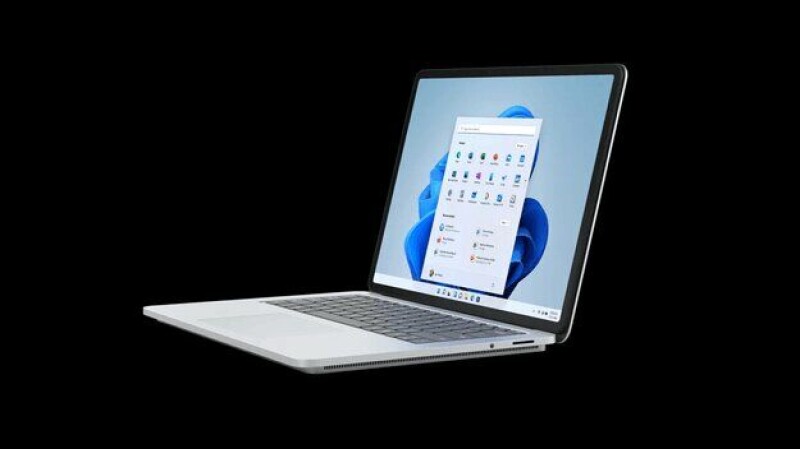
Microsoft has mostly repaired a flaw in Surface hardware that allowed unprotected devices to be bricked by a single packet

Published

on

EXCLUSIVE For the past 90 days, Microsoft has been quietly patching a firmware flaw in Surface devices that allowed the hardware to be bricked with a single packet, though only for those who have disabled Secure Core and Secure Boot.

And the company’s Copilot AI software inadvertently helped identify the faulty firmware.

According to Jack Darcy, a security researcher based in Australia, his instance of Microsoft Copilot stumbled across the bug after being asked to adjust the screen backlighting on a Surface device. The Copilot-conjured Python script ended up rendering the researcher’s laptop inoperable by overwriting the embedded controller firmware.

“Copilot autonomously created and executed four progressively aggressive Python scripts during a probe for backlight control values that sent raw SSAM ioctl commands (SSAM_CDEV_REQUEST = 0xC028A501) directly to the SAM microcontroller through the SAM software path,” Darcy explained to The Register.

Advertisement

The SAM or SSAM is the embedded controller used in Surface devices. And as our source explained, Microsoft’s implementation of the controller in Surface devices did not include any defense against arbitrary write values.

Microsoft does not consider the bug to be a practical threat. “There is no realistic attack scenario with this issue,” a spokesperson told The Register. “In order to successfully exploit it, an attacker would need to interact with specific drivers and send commands to a hardware interface. This would require administrator privileges on the machine, as well as disabling the Secure Boot feature. With this access, they could perform any number of actions.”

Commonly, Darcy said, digital devices require holding a button down or connecting a jumper cable to enable arbitrary write access. But that security check is absent in Surface devices, we’re told, enabling Copilot to vandalize the firmware in the absence of Secure Core and Secure Boot. Essentially, the probing triggered an update command from the SAM that overwrote the UEFI and Secure Boot firmware.

Surface devices treated to this sort of probing should continue to operate because the SAM was already initialized and is running in RAM. But upon reboot, when the SAM tries to reload using corrupted data in its non-volatile storage, it will fail to initialize, and the system will be unable to Power-On Self-Test (POST).

Advertisement

The Python script crafted by Copilot on the security researcher’s Surface device iterated blindly over a particular Target Category and the set of Command ID (CID) pairs, sending empty/null payloads to WRITE commands.

The result, Darcy explained, is that the SET Feature Report was called with null payload, the Output Report was called with null payload, and other CIDs were hit by SET commands that wrote garbage data.

As a result, the device became inoperable. We’re told this has been a common complaint about Surface devices online support forums over the years, though we have no way to determine whether boot failures reported for other Surface devices can be attributed to this specific problem.

Many Surface hardware issues reported publicly appear to be fixable through various troubleshooting techniques. But devices made inoperable by SAM access, our source insists, are permanently bricked – a situation that can entail hundreds of dollars in repairs for a new motherboard. No USB, no factory reset, no access to the BIOS/UEFI, we’re told.

Advertisement

Darcy said that the SAM Bus is terribly designed.

“There is no way to see the current value without scanning the bus,” he said. “But scanning the bus kills the unit.”

The problem is that the CIDs, which are like APIs for the SAM, have been interleaved in a way that’s dangerous.

“If all the reads were grouped together (say, CIDs 0x01–0x0F) and all the writes were grouped separately (say, CIDs 0x10–0x1F), a probe script could safely scan the read range without ever accidentally wandering into write territory,” Darcy said. “You could even put a simple bounds check in your code: ‘only probe below 0x10.’ Done. Safe.

Advertisement

“But because reads and writes are interleaved in the same numbering space, there is no safe range to probe. You literally cannot scan even two consecutive CIDs without a coin-flip chance of hitting a write command. The moment you decide to enumerate what’s available, you’re already firing blind writes, because the command space gives you zero structural information about which operations are safe and which are destructive.”

Managed devices not at risk

The Register asked Microsoft about our source’s claims on March 10, 2026. A company spokesperson reiterated a prior suggestion that the researcher contact the Microsoft Security Response Center (MSRC), an effort our source found too cumbersome. Rather than publishing details about what might have been a potential zero-day flaw – we were uncertain about the Secure Boot/Secure Core requirement at the time – The Register reached out to internal Microsoft sources in an effort to get someone’s attention.

By March 12, with the help of Microsoft media relations, we managed to coordinate a conversation between Darcy and Madeline Eckert, senior program manager with MSRC. Microsoft subsequently acknowledged the vulnerability and committed to issuing a fix. The Register in turn agreed to delay publication for 90 days while repairs were made. We’re told most affected devices have been updated (via Windows Update), or will receive updates in coming weeks. The issue did not meet the bar for a CVE, according to the company.

“We appreciate the work of Jack Darcy and The Register for reporting this issue under a coordinated vulnerability disclosure,” a Microsoft spokesperson said in a statement. “Our investigation found that a deprecated UEFI interface could trigger a boot loop on some devices. To trigger this loop, the user must have administrator privileges and have already disabled the Secure Boot security feature. We have released updates to address the issue for most impacted devices.”

Advertisement

That means managed devices are not at risk.

But those using Linux, or Windows users who have disabled Secure Core and Secure Boot for gaming, or who use custom Windows drivers, or who have USB boot enabled, may still be vulnerable if their systems haven’t received the update.

We’re uncertain about the range of Surface devices affected. Our source said it appears to be all of them (Surface Laptops 3-6, Surface Book 1-3) except for Surface Go models. ARM variants, however, have not been tested.

Microsoft moving Surface to Rust

One of the things we learned from Darcy during the effort to get this issue patched is that Microsoft is planning to move the Surface stack to Rust. We understand from David Abzarian, chief architect for Microsoft Surface, that work is underway to transition future Surface for Business hardware to a more secure architecture based on Rust code.

Advertisement

“Our most recent Surface for Business hardware features a major architectural shift in terms of improved reliability and security that spans our embedded controller, UEFI, but also some of our drivers,” said Abzarian in a statement provided to The Register. “We’re investing in the most secure foundation for a PC by building our embedded controller firmware from the ground up in Rust (as part of leveraging and contributing to the Open Device Partnership (ODP)) in addition to a rewrite of the UEFI DXE Core in Rust; these projects are known as Secure EC and Project Patina respectively. 

“We’re also not only shipping some of our drivers written in Rust, but also helping co-develop the framework Windows Drivers in Rust (WDR) to help enable a broad set of partners in the Windows ecosystem to capitalize on these benefits. I will also note that all of these efforts are open-source promoting one of our key security principles around transparency.”

Asked to comment, Darcy said, “The fact that a device can be destroyed, irreparably from userspace is… certainly an interesting design decision. While I applaud Microsoft for their beautiful, and innovative Surface series, a little more innovation around verifying incoming data at the firmware level would have been greatly appreciated.” 

We’re told Microsoft provided Darcy with a Surface laptop as a show of appreciation. ®

Advertisement

Source link

Continue Reading

Tech

A White Supremacist Youth Group Helped Orchestrate the Belfast Riots

Published

on

Within an hour after a horrific knife attack took place in Belfast on Monday night, far-right UK activist Tommy Robinson had shared a video of the incident on X, a post that racked up six million views. Within hours Elon Musk, the owner of the platform, weighed in, agreeing with a post calling for “consequences” for politicians.

By Tuesday morning, supercharged by X, the video was everywhere, and groups on Facebook were organizing protests across Northern Ireland and the UK. Far-right figures in the US and UK continued to pour fuel on the fire online, framing the incident as part of a broader anti-white agenda being perpetrated in Western countries.

By Tuesday evening, violent protests had broken out in Belfast, with masked rioters setting fire to vehicles, kicking in the doors of homes they believed housed immigrants, and setting those homes on fire.

Politicians were quick to criticize Musk and Robinson, who did not reply to requests for comment, for their role in fomenting the violence, but what no one appeared to notice was the role played by the white supremacist Active Club movement and its Youth Club wing in not only stoking tensions, but advising and orchestrating the masked youths who spearheaded much of the violence.

Advertisement

A WIRED investigation has documented how this global network activated within hours of the incident, showing how groups across the US helped promote the violence in Belfast. The movement is already analyzing how the protests played out and using them as a template for others to follow, highlighting the “organisation and professionalism” of those involved.

“Active Clubs, the fastest growing neo-Nazi movement around the globe, never miss an opportunity to exploit a tragedy for their own hateful purposes,” says Wendy Via, cofounder and president of the Global Project Against Hate and Extremism. “The protests in Belfast had hardly started before Active Club senior voices were functioning as a support network for the racist riots and encouraging replication in other countries.”

Around 10:30 pm local time on Monday night, emergency services were called to the Kinnaird Avenue area in north Belfast. Soon after, a video was shared online by an unknown person which showed a horrific knife attack against Stephen Ogilvie, who was left hospitalised with severe injuries to the face and neck, including the loss of his left eye.

Hadi Alodid, a 30-year-old Sudanese man, was arrested at the scene and has since been charged with attempted murder.

Advertisement

After Robinson posted the footage, it quickly gained steam on mainstream social media platforms. US-based X account End Wokeness, which specializes in sharing culture war and ragebait content, shared a screenshot from the video, with the caption: “African migrant just tried to behead a white man in North Belfast, Ireland. Video is too graphic to post.” The post has been viewed over 16M times.

Musk posted dozens of times about the incident in the following days, drawing the ire of politicians in the UK, but away from mainstream platforms like X and Facebook, other groups were also mobilizing and being much more explicit about the reason they believed a strong response was necessary.

Just hours after the attack took place, at 2:19 am on Tuesday morning, a Telegram channel called “White Youth In Revolt”—named after a phrase used across the Active Club and Youth Club movements—shared a screenshot of the video, writing: “Negro invader just attempted to behead a white man in the United Kingdom.”

The account typically shares content from Active Clubs in the US, but given the network’s growing footprint outside of America, it has a lot of followers in Europe.

Advertisement

Source link

Continue Reading

Tech

Gemini Can Now Adjust Your Picture Settings On Google TV

Published

on

Modern TV-watching is as much about anxiously messing around with settings to make sure the picture doesn’t look terrible as it is about actually enjoying a show. Happily, Google TV now lets you offload all the hassle onto Gemini.

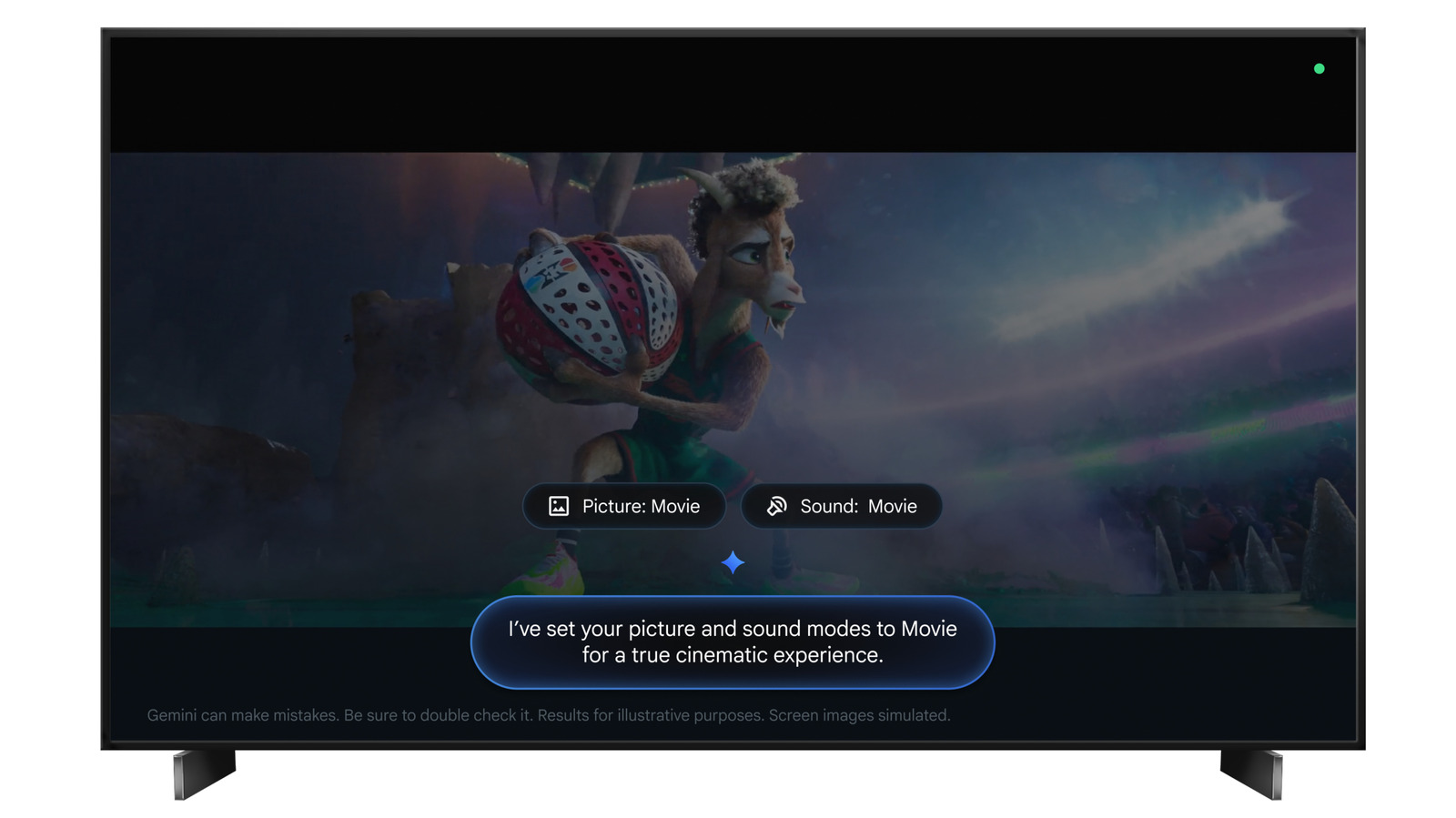
First announced during a Google TV news dump at CES at the beginning of 2026, the new functionality allows you to adjust picture and audio settings with natural language voice commands. You can set brightness and contrast levels, change the picture mode, increase volume and tweak the EQ without needing to reach for your remote (although you can also summon Gemini by holding the microphone button if you’d rather not use the wake word).

As well as specific commands like “set picture mode to Sport” (likely to be a popular one in the coming weeks given the World Cup has just started), you can also troubleshoot if something doesn’t look or sound right. If you say “Hey Google, the screen is too dark,” Gemini will attempt to correct the issue for you. Tell it you can’t hear dialogue clearly and it will boost voices. That kind of thing. 

You can also use Gemini for mood-setting if you want a theater-worthy movie night, and if you don’t entirely trust the AI’s calibration skills, you can instead just ask it to save you a few clicks by opening the exact settings menu you’re looking for before taking over.

Advertisement

Google points out that picture and sound modes vary across devices, so it’s probably wise to make sure you know what your TV can do before using the new voice features. Otherwise you might spend even longer trying to get it looking and sounding right than you would using the old-fashioned manual solution.

The other thing to note is that this functionality is currently exclusive to select TCL models in the US. In the next few weeks it’ll start rolling out to the QM9K, X11L, QM9L, QM8L and RM9L. You’ll have to perform a system update to start using it. There’s no word on when or indeed if other models or brands will be supported.

Google TV’s Gemini-assisted functionality has been expanding over the last few months. Back in March, Google introduced its “richer visual help” feature, which tries to respond to commands with more useful information. Ask for current sports scores, for example, and Gemini will display both a live scorecard and information on where you can watch that game.

Sport briefs, which are essentially a sports-oriented version of the news roundups that debuted last year, also arrived in March, as well as visual “deep dives” on specific topics.

Advertisement

Source link

Continue Reading

Tech

Latest Canvas Attack Shows Schools Still Struggle With Cybersecur

Published

on

A cyberattack against one of the world’s largest digital education platforms has forced attention onto the vulnerability of U.S. schools’ data.

Instructure, the company behind Canvas, a learning management system used by thousands of schools which has 30 million active users, had its service interrupted late last week. According to a company statement, hackers breached Instructure’s “free for teacher” account, or those specifically offered to give teachers access to Canvas courses.

The criminal hacking group ShinyHunters claims to have stolen 275 million records from roughly 9,000 educational institutions around the world, per reporting from Security Week.

In the latest, at the beginning of this week, Instructure published a note saying that it had reached a deal with the hackers to return the stolen data and had received digital confirmation of data destruction, along with assurance that none of its customers would be extorted. The note did not mention what Instructure gave in return. But the note announced a webinar with “Instructure leadership” scheduled for Wednesday.

Advertisement

According to Instructure, this is the second data breach within the year. The latest included a breach of customer — including teacher and students’ — email addresses, usernames, enrollment information and course names.

The attacks happened around finals for many colleges. Canvas was back online as of Saturday, according to a note about the incident on Instructure’s website. But at least six universities and school districts in a dozen states sent out alerts noting they had been impacted by the attack, according to reporting from CNN. Prior to Instructure’s deal, CNN noted that ShinyHunters had set a Tuesday deadline for schools to “negotiate a settlement.”

The education sector is an attractive target for hackers, with experts describing it as “target rich, resource poor.”

The breach comes amid immense frustration and legislative pushback against the extent schools have become reliant on edtech since pandemic closures forced schools to rush to embrace digital instruction and tools. Some wonder whether the attacks raise thorny questions about trust and the ability of schools to respond when outside vendors are targeted.

Advertisement

While this latest incident has renewed attention, cyber attacks against schools are not a new concern. Cybersecurity was even identified as a top concern in EdSurge’s 2025 trends forecast.

Indeed, the frequency of attacks has increased dramatically in recent years against both higher ed and K-12 schools, and some experts worry that AI is making attacks more sophisticated.

The figures are startling. For example, 82 percent of K-12 organizations reported a cyber security incident, according to a 2025 report from the Center for Internet Security, which noted 9,300 confirmed incidents.

Schools have struggled to figure out how to respond to new cybersecurity threats. Here are some notable highlights from the past few years:

Advertisement
  • 2022: A cyberattack against Illuminate Education made the rounds. In 2018, the European Union passed the General Data Protection Regulation, or GDPR, providing clarity into what data protection parents, teachers and students should get. But a few years later, during the Illuminate attack, experts noted that the U.S. lacked a national consensus, though states were beginning to pass legislation.

  • 2022: Later that year, after a major attack against Los Angeles Unified School District, one of the largest in the country, experts warned EdSurge that schools represent “honey pots of highly sensitive information.” In that attack, a ransomware gang dumped 500 GB of files, including sensitive student and teacher information, on the dark web when the district refused to pay.

  • 2025: Early into the Trump administration’s second term, experts noted that coordinated federal attacks had been impacted by cuts, weakening federal support for schools. At the time, districts noted that they were operating “in the dark” with an uncertain future around cybersecurity issues.

  • 2025: In a two-part EdSurge series, “Under Siege: How Schools Are Fighting Back Against Rising Cyber Threats,” reporter Ellen Ullman tracked how districts around the country are responding to AI’s rise in cyber incidents. Ullman’s reporting found that many schools remain weak on the fundamentals of cybersecurity, with small schools becoming attractive targets for cyber criminals. Schools are having to learn that the first line of defense against scams is humans, Ullman notes.

Some argue that the latest attacks are a sign that institutions need more meaningful expectations around cybersecurity, since the audits and certifications they currently rely on are failing to safeguard student data.

“Too often they serve as compliance theater and as weak shields against liability,” wrote Douglas Levin, national director of K12 Security Exchange Information, on social media.

Over the years, cybersecurity experts have shared a range of tips for schools to stay secure — from educating staff and students to seeking outside help to deal with the mounting threat.

With increasingly sophisticated attacks, there’s more than ever pressure for schools to secure student data despite all the challenges.

Advertisement

Source link

Continue Reading

Tech

RFK Jr. Talks About How Great A Job He’s Doing Managing The Measles Outbreak

Published

on

from the perhaps-he’s-on-team-measles dept

Cases of measles in American continue to rise. As of June 5th of this year, the official case count in the country stood at 2,030 confirmed cases. In 2025’s record breaking year for measles cases, the most we’d had in 3 decades, there were 2,288 confirmed cases. We’re going to speed right past that number in 2026, given that we’re nearly there already and we’re only half way through the year.

It was just weeks ago in April when RFK Jr. decided to wash his hands of the measles problem, literally saying it has nothing to do with him and was instead the fault of dirty immigrants invading our country.

“It has nothing to do with me,” he told lawmakers. “If you’re worried about polio and tuberculosis, you should look at the immigration policies in this country. ’Cause the place where it’s occurring are the place[s] where the immigrants are going, because they’re not vaccinated.”

This anti-immigrant trope when it comes to disease is as old as time, of course, and plainly stupid. But because the measles outbreak isn’t going to go away on its own, Kennedy had to address it recently during a trip to Virginia, where measles is becoming a growing problem. And in addressing it, Kennedy managed to pack more wrong into two sentences than I’ve ever seen before.

“There’s a global measles epidemic right now, we’ve done better than any country in the world in controlling it,” Kennedy said. “At [the] CDC we encourage people to get their measles vaccination, that’s the best way to prevent yourself from getting measles.”

Stating that there is a global measles epidemic is a sneaky statement to make for a number of reasons. First, I’ll note that there is no definition of terms that comes along with the claim. Second, much of the global data on this comes from the WHO, which, to date, has published global case counts only up to 2024 on its main tracking page, though it does have some surveillance data that goes up to the current month. And that data suggests that there is an uptick of global measles cases, to be sure, but nothing like there was only a few decades ago. In 2024, for instance, the WHO counted roughly 700k global cases of measles, compared with 1.5 million cases in 1993.

Advertisement

But regardless of how true it is that this is a global problem, it doesn’t matter. Kennedy’s job is to keep Americans safe from disease, not the world. Hand-waving away our own measles problem by globalizing it is a non-sequitur. And claiming that America is doing better than any other country on the measles problem is so wrong as to be laughable. The WHO has a handy presentation on the current measles problem and you can see that we aren’t even handling it the best in our own region.

That chart pretty clearly shows that Brazil and Canada are both doing a far better job than us in keeping measles cases low and combating outbreaks, if nothing else. Canada has a much lower total population compared with America, but Brazil is much closer. Besides, as we stated before, Kennedy has already said that the measles outbreak has nothing to do with him. So why is he now taking credit for how great we’re doing combating it, even though we’re not. By the way, the entire European region is kicking the America region’s ass when it comes to combating measles currently.

And I don’t even know how much I have to say about Kennedy’s baffling claim that he and the CDC are huge advocates for getting vaccinated to prevent measles. As I’ve stated repeatedly, one of the tricks Kennedy pulls is to say all kinds of things about the same subject. On measles, he has said, begrudgingly, that people should get vaccinated. He’s also said it would be better for everyone to just get measles for natural immunity, not to mention that he’s attempted to blame the infected for getting the disease as well.

Telling the public to get vaccinated, but also to not get vaccinated, and that it’s their fault if they catch measles, does not distill to something so simple as “we encourage everyone to get vaccinated.”

Kennedy is a liar and a charlatan. As is common with a person like that, he’s all over the place with his public comments when it comes to the measles and what we, and he, should be doing about it. He thinks that allows him to pretend like he’s been very pro-vaccination. It doesn’t.

Remove this man from his post before he gets more people killed.

Advertisement

Filed Under: measles, rfk jr.

Source link

Advertisement
Continue Reading

Tech

How the SpaceX IPO effect could send the Seattle area’s space industry to a higher orbit

Published

on

SpaceX and Space Needle
SpaceX’s Seattle connection dates back to 2015, when CEO Elon Musk announced at Seattle Center that the company’s satellite operation would be based in the region. “What this represents is the official opening of SpaceX Seattle,” he said at the time. (GeekWire File Photo)

SpaceX’s initial public offering is likely to boost the company’s valuation to $1.77 trillion, promote CEO Elon Musk to trillionaire status — and benefit the Seattle area’s space community as well.

The $75 billion IPO, which will add SpaceX to the Nasdaq stock exchange on Friday, is expected to be the biggest initial public offering in history. It’ll provide more capital for expanding SpaceX’s satellite networks and putting the company’s Starship mega-rocket into operation. Shareholders, including some of the hundreds of SpaceX employees in the Seattle area, could get a golden opportunity to cash in.

There could also be a payoff for Pacific Northwest space ventures that are banking on the lower launch costs and higher payload capacity SpaceX is promising to deliver.

“The reality is that SpaceX is the elephant in the room — and for a real reason, which is that they’ve got the lowest cost of launch and will continue to do so when Starship is up and running,” said Brendan Wales, general partner at Fuse, a Seattle-based venture capital firm. “So, whether SpaceX is successful or not, it is very impactful on Seattle startups.”

Those startups include a few that have received funding from Fuse, such as Redmond-based Starcloud, which aims to send a constellation of data center satellites into space; and Bothell-based Portal Space Systems, which is developing highly maneuverable spacecraft designed to inspect, service or deorbit other satellites.

Advertisement

The list of Washington state’s space ventures doesn’t stop there: Space Northwest, a Seattle-based space industry association, says more than 75 space companies call the Evergreen State their home.

SpaceX connects with the Seattle area

Even SpaceX is on Space Northwest’s map, by virtue of the company’s satellite production facility in Redmond. Back in 2015, Musk told a Seattle Center audience consisting primarily of potential employees that the satellite operation would be set up in the Seattle area instead of Southern California because “a lot of you guys, it seems, don’t want to move to L.A.”

Since then, SpaceX’s Redmond campus has been responsible for building nearly two-thirds of the world’s active satellites in orbit, and according to SpaceX’s IPO filing, the factory continues to turn out 70 satellites per week for its Starlink broadband internet constellation. With more than 12 million subscribers, Starlink generates more than half of SpaceX’s revenue and is the only one of the company’s three business segments to turn a profit.

SpaceX hasn’t said how many of its employees work in Redmond, although informal estimates range from 800 to 2,000. It’s even less clear how many of those employees will cash in on stock options. For what it’s worth, comments posted to Reddit suggest there won’t be enough of an impact to skew the Seattle area’s already-overheated housing market. “I think it’s going to be a big nothingburger,” one commenter wrote.

Advertisement

Starlink was just the first step in Musk’s strategy to turn SpaceX into a satellite company as well as a launch company. Most recently, Musk has laid out a vision for sending a million satellites into orbit to process data for artificial intelligence. But the IPO filing suggests that Redmond won’t be getting the biggest piece of that action: Instead, SpaceX says its operation in Bastrop, Texas, will be put in charge of producing AI compute satellites.

Seattle-area ventures connect with SpaceX

The impact of this week’s IPO won’t be limited to SpaceX and its shareholders, said Stan Shull, who monitors the Seattle area’s space industry as the founder and managing director of Alliance Velocity.

“A successful SpaceX IPO is likely to further accelerate the space industry, driving even more investment into the sector,” Shull said in an email. “Also, we may see a new round of now-wealthy SpaceX employees leave and start new entrepreneurial space ventures, including here in the greater Seattle area. Finally, the significant funds that SpaceX is raising with this IPO will help to ensure their success developing the Starship rocket, which some space companies are banking on for their own business models.”

For example, Marysville-based Gravitics is developing the orbital equivalent of aircraft carriers for customers including the U.S. Space Force. The largest varieties of those cargo-carrying spacecraft are designed to ride into space on SpaceX’s Starship or other heavy-lift rockets.

Advertisement

“SpaceX gets you to space. Gravitics makes it possible to operate once you’re there,” Gravitics CEO Colin Doughan said in an email. “The IPO confirms the launch layer is durable enough to build on. We’re executing on the logistics layer above it: more mass per mission, lower cost per kilogram, designed for the way commercial operators are actually flying now.  We are thrilled for our friends at SpaceX and see this as good for the industry overall.”

Jason Andrews, the co-founder and CEO of a spaceflight training venture called Orbite Space, acknowledged that he and fellow founder Nicolas Gaume had SpaceX’s Starship in mind when they created their Seattle-based company.

“Nicolas and I did indeed start Orbite because of the revolution Starship represents — a radical reduction in price, increase in frequency, and overall improvement in the client experience,” he said in an email. “As outlined by SpaceX, one of their ultimate missions is human expansion to the moon and eventually Mars, which is a good thing for the prospect of human spaceflight across the range of customers: governments, businesses and consumers. … Human spaceflight will soon be available to a much wider swath of humanity, and we are excited to play a small part in making that happen!”

Starcloud has already struck a deal to use SpaceX’s laser-based communication system on its own data center satellites, and plans to have Starship send its Starcloud-3 satellites into orbit when SpaceX is ready to take on commercial customers.

Advertisement

That may take a while, Shull said. “Initially, SpaceX is likely to prioritize Starship launches for its own space business ambitions and commitments. These include next-generation Starlink deployments, contracted flights for NASA’s Artemis moon program, its ambitious orbital AI data center plans, and possibly even test flights to Mars,” he said. “While I think Starship can and will be a total game-changer for the space industry, companies whose business models are largely or entirely reliant on ultra-low-cost Starship availability might have to bide their time or compete for early flight opportunities.”

SpaceX currently dominates the global launch industry — and if it continues to do so in the post-IPO era, Shull said the company may not feel the need to reduce its prices as rapidly as potential customers hope. Heightened competition from Seattle-area launch companies like Jeff Bezos’ Blue Origin space venture (for heavy-lift payloads) and Stoke Space (for medium-lift payloads) could change the equation.

The excitement generated by SpaceX’s IPO, and by lower launch costs, could also spark a new wave of companies doing things that sound like science fiction today. For example, one of the startups in a recent Y Combinator cohort, Galactic Resource Utilization Space, aims to build the first hotel on the moon.

Wales, the startup investor at Fuse, acknowledges that some of the business plans inspired by SpaceX’s IPO may never get off the ground. But the way he sees it, that’s totally normal.

Advertisement

“That type of thing happens when you’ve got a lot of capital flowing into a market, and then maybe it pulls back and there’s less of the wild stuff,” he said. “But I like these bubbly moments, because it allows for creativity. Some things will survive, and there are going to be things that could change the world.”

Source link

Continue Reading

Tech

‘Google Management Has Lost Its Moral Compass’: Google director jumps ship over company’s new AI contracts with DoD, Pentagon

Published

on


  • A Google director has resigned over the company’s contracts with the DoD
  • The director shared a letter internally with colleagues at Google
  • “Google Management Has Lost Its Moral Compass”, the letter stated

A director for Android platform security has resigned from his position over Google’s contracts with the Department of Defense.

In a letter shared with colleagues, and seen by Business Insider, René Mayrhofer said that the decision had become “unavoidable” following Google’s decision to allow the Pentagon to use the company’s AI models for classified work.

Source link

Advertisement
Continue Reading

Tech

Fewer than 2 in 5 S’pore employers plan to hire in the next 3 mths

Published

on

The city-state’s hiring outlook has fallen to a five-year low

Singapore employers are turning more cautious on hiring for the third quarter of 2026.

According to ManpowerGroup’s latest Employment Outlook Survey, only 35% of employers in Singapore plan to increase headcount between Jul and Sept. Meanwhile, 41% expect no change to staffing levels, while 22% anticipate reducing their workforce.

Based on responses from 599 employers, Singapore’s Net Employment Outlook (NEO) for Q3 2026 came in at 13%, down 11 percentage points both quarter-on-quarter and year-on-year. This marks the softest hiring outlook since Q4 2021, when the NEO stood at -2%.

Image Credit: ManpowerGroup

(Note: The NEO is calculated by subtracting the percentage of employers expecting to reduce headcount from those planning to hire.)

Singapore’s hiring outlook also lagged behind both the global average of 26% and the Asia-Pacific regional average of 28%.

Advertisement

Among employers planning to keep staffing levels unchanged, 38% said their current workforce was sufficient to meet business needs. Another 27% said they were holding off on hiring until there is greater clarity on economic conditions.

“Employers in Singapore are taking a more cautious approach to hiring this quarter, with many choosing to hold steady on headcount until there is greater clarity on geopolitical conditions,” said Linda Teo, country manager of ManpowerGroup Singapore.

Outlook across key industries

Despite the weaker overall hiring sentiment, most industries in Singapore still recorded positive NEOs for Q3 2026, indicating that more employers plan to hire than reduce headcount.

Image Credit: ManpowerGroup

The Manufacturing sector reported the strongest hiring outlook among all industries surveyed.

At the other end of the spectrum, the Finance and Real Estate sector was the only major industry to record a negative NEO of -2%, signalling that more employers expect to cut jobs than add them. The Hospitality and Retail sector posted a flat NEO of 0%, though ManpowerGroup noted that the result was based on a relatively small sample size.

Advertisement

Quarter-on-quarter, hiring sentiment weakened across almost every industry. Most sectors saw their NEOs fall by double-digit percentage points, reflecting growing caution among employers amid ongoing economic and geopolitical uncertainty.

The Technology and IT sector was the exception, with its hiring outlook remaining unchanged from the previous quarter, making it the most stable sector in the survey.

One notable outlier was Utilities and Natural Resources, where the NEO jumped by 34 percentage points quarter-on-quarter. While ManpowerGroup cautioned that the sector’s sample size was relatively small, the increase comes amid Singapore’s continued push towards sustainability and clean energy development.

Last October, Minister of State for Trade and Industry Gan Siow Huang said the clean energy workforce is expected to grow by 60%—or around 1,000 workers—over the next decade, highlighting the sector’s longer-term growth potential.

Advertisement

AI skills pay off

Amid the challenging job landscape, Teo added that hiring decisions are becoming more selective, with companies prioritising a “skills-based approach.”

AI-related skills topped the list of competencies that employers are willing to pay a premium for.

According to the survey, 66% of Singapore employers said they would offer higher pay for AI literacy skills, such as the ability to use AI tools effectively. 64% would pay more for AI model and application development skills, while 56% cited traditional IT and data skills.

Sector-wise, employers in the public sector, health and social services were the most likely to pay a premium for AI literacy skills (78%), followed by professional, scientific and technical services (72%) and tech and IT services (69%).

Advertisement

For AI model and application development skills, employers in the information sector and professional, scientific and technical services were the most willing to pay more, with both industries recording 76%. Finance and insurance firms followed at 71%.

Employers also value interpersonal and soft skills, with 66% saying they would pay more for critical thinking and problem-solving. The same proportion would pay a premium for communication, collaboration and teamwork, followed by leadership and social influence capabilities at 64%.

The findings suggest that while employers may be slowing their hiring plans, they remain prepared to invest in workers with in-demand technical and transferable skills.

  • Read other articles we’ve written on Singapore’s current affairs here.

Featured Image Credit: 2p2play via Shutterstock

Advertisement

Source link

Continue Reading

Tech

For one ambitious security type, chaos is a ladder

Published

on

Official BOFH logo (red rotary telephone with devil's tal and devil's horns)

EPISODE 11 “And uh… what are you doing?” the Head of Security asks, entering the Security office as I’m making my way to the exit – with a PC under my arm.

“Just taking this back to the office to archive the contents and then reset it to factory defaults,” I say. “Company policy when someone has been… let go.”

There have been a number of changes at Security – the same number of changes as there used to be members of Security staff. Apparently, eating endless pastries and watching pirated movies isn’t an industry-standard procedure for security professionals. Furthermore, the spate of alcohol thefts from the boardroom liquor cabinet seems to have ended after HR discovered several empty bottles in Security’s overflowing recycling bin…

HR acted swiftly (for a change) and a whole new security team was employed, headed by a keen new broom – who’s currently blocking the doorway…

Advertisement

To say that he’s enthusiastic in his role would be an understatement. His first move was to isolate Security onto a completely separate internet feed, firewalled off from the rest of the Company. Move two was to implement a plan of recording the equipment people leave the building with – something that’s proving rather unpopular with laptop users.

“Oh, I don’t think we’ll need it to be erased,” he says, holding out his hands to retrieve the machine from my grasp.

“Really, there’s no telling what’s on this machine,” I say. “Malware, copyright movies, porn even. We don’t know. It’s safer – for the Company – if we just start from a clean machine. We might even just dump it to be on the safe side.”

“Sure,” the Head of Security says. “Though that machine looks like it’s almost brand new. It’s still got stickers on it! And it looks fairly… high end. I think we can take the risk. I’m pretty up-to-date with IT security and the like – so maybe you should let me worry about…”

Advertisement

“I think this should probably be HR’s call,” I respond. “They may want to be sure the Company isn’t exposed to any risk that the machine might present.”

“I can call HR if you like,” the Chief Pie-eater suggests, calling my bluff and reaching for his phone. “But I doubt they’d be too concerned.”

“They should be. If there’s malware installed on the recovery partition, you’ll reinfect the machine when you restore it to factory defaults.”

“Thanks for your concern,” he says, wresting the machine from my grasp and stepping out of the doorway.

Advertisement

So that’s how it’s going to be.

Obviously, we knew there was going to be trouble. We prepared ourselves for it. The new Security team has an enthusiasm for the job that was completely absent from the former crew, mainly because they’re jockeying for the position of 2IC.

The Boss is waiting for me when I get back to Mission Control.

Advertisement

“Just had a call from Security. Apparently, you were trying to… remove… one of their machines?”

“Yeah. I was going to erase it and restore it to factory settings.”

“Couldn’t you just do that there?”

“We prefer to do a reinstall on the DMZ segment – just in case there’s any malware on the machine after we restore it.”

Advertisement

“Right. Well, I talked to the guy, and it certainly sounded like he had everything under control,” the Boss assures me.

And so there you go. The Boss can determine someone’s technical competence from a two-minute phone call. It must be one of his superpowers, along with the toxic body odor and the ability to sniff out a kebab stand in a farmers’ market.

Two minutes later, in Mission Control…

“Right,” I say, entering Mission Control. “Everyone ready?”

Advertisement

The PFY nods.

The lead candidate for 2IC of Security nods.

“One of the pitfalls with security types is that they often shave with Occam’s razor,” I say. “When seeing someone leaving the office with a PC under their arm, they immediately think ‘office theft,’ rather than thinking ‘did this person bring the aforementioned machine into the office in the first place, wait until they heard someone approaching, then make to exit the office?’”

The 2IC candidate contemplates this silently.

Advertisement

“Another problem with security types is how to celebrate a victory. In this situation, a wise person would not simply ‘upgrade’ their desktop machine with this newer and shinier item – because it might have an infected operating system – AND infected recovery partition. No, a wise person would first sca-“

“Ooh, we’re in business!” the PFY interrupts, as his machine receives a ping.

“Right,” I say to Security 2IC, “I’d give it maybe half an hour – to really trash your network – before I head downstairs. Then maybe I’d ask why all the machines in your office appear to be going crazy.”

“And you think that would be enough to get him fired, do you?” he asks.

Advertisement

“It will be when you discover the stash of Company laptops in the boot of his car as he leaves the parking basement,” the PFY says. “And make sure you have the Head of HR with you.”

“Why’s that?” the soon-to-be Head of Security asks.

“Because one of the laptops is his…”

Source link

Advertisement
Continue Reading

Tech

CANVAS L First Listen @ High End Vienna 2026: An Audiophile Soundbar Built for Movies, Music, and Bigger TVs

Published

on

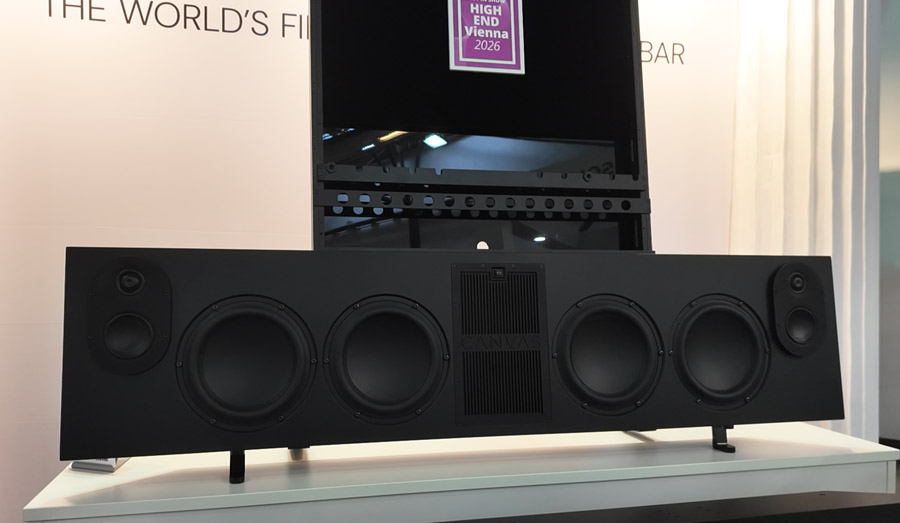
Most soundbars are built to make explosions louder and dialogue less awful, but they tend to struggle a bit when it comes to reproducing actual music. CANVAS L is coming at the category from a very different direction. Danish audio brand Canvas HiFi used High End Vienna 2026 to show a larger and more ambitious version of its all-in-one wireless speaker and soundbar, and the hook is not subtle: this is designed to do movies and music equally well without forcing buyers into a room full of boxes, cables, stands, subwoofers, and domestic unrest.

Our CANVAS L audiophile soundbar preview covered the core upgrades, including the wider cabinet, revised driver array, 1,500 watts of peak power, GaN power supply, expanded connectivity, improved BACCH 3D+ processing, and support for larger TVs from 65 inches up to 115 inches. That last part matters. The original CANVAS already made a strong case for the idea that a single speaker bar could behave more like a serious hi-fi system than a lifestyle soundbar, but its size couldn’t quite keep up with the extra large TVs that have grown in popularity in recent years.

Canvas L Audiophile Soundbar

CANVAS L pushes the concept into bigger-screen territory, where the visual scale of the TV finally has a matching audio solution that does not look like someone parked a center channel on a credenza and called it Scandinavian minimalism. It’s not that the physical bar itself is the width of a 115-inch TV. The cabinet measures in at 1440 mm wide s 373 mm high x 198 mm deep (56.7″ W x 14.7″ H x 7.8″ D). And while that is wider than most soundbars, it is still only about as wide as your average 65-inch TV.

However, by using BACCH 3D+ processing, the actual soundstage thrown by the bar spans the full width of even a large living room. Sounds can come from well outside the edges of even a 115-inch TV. And Canvas provides easily removable magnetic grilles that are sized to match virtually any sized TV from 65 inches to 115 inches. So you get a perfect aesthetic match. And if your tastes, or the décor of your living room, changes, you can easily swap in a grille with a different design, without having to call in a team of custom installers.

Advertisement
Canvas-L-with-Mounting-Bracket-900px
The Canvas L comes with a universal mounting plate that fits virtually any TV sized from 65 inches to 115 inches.

The real trick is whether CANVAS L can move between movie night and music listening without sounding compromised on both sides. Home theater products often chase impact and width but flatten music into wallpaper. Hi-fi products often do tone, texture, and imaging beautifully, then fall apart when asked to deliver cinematic scale. Based on our listening sessions at HIGH END Vienna, we can confidently state that the CANVAS L is equally capable for music listening and movie watching, and this is a rare accomplishment in lifestyle friendly products. Singers sound natural, drums and cymbals are crisp and punchy, and musicians span the full breadth of the room. Dialog in movies is always clean and intelligible, while explosions, dragon fire and car chases are presented with rich dynamics and a real sense of three dimensional space.

CANVAS L is able to accomplish this feat with its larger acoustic platform, 8-inch woofers, added passive radiators, vertically stacked midrange and tweeter drivers, increased amplification power, room correction through the Canvas app, and its secret weapon: BACCH 3D+. This tech is designed to create a much wider, deeper and more immersive sonic presentation from a single speaker, without having to add additional speakers in the sides or back of the room.

Canvas L Audiophile Soundbar Cutaway
Canvas L (cut-away)

CANVAS L also arrives in a market that suddenly looks a lot more serious. The original CANVAS did not have many obvious high-end soundbar rivals, but that is changing quickly. Dynaudio’s Opus One brings a massive active speaker system approach for larger TVs, while the Steinway & Sons Model S Soundbar from Steinway Lyngdorf takes the luxury active soundbar concept even further into custom-install and statement-system territory. And even Focal has entered the chat with their “don’t call it a soundbar” Mu-so Hekla one-piece speaker.

We have heard all of these, and they are all excellent in their own ways, which means CANVAS L can no longer rely on novelty alone. Its argument has to be stronger: real movie scale, credible two-channel music performance, flexible TV integration up to 115 inches, and BACCH 3D+ processing at a price that won’t push people away. Its rivals come from brands with decades of history and real credibility among audiophiles and music listeners, but the Steinway and Dynaudio alternatives cost significantly more, and the Focal speaker has a form factor that doesn’t lend itself to wall mounting and presents less of an integrated solution (visually speaking).

These issues do not make these competitors any less worthy of consideration, but it does raise the obvious question: why spend twice as much (or more) if you don’t have to? Or why have a separate visible speaker at all when you can have one that seamlessly blends in with the TV?

Canvas-HiFi-Frame-900px
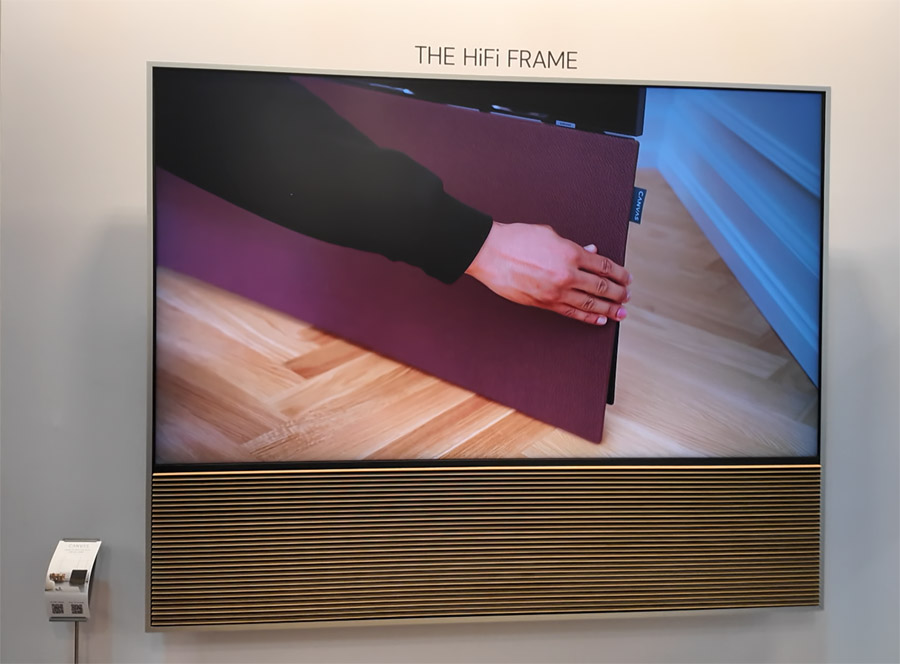
The Canvas “The HiFi Frame” includes an outer bezel that surrounds both the TV screen and the Canvas speaker for a fully integrated look with any Samsung TV.

One thing we learned at HIGH END 2026 is that the company’s original “The HiFi Frame” option, made specifically to work with Samsung’s “The Frame” Art TV, can actually work with any Samsung TV. So if you like the concept of an integrated hi-fi speaker which seamlessly matches your Samsung TV, but you want the higher performance picture option of an OLED TV or a Micro RGB TV, you can match those up with the Canvas HiFi Frame for the best of all worlds. Laust Nielsen, Canvas CEO, tells us that the CANVAS L will soon also offer this “HiFi Frame” option for Samsung TVs 65 inches and larger.

We should point out that the CANVAS L isn’t necessarily a solution for every situation. The BACCH 3D processing is most effective in a fairly narrow sweet spot, which can be defined during the set up. Outside that sweet spot, the sound is still natural and powerful, but the immersive surround effects are not as pronounced. Also, it’s not exactly cheap. While it will sell for €5,999 in Europe, U.S. pricing has not yet been finalized. It may run as high as $9,000 or more, depending on grille options. But if you’re dropping $30K on a top of the line 115-inch RGB backlit TV, you can certainly afford to spend a bit more to get sound to match that picture.

Advertisement
Advertisement. Scroll to continue reading.

The Bottom Line

The CANVAS L is that rare product that will satisfy most customers for both music listening and movie watching, while also fitting in with virtually any décor. For movies, you’ll get a huge and dynamic front soundstage with the illusion of sound all around you without adding more speakers. For music, it means wider, more believable stereo imaging from a product that still looks like it belongs in a living room or even the bedroom with one of your favorite TVs. Don’t worry, you can still have your dedicated home theater in your basement or backyard shed, but with a CANVAS L in your living room, you may feel a lot less inclined to get off your couch. Like, ever.

Source link

Advertisement
Continue Reading

Trending

Copyright © 2025