

Check your pocket. You’re probably carrying a tracking device that will allow the police — or even the Trump administration — to track every move that you make.
Tech
The Supreme Court will decide when the police can use your phone to track you, in Chatrie v. US


If you use a cellphone, you are unavoidably revealing your location all the time. Cellphones typically receive service by connecting to a nearby communications tower or other “cell site,” so your cellular provider (and, potentially, the police) can get a decent sense of where you are located by tracking which cell site your phone is currently connected with. Many smartphone users also use apps that rely on GPS to precisely determine their location. That’s why Uber knows where to pick you up when you summon a car.
Nearly a decade ago, in Carpenter v. United States (2018), the Supreme Court determined that law enforcement typically must secure a warrant before they can obtain data revealing where you’ve been from your cellular provider. On Monday, April 27, the Court will hear a follow-up case, known as Chatrie v. United States, which raises several questions that were not answered by Carpenter.
For starters, when police do obtain a warrant allowing them to use cellphone data, what should the warrant say — and just how much location information should the warrant permit the police to learn about how many people? When may the government obtain location data about innocent people who are not suspected of a crime? Does it matter if a cellphone user voluntarily opts into a service, such as the service Google uses to track their location when they ask for directions on Google Maps, that can reveal an extraordinary amount of information about where they’ve been? Should internet-based companies turn over only anonymized data, and when should the identity of a particular cellphone user be revealed?
More broadly, modern technology enables the government to invade everyone’s privacy in ways that would have been unimaginable when the Constitution was framed. The Supreme Court is well aware of this problem, and it has spent the past several decades trying to make sure that its interpretation of the Fourth Amendment, which constrains when the government may search our “persons, houses, papers, and effects” for evidence of a crime, keeps up with technological progress.
As the Court indicated in Kyllo v. United States (2001), the goal is to ensure the “preservation of that degree of privacy against government that existed when the Fourth Amendment was adopted.” More advanced surveillance technology demands more robust constitutional safeguards.
But the Court’s commitment to this civil libertarian project is also precarious. Carpenter, the case that initially established that police must obtain a warrant before using your cell phone data to figure out where you’ve been, was a 5-4 decision. And two members of the majority in Carpenter, Justices Ruth Bader Ginsburg and Stephen Breyer, are no longer on the Court (although Breyer was replaced by Justice Ketanji Brown Jackson, who generally shares his approach to constitutional privacy cases). Justice Neil Gorsuch also wrote a chaotic dissent in Carpenter, suggesting that most of the past six decades’ worth of Supreme Court cases interpreting the Fourth Amendment are wrong. So it’s fair to say that Gorsuch is a wild card whose vote in Chatrie is difficult to predict.
It remains to be seen, in other words, whether the Supreme Court is still committed to preserving Americans’ privacy even as technology advances — and whether there are still five votes for the civil libertarian approach taken in Carpenter.
Geofence warrants, explained
Chatrie concerns “geofence” warrants, court orders that permit police to obtain locational data from many people who were in a certain area at a certain time.
During their investigation of a bank robbery in Midlothian, Virginia, police obtained a warrant calling for Google to turn over location data on anyone who was present near the bank within an hour of the robbery. The warrant drew a circle with a 150-meter radius that included both the bank and a nearby church.
Google had this information because of an optional feature called “Location History,” which tracks and stores where many cellphones are located. This data can then be used to pinpoint users who use apps like Google Maps to help them navigate, and also to collect data that Google can use to determine which ads are shown to which customers.
The government emphasizes in its brief that “only about one-third of active Google account holders actually opted into the Location History service,” while lawyers for the defendant, Okello Chatrie, point out that “over 500 million Google users have Location History enabled.”
The warrant also laid out a three-step process imposing some limits on the government’s ability to use the location information it obtained. At the first stage, Google provided anonymized information on 19 individuals who were present within the circle during the relevant period. Police then requested and received more location data on nine of these individuals, essentially showing law enforcement where these nine people were shortly before and shortly after the original one-hour period. Police then sought and received the identity of three of these individuals, including Chatrie, who was eventually convicted of the robbery.
Chatrie, in other words, is not a case where police simply ignored the Constitution, or where they were given free rein to conduct whatever investigation they wanted. Law enforcement did, in fact, obtain a warrant before it used geolocation data to track down Chatrie. And that warrant did, in fact, lay out a process that limited law enforcement’s ability to track too many people or to learn the identities of the people who were tracked.
The question is whether this particular warrant and this particular process were good enough, or whether the Constitution requires more (or, for that matter, less). And, as it turns out, the Supreme Court’s previous case law is not very helpful if you want to predict how the Court will resolve Fourth Amendment cases concerning new technologies.
The Court’s 21st-century cases expanded the Fourth Amendment to keep up with new surveillance technologies
The Court’s modern understanding of the Fourth Amendment, which protects against “unreasonable searches and seizures,” begins with Katz v. United States (1967), which held that police must obtain a warrant before they can listen to someone’s phone conversations. The broader rule that emerged from Katz, however, is quite vague. As Justice John Marshall Harlan summarized it in a concurring opinion, Fourth Amendment cases often turn on whether a person searched by police had a “reasonable expectation of privacy.”
The Court fleshed out what this phrase means in later cases. Though Katz held that the actual contents of a phone conversation are protected by the Fourth Amendment, for example, the Court held in Smith v. Maryland (1979) that police may learn which numbers a phone user dialed without obtaining a warrant. The Court reasoned that, while people reasonably expect that no one will listen in on their phone conversations, no one can reasonably think that the numbers they dial are private because these numbers must be conveyed to a third party — the phone company — before that company can connect their call.
Similarly, while the Fourth Amendment typically requires police to obtain a warrant before searching someone’s home without their consent, if a police officer witnesses someone committing a crime through the window of their home while the officer is standing on a public street, the officer has not violated the Fourth Amendment. As the Court put it in California v. Ciraolo (1986), “the Fourth Amendment protection of the home has never been extended to require law enforcement officers to shield their eyes when passing by a home on public thoroughfares.”
As the sun rose on the 21st century, however, the Court began to worry that the fine distinctions it drew in its 20th-century cases no longer gave adequate protection against overzealous police.
In Kyllo, for example, a federal agent used a thermal-imaging device on a criminal suspect’s home, which allowed the agent to detect if parts of the home were unusually hot. After discovering that parts of the home were, in fact, “substantially warmer than neighboring homes,” the agent used that evidence to obtain a warrant to search the home for marijuana — the heat came from high-powered lights used to grow cannabis.
Under cases like Ciraolo, this agent had a strong argument that he could use this device without first obtaining a warrant. If law enforcement officers may gather evidence of a crime by peering into someone’s windows from a nearby street, why couldn’t they also measure the temperature of a house from that same street? But a majority of the justices worried in Kyllo that, if they do not update their understanding of the Fourth Amendment to account for new inventions, they will “permit police technology to erode the privacy guaranteed by the Fourth Amendment.”
Devices existed in 2001, when Kyllo was decided, that would allow police to invade people’s privacy in ways that were unimaginable when the Fourth Amendment was ratified. So, unless the Court was willing to see that amendment eroded into nothingness, they needed to read it more expansively. And so the Court concluded that, when police use technology that is “not in general public use” to investigate someone’s home, they need to obtain a warrant first.
Similarly, in Carpenter, five justices concluded that law enforcement typically must obtain a warrant before they can use certain cellphone location data to track potential suspects.
Under Smith, the government had a strong argument that this data is not protected by the Fourth Amendment. Much like the numbers that we dial on our phones, cellphone users voluntarily share their location data with the cellphone company. And so Smith indicates that cellphone users do not have a reasonable expectation of privacy regarding that data.
But a majority of the Court rejected this argument, because they were concerned that giving police unfettered access to our location data would give the government an intolerable window into our most private lives. Location data, Carpenter explained, reveals not only an individual’s “particular movements, but through them his ‘familial, political, professional, religious, and sexual associations.’” Before the government can track whether someone has attended a union meeting, interviewed for a new job, or had sex with someone their family or boss may disapprove of, it should obtain a warrant.
Why a cloud of uncertainty hangs over every Fourth Amendment case involving new technology
One of the most uncertain questions in Chatrie is whether the Kyllo and Carpenter Court’s concern that advancing technology can swallow the Fourth Amendment is still shared by a majority of the Court. Again, Carpenter was a 5-4 decision, and two members of the majority have since left the Court. One of those justices, Ginsburg, was replaced by the much more conservative Justice Amy Coney Barrett.
Justice Anthony Kennedy, who dissented in Carpenter, was also replaced by Justice Brett Kavanaugh. Chatrie is Kavanaugh’s first opportunity, since he joined the Court in 2018, to weigh in on whether he believes that advancing technology demands a more expansive Fourth Amendment.
And then there’s Gorsuch, who wrote a dissent in Carpenter arguing that Katz’s “reasonable expectation of privacy” framework should be abandoned, and that the right question to ask in a case about cellphone data is whether the phone user owns that data. After a long windup about Fourth Amendment theory, Gorsuch’s dissent concludes with an unsatisfying four paragraphs saying that he can’t decide who owned the cellphone data at issue in Carpenter because the defendant’s lawyers “did not invoke the law of property or any analogies to the common law.”
Because Gorsuch’s opinion focuses so heavily on high-level theory and so little on how that theory should be applied to an actual case, it’s hard to predict where he will land in Chatrie. (Though it’s worth noting that Chatrie’s lawyers do spend a good deal of time discussing property law in their brief.)
All of which is a long way of saying that the outcome in Chatrie is uncertain. We don’t know very much about how several key justices approach the Fourth Amendment. And the Court’s most recent Fourth Amendment cases suggest that lawyers can no longer rely on precedent to predict how the amendment applies to new technology.
But the stakes in this case are extraordinarily high. If the Court gives the government too much access to this information, the Trump administration could potentially gain access to years’ worth of location data on anyone who has ever attended a political protest. As the Court said in Carpenter, the government can use your cellphone to track all of your political, business, religious, and sexual relations.
At the same time, the police should be able to track down and arrest bank robbers. So, if there is a way to use cellphone data to assist law enforcement without intruding upon the rights of innocents, then the courts should allow it. The Fourth Amendment does not imagine a world without police investigations. It calls for police to obtain a warrant, while also placing limits on what that warrant can authorize, before they commit certain breaches of individual privacy.
The question is whether this Court, with its shifting membership and uncertain commitment to keeping up with new surveillance technology, can strike the appropriate balance.

Continue Reading

We notice there are a lot of hacks on YouTube lately, but we don’t share enough hacks about YouTube. That’s why [PortalRunner]’s latest oeuvre is interesting: it’s a video that gives you a different picture depending on the selected bitrate.
Watch it at 1080p, you get one thing; at 360p, the image is completely different. The hack relies on understanding precisely how YouTube cuts down videos — because if you haven’t uploaded a video there before, you might not know the creator doesn’t have to encode all of those options; they’re invited to upload in the highest possible definition, and YouTube reencodes the rest.
1080p and 720p films are shown at 60FPS, while 360p and below are 30FPS– so that’s one way to hide the difference. Since YouTube drops every second frame when encoding the lower-quality video, images you want in the HD version can be kept only in even-numbered frames that YouTube will remove. That seems easy enough, but how does [PortalRunner] avoid the low-quality image flickering in at 30 FPS when watching in higher definition?
Well, that relies on understanding exactly how downsampling works: going from 1080p to 360p means tossing out every third pixel in both the horizontal and vertical directions. If you’re careful, it turns out you can craft an image that vanishes when the 3×3 grid of pixels it’s made of at 1080p is averaged to a single background-colored pixel at 360p. [Portal Runner] is using vertical stripes here, but that’s not the only way to do it. Just to be sure the message came through loud and clear at 1080p, though, the original image, not the stripy one, is used on the odd-numbered, discarded frames.
Hiding the 1080p video is only half the battle: he needs to get those frames not to average specifically to the background color, but to make his new images. That’s a bit tricky, which is why the demonstration uses “1080p” and “lower” as its easter eggs: they fit well inside one another, with the characters lining up one-to-one. That’s without even getting into the hack he’s using with extra i-frames to create thumbnails on the timeline to tell you to ‘subscribe’. Look, it is YouTube, what else can you expect? We’re just glad to see a totally benign hack of the platform that’s holding so many hacks these days.
Of course, real hackers live on the command line, and you can play YouTube there, too.
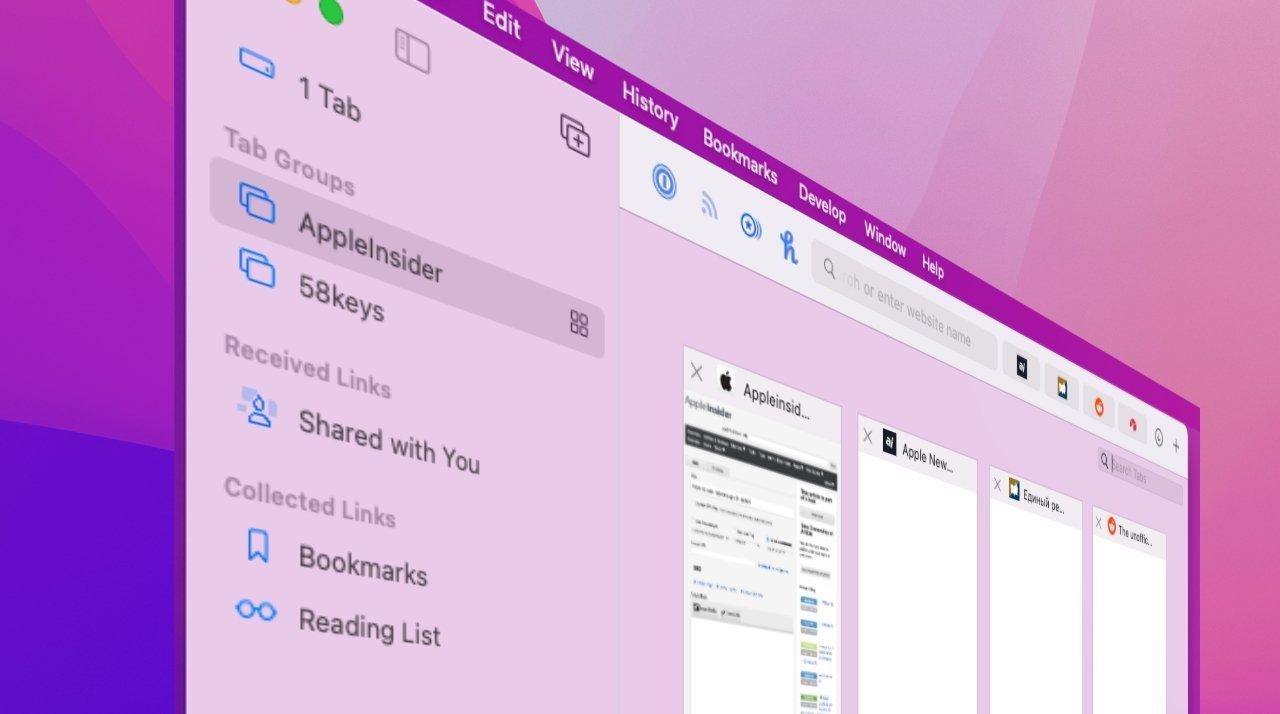
Likely debuting at WWDC, Safari users will soon find it will be easier to create groups of tabs, with a test version of the browser for the 27 operating systems using AI to group them for you.
Apple introduced Tab Groups in Safari 15 back in 2021, to help users organize and save groups of frequently-used browser tabs. Five years later, it is planning another change to the feature.
A test version of Safari for iOS 27, iPadOS 27, and macOS 27 has updated the Tab Groups to include an automated organization feature, says Mark Gurman in his “Power On” newsletter for Bloomberg. The center-top button for moving between tab groups has a new test option, appropriately titled “Organize Tabs.”
This feature is used to tell Safari to automatically group tabs together, or to leave them be manually collated by the user. When selected, Safari says that “tabs will group into topics you browse.”
Apple apparently hasn’t labeled it as a feature that uses Apple Intelligence, but it is using some form of AI. This sounds similar in concept to the Reminders feature, which can group items from a list into categories, such as product types in a shopping list.
Part of a wider OS update
The Safari update is going to be one of a number of software changes introduced as part of the new 27-generation of operating systems, due to be shown off at WWDC 2026 in June. It’s also not the only AI-related feature that has cropped up in pre-WWDC reports.
So far, there have been rumors of users being able to select their preferred AI model in iOS 27, expanding on the existing ChatGPT-based capabilities. Visual Intelligence will also be updated for iOS 27, shifted to the Camera app to make it easier to access.
The Photos app is also anticipated to get AI changes, on top of the existing Clean Up feature. This includes extending, reframing, enhancing, and contextual editing of an image.


AI + ML
PLUS: Robot becomes Buddhist monk in Korea; TikTok spending $25bn in Thailand; Baidu floating chip biz; and more!
China’s Cyberspace Administration last week published draft regulations governing the behavior of AI agents and suggested humans should always retain the ability to review decisions taken by software.
The draft expresses Beijing’s enthusiasm for AI agents with a call for efforts to develop datasets that accelerate development, along with security standards that make agents safe to use and ensure they behave ethically.
There’s also a call to develop mandatory standards for how agents will behave “in fields such as healthcare, transportation, media, and public safety.” China also wants to participate in international fora that develop such standards.
The draft calls for developers of AI agents to “clarify the reasonable boundaries and required authority for various decision-making methods, such as decisions limited to the user, decisions requiring user authorization, and autonomous decisions by the intelligent agent.”
Those boundaries should “Ensure that users have the right to know and the final decision-making power regarding the autonomous decisions made by the intelligent agent, and that the intelligent agent’s actions do not exceed the scope authorized by the user.”
The draft identifies many tasks Beijing thinks agents might take on, including marking homework, analyzing medical images, evaluating employee performance and recommending promotions, helping disaster relief efforts, and even providing “intelligent management of the entire bidding and tendering process, ensuring standardization and efficiency throughout.”
Samsung turns off its TV and appliance business in China
Korean giant Samsung last week decided to quit China’s TV and appliance markets.
“In response to the rapidly changing market environment, after careful consideration, Samsung Electronics has decided to cease sales of all home appliances, including televisions and monitors, in the Chinese mainland market,” states an “adjustment notice” on the Samsung China website.
Samsung will honor warranties, and continue to provide after-sales service.
The company hasn’t said why it’s quitting these markets in China. The Register expects the reasons have a lot to do with the rise and rise of Chinese consumer electronics companies, which can make a patriotic pitch in addition to pointing out the high quality of their products.
Samsung’s not the first to decide it’s too tough to try trading televisions in China: Sony quit the country, too.
Thailand approves giant TikTok datacenter
The government of Thailand last week approved TikTok’s plan to spend ฿842 billion ($25 billion) on new datacenters in the country.
Thailand’s Board of Investment said the project will see TikTok “install additional servers and expand data storage and processing infrastructure across Bangkok, Samut Prakan and Chachoengsao Province, supporting rising demand for digital services and strengthening Thailand’s role in regional digital infrastructure.”
The Board also signed off on a 200 MW datacenter to be built by Skyline Data Center and Cloud Services Co, and a 134 MW facility from Bridge Data Centres.
Baidu to float its chip biz
Chinese web giant Baidu has filed paperwork to spin out its chip design business Kunlunxin.
Baidu flagged its plan to do this in January, when it said the aim was to “independently showcase Kunlunxin’s value, attract investors focused on the AI chip sector, and leverage its standalone listing to enhance its market profile, broaden financing channels, and better align management accountability with performance.”
“This also supports the effort to unlock the value of Baidu’s AI-powered businesses.”
Kunlunxin’s chips suit inferencing and training workloads, but their performance can’t match Nvidia’s latest chips – or even four-year-old kit like the H100. That hasn’t stopped Baidu using the chips to power its own AI services, and major Chinese corporations also use the company’s chips.
Japan and EU to improve tech interoperability
The EU-Japan Digital Partnership Council recently convened its annual meeting and last week revealed that talks included “deepened discussions on the joint development and interoperability of data spaces” and promised to keep talking in a new “Data Strategy Working Group” that will “improve the interoperability of data policy frameworks.”
The meeting also discussed a successful pilot on interoperable digital identities which apparently “showed that cross-border use is technically possible, even where governance frameworks and technical architectures differ. Using prototypes of digital identity wallets, the project demonstrated how interoperability can be achieved in practice between different systems.”
As part of discussions, the EU and Japan agreed to begin working in new areas, including video games and audiovisual strategies.
Humanoid robot becomes Buddhist monk
Seoul’s Jogye Temple last week allowed a robot named Gabi to take the vows required of a Buddhist monk.
Temple leaders reportedly decided to initiate the robot because they feel humanoid machines will soon become a part of everyday life.
In February, the President of the Jogye Order, the Most Venerable Jinwoo, said “our lives have become ever more convenient thanks to cutting-edge science and AI. Yet the anxieties, anger, depression, and isolation—mental attachments and sufferings that science cannot resolve— are growing ever deeper.”
“This does not mean that Buddhism withdraws from this vast technological civilization,” he said. “Rather, we aim to fearlessly lead the AI era and redirect its achievements toward the path of attaining peace of mind and enlightenment.”
“In the age of AI and quantum science, peace of mind will be cultivated through Buddhism.” ®

Looking for a different day?
A new Quordle puzzle appears at midnight each day for your time zone – which means that some people are always playing ‘today’s game’ while others are playing ‘yesterday’s’. If you’re looking for Sunday’s puzzle instead then click here: Quordle hints and answers for Sunday, May 10 (game #1567).
Quordle was one of the original Wordle alternatives and is still going strong now more than 1,400 games later. It offers a genuine challenge, though, so read on if you need some Quordle hints today – or scroll down further for the answers.
SPOILER WARNING: Information about Quordle today is below, so don’t read on if you don’t want to know the answers.
Latest Videos From

Quordle today (game #1568) – hint #1 – Vowels
How many different vowels are in Quordle today?
• The number of different vowels in Quordle today is 5*.
* Note that by vowel we mean the five standard vowels (A, E, I, O, U), not Y (which is sometimes counted as a vowel too).
Quordle today (game #1568) – hint #2 – repeated letters
Do any of today’s Quordle answers contain repeated letters?
• The number of Quordle answers containing a repeated letter today is 0.
Quordle today (game #1568) – hint #3 – uncommon letters
Do the letters Q, Z, X or J appear in Quordle today?
• No. None of Q, Z, X or J appear among today’s Quordle answers.
Quordle today (game #1568) – hint #4 – starting letters (1)
Do any of today’s Quordle puzzles start with the same letter?
• The number of today’s Quordle answers starting with the same letter is 0.
If you just want to know the answers at this stage, simply scroll down. If you’re not ready yet then here’s one more clue to make things a lot easier:
Quordle today (game #1568) – hint #5 – starting letters (2)
What letters do today’s Quordle answers start with?
• C
• S
• B
• Y
Right, the answers are below, so DO NOT SCROLL ANY FURTHER IF YOU DON’T WANT TO SEE THEM.
Quordle today (game #1568) – the answers

The answers to today’s Quordle, game #1568, are…
A close one today. After picking “chump” over CLUMP I had minimal margin for error.
Fortunately, a lack of alternatives saved the day.
I knew that my final word ended O-A-S-T and with “coast” and “roast” eliminated there were only two more options that I knew of. I still felt nervous, though, after I guessed “toast” instead of BOAST.
Daily Sequence today (game #1568) – the answers

The answers to today’s Quordle Daily Sequence, game #1568, are…
Quordle answers: The past 20
- Quordle #1567, Sunday, 10 May: DONOR, FAITH, ROBOT, EXILE
- Quordle #1566, Saturday, 9 May: SHALL, ERUPT, WISER, DRIER
- Quordle #1565, Friday, 8 May: TOXIN, HELIX, FLOUT, ADULT
- Quordle #1564, Thursday, 7 May: DEALT, LOWLY, AHEAD, CHEEK
- Quordle #1563, Wednesday, 6 May: DRESS, SWIFT, HOARD, STEAD
- Quordle #1562, Tuesday, 5 May: SNEER, NEVER, RAMEN, TODDY
- Quordle #1561, Monday, 4 May: IMBUE, FIFTY, STEEP, PINTO
- Quordle #1560, Sunday, 3 May: HATER, FORCE, BASTE, TROUT
- Quordle #1559, Saturday, 2 May: DENIM, WAIVE, CHANT, RENAL
- Quordle #1558, Friday, 1 May: LUMEN, LINEN, GOING, THANK
- Quordle #1557, Thursday, 30 April: LOYAL, CACHE, SWEAT, LIGHT
- Quordle #1556, Wednesday, 29 April: TRAIL, RENEW, BELLE, GREED
- Quordle #1555, Tuesday, 28 April: CLINK, BONUS, BRUSH, DRIER
- Quordle #1554, Monday, 27 April: ARGUE, LUNAR, SEVER, THEIR
- Quordle #1553, Sunday, 26 April: PITHY, BOAST, PRIED, BLIMP
- Quordle #1552, Saturday, 25 April: RESET, DRINK, DEITY, SLACK
- Quordle #1551, Friday, 24 April: LOWLY, RELAX, BRASS, LUNCH
- Quordle #1550, Thursday, 23 April: KNEAD, PULSE, CRUST, TASTE
- Quordle #1549, Wednesday, 22 April: WEEDY, OMEGA, CLEFT, GAVEL
- Quordle #1548, Tuesday, 21 April: FLUTE, KITTY, AFIRE, GRANT

IT sector unemployment “increased to 3.8% in April from 3.6% in March,” reports the Wall Street Journal.
But they add that the increase reflects “an ongoing uncertainty in tech as AI continues to play havoc with hiring. That’s according to analysis from consulting firm Janco Associates, which bases its findings on data from the U.S. Labor Department.”
On Friday, the department said the economy added 115,000 jobs, buoyed by gains in industries including retail, transportation and warehousing and healthcare. The unemployment rate was unchanged at 4.3%. But the information sector lost 13,000 jobs in April.
While it’s still too early to say exactly how AI is affecting employment overall, some businesses, especially in the tech industry, have said it’s part of the reason they’re cutting staff. In April, Meta Platforms said it would lay off 10% of its staff, or roughly 8,000 people, as it seeks to streamline operations and pay for its own massive investments in AI. Nike will reduce its workforce by roughly 1,400 workers, or about 2%, mostly in its tech department, as it simplifies global operations. And Snap is planning to eliminate 16% of its workforce, or about 1,000 positions, as it aims to boost efficiency. In other areas of IT, which includes telecommunications and data-processing, employment is now down 11%, or 342,000 jobs, from its most recent peak in November 2022.
But there’s not just AI to blame. Inflation and economic uncertainty linked to the Iran conflict is giving some chief executives and tech leaders reason to pull back or pause their IT hiring, said Janco Chief Executive Victor Janulaitis.
The article even notes that postings for software developer jobs “are up 15% year-over-year on job-search platform Indeed, according to Hannah Calhoon, its vice president of AI”. But employers do seem to be looking for experienced developers, which could pose a problem for recent college graduates.

The free/open source project OrcaSlicer is a popular fork of 3D printer slicing software from Bambu Lab. But Tuesday independent developer Pawel Jarczak shuttered the project “following legal threats from Bambu Lab,” reports Tom’s Hardware:
Jarczak’s fork of OrcaSlicer would have allowed users to bypass Bambu Connect, a middleware application that severely limits OrcaSlicer’s access to remote printer functions in the name of security. Jarczak said in a note on GitHub that Bambu Lab threatened him with a cease and desist letter and accused him of reverse engineering its software in order to impersonate Bambu Studio.
From Bambu Lab’s blog post:
Bambu Studio is an open-source project under the AGPL-3.0 license. Anyone can take its code, modify it, and distribute it… That’s what OrcaSlicer does, and 734 other forks do as well. We have no issue with that and never have. At the same time, a license for code is not a pass to our cloud infrastructure… Our cloud is a private service. Access to it is governed by a user agreement, not the AGPL license… [T]he modification in question worked by injecting falsified identity metadata into network communication. In simple terms: it pretended to be the official Bambu Studio client when communicating with our servers… If this method were widely adopted or incorrectly configured, thousands of clients could simultaneously hit our servers while impersonating the official client.
“User-Agent is not authentication,” counters OrcaSlicer’s developer. “It is only self-declared client metadata. Any program can set any User-Agent.” And “the User-Agent construction comes directly from Bambu Lab’s own public AGPL Bambu Studio code…. So on what basis can anyone claim that I am not allowed to use this specific part of AGPL-licensed code under the AGPL license…? My work was based on publicly available Bambu Studio source code together with my own integration layer.”
But the bottom line is that Bambu Lab “contacted me directly and demanded removal of the solution.”
I asked whether I could publish the private correspondence in full for transparency. That request was refused… They also referred to legal materials and stated that a cease and desist letter had been prepared…
I removed the repository voluntarily. That removal should not be interpreted as an admission that all legal or technical allegations made against the project were correct. I removed it because I have no interest in maintaining a prolonged dispute around this particular implementation, and no interest in continuing to distribute it.
YouTuber and right-to-repair advocate Louis Rossmann reviewed the correspondence from Bambu Lab — then pledged $10,000 for legal expenses if the developer returned his code online. (“I think that their legal claim is bullshit,” Rossman said Saturday in a YouTube video for his 2.5 million subscribers. “I’m not a lawyer, but I’m willing to put my money where my mouth is.”)
The video now has over 129,000 views so far. “Rossman has not started a crowdfunding site yet,” Tom’s Hardware notes, “stating in the comments that he wants to prove to Jarczak that he has supporters willing to put their money where their mouth is. The video had over 129,000 views so far, with commenters vowing to back the case as requested.”


The idea of installing a software update on your fridge already feels kind of weird, let alone one centered around improving its AI capabilities. But that’s exactly what’s happening to Samsung’s line of Bespoke refrigerators this week, and to my surprise this patch is making major strides at providing truly useful machine learning in a modern day icebox.
As a quick recap, Samsung has offered AI-powered features like automatic food recognition and meal planning on its Bespoke refrigerators for a couple years already. However, as I found out after reviewing its flagship model late last year, the company’s AI capabilities are still very much a work in progress. Previously, the fridge could recognize around 60 different kinds of fresh foods (like fruits and veggies) alongside another 50 or so packaged goods like yogurt or popcorn. That felt like a decent start, but considering the sheer number of different items you can find at a typical grocery store, it was far from complete. Furthermore, you often had to input additional data like the number of items or when something was first added, which made the idea of AI-assisted grocery tracking more tedious than I’d like. I don’t know about you, but I generally don’t want to have to type on my fridge and I’m pretty sure the engineers at Samsung agree, which is probably what brought about this major update to its Bespoke refrigerator software.
So what’s new?
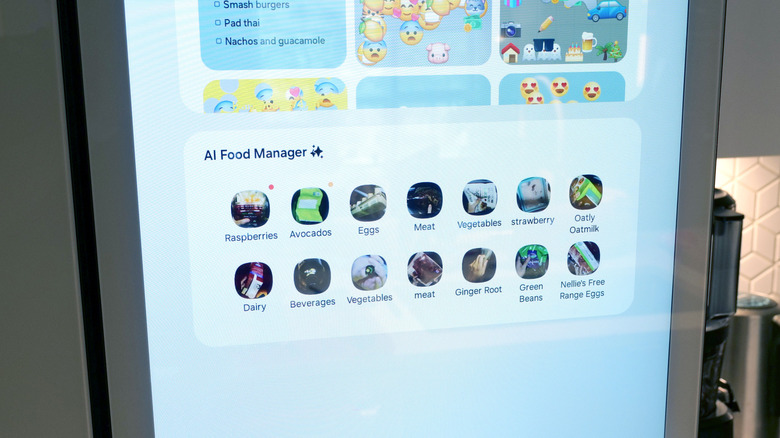
The big change is that Samsung is adding support for Google Gemini, which has several important implications. By combining Samsung’s existing on-device object recognition with Google’s cloud-based models, the total number of identifiable foods is increasing from just over 100 items to more than 2,000. Now this does mean you will need to connect the fridge to Wi-Fi, but considering the number of other smart features it supports like calendar integration and video playback, that’s not a big ask.
Another update is that Samsung is using Gemini to expand voice controls, allowing users to ask the fridge to change things like device settings, check details like when the water filter was last replaced or to even help troubleshoot issues. And depending on the situation, the fridge can even play back a tutorial about how to solve the issue.
Alternatively, for more complicated or harder-to-solve problems, Samsung is introducing what it calls Reliability AI, which is designed to monitor the fridge’s components or help identify faults before they get too serious. Or in cases where the device needs to be serviced, the AI can provide more detailed info to agents while potentially allowing them to fix certain things remotely.
For example, a Samsung representative told me that if a customer calls and says that cubes from the icemaker are coming out in clumps and stuck together, Reliability AI could allow agents to reduce the amount of water that is being added to the ice tray — all without ever needing to physically come to your home. Critically, Samsung says that while the fridge will monitor and track device health metrics, owners will need to provide express consent in order for repair personnel to access that data. Meanwhile, if an issue does require in-person servicing, Samsung says that by sharing this data with repair technicians, it allows people to identify and solve problems faster instead of having to arrive with no context and diagnose issues from scratch.
How this works in the real world
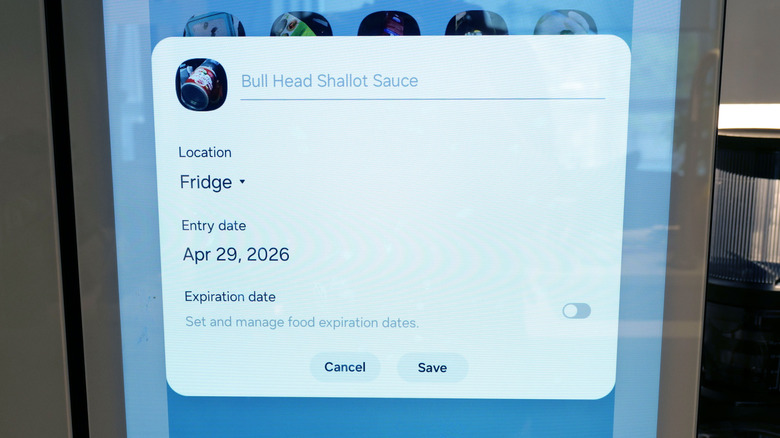
My test unit hasn’t run into any mechanical issues in the eight months I’ve been using it, so I haven’t been able to evaluate Samsung’s Repairability AI. That said, after checking it out first at Samsung’s headquarters, I’ve had the chance to use an early version of the Bespoke line’s new software over the last two weeks — including its upgraded support for cloud-based object recognition — and the improvement is profound. Even after using it for a while, I’m still surprised by how many different foods it recognizes. Deep in the back of my fridge, I have a can of Bull Head Shallot Sauce, which is a rather niche ingredient from Taiwan used almost exclusively in Asian dishes. However, the AI had no trouble recognizing it, automatically tagging it and including when it was first added to the fridge’s AI Food Manager.
On top of that, the system is now much better at recognizing brands and counting the number of specific ingredients in order to create more detailed listings. It can distinguish between a Diet Coke and Coke Zero while also accurately noting that there were multiples of each item. And even though the fridge often has to ping a cloud-based server somewhere to help recognize various items, results appeared rather quickly, often in less than a few seconds. And for certain foods like avocados, I was delighted that the fridge tracks how long you’ve had it and will surface a notification that it might be getting close to expiration. Granted, it’s not always right, but all I really need is a reminder to check on things and it does just that.
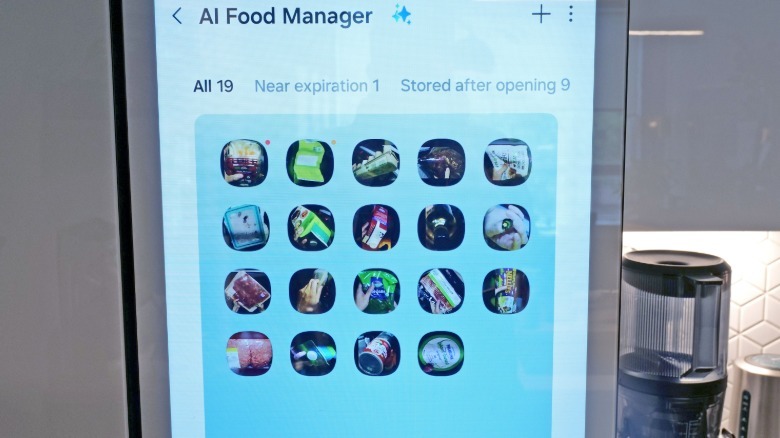 Sam Rutherford for Engadget
I also noticed that the fridge now remembers when you frequently take a specific food out and then asks if you want to add that item to your shopping list. It’s a nice reminder to replenish staples you use regularly and happens in a low-friction way, so it doesn’t become annoying. From there, you can simply check your phone when you’re at the store instead of needing to manually curate a list every week. Also, because the fridge does a much better job of recognizing and tracking what’s inside, it can provide better suggestions about recipes you can cook using ingredients you already have.
That said, like a lot of current models, the AI doesn’t always nail every detail. For example, I was initially impressed when it automatically labeled a tub of fake cream cheese as “Philadelphia Plant-based,” until I realized that the label was incomplete and the AI was merely reading what was written on the lid and didn’t have the smarts to accurately finish the description. Don’t get me wrong, it provides more than enough info to help me figure out what’s in the fridge when I’m glancing at the Food Manager. It’s just not quite spot on.
Outlook and things that still need work

The one issue with this update is that like a lot of AI services today, Samsung’s new software can be a bit overconfident or prone to hallucinations. One time, as my wife was putting something back in the fridge, the algorithm took a picture of a brightly colored bandage on her finger and labeled that as a veggie, which it very much is not. Other times it seemingly just guesses. But I’d argue going from around 100 identifiable items to over 2,000 is a very welcome improvement even with the limitations.
The other weird thing is that even though Samsung is leveraging Google’s AI models for a lot of the fridge’s new features, you won’t see any obvious callouts to Gemini inside the device itself. That’s kind of a bummer because Bixby is still the only digital assistant you can use and talk to directly.
I’ve said before that Samsung’s AI food recognition is a work in progress and I think that still holds true. With this latest update, the company has gotten a lot closer to delivering on the promise of a fridge with truly useful AI-powered features. What once felt more like a promising tech demo has quickly become a handy tool to keep track of your groceries, even with some hiccups here and there.

The Federal Communications Commission has extended a key waiver allowing certain foreign-made routers, drones, and drone components to continue receiving software and firmware updates in the United States until at least January 1, 2029.
The move comes after growing concerns that millions of already-deployed devices could become cybersecurity risks if manufacturers were suddenly blocked from issuing security patches and compatibility updates. The decision was announced through the FCC’s Office of Engineering and Technology (OET), which also expanded the scope of the waiver to cover additional software-related changes needed to maintain device functionality.
Security concerns forced a regulatory rethink
The extension follows a broader FCC crackdown that added certain foreign-produced routers and unmanned aerial systems to the agency’s “Covered List” in late 2025 and early 2026 over national security concerns. Those restrictions effectively blocked new approvals and limited post-certification modifications for affected devices.
Initially, existing waivers would have allowed updates only until 2027. However, regulators later acknowledged that cutting off software support entirely could create a bigger problem by leaving devices exposed to vulnerabilities, cyberattacks, and compatibility failures.

The updated waiver now permits critical firmware and software updates for previously authorized devices, even though the products themselves remain subject to broader restrictions. The FCC emphasized that the policy does not reverse the bans or remove affected products from the Covered List.
Why consumers should pay attention
For everyday users, the decision matters because routers and drones depend heavily on ongoing software support to remain secure and functional. Routers in particular act as gateways for home networks, connecting phones, laptops, smart TVs, cameras, and other internet-enabled devices. Without security patches, known vulnerabilities can become easier targets for hackers.

The FCC’s extension effectively gives consumers more time before worrying about their devices becoming unsupported or obsolete. It also reduces the risk of millions of products suddenly losing compatibility with future operating systems, networks, or connected services.
What happens next
While the waiver offers temporary relief, it also highlights the growing tension between national security policy and practical cybersecurity needs. Regulators are now expected to spend the next few years developing a more permanent framework governing foreign-made networking equipment and drones.
For manufacturers, the message remains mixed: existing products can continue receiving critical updates, but future approvals for foreign-made devices will likely face tighter scrutiny and more restrictive oversight in the years ahead.

While Artemis II was primarily a demonstration flight of the architecture NASA plans to use for future lunar missions, it was also an excellent excuse for the crew to snap some photos of the Moon and Earth with the benefit of modern camera technology. If you’ve been looking forward to seeing more of the crew’s images, you’re in luck, as thousands of new images have recently been released.
 Now we don’t mean to beat up on the folks at NASA, but browsing through these images, we couldn’t help but be reminded of an article we saw on PetaPixel that discussed the space agency’s haphazard approach to sharing images online.
It’s really more like an unsorted file dump than anything, made worse by the fact that you have to access it through a government website that looks and performs like it was designed in the early 2000s. There’s even a prominent button that attempts to load a gallery feature that relies on the long-deprecated Adobe Flash. It would be nice to see the situation improved by the time astronauts actually touch down on the lunar surface, but we wouldn’t count on it.
Speaking of old tech, we’ve been following the resurgence of keyboard-equipped smartphones with great interest, as we imagine many of you have been. A recent CNBC article addresses the trend, although it didn’t quite take the nerd contingent into account. We want physical keys so we can work in the terminal and write code without fighting an on-screen keyboard, but of course, that’s not exactly what your average consumer is looking for.
It’s quite the opposite, in fact. A 20-something user referenced in the article explained how the younger generations see the physical keyboard as a way to be less connected to their phones, describing it as “an extra barrier of inconvenience that adds more steps into the thinking process.” If you need us, we’ll be collecting dust in the corner.
As regular readers may know, we’ve also taken an interest in plug-in solar panels recently. So-called “solar balconies” have become quite popular in Europe, but regulatory friction in the United States has prevented them from achieving similar success here. An article in the MIT Technology Review talks about the process of bringing solar balconies to the US, and we’re not overly thrilled with some of the developments it highlights.
As the key hurdle appears to be safety, UL Solutions recommends that balcony solar panels be plugged into a specialized outlet. If putting a regular AC plug on the end of a solar panel can lead to potentially dangerous situations, they believe the solution is to require a different plug that no one could mistake for anything else, with built-in safety features to reduce the risk of electric shock.
 That might not seem unreasonable at first, but it actually represents a pretty serious hurdle for many users. Consider that the whole advantage of these panels is the convenience: you can simply open the box, plug them in, and start collecting energy. But if you need to install a special outlet, potentially requiring an electrician, the whole concept falls apart. Expect to hear more from us on this particular subject as it develops.
Finally, Spirit Airline customers weren’t the only ones running into issues this week — a Southwest flight in California was delayed due to complications with a robotic passenger. The bot actually had a ticket, but the flight crew said it still violated the airline’s rules for large carry-on luggage and had to be moved to a different seat. Then somebody realized the robot’s relatively large lithium-ion battery was also in violation of carry-on limits, and it had to be removed and confiscated by authorities. Important details to keep in mind if you happen to be a robot planning your summer vacation.
See something interesting that you think would be a good fit for our weekly Links column? Drop us a line, we’d love to hear about it.


During an investor call following the release of AMD’s first-quarter 2026 earnings, CEO Lisa Su confirmed that the Epyc Venice processors remain on schedule for launch later this year. The server CPUs will mark the debut of the Zen 6 architecture and AMD’s first move to TSMC’s 2nm process technology.
Read Entire Article
Source link

Tech2 seconds ago
Hacked Video File Holds Multiple Films On YouTube

Business2 minutes ago
Urban Company shares tank 9% after Q4 net loss swells to Rs 161 crore despite a sharp revenue uptick

Sports6 minutes ago
Takeaways: Ducks impress with bounce-back performance vs. Golden Knights

NewsBeat2 months ago
Manchester United reach agreement with Casemiro over contract clause amid transfer speculation

Politics1 month ago
US brings back mandatory military draft registration

NewsBeat1 month ago
Steven Gerrard disagrees with Gary Neville over ‘shock’ Chelsea and Arsenal claim | Football


-
 Crypto World3 days ago
HarrisX Poll Found 52% of Registered Voters Support the CLARITY Act
-

 Crypto World4 days ago
Upbit adds B3 Korean won pair as Base token gains Korea access
-

 Fashion2 days ago
Weekend Open Thread: Marianne Dress
-

 Tech6 days ago
Image AI models now drive app growth, beating chatbot upgrades
-
 NewsBeat4 days ago
NCP car park operator enters administration putting 340 UK sites at risk of closure
-
 Business2 days ago
Ignore market noise, India’s long-term story intact, say D-Street bulls Ramesh Damani and Sunil Singhania
-

 Politics2 days ago
Politics Home Article | Starmer Enters The Danger Zone
-
 Sports7 days ago
2026 NHL playoff picks: Second-round predictions, series odds, Stanley Cup bracket
-

 Crypto World6 days ago
UAE Free Zone Deploys Blockchain IDs to Verify Registered Firms
-

 Crypto World5 days ago
BlackRock CEO Larry Fink Discusses a New Asset Class
-

 Crypto World4 days ago
Robinhood says Wall Street is building onchain
-

 Tech5 days ago
Apple and Samsung are dominating smartphone sales so thoroughly that only one other company makes the top 10
-
Entertainment6 days ago
Serena Williams hits Met Gala in metallic dress after GLP-1 reveal
-

 Fashion4 days ago
The Best Work Pants for Women in 2026
-
 Sports7 days ago
Hearts v Rangers LIVE: Prediction, team news and line-ups as Scottish Premiership title rivals meet at Tynecastle
-

 Politics6 days ago
Met Gala 2026: Madonna’s Dramatic Red Carpet Look Steals The Show
-

 Tech5 days ago
I tested the Xiaomi 17 Ultra’s camera and I don’t think I’ll ever go back to an iPhone
-

 Entertainment7 days ago
Skai Jackson Responds To AI Baklash After Viral Snapchat Photos
-
Crypto World4 days ago
The FOMO Is Back: Why Bitcoin’s Latest Rally Has Analysts Flashing Warning Signs
-
 Tech4 days ago
AI agents are missing all the discussions your team is having. SageOX has an answer: agentic context infrastructure
You must be logged in to post a comment Login