Connect with us
DAPA Banner

Tech

The Weird, Twisting Tale of How China Spied on Alysa Liu and Her Dad

Published

on

On November 16, 2021, Matthew Ziburis sat in his car in a residential neighborhood in the Bay Area stalking an “enemy,” as he put it. A veteran of both the US Army and Marine Corps, Ziburis had previously served in Iraq. But on this mission, he was working at the behest of China’s government. The targets that autumn day were American citizens: Arthur Liu and his teenage daughter, Alysa.

Arthur’s personal story was an exemplar of the American Dream. As a university student, he took part in the 1989 pro-democracy movement in China. After the crackdown at Tiananmen Square that year, he fled to the United States, settling in California. Arthur poured a small fortune and an equal amount of energy into molding Alysa into a figure skating phenom. As a national champion at age 13, she bantered along with Jimmy Fallon on The Tonight Show, and was at the time on track to represent America at the Winter Olympics the following year in Beijing.

Ziburis was surveilling the Liu home when he called Arthur, falsely claiming that he was a member of the US Olympic Committee who needed to discuss upcoming travel to Beijing, Arthur says. Ziburis was adamant that Arthur fax him copies of his and his daughter’s passports as part of a travel “preparedness check,” Liu tells WIRED. This struck Arthur as odd. In his many years dealing with sports bodies, he had never fielded such a request. Alysa’s agent did not respond to a request for comment.

Ziburis’ surveillance of Arthur and Alysa Liu that November day five years ago was just one episode in a bizarre saga that spanned from California to Beijing, touched New York City mayors and members of the US Congress, and has seen two people plead guilty and two more awaiting trial.

Advertisement

Unbeknownst to Ziburis, as he sat outside Aurthur and Alysa’s Northern California home, he too was being watched.

Ziburis had allegedly been dispatched to Northern California by Frank Liu, a self-styled fixer in the Chinese community from Long Island, New York, who was in turn receiving orders from a person in China named Qiang Sun. According to US authorities, Sun was working at the behest of the Chinese government. A concerned private investigator who once worked for Frank Liu had alerted the FBI to Frank’s escapades and was assisting authorities. Law enforcement was already on to Ziburis by the time he arrived. Anthony Ricco, Ziburis’ lawyer, did not respond to requests for comment.

Officers watched as Ziburis surveyed Arthur’s home and visited his law office. The heavy-set man sulking around Arthur’s office also caught the attention of a neighbor, who approached Ziburis and asked him if he needed help, Arthur says. Apparently concerned, the FBI called Arthur to warn him that Ziburis was heading to his home. By then, in part because of the harassment, Arthur and Alysa were boarding a plane to fly out of California. “It was like a movie,” Arthur says.

Alysa’s showing in Beijing in 2022 was disappointing. Burned out, she retired from the sport. Then in February, after returning to the ice after a two year hiatus, Alysa became the first US women’s figure skater to win Olympic gold since 2002—intentionally without her father by her side.

Advertisement

Despite her much-publicized complicated relationship with Arthur, Alysa’s success—punctuated by her signature pierced smile, racoon-tail dye job, and palpable joy for her sport—has reignited interest in the long-running case of transnational repression against her and her father. Human rights advocates and researchers have documented in recent years the lengths Beijing has taken to suppress critical voices, even those residing abroad or whose perceived transgressions date back decades.

Source link

Continue Reading
Click to comment

You must be logged in to post a comment Login

Leave a Reply

Tech

SaaS is not dead. You are just being sold the funeral

Published

on

The “AI has killed software” narrative has a handful of very loud beneficiaries and a lot of quiet evidence against it. The companies that will survive the next five years are the ones that refuse to treat the hyperscalers as the new gods.

Whenever I make an affirmation, I like to do my research first, and not to sound like a LinkedIn post. I wish more people in this industry did the same, as there is a prevailing mood where we think that big numbers are the whole story.


When the Black Death came among us, people probably thought it was the end. When wars came to our societies, people thought it was the end. Yet, in a strange way, we have a natural power to overcome obstacles and turn change to our advantage.

When AI started to infiltrate our work, and later our personal lives, a large group of people declared that “AI will replace people,” that this technology, not even particularly new, would conquer our brains, hearts, and work, and lead us where it wanted.

Advertisement

Yet we are still working; people are still writing, thinking, creating, building.

The 💜 of EU tech

The latest rumblings from the EU tech scene, a story from our wise ol’ founder Boris, and some questionable AI art. It’s free, every week, in your inbox. Sign up now!

In the last two years, more and more people have been saying that “SaaS is dead.” Of course, this phrase came from someone’s mouth, someone with enough influence to shape general opinion, and everybody was already in black, ready for the funeral.

Advertisement

In August 2024, Klarna’s chief executive, Sebastian Siemiatkowski, sat on an earnings call and mentioned, almost in passing, that the Swedish fintech had “shut down Salesforce.” Workday was next.

Klarna would build its own AI-driven replacements, a lightweight stack unshackled from the bloat of traditional enterprise software. The quote moved markets. Articles followed with headlines about the death of SaaS. Salesforce’s Marc Benioff, on stage at Dreamforce, was asked to respond to a customer who had apparently decided the future was AI and the past was his product. He looked, by his own admission, embarrassed.

Six months later, Siemiatkowski quietly clarified what had actually happened. Klarna had not replaced Salesforce with AI. It had replaced Salesforce with other SaaS: Deel for HR, third-party tools for CRM, the Swedish graph database Neo4j for data consolidation.

Klarna still uses Slack, which is still a Salesforce product. Siemiatkowski himself admitted on X that he was “tremendously embarrassed” by how the story had spiralled.

Advertisement

“No,” he wrote, “we did not replace SaaS with an LLM.”

This is the single most instructive story in enterprise software of the past two years. The distance between what was said and what was done reveals the mechanics of the entire “SaaS is dead” narrative. The headline travelled. The correction did not.

An industry of analysts, venture capitalists, and foundation model CEOs built a year of marketing on the louder half.

Start by asking who gains from the story that software-as-a-service is being replaced by artificial intelligence, because the answer is surprisingly narrow. The hyperscalers do, because AI workloads justify the $660 to $690 billion in capital expenditure the five largest US cloud and technology companies have committed for 2026, according to Futurum Group analysis, nearly double the previous year.

Advertisement

The foundation model labs benefit, because every dollar of enterprise software spend redirected to their APIs validates valuations that are otherwise difficult to defend. OpenAI ended 2025 at around $20 billion in annual recurring revenue. Anthropic crossed $9 billion in January 2026. These are genuinely large numbers. They are also, respectively, about three per cent and a little over one per cent of the hyperscaler capex being spent to serve them.

The venture capitalists benefit because their portfolio repricing depends on the narrative that AI-native companies will outrun the incumbents they once funded. And Nvidia, supplier and financier of the boom, benefits until it no longer does.

In March 2026, CEO Jensen Huang confirmed that his recent investments in OpenAI and Anthropic would likely be the last. The circular financing, Nvidia invests in OpenAI, OpenAI buys Nvidia chips, had reached the point where even the chipmaker was ready to stop calling it a virtuous cycle.

MIT’s Michael Cusumano, quoted by Bloomberg, put the arithmetic bluntly: “Nvidia is investing $100 billion in OpenAI stock, and OpenAI is saying they are going to buy $100 billion or more of Nvidia chips.”

Advertisement

You could call that demand. You could also call it bookkeeping.

The 95% number that should have ended the hype

The harder question is whether any of this is producing business results. Here the data is less generous than the pitch decks.

In July 2025, MIT’s Project NANDA published “The GenAI Divide: State of AI in Business 2025”, based on 150 executive interviews, 350 survey responses, and analysis of 300 public AI deployments. Its headline finding: despite roughly $30 to $40 billion in enterprise generative AI spending, 95% of pilots delivered no measurable impact on profit and loss. Only 5% reached production.

The response from the industry was not to recalibrate. It was to argue that the wrong metric was being used. UC Berkeley published a rebuttal suggesting ROI was an “industrial-era” measurement unsuited to a “cognitive-era transformation.”

Advertisement

This is what every hype cycle says in its late phase, that profit is a distraction, that what is being built is too large for ordinary standards. The same argument was made about WeWork, the metaverse, and blockchain.

Each time, the underlying assumption was that the people with capital and megaphones understood the future better than the people actually trying to run a business.

The 5% of AI projects that did succeed, MIT found, shared specific traits. They were built by specialised vendors, not attempted internally. They focused on back-office automation rather than sales theatre. They integrated deeply with existing workflows. Over half of enterprise AI budgets, meanwhile, were going to sales and marketing tools where ROI was lowest.

This is not a revolution sweeping through the enterprise. It is a lot of companies buying demo-friendly products that do not produce returns, while a minority does the unglamorous integration work that quietly extracts value.

Advertisement

The collapse that did not collapse

Stil, I have to admit that there are genuine signs of stress in the SaaS market. In February 2026, roughly $285 billion in market value evaporated from software stocks in a single trading session, what Wall Street christened the “SaaSpocalypse.”

ServiceNow fell 7%. Intuit dropped 11%. LegalZoom lost nearly 20%. Salesforce is down approximately 30% year-to-date. The business rationale, that per-seat pricing starts to collapse when one employee with AI tools can do the work of five, is not wrong.

But Bain & Company, looking at the broader record, has offered a useful correction: technological transitions rarely produce extinction.

They produce heterogeneity. Desktop survived mobile. Cloud did not kill on-premise so much as push it into specialised niches. The history of software is a history of layers accumulating, not replacing.

Advertisement

SaaS vendors are becoming agent-orchestration platforms. Salesforce has Agentforce. HubSpot has AI tools. Snowflake partners with Anthropic. The incumbents are being forced to adapt, but adaptation is not death.

IDC’s European practice framed it precisely in February: “SaaS is not dead, but it is metamorphosing.”

Pricing shifts towards outcomes. Interfaces become more agent-driven. But the real business logic, the auditing, versioning, compliance, and data gravity, remains where it was. The transformation is real. The extinction event is marketing.

The new gods are not new

Every major technology wave produces a brief period in which the companies at its centre are treated as reinventors of reality. For the cloud, it was AWS. For mobile, Apple. Before that, Microsoft.

Advertisement

The rhetoric around big techs like Nvidia, OpenAI, Anthropic, Meta, and xAI has the same cadence: they are building the new infrastructure of civilisation, rewriting how humans work, inevitable. There is a grain of truth in it. AI, and agentic AI in particular, is a real technological step. 

The companies most likely to thrive are the ones already disciplined enough to recognise the pattern. Every enterprise that survived the dot-com crash, the mobile transition, and the cloud migration did so by adopting what was useful and ignoring what was hyped, by measuring outcomes against costs, by refusing to treat platform vendors as infallible.

The companies that went under bought the whole story: that their customers would wait while they rebuilt, that the new paradigm would reward early and total commitment.

We reported in February on a pattern now visible across dozens of SaaS companies between $20 million and $80 million in ARR: shipping AI features while net revenue retention quietly collapses.

Advertisement

Eighteen months after going “AI-first,” one company watched its NRR drop from 108% to 94% and lost $2.8 million in renewals, not because the product got worse, but because everyone was building the future and nobody was watching the present. The AI features were legitimately good. The existing customers churned anyway.

None of this is an argument against AI. Previous AI cycles ended with research freezes, shuttered startups, and survivors who had been quietly doing useful work while everyone else claimed the moon. This cycle will likely end similarly.

Some hype will turn out to be real. Most revenue projections will not. A handful of current “AI-native” startups will become durable businesses. Many will be absorbed or exposed as wrappers.

The companies that come through refuse both extremes. They do not miss the trend, because dismissing AI in 2026 is as serious a strategic error as dismissing mobile was in 2010. And they do not drown in it. They do not empty their engineering teams into AI-first rebrands while their existing revenue base walks out the door. They do not treat the big tech companies as gods, but as what they are: very large commercial entities with very specific interests in what you believe about the future.

Advertisement

Klarna, for the record, is still paying for SaaS. It is also still paying OpenAI. This is probably the honest shape of the future: not the death of anything, but a quieter rearrangement in which the winners are the operators who kept their feet on the ground while everyone else was watching the sky.

The funeral for SaaS has been extremely well-attended. The corpse, on closer inspection, is still breathing.

Source link

Advertisement
Continue Reading

Tech

NSA Using Anthropic’s Mythos Despite Blacklist

Published

on

Axios reports that the NSA is using Anthropic’s restricted Mythos Preview model despite the Pentagon insisting the company poses a “supply chain risk.” Axios reports: The government’s cybersecurity needs appear to be outweighing the Pentagon’s feud with Anthropic. The department moved in February to cut off Anthropic and force its vendors to follow suit. That case is ongoing. The military is now broadening its use of Anthropic’s tools while simultaneously arguing in court that using those tools threatens U.S. national security.

Two sources said the NSA was using Mythos, while one said the model was also being used more widely within the department. It’s unclear how the NSA is currently using Mythos, but other organizations with access to the model are using it predominantly to scan their own environments for exploitable security vulnerabilities.

Anthropic restricted access to Mythos to around 40 organizations, contending that its offensive cyber capabilities were too dangerous to allow for a wider release. Anthropic only announced 12 of those organizations. One source said the NSA was among the unnamed agencies with access. The NSA’s counterparts in the U.K. have said they have access to the model through the country’s AI Security Institute. Anthropic’s CEO met with top U.S. officials on Friday to discuss “opportunities for collaboration,” according to a White House spokesperson, “as well as shared approaches and protocols to address the challenges associated with scaling this technology.”

Source link

Advertisement
Continue Reading

Tech

Typing with your brain might soon be as simple as wearing a beanie

Published

on


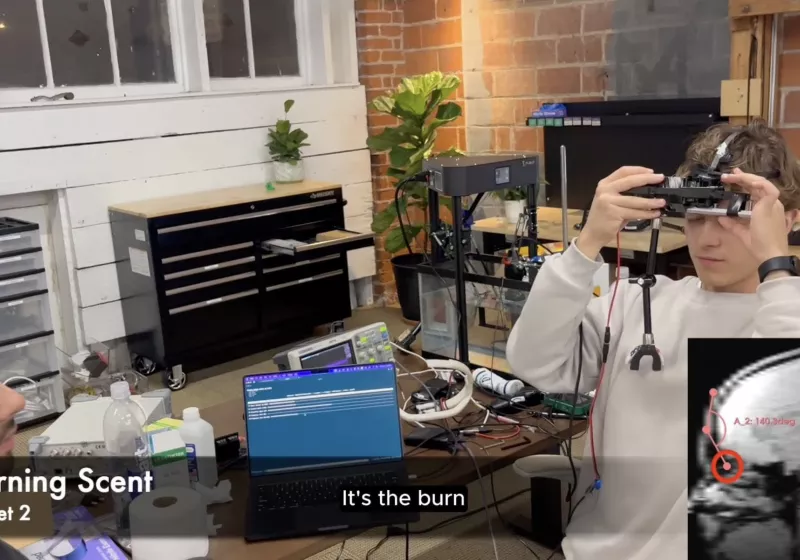
Silicon Valley startup Sabi is the latest entrant to suggest using the brain as an interface device. The company is developing a noninvasive device that translates internal speech into text. Rather than relying on implanted hardware, Sabi is building a wearable device – initially in the form of a beanie,…
Read Entire Article
Source link

Continue Reading

Tech

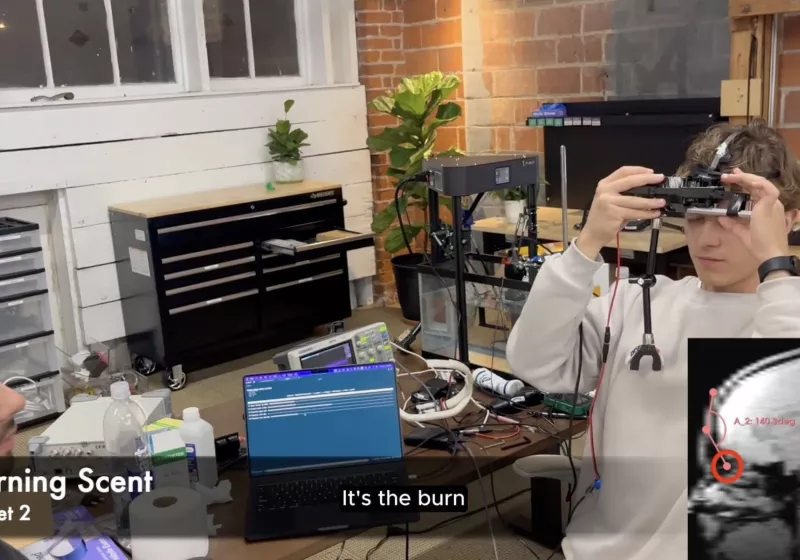
Researchers are using ultrasound to trigger smell directly in the brain for VR

Published

on


Current systems emphasize sight and sound, with some progress in haptics. Smell remains largely absent, despite its unusually strong connection to memory and emotion.
Read Entire Article
Source link

Continue Reading

Tech

Flash Joule Heating Recovers The Good Stuff

Published

on

Rare earth materials are a hot button topic these days. They’re important for everything from electric vehicles to defence hardware, they’re valuable, and everyone wishes they had some to dig up in their backyard. Lithium, too, is a commodity nobody can get enough of, with the demand for high-performance batteries grows each year.

When a material is desirable, and strategically important, we often start thinking of ways to conserve or recycle it because we just can’t get enough. In that vein, researchers have been developing a new technique to recover rare earth metals and lithium from waste streams so that it can be put back to good use.

Get It Back

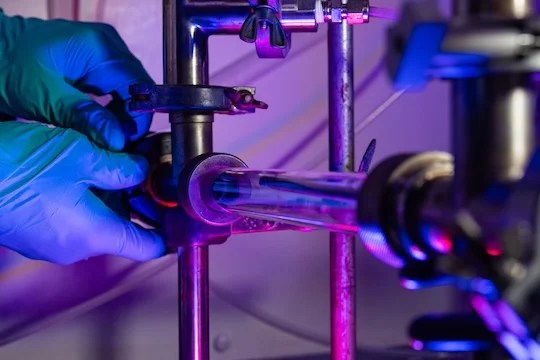
Enter the technique of flash joule heating. The method is relatively straightforward, in concept at least. It involves a high energy discharge from a capacitor bank, which is passed through a sample of material to be recycled or refined. The idea is that the rapid energy discharge will vaporize some components of the sample, while leaving others intact, allowing the desired material to be separated out and collected in a straightforward and economically-viable manner.  It does this in a manner rather contrary to traditional techniques, which often involve large amounts of water, acids, or alkalis, which can be expensive and messy to dispose of or reprocess to boot.

A flash joule heating apparatus used to recover rare earth materials. Credit: Jeff Fitlow, Rice University

Researchers from Rice have developed this technique to recycle rare earth metals from waste magnets. Imagine all the magnets that get thrown away when things like hard drives and EV motors get trashed, and you can imagine there’s a wealth of rare earth material there just waiting to be recovered.

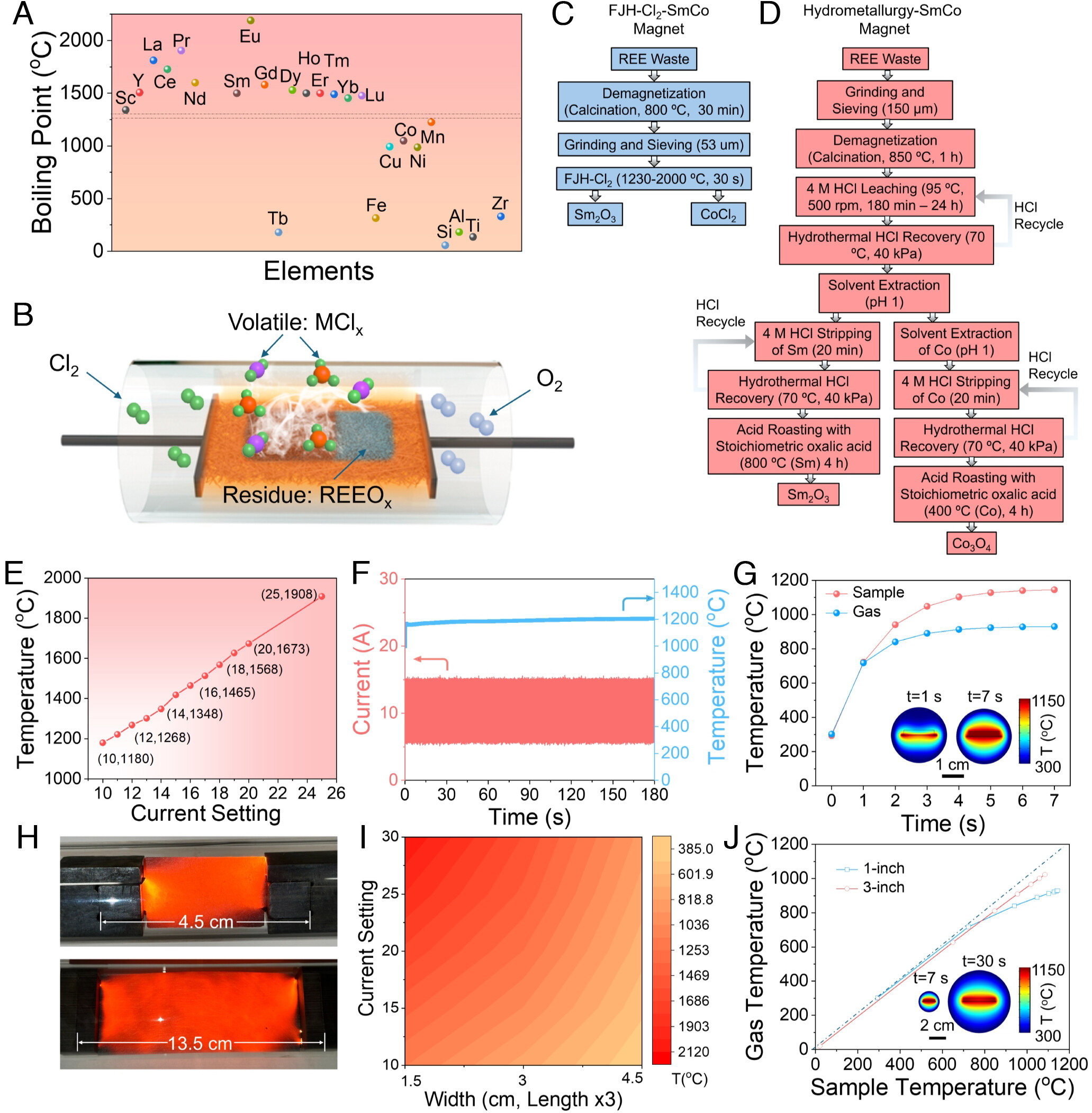
In this case, the high-energy discharge is applied to waste magnet material in an effort to vaporize the non-rare earth components that are present. The discharge is performed in the presence of chlorine gas, which would chlorinate materials like iron and cobalt in the sample, removing the volatile elements and leaving the rare earth elements behind in solid form. Laboratory experiments were able to refine the material to 90% purity in a single step.

Advertisement
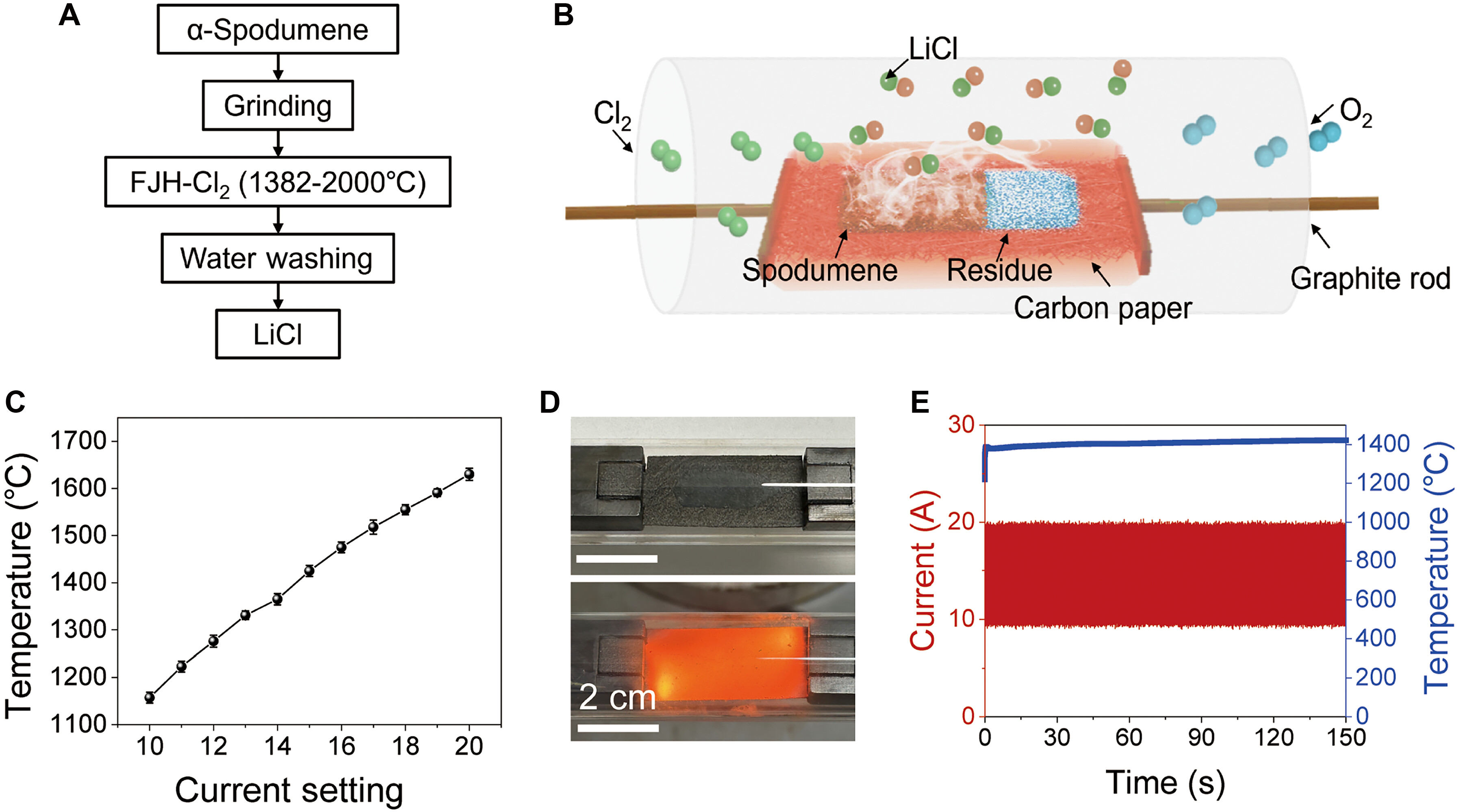
In the rare earth case, the undesired material is vaporized and removed by the chlorine gas while the rare earths remain behind in the solid phase. For capturing lithium from spodumene ore, it’s the opposite. Credit: research paper

As per the research paper, lifecycle analysis suggested the technique could reduce energy use by 87% compared to contemporary hydrometallurgy recycling techniques, while also reducing greenhouse gas emissions in turn and slashing operating costs by 54%.

The technique can also be applied to separate lithium from spodumene ore. It’s an abundant material, particularly in the United States, and improved ways to process it could increase its value as a source of lithium. When it comes to processing spodumene with flash joule heating, the discharge of electric current makes the lithium in spodumene available to react with chlorine gas. The rapid heating causes the vaporized lithium to form lithium chloride which can be bled off, while other components of spodumene like aluminium and silicon compounds remain behind. It’s basically the opposite of the rare earth recovery method.

As outlined in the research paper, this method achieved recovery of lithium chloride with 97% purity and a recovery rate of 94% in a single step. It’s also a lot simpler than traditional extraction methods that involve long periods of evaporating brine or using acid leeching techniques. Indeed, the laboratory rig was built using an arc welder to achieve the powerful discharge. Other researchers are examining the technique too and achieving similar results, hoping that it can be a cleaner and more efficient method of recovery compared to traditional hydrometallurgy and pyrometallurgy techniques.

The lithium recovery process using flash joule heating. Credit: research paper

These methods remain at the research stage for the time being. Pilot plants, let alone commercial operations, are still a future consideration. Regardless, the early work suggests there is economic gain to be had by developing recycling plants that operate in this manner. Assuming the technique works at scale, if it makes financial sense and recovers useful material, expect it to become a viable part of the recycling industry before long.


Advertisement

Source link

Continue Reading

Tech

Coral raises $12.5M to automate healthcare’s administrative back office

Published

on

The New York startup has built AI that reads handwritten fax forms, processes prior authorisations, and completes patient intakes in under five minutes, all without asking providers to change how they work. It has reached multiple millions in revenue in under a year and is targeting 4x growth by end of 2026.


Coral, the New York-based AI startup automating administrative workflows for specialty healthcare providers, has raised $12.5 million in a Series A led by Lightspeed and Z47.

The company was founded in 2024 by Ajay Shrihari, a robotics and AI researcher, and Aniket Mohanty, who has a background in medical image processing.

In under a year of commercial operation, Coral has reached multiple millions in annual revenue and is targeting 4x growth before the end of 2026.

Advertisement

The 💜 of EU tech

The latest rumblings from the EU tech scene, a story from our wise ol’ founder Boris, and some questionable AI art. It’s free, every week, in your inbox. Sign up now!

The problem Coral is solving is not technological complexity, it is administrative volume. In American healthcare, every appointment generates a trail of prior authorisation requests, referral packets, insurance eligibility checks, and discharge paperwork.

Much of this flows through fax machines, which remain deeply embedded in clinical workflows despite being a technology from a previous era.

Advertisement

Rather than attempting to replace fax infrastructure, an approach that would require providers to rebuild systems they cannot afford to rebuild, Coral connects to existing EHR systems, fax lines, and payer portals and automates around them.

Providers do not change how they work. Coral changes what happens inside that workflow.

The company began in the durable medical equipment sector, one of the most fax-intensive corners of outpatient care, where a single order can require multiple rounds of documentation before approval.

DASCO, a home medical equipment provider, has been an early customer, describing turnaround times dropping from hours or days to minutes.

Advertisement

Coral then extended the same model into infusion centres, where a delayed authorisation means a missed dose, not a delayed appointment, and into specialty pharmacy.

In each new vertical, the same administrative bottleneck appeared in the same shape.
The product’s core capability is document understanding at healthcare’s specific level of messiness: handwritten fax forms, scanned insurance cards, prior authorisation templates, and payer portal screens.

Coral’s models have reached 99.7% accuracy across these document types, a threshold the company describes as the minimum viable standard for healthcare, where errors have clinical and financial consequences.

Complete patient intakes, including complex cases, now run in under five minutes. When information is missing, which is frequent in this environment, the platform coordinates with payers, patients, and referral sources to resolve the gap without requiring staff intervention.

Advertisement

The strongest signal in the commercial story is not the revenue figure but the payment behaviour. A portion of Coral’s customers are paying the full contract value upfront, an unusual dynamic in enterprise software, and a striking one in a sector where vendor evaluation cycles are typically slow and risk-averse.

The explanation is mechanical: when a workflow that previously took hours completes in under five minutes at high accuracy, the return on investment is immediate and visible. Commit now, stop the queue now.

Coral recently shipped AI-powered voice and text workflows that automate follow-ups with payers, patients, and referral sources, replacing calls that previously required a staff member to pick up the phone.

The next phase of product development includes an AI workflow builder that will let providers design and deploy their own administrative processes without involving IT, and a co-pilot layer that surfaces operational intelligence from the data already flowing through the platform: which payers have the highest denial rates and why, where cases are stalling in the authorisation process, which referral sources convert reliably and which do not, and what changes would improve outcomes on insurance claim resubmissions.

Advertisement

Rohil Bagga, investor at Lightspeed, described the company as “delivering real outcomes at scale” in an environment where legacy automation has historically failed.

Ashwin KP, investor at Z47, framed the investment thesis around the specific characteristics of healthcare administration: over a trillion dollars in annual overhead, chronically underserved by technology, and requiring deep vertical expertise to crack.

The Series A funds team growth and product development, with Coral adding engineering talent alongside people who have spent careers inside healthcare operations.

Advertisement

Source link

Continue Reading

Tech

iPhone Ultra Launch Ahead: Six Big Upgrades Expected

Published

on

Apple is expected to introduce its first foldable iPhone later this year, and early reports suggest it may be called the iPhone Ultra. Newest leaks from tipster Jon Prosser suggest the device could bring one of the biggest changes to the iPhone lineup in years, especially in terms of design and usability. Here are six major upgrades that the iPhone Ultra is expected to offer.

Foldable Design with a New Look

iPhone Ultra Front Design
Image: FPT

The iPhone Ultra is expected to come with a completely new foldable design. Instead of a regular smartphone shape, it may open like a book, giving users a much larger screen when unfolded. It will also have a wider design instead of the usual tall shape seen in other foldables. For example, while using the outside screen, the user will have a smaller screen measuring 5.3 to 5.5 inches. Once unfolded, the second screen will expand up to 7.8 inches, bringing the user experience closer to that of an iPad mini.

The use of a titanium frame may help make it durable while keeping it lightweight. Another key highlight is the expected crease-free inner screen, which could improve the overall viewing experience. In terms of looks, the device may be limited to black-and-white color options.

Like other folding phones, TouchID will probably find its way back. It’s much easier to use a fingerprint sensor on the power button than to integrate Face ID sensors into both displays.

Software & Camera Configuration

Camera design of the iPhone Ultra
Image: FPT

One of the key differences between the iPhone Ultra and Pro models is the camera configuration. Unlike other models, the iPhone Ultra will have only two cameras. One will be a primary camera with a 48 MP sensor, while the other will be an ultra-wide camera with a 48 MP sensor. Unfortunately, since there won’t be a telephoto lens, zooming options may be limited for the users. Besides, the dual screen will require two front-facing cameras.

The iOS 27 is likely to introduce new multitasking features designed for the iPhone Ultra. Among the expected improvements are multi-app functionality, where users can perform multiple functions simultaneously, and app designs that more closely match what the iPad offers, particularly when used on the inner display. It is not going to be iPadOS but rather selected elements from the operating system.

Advertisement

Everything will be handled by the new A20 Pro chip, which may work on the 2nm manufacturing process. It’s very early to judge the performance numbers, but we are expecting the iPhone Ultra to feature 12 GB RAM and use the new C2 modem.

Expected Price

Apple is expected to position the iPhone Ultra as a premium product. The device is expected to start at around $1,999, making it Apple’s most expensive iPhone yet. However, since it offers both phone- and tablet-like experiences in a single device, some users may find the premium pricing justified.

Source link

Advertisement
Continue Reading

Tech

ASUS Drop Zone Service Now Available in More Cities Across India

Published

on

When Asus launched the Drop Zone program last year, it was seen as a commendable gesture to make repairs less taxing for consumers. Now, keeping in the same vein, Asus is expanding its Drop Zone initiative in India by adding 22 new stores to the network. The program, which allows users to submit laptops for servicing at ASUS Exclusive Stores instead of dedicated service centers, is now being rolled out across multiple regions, including Delhi NCR, Haryana, Karnataka, Kerala, Maharashtra, Tamil Nadu, Uttarakhand, Uttar Pradesh, and West Bengal.

What is Asus Drop Zone Service?

The Drop Zone initiative is designed to simplify the repair process by allowing customers to drop off and collect their devices at nearby ASUS stores. This eliminates the need to travel to service centers, which can often be inconvenient—especially for users in tier-2 and tier-3 cities.

With this expansion, ASUS is clearly trying to address common pain points like accessibility, turnaround time, and service transparency. Customers also get multiple service options, including carry-in support for immediate consultation, on-site servicing by technicians, and the Drop Zone model for easier logistics.

ASUS says it already has a wide after-sales network in India, with over 200 service centers and on-site support covering more than 17,000 pin codes across 761 districts. The Drop Zone expansion adds another layer to this ecosystem, bringing services closer to users. The company also offers 24/7 support through calls, chat, email, and remote troubleshooting. Speaking on the matter, Arnold Su, VP, Consumer and Gaming PC, System Business Group, ASUS India, said

Advertisement

At ASUS, our focus has always been on delivering a reliable and consistent ownership experience that extends well beyond the product itself. The expansion of our Drop Zone initiative into 22 additional stores marks a significant step towards making after-sales support more accessible and transparent for our customers. Guided by our 4A framework, we remain committed to building a service ecosystem that is responsive, convenient, and aligned with evolving customer needs.

Source link

Continue Reading

Tech

Company discards 32GB server RAM sticks worth $20,000

Published

on


At current market prices, the hardware appears valuable. Comparable SK hynix registered DDR4 modules currently sell for about $287.95 each, putting the total value at more than $20,000. However, that figure reflects today’s pricing, not what the hardware was worth when it was removed from service.
Read Entire Article
Source link

Continue Reading

Tech

Klipsch OJAS kO-R2 Speaker Debuts at Milan Design Week 2026: Only 600 Pairs, Don’t Expect Them to Last Long

Published

on

Klipsch is returning to Milan Design Week 2026 with something that goes beyond another product launch; it’s a continuation of one of the more interesting collaborations in modern hi-fi. Following the limited-run kO-R1 in 2024, Klipsch and OJAS have officially unveiled the kO-R2, a new loudspeaker created with Devon Turnbull, the artist and acoustic designer behind OJAS, as part of Klipsch’s 80th anniversary.

That matters more than the usual show-floor debut. The first kO-R1 wasn’t just a speaker, it was a statement about where heritage audio could go when handed to someone outside the traditional engineering echo chamber. Turnbull approached Klipsch’s horn-loaded DNA with a minimalist, almost gallery-first mindset, and the result landed somewhere between serious hi-fi and functional art. It sold out quickly and didn’t need a stack of Audio Science Review graphs to justify itself. Turns out art and musical enjoyment still carry more weight than rigid objectivism.

The kO-R2 builds directly on that foundation. Klipsch and OJAS describe it as a blend of minimalist design, advanced acoustic thinking, and bespoke materials, with an emphasis on form that’s meant to live as comfortably in a design exhibition as it does in a listening room. There are no performance specifications or pricing details yet, which feels intentional. This isn’t being positioned as a spec war product; it’s being framed as a continuation of an idea.

ko-r2-loudspeaker-oak
Klipsch OJAS kO-R2

And that’s the real story. At a time when much of the industry is chasing incremental upgrades and feature checklists, Klipsch is doubling down on a collaboration that prioritizes identity, experience, and cultural relevance. Bringing the kO-R2 to Milan Design Week instead of a traditional audio show makes that point clear: this is as much about design language and audience expansion as it is about sound.

Whether the kO-R2 ultimately delivers on the acoustic side will come later. For now, Klipsch and OJAS have done something more difficult; they’ve made people outside the usual audiophile bubble pay attention. 

Advertisement

Unveiled at Milan Design Week 2026

Set against the backdrop of the Fondazione Luigi Rovati, in partnership with USM Modular Furniture and Karimoku, Klipsch and OJAS are hosting curated, appointment-only listening sessions during Milan Design Week through April 26, 2026. Those who get access are encouraged to bring their own music, turning the kO-R2 preview into something more personal than the usual show-floor demo.

After its debut in Milan, a broader launch for the kO-R2 is expected in June 2026.

“Working with Klipsch continues to be an exploration of how we can strip audio down to its most essential, emotional core,” said Devon Turnbull. “With the kO-R2, we focused on creating something that feels immediate and human—where the technology disappears, and the listener is left with a pure, physical connection to the music.”

kO-R2 Design Concept

The kO-R2 is a two-way, sectoral horn-loaded loudspeaker positioned as the next step in the Klipsch x OJAS collaboration. It’s handcrafted in Hope, Arkansas, by the same team behind Klipsch’s legacy designs, and features an OJAS-developed multisectoral horn paired with Baltic birch cabinetry. The goal is clear: deliver the dynamic, low-distortion traits horn systems are known for, while presenting something that looks just as considered as it sounds.

Advertisement
ko-r2-loudspeaker
Klipsch OJAS kO-R2 Loudspeaker in Hammertone Silver.

The core of the latest speaker design is the OJAS 1506 multisectoral horn, fabricated from heavy cast aluminum and finished with electrophoresis and a flat black powder coat.

The exponential horn pulls from classic Western Electric and Altec Lansing design cues, but it’s not a straight throwback. The square, isosceles trapezoidal mouth is doing real work here, controlling dispersion in both planes rather than just looking the part. The result should be more even frequency distribution and a wider, more stable listening window, which is exactly what these older horn concepts were chasing in the first place.

Advertisement. Scroll to continue reading.

The kO-R2 leans into a restrained, material-first design without skimping on the hardware. It uses a high-quality compression driver, anodized aluminum binding posts, and anti-vibration feet—nothing flashy, just components that make sense for a horn-loaded design like this.

Details like the laser-engraved metal ID plate add a layer of exclusivity without turning it into a gimmick, and the five-step high-frequency attenuator is there for a reason: dialing in top-end energy to match the room and placement, which matters more with horns than most speaker types.

Advertisement

Calling it a “museum piece” isn’t entirely off base, but the real goal here isn’t to redefine audiophile expectations. It’s to bridge two worlds that don’t usually overlap this cleanly: serious acoustic design and industrial design that people actually want to live with.

The kO-R2 represents a powerful intersection of heritage and forward-thinking design. Partnering with Devon allows us to honor Klipsch’s 80-year legacy while pushing into new creative territory—delivering a product that is as culturally relevant as it is acoustically exceptional,said Vinny Bonacorsi, COO of Klipsch.

Klipsch OJAS Logo

The Bottom Line 

This isn’t a typical brand crossover. Klipsch is working within its core strength—horn-loaded design—while Devon Turnbull brings a different perspective on how these systems look and live in real spaces. The kO-R2 builds on the kO-R1 with a larger, more complex horn and a move to a floorstanding design, which should translate into greater scale and output.

There are still no detailed specifications or pricing, but the context matters. The kO-R1 launched at $8,498 per pair and sold out quickly. For the kO-R2, production is expected to be limited to around 600 pairs, so availability is going to be tight from the start.

It’s aimed at a specific buyer: someone who values both the design and the underlying acoustic approach, and who is comfortable buying into the concept without a full data sheet upfront. Between the prior pricing and limited run, this won’t be a mainstream Klipsch product—and that’s the point.

Advertisement
Klipsch OJAS kO-R2 Loudspeakers
Klipsch OJAS kO-R2 Loudspeaker in Red Oak veneer.

Price & Availability

Once released (expected to be June 2026), 600 pairs of the kO-R2 will be available worldwide in either Red Oak veneer or Hammertone Silver with a powder-coated, matte-black horn. Price has yet to be announced

Source link

Advertisement
Continue Reading

Trending

Copyright © 2025