



Connect with us
DAPA Banner
DAPA Coin
DAPA
COIN PAYMENT ASSET
PRIVACY · BLOCKDAG · HOMOMORPHIC ENCRYPTION · RUST
ElGamal Encrypted MINE DAPA
🚫 GENESIS SOLD OUT
DAPAPAY COMING

Tech

These Cutting-Edge OLEDs Can Bend, Fold, And Stretch Without A Single Crease

Published

on


Displays have come a long way, from monstrous CRT televisions to thin, lightweight LCDs and the portable smartphone displays we have now. The transition to wearable displays, however, has been thwarted by the annoying habit of OLED displays to break instead of bending. That might not be a problem anymore, as South Korean researchers, in collaboration with counterparts at Philadelphia-based Drexel University, claim to have developed a new type of OLED display that is both bendable and stretchable.

Flexible OLED displays have been around for more than a decade, but current foldable smartphones have serious drawbacks, such as significantly reduced display durability. Repeated folding and unfolding cause micro-fractures in the conductive traces and the gradual degradation of the organic layers of the OLED substrate. This manifests as visible damage and reduced image quality. The same weakness also makes it extremely difficult to integrate the current generation of flexible OLED displays into wearables that will likely be subject to repeated stretching and folding cycles.

The new flexible OLED display, described in the journal Nature, uses nanomaterials that allow it to be safely stretched to a whopping 1.6 times its original size. While contemporary wearable displays lose a significant amount of their brightness upon stretching, this nanomaterial-enhanced OLED display can allegedly retain 83% of its light output after 100 cycles rated at 2% strain. Let’s take a look at what makes this new technology tick.

Advertisement

Leveraging nanotechnology to improve brightness and durability

Traditional flexible OLED displays cannot endure many bending and stretching cycles due to the fragility of the conductive electrodes and organic layers that make up the panel. The electrical underpinnings wear out over repeated strain cycles, while the stretchable polymer layers introduced to enhance flexibility and durability reduce the display’s brightness and energy efficiency.

The new flexible OLED design overcomes those shortcomings by using a nanomaterial dubbed MXene to create transparent and stretchable electrodes. Developed by Drexel University’s College of Engineering in 2011, the nanomaterial combines excellent electrical conductivity, mechanical strength, stretchability, and transparency. This allows for a bendable display that claims to retain almost 90% of its performance and efficiency when stretched up to 60% of its maximum strain limit.

Advertisement

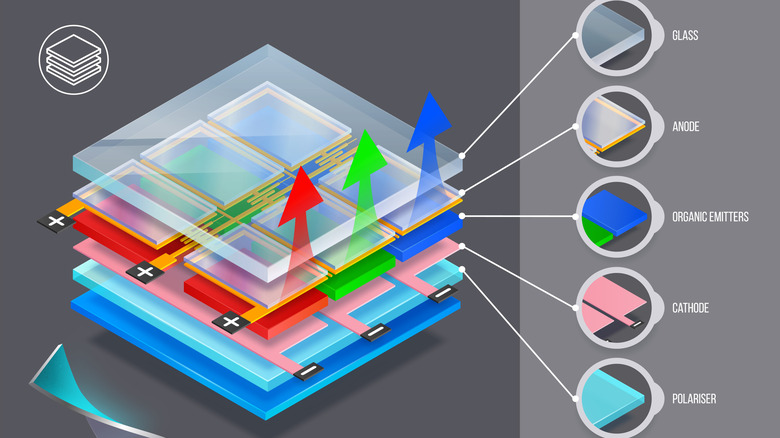
The researchers’ claims of impressive light efficiency stem from a new stretchable organic layer, called an exciplex-assisted phosphorescent (ExciPh) layer, that essentially alters the energy level of the OLED system to produce light more efficiently. An OLED pixel produces light by combining the positive and negative charges generated by the electrodes, which eventually unite to form an exciton. The subsequent decay of these excitons generates the electroluminescence driving individual OLED pixels. The new ExciPh layer lets more than 57% of excitons produce light, much higher than the 12% to 22% of traditional flexible OLEDs. This makes for a flexible display that’s not only more durable but also significantly brighter.

Advertisement

Will these lab experiments mature into consumer applications?

While the publication of research papers on high-tech displays and other promising phone-related technologies doesn’t always translate into consumer products, this joint US–Korean research endeavor did at least result in displays that offer a glimpse of the future. Drexel University researchers demonstrated the efficacy of their stretchable OLED display technology with two green monochrome displays: one depicted a heart icon, while the other showed a set of numbers.

Their counterparts at Seoul National University went one step further, developing a full-color stretchable display, replete with stretchable passive-matrix OLEDs. In other words, this flexible OLED technology already seems relatively mature, and deploying it in low-power wearable display solutions is not out of the realm of possibility.

The authors of this research paper list real-time health care monitoring and wearable communications technology as the potential applications of the stretchable OLED display prototypes demonstrated in their journal publication. Meanwhile, contemporary research into stretchable batteries, as discussed in ACS Energy Letters, seems to herald a future where wearable displays are the norm rather than science fiction.

Advertisement


Source link

Continue Reading
Click to comment

You must be logged in to post a comment Login

Leave a Reply

Tech

How Much Does The World’s First Cordless Hammer Chisel Cost?

Published

on


We may receive a commission on purchases made from links.

Like most other major power tool brands, Milwaukee has gone almost entirely cordless. While there are still some corded Milwaukee tools out there, most of its modern offerings rely on battery power — even some that feel like they shouldn’t be able to run effectively without wall power. A heavy-duty tool like a hammer chisel, for example, seems like it would need to draw power from the wall. However, Milwaukee has seemingly cracked the code and is releasing the M18 Fuel Striker Hammer Chisel, which it claims is the first cordless hammer chisel ever created.

Advertisement

Unfortunately, getting in on this piece of tool history comes at a hefty cost. The Milwaukee Striker will have a price tag of $599.00, just for the tool itself. On top of that, customers have to pay $49.00 for the protective chisel boot and $129.97 for the five-piece chisel set to get the full experience. That’s a whopping $777.97, which has the potential to increase even more if you don’t already have an M18 battery hanging around to power it. Those aren’t cheap, either; even a smaller unit like the M18 Fuel 2.0 Ah battery will run you around $120.

With such a high price, the Milwaukee Striker is a serious tool investment that only those who really need it are likely to buy. It also needs to deliver on the performance front, given how much Milwaukee is asking for it.

Advertisement

The stats behind the Milwaukee Striker

The Milwaukee cordless hammer drill has a brushless motor that the company says generates 7 joules of striking force, which it claims is equivalent to the 145 PSI pressure delivered by similar pneumatic hammer chisel models. There are also three different speed modes: 0 to 2,500, 0 to 3,000 BPM, and a mode that gradually increases the speed from 0 to 3,000 BPM when users fully depress the trigger. Said trigger is a variable-speed unit to provide the user with additional speed control.

As the M18 Fuel branding indicates, this tool is compatible with the entire Milwaukee M18 battery line. Additionally, it has a battery isolation system to reduce vibration and prevent battery pack movement in use, while Milwaukee’s RedLink Plus technology combats overheating and over-discharging. An LED work light on the front improves visibility on the job. Milwaukee stands behind the tool with its standard three-year warranty. If anything goes wrong and you didn’t do any of the things that immediately void a Milwaukee warranty, the company will repair or replace the tool free of charge.

Milwaukee continues to expand its product catalog, and the Milwaukee Striker manages to take a place of prominence as the first tool of its kind. Time will tell if this world’s first cordless hammer chisel lives up to its promise or ends up as an overpriced novelty that leaves much to be desired.

Advertisement


Source link

Advertisement
Continue Reading

Tech

Can Schools Afford an AI-First Future?

Published

on

Most conversations about generative artificial intelligence in schools eventually zoom in on using AI in the classroom. Before districts redesign teaching and learning around AI, they may need to answer a more fundamental question: Can schools afford an AI-first future?

The question sounds strange because generative AI is often presented as software with free and low cost tiers to individual users. Teachers open a browser window, type a prompt, and receive a response in seconds. The experience feels almost weightless and as simple as a Google search. The infrastructure behind that interaction is much more complicated.

A useful way to think about generative AI is to remember the large desktop computers that once sat in school computer labs. Students interacted with a monitor and keyboard, but much of the important work happened elsewhere inside a massive tower packed with hardware.

Today’s AI systems operate similarly, except the tower has been replaced by massive data centers located hundreds or thousands of miles away — and increasingly in some cases, just a few miles away

Advertisement

Cost of Compute

An explanation is in order. How do chatbots and the hardware behind them work? Think of the chatbot prompt as the remote control. The hardware stored at the data center is the wiring within a television, and the chatbot’s output is what appears on screen as you watch and flick through channels. 

Every student prompt, teacher-generated lesson plan or AI-assisted feedback comment depends on specialized processors, networking infrastructure, electricity, water, and increasingly scarce computing capacity.

Most discussions about AI in education begin after those systems are already in place. However, a growing body of research suggests schools should pay closer attention to the infrastructure itself.

Researchers studying AI adoption in education have largely focused on classroom implementation, AI literacy and governance. Stanford’s review of the evidence base for AI in K-12 education found that adoption continues to outpace rigorous evidence about educational outcomes. At the same time, UNESCO and other organizations have increasingly emphasized governance, transparency and human oversight as schools experiment with AI tools.

Advertisement

A separate body of research examines the infrastructure that makes those tools possible. Urban planners, computer engineers and environmental researchers have begun documenting the physical footprint of artificial intelligence. Their work points to a reality that is largely invisible to educators: generative AI is both software and hardware that requires robust infrastructure to support and scale. 

Research by Xiaofan Liang, PhD on data centers describes how AI expansion increasingly shapes land use, energy systems, local planning decisions and community development. Research by Shaolei Ren, PhD on power and water demand demonstrates that large-scale AI deployment carries substantial resource requirements that extend well beyond the technology sector. Researchers and policymakers are now examining how data center growth affects electricity demand, water consumption, electrical grid capacity, and environmental sustainability. 

According to estimates cited by the Congressional Research Service, U.S. data centers consumed about 176 terawatt-hours of electricity in 2023, roughly 4.4% of all U.S. electricity consumption. Using average residential electricity consumption estimates from the U.S. Energy Information Administration, that’s enough electricity to power nearly 17 million American homes for a year. The map below shows where the United States sits in the world’s energy picture and why AI’s growing appetite for power matters.

Attribution: Hannah Ritchie, Pablo Rosado, and Max Roser (2020) – “Energy Production and Consumption” Published online at OurWorldinData.org. (archived on May 18, 2026).

Advertisement

Traditionally, districts purchase educational technology such as learning management systems, assessment platforms and instructional software through licensing agreements that can often be forecast years into the future. But generative AI operates differently.

Unlike traditional software, which becomes cheaper to distribute as it scales, generative AI continues generating costs each time users engage with the system. Industry observers increasingly point to what’s called “inference costs,” which are the computing resources required to generate responses. These are some of the major costs of LLMs for consumers and one of the central economic challenges facing AI companies.

For schools, how can a district plan for these costs, and what happens when the costs far exceed expectations? Put another way, it’s unclear whether generative AI is financially feasible for schools. 

Many districts are currently experimenting with AI through pilot programs, limited licenses or AI features embedded within existing products. There are few examples of what universal access would actually cost. 

Advertisement

What would it mean for every student and their teachers to have access to generative AI every day? Before we address this question, there is another cost variable to consider: data privacy.

Many educators and parents have expressed concerns about student information flowing into commercial AI systems. One response has been to advocate for private deployments, district-controlled systems or locally hosted models that offer greater oversight and protection.

Those approaches may provide stronger governance, but they also require additional investment. That makes student data privacy a matter of policy and infrastructure. The more control schools want over data, the more likely they are to encounter costs related to storage, cybersecurity, hardware, networking and technical expertise.

Understanding the Generative AI Market

Meanwhile, the broader market continues to evolve.

Advertisement

OpenAI, Anthropic and other major AI companies are still competing to define the commercial landscape. Product offerings change frequently. Pricing models continue to evolve. Infrastructure investments remain enormous.

The result is a technology ecosystem with long-term economics that remains uncertain at precisely the moment schools are being encouraged to integrate it more deeply into teaching and learning. This uncertainty arrives during a challenging financial period for many districts.

Federal ESSER funding has expired. States continue debating educational technology spending priorities. District leaders face growing pressure to justify technology investments while responding to staffing shortages, student mental health concerns, and academic recovery efforts post-COVID-19 school shutdowns.

Against that backdrop, AI presents a different kind of procurement question: Do districts understand the long-term commitments they may be making when AI becomes embedded in curriculum, assessment and daily operations?

Advertisement

There is still one more cost factor to consider: community impact around data centers. Data centers are expanding rapidly across the United States. Local governments and residents are increasingly debating the benefits and tradeoffs associated with new facilities. Questions about energy demand, water consumption, environmental exposure and land use have become common features of public meetings and planning discussions.

For educators, these debates may seem distant from classroom practice. But every discussion about AI in schools ultimately depends on the infrastructure being built in communities across the country.

Schools are currently debating how to integrate AI into teaching and learning while the infrastructure, economics and governance systems required to support large-scale adoption are still taking shape.

Before schools decide how deeply AI belongs in classrooms, they may need a clearer understanding of how much it costs and if it’s feasible to maintain the systems that make an AI-ready classroom possible.

Advertisement

Source link

Continue Reading

Tech

Seattle drinkware maker MiiR sues Tesla for copying its tumbler lid design

Published

on

TL;DR

MiiR is suing Tesla for copying its tumbler lid design and vertical logo. The patent was granted in 2024. MiiR wants an injunction and Tesla’s profits.

Seattle-based drinkware maker MiiR is suing Tesla for allegedly copying the lid design and overall look of its stainless steel tumbler. The lawsuit, filed May 28 in US District Court in Seattle, alleges Tesla’s On The Road Tumbler infringes a design patent covering MiiR’s tumbler lid and mimics the cylindrical shape, rounded base, and vertical logo placement of its 360 Traveler Tumbler.

MiiR accuses Tesla of choosing to “substantially copy” its design rather than “innovate and develop its own unique style.” The company says Tesla was already aware of MiiR’s products because it had previously purchased or considered purchasing them.

At the centre of the case is MiiR’s lid, described in the patent as a “solid, saucer-shaped circular lid” whose circumference sits perpendicular to the sides of the container. The US Patent and Trademark Office granted the patent in February 2024. MiiR argues an ordinary observer would be deceived into thinking the two lids are the same or substantially similar.

Advertisement

MiiR also takes issue with Tesla’s logo placement. MiiR has used a distinctive vertical orientation of its etched brand name on drinkware since at least 2011. It says Tesla copied that same orientation on its tumbler rather than developing its own visual identity for the product.

The products are similar in size and price. MiiR’s 16-ounce 360 Traveler sells for $34 in eight colours. Tesla’s 14-ounce version is listed at $32 in three colours. Tesla sells the tumbler through its online shop and retail locations as part of a broader lifestyle merchandise line that includes apparel and accessories.

MiiR, founded in 2010, has won design awards from the Industrial Designers Society of America and donates a percentage of revenue from every product to environmental and community causes. It operates a production and warehouse facility in Marysville, Washington, north of Seattle. The company is represented by K&L Gates.

MiiR is seeking a permanent injunction to stop Tesla from selling the tumbler, damages, an accounting of Tesla’s profits from the product, and attorney fees. It is also asking the court to find that Tesla’s infringement was willful, which could result in enhanced damages. A separate claim under the Washington Consumer Protection Act alleges Tesla misled consumers into believing the tumbler was affiliated with or approved by MiiR.

Advertisement

Tesla has not publicly responded to the lawsuit. It is not the first time the company has faced intellectual property disputes over its product designs.

Source link

Advertisement
Continue Reading

Tech

Steam is ending gift cards because scammers were raising too much hell

Published

on

Valve is pulling physical Steam gift cards from retail stores, bringing an end to a program that has been around since 2012. The company confirmed, as spotted via SteamDB, that it will no longer send new stock of Steam gift cards to retailers once current supplies run out.

Digital Steam gift cards are not going away. Valve says users will still be able to buy them directly through Steam, and existing physical cards can still be redeemed whenever users choose. Retail stock, however, is expected to disappear by the end of 2026.

Why Valve is cutting off retail gift cards

Valve says the decision comes after years of scam-prevention efforts. The company says it worked with retailers and law enforcement, added prominent scam warnings, limited cards by currency, restricted availability, and removed cards from sale when unusual activity appeared. Unfortunately, scammers still adapted.

The issue is not limited to Steam. Scammers prefer gift cards because they are fast, widely available, and difficult to reverse once redeemed. A victim can buy one at a normal retail store, read out the code and PIN over the phone, and lose the money without ever handing over the physical card. Unlike a card payment or bank transfer, there is usually no simple chargeback process once the value has been claimed. Since no bank details are involved, it becomes much harder for victims or authorities to follow the money.

Who scammers target, and how the scam works

Gift card scams often target the elderly, isolated people, users who are less familiar with digital payments, and anyone who can be frightened into acting quickly. The setup usually starts with a phone call, email, text, or social media message.

Advertisement

Scammers may pretend to be government officials, tech support workers, debt collectors, utility companies, romantic partners, employers, or relatives in trouble. Although the story changes, the pressure tactic is usually the same. They insist on immediate payment, tell victims to keep the situation secret, and discourage them from ending the call.

Victims are often told exactly which card to buy and where to buy it. Once they share the number and PIN from the back of the card, the money can be drained remotely.

Valve is currently the only major company taking this step with physical gift cards. But if gift card scams keep growing, other companies may also decide that selling them in stores is no longer worth the risk.

Source link

Advertisement
Continue Reading

Tech

Apple got parental controls right but it does not matter

Published

on

Apple’s efforts to expand parental controls are a good start, and legally required soon. Like all safety systems, it’s only as strong as its weakest link.

On Monday, Apple spent 30 minutes of the WWDC 2026 discussing its latest updates to Child Accounts. These updates are designed to make using iPhone, iPad, and Mac safer for users under 18.

But how good are these features, really? Let’s break down what each one is, how it works, and why a lot of it ultimately doesn’t matter.

Communication Safety now blocks violence and gore blocking

Communication Safety was introduced in iOS 15.2 to protect children from viewing or sending images containing nudity. Communication Safety is enabled by default for all accounts under 18.

Advertisement

However, at some point, Apple realized that nudity isn’t the only kind of harmful content minors can be exposed to. That’s why, in iOS, iPadOS, and macOS 27, Messages will also block images and videos depicting gore and violence.

Smartphone screen showing a content warning dialog about potentially graphic media, with a small preview icon, explanatory text, and two large buttons labeled Not Now and Yes, Continue

A new safety warning pops up for violence and gore in iOS 27

The feature works across multiple Apple device features, including Messages, AirDrop, Contact Posters, FaceTime calls and video messages, shared photo albums, and some third-party apps.

When sensitive content is detected, Communication Safety blurs the photo or video before the child can view or send it. It also presents multiple interventions before viewing or sending potentially illicit content.

Advertisement

If a child account is registered to a user under 13 with a Screen Time password enabled, the child will be unable to view sensitive content without the family organizer’s express permission.

Personally, I think this is a fantastic place to start. As I’ve said before, I don’t have kids, but I certainly am not short on friends who do.

I suspect, however, that this feature may be somewhat limited. Many kids don’t communicate primarily through FaceTime or Messages; instead, they use social media platforms like Instagram or catch-all apps like Discord.

Apple does make some of these features available to third-party developers, which I’ll discuss more below, but there’s no guarantee they will choose to integrate them.

Advertisement

Better control over who kids talk to with Communication Limits

Previously, Communication Limits allowed parents to manage when kids could communicate with others via Phone, FaceTime, and Messages. This meant you didn’t need to worry about your kids staying up super late to text their friends on school nights.

Now, in iOS 27, Communications Limits will require parents to approve any new contacts added to a child’s account. This is infinitely better, because now parents know exactly who is in their child’s contact list without needing to actively go through their phone.

Ask to Browse

One of Apple’s more underrated features is Ask to Buy. It requires a family organizer to sign off on purchases made by a child’s account.

Apple introduced the predecessor to Ask to Buy in 2011, a 15-minute time limit between requiring another password entry after purchasing in-app purchases.

Advertisement

Then, in 2014, Apple officially launched Ask to Buy, which gave parents a way to approve or decline purchases via the Family Sharing section in Settings. It would receive a second update in 2022 with iOS 16.2, integrating requests into the Messages app, eliminating the need to check Settings first.

iPad and iPhone side by side; iPad shows a parental permission prompt in Safari, while iPhone displays a child requesting permission to browse a website through Messages

Ask to Browse will require parents to approve websites for children under 13, and optionally for children under 18

Now, Apple is taking it a step further with Ask to Browse, set to debut in iOS 27. Ask To Browse will alert parents via Messages when a child wants to view a new website and allow remote approval.

Honestly, it’s surprising that Apple took this long. The feature should, at the very least, have been introduced in 2022 alongside the Ask to Buy Messages integration.

Advertisement

A better Screen Time experience

This fall, iOS 27 and its iPad and Mac counterparts will get an overhauled Screen Time experience.

Time Allowances will give parents more flexibility over how kids spend time in apps across categories. These categories, for example, might include Entertainment, Games, and Social Media.

iPhone screen showing Screen Time Time Allowances settings, with a slider set to 1 hour and categorized app limits listed below for Entertainment, Games, Social Media, and other activities

Expanded Time Allowance controls make it easier to set up healthy screen time limits

Parents can set an overall time limit, such as two hours, for a child’s screen time. Then they can further customize how much time a child spends in each category, such as one hour on entertainment, half an hour on games, and half an hour on social media.

Advertisement

I like this quite a bit, especially because the interface is large and not intimidating, suggesting that it would be pretty easy to use for nearly anyone. It’s even better because it utilizes expert research to suggest appropriate screen time limits.

Help for parents, too (but only sort of)

One of the other things Apple mentioned was a brand new Child Safety guidance website. The website, which is live now, serves as a quick primer on all the safety features available to parents.

I’m putting extra emphasis on quick, by the way. It really doesn’t explain anything more than, say, any other Apple feature page.

Sure, it explains which features exist and which are coming soon, but that’s about it. There isn’t much information about what is inside the apps, what steps you’ll be expected to take, or why Apple suggests them.

Advertisement

Instead, it tells you that you can enable Find My on the Apple Watch for a child account. It tells you that Screen Time is a thing, sure, but not how to use it.

If I were in charge of the website, and I’m not, I would have, at the very least, linked out to the Apple User Guide or Support pages for each feature. At least then, a parent could know where to find each feature and how to customize it for their child.

Developers can participate, but don’t have to

To Apple’s credit, it’s trying to make it easier for developers to incorporate these safety features into their own apps.

For example, Apple offers the ScreenTime Framework to developers, giving them the tools to help parents supervise how much time their children spend in the app.

Advertisement

PermissionsKit, Apple’s developer framework that powers this process, allows third-party app developers to utilize the same Communication Limits Apple uses in FaceTime and Messages.

I think this could be huge for apps like Discord or Instagram. Whether those developers choose to do so is another matter entirely.

Tablet and smartphone screens showing a messaging app, with contact list on the left and a conversation asking to approve a new person via a security prompt in the center

Communication Limits, used here in Messages, can be integrated into third-party apps via PermissionsKit

The SensitiveContentAnalysis framework helps check for and blur nudity in third-party apps. This feature should probably be utilized by apps like Instagram, Snapchat, and Discord as soon as possible.

Advertisement

Again, these are opt-in features made available to developers. Because there is no requirement to utilize them, certain apps will likely still pose a risk to minors.

It’s a good start, but it’s not there yet

One of the bigger problems with these safety features is that many are opt-in. A safety net only works if it’s being used.

Child Accounts for users under 13 automatically enable additional protections, such as Communication Safety, Ask to Buy, and Sensitive Content Warnings. When it launches in the fall, Ask to Browse will also be enabled for users 12 and under.

In iOS 27, Communication Safety will also be automatically enabled for users aged 13 through 17. This is a solid move, especially knowing that a significant portion of CSAM is actually self-generated or otherwise passed around by minors themselves.

Advertisement

But things like Ask to Browse and Ask to Buy are opt-in for children aged 13 and older. While there is a reasonable expectation that, say, a 17-year-old could deduce whether they should visit a website, I’m not sure the same logic applies to a 13-year-old.

Screen Time limits, which can be used to limit a young person’s exposure to social media, are currently opt-in, regardless of the child’s age. And not only is it opt-in, but it also requires a family organizer to sit down and undergo a not-insubstantial setup process.

That’s a big ask for some people. Doubly so if the parents aren’t aware of these features in the first place, or aren’t entirely sure how they work.

I don’t know how to make this situation better. Apple isn’t responsible for what third-party developers make available, and a parent may not realize the dangers of social media or instant messaging apps.

Advertisement

It’s certainly not illegal for a 13-year-old to have an Instagram account. What they come across on it isn’t Apple’s responsibility; it’s Meta’s.

Perhaps the answer is a more robust setup process for child accounts. Make parents opt out of features like Ask to Browse and Ask to Buy for all minors, rather than opt in.

We won’t know exactly how many of these features work until they’re fully implemented in the public releases. Child accounts under 13 are not eligible to participate in Apple’s beta tests.

Hopefully, though, they are at least another tool parents can utilize. Lord knows they need all the tools they can get.

Advertisement

Parenting isn’t easy, and the omnipresent internet certainly hasn’t made it easier. I suspect this will be an eternally ongoing process, and unfortunately, until we find the gaps in the current system, we may not know what is causing harm.

As always, my advice, and the advice of AppleInsider, is as follows: If you know someone who isn’t particularly tech-savvy, take the time to offer help.

If you know a parent who is getting their kid their first iPhone, offer to show them how to set it up safely. And if you are a parent, I personally suggest having an open, honest dialogue with your kids about how to stay safe online.

Advertisement

Source link

Continue Reading

Tech

Tumbler tussle: Seattle’s MiiR sues Tesla, alleging copied cup design

Published

on

The beverage tumblers from MiiR, left, and Tesla that are being compared in a lawsuit. (MiiR, Tesla Images, GeekWire Composite Image)

MiiR, the Seattle-based maker of drinkware and other accessories, is suing Tesla, alleging the Elon Musk-led company copied its tumbler lid design and appearance.

In a lawsuit filed May 28 in U.S. District Court in Seattle, MiiR alleges Tesla’s On The Road Tumbler infringes on a design patent covering MiiR’s tumbler lid and copies the overall look of its stainless steel 360 Traveler Tumbler, including its cylindrical shape, rounded base, and vertical logo placement.

MiiR accuses Austin-based Tesla of choosing to “substantially copy” its design rather than “innovate and develop its own unique style,” according to a court filing, and says Tesla was aware of MiiR’s products because it had previously purchased or considered purchasing them. (Read the full complaint below.)

MiiR, founded in 2010, has built a portfolio of design patents and trade dress rights around its drinkware products, which have won awards from the Industrial Designers Society of America and other organizations. The company also donates a percentage of revenues from every product it sells to environmental and community causes.

The company previously ran a flagship retail location and coffee shop in Seattle’s Fremont neighborhood next to the Brooks Running headquarters. It now operates a production and warehouse facility north of Seattle in Marysville, Wash.

Advertisement
The tumbler lids for MiiR, left, and Tesla drinkware as seen on the company’s websites. (MiiR, Tesla Images)

While widely known for its line of electric vehicles, Tesla also sells a range of lifestyle merchandise — including apparel, accessories, and drinkware — through its online shop and retail locations.

MiiR’s 16-ounce 360 Traveler Tumbler sells for $34 on its website and comes in eight colors. Tesla’s 14-ounce version is listed for $32 on its site and comes in three colors.

At the heart of the case is MiiR’s tumbler lid, which was issued a patent by the U.S. Patent and Trademark Office in February 2024. The company describes it as a “solid, saucer-shaped circular lid” whose circumference sits perpendicular to the sides of the cylindrical container. MiiR argues its drinkware is “radically different” from what came before, with a “clean linear style” that made its products immediately associated with the brand.

MiiR says Tesla’s tumbler lid copies that patented design, arguing that an ordinary observer would be deceived into thinking the two lids are the same or substantially similar based on their shape, silhouette, and configuration.

The Tesla tumbler lid compared to patent drawings for the MiiR lid, as seen in court documents. (Image via U.S. District Court complaint)

MiiR also takes issue with how Tesla positioned its logo on the tumbler. MiiR says it has used a distinctive vertical placement of its etched brand name on its drinkware since at least 2011, and argues Tesla copied that same orientation on the On The Road Tumbler.

MiiR, which is represented by Seattle law firm K&L Gates, is seeking a permanent injunction to stop Tesla from selling the tumbler, along with damages, an accounting of Tesla’s profits from the product, and attorney fees. The company is also asking the court to find that Tesla’s infringement was willful, which could result in enhanced damages.

Advertisement

The suit also includes a claim under the Washington Consumer Protection Act, alleging Tesla’s conduct misled consumers into believing its tumbler was affiliated with or approved by MiiR.

GeekWire reached out to MiiR and Tesla for comment and we’ll update this story when we hear back.

Read MiiR’s full complaint against Tesla:

MiiR Holdings LLC vs. Tesla Inc. by Kurt Schlosser

Advertisement

Source link

Continue Reading

Tech

Beneath The Enshittification, Something Amazing Is Growing

Published

on

from the rebuilding-a-better-internet dept

Last month Terry Godier published a great essay on his website about “the boring internet,” discussing how the internet that many of us grew up with, the wonderful, empowering, exciting internet that moved power to the edges of the network rather than the center, is still there. It’s just hidden beneath enshittified commercial layers put there by companies seeking to extract more and more from you. It’s a great read and here’s just a snippet:

The internet you grew up on is not gone.

Some of its commercial superstructure is, and more of it will go. The next decade is going to be strange for any company whose value proposition was: we host the place where you talk to your friends.

The platforms will keep mutating. The feeds will keep filling. The slop will keep rising. The grief is real and you are not wrong to feel it.

But the actual internet — the protocols, the federated services, the plain-text commands, the open feeds, the small servers, the personal sites, the things people built when user and developer were sometimes the same word — is still right there.

Advertisement

It was not demolished.

It was buried under a louder layer for a while.

Go read the whole thing. You won’t regret it. This is why I wrote Protocols, Not Platforms, it’s why I’ve been so focused for years on helping more people understand the inherent power of distributing technological power.

But, as Godier’s piece notes, protocols are… boring. They change slowly (for a good reason, because you need stability to build on). They tend to change by consensus, which is messy. And rather than having billion dollar companies throwing a whole massive engineering team at making everything work, in the protocol world, we rely on constant experimentation by anyone who wants to experiment.

Advertisement

Sometimes that produces silly things. Sometimes it produces things that only kinda work. And sometimes, it produces wonderful new things that would never have existed in a world of fully centralized services.

But, it takes time. And that can be frustrating for those of us who want to live in that better future. The important thing for people to understand, though, is that while the amazing new breakthroughs in the protocol world may not get giant headlines in the NY Times or flashy stories about trillion dollar IPOs, they are building real things for real people, in which the people are the most important part, rather than the bankers or the billionaire execs looking to get richer.

So I was excited recently to take part as a juror for the Open Social Awards, put on by New_Public and Public Spaces, reviewing a wide range of projects looking to build on open social protocols (mostly ATproto and ActivityPub). The energy among developers right now for what they can do on open social systems is real, and it’s building fast. Tim Trautmann recently wrote about this, saying “the nerds are building a new internet.” As he wrote:

The open web of the nineties didn’t win because the tools were better. It won because a critical mass of people decided that the alternative, a handful of AOL-style walled gardens choosing what everyone saw, was not the future they wanted. Then they built their way out of it. Slowly, unglamorously, in rooms that looked a lot like this one.

Whether atproto ends up being the thing, or a stepping stone to the thing, I don’t know. Nobody in the room claimed to know. But the work is real, the apps are shipping, and the people building them are taking it seriously without taking themselves seriously. That combination is rare, and historically, it’s the one that wins.

Advertisement

You can see that kind of excitement as well in this recent video of a bunch of developers doing an ATproto hackathon, where you see people realizing in real time how powerful ATproto is in allowing you to build a better internet:

It’s so easy these days to get down on the state of the larger internet, increasingly controlled by bigger and bigger companies trying to extract more and more from you. But if you look beneath all of that, genuinely interesting, important things are being built, some of which was celebrated at the Open Social Awards last week.

The grand prize winner was the Newsmast Foundation, which has been helping mission-driven organizations build their own social spaces online, using ActivityPub. They’ve been building some amazing community apps for news organizations, non-profits, and more. Enabling those organizations to have their own social spaces, but built on top of an open protocol.

Advertisement

The two “Excellence Award” winners were equally strong — there was a real argument that either of them could have taken the grand prize. First there’s Blacksky Algorithms, which has built out an entirely separate and differentiated ATproto experience, where thousands of users can have a social media experience interoperable with Bluesky and others on the network, but without ever touching Bluesky hardware or software. The company keeps doing really fascinating things as well, including its use of pol.is for community decision-making, and offering up its ability to build entirely independent ATproto powered communities to others via Acorn.

And there’s one of my personal favorites, Sill, which is a wonderful cross-protocol newsreader app. You login with your Atmosphere (ATproto) handle and/or your ActivityPub handle, and it will find the news that is being discussed among your followers and format it in a nice digest format. I use it as a daily review of what’s happening in the world that’s interesting to me.

And then all of the “honorable mentions” were doing interesting things as well, figuring out ways to make open social more useful: Bounce (a tool for migrating between AcitivtyPub and ATproto while bringing your community with you, from the team who also does BridgyFed, a tool for communicating across protocols). Dandelion, an events platform built on ATproto. Streamplace, which does video streaming on ATproto. Leaflet, which has become one of the go to places for long form blogging within the ATproto world, and Bonfire Networks, which is also working on helping communities build their own communities online.

There were many other entries as well, and the energy developers are bringing to open social projects right now is genuinely contagious. People are learning that they can just build stuff, and specifically the kind of stuff that you had to rely on the goodwill (or perhaps commercial agreements) of a large company to build.

Advertisement

Every day there are more creative new ideas showing up. The one thing I’m looking forward to most is when we start to break out of the “rebuilding this centralized service on open protocols” and finally get to the point where we get entirely new things that are only possible because of open protocols. This is how these things have always worked. A new medium first gets used to rebuild familiar things — almost as a way of learning how the underlying system operates. Then come the breakthroughs that are only possible because of that new medium. If I had one complaint about the entries this year, it’s that too many of them felt like rebuilding the old things, just on a protocol.

We’re already starting to see small examples, though, of what it looks like when we go to the next stage, and it’s not just “this service, but without centralized control” to “we can function entirely differently without centralized control.” That’s just starting to happen, but I expect we’ll see many more examples in the near future.

In the meantime, congrats to the winners (and all the entrants) of the first ever Open Social Awards.

Filed Under: activitypub, atproto, atprotocol, open social, open social awards

Companies: new public, public spaces

Advertisement

Source link

Continue Reading

Tech

AI salaries in S’pore rose 5x faster than overall wages, some fresh grads land S$90K AI jobs

Published

on

Salaries for AI roles in Singapore have climbed 15-25% in the last 12 months

Artificial intelligence builders are winning even as AI is used to justify cutting jobs in big tech and global banks. In Singapore, salaries for workers developing these systems are climbing up to five times faster than average wages.

The pay for AI roles has climbed 15–25% in the past year, with fresh hires starting at S$70,000–S$90,000 annually, according to a Robert Walters report cited by The Straits Times. Meanwhile, overall nominal wages for full-time workers rose 4.9% in 2025, down from 5.6% in 2024, per Ministry of Manpower figures.

“AI and data-based roles remain among the most in-demand positions in Singapore this year,” said Kirsty Poltock, country manager at Robert Walters Singapore. “Companies are racing not just to experiment with AI, but to put it to work at scale in their businesses.”

While hard numbers are scarce, Poltock said AI-related hiring “has continued to grow strongly over the past 12 months, particularly in AI engineering, machine learning, data science, AI product management, and AI governance roles.”

Advertisement

For instance, Chinese technology companies are intensifying efforts to recruit AI graduates from Singapore’s two flagship universities, offering sharply higher pay packages from S$200,000 a year to entice PhD holders to work in China, reported The Straits Times.

On May 20, OpenAI committed over US$300 million (S$386 million) to build Singapore’s applied AI sector, including an Applied AI Lab and a training programme to create over 200 Singapore-based technical roles in the coming years.

Its rival, Anthropic, the creator of AI assistant Claude, is also hiring its first Singapore-based product support specialists and offering a lucrative salary, according to an advertisement on LinkedIn.

Meanwhile, Chinese tech giant Alibaba’s cloud computing arm had also set up a global artificial intelligence innovation hub in Singapore in 2025.

Advertisement

Too many jobs, not enough people

Image Credit: 2p2play via Shutterstock

AI is “clearly an outlier” for high demand, talent shortages, and premium salaries—even if not the only high-growth area, Poltock said.

She added that the demand for AI talents “has consistently outpaced the supply of qualified candidates”, resulting in salary hikes.

AI openings are everywhere. A quick search on the job portal MyCareersFuture.sg on Jun 10 revealed 150 listings for AI engineers, 45 for machine learning and 15 for data science. On the other hand, LinkedIn is advertising over 800 posts for AI engineers, more than 4,000 for machine learning and over 5,000 for data science.

However, fresh talent is scarce. AI roles often take longer to fill than other professional positions, Poltock said, because employers are competing for a limited pool of candidates.

Employers are particularly hungry for “deep tech” talents who can go beyond building AI prototypes to embedding systems into real‑world operations.

Advertisement

“Chinese tech firms tend to have a much stronger emphasis on deep technical AI capabilities and infrastructure, including research,” she added. “In Singapore, employers are generally placing greater emphasis on commercialisation and enterprise integration—using AI to improve productivity, automate workflows and enhance customer experience.”

No need for PhDs for AI roles

Image Credit: Shadow of light via Shutterstock

Typical entry routes into AI roles include bachelor’s and master’s degrees in computer science, data science, mathematics, or engineering—especially from local universities—plus programming skills and hands-on AI project work or internships.

“For the vast majority of AI roles we see in Singapore, a good bachelor’s degree plus practical experience and the right skills are sufficient, but to earn the absolute top end of the spectrum, a PhD would be required,” Poltock said.

An “absolute expert in AI research or leading major AI initiatives in Singapore” could command close to S$350,000 in total compensation, she added. Such an expert is expected to lead a team and has responsibilities that are increasingly global in scope, which recruiters said companies tend to look beyond Singapore for suitable candidates.

However, the silver lining lies in the fact that such AI leadership rarely fly alone but builds local teams, which creates downstream opportunities, said Yuan Yijia, founder of Singapore‑based AI recruitment agency Dada Consultants.

Advertisement

“They anchor an AI organisation here—then around them you start to see hiring for applied AI engineers, data analysts, platform and product roles. Those are exactly the kinds of positions that Singaporean graduates and mid‑career professionals can qualify for if they build the right skills,” she told The Straits Times.

Poltock urged Singaporeans to regroup and consider how AI can complement their careers, whether through AI-related degrees, mid-career technical upskilling, or applying AI within familiar sectors.

But riding the AI wave takes more than checking a box by taking a single course.

The candidates who stand out are “proactive, inquisitive and willing to get their hands dirty—through internships, internal pilot projects, or even self-initiated work at home.”

Advertisement
  • Read other articles we’ve written on Singapore’s current affairs here.

Featured Image Credit: Shadow of light via Shutterstock

Source link

Advertisement
Continue Reading

Tech

This California city just approved the use of Flock drones as first responders, but residents are worried about ‘militarization and surveillance’

Published

on


  • Stockton has approved a $3.15 investment in Flock drones
  • The drones will act as airborne first responders
  • Residents have raised privacy and surveillance concerns

Surveillance and privacy are huge concerns for individuals across the world right now, and municipal leaders in the California city of Stockton are the latest to attract criticism for a controversial drone expansion program that’s ostensibly being undertaken in the interests of public safety.

As reported by Stocktonia, the city council recently gave the thumbs up to a $3.15 million investment in drones manufactured by Flock, on top of the automatic license readers the company already supplies. These drones can act as airborne first responders, giving police eyes on a 911 call situation in as little as 30 seconds.

Source link

Advertisement
Continue Reading

Tech

A Meta Employee Who Just Lost Their Job Was Detained by Immigration Agents

Published

on

A former Meta employee who lost their job during a round of layoffs on May 20 is said to have been detained by US Immigration and Customs Enforcement in recent days, according to communications inside the company seen by WIRED.

A current employee posted about the incident on an internal Meta messaging board for immigration topics this week. The initial post was marked as “urgent” and tagged two Meta executives who focus on immigration issues and employee risk, in an attempt to escalate the issue to them.

The current status of the detained worker is unknown.

A spokesperson for Meta, Dave Arnold, declined to comment on the record. Representatives from ICE and the US Department of Homeland Security did not provide comment in time for publication. It is unclear whether the employee was detained by ICE, Customs and Border Protection, or another agency.

Advertisement

Internal messages reviewed by WIRED indicate employees believe their former colleague was being detained in El Paso, Texas, where there is a major US-Mexico border crossing. On the other side is Ciudad Juárez, home to one of the largest US consular offices in the region and a common destination for visa processing.

Many international employees at US tech companies work on H-1B visas, which allow firms to hire highly skilled foreign workers. These visas are tied to a specific employer. Workers who secure a new job need to adjust their immigration paperwork, sometimes by intentionally leaving and reentering the country.

WIRED was unable to confirm the worker’s nationality or what type of US visa they may have traveled on.

The incident marks a rare known instance of a corporate tech worker being taken into immigration custody since President Donald Trump launched dramatically escalated enforcement efforts across the country early last year, sparking widespread criticism.

Advertisement

In May, Meta cut nearly 10 percent of its workforce, or roughly 8,000 people, as part of its ongoing efforts to make the company more efficient and offset the massive investments it is making into AI infrastructure. Numerous workers on visas were among those let go, according to employees familiar with the departures.

A small community of Meta employees has demanded that the company do more to protect immigrant employees and contractors at risk of being detained or deported by ICE, including helping to pay for legal fees and allowing workers to avoid offices on days they fear immigration officials might be in the area. Amid what some employees describe as a lack of support from Meta, workers have begun organizing financial and logistical aid for colleagues in the US dealing with immigration issues.

Under the Trump administration, immigration authorities have been arresting tens of thousands of people a month, with about 60,000 people in detention centers as of early April, according to researchers. Tech offices have not been much of a target for raids. But in January, immigration authorities arrested two workers traveling to a Meta data center construction site.

Source link

Advertisement
Continue Reading

Trending

Copyright © 2025