Nio says it has performed more than 100 million battery swaps since 2018
The technology is hailed for its ease and speed
Slower on-site charging also reduces the strain on the grid
The history of EV battery swap technology is as long and as complicated as the electric vehicle itself, with numerous manufacturers attempting to create networks that would allow owners to drive in and have a fresh battery inserted in minutes.
Renault worked alongside the Better Place network with its early Fluence Z.E. model back in 2011 to push battery swap technology, and even Tesla had a stab at it, finally scrapping the idea due to a lack of interest.
But Chinese manufacturer Nio has continued to push forward with battery swapping technology, stating that during China’s recent May Day travel rush, its Power Swap business completed over 1 million battery swaps in a single week, according to Inside EVs.
Latest Videos From
Nio’s all-electric sub-brand Onvo currently operates 2,491 stations across China but is targeting more than 3,300 by the end of the year. This is in addition to Nio’s own 3,843 Power Swap stations.
Advertisement
Nio said that on its busiest day, May 1, the company swapped out 170,585 batteries across its entire network. On average, each site swaps out around 40 batteries a day, slowly recharging the spent cells and replacing them in a different vehicle once fully charged.
From May 1 until May 5, Nio says it provided 15.4 gigawatt-hours of energy, which it claims was around 16.3% of all energy delivered to EVs in China over the same period, according to Inside EVs.
Analysis: a standardized system is needed
(Image credit: Nio)
There are so many benefits of battery swapping technology, with the most obvious being speed. It takes around three minutes to swap a battery pack, while even the fastest chargers on the planet still take around ten minutes.
Advertisement
Sign up for breaking news, reviews, opinion, top tech deals, and more.
For most, the public EV charging experience takes at least 20 minutes, if not 45 or more.
Another plus point is that the spent battery cells are charged at a much slower rate on-site, meaning there is far less demand on local grids than an entire bank of ultra-fast-charging outlets delivering 1.5MW of power to multiple cars.
That said, battery swap technology is also very expensive, with a huge investment required from a manufacturer or provider to not only build the sites, but also ensure there are enough battery packs available to service an entire fleet.
Advertisement
This is why Nio’s Power Swap technology is limited outside of China, with a handful of stations operating in Europe. Although the number is steadily increasing.
On top of this, there is a distinct lack of standardization in the automotive battery industry, meaning Nio’s battery swap tech only works with Nio or its Onvo models.
However, the Chinese marque has been working with the country’s leading battery supplier, CATL, to both standardize and deploy battery-swapping technology that could see it open to rival manufacturers, such as Chery and Geely.
Advertisement
This is likely to make Chinese car design even more homogeneous, as vehicles will have to be built around the battery-swapping hardware, but it is a great way to make EV charging more convenient and lower the cost of EV ownership.
In most cases, customers simply lease the battery pack (one of the most expensive parts of an EV) on a monthly basis, which means manufacturers can lower the sticker price and encourage budget-savvy consumers to make the switch.
A range of sensory cues can cause mosquitoes to pick one human over another — mainly the smell and heat our bodies give off, and the carbon dioxide we exhale. Female mosquitoes — which are the only ones that bite — detect these signals with finely tuned receptors, then choose their target accordingly. “We have known for over 100 years that mosquitoes are attracted by the carbon dioxide that we exhale — this is the first signal that triggers their behavior” when they are dozens of meters away, Swedish scientist Rickard Ignell told AFP. Within around 10 meters, “mosquitoes will start detecting our odor, and in combination with carbon dioxide,” this attracts them even more, said the senior author of a recent study on the subject. As they get closer, body temperature and humidity make particular humans even more enticing.
[…] For Ignell’s recent study, the researchers released Aedes aegypti mosquitoes — known for spreading yellow fever and dengue — on 42 women in a lab, to see which ones they preferred. “We have shown that mosquitoes use a blend of odorous compounds (we identified 27 that the mosquitoes will detect, out of the possible 1,000) for their attraction to us,” Ignell said. The woman the mosquitoes most liked to bite — which included pregnant women in their second trimester — produced a large amount of a particular compound made by a breakdown of the skin oil sebum. That even a small increase of this compound — called “1-octen-3-ol”, or mushroom alcohol — made a difference came as a surprise, Ignell emphasized.
Frank Castle got a well-deserved solo outing during Marvel’s Netflix era, introducing Jon Bernthal as the antihero in Daredevil first before a two-season series run that ended in 2019. As a fan, I missed this take on The Punisher/Castle and was excited for his return in season 1 of Daredevil: Born Again. Driven by revenge and a sort of righteous rage, he’s a tortured soul whose precision in combat and carnage is the reason people watch. The Punisher: One Last Kill has every ounce of the brutal badassery — and tragic figure aspects — you want from Bernthal’s character, but the short story may not be enough if you want something with more narrative bite.
Arriving Tuesday night on Disney Plus, the 48-minute Marvel special also stars Judith Light and Jason R. Moore, who’s reprising his role as Curtis Hoyle. This isn’t a movie, but more of an interlude to explain what Punisher has been up to since the end of Born Again’s first season. It opens with Frank working out in a dimly lit apartment, where a kill board with strategically placed red X’s lives. Guess he’s been busy pursuing his personal goals, which, coincidentally, sets off a chain of violence that plagues Little Sicily, where the story is set. No one is safe here. No one and nothing.
Hearing Frank recite the Marines’ Reconnaissance Creed 5 minutes into the show signaled this was about to be something serious. Haunted by ghosts from his past, Frank is experiencing psychological challenges that justify the on-screen crisis hotline support message posted for the audience. This unfolds over the first 20 minutes before he’s tossed into a John Wick 3 scenario with a free-for-all bounty on his head. Then the bloody action begins — and ends.
Advertisement
Frank’s dealing with painful memories from his past in The Punisher: One Last Kill.
Marvel
Make no mistake, this Punisher/Frank is suffering and conflicted. Viewers walk with him on this personal journey that takes him outside of his dim room and outside of his mental discomfort. Bernthal’s performance is as gritty as ever, exposing Frank’s emotional vulnerability, giving his softer side a chance to shine while delivering a vicious sequence of him facing off against adversaries.
I’ve said before that it’s a treat watching Frank Castle beat people up. The no-nonsense, fearless on-the-spot destruction is his trademark, and is as entertaining to watch as any Jason Statham movie, or fictional killers like the aforementioned Wick, Power’s Tommy Egan or Klaus Mikaelson (IYKYK). That’s what most fans sign up for when watching Marvel’s Punisher on TV — or in the upcoming Spider-Man: Brand New Day.
Advertisement
It’s great to catch up with Frank in this way as season 2 of Daredevil: Born Again played out, and before we see him with Spidey; that’s what this episode seemingly intended to do. The intensity and rough-and-tumble raw action in The Punisher: One Last Kill is superb, and by the end, we’re reminded of exactly who the Punisher is, but the story leaves one wanting much more.
The special debuts tonight on Disney Plus at 6 p.m. PT/9 p.m. ET.
I’m nearing the end of another trip to Tokyo, and up until a few days ago had been lamenting a busy schedule and a lack of Jazz Kissa visits. Then a free Thursday popped up, and I decided to make the most of it.
Tokyo trips have become more frequent for me over the past year, ever since my wife, aka Mrs. Audiolove, moved back to Japan last summer as the advance guard for our planned retirement there. I’ll follow in a couple of years when I stop “working.”
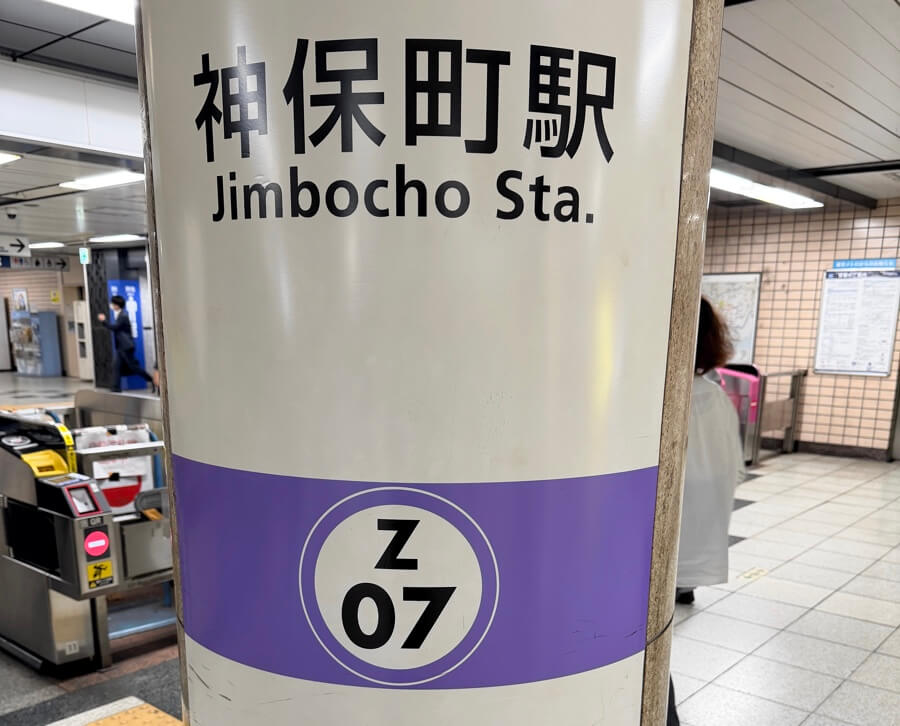
Jimbocho is a convenient destination from her place as it’s a one-train ride on the Denentoshi/Hanzomon line (one line becomes the other) from Yokohama. One of my goals this trip was to finally visit Eigakan in Hakusan (only three stops from Jimbocho) so I planned my day with that in mind.
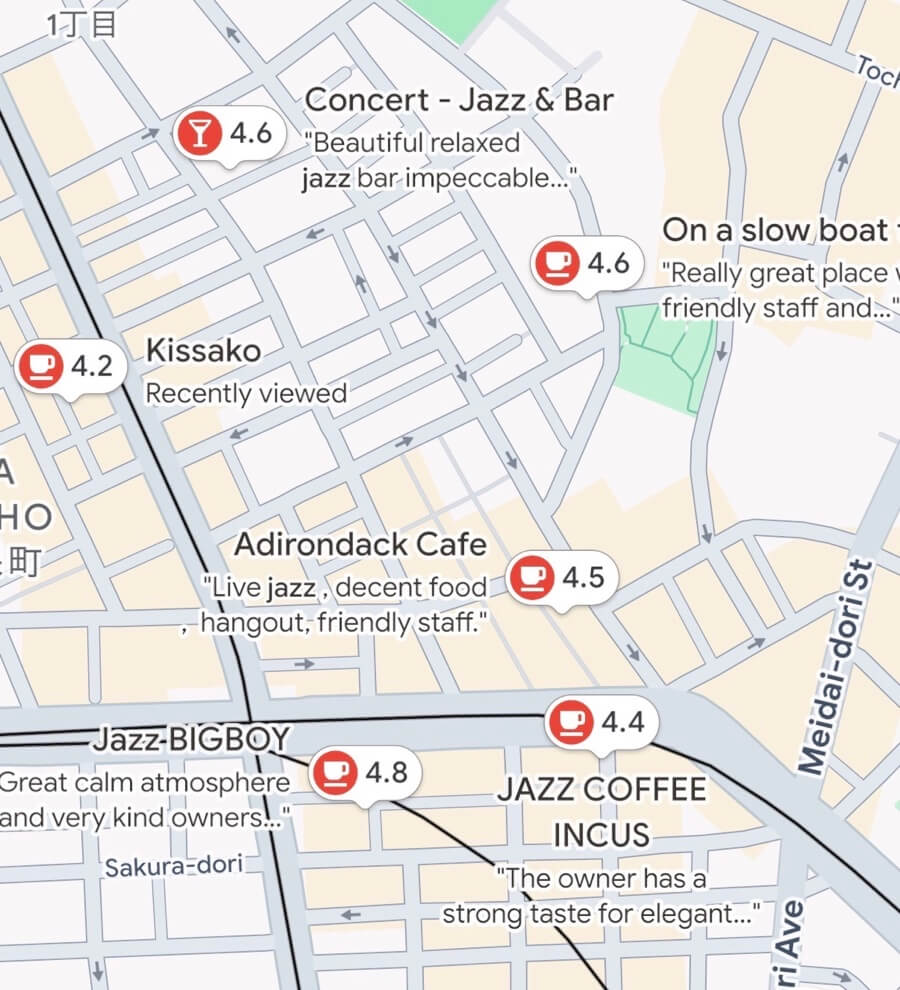
Some of the Jazz Kissas around Jimbocho Station.
Jimbocho is also something of a Jazz Kissa hotbed. I’ve visited Jazz Big Boy and Adirondack multiple times (I included both a couple of years ago in an article on my favourite Tokyo Kissas), but had several other joints in the area on my wish list, so this day would be a perfect opportunity to scratch a couple of itches before heading to Hakusan.
Advertisement
I picked a couple of new places – Incus and Kissako – figuring I’d have lunch at one of them, and grabbed the noon train into town.
Welcome to Jimbocho.
Incus
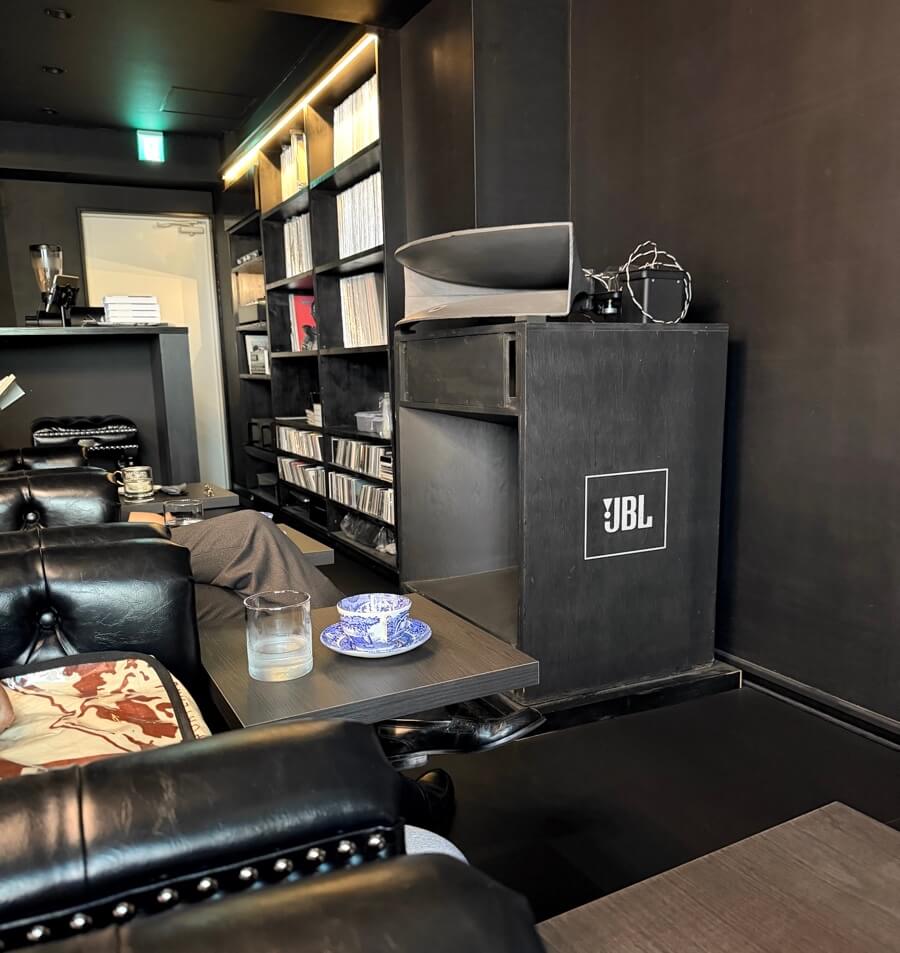
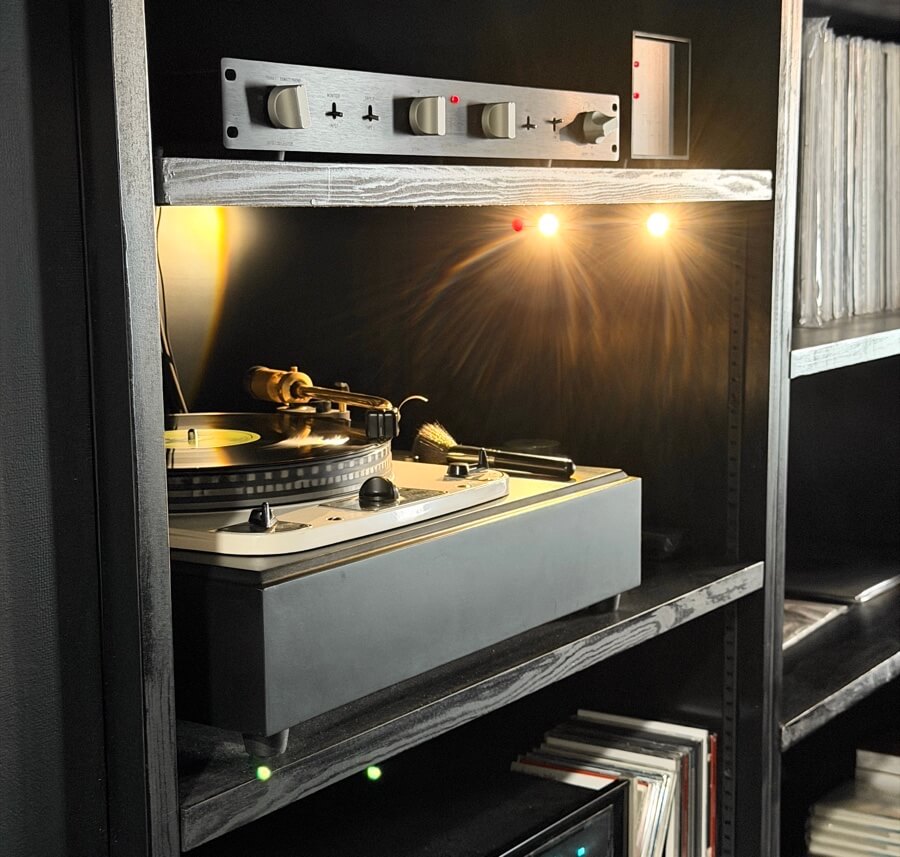
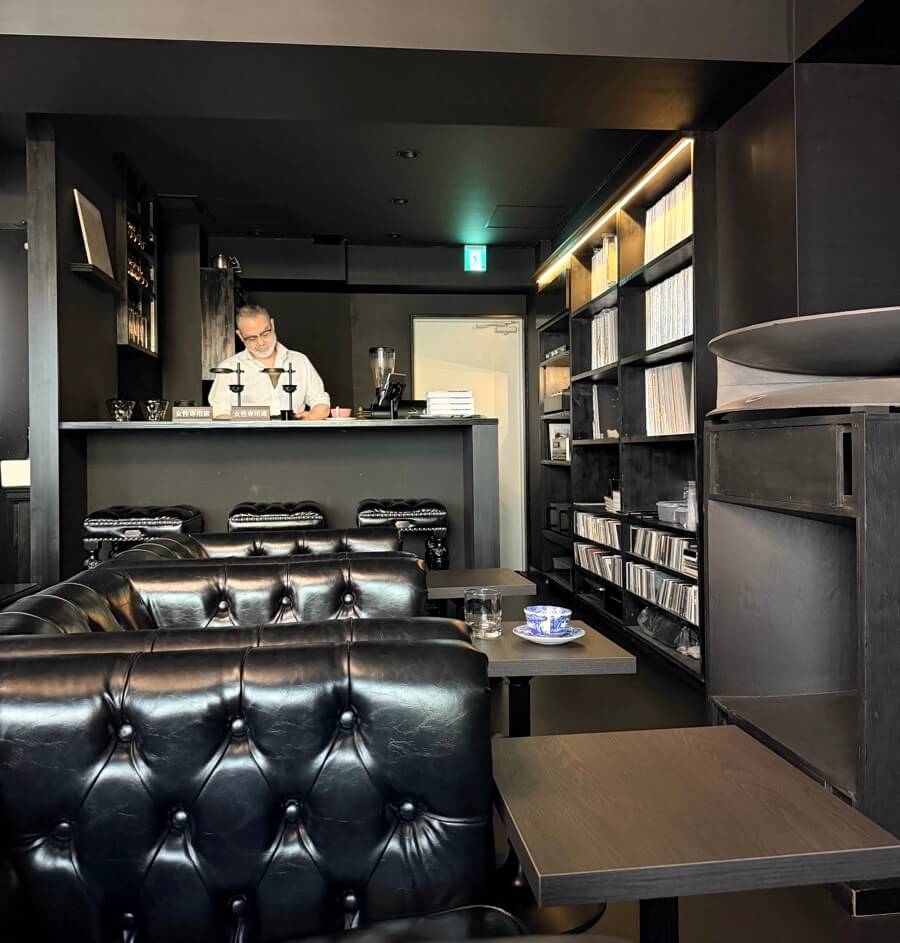
The first Jazz Kissa of the day could not have been more different than the other destinations I’d visit later. Incus is a sparse, modern, all black, minimalist space featuring huge JBL Professional Series speakers, Garrard 301 turntable and Mark Levinson amplification. Sound produced has wonderful clarity, depth and space.
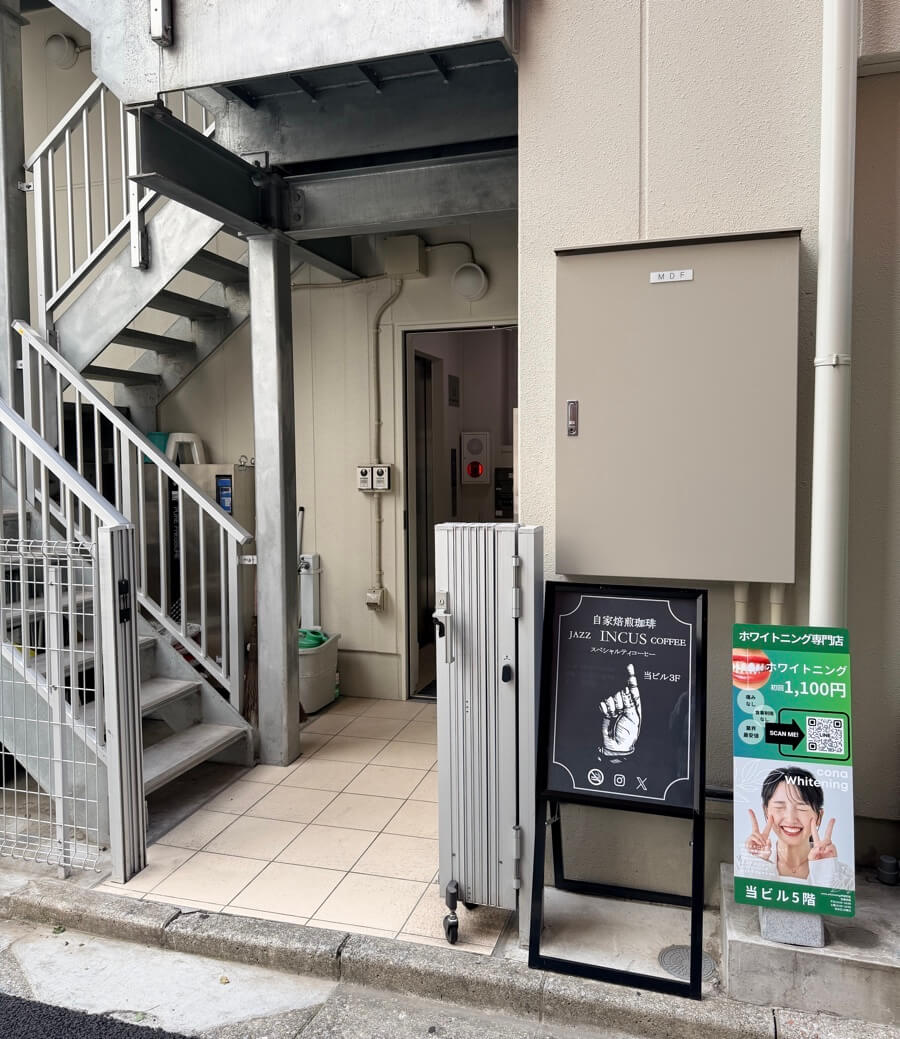
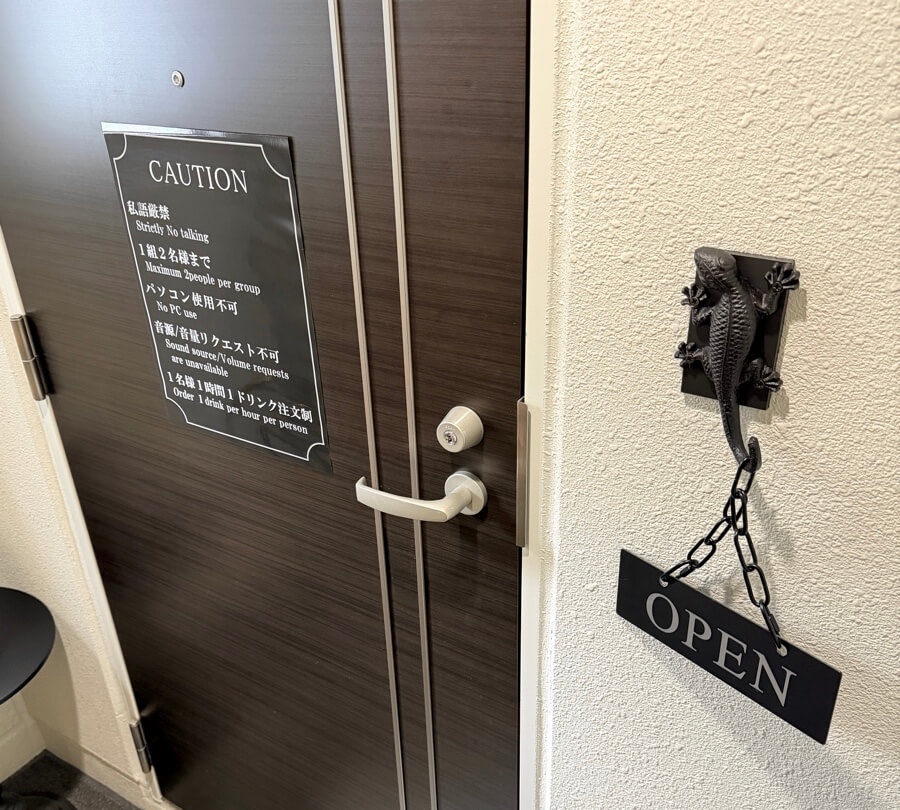
Incus entrance off a side alley. Elevator up to the 3rd floor.
Incus has a lot of rules; in fact it’s probably the strictest Kissa I’ve visited until now. There’s absolutely no talking, and a one-order-per-hour rule (no sitting on a single coffee for hours on end). Maximum party size of two patrons.
Caution! Please follow the rules.
And if that’s not enough… No computer use (though phones and tablets, and photos, are allowed; the issue seems to be keyboard noise interfering with musical enjoyment). No music requests and no album “bring-ins.” And no kids under junior-high-school-age.
Advertisement
I have no problem with guidelines like this though as it ensures enjoyment, free of distractions. You have been warned.
View from my listening chair. Are those speakers big enough?
The shop, equipment and record collection are meticulously organized and cared for. There’s seating for 8 in two rows of four plush chairs, plus 3 stools at the counter for overflow if there is any.
It all starts here.
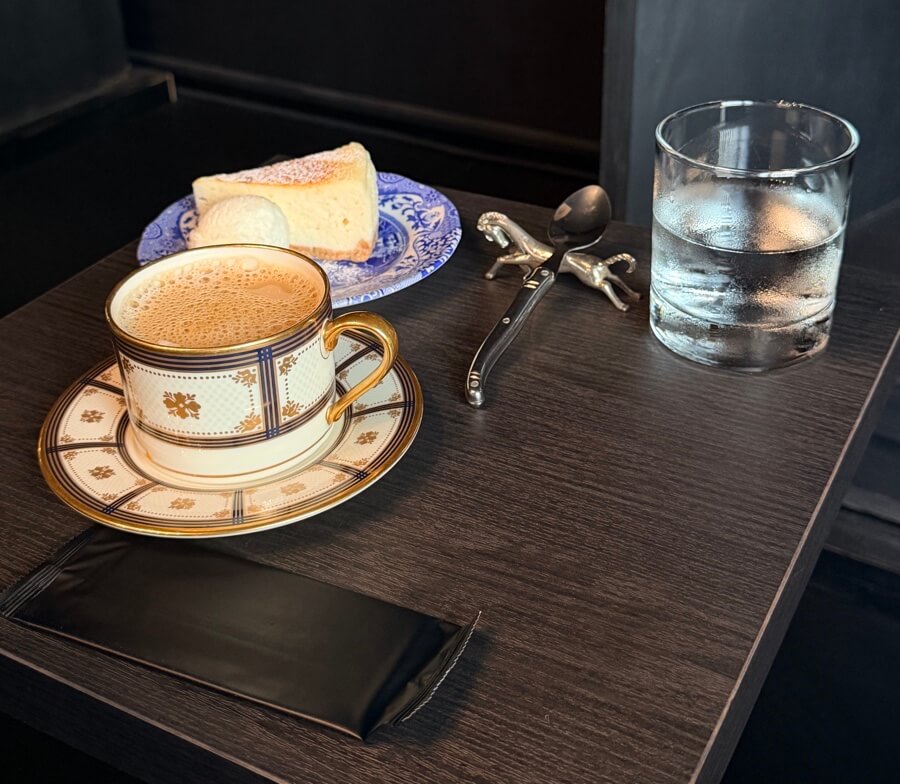
The menu features specialist, gourmet coffees, teas and desserts, with no other food on offer. Lunch would have to wait. I had Cafe au Lait, and cheesecake (ice cream on side), both of which were top-notch delicious.
Advertisement. Scroll to continue reading.
Advertisement
Coffee and cheesecake. Lunch will wait.
Music I heard in my hour-ish stay included Benny Bailey, Cosmic Tones Research Trio, and Masabumi Kikuchi & Masahiko Togashi (all very fitting of the vibe).
The Master of all he surveils.
Highly recommended for focused listeners and coffee afficionados.
Kissako
After leaving Incus I wandered over to Kissako, a quaint, casual, cozy space down a side alley a few minutes from the main book-selling area (and what Jimbocho is most famous for).
Such a welcoming entrance at Kissako.
The blue exterior, take out window, narrow street and potted plants lining the front give Kissako a French country cafe feel as you approach.
They even do take out.
Inside the shop there’s a tiny kitchen area and counter housing the turntable to the left of the door as you enter.
Advertisement
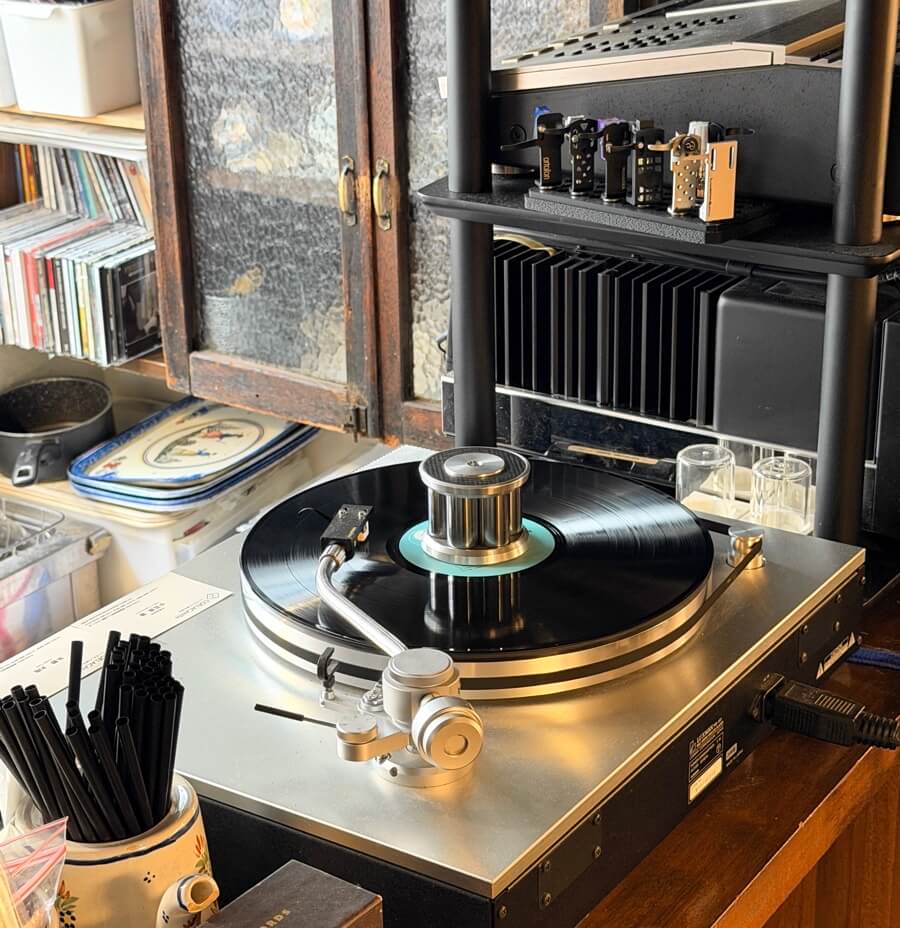
Luxman turntable, and LOTS of spare cartridges.
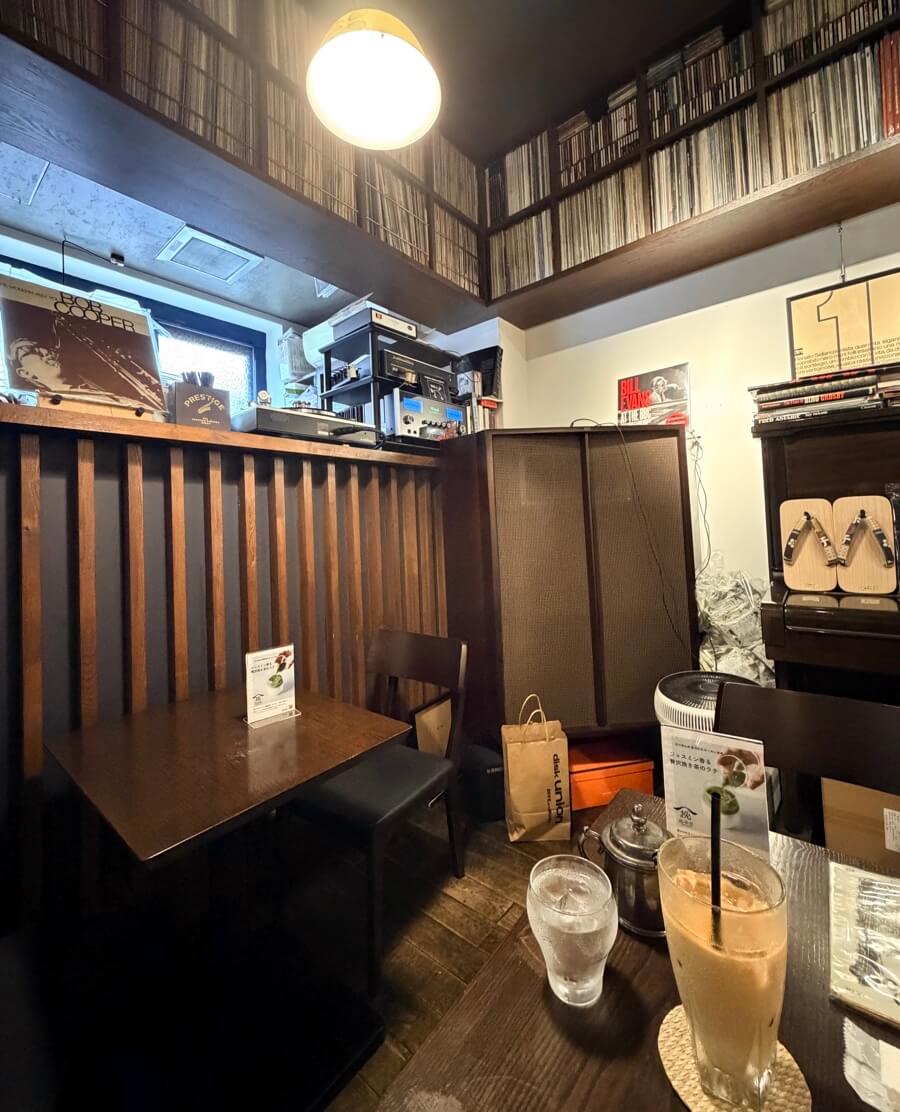
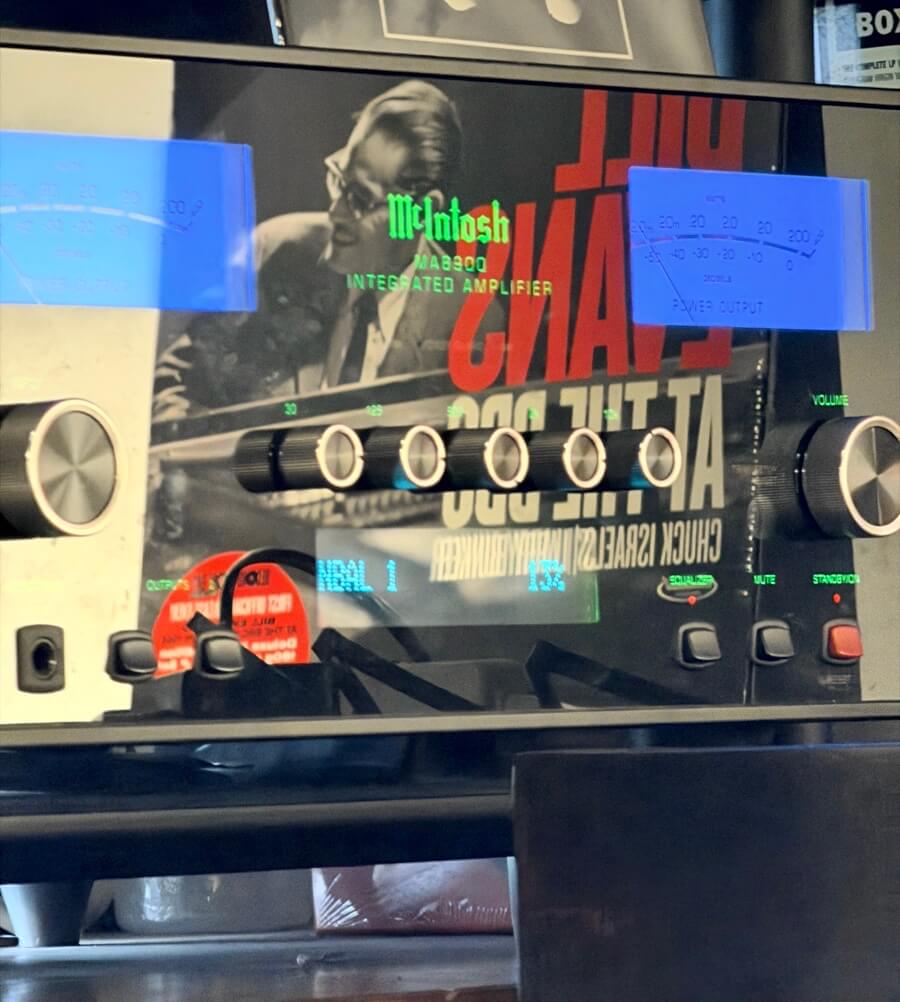
Seating is tight with space for about 15 surrounding two large Altec 820 horn-loaded corner speakers driven by a McIntosh MA-8900 amp, with Luxman PD-151 belt drive turntable as source. Records are stored up high, 360° around the room, with the day’s selected disks kept behind the counter.
Tight and cozy.
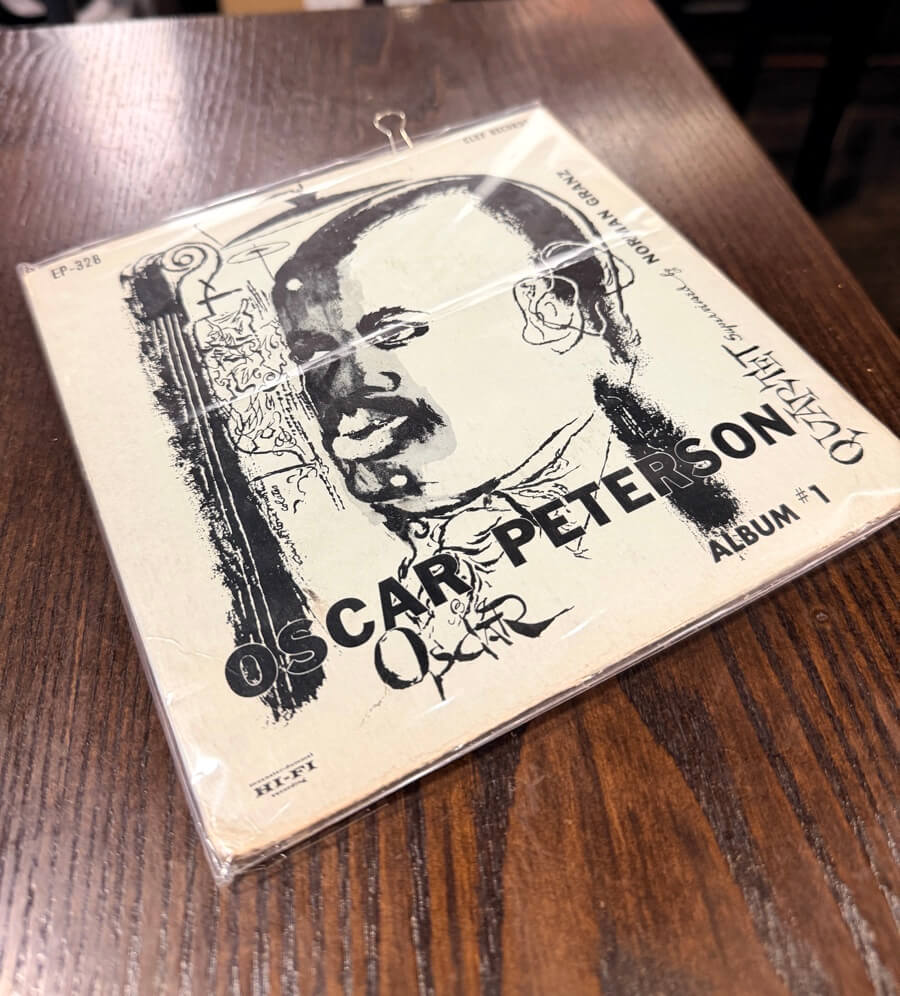
Menus are unique, enclosed between 7” record covers. I didn’t notice if all menus are the same, but my menu was held between two reinforced Oscar Peterson record covers.
Menu inside.
Like Incus this is a desserts and drinks only establishment, and I had an excellent Ice Cafe Latte. Lunch would again have to wait, but the Incus cheesecake was keeping me going.
Talking is okay here at low volumes and music is loud enough that surrounding chatter doesn’t interfere with enjoyment.
Advertisement
McIntosh and Bill Evans. What could be better?
I didn’t stay here too long but heard sides from Bill Evans at the BBC and Bob Cooper’s Milano Blues.
Ella & Louis
My original plan for this day was to visit Incus and Kissako as “appetizers,” and then head three stops up the Mita Line to Hakusan to cap the day off with Eigakan as the “main course”.
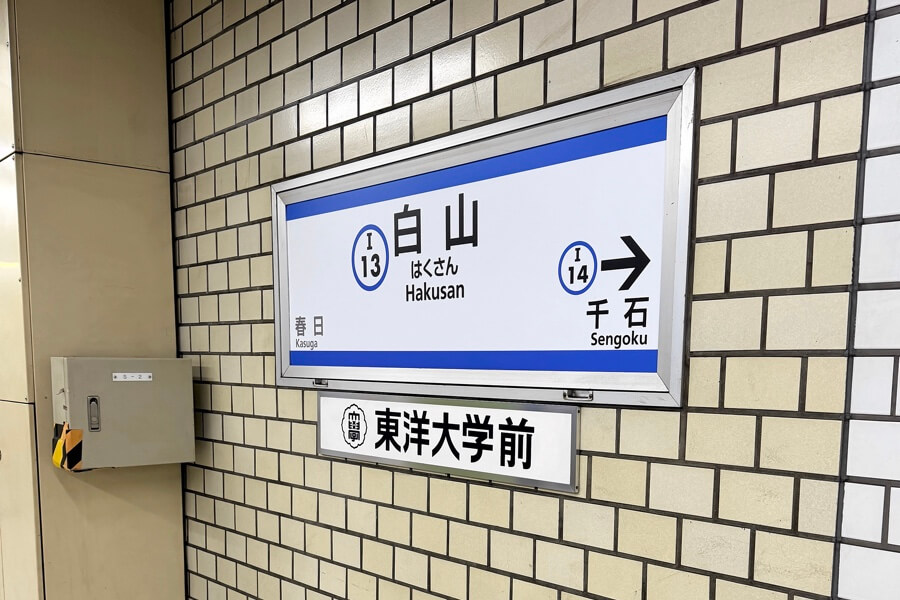
We are now arriving at Hakusan Station. I-13. The next stop after Hakusan will be Sengoku…
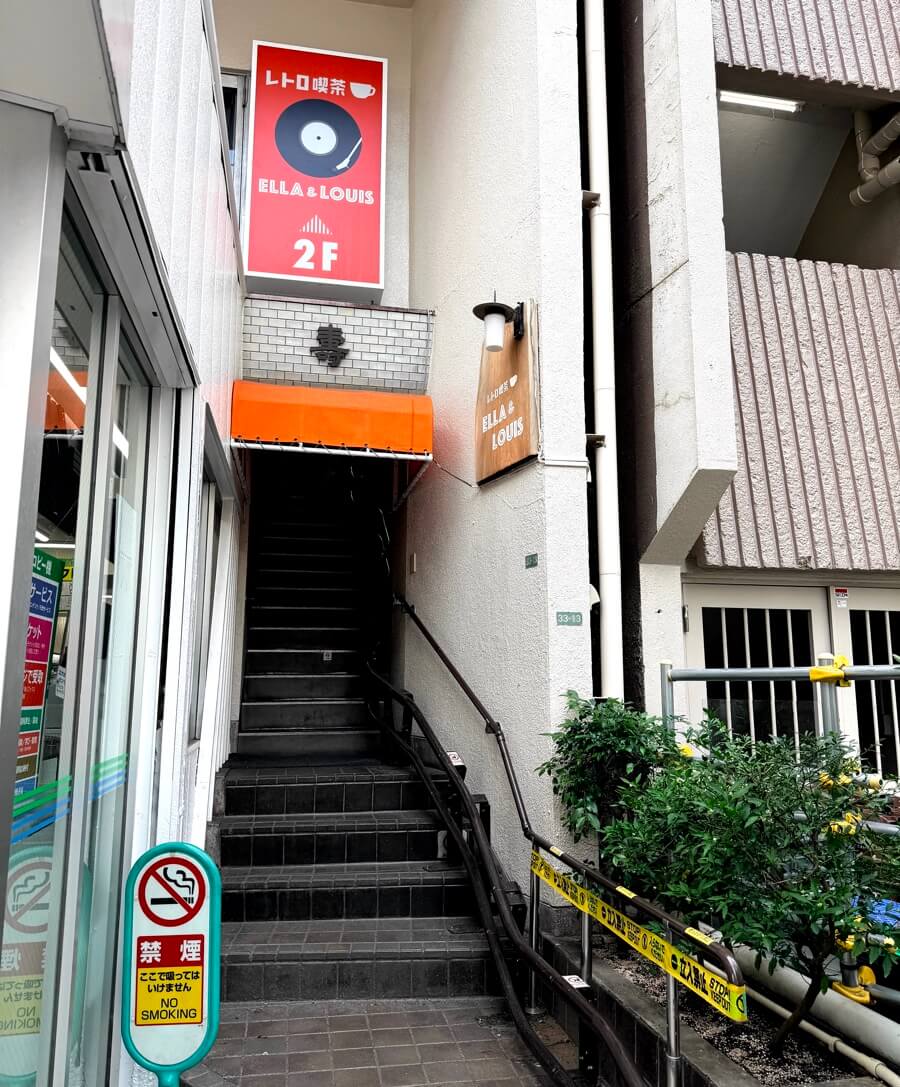
Eigakan opens at 4:00 and I arrived at Hakusan station with about an hour to spare. I pulled up Google Maps to see if there was a spot nearby to kill some time and found Retro Cafe Ella & Louis.
Advertisement. Scroll to continue reading.
Advertisement
The place looked quaint and as a bonus they serve food. From the name I assumed they’d be vocal jazz focused, and I decided to stop in for a bite and listen.
One flight up.
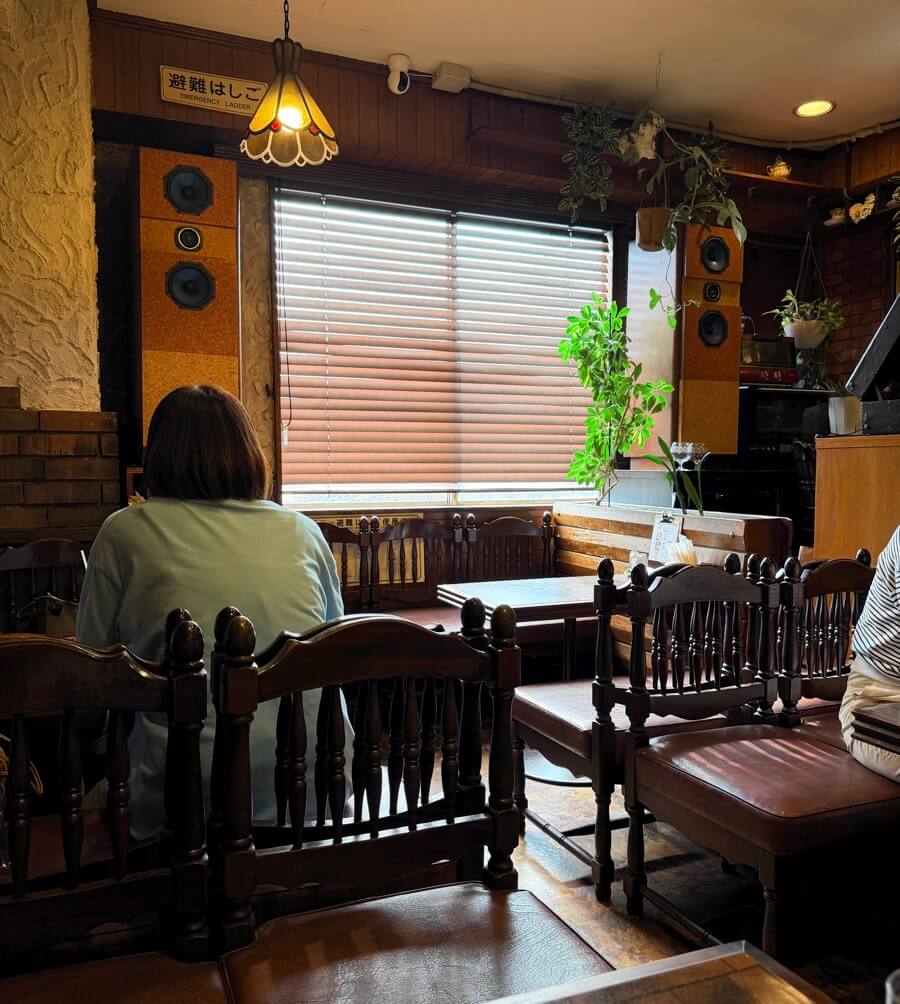
As advertised, Ella & Louis is rustic and casual with a full-on “Showa” vibe. Showa was the era from 1926 to 1989 corresponding with Emperor Hirohito’s reign, including World War II and the boom/bubble economy period of the ‘70s and ‘80s; most traditional jazz kissas opened in the post-war era and feature period-typical design and furnishings.
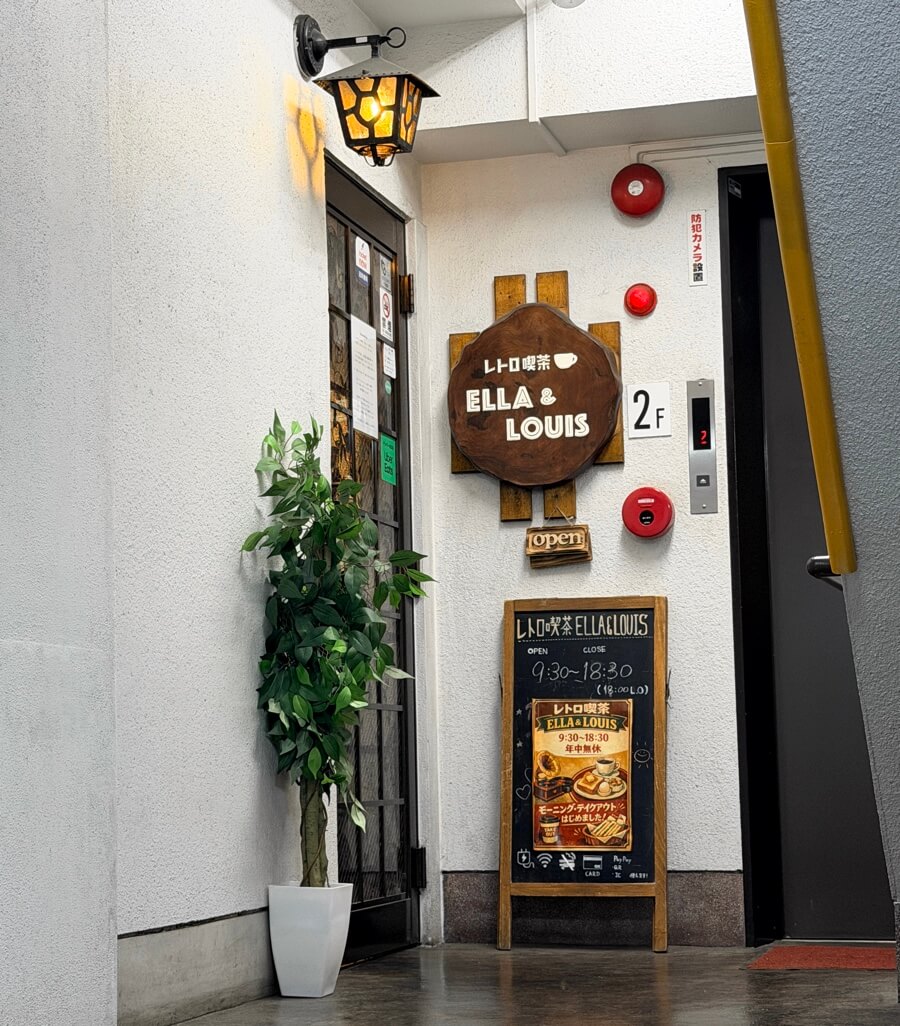
Enter here.
Ella & Louis was a regular coffee shop for 48 years and was taken over post-pandemic by a young Okinawan woman who shifted the cafe to more of a Jazz Kissa.
Showa vibes.
The shop is quite spacious with seating for about 30. It was quite busy for 3:00 in the afternoon, half full with mostly pairs of woman friends chatting quietly and sipping tea or coffee.
Advertisement
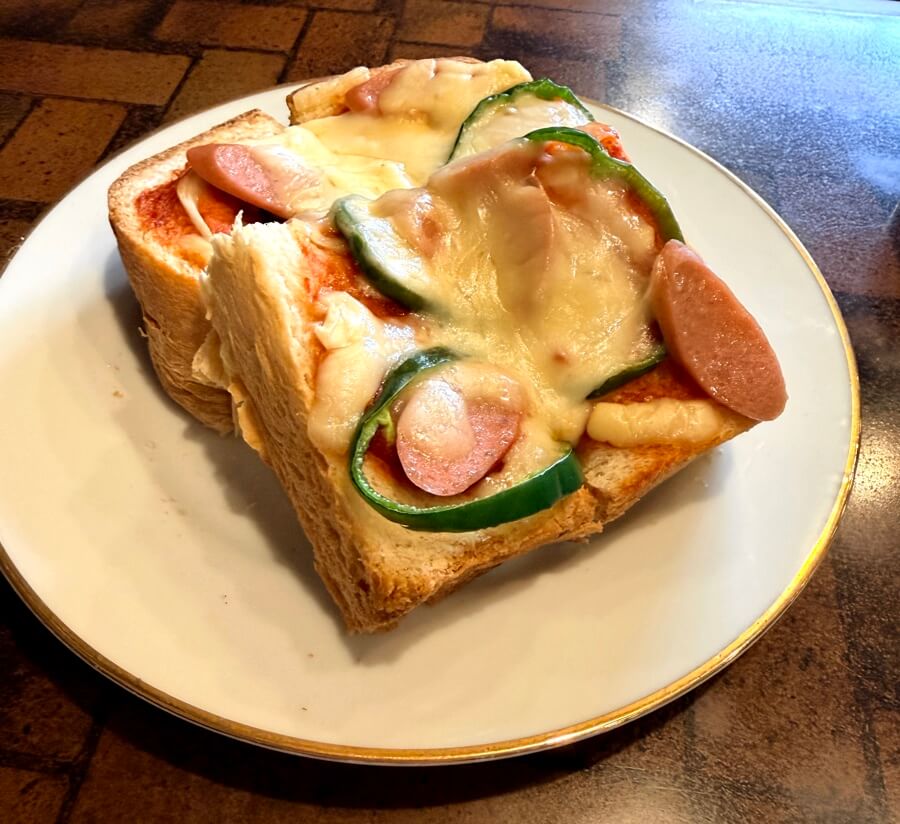
I took a seat and finally ordered a Japanese cafe-staple lunch of pizza toast: thick-sliced, hyper-refined white toast with tomato sauce, green pepper, sausage and melted processed cheese. Pizza gourmets may raise their eyebrows, but it went down a treat!
Pizza toast. Don’t knock it ’til you try it!
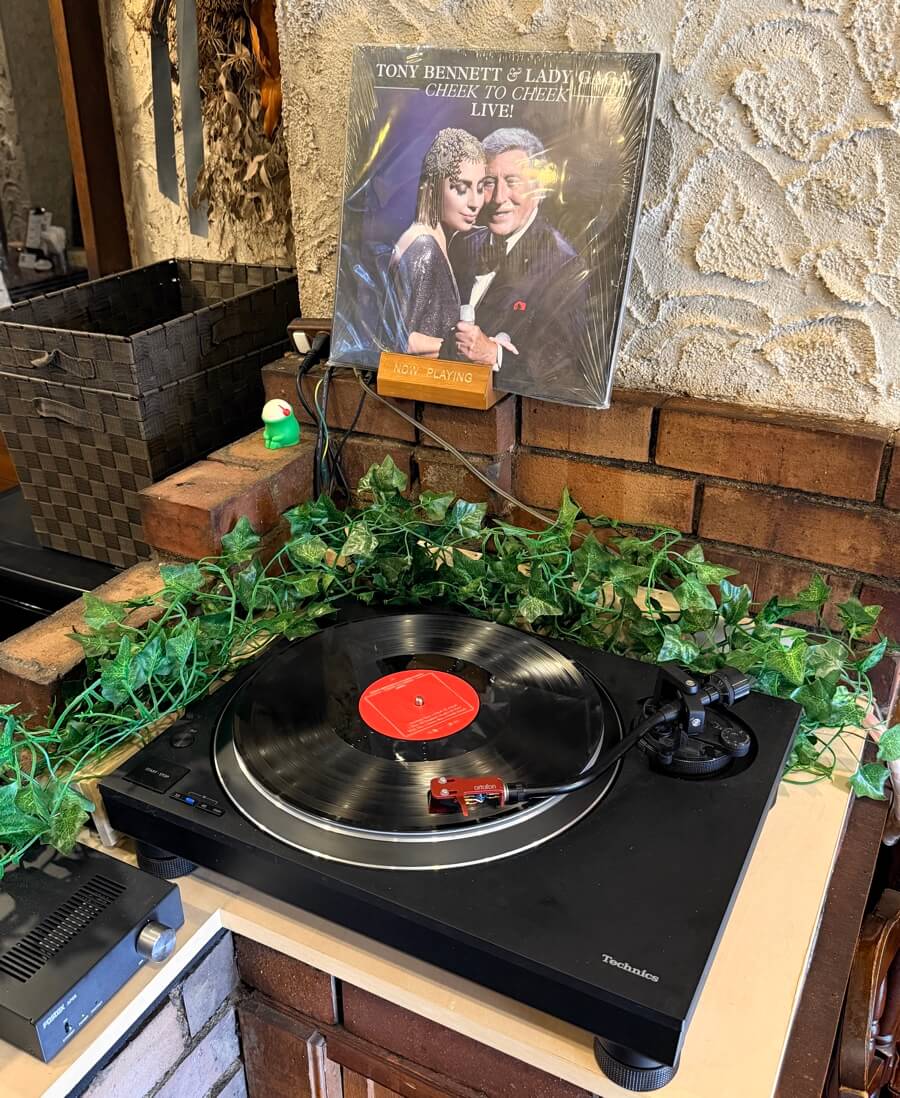
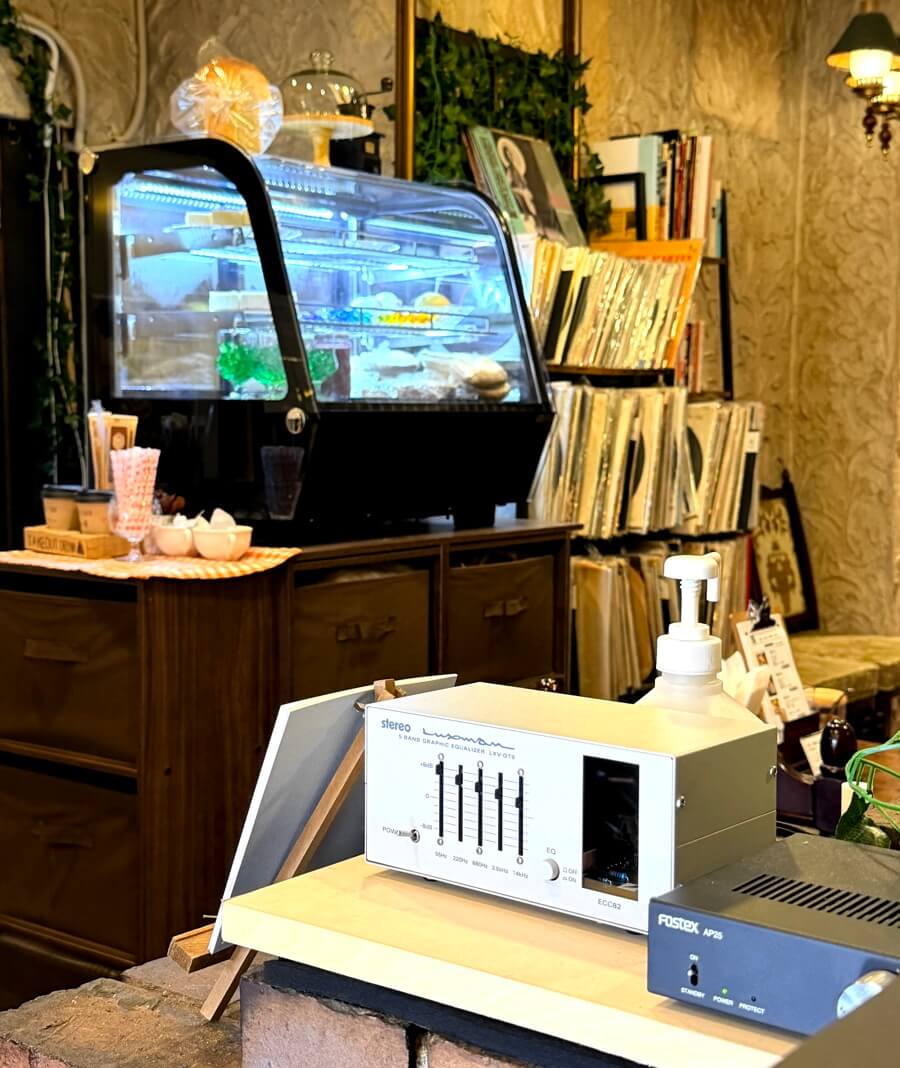
Music wasn’t too loud, and more background to conversation than focused listening. The audio system is simple, with custom-built speakers, a Fostex AP25 “personal amplifier” (one input and speaker outputs), entry-level Technics SL-100C turntable and a small Luxman 5-band equalizer.
Yes, we like vocal jazz.
Staff seemed in a Tony Bennett kinda mood this day and I heard a side of Tony Bennett classics followed by a side from his collaboration album with Lady Gaga. Not necessarily my preference, but it was pleasant enough.
Keeping things simple.
While the music and sound weren’t overwhelming, this is a lovely relaxing spot, and I enjoyed my visit immensely. Pizza toast consumed, the hour was approaching so I paid my bill and made my way to Eigakan.
Advertisement
Eigakan
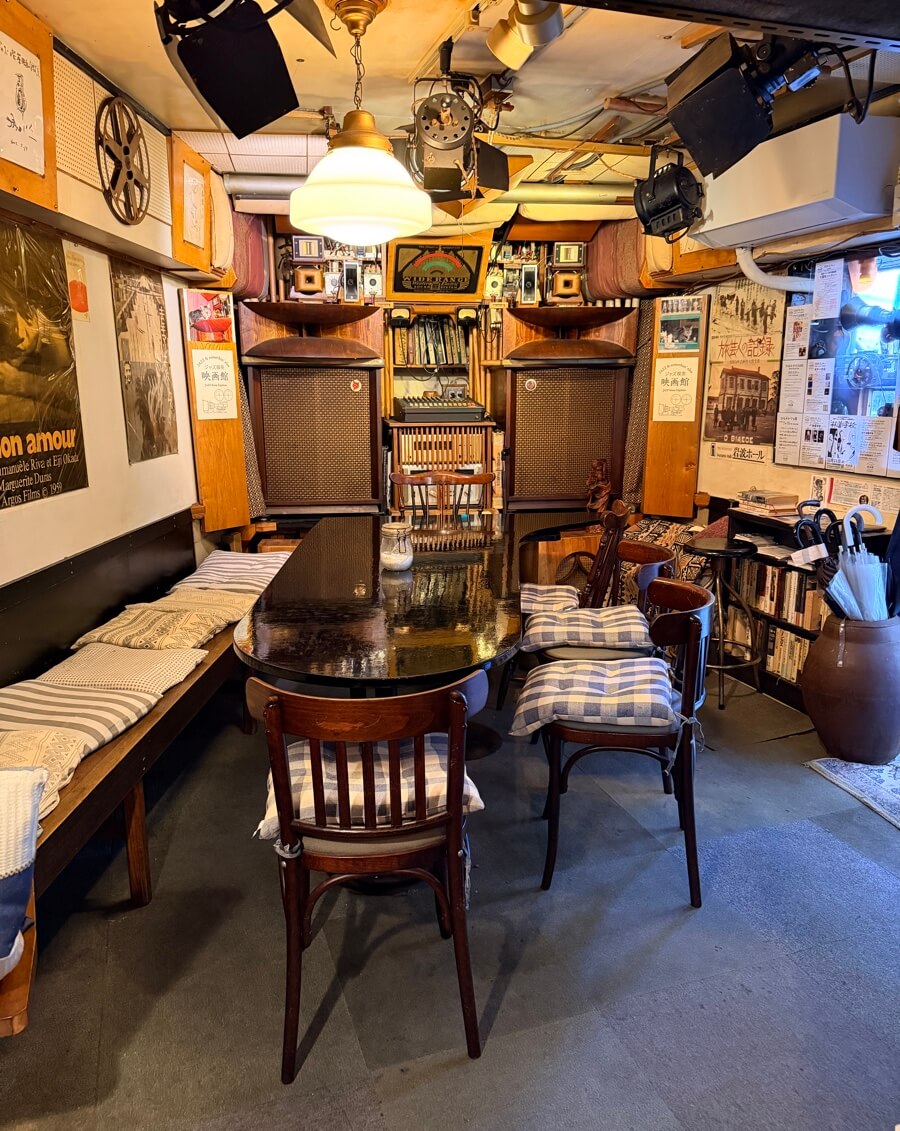
Oh my. Where does one start with Eigakan? If there is a list of top “historical landmark” jazz kissas in Tokyo, this combination music/movie museum is most definitely up there.
Heaven awaits just a few steps down.
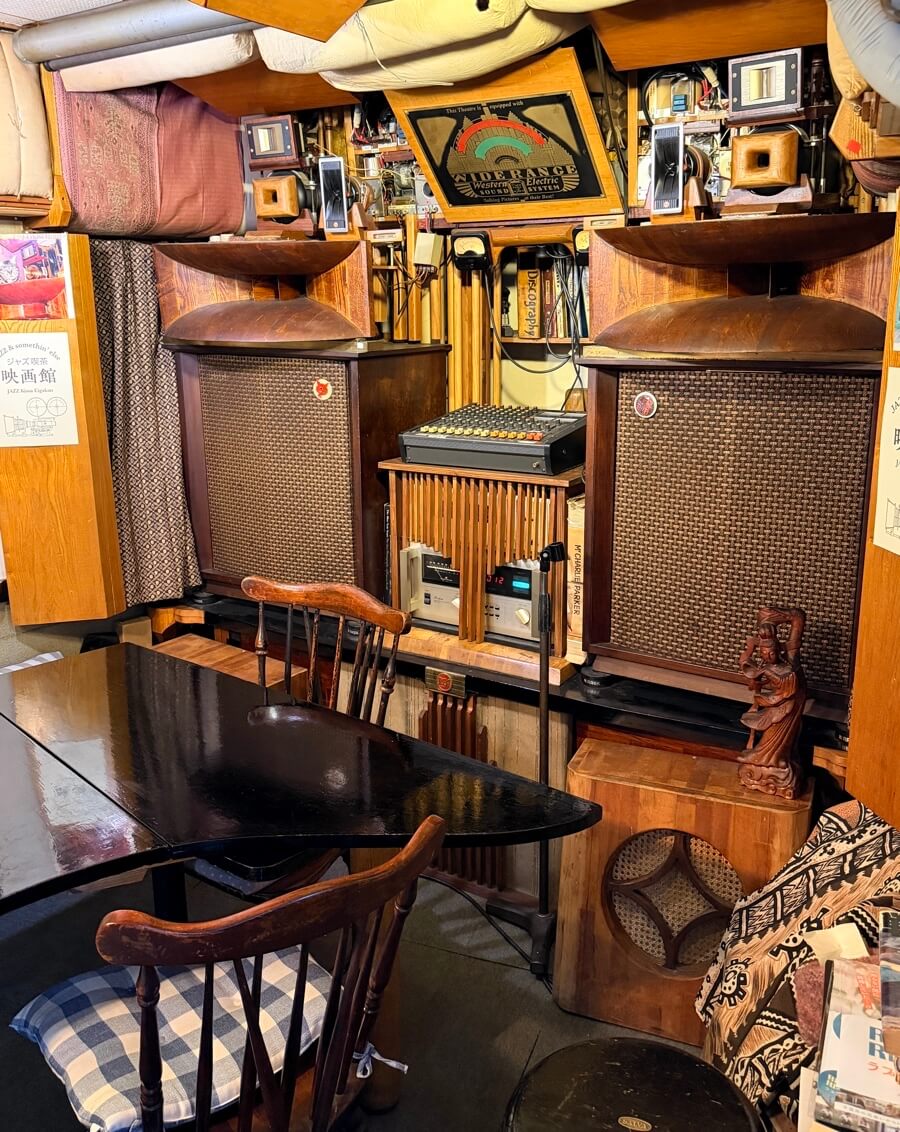
The space is wedge-shaped with speakers placed in the narrow end. The vibe is woody and rustic, with low lighting.
Where the magic happens.
The sound was remarkably clear and articulate, with bass that reached way down without turning the room into a demolition site. The music was loud, but not obnoxiously so. Enveloping, not invasive.
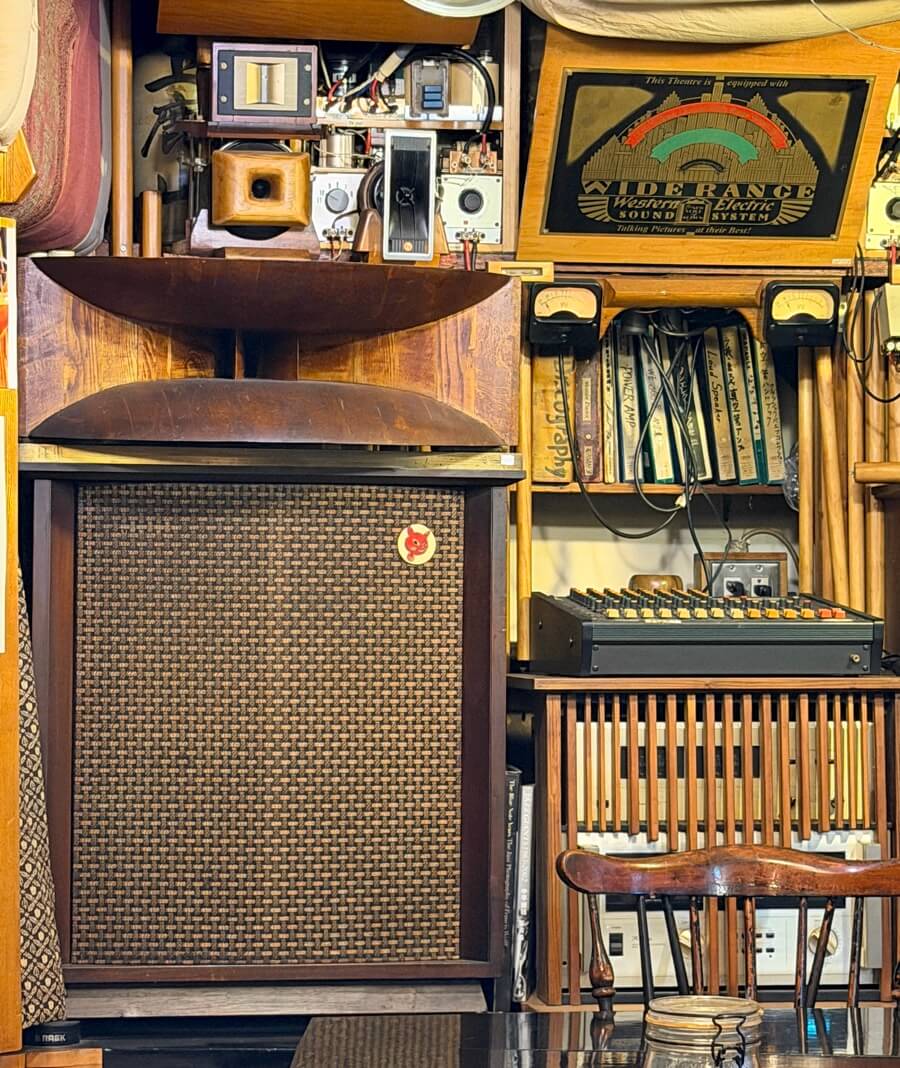
Sonic marvels.
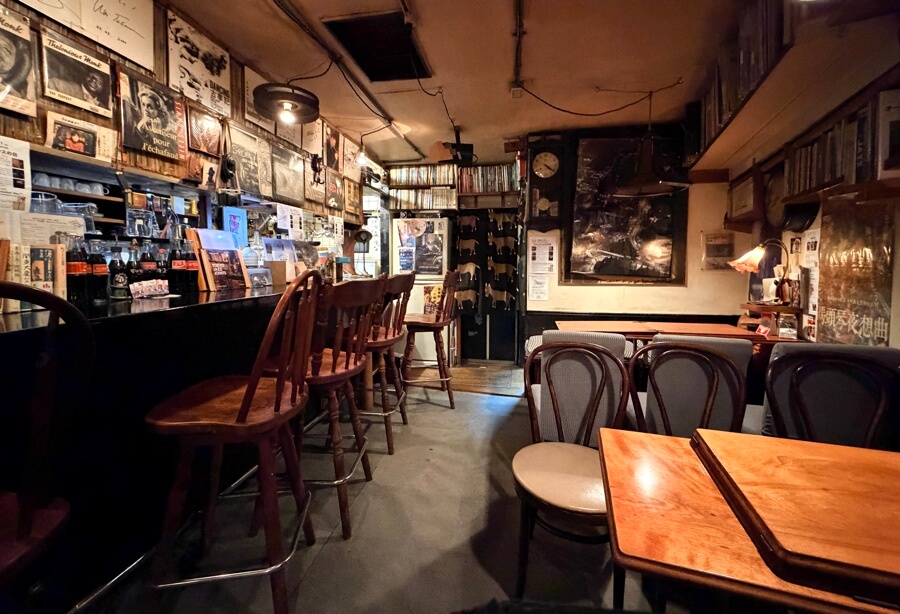
Seating is spread out with room for 30-ish including a communal area at the front, chairs and tables for 2-6 in the rear, and stools down one side along the bar. Low volume talking is okay, and smoking is allowed.
Advertisement
Advertisement. Scroll to continue reading.
View of the cheap seats.
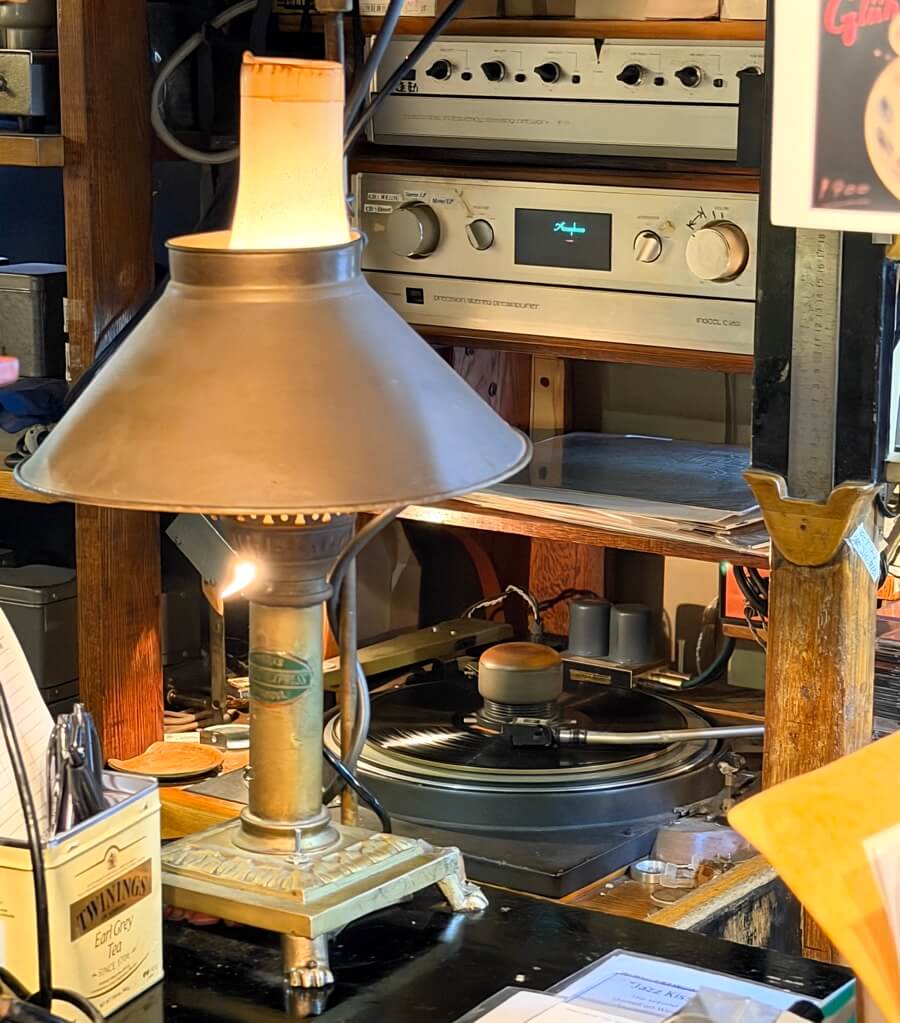
The audio system has been customized and tweaked over the decades into an auditory work of art. Main speakers are based on Western Electrics with custom made Hokkaido-sourced Tamo-wood horns and high-pitch super tweeters, and tube amps are customized from Dynaco kits (thanks for details to @djproben).
That tweeter set-up though!
Am not sure what the Franken-turntable is, but perhaps someone who’s been to Eigakan can enlighten me in the comments. The pre-amp (not sure if this has been customized in any way, but it wouldn’t surprise me) is an Accuphase C-280.
Elvin on the Frankentable.
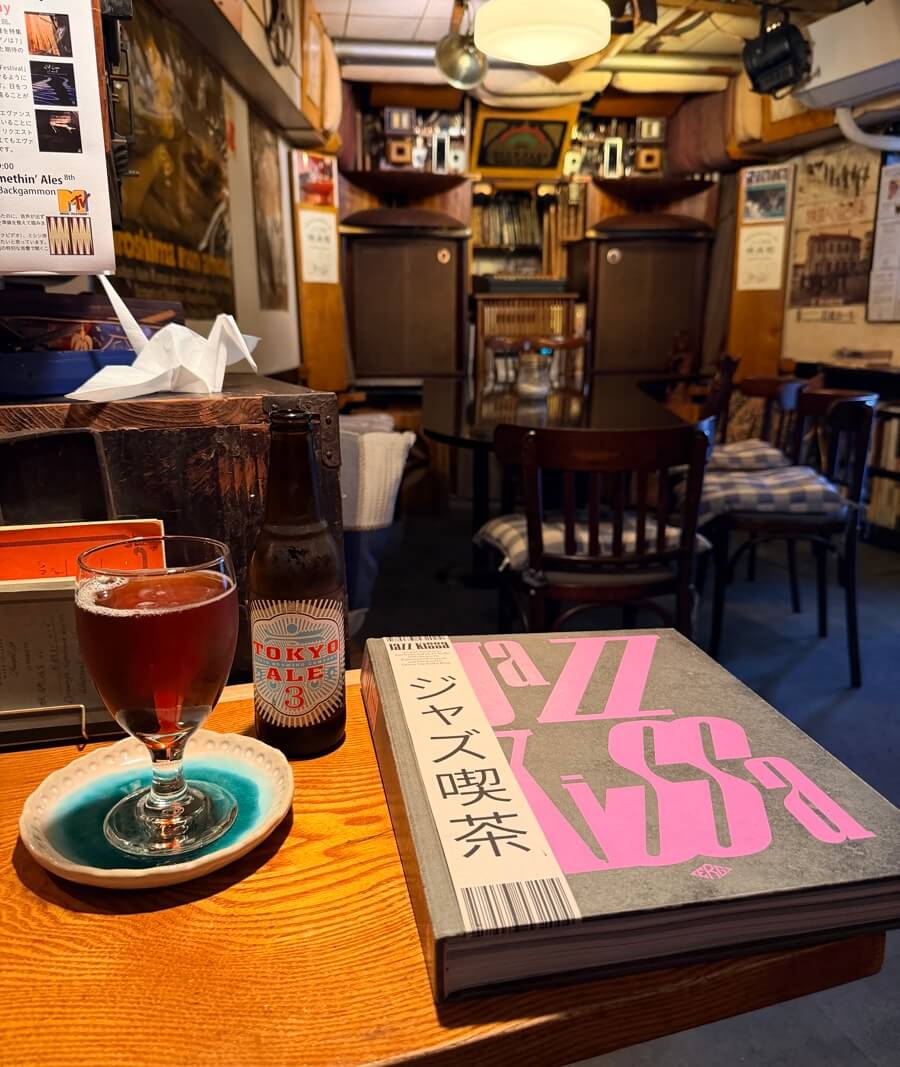
Eigakan is a feast not only for the ears but also the eyes, with shelves and racks of reading materials. I spotted (and leafed through) the ERG Media Jazz Kissa book, the Tokyo Jazz Joints picture book, and the recent kissa-focused National Geographic.
Books ‘n’ beers.
Being late afternoon when I arrived, I switched from coffee to beer with a tasty craft-brewed Tokyo Ale. It seems the brewery and Eigakan have a special relationship, with the Tokyo Brewing Company sponsoring events from time to time at the shop.
Advertisement
Musical accompaniment for my visit came from Elvin Jones (Dear John C), June Christy (Something Cool) and Gary Peacock (December Poems).
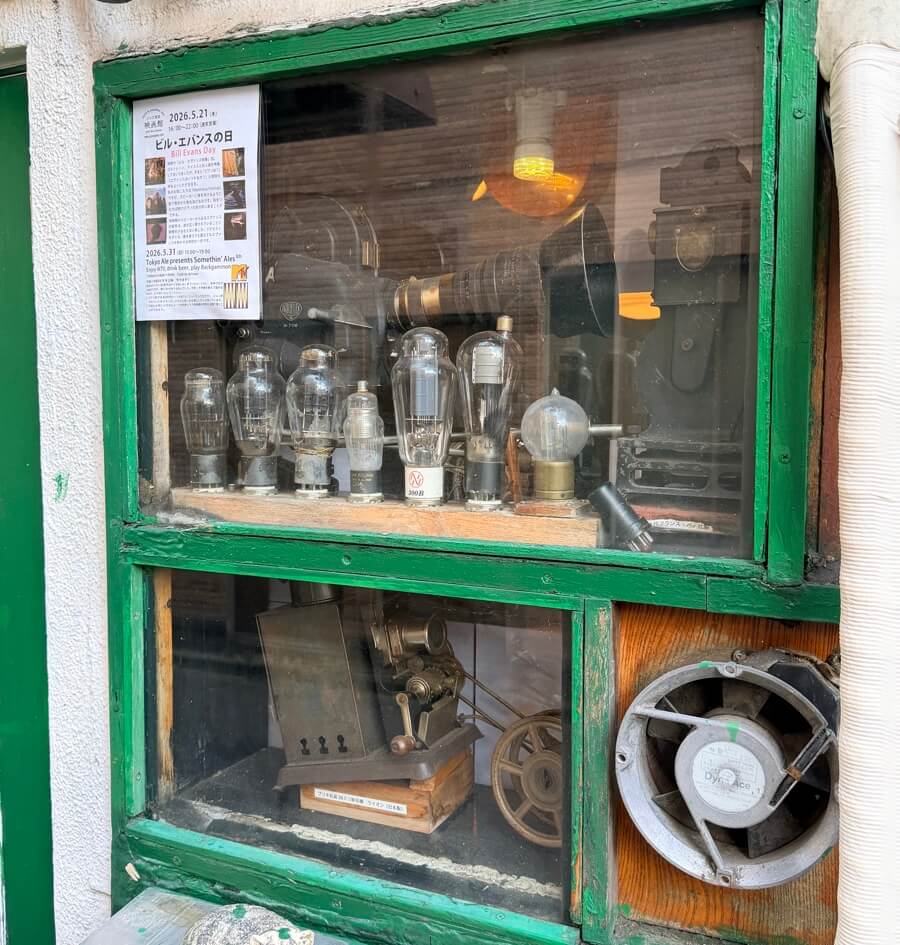
Tubes everywhere, including the front window.
Eigakan will certainly go down as one of the highlights of this Tokyo visit, and I’m sure to return often in the years to come.
Addendum: Jazz Olympus!
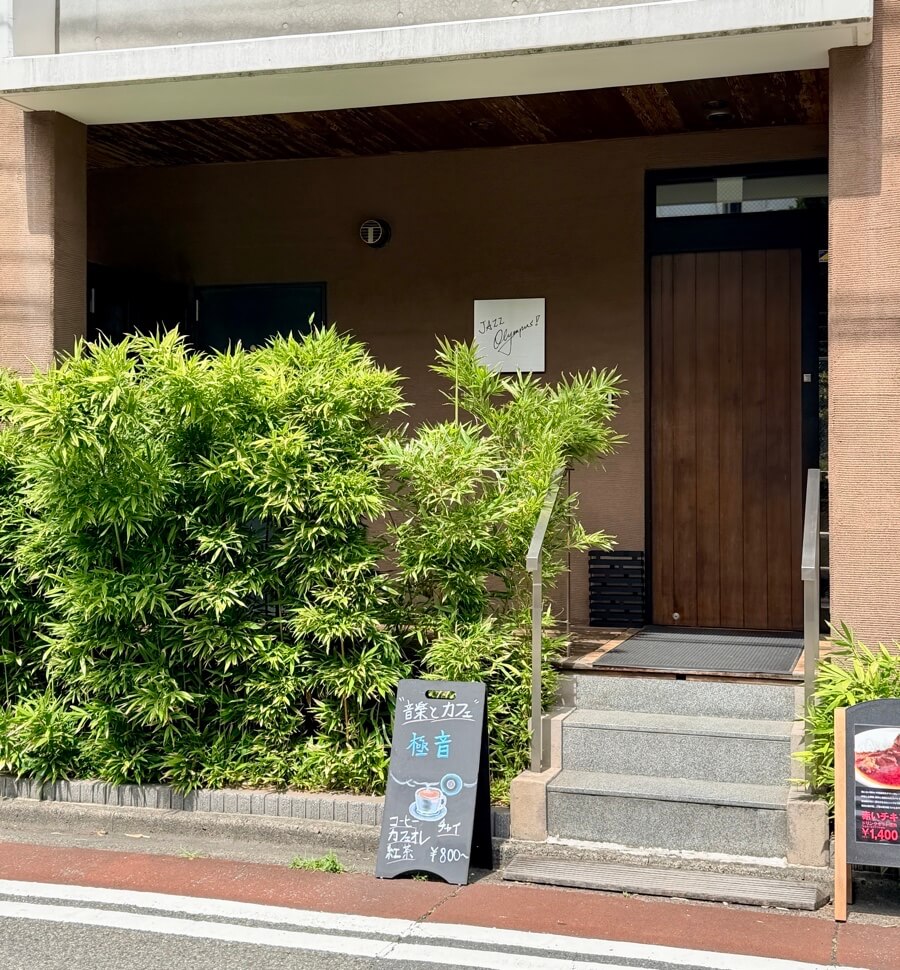
Had I not visited a week before, and if I’d gotten my act together a couple of hours earlier for this marathon day, I could have done a lot worse than to start the adventure at Jazz Olympus.
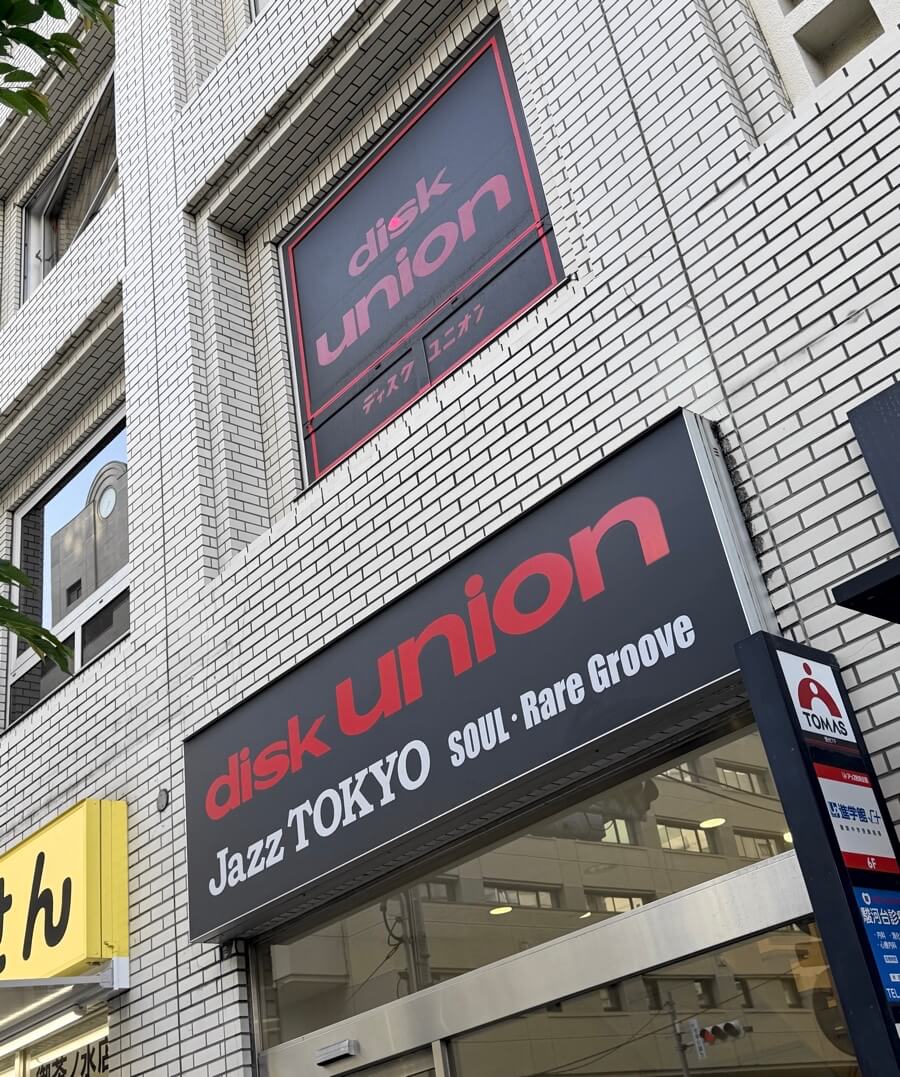
My first full day in Tokyo typically sees me heading to Ochanomizu to hit the Disk Unions (Jazz and Classical) and usually one or two of the Jimbocho Kissas.
Advertisement
Disk Union Jazz TOKYO in Ochanomizu.
For some reason though I’d never hit Jazz Olympus! on an open day. I’ve either made the attempt to visit on a Sunday or Monday (their regular closing days) or during one of the big, one-week Japanese holiday periods when almost all Jazz Kissas close (Golden Week in early May, O-bon in August, and at New Year).
Jazz Olympus! And the exclamation mark is earned!
As it turns out, Olympus! closed down in the spring of 2025, underwent some renovations and a system changeover, and reopened under new ownership in November 2025.
Olympus is not officially in Jimbocho but is so close (just across the street in Ochanomizu) that it might as well be.
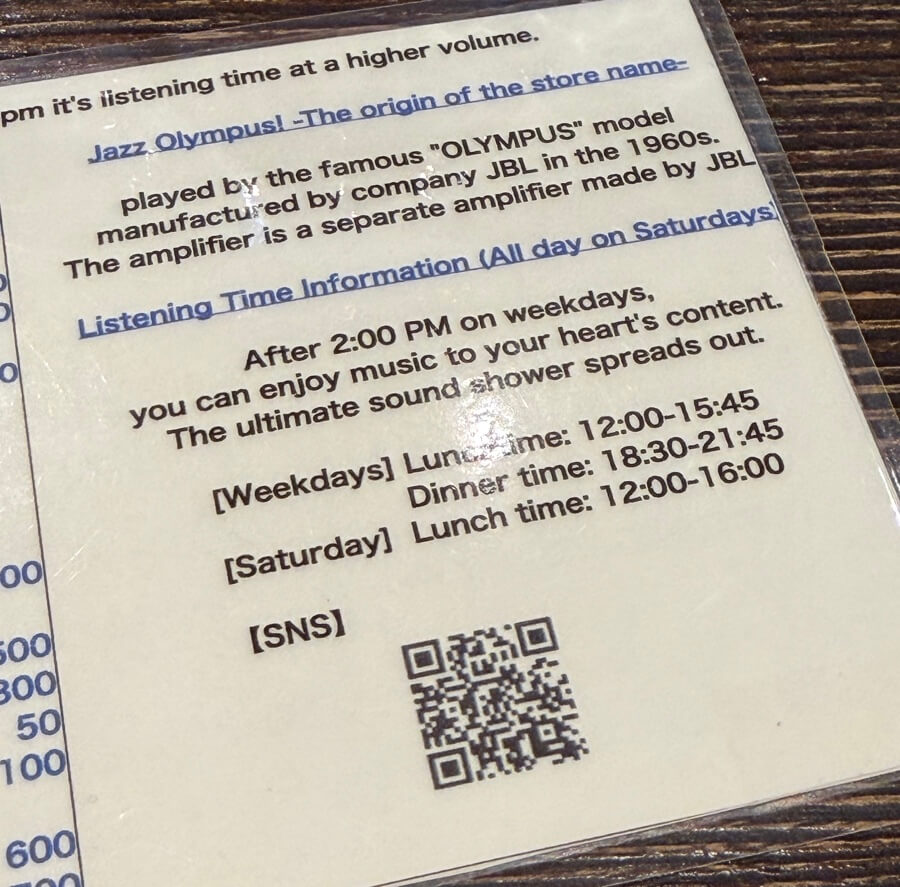
In case you wondered how the Kissa got its name…
This time around I checked ahead to see if Olympus! was open before visiting, and it was worth the wait. You can also make reservations, which is unusual for a Jazz Kissa.
Advertisement
Advertisement. Scroll to continue reading.
The non-smoking space is quite large and modern, but also welcoming and comfortable. There’s seating for 24 at six 2-tops down both sides of the room and a long communal table down the middle for singles.
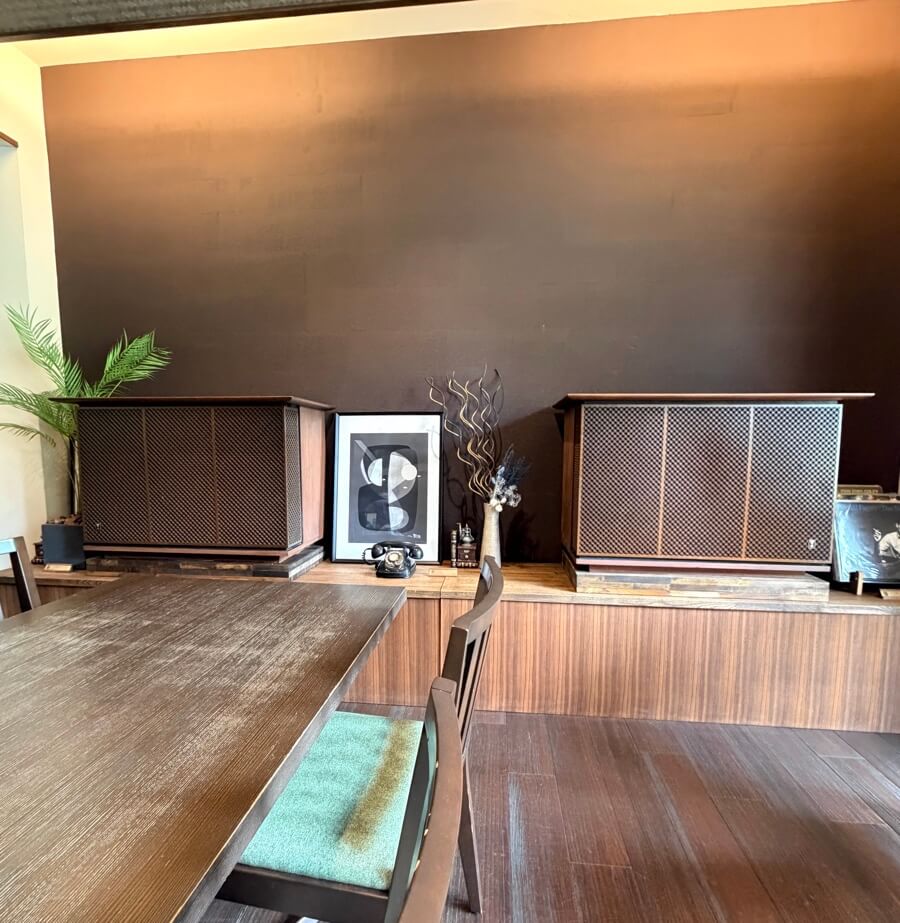
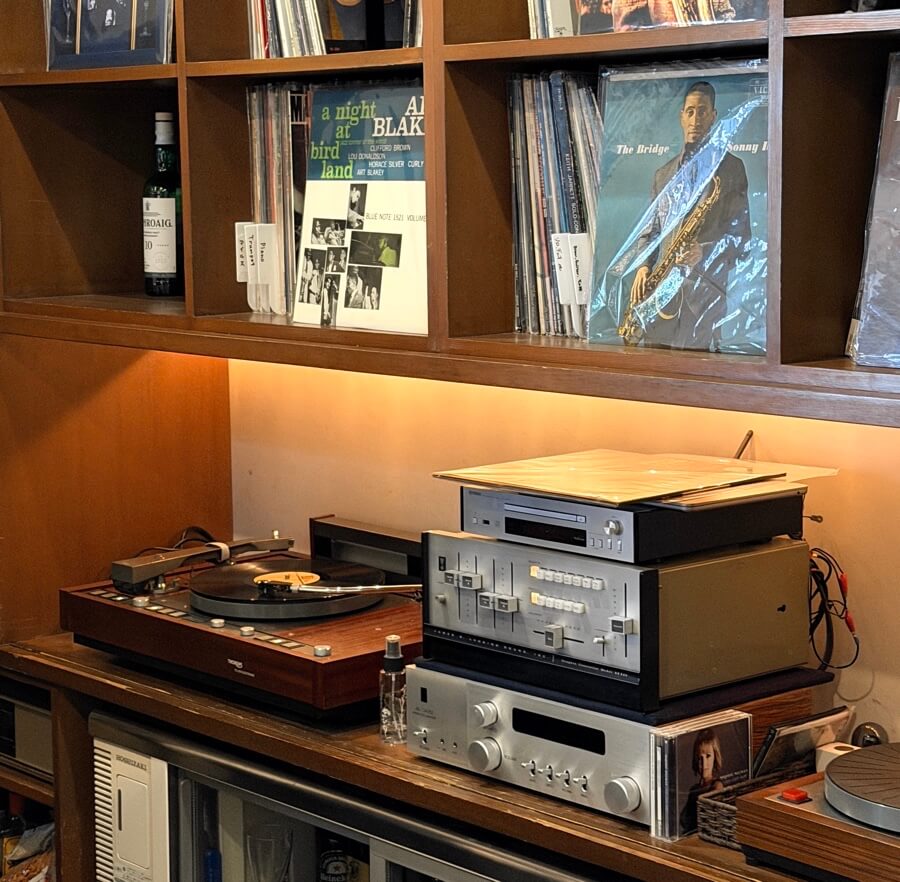
That is one serious system.
The big JBL Olympus speakers sound superb with amplification (power and pre) also by JBL, with Thorens TD-126 Mk. II turntable as source, and the vibe was perfect.
Shop system explained.
They play Western music from opening (noon) to 12:45, then jazz. Quiet talk is okay through lunch, and volume goes up from 2:00 for “listening time.” They also serve dinner from 6:30 in the evening.
Advertisement
Jazz Kissa serving curry, or curry shop playing jazz?
The Spicy Chicken Curry lunch set with drink, in my case iced coffee, was delicious. Olympus! is known for it’s curry to the point where some question if this is a Jazz Kissa that serves curry or a curry shopthat plays jazz. For ¥300 more I could have had a larger portion of curry, but that would have been gilding the lily.
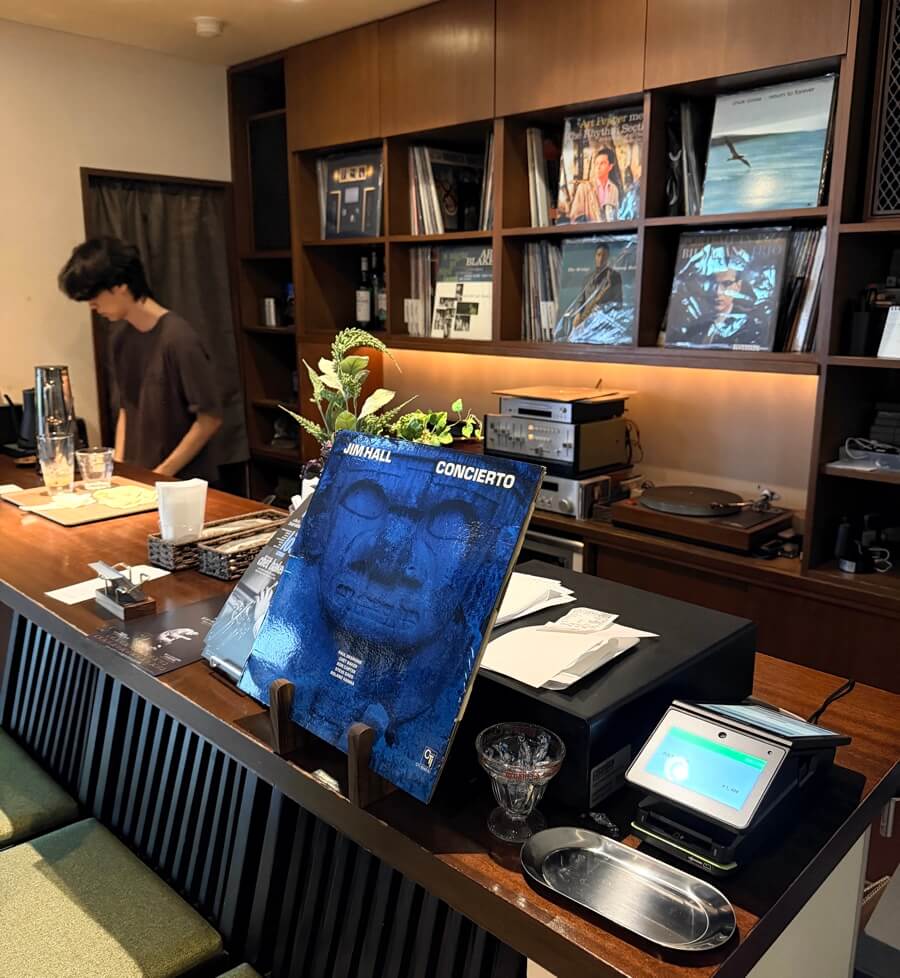
Control centre and serving hub.
I stuck around for several record sides including Dave Brubeck (Take Five), Art Blakey (Live at Birdland), McCoy Tyner (Nights of Ballads & Blues) and Jim Hall (Concierto).
Closing
This really was a great day. Four Kissas in a day could easily have been five, and it wouldn’t have been a huge stretch to add one or two of the other Jimbocho shops – Big Boy and/or Adirondack, or one of the places I’ve yet to visit, like On A Slow Boat, Ladrio or Naru (also Ochanomizu) – to make a bumper day of jazzing.
Final Eigakan view…
If you’ve visited any of these places, or do so in the future, I’d love to hear about it in the comments or by DM on Instagram at @audioloveyyc.
Britain spent nearly £1.5 billion shutting down renewable electricity generation last year
Smart meter households can now receive free electricity during surplus renewable generation periods
Octopus customers have already saved millions through experimental free electricity flexibility sessions
The UK is generating more renewable electricity than ever, but its grid often cannot use it all – as when the wind blows hard, or the sun shines bright, and demand is low, demand can fall below what is being produced.
Instead of putting that surplus power to wider use, the system has routinely paid wind farms to turn turbines off while paying gas plants to stand by, a payout practice which has cost the country almost £1.5 billion in a single year – with early 2026 figures suggest the bill is still piling up rapidly.
Now, Octopus Energy is looking to change this with a new expansion to its scheme to provide free electricity to its users across the UK.
Latest Videos From
Advertisement
What Octopus Energy is already doing
Octopus Energy has run its own version of this idea for several years through a system it calls Saving Sessions.
Going forward, the company will let its 8 million customers use more electricity when wholesale prices plummet.
This approach has already saved customers £4.6 million through free electricity sessions, and Octopus has also paid out £5.8 million to customers who cut down during peak times.
The firm stated, “the changes made to the DFS scheme mean customers can benefit from using more energy when renewables are high.”
Advertisement
Sign up to the TechRadar Pro newsletter to get all the top news, opinion, features and guidance your business needs to succeed!
British Gas already runs a separate scheme called PeakSave with half-price electricity on Sunday afternoons.
NESO said it may need to use more of its tools more often than in previous summers to manage low demand.
More than 36,000 Brits have expressed interest in joining Octopus Fan Club tariffs near local wind turbines.
Advertisement
Joining the Fan Club means that your electricity unit rates can be reduced by up to 50% when a local wind turbine is spinning and generating power.
The scheme will not fix the grid bottleneck on its own, but it offers a practical way to reduce waste immediately.
Octopus says it is “buzzing” about the change, and the company has a genuine track record of making these sessions work for its customers.
Advertisement
How the grid is changing its rules
Several energy companies are now testing schemes that pay households to use more power when renewable generation is high.
The National Energy System Operator (NESO) has also updated its Demand Flexibility Scheme (DFS) such that it proffers a solution.
The update allows power suppliers to encourage customers to run appliances, charge vehicles, or otherwise raise their consumption during periods of surplus.
Advertisement
Households with smart meters can be offered free or cheaper electricity at certain times, or rewards such as points that convert into gift cards.
The grid operator decides when the scheme runs and pays the supplier if it delivers the required change in demand.
Whether other suppliers will deliver the same level of engagement remains uncertain.
Free electricity for weekend washing is a real benefit, but the deeper problem of congested power lines still requires billions in new infrastructure spending.
Advertisement
For now, smart meter households with participating suppliers can claim a small win against a very large and wasteful problem.
Looking for the most recent Mini Crossword answer? Click here for today’s Mini Crossword hints, as well as our daily answers and hints for The New York Times Wordle, Strands, Connections and Connections: Sports Edition puzzles.
Need some help with today’s Mini Crossword? Read on. And if you could use some hints and guidance for daily solving, check out our Mini Crossword tips.
If you’re looking for today’s Wordle, Connections, Connections: Sports Edition and Strands answers, you can visit CNET’s NYT puzzle hints page.
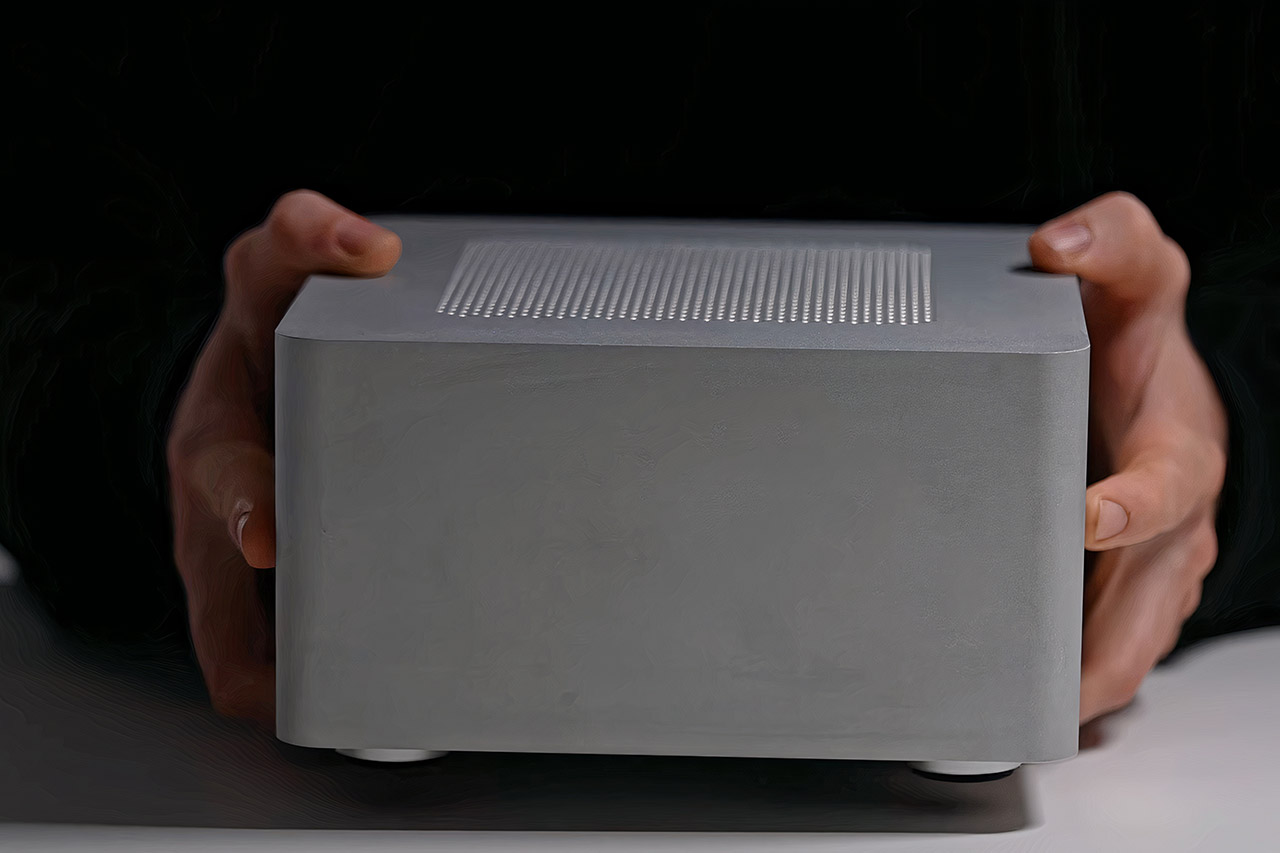
PhasedTech, a talented Apple enthusiast, had had enough of yearning for a Mac Studio. The compact beast of a computer had sleek lines, but let’s face it, the machine is pricey to say the least. So, rather than accepting a bad compromise and calling it a day, he loaded up all of his tools: a CNC machine and a 3D printer, and set out to make his own Mac Studio clone from the bottom up.
After weeks of scribbling ideas on paper, he ended up with a good overhaul. He began with a teeny tiny mini ITX motherboard measuring only 17 by 17 cm and painstakingly positioned all of the components on it so that when assembled, it is nearly as slim as the original Mac. Before experimenting with aluminum, he created a 3D printed prototype and tested it thoroughly to ensure that all of the elements fit together properly. Every corner and screw hole was meticulously measured, ensuring that everything fits together seamlessly and seems clean from the outside. Only when he was completely satisfied did he send the files to a company that could make the entire chassis out of solid aluminum stock and make it seem as polished and high-end as the original.
12th INTEL ALDER LAKE N95 PROCESSOR – The G3S mini pc uses the 12th Intel N95 CPU 4 Core 4 Threads 6MB cache, burst speed up to 3.4GHz. Compared with…
8GB RAM MEMORY & 256GB SSD STORAGE – GMKtec Nucbox G3S mini pc is prebuilt with 8GB DDR4 RAM, you will enjoy a speedier experience with Built-in 256GB…
RICH INTERFACE – Nucbox G3 Plus mini computer is equipped with USB 3.2, up to 10Gbps/S, HDMI(4K@60Hz)×2, 3.5mm Audio Jack. Supports WiFi 5, and…
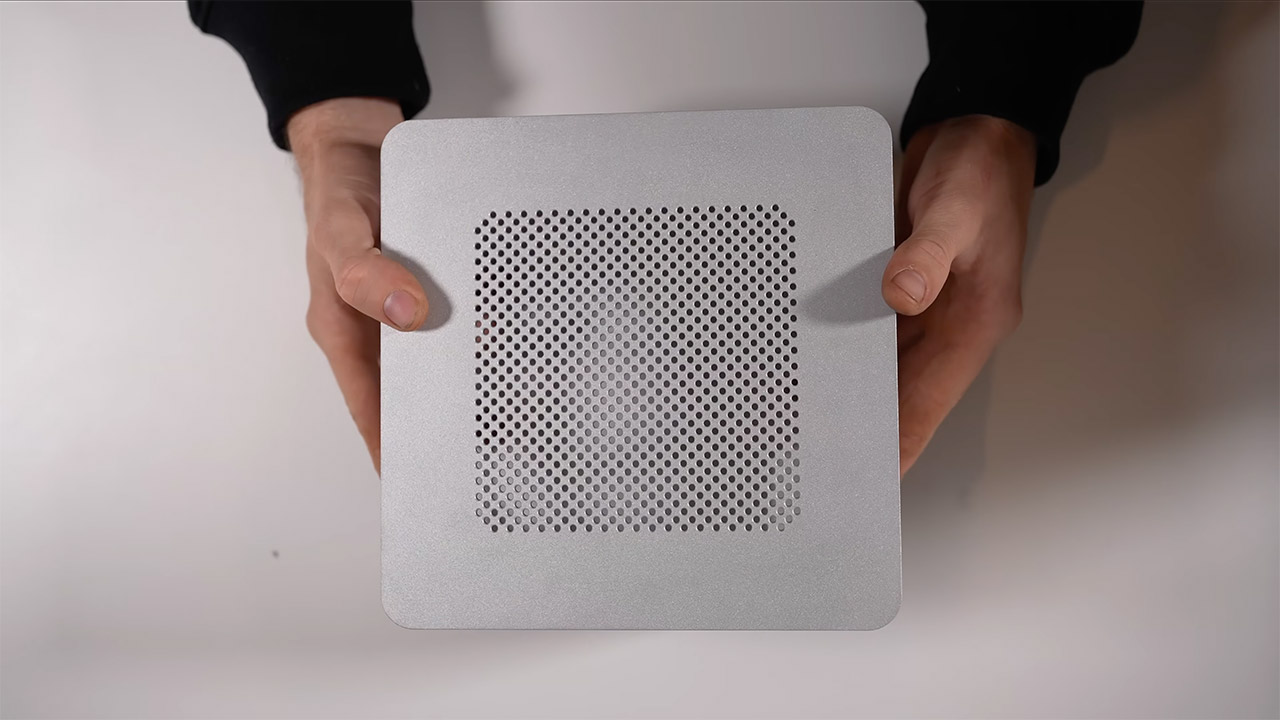
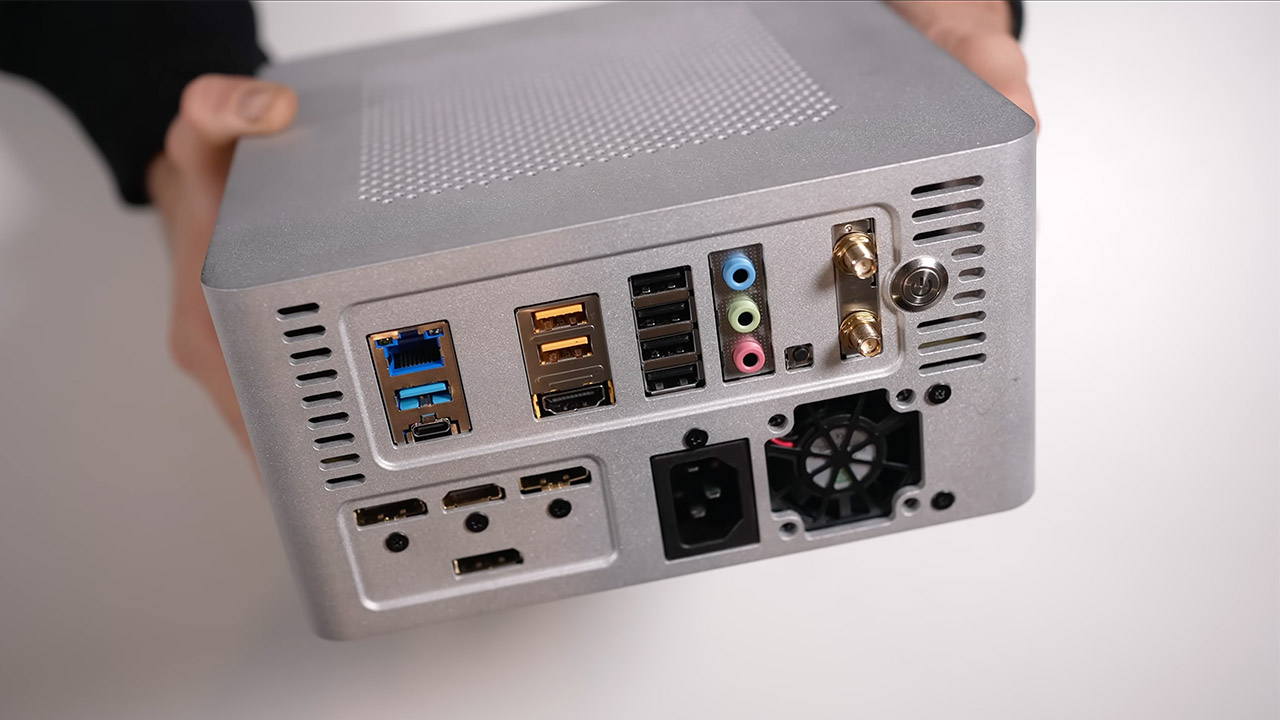
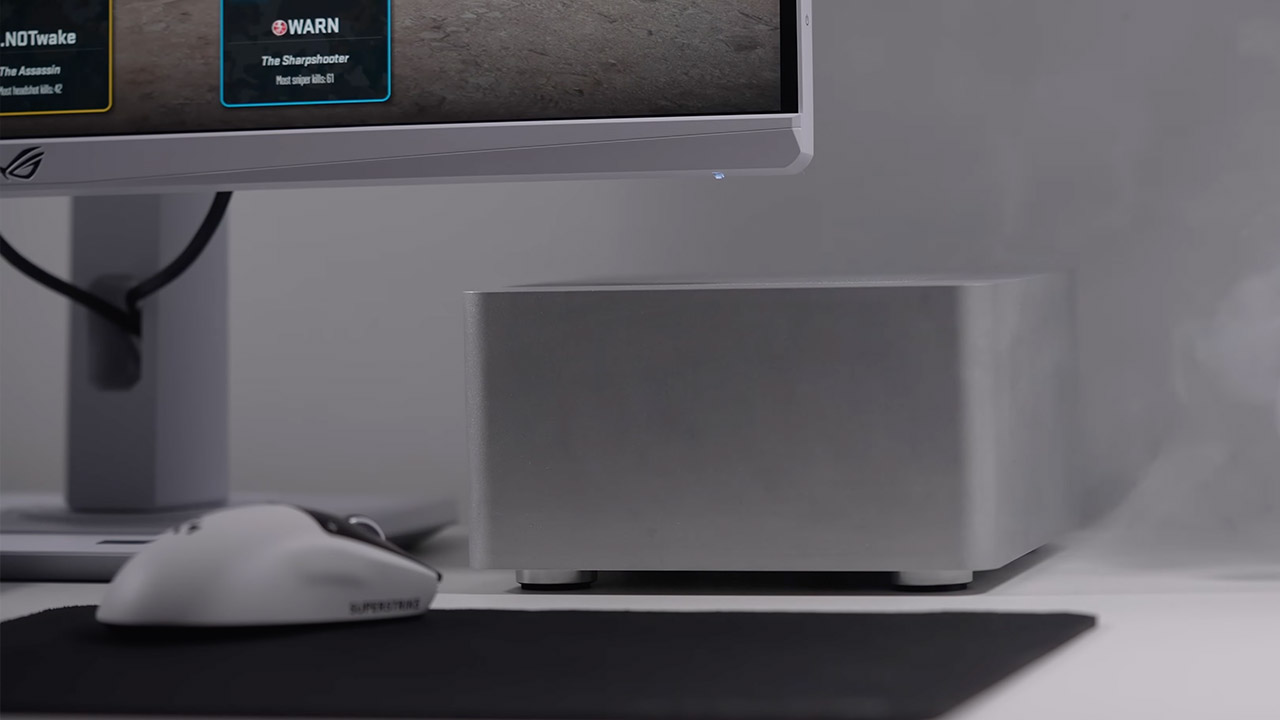
The dimensions are quite self-explanatory: the base is 196 millimeters on each side, somewhat smaller than the original, and he added 5 millimetres to the height, giving you a total volume of 3.8 liters. When you look at the top panel, it is sleek and ver similar to the Apple design. To make the front and sides as simple as possible, he used four small feet to elevate everything off the surface and discreetly placed the power button on the back.
Inside, the magic happens without becoming too heated, just as it should. It is outfitted with a Ryzen 5 9600X processor, 16GB of DDR5 RAM, and a 1TB NVme SSD for storage. A low profile RTX 5060 card handles the graphics, and it fits perfectly beneath the motherboard. Then there’s the ultra-low profile Noctua CPU cooler, which stands only 37 mm tall, and a 600W Flex ATX power supply in the lower portion. He even went so far as to insert foam padding between all of the components to prevent shaking when it was packed or moved.
Putting it all together required patience, as he had to remove the motherboard’s rear I/O shield to save a few millimeters before securing everything with four screws. The bottom plate glides into position and fastens with countersunk bolts, leaving no visible hardware. There are three apertures in the top for the graphics card’s fans to draw air from below and push heat out; there are no goofy vents on the sides, just good old-fashioned aluminum walls that absorb and radiate heat quite efficiently.
Real-world tests reveal that PhasedTech’s cautious engineering paid off, as Counter-Strike 2 runs at a brisk 300 frames per second at 1440p on medium settings, while Valorant remains silky smooth. During an extended session, the graphics card reaches its maximum temperature of roughly 65 degrees, while the processor remains cool in the low 70s. The metal enclosure becomes somewhat warm to the touch, which is really a positive thing, or proof that the casing is assisting in the removal of excess heat, and the fans are quiet enough to hum away in the background, making them ideal for ordinary office work.
SAP unveiled the Autonomous Enterprise at Sapphire 2026, embedding 200+ AI agents into its core business applications and partnering with Anthropic to make Claude its primary reasoning engine, betting that owning business process logic matters more than owning the AI model as its stock falls 41 per cent.
Christian Klein opened the SAP Sapphire keynote on Monday with a question that no chief executive of Europe’s most valuable technology company should need to ask. “Will SAP be a software company in the future?” The answer, delivered by SAP’s own AI assistant Joule at the end of the presentation, was that SAP is becoming a business AI company. The question was rhetorical. The 41 per cent decline in SAP’s share price over the past six months was not.
Advertisement
SAP unveiled what it calls the Autonomous Enterprise, a unified platform comprising more than 50 domain-specific AI assistants orchestrating over 200 specialised agents across finance, supply chain, procurement, human resources, and customer experience. The company announced a partnership with Anthropic to embed Claude as a primary reasoning engine across its AI-enabled portfolio. It launched a 100 million euro partner fund to accelerate deployment. It introduced seven vertical Industry AI solutions. It revealed agent-led migration tooling that it claims can reduce ERP transformation efforts by more than 35 per cent.
The announcement is the largest AI product launch in SAP’s 53-year history. It is also, unmistakably, a survival strategy.
The context
The 💜 of EU tech
The latest rumblings from the EU tech scene, a story from our wise ol’ founder Boris, and some questionable AI art. It’s free, every week, in your inbox. Sign up now!
Advertisement
SAP’s stock has lost more than a third of its value since peaking at 306.60 euros in July 2025. The January 2026 earnings call triggered a 15 per cent single-day decline, the steepest since 2020, after cloud revenue guidance fell short of expectations. The Q1 2026 results in April showed cloud revenue growing 27 per cent at constant currencies to 5.96 billion euros, but total revenue of 9.56 billion missed analyst forecasts, sending the stock down another six per cent in after-hours trading.
The problem is not SAP’s cloud business. Cloud ERP Suite revenue grew 30 per cent at constant currencies. Current cloud backlog reached 21.9 billion euros. The problem is the market’s judgement of what cloud revenue will be worth when AI agents start replacing the human users who generate per-seat licence fees.
In February, Workday’s chief technology officer traded his C-suite title for a technical staff role at Anthropic, a defection that crystallised the talent drain from legacy enterprise software to the AI companies building tools to displace it. The same month, a wave of agentic AI product launches from Anthropic, Salesforce, and Google erased roughly 285 billion dollars from SaaS company valuations in 48 hours, an event the financial press now calls the SaaSpocalypse.
SAP’s market capitalisation has fallen from more than 300 billion dollars to roughly 200 billion. The company that runs the back office of the global economy is being repriced as though it might not run the back office of the future.
Advertisement
The bet
The Autonomous Enterprise is SAP’s answer. The architecture has three layers. The SAP Business AI Platform provides the infrastructure for building, contextualising, and governing AI agents. The Autonomous Suite embeds those agents into core business applications. And Joule Work, a new interface, replaces the traditional screen-by-screen navigation with a conversational layer in which users describe a desired business outcome and Joule orchestrates the workflows, data, and agents to deliver it.
The most concrete demonstration is the Autonomous Close Assistant, which SAP says can compress a financial close process from weeks to days by automating journal entries, reconciliation, and error resolution across the entire cycle. The assistant does not replace the finance team. It orchestrates the agents that execute the tasks the finance team currently performs manually, while the humans approve, override, and govern.
This distinction matters. SAP is not selling AI that eliminates enterprise software. It is selling AI that makes enterprise software do more of the work that humans currently do inside enterprise software. The agents run within the same approval workflows, compliance frameworks, and governance controls that already govern human decisions in SAP systems. The lock-in does not weaken. It deepens.
The partnership
The Anthropic deal makes Claude a primary reasoning and agentic capability embedded across SAP’s solution portfolio. The integration goes beyond a standard API arrangement. Anthropic and SAP will collaborate to build custom agents and agentic workflows optimised for industries including public sector, healthcare, education, life sciences, and utilities.
Advertisement
SAP also announced expanded partnerships with Microsoft, bringing RISE with SAP onto Azure with deeper integration; Amazon Web Services, enabling zero-copy data sharing between SAP Business Data Cloud and Amazon Athena; Google Cloud, for bidirectional agent-to-agent interoperability; and Palantir, whose AIP platform will handle data migration scenarios alongside SAP’s agent-led transformation toolchain.
Anthropic is already embedding Claude into accounting software through its partnership with Xero, bringing AI-powered financial intelligence to millions of small businesses. The SAP deal extends that logic to the enterprise. Claude will power agents that take action for hundreds of thousands of SAP customers across finance, HR, procurement, and supply chain. A treasury manager can ask Joule to prepare a CFO briefing for a bank meeting and receive a completed presentation populated with live data, flagged risks, and analysis within minutes.
The question is whether the AI partner is also the AI competitor. Anthropic’s enterprise revenue has grown to the point where more than 1,000 businesses spend over a million dollars a year on its services. Its marketplace sells Claude-powered tools that perform functions SAP’s own applications handle. SAP is embedding the technology of a company whose long-term trajectory is to make SAP’s traditional product unnecessary.
The migration
SAP holds one card that no AI startup can match. Roughly 17,000 companies are still running SAP ECC, the legacy ERP system whose mainstream maintenance ends in December 2027. Extended support runs to 2030, but at higher cost and with diminishing returns. Every one of those companies must migrate to S/4HANA Cloud or find an alternative. Most will migrate.
Advertisement
The Autonomous Enterprise announcement converts that forced migration into an AI upsell. RISE with SAP customers will receive three Joule Assistants activated within their first year. SAP GROW customers get access to the full assistant portfolio at onboarding. The agent-led transformation tooling, built with Palantir, automates system analysis, code remediation, configuration, and testing at scale, reducing the effort, cost, and risk that have kept thousands of companies on the legacy platform.
SAP is using the deadline it created to sell the AI platform it just built. The 17,000 holdouts are not just a migration challenge. They are a captive market for the most expensive AI product launch in enterprise software history.
Oracle has assembled more than 16 billion dollars in data centre financing to pivot toward AI infrastructure, a bet that the future of enterprise technology is measured in compute capacity rather than software licences. SAP’s approach is different. It is not building data centres. It is embedding agents into the business processes that the data centres ultimately serve.
Advertisement
The strategic logic is that AI will commoditise software interfaces but not business process logic. Anyone can build a chatbot. Not anyone can build a chatbot that understands the intercompany elimination rules in a multinational financial close, or the procurement compliance requirements of a German automotive manufacturer, or the lot-tracing regulations in pharmaceutical supply chains. SAP’s 53 years of accumulated process knowledge is the moat. The AI agents are the means of monetising it.
The question
Anthropic has reached a one trillion dollar implied valuation on secondary markets, roughly five times SAP’s current market capitalisation. The company that SAP just made its primary AI partner is worth more than SAP. The company that builds the reasoning engine is valued higher than the company that owns the business processes the engine reasons about.
That valuation gap is the market’s current answer to Klein’s question. The market believes that AI companies will capture more value than the enterprise software companies AI is embedded into. SAP is betting that the market is wrong, that the value accrues to whoever owns the process, the data, and the governance layer, not whoever builds the model.
The Autonomous Enterprise will take years to validate. The 200 agents and 50 assistants are launching in phases through 2026 and into 2027. The Industry AI solutions roll out quarterly. The Anthropic integration is in its early stages. The migration deadline will force millions of decisions over the next 18 months about whether to adopt SAP’s AI stack or look elsewhere.
Advertisement
Klein asked whether SAP will be a software company in the future. The honest answer is that SAP does not know. What it knows is that 300,000 customers run their most critical business operations on SAP systems, and that the only way to keep them is to make those systems do things that used to require the people who operate them. The Autonomous Enterprise is not a product launch. It is a wager that the company which automates the work will remain more valuable than the companies whose workers it automates away.
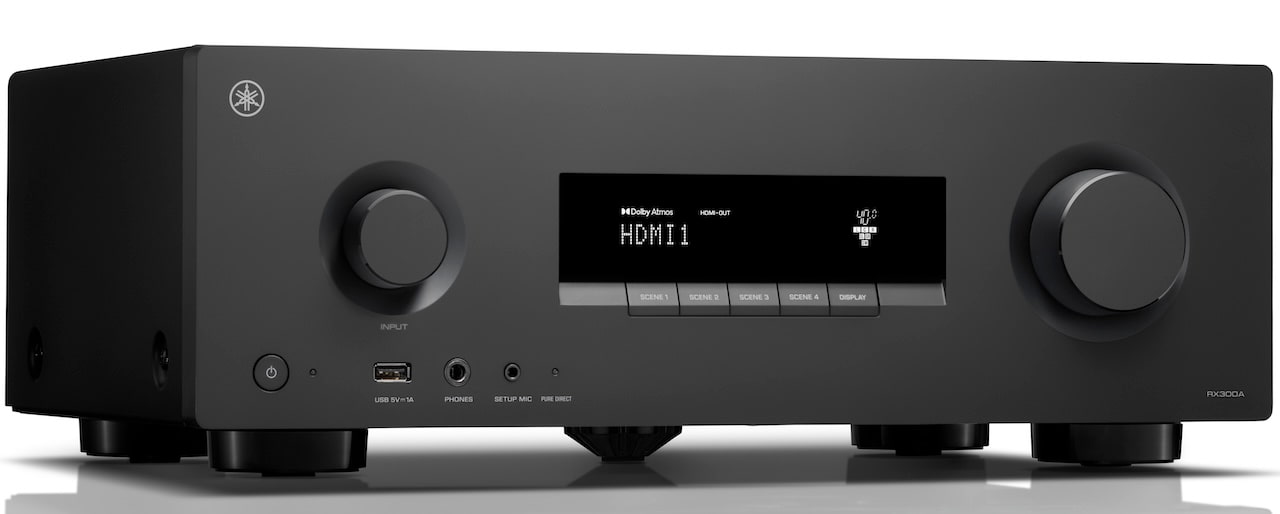
Yamaha’s new YHT-4970U Home Theater in a Box makes a pretty direct argument against spending $700 on another soundbar. The system bundles Yamaha’s new RX300A AV receiver with a matched 5.1-channel speaker package, speaker wire, and a subwoofer cable, giving first-time home theater buyers a real AVR-based surround system in one box.
No, it will not be as clean or idiot-proof as a soundbar. You will have to run wires. You will have to place speakers. Civilization may survive. The payoff is discrete surround channels, a real receiver at the center of the system, and an upgrade path that most soundbars simply do not offer at this price point.
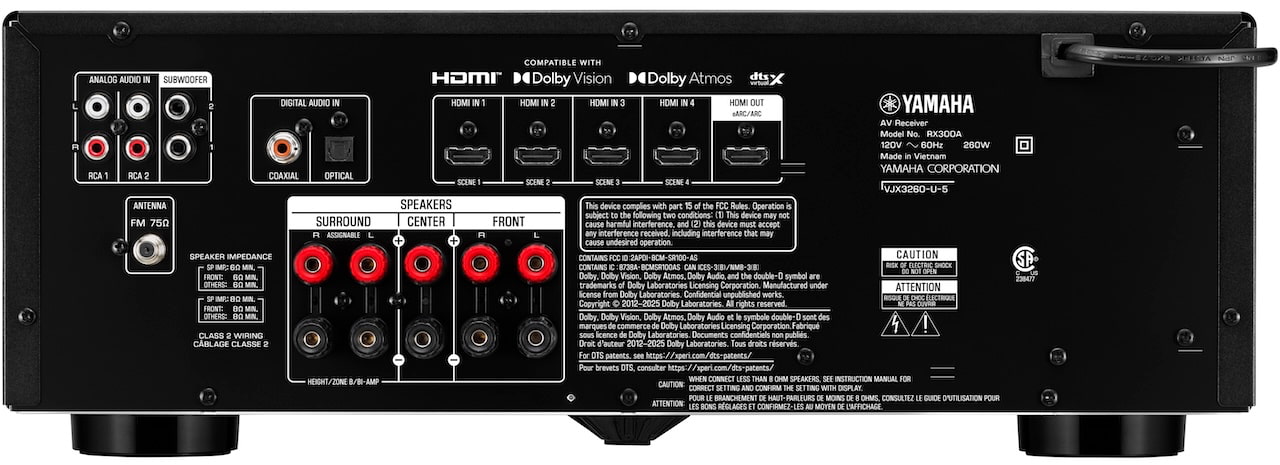
The RX300A AVR
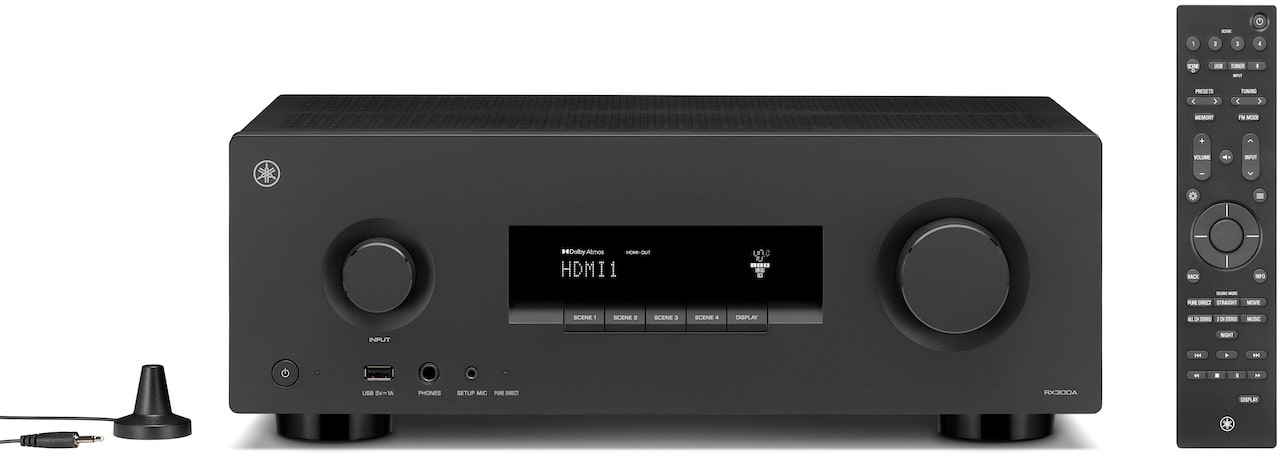
The RX300A AV receiver included with the YHT-4970U updates the look of Yamaha’s previous entry-level design, moving away from the older RX-V385, which originally arrived in 2018. The new front panel is cleaner and less crowded, with fewer visible buttons and simpler labeling, while still keeping the core controls easy to find. It is not a radical redesign, but it does make the receiver look more current and easier to understand for buyers who may be setting up an AVR-based system for the first time.
The RX300A includes an Anti‑Resonance Technology (A.R.T.) Wedge. This is a center-mounted “fifth foot” from Yamaha’s flagship AVENTAGE series that helps reduce vibration and improve stability, supporting cleaner, more accurate sound reproduction.
The incorporation of HDMI 2.1 supports high‑performance video sources, including 4K/120Hz and 8K/60Hz pass-through, along with Dolby Vision and HDR10+ for improved contrast, color accuracy, and detail. Gaming‑focused features, such as Variable Refresh Rate (VRR) and Auto Low Latency Mode (ALLM), help ensure smooth, responsive gameplay when paired with modern consoles.
Advertisement
Room Correction
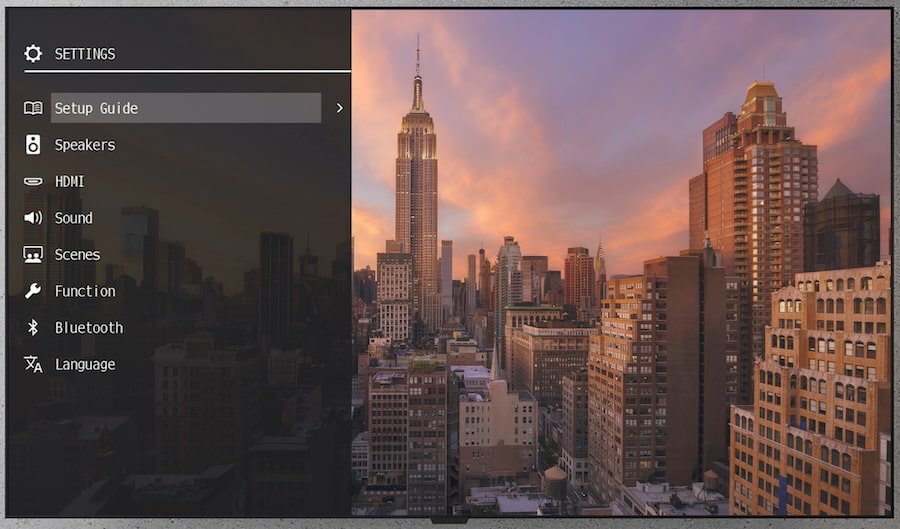
The RX300A provides a setup microphone that enables automatic room correction for the YHT-4970U system by measuring room acoustics and speaker behavior. This allows the receiver to optimize sound performance for the listening environment. An on-screen setup guide further simplifies installation by walking users through connections and configuration step by step.
Sound Setting Simplicity
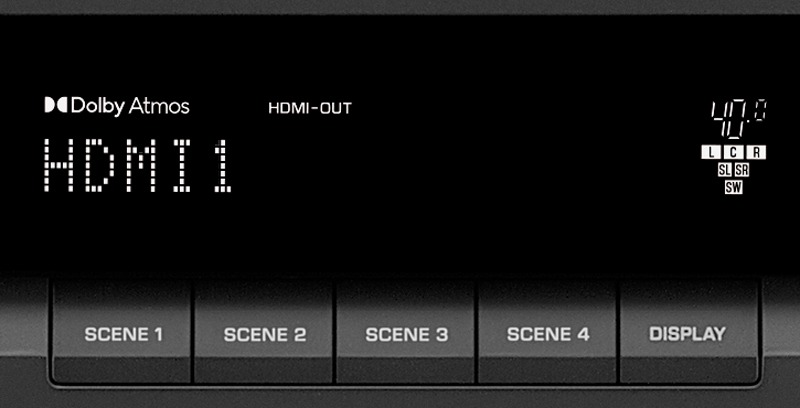
The RX300A also includes Yamaha’s Scene buttons, which let users store and recall common settings with a single press. Each Scene can be assigned to an input, sound program, and related playback settings, making it easier to jump between TV, movies, music, and gaming without digging through menus every time. It is a practical feature for an entry-level home theater system because it reduces setup friction and keeps the receiver from feeling like homework with speaker terminals.
The RX300A supports Dolby Atmos in two ways. If you run speaker wires to the rear of your room and place speakers there for 5.1 channels, the receiver can add virtual height effects to simulate sound coming from above you. If instead, you want real height channels or you don’t want to run wires to the back of the room, you can configure the receiver for height channels and mount those extra speakers on the ceiling or high on the front or side wall for discrete height effects. This would be a real 3.1.2-channel Dolby Atmos system, with the receiver creating virtual rear channel effects. Note that Yamaha calls this a “3.2.2-channel” configuration, because there is a second subwoofer output on the receiver that could can use if you have a second sub.
And while the RX300A does not natively decode DTS:X, it does support DTS Virtual:X, which is designed to create a more spacious height effect from DTS soundtracks without requiring physical height speakers. That distinction matters. Real height channel decoding and real height speakers will deliver the more convincing immersive sound experience, while virtual processing is the compromise for rooms where adding more speakers is not practical. Useful? Yes. Ideal? Nope. But keep in mind, people, this is an entry level receiver so it can’t do everything.
For wireless connectivity, Bluetooth Multipoint allows two devices (such as a smartphone and tablet) to remain paired simultaneously, making it easy to switch between sources without reconnecting. The RX300A can also be used with Bluetooth headphones or speakers.
The Speakers and Subwoofer
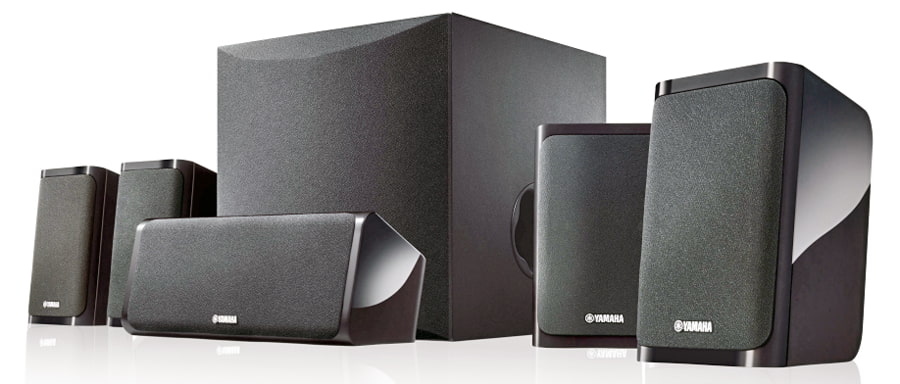
The RX300A is the control center of the YHT-4970U, but Yamaha also includes the rest of the basic 5.1-channel speaker package in the box. The system comes with two compact front speakers, two compact surround speakers, a compact center channel speaker, and an 8-inch, 50-watt powered subwoofer, with the speakers and subwoofer connecting to the receiver using standard speaker wire and audio cable connections.
Advertisement. Scroll to continue reading.
Advertisement
Pro Tip #1: The package includes one powered subwoofer, but the RX300A provides two subwoofer outputs, so a second subwoofer can be added later if the room or your bass addiction demands backup.
Pro Tip #2: Because the RX300A uses standard passive speaker connections and powered subwoofer outputs, the included speakers are not a dead end. Owners can upgrade the front, center, surround speakers, or subwoofer later without replacing the entire system. That is one of the biggest advantages over most soundbar packages: the YHT-4970U starts as a complete system, but it does not have to stay frozen that way forever.
Dolby Atmos Dolby True HD Dolby Digital Plus Dolby Digital DTS
Dolby True HD Dolby Digital Plus Dolby Digital DTS-HD Master Audio DTS- HD High Resolution DTS DTS 96/24 DTS Neo:6
Surround Sound Post Decoding Formats
Dolby Surround DTS Virtual:X
Not Indicated
Network Decoding Formats
No
No
USB Decoding Formats
MP3 MPEG4-AAC WM WAV
MP3 MPEG4-AAC WMA WAV
HDMI Decoding Formats
PCM (8ch max)
PCM (8ch max)
Sound Modes
Pure Direct Straight Movie All Channel Stereo 2 Channel Stereo Music Night
Direct Straight Enhancer Bass program BD/DVD TV CD Radio
Zone B
Yes
Not Indicated
Room Calibration
Room Correction
YPAO
Other Features
Dialogue Level Subwoofer Trim Extra Bass Lip Sync
Dialogue Level Subwoofer Trim Extra Bass Lip Sync
HDMI Connections
4 Inputs / 1 Output
4 Inputs / 1 Output
HDMI Features
HDMI 2.1 8K60Hz/4K120Hz eARC, ARC VRR ALLM QMS HDCP 2.3 CEC Auto Lip Sync Deep Color x.v. Color HD audio playback
HDMI Version 2.0b Video Upscaling To 4K eARC, ARC HDCP 2.2 CEC Auto Lip Sync Deep Color x.v. Color HD audio playback
High Dynamic Range (HDR) Support
HDR10+ HDR10 Dolby Vision Hybrid Log-Gamma
HDR10 Dolby Vision Hybrid Log-Gamma
Headphone Output
1
1
Subwoofer Pre-outs
2
1
HDMI
4 Inputs / 1 Output
4 Inputs / 1 Output
Analog RCA Inputs
2
2
Analog Aux Input
No
1 x 1/8″ / 3.5 mm Aux (Front)
Optical Input
1
1
Coaxial Input
1
2
USB
1 (Audio File Playback from a Mass Storage Device, Firmware Updates)
1
FM/AM Tuner
Yes / No
Yes/Yes
Bluetooth
Yes (Ver. 5.3, Multipoint)
Yes (Version 2.)1
Streaming
No (Streaming through Bluetooth only)
No (Streaming through Bluetooth only)
Wi-Fi / Ethernet Port
No
No
Speaker Output
5 (binding post terminals)
5 (binding post terminals)
Speaker Design
2 x Front, Bass Reflex 2 x Surround: Bass Reflex 1 x Center: Acoustic Suspension
2 x Front, Bass Reflex 2 x Surround: Bass Reflex 1 x Center: Acoustic Suspension
Speaker System Frequency Response
Not Indicated
28 Hz to 25 kHz
Speaker System Power Handling
Nominal Input Power 30 W per Channel
Max Input Power 100 W per Channel
Advertisement
Nominal Input Power 30 W per Channel
Max Input Power 100 W per Channel
Speakers Impedance
6 Ohms
6 Ohms
Speakers Sensitivity
Front, Surround: 83 dB, 2.83 V/m
Center: 84 dB, 2.83V/m
Advertisement
Front, Surround: 83 dB, 2.83 V/m
Center: 84 dB, 2.83V/m
Speaker Drivers
1x 2.75″ / 69.85 mm Full-Range Cone per Speaker
1x 2.75″ / 69.85 mm Full-Range Cone per Speaker
Subwoofer
Powered, Bass Reflex (twisted flare port)
Power Output RMS: 50 W (5 Ohms, 100 Hz, 10% THD)
Advertisement
Dynamic: 100 W (5 Ohms)
Frequency Response: 28 to 200 Hz
Driver: 1x 8″ / 203.2 mm Cone
Powered, Bass Reflex Power Output RMS: 50 W (5 Ohms, 100 Hz, 10% THD)
Advertisement
Dynamic: 100 W (5 Ohms)
Frequency Response: 28 to 200 Hz
Driver: 1x 8″ / 203.2 mm Cone
Power Consumption
260W
AVR: 400W Subwoofer: 40W
Standby Power Consumption
≤0.3W
≤ 0.2 W
Auto Power Standby
Yes
Yes
App
Not Indicated
Not Indicated
Dimensions (AVR)
434W x 157H x 319D mm
Advertisement
17-1/8”W x 6-1/8”H x 12-1/2”D
17.13″W x 6.31″H x 12.56″D
Dimensions (Speakers)
Not Indicated
Front and Surrounds: 4.38 x 6.88 x 4.63″ / 111.13 x 174.63 x 117.48 mm
Center: 10.88 x 4.38 x 4.63″ / 276.23 x 111.13 x 117.48 mm
Dimensions (Woofer)
11” W x 11” H x 13” D
Included Accessories
Remote Control Batteries FM Antenna Setup Mic Microphone Stand Quick Guide Safety Guide
Remote Control Batteries AM/FM Antenna Setup Mic Microphone Stand Quick Guide Safety Guide
The Bottom Line
The Yamaha YHT-4970U makes sense for buyers who want a real 5.1-channel AVR-based home theater system without buying every piece separately. It also offers a flexible configuration option to use front height speakers instead of surround speakers for Dolby Atmos, in case running wires to the back of your room is problematic. For $700, it delivers discrete speakers, a powered subwoofer, Bluetooth, HDMI connectivity, and a genuine upgrade path.
The limitations are clear. There is no discrete 5.1.2-channel option for Dolby Atmos. That would take 7 amplifier channels, where this only has 5. And the RX-300A receiver doesn’t support DTS:X decoding. But in today’s Dolby Atmos-heavy streaming and physical media ecosystems, this may not be that big a deal to most buyers. Also, the included speakers are likely the starting point, not the finish line. The good news is that the RX300A uses standard speaker and subwoofer connections, so owners can upgrade the speakers or add a second subwoofer later as budget and available space allow.
Advertisement
Who is it for? First-time home theater buyers, secondary rooms, and anyone who wants actual surround sound instead of another soundbar trying to do architectural drawings with DSP.
Pricing & Availability
Yamaha YHT-4970U 5.1-Channel Home Theater in a Box – $699.95 (July 2026)
Looking for the most recent regular Connections answers? Click here for today’s Connections hints, as well as our daily answers and hints for The New York Times Mini Crossword, Wordle and Strands puzzles.
Today’s Connections: Sports Edition isn’t terribly tough, especially if you know the team names of one certain state. The purple category is tricky, but what else is new? If you’re struggling with the puzzle but still want to solve it, read on for hints and the answers.
Connections: Sports Edition is published by The Athletic, the subscription-based sports journalism site owned by The Times. It doesn’t appear in the NYT Games app, but it does in The Athletic’s own app. Or you can play it for free online.
Hints for today’s Connections: Sports Edition groups
Here are four hints for the groupings in today’s Connections: Sports Edition puzzle, ranked from the easiest yellow group to the tough (and sometimes bizarre) purple group.
Yellow group hint: Get better at something.
Advertisement
Green group hint: Beehive State.
Blue group hint: They led the team.
Purple group hint: Fore!
Answers for today’s Connections: Sports Edition groups































































You must be logged in to post a comment Login