In 1963 a kit of red and white polystyrene plates, stiff metal rods, rubber bands, and short plastic tubes sold for $4.99 ($54.45 today) and assembled into a working digital computer. Three small windows on the front face displayed binary digits as either 0 or 1. A white lever marked “Clock” stuck out from the right side. Pushing that lever fully inward and then drawing it back out advanced every calculation by one step. No batteries or power cord were required. All motion came from the user’s hand and the tension stored in the rubber bands.
E.S.R. Inc., a small company founded by three engineers who originally intended to produce electronic computing equipment, release the kit as a side project to create quick cash. Instead of being a one-hit wonder, the Digi-Comp 1 sold out faster than anyone could keep up. Over 100,000 units were sold, with some estimating it could have been as many as 250,000. For a period, the number of Digi-Comp 1s was actually greater than the number of true electronic computers in use. At least in the middle of the 1960s. Eventually, the business chose to move its focus to more… traditional toys, and Digi-Comp 1 would remain in production for a little longer. It remained in production until the early 1970s.
[Ultra-Compact Mini PC: 25% Faster Single-Core] Measuring just 4.6 x 4.4 x 1.35 inches, this space-saving small pc fits seamlessly into any office…
[Dual-Channel RAM & NVMe SSD Expandability] Pre-equipped with 8GB DDR4 RAM and a fast 256GB NVMe SSD to supercharge your daily productivity. Unlike…
[48EU Intel UHD Graphics: Double the EUs of N5095/N95] Features Intel UHD Graphics with 48 Execution Units (EUs)—double the graphics cores of…
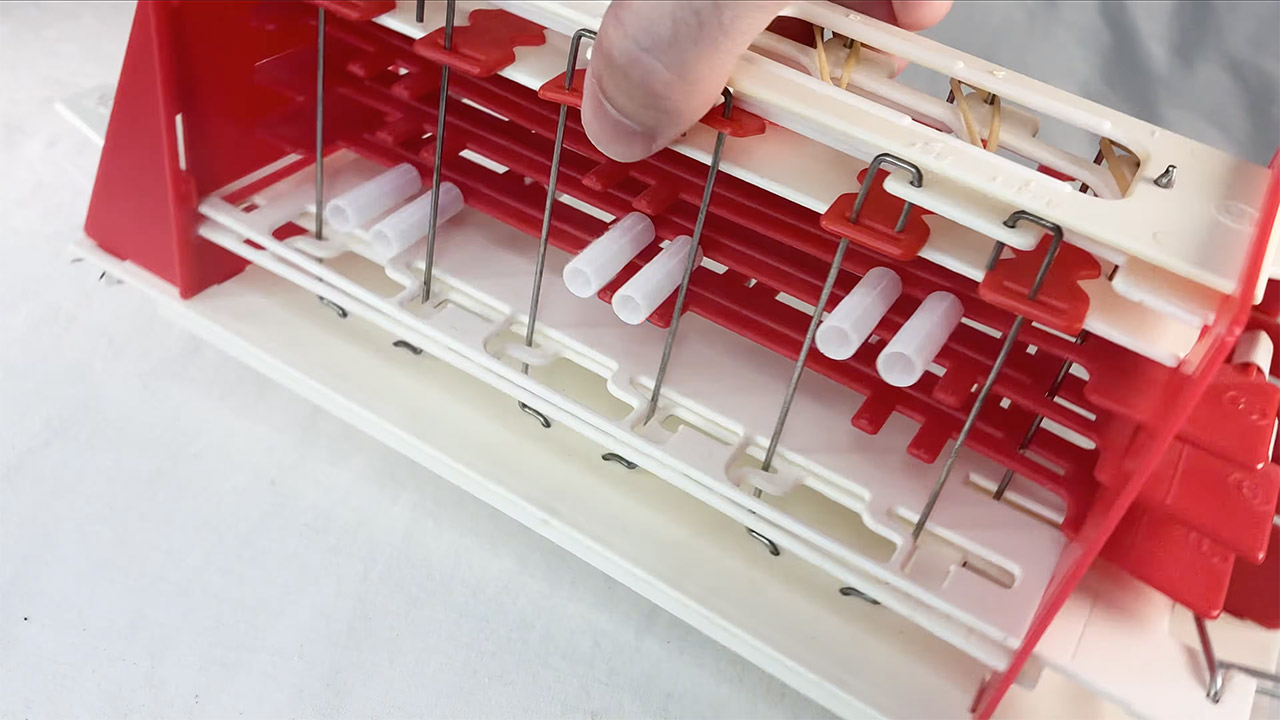
You assemble the device by slapping the base plate down and joining the upright supports in one seamless action, with no tools required. Then you add three horizontal bars that can move in any way because they can lock into either of two spots that you’d intuitively associate with binary 0 or binary 1, and those three bars may represent any number between 000 and 111, or, in more common terms, 0 to 7. Six thin rods now run along the front of the machine, with another six going along the back. Along the front, there are little tubes that you put onto tabs, and on the back, there are tubes that you fit onto the appropriate tabs. The arrangement of the back tubes dictates which rods can move and which cannot during a single clock cycle.
Now, the front rods serve as logic sensors, and depending on the condition of those three sliding bars, they will either drop or remain held up. The back rods are your actuators. So, if a rear rod swings free, it can push the bar from 0 to 1 or 1 to 0, as long as the right tube is in place. The rear rods with odd numbers reset to zero, while those with even numbers reset to one. Rubber bands keep the rods taut, allowing them to snap back into position as soon as an obstructing tube is relocated or a passage opens.
When you draw the lever all the way in and secure the logic rods, you complete a full clock cycle. Any rod that is not blocked by a front tube then connects to the corresponding rod on the back. Then, on the way back out, those free rear rods spring into action, shifting the sliding bars to whatever position is required by where you’ve placed the tubes. By the time the bars have set, the overall pattern of what is blocked and what is not has changed, making it ready for the next cycle. That’s all there is to it, because the machine’s current state totally controls its next state. In other words, it is a three-bit finite-state machine.
Users rummaged through the large instruction booklet to find tube arrangements that really worked. One fairly conventional configuration transformed the machine into a binary counter that counted up from 000 in a smooth, step-by-step manner, 000 to 001, then 010, 011, and so on all the way up to 111 until eventually counting down to 000 again. Other layouts became more fascinating, as you could combine two numbers, subtract one from another, move bits left or right, or just flip the entire value on its head. You could also use it for simple multiplication and comparisons. The kit featured a clever little plastic bit that allowed you to create “or” situations and solve some interesting challenges. People were able to encode games like Nim so that the machine would enforce the rules and vary the outcome depending on the starting position.
The results appeared immediately in the three front windows when the bars were clicked into place. The documentation that came with the tube layouts included not only the charts for how to set up the tubes, but also the fundamentals of binary counting and Boolean logic, all explained in a way that a 12-year-old could grasp. Many people who received a Digi-Comp 1 as a present later claimed that it was the first gadget to make abstract rules feel real and concrete. The tangible “click” of the bars moving and the rods shifting in front of you was extremely effective in demonstrating cause and consequence in a manner that a simple diagram cannot.
OK, so window-cleaning robots cannot deal with traditional windows. I know textured glass interferes with the suction and, predictably, handles and fixtures interfere with the movement, but it also struggles with astragals that aren’t thick or solid enough. I wouldn’t risk using it with any that aren’t finished in hard plastic or something else durable.
I figured I’d give it one last chance on the upstairs bay window, as it’s a PVC replacement that was put in before we moved in, so it has thicker astragals finished in hard plastic. Using it one story up gave me serious anxiety. After an alarming five minutes or so of watching it loudly and squeakily navigate the window, it began to sound an alarm and flash a red light, with a stern voice informing me it was stuck and I should check the app for solutions. Where was it stuck? You guessed it, right at the top of the window where I had no hope of reaching it.
I’m not ashamed to say I panicked. I worried that if it suddenly fell, it would potentially smash into the window downstairs. The charging case does act as a counterweight; other window-cleaning bots have tethers to attach to furniture. There’s also a button to retract the cord and cut the slack, but there’s still potential for damage if it falls. I tried to lean out of my window, while it loudly alerted, to see if I could reach the release button. No joy.
By this time, a couple of passersby had stopped to watch. I tried to pull it in using the cable, but it wouldn’t budge. Eventually, I figured out I could lower the top pane just enough to reach it. But pressing and holding the button to power down the suction, while hanging out my window and holding the strap, felt downright dangerous. My heart was pounding in my ears by the time it finally released. I got it inside and back into its case, where it will remain until I return it.
Advertisement
The Ugly
Reflecting on this sorry saga, I can’t help feeling, even without my mishaps, which may be partly down to user stupidity and bad luck, that window-cleaning robots are just a massive waste of time.
They’re way too much work to use. Time-wise, I could clean the windows far faster and do a better job with less stress. By the time you’ve set up a window-cleaning robot and stuck it on the window, you could have cleaned it yourself. You have to babysit the damn thing and then detach it and move it to the next window. Even if you get to a point of trusting it, you’ll have to return every five to 10 minutes. It can’t deal with window handles, fittings, or certain astragals, and windows must be at least 12 by 16 inches, but realistically larger, for it to be worth using. It always leaves dirt in the corners and cannot remove stubborn stains like bird droppings.
Storyteller Overland just put a nearly three-hundred-thousand-dollar price tag on a Ram 3500 that can sleep four, cook a full meal, and open its rear wall into an elevated outdoor platform. The GXV Wild arrives as the smaller, more agile member of the company’s Global Expedition Vehicles line, built to reach remote places while still offering real living space once you stop.
Built on a single cab Ram 3500 Big Horn Level 2 grade, the truck retains its 6.4-liter Hemi V8 and eight-speed transmission. That engine generates 375 horsepower and 429 pound-feet of torque on ordinary gasoline, no fancy stuff required. By removing the rear seats, the truck’s weight and wheelbase are reduced, making it much more agile on tight dirt paths and through dense brush. Standard features include four-wheel drive and a 52-gallon tank to keep you going.
Fire HD 8 offers an 8″ HD display for seamless streaming and gaming, coupled with a 5MP rear facing camera for photos—with a thin, light, durable…
Fast and responsive with long battery life – With up to 4 GB RAM (2X more than 2022 release), 64GB of storage, and up to 1 TB of expandable storage…
Save time, get creative – Enjoy three smart tools to help you send polished emails, quickly summarize webpages, and create unique wallpapers.
AEV’s three-inch lift raises the suspension, and it comes with 20-inch aluminum wheels shod with 275/80 R20 MPT tires. More ground clearance is usually a good thing, and they’ve got everything set up so the truck can comfortably crawl through the bush while also zipping down the highway. Out front, a 12,000-pound Warn winch gets you out of tricky situations, while Diode Dynamics lighting handles both driving and scene work. The overall length is slightly over 22 feet 10.5 inches, with 11 feet 3 inches from the ground to the roof of the car and 8 feet 7.5 inches between mirrors. The GVWR is 14,000 pounds, the payload after the camper body is only 1,000 pounds, and the towing capacity ranges from 10,000 to 11,000 pounds, depending on who you trust.
Advertisement
The FlipOut rear deck is arguably the most notable feature, as it’s a clever little design in which the back wall folds down to create a solid platform with safety netting, overhead red and white lighting, a 120 volt outlet, and a mosquito screen. There’s also an awning door with a little skylight to conceal the entrance when the deck is completely down, as well as a 10-foot electric awning with LED lighting to offer you a little extra space outside. Powered access steps make it a little easier to get in and out, and there must be some lockable external storage, an exterior shower, and city water and shore power hookups somewhere in there.
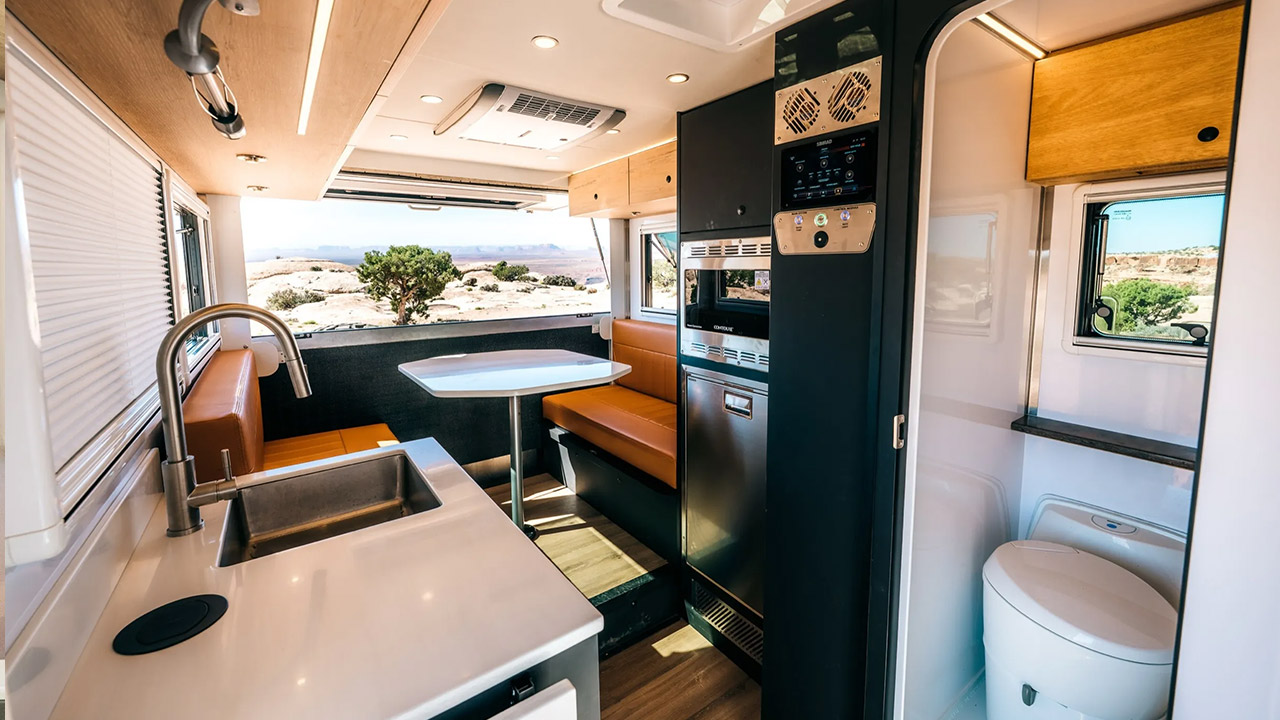
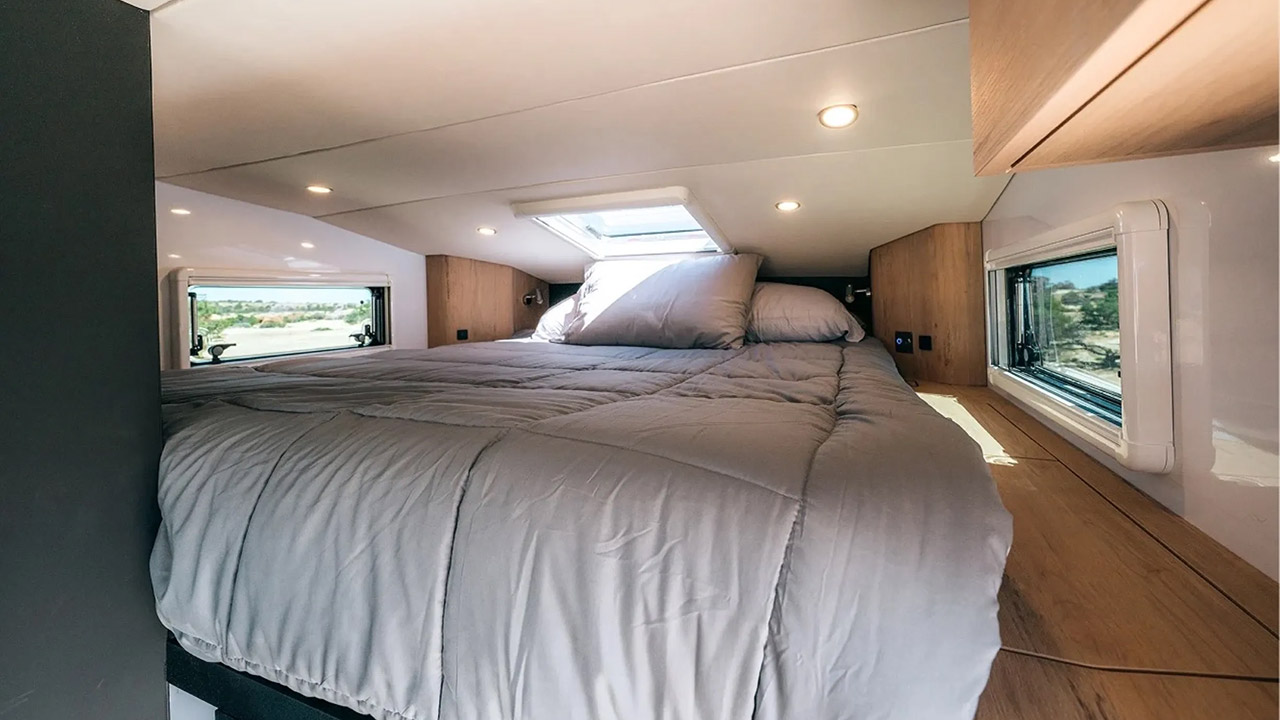
There is no need to brave the elements to get to the living area from the truck cab. Simply hop inside, and with two seatbelts, you can only drive with two passengers. When parked, four individuals can sleep in the loft, which has an RV queen bed with a ladder, an upholstered headboard, a vented skylight, bedside storage, USB ports, wireless charging, and a 120-volt outlet. The rear dinette seats four and converts into a second queen size bed, while the galley features a stainless steel Vitrifrigo four cubic foot fridge/freezer, an induction cooktop that folds up out of the way when not in use, and a single appliance that serves as a microwave, oven, and airfryer. There’s a 120-volt pop-up plug and wireless charging nearby, and the wet bath is basic but adequate, with a shower, sink, flushable cassette toilet, exhaust fan, dimmable lighting, a dual-pane window with shades and bug screen, and some storage and a mirror.
A 12kWh Mastervolt system generates power, which is paired with a 4,500-watt inverter. The standard setup contains 400 watts of solar panels, which can be increased to 800 watts via an additional connector. You can connect to shore power using a 120-volt, 30-amp arrangement. To be safe, prewiring for Starlink is included. Our water tanks are generously sized, storing 50 gallons of fresh water and 20 gallons of gray water, as well as a cassette toilet that can handle 4.75 gallons of “grey water.” They’ve also included Simrad’s Mission Control tablet to help you monitor power, water, temperature, and lighting.
When you look at the facts, the GXV Wild comes in at $299,898 with no hidden costs, demonstrating clear pricing from the start. Orders are now open to the public; simply contact one of our dealers to get started. We hope to get the new Wilds on the road in the third quarter of 2026. Our warranties are also very comprehensive: one year or 15,000 miles for the capsule, three years or 36,000 miles for the structure, ten years or 100,000 miles for the Ram powertrain, and five years for the Mastervolt system.
The U.S. Cybersecurity and Infrastructure Security Agency (CISA) warned that hackers are exploiting a critical-severity remote code execution (RCE) flaw in the Windows Internet Key Exchange (IKE) Service Extensions component.
Also known as MS-IKEE, this is a set of additional capabilities Microsoft added to the IKE Protocol, including authentication via cryptographically generated addresses (CGAs), denial-of-service protection, and easier interoperability with non-Internet Protocol Security (IPsec)–capable peers.
Tracked as CVE-2026-33824, this RCE vulnerability impacts all supported Windows 10, Windows 11, and Windows Server releases, and it allows attackers without privileges to gain code execution by sending maliciously crafted packets to unpatched Windows systems through UDP ports 500 or 4500.
“Double free in Windows IKE Extension allows an unauthorized attacker to execute code over a network,” Microsoft says in an advisory issued during the April 2026 Patch Tuesday when it addressed the vulnerability.
“An unauthenticated attacker could send specially crafted packets to a Windows machine with Internet Key Exchange (IKE) version 2 enabled, which could enable remote code execution.”
Advertisement
Microsoft also advised security teams that can’t immediately install the CVE-2026-33824 security update to block inbound traffic through UDP ports 500 and 4500 on systems that don’t use IKE, or to configure firewall rules to allow inbound traffic only from known peer addresses when IKE is used.
Now actively exploited in the wild
While Microsoft has yet to update its advisory to flag it as exploited, CISA has added the flaw to its catalog of actively exploited vulnerabilities and ordered U.S. Federal Civilian Executive Branch (FCEB) agencies to secure their devices within three days, as mandated by Binding Operational Directive 26-04.
“This type of vulnerability is a frequent attack vector for malicious cyber actors and poses significant risks to the federal enterprise,” the U.S. cybersecurity agency also warned on Tuesday.
Additionally, while BOD 26-04 applies only to government agencies, CISA urged all network defenders to prioritize patching the CVE-2026-33824 security flaw to block ongoing attacks.
CISA and Microsoft spokespersons have yet to reply after BleepingComputer reached out for more information on attacks actively targeting the CVE-2026-33824 vulnerability.
Overall prevention scores can hide what happens after initial access. Once attackers are using valid credentials, prevention drops sharply.
The Blue Report 2026 measures defenses technique by technique across 338 million simulations run in customer production environments.
Every year, marketing teams are expected to deliver more. Marketing leaders are under growing pressure to prove the return on investment they deliver and demonstrate the value they bring to the business.
At the same time, budgets remain tight, sales cycles are getting longer, and more people are becoming involved in buying decisions.
Against that backdrop, many organizations have turned to AI to automate routine tasks, analyze market and audience data and support content creation.
Advertisement
Latest Videos FromTechRadar
But as adoption matures, the conversation is now moving from experimentation to execution.
Khalid Aziz
B2B Marketing Director for Canon UK & Ireland.
According to recent UK government research, whilst 41% of businesses are now using AI technology, only 21% have integrated AI into their existing business systems, showing that while there’s been real progress, we’re still in the early stages.
The next challenge is not over-use, but shallow use. That means moving beyond isolated use cases and embedding AI into everyday marketing workflows, equipping people with the skills to use it effectively and focusing on the commercial outcomes it helps deliver.
Advertisement
An important part of this is ensuring humans remain at the core. Ultimately, AI should enhance human capability, not the other way around. This is particularly important when it comes to the creativity, storytelling and decision-making at the heart of marketing.
Sign up to the TechRadar Pro newsletter to get all the top news, opinion, features and guidance your business needs to succeed!
Looking beyond isolated use cases
The shift from AI experimentation to execution requires organizations to look beyond familiar use cases and think more strategically about where AI can create commercial value.
Advertisement
Rather than treating AI as a standalone capability to simply improve efficiency, marketers should be looking at where it can support existing workflows across the entire marketing function – from campaign planning and content creation through to new lead generation, sales enablement, measurement and reporting.
One of the biggest barriers is that people tend to rely on what they already know. That’s why ongoing training and development are so important. Helping marketing teams understand where AI genuinely adds value and giving them the confidence to apply it in new ways are what will allow organizations to move beyond isolated use cases and deliver stronger commercial outcomes.
Advertisement
Execution for commercial outcomes
As AI becomes embedded across the marketing function, success will depend less on adopting the technology itself and more on how effectively teams apply it to core business objectives. While use cases continue to evolve, marketing leaders should focus on three priorities to deliver the greatest impact.
First, AI should drive efficiency with a goal to shorten sales cycles. It should be viewed as a tool that removes friction from the customer journey to accelerate the flow of opportunities through the funnel.
Beyond just task automation, marketing teams should be focusing on how their use of AI is delivering faster decision-making, more relevant customer engagement and stronger alignment between marketing and sales – ultimately helping organizations reduce sales cycle length and bring revenue forward.
Second, as AI-powered search experiences increasingly influence how buyers discover information, producing more content is no longer enough. Brands must focus on creating high-quality, differentiated and authoritative content that AI systems are more likely to surface and reference. This means going a step further than using prompts in chatbots and using AI to uncover audience insights, scale ideation and optimize formats.
Advertisement
Finally, marketing teams should leverage AI’s ability to collect actionable insights from large volumes of data and predictive analytics into emerging trends to streamline reporting and measurement processes. Automated dashboards and lead scoring can provide near real-time visibility into performance, enabling leaders to make faster, more informed decisions and keep teams aligned against shared objectives.
In an environment where budgets are under constant scrutiny, robust measurement frameworks will be critical to demonstrating marketing’s contribution to business outcomes.
AI should enhance human capability, not the other way around
It is important to remember that human creativity remains essential for developing original perspectives, compelling storytelling and genuine brand distinction. Organizations that combine AI efficiency with human expertise will be best positioned to maintain visibility and relevance in an increasingly AI-mediated digital landscape.
Advertisement
This starts with ongoing training and development, and creating an environment where employees feel confident experimenting, sharing knowledge and executing new capabilities. As AI becomes embedded across the entire workflow, strong leadership and collaboration across marketing, sales and the wider business will be just as important as the technology itself, helping teams apply AI consistently, securely and strategically.
The organizations seeing the greatest success will be those that build AI around their people, rather than expecting people to adapt to AI. When organizations combine the right technology with ongoing training, cross-functional collaboration and clear governance, AI becomes much more than an efficiency tool. It becomes something that enables employees to apply greater creativity, judgement and commercial thinking, while ensuring implementation remains responsible and aligned to broader business goals.
Looking ahead
The conversation around AI has moved past experimentation and is now about getting the balance right – moving beyond shallow, task-based use of AI and embedding it strategically across marketing in ways that deliver measurable commercial value, without overusing it or losing the human qualities that customers value most.
Advertisement
Looking ahead, UK Government research shows that 59% of organizations planning further AI investment intend to embed AI into their existing tools and systems over the next 12 months, while 42% also plan to invest in workforce reskilling and development.
Ultimately, the organizations that pull ahead won’t necessarily be those investing in the most technology, but those that invest in their people. This means helping teams understand where AI genuinely adds value, and ensuring it compliments commercial thinking, continuous learning and human creativity, rather than replaces it.
This article was produced as part of TechRadar Pro Perspectives, our channel to feature the best and brightest minds in the technology industry today.
Advertisement
The views expressed here are those of the author and are not necessarily those of TechRadarPro or Future plc. If you are interested in contributing find out more here: https://www.techradar.com/pro/perspectives-how-to-submit
In a bid to crack down on harmful activities, the model – which is designed with young people in mind – limits access to controversial topics such as self-harm and sexual content.
AI companies have long been criticised for exposing young people and children to graphic and inappropriate content online.
In response to growing concern over the protection of vulnerable people, OpenAI has launched a new ChatGPT model designed specifically for teenagers aged between 13 and 17.
Companies such as OpenAI have faced significant criticism for exposing children to harmful and illegal material by allowing them to access information, advice and images covering inappropriate topics such as suicide, self-harm, violence, eating disorders and graphic sexual behaviours.
Advertisement
In April of 2025, a 16-year old boy ended his life by suicide after months of discussing his worsening mental health with an OpenAI chatbot that, according to a lawsuit filed by his family, encouraged suicidal ideation. The bot even offered to help draft a suicide note for his family.
The new ChatGPT model aims to limit high-risk conversations and in some cases, if deemed necessary and if the prompt has been opted in to, the system will alert adults to suspect behaviour through parental controls and notifications. The model will also prevent the bot from suggesting it has personal feelings.
It will instead offer studying tools and learning support. Rather than providing the answers to queries straight away it will aim to guide the young person towards the solution, so they can work it out for themselves.
Reportedly, the model will use more than 2,000 signals to detect if a user has lied about their age to gain access to a standard model and if they are deemed to be under the age of 18 the chatbot will automatically turn on the teen mode.
Advertisement
In a statement OpenAI said, “We will continue to build additional features in order for teens to benefit from AI and measure and publish what we are learning. Teens should be able to use AI to learn, create, and explore. But that access should come with protections that reflect their developmental stage, reinforce real-world relationships, and support healthy use over time. ChatGPT for Teens is our next step in building toward that standard.”
Yesterday (18 August) a cohort of four US states announced they are taking Meta to trial in a bid to prove that the social media giant knowingly causes harm to children. The suit claims that Meta specifically targets users under 13 years old in order to harvest data, send targeted advertising and develop ways to prolong their time on their apps, all as a means of monetisation.
Don’t miss out on the knowledge you need to succeed. Sign up for the Daily Brief, Silicon Republic’s digest of need-to-know sci-tech news.
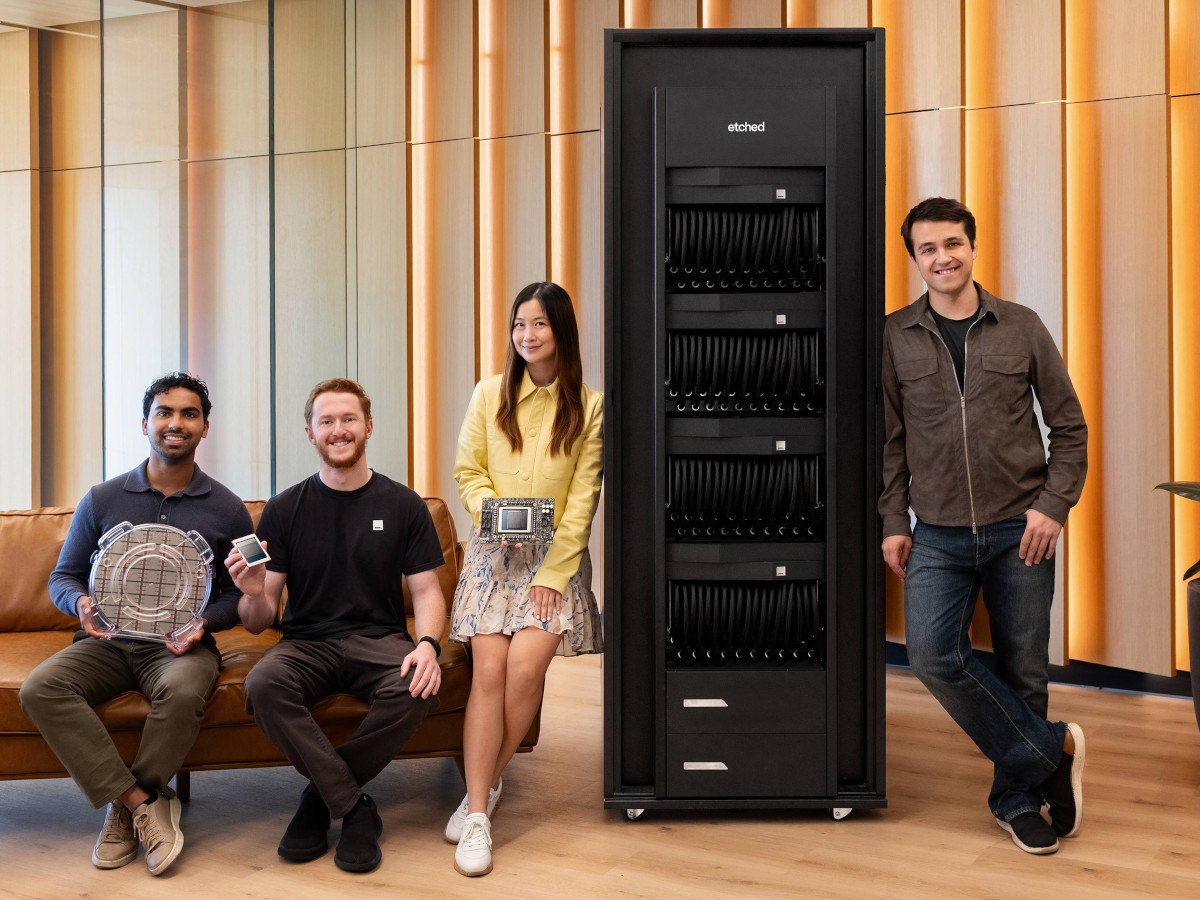
Etched was founded in 2022 by Gavin Uberti, Robert Wachen and Chris Zhu, and emerged from stealth in June of this year.
AI hardware start-up Etched has raised $700m in a new funding round led by US trading firm Jane Street, which the start-up said boosted its valuation to $21bn – doubling in less than a month.
Etched builds inference clusters to make AI inference – essentially the process of using a trained AI model to make predictions on new data – faster, cheaper and more efficient. To do this, according to the start-up, it co-designs chips, racks, software and manufacturing methods.
The start-up said it uses two central technologies to power its inference clusters: low-voltage inference, which it said delivers higher compute density within the same power as existing hardware, and cluster scale memory, a hybrid memory subsystem that creates a “massive” shared memory pool across an entire cluster rather than a single chip.
Advertisement
As well as leading the funding round, Jane Street has also become Etched’s first customer. Etched shipped its hardware rack to the company last month after it tested the start-up’s inference hardware.
“We’ve felt the urgency to get our hardware into customers’ hands and run real workloads since day one. Jane Street putting this cluster into production is proof of what we’ve built,” said Gavin Uberti, co-founder and CEO of Etched.
“Now, we’re sprinting on scaling production for the rest of our customers.”
As well as deploying its first rack to Jane Street, Etched said it has also secured more than $1bn in customer contracts across industries including public and private “frontier” AI companies and clouds.
Advertisement
Other participants in the latest funding round include Kleiner Perkins, Sequoia Capital, Andreessen Horowitz, Peter Thiel, Tiger Global, Bain Capital Ventures, Neo, Stripes, Primary, Positive Sum, Diffusion, Argo and Blackstone.
Sequoia previously led Etched’s $300m Series C round last month, after which the start-up was reportedly valued at $10.3bn.
Etched was founded in 2022 by Harvard Thiel fellows Uberti, Robert Wachen and Chris Zhu. The start-up, which currently has a team of 400 employees, emerged from stealth in June of this year.
It is the latest emerging challenger to Nvidia’s dominance in the AI chip market, and has reportedly been recruiting “aggressively” from the tech giant, according to the Wall Street Journal, which said that around 15pc of Etched’s current team previously worked at the tech giant.
Advertisement
“Under 1pc of the world has access to frontier models. Scaling intelligence requires a new kind of inference hardware,” wrote the start-up in a blogpost announcing its latest funding.
“As we ramp to gigawatt scale, we’ll face a new set of challenges: building new factories, global supply chains, fleet software, self-improving kernel agents and more.”
Just last week, ChangXin Memory Technologies, a Chinese manufacturer of dynamic random-access memory chips, replaced Tencent as the world’s most valuable Chinese company.
Advertisement
Earlier this month, AI giant Anthropic confirmed previously rumoured plans to design its own chips in response to a worldwide shortage and increased pressure to develop faster, more advanced AI systems.
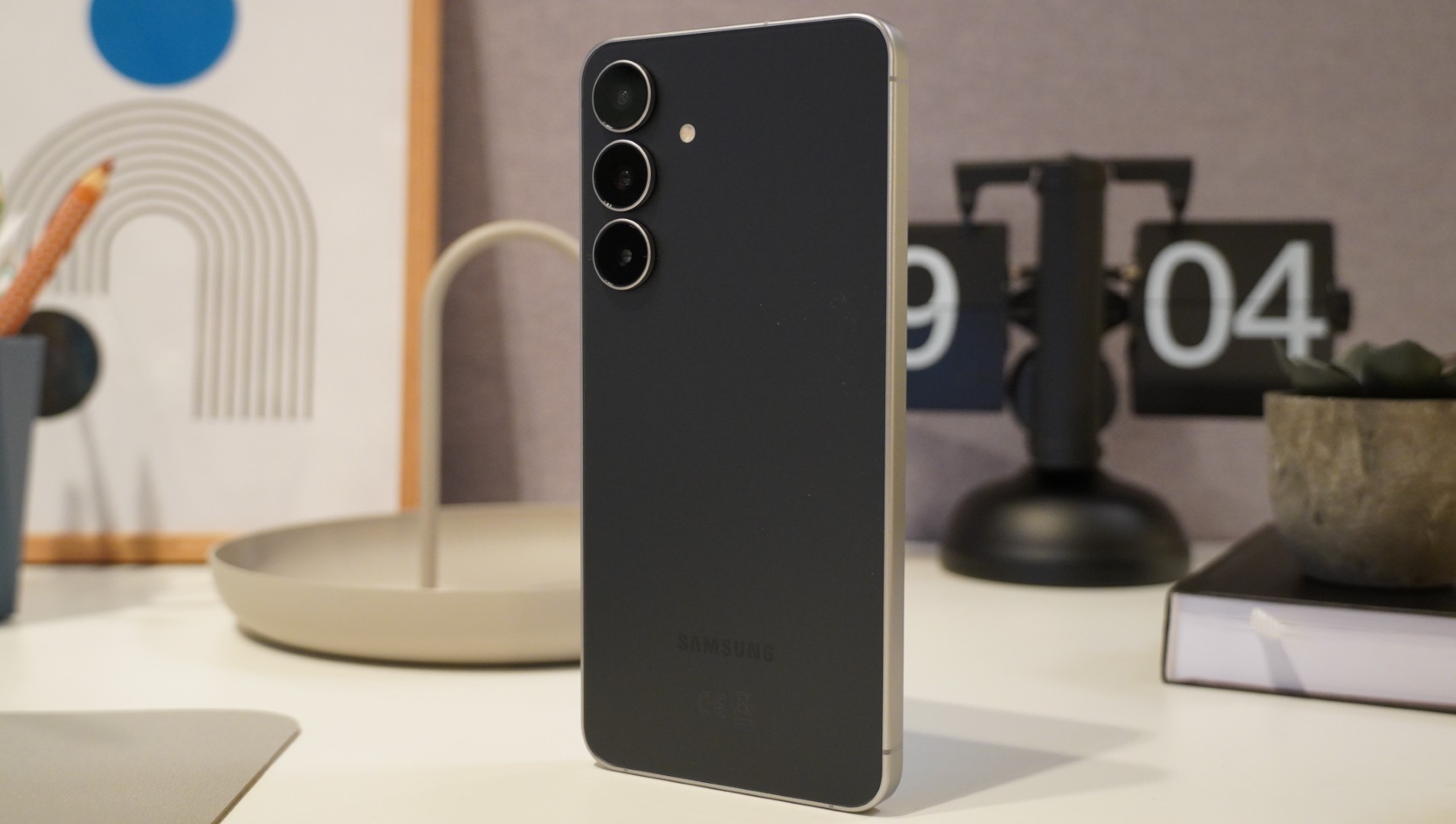
Samsung’s Galaxy S26 FE could be getting closer to launch after the phone appeared on the Google Play Console, adding another piece to the puzzle after its recent FCC certification.
The listing confirms the phone, identified as model SM-S741U, will be powered by Samsung’s Exynos 2500 chipset and paired with 8GB of RAM. It also lists a 1,080 x 2,340-pixel display. These match the specifications that leaked for the phone last week.
The Google Play Console listing also includes an image of the handset, although there’s no launch date attached to it just yet. However, leaked renders have already shown the Galaxy S26 FE in several colour options.
The latest appearance is notable because the S26 FE has now cleared both the FCC and Google Play Console, two fairly significant steps before a smartphone reaches consumers. That doesn’t confirm Samsung is about to launch it, but it does suggest the phone is moving through the necessary certification process.
Advertisement
Samsung’s previous Galaxy S25 FE arrived in September, so anyone waiting for the S26 FE may still have a few weeks to go at the very least.
Advertisement
The same Google Play Console listing also gives us an early look at two cheaper Galaxy phones. The Galaxy A08 (SM-A085F) is listed with MediaTek’s Helio G99, an LTE-only chip already used in the Galaxy A07 4G. Interestingly, the listing says the A08 can have up to 8GB of RAM. Its display resolution is 720 x 1,600 pixels.
The Galaxy A07s (SM-A077M) also uses the Helio G99, but is listed with 4GB of RAM and the same 720 x 1,600-pixel resolution.
Advertisement
Samsung launched the Galaxy A07 4G in late August last year, so the A08 and A07s could be approaching their own launches. For now, though, the Galaxy S26 FE is the more interesting of the three. Its Exynos 2500, 8GB of RAM and higher-resolution display point to a more capable mid-range phone.
Microsoft has reminded customers that systems running Home and Pro editions of Windows 11 24H2 will stop receiving updates in two months.
“On October 13, 2026, Windows 11, version 24H2 Home and Pro editions, and Windows 10 Enterprise LTSB 2016 will reach end of updates,” Microsoft warned in a message center update.
“After this date, devices running these editions will no longer receive monthly security and non-security preview updates containing protections from the latest security threats.”
However, according to its support website, Windows 11 24H2 Enterprise and Education editions will remain under mainstream support until October 2027.
Customers are advised to upgrade to Windows 11 25H2 (also known as the Windows 11 2025 Update), which has become generally available in September 2024 as a minor update installed through an enablement package.
Advertisement
Microsoft added that devices running Windows 11 24H2 Home and Pro that aren’t managed by IT departments will automatically upgrade to Windows 11 25H2. However, customers can still choose when to restart or postpone the update.
“If you have an eligible Windows 10 or Windows 11 device, you can check whether the update is available by selecting Settings > Windows Update and selecting Check for updates. If your device is ready for the update, you’ll see the option to Download and install Windows 11, version 25H2,” it said.
More recently, it announced that Windows Server 2022 is also rapidly approaching its mainstream end-of-support date of October 2026, when it will switch to extended support to continue receiving security updates through October 14, 2031.
Overall prevention scores can hide what happens after initial access. Once attackers are using valid credentials, prevention drops sharply.
The Blue Report 2026 measures defenses technique by technique across 338 million simulations run in customer production environments.
Clamp, flash, repeat – no separate IO board or host computer required
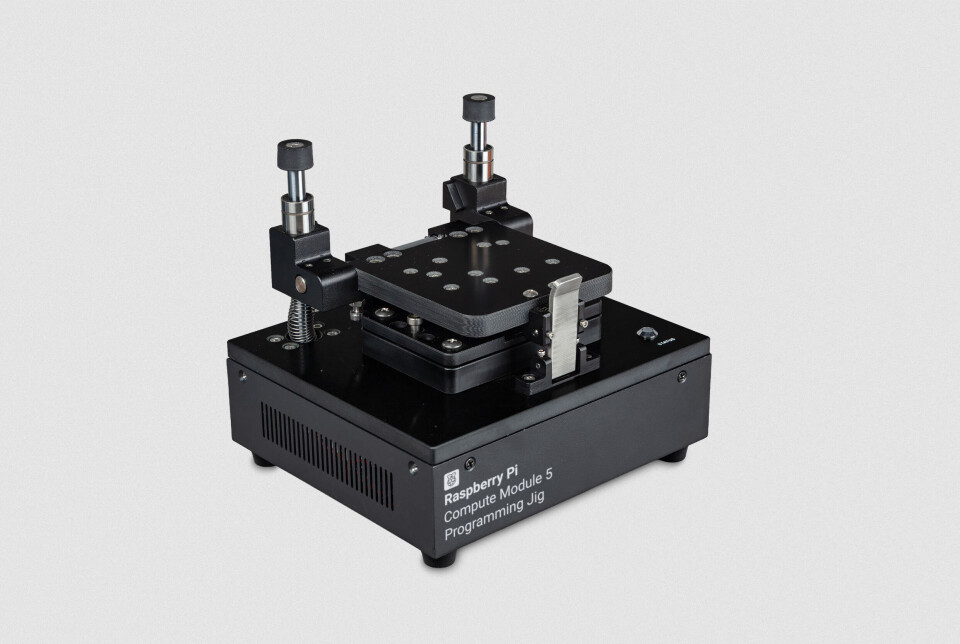
Raspberry Pi has unveiled a $600 Programming Jig to take the faff out of preparing batches of Compute Module 5 (CM5) boards for deployment.
The device combines the provisioning host and module interface in one box, eliminating the need for a separate IO board.
Advertisement
Raspberry Pi’s black Programming Jig is designed to provision Compute Module 5 devices one at a timeImage courtesy of Raspberry Pi
The IO board is, of course, considerably cheaper, but serves a different purpose: it exposes a CM5’s interfaces for development and prototyping. It can also be used during provisioning, albeit through a more involved setup. The Programming Jig is designed to install an operating system and security configuration, then move straight on to the next module.
Weighing just under 1.8 kg, the single-head device accepts one CM5 at a time. Clamp the computer in place and provisioning begins automatically. A typical installation takes about 90 seconds, after which a green status LED indicates that the module can be removed and replaced with the next one. It is a straightforward procedure that industrial users may welcome when faced with a stack of CM5s destined for embedded systems.
Initial setup involves writing the jig’s own operating system and configuring it with Raspberry Pi Imager. Raspberry Pi recommends using Connect to access the jig’s desktop remotely, after which operators can upload the images destined for their CM5 boards.
Raspberry Pi had already tackled part of the mass-provisioning problem with rpi-sb-provisioner, which automates operating system installation and security configuration. The remaining challenge was hardware: each CM5 still had to be connected to a provisioning host, perhaps through an IO board attached to a separate Raspberry Pi or other computer.
Advertisement
The Programming Jig integrates the controller and pogo-pin interface into a single unit. Once configured, the operator need only place a CM5 in the clamp and close the lid.
Sadly, there is no satisfying ping when the job is done, but we don’t doubt that some enterprising soul will fix that before long. ®
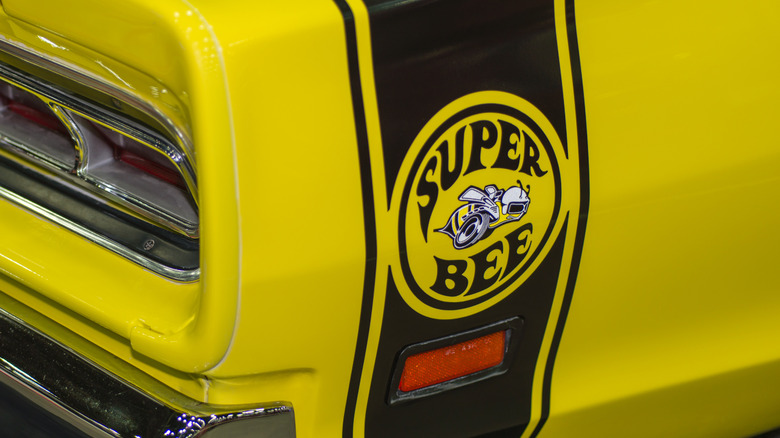
The title of Mopar’s “Blue Collar” muscle car goes to the Dodge Super Bee, which started out as a high-performance version of the 1968 Dodge Coronet. The car evolved into its own model that ran in the Dodge lineup from 1969 until it was cancelled after the 1971 model year. The Super Bee was Dodge’s answer to the problem of how to sell a muscle car to working class customers while keeping the vehicle’s cost down and the payments affordable. While the Plymouth Road Runner would compete directly with the Dodge Super Bee for Mopar customers, the shorter-lived Super Bee has become just as much of a collector’s item, with models today going for as much as $135,000.
Dodge was looking for a low-cost way to put together a muscle car that wouldn’t break the bank for their blue collar customers. The company initially based the Super Bee on the inexpensive but sturdy midsize Dodge Coronet’s pillared sedan body. By keeping the interior basic and minimizing the number of options, Dodge was able to keep the Super Bee’s price down. The Super Bee name took Dodge’s Scat Pack marketing to the next level. The vehicle had all of the hallmarks of a muscle car, even at its intentionally low price — a long hood, plenty of blacked-out areas on the body, “bumblebee” stripes around the rear, hood scoops, wide tires, and intensely bright colors like Plum Crazy and HEMI Orange that signaled the intent to be loud, proud, and competitive. For 1969, a pillarless two-door body style joined the lineup.
Advertisement
What powered the Dodge Super Bee and how did it perform?
Steve Lagreca/Shutterstock
The 1968 Dodge Super Bee’s standard engine was a 335-horsepower version of the 383 V8, which used the camshaft, induction system, and cylinder heads from the larger 440 V8. You could get a street version of the 426 HEMI engine for $1,000, but most customers left that box unchecked. For 1969, the famed Dodge 440 Six Pack was added, using three Holley two-barrel carbs to produce 390 horses for a more reasonable $460 cost, making the Super Bee one of the six legendary muscle cars built with the 440 Six Pack.
In 1970, the Coronet was restyled, resulting in some cosmetic changes. The following year it was discontinued; the Super Bee became a low-cost performance version of the redesigned Charger. This would be the last year for the Super Bee, not counting the 2007-09 attempt to revive it on the recent Charger platform. A total of just around 56,000 Super Bees were made during its four years of production, making them fairly rare compared to most other mass-market muscle cars.
In a July 1969 road test in Car Life magazine, a 1969 Dodge Super Bee with the 440 Six Pack engine did 0-60 mph in a scorching 6.3 seconds, with the quarter-mile flashing by in 13.8 seconds at 104.2 mph. That’s pretty impressive performance, even for the peak of the muscle car era.
Advertisement
The 1968 to 1971 Dodge Super Bee was a key part of the democratization of muscle cars. Rides like these were affordable for working-class people who wanted high-performance vehicles, but still needed a monthly payment that they could handle.






































































You must be logged in to post a comment Login