For one more day, Tim Cook is still the CEO of Apple. Despite foibles, he was the right man in the right place to make Apple the financial and cultural juggernaut it is today. John Ternus is too.
Since my first Apple II in 1979, there have been many Apple CEOs, many philosophies behind Apple. Jobs’ was apparent in the 80s, and then again in his iCEO/CEO days.
And then he got sick. He made his last, best decision for Apple before he did.
He made Tim Cook the CEO of Apple.
Advertisement
Cook’s era begins in 2011
Cook’s first keynote was rough. It would take him about two years to get as smooth at presentation as Jobs was.
I think intentionally, he never tried a Jobsian reality distortion field approach.
When Cook took those keys, the iPhone wasn’t as big as it would be just a few years later when the iPhone 6 shipped. That blew the doors off the place.
He also had the early iPad to deal with and advance. And then, the first project without any real involvement from Steve Jobs, the Apple Watch, shipped.
Advertisement
He’s been hailed and pilloried over the years for the same reason, he wasn’t Steve Jobs. Apple didn’t need another Steve Jobs after Apple wasn’t first to a MP3 player or to a smartphone.
They needed a Tim Cook, after Apple wasn’t the voice of the revolution anymore. They needed a guy to drive Apple’s logistics and culture into the stratosphere, where it is today.
For everybody who thinks that Steve Jobs was right about everything, as a reminder, he named Cook to be CEO. And it worked out pretty well.
Not parasocial, not social
I’ve had close encounters with Apple’s two great CEOs. The first was with Steve Jobs, when I was hired for a games evangelism role inside Apple in 2001. The offer was tended, I was packing up my family to move, and in about a 40-word conversation, he handed me off to his assistant to tell me that the role was gone.
Advertisement
I wasn’t public-facing with Apple writing when Steve Jobs died. I did a lot of discussions and briefings in DC with mostly military folks about what it might mean, so I was still very immersed and had a lot to do that day and week afterwards.
The second Apple CEO close encounter was with Cook. This was in very late 2011, almost 10 years to the day after the Jobs call, very soon after he took over. I don’t remember the day, but it was after Thanksgiving and before the feds shut down for Christmas.
The iPad was relatively fresh, and the Department of Defense was considering them for use. Having been a submariner and a consultant, I was invited to a big meeting one Thursday night in DC.
As it turns out, the Department of Defense, specifically the Department of the Navy, didn’t like the Wi-Fi on it. There were concerns that it might be an issue with RF emissions control, and therefore impactibg detectability on underway ships and submarines.
Advertisement
Tim was in town for some lobbying effort or other, I forget which. I still wasn’t doing this job facing the internet yet, that would take another six months.
He and I very briefly exchanged pleasantries in a meeting room. A panel discussion about the iPad Wi-Fi “issue” in was about to start, but he was ushered out by his assistants before the discussions started. This left us with folks from the Reston, VA government support office and a few engineers from Cupertino.
And that was it. One of Tim’s many assistants reached out after my daughter died and I wrote about how my Apple Watch helped get a heart condition diagnosed. That was more a sympathy call than anything else.
John Ternus is his own man, influenced by Cook’s shadow
I’ve been asked a few times about what I expect from John Ternus as Apple CEO. I’ve mostly said “expect a very Cook-ian company for at least four years.”
Advertisement
It’s too early to tell what John is going to be like in a year or two. All that’s certain is that he’s got big shoes to fill.
He’s not an operations guy, he’s an engineer, mostly. He’s had his hands in all of Apple’s hardware for at least a decade, which is a good foundation.
He’s got a $4 trillion dollar company, who righted the wrongs of late-Intel hardware for most users mostly under Ternus’ hardware direction. He’s being handed an absolutely commanding mobile ecosystem, that he had less to do with, but not nothing.
Apple’s quarterly revenue from Q1 2012 to the present
Advertisement
The folding iPhone is about to ship albeit about 10 years after the first folding smartphone shipped. And Apple’s main money-maker for the rest of the year, the iPhone 18 Pro, is in days too.
This is not a Disneyesque CEO turnover. I still think that Bob Iger handed off to Bob Chapek, seeing the COVID storm on the horizon and other cultural and structural issues in that massive company.
After all, COVID had been brewing inside Apple’s and Disney’s supply chain in September of 2019, before it hit the US. Iger knew it was coming and was going to be a problem.
And on COVID, I think Cook stared that down better than Jobs would have. I suspect the latter would enforce his own timetables, global pandemic be damned, to the detriment of the company.
Advertisement
The RAM and SSD commodity pricing as of August 2026 that facing the new CEO are COVID-esque from a pricing and value destruction perspective, and will be for years, but not insurmountable. It just needs a whole lot of spending money, patience, and time.
I suspect Tim will be working that as a geopolitical problem as Apple Executive Chairman tomorrow, and going forward.
Jobs was Jobs. Cook mostly got allowed to be Cook by Apple fans, but he was true to himself, bedamned the complaints that he wasn’t Jobs.
Let Ternus be Ternus. Don’t decry that he isn’t Jobs or Cook, he’s not really listening anyway.
Advertisement
No matter what happens, it’s going to be interesting.
Apple was doomed in the ’90s when bean-counters ran the company. Things were bad, and the Sears/CompUSA Performa strategy just did not work. Then it wasn’t when Steve Jobs came back and pulled the cloth off the iMac when the company was the voice of the revolution.
Then, in the minds of some, it was doomed again when Tim Cook took over, right after Apple stopped being the voice of the revolution and was instead a dominant force with iPod and a growing dominance with iPhone under the last years of Steve Jobs.
Apple won, it needed Tim Cook to evolve, and Steve Jobs knew it.
Advertisement
And it’s not doomed tomorrow, or for the next 16 years, under John Ternus’ control.
Tim, I’m going to miss the prayer-hands at every event, they were fun. I’m going to miss the exuberant good morning, good afternoon, and one single good evening.
It’s been fun covering you for 22 years between your two temporary stints and your CEO tenure, for the feds, for MacNN, and for AppleInsider.
These aren’t isolated moments, but the visible rise of a travel category: the “race-cation.” Fitness enthusiasts aren’t just picking a gym or a training plan anymore; they’re picking a destination, buying flights, booking hotels, and building entire holidays backwards from a finish line.
Advertisement
And the businesses that spotted it early—airlines, hotel chains, even government tourism boards—are already building entire products and services around it.
The businesses that got there first
(Left): AirAsia x HYROX aircraft; (Right): World of Hyatt’s advertisement./ Image Credit: AirAsia/ Grand Hyatt
A handful of brands were quick to build entire commercial products around the race-cation the moment they saw it coming.
These intentionally built products have found a big customer base designed around a specific new kind of trip, one where the itinerary is built backwards from a start line.
The fitness trend that started it all
HYROX’s workouts include sandbag lunges and sled pulls./ Image Credit: Dittaya Mhosomboon/ Elizabeth Low
So a Singaporean who trains for it at home can fly to Seoul or Bangkok and compete in something functionally identical, just with a new stadium, a new crowd and a fresh excuse for a holiday wrapped around it. It’s this portability that turns signing up for a race into a whole vacation.
(Left): Amelia Yeo (middle) in Incheon, South Korea, with her family; (Right): Amelia competing at the HYROX event in Incheon./ Image Credit: Amelia Yeo
That appeal shows up in how people actually build these trips.
Singapore-based orthopaedic surgeon Alan Cheung has completed nine HYROX races, six of them overseas across Seoul, Sydney, Melbourne, Hong Kong, Taipei and Bangkok—using each one as much as a way to reconnect with friends and relatives living abroad as a competition to win.
For fellow Singaporean Angus Tan, a fitness influencer who flew to Jakarta with his partner for his first overseas race, the pull is partly practical—a short flight, minimal leave needed—but mostly about what the race gives the rest of the trip. “There’s something really satisfying about earning your holiday,” he told CNA Luxury.
For some, the race becomes the reason a family finally gets together. When Singapore marketing lead Amelia Yeo signed up for her first HYROX in Incheon, her parents, brother and his girlfriend flew out to support her, turning into the family’s first holiday together in almost eight years.
And for whole gyms, the race-cation becomes a group pilgrimage: Hong Kong’s DOP Training Club brought around 90 members, roughly 70% of its membership, to Bangkok in Mar 2026, closing the gym for the week so the club could compete and celebrate together, continuing a pattern of earlier group trips to Taipei, Kobe and Beijing.
Advertisement
None of this is cheap, either, which is arguably the more telling part.
For a lot of racers, the entry fee, the flight and the months of training aren’t a deterrent, but may be what makes the finish line worth flying for in the first place.
Singapore & Singaporeans are jumping on the bandwagon
The annual Gold Coast Marathon (left) and the Great Wall Marathon (right)./ Image Credit: Gold Coast Marathon/ Worlds’s Marathons
Beyond HYROX, Singaporeans are also willing to fly out for other fitness events.
This regional travel-for-a-race pattern now has numbers to back it up, too. Similar to race-cation, travel platform Agoda has coined the term “run-cation” for the phenomenon of people travelling for marathons.
One of them was Vijay Andrews, a 32-year-old Indian fitness coach who’d spent months recovering from an injury that kept him out of a HYROX event in New Delhi earlier in the year. When he heard Singapore’s edition was coming up, he booked his flight.
The workout itself isn’t new. What’s changed is that a fitness class has become something people plan a whole trip around, train months to earn, and fly across the region to share with the people who train alongside them.
The race gives these trips a reason. Everything else—the city, the food, the extra few days off—is just the reward for having shown up at the start line.
Read other articles we’ve written on Singaporean businesses here.
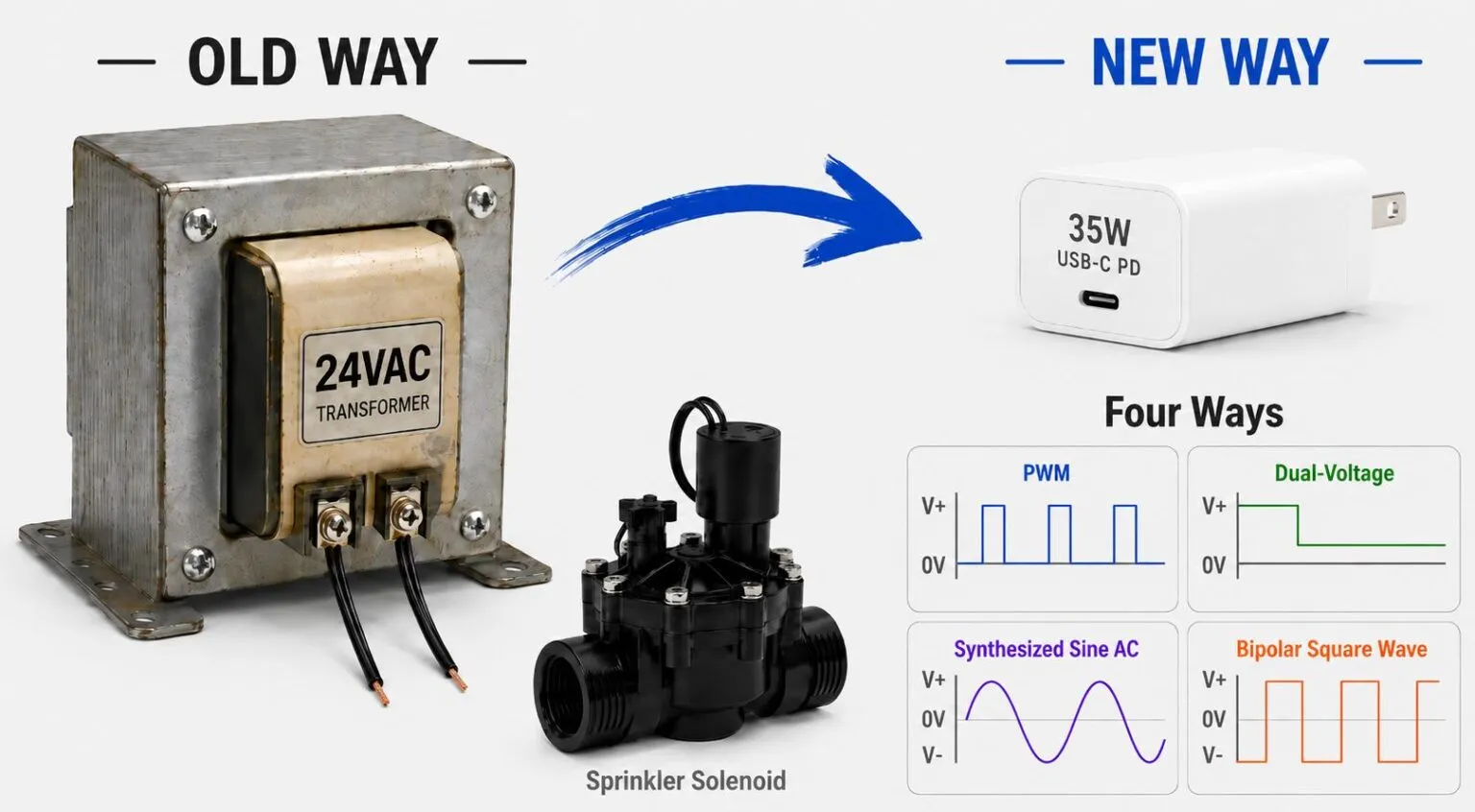
In the modern world USB has become a truly universal connector, with its inclusion on almost every major piece of consumer electronics. It has even expanded well beyond things that we’d think of as consumer electronics, like the solenoids on automatic sprinkler systems.
This project comes to us from opensprinkler.org who have been working on various ways of controlling the old sprinkler standards, which generally rely on a 24 VAC power supply to drive solenoids. This tests uses the power available from USB-PD and closely examines four methods of energizing the solenoids: unipolar PWM, dual voltage, synthesizing an AC wave from a DC supply, and producing a bipolar square wave. The bipolar square wave had some interesting results, being able to get pretty close to the behavior of a true sine wave while minimizing the demand on power electronics.
For those working on old sprinkler systems, or many other antiquated systems that still rely on 24 VAC, this project shows that USB can deliver a surprising amount of power in unique ways, and the fact that it’s near-ubiquitous and affordable makes it that much easier to adapt into situations it was never really designed for.
Outside the UK? Use NordVPN to unblock your free stream
Watch Aston Villa vs Arsenal live streams as the Gunners look to inflict more misery on the home side who lost their opening Premier League 2026/27game 4-0 after seeing a host of their best players depart over the summer.
It’s been a tough start to the campaign for Aston Villa boss Unai Emery. The Spaniard has seen Youri Tielemans, Lucas Digne, Morgan Rogers and Ezri Konsa all depart, while Ollie Watkins and Emiliano Martinez could soon follow suit. His decimated squad was then thumped 4-0 by Brighton, with João Gomes seeing red. With injuries also sidelining strikers Brian Madjo and Tammy Abraham, Villa fans will be fearing the worst against the reigning champions.
In stark contrast to the negativity around Villa Park, Arsenal will head to Birmingham brimming with confidence. The Gunners eased past Coventry 3-0 on the opening weekend, with new signing Christos Tzolis particularly impressive in attack. Mikel Arteta’s side will relish the opportunity to expose Villa’s problems and will expect the likes of Tzolis, Bukayo Saka and Kai Havertz to create plenty of chances.
Here’s how to watch Aston Villa vs Arsenal in the 2026/27 Premier League from anywhere in the world.
Advertisement
How to watch Aston Villa vs Arsenal from anywhere
A VPN is handy piece of software that can make your device appear as if it’s back in your home country, so you can unlock your usual service. The best VPN right now? We recommend NordVPN – it does everything and comes with a 75% discount and and extra three months for free…
How to watch Aston Villa vs Arsenal live streams in the USA
Soccer fans in the US can watch Aston Villa vs Arsenal in the Premier League on USA Network.
Advertisement
There is no dedicated streaming platform for USA Network, but it is available on cord-cutters like YouTube TV, Hulu+Live TV,Sling(select markets),FuboorDirecTV, many of which carry free trials.
Outside of the US? Use a VPN while you’re traveling away from home to unlock your stream.
How to watch Aston Villa vs Arsenal live streams in the UK
(Image credit: Future)
In the UK, Aston Villa vs Arsenal is being broadcast on Sky Sports Main Event and Sky Sports Premier League.
Advertisement
Sky Sports packages cost £35 per month for new customers, or £22 per month if you already have a 24-month Sky TV contract.
If you’re out of the UK but still want to tune in, explore the VPN route set out above, which will help you access your accounts from anywhere.
How to watch Aston Villa vs Arsenal live streams in Canada
Fubo is the Premier League’s broadcast partner in Canada and has live coverage of Aston Villa vs Arsenal.
Advertisement
Prices start from CA$31.49 per month for Fubo’s Sports Monthly package. However, the best option right now is the Quarterly Package which costs just CA$27.99 CA$14.99 for each of the first three months. You can also watch Fubo’s content if you have a selected DAZN subscription in Canada.
Not in Canada? Use NordVPN if you’re away from home, in order to tap into your preferred coverage from anywhere.
How to watch Aston Villa vs Arsenal live streams in Australia
(Image credit: free)
An Aston Villa vs Arsenal live stream is available in Australia on Stan Sport.
Advertisement
You can pick up a Stan Sport subscription for as little as AU$29.99 per month for the basic plan containing adds. That price consists of the AU$9.99 Stan subscription fee plus the Sport add-on for AU$20.
Outside of Oz? You can use NordVPN to access your usual Premier League coverage.
What is the Aston Villa vs Arsenal start time?
Aston Villa vs Arsenal kicks off at 8pm BST / 3pm ET / 12am PT on Monday, August 31.
If you are Down Under, the game will be broadcast at 5am AEST on Tuesday, September 1.
Advertisement
We test and review VPN services in the context of legal recreational uses. For example: 1. Accessing a service from another country (subject to the terms and conditions of that service). 2. Protecting your online security and strengthening your online privacy when abroad. We do not support or condone the illegal or malicious use of VPN services. Consuming pirated content that is paid-for is neither endorsed nor approved by Future Publishing.
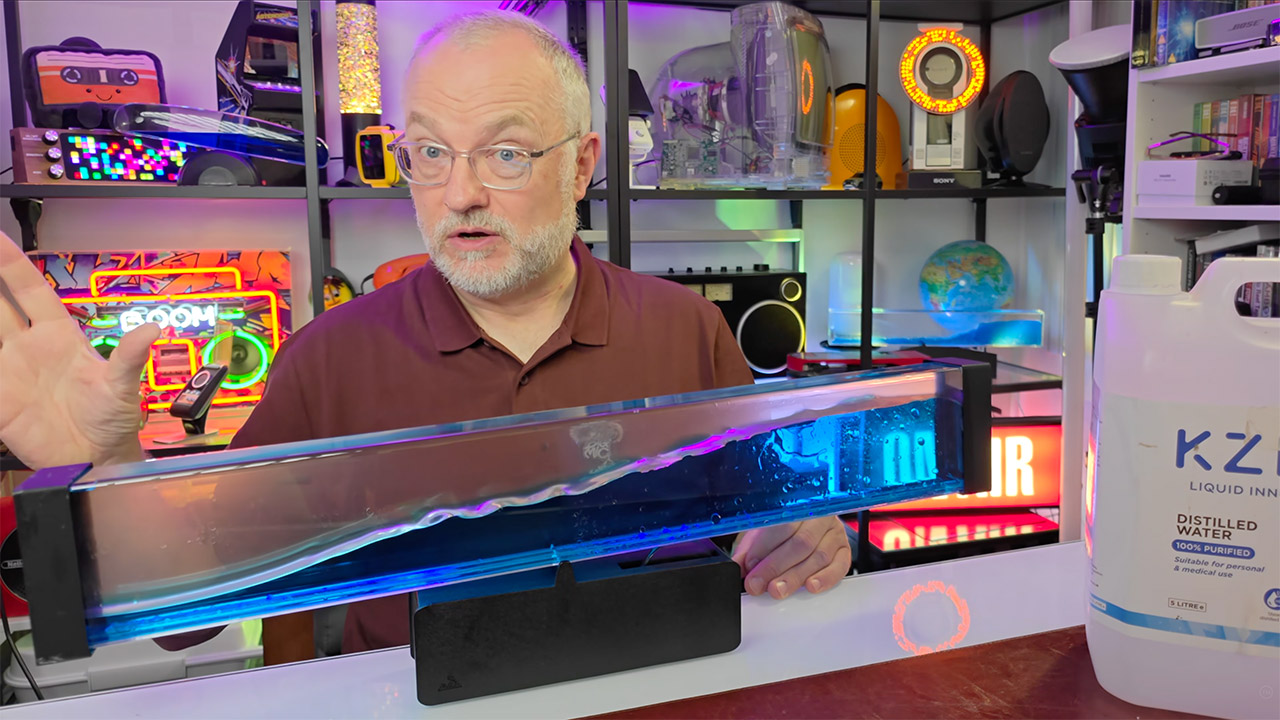
Techmoan already owned an 18-inch Hughes Wave Motion Machine that set him back about $500. He wanted something longer, so he paid $300 for the biggest model waveshop listed, a 25-inch unit shipped from India.
Website images appeared to be quite polished until he realized they were AI-generated. Prices sat in rupees. PayPal stayed unavailable on the main site, forcing a bank transfer unless you switched to the nearly identical waveshowcase.com page that accepted cards. A scam-checking site scored the operation at 50%. He ordered anyway and used PayPal through the dollar site for some protection.
【COMPACT BUT POWERFUL】- D11 Max has more skills. Designed for all things sleep, this sound machine comes with favorable features: rechargeable…
【HUGE BATTERY, WORRY-FREE ON THE GO】- Everything D11 max has, PLUS a LONG-LASTING battery. The portable sound machine is built with…
【HELPS SETTLE-IN & STAY ASLEEP】- Moms know how precious sleep can be. Turn it on to create peaceful sleep environment to help crying baby calm…
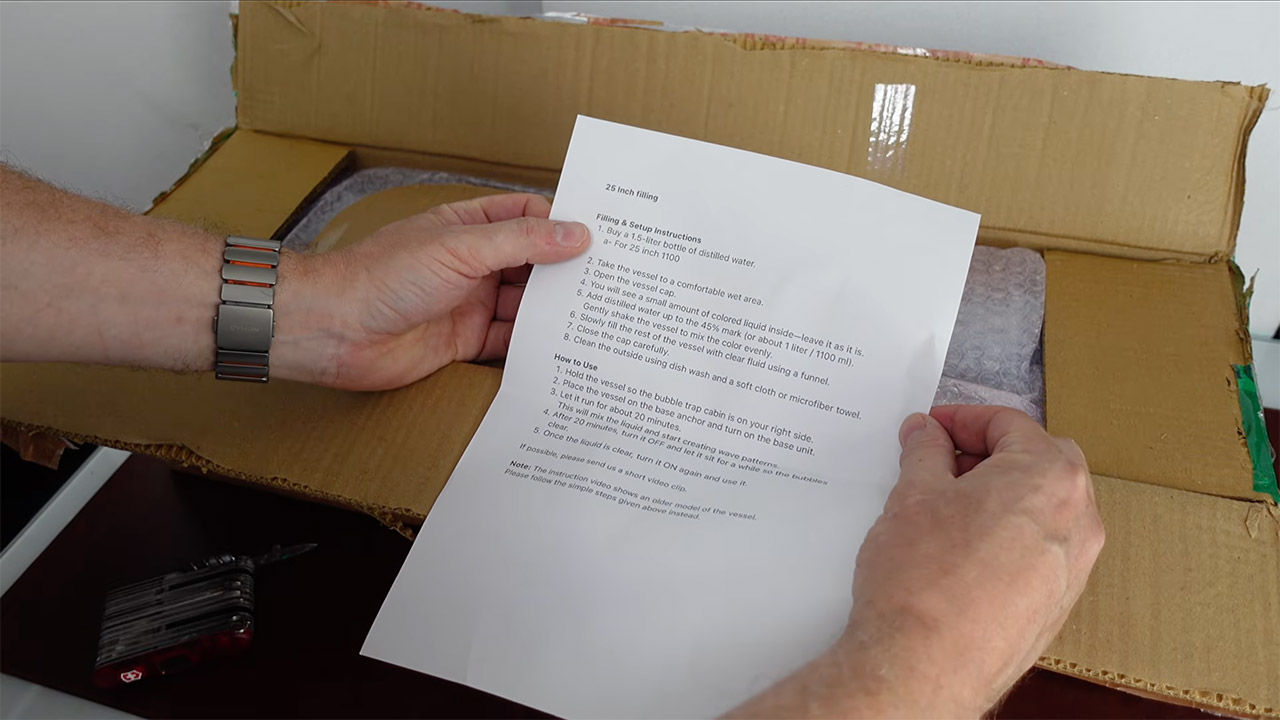
UPS delivered the box faster than expected after a short email exchange. Everything he bought was in the box, including the acrylic chamber, motorized base, funnel, a bare-bones set of instructions, and three little Minute Maid-style bottles holding transparent mineral oil. One of the thin plastic end caps shattered when he attempted to open the box to begin using it, and for some reason, the distilled water he had ordered did not arrive in the delivery.
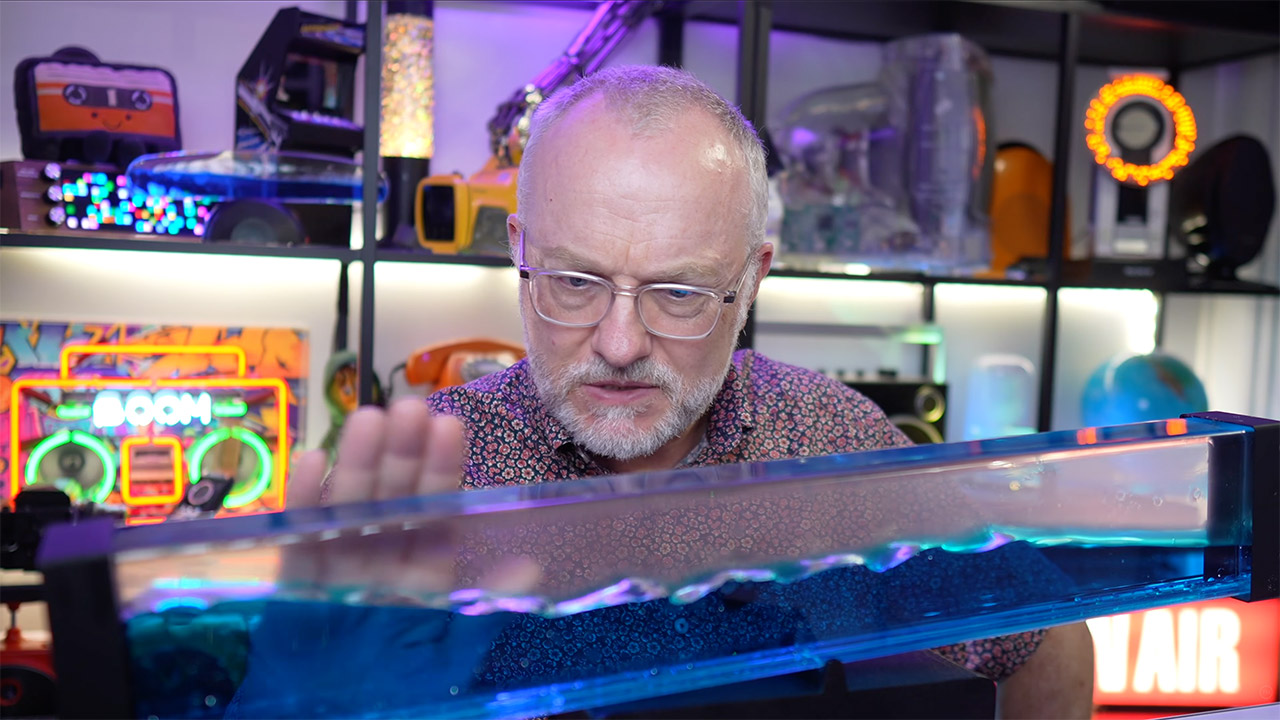
Filling the reservoir is a two-step process: first, mix 1 1/2 liters of distilled water with the supplied blue dye until it reaches the designated 45% line, shake it well, and then gently add mineral oil through the air trap hole until it is full. The instructions are a little vague about which brands or ratios to use, but once that’s done, all you have to do is run the motor for twenty minutes, turn it off for another twenty to allow the bubbles to collect in the side reservoir, then turn it back on and let it go.
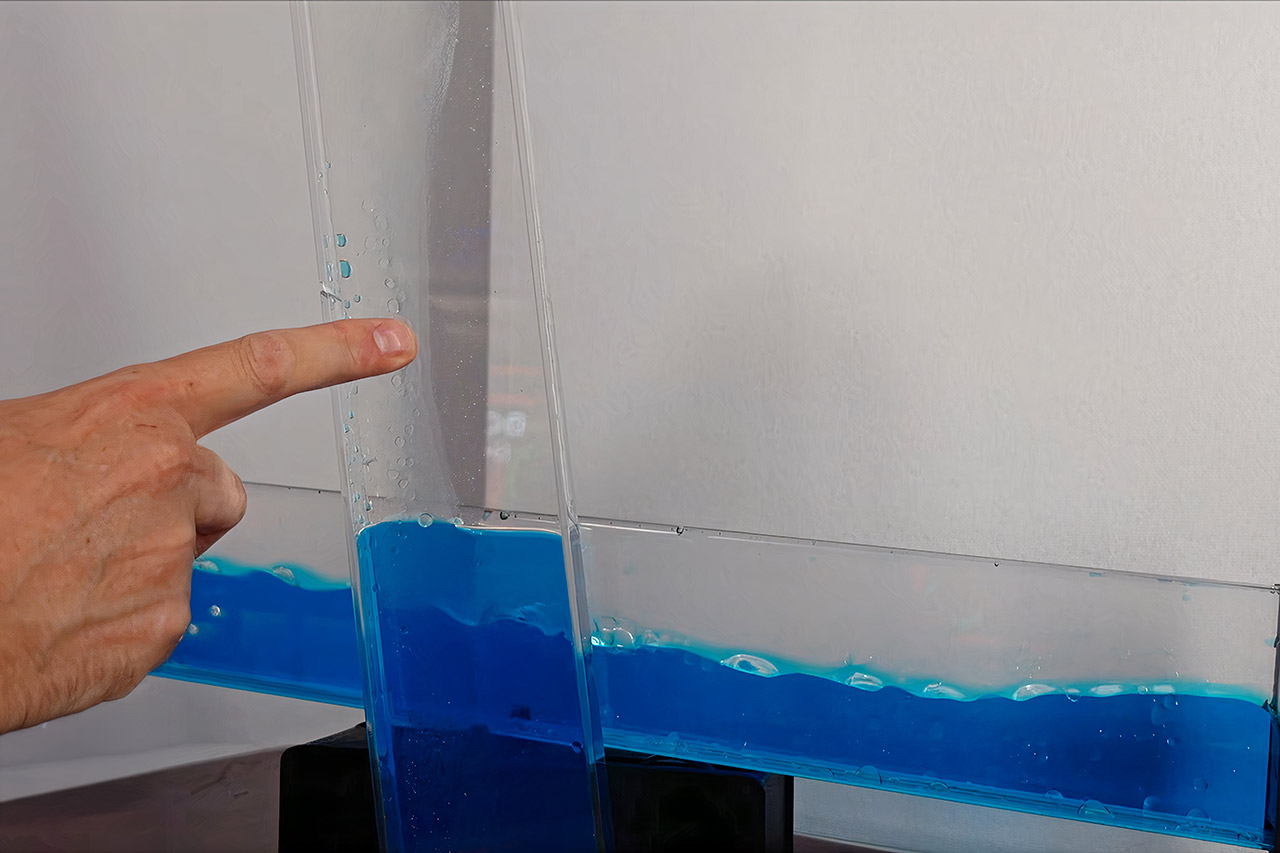
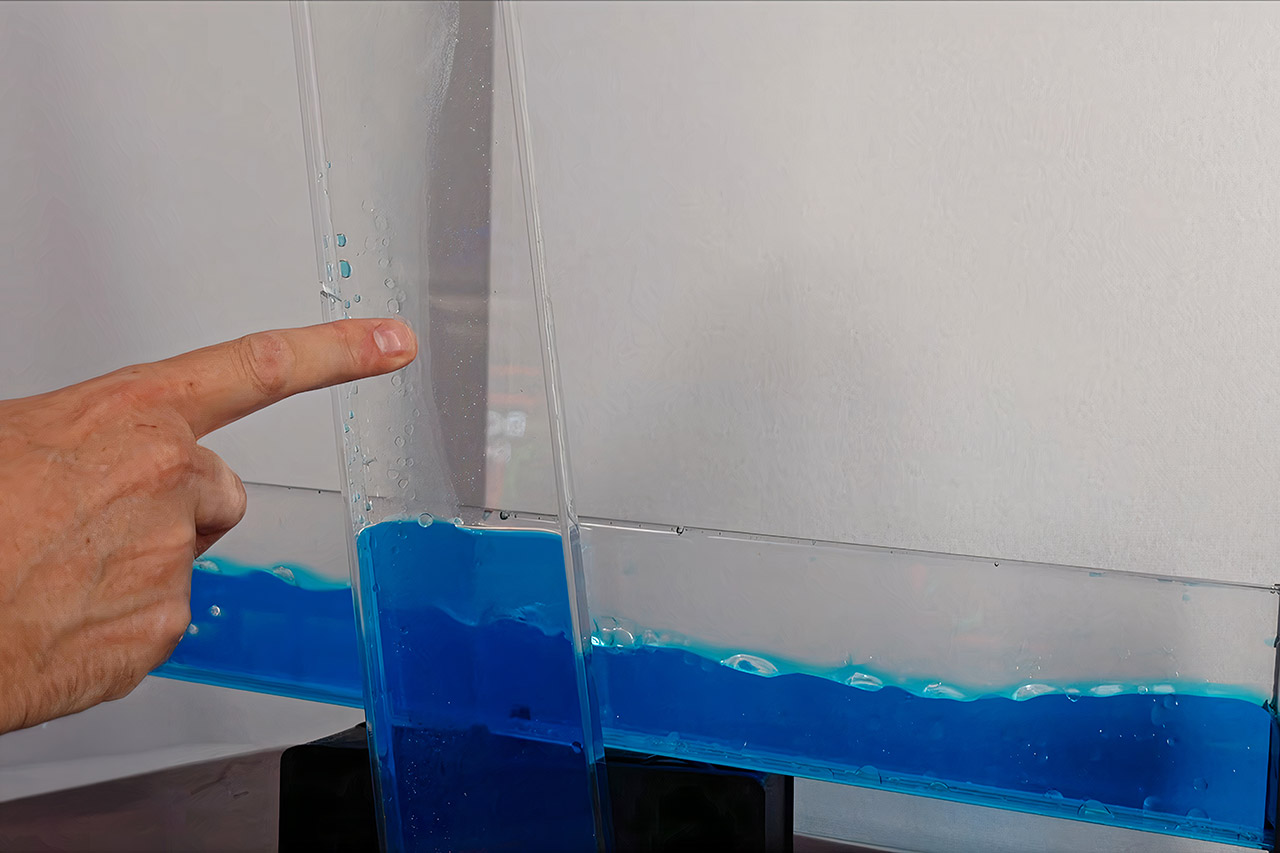
A small motor within moves a wheel, causing the entire chamber to rock back and forth in a gradual, soothing seesaw motion. Two liquids of differing densities collide and eventually mix to generate these continuous waves. The motion is quiet and even, and for the most part it remains that way. Unlike some of the older 1980s machines he used to witness, these waves do not crash or break apart in a spectacular manner, as one of his buddies, Techmoan, must have experienced. Bubbles still clung to the acrylic after the settling cycle, and a seam leaked slightly, which he fixed with tape. After a few hours of use, the blue layer began to emit a faint mist and form small floaters.
It’s evident that the budget materials match the price tag on this device. The base appears to have been 3D printed and is just weighted to provide stability. The end caps feel fragile and fit loosely. To be honest, the device lacks a power switch, so you must either unplug it or add a remote on/off socket to your own power strip, which is inconvenient. He tried adding some shims beneath the base to give it more stability, as well as altering the voltage to see if he could make it to rock quicker, but neither of these methods provided any further drama. The Hughes 18-inch unit may appear thicker and more polished, but it is actually not much different, having the same leaking concerns and edge blobs as this one. Both of these contemporary equipment are noticeably quieter than the old machines you used to see in the shop decades ago. This Indian version essentially uses the same process but scales it down to make it cheaper.
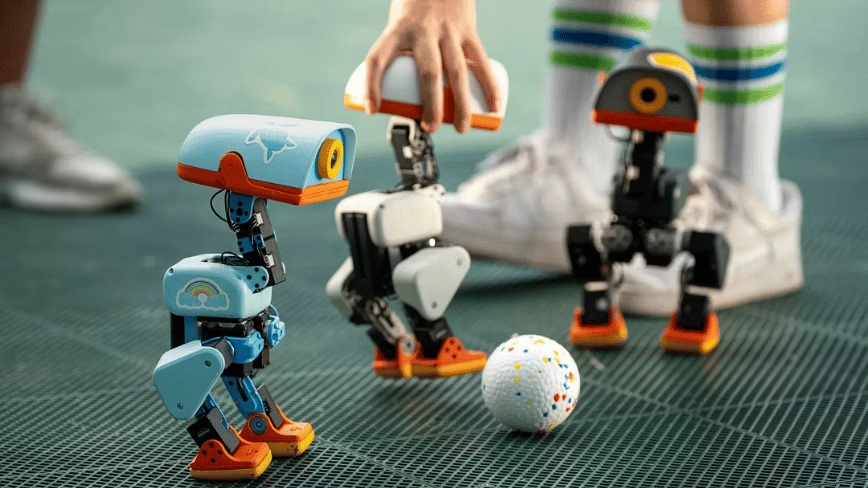
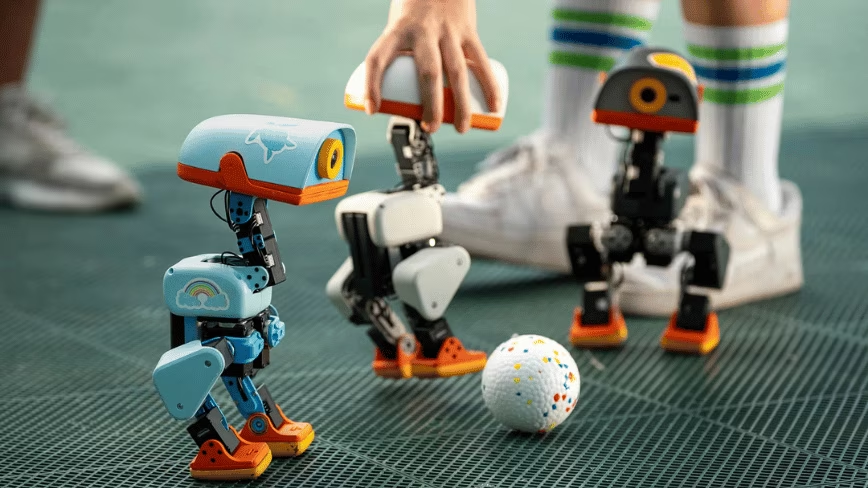
Pollen Robotics has unveiled a bipedal robot called Microduck, at an introductory price of $399 before taxes and shipping. The Bordeaux company is owned by the AI platform Hugging Face. Its new machine has one eye and 15 motors, stands 25cm tall, and weighs under 800g. Preorders opened on Thursday. Pollen is targeting first deliveries before Christmas 2026 in North America, Europe and the UK.
The robot walks, crouches, rights itself when it falls, and picks small objects up with its beak. Videos on the launch post show it collecting socks and a marker pen. An optional accessory pack adds wheeled feet so it can roller skate, along with a ball, an NFC chip and tags, and a laser pointer it follows with its camera.
Microduck runs on a Rockchip RK3566 with an AI accelerator, 1GB of RAM and 32GB of onboard storage, a part number first reported by The Verge. It sees through a front camera and judges distance with a compact LiDAR, an 8×8 time-of-flight matrix. One inertial measurement unit sits in the body and a second in the head. A 50Hz policy loop connects the onboard model to those sensors and decides what the robot does next, The Register reported.
It runs on a removable NP-F550 camera battery, a 2600mAh cell common in video kit, giving around an hour of runtime.
Advertisement
The software is open, the hardware is not
The whole software stack ships open source, and it is out already. The SDK and robot software sit in one GitHub repository, the reinforcement learning and sim-to-real tools in another, months before the first robot arrives. A developer can teach a skill in simulation, then push it onto the machine. European robotics firms increasingly work this way, and NEURA Robotics is building robot gyms.
The hardware is a different matter, and Pollen is unusually direct about it. Its press kit tells journalists that the open-source statement covers the software stack only. The mechanical and electronic design files are not open, and it asks reporters not to describe the robot as open-source hardware. A Pollen representative separately told The Register the company has no plans to open source it.
Buyers get an open stack on a closed chassis. Pollen already uses that arrangement for Reachy Mini, which it says has sold more than 10,000 units since launching last year.
Clement Delangue, Hugging Face’s chief executive, called it “a tiny $399 open-source robot you can teach new tricks with reinforcement learning”. His post on X has drawn 4.4 million views. He has spent the past year arguing that open models are winning. “Welcome to the era of open-source affordable robots to democratize physical AI and world models,” he wrote.
Advertisement
It cannot lift much
Santiago Pavon of Pollen Robotics put the robot’s lifting capacity at roughly 100 grams. That is about the weight of a bar of soap. The beak articulates and the camera can find an object, but Pavon accepts that grasping will stay limited on a machine this size. TechCrunch published a correction to its launch story after misstating how much the beak could carry.
Pollen is not selling a household helper. The Register called Microduck a cheap testbed for teaching people about hardware AI, machine learning and modern robotics. It is not an in-home butler or a cleaner. The framing matters in a year when robot demonstrations have outrun the machines. The humanoid that beat Usain Bolt’s record in Beijing left roboticists unimpressed.
Autonomy is left to the community
What Microduck does not have is any purpose of its own. Pollen wants owners to build voice recognition, navigation and grasping on top of the platform. It also wants simultaneous localisation and mapping. The company is asking for help rather than promising a roadmap, which makes this a bet on a user base that does not exist yet.
“Adding purpose and autonomy to the robot is something we are still working on, and we expect the community to pick up and contribute,” Pavon said. He described autonomous behaviour as a community objective, and called the idea exciting. Anyone can train new behaviours in simulation using reinforcement learning, he said.
Advertisement
Pollen’s own answer to what people should build is more ducks. It says the robot is about ten times more fun in groups. Races, football and robots reacting to each other are what made it feel alive internally. For developers it is a cheap way into multi-robot behaviour, without a room full of hardware.
Pollen is not the only firm trying to standardise how AI models reach real hardware. Anthropic published a standard for lab hardware on the same day Microduck went up for preorder.
Every robot gets its own voice
Microduck sings, and no two sound alike. Pollen says it “communicates through weird little sounds, closer to a creature than an assistant”, and that each robot generates its own audio identity the first time it wakes up. That voice stays with the unit for life. It comes in cream, graphite, lavender and sky.
The launch lands in the middle of a $12.9bn deal
Hugging Face bought Pollen Robotics in April 2025 to build cheap open hardware. The two launched Reachy Mini a couple of months later. That desktop robot now sells in two versions. A $499 model runs on a Raspberry Pi, and a $399 Lite runs off a Mac or a PC.
Advertisement
Microduck arrives in the middle of a takeover. The Information reported that Nvidia has agreed to buy Hugging Face for $12.9bn. That followed reports days earlier that put the two in talks over a sale. Business Insider put the figure above $13bn, citing a person familiar with the matter, and said the two sides had not finalised an agreement.
Nobody involved is discussing it. Pavon answered questions about Microduck but not about the Nvidia deal. Neither Nvidia nor Hugging Face replied to The Register, and both have stayed quiet since the Business Insider story broke. Nobody has said what the deal would mean for a small French robotics subsidiary.
A camera in the bedroom
Microduck carries a camera and a microphone, and Pollen expects people to put it in their homes. There is at least a light: the robot has a dedicated camera-use indicator, which Pollen says is modelled on the REC lights of old camcorders.
That is the fix Meta reached for on its smart glasses this month, after people worked out how to cover the LED. Delangue has argued before that robots running open models beat “a black box system” controlled by a handful of organisations, “especially if these organizations’ CEO is not the most stable person in the world,” he told TechCrunch.
Advertisement
Open source gives developers auditability, TechCrunch noted, but it does not guarantee that data stays private. Owners install applications on top of the model, and those apps can reach the camera and the microphone. What they do with it depends on how a developer builds them.
Some numbers are still soft. Pollen says camera resolution, LiDAR range, radio versions, SDK languages and any age recommendation are provisional.
Two things will show whether the pitch holds. The first is whether units ship before Christmas 2026, the date Pollen has given. The second is whether anyone outside the company publishes a behaviour worth installing, because the autonomy Pollen is promising is work it has asked other people to do.
The researchers discovered Fire Ant’s new tactic after finding an active GRE (Generic Routing Encapsulation) tunnel interface on a Cisco IOS XR router that could not be explained by a running configuration or commit history.
According to incident response company Sygnia, the threat actor switched from targeting VMware hypervisors to compromising Cisco routers, TACACS authentication servers, and Linux management hosts.
The researchers discovered Fire Ant’s new tactic after finding on a Cisco IOS XR router an active GRE (Generic Routing Encapsulation) tunnel interface that could not be explained by a running configuration or commit history.
Further analysis revealed that Fire Ant had deployed custom malware on the devices, enabling persistence through a fake system service that ran the implant only during alternating hours.
The malware selectively suppressed syslog messages to hide tunnel-related information from legitimate administrators, established outbound Telnet connections to Fire Ant infrastructure, and supported interactive shell access with no logging.
Advertisement
Fire Ant’s evasion tactics Source: Sygnia
The attackers also used their administrative access to capture traffic from multiple routers and upload the resulting PCAP files to external FTP servers.
These captures could expose internal topology, administrative connections, authentication flows, routing relationships, and traffic exchanged with connected networks.
“This behavior shifts the router’s role from a transit device to a collection platform,” Sygnia explains.
“Once the actor controlled the router, the device became a vantage point for observing traffic moving through trusted network paths.”
The concealed GRE tunnel connected one compromised router to a legacy Linux server, which Fire Ant used as a staging and reconnaissance system.
Advertisement
From there, the attackers probed systems in connected high-value environments, including systems associated with critical infrastructure, over ports commonly used for SSH, web services, SMB/RPC, and RDP.
Sygnia believes that Fire Ant’s operation aimed to compromise trusted infrastructure at an initial victim and use it as a covert bridge to explore access paths into connected high-value networks, a tactic which they dub “target behind the target.”
Operational overview Source: Sygnia
The researchers also discovered a previously undocumented backdoor called ‘BridgeAgent,’ which Fire Ant disguised as a legitimate Zabbix monitoring agent.
The backdoor persists as a root-level systemd service and supports TLS reverse shells and the execution of additional payloads on the compromised host.
The GRE tunnel function backing BridgeAgent Source: Sygnia
Sygnia says Fire Ant activity strongly overlaps with UNC3886, a Chinese espionage group previously documented by Google. However, the researchers say that there are differences in filenames, paths, and implementation details.
The researchers warned that Fire Ant systematically tampers with system logs and records, even changing file timestamps to obscure evidence that would benefit investigators, noting that logs retrieved from compromised infrastructure should be validated against other data.
Advertisement
Sygnia’s report shares an extensive list of indicators of compromise (IoCs), along with hunting and YARA rules to detect Fire Ant activity.
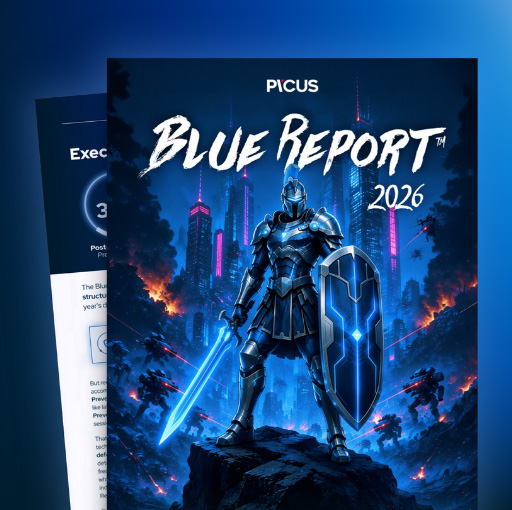
Overall prevention scores can hide what happens after initial access. Once attackers are using valid credentials, prevention drops sharply.
The Blue Report 2026 measures defenses technique by technique across 338 million simulations run in customer production environments.
What we know so far: Apple is widely expected to introduce its first foldable smartphone in September, joining Samsung and a host of other companies in the emerging market for ultra-premium handsets. It’s too early to know if Apple’s foldable will be the must-have gadget of the 2026 holiday season, or if a prototyped accessory will even make it to market.
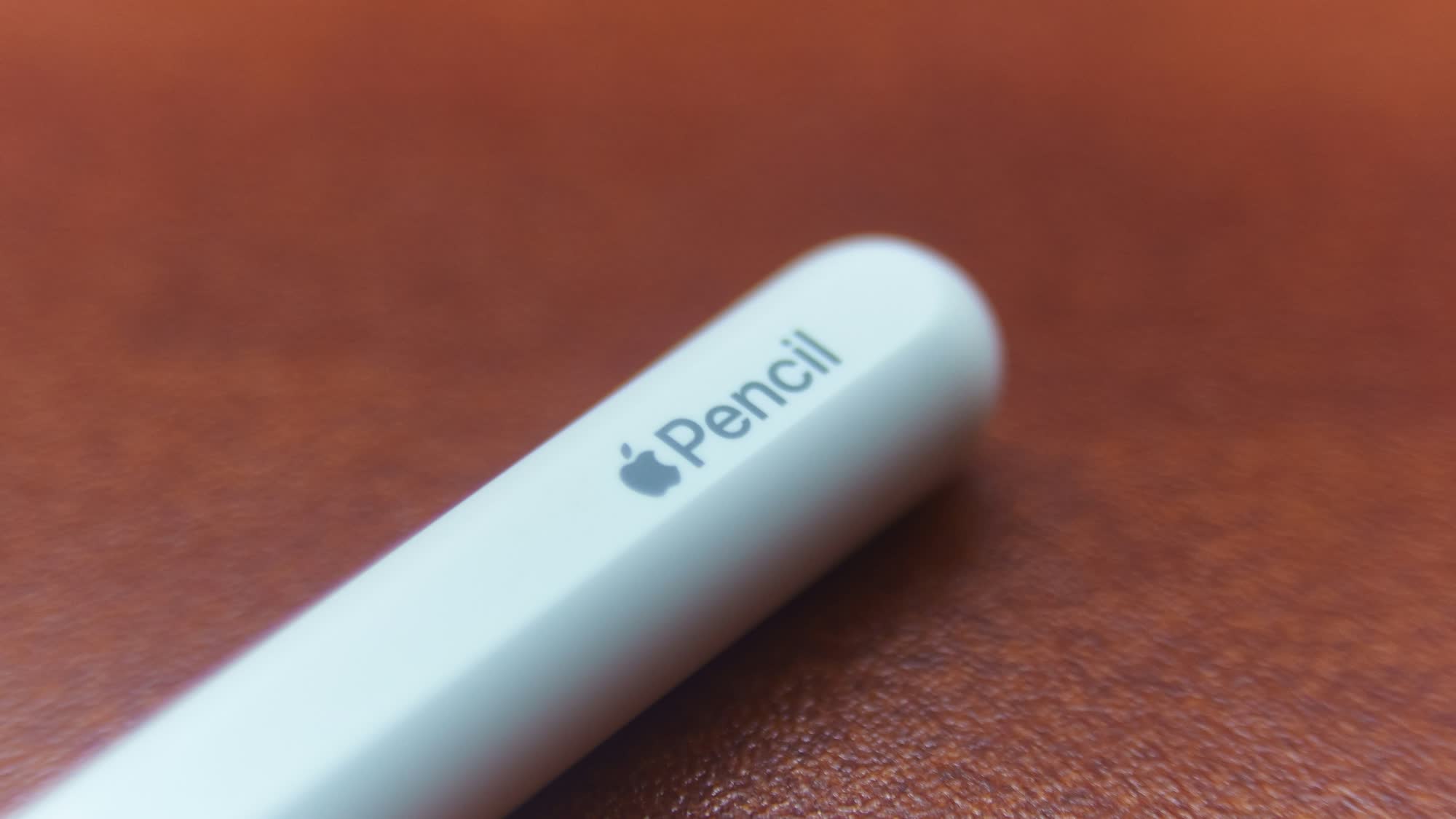
According to Bloomberg’s Mark Gurman, Apple has internally prototyped and tested a version of the Apple Pencil for its forthcoming foldable. The accessory is said to be stubbier than the version for the iPad due to the phone’s height, and attaches using magnets for storage and charging.
A stylus for what is essentially a small tablet doesn’t sound like a terrible idea, but there are drawbacks. Gurman said stowing the Pencil could get tricky when not actively using it. Perhaps even more concerning is the delicate nature of foldable displays. Most are manufactured using plastics, which can scratch just by dragging your fingernail across it. The last thing you want with something that fragile is a stylus with a pointy tip.
Then there’s the principal of the matter. When Apple co-founder Steve Jobs introduced the original iPhone in 2007, he famously said that “nobody wants a stylus.” And thus, the iPhone has relied on touch inputs from the very beginning. Bringing in a stylus nearly two decades later would be a surprise, but Apple will be under new leadership by the time the iPhone Fold ships so it’s not an entirely impossible outcome.
Advertisement
To be clear, Gurman doesn’t think Apple will actually launch the accessory as a consumer product when the foldable debuts in a couple of weeks and neither do I. While it could be helpful to a certain subset of buyers, it’s simply a bridge too far at this point. Foldable displays need to be much more robust to withstand the daily stresses introduced by a stylus, and the technology simply isn’t there yet.
Apple is set to announce its folding iPhone at an event scheduled for September 9.
MapQuest stood up to President Donald Trump, and now its app is reaping the rewards.
The “OG of online mapping,” as the company calls itself, announced on Thursday that it would not change the name of Lake Ontario on its maps to Lake America, despite Trump’s executive order directing the U.S. Department of the Interior to update the lake’s name in the U.S. geographic naming service. As a result, MapQuest’s mobile app downloads soared, sending the iOS app to the No. 4 position on the U.S. App Store’s Top Charts for apps (not including games) as of Monday morning on the U.S. east coast.
MapQuest also reached the No. 8 position overall in the U.S. App Store across both apps and games, and it became the No. 1 Navigation app in the United States.
In Canada’s App Store, the app reached No. 2 overall as of Sunday evening.
Advertisement
The 30-year-old company remarked that it received “hundreds of thousands” of new downloads since its decision to keep the name Lake Ontario in place, and saw its app’s usage climb to 50 times above its normal levels.
Third-party data from market intelligence provider Sensor Tower confirms the surge, noting that MapQuest saw 184,000 and 162,000 total global and U.S. app downloads during the week beginning August 24, respectively, each representing an increase of more than 10x week-over-week. In the U.S., daily downloads were up 128% day-over-day from August 26 to August 30.
“We took the same approach we did with the Gulf of Mexico: be part of the conversation, and give people an app that keeps the names they’re familiar with,” said Doug Berger, General Manager of MapQuest, in a statement. “Hundreds of thousands of people signaled to us this weekend that we got it right by downloading our app.”
MapQuest also released an online tool that lets you jokingly rename Lake Ontario to whatever you want it to be, then share the results on social media. The company had offered a similar tool last year, after Trump renamed the Gulf of Mexico to the Gulf of America.
Advertisement
Trump’s decision to rename the body of water bordering the U.S and Canada comes as trade talks broke down, leading the U.S. to impose new 50% tariffs on $20 billion worth of Canadian goods, with Canada poised to retaliate.
On Saturday, Google Maps announced it was complying with Trump’s decision, explaining that it updates Google Maps to reflect the name changes in official government sources. In the U.S., that’s the Geographic Names Information System (GNIS). The updated map will only be shown to users in the U.S., while those in Canada will see Lake Ontario, and those outside of the two countries will see both names.
Both Apple Maps and Google Maps previously changed the name of the Gulf of Mexico to the Gulf of America last year, after Trump issued a similar name-changing executive order.
As of Monday morning, Apple Maps has yet to rename the Great Lake to Lake America and has not issued a statement about its plans.
Advertisement
MapQuest has changed hands several times over the years, having been acquired by AOL shortly after going public. It then ended up with Verizon for a time, as a result of Verizon’s acquisition of AOL. In 2019, Verizon sold MapQuest to internet advertising company System1.
MapQuest’s app has been downloaded 687,000 times worldwide this year so far, up 29% year-over-year, SensorTower estimated. Since 2012, MapQuest has been downloaded 24.4 million times, with 97% of those installs coming from the U.S.
When you purchase through links in our articles, we may earn a small commission. This doesn’t affect our editorial independence.
A hot potato: Spot, the robotic quadruped from Boston Dynamics, has been used in numerous professions over the years, but its most controversial application could be on the way. Immigration and Customs Enforcement (ICE) is set to spend $2 million on the robot dogs, which could support officers by remotely assessing environments before they enter.
A new Department of Homeland Security procurement notice describes the possible purchase of Boston Dynamics SPOT robots and accessories valued at between $1 million and $2 million.
The document lists the robots’ potential uses as inspection, situational awareness, and hazard assessment in environments that may pose risks to personnel.
It adds that these capabilities helps improve officer safety, supports informed operational decision-making, and enhances DHS’s ability to respond to incidents involving dangerous, confined, unstable, or difficult-to-access areas.
There’s no mention of the robots being used to apprehend people or make arrests, which was later confirmed by a senior DHS official speaking to NBC News, though that’s unlikely to make their use by ICE any less controversial.
This won’t be the first time Spot has been used by a government agency. In 2019, the Massachusetts State Police bomb squad leased one of the robots for use as a “mobile remote observation device.” It was sent to inspect suspicious objects and dangerous locations, taking part in at least two incidents.
The NYPD later deployed a heavily modified Spot known as Digidog. The robot was used for reconnaissance during a 2020 incident in which a gunman barricaded himself inside a basement, and again the following year to investigate a house during a reported home invasion before officers entered.
Advertisement
Digidog reportedly completed around six missions without harming civilians, but footage of the robot in action prompted a backlash over surveillance and the increasingly Black Mirror-like appearance of modern policing. The NYPD terminated its $94,000 lease in 2021, only to bring Digidog back two years later. The department acquired two of the robots for $750,000, saying they would only be deployed in life-threatening situations such as bomb threats.
Spot also has a history with the US military. An early version was tested by the Marines as a potential load-carrying and ground-reconnaissance platform. While it was much quieter than Boston Dynamics’ gas-powered AlphaDog, Spot had to be monitored continuously and could carry only around 40 pounds of equipment. Those limitations meant the military ultimately shelved the project.
Boston Dynamics prohibits customers from using Spot to harm or intimidate people, warning that it will take “appropriate measures to mitigate that misuse.” Even if it believes this doesn’t apply to ICE, the company will have to decide whether up to $2 million in sales will be worth the bad publicity.
In a display case on the lower level of the Faraday Museum at the Royal Institution in London, there’s an unassuming stack of gray metal discs and blotting paper. It’s not at all obvious that this humble object is the starting point of today’s multibillion-dollar global battery industry. The object’s invention in 1799 grew out of a disagreement that Alessandro Volta—the Italian physicist for whom the unit of measurement for electrical potential is named—had with his friend Luigi Galvani over a dead frog.
The Debate Over Animal Electricity
Galvani was a well-respected Italian physician. In the 1770s, he began investigating the use of electricity to stimulate the muscles of dissected frogs. Armed with an electrostatic generator and an early type of capacitor called a Leyden jar, he was able to create a charge, store it, and then zap his animal specimens at will. He was intrigued when the frog legs twitched as if they were still alive. He spent the last three decades of the 18th century studying the phenomenon, and in 1791, he published De viribus electricitatis in motu musculari commentarius (Commentary on the Effect of Electricity on Muscular Motion).
Luigi Galvani spent decades investigating what he believed to be a natural electric force emanating from animals. Universal History Archive/Getty Images
Galvani saw the frog as embodying an “animal electricity,” an innate vital force that activated nerves and muscles, similar to what had been observed in (living) electric eels and torpedo rays. For Galvani, the frog was an electrical machine analogous to a Leyden jar. The brain was the source of the electrical charge; the nerves conducted the electrical fluid; and the muscles stored opposite charges. The illustrations in his 1791 book are fabulous—frog legs spread all over his laboratory table!
Advertisement
Galvani was wrong in thinking that his frogs were electrical machines, but he was right that the muscle contractions were caused by electric signals.SSPL/Getty Images
At first, Volta, chair of physics at the University of Pavia, concurred with his friend. But after beginning his own experiments, he concluded that Galvani was wrong and that the frog generated no electricity at all. He thought of the frog as nothing more than an electroscope, an instrument to indicate the presence of an electrical charge. Volta posited that the source of the charge Galvani observed came from two different metals in contact with the frog. He termed this “metallic electricity.”
Alessandro Volta came to disagree with Galvani’s theory of animal electricity.Apic/Getty Images
To prove his point, Volta created an “artificial electric organ.” He stacked alternating discs of copper and zinc, separated by cardboard, blotting paper, or cloth soaked in brine or acid. When the top and bottom plates were connected, an electric current flowed through the stack. As opposed to a Leyden jar, which is essentially a capacitor that can store an electric charge and release it in a brief powerful discharge, his stack of discs generated its own electricity through a chemical reaction and delivered a sustained low-current output.
Volta didn’t publicly demonstrate or announce his artificial electric organ until after Galvani died in 1798. But when he finally did, in 1799, it immediately began upending science. Just six weeks after Volta wrote to the Royal Society about his invention, the English scientists William Nicholson and Anthony Carlisle used a voltaic pile to run a current through water to separate it into hydrogen and oxygen. They had discovered chemical electrolysis. Humphry Davy later used a large voltaic pile to isolate a number of elements, including potassium, sodium, calcium, strontium, and barium. Early piles petered out after a few hours. Users who stacked up more metal discs to make more powerful piles found the weight of the discs squeezed out the moisture in the paper or cloth.
Invented in 1799, Volta’s “artificial electric organ” (later known as the voltaic pile) was the first battery. Volta presented this one to Michael Faraday in 1814.Royal Institution of Great Britain/Science Source
One of the most enthusiastic users of the voltaic pile was Galvani’s nephew, Giovanni Aldini, who spent much of his career defending his uncle’s ideas. Aldini created spectacles across Europe in which he used voltaic piles to shock the carcasses of livestock and, occasionally, the bodies of recently executed convicts. Vivid descriptions in the popular press, as well as Aldini’s own writings, raised the question of whether electricity could bring the dead back to life. Mary Shelley provided her answer in her 1818 novel, Frankenstein; or, The Modern Prometheus. In an introduction to an 1831 edition, Shelley cites galvanism as one of her inspirations for the monster’s reanimation process.
Advertisement
Beyond Winners and Losers in Scientific Debates
Scientists and historians share a common trait: They like stories with clear winners and losers. The narrative of competition helps drive a narrative of progress that makes it look like humanity is always moving forward. In the case of Galvani and Volta, Volta is usually depicted as the clear winner in the debate over animal versus metallic electricity. The Encyclopedia Britannica goes as far as to write that “with his announcement of the first electric battery in 1800, victory was assured for Volta.”
But both science and history are more nuanced than that. In fact, Galvani and Volta were both partially right and partially wrong. There was no universal force of animal electricity, but Galvani was correct that electrical signals caused muscle contractions, which he discussed in his anonymous 1794 publication Dell’uso e dell’attività dell’arco conduttore nella contrazione dei muscoli (On the Use and Activity of the Conductive Arch in the Contraction of Muscles). Volta was right to push back on Galvani’s animal electricity theory, but he was wrong that electrophysiological effects require two different types of metal, or any metal at all; the circuit in the voltaic pile was closed by the wet paper or cloth.
It seems a little presumptuous for the Encyclopedia Britannica to declare Volta the winner and Galvani the loser. Volta definitely thought his friend was wrong, but he waited until after Galvani’s death to make his views public. It’s closer to the truth to say they were both genuinely curious to understand the nature of electricity. In the process, they unknowingly helped develop different fields of inquiry: electrophysiology for Galvani and electrochemistry and battery science for Volta.
Such an outcome is actually quite common in scientific disagreements. For example, Isaac Newton’s dispute with Christiaan Huygens over the nature of light—did light consist of particles, or corpuscles, as Newton termed them, or waves, as Huygens contested—breaks down today into quantum optics and classical optics. Similarly, Louis Pasteur’s and Justus von Liebig’s debate over fermentation (microorganisms versus chemical decomposition) led to two complementary fields: microbiology and biochemistry.
Maybe instead of looking for winners and losers, we would be better off expanding our horizons and considering the multiple paths of inquiry and discovery. Writing in 1816, toward the end of his career, Volta graciously acknowledged Galvani’s pioneering work, saying “it contains one of the most beautiful and surprising discoveries and the germ of many others.” What new revelations are waiting to develop out of today’s scientific debates?
Part of a continuing series looking at historical artifacts that embrace the boundless potential of technology.
An abridged version of this article appears in the September 2026 print issue as “The First Battery.”


















.jpg)
.jpg)





 Luigi Galvani spent decades investigating what he believed to be a natural electric force emanating from animals. Universal History Archive/Getty Images
 Galvani was wrong in thinking that his frogs were electrical machines, but he was right that the muscle contractions were caused by electric signals.SSPL/Getty Images
 Alessandro Volta came to disagree with Galvani’s theory of animal electricity.Apic/Getty Images
 Invented in 1799, Volta’s “artificial electric organ” (later known as the voltaic pile) was the first battery. Volta presented this one to Michael Faraday in 1814.Royal Institution of Great Britain/Science Source














































You must be logged in to post a comment Login