Tech
Today’s NYT Mini Crossword Answers for Feb. 11
Looking for the most recent Mini Crossword answer? Click here for today’s Mini Crossword hints, as well as our daily answers and hints for The New York Times Wordle, Strands, Connections and Connections: Sports Edition puzzles.
Need some help with today’s Mini Crossword? A couple of the clues took me a few minutes, especially 2-Down, which is an unusual animal. Read on for all the answers. And if you could use some hints and guidance for daily solving, check out our Mini Crossword tips.
If you’re looking for today’s Wordle, Connections, Connections: Sports Edition and Strands answers, you can visit CNET’s NYT puzzle hints page.
Read more: Tips and Tricks for Solving The New York Times Mini Crossword
Let’s get to those Mini Crossword clues and answers.
The completed NYT Mini Crossword puzzle for Feb. 11, 2026.
Mini across clues and answers
1A clue: Flying ___ (kind of bat, despite its name)
Answer: FOX
4A clue: Furniture retailer known for its sprawling stores
Answer: IKEA
6A clue: Drug cops, informally
Answer: NARCS
8A clue: Geological time period spanning several ages
Answer: EPOCH
9A clue: Like F, in the alphabet
Answer: SIXTH
Mini down clues and answers
1D clue: Penalties for parking violations
Answer: FINES
2D clue: African mammal whose striped legs resemble a zebra’s
Answer: OKAPI
3D clue: Make a copy of
Answer: XEROX
5D clue: Bank customer’s holding: Abbr.
Answer: ACCT
7D clue: “Quiet, you!”
Answer: SHH
Tech
OpenAI policy exec who opposed chatbot’s “adult mode” reportedly fired on discrimination claim
Ryan Beiermeister, who served as OpenAI’s vice president of product policy, was fired in January after a male colleague accused her of sex discrimination, the Wall Street Journal has reported.
“The allegation that I discriminated against anyone is absolutely false,” Beiermeister told the Journal. TechCrunch reached out to OpenAI for comment and also contacted an email that appears to be associated with Beiermeister; neither had responded at the time of publication.
Per the Journal’s report, Beiermeister’s termination came after she expressed criticism of a planned ChatGPT feature dubbed “adult mode.” The new mode would introduce erotica into the chatbot user experience. Fidji Simo, who serves as OpenAI’s CEO of Applications — a role overseeing the company’s consumer-facing products — has told reporters that the new feature is planned to launch during the first quarter of this year.
Beiermeister and others at the company have raised concerns about how the new “adult” feature could potentially impact certain users, according to the report.
OpenAI reportedly said that Beiermeister, who was fired following a leave of absence, had “made valuable contributions during her time at OpenAI, and her departure was not related to any issue she raised while working at the company.”
Beiermeister’s LinkedIn profile says she previously worked for four years on Meta’s product team and spent more than seven years working for Palantir.
Tech
Discord Tries To Walk Back Age Verification Panic, Says Most Users Won’t Need Face Scans
Discord has moved to calm a user backlash over its upcoming age verification mandate by clarifying that the “vast majority” of people will never be asked to confirm their age through a face scan or government ID.
The platform said it will instead rely on an internal “age prediction” model that draws on account information, device and activity data, and behavioral patterns across its communities to estimate whether someone is an adult. Users whose age the model cannot confidently determine will still need to submit a video selfie or ID.
Those not verified as adults or identified as under 18 will be placed in a “teen-appropriate” experience that blocks access to age-restricted servers and channels. The clarification came after users threatened to leave the platform and cancel Nitro subscriptions, and after a third-party vendor used by Discord for age verification suffered a data breach last year that exposed user information and a small number of uploaded ID cards.
Tech
Android 17 Beta 1 is around the corner, will skip the traditional Developer Preview stage
While Android beta testers were exploring the newly-launched Android 16 QPR3 Beta 2.1, Google decided to surprise everyone. The official Android Beta Program handle on Reddit has confirmed the arrival of Android 17 Beta 1, and it’s coming sooner than you’d think.

“We are looking forward to our next Beta program cycle that covers our Android 17 Platform Release (26Q2),” says Google. It says the upcoming update will build on the Android 16 QPR platform release and include the “latest bug fixes and improvements.”

A surprise at the end of the cycle
The timing isn’t exactly shocking, as Android 16 QPR3 Beta 2.1 is the last update in the cycle. What’s unique, however, is Google’s route. Instead of pushing Android 17 via the Developer Preview stage, the company is jumping straight into the first beta.
Current beta testers (those enrolled in the Android Beta Program with an eligible Pixel smartphone) will automatically receive the Android 17 update once it goes live (which could be sometime in the coming weeks).
On the one hand, it’s good that Google is seeding the Android 17 update promptly to beta testers, making the initial build available for a wider testing audience.

The fine print beta testers shouldn’t ignore
However, once testers upgrade to Android 17 Beta 1, they won’t be able to roll back to the previous stable version until the cycle ends (which would be around June 2026) without wiping their device.
Anyways, that also implies that Google is planning to release the stable Android 17 version around the same time. Regular users should expect the major Android update to hit their Pixel devices in or around June 2026.
As for what’s new in Android 17 Beta 1? Google hasn’t spilled the beans yet. Even so, we expect to see the usual early-beta performance improvements and software refinements, sprinkled with a couple of visual adjustments.
Tech
What George Washington Can Teach Us About Grace in the Wake of Violence
This year, Americans are celebrating the 250th anniversary of the Declaration of Independence. That statement of foundational political principles and national identity in the summer of 1776 capped off a year of armed conflict marked by the first shots at Lexington and Concord, the shocking British casualties at Bunker’s Hill, and the ensuing siege of Boston in the spring and summer of 1775. Those conflicts saw the ascent of George Washington to the office of Commander in Chief of the Continental Army — the first national office held by the man who would earn the right to be called the father of our country. Like the greatest of statesmen, Washington proved equally capable of defending his country in war and of governing it in peace.
On Sept. 10, 2025, tragedy struck Utah Valley University, where I teach. At the time, my colleagues and I were hosting Junior ROTC cadets from around the state for the first of a series of Constitution Day events on the theme of George Washington’s constitutional legacy. Washington’s example of courage, moderation, wisdom and civic charity are always relevant models for American students. But that day, the importance of virtuous civic leadership in the face of threats to American prosperity and freedom was visceral and poignant.
For teachers, navigating Americans’ deep disagreements in the classroom feels risky. Early survey evidence suggests that the assassination of Charlie Kirk has only increased the tension. Rather than sparking a renewed commitment to open dialogue, Kirk’s killing has intensified the silence.
According to an October 2025 survey of college students from the Foundation for Individual Rights in Education (FIRE), a notable portion of students have become less comfortable expressing their views on controversial topics in class (45 percent), in common campus spaces (43 percent), and on social media (48 percent), after what happened to Kirk.
A general might seem like an odd model for civil discourse following such a tragic event, but in the American experience, our greatest military leaders furnish helpful examples. With Washington, this is not difficult to see.
At the most basic level, Washington’s steady devotion to the rule of law and constitutional self-government is foundational to Americans’ ability to navigate our political differences. We all operate under the same framework — the Constitution — and must adhere to it as our common bond, even as we seek to improve it and navigate our differences and disagreements about the common good.
Washington lived out this commitment in his conduct at Newburgh in 1783 when he put down a budding coup by his own disgruntled officers and later when he twice laid aside unparalleled executive power, first as commander in chief and later as president of the United States.
In his farewell address at the end of his long public service he pressed home the importance of constitutional fidelity as the bedrock of American citizenship.
“The basis of our political systems is the right of the people to make and to alter their constitutions of government,” he wrote. “But the Constitution which at any time exists, till changed by an explicit and authentic act of the whole people, is sacredly obligatory upon all.”
Navigating Disagreement With Respect
At a more practical level, Washington navigated constant opposition to his command of the Continental army with grace. As president, he presided over a cabinet riven by political division, and even personal animosity. He spoke to his fellow citizens across important differences in a way that reminded them of their common American citizenship and their common humanity. His letter to the Hebrew Congregation at Newport is a model.
But even more important than Washington’s ability to communicate what he held in common with his fellow citizens was his ability to do that while disagreeing with them fundamentally. While famously skeptical of political parties, Washington was not one to dodge controversy. He would not sacrifice his view of the common good for the sake of avoiding an argument.
Washington’s willingness to contend for his principles serves as an important lesson to students and teachers of civic education: civil discourse does not mean avoiding disagreement. It does not mean giving up or surrendering our convictions. It does not mean hiding or concealing our objections to laws or policies or ideas simply for the sake of maintaining the appearance of agreement and civility.
It’s easy to lament our fractured discourse. But as teachers and educators, we must work to repair it. School leaders and administrators should actively support civil discourse and defend the educators who teach it, as well as provide a forum for students who want to express their views. Fostering this courage isn’t about asking students to be martyrs for their beliefs. It’s about creating a positive environment for productive disagreement.
For robust civil discourse, it is important to cultivate courage, humility and civic charity. To foster courage, teachers can scaffold robust debate by starting with discussion topics that lower the social risk of speaking and then building up to more challenging questions, so that each student has a chance to be heard. To instill humility, the first object of discourse should be on understanding a problem from all sides rather than settling a debate. Humility requires a recognition that we may be wrong, or at the very least that we certainly have something more to learn. Human beings are finite and rarely have a complete understanding of the question at hand.
Nurturing Humility and Reasoning Skills
Teachers can nurture civic charity by framing classroom debates as a collaborative, not confrontational, approach to a solution. The parliamentary model of addressing the chair rather than individuals in a debate can help students to see their peers not as enemies but as partners working towards a common goal.
Students should always be pressed to “steel man” arguments, even for positions they don’t hold. This builds intellectual humility, sharpens reasoning skills, and detaches contentious ideas from the people who hold them. Intellectually serious and fact-based comparisons between our present and the past are indispensable. Flippant dismissals of opposing views as fascist and communist will not advance the truth-seeking enterprise.
In other words, we can teach them to be like Washington, who used civil disagreement among his cabinet members to formulate compromises where possible and to proceed with decisions on controversial matters having treated all sides with due respect where compromise is not possible.
I have so far suggested means of supporting civil discourse in the midst of our present divisions and about those issues that divide Americans. But perhaps the most important thing we do for students as civic educators is to help them step outside our current political divisions. Our founding principles and institutions form a pre-partisan constitutional inheritance that was crafted long before the left-right ideological frameworks and red-blue partisan divides we ham-handedly use to put ourselves in political tribes came into fashion.
Examining our country’s historical debates over how best to live up to our constitutional principles engages students with scenarios and questions for which their current partisan frameworks do not provide a clear answer. It reminds them, as Washington sought to do in his farewell address, of the inheritance they hold in common with each other as Americans.
Tech
Windows 11 KB5077181 & KB5075941 cumulative updates released
Microsoft has released Windows 11 KB5077181 and KB5075941 cumulative updates for versions 25H2/24H2 and 23H2 to fix security vulnerabilities, bugs, and add new features.
Today’s updates are mandatory as they contain the February 2026 Patch Tuesday security patches for vulnerabilities discovered in previous months.
You can install today’s update by going to Start > Settings > Windows Update and clicking on ‘Check for Updates.’

Source: BleepingComputer
You can also manually download and install the update from the Microsoft Update Catalog.
This is the third ‘Patch Tuesday’ release for version 25H2, but as it’s based on version 24H2, there are no exclusive or special changes. You’ll get the same fixes across the two versions of Windows 11.
What’s new in the February 2026 Patch Tuesday update
After installing today’s security updates, Windows 11 25H2 (KB5077181) will have its build number changed to Build 26200.7840 (or 26100.7840 in case of 24H2), and 23H2 (KB5073455) will be changed to 226×1.6050.
This update mostly contains bug fixes, and here’s everything you need to know:
-
[Gaming] Fixed: This update addresses an issue that determines device eligibility for the full-screen gaming experience.
-
[Networking] Fixed: This update addresses an issue that prevented some devices from connecting to certain WPA3‑Personal Wi‑Fi networks. The issue might occur after you install KB5074105.
-
[Secure Boot] With this update, Windows quality updates include a broad set of targeting data that identifies devices and their ability to receive new Secure Boot certificates. Devices will receive the new certificates only after they show sufficient successful update signals, which helps ensures a safe and phased rollout.
-
[Cross Device Resume] New! This update expands the functionality of Cross‑Device Resume, which Microsoft first introduced in the May 2025 Windows non-security update (KB5058499). You can continue activities from your Android phone on your PC based on the apps and services you use, including resuming Spotify playback, working in Word, Excel, or PowerPoint, or continuing a browsing session.
-
Vivo Android phone users can continue browsing from Vivo Browser on their PC.
-
If you use an Android phone from HONOR, OPPO, Samsung, vivo, or Xiaomi, you can resume online files that you opened in the Microsoft Copilot app on your phone and continue working on them on your PC. Files open in the corresponding Microsoft 365 app on your PC if it is installed. If the app is not installed, the files open in your default web browser. This feature does not support offline files stored only on your phone.
-
-
[Windows MIDI Services] New! This update improves MIDI on Windows with enhanced support for MIDI 1.0 and MIDI 2.0, including full WinMM and WinRT MIDI 1.0 support with built-in translation, shared MIDI ports across apps, custom port names, loopback and app-to-app MIDI, plus performance improvements and bug fixes—delivering a better experience for musicians.
The App SDK and Tools package is a separate download that enables inbox MIDI 2.0 features and includes tools like MIDI Console and the MIDI Settings app. Releases are available on the Windows MIDI Services landing page and GitHub and are currently unsigned, which might display a security warning during download or installation.
-
[Narrator] New! Narrator now gives you more control over how it announces on‑screen controls. You can choose which details are spoken and adjust their order to match how you navigate apps. These settings apply throughout the app to help reduce extra speech and make Narrator easier to follow.
-
[Settings] New!1 You can view the Device card on the Settings home page. It shows key specifications and usage details for your PC. From the card, you can go directly to Settings > System > About for more detailed information about your device. This card appears when you sign in with your Microsoft account. This feature rollout has resumed after being paused during the August 2025 release.
-
[Smart App Control] New! You can turn Smart App Control (SAC) on or off without any clean install requirement. To make changes, go to Windows Security > App & Browser Control > Smart App Control settings. When turned on, SAC helps block untrusted or potentially harmful apps. To learn more, see App & Browser Control in the Windows Security App – Microsoft Support.
-
[Voice Access] New! A streamlined setup makes it easier to get started with Voice Access. The redesigned experience helps you download a speech model for your chosen language, select your preferred input microphone, and learn what Voice Access can help you do on your Windows PC.
-
[Voice Typing] New! The Wait time before acting setting in Voice Typing enables you to adjust the delay before a voice command runs. This setting gives you flexibility for different speech patterns and improves recognition accuracy whether you speak slowly or quickly.
-
[Windows Hello] New! Windows Hello Enhanced Sign-in Security (ESS) now supports peripheral fingerprint sensors. This update extends this more secure sign in option beyond devices with built in fingerprint sensors to include desktops and other Windows 11 PCs, including Copilot+ PCs. To get started, plug in a supported ESS fingerprint reader, go to Settings > Accounts > Sign in options, and follow the prompts to enroll.
Microsoft is not aware of new issues with this month’s Patch Tuesday.
Tech
With co-founders leaving and an IPO looming, Elon Musk turns talk to the moon
On Tuesday night, Elon Musk gathered the employees of xAI for an all-hands meeting. Evidently, he wanted to talk about the future of his AI company, and specifically, how it relates to the moon.
According to The New York Times, which reports that it heard the meeting, Musk told employees that xAI needs a lunar manufacturing facility, a factory on the moon that will build AI satellites and fling them into space via a giant catapult. “You have to go to the moon,” he said, per the Times. The move, he explained, will help xAI harness more computing power than any rival. “It’s difficult to imagine what an intelligence of that scale would think about,” he added, “but it’s going to be incredibly exciting to see it happen.”
What Musk didn’t appear to address clearly was how any of this would be built, or how he plans to reorganize the newly merged xAI-SpaceX entity that is simultaneously careening toward a potentially historic IPO. He did acknowledge, proudly, that the company is in flux. “If you’re moving faster than anyone else in any given technology arena, you will be the leader,” he told employees, per the Times, “and xAI is moving faster than any other company — no one’s even close.” He added that “when this happens, there’s some people who are better suited for the early stages of a company and less suited for the later stages.”
It isn’t clear what prompted the all-hands, but the timing, whatever its cause, is at least curious. On Monday night, xAI co-founder Tony Wu announced he was leaving. Less than a day later, another xAI co-founder, Jimmy Ba, who reported directly to Musk, said he was bouncing, too. That brings the total to six of xAI’s 12 founding members who have now left the young company. The splits have all been described as copacetic, and with a SpaceX IPO reportedly targeting a $1.5 trillion valuation coming as soon as this summer, everyone involved stands to do very well financially on their way out the door.
The moon itself is a more recent preoccupation. For most of SpaceX’s 24-year existence, Mars was the end game. This past Sunday, just before the Super Bowl, Musk surprised many, posting that SpaceX had “shifted focus to building a self-growing city on the Moon,” arguing that a Mars colony would take “20+ years.” The moon, he said, could get there in half the time.
It’s a pretty big change in direction for a company that has never sent a mission to the moon.
Rationally or otherwise, investors do seem considerably more excited about data centers in orbit than about colonies on other planets. (Even for the most patient money in the room, that’s a long timeline.) But to at least one venture backer in xAI who talked with this editor last year, the lunar ambitions have nothing to do with Wall Street and aren’t a distraction from xAI’s core mission; they’re inseparable from it.
Techcrunch event
Boston, MA
|
June 23, 2026
The theory, laid out by the VC at the time, is that Musk has been building toward a single goal from the beginning: the world’s most powerful world model, an AI trained not just on text and images but on proprietary real-world data that no competitor can replicate. Tesla contributes energy systems and road topology. Neuralink offers a window into the brain. SpaceX provides physics and orbital mechanics. The Boring Company adds some subsurface data. Add a moon factory to the mix and you start to see the outline of something very powerful.
Whether that vision is achievable is a very big question. Another is whether it is legal. Under the 1967 Outer Space Treaty, no nation — and by extension, no company — can claim sovereignty over the moon. But a 2015 U.S. law opened a significant loophole — while you can’t own the moon, you can own whatever you extract from it.
As Mary-Jane Rubenstein, a professor of science and technology studies at Wesleyan University, explained to TechCrunch last month, the distinction is somewhat illusory. “It’s more like saying you can’t own the house, but you can have the floorboards and the beams,” she said. “Because the stuff that is in the moon is the moon.”
That legal framework is the scaffolding on which Musk’s moon ambitions apparently rest, even as not everyone has agreed to play by those rules (China and Russia certainly have not). Meanwhile, for now at least, the team to help him get there keeps getting smaller.
Tech
Engineer Builds What Could Quite Possibly be the World’s Most Efficient Drone

Luke Maximo Bell was able to keep a drone airborne for more than 3 hours on a single battery charge, a remarkable feat of endurance engineering. Bell has a reputation for pushing the limits, and in 2022 he set a global speed record with his Peregrine quadcopters, so it’s no surprise to see him take on this new task.
Bell designed this drone with sheer staying power as his goal from the start, wanting it to survive as long as possible on a single charge, so he made every single decision with that in mind. He used massive 40-inch carbon fiber propellers from T-Motor that turn slowly on low-KV motors, requiring less power than smaller, faster-spinning propellers. These G40 propellers were combined with MN105 V2 Antigravity motors with a 90 KV rating, the lightest unit capable of handling the prop size without adding excessive weight.
DJI Neo 2 (Drone Only), Lightweight & Foldable 4K Drone With Camera, Palm Takeoff & Landing, Gesture…
- Lightweight & Portable Design – Weighing just 151g [9] and C0 certified, this compact drone features full-coverage propeller guards for safer…
- Palm Takeoff & Landing [1], Gesture Control [2] – Enjoy easy palm takeoff and landing, plus intuitive gesture controls for hands-free operation and…
- Smooth & Reliable Tracking – ActiveTrack [3] keeps your subject in focus, while Apple Watch lets you view live feed, check flight status, or use voice…
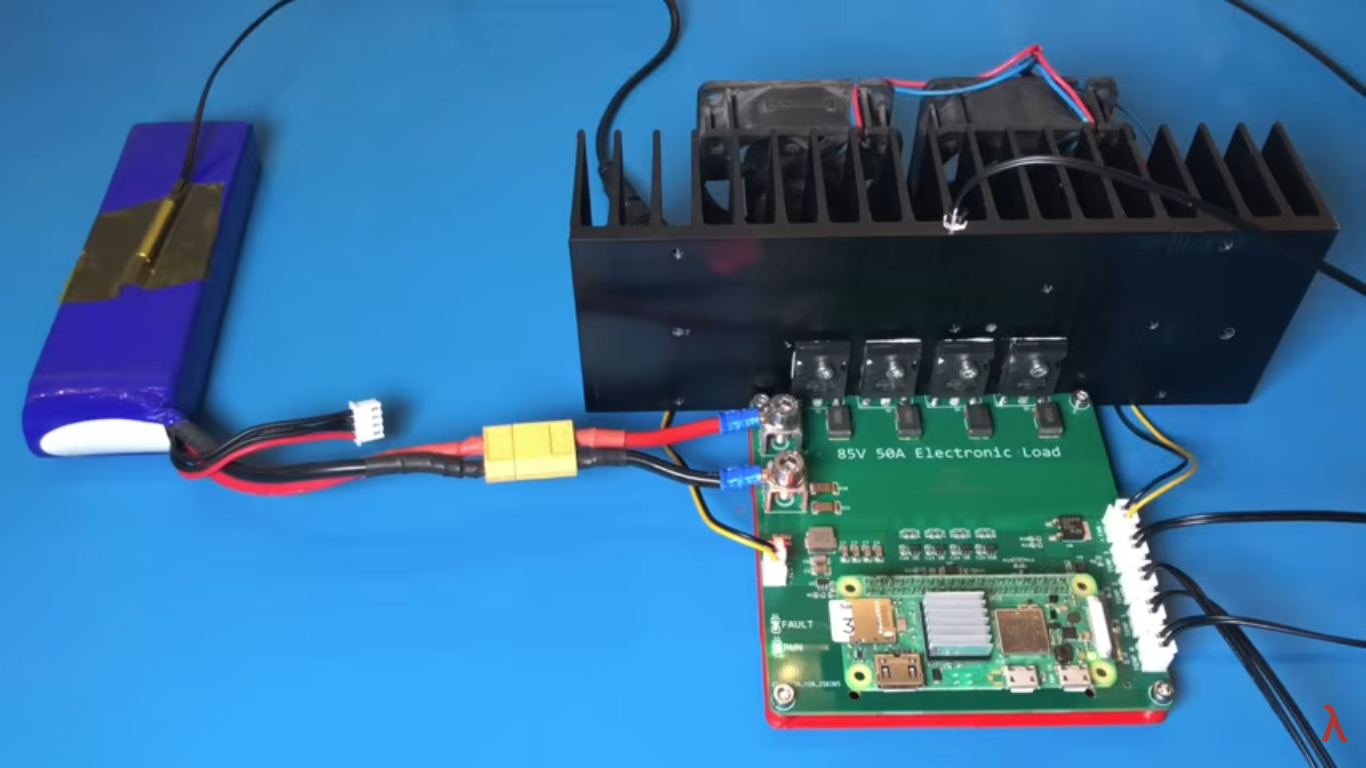
The drone is powered by Tattu’s semi-solid state NMC LiPo packs, which provide approximately 320 watt-hours per kilogram of battery, which is roughly double the energy density of normal lithium-polymer cells and a significant advantage for anyone trying to build a long-lasting drone. To make things even more efficient, Bell removed 180 grams of packaging from each battery and replaced hefty connectors with lighter ones, saving a total of 360 grams, which is approximately equal to the weight of the complete carbon fiber frame. Depending on the air flow, it hovers around 400 watts, but drops to 250 watts during gradual forward motion as the air flow increases lift.

Bell paid special attention to the length of the drone’s arms, which is not something you think about all the time but is quite important. He used computational fluid dynamics simulations in AirShaper to test various arm length combinations before deciding on an 800mm length that appeared to produce the best results. Going too short can result in wake interference between propellers, while going too long adds unnecessary weight. The wires received the same level of attention; he chose 18 AWG gauge wire and utilized it for all 11m or so of wire per engine, weighing the resistance losses against the energy cost of utilizing additional copper.

To keep things simple and reliable, he limited the electronics to a minimum: a Holybro Nano Drive 4-in-1 ESC handles power distribution, a TBS Lucid H7 flight controller runs INAV firmware, a Matek GPS device gives position data, and a DJI O4 Air device feeds video feed back to base. Early versions of lighter components failed, so he replaced them with tested parts to avoid similar problems. The frame is comprised of carbon fiber tubes, with 3D printed arms, mounts, and legs.

Bell conducted numerous studies to build the drone, including bench tests that examined the thrust to power ratio under various loads, and he was pleased to discover that efficiency decreases as thrust increases, which is a good thing because he was then able to keep the weight down while keeping the thrust up. The first few flights were problematic, with a few oscillations and broken parts, but he learned from each failure to improve the next iteration.

In the end, the drone flew for more than 3 hours and 30 minutes without incident, even when pounded by winds; at 2 hours and 14 minutes, it had already surpassed SiFly’s hover time with plenty of juice remaining. Forward flight testing revealed a clear efficiency boost, and the drone landed successfully with the battery at 2.95 volts to avoid damage, an unofficial record that puts it far ahead of the current benchmark.
Tech
Border Patrol Thug Greg Bovino Bitched About Being Asked To Be A Bit More Lawful Before Being Turfed To California
from the back-on-the-practice-squad dept
Border Patrol commander Greg Bovino has been sent back to the border after making himself the Nazi scum face of the Trump administration’s brutal efforts to purge this country of as many non-white people as possible.
Bovino made it clear what team he really wanted to play for before Trump was even sworn in for the second time. After Trump’s election win (but before Trump actually took office), Bovino self-authorized an expansive anti-migrant operation without bothering to check in with DHS leadership to make sure he was cleared to do this.
Trump is always capable of recognizing opportunistic thugs whose dark hearts are as corroded as his own. Bovino was swiftly elevated to an unappointed position as the nominal head of Trump’s many inland invasions of cities run by the opposing political party. Bovino embraced the role of shitheel thug, leading directly to court orders that attempted to restrain his brutal actions. Bovino appeared willing to ignore most court orders he was hit with, increasing his brutality and his public contempt of not only court orders, but the judges themselves, who he insulted during public statements to journalists.
After two murders in three weeks, the Trump administration started to realize it has lost the “hearts and minds” battle with most US citizens and residents. While ICE operations continue to be indistinguishable from kidnapping and the DHS is still ambushing migrants attempting to follow the terms of their supervised release agreements, Bovino has become the now-unacceptable personification of the administration’s bigoted war on migrants.
Bovino has been sent back down to the minors, so to speak. He’s been removed from high-profile surges in Chicago and Minneapolis and remanded to his former patrol area, which is much, much closer to the US border where there’s nearly no immigration activity happening thanks to the ongoing war on migrants.
Insubordination is fine as long as it doesn’t create friction Trump may have to eventually deal with. Bovino, however, is just as incapable of picking his battles as the president himself. Too many cocks spoil the broth, as the saying (almost) goes.
Thanks to a leaked email shared with NBC, we now know more about Bovino’s resistance to anyone anywhere who attempted to tell him what to do.
Bovino wanted to conduct large-scale immigration sweeps during an operation in Chicago in September, but the acting director of Immigration and Customs Enforcement, Todd Lyons, told him the focus was to conduct “targeted operations,” arresting only of people known to federal agents ahead of time for their violations of immigration law or other laws, according to the correspondence.
“Mr. Lyons seemed intent that CBP conduct targeted operations for at least two weeks before transitioning to full scale immigration enforcement,” Bovino wrote in an email to Department of Homeland Security leaders in Washington, referring to Customs and Border Protection, which oversees Border Patrol agents. “I declined his suggestion. We ended the conversation shortly thereafter.”
Keep in mind that Bovino is a Border Patrol commander who was working nowhere near the border. Also, keep in mind that ICE is the lead agency in any immigration enforcement efforts because… well, it’s in the name: Immigration and Customs Enforcement. This is Bovino not only giving the finger to the chain of command, but also insisting his agency (along with the CBP) take the lead in Midwestern apprehensions, despite neither agency having much in the terms of training for inland operations.
Speaking of chain of command, the commander of an agency that’s a component of the DHS made it clear he believed he didn’t have to answer to the DHS either, as Leigh Kimmons reports in their article for the Daily Beast:
The email also revealed a rather bizarre chain of command, with Bovino saying he reported to Noem’s aide, Corey Lewandowski, and appearing to defy Lyons’ authority. “Mr. Lyons said he was in charge, and I corrected him saying I report to Corey Lewandowski,” Bovino reportedly said of the unpaid special government employee.
This email makes one thing perfectly clear: Bovino appeared to believe he answered to no one. And he would only “report” to people he felt wouldn’t push back against his confrontational, rights-violating efforts. This probably would have never been a problem, but Bovino consistently crossed lines that even Trump’s high-level sycophantic bigots were hesitant to cross.
And now he’s the one who is experiencing the “find out” part that usually follows the “fucking around.” He’s been sidelined, perhaps permanently. Acting ICE director Todd Lyons is the new face of Trump’s inland invasions. Kristi Noem herself seems to be on the list of potential cuts, should the administration continue its on-again, off-again pivot to a less outwardly racist agenda when it comes to immigration enforcement.
But I’m not here to damn with faint praise or even damn with faint damnation. I hope Bovino’s last years as a Border Patrol commander are as terrible as his haircut. I hope Todd Lyons veers so far to the middle that Trump shitcans him. I hope Noem is on the path to private sector employment, tainted with the scarlet “T” that means any future version of MAGA won’t even bother to check in with her now that the only people she can make miserable are her own children. Adios, Bovino. Sleep badly.
Filed Under: cbp, chicago, dhs, gregory bovino, ice, kristi noem, leaks, mass deportation, minneapolis, minnesota, todd lyons, trump administration
Tech
Microsoft releases Windows 11 26H1 for select and upcoming CPUs
Microsoft has announced Windows 11 26H1, but it’s not for existing PCs. Instead, it will ship on devices with Snapdragon X2 processors and possibly other rumored ARM chips.
Microsoft insists Windows 11 is still following an annual update cadence, which means Windows 11 26H2 is likely on track.
According to Microsoft, Windows 11 26H1 is based on a new platform release to support the upcoming ARM chips.
In a press release, Microsoft says it worked with OEMs and IHVs to support new device innovations and development via a new Windows Update.
“That means that this release is not being made available through broad channels but is only intended for those who purchase these new devices. At this time, devices with Qualcomm Snapdragon® X2 Series processors will come with Windows 11, version 26H1,” Microsoft noted.
“Organizations should continue to purchase, deploy, and manage devices running broadly released versions of Windows 11 (e.g. versions 24H2 and 25H2) with confidence.”
Microsoft also has an FAQ that clarifies version 26H1 is not a feature update for version 25H2, and that “there is no need to pause device purchases or OS deployments, and no changes are required to existing enterprise rollout plans.”
Devices running Windows 11 26H1 won’t get specific new features, as changes will be shared across platform releases, but version 26H1 should offer better performance or battery life on new ARM PCs.
All other PCs should get Windows 11 26H2 later this year, but Microsoft hasn’t confirmed the fall release yet.
Tech
Databricks hits $5.4B revenue run rate and banks a $134B valuation in a rare software surge

Databricks is having one of those years that most enterprise software companies would quietly envy. The data and AI platform says it has reached a $5.4bn annual revenue run rate, growing 65% year over year, at a time when growth across the sector has cooled noticeably. For a private company, that pace is rare. And it helps explain why investors have continued to pour money into Databricks, even as funding has become more selective. The company says it has now raised more than $7bn in total capital, including recent equity funding that values the business at $134bn, alongside a large…
This story continues at The Next Web
-
Politics3 days agoWhy Israel is blocking foreign journalists from entering
-
NewsBeat2 days agoMia Brookes misses out on Winter Olympics medal in snowboard big air
-
Sports4 days agoJD Vance booed as Team USA enters Winter Olympics opening ceremony
-
Business3 days agoLLP registrations cross 10,000 mark for first time in Jan
-
Tech5 days agoFirst multi-coronavirus vaccine enters human testing, built on UW Medicine technology
-
Tech7 hours agoSpaceX’s mighty Starship rocket enters final testing for 12th flight
-
NewsBeat2 days agoWinter Olympics 2026: Team GB’s Mia Brookes through to snowboard big air final, and curling pair beat Italy
-
Sports2 days agoBenjamin Karl strips clothes celebrating snowboard gold medal at Olympics
-
Politics3 days agoThe Health Dangers Of Browning Your Food
-
Sports4 days ago
Former Viking Enters Hall of Fame
-
Sports5 days ago
New and Huge Defender Enter Vikings’ Mock Draft Orbit
-
Business3 days agoJulius Baer CEO calls for Swiss public register of rogue bankers to protect reputation
-
NewsBeat5 days agoSavannah Guthrie’s mother’s blood was found on porch of home, police confirm as search enters sixth day: Live
-
Business6 days agoQuiz enters administration for third time
-
Crypto World18 hours agoBlockchain.com wins UK registration nearly four years after abandoning FCA process
-
Crypto World1 day agoU.S. BTC ETFs register back-to-back inflows for first time in a month
-
NewsBeat2 days agoResidents say city high street with ‘boarded up’ shops ‘could be better’
-
Sports2 days ago
Kirk Cousins Officially Enters the Vikings’ Offseason Puzzle
-
Crypto World1 day agoEthereum Enters Capitulation Zone as MVRV Turns Negative: Bottom Near?
-
NewsBeat6 days agoStill time to enter Bolton News’ Best Hairdresser 2026 competition