
Tech
Trump FCC Hilariously Bungles Chinese ‘Drone Ban’


from the real-keystone-cops-shit dept
Earlier this week we noted how the Trump administration’s unpopular ban on Chinese drones had become a crony capitalist mess, with Brendan Carr and his FCC struggling to fine or ban companies for violations. The ban is a stupid, protectionist mess that has far more to do with coddling the president’s sons’ drone investments than it does protecting national security or consumer privacy.
Right on queue, The Verge has an interesting feature on just how easy it has been for some companies to bypass the FCC restrictions. The Trump ban was supposed to encourage drone makers to create devices here in the U.S.; but instead companies are simply setting up the laziest fake companies in the U.S, and the Trump FCC appears too short-handed or incompetent to notice.
So the over-arching impact of the ban has been to create a flood of new companies selling popular DJI-made Chinese drones under a litany of new names. They don’t try very hard to disguise them:
“When software developer and journalist Konrad Iturbe began watching FCC databases for those frequencies, he realized that DJI was preparing to play a grand game of Whac-A-Mole in the United States. Well ahead of the December 2025 drone ban, a host of new companies had suddenly appeared selling barely disguised versions of DJI technology. He dubbed them “DJI front companies.”
To pretend these drones are made in the U.S., the companies use fake U.S. front locations to pretend that the drones are assembled here. Again, they’re not trying very hard to disguise them, and most could have been unearthed with basic Google searches:
“But it’s easier than that. Odyssey Robot declared that its drone was designed, developed, and manufactured at 21 Miller Alley Suite 210 in Pasadena, California. Even a basic Google search can show you that’s not the address of a factory — it’s a coworking space called Industrious that explicitly prohibits members from manufacturing anything onsite.
Odyssey Robot also declared that its drones are assembled at eTak Worldwide Corporation in Grand Prairie, Texas. With 80,000 square feet of warehouse space and 15 loading docks, you could theoretically build drones there. But again, a basic Google search would show you that eTak isn’t an assembler; it’s a recycling company that collects e-waste, including old batteries, then sorts and dismantles them.”
Like most of what Trump does, none of this appears thought out very well, and the administration isn’t competent enough to even do basic investigations to enforce its own restrictions. And like elsewhere in the administration, Trumpism rejoices at the idea of dismantling regulators; then throws these weird sorts of complicated demands in their lap expecting productive outcomes.
Again, in a functional world, you’d allow Chinese companies to do business in the United States, but you’d fund, staff, and legally empower your regulators to strictly enforce competition, labor, environmental, and consumer protections. Because that would result in U.S. companies making less money and having to try harder, we instead get this weird jumbled tangle of corruption and buffoonery.
The primary justification for the Trump Chinese drone ban is that these devices pose meaningful privacy and national security risks. But there’s been absolutely no evidence presented by the administration supporting this allegation. There is, however, ample proof that administration greed, corruption, and incompetence has been indistinguishable from a foreign attack.
Filed Under: ban, chinese, drones, fcc, hardware, made in the U.S., trump
Companies: dji

Tech
The lineage behind 69% of open models was never verified. Cisco just fingerprinted almost 900 for free
A security team approving an open-source model for production today starts with a repository page. The page lists the model name, the license, and a tag identifying the base model it descended from. That tag is a string the uploader typed. Hugging Face does not require uploaders to substantiate the claim through weight-level analysis.
The ATOM Report, published by Nathan Lambert and Florian Brand at Interconnects AI in April 2026, tracked roughly 1,500 mainline open models. ATOM identifies derivatives through the Hugging Face base_model tag, a field the uploader populates, filtering to models whose base model appears in the tracked list and that have more than five lifetime downloads and excluding GGUF and MLX re-uploads. By that measure, Alibaba’s Qwen family is the declared parent of 69% of new open-model derivatives as of February 2026, up from 1% in January 2024. Chinese labs overall account for 70%. Europe sits at 4%. Cumulative tracked downloads across the three regions reached 2.04 billion through March 2026.
The verification gap extends to scan coverage. Cisco Foundation AI scans every public file uploaded to Hugging Face through an updated ClamAV engine, and the platform surfaces a file-level badge per file. Hugging Face’s own malware scanning documentation notes a file with neither an ok nor an infected badge may be queued, still scanning, or errored. At a given review point, a repository may contain files without completed scan results. Coverage has been an assumption, not an attribute anyone could read before approving a model.
From command line to public lookup
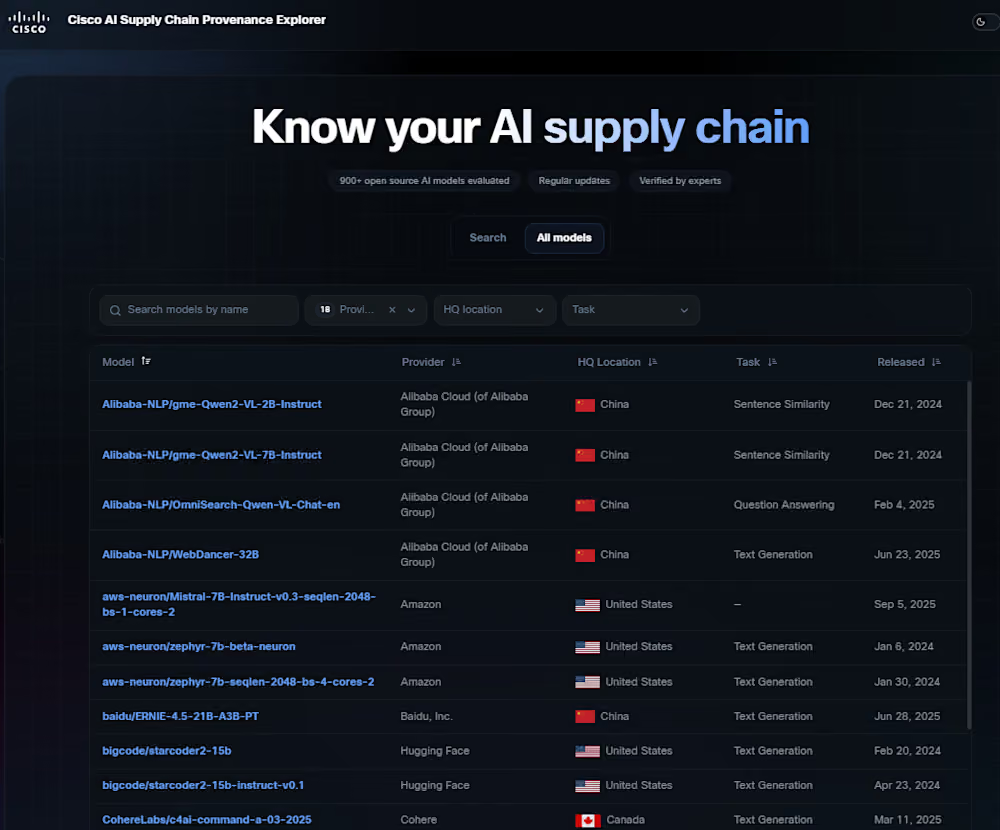
Cisco on Thursday published the AI Supply Chain Provenance Explorer, a free public database covering almost 900 open models. Each entry can carry provider headquarters, a fingerprinted lineage graph, license restrictions, and a files-scanned count. The tool extends Cisco’s Model Provenance Kit, an open-source Python toolkit released in April that fingerprinted roughly 150 base models across 45+ families and 20+ publishers. Coverage grew roughly sixfold in a quarter.
The April release was a command-line tool. Running it meant a local Python environment, downloading model weights that run into tens of gigabytes, and dedicating engineer hours per model. The Explorer queries results Cisco already computed. On Thursday, verifying parentage starts with a search bar, and cost is why enterprises run open weights in the first place.
Amy Chang, head of AI Threat Intelligence and Security Research at Cisco, has been building the case for why verification gaps matter. During a VB Transform 2026 agentic security panel, Chang presented findings from 6,986 multi-turn attacks against 15 flagship models, with success rates reaching 88.3%. “If you don’t understand how models are susceptible to different types of attacks, then you are unable to account for how that model that is powering your agent, that is powering your application, to understand where those failure points are,” Chang told the audience. Understanding failure points starts with knowing which model you are running.
The Explorer also surfaces data Cisco already uses operationally. The company’s Cerberus system inspects models entering Hugging Face and feeds Secure Access policies that block by risky license or region of origin. The Explorer makes that class of information free and searchable without a Cisco product.

How fingerprinting replaces the tag
The Explorer grounds model relationships in similarity scores rather than self-reported metadata. Cisco’s Model Provenance Kit works in two scored stages. Stage one compares architecture metadata before loading any weights. When metadata is ambiguous, stage two extracts five weight-level signals. Embedding Anchor Similarity captures geometric relationships that survive fine-tuning. Embedding Norm Distribution encodes word frequency patterns. Norm Layer Fingerprint reads layers stable across fine-tuning. Layer Energy Profile compares distributions across network depth. Weight-Value Cosine directly compares weight values, and independently trained models show essentially zero correlation on this signal. Cisco reported 96.4% accuracy on its own 111-pair benchmark at a 0.70 threshold, with an F1 of 0.963. Four pairs were misclassified, all involving extreme architectural transformation that Cisco calls a fundamental limit of pairwise weight comparison.
Tokenizer signals are computed for diagnostics but deliberately excluded from the provenance score. StableLM and Pythia both use the GPT-NeoX tokenizer and would score as related despite sharing no weight lineage. Excluding tokenizer data prevents false positives.
Behavioral fingerprinting adds a second approach. Jonah Leshin, Manish Shah, and Ian Timmis at Project VAIL, working with Daniel Kang at UIUC, published work on behavioral endpoint stability showing that a model endpoint can stay healthy while its effective identity changes through weight updates, quantization, or routing. Cisco’s launch blog states the Explorer integrates both static fingerprinting and behavioral-similarity analysis to ground the lineage graph. Static analysis supplies weight-level evidence of training-time derivation. Behavioral analysis catches runtime identity drift.

Where existing tools fall short
The Explorer carries real limits. Almost 900 models is a meaningful start, but Hugging Face hosts more than 2 million as of spring 2026. Models outside the boundary still depend on the self-reported tag. Cisco has not said whether the Explorer exposes an API, and without one, a team can look models up by hand but cannot wire the check into a CI gate. That is the line between a governance artifact and a control.
Traditional SCA tools face a structural mismatch because they were built for dependency manifests and container images. Sakshi Grover, senior research manager for cybersecurity at IDC, said in CSO Online that traditional SCA “was designed to inspect dependency manifests, libraries, and container images” and “is far less effective at identifying” the risks tied to AI workflows. Gartner director analyst Jaishiv Prakash told the same outlet that enterprises need “dedicated controls for model sources, approved versions, access, and runtime validation at the registry layer.” Both were commenting on broader supply chain risks, but the gap they describe is the one the Explorer targets.
Cisco’s Model Provenance Constitution defines where one model counts as a derivative of another. The constitution defaults to labeling ambiguous pairs as independent, because a false positive triggers a licensing accusation while a false negative gets caught during manual review. That deliberate conservatism supports the 96.4% accuracy figure. Derivation is not binary, and fingerprinting is one form of evidence alongside documentation and checkpoint verification.
What goes in the approval record
On August 2, the European Commission gains its AI Act enforcement powers over GPAI model providers, with fines up to 15 million euros or 3% of global turnover, whichever is higher. Organizations that substantially modify and place an open model on the EU market can acquire provider status, with Commission guidance treating modification compute exceeding one-third of the original’s. The Act’s open-source exemption under Article 53(2) requires a genuinely free and open-source license permitting access, use, modification, and redistribution, with weights, architecture, and usage information all public. Public weights alone do not qualify. Llama’s community license carries a monthly-active-user threshold and a disqualifier the Commission guidance names explicitly. Llama and Gemma together account for roughly a fifth of new derivatives in the ATOM counts, and both carry licenses the Commission criteria would likely disqualify. License classification becomes part of the provenance review, and that is exactly what the Explorer surfaces.
The board question that arrives first after a base-model vulnerability disclosure is straightforward: “Which of our production models inherits this weakness, and how do we know?” The answer today requires a manual hunt through repository pages, tracing self-reported tags that no weight-level analysis has confirmed. The Explorer converts that hunt into a lookup for the models it covers.
Four fields belong in the approval record that most organizations do not carry today. Fingerprint-supported derivation grounded in weight analysis rather than a self-reported tag. A files-scanned count replacing the assumption of coverage with a measurable scan count. Provider headquarters as a filterable field, recognizing that headquarters alone does not resolve export-control exposure, since ownership and deployment location also govern the screening. And license lineage surfaced so legal teams can identify potential upstream terms before a model reaches production.
Cisco released the Supply Chain Provenance Explorer today, and it is available at provenance.aidefense.cisco.com. The database is free, public, and does not require a Cisco product or account.
What changes for a security team on July 30
|
What the team has today |
What the Explorer publishes |
Recommended action |
|
Blast radius after a base-model vulnerability. The model name and the base_model tag. Scoping which models inherit a disclosed weakness is a manual hunt through repository pages. |
Lineage grounded in similarity scores using two scored stages of fingerprinting on architecture metadata and five weight-level signals. The kit scored 96.4% accuracy at the 0.70 threshold. |
Attach fingerprint-supported derivation to each model in the asset inventory so a disclosure triggers a scoped review instead of a hunt. |
|
Malware scan coverage. A file-level badge per file. At a given review point, a repository may contain files without completed scan results. Coverage has been an assumption. |
Files-scanned counts and reported malware or unsafe-file findings per model, from ClamAV-based scanning. Scan coverage becomes readable before approval rather than inferred from a badge. |
Replace the assumption that a model was scanned with the recorded count. Where coverage is partial, document whether the gap is acceptable and why. |
|
Provider jurisdiction. An organization name on a repository page. A derivative several steps from its origin displays the uploader, not the ancestor. |
Provider headquarters, website, and associated HF organizations as a filterable field. Headquarters alone does not resolve export-control exposure. |
Add jurisdiction to the approval record. Any team that substantially modifies and places an open model on the EU market faces potential provider obligations under the EU AI Act. |
|
License obligations. A license tag describing what the uploader believes applies. Terms from a base model upstream may not appear on the page the engineer reads. |
Common limitations per model, including attribution, non-commercial terms, geographic restrictions, and prohibited use cases. Fingerprinted lineage helps legal teams identify potential upstream terms. |
Route license lineage to legal before production, not after a contract references it. Document the position at approval rather than reconstructing it during a dispute. |


SECURITY
A week into shutdown, 14,000 customers still have no restoration date and some are struggling to pay staff
A week after suspending online banking, CAF Bank still has no timetable for restoring access to its 14,000 UK charity customers.
The bank updated customers on Thursday about the outage, which has disrupted payments to staff and suppliers.
Little had changed. In a message seen by The Register, CAF Bank said it was not yet able to restore the service safely.
As it had earlier in the week, the bank said it detected attempted fraud on some accounts and acted quickly to stop it. Its investigation uncovered a previously unknown vulnerability in the connection between its systems and third-party software. CAF Bank said its technical team was working around the clock with suppliers and external experts on a fix.
The Register understands that no timetable has been set for restoring online banking.
Earlier this week, CAF Bank CEO Alison Taylor apologized for the disruption. “The core bank is not affected. We are acutely aware of the impact this has on our customers and want this to be fixed as soon as possible, but we cannot restore access to the online service until we are assured the issue is safely resolved,” she said.
Since The Register first reported the story earlier this week, the BBC has spoken to charities struggling to make essential payments, including payroll.
Kevan Hodges, chief executive of Down’s syndrome charity 21 Together, told the BBC the outage was “appalling.”
“People are concerned that wages won’t get paid because of this, and that’s just stressful when they have bills to pay. My team have wasted days trying to get through to [CAF Bank], but all in vain,” he said.
Bali Rodgers, chief executive of Safer Communities Alliance, told the BBC the grassroots organizations it represents were slowly losing trust in the bank.
CAF Bank also came under fire last year after the introduction of a new banking platform left customers unable to log in or make transactions. The bank later apologized but has not disclosed how much it spent on the system.
CAF Bank held £1.45 billion ($1.93 billion) in customer deposits at the end of its 2024/25 financial year. ®
Verdict
The Lotus Perfectionist Oven is a high-end countertop appliance with seven cooking functions and a useful probe to ensure perfect results. The countertop oven is heavy and well-made, with a stainless-steel body, and looks and performs more like a commercial oven than an appliance built for consumer use. The countertop oven has high-quality components that look and feel like they’ll last a lifetime. It’s also incredibly easy to operate the user-friendly appliance. The controls are straightforward and the LCD screen displays information clearly. You’d expect professional results at this price, and the Lotus Perfectionist delivers.
-
Seven cooking functions
-
Well made
-
Easy to use
-
Cooks brilliantly
-
Probe can only be used with air fry and bake functions
Key Features
Introduction
Lotus makes a variety of high-end appliances, including coffee makers, toasters, and blenders. All of the appliances have the same heavy, industrial build, and anyone seeing the countertop oven or the rest of the Lotus suite in your kitchen would consider you a professional chef.
Lotus products were previously available only at Williams-Sonoma, but as of April 2026, they’re also available on Amazon – making them even more accessible for consumers. Should you spend this much on an air fryer? Absolutely, here’s why.
Design and features
- Heavy and well-made
- User friendly
- Range of functions
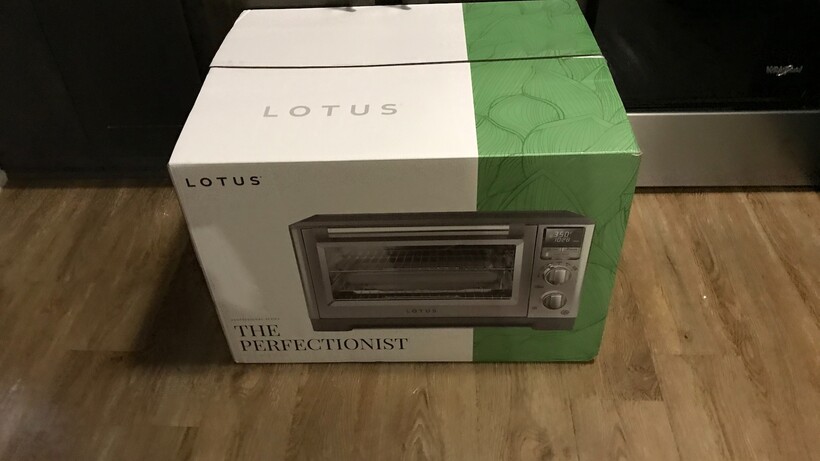
The Lotus Perfectionist Oven arrived in a brown cardboard box, and inside of that, a green and white branded box. Everything was packed securely to guard against damage. This is one of the heaviest countertop ovens I’ve ever tested (46 pounds), and that’s a testament to the quality build. It’s made of stainless steel and aluminum. No flimsy components here. The knobs are also crafted of quality stainless steel with a nickel finish, and designed to endure years of turning them left or right. The oven has a generous interior and can fit a 9” x 13” dish or a whole turkey.

The Lotus Perfectionist came with plenty of accessories, including an air fry basket and tray, baking pan, removable side rack guides, two oven racks, a crumb/drop plate and a temperature probe.

The controls are all on the right side. At the top is the display panel, which shows a variety of prompts and messages. There’s an up arrow to indicate the temperature is rising, and Convention and Air Fry icons are also displayed in this area. Other messages include a notification when the desired time or temperature has been reached. When using the Toast setting, the shade and number of slices can be viewed here as well.

Beneath the display panel are the buttons for Convection cooking, Probe cooking, and Start/Stop.
At the bottom are the two control knobs: The top knob includes the cooking selections: Proof, Warm, Air Fry, Bake, Broil, and Toast/Bagel. This is also where the cooking temperature is selected, as well as the darkness level when using the Toast and Bagel functions.
The bottom knob is where the time is selected, and in Toast/Bagel mode, it’s also where the number of slices would be selected. And directly below that, to the right, is the button to turn the interior light on and off.
The Lotus Perfectionist is easy to care for. All of the removable parts are safe to put in the dishwasher. The control panel display, oven racks, and side rack guides can be wiped with a slightly damp sponge. The interior of the oven and the control knobs can be wiped with a damp, soapy cloth. The probe should be cleaned with soapy water, and the glass oven window should be clean with glass cleaner sprayed on a cloth.
Performance
- Must remember to load food after preheat ends
- Cooks to perfection
- Probe ensures accurate temperature
I was impressed with the oven’s performance and it wasn’t hard to understand why this is called “The Perfectionist”. The countertop appliance does an excellent job of cooking food well on various settings.
Preheat is automatic – after selecting the temperature and time, and pressing Start, it begins the preheat process, and then beeps when the preheat cycle is over. However, I had to remember to put the tray in the oven when the preheat cycle was over – and I forgot this on at least two occasions. Fortunately, it was only for a minute or two, so the cooking time was not drastically affected – and the food turned out well, regardless.
The heating elements cycle on and off when using the oven, which helps to maintain the selected temperature.
My first test was actually rather funny. I put the frozen Pillsbury cookies on top of the rack. In the photo of the finished test, you can see that they fell through the rack and are now underneath on the pan. However, after the cookies cooled, the rack came right off, and the cookies were delicious.

The second time, I baked some Nestle Tollhouse cookies without the rack. I sprayed the tray with Pam Nonstick Cooking Spray. Both times, the cookies were delicious – crunchy on the outside, and soft, warm, and gooey on the inside.

In my next test, I made salmon. I used the air fryer basket and tray, and sprayed the basket with Pam spray.
Then, I air fried the salmon at 375°F for 12 minutes – and added some rice and small tomatoes to the final meal. The salmon was light and flaky, tender and juicy on the inside. Fortunately, I cooked two pieces of salmon, so I was able to refrigerate the second piece so I didn’t have to cook the next day.

When I resumed testing, two days later, I broiled some pork chops. I seasoned the pork chops, sprayed the rack with Pam spray, and then put the pork chops in the Lotus Perfectionist. I chose Broil/Hi for about 10 minutes, then flipped the pork chops, and broiled them about 5 minutes longer.
When the meat was done, I added rice, small tomatoes, and carrots. The pork chops were browned and crunchy around the edges, and tender and juicy on the inside.

My next test was French Fries. I used the air fry basket, spraying Pam spray in the basket before loading it up with fries. I air fried at 350 degrees for around 18 minutes.
The fries were a golden brown, and they were crunchy on the outside and hot, soft, and tasty as I bit into them.

I used Probe mode to cook chicken thighs. Note: the probe is designed to be used in either Air Fry or Bake mode, so I baked the chicken thighs. I sprayed the baking pan, inserted the meat, and then inserted the probe about 1 inch into one of the thighs. (In hindsight, I should have taken the top rack out since it wasn’t in use, but I’m in the habit of leaving both racks in most of the time.) Since I had no idea what the ideal internal temperature should be, I had to research this information online. I decided on an internal temp of 170°F – and the display screen shows the temperature every step of the way.
When the food reached the set temperature, the oven produced a long chime and a series of short chimes. I unplugged the probe and removed the tray from the oven. The chicken thighs were delicious – they were tender, juicy, and flavorful.

In other tests, I also used the Convection feature, which cooks food faster. Keep in mind that when using the Convection setting, the temperature should be reduced by 25°F, or the cooking time should be reduced by 25%. Lotus does not recommend the Convection feature for frozen pizza.
I also used the Warm feature when food was done before I was ready to eat it. The Warm feature has a temperature range of 140°F and 170°F.
As a general rule, Lotus recommends a light spray of cooking oil to provide a crispier texture, and advises that most foods need to be flipped, stirred, or rotated.
Should you buy it?
You want a countertop oven that’s going to stand the test of time
The heavy, high-quality Lotus Perfectionist has a commercial build, with sturdy-long-lasting components. You won’t have to worry about replacing parts or trashing it because it stopped working.
You don’t cook that often, or you still plan on using your traditional oven
The Lotus Perfectionist is superb, but at the time of publication, it’s $900. That’s a lot of money to pay for an appliance that you won’t use on a regular basis.
Final Thoughts
The Lotus Perfectionist was a joy to test. The food always came out well, even when I didn’t necessarily follow the rules as precisely as I should have. The controls are easy to use and understand, and the display panel is generous enough to be easily viewed. I never had to worry about being careful to ensure I didn’t break anything since the oven is well made and quite durable. My outcomes were comparable to what I would expect when eating out, and cleanup was a breeze. I definitely recommend the Lotus Perfectionist Air Fry and Convection Oven if you’re looking for a high-quality appliance that performs well and will last for years, otherwise for something cheaper the guide to the best air fryers can help.
How We Test
We test every air fryer we review thoroughly over an extended period of time. We use industry standard tests to compare features properly. We’ll always tell you what we find. We never, ever, accept money to review a product.
Find out more about how we test in our ethics policy.
- Used as our main air fryer for the review period
- We cook real food in each air fryer, making chips, frying sausages and cooking frozen hash browns. This lets us compare quality between each air fryer that we test.
FAQs
You can use this to cook food to a set internal temperature, getting perfect results each time.
Full Specs
| Lotus The Perfectionist Air Fry and Convection Oven Review | |
|---|---|
| Manufacturer | – |
| Size (Dimensions) | 22.375 x 16.75 x 12.625 INCHES |
| Weight | 46.6 LB |
| Release Date | 2026 |
| First Reviewed Date | 20/07/2026 |
| Model Number | Lotus The Perfectionist Air Fry and Convection Oven |
| Accessories | Two side rack guides, two oven racks, air fry basket, air fry tray, baking pan, broil rack, crumb/drip tray, temperature probe, user guide |
| Number of compartments | 1 |
| Cooking modes | Bake, broil, air fry, proof, toast/bagel and warm |
| UK RRP | TBC |
| USA RRP | $899.95 |
Tech
A third of physical PS5 games and half of Xbox Series discs need downloads to work properly, report shows

A hot potato: Since PC gaming went pretty much fully digital many years ago, some console gamers have bragged about their machines’ ability to play physical discs and the advantages that brings. But a new report illustrates how just because a game is on a disc, it doesn’t guarantee you won’t need an internet connection to play it.
From Sony’s decision to end production of discs for new PlayStation games in 2028 to the Xbox network outage that stopped some disc-based titles from working, there’s been a lot of conversation about physical media recently.
One topic revolves around the many discs that don’t work (to different degrees) without an online connection, usually to fix a game-breaking bug. The testers at Does It Play (via Ars Technica) found that most disc games are “plug and play,” but a sizable minority can’t be played as intended straight from the disc.
The results show that 27% of all the physical releases the site has tested require some sort of download to fix game-breaking bugs or obtain core game content not stored on the disc.
On the PS5 specifically, 34% of tested disc releases are not fully playable as intended without a patch. Half are beatable but have serious bugs or are missing content, while the other half require a download to play properly or at all.

It’s a much worse picture on the Xbox Series X. Only 50% of tested physical releases were complete and playable as intended from the disc. Another 12% could be beaten but were too buggy or missing content, leaving 38% that required some form of download.
Those Xbox results come from just 78 entries, compared with 792 for the PS5, so the difference should be treated cautiously. The Nintendo Switch 2 performed better, with 75% of its tested releases complete and beatable without a download, although its sample was even smaller at 48 entries.
Reliance on downloads weakens what was once physical media’s biggest selling point: long-term access. Once servers close, missing files and essential patches may become impossible to obtain, creating a major problem for preservation. Then there are players who buy a game requiring a download but have no internet connection to obtain it.
Physical copies still offer advantages, of course. They can be resold, lent to friends, and are often much cheaper than digital versions. It was recently reported that some physical PlayStation games cost up to 90% less than their digital counterparts.
But as the recent Xbox outage demonstrated, owning a disc doesn’t always protect players from server failures. Microsoft said disc-based entitlement checks should not have blocked games and is preparing a fix, though it still hasn’t fully explained why some valid discs failed.

Google announced Googlebook at I/O in May, but we are still waiting to see what the finished hardware will actually look like. The first devices are expected this fall, and new images published by Android Headlines may have given us an early look at what Lenovo has planned.
Lenovo appears to be preparing at least three Googlebooks, including two traditional laptops and a detachable 2-in-1 tablet. There is also a new wireless AI mouse that seems to have been designed specifically for the platform.
Google has already confirmed that Acer, Asus, Dell, HP, and Lenovo are working on Googlebooks. Still, Lenovo launching three different models would make its opening lineup considerably more ambitious than I expected.
The tablet is the most interesting one


The two laptops appear to come in different sizes, suggesting Lenovo may be targeting separate users and price points. The images do not reveal much about their specifications, processors, or displays, so it is difficult to say how different they will be.
The detachable tablet is much easier to get excited about. Android Headlines reports that the device has four speakers, Dolby Atmos support, and stylus compatibility. It could prove more interesting than another conventional laptop by leaning into Googlebook’s support for Android apps and touch input.
Lenovo also has a mouse for Magic Pointer

Lenovo’s new 59-gram wireless mouse reportedly includes an RGB strip and a dedicated AI key. Googlebook is built around Gemini Intelligence rather than treating AI as a separate app or sidebar, and the mouse may connect directly to Magic Pointer, the Gemini-powered cursor feature that can surface contextual actions based on whatever you point at on screen. Lenovo has not yet explained what the AI key does, but it could provide a quicker way to call up those suggestions.
I still have questions about how consistently Googlebook will perform across different chips, screen sizes, and form factors. Google has positioned the platform as premium, and rising memory costs could push prices even higher. The company has not announced a launch date for the first devices, although IFA in September seems like a plausible venue for Lenovo to unveil its lineup.


Given a rising number of publishing misconduct allegations, IEEE in 2022 created the Publishing Ethics Team as a centralized department to assist in handling claims. The group also works to increase the organization’s visibility in the broader publishing ethics area and helps IEEE volunteers write new policies.
Here are some highlights of the team’s activities last year.
New detection tools
IEEE conducted a pilot program in 2024 to integrate tools from the International Association of Scientific, Technical, and Medical Publishers (STM) Integrity Hub into the peer-review workflow of IEEE Access. The multidisciplinary, fully gold-open-access journal publishes research results across all IEEE fields of interest.
STM created the hub so scholarly publishers could access a suite of integrated, commercial, third-party research integrity tools as well as those developed by STM Solutions. The tools help the publishing group avoid printing problematic content upon manuscript receipt, rather than reacting postpublication.
The new features include the Clear Skies Papermill Alarm, which helps identify potentially fraudulent manuscripts at submission. Another is an integration with the PubPeer database, which allows users to check whether references in a manuscript have received previous PubPeer comments or have been retracted—both of which can indicate quality or integrity issues. The duplicate submissions detector can determine whether the same manuscript has been submitted to multiple journals by different publishers, often a sign of academic “paper mill” activity.
Following the success of the pilot, IEEE began working last year to expand the services to all its periodicals. It is anticipated that all IEEE periodicals will be included in the Integrity Hub screening by the end of this year.
Raising visibility
The team participated in industry-wide initiatives with STM. It also renewed membership in groups including the Committee on Publication Ethics, and the team continued its work sponsoring and presenting at conferences.
At a panel presentation during the Council of Science Editors annual meeting last year, Amanda Sulicz, manager of IEEE Research Integrity, participated in the Research Integrity Investigation panel session. She also presented at the Standardization of Publishing Integrity Norms and Corrective Actions poster session during the Society for Scholarly Publishing’s annual meeting, held 28 to 30 May 2025.
Luigi Longobardi, the IEEE Publishing Ethics and Conduct director, gave a presentation at the Communication and Collaboration With Institutions session during STM Innovation and Integrity Days, which took place 9 and 10 December.
IEEE was a sponsor of the National Conference on Research Integrity, held 20 to 22 May 2025, and the International Congress on Peer Review and Scientific Publication, held 3 to 5 September.
Ethics reports
The team is responsible for tracking ethics-related complaints for all IEEE publications, including articles published in periodicals and conference proceedings. When complaints regarding an article’s integrity are received, either via email at pub-ethics@ieee.org or the anonymous ethics reporting line, the team works with IEEE volunteers to open a case, investigate the complaint, and resolve the matter.
Last year 591 cases were opened, a 56 percent increase over 2024. Of the 591 reports, 317 were closed and 274 are still under investigation. Of the complaints, 88 percent were research-related, including issues with plagiarism, AI-generated text, and falsification of—or unauthorized use of—data. The other 12 percent involved alleged misconduct by editors, reviewers, and conference organizers.
The complexity of the reported cases has expanded. An increasing number of the complaints deal with more than one article or complicated situations such as editorial misconduct or peer-review manipulation.
Conference publications
For the second consecutive year, the team participated in the joint IEEE Publication Services and Products Board/IEEE Conferences Committee’s ad hoc committee on conference publication quality. The committee is tasked with analyzing and reviewing problematic conference papers and enhancing quality screening of articles prior to publication to detect integrity issues such as plagiarism and tortured phrases. The committee also updates educational modules on organizing and managing conferences.
As part of the review process, the committee focused on conference articles that contained tortured phrases, which are nonstandard English expressions that are imprecise or erroneous and give the impression of technical jargon.
Many of the articles reviewed by the ad hoc committee were identified by the Problematic Paper Screener, a free online tool that uses application programming interfaces to screen papers published online for potentially problematic content, such as tortured phrases, machine-generated content (SCIgen or Mathgen, for example), or references to retracted content.
The ad hoc committee was responsible for reviewing and recommending the retraction of more than 1,700 problematic conference articles last year.
Case studies
From the cases the team reviewed, IEEE learned valuable information to help update its publishing policies and best practices.
Here are examples of two anonymized cases reported to the team last year.
From Your Site Articles
Related Articles Around the Web

from the double-dog-dare dept
I will admit it’s always a special kind of fun when a topic we cover here at Techdirt gets the John Oliver treatment. He and his writing team generally gets things right, which helps. And I’m not saying that Oliver and his crew are definitely Techdirt readers, but, well, hi John and crew!
Readers here will recall that I’ve spent the last year or so pointing out that famed gas station and/or supermarket chain, Buc-ee’s, has become the trademark bullying Monster Energy of gas stations. This is a company that doesn’t seem to understand what parody is, and which somehow believes that it alone owns the right to use a cartoon animal, or sometimes human, in a circular logo for any kind of related business to its own.
Well, Oliver dedicated a segment to Buc-ee’s bullying ways on his show this past week and he did not disappoint.
In recent years, it sued Super Fuels in Dallas, whose logo was a brown dog sporting a red cape, a drive-through liquor store in Missouri named Duckees featuring a cartoon duck wearing sunglasses, Choke Canyon Travel Center in Texas over its cartoon alligator wearing a cowboy hat, and Nut Huggers, an Oklahoma-based underwear company with a mascot of a squirrel.
Oliver accused the chain of “outright bullying,” noting that most of the stores have changed their logos because they do not have the resources to fight the Texas giant, which operates more than 50 stores.
And that’s where the real fun starts.
Now, it would be absolutely stupid for Buc-ee’s to actually sue Oliver and HBO over this. The PR would be terrible, it would only give Oliver more attention and generate more headlines about the company being a trademark bully, and it would make the company look very thin-skinned and childish. I’m also relatively certain that’s exactly what will happen.
After all, any such lawsuit wouldn’t even rank in the top 3 of stupid trademark suits that Buc-ee’s has filed. And since they’ve demonstrated that they just can’t help themselves, I imagine we’re going to get more segments about this on Oliver’s show.
Filed Under: john oliver, trademark, trademark bullies
Companies: buc-ee’s, hbo
Tech
Microsoft R&D jobs drop for second straight year as total headcount falls for first time in a decade
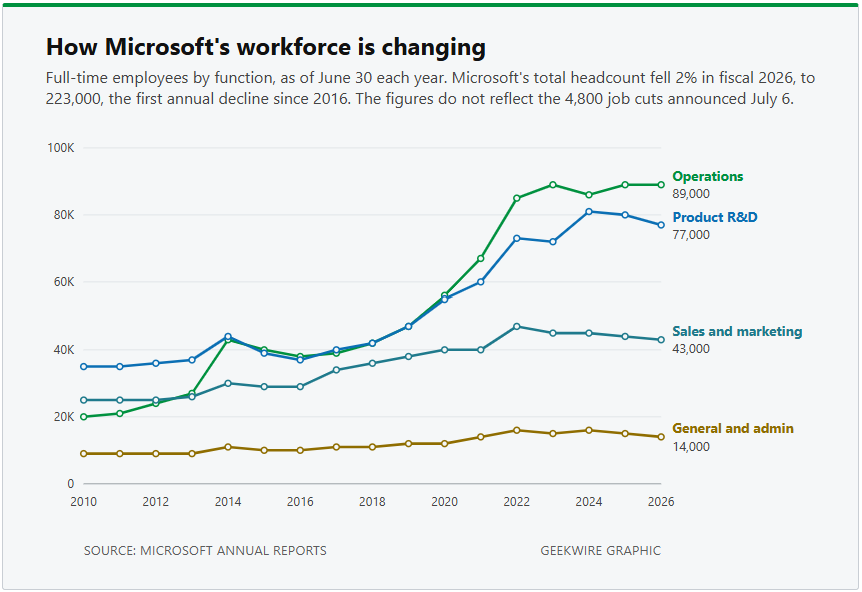
The number of product research and development roles at Microsoft declined for the second straight year, according to the company’s annual regulatory filing, offering a new indication of how the tech giant is reshaping its workforce in the AI era.
Microsoft’s total headcount declined by 5,000 people to 223,000 as of June 30, according to its Form 10-K, filed with the SEC this week. It’s the first annual employment decline for Microsoft since 2016, when the company was writing off and winding down its Nokia smartphone business.
The trend is notable in part because, over the same time period, Microsoft’s revenue rose 18%, or $50.1 billion, to $331.8 billion — the largest one-year increase in the company’s history.
Here’s how the employment trends break down:
- Product R&D roles represented the majority of the net decline, falling by 3,000, to 77,000 — down from a peak of 81,000 in 2024.
- Operations roles, now Microsoft’s largest employment category, held steady at 89,000 after growing by 3,000 the year before. It includes datacenter operations, product support, consulting, and manufacturing and distribution.
- Sales and marketing roles declined by 1,000, to 43,000, and general and administration by 1,000, to 14,000.
- The reductions fell disproportionately on Microsoft’s U.S. workforce, which declined by 4,000, to 121,000. International employment declined by 1,000, to 102,000.
The numbers reflect the roughly 9,000 jobs Microsoft cut on July 2, 2025, two days into its fiscal year. They do not reflect the 4,800 cuts announced July 6 of this year — spanning sales, consulting and Xbox — or the thousands of U.S. employees who left in early July under the company’s first voluntary retirement program.
On the earnings call Wednesday, CFO Amy Hood confirmed that “total company headcount declined 2% year over year.” She linked a 10% increase in operating expenses to “continued investment in R&D compute capacity, talent, and data to support product development across the portfolio.”
AI coding tools — including Microsoft’s own GitHub Copilot — have become a standard part of how software is built at Microsoft and across the industry, reducing the number of people and the amount of time it takes to ship products, while often expanding the total scope of the work.
Microsoft has repeatedly declined to link its job cuts to AI. Chief People Officer Amy Coleman said in a memo earlier this month that the roles being eliminated were not being directly replaced by AI, while acknowledging that “AI is changing how work gets done.”
Tech companies have been keeping a tighter rein on operating expenses, primarily through job cuts, in part to offset soaring capital expenses to support their AI infrastructure buildouts. Microsoft’s capex reached $41 billion in the June quarter alone.
Microsoft is also moving engineers out of product development and into customer-facing roles. The Microsoft Frontier Company, a $2.5 billion initiative announced July 2, brings together more than 6,000 people to embed engineers inside customers building AI systems — a group drawn “primarily from Microsoft’s existing engineering and forward-deployed teams,” according to the company.


The AI boom needs colossal amounts of electricity. That has turned fusion, forever mocked as “30 years away,” into one of the hottest bets in tech. The best-funded player just raised another $1 billion.
Commonwealth Fusion Systems, based in Massachusetts, said the round takes its total to $4 billion, roughly 30% of all the money ever raised for fusion. It is the company’s biggest round since a $1.8 billion raise in 2021. The new backers are institutions: pension funds, sovereign wealth funds and infrastructure investors, which CFS declined to name.
The timing is not subtle. Tech firms are buying electricity at almost any price to feed AI data centres, and clean, round-the-clock power is scarce. CFS has already sold half the output of its first plant to Google. Fusion’s promise of limitless carbon-free energy suddenly has a rich, impatient customer.
The tell: a Moderna banker in the CFO seat
A quieter move may matter more. This week CFS hired Lorence Kim as chief financial officer. Kim ran finance at Moderna and took the biotech public in 2018. “Fusion today is where mRNA was a decade ago,” he wrote: “scientifically real, commercially yet-to-be-proven, and closer than the consensus thinks.”
TechCrunch reads the hire as a sign CFS could go public within two or three years, it reported. CFS says an IPO is not necessarily in the works. Either way, the race is on: rival General Fusion listed through a SPAC this month, and TAE Technologies is merging with Trump Media.
The science still has to work
The money is ahead of the physics. CFS builds tokamaks that use powerful magnets to squeeze plasma hot and dense enough to fuse. Its demonstration reactor, SPARC, aims to hit scientific breakeven in 2027, the point where a reaction gives off more energy than it takes to start. Only one machine, at Lawrence Livermore, has ever managed it.
In parallel, CFS is building ARC, a commercial plant in Chesterfield County, Virginia. It has applied to plug into PJM, the largest US power market, and lined up buyers: Google for 200 megawatts, and Italy’s Eni for more than $1 billion of electricity. It hopes to reach the grid in the early 2030s.
Plenty could still go wrong. Breakeven is not electricity, first-of-a-kind plants slip, and the 2030s are a long time to burn cash. But the AI data-centre boom is minting power buyers, and rival fusion startups are raising fast. CFS is betting the window to raise, and maybe to list, is open now, and it does not want to miss it.


SOFTWARE
A nice little summer job for someone
Teams mobile users now have even less time to update the app before older versions lose calendar access.
Microsoft originally set a late-October deadline in its message, but we’re guessing someone familiar with the impending demise of Exchange Web Services (EWS) had a quiet word. The date has been brought forward to the beginning of October, leaving users until the end of September to update the Teams mobile app.
The October deadline applies only to the iOS and Android apps. The web and desktop versions are unaffected.
Users with automatic updates enabled will probably receive a compatible version without doing anything. Managed devices are another matter, and administrators will need to ensure an updated Teams app is deployed, though we can’t imagine why they might hesitate to roll out one of Microsoft’s updates.
Microsoft has stern words for refuseniks: “Older versions will lose calendar access.”
“This change helps maintain a reliable calendar experience on iOS and Android devices and ensures compatibility with ongoing Teams service updates.”
Microsoft will begin disabling EWS in Exchange Online on October 1, 2026. The service stopped receiving feature updates in 2018, its retirement was announced in 2023, and Microsoft detailed the shutdown process earlier this year.
EWS allows applications to access mailboxes and other data in Exchange. It dates to 2007 and has proved popular with both integrators and miscreants, including those behind the Midnight Blizzard intrusion. Microsoft is understandably keen to shut it down.
EWS in on-premises Exchange Server is unaffected, but the Exchange Online version is heading for retirement. Administrators can re-enable it temporarily through a policy setting, but the plug will be pulled for good next year. At the time, Microsoft stated: “There will be no exceptions past April 2027.” ®

Cavaliers Predicted to Pursue Kevin Durant Trade After Missing Out on LeBron James in Free Agency This Summer

CLARITY Act eyes Senate vote before August recess
Neeraj Chopra eyes second Commonwealth Games gold in stacked Glasgow javelin final


-

 Fashion7 days ago
Weekend Open Thread: Brooks Brothers
-
 Sports5 days ago
Commonwealth Games boxing: Jadumani Singh seals dominant 5-0 win over Pakistan’s Sumama Rehman to enter quarter-finals | Commonwealth Games News
-

 Business2 days ago
Why Trees Belong on the Risk Register
-

 Tech5 days ago
Intel is reversing course and bringing hyper-threading back to its server chips
-

 Crypto World6 days ago
Ripple bought a bank in pieces. The $4 billion audit
-

 Politics4 days ago
Luke Littler dismantles Gerwyn Price to retain title in Blackpool
-

 Politics3 days ago
The Part of the Electric Transition Nobody Wants to Discuss
-

 News Videos5 days ago
BITCOIN JUST ENTERED THIS CRITICAL ZONE…
-

 Business3 days ago
Major shareholder moves on Canyon
-

 Crypto World5 days ago
XRP Ledger adds $2.6B as RWA inflows rank second
-

 News Videos1 day ago
Bitcoin Enters the 3rd Stage of the Bear Market
-

 Politics5 days ago
Spain sweeps the board at 2026 World Cup with individual awards
-
 Entertainment3 days ago
‘Stargate’ Creator’s New Sci-Fi Series Returns for Season 3 Tomorrow
-

 Entertainment6 days ago
Sara Gilson Killed By Husband After Viral “Pedophile” TikTok Video
-

 Crypto World3 days ago
Kraken Enables Retail Access to Jersey Mike’s IPO via Tokenized Shares
-

 Tech7 days ago
Anthropic launches Claude Opus 5, a cheaper AI model for coding, agents and enterprise workflows
-

 Tech4 days ago
New macOS Sequoia & Sonoma security updates for older Macs
-

 News Videos3 days ago
Claude: Build Financial Dashboards in Minutes (2026)
-

 Politics1 day ago
Luke Littler’s dominance sparks GOAT debate
-

 Sports17 hours ago
Seema Kaliramna Wins Discus Throw Bronze, Takes India’s CWG Medals Tally To 17
You must be logged in to post a comment Login