


Connect with us
DAPA Banner
DAPA Coin
DAPA
COIN PAYMENT ASSET
PRIVACY · BLOCKDAG · HOMOMORPHIC ENCRYPTION · RUST
ElGamal Encrypted MINE DAPA
🚫 GENESIS SOLD OUT
DAPAPAY COMING

Tech

Trump threatens 100% tariffs on any country imposing digital services taxes on US tech firms

Published

on


Several European countries have been considering or already applying digital services taxes to large online platforms. These surcharges are aimed at revenue generated by activities such as digital advertising and online marketplaces – areas dominated by US-based companies.
Read Entire Article
Source link

Continue Reading
Click to comment

You must be logged in to post a comment Login

Leave a Reply

Tech

Save $850 on 16-inch MacBook Pro M5 Max 2TB at Amazon

Published

on

Amazon’s staggering $850 discount on a loaded 16-inch MacBook Pro with Apple’s M5 Max chip is available now, but with Prime Day ending tonight, you’ll want to act fast.

Prime Day ends tonight, and there’s a high likelihood this 16-inch MacBook Pro will go up in price. That’s because Amazon is currently knocking $850 off Apple’s revised MSRP for the high-end M5 Max model with an 18-core CPU and 40-core GPU, and we’re already seeing stockouts for other MacBook Pro SKUs.

Buy 16″ M5 Max MacBook Pro for $4,149.99

Equipped with 48GB of memory and 2TB of storage, this model in your choice of Space Black or Silver is on sale for $4,149.99.

Advertisement

This is a great deal for a large number of users, but if you need additional storage or RAM, there are discounts of up to $2,300 off every configuration in our 16-inch MacBook Pro Price Guide.

Last call for these Prime Day MacBook Pro deals

  • 14″ MacBook Pro M5 (10C CPU, 10C GPU, 16GB, 1TB, Standard Display): $1,549.99 ($450 off)
  • 14″ MacBook Pro M5 Pro (15C CPU, 16C GPU, 24GB, 1TB, Standard Display): $2,049.99 ($450 off)
  • 14″ MacBook Pro M5 Pro (15C CPU, 16C GPU, 24GB, 2TB, Standard Display): $2,399 ($600 off)
  • 14″ MacBook Pro M5 Max (18C CPU, 32C GPU, 36GB, 2TB, Standard Display): $3,199.99 ($900 off)
  • 16″ MacBook Pro M5 Pro (18C CPU, 20C GPU, 24GB, 1TB, Standard Display, Space Black): $2,549.99 ($450 off)
  • 16″ MacBook Pro M5 Max (18C CPU, 32C GPU, 36GB, 2TB, Standard Display): $3,649 ($750 off)
  • 16″ MacBook Pro M5 Max (18C CPU, 40C GPU, 48GB, 2TB, Standard Display, Space Black): $4,149 ($850 off)

Source link

Continue Reading

Tech

Meta reportedly building Kalshi-like prediction markets app

Published

on

The Arena app will not use real money to process bets, sources told The New York Times.

Social media giant Meta is building a prediction markets app similar to Polymarket and Kalshi, The New York Times has reported.

The new app – internally referred to as ‘Arena’ – is the latest in Mark Zuckerbeg’s attempts to capitalise on changing internet trends and tap into emerging social behaviour online.

Sources told the publication that Meta would not allow users to bet real money on the app, likely opting for a points-based system instead, although the use of money wagering has not been completely ruled out.

Advertisement

Zuckerberg has reportedly assigned a small team at Meta to build Arena, which would function independently from the tech giant’s social media platforms Instagram, WhatsApp, Facebook and Messenger.

Meta, with more than 3.5bn daily users across its platforms, hopes to grow Arena by directing its audience towards the new app.

Prediction markets allow participants to wager bets on real-world events in areas such as politics, entertainment and sports. Platforms such as Kalshi and Polymarket have committed majorly to pushing their platforms to US users in recent years, including receiving endorsements from president Donald Trump.

These prediction markets, however, have resulted in a sharp rise in online gambling in the US, many experts have highlighted. The issue is exacerbated with heavy advertising across sports matches, public transport and billboards, making it harder for gambling addicts to quit.

Advertisement

Kalshi and Polymarket put together accounted for about $24bn in global trading volume in just April this year, according to Pew Research Center. Comparatively, the total money gambled through legal sportsbooks in the US came to around $14bn per month on average in 2025.

“Set aside the debate on whether prediction market apps are investing or gambling – they’re habit-forming. And Meta is already facing high-profile litigation tied to concerns about addictive product design,” commented Forrester’s VP research director Mike Proulx.

“The irony here is hard to miss and not a great look for a company already under scrutiny.”

While Meta doesn’t share official numbers on underage users across its platforms, the EU indicated that roughly 10-12pc of children under 13 in the bloc are actively accessing Instagram or Facebook.

Advertisement

The European Commission recently found that the social media giant did not do enough to mitigate risks children face when using its platforms.

Meta has made previous attempts to expand what it offers to its users. In 2019, company employees tried to create various social media apps, across podcasts, music and travel – but none gained sufficient traction.

In 2020, the company experimented with prediction markets with an app called ‘Forecast’. This was quietly closed down in 2022.

“Meta is following its familiar copycat playbook,” Proulx added.

Advertisement

“Prediction markets are exploding into the mainstream, especially among younger men, and Meta wants a piece of that engagement. But this is yet another market that exists before its rules do. And like Meta, this category comes with baggage.”

Over in Europe, countries including Germany, Belgium, Spain, France, Italy and the Netherlands recently announced that they would target unlicensed prediction market platforms. Last month, Spain temporarily blocked Polymarket and Kalshi.

Don’t miss out on the knowledge you need to succeed. Sign up for the Daily Brief, Silicon Republic’s digest of need-to-know sci-tech news.

Advertisement

Source link

Continue Reading

Tech

RF Hacking A Ceiling Fan Via The Remote

Published

on

[Sam Wilkinson] recently installed a Dreo CLF513S ceiling fan in his place — it’s cheap, well-sized, and blows air around as you’d expect it to. The only problem is that it only works with an ugly cloud-only smart home setup out of the box. Never mind, though, because [Sam] figured out how to hack up a custom solution.

Hacking efforts began with the included remote control. [Sam] identified that the remote had to be RF, since it didn’t need line of sight to work properly. The FCC ID on the back of the device further indicated this was the case. Armed with that knowledge, it was simply a case of figuring out the commands sent by the remote, building something to replay them, and then hooking that into [Sam]’s existing Home Assistant setup.

The remote ran on 433.92 MHz, a not-uncommon bit of spectrum for these sort of appliances. An RTL-SDR was thusly enlisted to capture the output, with a spectrogram indicating the remote used simple on-off keying to send commands. Once commands were captured, [Sam] grabbed an ESP32-C6 microcontroller, hooked it up to a RFM69HCW radio transceiver, and programmed it to replay the fan on/off command. From there, a little dabbling with MQTT got the ESP32 controlling the fan as desired from within the Home Assistant ecosystem.

Advertisement

Sometimes, it’s hard to find smart home gear that actually suits your tastes and budgets. Often, a bit of tinkering can shape existing appliances to bend to your will instead. If you’re tweaking your own gear to better fit your smart home, don’t hesitate to notify the tipsline.

Source link

Advertisement
Continue Reading

Tech

Amazon’s Echo Studio is down to its lowest ever price for Prime Day

Published

on

The Echo Studio houses immersive audio, Alexa support and clever sensors for smart home controls, all for an affordable price.

Pick up the Echo Studio for just £166.24 this Prime Day and save over £53 off its usual price. That’s the lowest we’ve seen the smart speaker reach on Amazon since its launch last year. 

Amazon Echo Studio (2025) heroAmazon Echo Studio (2025) hero

The Echo Studio is down to its lowest ever price

The Echo Studio houses immersive audio, Alexa support and clever sensors for smart home controls, all for an affordable price.

Advertisement

View Deal

The Echo Studio is a well-rounded smart speaker that’s designed for use with Alexa+. Once you opt into the service, Alexa+ promises to be a more conversational assistant than the standard Alexa, allowing you to chat naturally between different topics and requests. In fact, we hailed the service as being “light years ahead of the competition” as it’s better at general responses, building smart home routines and able to find information from emails.

Advertisement

The light ring will illuminate once Alexa has heard that all-important wake word, giving you an indication that it’s ready and waiting to answer your question. 

Otherwise, the Echo Studio itself is equipped with three 1.5-inch drivers and a 3.75-inch high excursion woofer. What that means is real-world use is that the device is a very competent-sounding speaker for its price. While bass levels aren’t quite as room-shaking as other speakers, overall low frequencies are handled well while sound is well-balanced.

Advertisement

Its design doesn’t stray too far from its predecessors, though now it includes easier-to-operate buttons than the previous Studio iteration, and rids itself of the action button too. That means you’ll have to either actually say “Alexa” to get its attention.

Advertisement

Overall we awarded the Echo Studio with a four-star rating, as Home Technology Editor Dave Ludlow concluded the smart speaker is a “powerful, all-rounder for the voice assistant [Alexa], music and entertainment”. 

Whether you’re keen to try Alexa+, want an easy way to control your smart home appliances or need to upgrade an old smart speaker, the Echo Studio is a brilliant option. Not only is Alexa easily one of the best voice assistants around, but its sleek design and brilliant speaker set-up makes it a solid investment.

Advertisement

Source link

Advertisement
Continue Reading

Tech

Netflix now wants every profile to have its own email address, annoying users

Published

on


Netflix is changing how user identities work on its platform, and for many subscribers, the move is showing up in the form of unexpected login prompts and extra steps at sign-in. The company has begun requiring almost every profile on an account to be tied to a unique email address,…
Read Entire Article
Source link

Continue Reading

Tech

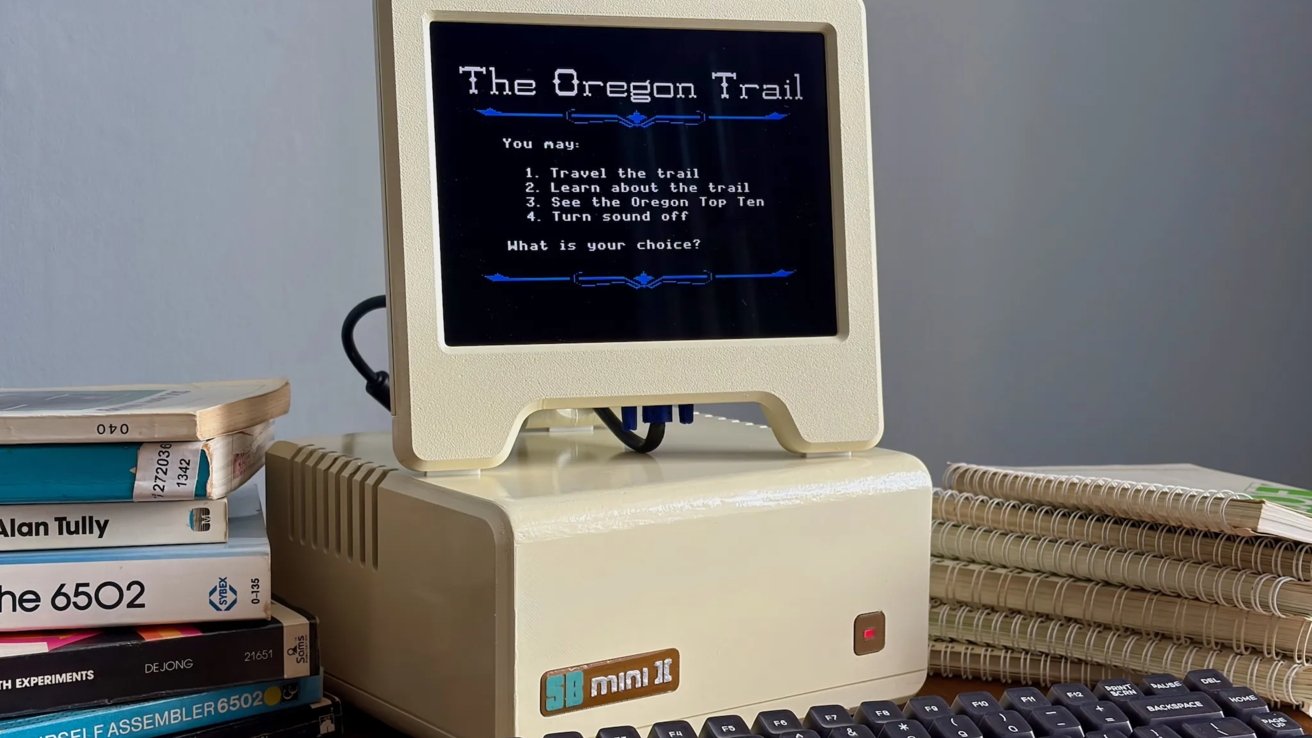
What emulation? This homebrew Apple II does it all in hardware

Published

on

A project has cloned the Apple II Plus, but instead of using emulation, it goes the harder route by rebuilding Apple’s classic computer in hardware.

If someone wants to get the experience of using Apple’s vintage products, they often turn to a software emulator. However, as one project proves, it’s possible to get the same effect by focusing on the hardware side.

Posted on Sunday by Simon Boak, the SB Mini II is referred to as a “Homebrew Apple II Clone.” It is a rebuild of the Apple II Plus from a hardware standpoint, but using modern components.

Boak saw that most of the basic logic chips are still available to consumers, including the 6502 CPU. That, combined with circuit diagrams in the original manual and a library of books on the topic, helped Boak come up with a gameplan and a shopping list of parts.

Advertisement

A modern(ized) marvel

The clone does use modernized alternatives compared to the original design, mostly due to advancements in technology.

A key one is the replacement of the dynamic RAM (DRAM) used in the original Apple II. While the original kept to DRAM to save on cost, Static RAM or SRAM is also cheap enough for the project.

As a result, one and a half 32K SRAM chips are used to get the required 48k the Apple II Plus needs. The change also means there was no need to use circuitry to refresh the DRAM, which allowed the memory to function.

Boak remarks that a lot of the original circuit generated a composite video signal. Instead, using an Apple II VGA card, he was able to get a sharper video output, as well as removing the video generation logic from the circuitry.

Advertisement

In effect, it is a “headless” clone if it is used without the VGA card.

This also helped simplify the clock and timing signals as well. In this project, Boak uses a 4.096 MHz crystal oscillator, divided down to 1.024MHz, which is close to the 1.023MHZ of the original machine.

A Raspberry Pi Pico, which in itself is more powerful than the Apple II Plus, is used as a way to connect a USB keyboard to the Apple II. The Pico does generate the same parallel data signals as the original keyboard, as well as eliminating the need to use voltage level shifters.

Smart case

The project was finished off by being placed in a specially created case, which was 3D printed in parts before being glued and painted together. Those part files have since been released via GitHub.

Advertisement

It’s based on the design of the Apple ProFile hard drive. However, there are extra vents and a rear panel added so that connections could be accessed.

Just as the original was designed for easy access to the internals, the enclosure’s lid clips shut, so it can be opened without tools.

To go with the clone, Boak has also designed a matching Studio II LCD monitor.

This is far from Boak’s first attempt at making clones of Apple products. In June 2024, he created an Apple 1 clone with a printer, which used an SD card for storage.

Advertisement

The Apple II Plus recreation is certainly impressive, since it’s a hardware recreation instead of just using an emulator. But sometimes, even those efforts can be just as astounding.

In 2024, a Hackintosh project aimed to recreate the original Macintosh Plus, using modern components internally. However, the effort used 3D printing to produce a highly-accurate full-scale recreation of Apple’s hardware.

Source link

Advertisement
Continue Reading

Tech

This Is the Most Detailed Image Yet of the Milky Way’s Center

Published

on

The European Space Agency’s (ESA) Euclid space telescope has captured the largest and most detailed visible-light image ever obtained of the Milky Way’s galactic bulge, the central region of our galaxy.

The image is a mosaic containing more than 60 million stars, as well as nebulae and star clusters. It will allow scientists to confirm the possible presence of exoplanets using a microlensing technique and measure their masses with greater precision.

The Power of Euclid

Although Euclid was designed to observe billions of distant galaxies, its visible-light camera is sensitive enough to resolve individual stars at the center of the Milky Way—a region that is both extremely bright and densely populated—without being overwhelmed by the intense light.

On March 23, 2025, Euclid turned its gaze toward the galactic bulge, capturing this enormous image in just 26 hours of observations. The result was remarkable: a mosaic composed of nine separate “pointings” (exposures) by its visible-light camera, each covering an area of sky larger than the full moon.

Advertisement

While the quality of Euclid’s visible-light images is comparable to that of the Hubble Space Telescope, there is one major difference: Each pointing that Euclid captures in just a few hours covers an area 270 times larger than Hubble’s field of view. It is also much faster. To put this into perspective, the Keck Observatory would require roughly 2,000 hours to observe the same mosaic.

The Image of the Milky Way

The new Euclid image captures more than 60 million stars, along with nebulae and star clusters, in one of the Milky Way’s most crowded regions—a location ideally suited for searching for exoplanets through gravitational microlensing.

“To catch microlensing, you need to observe parts of the sky that are crowded with stars, such as close to the centre of our galaxy,” said Jean-Philippe Beaulieu, who led the observing campaign, in a press release. “During the last 20 years, almost 300 exoplanets have been discovered using this technique, all with ground-based telescopes and all towards the center of our galaxy. This image from Euclid includes 51 known planetary systems—and it will assist in studying many more that will be found.”

Measuring Planetary Masses

Although detecting a microlensing event requires several weeks of observations—meaning Euclid could not identify any new events during its relatively short observational campaign—what makes this image so valuable is that it provides the data needed to measure the masses of already known planets, as well as planets that have yet to be discovered.

Advertisement

“In 24 hours, Euclid has already captured the stars involved in all the future microlensing events that the Roman space telescope will detect, but before the stars and planets involved have aligned,” said Natalia Rektsini, who led the publication of the data, in a press release. (The Nancy Grace Roman space telescope is slated to launch later this year.) “This means that anyone who detects a microlensing event in the same region, for example with Roman, will be able from now on to use Euclid data as a time reference in the past and see how the stars looked before they overlapped.”

In effect, Euclid’s observations will serve as a reference archive for future missions, enabling more detailed studies of exoplanets and more precise measurements of their masses.

“In just 24 hours, Euclid has delivered unique data on the Milky Way’s center, with a large and sharp view of this region,” said Valeria Pettorino, ESA’s Euclid project scientist, in a press release. “This data can also be used for other scientific applications, from brown dwarfs and binary stars to stellar motions and dust across our galaxy.”

This story originally appeared on WIRED Italia and has been translated from Italian.

Advertisement

Source link

Continue Reading

Tech

Sony is deleting 551 movies and TV shows you bought on PlayStation, because you don't really own your digital purchases

Published

on


Sony has confirmed that it will remove 551 movies and TV series from the PlayStation Store in the UK on September 1, 2026. The content will also be simultaneously deleted from customers’ libraries who have already purchased it. Sony did not mention anything about refunds, suggesting affected users will not be compensated financially.
Read Entire Article
Source link

Continue Reading

Tech

Week in Review: Most popular stories on GeekWire for the week of June 21, 2026

Published

on

Get caught up on the latest technology and startup news from the past week. Here are the most popular stories on GeekWire for the week of June 21, 2026.

Sign up to receive these updates every Sunday in your inbox by subscribing to our GeekWire Weekly email newsletter.

Most popular stories on GeekWire

Source link

Continue Reading

Tech

Amazon Extends Prime Day MacBook Air Deals up to $450 Off

Published

on

Two of Amazon’s top Prime Day MacBook Air deals have been extended, resulting in discounts of up to $450 off.

After many M5 MacBook Air deals sold out during Prime Day, two of the top choices at Amazon have been extended into the weekend. Save $450 on the 13-inch MacBook Air M5 with 16GB of RAM and 1TB of storage.

On sale for $1,149.99, only select colors are available at press time due to the increased demand after Apple raised prices on Thursday.

Buy 1TB 13″ MacBook Air for $1,149.99

Advertisement

Need additional screen real estate? The standard 15-inch MacBook Air with Apple’s M5 chip, 16GB of memory, and a 512GB SSD is also marked down to $1,149.99, reflecting a $350 price cut off Apple’s new MSRP.

Prime Day MacBook Air deals have been extended

You can compare prices across retailers in our MacBook Air Price Guide for offers on CTO models as well.

Source link

Advertisement
Continue Reading

Trending

Copyright © 2025