
Tech
Two Die In Pennsylvania Of Measles Marking The First Deaths Of 2026


from the needless-deaths dept
Last year, as decades of work by RFK Jr. to undermine vaccines with false links to deaths and autism culminated in his appointment to lead HHS, America saw the largest resurgence of measles cases in something like three decades. Three people died, including two children, all unvaccinated. Kennedy mostly ignored the outbreak from the beginning and has since only mustered the ability to say that people should get the MMR vaccine out of one side of his mouth while reminding everyone that he thinks vaccines are bad out of the other. Measles continued to roar into 2026, with Kennedy and HHS officials attempting to downplay case counts and deaths the entire time. We’ve already eclipsed 2025’s record-breaking case count here in 2026 and we still have months to add to that total.
And now we have our first two deaths from measles in 2026, as well. Both occurred in Pennsylvania and, while health officials aren’t releasing many details due to privacy concerns, it was noted that both of the deceased were unvaccinated for measles.
They are the first measles deaths reported in Pennsylvania in 35 years and the first deaths reported in the US in 2026. Last year, the US saw three measles deaths: two in otherwise-healthy but unvaccinated school-age children in Texas and one in an unvaccinated adult in New Mexico. Prior to those deaths, the US had not seen a measles death since 2015, when a woman with underlying conditions became severely ill.
Citing privacy, health officials in Pennsylvania are not providing information on the people who died beyond that they were unvaccinated and were residents of Lancaster County. Officials noted that the deaths are among 393 confirmed cases reported this year across 28 counties in the state.
As we talked about recently, due directly to the decades of work Kennedy has taken to undermine vaccines, vaccination rates for school children have and are continuing to fall. These deaths, and the vast majority of the case counts, are completely needless. We have the solution to preventing them. The MMR vaccine is safe and effective for those that are not immunocompromised. There is no scientific reason to believe it causes autism. And, importantly, if 95% of us get vaccinated against measles, we achieve herd immunity which protects those that can’t get vaccinated, as well as very young children who haven’t been vaccinated yet.
And that last category is one that is likely to grow, thanks to the Trump administration’s blatantly stupid executive order attempting to curtail how childhood vaccines are delivered and when. Not to mention the constant muddy waters Kennedy himself creates as to whether vaccines are good or bad, when they are so, what risks they carry, and so on. It is not an overreach to say that this administration, and Kennedy’s decades of bullshit in particular, got these people killed.
Still, anti-vaccine rhetoric, misinformation, and disinformation have shaken confidence in the vaccine, driving down vaccination rates. Some of that damaging discourse has come from Trump administration officials, most notably ardent anti-vaccine activist Robert F. Kennedy Jr., who is currently the US health secretary. But President Trump has also contributed, falsely claiming in a White House press event two weeks ago that the MMR vaccine can be “quite lethal.” The MMR vaccine has never been linked to a death in a person with a competent immune system (it’s not recommended in those who are immunocompromised).
One hundred percent correct. People look to their leaders for guidance on things like public health. Or they used to, at least. For some non-insignificant percentage of the country, they really do think Trump and Kennedy know what they’re talking about when it comes to matters of medicine. They don’t, of course. Not even close. But enough people are listening to them that it puts all of us in danger.
This has to end. Outbreaks of infectious diseases at the level of the measles tend to grow exponentially if not addressed. That’s why we’re already past last year’s case count. The project for getting back to herd immunity and proper vaccination rates will not be a short one. It will take years.
And I very much doubt that we won’t pass the death count here before the end of the year as well.
Filed Under: anti-vaxxers, health & human services, measles, mmr, pennsylvania, rfk jr., trump administration, vaccines


A French court has for the first time recognized cosmic radiation as a contributing occupational factor in a flight attendant’s breast cancer, alongside passive smoking and years of night work. The landmark ruling could open the door to similar claims from other aircrew, as research continues to link long-term high-altitude flying with elevated exposure to radiation-related cancers. The BBC reports: Sophie Lainault, a 59 year-old former stewardess on Air France, sought to have her cancer recognized as an occupational disease, brought on by conditions at work. This has now been confirmed in a landmark court ruling in the southwestern town of Bayonne, which said that cosmic radiation was one of three carcinogenic hazards arising from her profession. […] As stewardess and later purser on Air France airliners, Lainault clocked up 12,600 flight hours between 1989 and 2019. More than half of these were at night. Many long-distance high-altitude flights from Paris would have taken her near the North Pole, where exposure to radiation from space — strictly speaking particles from the sun and other stars — is the most intense.
A study this month at the Harvard Medical School in the US found that flight attendants and pilots had the highest level of radiation-related cancer deaths among more than 500 different professions. In all, about 6.9% of deaths among flight attendants and 6.7% of deaths among pilots were from radiation-related cancers, according to the analysis. These proportions were higher than for other professions including nuclear technologists, who are routinely exposed to radiation from non-cosmic sources yet placed 12th on the list, the authors said. “In France the link between breast cancer and certain hazards has been established for a number of professions, such as nurses … but this is the first time for an air-hostess,” said Lainault’s lawyer Elisabeth Leroux.


Read more of this story at Slashdot.


The IEEE–Eta Kappa Nu (IEEE-HKN) honor society is preparing to host the Innovating the Future event on 6 November.
The inaugural one-day, in-person event is designed to provide a forum for IEEE and IEEE-HKN undergraduate and graduate student authors to present their original research papers. A keynote address and thematic presentation sessions are planned as well. Student attendees can network with their peers and gain firsthand experience with the academic publishing process.
To present at the conference, students had to submit an abstract of their research before 1 May. Students whose work was accepted were assigned a volunteer IEEE member to mentor them and guide them through the research writing process, including presenting and publishing their original work.
Those whose paper was accepted by 1 August were invited to present at the conference. The conference proceedings will be submitted for publication in the IEEE Xplore Digital Library.
Upholding research integrity in a changing landscape
IEEE Life Fellow Manuel Castro, the conference’s technical program chair, oversees IEEE-HKN’s Innovating the Future program committee. It manages the review process, organizes logistics, and handles the mentoring component.
“This new conference is important to IEEE, as well as to IEEE-HKN,” Castro says, “because it allows student authors to grow in their skills and competencies, and be supported while turning their technical activities into publications.”
“The conference offers me a chance to learn how to communicate my research to a broader audience, gain feedback from other student researchers beyond my institution, and see how my work can be made more accessible.” —David Kwabi-Addo
IEEE Life Fellow Sorel Reisman, a California State University professor emeritus and an IEEE-HKN governor-at-large, says that because the academic research landscape is rapidly shifting, the conference is timely.
“As AI increasingly threatens the integrity of research papers being published in leading journals and conference proceedings, it is essential that future scholars—many of them current IEEE-HKN students—grasp the established standards of legitimate, peer-reviewed research publishing,” Reisman says.
Perspectives from mentors and students
A cornerstone of the conference is its rigorous mentorship initiative, which pairs each author of an accepted abstract with an experienced IEEE volunteer. The mentors provide personalized guidance on organizing the students’ technical content into the correct format for publishing. They also discuss navigating the peer review process, structuring presentations, and preparing the final manuscript for publication.
The impact of the guided process can be valuable for both the mentors and their mentees. IEEE Member Wafa Elmannai, associate professor and chair of the electrical and computer engineering department at Manhattan University, in Riverdale, N.Y., and faculty advisor to the IEEE-HKN Gamma Alpha chapter, serves as a mentor.
“Research is essential to advancing technology and driving innovation,” Elmannai says.
She volunteered to be a mentor, she says, because she has seen how conducting research can transform a student’s future by building their confidence, curiosity, and critical thinking skills.
“Mentoring encourages students to step outside their comfort zones and develop innovative solutions that contribute to society,” she says.
For the students, the conference can be a critical stepping stone. David Kwabi-Addo, an IEEE graduate student member who is researching computational biology at MIT, is president of the IEEE-HKN Beta Theta chapter. He says he views the program as an opportunity to gain experience in producing academic scholarship.
“I submitted an abstract of my research paper because I see the conference as a chance to produce what could become my first conference publication,” Kwabi-Addo says. “The conference offers me a chance to learn how to communicate my research to a broader audience, gain feedback from other student researchers beyond my institution, and see how my work can be made more accessible.”
He says he hopes his participation will highlight the diverse breadth of research that future conferences can showcase.
Workshops on the publishing process
Conference organizers are holding a series of workshops to guide students through every step of the academic publishing process. The workshops are open to anyone and available on the IEEE-HKN YouTube channel.
Topics previously covered are:
Registration is open to all for this upcoming workshop:
A launchpad for the next generation
The Innovating the Future program is designed not only to improve the quality of submissions but also to foster long-term professional development and research communication skills to develop the next generation of IEEE authors. The conference is more than a venue for presenting research; it is a launchpad for innovators committed to advancing technology for humanity.
From Your Site Articles
Related Articles Around the Web
Free VPN to protect your privacy. We believe online privacy is a fundamental human right. Providing free access is part of our mission. The Proton VPN free plan is unlimited and designed for security. No catches, no gimmicks. Just online privacy and freedom for those who need it.
Our mission is to provide private and secure Internet access to all. ProtonVPN is used by activists and journalists all around the world. Our free plan is the only one that:
- Has no data or speed limits
- Has no advertisements
- Does not log your online activity
- Is protected by Swiss privacy laws
What is the difference between the Stealth protocol and other protocols like WireGuard?
The Stealth protocol is designed to help users bypass censorship by disguising VPN traffic as regular HTTPS traffic. This makes it effective in restrictive regions. However, it may be slower than other protocols like WireGuard, which is typically faster and more efficient for general use if censorship is not a concern.
Can I stream content using ProtonVPN?
Yes, ProtonVPN supports streaming on its paid plans, particularly when using servers optimized for this purpose. These servers provide reliable access to popular streaming platforms and better speed. However, streaming support is not available on the free plan.
How many devices can I connect simultaneously with ProtonVPN?
The number of devices you can connect depends on your subscription. The free plan allows only one device at a time, while the paid Plus plan supports up to 10 simultaneous connections, making it suitable for users with multiple devices or families sharing the same account.
Features
Security
Our secure VPN sends your internet traffic through an encrypted VPN tunnel, so your passwords and confidential data stay safe, even over public or untrusted Internet connections.
Secure Core VPN
Secure Core protects your connection by routing your traffic through multiple servers before it leaves our network, defending you against advanced, network-based attacks. Secure Core servers are located in hardened data centers in Switzerland, Iceland, and Sweden, protected by strong privacy laws, and operated on Proton’s dedicated networks.
Kill switch
A VPN kill switch keeps your IP address safe if something goes wrong with your VPN connection. If your VPN connection fails, the kill switch will prevent your device from connecting to the internet until your device reconnects to a VPN server.
Adblocker (NetShield)
NetShield speeds up your connection and protects you from malware by filtering out images, scripts, and other resources that are from domains known to host malware. Available for VPN Plus and Proton Unlimited users, NetShield can also block online trackers and ads.
Apps
Regardless if you use a PC, tablet, phone, or anything in between, Proton VPN has you covered with Free VPN apps for all of the major operating systems.
Servers
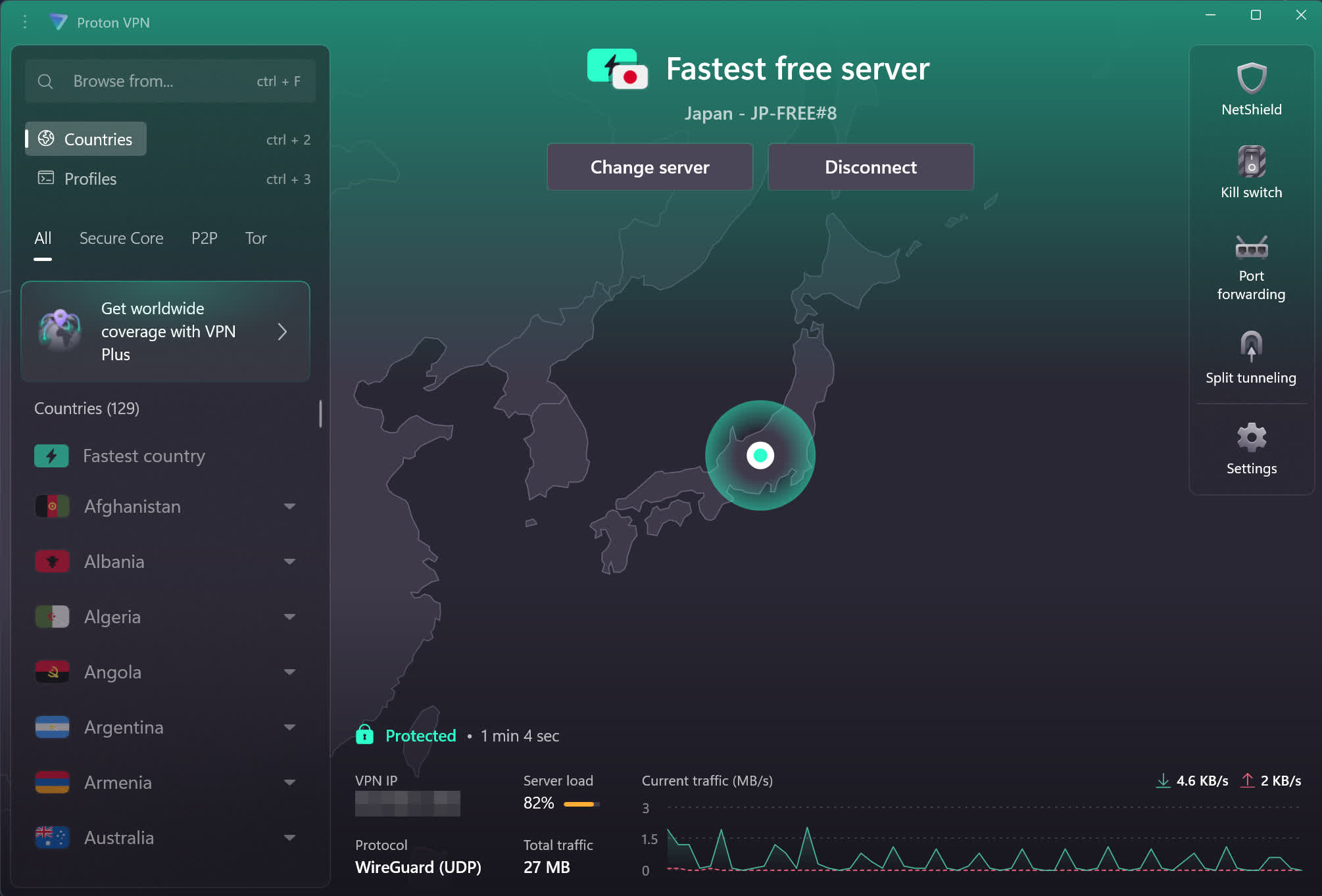
Proton VPN offers free access to VPN servers in the United States, Netherlands, and Japan. The Proton VPN free plan has a strict no-logs policy backed by the Swiss data privacy laws. Additionally, Proton VPN does not apply any bandwidth, duration, or speed limits to free users.
Privacy
Keep your browsing history private. As a Swiss VPN provider, we do not log user activity or share data with third parties. Our anonymous VPN service enables Internet without surveillance.
Freedom
We created ProtonVPN to protect the journalists and activists who use ProtonMail. ProtonVPN breaks down the barriers of Internet censorship, allowing you to access any website or content.
Perfect forward secrecy
ProtonVPN exclusively uses ciphers with Perfect Forward Secrecy, meaning that your encrypted traffic cannot be captured and decrypted later, even if an encryption key gets compromised in the future.
No-log policy
ProtonVPN is a no logs VPN service. We do not track or record your internet activity, and therefore, we are unable to disclose this information to third parties.
Tor over VPN
ProtonVPN also integrates with the Tor anonymity network. With a single click, you can route all your traffic through the Tor network and access Onion sites.
ProtonVPN Plus
Upgrading to a paid account provides access to advanced features, but our core privacy and anti-censorship features are available to all users:
- VPN Accelerator
- Strict no-logs policy
- Kill Switch
- Access blocked content
What’s New
- ProtonVPN’s Windows latest version is 5.1.6
- ProtonVPN’s macOS latest version is 6.5.1
- ProtonVPN’s Android latest version is 5.19.99.0
- ProtonVPN’s iOS latest version is 7.5.2
Redesigned Windows and iOS apps
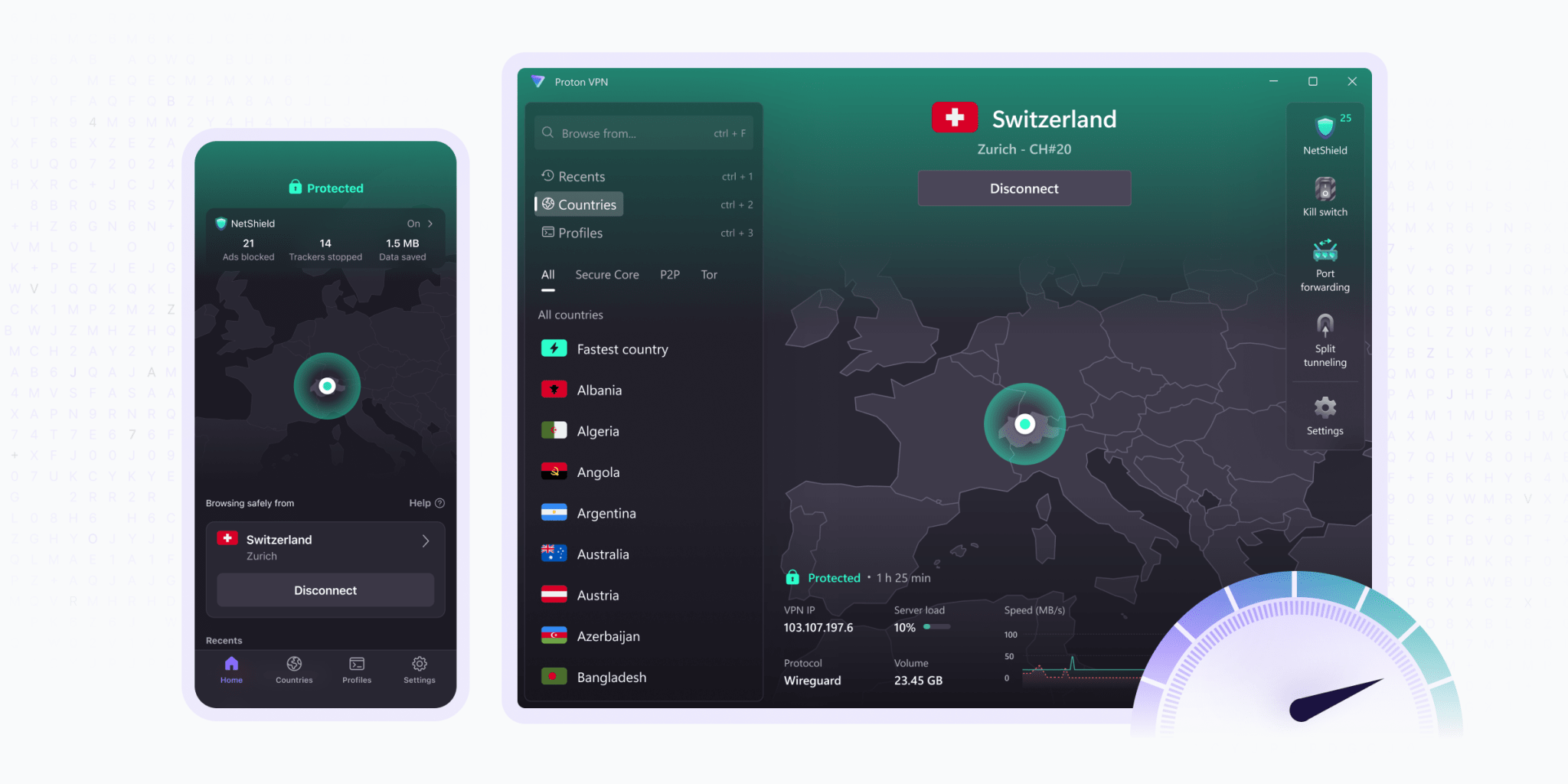
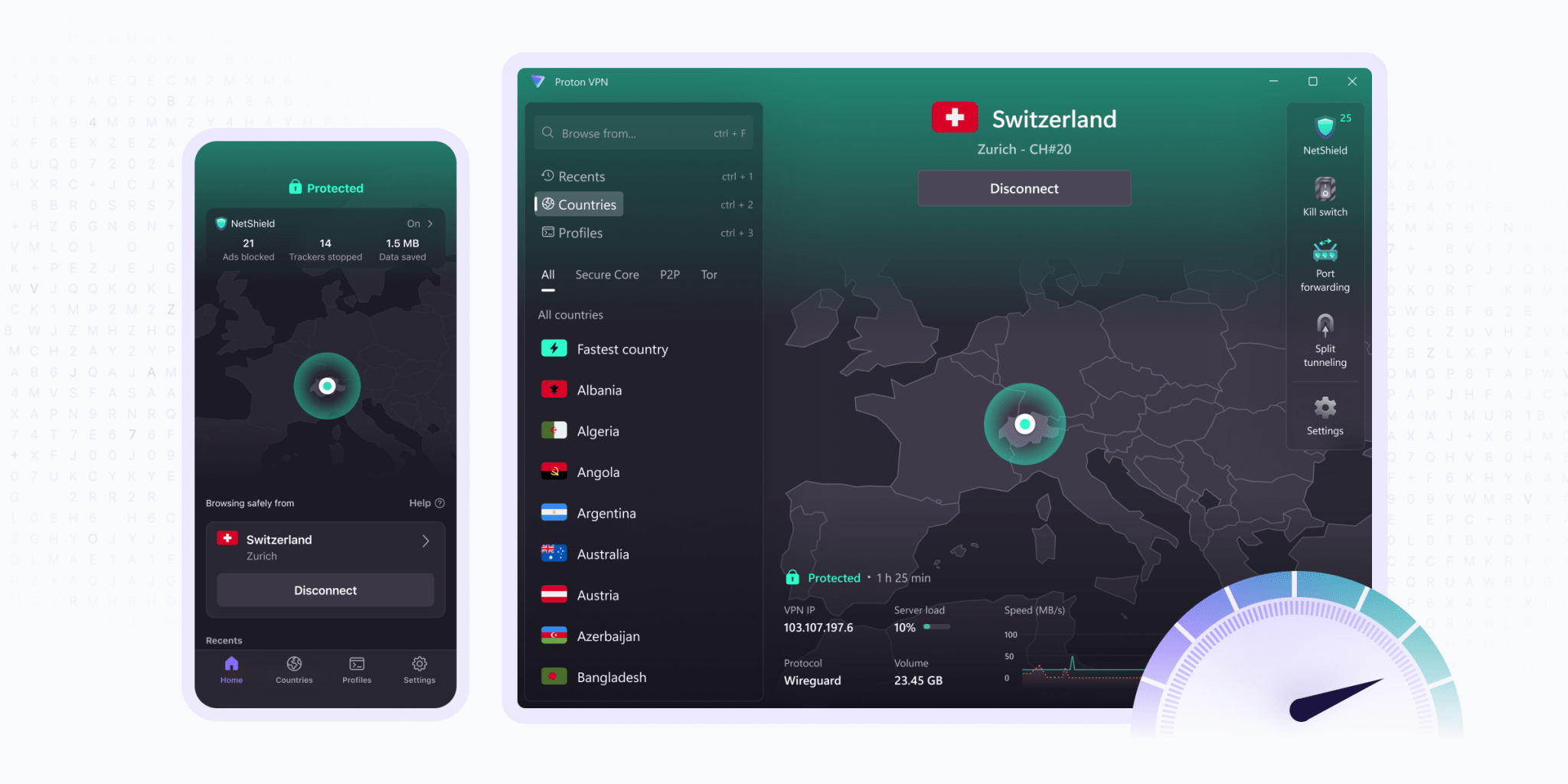
Following last year’s introduction of our all-new Android app we’re bringing the same modern design and intuitive-to-use experience to our Windows and iOS apps. The Windows app is optimized for desktop experience to ensure the features you need are at your fingertips.
The new iOS app now provides the same core mobile experience as our Android app, and both have been improved and refined thanks to enthusiastic feedback from the Proton VPN community.
On both the new Windows and iOS apps, the Home screen is the focal point. With it, you can:
- Know at-a-glance that you’re protected by Proton VPN with a map showing your connection location
- Easily track how many ads and trackers NetShield Ad-blocker has blocked – and how much data this has saved
- Quickly see and connect to your recent VPN connections and profiles
- Pin your favorite recent VPN connections and profiles for easy one-tap access
- Click or tap on a connection for its details
- Filter by country, city or state, or individual server (results automatically sorted by server load)
- Tap Info ⓘ next to any feature for a clear, concise explanation
You can also use the redesigned Settings menus on Windows to quickly explore and use the app’s advanced features, including:
- Kill switch and advanced kill switch
- Port forwarding
- Split tunneling
- Custom DNS servers
- NAT type
For convenience, we’ve also provided shortcuts to some of these advanced features on the Home screen.
Advanced VPN profiles on Windows and Android
Custom VPN profiles are now more flexible and easier to use on Windows and Android. With this redesigned tool, you can quickly connect to our service in exactly the way you like – or use one of our pre-built profiles.
New widgets for Android and iOS
We’ve introduced a brand new widget for Android, and a completely redesigned widget for iOS. These widgets can be placed anywhere on your Home screen, making it easy to see if you’re connected and providing convenient one-tap access to connections and profiles without opening the Proton VPN app.

AI is making it harder to find a job. AI-driven Application Tracking Systems (ATS) can dump your resume before a recruiter has ever seen it, even if you have all of your qualifications clearly spelled out. TopResume takes the guesswork out of the process by giving you a fresh, professionally-written resume, as well as a free resume review that focuses on these tracking systems—essential in a time where AI is making the decisions on who moves forward in the interview process.
TopResume doesn’t offer a ton of discount codes, coupons, or promos. However, you can get four weeks of free access to TopResume’s Career Services Platform that includes interview training, resume critiques, and recruiter access when you pick up a package through WIRED.
TopResume Free Resume Review: Start With the No-Cost Option
TopResume’s free resume review will get an extra set of eyes on your CV. It’s a free resume critique, not a rewrite or a fresh resume made from scratch like TopResume’s paid offerings.
The free CV review is good to dip your toe in the water, particularly when it comes to highlighting keywords that could get your resume buried in an Application Tracking System (ATS). After you drop your resume on TopResume’s website, you’ll need to wait up to 48 hours before your review. I threw mine in on a Friday, expecting to find a critique in my inbox on Monday morning. It showed up about six hours later.
I was shocked how detailed even the free resume review was. Some of the points were generic, but there was a ton of useful information even in the free review. For instance, apparently, the file size for my resume is massive compared to others because I saved it as a PDF. I would’ve never even considered that.
TopResume also feeds your CV into an ATS with its free review, showcasing how these systems will categorize you. That was enlightening. I hadn’t realized that my resume focused on responsibilities over outcomes, so it was difficult for the ATS to nail down my demonstrable skills.
How Much Is TopResume at the Moment?
TopResume offers free DIY Career Tools to explore their Resume Builder to get personalized job matches. There are also programs to help you save time on your job search, and you can try Premium at $3 for a 7-day trial, and after it becomes $25 per month. With this program, you’ll get 18 career tools like unlimited resumes and cover letters, AI resume tailoring, resume distribution, and access to more than 400 expert-led courses. Resume Writing services start at $179 for a resume crafted by an expert, with prices varying depending on whichever package you choose. With this service, you can do things like add a LinkedIn makeover or a cover letter to help you stand out. For full, one-on-one support until you’re hired, try Get Hired Now which starts at $1,995 and includes a dedicated career coach to help with your resume, job search strategy, interview preparation, and more to ensure you get the job you deserve.
TopResume Has a Package for Every Career Path
There are several TopResume packages available if you want to go beyond the free review. TopResume charges varying amounts depending on your package, starting at $180. Regardless of the package you choose, you’ll get access to TopResume’s Career Services Platform for four weeks, free of charge. It’s a service that can go beyond just your resume, helping with interview prep, resume circulation, and more.
TopResume’s standard service is called Professional Growth, and it provides a fresh resume with one of TopResume’s ATS-optimized templates, the Career Services Platform, three applications sent for you, and TopResume’s interview guarantee. Above that is Career Evolution, which includes everything that Professional Growth includes, plus a professionally-written cover letter.
If you need the best of the best, TopResume has two options available. The Career Confidence package matches you to a writer in the top 20% of TopResume’s network, and it even includes an interview coaching session and a LinkedIn makeover. The Executive Priority package further restricts the writer pool to the top 10% in TopResume’s network, and it comes with all previous perks, along with an extra interview coaching session.
Verdict
The Glorious GHS Wireless InfinitePlay trades outright audio drama for practicality, pairing tactile on-board controls and versatile connectivity with a swappable battery system that trounces the competition on runtime. Its balanced sound signature is a little light on bass and treble bite, and the plastic build feels underwhelming for a higher price tag, but a standout boom mic and best-in-class battery life make it a headset built for longevity over spectacle.
-
Fantastic battery life
-
Comfortable fit
-
Tactile controls
-
No ANC
-
Could do with some more bass
-
Software is more basic than rivals
Key Features
-

Review Price:
£199.99
-
Swappable batteries:
The GHS Wireless InfinitePlay features swappable batteries with up to 85 hours of endurance each, making this an efficiency champion.
-
Dual wireless connectivity:
This headset can also work over both Bluetooth and 2.4GHz, as well as USB-C wired.
-
Tactile controls:
The GHS Wireless InfinitePlay has tactile dial-driven controls for sorting everything from connectivity to media playback.
Introduction
Breaking into the gaming headset market is hard enough as it is, let alone while working on a novel concept – that’s what Glorious is trying to do with its new GHS Wireless InfinitePlay.
It’s a brand I associate more with enthusiast-grade mechanical keyboards and excellent ultralight gaming mice than headsets, although it has slowly been getting into gaming headsets in more recent times. The GHS Wireless InfinitePlay feels like the culmination of a lot of hard work.
We’ve seen this before with the SteelSeries Arctis Nova Pro Wireless and more recently SteelSeries’ Arctis Nova Pro Omni, although it’s otherwise been a bit of an untapped market. Glorious is attacking the top end of the gaming headset market with this headset, too, packing a fair amount of features inside for a premium £199.99/$229.99 price tag.
With that in mind, Glorious is taking aim at SteelSeries as well as the likes of the Razer BlackShark V3 Pro, the Alienware Pro Headset and the Logitech G Astro A50 X.
I’ve been putting the GHS Wireless InfinitePlay through its paces for the last couple of weeks to see if it’s one of the best gaming headsets we’ve tested.
Design and Features
- Non-descript black chassis
- Lovely tactile controls
- Clever swappable batteries and versatile connectivity
With the GHS Wireless InfinitePlay, Glorious hasn’t opted for an off-the-wall or ridiculous design and has instead kept things quite tame. The earcups are a bit of a funny shape, but apart from that, this design is understated and rather pleasant for being so.
The build here is predominantly plastic, which is a bit of a shame for the higher price tag against rivals, but the quality is adequate, and there aren’t any unwanted creaks or funny noises from the plastic.

The GHS Wireless InfinitePlay is rather comfortable, too, owing to deep and plush earcups, plus a suspension-style headband. The headband also adjusts independently, and this headset can fold flat with ease, too. At 360g, though, it is on the heavier side with the boom microphone attached, although the tighter clamping force lends itself to this headset offering some excellent passive noise isolation.
Where this Glorious headset excels is with its on-board controls, as most of it feels lovely and tactile, perhaps as you’d expect from a firm more known for its keyboards and mice than its headsets. On the left we’ve got a USB-C port, a jack for connecting the boom mic, a mic mute toggle and a rotary dial for chat and game mix. The right side has a toggle for wireless connectivity methods, while the dial controls master volume and media playback.

The rotary dials are the star of the show here, and they feel tactile in use, although it can be a little difficult to distinguish between the controls here as they don’t feel any different. It’s simply a case of remembering what each dial does.
Additional software comes in the form of Glorious’ Core suite, the same as it’s used for keyboards and mice in the past. It provides functions you need, and little else, such as different EQ modes, with two custom profiles, while you can also adjust game and chat sound balance via a slider, adjust mic volume and enable sidetone, and turn the Environmental Noise Cancellation on or off for the microphone specifically. This headset doesn’t have any form of active noise cancellation, though.

As for connectivity, the GHS Wireless InfinitePlay is rated to work over both Bluetooth 5.4 and 2.4GHz wireless for versatile cordless connectivity, plus it can also work USB-C wired, too. Switching between them is made simple with the toggle switch on the rear of the headset, and I had no issues connecting the headset to both my Windows gaming PC over 2.4GHz and my Honor Magic V3 over Bluetooth simultaneously. Glorious rates these cans to work with PC, mobile, Nintendo Switch, Switch 2 and PS5; there isn’t any Xbox connectivity on offer.
The party trick for this headset is its swappable batteries, though, which is what gives it the InfinitePlay moniker. Each one can last for up to 85 hours on a charge, and charging is done through a base station included with the headset. Swapping the batteries is also easy, as there isn’t a finicky hidden compartment or any other guff required, and these will run for more than double what you’ll get out of the rival options from SteelSeries. There is also a guardian battery inside the headset to prevent any real downtime if both batteries you have go fully flat. I suppose that’s the benefit of not having any noise cancellation here.
Audio and Microphone
- More balanced approach
- Wide soundstage and decent detail
- Can be lacking some bass
The GHS Wireless InfinitePlay opts for a more balanced and even-handed approach to its sound than other headsets, with something that’s approaching a reference-like feel. This gives equal weight to the bass, mids and, to some extent, treble to present a headset that’s designed to be as versatile for games as it is for general listening.
To my ears, I actually think this headset is lacking a little in low-end thump and power. Spinning up Rush’s YYZ, for instance, the bass has a tight feel with reasonable extension, but it’s lacking the sub-bass and general power you get more of from other headsets. It means things such as explosions from grenades and the like in Counter-Strike 2 lack the same immersive feel as you’ll get from some rival options.

Saying that, the mid-range is decently clear, with forward vocals in my testing tracks from James Taylor and Gloria Estefan, while there is good detail retention to boot. This aids with the crispness of elements such as in-game voices and footsteps and gives the sound more of an immersive quality.
The treble here, as I noted when listening to Steely Dan’s Do It Again, can lack some punch and attack, though, feeling quite smoothed over in the track’s competing percussion intro. I’d have liked a bit more bit here, if I’m being critical.

The GHS Wireless Infiniteplay features a decently wide and precise soundstage for games and music, too. This headset isn’t as precise as wider open backs I’ve tested, but it’s cromulent for my usual tests in Counter-Strike 2, with solid directionality and breathing space for footsteps, distant gunshots and more besides.
The piece that surprised me with this headset was how strong the detachable boom microphone is, with it offering fantastic substance and body to my voice, alongside good plosive handling. If I’m being a little nitpicky, the noise cancellation on the microphone isn’t quite as strong as with other cans, as the noise of my keyboard still got through while I was talking in some sample audio.
Should you buy it?
You want class-leading battery life
Glorious’ first gaming headset is a smash when it comes to battery life, putting established rivals to shame thanks to its innovative swappable battery system.
The fact the bass feels a bit pared back means the audio here isn’t as strong or immersive as rivals choices, though.
Final Thoughts
The Glorious GHS Wireless InfinitePlay trades outright audio drama for practicality, pairing tactile on-board controls and versatile connectivity with a swappable battery system that trounces the competition on runtime. Its balanced sound signature is a little light on bass and treble bite, and the plastic build feels underwhelming for a higher price tag, but a standout boom mic and best-in-class battery life make it a headset built for longevity over spectacle.
The USP of its swappable batteries are genuinely useful, and means this headset holds a commanding lead in its endurance against both the SteelSeries Arctis Nova Pro Wireless and its Arctis Nova Pro Omni. Connectivity here is also strong against rivals, as is the comfortable fit and fantastic microphone that puts a lot of rivals to shame.
That being said, the couple of shortcomings this headset has peg it back from being a true giant killer. For instance, the lack of ANC and the fact its audio is lacking in low-end power and precision means rivals such as Razer BlackShark V3 Pro and Alienware Pro Headset are a better buy for not much more money.
If you’re prioritising endurance above everything else, then you’ll be hard-pressed to find a stronger choice than the Glorious GHS Wireless InfinitePlay, For more options, check out our list of the best gaming headsets we’ve tested.
How We Test
We use every headset we test for at least a week. During that time, we’ll check it for ease of use and put it through its paces by using it in a variety of games, as well as playing music in order to get the full experience.
We also check each headset’s software (if applicable) to see how easy it is to customise and set up.
- We use every headset we test for at least a week.
- Use on as many platforms as possible to test versatility.
- Judge audio for both gaming and music playback.
- Use with multiple games to test audio.
FAQs
No, the Glorious GHS Wireless InfinitePlay doesn’t have active noise cancellation, relying instead on passive noise isolation.
Full Specs
| Glorious GHS Wireless InfinitePlay Review | |
|---|---|
| Manufacturer | – |
| Battery Hours | 85 00 |
| Size (Dimensions) | 175 x 200 x 86 MM |
| Weight | 360 G |
| Release Date | 2026 |
| First Reviewed Date | 04/08/2026 |
| Driver (s) | 40mm drivers |
| Connectivity | Bluetooth 5.4, 2.4GHz, USB-C wired |
| Colours | Black |
| Frequency Range | 20 20000 – Hz |
| Headphone Type | Over-ear |
| Sensitivity | 91 dB |
| Polar patterns | Cardioid |
| Compatibility | PS5, Switch, Switch 2, PC, mobile |
| UK RRP | £199.99 |
| USA RRP | $229.99 |
| EU RRP | €229.99 |
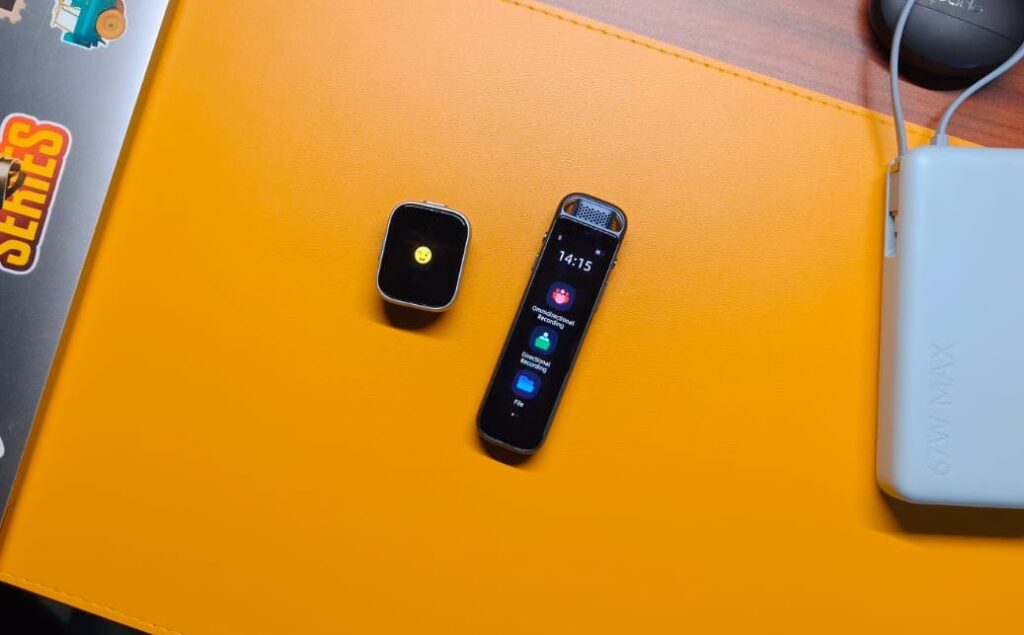
Back in my college days, I remember recording lectures on a budget Android phone, hoping to save all the important information right before exams. Yes, it wasn’t a perfect solution. My phone’s microphone wasn’t the best, and sorting through an hour-long lecture just to find something was like looking for a needle in a haystack. The same problems still apply in my professional life. I like to record in-person meetings because of my goldfish memory, but it’s a bit of a faff. And I’m not alone. Many professionals suffer from this exact problem, which is the reason the iFlyTek P1 and P1 Pro exist.
In essence, they are AI voice-recording devices that help you record meetings, transcribe them, and provide detailed summaries of what needs to be done and when. You can also translate meetings into different languages. They also work as conventional voice recorders for taking interviews and such, but the real appeal is with the Deepting app. But should you spend $119 on the P1 or $159 on the P1 Pro? To find out, I’ve been testing both for the better part of two weeks, recording meetings and sorting through all the information and its legitimacy.
iFlyTek P1 & P1 Pro Review
Summary
The iFlyTek P1 and P1 Pro solve the genuine problem of recording and sorting through meetings, turning it into an automated experience that requires little oversight. The recording quality, even for larger conferences, was excellent, and iFlyTek’s AI does a really solid job of transcribing the content. This, coupled with the fact that you can ask questions about the meeting directly, makes both genuinely useful tools.
Design & Hardware

The iFlyTek P1 and P1 Pro are fundamentally different devices. Yes, both record meetings, but that’s where the similarities end. Starting with the P1, it looks like a smartwatch. A small rectangular device with a display on the front and buttons on the top and left side. The first time I unboxed it, I mistook it for an Apple Watch, and I wasn’t the only one who thought that. The second thing I noticed was the weight, or lack thereof. The P1 is extremely light because you actually have to wear it. It comes with a magnetic accessory, which sticks to the back. You can either hook the magnet onto your shirt, like those fancy microphones, or use the clips. The latter are spring-loaded so they won’t fall off whenever you move.
The build is plastic, but I don’t mind since the P1 is extremely well made, with no moving parts or loose ends. There are two buttons on the device, each serving a different purpose. You power it on by holding the button on the left side for two seconds. Now, press the top button for two seconds to start/stop recording. So what does the display actually do? Well, that’s a great question you may have asked. The display on the P1 is very small. Possibly the smallest display I’ve ever seen to date. And it’s not that useful. All it does is show a winking emoji when the device powers on and a microphone emoji when it’s recording. Nope, you can’t change any settings or listen back to what you just recorded. For all that, you’ll need to rely on the Deepting app.

If not having a screen or speakers to play back what you just recorded is a problem for you, then the P1 Pro is what you need. It ditches the smartwatch form factor for a more elongated design, with a 3.2-inch OLED display nestled in between. It runs on custom software, allowing you to toggle between omnidirectional and directional recording, check the stored files, and adjust settings. The screen is plenty responsive, and iFlyTek has designed the UI quite thoughtfully. You also get a more premium metal-and-glass build, along with an extra flagging button to mark important moments of a meeting. Sadly, you can’t hook the P1 Pro to your clothing, so it’s more of a hands-on tool you might see people using during interviews.
Microphones & Recording Quality

As with the design, the microphones on the iFlyTek P1 and P1 Pro are different. The smaller one has two mics that can record either omnidirectional or directional audio. iFlyTek says it can record someone speaking clearly up to 5 meters, but I found the reality to be different. With some background noise, you should always aim to be around 3-4 meters max from the subject, after which the AI will have a hard time transcribing all the information. Speaking of the quality, I like it. The mics pick up conversation effectively without letting background noise interfere much. You will hear the playback clearly and not have to guess what the subject was saying.
The P1 Pro adds an extra mic, bringing the total to three. This increases the effective range of the P1 Pro to 10 m, which should be sufficient for recording conference room meetings. There is also support for 96 kHz/24-bit hi-res audio, which I put to the test when doing an interview with an eSports player at a PUBG Mobile tournament. Despite the abysmally loud background music, the P1 Pro picked up both of our voices surprisingly well, and the details were on point. I also put it in a conference room, and it effectively picked up voices from about 8 m away. Though after that, picking up quieter words became a problem. Both devices come with 64GB of onboard storage, which should be sufficient for years to come.
App Experience
So far, I’ve been impressed by the iFlyTek P1 and P1 Pro, but the app experience is the real deciding factor. Both devices pair with the Deepting app, available on both the Google Play Store and the App Store. Once paired, the app gives you unlimited cloud storage and 300 minutes of transcription every month. That was enough for a casual user like me, but if you’d be using it every day, I can see this being limiting. If that’s the case for you, there’s a Deepting Pro subscription. I’m not the biggest fan of subscriptions, but it does give you 1800 minutes of transcription, so you can be the judge.
All that aside, the recordings are synced from the device pretty fast. Each recording is stored separately, and you can play them at different speeds. There is a transcribe button front and center, which uploads your conversations to a remote server for processing. As for the quality itself, I found no problems. The transcription was accurate over 95% of the time, with clear separation between speakers, sentences, and pauses. It can sometimes mess up specific names, but that wasn’t a big problem and happened only 1 out of 10 times. You can also translate these transcriptions into 11 different languages.
On the top right, there’s the AI button, which itself has three sections: Overview, Notes, and Ask AI. The first gives you a concise summary of the meeting. If you want more detail, then the Notes section is where you need to be. It formats the content into headings, points, and other elements, which was great for digging up important information from an hour-long corporate jargon meeting. There’s also this ChatGPT-powered Ask AI feature. With it, you can ask questions about the meeting directly, instead of having to find everything yourself.
Verdict

After extensive testing, I can say both the iFlyTek P1 and P1 Pro deserve a place in the market. They solve the genuine problem of recording and sorting through meetings, turning it into an automated experience that requires little oversight. The recording quality, even for larger conferences, was excellent, and iFlyTek’s AI does a really solid job of transcribing the content. This, coupled with the fact that you can ask questions about the meeting directly, makes both genuinely useful tools. Yes, they do have a few flaws, namely the subscription, but if you have a use case, you should consider them.

As data center developers compete for a cut of the hundreds of billions of dollars flowing into the artificial intelligence industry, the queue to join the UK’s power grid has become jammed with projects that will likely never get built. The snarl is exacerbating already years-long wait times for viable projects, and it’s messing with attempts to forecast energy demand and plan grid expansions.
In July, the UK’s energy regulator, Ofgem, laid out a proposal meant to force phantom data centers out of the swollen queue. Under the plans, set to be finalized after an industry feedback process that ends in September, developers would be required to put down a steep, nonrefundable deposit that could balloon to hundreds of millions of dollars for the very largest data centers. Developers would also be required to line up customers in advance and prove they have the funding to complete their builds.
However, Ofgem faces a Goldilocks conundrum: The reforms must be burdensome enough to deter speculators but not so much that they drive legitimate data center projects to other shores, undermining the UK’s ambitions to meet the voracious demand for the compute required to run sophisticated AI models.
Data center developers face delays almost everywhere; similar grid congestion issues afflict the US and countries across Europe. But whereas the US is a highly desirable market, Ofgem’s reforms risk making the UK—already unattractive for the high cost of energy and dearth of land—one of the world’s most expensive places to build a data center, industry experts believe.
The frenzied data center buildout “is bringing a huge amount of capital investment into the UK,” says Alex Burgoyne, head of data centers at real estate consultancy Knight Frank. “We don’t want to shoot the golden goose.”
Ofgem says that it will take into account industry concerns before settling on a fee, but that differences between international energy markets make like-for-like comparison difficult. “We recognize data centers are a key part of the UK’s AI ambitions and future economic growth. Enabling viable data centers to connect more quickly is an enabler of this,” Nathan Macwhinnie, deputy director of strategic planning and connections at Ofgem, tells WIRED in a statement.
The queue to join the UK grid began to balloon toward the end of 2024, around the time the government designated data centers “critical national infrastructure.” Between November 2024 and June 2025, the total energy demand of the projects in the connection queue increased from 41 gigawatts to 125 gigawatts, according to Ofgem. New data centers make up 73 gigawatts of that—equivalent to one and a half times the peak demand for the entire UK last year—and counting.
The government has said it believes much of that demand is a mirage. “It’s absolutely insane,” says Taco Engelaar, managing director at grid optimization company Neara. “No one really understands … what the real grid demand will be because of these phantom projects.”
The crowded queue is largely the product of an incentives problem. Because developers face a years-long wait for grid access, and it has previously cost only a few thousand dollars to join the queue, they might as well apply for power, even if they do not have a watertight plan to develop a site. It’s a no-downside bet that allows developers to hedge for a future in which demand for compute remains sky-high.
However, because grid operators have to account for the combined effect of large infrastructure proposals on network stability before granting individual connections, phantom data centers can exacerbate already-lengthy delays for viable projects. “They have to treat every project as serious when they try to study whether the system can handle them,” says Olivier Darmouni, associate professor of finance at HEC Paris Business School, who has published research on the impact of AI on power grids. “The more speculative projects are especially damaging because they make these studies more complex, more expensive, longer.”


Star Wars Zero Company is earning strong reviews for bringing XCOM-style turn-based tactics to the Star Wars universe. Critics are praising its cinematic presentation, characters, and grittier story, while pointing to some occasional performance issues.
Tech
As Apple Prepares Another Next Tech-Defining Moment, Look Back at Major Milestones From Then to Now

That rumored foldable iPhone didn’t come from nowhere. Experts from CNET, PCMag, Mashable, Popular Science, ZDNET and Lifehacker examine Apple’s most important tech reveals.


Tech
Meta Just Paid Nearly $17 Billion To Make Sure It Gets To Write The Kid Safety Rules For Every Other Social Media Platform
from the regulate-me-daddy dept
By now you’ve almost certainly heard the news that Meta has settled with 52 state and local Attorneys General who had sued the company in some form or another over child safety on Meta’s platforms. The headlines are all covering the basics: the years-long case these states filed against Meta ends, and Meta pays somewhere between $12.7 billion and $18 billion, depending on which document you read (the consent judgment itself caps the total at $16,680,647,753.21; Meta’s press release rounds it up to “approximately $18 billion”). Also Meta will implement a bunch of changes to its platforms with the aim of improving child safety on those platforms. It will also “encourage” YouTube and TikTok to enable the same safety features even though (bizarrely), if YouTube and TikTok follow suit, then Meta will have to pay more.
You can read the details of the proposed settlement here.
Notably, the whole point of doing this as a “settlement” is that everyone involved knows full well that no government could mandate these feature changes without violating the First Amendment. But now that it’s in a “settlement” the courts may need to explore if these choices — which Meta could make freely on its own — suddenly have become a “state action,” implicating the First Amendment.
As with the various rulings against Meta over the last few months, people are cheering this on, without realizing the damage it will do. We’ll explore why this is problematic in a moment, but just to highlight that I’m not alone in thinking so, both EFF and Fight for the Future are warning how bad this settlement is. Here’s EFF:
Under this settlement, young users will now have less access to Meta products, and a lesser ability to exercise their rights to speak, access information and art and culture, associate and form communities, and play. The settlement also embeds age assurance into every product, mandating the collection of even more personal information from users of all ages; this enshrines Meta’s harmful surveillance into law, and it will compromise users’ privacy and anonymity while increasing their exposure to data breaches and government data requests. And the data minimization and security measures don’t keep states from using data collected under the agreement for other law enforcement purposes – which could include things like criminal investigations of abortions or gender-affirming care.
And here’s Fight’s emailed statement:
Big Tech does pose harm to our kids through its business practices and exploitation, but pushing for more censorship, age-gating, and surveillance of young people at the hands of the same Big Tech companies that have already harmed young people is not the answer. Online ID checks when implemented put vital information behind age-gates, stamp down teenagers’ right to speak, and expose all of us to even more of our data being collected, hacked, and leaked. Meta knows that managing this amount of personal information and enforcing these agegates will be messy and that’s why they are seeking to offload the burden to anyone but themselves, while being seen to comply by the public and lawmakers. Instead of actually damaging their exploitative business model, this result allows Meta to bring everyone else down with them, from app stores to other social media companies. We feared that these lawsuits would manufacture consent for invasive age verification and content controls and our fears have been proven correct. We will continue to oppose online ID checks everywhere and be on the watch for more censorship creeping into Meta’s platform.
We’ll get into the specifics of why this settlement is so bad, but first some important background. For a few decades now, when basically all Attorneys General would get together to threaten and/or sue tech companies, it was almost always over bullshit headline grabbing claims where the AGs either had no jurisdiction or ability to legally do anything. Sixteen years ago, we wrote one story about an account written by a CEO of a company who faced down dozens of state AGs who were way more concerned about the headlines they generated than actually making platforms safe.
It was similar to other stories that we’d heard, where no matter what companies did to explain to the AGs what steps they were taking to keep a platform safe the AGs would simply turn around and misrepresent what they were told, out of context, to make the platforms look worse and worse until they agreed to some sort of settlement. It happened with Craigslist. It happened with ISPs being forced to kick their users off at the behest of the recording industry. Even John Oliver has covered how grandstanding state Attorneys General will target just about anyone they want to shake down in some form or another.
That’s not to say that there aren’t righteous cases brought by Attorneys General, but there are so many examples of them being much more about getting headlines than actually making people safer. And the simple fact is that these efforts are so resource intensive, so expensive, and so draining that it’s no surprise that most companies end up “settling” by agreeing to do things that the government simply cannot force a company to do. But because it’s a “settlement” people act like it’s not the government doing it.
In this case, given some of the recent court decisions, it’s no surprise that Meta would strike some sort of settlement. As these cases continued, the headlines would only get worse for the company. And Meta deserves some bad headlines, but as I’ve discussed, many of the bad headlines in these cases involved lawyers and the media taking things way out of context. The classic case with Meta is that many of its efforts to study how to make its platforms safer were used against the company as proof that “they knew!” their platforms were unsafe!
The lesson for the rest of the tech industry is grim and unambiguous: never study whether your own platform is causing harm. The mere existence of the research will be turned into Exhibit A that “they knew,” both in the court of public opinion and in actual courts.
The other bit of background worth understanding here is that Meta has been desperately seeking a path to regulatory capture for quite some time now. It’s been practically begging for Congress to pass child safety legislation that only the largest companies (like itself) could comply with. Indeed, Meta has done this before. It went against the rest of the internet industry in embracing FOSTA, again to try to create a regulatory moat. So this shouldn’t be surprising.
Meta’s failed forays into the “metaverse” and AI have shown that it’s been pretty consistently losing the innovation race, and the government granting it a regulatory moat that smaller competitors can’t cross would be a godsend.
And it’s even better when it can be done in a way that looks like Meta “losing” a lawsuit.
So that’s what Meta gets here. They “settle” the lawsuit so the AGs and Meta haters can all claim that they’ve “protected the children.” Meta pays out over a decade — enough that it’s taking a $10 billion legal charge in Q3, which stings for a bit but will mostly be forgotten by next year. Meta can easily eat the cost. And then Meta agrees to implement a bunch of kid safety features, most of which we have no idea whether they actually protect any kids. Notably, a legislature could not have mandated most of these features without running straight into the First Amendment — but coming out of a settlement, they carry the imprimatur of law anyway (more on that in a moment), and the structure of the agreement makes it so that Meta has to actively encourage Google and TikTok to take identical steps, thereby setting in concrete what steps any platform will have to take to be considered following “best practices” and therefore acceptable to most of the country’s Attorneys General.
The specific features don’t even matter that much, but for the record:
- Time Limit: A default two-hour daily time limit that teens can only turn off with a parent’s permission. This limit is cumulative across Facebook and Instagram, and time spent scrolling on both apps counts toward the total, including if we detect that someone has multiple accounts.
- Night Mode: A default block from our apps between midnight and 6am. This means teens will not be able to post or view their Feed, Stories, Explore, or Reels, for example.
- School Mode: Notifications will be muted by default between 8 AM and 3 PM. During those hours, teens will no longer receive push notifications, except for direct messages and alerts about their account security or safety.
- Regular Prompts: Teens will receive prompts after every 15 minutes of continuous screen time on Facebook or Instagram. They’ll also receive prompts when their total daily usage hits 60 minutes and 90 minutes. These prompts are designed to encourage intentional use.
- Algorithmic Feed Control: Teens will be able to choose a non-algorithmic feed — one that isn’t personalized by our recommendation systems — as their default. We will periodically remind them of this option, and parents can choose to adjust their teen’s default experience to require this setting.
- Autoplay Control: Teens will be able to turn off autoplay, so that content no longer automatically plays. Instead, they’ll need to take a deliberate action, like a tap or swipe, to see more. Parents can choose to adjust their teen’s default experience to require this setting.
- Hidden Likes: Teens won’t see the number of likes and reactions on posts — both their own and those from others — by default.
- Disabling cosmetic surgery and extreme makeup filters: In addition to our existing policy to block teens from using cosmetic surgery filters, we’ll now block teens from using extreme makeup filters.
- Age Assurance: We work hard to find and remove underage accounts from our apps and, as part of our agreement, we’re investing in even stronger technology to proactively catch accounts that may belong to under-13s. We’re also strengthening the technology we use to identify accounts that may be between the ages of 13 and 17, so we can ensure those accounts are placed in experiences designed for teens, even if they give us an adult birthday. However, to ensure teens are consistently protected across the many apps they use, app stores must provide developers with verified age information. This will allow platforms to put age-appropriate protections in place for as many teens as possible. That’s why we’ll continue to advocate for legislation that empowers parents by requiring app stores to verify age and obtain parental approval before a teen downloads an app.
- Age-appropriate content restrictions: We will maintain our current content standards so that, by default, teens are placed into 13+ content settings, inspired by movie ratings criteria and parent feedback. We will also continue to prevent teens from following or interacting with accounts we consider age-inappropriate. We will work to continually improve these systems to ensure age-appropriate content experiences for teens.
- Unwanted contact from strangers: We will maintain our current practices of defaulting teens into private accounts on Instagram and private default settings on Facebook, and we’ll continue to restrict potentially suspicious adults from contacting them. We will also strengthen our efforts to make it harder for those adults to find, follow, or interact with teens.
- Reporting and ongoing protection from harmful content: We will continue to give teens easy ways to report content that concerns them, and we’ll work to improve our response times. We will also continue our work to protect teens from potentially harmful experiences by regularly evaluating how often teens are exposed to them. We’ll draw on research and expert input to improve our work.
- Strengthening our parental controls: We will encourage parents to set up our supervision tools and give them new controls and insights. This includes notifying parents when a teen links a secondary account, alerting them to interactions with potentially suspicious accounts, and providing periodic updates on their teen’s usage and any changes their teen attempts to make to their protective settings.
Some of those might be good features. Some of them might not be. Some of them might be good for some kids, but very bad for other kids.
Part of the problem is we really don’t know.
There is something of an accountability structure here too. Meta and the states will appoint an “independent” auditor for five years, and the age assurance system gets tested annually to meet certain thresholds. But it’s important to look at what’s actually being audited here. It’s whether or not Meta is implementing the things it’s promised to do, not whether any of those things actually work.
But now these are, effectively, mandated by law. Even though if Congress or the states had passed a law requiring these, it would almost certainly be thrown out as unconstitutional under the First Amendment.
The weirdest part of the agreement is that Meta has to try to convince Google (YouTube) and TikTok to implement some (but not all?) of these same features. Indeed, Meta has already put up a settlement-mandated open letter to those two companies asking them to implement those features.
What’s so weird is that if YouTube and TikTok agree to do this and to voluntarily throw billions of dollars at the states, then Meta also needs to pay more. The breakdown of the money Meta owes is partially dependent on them arm-twisting those two companies to do the same things:
The agreement includes a payment of approximately $18 billion, which can be used to fund youth online safety initiatives, among other state priorities. The payment will be distributed in annual installments over a 10-year period. Participating states will receive approximately 70% (approximately $12.7 billion) of the allocated payment over the decade. The remaining 30% (approximately $5.3 billion) will be released only after two specific conditions are met.
- YouTube and TikTok implement a one-hour Daily Limit, Night Mode, and age assurance measures.
- YouTube and TikTok each pay an amount matching the 30% figure, with half of the remaining funds tied to YouTube’s payment and half tied to TikTok’s.
You can argue that Meta might not actually want YouTube and TikTok to do this, so they won’t have to pay that extra $5.3 billion, but from a competitive standpoint, you have to think that Meta absolutely needs to have YouTube and TikTok implement these features or its already somewhat dwindling market share will dwindle faster.
It’s quite possible that YouTube and TikTok will go along with this, rather than get bogged down in a similarly costly legal fight. But, again, that would create many problems. First, we still don’t know if those feature changes are actually helpful or effective. But now they’re effectively government mandated.
In theory, this could open up room for other platforms to come in and sweep up the youth market by not implementing these same features. But the nature of this agreement is that if the state AGs suddenly feel like any platform is becoming too popular with the kids, it can point to this agreement and call it “industry standard” or “industry best practices” to insinuate that other companies not doing the same are deliberately choosing to keep kids unsafe.
Indeed, within the agreement there’s a bit of weirdness, in which Meta has to push for “industry wide adoption” which is currently defined as YouTube and TikTok, but which the agreement makes clear could include any new social media platform if such a new platform meets the thresholds. In other words, Meta is basically being forced into guaranteeing this settlement creates an industry-wide standard.
And that’s a real problem when we still don’t know how to actually help keep kids safer online. So if a web service comes up with a unique or innovative or different idea that works differently than what Meta has agreed to do, then that may be too risky to even try. Better to just follow what the AGs have “blessed” in this settlement.
As noted, we already know that some of these things are directly harmful. Age assurance is a privacy nightmare. Enshrining it as the industry standard means the end of meaningful online anonymity, and it “forces” Meta to collect more data about all of us — including adults — while handing the states a pipeline to that data for whatever else they decide it’s useful for.
That’s bad.
Also, there are some oddly specific requirements:
Meta SMPs will disable Teen Users from applying Cosmetic Procedure Filters to their content.
The agreement clarifies that this means:
… any digital filter or augmented reality (AR) effect that distorts, sculpts, redefines, or idealizes a user’s face in a way that cannot be achieved without cosmetic surgery or extreme makeup techniques.
And, sure, I can understand why such content might be unhealthy for teens. But it is, in fact, Constitutionally-protected speech. Meta could decide internally to block that speech specifically on its own platform (that’s its own editorial right). But now that it’s being done at the behest of government pressure, it almost certainly violates the First Amendment.
Also, somewhat oddly, some of the rules appear to only apply to content in English or Spanish:
With respect to Potentially Harmful Reported Content submitted in English or Spanish, Meta SMPs shall maintain processes designed to permit Teen Users to receive a response indicating Meta’s decision on the report within 6 hours in at least 90% of cases.
The implication is obvious: those are the languages most reports come in, and Meta is expected to staff up enough to clear them fast. But it also means the government has just negotiated a moderation service level that varies by the language you happen to speak — English and Spanish speakers get a six-hour guarantee, Tagalog and Mandarin speakers get whatever Meta feels like. That’s a strange thing for a state to be dictating at all.
This is also a perfect example of the kind of standard that only a giant can meet. A six-hour turnaround on 90% of reports is achievable when you have thousands of trust & safety staff and a decade of tooling. For a startup with four employees and a Discord server, it’s a fantasy — and now it’s the benchmark against which every AG will measure them.
So what happens now? The judge will need to review the settlement, but I’m actually wondering if some teenage users would have standing to challenge this. Meta is clearly restricting First Amendment protected speech under this agreement. It is free to do so on its own if it chooses to do so, but this is different. Here it’s doing so because it’s being forced to by various state AGs, making it a state action.
Under the Supreme Court’s recent (unanimous) Vullo decision, that seems pretty clearly unconstitutional. In that case,the justices said, quite clearly:
[A] government official cannot do indirectly what she is barred from doing directly: A government official cannot coerce a private party to punish or suppress disfavored speech on her behalf.
That seems like it should be the whole ballgame, because that’s what’s happening here.
One other point on all of this. Here’s the list of 52 Attorneys General that have agreed to this settlement:
Alabama, Alaska, American Samoa, Arizona, Arkansas, California, Colorado, Connecticut, Delaware, District of Columbia, Georgia, Hawaii, Idaho, Illinois, Indiana, Iowa, Kansas, Kentucky, Louisiana, Maine, Maryland, Massachusetts, Michigan, Minnesota, Mississippi, Missouri, Montana, N. Mariana Islands, Nebraska, Nevada, New Hampshire, New Jersey, New York, North Carolina, North Dakota, Ohio, Oklahoma, Oregon, Pennsylvania, Puerto Rico, Rhode Island, South Carolina, South Dakota, Tennessee, Texas, Utah, Vermont, Virginia, Washington, West Virginia, Wisconsin, and Wyoming.
Notice anyone missing? Yup. There’s no New Mexico. Remember, New Mexico won its initial case against Meta recently, enabling the judge to force a different set of feature changes on the company. So… now Meta may have certain features for New Mexico, and different features for everywhere else?
None of this is to say that Meta shouldn’t do a better job trying to protect kids on its platform. Obviously, it can certainly do more. But this settlement seems much more like Meta using this case as a way to force the industry into a set of required steps (which might not help much, and may do real harm in some cases), making it difficult for smaller competitors to enter the market, and giving them a bit of regulatory capture through mass lawsuit settlement.
As law professor Jess Miers wrote, this settlement is about Meta selling out the entire social media industry, forcing them to embrace impractical and unhelpful features that serve only to lock in giants and lock out upstarts:
But for all the people “celebrating” this as a win “against” Meta, you’ve been fooled. Meta just cut a deal to put itself in charge of how social media works going forward. As Justin Maurer wrote on Bluesky, this is Meta taking a “please regulate me Daddy” approach to the government, and getting exactly what it really has been asking for.
We still don’t have any actual evidence that this will help anyone, let alone every kid. The state AGs didn’t have to prove how this would help kids. Meta didn’t have to prove it. The judge won’t be asked to. It’s just taken on faith. Meta offered this up, the AGs okayed it… and it all becomes a grand experiment on kids.
You can argue that these feature changes sound like they should help kids. Limiting access to two hours a day (unless parents grant more, which many will), lights out at midnight, disappearing like counts — these all sound like they’ll help some kids. But if it turns out that locking kids out of these systems actually pushes the most vulnerable ones to darker places with no trust & safety team at all, you won’t hear about that from Meta or the AGs.
We just spent three years teaching the entire industry that if you do research on child safety, you’ll have it held against you. Do we really think that all of this is going to actually enable anyone to figure out what works to help actual kids?
Meta bought itself a moat. The AGs bought themselves headlines that will be useful next election season. And every teenager in the country was just automatically enrolled in an untested experiment. There’s a five year independent auditor requirement to confirm that Meta follows the rules. But not to see if the rules work.
Filed Under: child safety, kid safety, settlements, state ags, states
Companies: meta, tiktok, youtube
Radiation Link In Flight Attendant's Breast Cancer, French Court Finds

Titan, Infosys among 10 stocks with highest HNI holdings in Q1; check full list

Is Your Bitcoin Safe on Lightning? Developers Confirm Real Flaws, Patch Coming





-

 Fashion6 days ago
Weekend Open Thread: Madewell – Corporette.com
-

 Crypto World1 day ago
SpaceX stock could rise 75% to $240, JPMorgan says
-

 Business5 days ago
Musk’s Tesla, SpaceX Confirm $16.8 Billion ‘Terafab’ Chip Plant as World’s Largest Building in Texas
-

 Crypto World5 days ago
anatomy of crypto’s biggest liquidation event since 2021
-

 Crypto World2 days ago
A $30 Billion AI Fund Implodes, Now the SEC Is Investigating Wall Street’s Role
-

 Politics5 days ago
6 months on, Irish renters crushed by effects of government housing bill
-

 Crypto World1 day ago
Did Trump Just Move SpaceX Stock With One Truth Social Post?
-
 NewsBeat5 days ago
The ‘Lucky Dip Gang’ causing carnage for clicks: After five thugs were killed speeding in the wrong direction on a motorway, GUY ADAMS investigates a sick new trend… and why police aren’t even allowed to pursue them
-

 Business4 days ago
Mystery AI Model ‘Ox Alpha’ Draws Developers With Free Access as Chinese Lab Origins Remain Debated
-

 Business3 days ago
Moderna CEO warns China is pouring state money into mRNA technology
-

 Business7 days ago
Five Below: Kids Discount Retailer Reaps Rich Rewards
-

 Business2 days ago
NVIDIA Stock Drops Nearly 2 Percent to $210 on Seventh Losing Day Ahead of Critical AI Earnings
-
 Crypto World5 days ago
Nvidia Stock Suffers Longest Losing Streak Since 2022: Will Q2 Earnings End It?
-

 Sports4 days ago
Deshaun Watson fires back at Browns fans after being booed: ‘It’s a disrespectful thing’
-

 Business6 days ago
UK firms in critical financial distress rise 9% to 53,756
-
 Crypto World4 days ago
Google Gemini AI Predicts Ethereum Could Become the Trade Retail Misses in 2026
-
 Tech5 days ago
Unitree’s New Superman Robot Claims to Outjump and Outrun Every Human, Usain Bolt Included
-

 Crypto World7 days ago
Optimism-funded team's deciding vote shifts $49 million in OP tokens away from users
-
 Tech6 days ago
Faster chip in a familiar form factor
-
 Crypto World7 days ago
Japan 225 Analysis: Index Declines Amid Rising BoJ Rate Expectations
You must be logged in to post a comment Login