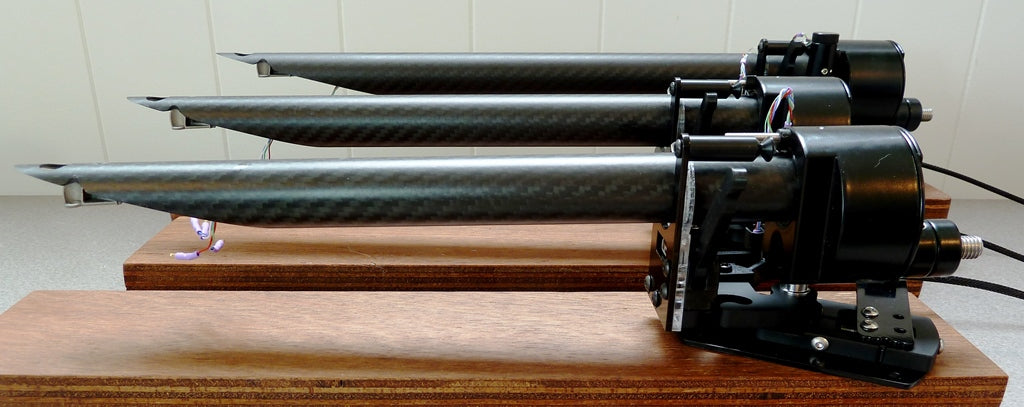
The Wand has been one of those tonearms that has intrigued me for years, largely because it never looked like it was designed by committee, or by someone trapped in front of a CAD workstation after midnight with too much confidence and something much stronger than coffee. They do it differently in New Zealand. Its wide to narrow carbon fiber arm profile helped make it instantly recognizable, and the design has built a real following over time. The latest chapter arrives next week at HIGH END Vienna 2026, where Wand will unveil its new 12-inch Dark-Light tonearm, a longer version of the 10-inch Dark-Light that first appeared at Munich High End 2025.
Long tonearms are not new, and neither is the argument over whether the added length is worth the extra real estate and setup demands. Wand already offers 9.5-inch, 10.3-inch, 12-inch, and 14-inch arms, and the company claims a 12-inch arm can reduce distortion by roughly 30% compared to a 9-inch design. That matters if the arm can keep resonance, rigidity, and bearing behavior under control, which is where Wand has always tried to separate itself from the usual aluminum tube and prayer routine.
My own curiosity goes back to some oddball tonearms I tried years ago, including the Japanese RS Labs RS-A1, a rotating headshell design that looked faintly mad but made a persuasive case for thinking differently about geometry and tracking. I also came across The Wand while looking at restored idler drive Lenco turntables, including the Dutch PTP Audio projects built around classic Swiss Lenco decks from the 1970s. PTP adopted The Wand for some of its turntables back in 2014, which only made the rabbit hole deeper. Naturally, I fell in. That is how these things happen.
The new 12-inch Dark-Light is not just about making the arm longer because the internet needs another argument. It is about whether Wand can preserve the speed, low noise, and musical flow that made the shorter model interesting, while taking advantage of the lower tracking distortion that a properly executed 12-inch arm can deliver. For vinyl listeners with the deck, space, cartridge, and patience to make it work, this could be one of the more interesting analog debuts at HIGH END Vienna 2026.
Advertisement
Handmade in New Zealand, Designed by Simon Brown
Design Build Listen is not just another boutique analog brand making pretty bits for expensive turntables. Based in Aotearoa / New Zealand, the company hand builds The Wand Tonearm along with other audio accessories, including its “No Ring Rings” tube dampers designed to reduce unwanted vibration.
Created by designer Simon Brown and launched in 2011, The Wand Tonearm has earned multiple design awards and five star reviews for its distinctive carbon fiber arm design. Its large diameter arm tube is claimed to be at least four times stiffer than traditional tonearms, which helps explain why The Wand has always felt less like a retro accessory and more like a serious rethink of how a tonearm should work.
Longer Reach, Tapered Stiffness, Serious Vibration Control
The new Wand Dark-Light 12-inch tonearm is not just a longer version built for people with more plinth real estate and stronger opinions. Its core advantage is Wand’s Musical Taper design, which increases the arm tube diameter toward the pivot as length increases. That larger rear section is intended to preserve stiffness rather than sacrifice rigidity, while also allowing more internal brass mass near the bearing assembly.
The added mass lowers the center of gravity and gives vibrational energy a more controlled path away from the cartridge and arm tube. For a 12-inch tonearm, that matters: the longer geometry can help reduce tracking distortion, but only if the arm remains stable, rigid, and free enough to trace the groove properly. The Dark-Light’s appeal is that it tries to balance those demands without turning the design into another heavy analog science project with nicer photography.
Advertisement
Will The Wand Tonearm Work With Your Cartridge?
The Wand Tonearm should work with a wide range of cartridges, which is one reason it has attracted attention from both high end analog users and listeners building more sensible vinyl systems. Design Build Listen says The Wand has been used with cartridges from Lyra, Transfiguration, Koetsu, Kiseki, Dynavector, Denon, Ortofon, Hana, and others, which covers a pretty broad slice of the cartridge world.
The standard Wand Tonearm is considered a medium mass design, with a claimed effective mass of 12.5g, while the 12-inch version is listed at 15g. The Master Series arms add roughly another gram.
Very high compliance cartridges still need some care, but Design Build Listen notes that even a Shure V15Vx measured at a 7Hz resonance, which remains usable. Lower compliance moving coil cartridges are also considered a good match.
Advertisement. Scroll to continue reading.
Advertisement
Denon DL-103 and Ortofon 2M models appear to be among the most popular cartridge choices with Wand users, which makes sense. One is a classic low output moving coil with a long history, and the other is a widely used moving magnet family that covers a broad range of budgets. Wand also recommends Hana moving coil cartridges, especially the Hana ML.
The practical takeaway is that The Wand is not a one-cartridge science project. It should work with many common MM and MC cartridges, provided setup is done properly and the turntable is not being asked to rescue warped records from the witness protection program. As always, compliance, cartridge weight, counterweight range, and phono stage compatibility still matter, but for most users, The Wand should not create a matching crisis.
Will The Wand Fit Your Turntable?
The Wand is designed around Rega-style mounting dimensions, but that does not mean it is the obvious upgrade path for every Rega Planar 3, Pro-Ject Debut PRO, or other sub-$1,000 turntable. This is a serious tonearm, and not an inexpensive one, so the better question is whether the turntable, cartridge, plinth, and overall system justify the move. Bolting a high-end tonearm onto an entry-level deck can work mechanically, but it may not be the smartest use of the budget. Vinyl has enough ways to separate you from your money without handing it the keys.
Where The Wand makes more sense is on turntables with the space, adjustability, and mechanical foundation to take advantage of it. Design Build Listen offers mounting information and kits for a wide range of decks, including the Linn LP12, Technics SL-1200 and SL-1500 family, including newer GR models, Lenco L75 family turntables, Thorens TD-160 and TD-150 models, Thorens TD-318 family turntables, Michell turntables, and SME-style armboards.
Advertisement
The 10.3-inch Wand is especially interesting because it was designed to deliver much of the appeal of a 12-inch arm in a more compact footprint. Design Build Listen describes it as the longest arm intended to fit on a Linn LP12 or Technics SL-1200 family turntable, which gives owners of those decks a way to go longer without needing a battleship-sized plinth.
Suspended turntables should not be ruled out automatically. The Wand weighs roughly 500g, which is in the same general territory as an SME 3009 and somewhat heavier than many Rega arms. That means most properly adjustable suspended decks should be able to accommodate it, but setup matters. Arm height, lid clearance, suspension adjustment, mounting geometry, and counterweight clearance all need to be checked before anyone starts drilling holes and pretending this is IKEA furniture.
The Bottom Line
At €8,900, the Wand 12-inch Dark-Light tonearm is not a casual upgrade. It is built for serious turntables, serious cartridges, and vinyl listeners who care about geometry, stiffness, resonance control, and setup precision.
Its appeal is the way Wand tackles the 12-inch tonearm problem: lower tracking distortion, a tapered carbon fiber arm tube designed to maintain rigidity, internal brass mass for vibration control, and, finally, headshell lifts for better day-to-day usability.
Advertisement
This is for experienced Linn, Technics, Lenco, Thorens, Michell, and custom plinth users, not someone trying to turn a budget deck into an analog miracle. It is available now and can be heard at Vienna High End in Halle 5, S15.
The blog Linuxiac reports: A new systemd fork has appeared with a specific purpose: removing systemd’s recently added support for storing a user’s birth date in JSON user records.
The fork, called Liberated systemd, published its first tagged release as v261 shortly after the official systemd 261 release. In other words, the fork follows upstream systemd while reverting the change that added the new optional birthDate field.
Importantly, this is not a new init system, a wider redesign of systemd, or a general-purpose alternative to the upstream project. Its stated purpose is to remain close to upstream systemd while removing what the author describes as “surveillance enablement”… The author recommends testing the fork in a virtual machine before using it on real hardware and warns nightly builds are more likely to be unstable than named releases.
After five films, digital technology has finally arrived in the cloth-and-plastic world of Toy Story. But the film, directed by franchise veteran Andrew Stanton and McKenna Grace, mostly avoids the easy trope of making technology inherently bad. Instead, it’s a disruptive force that can be either helpful or harmful, depending on how it’s used. The film makes the case that parents need to take a hands-on approach to help kids manage their gadgets, especially when it comes to managing screen time or dealing with bullying.
Slight spoilers ahead for Toy Story 5.
Toy Story 5 centers on Bonnie, a young girl struggling to make friends who was gifted Woody, Buzz and Andy’s other toys from the first three films. She’s the only kid in her neighborhood not using a Lilypad tablet — instead, she prefers to play the old fashioned way, by crafting scenarios purely out of her imagination. Her parents reluctantly decide to get her a Lilypad (played by Greta Lee) as a way to connect with other kids.
Like a McKinsey consultant storming into a quaint local business, Lilypad decides she knows the best way for Bonnie to make friends. The tablet sends friend requests to several girls Bonnie knows, and she miraculously gets an invite to a sleepover. But instead of playing together, all of the girls just zone out endlessly on their Lilypads, barely saying a word to each other. Those same girls later start bullying Bonnie for playing with older toys, which leads to Bonnie’s parents wisely disabling the Lilypad’s social network access.
Advertisement
Pixar
It might seem crazy that parents even have to worry about social networking for 8-year-olds, but platforms like Zigazoo and JusTalk Kids already exist. They market themselves as safe spaces where kids can chat with close friends and family members, but there’s still room for awful social dynamics. Kids will be kids, and many of them are little jerks.
While Lilypad stumbles to help Bonnie connect, older toys like Cowgirl Jessie (Joan Cusack) also realize they’re out of touch with the way kids play today. When Jessie tries to sneak her way into Bonnie’s sleepover, she immediately becomes a source of shame.
Research shows a relationship between managing anxiety and imaginative play in kids, and Toy Story’s main cast make convenient messengers for that information. But the film surprised me by finding ways to make room for Lilypad and other new devices. A messageboard app on Lilypad helps Bonnie connect with Blaze, another young girl who still plays with toys the old fashioned way. Without Lilypad, they probably never would have met.
It’s hokey, but it works in the context of the film. And it’s also the reality parents have to live with today. Despite their potential harms, it’s helpful for kids to sometimes watch TV on the go. There are tons of educational games on iPadOS and Android, and both platforms also have a bevy of video chatting apps for staying in touch with friends and relatives. The key is moderation and parental supervision.
Toy Story 5 would be even more of an insightful critique if it made room for new types of play. Lilypad just has a few basic games for kids. But these days, any iPad can play Minecraft, a game that is appealing precisely because it so closely mirrors imaginative play. It’s also complex enough to grow with kids into adulthood, more so than the likes of Woodie and Buzz Lightyear.
Advertisement
Now that tablets have entered the world of Toy Story, it’s unclear where the franchise can go next. Pixar has already wrung the series’ core concept dry. We’ve explored the inner lives of toys, we’ve seen them wrestle with the meaning of their existence and they’ve even confronted death directly. (Toy Story 3 must have traumatized an entire generation.) Toy Story 5 isn’t nearly as essential as the original trilogy, but at least it’s a reminder to parents that they can’t just sit back and relax when it comes to tech.
Putting hidden data in places where few expect it can be a fun hobby or even a professional career. In the case of [Tim Wehrle] it’s just the former. His most recent project in this area uses a favicon image for storing a HTML-based website and rendering its contents within the browser after the favicon has been downloaded.
To pull this off, a very basic HTML page was turned into a series of UTF-8 encoded bytes that were then declared to be a standard PNG image. The original 208 byte payload plus 4-byte PNG header only used part of a 9×9 pixel favicon. With a larger favicon image as typically used you could thus easily store more data, whether as visual noise like here or a bit more hidden.
Of course there’s a catch, and in this case it’s the Typescript code to unpack the bytes from the “image” and render them; you have to load that separately. But still, in these days of all-singing, all-dancing websites that take forever to render, it’s refreshing to see what you can do with so few bytes that they fit in a favicon.
As for the purpose of such an approach, that’s left as an exercise for the reader, but you’re more than welcome to take a poke at the GitHub project and the demonstration site..
Apple’s home automation updates and new product roadmap powered by Siri AI will kick off in 2026 with HomePod and Apple TV updates, but if you’re excited for the robotic arm for a Home Hub, you’re going to be waiting a while.
It’s no secret that Apple’s new AI push will include several new products like the long-rumored Home Hub. However, the timing of some of those products’ releases remains in question.
The Home Hub itself is expected in 2026 as well, which means an Apple Home-focused release cycle or event could occur in the fall. That device should launch as a standalone display that can be paired with various mounts like speakers, wall mounts, and articulating arms.
Advertisement
The new Apple TV is expected to support Apple Intelligence in some specific capacity and may have a new Siri Remote. The HomePod mini would also gain access to Siri AI, but that’s likely the only major feature of the product.
The robotic arm accessory for the Home Hub, which may include an upgraded AI-focused version of the tablet device, isn’t expected until 2027 or 2028. That device has always been more of a moonshot, with the Pixar Lamp-like device with a personality still in early testing.
It’s not really a question of if these products are coming, but when. With everything else releasing, Apple will need to find time to reveal its new Home Hub product category and sell people on why the new Apple TV and HomePod mini are necessary.
Advertisement
The September keynote will already be packed as it is, and I don’t think these products will fit the “just drop a press release” model. My expectation is that there will be a lengthy Apple Home segment during a primarily Mac-focused keynote in October.
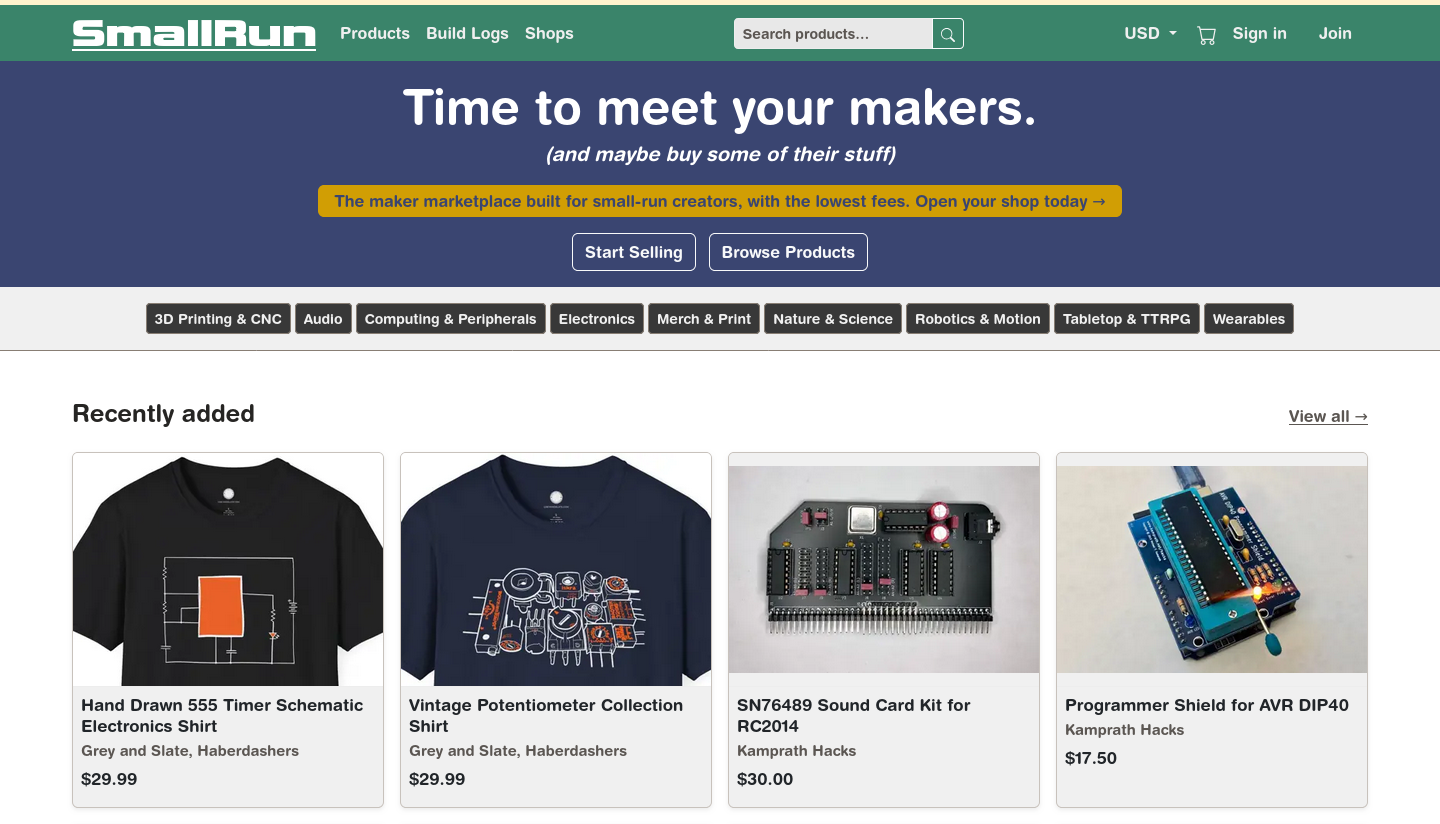
So you have a project that you love, and everyone else loves too. People start saying “you should sell this” but where? Well, there’s a new marketplace you might want to consider called called SmallRun, aiming at makers and their, well, small production runs.
SmallRun will absolutely host your custom PCBs, on-demand 3D prints, and other traditional maker products — but they’ll also happily sell your merch, too. Along with electronics and hardware, they aim to allow you to sell products in categories like tabletop gaming, sciences, and yes, accessories/apparel.
For sellers, they offer automatic payouts and promise to take care of the taxes by integrating with Stripe. That said, they’re still working on getting the whole VAT thing set up for products imported to the EU. EU to EU sales are apparently OK. They’ll host build logs, which may drive engagement with your product. There’s even a handy tool to import your existing listings from eBay, Tindie, Lectronz, Etsy, Shopify, or Crowd Supply if you’re already in the biz. They make their money by taking a cut of your sales: eight percent, plus forty cents per listing.
Depending on your perspective, you might wonder if we need another marketplace, To that we can only say: “Let a thousand flowers bloom!” Competition should drive these marketplaces to continuously improve and we all win.
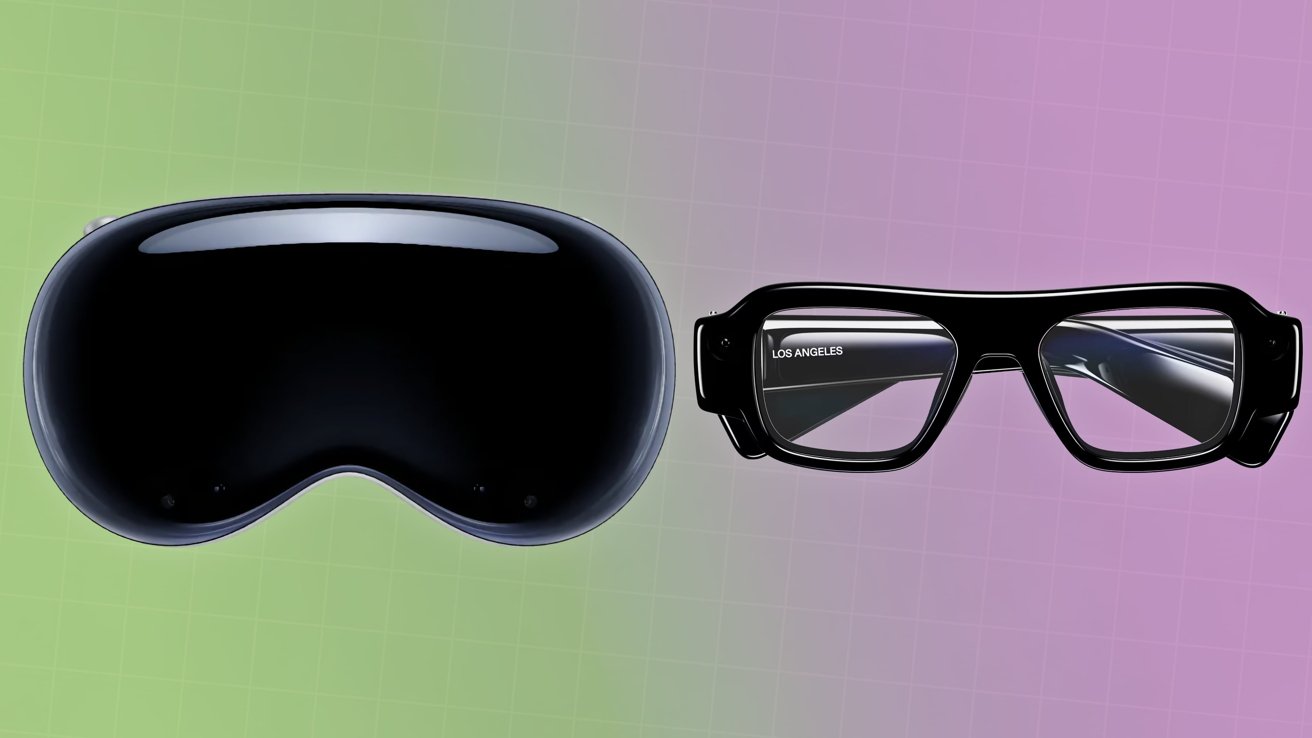
Apple wants you to step into a virtual world, while Snap wants you to stay in the real one. Here’s how their very different approaches to spatial computing compare.
Apple Vision Pro [left] vs Snap Specs [right]
The launch of Snap Specs at Augmented World Expo on June 16 is a big shift forward for the social company. After the previous effort of Snap Spectacles, Snap Specs are a step closer to the augmented reality future by being smart glasses with a built-in display. This is something that brings Snap’s efforts in line with the Ray-Ban eyewear that Meta has produced, including its yet-to-ship Meta Ray-Ban Display. It’s also a massively different product from Apple’s own head-mounted computing device, the Apple Vision Pro. Continue Reading on AppleInsider | Discuss on our Forums
On the latest episode of TechCrunch’s Equity podcast, Sean O’Kane, Rebecca Bellan, and I discussed what actually prompted the administration’s moves against Anthropic, and what this might mean for the broader AI ecosystem.
As Sean put it, “Anthropic has not had the best relationship with the Trump administration in a way that stands apart from the other leading AI labs,” so perhaps other Anthropic’s rivals don’t need to worry about a similar crackdown.
But Rebecca also noted that leading cybersecurity experts have “signed an open letter to ask Trump to revoke the order, and they say it’s actually dangerous to have to pull these advanced cybersecurity capabilities from network defenders in the U.S.”
Advertisement
And we wondered whether this could all end up being good publicity for Anthropic, especially since — in Rebecca’s words — “everybody loves a bad boy.”
Keep reading for a preview of our conversation, edited for length and clarity.
Rebecca Bellan: As I’m sure many of our listeners know, the U.S. government basically just forced Anthropic to pull its two newest models offline — Fable 5, and then there was also Mythos 5, which was the one that was available to current Mythos users, [whereas] Fable 5 was more available to the public.
They sent a letter [last] Friday that cited “national security concerns.” No one knows what those concerns are. That report has not been made public, they gave no specifics and told [Anthropic] that they had to ensure that those models couldn’t be used by any foreign nationals. So Anthropic was like, “Okay, I guess we have to just pull the models entirely, because we don’t know when someone’s a foreign national. A lot of our own employees are foreigners.”
Advertisement
But really, [reports said] the White House got tipped off to this because of some Amazon researchers that allegedly found a way to bypass Fable 5’s guardrails. Amazon CEO Andy Jassy raised these concerns with the White House, and it just kind of spiraled from there.
Sean O’Kane: This all moved really fast, especially for a Friday afternoon into a weekend. And it’s at the same time that the administration was ostensibly trying to negotiate some sort of treaty for the war that it started in Iran.
Rebecca: Friday evening for us in New York. They love a distraction.
Sean: Let’s step real far back for a moment. Anthropic has not had the best relationship with the Trump administration in a way that stands apart from the other leading AI labs — I think there’s an element, at least, of that playing here.
Advertisement
So do you think that this is going to have implications for those other companies? Do you think that the Trump administration would be less inclined to sort of turn off the tap on one of those competitors?
Anthony Ha: Part of the context here is that both the reporting and an analysis from independent security experts suggest that the actual security risk from Anthropic is not that unique. So a lot of this seems to stem as much from parts of the Trump administration and Anthropic just [not getting] along very well. Whatever risks there are, those things are gonna blow up out of proportion just because it seems like they can’t have a civil phone call with each other.
If you’re another company — on the one hand, maybe that’s advantageous to you, because you can say, “Well, we just don’t get these guys mad at us and we can do what we want.” But that’s also not a great regulatory landscape to just [say], “Boy, I hope they don’t get mad at us.”
Rebecca: On the one hand, it definitely feels retaliatory — after the government labeled Anthropic a supply chain risk, there’s this big lawsuit going on between them, it really feels like the White House is just looking out for any excuse to pummel Anthropic. And I feel that way not only because that was my initial reaction, but because of what a lot of cybersecurity researchers have said. They say that this should never have triggered an export control [order]. They’ve all signed an open letter to ask Trump to revoke the order, and they say it’s actually dangerous to have to pull these advanced cybersecurity capabilities from network defenders in the U.S. Anthropic itself said some of the same jailbreaks could have been found in several other AI models.
Advertisement
Cynically, it’s like: Okay, are you just pausing Anthropic so that others can catch up to where Anthropic was?
But at the same time, I’ve also seen reactions that [say]: Anthropic kinda had this coming. They’re like, “This is too dangerous for anyone to use, but not us, we’re the good guys.” They’re talking out of both sides of their mouth. A week before Fable came out, they were [saying], “Hey, we need to slow down AI, guys. It’s getting really dangerous.” But then boom, “Here’s our most insane ever, super powerful model, go off.”
Anthony: In some ways this feels like a microcosm of a lot of the discussion around AI, where people like Sam Altman and Jensen Huang are [saying], “Hey, let’s try to lower the temperature. Why is everybody mad at us?” Well, you spent the last couple years essentially saying you’ve built this God machine that will take jobs away from everyone. It’s not exactly a shock that people don’t feel great about this.
And there’s something about the way Anthropic talks about Mythos in particular, where they’re like, “This is the most incredibly powerful model ever, it’s too dangerous to release to the public.” And so on some level, [you say,] “Well, okay, let’s say that we take that seriously then. That means that there’s going to be an incredible level of scrutiny around it.”
Advertisement
And I do wonder — it does seem like Anthropic is not happy about this. I want to be careful about not overstating how this could be beneficial to them. But we also ran some stories about Ramp analysis to highlight the fact that the last big blow-up between Anthropic and the Trump administration was good for the company, in at least some ways. Downloads of Claude shot up. I think a lot of people who maybe had thought of ChatGPT as the chatbot, the AI assistant before, suddenly they were looking at Claude as maybe the more responsible one, the more “resistance” one.
And in the same way, [while] Anthropic is very stressed out about this, this could, again, make their models seem even more powerful.
Rebecca: Definitely. “We’re so dangerous.” Everyone loves a bad boy, right? Everyone’s like, “It’s the most powerful model, even Trump says so. Of course, I’ve got to get my hands on it.”
When you purchase through links in our articles, we may earn a small commission. This doesn’t affect our editorial independence.
“There’s a revolution in battery technology hiding in plain sight,” reports The Wall Street Journal. “The 3-D printing of batteries has the potential to put energy storage inside any device.
“This will enable lightweight and long-lasting consumer gadgets, long-range military drones and even nanoscale robots.” Almost all the innovations we regularly hear about — from cheaper, tougher electric-vehicle batteries to “Holy Grail” solid-state batteries — are about changing the chemistry of batteries. The promise of battery-tech 3-D printing (aka additive manufacturing) is simple: What if batteries could fill any available space, even structural elements of our gadgets, rather than always taking a rigid shape like a pouch or cylinder?
The new approach has obvious appeal. The entire airframe of a drone could be filled with energy storage for increased range. Smartglasses could have sleek battery-packed frames, so they look like everyday eyewear rather than “Revenge of the Nerds” props. One of the biggest advantages of 3-D printing is that it works with any battery, regardless of its cell chemistry. It could advance today’s lithium-ion as well as emerging sodium-ion and solid-state tech… Some [startups] are trying to use 3-D printing to create efficiencies in existing battery manufacturing systems. A brave handful of startups are pursuing radical new designs and approaches. They’re starting with defense applications, where cost and scale are less of an issue…
At Silicon Valley-based Sakuu… [r]ather than trying to 3-D-print whole batteries, the company is working on replacing one of battery manufacturing’s biggest pain points, says Arwed Niestroj, Sakuu’s chief operating officer, who is also a nuclear physicist and former head of Mercedes-Benz Research & Development North America. Existing battery assembly lines include football-field-long ovens for drying layers of material that have been dissolved in solvents. This requires a huge amount of energy and is a significant contributor to manufacturing costs, a big reason EV batteries aren’t cheaper. Sakuu’s process, under development for years, uses additive manufacturing to lay down key battery components without solvents, eliminating the need for ovens, says Niestroj.
Advertisement
Sakuu is currently working to commercialize this tech with a major battery manufacturer…
Today marks the summer solstice, the longest day of the year and the start of astronomical summer in the Northern Hemisphere. This doesn’t really have much to do with hacking hardware or building gadgets other than the fact that from this point on you’ll have progressively less daylight hours to do it in each day. Of course, if you do your best work in the middle of the night this won’t impact things much.
If you’re as likely to find a controller in your hand as a soldering iron in the evenings, you might be interested in a recent filing against Sony. Lawyers representing a group of four gamers allege that the entertainment giant is violating a California law that says digital storefronts need to make it clear that buyers don’t technically own the games in question but are merely licensing them — a license which, as we’ve seen in the past, can be revoked or modified at any time with no restitution made to the purchaser.
Now while we agree conceptually that selling gamers a license rather than an actual copy of the game is clearly a one-sided deal, we’re still not sure this case has a lot of merit. As far as we can tell, Sony does make it clear in the fine print that you’re not really going to own anything once they take your money. Or, at the very least, they make it equally as clear as any other company that’s selling digital downloads these days. Should the court actually find that said fine print is a little too fine, it could conceivably have ramifications throughout the entertainment industry. This is certainly a case to keep an eye on.
If you want to be sure none of your games can be removed from your digital grasp without warning, perhaps your best bet is to stick to the classics. Fans of 1989’s F-15 Strike Eagle II on PC will be excited to hear that there’s an ongoing effort by Neuvieme Porte to reverse engineer the flight sim and re-implement the whole thing in portable C.
This would open up all sorts of possibilities, such as ports to other platforms and the addition of new features and content. But before the project can get to that point however, Neuvieme is looking to recruit some virtual test pilots. Just keep in mind that the goal, at least for now, is to recreate the game exactly. That means bugs present in the original release are to be preserved. As such, it would help to have logged enough hours back in the DOS days to recognize what’s an OG bug and what’s been newly introduced.
Advertisement
From working on virtual jet fighters to the real deal, IEEE Spectrum recently ran an article about a startup called Phoenix Semiconductor that’s looking to produce bespoke pin-compatible replacements of critical chips for the military. They reason that the Air Force won’t mind paying $1,000 for a chip that cost them a buck back in 1975 when the alternative is grounding a $70+ million F-18 that needs the thing to take off. The goal isn’t really to recreate the old parts as they were, but instead to build drop-in replacements that are tailored for specific applications. In other words, Uncle Sam doesn’t care of the IC actually looks like the original, so long as it fits and it gets the jet up in the air again.
Finally, on the subject of aerospace technology, NASA’s Jet Propulsion Laboratory published a blog post earlier this week detailing their work on the Exploration Rover for Navigating Extreme Sloped Terrain (ERNEST). While NASA’s Curiosity and Perseverance rovers have done some incredible work on Mars, they’re slow and have to be operated with the utmost caution to make sure they don’t get stuck. In comparison, ERNEST is several times faster and is designed with an active suspension system that lets it lift each wheel up off the ground independently if needed.
The prototype rover also features improved autonomy that may allow future rovers make more decisions on their own. That may not be a huge time saver on the Moon, but given the communication delays with the Red Planet, a Mars rover that doesn’t have to stop and ask Earth for directions so often will be able to get more useful work done at the end of the day.
Advertisement
See something interesting that you think would be a good fit for our weekly Links column? Drop us a line, we’d love to hear about it.
The Wall Street Journal reviewed 1,105 videos along with guidance given to creators for crafting their posts.
Polymarket
In case you needed another reason to be wary of those videos showing people winning big on Polymarket, an investigation by The Wall Street Journal has found that the company is paying social media creators to post misleading content promoting the prediction market. Of the 1,105 TikTok videos the publication reviewed, 778 appeared to show someone placing a bet — but a closer look reportedly revealed that none of the latter featured the actual Polymarket website, instead using dummy sites made to look like the real thing.
For more than half of the videos that appeared to show winning bets, those bets would in reality have been losses, The Wall Street Journal reports. The publication spoke to creators who worked with Polymarket and viewed materials they say they were given to ensure their videos were convincing and engaging. In addition, Polymarket reportedly also enlisted a “social-media army” to repost these videos and help them go viral.










 To pull this off, a very basic HTML page was turned into a series of UTF-8 encoded bytes that were then declared to be a standard PNG image. The original 208 byte payload plus 4-byte PNG header only used part of a 9×9 pixel favicon. With a larger favicon image as typically used you could thus easily store more data, whether as visual noise like here or a bit more hidden.













































You must be logged in to post a comment Login