When you plan to start a business, the primary advice given is “first gather knowledge about the field, take some work experience, and understand your industry and market.” Because imagine starting a business or coming up with a new idea or product for your business expansion, only to find your competitor has already done it a week ago. It won’t give you the expected results or growth; that is where market intelligence steps in. In today’s cutting-edge era, it saves you from falling behind. In this blog, we will understand what market intelligence is, its types, and how to execute it.
Definition
Market intelligence is the collection and analysis of data to understand a company’s positioning among competitors, customers, industry trends, and advancements. This data processing offers a competitive edge and enables more informed decision-making for a business.
It is about getting the information at the right time, at the right place. One of the recent market intelligence examples is Netflix, which is one of the largest OTT platforms that leverages user data to personalize content, driving 90%+ customer retention, which saves $1 billion annually.
Types of Market Intelligence
Different branches of market intelligence answer different questions. Let’s understand each in depth:
1. Competitor Intelligence
It is full proof record of your rivals, what they are doing, their weak points and strengths, where they stand in the market, and what it is that customers appreciate and don’t like about them. By knowing so much about your competition, you can tailor strategies, get a competitive advantage, and also understand what not to do.
This branch deals with what others are doing in the market.
Advertisement
2. Product Intelligence
This intelligence arm works on gaining insights about individual products as to how they perform in the bigger market. It is a combination of sales data, pricing models, and consumer feedback. Product intelligence also helps in understanding which features are liked by customers and how they are impacting pricing and margins under pressure, and available alternatives. These insights support product updates and market priorities.
This branch tells you what is selling in the market.
3. Industry & Market Trend Intelligence
This is about being well-versed in your industry type and market at a broader level. It covers market size, growth rates, KPIs, government rules, technical changes, and larger persuasive trends that can market even overnight or at a rapid pace. Data such as internet search reports, industry business reports, and public statistics are used. This allows you to adjust your strategies in time and to consider what innovations can be done to stay ahead.
This branch guides you about market demands and needs.
Advertisement
4. Consumer Intelligence
This data collection and study is to deeply understand your customers’ behaviors, needs, and satisfaction. Data, including survey results, user feedback, etc., etc are useful to build better communication, refine consumer needs, expectations, and value propositions. This is beneficial to understand the buyer journey.
This branch is a connection between a business and its users, and it tells what they are looking for and why they choose a particular brand.
Marketing Intelligence Services
We will discuss some of the best market intelligence services.
1. Adverity
It is a fully integrated data platform, and its strength lies in automation, connectivity, transformation, governance, and utilization of data at a large scale. The complicated set of data is turned into usable insights. It is best for teams wanting control over pipelines. Though it has some challenges, including a steep learning curve, IT help, and the requirement of technical skills.
Advertisement
2. Improvado
Improvado is a full suite marketing analytics platform made for the AI era. The platform connects over 1000 data sources in any direction and can be built in minutes. It allows you to launch campaigns from a single prompt, along with offering dashboards and reports. It is one of the best platforms for internal teams or agencies with mixed sources and custom needs. Fallbacks can be a technical oversight with complex custom data pipelines.
3. Funnel
Funnel helps businesses and teams to move beyond reporting towards true incremental impact, predict budgets, and mimic different media allocations without needing to stitch separate tools or waiting for engineering resources. It is a great help for marketers who need more than dashboards. Also it can be used in a non-coding way with enterprise scalability and offering advanced measurement out-of-the-box. It is designed to focus on marketing and not finance/HR.
How Beneficial is Marketing Intelligence Research?
Improved Products: Derived insights help make the products more updated, make sure that the new releases are in alignment with consumer demands. Consumer feedback reports also help in understanding what is being liked in the product and what needs to be improved or changed.
Enhanced Marketing Effectiveness: As the intelligence keeps the campaigns in line with market needs, it results in better impacts in the competitive landscape.
Risk Mitigation: When you have enough data to understand the current scenario and what has happened in the past, it gives you the power for predictive analysis and to take proactive measures. This helps in reducing the chances of unexpected setbacks.
FAQs
What type of data is used in market intelligence services?
The data used in market intelligence is an amalgamation of qualitative and quantitative data. Type of data, such as consumer surveys, feedback reports, sales data, competitor analysis, and secondary research. This all-encompassing set of data gives a 1000-foot and 360-degree view of the market.
How important is market intelligence & what are its key elements?
Market intelligence is a vital process and must be done on a regular basis to ensure a competitive advantage and stay updated about market shifts. The key elements of marketing intelligence include data collection, organizing and processing, analysis, interpretation, decision, implementation, and feedback.
Is market intelligence important and relevant for small businesses?
Yes, absolutely. All the more, it will be more beneficial for a small business as market intelligence gives a complete view of the market, empowering small businesses to compete effectively and assertively against the big firms.
Advertisement
Final Word
Learning about what market intelligence is and executing it to make the best of data is important for every business today. By collecting data and analyzing it, businesses can make informed decisions and avoid future risks. We discussed the importance of market intelligence and also found out some amazing marketing intelligence platforms. In this blog i have also mentioned how different types of marketing intelligence offer solutions to different segments of external positioning of a business in the market. Thus, marketing intelligence is essential for a complete and broader view of the marketplace.
A week ahead of the Google I/O event, during the Android Show stream, there were some iPhone-friendly Android features teased. We already knew about them.
An Android smartphone and an iPhone
Google I/O 2026 is taking place on May 19 and 20, and the search giant is warming up for its biggest presentation of the year. To prepare its users for that event, it held a smaller presentation on Tuesday about Android. The Android Show I/O Edition 2026 was a 40-minute prerecorded stream, introducing a number of changes to Google’s ecosystem. There was obviously a lot of Google, Chromebook, and Android-specific content, but also some that was Apple-related in nature. Continue Reading on AppleInsider | Discuss on our Forums
The organisation plans to use the investment as a means of accelerating the application of its AI model, at scale.
AI-powered drug design and development company Isomorphic Labs has announced the raising of $2.1bn in Series B funding. The round was led by Thrive Capital and includes participation from existing backers Alphabet and GV alongside new investors MGX, Temasek, CapitalG and the UK Sovereign AI Fund.
Founded in 2021 and led by CEO Demis Hassabis and its president Max Jaderberg, Isomorphic Labs is headquartered in London and has additional premises in Cambridge, Massachusetts and Lausanne, Switzerland. The company, which is a spin-off from Google DeepMind, an AI research lab acquired by Alphabet in 2014, aims to address the challenges of drug discovery using AI technology.
Isomorphic labs intends to put the recently raised funds towards the continued development and deployment of its AI drug design engine (IsoDDE) and the acceleration and expansion of its pipeline of therapeutic programmes. Additionally, the funding will support current hiring targets.
Advertisement
Commenting on the announcement Ruth Porat, the president and chief investment officer at Alphabet and Google said, “The application of AI in healthcare offers a profound opportunity.
“Isomorphic Labs has already made extraordinary progress in harnessing AI to accelerate drug discovery, and we are excited by this momentum and the early promise of the technology platform.This trajectory is encouraging, and this funding will be used to accelerate the work and bring important interventions to market with greater speed.”
Jaderberg added, “This milestone is built on the strength of our AI drug design engine, which has already proven its worth across our internal programmes by hitting key milestones and identifying viable candidates with unprecedented speed.
“Our drug design engine works, and it’s giving us a repeatable way to design new medicines for a wide range of diseases, building a future of medicine that was previously out of reach.”
Advertisement
Reportedly, Isomorphic expects to run its first clinical trials by the end of 2026, a delay from the CEO’s earlier target of having AI-designed drugs in trials by the end of 2025.
In late April, Alphabet was among some of the large scale organisations posting positive quarterly reports. Alphabet beat revenue expectations for the past quarter, led by its growing cloud business, which rose 63pc to hit $20bn. Consolidated revenue grew 22pc to nearly $110bn.
Don’t miss out on the knowledge you need to succeed. Sign up for the Daily Brief, Silicon Republic’s digest of need-to-know sci-tech news.
It’s possible that among Hackaday readers are the largest community of people who have designed their own CPU in the world. We have featured many here, but it’s possible that not so many of them have gone on to power an everyday project. Step forward [Baltazar Studios] then, with a scientific calculator sporting a self-designed CPU on an FPGA.
The calculator itself is nice enough, with a smart 3D printed case, an OLED display which almost evokes a VFD, and very well made buttons. But it’s the CPU which is of most interest, because while it follows a conventional Harvard architecture with a 12-bit instruction set, it works with 4-bit nibbles. This choice follows one used by HP in their calculator designs, seemingly because it can be optimised for the binary coded decimal which the calculator uses.
With calculators being yet another app on our spartphones or comnputers, there seems to be less use of calculators outside of education in 2026. But if you are a calculator user there’s nothing like a calculator you made yourself, and with a CPU of your own design it has few equals. We like this project almost as much as we like the Flapulator!
Artificial intelligence didn’t roll out slowly. In fact, at times it feels like it landed all at once.
In just a few years, systems that began as internal experiments are now embedded in customer support, fraud detection, software development, and even IT infrastructure operations.
AI is now part of the operational backbone of modern enterprises.
Advertisement
Latest Videos From
But there’s a problem.
Anand Kashyap
CEO and co-founder, Fortanix.
Advertisement
While AI capabilities have advanced, the way we secure them hasn’t kept up.
Most organizations are still applying traditional security models to a fundamentally different kind of workload, and it’s leaving a critical gap at runtime, or the exact moment when AI systems do their work.
The Illusion of Coverage
For years, enterprise security has focused on two primary states of data: when it’s stored and when it’s moving. Encryption for data at rest and in transit, with identity and access controls for both.
Advertisement
Sign up to the TechRadar Pro newsletter to get all the top news, opinion, features and guidance your business needs to succeed!
These controls still matter. But there’s a third state that’s far more complex and far less protected: data in use.
When an AI model runs, sensitive data is actively processed in memory. Model weights, which are often the most valuable intellectual property an organization owns, are loaded into memory. Prompts, responses and contextual data are generated and transformed in real time.
In most environments, all of that becomes visible to the underlying system. The uncomfortable reality is that even well-secured environments can expose their most valuable assets at the moment they’re being used.
Advertisement
Where AI Security Actually Breaks
When security teams investigate AI-related risks, the root cause rarely traces back to perimeter defenses. The issues tend to emerge deeper in the lifecycle across three key phases:
1. Training: When data quietly leaks into models. Training pipelines span storage systems, shared compute environments, orchestration layers and debugging tools. They can be messy: data moves constantly, intermediate artifacts are created and cached, and logs accumulate quickly.
Advertisement
In this environment, sensitive information might surface in unexpected places. Models themselves may unintentionally retain elements of the sensitive data they were trained on. And model weights, which encapsulate that learning, are often handled more casually than they should be.
This all creates a subtle but serious risk where exposure doesn’t always come from a direct attack. Sometimes it comes from normal development practices.
2. Inference: An overlooked exposure layer. Once a model is deployed, attention shifts to inference, or the point at which inputs become outputs.
On the surface, it looks simple. But in practice, inference workflows involve multiple streams of sensitive data, including user prompts and queries, generated responses, internal enterprise data retrieved to ground outputs, and the model itself.
Advertisement
Much of this data is processed through monitoring tools, logging systems and debugging pipelines, often in plaintext.
Even without a breach, sensitive information can be exposed through routine operations. Troubleshooting dashboards might capture more than intended, or logs could persist longer than expected. Shared infrastructure also introduces more potential for leakage.
Inference security isn’t only about blocking access. It’s about controlling what happens during execution, and most organizations aren’t doing that yet.
3. Runtime: The blind spot in modern security. The most critical yet least protected phase is the runtime phase. This is where models actually execute, encrypted data is decrypted, and model weights exist in memory. And it’s precisely where traditional security models fall short.
Advertisement
Even in environments with strong identity management controls and encryption policies, runtime assumes a certain level of trust in the underlying system. If that system is compromised, or even simply misconfigured, the protections around it don’t matter because keys are still released, workloads still run, and sensitive assets are still exposed.
This is why runtime is currently the weakest link, and why it has emerged as the true security boundary for AI systems.
Why the Problem Becomes Worse at Scale
As organizations expand their use of AI tools, the risks don’t just increase. They multiply. AI workloads are rarely isolated. They more commonly run across distributed environments, shared accelerators, and multi-tenant infrastructure. They interact with internal systems and external services, and they operate continuously, not intermittently.
Advertisement
This creates a compounding effect:
1. More data flowing through more systems.
2. More models deployed across more environments.
3. More opportunities for exposure during execution.
Advertisement
At the same time, the value of what’s being processed is going way up. Proprietary models are becoming core business assets, and sensitive enterprise data is being used to fine-tune outputs and drive decisions.
In this context, a single weak point at runtime becomes a major systemic risk.
Top Priority: Rethinking Trust in AI Systems
The core issue isn’t a lack of security tools. It’s a mismatch in assumptions when it comes to trusting the infrastructure AI runs on.
Advertisement
With traditional security, the assumption has always been that once a workload is inside a trusted environment, it can be relied upon to behave securely. But AI changes this because these systems are dynamic. They process sensitive data continuously, rely on complex stacks that are difficult to fully validate, and often run in environments that organizations don’t fully control.
In other words, crossing the perimeter isn’t the hard part anymore. Staying secure after crossing it is.
To address this, security needs to move closer to the workload itself. So, instead of focusing only on protecting access to systems, organizations need to protect what happens inside them, particularly during execution. That means:
1. Ensuring that data remains protected even while it’s being processed,
Advertisement
2. Preventing unauthorized access to model weights during runtime,
3. Verifying that workloads are running in trusted environments before allowing them to execute.
This is where approaches like Confidential Computing and hardware-based isolation are making a difference. By creating protected execution environments and tying access to cryptographic verification, the industry is moving security from assumption-based trust to proof-based trust.
In simple terms: don’t trust the system. Make it prove it’s secure.
Advertisement
Security Has Moved to the Moment of Use
For years, organizations have invested in securing where data lives and how it moves. But with AI, the most important moment is when the model runs, and data, logic and decision-making converge in real time.
That’s where the real risks are, and that’s where security needs to be focused.
The organizations that recognize this shift early will set themselves up to scale AI safely. Those that don’t may find that their most advanced systems, built on an outdated trust models, are highly vulnerable.
Advertisement
In modern AI, security isn’t defined by the perimeter. It’s defined by what happens inside it.
This article was produced as part of TechRadar Pro Perspectives, our channel to feature the best and brightest minds in the technology industry today.
The views expressed here are those of the author and are not necessarily those of TechRadarPro or Future plc. If you are interested in contributing find out more here: https://www.techradar.com/pro/perspectives-how-to-submit
An anonymous reader quotes a report from the Financial Times (via Ars Technica): Amazon employees are using an internal AI tool to automate non-essential tasks in a bid to show managers they are using the technology more frequently. The Seattle-based group has started to widely deploy its in-house “MeshClaw” product in recent weeks, allowing employees to create AI agents that can connect to workplace software and carry out tasks on a user’s behalf, according to three people familiar with the matter. Some employees said colleagues were using the software to automate additional, unnecessary AI activity to increase their consumption of tokens — units of data processed by models. They said the move reflected pressure to adopt the technology after Amazon introduced targets for more than 80 percent of developers to use AI each week, and earlier this year began tracking AI token consumption on internal leader boards.
“There is just so much pressure to use these tools,” one Amazon employee told the FT. “Some people are just using MeshClaw to maximize their token usage.” Amazon has told employees that the AI token statistics would not be used in performance evaluations. But several staff members said they believed managers were monitoring the data. “Managers are looking at it,” said another current employee. “When they track usage it creates perverse incentives and some people are very competitive about it.”
E-commerce means faster-than-ever deliveries to customers, with faster dispatches and a time-efficient packaging process that gives you an edge in speed. But managing all this manually does not offer optimal efficiency, and that’s when the need for a cloud-based warehouse management system arose. After implementing WMS (Warehouse Management System), order picking speed increased by 25-40%, and some implementations even resulted in inventory accuracy rates as high as 99.8%. In this article, you will learn about how the pick and pack system works and which are some of the finest warehouse fulfillment software according to different businesses.
What is a Pick and Pack Software?
Pick and pack software is a tool, or we can say a part of a warehouse management system, that helps correctly pick products from the storage/shelves and bundle them for shipping. When an order query is triggered, the software displays which item to be picked, the quantity of it, and from which location it needs to be picked. Software uses barcode scanning technology to complete this process to avoid mistakes. Later, the software guides workers during the packaging of the products to make sure of rights items, box sizes, and labels are delivered.
As these warehouse picking and packing solutions automate the complete process, it reduces the chance of errors, save time, and help in faster and more accurate order fulfillment.
Best Pick and Pack Softwares
The software is often categorized on the basis of the businesses or workflows they are used for, ranging from e-commerce websites to enterprise operations. Here is a list of different types of plugins for different purposes.
Advertisement
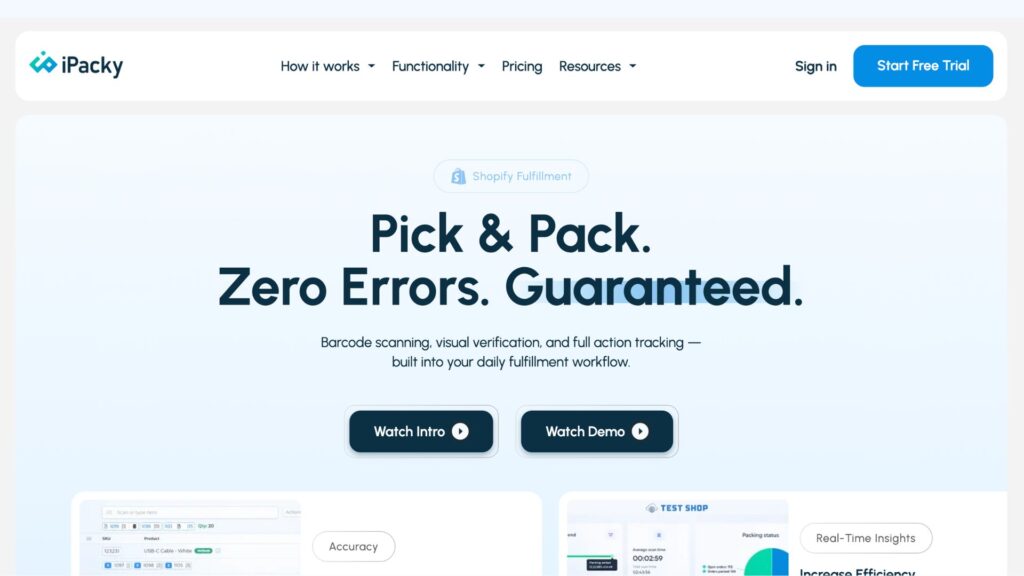
1. iPacky
It can be a great option as a pick and pack software for e-commerce. The tools claim their services to be error-free and guaranteed.
Pros
It is a virtual product for the easy processing of bundles or packs with a variety of products.
iPacky has a feature to register serial and batch information about the products on the order, which can be looked up later.
Offers you enhanced information flow such as customer order notes, packers’ notes, timeline notes, and product notes.
Cons
It only works with Shopify; for businesses operating on multiple platforms, that’s why it is not the right choice for all-purpose use.
It is not a complete solution to cater to a full WMS as it is only focused on picking and packing.
Data dependency on Shopify can cause accuracy errors; if the Shopify data is incorrect, the same will be reflected on iPacky.
Pricing
It offers a free version with full functionality up to 50 shop orders per month. The base price starts at $19.99/month. Check the official page for more details.
Ratings
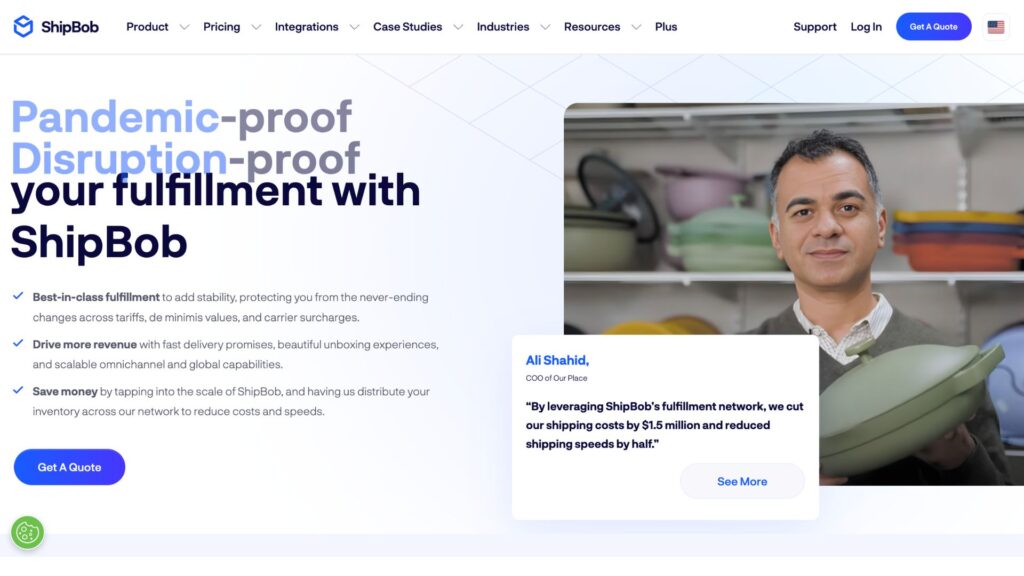
2. ShipBob
It has deep industry expertise across sectors as a complete warehouse workflow optimization solution at a global level. ShipBob uses a fulfillment network that has cut shipping costs by $1.5 million and reduced shipping speeds by half. It offers solutions for mid-market brands, WMS for brands, and WMS for 3PLs.
Pros
One of the best things is that they work in multiple sectors, beauty, food, health, apparel, and many more. And offer an end-to-end solution in warehouse management.
You can connect 50+ inetgrations form their app store or just build directly using their API.
The products ShipBob offers are outsourced fulfillment, full-stack fulfillment, omnichannel & B2B, customization in packaging, logistics, and more useful services.
Cons
This platform can be costly and has a complex pricing structure.
Some users experienced missing or mishandled stock and a lack of consistency across different facilities.
Fulfillment quality differs as per location, which can cause service variability and impact reliability.
Pricing
You need to request a demo on the official page of the website to know the exact pricing as per your requirement. But I have sourced you some pages where you can refer forstorage prices andthe US fulfillment centre B2B pricing.
Ratings
Capterra: 3.6/5
G2: 3.7/5
Trustpilot: 3.7/5
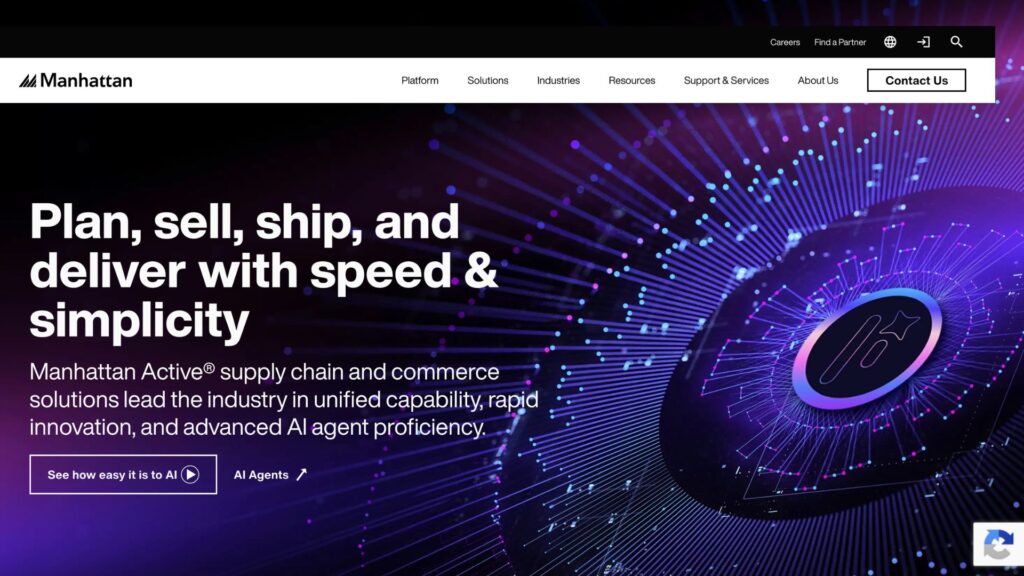
3. Manhattan WM
Manhattan Active® Warehouse Management is a cloud-based, microservices WMS made to bring together and optimize warehouse operations with real-time visibility, intelligent automation, and versionless architecture that offsets costly upgrades.
Pros
It has a strong clientele, including world-class brands Crocs, Brooks Brothers, DHL, PACSUN, and more. This shows the trust and reliability of the platform.
They offer a combination of automation with robotics management within the WMS, which helps in the smooth operation of automated tasks. Also, it makes it easy for managers to onboard new technology without needing extensive IT resources.
Multi-echelon inventory optimization (MEIO), transport management, 3PL supply chain solutions, AI agents and base agents, fleet management, and many more solutions related to finance, transportation, vendor management, and business planning are offered by Manhattan Active WM.
Cons
The implementation is complex and time-consuming, and can also require significant resources.
The learning curve is steep as it deals with large-scale enterprises and gives technically advanced solutions.
You need thorough planning to avoid system update interruptions. Also, integration with a legacy system often demands additional infrastructure.
Pricing
For pricing details, businesses need to directly contact Manhattan Active® Warehouse Management via their official website or contact information.
Ratings
Capterra: 4.0/5
Gartner: 4.2/5
G2: 4.0/5
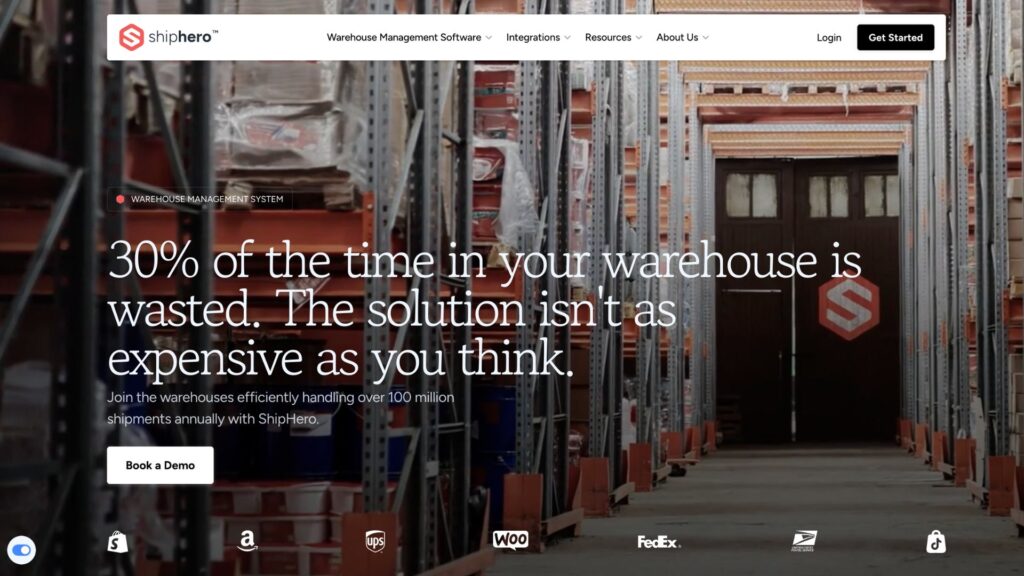
4. Shiphero
Best tool in route optimization for picking. The platform has been in business for more than a decade, and it is designed for wholesale & manufacturing and multi-channel orders. It streamlines everything from receiving to returns.
Pros
An AI-driven platform that helps reduce errors, automate tasks, and focus on time & cost efficiency.
Well integrated with several tools such as Shopify, eBay, Etsy, Oracle NetSuite, and many more.
Some of the most important features are optimized picking routes, order processing options for teams to pick orders most suitably, interesting gamified packaging avoiding the slow process of mouse and keyboard, and many other applications.
Cons
No bulk editing tools or management tools for advanced orders.
Some customers experienced delayed customer support.
There are reviews about inventory management and reporting tools that are less intuitive.
Pricing
The pricing is based on business demand and needs. It is tailored to the clients.
Ratings
Capterra: 4.3/5
Trustpilot: 4.4/5
G2: 4.4/5
5. Access Mintsoft
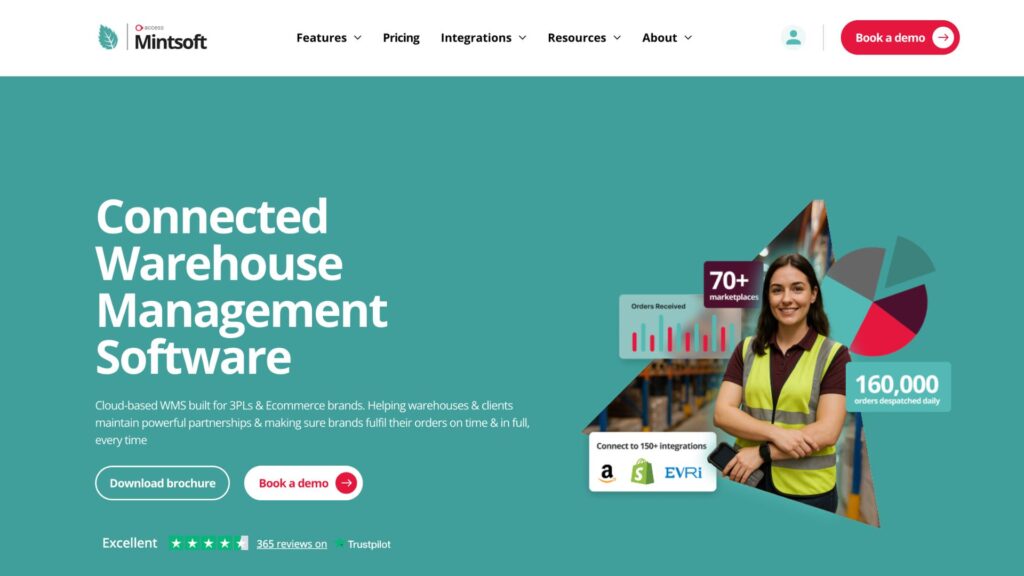
It is a WMS designed to automate inventory management, order fulfillment, and shipping. It is especially a good option for pick and pack software for small businesses and midsize enterprises.
Pros
Quick order processing, enhanced picking accuracy, fast delivery, and real-time inventory updates.
They offer multiple picking methods from single orders to bulk batches. Barcode scanning to keep track of stock and delivery.
An efficient mobile application and, most importantly, the Rebin picking feature for advanced order batching, which reduces unwanted footfall in the warehouse for multi-item orders.
Cons
Users faced a hostile interface after login and difficulty in accomplishing basic tasks that competitors automate. The user experience is not great, as some users have reviewed, and the learning curve is steep.
Some people reported unreliability of imports.
Mintsoft allocates a pic face too early, instead of reserving stock first and assigning after the pick list is printed. This drawback reduces warehouse flexibility.
Pricing
They offer different pricing plans according to the workflows, such as the ecommerce brands & wholesalers (brand plan), which starts at approximately $213/month. You can check the other plans here.
When looking for a warehouse management system platform, or specifically a pick and pack software, you must consider the following factors:
Order Management and Integration
Make sure your chosen platform/tool is well compatible with sales channels, preferably multiple channels (e-commerce platforms, ERP systems), to receive and process orders.
Look for advanced order features and priority features based on urgency, location, and shipping method.
Picking Optimization
Make sure the guides work through optimizing routes in the best possible way to pick items in the warehouse.
Advertisement
Has multiple picking methods. Uses modern tech to avoid errors by verifying product details, such as barcodes and RFID tags.
Enhance Packing
Check whether the packing assistance of optimal level or not; it must suggest packaging materials and box sizes for orders.
The items must be packed securely, with weight dimensions taken into account for shopping. Prints shipping labels directly.
Shipping Integrations
Make sure the software features integrate with carrier services (FedEx, UPS, USPS) for real-time rate comparisons and tracking. The shipping labels can be automated, and customers can receive tracking information.
Inventory Tracking Features
Updates on inventory are one of the most important features to look for while selecting packing software for warehouses. You must be aware in real-time about when and where your items are picked and packed.
Advertisement
Also, it helps you prevent overselling by syncing with stock across multiple sales channels.
Analytics and Reports
Provides clear actionable insights about order accuracy, fulfillment speed, and how effectively employees are working.
Table for you to spot areas for improvement and bottlenecks.
Tool Name
Best for
Pricing
iPacky
Shopify
Has a free version & a paid version that starts from $19.99/month
ShipBob
Global E-commerce
Request a demo for pricing and check the above-mentioned official pages
Manhattan Active Warehouse Management System
Large Scale Enterprises
Directly contact the provider
Shiphero
AI-Driven Solutions
Based on businesses’ needs and demands
Access Mint
Midsize Businesses & 3PL Fulfillment Solutions
Starts at $213/month approx.
Conclusion
Every sector is observing a surge in automation due to the rise and broad implementation of artificial intelligence. Consequently, time & cost efficiencies, along with high speed, are the goal of every industry today; therefore, speaking of e-commerce domains, it is the primary requirement. Warehouse management systems and their most important branch, called pick and pack software, are helping achieve these goals. They automate tasks, track inventories, streamline operations, enhance shipping, picking, order management, and integration. We discussed some of these tools for each of the different workflows. Their strengths, weaknesses, ratings, and what are they best used for?
Pick and pack software works by automating and guiding the order-fulfillment process in a warehouse. It all starts when an order is received from an online store or an order system. The software begins with listing products, shows which ones, how much/many, and from where to collect the products.
They help optimize picking routes, use barcode scanning to confirm scanning, and then also guide the packaging process with the right size and type of packaging. The inventory is updated in real-time throughout the process, speeding up the process and making sure the right order is delivered to the right customers before the mentioned time.
Chances are, you’ve looked at the gear selector in your car and realized that you know what P, R, N, and D stand for, but ‘L’ may not be familiar. You aren’t alone and there’s a good chance you’ve never used it, or at best you’ve shifted into “L” by accident, before throwing the selector back into drive.
Really, “L” refers to low gear. It allows your transmission to utilize more torque towards the lower end of the gearing. In practice, it often means restricting the transmission to stay in first gear (although some manufacturers use a different gear).
Advertisement
In the days of eight, nine, or even 10-speed automatic transmissions, “L” is still sometimes used, but in some cases, it has been replaced with a “+/-” or “S,” or “M,” indicating that you can manually select the gear you want. On sportier cars, the gear selection is done by paddle shifters behind the steering wheel.
Advertisement
When you need lower gears
Going back to the simple “L,” when is going into low gear needed? CarFax notes that going up a hill and going down a hill are times when shifting into “L” might help you out. The lower gearing helps your car attain and maintain enough torque to climb a steep hill. Additionally, while descending, it allows engine braking to take over, reducing wear on your brakes. It can also give you more torque for towing.
Modern automatic transmission are complex bits of machinery that give drivers a lot of flexibility when behind the wheel. Advanced, bleeding edge transmissions in new hybrids and mild hybrids even utilize the instant torque from an electric motor built into the transmission, like in the now-discontinued Jeep Wrangler 4xe giving the low gear more grunt. The electric motors in plug-in hybrids and electric cars do away with the need for selectable lower gear entirely. The motor decides for you.
Still, for people who like and drive older cars, there’s something nostalgic and even a little heartwarming about seeing “PRNDL” on a gear selector. There’s no mechanical wizardry involved.
Apple grew iPhone sales in the United States during the first quarter of 2026 even as the broader smartphone market declined, fueled both by strong iPhone 17 demand and Samsung’s delayed Galaxy S26 launch.
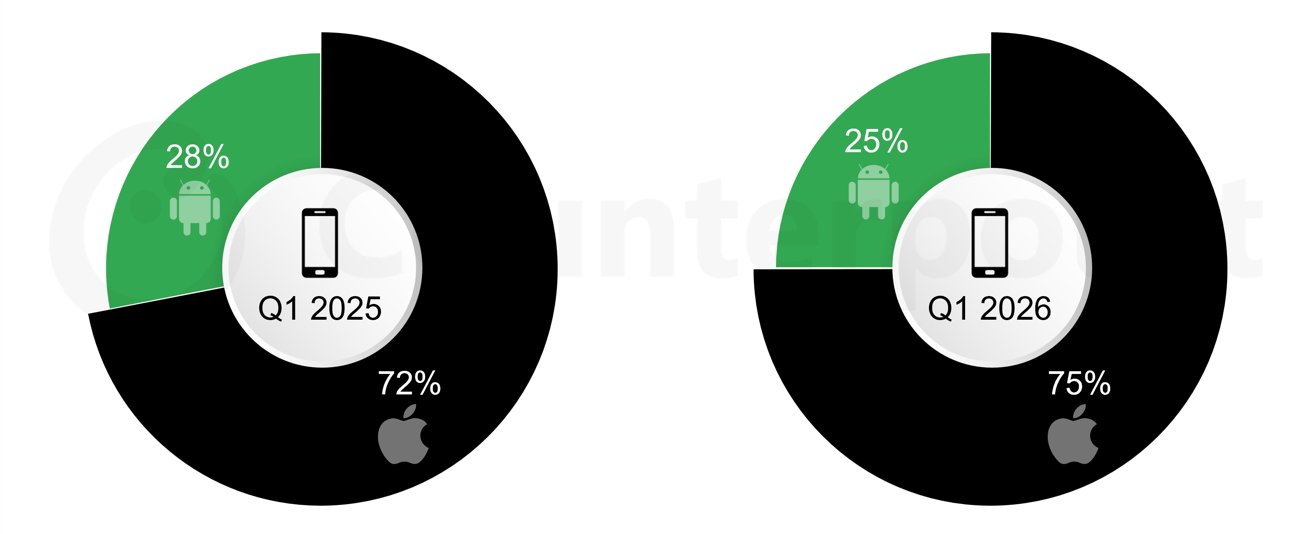
US iPhone sales volume rose 1.3% year over year during Q1 2026, according to Counterpoint’s US Monthly Smartphone Channel Share Tracker. The US smartphone market declined 5.7% during the same period, while Android smartphone sales fell 14.4% year over year.
Apple gained share across AT&T, T-Mobile, and Verizon during the quarter. Verizon showed the largest shift, with Apple reaching a 77% share of smartphone sales in Q1 2026.
Supply constraints during the 2025 holiday quarter continued limiting iPhone availability into early 2026, extending demand for the iPhone lineup through much of the first calendar quarter. Counterpoint said the base iPhone 17 model also saw stronger demand than expected during Q1 2026.
Advertisement
Apple increased its share of smartphone sales across the three largest US wireless carriers during Q1 2026. Image credit: Counterpoint Research
Samsung delayed the Galaxy S26 launch until mid-March, creating a wider opening in the premium smartphone market during Q1 2026. The US premium smartphone segment remains heavily concentrated around Apple, Samsung, Google, and Motorola.
Launch timing matters more in that kind of market because flagship devices drive a large share of upgrade activity.
Apple’s pricing and carrier strategy continue strengthening its position
Carrier relationships remain one of Apple’s biggest advantages in the US smartphone market. Verizon showed the largest shift during Q1 2026, with Apple reaching a 77% share of smartphone sales.
Apple’s advantage extended beyond Samsung’s delayed Galaxy S26 launch. The company kept iPhone 17e pricing relatively stable while increasing entry-level storage to 256GB.
Rising memory costs pushed competing smartphone makers toward higher prices during the same period. Carrier incentives, financing offers, and ecosystem retention increasingly shape purchasing decisions alongside hardware specifications.
Advertisement
Apple also strengthened its promotional position across devices priced above $600 in US postpaid channels during the quarter, outperforming Samsung in Counterpoint’s Smartphone Promotional Index. Apple’s pricing and carrier strategy place greater emphasis on keeping users inside the iOS ecosystem and expanding long-term services revenue.
The report said that strategy may limit hardware margin growth in some segments. Smaller Android vendors may struggle to match the company’s pricing consistency, carrier support, and marketing scale as component costs continue rising.
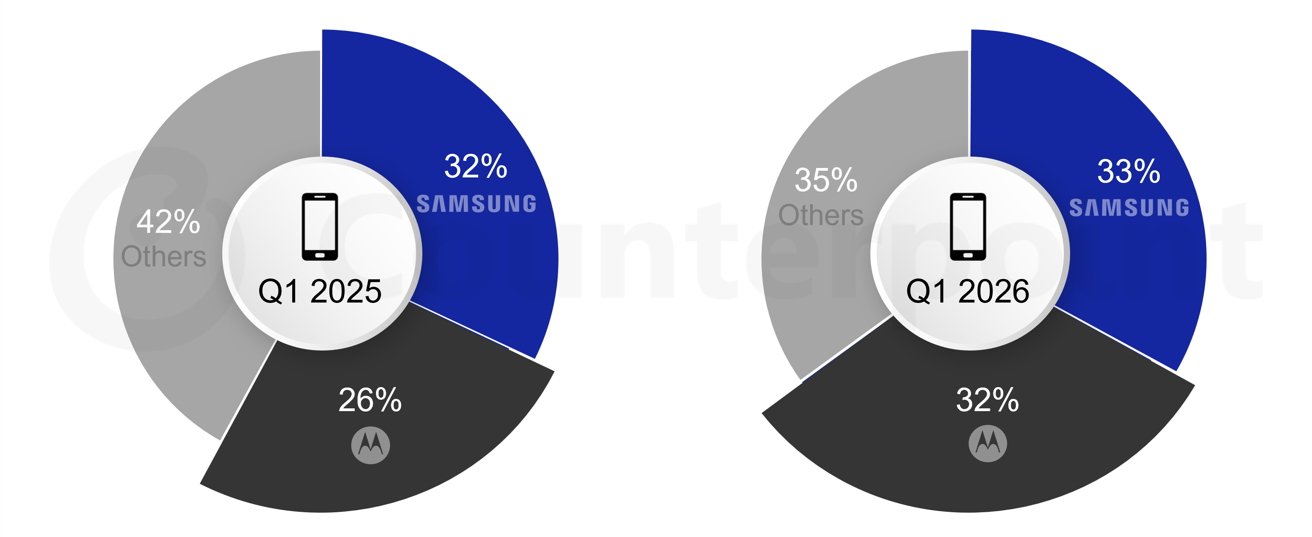
Samsung and Motorola gained share in prepaid and national retail smartphone sales during Q1 2026. Image credit: Counterpoint Research
Prepaid and low-cost smartphone segments continued weakening across the US market during Q1 2026. Higher gas prices and debt payments offset the impact of larger tax refunds, leaving lower-income consumers under continued economic pressure during tax season.
Sales weakness was particularly severe below the $100 smartphone tier, where rising memory costs and shrinking margins are putting pressure on smaller Android brands. Samsung and Motorola gained share across prepaid channels such as Cricket and Metro.
Brands including TCL, HMD, Maxwest, Orbic, and Blu lost share, delayed refresh cycles, or struggled to maintain marketing support during the quarter. Those shifts point toward a more consolidated US smartphone market as smaller brands lose ground.
Advertisement
The US smartphone market is becoming more consolidated, with Apple strengthening its position in premium devices while Samsung and Motorola absorb more of the shrinking low-cost segment.
There is a version of this story that writes itself.
Consider how AI tools have shaken up the creative process, streamlining repetitive and mundane tasks, accelerating production timelines, and empowering more people than ever before to visualize their ideas (if imprecisely).
These are fascinating developments. But the more interesting conversation is what these trends in creative operations now signal for leaders navigating AI, brand strategy and enterprise decisions.
Advertisement
Latest Videos From
Phil Garnham
Executive Creative Director at Monotype.
Advertisement
The human-AI collaboration in typography
Right now, AI is doing two things to the creative industry. It is compressing the time it takes to produce work, and in doing so, it is exposing which parts of that work require human expertise.
In that sense, AI is an iterator, not a replacement for creative judgment. It is generating options, compressing exploratory cycles, and surfacing new formal directions faster than any team could manually. But the key decisions – what works, what fits the brand, what communicates a specific intent to a specific audience, which cultural context it fits – contain nuances where human intuition remains indispensable.
In type design and technology specifically, seemingly small decisions matter enormously. Proportion, rhythm, contrast, spacing and personality are not considerations one can hand off to an AI model and expect production-ready results. But AI can and is helping teams make faster and more informed decisions by compressing exploratory cycles and surfacing formal directions faster than any person could manually.
Similarly, AI is extending type systems into broader language coverage more efficiently. Latin has historically dominated type design, and expanding into Arabic, Devanagari, Chinese and other scripts have required significant time and specialist expertise. For global businesses, that has often meant inconsistent brand expression across markets.
Advertisement
Sign up to the TechRadar Pro newsletter to get all the top news, opinion, features and guidance your business needs to succeed!
AI is now helping close some of that gap, but it does not reduce the need for local knowledge. Language carries culture, history, regional expectations, and visual norms that demand human oversight. The better model is AI helping experts in graphic design with stronger support behind them, rather than replacing the local experts who makes global brand expression work.
Recent research supports these examples: 62% of surveyed organizations using AI and automation reported boosts in both efficiency and creativity, which suggests the two are not in tension so much as they are increasingly dependent on each other.
Advertisement
Typography as operational infrastructure
As organizations use AI to generate content faster and at greater scale, they also need stronger typographic systems to hold that content together. Think of font licensing, version control, language support, consistency across channels and markets – these are all questions that used to live in back-office conversations but are now firmly strategic.
Additional research shows that 82% of creatives cite typography as one of the top three components in their decision-making, and 85% view choosing a distinctive font as critical to shaping a brand’s identity.
At a moment when AI is accelerating content production across every channel, those numbers reiterate that the typographic decisions underpinning the content carry more weight than they are often credited for in boardroom conversations.
Advertisement
Importantly, a business generating marketing assets or product interfaces with AI cannot afford typographic inconsistency. Brand coherence breaks down quickly when different teams and tools start pulling from different font sources without any governance in place.
The volume and speed that AI unlocks makes that problem significantly prominent and harder to manage without a system to support it.
Typography is increasingly functioning as the operational layer that determines whether faster content production can truly be deployed at scale.
Advertisement
How creative teams find and deploy type is changing
Beyond production, AI is also shifting how creative and brand teams discover type. Historically, font search has been constrained by names, categories and broad stylistic labels. The industry is now moving toward search by emotional intent, tone of voice, and communicative effect.
Describing what a piece of communication needs to feel like, rather than navigating rigid filter systems, makes type selection faster and more aligned to the outcomes that creative teams are trying to express. For businesses managing large-scale brand systems, that is a meaningful workflow improvement.
Risks and considerations to look out for
These opportunities sound exciting, but any business leader evaluating AI creative tools should remember that generative image tools frequently hallucinate typography.
Advertisement
The letterforms look plausible at first, but designers making decisions using AI-generated type mock-ups are often working from something that cannot be built or deployed at scale.
The practical solution is insisting on workflows where actual fonts are tested in real contexts, with real outputs, before any creative direction is committed to.
The real competitive divide is behavioral
For business technology leaders, the competitive divide will be in how AI tools are embedded into daily workflows in ways that genuinely improve speed and quality of decision-making.
Advertisement
The systems underneath, including typography, enable that output to stay on-brand and scalable.
For designers and creative businesses serious about AI, getting that infrastructure and governance right is where the work starts.
This article was produced as part of TechRadar Pro Perspectives, our channel to feature the best and brightest minds in the technology industry today.
Advertisement
The views expressed here are those of the author and are not necessarily those of TechRadarPro or Future plc. If you are interested in contributing find out more here: https://www.techradar.com/pro/perspectives-how-to-submit
A report has outlined some of the changes coming in iOS 27, some new, some rehashed, none surprising. Among them are elements affected by Apple Intelligence upgrades and a customizable Camera app.
It seems Apple’s recent hire of pro camera app Halide co-founder Sebastiaan de With will yield near-immediate results in iOS 27. Tuesday’s latest rumor is a continuation in a series of reveals of otherwise obvious feature updates coming soon.
According to the latest update from Bloomberg, Apple’s iOS update will touch Camera, Weather, Safari, Image Playground, and the system tab bar.
Even the keyboard is reportedly getting a new animation when it slides up.
Advertisement
For those that have been following Apple for years, these rumored changes aren’t surprising. Apple tweaks UI features and adds elements with each OS upgrade.
There are some details that could only be guessed at before. So, here’s a list of what’s coming.
A customizable Camera app with selectable widgets for each camera mode
A Siri app that lists recent conversations with the user
A new Siri animation that lives in the Dynamic Island
A swipe-down from the top gesture that summons a new AI-powered “Search or Ask” bar in the Dynamic Island
A long-press on the search bar will let users swap AI models
Safari gets a new Start Page with four tabs for accessing favorites, bookmarks, a reading list, and browsing history
Weather gets a new Conditions panel in the main interface that used to require a separate menu
Image Playground is being redesigned with a new “describe a change” option and upgraded models that produce more lifelike results
Search will be reintegrated with the bottom tab bars across apps similar to how it looks in the App Store today
Previous rumors also indicated various Siri changes, like the new standalone app. Apple moving Siri to the Dynamic Island also seems obvious since it’ll be anthropomorphized as a character you’re interacting with rather than it being an ambient rainbow color.
That said, it appears that Apple will still be keeping Siri and AI tucked away until summoned. That’s the opposite approach of Google, which announced an AI cursor that waits for you to gesture at anything to bring up an AI feature.
Apple Photos is getting new features powered by Apple Intelligence, like the ability to extend a background or automatically enhance an image. We’ve also heard of Apple Wallet getting a custom pass generator, which was leaked via code previously.
Advertisement
These extra details might have been easy to arrive at with some simple guesswork, but now they’re confirmed by a reliable source. Of course Sebastiaan de With would bring a custom camera interface, Siri would get a vastly new UI, and Liquid Glass would see some tweaks.
Now let’s wait and see if someone can tell us something we don’t know. Or actually, maybe it’ll be a surprise for once.
We don’t have to wait long, as Apple will reveal iOS 27 during WWDC 2026 on June 8. Expect more leaks in the meantime, even if they aren’t difficult to predict or groundbreaking.






























































You must be logged in to post a comment Login