When Focal and Naim announced support for another high-resolution streaming service this week, my first reaction was probably the same as that of a lot of North American audiophiles: What exactly is Presto Music?
I spend an unreasonable amount of time using TIDAL and Qobuz, reviewing network amplifiers and streamers, and wondering why some streaming apps can locate a recording in four seconds while others behave as though you’ve requested the Dead Sea Scrolls. My Bubie could probably find those faster; they’re in the dining room, third drawer down, behind the Chanukah cards from 1983. Somehow, Presto Music had still managed to stay off my radar.
That might be about to change. Focal and Naim have added native Presto Music integration to supported streaming products, giving owners access to a service built specifically around classical music, jazz and audiophile recordings. Presto currently advertises more than 200,000 albums, over 34,000 hi-res releases, more than 70,000 digital booklets and playback up to 24-bit/192kHz.
Those numbers are interesting, but they are not the real reason this announcement deserves attention. Naim already supports the major streaming platforms and has spent years developing one of the better software ecosystems in high-end audio.
Advertisement
Why would Naim bother adding a comparatively obscure British streaming service unless it believed its customers might actually care?
Related Reviews:
What Exactly Is Presto Music?
Presto isn’t a startup that appeared last Tuesday with a logo, an AI recommendation engine and $40 million in venture capital. The company began as a record shop in Royal Leamington Spa, England, in 1986 and eventually developed into a major online retailer specializing in classical and jazz recordings, downloads, sheet music and related products. Its streaming service launched in 2023.
That history helps explain the service.
Spotify, Apple Music and TIDAL are built around enormous catalogs and broad mainstream discovery. Presto concentrates on classical music and jazz, where metadata can matter just as much as the album title. Classical listeners frequently care about the composer, orchestra, conductor, soloist, label, recording date and specific performance, while jazz collectors can be equally particular about personnel, session dates and mastering.
Presto leans heavily into that kind of information, along with reviews, curated editorial content and digital booklets. More than 70,000 albums include booklets, which should immediately make sense to anyone who spent decades buying CDs and actually read the liner notes instead of using the jewel case as a coaster.
Advertisement
Presto Isn’t Trying to Beat TIDAL at Being TIDAL
Presto’s catalog is much smaller than TIDAL or Qobuz, and pretending otherwise would miss the point.
TIDAL offers a massive mainstream catalog, hi-res FLAC and Dolby Atmos, while Qobuz combines more than 100 million tracks with extensive hi-res content, editorial material and broad hardware integration. For someone whose listening jumps from Miles Davis to Radiohead, Mahler and Black Sabbath before lunch, either service remains a far more comprehensive single-subscription option.
Advertisement. Scroll to continue reading.
Presto’s argument is different: be exceptionally good at classical and jazz rather than merely having them buried inside a gigantic catalog.
Advertisement
Its standard streaming plan is currently $10.99 per month, while Streaming Plus costs $14.99 and adds discounts on purchases from Presto’s retail business. Both offer the same streaming catalog and audio quality up to 24-bit/192kHz.
The question isn’t whether Presto has more music than Qobuz. It doesn’t. The better question is whether a smaller, more focused service can offer classical and jazz listeners a better experience.
That is a much more credible fight.
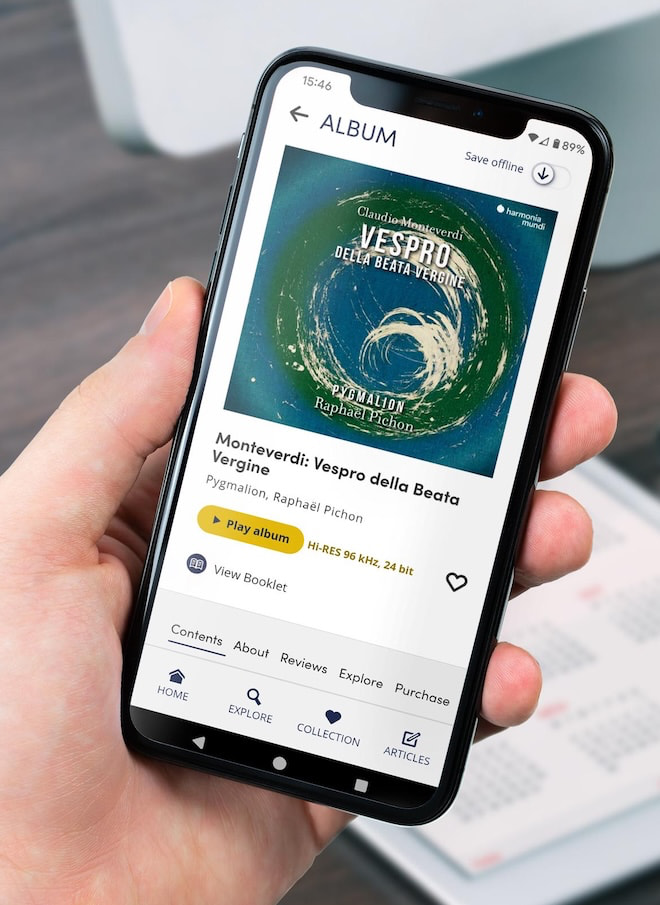
Presto Music App on smartphone
It Also Pays Differently
Presto has another unusual distinction: its royalty model.
The company uses what it calls a pay-per-second system rather than treating every stream as an equivalent unit. That matters particularly with classical music, where a single movement can run for 20 or 30 minutes while a pop album might divide the same listening time among numerous tracks.
Advertisement
Presto argues that paying according to listening time avoids penalizing longer works simply because they generate fewer individual track plays. There are important caveats: comparisons with competing services rely partly on industry estimates, and payments still initially go to labels and rights holders before reaching individual performers.
Even so, the logic is easy to understand. A 28-minute symphonic movement shouldn’t be commercially disadvantaged simply because somebody else released 11 songs during the same amount of listening time.
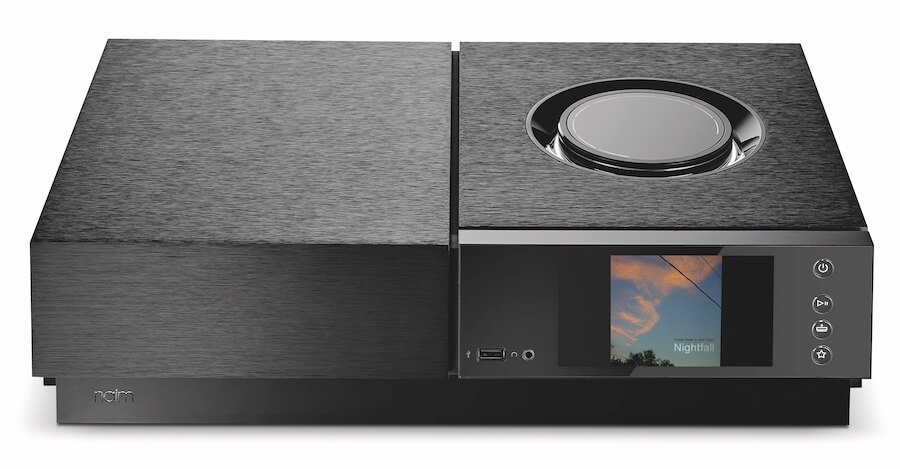
Naim Uniti Nova Power Edition
Why Would Naim Bother?
This is the part that interests me most.
Naim does not need another streaming logo to make its spec sheets look fuller. Streaming integration has been central to the company for years, from the Uniti Atom and Uniti Nova through newer products such as the CI-Uniti 102. Focal, meanwhile, has increasingly moved the same ecosystem into products such as the Mu-so Hekla.
Advertisement
We’ve reviewed enough Naim hardware to know that its customers are not generally buying these products because they were the cheapest boxes on the shelf at Costco.
The decision to integrate Presto therefore feels more meaningful than another routine service announcement. There is an obvious overlap between the people spending real money on Naim hardware and listeners who care about recording provenance, mastering quality, metadata, liner notes and finding a particular performance rather than asking an algorithm to “play some classical.”
Advertisement. Scroll to continue reading.
That doesn’t mean every Naim owner spends Sunday morning comparing Karajan and Klemperer recordings while drinking Rooibos from a Salisbury-approved mug. But the demographic overlap isn’t exactly difficult to see.
Advertisement
Naim already has access to the big streaming platforms. Adding Presto suggests that the company believes specialist streaming services can have real value when they understand their audience better than the giants do.
How Does It Work?
There is an important technical distinction here.
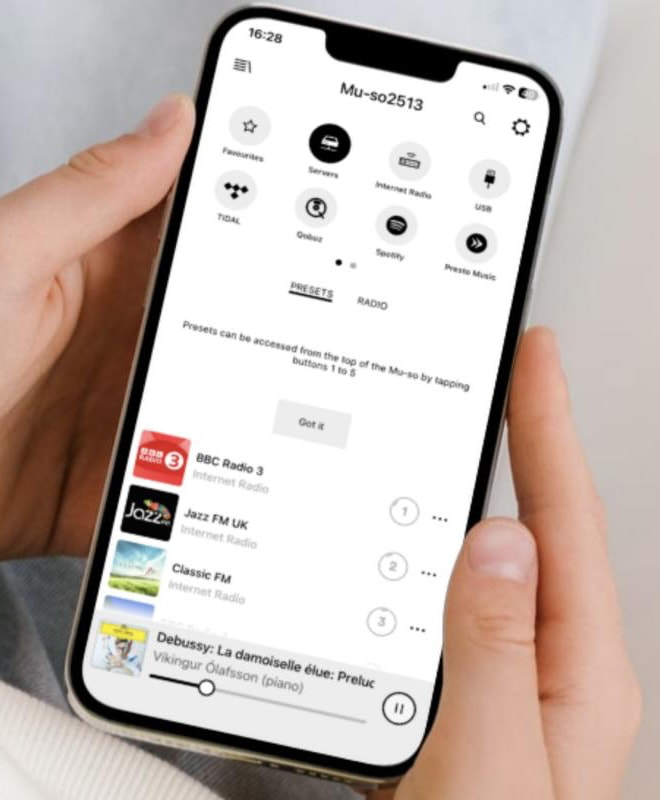
Focal and Naim have not announced a separate “Presto Connect” protocol equivalent to TIDAL Connect or Qobuz Connect. Instead, Presto is integrated directly into the Focal & Naim ecosystem. Users update the Focal & Naim app and compatible product firmware, sign into Presto, and stream directly through supported hardware.
That still provides the important benefit: the streamer receives the service directly rather than relying on Bluetooth or another compromised workaround.
Naim isn’t the first high-end manufacturer to embrace Presto. Eversolo already supports the service, while its integration with BluOS opens it to compatible products from Bluesound, NAD, PSB, DALI, Monitor Audio, Cyrus, Roksan and others. Audirvāna also supports Presto on the software side.
Advertisement
What makes the Focal and Naim announcement interesting is that another major audiophile ecosystem has now decided this specialist classical and jazz service deserves native support. Presto isn’t suddenly arriving because Naim discovered it; it has been quietly building a legitimate hardware footprint while a lot of North American audiophiles still have no idea what it is
There is, however, a firmware wrinkle.
Newer Naim platforms have begun receiving the required updates, but some Uniti and Classic streamers are still waiting for firmware 3.13 as of August 9, 2026. First-generation Naim streamers are excluded from Presto support entirely.
So if your Uniti refuses to display Presto this morning, repeatedly rebooting it while questioning British engineering probably isn’t going to help. The update may simply not be available for your model yet.
Advertisement
Is This Really a Threat to Qobuz?
Not exactly.
Qobuz remains the most obvious comparison because both companies emphasize high-resolution audio, editorial content and listeners who care about sound quality. Qobuz, however, offers a vastly broader catalog and much deeper support across the hi-fi industry.
Advertisement. Scroll to continue reading.
Presto’s advantage is specialization.
Advertisement
Its classical orientation, jazz focus, digital booklets and more granular metadata give it a distinct identity. There is also something increasingly refreshing about opening a music service that doesn’t immediately attempt to convince you that whatever went viral twelve minutes ago while someone made a sandwich should become the center of your listening universe.
Whether that’s enough to persuade an existing Qobuz subscriber to pay for a second service is the more interesting question.
We’re Going to Find Out
eCoustics has covered Naim and Focal extensively, and we have reviews of the Focal Mu-so Hekla and Naim CI-Uniti 102 coming this month. That gives us an obvious opportunity to do more than repeat the announcement.
We’re going to try Presto on the hardware.
Advertisement
How good is the search function when you’re looking for a specific classical recording? How deep is the jazz catalog? Do the digital booklets materially improve the experience? How reliable is hi-res playback through the Focal & Naim platform? And if you’re already paying for TIDAL or Qobuz, is there enough here to justify another subscription?
Because streaming subscriptions are starting to resemble cable television packages. Everybody promised us freedom from bundles, and somehow we ended up paying six companies every month again.
At least this one comes with Mahler.
The Bottom Line
Presto Music isn’t going to replace Spotify, Apple Music, TIDAL or Qobuz for most listeners, and its smaller catalog makes that fairly obvious. What it offers instead is specialization: classical and jazz, hi-res playback, meaningful metadata, extensive digital booklets, human editorial curation and a royalty model designed around the realities of longer musical works.
Advertisement
The more significant part of this story may be Naim’s decision to integrate it. Naim already supports the major players; it didn’t need Presto simply to make the feature list longer. Adding it suggests that specialist streaming services may have a legitimate place alongside the giants when they understand their audience well enough.
Presto Music has been streaming since 2023. A lot of us are only noticing it now.
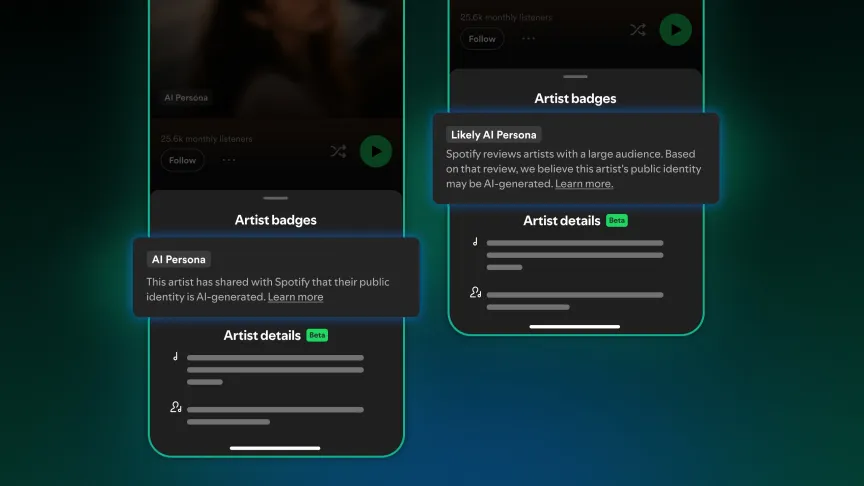
Music fans who are seeking to pin down AI artists versus human creatives on Spotify will soon have a new tool at their disposal. On Tuesday, the music streamer shared that it’s adding an “AI Persona” label to the platform as another way to help fans — and artists — identify AI creators. The badge will start appearing in profiles, songs, search results and in an artist’s About section in mid-September.
If you’re worried about those tracks popping up in your finely tuned algorithm, don’t. Spotify explained that AI Personas will automatically be excluded from your personalized recommendations by default, unless you choose to follow the AI Personas account or a specific AI music profile.
How will the streamer pinpoint which accounts are AI? Starting Aug. 11, accounts can self-report via Spotify for Artists, but Spotify will also conduct its own reviews and tag profiles with the AI Persona label. According to the streamer, it will check “artist profiles and identify those whose public identity — the identity an artist presents on their profile, including name and imagery — appears to represent photorealistic AI-generated identities.” To take it a step further, when you, as a listener, click the badge, you’ll be able to see whether the artist disclosed their AI identity themselves or if Spotify classified them as an AI artist.
Spotify
During the coming months, the streamer will enable listeners to flag suspected AI profiles. Artists can appeal if they think they’ve been incorrectly designated as AI. The company clarified that the move is about verifying an artist’s authentic identity, not about how the music was made.
It’s one of the latest ways Spotify is aiming to help listeners distinguish between AI and human artists. While the streaming service has a range of AI tools that let subscribers curate their listening experience, it’s also launched artist profile protection, verification badges and policies to crack down on deepfakes.
Advertisement
Kourtnee Jackson
Senior Editor
Kourtnee covers streaming services and entertainment. She previously worked as an entertainment reporter at Endgame 360, where she wrote about film, television, music, celebrities and streaming platforms.
See full bio
Really, the shape is ideal for long-term use. It’s fairly ergonomic, and it’s easy enough to lay your hand across with a relaxed grip. I found it to be a great option for raid nights in Destiny 2 (with as many as five or six Crota runs in one night) and more chill games like The Big Walk, where precision and agility take a bit of a back seat to consistency and comfort.
While the Naga V3 Pro weighs 116 grams with the heaviest twelve-button side panel (the six-button panel is 115 grams, and the two-button is 113), the mouse doesn’t feel particularly heavy. The weight is all kept fairly low, and is distributed well across the mouse. Compared to some older mice with high-up batteries and nose-heavy shapes, the Naga hardly feels like its weight; I would’ve guessed it was below 100 grams if I hadn’t checked. You’ll notice the added heft if you’re switching directly from a 60 gram gaming mouse, but otherwise, this mouse manages its mass very well.
One downside to its old-school vibe is the limited color options. Black is the only version available, and while that’ll always be the most popular (especially for Razer), a more niche mouse like the Naga V3 Pro could have definitely benefitted from another color.
Advertisement
So Many Buttons
This mouse has an absurd number of buttons. I found myself struggling to use all of them, but I’m sure there are quite a few people who still won’t think it’s quite enough.
Like the Logitech MX Master 4, the Naga incorporates a customizable mouse wheel with options for smooth or ratcheting operation, along with a “precision tactile” mode that decreases the space between each of the scrolling steps. The wheel also has a tilt function for horizontal scrolling; it’s ideal for spreadsheets and multimedia work that requires two axes of movement, but can just as easily be remapped to any number of macros (I could see it being useful for leaning to the left or right in a tactical shooter like Rainbow Six: Siege).
Drawing further comparisons to the MX Master line, I really found this mouse to be good for everyday work. The comfortable shape and extensive navigation capabilities made it great for multimedia work, and the number pad was ideal for mapping software-specific functions, especially for photo and video editing software that can require some repetitive and complex inputs.
Despite the sheer number of buttons, I really found that they never got in the way when not in use. All of them are placed in such a way to be easily accessible without disrupting the basic left and right click functionality. The only button I found myself regularly pressing on accident was the third click button, which can be locked entirely using a switch on the underside of the mouse.
Engineer Shane Wighton set out to answer a simple question that industrial food processors have quietly solved for decades. What if you could force a potato or apple to shed its own skin without a blade ever touching it? His answer involved building a high-pressure steam system dangerous enough that he ran every test from behind a blast chamber, operating valves remotely so he would not be standing next to something holding the energy of several sticks of dynamite.
Steam peelers have long been utilized in industrial potato chip production. A sealed vessel is filled with produce, and the chamber is saturated with high-pressure steam. The epidermis absorbs heat substantially faster than the underlying flesh. The water right beneath the epidermis gets fairly heated. When a fast valve is opened, the pressure lowers dramatically. The skin just peels away as the trapped water rapidly vaporizes and expands aggressively. Wighton had never seen such clear, fast-moving film of the incident before. He reasoned that it was time to create one that was transparent so that everyone could see the problem for themselves.
ALL-IN-ONE ELECTRIC PRESSURE COOKER: Replace multiple appliances with one 9-in-1 multi cooker. Pressure cook, slow cook, make rice, sous vide, steam…
COOK UP TO 2X FASTER*: HyperHeat technology builds pressure quickly to speed up cooking time compared to traditional methods, helping you get meals on…
SEAR AND SAUTÉ IN ONE POT: Skip extra pans—use the large cooking surface to sear meats and sauté ingredients directly in the pot for deeper flavor…
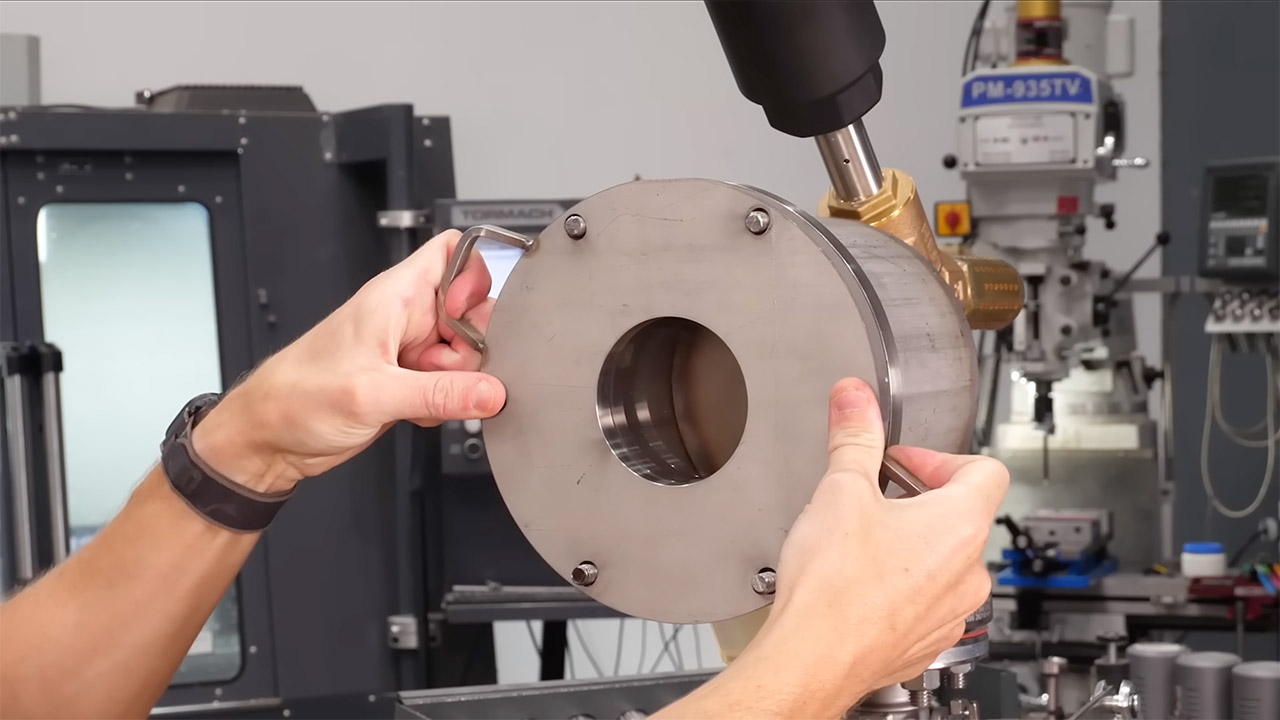
He started by building a boiler out of thick-walled stainless steel tubes and plates. He machined the ends flat to provide a firm seal and installed high-temperature silicone gaskets between the faces. He held the whole thing together with some long threaded rods, but he knew stainless steel expanded far more than the rods when heated. Standard washers would have allowed the joint to slacken. Wighton piled some Belleville washers, which are conical spring disks that may be arranged to provide a continuous clamping force even as the metal increases. He had a 2 kW immersion heater submerged in the water, a mechanical safety valve to keep the pressure at 200 psi, and an air cylinder to safely open the outlet valve from a distance.
The produce was stored in a second chamber, which was similar to the first but included a quick-release valve and a viewing window. The window itself required meticulous design. A portion of an aluminum disk with o-rings squeezed a glass disk against the chamber. Since water under pressure retains far less energy than steam or compressed air, steam pressure plays an important role in seal retention. Leaks emerged, but the welds were repaired and the seats were cleaned. Only after that did steam enter the system.
Potatoes went first, and at 20 pressure, the skin barely moved, but at 40 psi, it began to crack open. Higher pressures provided full performance. In slow motion, the skin lifts, stretches, and peels away in large sheets that slap against the glass. Flesh loss remains minor. In one test, almost no real potato remained on to the discarded skin, indicating near-perfect separation, which is what commercial systems strive for on a daily basis.
Apples were followed by steam, which charged the valve and opened. The skin broke cleanly from the meat, and the apple itself deformed into something that appeared to have been hit by some fairly mean magic. The chamber was filled with the aroma of warm apples. Tomatoes shed their skins without any drama. Lemons developed several unusual surface blisters, necessitating even higher pressure or faster venting to complete the operation. Grapes have gotten mealy. Blackberries emptied themselves out, leaving hollow skins. Strawberries, on the other hand, performed something even odd, fragmenting into a mix of flesh and seeds that Wighton still cannot entirely comprehend. The high-speed footage simply prompted additional doubts.
Solar eclipse, 17 February 2026. Image: ESA/Royal Observatory of Belgium
The eclipse creates favourable conditions for the experiment by highlighting the solar corona.
A group of Italian scientists will take advantage of tomorrow’s (12 August) solar eclipse to test a new tool that could shed more light on our understanding of the sun.
Advertisement
The team’s ‘Circular Slit Spectrometer’, funded by the Italian National Institute for Astrophysics, is designed to capture the spectrum of the entire solar corona – the outer layer of the sun’s atmosphere – in a single photograph. This has been previously impossible.
The device has a circular slit that enables this when placed at a certain distance from the centre of the sun, explained principal investigator Federico Landini of the Astrophysical Observatory of Turin. It offers an upgrade over previous instruments that took hours to scan the corona, when its movements change in minutes.
The Italian scientists journeyed to Spain’s Javalambre Astrophysical Observatory via road last Friday to set up the time-sensitive experiment that will run for a short period at around 8.30pm local time tomorrow.
The eclipse creates favourable conditions for the experiment by hiding the sun behind the moon, highlighting the solar corona. This outer portion of the sun emits powerful coronal mass ejections and solar winds, which have a major impact on communications networks and power grids on Earth.
Advertisement
“There is neither space nor time for the unexpected,” senior researcher Paola Zuppella from the Institute for Photonics and Nanotechnologies in Padua told Reuters.
The eclipse is set to start at around 6.15pm, reach its maximum an hour later and end at around 8.08pm. It will be the largest eclipse visible from Ireland until 2090 and will offer viewers in Europe the opportunity to witness the eclipse as the sun sets.
Cork is best-positioned for watching the eclipse in the country, with 96pc of the sun expected to be covered at its peak. Around 94pc of the sun will be covered in Dublin and 93pc in Belfast.
Advertisement
Don’t miss out on the knowledge you need to succeed. Sign up for the Daily Brief, Silicon Republic’s digest of need-to-know sci-tech news.
Newly minted RaaS crew breaks in through using internet-facing kit via known Fortinet flaws, then steals and scrambles data
US cyber agencies are warning critical infrastructure operators to patch their internet-facing kit after Gunra ransomware affiliates were spotted exploiting known vulnerabilities to break into networks.
Gunra first surfaced in 2025 and has wasted little time expanding. CISA, the FBI, NSA, Secret Service, and partner agencies in the US and South Korea say it now operates as ransomware-as-a-service, with affiliates attacking organizations worldwide.
Advertisement
Targets have included healthcare, financial services, government, professional services, nonprofits, and other critical infrastructure organizations.
The attackers have exploited CVE-2024-55591 and CVE-2025-24472, authentication bypass flaws in Fortinet’s FortiOS and FortiProxy, to gain administrative access through internet-facing appliances.
Once inside, Gunra affiliates follow the now-familiar double-extortion playbook: steal data, encrypt systems, and demand payment for a decryptor and a promise not to publish the haul.
Negotiations take place through a Tor-based portal, according to the advisory, with victims typically given between five and seven days to cough up before their stolen data is published.
Advertisement
“Gunra is another variant in the ongoing trend of ransomware attacks causing disruption and harm to US and international organizations,” said Chris Butera, CISA’s acting executive assistant director for cybersecurity.
Trend Micro first observed Gunra in April 2025, initially targeting Windows systems and borrowing elements from the Conti ransomware operation. The security shop later uncovered a Linux variant, broadening the range of systems its operators could scramble.
That Linux version can run as many as 100 encryption threads in parallel and supports partial encryption, allowing attackers to specify how much of individual files should be encrypted. It can also store RSA-encrypted keys in separate keystore files.
Trend Micro has seen Gunra activity in Turkey, Taiwan, the US, and South Korea. The gang’s own leak site casts the net wider, claiming victims in Brazil, Japan, and Canada as well, including manufacturers, healthcare providers, IT companies, and law firms.
Advertisement
The agencies are urging potential targets to patch known exploited vulnerabilities in internet-facing systems, secure VPN gateways and RDP access with multifactor authentication, segment networks, and maintain offline, immutable backups to make life harder for attackers who get through the front door. ®
alternative_right shares a report from 404 Media: Robotics companies promise that video-camera-toting security robots can deter and detect crime. But many companies are rethinking the approach after a trail of canceled contracts and questions about whether the artificial intelligence-powered bots are meeting the needs of businesses and local governments. Proof News found evidence of at least 21 security robot deployments since 2015. We contacted contract holders and combed news articles and determined that at least 13 of those programs have ended. Silicon Valley-based Knightscope secured the most security robot contracts, according to Proof’s analysis, and also suffered the bulk of cancellations.
For example, New York City’s then-Mayor Eric Adams installed a Knightscope robot on the overnight shift at the Times Square subway station, but the program was scrapped when the pilot expired in 2024. City leaders did not respond to Proof News’ questions about why the robot wasn’t renewed. By the end of its assignment, it was reportedly gathering dust in an empty storefront. Outside Columbus, Ohio, the city of Dublin pulled the plug on a Knightscope robot in May, ending its two-year pilot program after less than 10 months. The city enlisted the robot, dubbed DubBot, to patrol a downtown park, but city spokeswoman Robyn Gray said it “did not fully meet our operational needs,” and failed to identify any criminal incidents or lead to any tickets or arrests.
[…] Seeking a new path forward in the security industry, Knightscope CEO William Santana Li said the company is forging a new model, combining its robots and AI-powered software with another key ingredient: human security guards. Knightscope announced it purchased Event Risk LLC, a national security guard firm, earlier this year. Knightscope has incurred net losses since inception in 2013, according to its most recent quarterly filing with the U.S. Securities and Exchange Commission, and is $273 million in debt. Knightscope hopes its pivot to incorporate people will give it a greater share of the physical security market — which the company believes is worth an estimated $230 billion annually. Li declined to answer questions about the disbanded programs, but said in an email, “Technology cannot do everything — and neither can people — but the combination can be very powerful.”
Bumble is officially giving up on the rule that made it, well, Bumble.
The dating app announced Tuesday that anyone in a match can now send the first message, ending the women-message-first requirement that has been one of the company’s defining features for more than a decade.
Bumble is also giving matches 72 hours to respond, up from 24, in an effort to take some of the pressure out of coming up with a response in a short time frame. The longer window gives people more flexibility to reply, rather than feeling like they need to check the app constantly or risk a match disappearing.
The change marks a pretty significant shift for Bumble, which built its brand around putting women in control of heterosexual dating conversations. When the app launched in 2014, Bumble was positioned as the more considerate alternative to Tinder, with women deciding whether a conversation would begin and, ideally, avoiding some of the unsolicited messages and general weirdness that had become synonymous with dating apps.
Advertisement
Bumble founder and CEO Whitney Wolfe Herd framed the new update as an evolution rather than a retreat from the company’s original mission.
“While women making the first move was a radical idea, being women-first was never about prescribing just one way to connect. It was about designing an experience with women’s needs in mind to create better outcomes for everyone,” Herd said in a statement.
And, apparently, plenty of women are ready for this change. According to Bumble’s survey data, 66% of women surveyed said they prefer men to send the first message, with many saying it would make dating feel less stressful. Additionally, more than half of members surveyed said the longer response window improved their experience.
“Today, our community is asking for more flexibility, less pressure, and more opportunities to create real, meaningful connections, and that is what this new experience provides. This evolution isn’t a departure from our founding vision, but the realization of it,” Herd added.
Advertisement
The change also isn’t coming completely out of nowhere. Bumble began loosening its original rules in 2024 with “Opening Moves,” a feature that allowed women to set a question on their profile that a man could answer.
The change also arrives as Bumble tries to turn around a business that has been struggling to regain its footing. The company’s second-quarter earnings report last week showed revenue dropping 15.2% year over year to $210.5 million, while the company expects its number of paying customers to decline in the third quarter.
Over the past several quarters, Bumble has tried to address a broader slowdown in online dating, as the industry wrestles with user fatigue, an increasingly crowded market, and the reality that swiping through hundreds of profiles isn’t necessarily anyone’s idea of a great time. The company recently revealed it’s exploring a swipe-free future, along with more in-person events and AI features to garner more traction, especially among Gen Z users.
When you purchase through links in our articles, we may earn a small commission. This doesn’t affect our editorial independence.
Technology is always moving forward, and for the most part, it’s making our lives easier. Every once in a while, though, an invention comes along that basically changes the way we interact with the world around us. QR codes are a perfect example. They’ve become so deeply woven into our everyday lives that we barely even think about them anymore. Everyone has a smartphone anyway, so if you have some information you want to get across efficiently, just place a QR code in an accessible location and have everyone scan it with their phones.
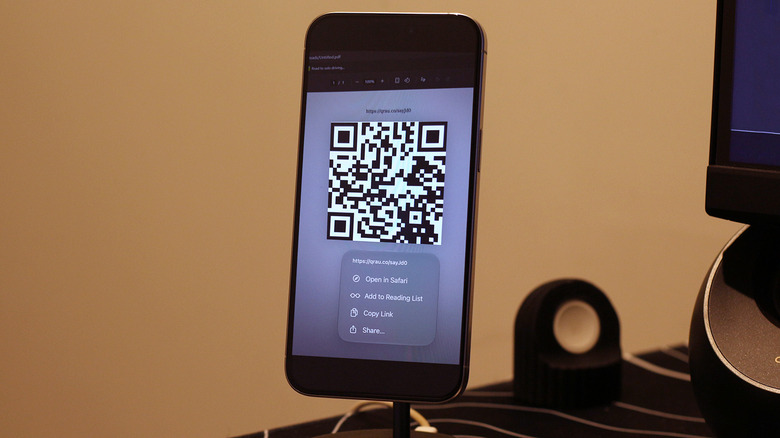
The iPhone’s camera app automatically recognizes QR codes and lets you open links, join Wi-Fi networks, and perform other actions with a single tap. The default camera app on many Android smartphones lets you do the same. You could also use a dedicated QR scanner app or fire up Google Lens to handle the job. But what about when someone sends you a QR code digitally? How do you scan a QR code that’s on your phone’s screen using the same device? Well, both Apple and Google have thought of that too.
On an iPhone, save the image of the QR code to your photo library. Launch the Photos app, expand the image, tap and hold the QR code, and select the action that appears, such as “Open in Safari” for a website link. If you’re using Android, launch the Google Photos app, select the image, swipe up to reveal more options, tap “Search,” and then tap the highlighted QR code to reveal its contents.
Advertisement
Your photo app can do more than scan QR codes
Adnan Ahmed/SlashGear
Both Google Photos and the Photos app that comes with Apple devices have evolved over the years to do much more than simply store your media files. Being able to scan a QR code that’s already in your photo library can come in handy. For instance, when you point your phone at a QR code, the camera app usually takes a second or two to recognize it. Plus, if you move the QR code out of the frame, the shortcut to open its link quickly disappears. In such cases, quickly grabbing a picture and accessing the QR code through the Photos app later can prove to be much more convenient.
If an image contains text, you can quickly copy it as well. On iPhone, all it takes is a long tap on the text area in an image, and you’ll see the selection handles pop up alongside a context menu where you can copy or share the selected text. Google Photos lets you do the same when you swipe up and tap the “Copy text” option.
Advertisement
Though it’s become incredibly convenient to do so, you should be careful about scanning unknown QR codes. While QR codes themselves are harmless, they can direct you to malicious websites or phishing pages designed to steal your personal information.
There have been rumblings for a while that America’s richest and most annoying white supremacist, Elon Musk, really wants to get into the wireless phone business. His lobbyists have been making noise in support for broader phone unlocking rules, and there’ve been several IPO-fluffing press leaks over the last few months indicating they’re keen on building a Starlink phone.
They’ve also leaked word to Semafor, likely in part to boost Musk’s sagging and disastrous IPO, that Musk’s companies are on the hunt for spectrum allowing them to offer wireless phone service in more dense, urban markets (since Starlink LEO satellite lacks the capacity for that):
“SpaceX, which is trying to fill a hole in its airwaves crucial for a full-service wireless network, has been hunting for spectrum that works well in cities and dense areas, according to people familiar with the matter. The company is considering buying competitors to acquire the spectrum or competing at a government auction set for next year, the people said.”
There have been some rumblings that Musk Corp could try to acquire T-Mobile, which they’re already partnering with on a hybrid LEO satellite and cellular phone offering that lets you use Starlink in remote areas for calls and cellular when in more dense locations.
One of several problems for Musk is his highly-fraudulent IPO is cratering, adding additional financial pressure to the mix. Massive acquisitions, which you’d probably need to do this effectively, are costly, debt-riddled, notoriously time-consuming and resource intensive.
Advertisement
SpaceX’s IPO promised that Starlink would quickly jump from 10 million current subscribers to 300 million or more in very short order. That’s pretty much impossible with just Starlink (despite some delusional numbers being tossed around by Jason Calacanis and friends). Even if you acquired T-Mobile (142.6 million subscribers) it would take years and a ton of good luck to get anywhere close.
Telecom is also a massively cash-intensive business to jump into. Spectrum, tower leases, backhaul is all annoying, complicated, pricey, and time consuming to get right. Assuming 100% competency you’d be talking years before any sort of meaningful traction, by which time they could be facing less Musk-friendly regulators at the FCC.
Companies like AT&T, Verizon, and Comcast also just inherently loathe competition, and can be quite formidable when they join forces to box out any new competitors. The highway of telecom history is littered with corpses of folks who believed they could break through the monopolistic, government-coddled logjam (Dish Network being just the latest). As is the highway of very deep-pocketed companies trying to offer their own smartphones (Amazon, Facebook, Microsoft).
You’ve also got other companies like Amazon considering similar phone networks. Musk’s companies, especially Starlink, also are notorious for refusing to have competent customer service, something they’d need to excel at to disrupt cellular and gain fast market share. And this is all while Musk continues to show signs of massive instability as he dedicates the majority of his time to being a bizarre and unhinged egomaniacal racist on his personal propaganda website.
Advertisement
Though Musk does have some things in his favor. Like an army of cultists who’ll praise his barely available and expensive phone service no matter how clumsy or half-completed any network build is. People in the extended Roganverse already think the costly and congested Starlink network is akin to magic, and the marketing hype surrounding a Musk phone would be utterly deafening.
That doesn’t naturally equate to success in competently challenging some of America’s biggest and most politically powerful monopolies in brick-and-mortar reality, though.
The latest iOS 27 developer beta includes code referring to multiple iPhone models, including six that are believed to be as-yet unannounced ones like the iPhone Fold.
Back in December 2025, code in iOS 26 featured references to more than a dozen unreleased Apple products, ranging from iPhones to Macs and an AirTag. Now similar references in iOS 27 expressly point to six models of iPhone that Apple has yet to launch.
The references are all to internal codenames rather than either product names or device identifiers. Based on previous reports, however, the six models together with their codenames appear to be:
V62: iPhone Air 2
V63: iPhone 18 Pro
V64: iPhone 18 Pro Max
V67: iPhone 18
V68: iPhone Fold
V69: iPhone 18e
The references were all included in a iOS 27 code relating to battery usage. The same section also featured references to multiple existing iPhone models.
Each one of the codenames has been reported before, and ascribed to particular iPhone models. However, according to Macworld, which first spotted the code references, there has never before been a complete iPhone 18 lineup listed like this.
Advertisement
Six in the works, four coming soon
It definitely implies that Apple has six iPhone models in the works. What it doesn’t and cannot imply is when or really even if any of them will launch.
The presence of these code references in the beta definitely does not mean that this is a list of what Apple will announce in September 2026.
At present, the strongest rumors about that September 2026 launch are that it will be solely for the Pro models of the iPhone. If correct, that means the iPhone 18 Pro and iPhone 18 Pro Max, and it’s also repeatedly reported that the iPhone Fold will be unveiled then.
Advertisement
That would account for three of the six references found in the code. Apple is expected to launch the remainder of the iPhone 18 range in spring 2027.
If so, that would surely mean the iPhone 18, but it may also mean an updated iPhone Air, plus the lower-cost iPhone 18e.





























![How To Invest in Crypto as A COMPLETE Beginner [2025 GUIDE]](https://wordupnews.com/wp-content/uploads/2026/01/1769891288_maxresdefault-80x80.jpg)








































You must be logged in to post a comment Login