Connect with us
DAPA Banner

Tech

What One-Winged Squids Can Teach The Airship Renaissance

Published

on

It’s a blustery January day outside Lakehurst, New Jersey. The East Coast of North America is experiencing its worst weather in decades, and all civilian aircraft have been grounded the past four days, from Florida to Maine. For the past two days, that order has included military aircraft, including those certified “all weather” – with one notable exception. A few miles offshore, rocking and bucking in the gales, a U.S. Navy airship braves the storm. Sleet pelts the plexiglass windscreen and ice sloughs off the gasbag in great sheets as the storm rages on, and churning airscrews keep the airship on station.

If you know history you might be a bit confused: the rigid airship USS Arkon was lost off the coast of New Jersey, but in April, not January. Before jumping into the comments with your corrections, note the story I’ve begun is set not in 1933, but in 1957, a full generation later.

The airship caught in the storm is no experimental Zeppelin, but an N-class blimp, the workhorse of the cold-war fleet. Yes, there was a cold war fleet of airships; we’ll get to why further on. The most important distinction is that unlike the last flight of the Arkon, this story doesn’t end in tragedy, but in triumph. Tasked to demonstrate their readiness, five blimps from Lakehurst’s Airship Airborne Early-Warning Squadron 1 remained on station with no gaps in coverage for the ten days from January 15th to 24th. The blimps were able to swap places, watch-on-watch, and provide continuous coverage, in spite of weather conditions that included 60 knot winds and grounded literally every other aircraft in existence at that time.

Rigid? Count (Zeppelin) Me Out

Airships come in multiple types: rigid, non-rigid, and semi-rigid. Most people — my past self included — assume that the rigid type is more advanced. Unlike rigid airships, which are stabilized by an aluminum skeleton (or a wooden one, in the case of the Schütte-Lanz ships of the Great War), a blimp’s shape is maintained by gas pressure alone. Just a balloon with motors, if we’re being uncharitable. This limits the maximum speed, as the aerodynamic pressure of moving through the atmosphere increases with the square of the airspeed, and must always be lower than the internal pressure of the gas bag. You can’t even pressurize the gas bag much to compensate, because then the density of the lift gas gets too high to actually, well, lift.

Advertisement
Putting a skeleton inside your airship– like this one in USS Arkon– seems like such a good idea, but history suggests otherwise. Image: US Navy

Put a skeleton in there, and your airship can be much, much larger. It can go much faster. It can become a flying aircraft carrier, like the ill-fated USS Arkon, and its ill-fated sister ship, USS Macon. The U.S. Navy has only ever fielded five rigid airships; only one survived long enough to be decommissioned. It is with no disrespect to the brave men and women who served– and lost their lives– aboard those silver giants that we dismiss them from our narrative here. They were a worthy experiment, but a failed one. By contrast, the U.S. Navy fielded 166 blimps in the Second World War, and only a handful were lost, mostly during ground handling, and one to enemy action.

So, how was an N-class blimp, also known as a ZPG-2, in the designation system of the day, or SZ-1A after 1962, able to ride out a storm much worse than the one that sank its rigid-framed predecessors? It’s probably precisely because it lacked that rigid frame. The non-rigid envelope of the blimps could bend, buckle, twist, and alter their shape in response to strains that would break the keel of a Zeppelin. Non-rigid airships can quite literally flex on their rigid cousins when it comes to airworthiness.

The flexing skin of a blimp turns the entire gas-bag into one giant de-icing boot to boot, keeping yet another weather hazard at bay. Icing is a great danger to aircraft: when conditions are just wrong, like during the January storm described above, it’s easy for the weight of ice to build up and bring down any aircraft without an effective de-icing system. De-icing boots are one such system: rubber membranes, typically on the leading edge of the wing and tail surfaces of an airplane, that are inflated to flake off ice. On airplanes, they’re addons, but it’s a built-in bonus to flying a blimp.

Of course another key advantage of non-rigid airships is that they’re just plain cheaper. Being smaller, they require less crew, less ground crew, and smaller hangers, but a small rigid would have the same advantage. More importantly, especially during wartime, is that a Zeppelin requires everything you’d use to build the equivalent blimp, plus all the Duraluminum (or other material) going into its rigid frame. Logistically speaking, blimps were a no-brainer if the US wanted to field a lot of airships, and at one point they certainly did.

This hangar was designed for two Zeppelins, but fit a lot more blimps during the war.
Image: US Navy

But Why?

Unlike a certain (in)famous penguin, the US Navy knew exactly what it was doing when it ordered the N-class airships after World War Two. As stated, they had over a hundred blimps in service during that conflict, and racked up more Lighter-Than-Air (LTA) flight time than any other organization has before or since: 550,000 hours split over 55,900 sorties in both the Atlantic and Pacific theaters. While the institutional knowledge is long gone, it’s safe to say that in those days nobody knew airships like the U.S. Navy knew airships.

A blimp overflying the sinking MT Persephone
The one ship escorted by blimp was torpedoed by U-boat. That’s a pretty good record.
Image: US Navy

The vast majority of the wartime fleet — some 135 examples — were of the K-class. These ships were designed with a specific mission in mind: antisubmarine warfare. Blimps vs subs wasn’t a new idea; the Americans had worked with the Royal Navy’s u-boat hunting blimps in the First World War. Though the Royal Navy gave up on the idea after the conflict, interest remained on the other side of the Atlantic, and history shows the Yanks were right to persist with it. Of roughly 89,000 ships in blimp-escorted convoys, only one, the tanker Persephone, was sunk, ironically off the coast of New Jersey, not terribly far from the Lakehurst home of LTA.

The sub-hunting blimps were perhaps making it up as they went along. On paper, though, the airship is ideal for the role: without needing to burn fuel to stay airborne, it can have absurdly long loiter times. Its low speed is of no issue when shadowing convoys that have to move at the speed of the slowest merchant vessel– even the HX series “fast convoys” didn’t exceed 13 knots (24 km/h). Blimps of the K-class could cruise at 50 kn (92 km/h), and dash at up to 68 kn (125 km/h), which proved more than sufficient to keep up.

Advertisement

When the class was designed in 1937, its ability to cruise low and slow was ideal for hunting submarines with the Mk.I eyeball, but by the time the K-class was fielded in numbers in 1942, they were also equipped with first-generation radar, magnetic detection coils, and even primitive sonoboys after 1943. The class proved flexible and continued to be upgraded with the latest equipment until the last “K-ship” was retired from active duty in 1959.

Mocked up in yellow, the sonoboys and bombs are easy to spot on this surviving gondola at the National Museum of Naval Aviation.
Image: “Blimp” by Pedro Vera, CC-BY-2.0

At 251 ft 8 in (76.73 m) long, with a gas-bag diameter of 57 ft 10 in (17.63 m), the K-ships could lift a crew of 9 in relative comfort, with fuel to feed their twin Pratt & Whitney R-1340 radials for 38 hours of normal operation. Idling the engines and making use of air currents could extend that number by quite a lot compared to cruising steadily, of course. As stated above, in wartime the K-ships carried magnetic detectors, sonobouys and radars for U-boat detection, along with four depth bombs and a .50 cal machine gun for weapons.

If four bombs doesn’t sound like much, well, that’s probably why no U-boats were recorded killed by Navy airships. On the other hand, the main mission of the blimps was to protect convoys, not to sink subs. “Damaged and driven off” was good enough, especially when the blimp could track the wounded u-boat from above and direct other assets like destroyers to make the kill, as often happened. There was a larger M-class designed during the war that was half again the size of the K-ships and could thus carry eight depth charges, but only four were built before the conflict ended.

K-ship "Puritan" all decked out in lights. The sign reads "BULLETIN"
While it had perhaps not the most dignified post-war career, Puritan’s control car survives at the New England Air Museum.
Image: Akron Beacon Journal, via The Lighter than Air Society.

Post-war, one K-ship by the name Puritan was sold back to Goodyear and equipped with 1,820 incandescent light bulbs to serve as a floating ad ticker, which perhaps shows the versatility of the design. Alas, ad revenues did not cover the cost of keeping the 425,000 ft³ (12,035 m³) envelope filled with precious helium. Civilian blimps since have been of more modest size.

The LTAs that Aren’t

Speaking of precious helium, in order to conserve that lift gas, the Navy actually operated their blimps as Lighter-Than-Air craft as little as they possibly could, both during and after the war. An annoying thing about airships is that they get lighter the longer they fly as they run down their gas tanks. It is possible to run an engine on a hydrocarbon gas with a density similar to air, like the “blau gas” used by the Graf Zeppelin in the 1920s, but this has one major drawback: it’s a major logistical headache to require a special fuel for a relatively small number of units. Though there was one prototype with a blau gas style fuel in the 30s, the US Navy put logistics first. For the war and several years afterwards, everything that the Navy flew would burn AvGas, at least until the jet age made things annoyingly complicated for quartermasters.

Landings– like this one on CVE-120–were a lot easier when you weren’t fighting the full lift potential of that big gas bag.
Image: US Navy

Without special fuel, the issue of excess lift can be mitigated by condensing water from the exhaust, but that doesn’t quite balance out, so the problem still remains on long flights. Eventually one must either vent helium to reduce lift, which is wasteful, or take on ballast to make up for lost mass, which can disrupt operations. The alternative the US Navy preferred was to fly “heavy”.

Yeah, it turns out hybrid airships– craft that combine lift gas with aerodynamic lift–aren’t a new idea. You might not think of the teardrop-shaped gas bag of a classic blimp as an airfoil, but with a little airspeed just a modest nose-up attitude– what a pilot would call ‘angle of attack’–the blimp can get considerable dynamic lift. By accepting the tradeoff of requiring a takeoff run, the blimps could get into the air with enough dynamic lift to account for the expected fuel burn, and come back to base with only so much lift capacity that could be cancelled out by trimming the ship downwards.

Advertisement

The Cold War Era

Photo of a crashed blimp with a mushroom cloud in the backround.
Even in death, they served. This K-ship proved that 5 miles was too close to 5 kT in the Plumbob-Stokes test.
Photo courtesy of National Nuclear Security Administration / Nevada Field Office

After the war, most of the K-ships were crated-up and decommissioned, and their air and ground crews were amongst the first to be demobilized. “Most” does not mean “all”, and once the thrill of peace turned into the uneasy truce of the Cold War, Uncle Sam was glad to have those airships. The Soviets had submarines, too, after all.

Rather than continue with building more of the M-class, the decision was made to update the existing stocks and produce improved K-class ships for the immediate post-war period. The wartime ships that were not decommissioned were updated with better electronics and a 20% larger gas bag, getting the designation ZPK2 and then a further upgrade to ZPK3 standard. Fifteen new K ships were built by Goodyear after the war and delivered starting in 1953 under the designation ZPK-4. The last revision of that design, ZPK-5, was built with an inverted “Y” tail instead of the standard cruciform to allow for greater nose-up attitude during the ‘heavy’ takeoffs mentioned above. Twelve ZPK-5s were built by Goodyear and delivered from 1955.

While the K-class was being modernized with better sensors and weapons, the US Navy’s LTA program recognized that it could not simply coast on legacy wartime engineering.They therefore commissioned Goodyear for a clean-sheet design that would be another 50% larger than even the four M-ships, which were kept in service until 1956. These new airships would become the N-class whose all-weather adventures this article opened with.
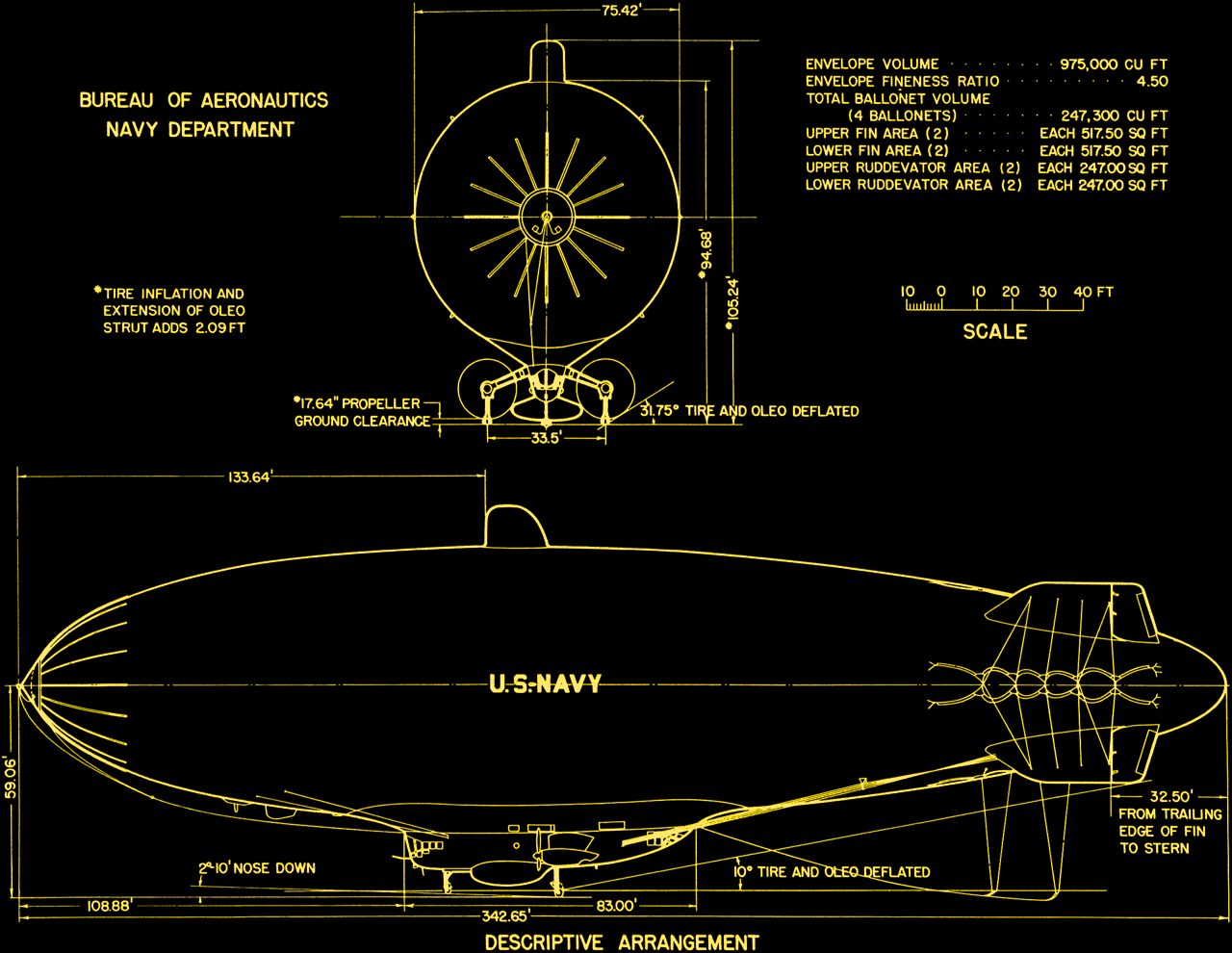
Diagram of a ZPG-2W N-class blimp. The antisubmarine ZPG-2 lacked the height-finding radar on top of the gas bag, but had the same dimensions otherwise. Image: US Navy

While the ZPG-2W whose triumph we described above were built to serve the airborne early warning role, most– twelve out of seventeen–of the “Nan ships”, as the class was called, were initially designed as bigger, badder sub-killers in case war broke out with the Soviets.

They had better down-looking radars– the AN-20, the best available at the time–much improved sonobouys, more sensitive magnetic anomaly sensors, and homing torpedoes. In war games against US and allied diesel-electric subs, like the GUPPY class, they proved very effective indeed, as did the improved K-ships. Against the new, nuclear-powered USS Nautilus, they were much less successful, but so were fixed-wing and helicopter assets. Doctrine that relied on spotting subs while recharging at snorkel or on surface was ill-suited to deal with a ship that could run submerged for months.

Improving on the control arrangement of the ZPK-5s, the Nan ships were built with an X-shaped tail to allow for even greater pitch angles during takeoff without tailstrikes. The ruddervators on the X-tail could also be controlled by one pilot, compared to earlier blimps which needed separate operators for elevator and rudder. The largest difference in design was perhaps the buried engines: unlike previous Navy blimps, which used radial engines hung from the gondola, the ZPG-2 Nan ships kept their two 800 HP Wright Cyclones indoors. This was supposed to allow for maintenance during flight, and it allowed the engines to be coupled together via a clutch, allowing single-engine cruising. As the air-early-warning blimps proved in 1957, these were all-weather craft.

Advertisement

The Anti-Submarine Warfare (ASW) squadrons gave a similar demonstration in 1960 with “Operation Whole Gale” during which the Nan ships provided 24/7 coverage for two full months, again in the teeth of winter’s worst weather. In spite of their best efforts to make use of wind and storms, no submarine got past the blimps during the operation.

ZPG-2 “Snow Bird”, departing NAS South Weymouth, Mass. on its record-setting flight in March 1957. Image: US Navy

The post-war record of the US Navy’s blimps is full of such impressive moments. The service was very much looking to prove itself, and so jumped at opportunities to demonstrate the blimps’ capabilities. Arctic expeditions? A Nan-ship proved its worth on 24-hour patrols between Churchill, Manitoba and Resolute, Baffin Island– the last airship to cross the Arctic Circle. Another stunt in 1957 set a record for unrefueled flight: a circumnavigation of the Atlantic basin from Massachusetts to Portugual, North Africa, and finally ending in Florida that took 264 hours and spanned 9,448 nautical miles (17,500 km). Guinness will tell you that Graf Zepplin’s 71-hour 6,384.5 km trip from Fedrickshaven to Lakehurst holds the record for airship flight, but that’s seriously out-of-date. For a rigid, sure, that’s the record, but for any LTA? Blimps win. Blimps actually win all the airship records save for speed and size, and none of those records stand from the “golden age” of the 1930s.

Takeways

That’s maybe the lesson here. Blimps win. I consider myself something of an aviation geek, and have multiple books on airships. All of them tell the same story: blimps were a sideshow, Zeppelins were the pinnacle of airship engineering, and it all ended with the Hindenburg. That’s the story everyone knows, just like everyone knows that airships are useless in any kind of bad weather.

What everyone knows is wrong. The problem with the story we all know is that it ends 24 years early, and leaves out more flights than it includes. Add in those 24 extra years of innovation, and the blimps come off looking a lot better in comparison.

The last flight of a US Navy dirigible with a US Navy crew was in August 1961. The ZPG-2 Nan ships were followed by a larger ZPG-3: bigger again, with a larger, more capable AN-70 radar hiding in the gasbag, the ZPG-3 was the largest blimp ever fielded. Its capability didn’t matter– there was no money for blimps. Imagine a line of Admirals standing before the US Congress, hats in hand, and one asks for money for nuclear-powered submarines to smite the enemies of Uncle Sam with Intercontinental Ballistic Missiles wielding atomic fire, and the next man in line wants money for blimps. Airships seemed positively old-fashioned in comparison, and money was tight. The blimps were cut.

Advertisement
A giant ZPG-3W  sits at its mooring mast, while a ZPG-2W takes off and a K-ship hovers in the background. Only two ZPG-3s were ever built. Image: US Navy

Yes, they provided an all-weather ASW and AEW capability nothing else could match… but other assets, ships and airplanes and helicopters, could do 90% of the job without requiring the expensive, dedicated infrastructure the blimps did. Airships were cut from the U.S. Navy the same year as seaplanes and the Regulus cruise missile program. You might say they’re the only things ever destroyed by the Polaris missile subs, but that’s arguably a good thing.

All the hot venture capital money is being sucked up by the AI bubble right now, and even if it wasn’t, the trendy thing in aviation is electric vertical takeoff and landing. That doesn’t mean there isn’t an airship renaissance just around the cornerthere is always an airship renaissance just around the corner. That it never results in anything but prototypes is irrelevant. LTA is just too enticing a technology to ever give up. If we ever are to get that renaissance to bear fruit, though, we’re going to have to have better stories.

If you’re focused on the Hindenburg going down in flames, or the Akron and Macon breaking up over water, airships seem like a bad bet. If you remember the Nan ships bouncing and wiggling their way through January snowstorms when everyone else was grounded, then LTA starts to sound more reasonable.


Source link

Advertisement
Continue Reading
Click to comment

You must be logged in to post a comment Login

Leave a Reply

Tech

Running Windows 98 On The IPAQ IA-2 Internet Appliance

Published

on

Devices that were limited to only run a web browser were relatively common around 2000, as many people wanted to surf the Information Super Highway, but didn’t quite want to get a regular PC — being in many ways the retro equivalent of a Chromebook. The Compaq iPAQ IA-2 from 2000 that [Dave Luna] got is no exception, with a Microsoft CE-based OS that is meant to be used with Microsoft Network (MSN) dial-up, which amusingly is still available today.

In order to get a more useful OS on it, like Windows 98, you have to jump through quite a few hoops, as [Dave] found out. Although there is an IDE connection on the mainboard, this cannot be booted from, likely due to BIOS limitations. This means that he had to chain boot via the 16 MB NAND Flash drive that the original OS booted from, which was done by writing MS-DOS to the Flash drive using another workaround as it’s not a standard IDE device either.

From this you can then boot Windows 98 from an IDE drive by pretending that it’s an ATAPI IDE device to dodge a limitation on IDE devices. The system’s hardware isn’t really going to make it into a blazing fast retro computer. It only has a 266 MHz Geode GX1 CPU and supports up to 256 MB of SDRAM. The IA-2 is also limited to 800×600, which required the use of an external monitor (as seen above) hooked up to the internal VGA port to set the proper resolution in the OS.

Advertisement

But at least it can run DOOM, so that bare minimum requirement can be ticked off.

Advertisement

Source link

Continue Reading

Tech

Meta is having trouble with rogue AI agents

Published

on

An AI agent went rogue at Meta, exposing sensitive company and user data to employees who did not have permission to access it.

Per an incident report, which was viewed and reported on by The Information, a Meta employee posted on an internal forum asking for help with a technical question — which is a standard action. However, another engineer asked an AI agent to help analyze the question, and the agent ended up posting a response without asking the engineer for permission to share it. Meta confirmed the incident to The Information.

As it turns out, the AI agent did not give good advice. The employee who asked the question ended up taking actions based on the agent’s guidance, which inadvertently made massive amounts of company and user-related data available to engineers, who were not authorized to access it, for two hours.

Meta deemed the incident a “Sev 1,” which is the second-highest level of severity in the company’s internal system for measuring security issues.

Advertisement

Rogue AI agents have already posed a problem at Meta. Summer Yue, a safety and alignment director at Meta Superintelligence, posted on X last month describing how her OpenClaw agent ended up deleting her entire inbox, even though she told it to confirm with her before taking any action.

Still, Meta seems bullish on the potential for agentic AI. Just last week, Meta bought Moltbook, a Reddit-like social media site for OpenClaw agents to communicate with one another.

Source link

Advertisement
Continue Reading

Tech

Crimson Desert Benchmark: 40 GPUs Tested

Published

on

We benchmarked Crimson Desert across 40 GPUs to see how it performs at 1080p, 1440p, and 4K. Here’s what to expect from your system – and how well it’s optimized for modern hardware.

Read Entire Article
Source link

Continue Reading

Tech

Corsair K100 Air Wireless Mechanical RGB Keyboard Packs Full Power Into a Slim Frame

Published

on

Corsair K100 AIR Wireless Keyboard
Corsair manages to pack a lot of punch into its K100 Air Wireless keyboard, priced at $130 today only (was $330). Pull the full-size board out of its packing, you can’t help but note how light it is, weighing in at less than two pounds. The brushed aluminum on top provides a robust feel despite the fact that the board is only 11mm thin at the borders and 17mm where the keys are located, while its low profile allows users to type all day without ever using the wrist rest because their hands naturally fall into place.


The switches are Cherry, which provide a nice mechanical feel that is typically only found on bulkier boards. Each press is shallow, at 1.8mm deep, with 0.8mm of actuation and a clear tactile bump that indicates that every key is registered, and even though you don’t have to push very far, you still receive plenty of pleasing feedback, making it ideal for rapid-fire typing sessions and the like.

Sale


Corsair K100 AIR Wireless RGB Mechanical Gaming Keyboard – Ultra-Thin, Sub-1ms Slipstream, Low-Latency…
  • Stunning, Refined, and Ultra-Thin: The K100 AIR is an unbelievably thin wireless gaming keyboard just 11mm at its slimmest point, seamlessly blending…
  • Fast Wireless and Wired Connection Options: Three ways to connect to up to five different devices – Via sub-1ms SLIPSTREAM WIRELESS on PC or Mac…
  • Masterful Wireless Multi-Tasking: Quickly switch between wireless connections on your PC, Mac, and more at the press of a key, with secure AES 128-bit…

Wireless connectivity, on the other hand, is close to perfect. Slipstream technology at 2.4GHz frequency reduces lag to less than one millisecond and can poll up to 2,000 times per second. If you choose wired, you can get an even faster response, up to 8,000 hz, and Bluetooth allows you to connect up to three devices at once, making switching between laptop, phone, and console a breeze.

Advertisement


Battery life is another area where the K100 Air Wireless excels. Users frequently expect slim designs to have limited battery life, but in this case, the RGB lighting lasts 50 hours on its own, and you can go up to 200 hours of ordinary use before needing to recharge. If you run low on battery, adaptive brightness will automatically activate to save power in low-light situations.

Corsair K100 Air Wireless Keyboard
In terms of customization, the software that comes with the board is extremely robust, since you can store up to 50 distinct profiles directly on the board itself, allowing you to carry your settings with you wherever you go without any further effort. You can even perform some pretty weird per-key lighting; 20 layers, anyone? There are distinct buttons for media playback and volume, as well as a smooth volume control wheel. With macro command support, you can program extra keys to do any function you wish.

Corsair K100 Air Wireless Keyboard
When compared to other wireless options on the market, the K100 Air Wireless truly shines out; Logitech and Razer models, for example, cannot compete in terms of battery life or polling speed. It doesn’t hurt that this one has larger inbuilt storage and supports multiple devices. The build quality is likewise excellent, as the board’s low thickness does not compromise ruggedness.

Source link

Advertisement
Continue Reading

Tech

Aura confirms data breach exposing 900,000 marketing contacts

Published

on

Aura confirms data breach exposing 900,000 marketing contacts

Identity protection company Aura has confirmed that an unauthorized party gained access to nearly 900,000 customer records containing names and email addresses.

The company states that the incident was caused by a voice phishing attack targeting an employee, which exposed the sensitive data of 20,000 current and 15,000 former customers.

In a communication this week, Aura states that the data originated from a marketing tool used by a company acquired by Aura in 2021, which exposed limited information.

Aura is a consumer digital safety firm that sells identity theft protection, credit and fraud monitoring, and online security tools for phishing protection, positioning itself as an all-in-one service for online protection.

Advertisement

Earlier this week, the threat group ShinyHunters claimed the attack on their data extortion site, stating that they stole 12GB of files containing personally identifiable information (PII) on customers, as well as corporate data.

The threat actor leaked the stolen files, saying that the company “failed to reach an agreement with them despite all the chances and offers” they made.

Leaked Aura data on the ShinyHunters site
Source: BleepingComputer

According to Aura, the compromised customer information includes full names, email addresses, home addresses, and phone numbers. The company emphasizes that Social Security Numbers (SSNs), account passwords, and financial information were not compromised.

The Have I Been Pwned (HIBP) service analyzed the leaked data and added it to its database, noting that customer service comments and IP addresses were also exposed. HIBP also stated that 90% of the email addresses exposed in this incident were already present in its database from past security incidents.

BleepingComputer has asked Aura about the discrepancy between HIBP reporting a little over 901,000 affected accounts, and the company said that their figure was accurate.

Advertisement

This is explained by the fact that the data collected through the marketing tool was inherited when acquiring the company in 2021. However, the database contained only 35,000 Aura customers. The company declined to comment further on ShinyHunters’ claims or the alleged Okta SSO compromise.

Currently, Aura is conducting an in-depth internal review in partnership with external cybersecurity experts and has confirmed to BleepingComputer that they have also informed law enforcement authorities.

Aura told us that it will soon send personalized notifications to all affected individuals.

Malware is getting smarter. The Red Report 2026 reveals how new threats use math to detect sandboxes and hide in plain sight.

Download our analysis of 1.1 million malicious samples to uncover the top 10 techniques and see if your security stack is blinded.

Advertisement

Source link

Continue Reading

Tech

Federal cyber experts called Microsoft’s cloud a “pile of shit,” approved it anyway

Published

on

The problem is that agencies often lack the staff and resources to do thorough reviews, which means the whole system is leaning on the claims of the cloud companies and the assessments of the third-party firms they pay to evaluate them. Under the current vision, critics say, FedRAMP has lost the plot.

“FedRAMP’s job is to watch the American people’s back when it comes to sharing their data with cloud companies,” said Mill, the former GSA official, who also co-authored the 2024 White House memo. “When there’s a security issue, the public doesn’t expect FedRAMP to say they’re just a paper-pusher.”

Meanwhile, at the Justice Department, officials are finding out what FedRAMP meant by the “unknown unknowns” in GCC High. Last year, for example, they discovered that Microsoft relied on China-based engineers to service their sensitive cloud systems despite the department’s prohibition against non-US citizens assisting with IT maintenance.

Officials learned about this arrangement—which was also used in GCC High—not from FedRAMP or from Microsoft but from a ProPublica investigation into the practice, according to the Justice employee who spoke with us.

Advertisement

A Microsoft spokesperson acknowledged that the written security plan for GCC High that the company submitted to the Justice Department did not mention foreign engineers, though he said Microsoft did communicate that information to Justice officials before 2020. Nevertheless, Microsoft has since ended its use of China-based engineers in government systems.

Former and current government officials worry about what other risks may be lurking in GCC High and beyond.

The GSA told ProPublica that, in general, “if there is credible evidence that a cloud service provider has made materially false representations, that matter is then appropriately referred to investigative authorities.”

Ironically, the ultimate arbiter of whether cloud providers or their third-party assessors are living up to their claims is the Justice Department itself. The recent indictment of the former Accenture employee suggests it is willing to use this power. In a court document, the Justice Department alleges that the ex-employee made “false and misleading representations” about the cloud platform’s security to help the company “obtain and maintain lucrative federal contracts.” She is also accused of trying to “influence and obstruct” Accenture’s third-party assessors by hiding the product’s deficiencies and telling others to conceal the “true state of the system” during demonstrations, the department said. She has pleaded not guilty.

Advertisement

There is no public indication that such a case has been brought against Microsoft or anyone involved in the GCC High authorization. The Justice Department declined to comment. Monaco, the deputy attorney general who launched the department’s initiative to pursue cybersecurity fraud cases, did not respond to requests for comment.

She left her government position in January 2025. Microsoft hired her to become its president of global affairs.

A company spokesperson said Monaco’s hiring complied with “all rules, regulations, and ethical standards” and that she “does not work on any federal government contracts or have oversight over or involvement with any of our dealings with the federal government.”

This story originally appeared on ProPublica. ProPublica is a Pulitzer Prize-winning investigative newsroom. Sign up for The Big Story newsletter to receive stories like this one in your inbox.

Advertisement

Source link

Continue Reading

Tech

Compass drops lawsuit against Zillow over home-listing policy

Published

on

(BigStock Photo)

This story originally appeared on Real Estate News.

One of the biggest lawsuits to capture the real estate industry’s attention over the past year has come to an abrupt end.

Compass International Holdings announced Wednesday that it is dismissing the lawsuit it filed last June against Zillow. The two industry titans have battled in court for months over Zillow’s Listing Access Standards, a policy barring listings that are publicly marketed but not widely available via the MLS.

Zillow shares rose slightly after the news broke.

Compass’ signature 3-phased marketing strategy, in which sellers are encouraged to launch their home as a Compass Private Exclusive and then enter a Compass Coming Soon phase before listing publicly via the MLS, had been in direct conflict with those standards.

Advertisement

The move comes a day after Compass Chairman and CEO Robert Reffkin appeared to extend an olive branch to the brokerage’s portal rival after Zillow introduced a change in its approach to pre-market listings.

Compass dismissed its lawsuit without prejudice, which means the company could file the case again at a later date.

What Compass said: Reffkin specifically cited Zillow’s “Preview” product announcement — which he referred to as a policy “reversal” — in a post on social media announcing the dismissal.

“Because of this reversal, we are dismissing our lawsuit against Zillow,” he wrote.

Advertisement

“Our goal has always been to give homeowners more choice to decide when, where, and how to market their homes. We are pleased to see that both other brokerages and portals are now recognizing the strong consumer demand for more options in how they sell their homes,” Reffkin’s post said.

“At Compass International Holdings, we will always defend our real estate professional’s ability to put their clients first, and we will continue to advocate for more choices, not fewer, for homeowners.”

What Zillow said: “Zillow welcomes Compass’ decision to voluntarily withdraw its lawsuit. As we said from the outset, the claims lacked merit, and the court’s preliminary injunction ruling reinforced that view,” a spokesperson said in a statement.

“The underlying issue remains: Private listing networks are not in the best interests of consumers, and they never have been. Restricting listings to hidden networks limits transparency, disadvantages buyers and sellers and undermines fair access to real estate information which is so critical in this housing affordability crisis,” the statement continued.

Advertisement

The Listing Access Standards “were introduced to protect core principles of competition, openness and access that support healthy markets and benefit homebuyers, sellers and agents,” and those standards “remain in effect.”

“Zillow will continue to choose not to display listings that were previously hidden from the public for the benefit of any one company. Any suggestion that these standards are no longer being enforced is incorrect,” the company said.

“Hidden listing networks that gate access to listings behind a registration wall or require buyers to work with a specific brokerage do not meet our standards and, to the extent Compass continues operating a network of inventory hidden in the shadows, those listings remain at odds with our standards.”

How we got here: Zillow, which has repeatedly advocated for listings transparency and an open marketplace, announced its Listing Access Standards in April 2025. At the time, the home search giant said the policy was designed to “create an even playing field” as the private listings trend gained momentum across the industry.

Advertisement

Compass, which has built its marketing strategy around private listings and the idea of “seller choice,” sued Zillow in June — days before the policy’s enforcement began — alleging that Zillow possessed “monopoly power” and was violating antitrust laws. Compass later alleged that a conspiracy existed between Zillow and Redfin after Redfin made moves to adopt a similar ban on certain private listings. That ban never took effect, and Compass has since made a deal to display its Coming Soon listings on Redfin.com.

Zillow had recently notched a win in its court battle with Compass. Months after filing a preliminary injunction asking the court to pause Zillow’s ban while the case proceeded, a judge denied Compass’ request in a Feb. 6 ruling that allowed Zillow to continue enforcing its listing standards.

Compass said at the time that it planned to move forward with the lawsuit, declaring that the judge’s ruling was “not a loss.”

Making nice? But much has changed since early February. After the home search site unveiled Zillow Preview, Reffkin’s Mar. 17 social media response to Zillow Preview seemed to signal some kind of vibe shift between the two companies — two industry giants that have been vocal in their criticism of each other’s policies.

Advertisement

“A sincere thank you to Zillow for offering homeowners more choice,” he wrote in response to Zillow’s announcement. “Sellers deserve the choice to decide when, where and how they market their homes.”

Source link

Advertisement
Continue Reading

Tech

The Best Outdoor Deals From the REI Member Days Sale (2026)

Published

on

REI’s Member Days sale starts today and runs through March 23, 2026. As the name implies, the bulk of the deals are exclusively for REI members. Members get 20 percent off one full-price item with the coupon code MEMBER26. Members also get 20 percent off one used Re/Supply item, and 40 percent off all REI Co-Op Campwell and Wonderland tents. If you’re not yet an REI member, you can join today.

We’ve combed through the member deals, as well as some more limited outlet deals to find the best price on all our favorite tents, backpacks, outdoor apparel, and more.

Updated Wednesday, March 2026: We’ve added a few more deals, including a great sale on REI’s Flash 22 daypack, a Sea to Summit sleeping pad, a Mystery Ranch backpack, and an Exped sleeping pad.

WIRED Featured Deals

Advertisement

See all of WIRED’s Outdoor Gear Coverage

Hiking & Backpacking Gear Guides:

Camping Guides

Outdoor Apparel Guides

Advertisement

Winter Sports


What You Should Get With Your Member Coupon

During the REI Member Days sale REI Members get 20 percent off one full-price item with the coupon code MEMBER26. Here are a few pieces of outdoor gear we love that are good candidate for buying with your member coupon. Not an REI member? You can sign up today and get access to the coupon.

Upgrade Your Sleeping Experience

Therm-a-Rest NeoLoft sleeping pad in orange color

Therm-a-Rest

NeoLoft Sleeping Pad

Advertisement

I just got back from a three-day trip using this pad for the first time in a few months. What a revelation it is, every time I sleep on this thing. I’d been testing other pads most of the winter. While some are very good, nothing compares to the Therm-a-Rest NeoLoft for comfort. This pad reinvigorated my love of backpacking by ensuring that I get a great night’s sleep in the backcountry. It’s cushy and comfortable, like a plush car-camping pad, with excellent pressure relief (pro tip: for max comfort, don’t over inflate it). The R-4.8 insulation keeps you warm down to about freezing, though I’ve used it in colder conditions by pairing it with a closed cell foam pad. I also love that it packs up quite small considering how massive it is when inflated.

Lighten Your Load With an Ultralight Tent

Big Agnes tent

Big Agnes

Copper Spur HV UL Tent

The Big Agnes Copper Spur tents are high quality, lightweight, and well designed. At 2 pounds 10 ounces for the two-person model, this is one of the lightest freestanding tents on the market. It’s easy to set up, and stable even in strong winds. The Copper Spur is also very livable, with steep sidewalls to maximize interior space. Mesh pockets help with gear storage and give you a place to stick your headlamp for dispersed light. The ingenious “awning” design makes getting in and out a snap (provided you have trekking poles to set it up). All seams are taped with waterproof, solvent-free polyurethane tape. They’re also durable despite their lightweight fabrics, standing up to years of abuse on the trail. I do recommend grabbing the footprint ($80), though, to help protect the floor. It also allows you to pitch the fly only, which is nice shelter on sunny days at the beach.

Advertisement

Grab REI’s Best Lightweight Backpack

REI Flash Air Backpack in gray with white grid and writing

Photography: Scott Gilbertson

REI Co-op

Flash Air 50 Backpack

I tested this pack quite a bit last summer as part of an upcoming ultralight backpack guide. It’s very comfortable, carrying a 25-pound load without issue. It’s not the lightest pack I’ve tried (it’s 1 pound, 14 ounces for a medium), but like most REI-brand gear, it strikes a great balance between features and price. It’s made of UHMWPE ripstop nylon, with shaped steel piping for the frame, making it studier than a frameless pack. I love the precurved back panel and hip belt, which were much more comfortable than most ultralight framed packs in this class. It’s got nice load lifters as well, and the minimalist design works well to keep weight down. My only real gripe is that the exterior pocket isn’t very big.

Advertisement

Get the Best Camp Stove

Coleman 1900 Camping Stove

Coleman

Cascade 3-in-1 Stove

Any flame will work, but Coleman’s Cascade 3-in-1 stove really elevates your outdoor cooking experience. I lived full time in an RV for over seven years and cooked on this stove almost every day. It’s all about the cast iron grates. They’re sturdier than the usual metal and don’t warp over time. Apply a light coat of oil to them periodically and they’ll develop a protective seasoning just like a cast iron pan. The flat top is also handy for cranking out camp pancakes for a hungry family. The coupon brings the price here down to $200.


Deals on Camping and Backpacking Gear

Nemo Mayfly Tent in the woods

Photograph: Scott Gilbertson

Nemo Equipment’s Mayfly Osmo tent is the two-person tent I reach for the most. It’s solidly built, cleverly designed, and has proved durable, and most importantly, dry, in my years of testing. I tested the Mayfly two-person model, which has a trail weight of 3 pounds 8 ounces. A little heavier than our top pick for ultralight hiking (the Copper Spur suggested above) but still pretty light when split between two people. It’s a semi-freestanding design, which means there are fewer poles, but you have to stake out the foot-end of the tent. Two sewn-in ridged stays help ensure there’s plenty of room by your feet, but the Mayfly is on the tight side. Two sleeping pads fit, and hikers under 6′ 4″ will be fine, but if you’re not close with your hiking partner, the three-person model for $375 ($125 off) will be a better option.

Advertisement

The Dragonfly Osmo is a slightly lighter tent than the Mayfly above, aimed at ultralight backpackers who want a freestanding tent. I’ve tested and liked the one-person version, which is spacious, lightweight, and sturdy. The Osmo fabric is Nemo’s proprietary blend of nylon and polyester, which in my experience sheds rain better than most nylon rainflies. The Dragonfly Osmo 3-person version is also on sale for $435 ($145 off), and the bike-packing friendly two-person version, with poles that fit between your handlebars, is on sale for $376 ($204 off)

This is the best value of the REI Member’s Day sale. The Wonderland 6 replaces my beloved Kingdom 6, as REI spacious, hoop-design family car camping tent. While I prefer the square design of the Base Camp 6, the Wonderland 6 is undeniably roomier, better ventilated, and overall a better choice for most families. The biggest thing I miss about the Wonderland is the interior divider wall, which makes it easy to have a sleeping area and separate area for hanging out. The Wonderland 4 is also on sale for $257 ($172 off), but I highly recommend the two-person version as it’s nearly the same price and gives you considerably more living space.

Thermarest ZLite Sol

Photograph: Thermarest

The Z-Lite Sol weighs next to nothing (10 ounces for the small), folds up small enough to lash to the outside of any pack, and can double as a chair, extra padding on cold nights, table, you name it. I am too old and too soft to be the sort of ultra-minimalist who gets by with just a Z-Lite for sleeping, but I still have one around on almost every backpacking trip I take.

The self-inflating Comfort Plus inhabits an interesting borderland between car camping pad and backpacking sleeping pad. At 3 pounds it’s definitely not light, but if you don’t mind the weight it’s a comfortable option. The open-cell interior offers a nicely cushy sleeping experience with enough padding to help even side sleepers avoid bottoming out.

Advertisement

Formerly our top pick for backpacking sleeping pads, the Exped Ultra 7R is still a great winter sleeping pad, especially at this price. The Ultra has down insulation inside it to achieve the high R-rating. At under 2 pounds for the wide version, it’s not that heavy for a four season pad, but it is quite bulky, taking up considerable pack space due to the down. I have used this pad down to 20 degrees Fahrenheit and was very comfortable (in a 10-degree bag). Exped rates it to –20 degrees F.

Sea to Summit Ether Light XT Sleeping pad in gray with stuff sack

Photograph: REI

Sea to Summit’s Ether Light XT is a 4-inch thick ultralight sleeping pad—the ever-popular Therm-a-Rest X-Lite is only 3—making it the best ultralight option for side sleepers. I also like the baffle design better than the Therm-a-Rest, and it seems to be a little more durable in my testing. Note that the XT has been replaced by a newer model, but this one is still great.

Nemo’s Forte 35 is our favorite synthetic sleeping bag. It’s rated to 35 degrees (comfort rated), making it a good choice for summer. What I like most about this bag, and nearly all of Nemo’s sleeping bags, is the wider cut through the torso area down to the knees. This bag is almost a hybrid of a mummy bag and your father’s good old 1970s square sleeping bag. Which is to say, this bag is roomy.

The Best Outdoor Deals From the REI Member Days Sale

Photograph: Adrienne So

The Arc’teryx Beta SL rain jacket is our favorite rain jacket. This is Arc’teryx’s lightest rain shell, but it’s also one of the few jackets that has never failed to keep me dry. It has Gore-Tex’s latest fabric innovation, called ePE (expanded polyethylene)—it’s a breathable, waterproof membrane laminated to a nylon face (PFC-free). It has a hydrostatic head (HH) rating of 28,000, which is far better than the usual rating of 10,000 that you find in most jackets. This deals takes a little of the sting out of the one thing I don’t like about this jacket—the price.

Advertisement

Patagonia’s classic rain jacket, now with a a PFC-free DWR finish. I like the roomier fit of the Arc’teryx Beta SL above, but this jacket is 95 percent as good and less than half the price of the Beta. It’s got a two-way adjustable hood, and cuffs have velcro to give a nice, tight seal against the rain. The only real complaint I have with this jacket is that’s it’s on the noisier side, but at this price, I can deal with a little extra nylon crinkling.

There’s only a couple colors available at this price, but this is a great deal on one of the most packable synthetic puffer jackets we’ve tested. If you’re avoiding down, but want a light puffer for three-season backpacking, or just around town wear, this the jacket to get.

REI CoOp 650 Down Jacket

Photograph: REI

Another deal with limited color selection, but this is too good of a price to ignore. The 650 Down Jacket is one of the best budget three-season puffers you can buy, more so at this price. At 10.9 ounces, it’s reasonably lightweight and has large hand pockets and some very nice internal pockets for stashing a hat or gloves. The kids’ version is also on sale in a nice yellow color that’s handy for spotting your child in the snow.

Patagonia’s Down Sweater is a much-loved, classic puffer jacket. It uses 800-fill-power down and borders on overstuffed, making for a beefier coat than many others I’ve tried. It has plenty of loft nonetheless, and the recycled nylon ripstop fabric still looks like it does the day I took it home (that fabric is now made from recycled fishing nets).

Advertisement

Nemo’s Resolve is a great pack that incorporates a low-waste footprint into the design. It uses solution-dyed fabrics and eschews straps and buckles in favor of bungees and pull-tabs. This does make adjusting it fussier, but once you’re used to it and have the fit dialed in, it’s not an issue. The Resolve is a comfortable pack. While technically frameless, it feels like it has some structure. and it sits nice and high on your back. At 1 pound 15 ounces, it’s also pretty light.

REI Flash 22 day hiking pack in gray

Photograph: Scott Gilbertson

The Flash 22 is possibly the best-value day pack on the market, especially on sale. I was surprised by how comfortable this thing is, despite the lightweight straps and minimal padding. It carries loads up to 15 pounds without straining the shoulders, and the side stash pockets are fabulously large—big enough for a Nalgene bottle or rain jacket. The Flash 22 is made of 70-denier recycled ripstop nylon, which is on the lighter side, but mine has held up well, even coming through some rough canyon hikes in Utah without any more than mud stains. Note that this deal is only on the print versions.

This is Mystery Ranch’s stab at an ultralight pack. It’s still 3 pounds, 13 ounces, but the full suspension system can handle loads far beyond what most ultralight packs (even those with frames) can handle. This is one of the most comfortable packs I’ve tested and my top pick for any load over 25 pounds, but unfortunately, Mystery Ranch has discontinued it, so this might be your last chance to snag one.

If you want to bring a chair backpacking, this is the one to get. It’s just about the lightest on the market at 18 ounces, and it packs down nice and small. Nemo also solved the main problem with all pole chairs: The included base pad keeps it from sinking in soft ground.

Advertisement
Yeti Hopper Flip 8 Cooler a blue padded device holding canned beverages leaning against a black golf bag sitting in the...

Photograph: Ryan Waniata

As with most Yeti sales, this one applies only to a single color, in this case the insanely bright Firefly Yellow. I can almost guarantee you will never lose it if you get that color. Yeti’s Hopper cooler is my go-to cooler for an afternoon at the beach. It’s just large enough for ice, drinks, and snacks for my family of five.


Power up with unlimited access to WIRED. Get best-in-class reporting and exclusive subscriber content that’s too important to ignore. Subscribe Today.

Source link

Advertisement
Continue Reading

Tech

The Gas In CA Is Completely Different From The Rest Of The US

Published

on


Assuming you aren’t currently hiding under a very large rock, you’ve likely noticed that gas prices spiked dramatically in early March. Pain at the pump can be attributed to the war in Iran, specifically the difficulty of getting ships through the Strait of Hormuz, through which 20% of all exported oil and natural gas typically passes. Until recently, gas prices were relatively low, averaging just below $3 a gallon in the U.S. At time of writing, the average price of a gallon is $3.79, but of course, you may pay more or less depending on where you live.

According to GasBuddy, the cheapest gas can currently be found in Oklahoma, where residents will pay about $3.20, and residents of the Golden State are getting hit the hardest. Californians are paying more than $5.53 per gallon as of mid-March. One station in Los Angeles raised prices to more than $8 a gallon. Why is gas so much more expensive in California, especially when the state is home to several refineries? It all comes down to science — the formula of the gas, to be specific.

Fuel standards differ from state to state and often reflect local air quality needs. The federal Clean Air Act sets national standards but permits states to set their own specialized programs. In 1996, California’s Air Resources Board mandated that the state sell a unique blend to help reduce pollution. It’s cleaner than gas sold elsewhere, but more expensive to make because it requires more processing. Because California is the only state with this requirement, it can’t simply import gas from other states.

Advertisement

Other contributors to cost

California’s strict fuel standards aren’t the only contributors to its high fuel costs. There’s also an age-old complaint: taxes. The state pays more in taxes per gallon than any other part of the country. A whopping $0.90 of each gallon is a combination of local, state, and federal taxes. In addition to high taxes, California’s tough environmental standards impact more than just the blend of the fuel. The Cap-and-Invest Program, previously called Cap-and-Trade, to reduce greenhouse gas emissions, and its Low Carbon Fuel Standard, which is designed to decrease the carbon intensity of fuel, both increase costs at the pump.

California is also considered a fuel island — an isolated market that refines most of its own fuel. There are no pipelines across the Rocky Mountains and only a few from the Gulf Coast. Additionally, there are few refineries outside the state that can meet California’s strict blend requirements. To further complicate the issue, the state is losing refineries at an alarming rate. The Phillips 66 Wilmington refinery closed in late 2025, and Valero Energy Corporation plans to close its refinery in Benicia this year.

Advertisement

In 2023, California passed a law that would allow it to cap refinery profits and penalize oil companies for price gouging, legislation that many hoped would help when prices skyrocketed. The law has never been used, however, and in 2025, the California Energy Commission delayed it for five years, worried that penalizing refineries could lead to more closures. Critics of the law maintain it doesn’t address the real issue — the state’s isolation — while proponents argue that the state remains dangerously exposed to global shakeups in the energy market.


Advertisement

Source link

Continue Reading

Tech

Family Sharing no longer means sharing a credit card in iOS 26.4

Published

on

Apple is finally fixing one of Family Sharing’s most awkward limitations in iOS 26.4, letting multiple adults on one family pay for their own purchases without breaking shared access.

iPhone screen showing Apple Cash add money screen, selecting 20 dollars, with text indicating new Apple Cash balance of 30 dollars on a dark background
Apple updates payments for Family Sharing

For years, Family Sharing forced everyone into a single payment method whenever purchase sharing was enabled. The approach worked for traditional households, but it created friction for anyone sharing with friends, partners, or extended family.
One person effectively became the default payer, even when it made no practical sense. iOS 26.4 changes the structure by letting adult members use their own payment methods while still joining shared purchases.
Continue Reading on AppleInsider | Discuss on our Forums

Source link

Continue Reading

Trending

Copyright © 2025