Wishful thinking: Microsoft is finally stripping the Windows search box down to what many users wanted from it all along: a simple way to quickly find apps, files, and settings without being distracted by additional content. In test builds now rolling out to Windows Insiders in the Experimental channel, the experience looks and behaves very differently from recent versions of Windows.
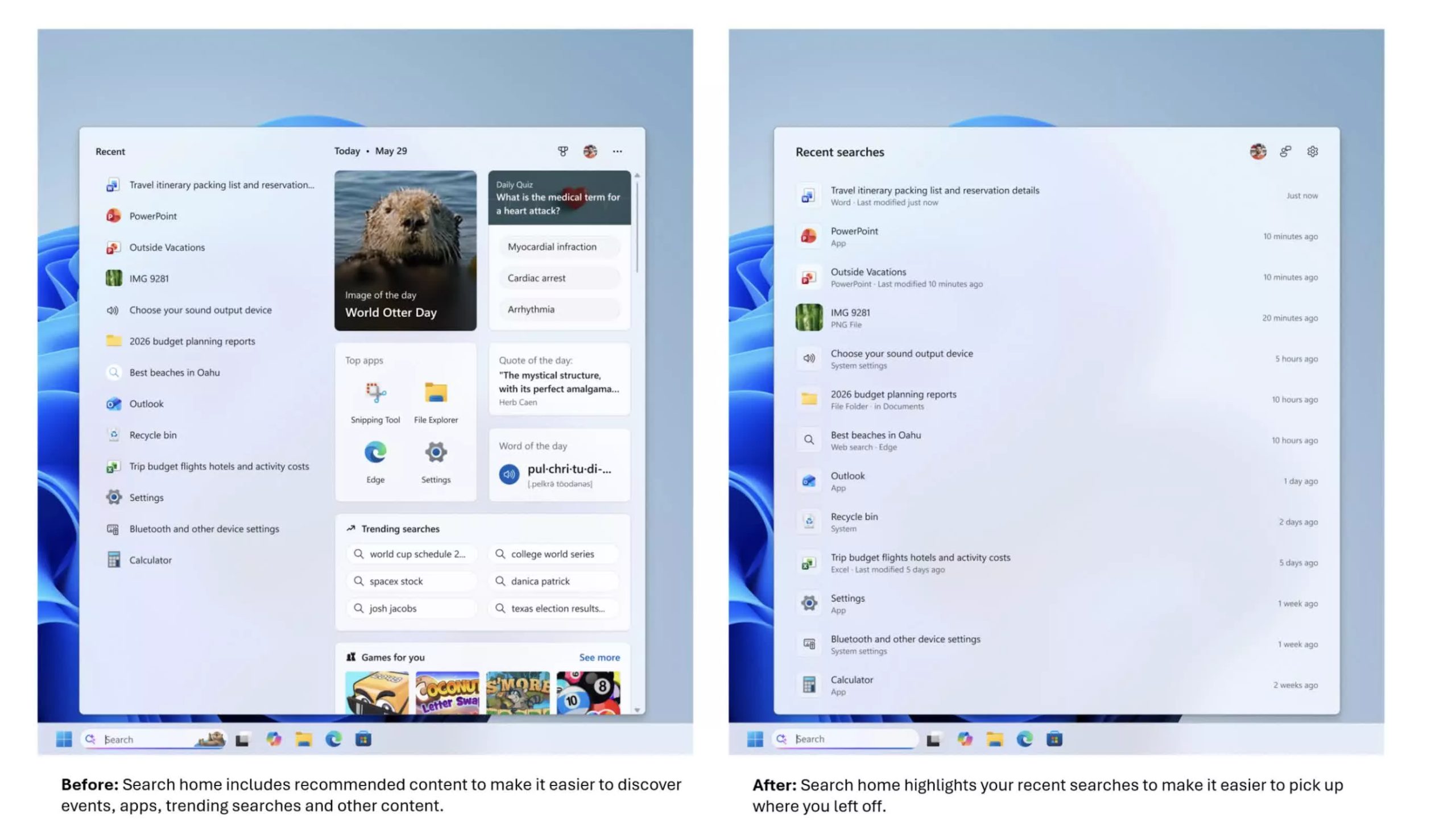
The change appears first on the search home screen. Instead of the old layout – with recently used apps on the left and tiles on the right asking “What day is it today?” or offering features such as “Daily quiz,” “Word of the day,” “Search trends,” and “Recommended games” – the new view is much cleaner.
The home screen now focuses on recent searches and local content rather than making the search box feel like a news or entertainment hub. For people who use search as a starting point, this shift is likely the first thing they will notice.
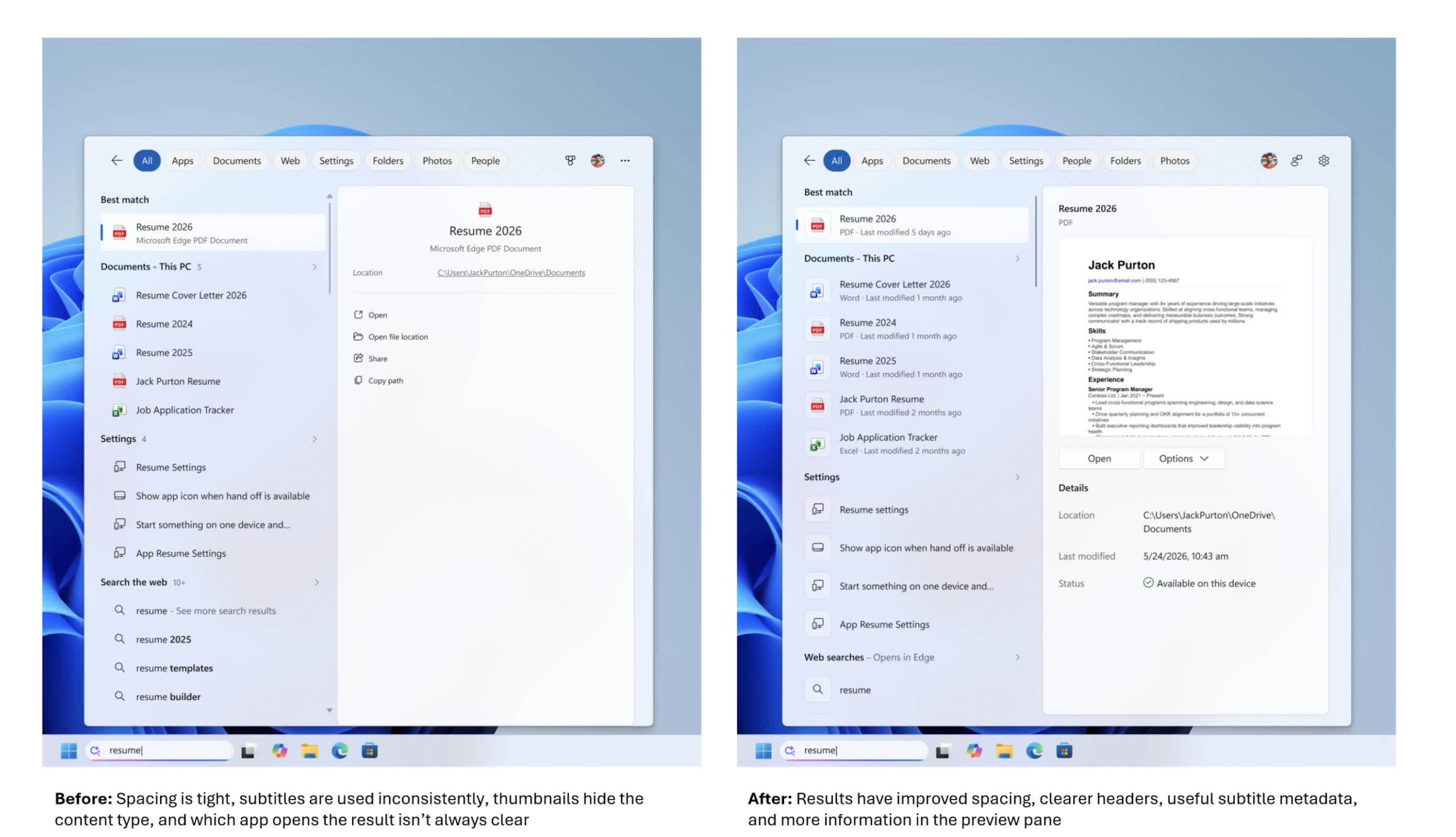
Beneath the simpler UI, Microsoft is putting more emphasis on helping users understand what they are about to click on. Search results now more clearly identify whether an item is an app, a setting, a file, a web result, or a Microsoft Store suggestion.
Advertisement
That sounds basic, but the search box has become a primary launch point for opening apps, finding files, changing settings, and getting quick answers from the web. Making the source and type of each result clearer is intended to help users choose the right option more easily.
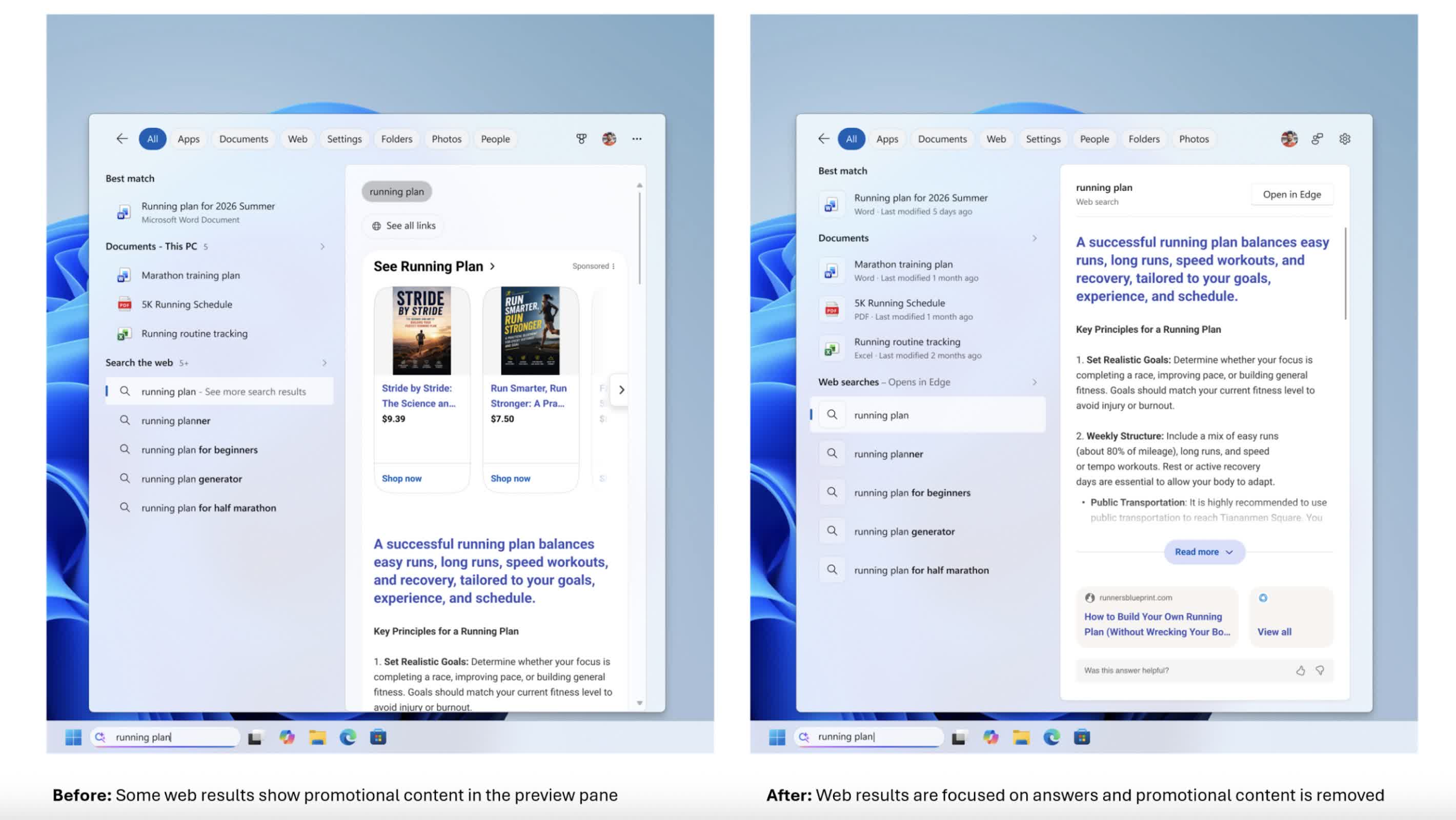
The company is also removing promotional content from web results. In earlier versions of Windows 11, web results displayed in the search box could begin with product-related suggestions and other promotional material.
In the new experience, the focus is squarely on the answer itself. Web results are presented more directly, without layers of promotional content appearing above them. For users who rely on the search box to quickly find information, the change makes it feel less like an advertising space and more like a straightforward tool.
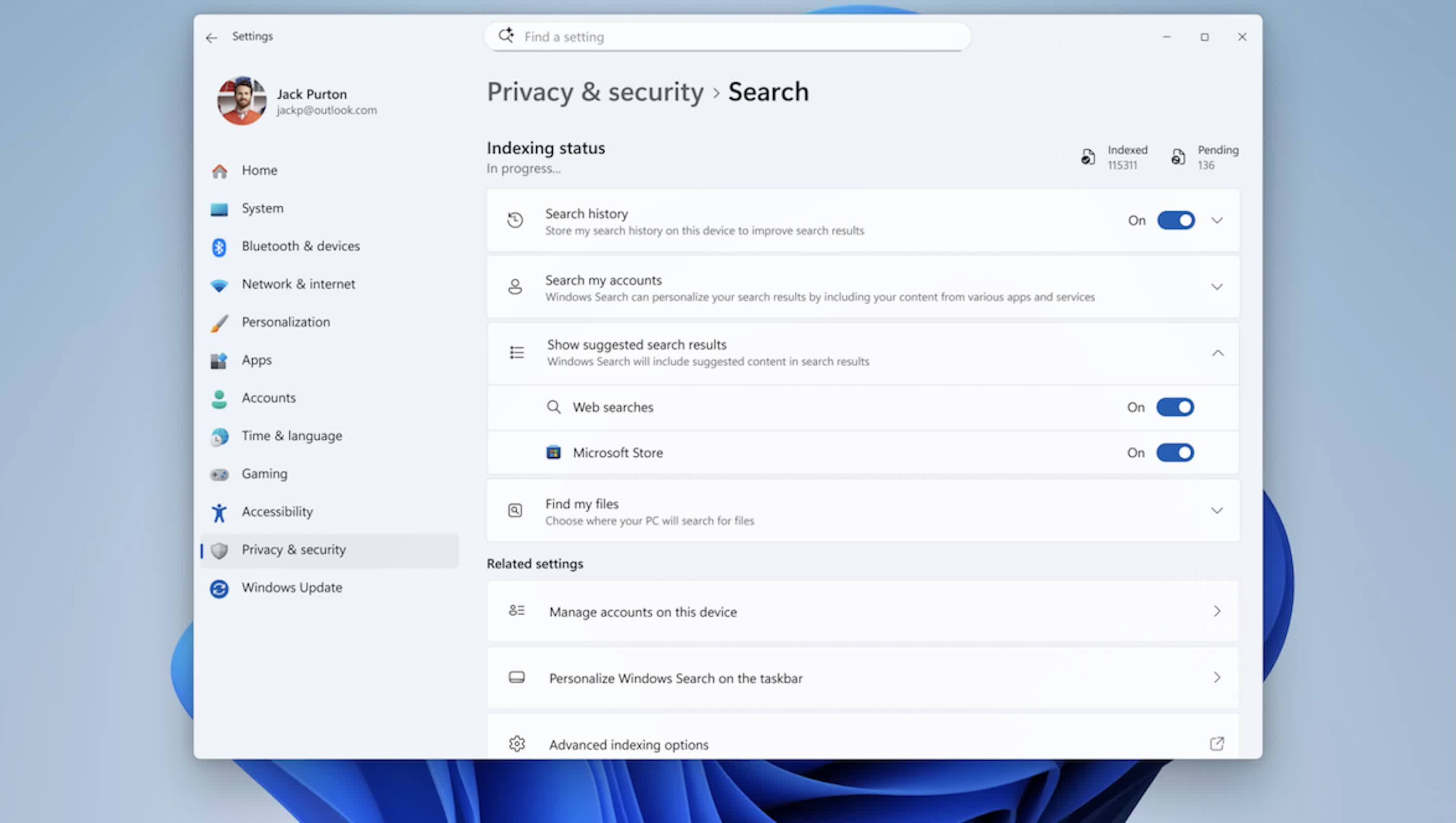
Another notable change is the level of control users have over how much online content appears in search results. A new setting under Settings > Privacy & Security > Search allows users to choose whether web and Microsoft Store suggestions appear alongside local results.
Advertisement
If that option is turned off, the search box behaves more like a local launcher and file finder rather than mixing in web and Store suggestions. The option is simple, but it acknowledges that not everyone wants online suggestions in a workflow focused primarily on opening content that is already stored on the machine.
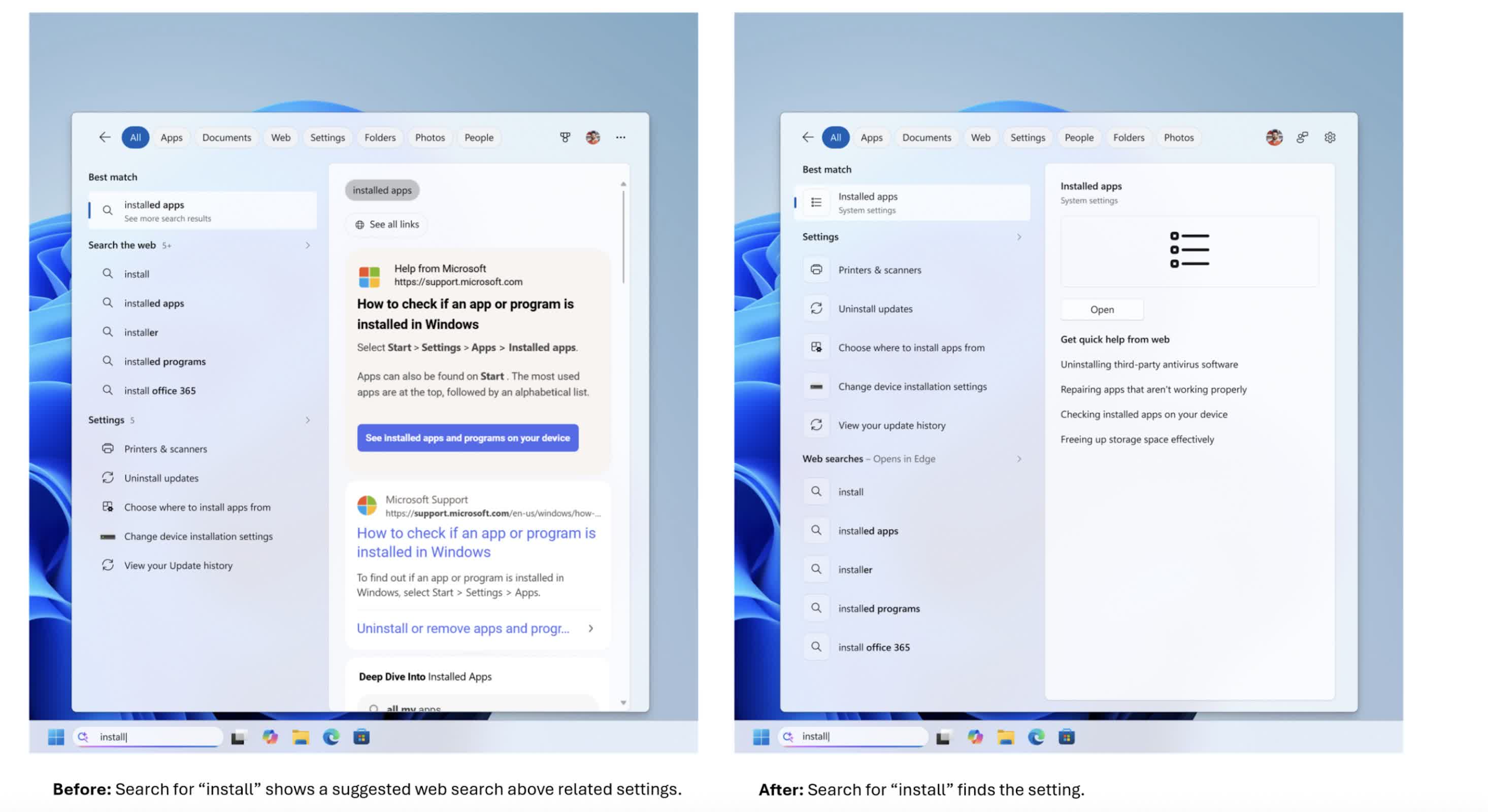
Behind the scenes, Microsoft has adjusted how it ranks results to better support this local-first approach. Apps, settings, and files are now more likely to appear ahead of web and Store items when they are a strong match for a query.
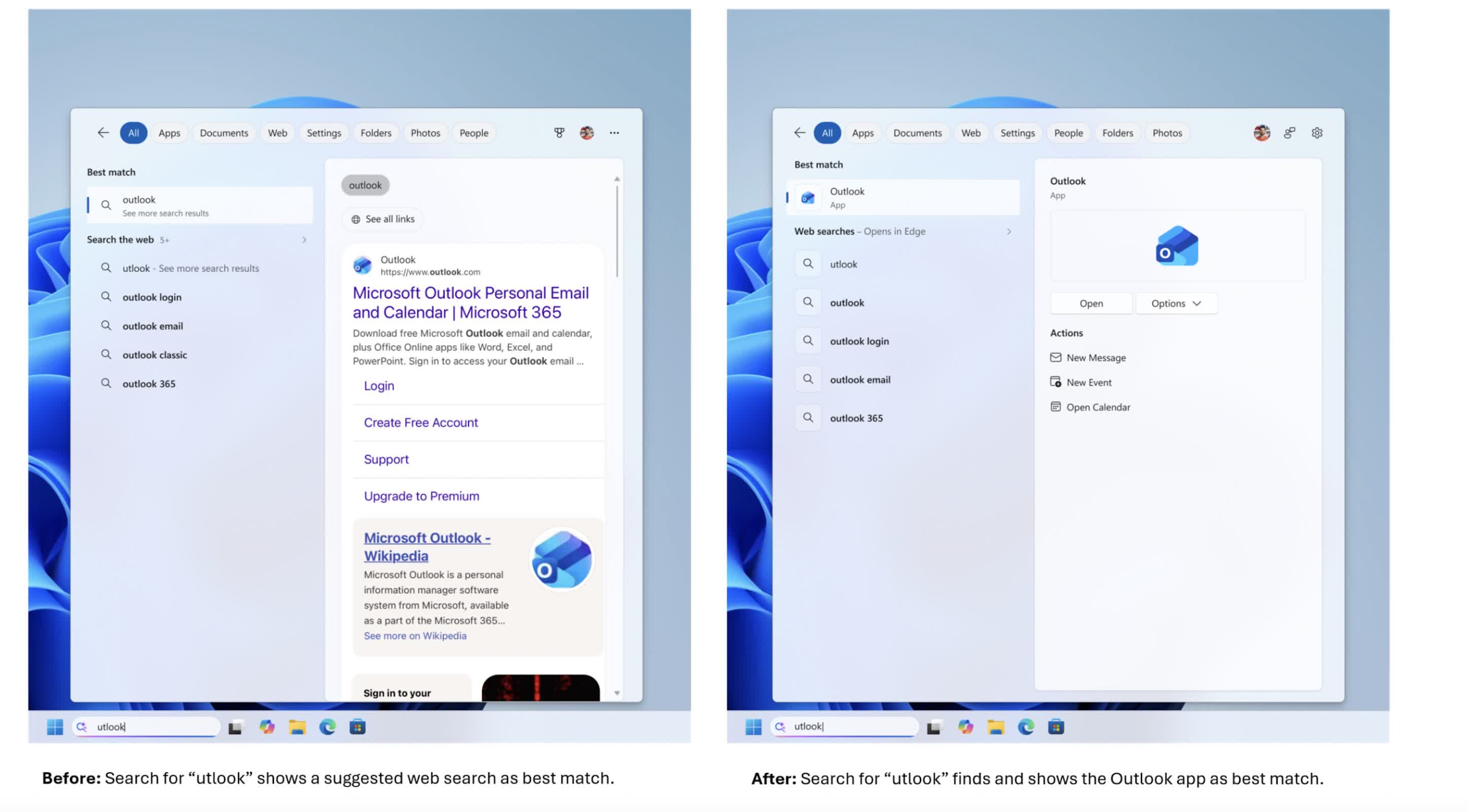
Core system objects, such as This PC and Recycle Bin, now appear more reliably instead of getting lost among tiles and other content. The search engine is also more forgiving of app names, handling typos, extra letters, and partial queries – so something like “utlook” can still find Outlook.
File search has been improved as well. The updated search box can handle very short queries, including two-character strings, which is useful for users working with short codes or brief file names.
Advertisement
Microsoft has also improved how cloud and connected files are surfaced, bringing them into view when they appear to be a better match than local content. The goal is to help users move more quickly from entering a search term to opening the document, download, or folder they intended to find, whether it is stored on the device or in online storage.
Settings search is getting attention as well. The company has made an initial round of changes to how settings results are ranked, aiming to surface more relevant controls higher in the list.
More tuning is planned as Microsoft collects data and feedback from the Experimental channel, meaning this part of the experience is likely to evolve over time. The company is also working on improving reliability by reducing crashes and search-related loading issues, with additional work still underway.
As with many recent Windows changes, the rollout will be gradual. The new search box is being distributed through Microsoft’s Controlled Feature Rollout system, so even users in the Experimental channel may not see it immediately.
Advertisement
Some users may receive the update after a reboot, while others may need to enable it through feature flags. Broader availability will follow as Microsoft refines the feature based on performance data and user feedback. For users who have been asking for a faster, cleaner, and more predictable search experience, this redesign arriving in 2026 represents a significant shift in how Microsoft approaches one of Windows’ most visible features.
T+A does not build inexpensive audio components, and its new HV reference pairing makes no attempt to wander into that unfamiliar part of town where tourists buy four-euro spätzle and lederhosen assembled somewhere considerably less German.
The German manufacturer has formally launched the SDX 3100 HV streaming DAC and preamplifier for $44,900 alongside the A 3100 HV stereo power amplifier for $29,900. The complete two-box system costs $74,800 before adding loudspeakers, cables, an equipment rack, or the optional $2,190 MM or MC phono module.
We first encountered both components at AXPONA 2026, but confirmed pricing, final specifications, and availability make them worthy of a closer look. The A 3100 HV began shipping on July 9th in silver or titanium, while SDX 3100 HV availability is rolling out through dealers, with some North American listings indicating August delivery.
The price will dominate the conversation, because $74,800 remains a serious amount of money even by high-end audio standards. What T+A is offering, however, is not merely another streamer connected to a large amplifier. The SDX 3100 HV and A 3100 HV represent a highly integrated reference system that combines some genuinely unusual digital architecture with enough amplification to drive almost any conventional passive loudspeaker.
Advertisement
Related Reviews:
The SDX 3100 HV Is More Than a Streamer
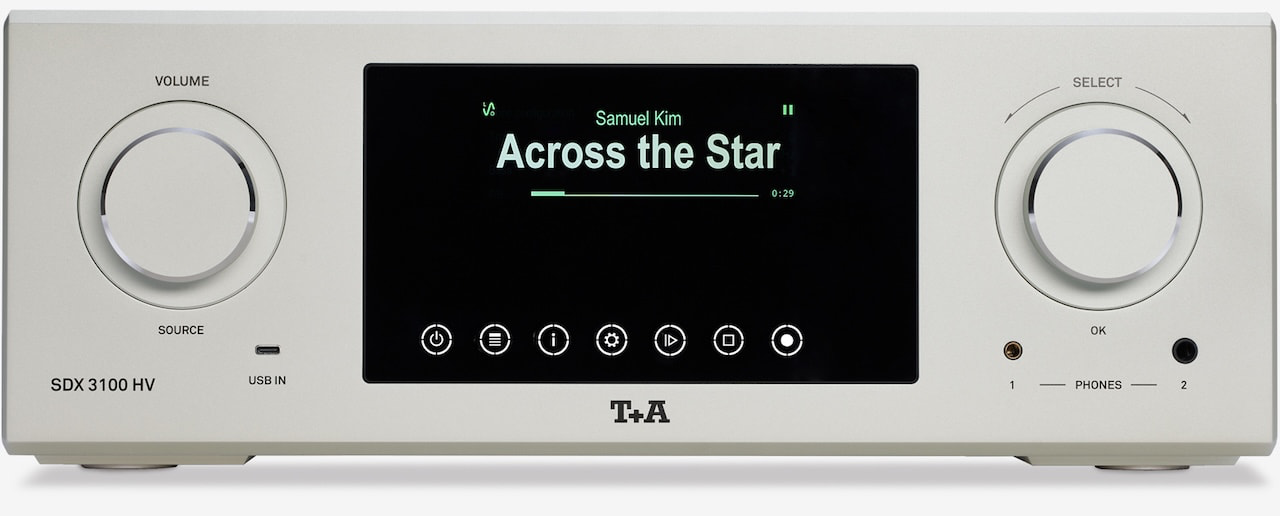
SDX 3100 HV
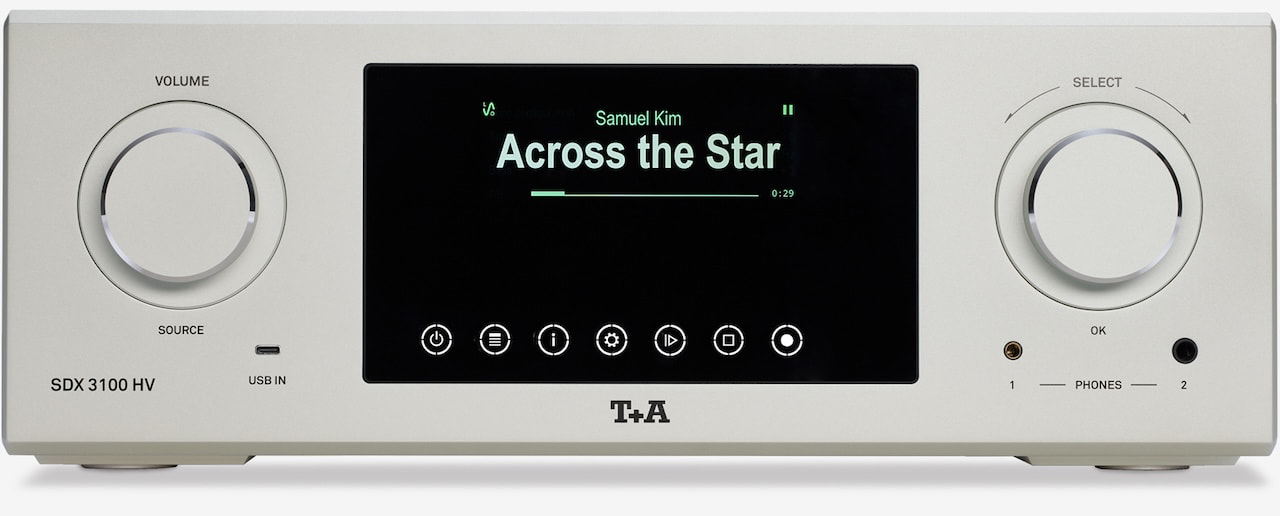
The SDX 3100 HV replaces the SDV 3100 HV at the top of T+A’s digital lineup, combining a network streamer, DAC, fully analog preamplifier, headphone amplifier, tuner, and system controller inside a 57-pound aluminum chassis.
Its most significant technical feature is T+A’s Path Separation Technology, which routes PCM and DSD through different conversion architectures rather than forcing both formats through the same DAC design.
PCM signals are handled by a double-differential quadruple converter using four 32-bit sigma-delta DAC channels per side, supporting rates up to 768kHz through USB. DSD travels through T+A’s proprietary True 1-Bit converter without first being converted to PCM, with USB playback supported up to DSD1024.
There is an important distinction buried beneath that impressive headline number. DSD512 and DSD1024 require a compatible Windows computer with T+A’s driver or a Linux system running a supported kernel. Network streaming is currently specified up to DSD256, which remains more than sufficient for almost every commercially available recording but is not quite the same as streaming DSD1024 from a NAS while congratulating yourself on having survived another firmware update.
T+A’s De-Jitter Masterclock examines incoming clock signals and routes anything failing its stability requirements through an additional PLL stage. Separate quartz oscillators are used for the 44.1kHz and 48kHz frequency families, reducing the need for sample-rate conversion between them. The SDX also provides selectable digital filters, including FIR, Bezier, and two NOS options.
Advertisement
Streaming Without Another Proprietary Island
The third-generation Audiophile Streaming Architecture, or ASA G3, supports TIDAL Connect, Qobuz Connect, Spotify Connect, Amazon Music HD, Deezer, HIGHRESAUDIO, Apple AirPlay 2, Audirvana, internet radio, and locally stored music.
Roon certification is still listed as being in progress. That will need to be completed quickly because a $44,900 streaming component should not arrive with a significant software feature still waiting in the departure lounge.
Advertisement. Scroll to continue reading.
Wired Gigabit Ethernet and dual-band Wi-Fi 6 are included, along with Bluetooth 5.4 using aptX HD, AAC, SBC, and MP3. Bluetooth is clearly present for convenience rather than as the preferred method for extracting everything the SDX can deliver.
Advertisement
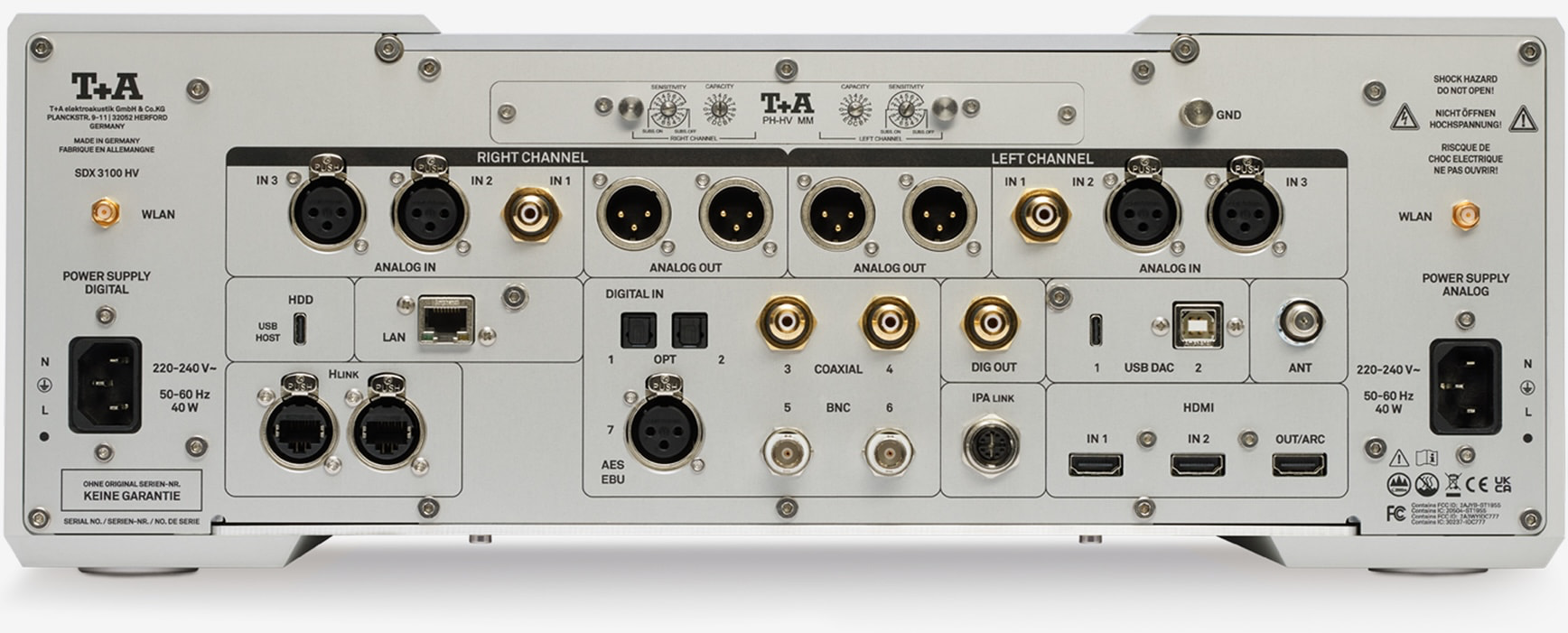
Physical connectivity is extensive. The digital section includes AES/EBU, coaxial, BNC, optical, USB, two HDMI inputs, and an HDMI output with ARC. The specification currently lists ARC rather than eARC, although that is unlikely to present a meaningful bandwidth limitation in a two-channel system.
SDX 3100 HV (rear)
A Proper Analog Preamplifier
Many streaming DACs offer variable output and describe themselves as preamplifiers. The SDX 3100 HV takes the role more seriously.
Its fully symmetrical, double-mono preamplifier is constructed with discrete components and galvanically isolated from the digital circuitry. Volume is controlled by a relay-switched network with channel matching specified within 0.05dB at minus 60dB, where less carefully designed controls can begin shifting the image toward one loudspeaker.
The SDX also includes balanced and single-ended analog inputs, making it possible to connect tape machines, external phono stages, or other analog sources without converting them into the digital domain.
Advertisement
T+A has even included fully analog tone controls with individually adjustable bass and treble levels and selectable turnover frequencies. That is a more sophisticated approach than the usual bass and treble knobs, allowing some correction for loudspeaker balance, room placement, and difficult recordings without passing the signal through DSP.
It is not room correction, and there is no automated measurement system or sophisticated subwoofer bass management. Buyers looking for Dirac Live, ARC Genesis, or Linn Space Optimisation will need to solve those problems elsewhere.
The optional phono board is available in separate MM and MC versions for $2,190. At this price, including both cartridge types in one adjustable module would not have caused the accountants to begin rationing office supplies, but the internal option is still useful for owners seeking to avoid another box.
A discrete Class A headphone amplifier supplies both 6.3mm and 4.4mm Pentaconn outputs. T+A specifies a six-ohm output impedance and up to 200mA of current, making it considerably more substantial than the convenience headphone circuits often added to digital components.
Advertisement
The A 3100 HV Offers Two Amplifiers in One
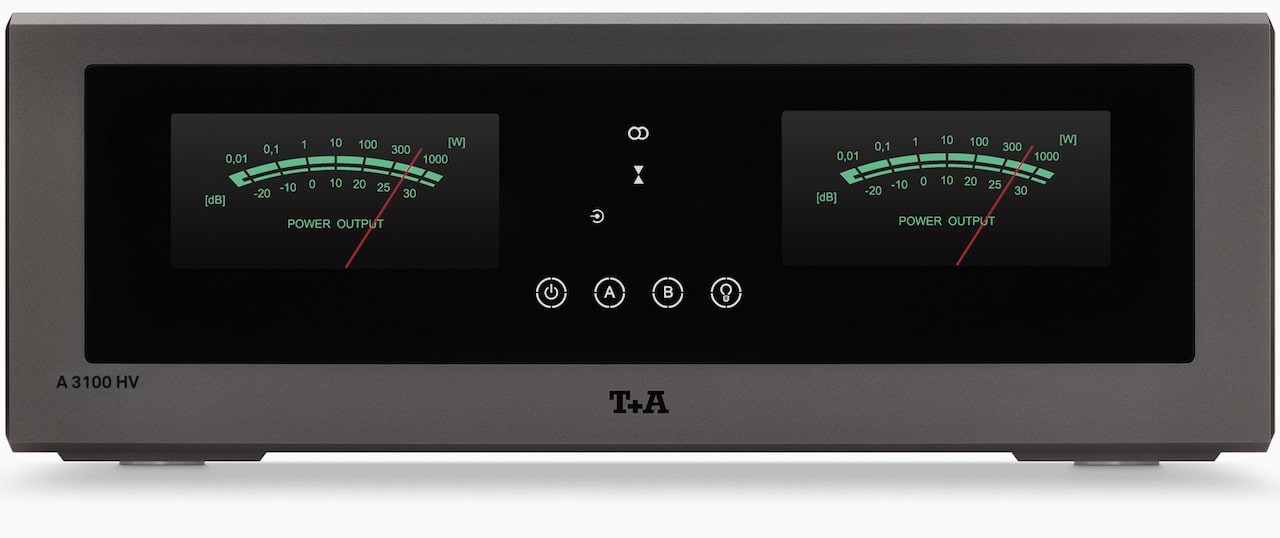
A 3100 HV
The matching A 3100 HV replaces the A 3000 HV, which remained in production for more than a decade. T+A claims more than 270 engineering changes, including revised board layouts, tighter-tolerance components, improved thermal management, and a new High Current operating mode.
T+A’s HV designation refers to its use of much higher internal operating voltages than conventional solid-state circuits. The objective is to keep the transistors working within a smaller and more linear portion of their operating range, pursuing some of the linearity associated with tubes without using tubes or their eventual maintenance requirements.
In High Current mode, the output stage runs at substantially increased idle current and can deliver up to 75 watts in pure Class A before transitioning into Class AB operation. This mode is intended for systems where listeners value the amplifier’s highest-bias operation and do not require maximum output.
Advertisement. Scroll to continue reading.
Switching to High Power mode changes the priorities. The A 3100 HV is rated at 300 watts per channel into eight ohms and 500 watts into four ohms, with short-term output reaching 380 watts into eight ohms and as much as 650 to 700 watts into four ohms, depending on the measurement listed.
Advertisement
Those figures come from a 1,000-watt toroidal transformer and 120,000µF of reservoir capacitance. The power supply is magnetically shielded and physically separated from the audio circuitry behind a 10mm aluminum partition. Voltage and current amplification are located on separate boards and galvanically isolated to reduce interaction between the input stages and the current being delivered to the loudspeakers.
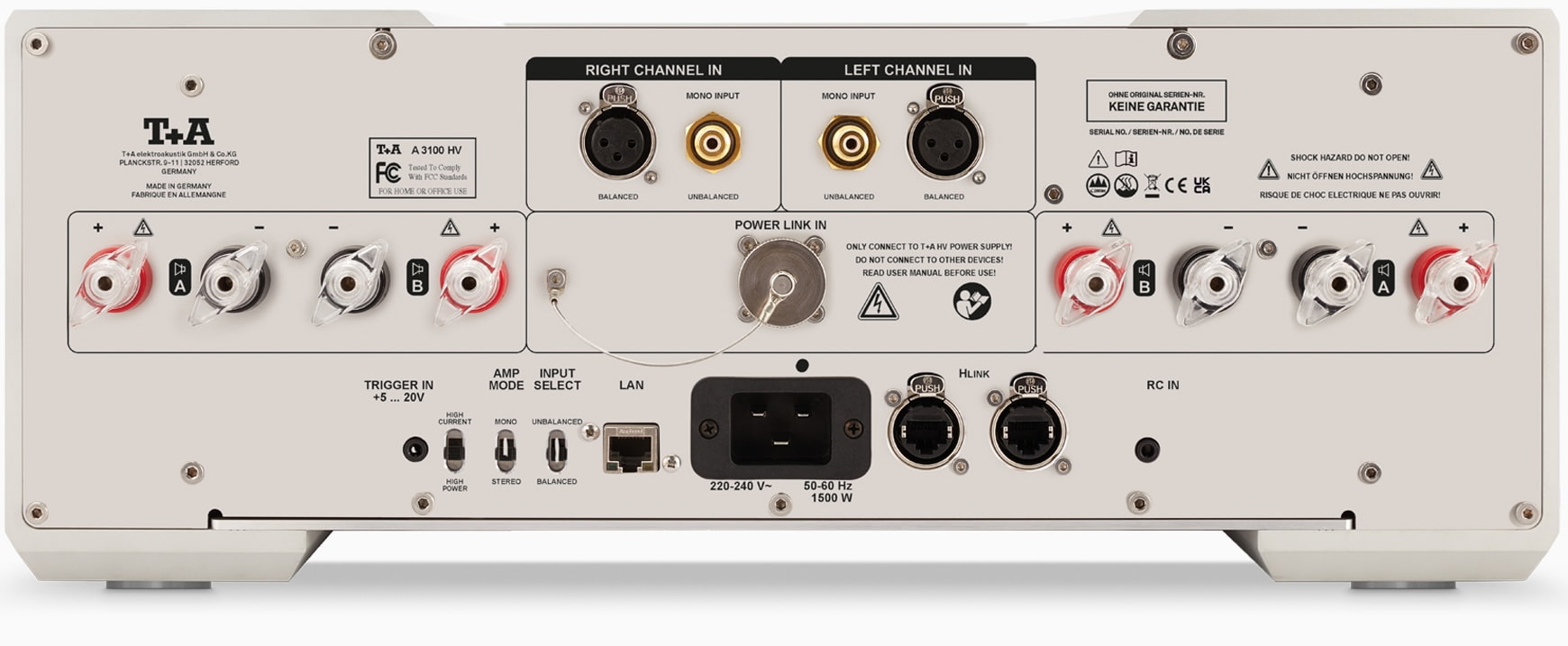
A 3100 HV (rear)
The amplifier can also be switched into mono operation, allowing owners to add a second A 3100 HV. At that point, the electronics alone rise to $104,700 before contemplating T+A’s optional external power supplies. The phrase “diminishing returns” may be heard faintly in the distance, but nobody in this market appears to be returning its calls.
What Does It Compete With?
There is no perfect direct competitor because T+A combines several product categories in an unusual two-box arrangement.
Naim’s closest conceptual alternative requires an NSS 333 streamer, NAC 332 preamplifier, and two NAP 350 mono power amplifiers. The NAP 350 delivers 175 watts into eight ohms and 345 watts into four ohms, making the Naim system less powerful on paper while requiring four chassis before optional external power supplies enter the discussion.
Advertisement
The CH Precision I1 takes the opposite approach. It combines preamplification, power amplification, DAC functionality, and optional streaming and phono modules in one configurable chassis. Its modular architecture is extremely flexible, but rated output is 100 watts per channel into eight ohms. The T+A system requires two shelves but provides far greater power and includes its full streaming platform as standard.
Boulder’s 866 Digital integrated amplifier also consolidates streaming, DAC, preamplification, and power amplification into one component. It delivers 200 watts into eight ohms and 400 watts into four ohms and supports Ethernet, USB, AES3, optical, AirPlay, and Roon. It is the more compact approach, although it lacks T+A’s separate native DSD conversion path and extensive direct streaming-service integration.
Linn’s Klimax DSM and Klimax Solo 800 amplifiers represent another logical comparison, especially for listeners interested in streaming, system integration, and room optimisation. Pricing places the T+A system in some perspective: a single Klimax Solo 800 starts at $51,190 in the United States, making a stereo pair $102,380 before adding the Klimax DSM source and preamplifier. Suddenly $74,800 starts looking merely extravagant rather than requiring intervention from concerned relatives.
Why This System Is Different
The SDX 3100 HV and A 3100 HV stand apart because they do not force buyers to choose between old-school analog engineering and a modern streaming system.
Advertisement
The SDX offers direct access to the major streaming platforms, HDMI ARC, high-resolution USB playback, analog inputs, optional phono support, proper preamplification, analog tone controls, and a robust headphone amplifier. The A 3100 HV can prioritize Class A operation for lower-level listening or switch to 500-watt Class AB output when the loudspeakers demand considerably more persuasion.
T+A has also managed to keep the complete system to two chassis. That will matter to buyers who want reference-level separates but have no desire to assemble a seven-box shrine requiring its own electrical subpanel and structural engineer.
The Bottom Line
There is no sensible way to describe $74,800 as affordable, and T+A does not need anyone performing financial gymnastics to make it sound reasonable.
Advertisement. Scroll to continue reading.
Advertisement
A complete system with the phono module costs $76,990. Adding T+A’s optional $19,490 PS 3100 HV external power supply pushes the total to $96,480. Two amplifiers in mono operation take the system comfortably beyond six figures.
That pricing excludes almost everyone, including many serious audiophiles with excellent systems and perfectly healthy credit scores.
But judged within the reference electronics category, the T+A pairing is not an outlier. It competes with systems from Linn, CH Precision, Naim, Boulder, dCS, and other manufacturers for whom five-figure source components and power amplifiers are entirely normal.
The more relevant question is whether T+A’s two-box architecture can deliver enough of the performance, flexibility, and long-term usability of those larger systems to justify its substantial price.
Advertisement
On paper, the answer is at least plausible. The engineering is ambitious, the specifications are formidable, and the combination of native DSD conversion, real analog preamplification, selectable amplifier bias, and 500-watt output is unusual at any price.
Whether it sounds like $74,800 will require far more than reading the specification sheet while making approving German noises.
Pricing & Availability
The T+A A 3100 HV is available in silver or titanium for $29,900 and began shipping through authorized dealers on July 9, 2026.
The SDX 3100 HV is priced at $44,900, with dealer availability rolling out through July and August 2026.
Advertisement
The optional MM or MC phono module is $2,190.
The complete SDX 3100 HV and A 3100 HV system costs $74,800, or $76,990 with one of the phono modules.
We may receive a commission on purchases made from links.
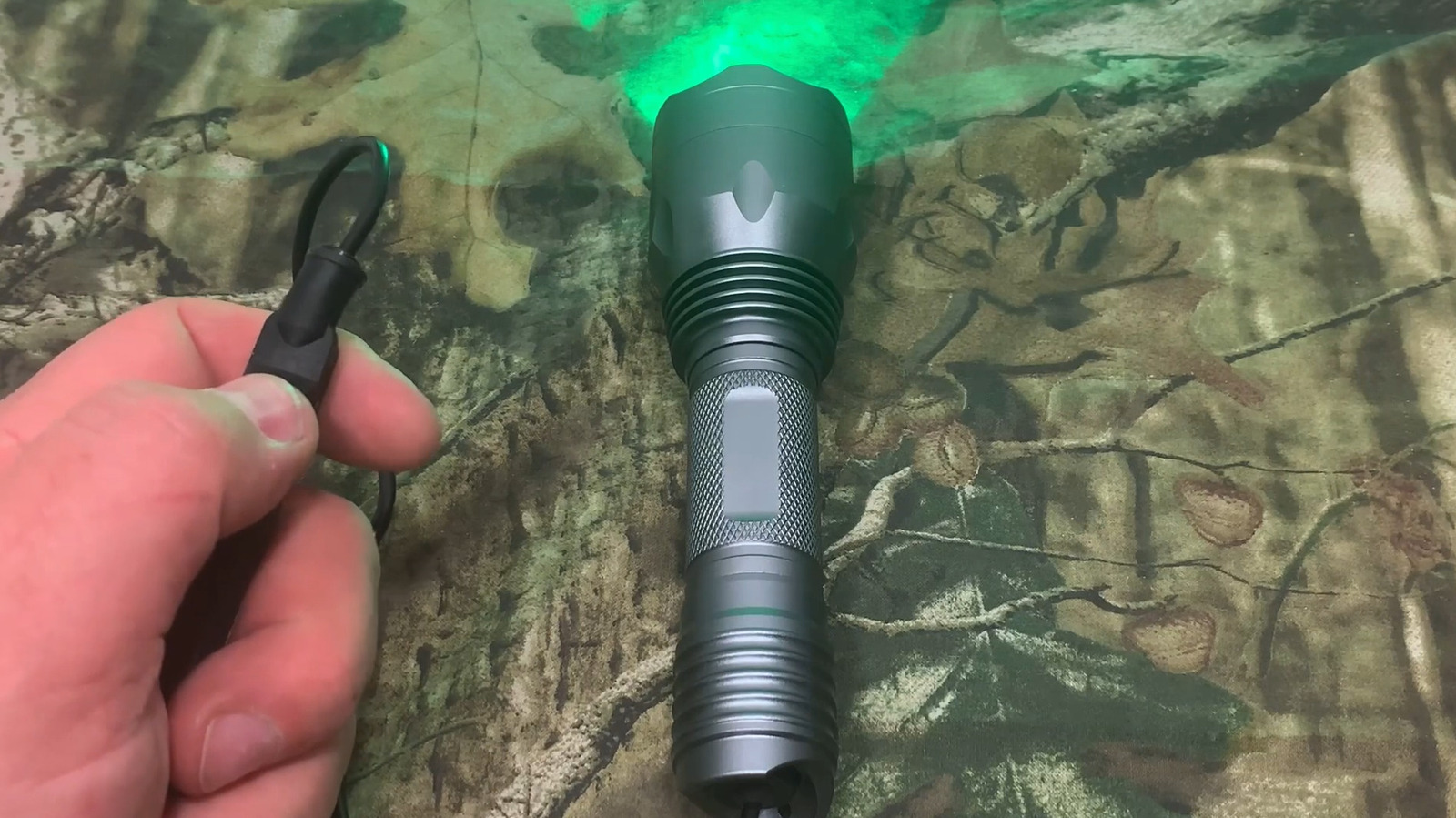
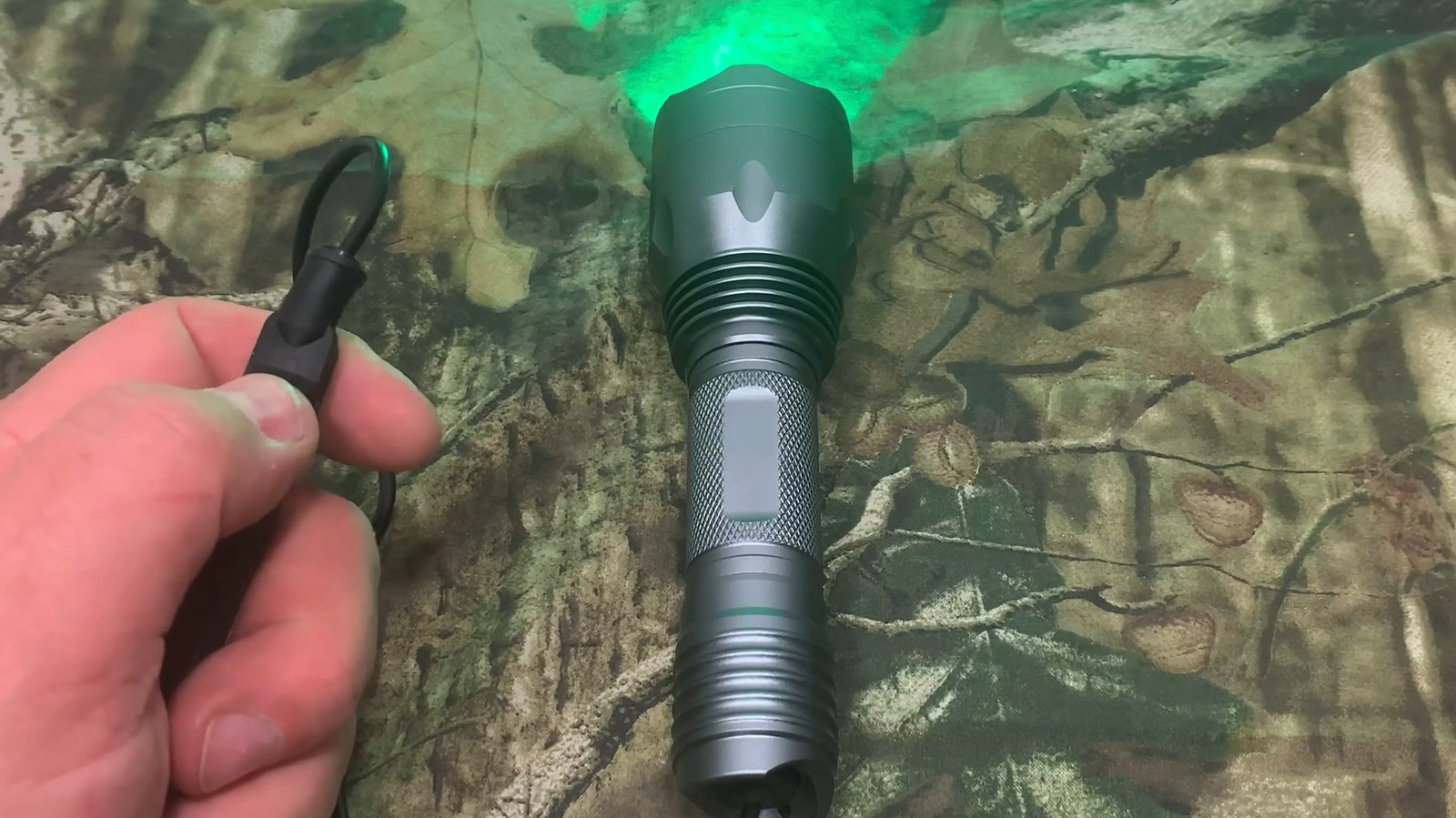
Compared to the more well-known standard that are white light flashlights, a green light flashlight is a specialized tool primarily used for certain night activities. At the mention of the words green and flashlight, the first association might be military-related, but everyday people can easily use them and acquire them from popular flashlight brands. While the military and some law enforcement indeed use them, a green light flashlight has many uses, and it’s particularly helpful for wildlife, such as during hunting or observation. It’s because green light is much less alarming to animals compared to a bright white light, so they’re less likely to get spooked.
Advertisement
Additionally, a green light is less intrusive to human sight, and it helps our eyes adjust better at night. If you have ever had a bright white light flashlight pointed at your eyes when it’s dark, you know how disorienting it is. The reason for this is that a green light sits at a medium range wavelength of around 510nm to 565nm on the visible spectrum. This is relevant because in the dark, our eyes respond best to 380nm and 650nm wavelengths, reaching peak adaptation at 507nm, which is very close to green.
Advertisement
What are the benefits of a green light flashlight?
A green light flashlight is also good for navigation at night, or if you need to read a map or an instrument. Along with the aforementioned wildlife hunting or observation, a green light flashlight is useful for night fishing as well. Just like mammals, fish are less likely to be startled by a green light. It can be used to attract baitfish, making it one of the more essential tools to keep on your boat. Because of its subtle nature and reduced glare, a green light flashlight is also used in military and law enforcement operations or surveillance.
It’s important to note that a green light flashlight, or rather the green light itself, isn’t inherently harmful to animals. It could interfere with natural behavior in some cases, but a green light flashlight isn’t physically damaging to them, since it’s designed with wavelengths less disruptive to wildlife. Most animals, especially mammals, are dichromatic, meaning they only see colors in two wavelengths, blue and yellow. In other words, they struggle to distinguish green properly, which is why the green light is a better option.
Marantz has announced the launch of two new hi-fi separates at a more affordable prices.
The Model 70 integrated amplifier and CD 70 build on the success of the PM6007 and CD6007, and shows that while everyone’s getting into hybrid hi-fi products and active speakers, there’s still room for specialist hi-fi separates in the market.
Both feature Marantz’s full-width architecture that’s made their recent products stand out, and will be available in black and silver-gold finishes, a look that Marantz hopes will “appeal to culture-driven consumers who see audio as an integral part of their home environment”.
Inside the Model 70 is Class AB amplification that can deliver 50W per channel, and is supported by an enhanced power supply and larger toroidal transformer. Marantz says that this configuration results in “greater dynamic expression, improved speaker control and increased authority across a wide range of loudspeaker pairings.”
Advertisement
There’s a “high-performance” DAC for “exceptional” digital playback quality, and even at this lower price, there’s room for Marantz’s proprietary HDAM circuitry that aims to “preserve the speed, accuracy and musical character” that’s defined the warm, detailed and musical sound of Marantz’s products.
Advertisement
Vinyl fans can make use of an MM phono stage, while there’s also HDMI ARC for connecting to a TV and aptX Adaptive Bluetooth to stream to the amplifier or connect a pair of wireless headphones to the amp. A range of analogue and digital inputs are provided, plus preamplifier and sub outputs to suit a “broad range of listening environments and system configurations”.
Image Credit (Marantz)
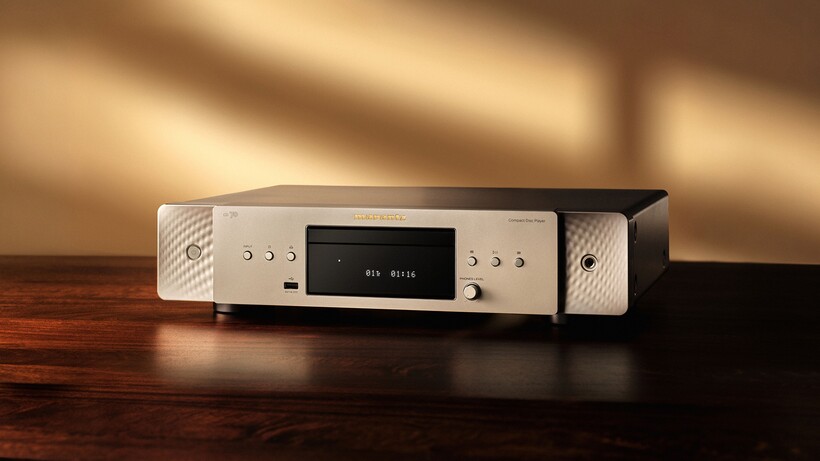
With CD enjoying some time back in the spotlight, those committed the silver disc will be able to have a Marantz CD player as part of their set-up going forward.
It has the same DAC and HDAM circuitry as the Model 70, with a front-panel USB-A input and support for FLAC, ALAC, AIFF and DSD files. A built-in headphone amplifier ensures private listening with a pair of wired headphones.
Advertisement
Marantz says that “every aspect” of the CD 70’s build has been carefully optimised to minimise noise and preserve musical detail. and this includes an upgraded power supply: double-layered chassis base, rigid isolation feet and “strategically” deployed copper hardware that contribute to “improved stability and reduced interference”
Advertisement
The Model 70 integrated amplifier is priced at €850 / £749, and reportedly won’t be available to buy in North America. However, the CD 70 will go on sale in North America, with availability starting from August 15th for $750 / €600 / £499.
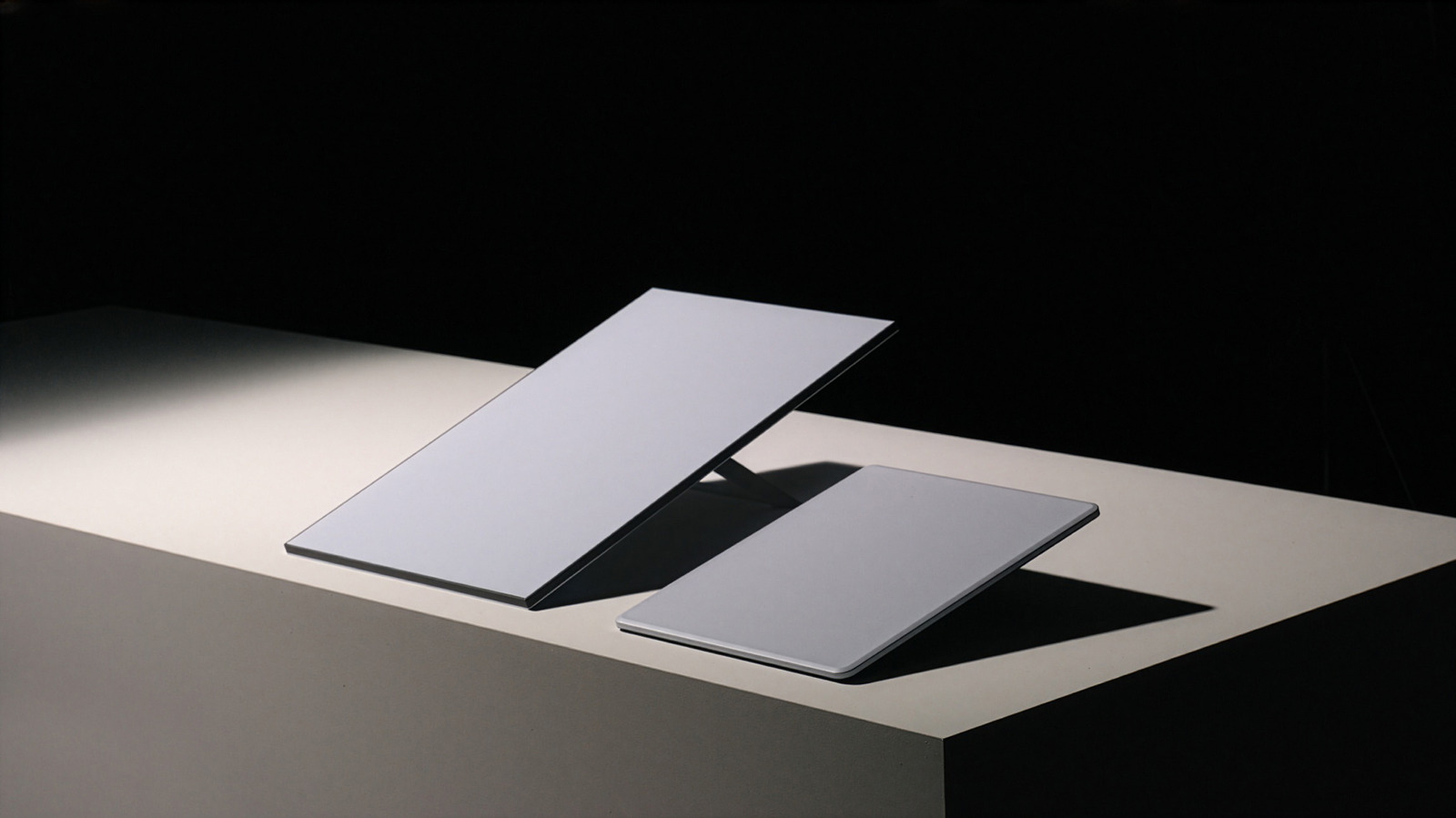
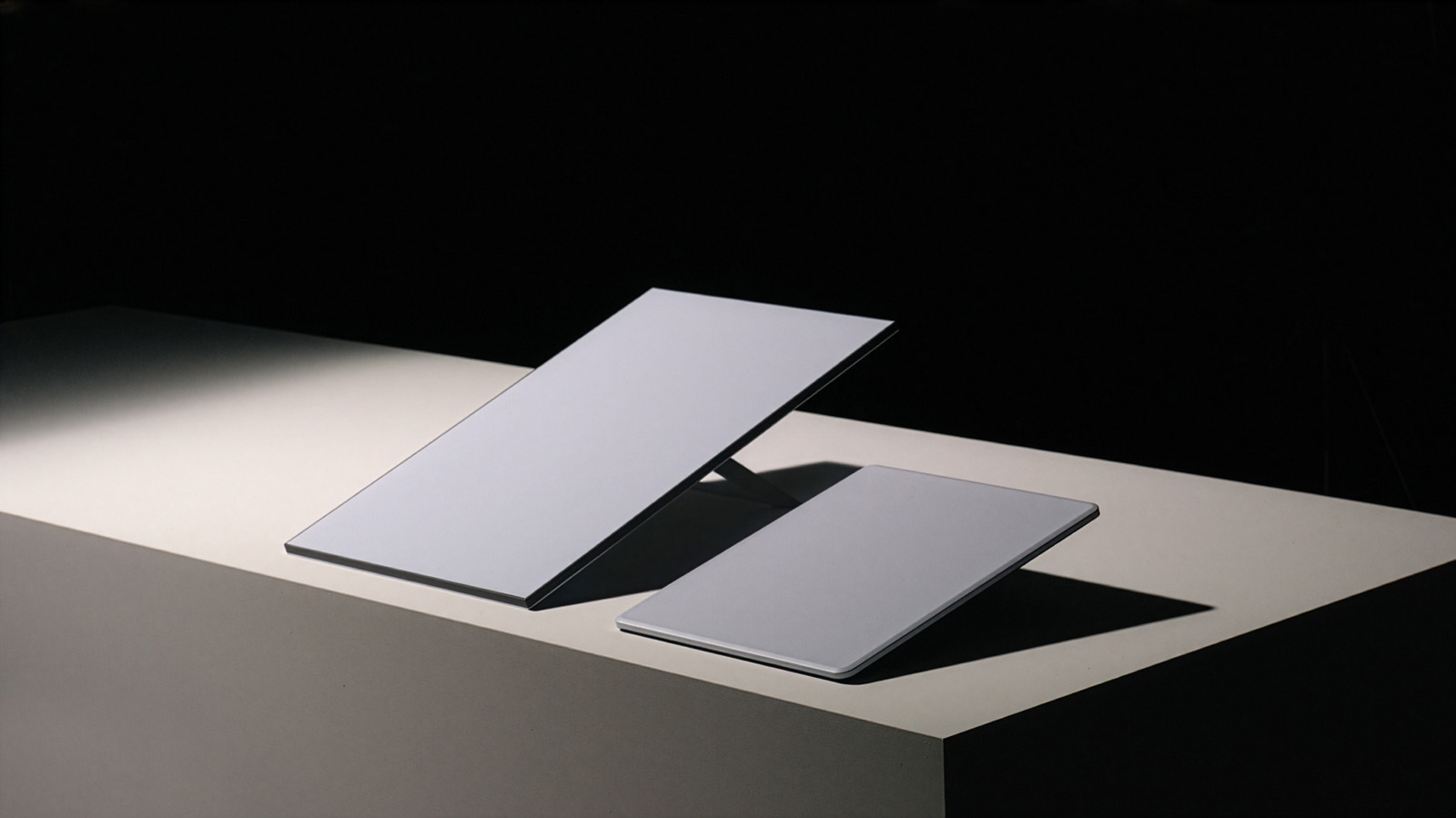
Starlink quietly released its latest V5 residential dish, and while it doesn’t boost data speeds, it offers several improvements. Compared to the previous V4 dish, the new model is smaller, lighter and more energy efficient, which should make it easier to install while also reducing your power bill.
SpaceX confirmed in a post on X that the product will arrive today in the US in certain regions at first. It follows the V4 model that debuted in 2023 and will continue to be offered via the Starlink Residential plan. “Starlink V5 has a smaller form factor, new lightweight design, greater power efficiency than the Starlink V4,” according to a support page that compares the two models.
You may expect a speed boost with a new dish, but the V5 actually supports a slightly lower data rate of 375+ Mbps compared to 400+ Mbps for the V4. However, the new model is considerably smaller at 2.4 pounds rather than 6.5 pounds and is just 5.12 x 12.05 x 1.34 inches in size, compared to 23.4 x 15.1 x 1.5 inches for the V4. It also consumes less power at 35 to 50 watts compared to 75 to 100 watts for the previous model.
It weighs nearly the same as the portable Starlink Mini, but unlike that model, the V5 isn’t designed for in-motion use, Starlink says. It will be bundled with the Router Mini and come with a “pipe adapter” for rooftop installation.
Advertisement
One region offering the new dish, according to a Reddit post seen by PCMag, is Drummond, Montana. There, the V5 dish is offered only with the least expensive $55 per month 100Mbps Residential plan. The pricier Residential and Residential Max plans only support the V4 dish with the superior Router 3, for now.
Elon Musk showed the new dish off recently in a video post on X, saying the new dish would be made in “much higher volume than the current terminals.” The company recently announced its next-gen Starlink Mobile network, set to launch in mid-2027, that would provide up to 150 Mbps speeds and “feel like you’re connected to a high-performing 5G terrestrial network.” Last year, the company also showed off a new $2,000 Performance dish designed to handle gigabit internet speeds.
A judge has dismissed an attempted class action lawsuit against Apple, which accused the tech giant of failing to stop the storage of child sexual abuse material on iCloud.
A lawsuit from August 2024 that accused Apple of “privacy-washing” and failing to properly deal with the issue of child sexual abuse material (CSAM) on iCloud has been dismissed.
In a ruling reported by Reuters on July 14, U.S. District Judge Noel Wise in San Jose, California, agreed with Apple’s argument that it was shielded from the claims by Section 230 of the Communications Decency Act. This refers to a section that protects online platforms from liability for third-party content, namely that of its users.
Representing the plaintiffs, Attorney James Marsh said that an appeal was being considered, as well as other potential legal claims. The attorneys claimed that the class of 2680 people were entitled to compensatory damages of $32.8 billion in total.
Advertisement
Under the ruling, Wise added that there’s no federal law that would force Apple to create new tools or deploy existing technology to identify and report CSAM on iCloud.
“Lawmakers can fix this problem that is contributing to the exploitation of children,” the Judge wrote in the ruling. “This Court cannot.”
The lawsuit was dismissed with prejudice, so it cannot be refiled under the same claims by the plaintiffs.
A CSAM failure
The lawsuit arrived after Apple attempted to implement measures to help prevent the spread of CSAM. But, after considerable outcry, it abandoned its plans.
Advertisement
Back in 2021, Apple announced a suite of tools it wanted to release across its platforms. There were two chief areas, consisting of Communication Safety and CSAM detection in iCloud Photos.
Communication Safety, which is intended to help prevent children from seeing or sending objectionable material, is still being developed as a service. The most recent changes expanded from nudity to violence and gore detection.
The second, CSAM Detection in iCloud Photos, used cryptographic techniques to detect collections of that content, which would then be reported to NCMEC (National Center for Missing and Exploited Children). The technique wasn’t scanning actual images, but instead detected existing CSAM files using known hashes.
Apple received a lot of criticism, including complaints from experts at other tech companies, over privacy and security fears.
Advertisement
Apple ultimately killed off the iCloud CSAM scanning plan in December 2022. In August 2023, Apple provided a more detailed reasoning for abandoning the plan, after being pressed by a child safety group.
This included the potential creation of new threat vectors for data thieves to find and exploit. There were also fears it could result in unintended consequences, such as leading to bulk surveillance and more demand to search other encrypted messaging systems.
Damned either way
While Apple had basically given up on its CSAM detection plans, instead focusing on Communication Safety, the issue simply didn’t go away.
A July 2024 report from the UK’s National Society for the Prevention of Cruelty to Children (NSPCC) accused Apple of vastly undercounting incidents of CSAM in its services.
Advertisement
Apple had made only 267 reports to NCMEC, as required by U.S. law, for incidents it detected globally in 2023. However, the NSPCC said that Apple was implicated in 337 offenses between April 2022 and March 2023 in England and Wales alone.
By comparison, Google reported over 1,470,958 cases in 2023, with Meta reporting 17,838,422 on Facebook and 11,430,007 on Instagram.
While Apple is not able to see the content of iMessage for CSAM scanning purposes, the NCMEC pointed out that Meta reported over a million suspected CSAM cases for the encrypted WhatsApp in 2023.
The now-dismissed lawsuit surfaced just one month later.
Advertisement
Aside from demanding damages, the lawsuit also wanted Apple to be forced to adopt CSAM measures. This included ways to prevent the storage and distribution of CSAM on iCloud, as well as making reporting more easily accessible and complying with quarterly third-party monitoring.
The US’s explosive diarrhea problem is worse than you think—and it’s about to get even messier.
The country is grappling with a large and fast-spreading outbreak of cyclosporiasis, a parasitic infection that causes extreme gastrointestinal distress. There are nearly 7,000 potential cases, more than 3,300 of which are in Michigan alone as of Tuesday, and state officials have identified tainted lettuce as the likely culprit.
The actual case count is almost certainly higher, though, because most people don’t seek medical care when they get diarrhea. And even when they do, labs don’t routinely test for cyclosporiasis, says Jeanne Marrazzo, CEO of Infectious Diseases Society of America. She estimates cases are at least double the Centers for Disease Control and Prevention’s numbers.
“That’s because of underdiagnosis and also because there are cases that are likely to be mild. Many people aren’t going to declare themselves and get counted,” she says. Cyclosporiasis isn’t as common as other foodborne illnesses, meaning it’s not included in standard panels that test for several types of gastrointestinal disease.
Advertisement
But for many folks who get sick, the effects are, let’s just say, not pleasant. “A lot of times with diarrhea, you have an episode and you feel better,” says Marrazzo. “With this, it just can kind of go on and on, and it really takes people out.”
Bad enough, yes. But about that whole getting worse thing.
Public health officials have urged people to thoroughly clean produce, and some restaurants have taken precautions. Notably, Taco Bell has said it had “voluntarily and temporarily removed limited ingredients at select restaurants as a precautionary measure.” While that might help those trying to live mas avoid getting cyclosporiasis, it’s not the only part of the produce supply chain that can be affected.
Norman Beatty, associate professor of medicine in the division of infectious diseases and global medicine at the University of Florida, says the cyclospora parasite has unique mechanisms that allow it to lodge into the crevices of other fruits and vegetables. It’s most commonly found in fresh, raw produce, particularly herbs, lettuce, and berries.
Advertisement
Unlike some of the more common foodborne pathogens, cyclospora is resistant to bleach and common sanitizers used by food manufacturers. “Despite the commercial approaches to washing the produce that ends up in our grocery stores, the oocysts can continue to stick,” says Beatty. (Oocysts are the infectious stage of the parasite.)
Cooking destroys the parasite, but because lettuce and berries are usually eaten raw, there’s no easy way to eliminate it before consumption.
Bill Marler, a lawyer who specializes in food poisoning cases, says that, historically, most cyclosporiasis cases have been linked to imported produce. But the last decade has seen the US’s first All-American cyclospora outbreaks, such as when bagged lettuce from a plant in Illinois sickened more than 700 people.
Marler described cyclospora as becoming “like pythons in the Everglades.” The invasive snakes have infamously taken over the wetlands of South Florida, outcompeting native fauna and inspiring a year-round python hunting season. Cyclospora threatens to do the same, using our guts as the host environment. As more people get cyclospora and poop it out, it becomes more likely that water gets infected. That in turn increases the risk of outbreaks.
Advertisement
“Likely what happens is, it gets into the water supply that’s utilized to irrigate crops,” Marler says. He adds that agricultural workers typically get blamed for outbreaks, but “this is unlikely to be one lone worker not washing his or her hands, or someone pooping in the field. Something has gotten a water supply contaminated, spreading over a larger amount of produce.”
The parasite is also resistant to chlorine, the primary disinfectant used in most municipal water and wastewater treatment systems.
Beatty says it’s likely that thousands more people around the country have been infected.
“This shows us how easily an organism can be distributed to one location within the United States to multiple locations pretty quickly through the networks that we have set up for food distribution,” he says. “This could end up being reported in all 50 states.”
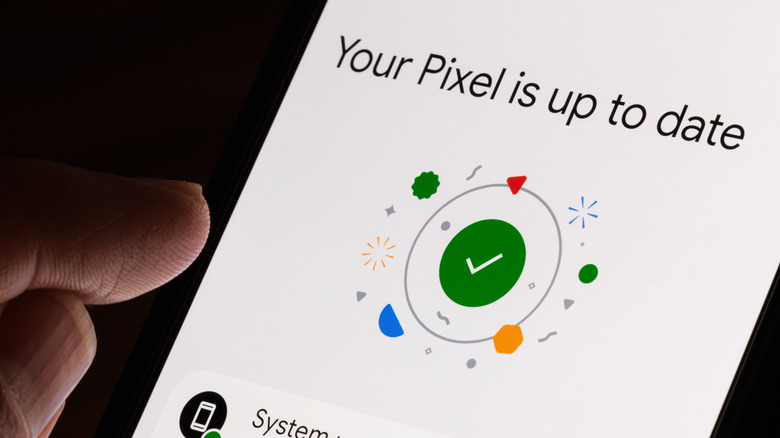
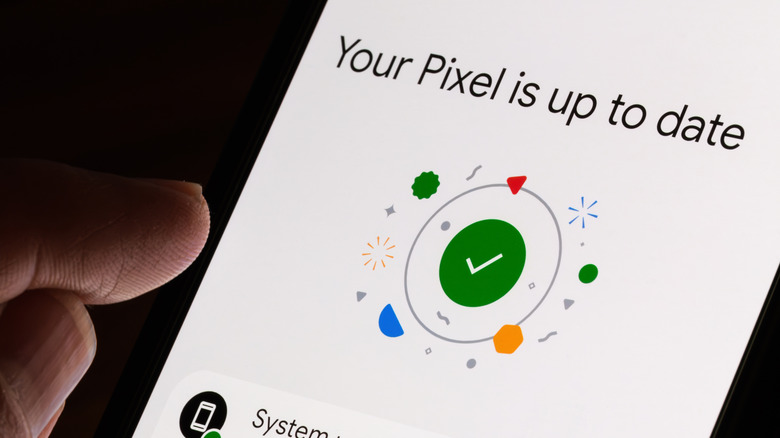
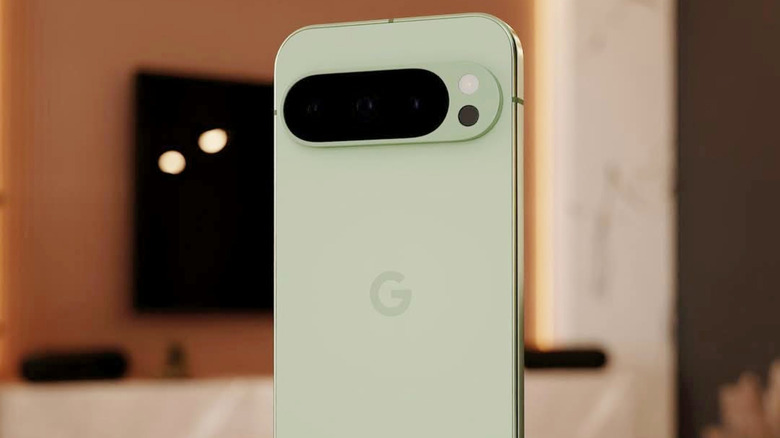
When a new smartphone from a top-tier company is on the horizon, it always brings attention in the tech world. The upcoming Google Pixel 11 is expected to be unveiled next month during the Made by Google event, which starts on August 12. Going by the rumors and how Google handled the releases of older Pixels, the release date of Google Pixel 11 should follow after the event ends in about 7 days or so. Speaking of rumors, many are speculating about the hardware and software of Google’s new phone. There’s a lingering worry that the Google Pixel 11 won’t be worth waiting for since it won’t be much of an improvement over the previous series, and that may be true.
Firstly, we do want to point out that this is mainly concerning the casual and everyday user base. That being said, the design and size of the Google Pixel 11 are likely to stay the same as the Pixel 10. What is expected to change, however, is the performance. Rather, we may see a new chipset. According to the online gossip, Pixel 11 will have Google’s new Tensor G6 chip with a 2nm process for better thermal control. This is probably the most impactful change, and while the CPU will get a boost, early leaks reported that an outdated GPU is coming to the Google Pixel 11. Naturally, this isn’t what users were hoping for, and if true, it’s going to be one of the downsides of buying a new Pixel.
Advertisement
How much will Google Pixel 11 cost?
Elvard project/Shutterstock
Like with the specs, the actual price is unknown, but there’s no shortage of guesses. Compared to the Pixel 10, a price increase is in order for the Google Pixel 11, and the reason is the current RAM shortage. By some estimations, the new version will cost around $115 more when compared to the Pixel 10, which means that the price will be above $900 and possibly closer to $1000. If so, that’s not a small increase by any means. In case you don’t need to have the latest tech every time it comes out or aren’t a demanding user, you’ll get a much better value for your money with a Pixel 10 during a Black Friday sale or similar.
Reportedly, unlike its predecessor, which had 128GB of storage as a starting point, the Google Pixel 11 series will come with 256GB of storage initially. This should somewhat lessen the price hike impact, although there is no official confirmation yet. Additionally, the camera is set for some improvements. Pixel 10 had a 48MP main lens, and there’s been talk of Pixel 11 getting a 50MP main lens. While an improvement, the Pixel series was never comparable in camera quality to Samsung Galaxy phones or iPhones. So, if you’re happy with what the Pixel 10 camera can do (there are some camera tricks worth trying), this may not be of much interest to you.
Advertisement
Should I buy Pixel 10 or wait for 11?
As one might expect, Google Pixel 11 will run on Android 17 (which has some cool new features), Google’s latest mobile OS, released in June 2026. Still, the question remains: Is Google Pixel 11 worth it? Well, everything about it is a rumor at the moment, so it’s hard to judge something that’s not official. Nonetheless, if rumors turn out to be true, most casual users likely won’t see much of a difference compared to a Pixel 10.
The new chipset and increased starting storage are nice, but the price increase is much less so. As it stands now, Google Pixel 11 will represent the usual yearly polish rather than some notable change and improvement. If you already have a Pixel 10, you probably don’t need an 11, though owners of older Pixel phones could find a reason or two to splurge on a Pixel 11. Though, if Google sets the price tag around $1000, you’re possibly better off waiting for the Pixel 10 to go on sale.
Miles Wang, an OpenAI researcher whose work includes using AI to accelerate scientific and biological discovery, is leaving the ChatGPT maker to launch a new startup focused on developing AI models for drug discovery, according to four people with knowledge of his plans. Several other OpenAI researchers are expected to join the new company.
Wang is in talks to raise about $200 million at a $2 billion valuation, two of the people said. Lightspeed is in discussions to lead the funding round, according to sources. Talks are ongoing, the deal may not be final and details could change.
Wang disputed the story’s funding figures and description of the company but did not specify the correct numbers or details. Lightspeed didn’t respond to a request for comment.
The funding discussions point to investor interest in applying AI to make breakthroughs in life sciences. Chai Discovery, a two-year-old startup developing AI models that can predict molecular interactions to identify new drugs, announced on Tuesday that it raised $400 million at a $3.8 billion valuation. (Co-founder Josh Meier also passed through OpenAI as a researcher.) Meanwhile, Google DeepMind spinout Isomorphic Labs, which also develops AI models for drug discovery, raised a $2.1 billion Series B in May.
Advertisement
Wang’s new startup may be working on AI models that will help find new uses for existing drugs and possibly those that previously failed in trials, a couple of sources told TechCrunch. Finding new uses for FDA-approved drugs can result in significantly faster time to revenue than developing new drugs from scratch, as these medicines have already been tested for safety.
Wang joined OpenAI in 2024 after dropping out from Harvard, where he was working on a bachelor’s degree in computer science. (In recent years, investors are once again comfortable betting on young founders who haven’t completed college.)
At OpenAI, he co-authored research papers, including evaluating how AI models can automate and accelerate scientific discovery.
When you purchase through links in our articles, we may earn a small commission. This doesn’t affect our editorial independence.
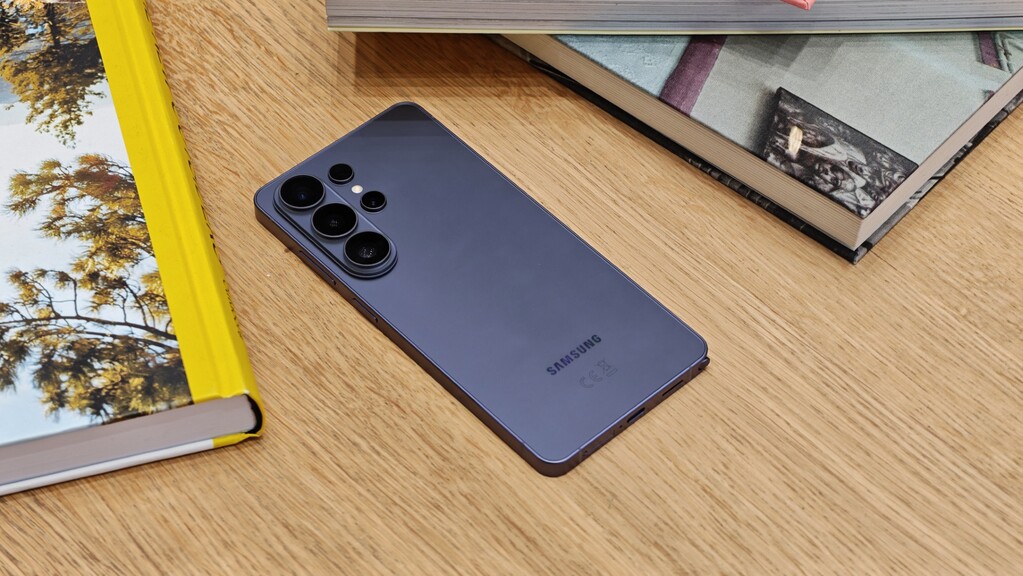
Samsung has released the fourth One UI 9 beta for the Galaxy S26 series, bringing another round of bug fixes and refinements ahead of the software’s official debut later this month.
The update has started rolling out in India first, carrying firmware that ends in ZZG4, and is available to users already enrolled in Samsung’s One UI 9 beta programme. At around 1.25GB, it’s a sizeable download.
Rather than introducing major new features, this latest beta focuses on stability as Samsung enters the final stretch before launch. According to the changelog, the company has fixed a range of issues affecting core parts of the interface. These include problems with the clock size, Quick Panel, navigation bar, timer notifications, and the Routines app.
The update also bundles the July 5, 2026 Android security patch, ensuring testers receive the latest security fixes alongside the software improvements.
Advertisement
The timing isn’t particularly surprising. Samsung has been steadily polishing One UI 9 over the past few months. The third beta arrived almost exactly a month ago. Consequently, a fourth beta at this stage suggests the company is ironing out the remaining rough edges before making the software widely available.
Advertisement
One UI 9 is expected to make its official debut alongside Samsung’s next generation of foldables at Galaxy Unpacked on 22 July. At that event, the company is expected to unveil the Galaxy Z Fold 8, Galaxy Z Fold 8 Ultra, and Galaxy Z Flip 8. Those devices will be the first to ship with the new software out of the box, with older Galaxy smartphones and tablets getting it in due course.
While Samsung hasn’t confirmed whether another beta will follow, this release suggests the software is approaching its final form.
Advertisement
As with previous beta releases, availability remains limited to registered participants in supported regions. However, the rollout will likely expand gradually. Galaxy S26 owners enrolled in the programme should see the update appear over the air in the coming days if it hasn’t already reached their device.
With Nintendo’s 3DS experiencing a bit of a renaissance lately, prices for functioning systems have shot through the roof. Getting a busted one with a broken screen is a lot cheaper, but then you run into the eye-watering price difference between a replacement top screen for the regular version and the larger XL variant. The latter costs about the same as a whole new used 3DS, while the former goes for peanuts. Here the solution is obvious, with [Skawo] demonstrating how they hacked the cheaper, smaller top screen into a New 3DS XL.
The price difference on AliExpress as shown in the video is on the order of $120, with the smaller screen going for less than $10. Since they both use the same connector pin-out and display technology, you can plug either display into the New 3DS XL mainboard.
Where you’ll run into issues, other than the replacement display being obviously not XL, is the physically shorter flat flex cable for the controls that forces the display to be installed in an offset manner. You need jailbroken firmware like Luma3DS here to adjust for the screen offset. Filling in the missing screen real-estate is the other issue you have to patch over somehow, which was done here in barbaric fashion with some cardboard.
Advertisement
Beyond that it does work, and as a fix to at least get a broken New 3DS XL back into the game it’s worth considering. Do note that there’s a difference between regular 3DS and New 3DS (second generation) screens with neither being compatible, so be careful before you try such a fix.
















































You must be logged in to post a comment Login