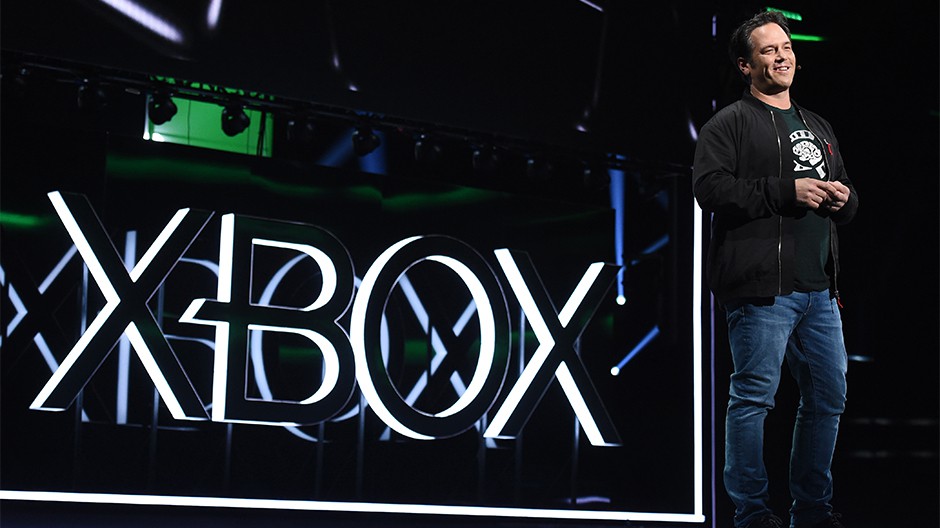
Phil Spencer, head of Xbox at Microsoft, at the Xbox E3 Briefing at the Microsoft Theater in Los Angeles in 2019. (Microsoft Photo)
Phil Spencer, the Xbox leader who spent 38 years at Microsoft and helped reshape the gaming industry through big acquisitions and a bet on cloud gaming, is retiring from the company.
He will be succeeded as CEO of Microsoft Gaming by Asha Sharma, a former Instacart chief operating officer and Meta vice president who joined Microsoft two years ago, the company said Friday.
The transition also includes the departure of Sarah Bond, the Xbox president who was widely seen as a potential Spencer successor, and the promotion of Matt Booty to executive vice president and chief content officer overseeing Microsoft’s nearly 40 game studios.
In an email to employees, Spencer said he told Microsoft CEO Satya Nadella last fall that he was ready to step back, and that they had been planning the transition since then. He called his nearly four decades at Microsoft “an epic ride and truly the privilege of a lifetime.”
Spencer “expanded our reach across PC, mobile, and cloud; nearly tripled the size of the business; helped shape our strategy through the acquisitions of Activision Blizzard, ZeniMax, and Minecraft; and strengthened our culture across our studios and platforms,” Nadella wrote in a separate memo.
Advertisement
The longtime Xbox leader will remain in an advisory role through the summer to support the handoff. Bond is also expected to remain at the company through a transition period.
Asha Sharma and Matt Booty, the new leadership team for Microsoft Gaming. (Microsoft Photo)
Sharma, who is currently president of Microsoft’s CoreAI product organization, has roots in the Seattle startup community, with deep experience in consumer platforms and operations, and no prior experience in the video-game industry.
That’s where Booty’s new role will presumably come in — as chief content officer, the industry veteran will oversee Microsoft’s sprawling studio portfolio, pairing his decades of gaming experience with Sharma’s operational background.
In her first message to the gaming team, Sharma pledged to recommit to Xbox’s core console fans and vowed that the company would not “flood our ecosystem with soulless AI slop,” calling games “art, crafted by humans.”
Microsoft had been planning to make the announcement next week, but accelerated its timeline after IGN learned about the plans from inside sources. The gaming publication broke the news a short time ago.
Advertisement
Xbox is facing headwinds heading into the transition.
Gaming revenue fell 9%, or $623 million, during Microsoft’s most recent quarter, with Xbox content and services revenue declining 5% and hardware revenue falling 32%. Microsoft’s CFO Amy Hood attributed the decline in part to a prior-year quarter that benefited from stronger first-party game releases.
The business accounts for just over 7% of Microsoft’s total revenue — about $5.96 billion of the company’s $81.3 billion in the most recent quarter — but remains core to the tech giant’s consumer ambitions.
Here is the full text of the Microsoft memos announcing the news:
Advertisement
From Satya Nadella:
Gaming has been part of Microsoft from the start. Flight Simulator shipped before Windows, and you can practically ray‑trace a line from DirectX in the ’90s to the accelerated‑compute era we’re in today.
As we celebrate Xbox’s 25th year, the opportunity and innovation agenda in front of us is expansive. Today we reach over 500 million monthly active users, are a top publisher across all platforms, and continue to innovate across gaming hardware, content and community, in service of creators and players everywhere.
I am long on gaming and its role at the center of our consumer ambition, and as we look ahead, I’m excited to share that Asha Sharma will become Executive Vice President and CEO, Microsoft Gaming, reporting to me. Over the last two years at Microsoft, and previously as Chief Operating Officer at Instacart and a Vice President at Meta, Asha has helped build and scale services that reach billions of people and support thriving consumer and developer ecosystems. She brings deep experience building and growing platforms, aligning business models to long-term value, and operating at global scale, which will be critical in leading our gaming business into its next era of growth.
Matt Booty will become Executive Vice President and Chief Content Officer, reporting to Asha. Matt’s career reflects a lifelong commitment to games and to the people who make them. Under his leadership, Microsoft Gaming has grown to span nearly 40 studios across Xbox, Bethesda, Activision Blizzard, and King, which are home to beloved franchises including Halo, The Elder Scrolls, Call of Duty, World of Warcraft, Diablo, Candy Crush, and Fallout.
Advertisement
Together, Asha and Matt have the right combination of consumer product leadership and gaming depth to push our platform innovation and content pipeline forward. Last year, Phil Spencer made the decision to retire from the company, and since then we’ve been talking about succession planning. I want to thank Phil for his extraordinary leadership and partnership. Over 38 years at Microsoft, including 12 years leading Gaming, Phil helped transform what we do and how we do it. He expanded our reach across PC, mobile, and cloud; nearly tripled the size of the business; helped shape our strategy through the acquisitions of Activision Blizzard, ZeniMax, and Minecraft; and strengthened our culture across our studios and platforms. I’ve long admired Phil’s unwavering commitment to players, creators, and his team, and I am personally grateful for his leadership and counsel. He will continue working closely with Asha to ensure a smooth transition.
We have extraordinary creative talent across our studios and a global platform that is second to none. I’m excited for how we will capture the opportunity ahead and define what comes next, while staying grounded in what players and creators value.
Please join me in congratulating Asha and Matt on their new roles, and in thanking Phil for everything he has done for Microsoft and for our industry.
From Phil Spencer:
Advertisement
When I walked through Microsoft’s doors as an intern in June of 1988, I could never have imagined the products I’d help build, the players and customers we’d serve, or the extraordinary teams I’d be lucky enough to join. It’s been an epic ride and truly the privilege of a lifetime.
Last fall, I shared with Satya that I was thinking about stepping back and starting the next chapter of my life. From that moment, we aligned on approaching this transition with intention, ensuring stability, and strengthening the foundation we’ve built. Xbox has always been more than a business. It’s a vibrant community of players, creators, and teams who care deeply about what we build and how we build it. And it deserves a thoughtful, deliberate plan for the road ahead.
Today marks an exciting new chapter for Microsoft Gaming as Asha Sharma steps into the role of CEO, and I want to be the first to welcome her to this incredible team.Working with her over the past several months has given me tremendous confidence. She brings genuine curiosity, clarity and a deep commitment to understanding players, creators, and the decisions that shape our future. We know this is an important moment for our fans, partners, and team, and we’re committed to getting it right. I’ll remain in an advisory role through the summer to support a smooth handoff.
I’m also grateful for the strength of our studios organization. Matt Booty and our studios teams continue to build an incredible portfolio, and I have full confidence in the leadership and creative momentum across our global studios. I want to congratulate Matt on his promotion to EVP and Chief Content Officer.
As part of this transition, Sarah Bond has decided to leave Microsoft to begin a new chapter. Sarah has been instrumental during a defining period for Xbox, shaping our platform strategy, expanding Game Pass and cloud gaming, supporting new hardware launches, and guiding some of the most significant moments in our history. I’m grateful for her partnership and the impact she’s had, and I wish her the very best in what comes next.
Advertisement
Most of all, to everyone in Microsoft Gaming, I want to say “thank you”. I’ve learned so much from this team and community, grown alongside you, and been continually inspired by the creativity, courage, and care you bring to players, creators, and to one another every day.
I’m incredibly proud of what we’ve built together over the last 25 years, and I have complete confidence in all of you and in the opportunities ahead. I’ll be cheering you on in this next chapter as Xbox’s proudest fan and player.
Phil
XBL: P3
Advertisement
From Asha Sharma:
Dear team,
Today I begin my role as CEO of Microsoft Gaming.
I feel two things at once: humility and urgency.
Humility because this team has built something extraordinary over decades. Urgency because gaming is in a period of rapid change, and we need to move with clarity and conviction.
Advertisement
I am stepping into work shaped by generations of artists, engineers, designers, writers, musicians, operators and more who create worlds that have brought joy and deep personal meaning to hundreds of millions of players. The level of craft here is exceptional, and it is amplified by Xbox, which was founded in the belief that the power of games connect people and push the industry forward.
Thank you to Phil for his leadership, and to every studio, platform, and operations team that built this foundation. We are stewards of some of the most loved stories and characters in entertainment and bring players and creators together around the fun and community of gaming in entirely new ways.
My first job is simple: understand what makes this work and protect it.
That starts with three commitments.
Advertisement
First, great games.
Everything begins here. We must have great games beloved by players before we do anything. Unforgettable characters, stories that make us feel, innovative game play, and creative excellence. We will empower our studios, invest in iconic franchises, and back bold new ideas. We will take risks. We will enter new categories and markets where we can add real value, grounded in what players care about most.
I promoted Matt Booty in honor of this commitment. He understands the craft and the challenges of building great games, has led teams that deliver award-winning work, and has earned the trust of game developers across the industry.
Second, the return of Xbox.
Advertisement
We will recommit to our core Xbox fans and players, those who have invested with us for the past 25 years, and to the developers who build the expansive universes and experiences that are embraced by players across the world.
We will celebrate our roots with a renewed commitment to Xbox starting with console which has shaped who we are. It connects us to the players and fans who invest in Xbox, and to the developers who build ambitious experiences for it.
Gaming now lives across devices, not within the limits of any single piece of hardware. As we expand across PC, mobile, and cloud, Xbox should feel seamless, instant, and worthy of the communities we serve. We will break down barriers so developers can build once and reach players everywhere without compromise.
Third, future of play.
Advertisement
We are witnessing the reinvention of play.
To meet the moment, we will invent new business models and new ways to play by leaning into what we already have: iconic teams, characters, and worlds that people love. But we will not treat those worlds as static IP to milk and monetize. We will build a shared platform and tools that empower developers and players to create and share their own stories.
As monetization and AI evolve and influence this future, we will not chase short-term efficiency or flood our ecosystem with soulless AI slop. Games are and always will be art, crafted by humans, and created with the most innovative technology provided by us.
The next 25 years belong to the teams who dare to build something surprising, something no one else is willing to try, and have the patience to see it through. We have done this before, and I am here to help us do it again. I want to return to the renegade spirit that built Xbox in the first place. It will require us to relentlessly question everything, revisit processes, protect what works, and be brave enough to change what does not.
Advertisement
Thank you for welcoming me into this journey.
Asha
From Matt Booty:
I read Phil’s note with much gratitude. He has been a steady champion for game creators and our studio teams, and I’ve learned so much from his leadership over the years. All our games have benefited from his foundational support. I’m also grateful to Satya for his ongoing commitment to gaming and holding a vision of how it can connect back to the larger company.
Looking forward, I’m excited to partner with Asha as our next CEO. Our first conversations centered on her commitment to making great games and the role that plays in our overall success. She asks questions, pushes for clarity, and wants our choices grounded in player and developer needs. That mindset matters as the industry around us is changing quickly: how players engage, how games are made, and how business models and platforms evolve.
Advertisement
We have good reasons to believe in what’s ahead. This organization and its franchises have navigated change for decades, and our strength comes from teams who know how to adapt and keep delivering. That confidence is grounded in a strong pipeline of established franchises, new bets we believe in, and clear player demand for what we are building.
My focus is on supporting the teams and leaders we have in place and creating the conditions for them to do their best work. To be clear, there are no organizational changes underway for our studios.
Thanks for everything you do for players and for each other.
Looking for the most recent Mini Crossword answer? Click here for today’s Mini Crossword hints, as well as our daily answers and hints for The New York Times Wordle, Strands, Connections and Connections: Sports Edition puzzles.
Need some help with today’s Mini Crossword? It’s the extra-long Saturday version, and a few of the clues are tricky. Read on for all the answers. And if you could use some hints and guidance for daily solving, check out our Mini Crossword tips.
If you’re looking for today’s Wordle, Connections, Connections: Sports Edition and Strands answers, you can visit CNET’s NYT puzzle hints page.
I used to be of the opinion that MacBooks are relatively safer than other laptops, but I have been proven wrong. Embarrassingly and demonstrably wrong. A new report from Sophos X-Ops has spared no effort in rubbing my nose in it.
Researchers at the firm tracked three separate attack campaigns between November 2025 and February 2026, all of which targeted macOS users with something called the MacSync infostealer. For those catching up — it’s a type of malware that quietly rifles through your passwords and saved credentials, acting like a digital pickpocket.
Nirave Gondhia / Digital Trends
So, how does it actually work?
The malware used a delivery method called ClickFix, which requires minimal technical effort. It just needs the victims to copy and paste a command into their Mac’s Terminal (designed to run and execute text-based commands) and press enter on the keyboard.
First, bad actors used fake OpenAI download pages, which were circulated via sponsored ads on Google (sitting right above the legitimate link). Then, they got even more creative: attackers started sharing rear ChatGPT shared conversations disguised as “helpful Mac guides.”
These guides routed users into fake GitHub pages, which contained carefully created software installation instructions, but in reality, they asked users to copy a terminal command, allowing the ManSync infostealer to work in the background. That’s it; that’s the whole attack.
Advertisement
Apple
How bad did it get?
Sophos has found out that by December 2025 alone, bad actors had routed more than 50,000 clicks on such malicious domains. A “click” means that someone copied the malicious terminal command, but not necessarily that the malware successfully installed; the actual infection count could be lower.
The developers put another spin on their attacking method in February 2026, allowing it to run silently in the background, bypassing the competent macOS security tools such as Gatekeeper and XProtect. It can, in a very real way, patch your ledger crypto wallet’s 24-word master key.
The firm reports that infection clusters were active in key markets, including parts of North and South America and India, as recently as weeks before they published the article (by the end of the beginning of March, possibly).
Moreover, the notion that “Macs are safe,” is at least, for the time being, not true. As AI platforms grow in popularity, and, more importantly, gain the trust of millions of users, bad actors are coming up with new ways to use the LLMs-driven tools to their advantage. For now, I’d advise you to not paste any text-based command into your Mac’s Terminal.
We’ve all heard the saying: “screens before bed are bad,.” Yet somehow, I’ve been watching screens to go to sleep after a day of working with the screens for around eight to 10 hours. Well, I might consider switching to Samsung’s micro RGB TVs for both my work and leisure requirements, as they’ve recently got an eye- and sleep-friendly certification.
In a press release, the Korean tech giant has announced that its Micro RGB TV (the R95H model) has received two certifications from VDE (which is a German testing body).
Samsung
What certifications has the Samsung TV received?
The Samsung TV has received the Safety for Eyes certification and the Circadian Rhythm Display (CRD) certification. Without making things too technical for you, the R95H model has been officially tested to not wreck your eyes or sleep, especially during the hours after sunset, when too much blue light consumption can disturb your sleep cycle.
Here’s how it works. The first certification, Safety for Eyes, takes care of the blue light emissions — the wavelength which is associated the most with eye strain and disturbed sleep — confirming that the television meets the safe thresholds for prolonged viewing sessions.
The second one, Circadian Rhythm Display (CRD) verification goes a step further by confirming that the TV actually mimics the pattern of natural light. The television leans toward producing cooler tones during the day, warmer tones in the evening, and, most importantly, dials down blue light at night.
Advertisement
Samsung
How do the compatible TVs pull this off?
Basically, it doesn’t force your brain into thinking that it’s noon by producing cool light, when it’s midnight, so that viewing the television doesn’t disrupt your sleep cycle. But how does the TV manage all this?
Well, it’s Samsung’s micro RGB LED architecture that allows the display to make the fine-grained adjustments in the overall brightness and color profile of the screen, with an enhanced level of precision that isn’t present on other models.
While the Safety for Eyes certification is available across the company’s 2026 TV lineup, Circadian Rhythm Display (CRD) is currently available on the premium models.
Keeping a workshop organized can feel like a never-ending task, and so any item that helps make organization easier can make a big difference. Fans of Harbor Freight will already be well aware that the retailer is a great place to look for cheap garage and workshop essentials, and one product in particular might come in useful for anyone trying to keep their workshop clutter within manageable levels. The Bauer storage system modular organizer features 12 individual bins that can be arranged in a custom configuration, making it a great place to store those small items that can get lost around the workshop.
All of the bins are removable, so there’s no need to haul around the entire organizer for smaller jobs. However, anyone who prefers to take everything with them on the go should still find the organizer useful, since it’s IP65 rated against dust and water ingress and can be connected to other Bauer storage system products. The brand offers a range of crates, tool boxes, and cases, alongside the modular storage organizer, in a similar manner to Milwaukee’s popular Packout storage system.
The Bauer organizer retails for $39.99 at Harbor Freight, and at the time of writing, it’s only available as an in-store exclusive and not online. However, if its reviews are anything to go by, it might be worth the trip to your local retailer.
Advertisement
The Bauer organizer gets consistently good reviews
Bauer makes plenty of top-rated power tools, and its modular storage organizer gets similarly glowing reviews from buyers. It has amassed just under 400 reviews from Harbor Freight buyers to date, with a near-perfect average score of 4.9 out of 5 stars. Several reviewers note how easy the organizer makes it to store a wide range of items, from screws and drill bits to pens and snacks. Others say that the organizer’s clear lid is a particularly useful feature, since it allows them to see exactly what’s in each bin at a glance.
Advertisement
Complaints about the organizer are few and far between. One reviewer who left a two-star review claimed that the material quality of the organizer wasn’t up to the task, while a few reviewers who left three-star reviews said rival systems were tougher overall. Aside from that, buyers remain consistently impressed with the organizer’s construction and its capabilities.
While plenty of reviewers like the Bauer organizer, it’s far from the only Harbor Freight product that might come in useful if you’re looking to cut down on clutter. The retailer also offers individual $3 stacking tilt bins that can help organize garages and workshops, and they get similarly good reviews from buyers.
When Google introduced Project Genie a few months ago, many described the AI tool as a potential game-changer for game development and other world-building tasks. According to a recent Google presentation, however, the Genie 3 AI model – the generative engine behind Project Genie – is still far from disrupting,… Read Entire Article Source link
Longtime Slashdot reader tsuliga writes: Two new episodes of Doctor Who that were previously lost have been found. The original Doctor Who episodes were wiped or deleted by the BBC because they were not aware of the future use of re-runs of these shows. Ninety-five of the 253 episodes from the program’s first six years are currently missing. How many more episodes are out there waiting to be rediscovered? “The main broadcasters in the UK in the 1960s, 70s, up to the 80s really, junked quite a lot of content,” said Justin Smith, a cinema professor at England’s De Montfort University and film archivist. “In some ways finding missing ‘Doctor Whos’ is the holy grail” of classic TV discoveries, Smith said.
The two episodes were “The Nightmare Begins” and “Devil’s Planet,” both of which aired during the show’s third series in 1965. It features William Hartnell as the Doctor in a story involving archvillains the Daleks — pepperpot-shaped metal aggressors whose favorite word is “Exterminate!” Smith said that for fans of the show, “it’s got it all, it really has. It is intergalactic, it’s got some great performances. It stands up really, really well.”
The Norwich-based agbiotech company launched the first new commercial banana varieties in more than 75 years in 2025. Now it has to build enough supply to meet demand.
The world’s favourite fruit is in serious trouble. Panama Disease Tropical Race 4, a fungal pathogen that travels in soil and water and leaves no cure in its wake, has now been confirmed in more than 20 countries.
It threatens, in the starkest terms, the near-total collapse of the global Cavendish banana, the single variety that accounts for over 90% of the export market and underpins a $25 billion industry that supports 400 million people.
The Cavendish survived its last existential crisis, in the 1950s, only by replacing its predecessor. There is currently nowhere left to go.
Against that backdrop, Tropic, a Norwich-based gene-editing company, has raised $105 million (approximately €91 million) in an oversubscribed Series C, co-led by Forbion through its Bioeconomy Fund and Corteva, via its Corteva Catalyst investment platform.
Advertisement
Significant participation came from Just Climate and IQ Capital, alongside new investors ABN Amro and Invest International. Existing backers Temasek, Five Seasons Ventures, Aliment Capital, Sucden Ventures, Genoa Ventures, and Polaris Partners also joined the round.

The company was founded in late 2016 at the Norwich Research Park by Gilad Gershon, an agritech investor and former Israeli Navy ship commander, and Dr Eyal Maori, a virologist and RNA biologist whose earlier work formed the scientific basis for Beeologics, an agricultural genetics startup later acquired by Monsanto.

Together they built out a platform using CRISPR gene editing and Tropic’s own proprietary technology, Gene Editing Induced Gene Silencing, or GEiGS, to make targeted modifications to tropical crops without introducing foreign DNA.
The milestone that drove this round happened in 2025: Tropic commercially launched two new banana varieties, the first to reach market in more than 75 years. The first is a non-browning banana, developed by disabling the gene that produces polyphenol oxidase, the enzyme responsible for the brown discolouration that begins within minutes of cutting.
Advertisement
The second is an extended shelf-life variety, which lengthens the banana’s green life by an additional 12 days by targeting the genes responsible for ethylene production, the plant hormone that triggers ripening. Tropic says this reduces transportation waste by up to 50 per cent. The non-browning variety was named one of TIME Magazine’s Best Inventions of 2025.
Gershon said demand is already outpacing what the company can produce.
“2025 proved that our technology delivers, not in the distant future, but right now. With two banana varieties already on the market and demand outstripping supply, this investment enables us to scale global production and expand into new crops faster than ever before.”
Regulatory approvals for the bananas are in place in the Philippines, Colombia, Honduras, the US, and Canada. Consumer launches in the US and Canada are planned for 2026. The technology is described by Tropic as non-GMO, as it makes targeted changes to the banana’s existing DNA without introducing genetic material from another organism.
Advertisement
The more urgent project, however, is TR4. Tropic is deploying its GEiGS technology to redirect the banana plant’s own RNA interference machinery to attack the fungal genes responsible for the disease. In 2025, the company shipped plants to establish a mother plantation, the first stage of production at commercial scale, with deployment of TR4-resistant varieties targeted for 2027.
The $25 billion banana industry figure for TR4’s potential impact comes from Tropic’s own framing; the existential scale of the threat is corroborated by extensive independent reporting.
The Series C capital will fund expanded plant production infrastructure, support commercial partnerships across export markets, and accelerate Tropic’s broader pipeline, including resistance to Black Sigatoka, a fungal disease that currently costs farmers between $2,000 and $3,000 per hectare annually in pesticide treatment, and the company’s rice programme.
Tropic has also licensed its GEiGS technology to a set of third parties, including Corteva for disease resistance traits in corn and soybean, British Sugar for disease-resistant sugar beet, and animal genetics company Genus. The licensing track suggests the underlying technology has commercial reach well beyond tropical fruits.
Advertisement
Joy Faucher, General Partner at Forbion, who will join Tropic’s board alongside Tom Greene of Corteva and Siddarth Shrikanth of Just Climate, framed the investment in terms of broader planetary health.
“Tropic is an exemplary case of how advanced biotechnology can be applied with precision to challenges in planetary health, starting with banana and rice.”
For Corteva, whose Senior Director Tom Greene also joins the board, the appeal sits partly in the consumer-facing dimension.
“Tropic’s non-browning banana varieties are a promising example of how the agriculture industry is leveraging innovation to deliver new and improved choices for farmers and consumers worldwide.”
Advertisement
Tropic’s total pre-Series C funding stood at approximately $73.5 million, comprising a $10 million Series A in 2018 led by Pontifax AgTech and Five Seasons Ventures, a $28.5 million Series B in 2020 led by Temasek, and a $35 million Series C in 2022 led by Blue Horizon. The new $105 million round, its second to carry the Series C designation, reflects a significant step-change in scale.
The commercial challenge now is less scientific than logistical. Gene editing the world’s most widely grown export banana is one thing. Producing it at a scale capable of supplying meaningful volumes across global export markets, while simultaneously developing disease-resistant varieties against a pathogen with no known cure, is another order of magnitude entirely. What this round is funding, in large part, is the answer to that second question.
Editor and reporter Taylor Soper joined GeekWire in 2012 out of the University of Washington. (GeekWire Photo / Kurt Schlosser)
After more than 13 years as a GeekWire reporter and editor, Taylor Soper is preparing for his next big assignment: he’ll soon join AI2 Incubator as director of AI House, the Seattle startup hub that has quickly become a gathering place for AI founders, practitioners, and researchers.
This is a big change for all of us. We are going to miss Taylor deeply, and we know GeekWire’s readers and community will, as well. But we’re excited to see what he’ll do in his new role, and we’ll be using the opportunity to bring fresh eyes to GeekWire’s coverage of startups and the broader tech community in the Seattle region and the rest of the Pacific Northwest.
In a post announcing Taylor’s new role, AI2 Incubator Managing Director Yifan Zhang says that he “brings a unique combination of skills that fits our thesis for today’s AI era: over a decade of deep relationships across Seattle tech, an intense and insatiable curiosity, and a talent for asking the right questions.”
We can vouch for that. Taylor was GeekWire’s first editorial hire, back in 2012, straight out of the University of Washington, when we were in a 10×10 foot office next to the Ballard Bridge.
In the years that followed, he became one of the most connected and respected business and tech reporters in the Pacific Northwest, covering everything from early-stage startups to Microsoft and Amazon at the highest levels, breaking funding scoops and acquisition news.
Advertisement
In recent years, as GeekWire’s editor, he has led and coordinated our news team and guided our reporting on everything from civic coverage to artificial intelligence.
Taylor Soper on the job through the years, including the video (center) that he submitted in support of his original GeekWire job application.
Taylor’s impact goes well beyond what he’s reported and published. The Seattle tech community is better for the long hours and dedication he brought to the job, year after year.
“I’m grateful to GeekWire for giving me an opportunity and supporting my growth, and to all of my colleagues for the work we did together reporting on the Seattle tech ecosystem,” he said. “I’m excited to work alongside founders and help supercharge the next generation of startups in this AI era.”
GeekWire remains as committed as ever to covering startups and the tech community. GeekWire co-founder Todd Bishop will be stepping back into the role of editor while continuing to report and write, working with staff reporters Lisa Stiffler and Kurt Schlosser, co-founder and publisher John Cook, and regular contributors including Alan Boyle and Thomas Wilde.
We’re also looking to add reinforcements to our news team over time.
Advertisement
Taylor’s last day at GeekWire will be March 25, and if the pattern holds, he’ll be reporting and publishing stories to the end. We feel fortunate that GeekWire has been his home for so long, and we have no doubt his impact will continue for many years to come.
Few things are as iconic to camping as the green Coleman stove. Every summer you’ll find them, along with Coleman lanterns and coolers, on picnic tables across America. At WIRED, we’re big fans of the Coleman Cascade stove, but all Coleman stoves are capable of cooking up delicious camp food. There is more to Coleman than stoves, of course. I’m a fan of the coolers as well, along with the tents (simple and sturdy), and the Forester Sling chair for lounging. No matter what you need to outfit yourself for outdoor adventure as warmer weather arrives, we have a Coleman promo code and coupons to help you save.
Claim Up to 30% Off Select Items During the Spring Cooking Sale
Right now, Coleman is offering up to 30% off select cooking gear and outdoor essentials. The sale runs through March 21, and features some great deals like the 3-burner Even-Temp Propane camp stove. Three burners are a must for family adventures, and the Even Temp offers two 11,500 BTU burners, with a less powerful burner in the middle, meaning you can fry eggs and pancakes for the kids, and make your coffee as well.
Snag a 15% Coleman Promo Code When You Sign Up
If what you want isn’t on sale, no problem. You can get a 15% discount on one full-price purchase just for signing up for Coleman email list. Separately, you can save 15% on a full-price purchase and get free standard shipping when you sign up for texts.
Members Get Free Shipping at Coleman
If you create an account online on Coleman, you can snag free shipping. Free shipping doesn’t apply to the expedited delivery options, but so long as you’re not in a rush it’ll save you a few dollars. Just create an account, login, and the free shipping will be automatically applied during checkout. This Coleman free shipping deal is only valid for standard shipping within the contiguous United States.
The sun shines a spotlight on the steep face of an unnamed crater. NASA’s Lunar Reconnaissance Orbiter (LRO) took this photo on August 30, 2023. This spacecraft has been orbiting the moon since 2009, continuously collecting photographs of its surface using its cameras. When the camera started rolling, the orbiter was floating about 100 kilometers above the moon’s surface, with the sun’s rays coming in at an angle of 82 degrees from the right.
This particular crater is 10 kilometers wide and dips off by more than 2 kilometers at 70 degrees south latitude and 302.46 degrees east longitude, and it is relatively close to the Bailly O crater. The sides of this crater are 36 degrees, which is roughly the angle at which debris falls on the moon, and the lines are rather clean, with the exception of a few small impact craters at the top. This shows that the crater is rather young, possibly no more than 2 million years old.
Build a realistic LEGO Technic lunar rover model – This LRV building kit for adults is packed with authentic details including seats, steering…
NASA model for adults – Enjoy a mindful project assembling all the details of the rover and equipment including the battery pack, heating and…
A build for NASA fans – Remember the Apollo 17 mission with a display that features the lunar roving vehicle alongside 3 detailed equipment…
The angle at which the light comes in allows you to see all of the tiny details that you would otherwise miss in a normal photo. So, in this view, which depicts a 12-kilometer stretch of lunar surface, you can see a lot of little differences in the landscape and minerals. There is a 3.5-kilometer length where the wall and floor have a distinct and dramatic contrast, with all sorts of small elements in the front and the backdrop fading into the shade.
Advertisement
The LRO has done a great job of creating a complete map of the moon’s surface over the years as a result of all of the photos it has taken, and these can be used in the future to identify safe landing sites, locate ice in the polar regions, and calculate how much radiation you will be exposed to. And as new technology emerges, it becomes easier to prepare for long-term expeditions to the moon.