







Connect with us
DAPA Banner

Tech

XPENG IRON Humanoid Robot Makes Public Debut at Mall in Shenzhen, Slight Mishap Ensues

Published

on

XPENG IRON Humanoid Robot Public Mall Fall
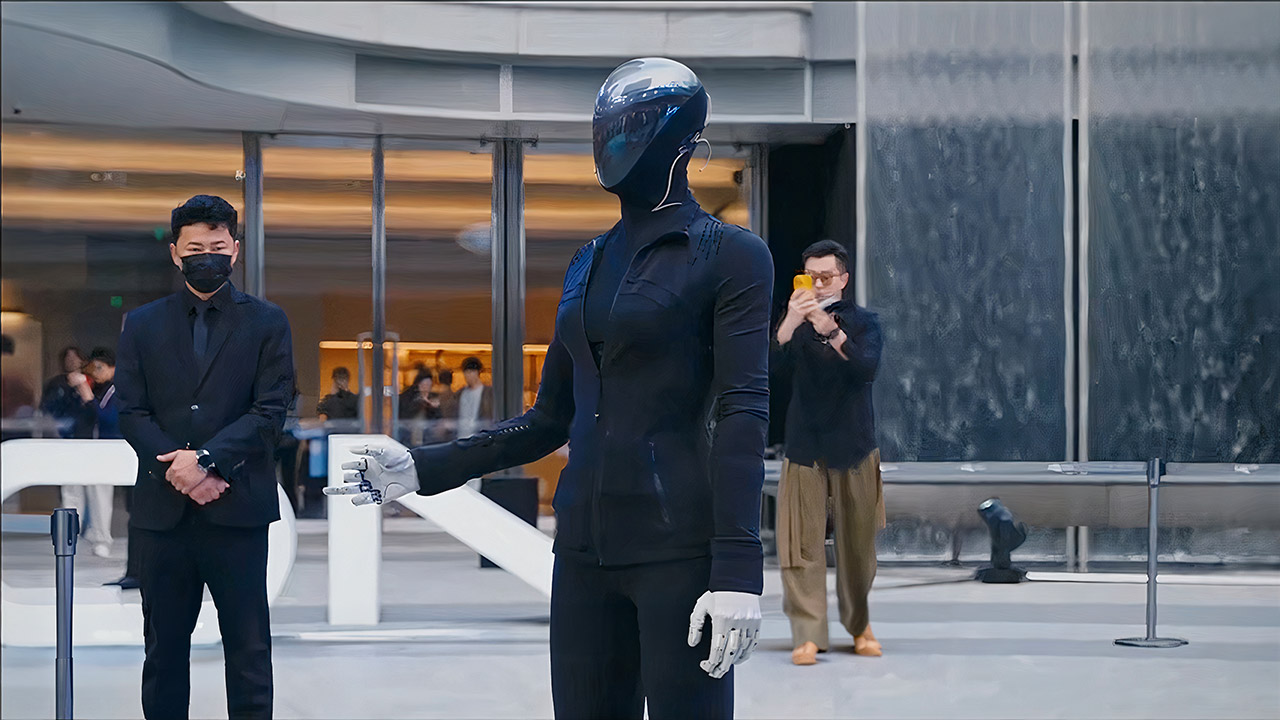
The XPENG IRON humanoid robot made its first public appearance, but things didn’t go as planned. The sleek black machine tipped over during a presentation in a packed retail mall in Shenzhen. Fortunately, no one was injured, but the robot was a bit of a mess, and staff workers had to come and carry it away after it failed to stand up on its own.


He Xiaopeng, CEO of XPENG, responded to the incident on social media in a somewhat calm manner. He described it this way: they fall down, steady themselves, and eventually run. He described the robot’s collapse as one of the regular, everyday setbacks associated with each new development in robotics technology.


Unitree G1 Humanoid Robot(No Secondary Development)
  • Height, width and thickness (standing): 1270x450x200mm Height, width and thickness (folded): 690x450x300mm Weight with battery: approx. 35kg
  • Total freedom (joint motor): 23 Freedom of one leg: 6 Waist Freedom: 1 Freedom of one arm: 5
  • Maximum knee torque: 90N.m Maximum arm load: 2kg Calf + thigh length: 0.6m Arm arm span: approx. 0.45m Extra large joint movement space Lumbar Z-axis…

This was the most recent version of IRON to be released, and after its debut in late 2025, XPENG went back to the drawing board to completely revamp it. They’d always wanted the robot to move and look more human-like, so they worked hard on a bionic spine, flexible skin that wraps around the body, and even customizable body proportions that allow you to choose alternative forms or gender traits.


As a result, the robot now stands 1.73 meters tall and weighs 70 kilograms, and it has some serious muscle under the hood, with 82 degrees of freedom to be exact, and each of those hand things has a respectable 22 degrees of freedom to give you that sort of grip on delicate things or even just doing some small tasks. Then there’s the vision system, which has a 720-degree field of view and gives the impression that the robot is completely aware of everything around it. All of this is powered by 3,000 TOPS of computational power, which comes from three custom-built Turing AI chips that handle everything from perception to motion.

This robot’s power comes from an all-solid-state battery, which is groundbreaking for humanoid robots due to its much higher energy density, reduced weight, and increased safety. You’re already familiar with the walk, as some were claiming it was as smooth as silk, and people wondered if someone was manipulating it from afar, but in its most recent outing, it shown that it can move on its own.

Advertisement

XPENG IRON Humanoid Robot Public Mall Fall
However, XPENG has big plans for the IRON, including reception jobs, retail labor, guided tours, and other tasks similar to those found in a shop or restaurant. They’re already planning to begin mass manufacturing by the end of 2026, with output ramping up early the next year. What about the minor mishap at the mall? That was simply part of the robot’s big debut, an opportunity to test it in a real-world setting rather than a sterile lab.

Source link

Advertisement
Continue Reading
Click to comment

You must be logged in to post a comment Login

Leave a Reply

Tech

Stryker attack wiped tens of thousands of devices, no malware needed

Published

on

Stryker attack wiped tens of thousands of devices, no malware needed

Last week’s cyberattack on medical technology giant Stryker was limited to its internal Microsoft environment and remotely wiped tens of thousands of employee devices.

The organization says in an update on Sunday that all its medical devices are safe to use but electronic ordering systems remain offline, and customers must place orders manually through sales representatives.

Stryker emphasizes that the incident was not a ransomware attack and that the threat actor did not deploy any malware on its systems.

Last week, Stryker was the target of a cyberattack claimed by the Handala hacktivist group, believed to be linked to Iran.

Advertisement

The attacker alleged that they wiped “over 200,000 systems, servers, and mobile devices” and stole 50 terabytes of data. However, investigators did not find any indication that data was exfiltrated.

Following the disruption, Stryker employees in multiple countries started to complain that their managed devices had been remotely wiped overnight.

Some employees had their personal devices enrolled in the company network and lost personal data during the wiping process.

Hackers had Global Admin privileges

A source familiar with the attack told BleepingComputer that the threat actor used the wipe command in Intune, Microsoft’s cloud-based endpoint management service, to erase data from nearly 80,000 devices between 5:00 and 8:00 a.m. UTC on March 11.

Advertisement

The attacker carried out the action after compromising an administrator account and creating a new Global Administrator account.

The investigation is being conducted by the Microsoft Detection and Response Team (DART) in collaboration with cybersecurity experts from Palo Alto Unit 42.

Stryker’s update highlights that the attack did not impact any of its products, connected or otherwise, and was limited exclusively to the internal Microsoft corporate environment.

“All Stryker products across our global portfolio, including connected, digital, and life-saving technologies, remain safe to use,” the company says.

Advertisement

Restoration efforts are currently underway, the main focus being on resuming shipping and transactional services. Customers are encouraged to maintain normal communication with company personnel while the infrastructure is steadily recovered.

Any order placed before the cyberattack will be honored as systems are restored, while those placed during the disruption will be processed when systems are back online, and the supply flow resumes to normal.

The company is working with its global manufacturing sites to deal with potential operational impact.

Stryker’s current priority is to restore the supply-chain system and resume customer orders and shipping. “Our core transactional systems are already on a clear path to full recovery,” the company says.

Advertisement

Malware is getting smarter. The Red Report 2026 reveals how new threats use math to detect sandboxes and hide in plain sight.

Download our analysis of 1.1 million malicious samples to uncover the top 10 techniques and see if your security stack is blinded.

Source link

Continue Reading

Tech

Fujifilm’s Instax Mini 13 Finally Gets It Right, Captures Selfies That Actually Look Good

Published

on

Fujifilm Instax Mini 13 Instant Camera
Fujifilm has just introduced the Instax Mini 13, the latest addition to one of the best selling instant camera lines in the world. It sits comfortably in the palm of your hand from the moment you pick it up, and a metallic silver logo on the front adds a subtle touch of shine without making the whole thing feel fussy or overcomplicated.


Simply twist the lens ring and you’re good to go in one fluid action. Twist it again, and the close-up mode appears, allowing you to take close-up photographs of whatever is directly in front of you. Because of built-in parallax correction, the viewfinder lines up perfectly with the lens, ensuring that everything is centered.

Sale


Fujifilm Instax Mini 12 Instant Film Camera – Pastel Blue
  • Compact and cute design. Easily twist the lens to turn on and off
  • Built-in selfie mirror for easy selfies Close-up mode with parallax correction
  • Features automatic exposure and flash control for bright photos that are not “washed-out”


There’s a tiny mirror on the front to help you line up your own pictures perfectly. You have dual timers built in that clock down from two to ten seconds depending on whether you’re taking a group shot or flying solo. Fujifilm also includes a small wedge piece that snaps into the strap and then be used to raise the camera up on a level surface. The countdown will run automatically while you get everything in place. The exposure settings are also automatically adjusted, regardless of the lighting conditions. The flash has its own small control mechanism that performs an excellent job of balancing the results whether you’re in full light or just in the shade.

Advertisement


If you put two regular AA batteries in the bottom, it will print about a hundred times before needing to be replaced. The camera also includes a feature that allows it to turn off after five minutes of inactivity, which helps to extend the battery life. The film loads at the back, just like any other Instax Mini. Each finished print measures approximately 3.5 x 2 inches overall, with a photo area of 2.5 x 1.75 inches. You’ll have to wait around 90 seconds for the colors to appear properly, however if you’re in cool air, it may take a little longer.

Fujifilm Instax Mini 13 Instant Camera
There are five colors, including Dreamy Purple, Frost Blue, Candy Pink, Lagoon Green, and Clay White. The camera alone costs $94 MSRP, and Fujifilm is also releasing a new film pack called Pastel Galaxy, which includes sparkling cosmic motifs in ultra delicate pastel tones along the edges. That gives a fun touch to each print. If you scan prints into your phone, you will find that the companion app now does a better job of isolating the image from the background, resulting in cleaner-looking digital copies. Availability begins in late June.
[Source]

Source link

Advertisement
Continue Reading

Tech

Canva Affinity adds Light UI, Convert to Curves, and Live Tone Blend

Published

on

Affinity’s latest update to introduces Light UI for a brighter and cleaner workplace, Convert to Curves to eliminate manual tracing by transforming objects into a fully editable vector curves, and Live Tone Blend Groups which blends layers dynamically and non-destructively.

Read Entire Article
Source link

Continue Reading

Tech

A Voltage Regulator Before Electronics

Published

on

Did you ever wonder how the mechanical voltage regulator — that big black box wired up to the generator on a car from the ’60s or before — worked? [Jonelsonster] has some answers.

For most people in 2026 an old car perhaps means one from the 20th century, now that vehicles from the 1990s and 2000s  have become the beloved jalopies of sallow youths with a liking for older cars and a low budget. But even a 1990s vehicle is modern in terms of its technology, because a computer controls the show. It has electronic fuel injection (EFI), anti-lock braking system (ABS), closed loop emissions control, and the like.

Go back in time to the 1970s, and you’ll find minimal electronics in the average car. The ABS is gone, and the closest thing you might find to EFI is an electronic ignition where the points in the distributor have been replaced with a simple transistor. Perhaps an electronic voltage regulator on the alternator. Much earlier than that and everything was mechanical, be that the ignition, or that regulator.

The video below the break has a pair of units, it seems from 1940s tractors. They would have had a DC generator, a spinning coil with a commutator and brushes, in a magnetic field provided by another coil. These things weren’t particularly powerful by today’s standards and sometimes their charging could be a little lackluster, but they did work. We get to see how, as he lifts the lid off to reveal what look like a set of relays.

Advertisement

We’re shown the functions of each of the three coils with the aid of a lab power supply; we have a reverse current relay that disconnects the generator if the battery tries to power it, an over-current relay that disconnects the field coil if the current is too high, and an over-voltage relay that does the same for voltage. The regulating comes down to the magnetic characteristics, and while it’s crude, it does the job.

We remember European devices with two coils and no field terminal, but the principle is the same. There is never a dull moment when you own an all mechanical car.

Advertisement

Source link

Continue Reading

Tech

Nvidia’s version of OpenClaw could solve its biggest problem: security

Published

on

Nvidia CEO Jensen Huang thinks every company should have an OpenClaw strategy. And Nvidia is here to provide it.

Nvidia has developed NemoClaw, an enterprise-grade AI agent platform, Huang announced during his GTC keynote on Monday. The platform is built on top of OpenClaw, the popular open-source framework for building and running AI agents locally on a company’s own hardware.

The new open source platform is essentially OpenClaw with enterprise-grade security and privacy features baked in. The idea is to turn OpenClaw into a secure platform that enterprises can tap into with one command, giving them control over how agents behave and handle data, according to Nvidia.

“For the CEOs, the question is, what’s your OpenClaw strategy?” Huang said onstage. “We need it. We all have a Linux strategy. We all needed to have an HTTP HTML strategy, which started the internet. We all needed to have a Kubernetes strategy, which made it possible for mobile cloud to happen. Every company in the world today needs to have an OpenClaw strategy, an agentic systems strategy.”

Advertisement

Nvidia worked with OpenClaw’s creator Peter Steinberger to develop NemoClaw, Huang said.

Once released, NemoClaw users will be able to tap any coding agent or open-source AI model, including Nvidia’s NemoTron open models to build and deploy AI agents. The platform allows users to access cloud-based models on their local devices. The platform is hardware agnostic — it doesn’t need to run on Nvidia’s own GPUs — and integrates with NeMo, Nvidia’s AI agent software suite.

For now, Nvidia is describing NemoClaw as an early-stage alpha release. “Expect rough edges. We are building toward production-ready sandbox orchestration, but the starting point is getting your own environment up and running,” the company stated on its website in a note directed toward developers.

Techcrunch event

Advertisement

San Francisco, CA
|
October 13-15, 2026

Building enterprise AI agent platforms has become the du jour obsession of the AI space in recent months.

Advertisement

OpenAI launched Frontier, its open platform for enterprises to build and manage AI agents, in February. In December, global research firm Gartner released a report about how governance platforms for AI agents would be the crucial infrastructure needed for enterprises to adopt the AI tech. Nvidia clearly got the message.

“OpenClaw gave us, gave the industry exactly what it needed at exactly the time,” Huang said. “Just as Linux gave the industry exactly what it needed at exactly the time, just as Kubernetes showed up at exactly the right time, just as HTML showed up. It made it possible for the entire industry to grab on to this open source stack and go do something with it.”

Source link

Advertisement
Continue Reading

Tech

Boox’s new Go E Ink tablet includes a 10-inch display and runs Android 15

Published

on

There are , but most of them are basically digital notebooks. They are great for reading and handwriting notes, but not so great for doing all of that regular tablet stuff like checking emails and doomscrolling. Boox, however, has released a number of E Ink tablets that can , opening up users to the wide world of traditional smartphone apps.

The company’s latest product is a refresh of the Go 10.3 tablet, called the Go 10.3 Lumi. This introduces plenty of new features and, as the name suggests, one is a front light. The tablet has been designed for both natural sunlight and low-light environments. The previous model was great, but it turns into a useless paperweight without access to ambient light.

A tablet.

Boox

Despite the front-facing light, the Go 10.3 Lumi is still lighter than its predecessor, at 12.8 ounces. It’s also on the thinner side, with a 4.8mm profile.

The basic specs are similar to the Go tablet, with an octa-core processor, 4GB of RAM and 64GB of internal storage. It runs on , which is a massive improvement for both security and access to apps. The previous iteration ran on Android 12, and Google . That means no more critical security updates.

Advertisement

In addition to beefed up security, Boox promises the upgrade to Android 15 offers users improved memory management, better multitasking and smoother UI interactions. E Ink devices can be sluggish so I’m all for anything that speeds things up.

It integrates with external keyboards and boasts integrated speakers, which will certainly come in handy when navigating apps downloaded from the Play Store. Despite the screen technology, this is an Android tablet. It should be able to run just about any app available.

However, the E Ink technology will likely run into hiccups with video-based apps and games. It’s just not made for that. This could be a great little gadget for emails and text-based social media, but not for something like TikTok. It should be able to handle non-animated games just fine, like crossword puzzles and stuff like that.

Boox says the tablet gets “substantial battery life” and has been “optimized for extended usage cycles.” The company hasn’t announced detailed battery specs, but did say people “can work all day without looming battery anxiety.” E Ink devices tend to last a good while, so I’m not worried about that.

Advertisement

The Boox Go 10.3 Lumi is available to order right now and costs $450. If you want to save a few bucks and have no interest in a front light, there’s a stripped down version that also runs Android 15 but costs $420.

Source link

Continue Reading

Tech

Gateway Global AI’s approach to business automation

Published

on

Artificial intelligence has become a central topic in business strategy discussions, yet many organizations continue to struggle with how to integrate it into everyday operations. Gateway Global AI, a technology company developing voice-first infrastructure, is approaching that challenge from a different angle. According to CTO Jason Trindade, the company focuses on simplifying how businesses deploy AI systems by consolidating multiple functions into a single operational framework.

Gateway Global AI has developed a platform that integrates AI voice systems with business infrastructure. Rather than treating artificial intelligence as a standalone feature, the company’s architecture positions AI as a central operational layer. In practice, that means customer interactions, voice interfaces, and system routing can operate through one coordinated structure rather than a collection of disconnected tools.

Trindade explains that his interest in this area developed while building websites and experimenting with different digital systems over several years. During that process, he began exploring how artificial intelligence interacts with human behavior. He studied behavioral frameworks such as DISC (Dominance, Influence, Steadiness, and Conscientiousness) personality profiles and explored how those concepts might influence AI communication design. According to him, those ideas eventually shaped how Gateway Global AI approaches voice-driven interaction.

I spent a long time studying how people communicate and how behavior works,” Trindade says. “When we started applying those ideas to AI systems, it became clear that giving AI a behavioral framework can be more effective than simply giving it rules.

Advertisement

The result is a voice-first platform designed to allow businesses to integrate AI agents into communication channels such as customer calls, service requests, and internal workflows. Instead of functioning as a simple chatbot or voice assistant, the system is designed to operate as a routing layer for AI interactions

According to Trindade, the router acts as a central entry point for AI interactions across a business. Traditional organizations often have a single point of entry for communication, such as a main phone line or contact system. In a similar way, Gateway Global AI’s platform is designed to allow companies to manage incoming AI-driven interactions through one infrastructure layer. According to Trindade, swapping the phone numbers for QR codes puts voice AI on the IP network, which eliminates bottlenecks and latency.

What businesses will eventually need is a single point of entry for AI,” he explains. “If artificial intelligence is handling communication and processes, organizations will want one system that manages those interactions in a controlled way.

A key part of the platform is its portability. The system is designed to run on a single server architecture that can be installed onto existing infrastructure. Trindade notes that this approach grew out of his own development process, during which he spent months reviewing documentation, testing systems, and refining the platform’s structure.

Advertisement

I built the platform so it can be packaged and deployed like an operating system,” he says. “You can place it onto a server and have the same architecture running almost immediately.


Gateway-Global-AI-McDonald's
Credit: Gateway Global AI
Gateway-Global-AI-McDonald's

Gateway Global AI also places a strong emphasis on voice interaction. “Voice AI allows businesses to have natural conversations with customers while still connecting those interactions to the company’s existing digital services,” Trindade says. “In many situations, it can guide people to information that already exists within the company’s ecosystem, whether that’s a website, catalog, or other resources.

Trindade notes that the broader goal is to make AI systems easier to deploy and manage. In his view, many organizations approach AI projects by focusing first on user interfaces and external features rather than infrastructure. That sequence, he suggests, can make implementation more complicated over time.

From Trindade’s perspective, the company’s platform is designed with scalability in mind, particularly for organizations that operate across multiple locations or serve large customer bases. The architecture supports multi-tenant deployment, he notes, which means a single platform can manage operations across many branches or business units.

Advertisement

Gateway Global AI also plans to expand its ecosystem through developer collaboration. Trindade says the company intends to support software developers who want to build applications on top of the platform’s core infrastructure. The aim is to create a foundation that other developers can extend through APIs and development tools.

Looking ahead, Trindade believes voice-driven interaction will continue to play a growing role in how businesses communicate with customers and manage operations. From his perspective, the next phase of AI adoption will depend not only on new algorithms but also on systems that simplify how organizations implement the technology.

Through Gateway Global AI, Trindade is exploring how infrastructure design, behavioral insights, and voice-based technology might converge to shape that next phase of business AI integration. “Artificial intelligence is evolving quickly,” he says. “The opportunity now is to build infrastructure that allows companies to actually use it in a practical way.

Advertisement

Source link

Continue Reading

Tech

Picsart now allows creators to ‘hire’ AI assistants through agent marketplace

Published

on

The AI-powered design platform Picsart is launching an AI agent marketplace, allowing creators to “hire” AI assistants to help them with specific tasks, like resizing and remixing social content, or editing product photos on Shopify.

With over 130 million worldwide users that skew Gen Z, Picsart is like a more advanced Canva for social media managers and content creators. The company reached unicorn status amid the creator economy boom in 2021, but has remained relevant by continuing to ramp up its AI-powered products to serve the current market.

The timing is good for Picsart to launch such a marketplace, since viral projects like OpenClaw have fueled industry demand for agentic AI chatbots that can carry out requests like a personal assistant.

“Creators have been stuck as the operator of every workflow — the one doing, not deciding,” said Hovhannes Avoyan, Picsart founder and CEO, in a statement. “Our Agents change that relationship — you set direction, the agent builds a plan using real data, you approve, it executes.

Advertisement

Picsart says that it will introduce more specialized agents each week, but to start, creators can work with four different agents: Flair, Resize Pro, Remix, and Swap.

Image Credits:Picsart

The Flair agent is perhaps the most sophisticated of the bunch, integrating with Shopify to act as an assistant for online store owners. The agent analyzes market trends to make recommendations for how a shop could improve, like suggesting it edit product photos to look more cohesive. In a future update, Flair will be able to run A/B tests and identify underperforming products to proactively offer recommendations for how a creator can improve their sales.

The Resize Pro agent can resize images and videos for the recommended dimensions on various different platforms, but it uses AI to generatively extend the frame if the original media isn’t conducive to a certain size. The AI supposedly will ensure that resized images look like they were composed intentionally and weren’t just cropped haphazardly.

Techcrunch event

San Francisco, CA
|
October 13-15, 2026

Advertisement

The Remix agent invites the creator to describe a style, like “vintage film,” “watercolor,” or “cyberpunk” and edit an existing photo library to fit within that theme, while the agent feature allows users to change the backgrounds of photos in bulk.

Image Credits:Picsart

For an agent like Flair, which is supposed to work behind the scenes asynchronously to analyze store data, it will be especially helpful that users can chat with these agents on WhatsApp or Telegram. Picsart integrates with those apps specifically since their APIs enable businesses to set up AI chatbots; but as more platforms add similar tools, the functionality could broaden.

“As agents extend to messaging apps creators already use, that conversation happens anywhere — at your desk or from the subway,” added Avoyan.

Advertisement

In some cases, AI agents can prove problematic, since any LLM-based software has the potential to hallucinate and could potentially take actions that the creator did not intend. But Picsart allows users to set “autonomy levels” for agents like Flair, which give the option of requiring creator approval before taking any action. These agents should also be less vulnerable to prompt injection attacks than more public facing agents, assuming that Picsart doesn’t roll out agents that interact more directly with customers or the internet at large.

Like many other AI tools, Picsart offers a free plan with just a few AI credits each week, but users can get significantly more capacity when paying for premium subscriptions, which start at about $10 per month when billed annually. To use an AI agent, you’ll probably need a paid plan.

Source link

Advertisement
Continue Reading

Tech

The Temu People Asked A Sports Reporter To Not Use Its Name As Shorthand For Crap Quality

Published

on

from the if-the-knock-off-shoe-fits dept

Normally, a post about the signing of an NFL free agent wouldn’t make it anywhere near these here Techdirt pages. Today, that is not the case. The site For The Win posted a mildly interesting report on the Tennessee Titans signing wide receiver Wan’Dale Robinson to a 4 year, $78 million contract.

But wait, you’re wondering, where does the Techdirt part of this come in? Well, it starts with this passage from the FTW post:

Fortunately there’s wiggle room should things fail to pan out. With only $38 million guaranteed, the Titans can reasonably walk away from this deal after one or two years and start fresh.

This contract isn’t as big as it seems and could be an asset if Robinson’s 2025 was merely his first giant leap forward in a career marked by growth. As it stands, he seems like the name brand version of the Temu receivers Ward played with as a rookie. That’s a good thing, even if it’s an expensive one.

And then it morphs into this, direct from the FTW author of that post:

Advertisement

Let me stipulate a couple of items. There seems to be nothing in Temu’s reach-out that resembles a threat. They aren’t making any demands. All of the communication seems to be polite enough and I’ve seen companies behave far worse than this when their brands are associated with something negative.

That said, this is still the weakest of sauces. Reaching out to a sports reporter as a large retailer brand just because you don’t like a single throwaway joke-line in a story about a free agent signing is a demonstration of the thinnest of skins under any circumstances. It’s all the more so when the brand in question does have very real reputation problems with large swaths of the public, earned or otherwise.

It doesn’t take much in the way of Google-Fu to uncover precisely why the author of the post chose to associate Temu with knockoff quality products. The company is not BBB accredited. It has a 2 out of 5 star review on Trustpilot. There are a ton of Reddit threads just like this one with people sharing their negative experiences buying off of Temu.

I’ve never bought from Temu. But there is a great deal of smoke out there for there to not be any fire. And if Temu really thinks the best path towards correcting its reputational problems is firing off requests to remove references to those problems from articles about professional athletes, well, then I’m beginning to see the real source of the problem here.

Advertisement

Filed Under: cheap goods, christian d’andrea, journalism, knockoffs

Companies: temu, usa today

Source link

Advertisement
Continue Reading

Tech

iPhone 5 reaches the end of the line as Apple declares it obsolete

Published

on

Repairs are now off the table for the iPhone 5, closing out support for one of Apple’s most important early designs.

Black iPhone with home screen icons displayed, standing upright on a white background, with white wired EarPods lying in front, cable loosely coiled and inline remote visible
iPhone 5

The company updated its vintage and obsolete products list on March 16, moving the iPhone 5 and 8GB iPhone 4 out of vintage status. The iPhone 5 holds more weight due to its role as the first iPhone with a Lightning port.
Apple will no longer provide hardware service or supply parts for the iPhone 5 through its retail stores or authorized repair network. Effectively, it ends the device’s usable lifespan within Apple’s ecosystem for most users.
Continue Reading on AppleInsider | Discuss on our Forums

Source link

Continue Reading

Trending

Copyright © 2025