
Crypto World
Paradex Confirms $DIME TGE Timeline and Expands Airdrop Allocation Following XP Season 2 Conclusion



[PRESS RELEASE – Singapore, Singapore, January 30th, 2026]
Paradex today announced the official conclusion of XP Season 2, marking a major milestone in the platform’s roadmap toward the upcoming $DIME Token Generation Event (TGE).
As part of its continued commitment to trader-first incentive alignment, Paradex confirmed that 25% of $DIME’s fully diluted supply will be airdropped to all XP holders at TGE, with tokens fully unlocked at launch.
In a significant expansion of community rewards, Paradex also revealed that Season 2 XP holders will receive 20% of the total token supply, up from the previously planned 15%, reinforcing the platform’s long-term focus on rewarding active ecosystem participation.
The $DIME TGE is currently scheduled for late February or early March, following the Chinese New Year holiday, with the official date to be announced by the Paradex Foundation.
XP Season 2: Major Growth and Final Week Distribution
XP Season 2 represented a period of substantial growth for Paradex across every major protocol metric:
- Average daily trading volume increased from $68M to $2.1B (31x)
- Open Interest grew from $28M to $679M (24x)
- Total Value Locked rose from $25M to $218M (9x)
- Total users expanded from 4.1k to 70.3k (17x)
During the final week of the season (January 23 to January 29), Paradex distributed 6 million XP directly to active user wallets, with additional rewards allocated through referral codes and affiliate programs.
Users surpassing 25,000 XP during the final week also received exclusive BadgerBox drops.
A final waitlist snapshot is scheduled for January 31 at 00:00 UTC.
$DIME Airdrop Allocation Breakdown
Paradex confirmed the following $DIME distribution structure at TGE:
- 25% of total supply allocated to all XP holders (fully unlocked)
- 20% dedicated specifically to Season 2 XP participants (increased from 15%)
- 5% reserved for Pre-Season and Season 1 XP holders (unchanged)
With half of the token supply dedicated to user rewards and participation, Paradex continues to position itself as a platform built around long-term ecosystem alignment.
Token Generation Event Details
- Token: $DIME
- Timing: After Chinese New Year
- Target Window: Last week of February or first week of March
- Initial Listing: Paradex Spot Markets
- Issuer: Paradex Foundation (official date forthcoming)
XP Season 3 Launches February 1
Looking ahead, Paradex announced that XP Season 3 will begin on February 1, shifting focus toward the next phase of ecosystem expansion, including:
- Spot trading
- Real-World Asset (RWA) Perpetuals
- Options markets
XP accumulation will begin immediately on February 1, while the first weekly XP distribution will occur post-TGE, allowing the team to prioritize a smooth and focused token launch.
Paradex reiterated that the platform remains committed to transparent execution, continued incentive alignment, and rewarding the traders and builders who drive long-term ecosystem growth.
About Paradex
Paradex is a privacy-first, zero-fee on-chain perpetuals exchange focused on high-performance decentralized trading infrastructure for a global community of crypto participants.
Website: https://paradex.trade/
X (Twitter): https://x.com/paradex
Discord: https://discord.gg/paradex
SECRET PARTNERSHIP BONUS for CryptoPotato readers: Use this link to register and unlock $1,500 in exclusive BingX Exchange rewards (limited time offer).



Chaos Labs is ending its three‑year Aave mandate after a $27m oracle fiasco, deep governance infighting, and mounting fears over who is legally liable when DeFi risk breaks.
Summary
- Chaos Labs is terminating its Aave mandate after three years, citing a fundamental dispute over how the $27 billion lending protocol should manage risk.
- The move follows high‑profile exits by Aave Chan Initiative and BGD Labs, deepening governance turmoil at DeFi’s largest money market.
- Chaos also flags undefined legal liability for DeFi risk managers after recent oracle failures triggered tens of millions of dollars in erroneous liquidations on Aave.
Chaos Labs, the risk firm that has “priced every loan initiated on Aave and managed risk across all Aave V2 and V3 markets and networks” since late 2022, is walking away from the protocol after concluding “the engagement no longer reflects how we believe risk should be managed.” In an announcement echoed by BSCN on X, the company said Monday it is “proactively terminating its engagement with DeFi’s largest lending protocol @aave, citing a fundamental disagreement over how risk should be managed,” and warning that DeFi risk managers currently operate without a clear regulatory framework or safe harbor if something breaks.
The departure lands as Aave, which has processed roughly $3.33 trillion in cumulative deposits and nearly $1 trillion in loans and recently crossed $50 billion in total value locked, faces mounting internal and external scrutiny over governance, risk, and legal exposure.
Chaos is the third core contributor to step back from Aave in recent months, after governance shop Aave Chan Initiative and core technical team BGD Labs each disclosed plans to end their mandates amid disputes over power, budgets and roadmap control inside the DAO. ACI founder Marc Zeller framed his own exit as the product of a protracted power struggle, warning that a recent vote handed Aave Labs “the largest budget in DAO history,” while BGD told tokenholders “we will not be seeking a renewal and will cease our contribution to Aave” once its contract expires. These fractures are emerging even as Aave continues to command roughly 30–40% of the DeFi lending market and nearly a quarter of sector TVL, underscoring how governance tensions can flare precisely when protocols reach systemically important scale.
Chaos Labs’ break with Aave follows a series of oracle and risk‑engine incidents that have already driven uncomfortable questions about who is accountable when automated risk systems misfire. In March, a misconfigured Chaos Labs oracle on Aave caused erroneous liquidations of around $26.9 million in positions using staked Ether collateral, after the CAPO risk agent reported an inaccurately low price ratio and pushed several accounts below their health‑factor thresholds. A separate post‑mortem and external coverage estimated roughly $27 million in forced liquidations triggered when wrapped staked Ether was undervalued by about 2.85%, affecting at least 34 high‑leverage positions before parameters were manually corrected. Chaos Labs and Aave have emphasized that no bad debt was incurred and that affected users would be reimbursed, but the episode illustrates the legal gray zone the firm now highlights: risk managers are making protocol‑wide decisions that can move tens of millions of dollars in seconds, yet operate without explicit regulatory safe harbor or clearly defined liability regimes if those decisions go wrong.
The exits of Chaos Labs, ACI and BGD Labs leave Aave’s DAO with fewer seasoned operators just as the protocol rolls out its next‑generation v4 architecture and pushes deeper into institutional‑grade features. Aave’s total value locked sits in the tens of billions of dollars and the protocol has grown its TVL by more than 50% in certain recent quarters, outpacing the broader DeFi sector and making its risk governance choices a live concern for markets well beyond crypto‑native users. With multiple core contributors now publicly criticizing governance dynamics and risk alignment, Aave’s community will be forced to answer the question Chaos Labs has implicitly posed: who, exactly, bears responsibility when decentralized risk systems break at scale?
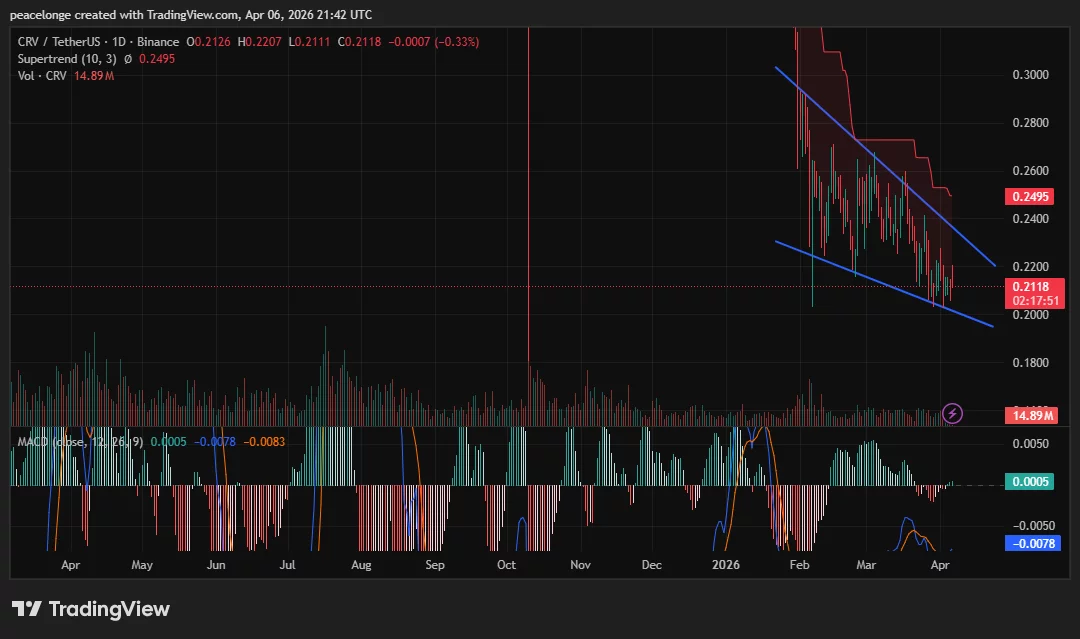
CRV price has been grinding lower since late 2025, and the Curve DAO token is now pressing against the lower boundary of a descending channel that has defined its price action for months. The $0.20 level is within reach, and the chart is setting up a clear binary outcome: hold and recover, or break into uncharted territory.
Summary
- CRV price is at $0.2118 on April 6, approaching the lower boundary of a descending channel in place since late 2025, with the $0.20 psychological level as the key downside reference.
- The daily Supertrend at $0.2495 confirms the bearish trend, though the MACD line at 0.0005 has crossed marginally above the signal at -0.0078, a tentative early stabilisation signal.
- A daily close below the channel lower bound near $0.21 exposes $0.20, while a recovery above the Supertrend at $0.2495 is required to shift the bias toward neutral.
Curve DAO (CRV) price is trading at $0.2118 on April 6, down 8.10% over the prior 24 hours, as the Curve DAO token continues to lose ground within a descending channel that has defined its structure since late 2025. The token is pressing against the lower boundary of that channel, with $0.20 now the critical downside reference for traders watching the DeFi sector’s largest decentralised exchange protocol.
On the daily chart, CRV has been contained within a descending channel since late 2025, with the upper trendline aligning with the Supertrend at $0.2495 and acting as rolling bearish resistance. The lower channel boundary is converging on price near $0.20, leaving a narrowing range that typically precedes a more directional move. The daily MACD shows the MACD line at 0.0005 crossing marginally above the signal at -0.0078, a tentative early stabilisation signal, though volume has not produced any spike that would confirm genuine accumulation behind that reading.
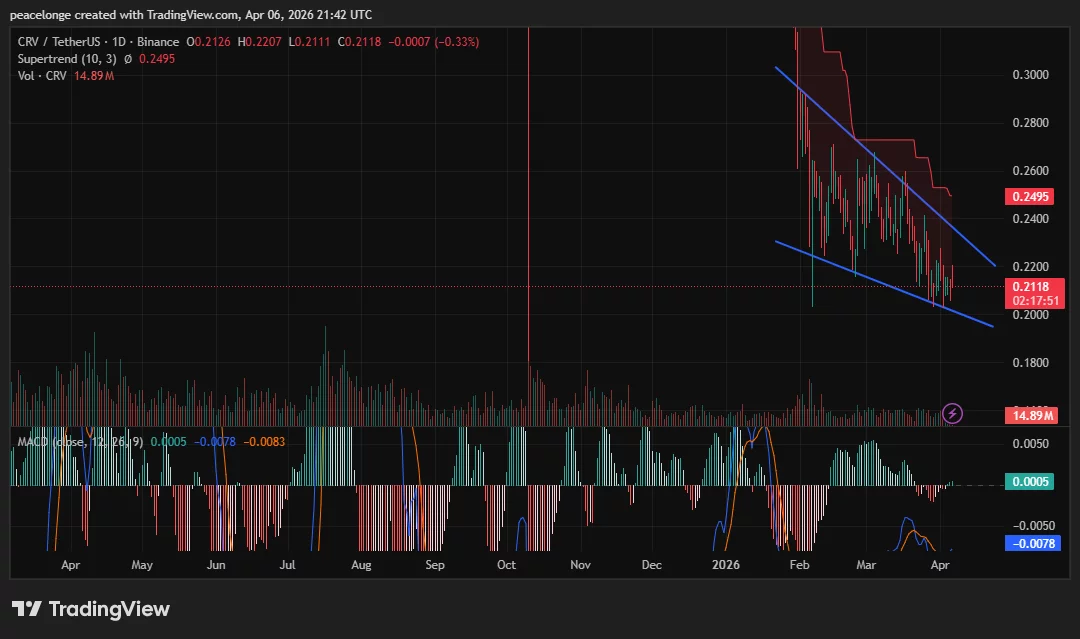
On the 4H chart, a descending wedge pattern has formed between two converging trendlines, with the lower bound at the Supertrend support of $0.2071 and the upper bound at $0.2224. A descending wedge is technically a bullish reversal pattern, though the 4H MACD at 0.0004 is essentially flat, providing no directional confirmation at this timeframe.
A March 2 flash loan exploit on the sDOLA-crvUSD Curve LlamaLend pool, involving an improper oracle configuration that temporarily distorted pool pricing, has continued to weigh on market sentiment. Curve Finance confirmed its core protocol contracts were unaffected, but the incident left a residual risk premium in CRV pricing that has not yet fully cleared.
Key Levels: $0.2071 Holds First, $0.20 Below, $0.2495 Above
The 4H Supertrend at $0.2071 is the immediate support. A four-hour close below that level exposes the $0.20 psychological level, which aligns with the projected daily channel lower boundary. A daily close below $0.20 would represent a significant breakdown, with $0.18, the token’s lowest level from August 2024 per TradingView data, as the next structural reference below. That $0.18 level is the bear case extended target and the point at which the current thesis would require reassessment.
On the upside, the $0.2224 level is the upper bound of the 4H descending wedge and the first resistance to clear. The daily Supertrend at $0.2495 is the key level that must be reclaimed to challenge the broader downtrend. A confirmed daily close above $0.2495 would be the first credible signal the descending channel is being genuinely challenged.
Derivatives Data Confirms Cautious Positioning
According to CoinGlass data, CRV futures open interest declined 11.47% to $74.45 million as of late March, while the OI-weighted funding rate of 0.0067% signals marginally net-long positioning despite the price slide. A market analyst noted in a March 30 analysis that the current phase reflects “accumulation, not decline,” but added that a confirmed bullish reversal would only materialise on a move back toward the $0.30 to $0.32 range. That remains a significant distance from current price, and the technical structure has not yet provided the confirmation that view requires.
If $0.2071 gives way on the 4H chart, a test of $0.20 looks probable. A close above $0.2495 on the daily would be the first real sign the descending channel structure is being challenged.


Bitcoin climbed above $70,200 on Monday for the first time since March 25, as a report that the US and Iran are negotiating a 45-day ceasefire sent risk assets sharply higher across global markets.
Summary
- Bitcoin surged more than 3.5% on April 6, peaking at $70,200 after Axios reported that the US, Iran, and regional mediators are actively discussing a 45-day ceasefire
- The move triggered $273 million in short liquidations across crypto markets within 24 hours, according to Coinglass
- Markets remain cautious, with Polymarket giving the ceasefire roughly 30% odds by April 30, and a White House official confirming Trump has not yet signed off on the proposal
Bitcoin (BTC) reclaimed $70,000 on Monday for the first time in nearly two weeks, rising more than 3.5% to a peak of $70,200 as Axios reported that the US, Iran, and a group of regional mediators are discussing terms for a potential 45-day ceasefire. The report, citing four US, Israeli, and regional sources, sent fresh capital flowing into risk assets on the first trading day after Easter.
Ethereum climbed as much as 5.1% alongside Bitcoin, while the total crypto market cap crossed back above $2.5 trillion. Major altcoins followed, with SOL, XRP, and DOGE all registering gains.
Pakistan is brokering what sources describe as the “Islamabad Accord,” a two-phase deal that would begin with a 45-day ceasefire and transition into negotiations for a permanent end to the conflict. The plan also envisions the reopening of the Strait of Hormuz, the key shipping lane that has remained closed since the war began six weeks ago.
A White House official confirmed the proposal is under active consideration but told reporters: “The President has not signed off on it. Operation Epic Fury continues.” Trump, who extended his strike deadline on Iran to Tuesday at 8 pm ET, told Axios he is “in deep negotiations” with Tehran, adding: “There is a good chance, but if they don’t make a deal, I am blowing up everything over there.”
Six Weeks of Conflict Have Kept Crypto Range-Bound
The US-Iran war has kept roughly 20% of global crude supply constrained behind the closed Strait of Hormuz, sustaining oil prices at elevated levels and dampening risk appetite since the conflict began. Bitcoin had already been weighed down by weeks of escalation headlines, with the asset trading within a $65,000 to $73,000 range even as ceasefire rumors produced repeated short-term spikes. Prior diplomatic attempts collapsed after Iran rejected earlier terms, keeping the strait closed and pressure on risk markets intact.
$273 Million in Shorts Cleared, Open Interest Signals Fresh Capital
Coinglass data shows $273 million in bearish crypto bets were liquidated within 24 hours of the ceasefire reports surfacing. Short positions made up the overwhelming majority of losses, reflecting how heavily traders had positioned for further downside heading into the holiday weekend.
Bitcoin’s notional open interest rose 7%, and Ethereum’s climbed 11%, both outpacing spot price gains. As crypto.news noted, rising open interest alongside positive funding rates suggests fresh capital entering the market rather than a pure short squeeze. Polymarket currently gives the ceasefire roughly 30% odds by April 30, up from 18% before the Islamabad Accord came to light.
Whether the deal clears Trump’s Tuesday deadline remains the critical variable. Any breakdown in talks risks an immediate reversal, with analysts flagging $65,000 to $66,000 as the key support zone to watch if ceasefire optimism fades.
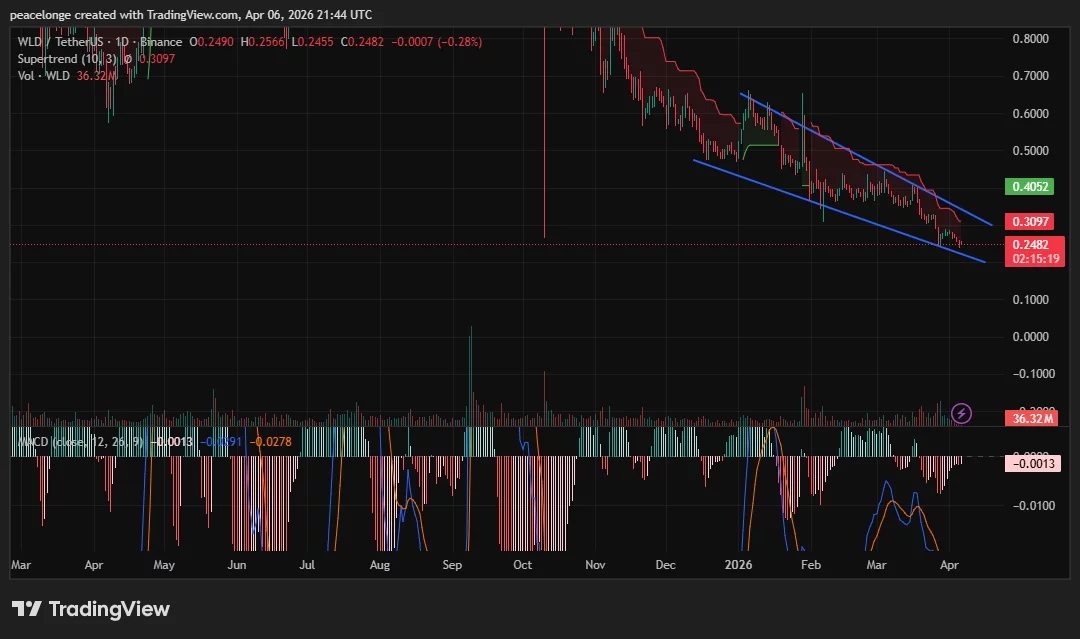
Worldcoin price is grinding just above an all-time low, and the WLD token has failed to stage any meaningful recovery despite Nasdaq-listed Eightco disclosing a $326 million position on April 2. The descending channel structure on both the daily and four-hour charts remains firmly intact, pushing price closer to uncharted territory each session.
Summary
- Worldcoin price is at $0.2482 on April 6, just above the all-time low of $0.2455 set on March 28, as a descending channel on the daily chart holds price near historic lows.
- The daily Supertrend at $0.3097 and a deeply negative MACD at -0.0013 confirm the bearish trend, while Nansen data shows elevated exchange inflows adding near-term selling risk.
- A daily close below $0.2455 would confirm a new all-time low and expose the $0.20 support level, while reclaiming the Supertrend at $0.3097 is the minimum required to challenge the downtrend.
Worldcoin(WLD) price is trading at $0.2482 on April 6, down 7.98% over the prior 24 hours and pressing against an all-time low of $0.2455 set just nine days earlier on March 28. A descending channel that has contained the WLD token since late 2025 keeps price pinned near historic lows, with no confirmed technical reversal pattern present on either the daily or four-hour chart.
On the daily chart, WLD is trading within a defined descending channel, with the upper boundary sitting near $0.4052 and the lower trendline converging directly on price at current levels. The Supertrend sits at $0.3097, well above price, acting as a rolling resistance ceiling that has rejected every recovery attempt in recent weeks. The MACD line sits at -0.0013 against a signal of -0.0091, with the histogram deeply negative, confirming that downward momentum remains intact.
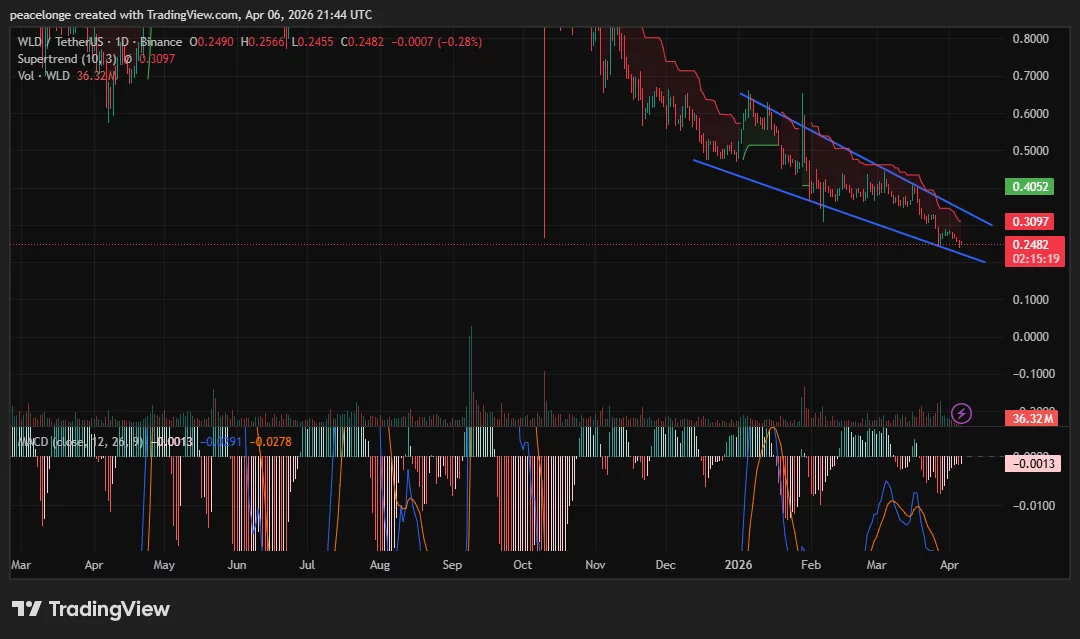
On the 4H chart, the Supertrend at $0.2641 holds above price as bearish resistance on every actionable timeframe. The 4H MACD shows the MACD line at 0.0003 crossing marginally above the signal at -0.0053, a tentative micro-stabilisation on the shorter timeframe that carries limited analytical weight while the daily structure remains this heavily one-sided.
Eightco Holdings, a Nasdaq-listed firm, disclosed on April 2 that it holds 277 million WLD tokens worth approximately $326 million, describing itself as “the largest public market participant in the Worldcoin ecosystem.” Despite the scale of that institutional position, WLD has produced no sustained upside response, reflecting the depth of selling pressure the market is still absorbing.
Key Levels: $0.245 ATL Breaks First, Then $0.20
The all-time low at $0.2455 is the critical immediate support. A daily close below that level would confirm a new historic low for WLD and open a path toward the $0.20 psychological level, which aligns with the projected lower boundary of the descending channel in the weeks ahead. The $0.20 level carries no prior support, as it would represent territory WLD has never closed at on a daily basis.
On the upside, reclaiming the Supertrend at $0.3097 is the minimum threshold for any credible recovery attempt. Above that, the upper channel boundary near $0.4052 is the next meaningful resistance zone. The bullish thesis is fully invalidated on a daily close below $0.20.
Exchange Inflows Signal Continued Selling Pressure
Data from Nansen shows the total balance of WLD tokens held across centralised exchanges rose over 25% to approximately $742 million in the week ending March 27, as the Worldcoin team moved around $26 million in WLD to exchange wallets. Elevated exchange balances signal increased near-term selling risk, as tokens held on exchanges are more readily available for disposal. Until that dynamic reverses, the supply overhang on WLD is unlikely to ease meaningfully.
A confirmed break below $0.2455 would represent a structural deterioration, with $0.20 as the logical next downside target if the all-time low floor fails to hold.
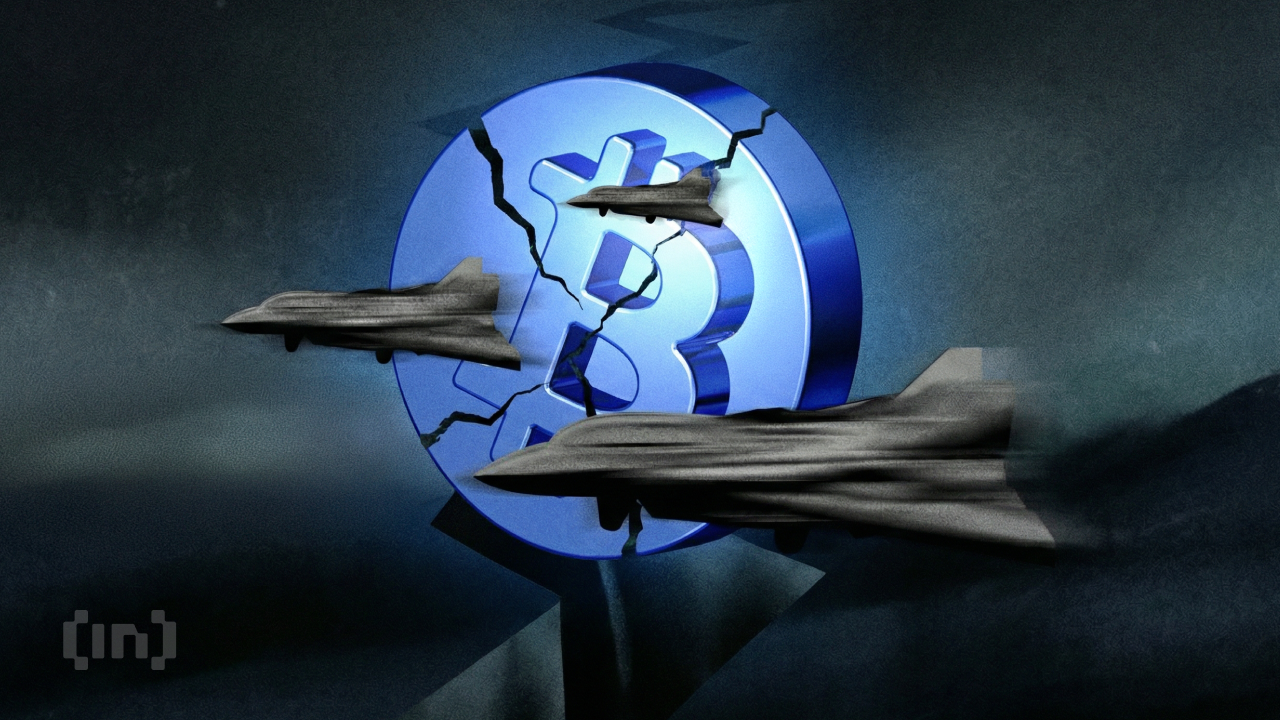
Bitcoin dropped roughly 2% to $68,500 in early Tuesday trading. The move fully erased Monday’s brief climb above $70,000. Geopolitical pressure, not market fundamentals, is driving the sell-off.
Monday’s short-squeeze rally was always structurally weak — and the market proved it fast.
Tuesday Deadline Triggers Risk-Off Across Markets
Trump’s deadline for Iran to reach a deal — or face expanded military strikes — moved from threat to imminent reality overnight. Tehran rejected a ceasefire proposal relayed through Pakistan, demanding sanctions relief, reconstruction commitments, and a permanent end to hostilities. Markets responded with broad caution across risk assets.
Oil surged past $113 a barrel as Trump threatened to target Iranian bridges and power plants by Tuesday night. Gold climbed to $4,654 an ounce as investors rotated toward traditional safe havens. Crypto markets partially recovered, with Bitcoin edging back toward $68,957 and Ether recovering to $2,115.
BNB slipped 0.6% to $600, and XRP fell a similar margin to $1.32 over 24 hours. The global crypto market cap held near $2.44 trillion, down just 0.2%. Monday’s rally, built on over $145 million in forced short liquidations per CoinGlass data, remains the dominant price driver — fresh capital has yet to follow.
Bitcoin Stuck in a Familiar Trap
Bitcoin has now failed at the $70,000 level repeatedly since late February, when Iran-related conflict first began weighing on risk appetite. Every rally toward that level attracts profit-taking and runs into thin liquidity. The pattern has become predictable.
The Strait of Hormuz now sits at the center of ceasefire negotiations. Any prolonged disruption to energy supply routes would significantly darken the global macro outlook. Crypto, still moving in close lockstep with broader risk assets, would absorb that pressure directly.
The post Bitcoin Slides Below $69K as Iran Strike Deadline Looms appeared first on BeInCrypto.


ETHGlobal Cannes 2026’s 10 finalists push AI agents, privacy infrastructure and on-chain prediction markets through projects like ENShell, DIVE, Corpus and VEIL VPN.
Summary
- ETHGlobal has named 10 Cannes 2026 finalists pushing AI agents, privacy infrastructure and on-chain prediction markets across ENShell, DIVE, maki, Défi, ALMA, npmguard, VEIL VPN, PaintGlobal, EVM PORST and Corpus.
- Projects like ENShell, DIVE and Corpus show how autonomous agents can safely sign, verify and trade on-chain, while VEIL VPN builds a verifiable “no‑logs” network at the Internet’s encrypted edge.
- The finalists sit inside a maturing Ethereum hackathon circuit, where events like ETHGlobal routinely put up prize pools in the tens of thousands of dollars and attract developers chasing both funding and distribution.
ETHGlobal used a simple “Drumroll please…” tweet to introduce what is arguably one of its most technically ambitious finalist slates yet, telling followers “Our ETHGlobal Cannes finalists are here! We’re excited to announce the top 10 projects of the weekend: ENShell, DIVE, maki, Défi, ALMA, npmguard, VEIL VPN, PaintGlobal, EVM PORST, Corpus” and directing users to “Learn more about the winners ↓” via its showcase portal.
The 10‑project lineup spans AI‑first protocol design, verifiable networking and interface‑level tooling for developers and prediction markets. According to ETHGlobal, its hackathons are designed to “teach new skills, strengthen developer communities, and push the limits of new technologies,” and Cannes 2026 is framed as a proving ground for what happens when on‑chain agents and infrastructure are treated as first‑class design constraints rather than bolt‑ons.
The official ETHGlobal finalist thread quickly followed with per‑project one‑liners. ENShell, tagged as “ETHGlobal Cannes 2026 Finalist | 🐚 ENShell” and developed by @CodeQuillClaim, is described as a tool that “Prevents AI agents from executing malicious transactions caused by prompt injection attacks,” pointing to an architecture where agent transaction flows are wrapped inside a hardened ENS‑aware shell that checks proposed actions against policy before a signature ever hits a wallet . DIVE, credited to @derek2403, @avoisavo, @cedricctf11a and @ilovetofupeach, is introduced as an “AI swarm engine verifying real-world truth for prediction markets and autonomous on-chain settlement,” implying a multi‑agent oracle layer that cross‑checks external data before committing settlements to smart contracts . VEIL VPN, meanwhile, positions itself as a protocol at the network edge: ETHGlobal calls it “Verifiable Encrypted Internet Layer, is the pay as you go VPN protocol that proves no logs are kept,” suggesting a design where proofs about server behavior are surfaced alongside encrypted traffic to make “no‑logs” claims cryptographically auditable rather than purely marketing language .
Cannes’ emphasis on agents is not accidental. ETHGlobal’s own ENS prize track for the event describes the Ethereum Name Service as “the identity layer for the new internet” that “turns wallet addresses into human-readable names like yourname.eth — a portable, onchain profile that works across every app, chain, and wallet,” and explicitly calls out that “as AI agents become first-class onchain actors, ENS is how you give them a name, a reputation, and a place to be found”. Within this frame, ENShell looks less like a standalone tool and more like a reference implementation for ENS‑based agent controls: by sitting between LLM prompts and transaction submission, it can apply machine‑readable policies tied to ENS identities and revoke or quarantine flows that look like prompt‑injection‑driven privilege escalation. The ENS prize track itself offers targeted rewards such as “Best ENS Integration for AI Agents” with $4,000 in total awards, including $2,500 for first place and $1,500 for second, and a separate “Most Creative Use of ENS” pool with a further $6,000, underlining how prize money is being explicitly steered toward agent‑centric integrations.
Corpus takes that agent mentality to products rather than identities. In ETHGlobal’s words, Corpus lets teams “Turn any product into an autonomous AI agent corp that runs GTM, trades, and earns for you,” suggesting a multi‑agent architecture where go‑to‑market operations, treasury management and trading strategies can be expressed as separate, composable bots with shared access to protocol‑level wallets and on‑chain reputational footprints. This framing echoes a broader shift across Ethereum towards products that ship with built‑in “agent corps” for growth, liquidity management and user support, anticipating a future where a meaningful share of on‑chain volume is initiated not by humans clicking buttons, but by semi‑autonomous services negotiating with one another on behalf of users and DAOs.
If ENShell and Corpus are about giving agents guardrails and jobs, VEIL VPN and DIVE are about ensuring the world they see is actually real. DIVE’s description as an “AI swarm engine verifying real-world truth for prediction markets and autonomous on-chain settlement” implies a layered stack where multiple models interrogate the same real‑world event, resolve disagreements across agents, and only then write a consensus outcome into a settlement contract that can unlock funds, close markets or trigger hedging logic. In practice, this could allow prediction markets to move away from single‑oracle designs towards resilient swarms, a direction that mirrors both how traditional financial data providers run redundant feeds and how some DeFi protocols now weight multiple oracle sources to guard against manipulation.
VEIL VPN’s engineering challenge is different but equally fundamental. By positioning itself as a “pay as you go VPN protocol that proves no logs are kept,” the team is implicitly acknowledging widespread skepticism around commercial VPN claims and betting that cryptographic proofs and on‑chain settlement can restore trust at the packet level. A plausible design here involves combining anonymous credentials, encrypted tunnels and zero‑knowledge attestations about server‑side logging behavior, with users paying per‑session from non‑custodial wallets and being able to audit, or even slash, relays that violate agreed‑upon privacy constraints. ETHGlobal’s decision to push such a network‑layer experiment into its finalist pool speaks to a belief that the next generation of crypto infrastructure will not just live in DeFi front‑ends or Layer‑2 rollups, but deep in the plumbing of how traffic moves, is priced, and is verified.
Beyond individual architectures, the Cannes finalists underscore how hackathons have become capital‑efficient R&D funnels for Ethereum, with events like ETHGlobal routinely offering $5,000–$10,000 top prizes and aggregate prize pools reaching $20,000 or more once partner bounties are included. ETHGlobal notes that teams can “select up to 3 Partner Prizes” per submission and that prizes are awarded across tracks ranging from “Hooks, Hooks, and Hooks — $10,000” to Filecoin‑backed data and AI‑tool categories, creating a funding environment where early‑stage teams can assemble meaningful non‑dilutive capital and distribution simply by shipping something useful over a weekend. For ENShell, DIVE, VEIL VPN and Corpus, the Cannes finalist slot is both a badge of engineering credibility and a launchpad into deeper ecosystems around ENS, prediction markets, privacy infrastructure and agent‑native protocol design.
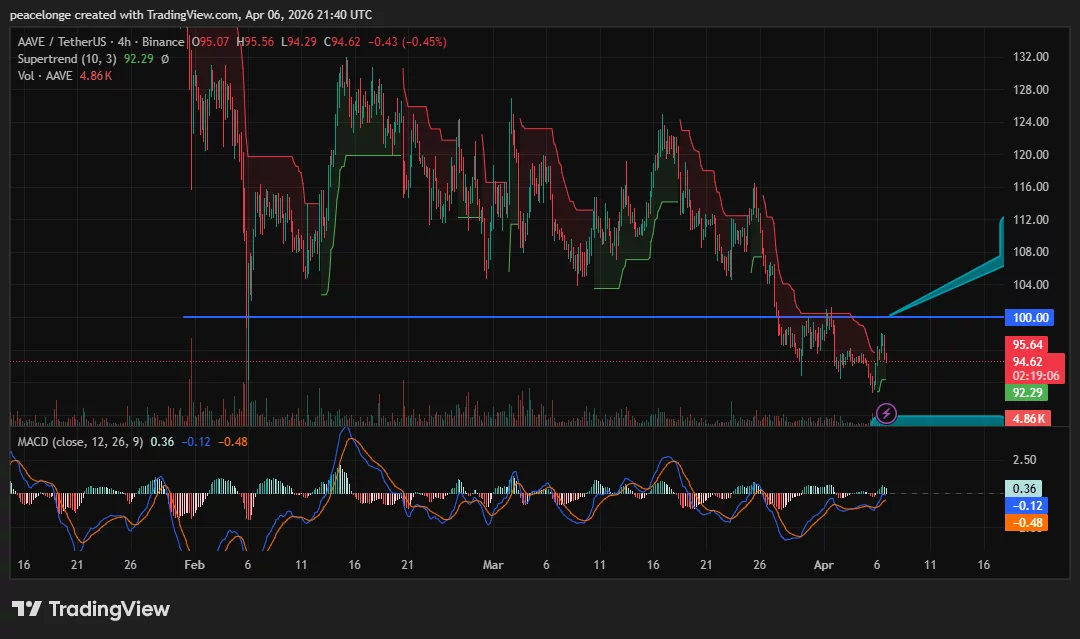
AAVE price posted one of its sharpest single-session drops in months on April 6, briefly crashing through $84 before a partial recovery took hold. The chart damage is clear: $100 has gone from support to resistance in a single session, and the technical setup across both the daily and four-hour timeframes remains decisively bearish.
Summary
- AAVE price fell to an intraday low of $83.92 on April 6 before recovering to $94.66, confirming the $100 psychological support as resistance on the daily chart.
- The daily Supertrend at $107.82 and a deeply negative MACD reinforce the bearish bias, while the 4H Supertrend at $92.29 is currently acting as near-term floor.
- A failure to reclaim $100 keeps the $83 intraday low and the $80 Fibonacci zone in sight, while a daily close above $107.82 would be the first signal of a structural shift.
AAVE (Aave) price crashed to $83.92 on April 6, sliding more than 11% from the prior session’s close of $94.15 before recovering to $94.66, as DeFi sector selling and broader macro risk-off sentiment pressured the Aave lending protocol’s native token. The drop confirmed a decisive break below the $100 psychological support, a level the daily chart now labels as resistance following months of acting as a structural floor.
On the daily chart, the Supertrend indicator sits at $107.82, well above price and capping any near-term recovery attempt. The MACD histogram remains negative across the daily timeframe, with the signal line still below zero, confirming that selling momentum has not yet reversed. Today’s candle printed a long lower wick from $83.92, reflecting demand at intraday lows, but the $94.66 close falls well short of what is needed to challenge the $100 threshold.
BGD Labs, a core technical contributor to the Aave protocol, formally concluded its engagement on April 1 after citing governance tensions. Aave founder Stani Kulechov had previously noted on X that the protocol’s risk infrastructure “has historically processed over 1,200 payloads and 3,000 parameters without issues,” but BGD Labs’ exit has introduced fresh uncertainty around development continuity heading into the V4 launch cycle.
On the 4H chart, the Supertrend at $92.29 is acting as dynamic support. The 4H MACD histogram is near flat, reflecting a pause in downside momentum rather than a confirmed reversal.
Key Levels: $80 Zone in View if $92 Fails
The 4H Supertrend at $92.29 is the immediate support to monitor. A daily close below that level reopens the $83.92 intraday low as the next test. Below that, the $80 round number marks the next significant support, reinforced by the 0.786 Fibonacci retracement of AAVE’s 2024 to 2025 rally, which falls in the $80 to $85 zone. That is the bear case invalidation level for any medium-term recovery thesis.
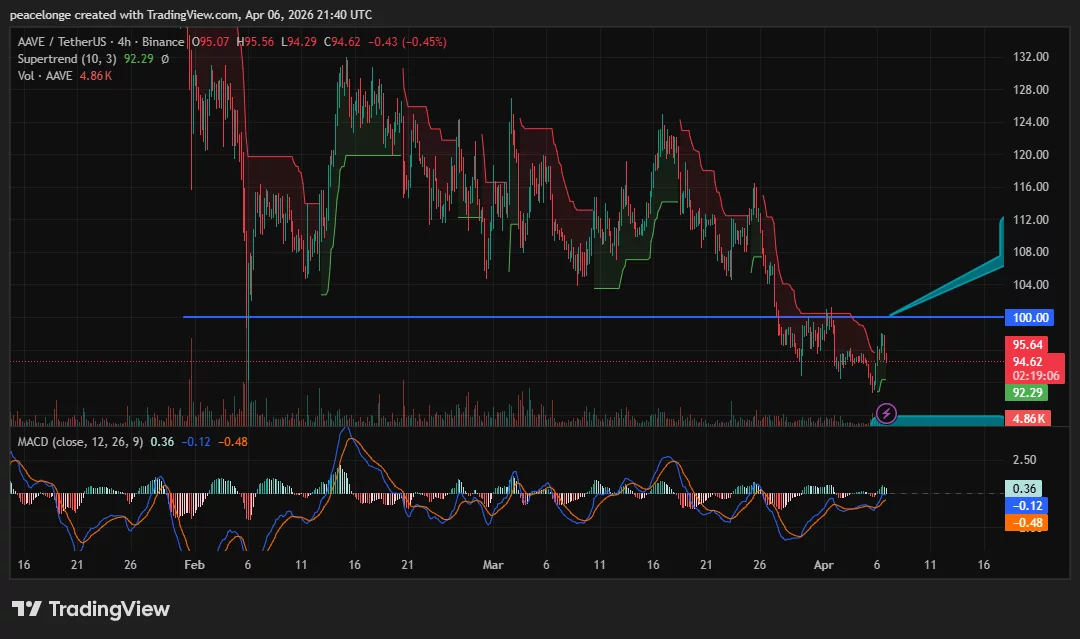
On the upside, $100 is the primary resistance. A confirmed daily close above the Supertrend at $107.82 is the minimum required to shift the short-term bias toward neutral. A sustained recovery above $100 with volume confirmation opens the path toward $112, as indicated by the potential ascending structure visible on the 4H chart.
On-Chain Context and Institutional Signals
Grayscale Investments has filed to convert its Aave Trust into an ETF on NYSE Arca, a potential longer-term demand catalyst, though approval timelines provide no near-term price support. According to CoinGlass data, AAVE futures open interest has declined alongside price in recent sessions, consistent with long-side deleveraging rather than aggressive fresh short building, which reduces the probability of a sharp short-covering bounce.
If $92.29 gives way on the 4H chart, a revisit of the $83.92 intraday low looks probable, with $80 as the last significant structural support before territory AAVE has not traded in years.
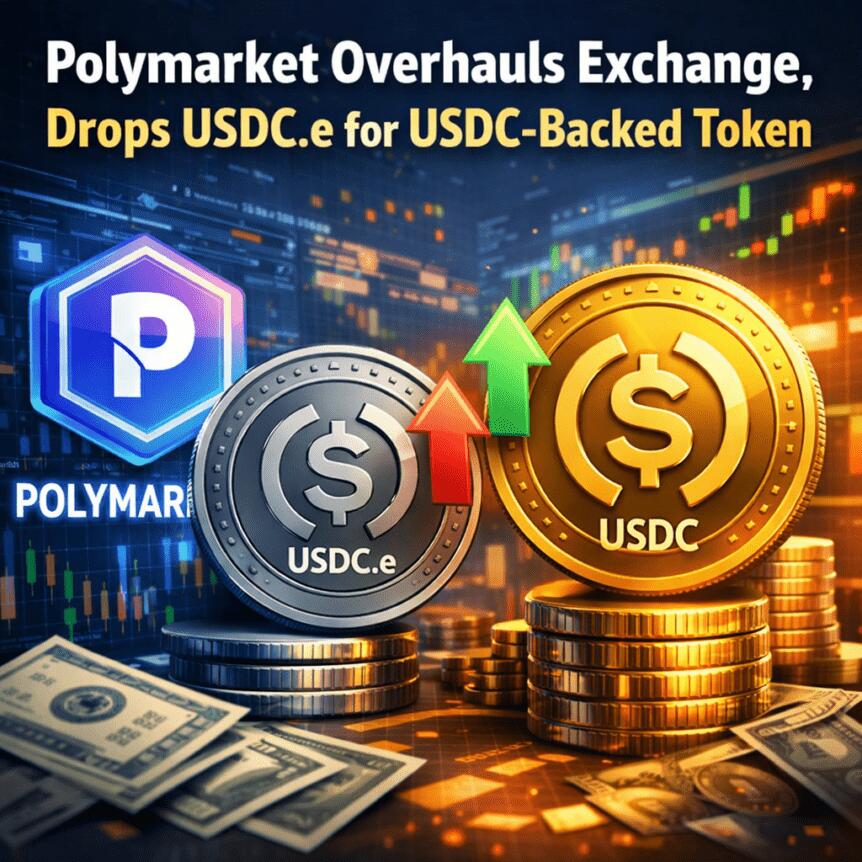
Polymarket is overhauling its exchange infrastructure in the coming weeks, introducing a new collateral token and an upgraded trading engine that give the platform tighter control over settlement and risk as it moves toward closer alignment with US regulatory expectations.
In a Monday announcement, Polymarket said it will deploy new exchange contracts—Version 2—designed to simplify how orders are structured and matched. The upgrade aims to boost trading efficiency and make it easier for developers to connect apps and trading bots to the platform.
The upgrade also expands on-chain compatibility by adding support for EIP-1271, the Ethereum standard that allows smart contract wallets, including multisigs and automated trading systems, to sign transactions, broadening support beyond traditional externally owned wallets.
A central feature is the introduction of Polymarket USD, a new collateral token that will replace USDC.e, Polymarket’s bridged version of USDC. The new token is fully backed 1:1 by USDC, giving Polymarket greater direct control over its settlement layer and reducing reliance on bridged assets.
For most users, the transition will be automatic through the platform’s interface, requiring only a one-time approval. The rollout is expected to unfold over the coming weeks, though Polymarket did not provide a precise date.
Key regulatory backdrop and market implications
The upgrade comes as Polymarket continues to adapt to evolving US regulatory expectations, including efforts to curb manipulation and insider-trading risks as it seeks to strengthen market integrity and align more closely with US standards.
In November, Polymarket won approval from the Commodity Futures Trading Commission to operate an intermediated trading platform in the United States, clearing the way for its return after previously exiting the market. Following that approval, Polymarket said it plans to onboard brokers and customers directly and facilitate trading through regulated US venues.
Interest in prediction markets has continued to grow, with users increasingly trading real-world outcomes tied to politics, markets, and policy. Industry data have shown Polymarket’s fee revenue rising in recent weeks after a pricing overhaul, underscoring the demand for these platforms.
Market data provider DeFiLlama tracks Polymarket’s revenue indicators and has highlighted the platform’s uptick as it expands fee-based income alongside its technological upgrade.
Beyond the user-facing changes, the upgrade is designed to strengthen the platform’s connective tissue for developers and automated traders, while giving Polymarket enhanced control over its settlement pipeline and a more cohesive collateral framework to manage risk.
What this means for users and developers
For everyday users, the transition should be largely seamless: the one-time approval triggers the automatic switch to the new system, and existing accounts will be supported by the updated interface. Traders and developers can anticipate easier integration with external apps and bots thanks to the simplified order structure and standardized settlement flow.
Polymarket’s ongoing push toward regulatory-aligned operation could attract more traditional market participants, brokers, and liquidity providers, potentially broadening the range of real-world events offered for trade.
Looking ahead, observers will watch how quickly the new infrastructure gains traction among users and whether regulatory clarity translates into faster onboarding of US participants via regulated venues.
As Polymarket advances its technical overhaul, the timing of regulatory milestones, the pace of onboarding, and the robustness of the new collateral approach will be key determinants of the platform’s next phase of growth.

Key Takeaways
- First-quarter earnings from UnitedHealth (UNH) scheduled for April 21, 2026
- Consensus estimates point to $6.69 EPS, reflecting an 8% year-over-year drop, alongside $109.58 billion in revenue
- Raymond James raised its rating to Outperform, establishing a $330 target price
- Shares climbed approximately 1.2% in response to the analyst action
- Derivatives markets suggest a potential ~9% swing following the earnings announcement
UnitedHealth Group prepares to unveil its first-quarter financial performance on April 21, with market participants paying close attention following a challenging beginning to 2026.
UnitedHealth Group Incorporated, UNH
Shares have tumbled approximately 17% year-to-date, weighed down by disappointing forward guidance and persistent challenges within its Medicare Advantage segment. This selloff has pushed the stock beneath the entry point established by Berkshire Hathaway, igniting discussion about potential value at current levels.
The Street anticipates adjusted earnings per share of $6.69 for the quarter, representing an 8% decline compared to the prior-year period. Revenue projections stand at $109.58 billion, essentially unchanged from last year’s figure.
Options activity suggests traders are bracing for approximately 9% volatility in either direction once results are published — indicating heightened uncertainty surrounding the upcoming release.
On April 1, Raymond James elevated UNH from Market Perform to Outperform, assigning a $330 price objective. Analyst John Ransom contended that the market is overlooking the company’s earnings capacity, especially regarding operational efficiency gains.
The rating change propelled shares higher by roughly 1.2% during the April 2 session, with the stock touching $279.04 before closing at $277.30.
Ransom highlighted administrative expense optimization as a crucial catalyst. His analysis suggests that each 100-basis-point reduction in general and administrative costs could contribute approximately $3.80 to per-share earnings.
Optum Health Under the Microscope
Raymond James noted enhanced transparency around Optum Health’s margin profile. While current-year margins may appear stable, the firm believes the underlying trajectory is favorable as UnitedHealth divests from loss-making assets.
The healthcare giant has already shuttered or divested multiple unprofitable clinic locations. This rationalization effort should alleviate margin compression moving forward.
Optum’s fee-for-service operations, generating approximately $33 billion annually, currently operate at single-digit profitability. Analysts identify substantial improvement potential through enhanced operational discipline.
The collective Wall Street sentiment toward UNH skews positive. According to TipRanks analytics compiled April 1, the stock carries a “Strong Buy” rating based on 17 Buy recommendations, 3 Hold ratings, and no Sell calls.
The consensus 12-month price objective stands at $366.47, suggesting approximately 35% appreciation potential from current trading levels. The most optimistic forecast envisions UNH at $440, while the most conservative projection sits at $311.
Potential Headwinds Persist
Some analysts maintain caution. Leerink identified Risk Adjustment Data Validation (RADV) audits — Medicare Advantage payment reconciliations — as a significant challenge.
An upcoming Ninth Circuit Court decision regarding UnitedHealth’s preemption argument could broaden legal exposure should the ruling prove unfavorable.
Institutional investors control approximately 87.9% of outstanding shares. Major stakeholders include Norges Bank, Capital Research Global Investors, Berkshire Hathaway, and Dodge & Cox, which substantially increased its holdings in the previous year.
Notwithstanding the 2026 downturn, UNH recently secured a position among the top 10 holdings within the Schwab U.S. Dividend Equity ETF. The corporation distributes an annual dividend of $8.84 per share, currently yielding about 3.2%.
The most recent quarterly report showed a modest earnings beat — $2.11 EPS against the $2.09 Street estimate — accompanied by $113.73 billion in revenue, reflecting 12.3% year-over-year growth.
First-quarter financial results will be released prior to the market opening on April 21.



China’s Cyberspace Administration has ordered Apple to pull Jack Dorsey’s Bitchat from its China App Store, citing regulations that require apps with “social mobilization” capabilities to pass a government security assessment before launch.
Summary
- The Cyberspace Administration of China told Apple to remove Bitchat from its China App Store and TestFlight beta, effective February 2026, a ban Dorsey disclosed publicly on April 5
- The CAC cited Article 3 of its regulations governing apps with “public opinion or social mobilization capabilities,” which require a mandatory security review before deployment
- Bitchat, which runs entirely over Bluetooth mesh networks with no internet required, has surpassed three million downloads globally and was widely used by protesters in Iran, Uganda, Nepal, and Indonesia to bypass government shutdowns
Block CEO Jack Dorsey confirmed on X that his decentralized messaging app, Bitchat, was pulled from China’s App Store in February 2026 at the direct request of the Cyberspace Administration of China. As crypto.news reported, the CAC cited Article 3 of its regulations covering online services with “public opinion or social mobilization capabilities,” a provision that has been in force since 2018 and requires a state security assessment before any such platform can launch. Both the App Store listing and the TestFlight beta version are now unavailable in China, though the app remains accessible in all other markets.
Bitchat’s core design is what put it on Beijing’s radar. The app operates entirely over Bluetooth and mesh networks, requiring no internet connection. That architecture makes it functionally immune to conventional government filtering and firewall blocking — the same tools China relies on to manage digital communication.
That design has given Bitchat an outsized role during political unrest. Protesters in Iran used it to communicate as authorities attempted to restrict connectivity during the ongoing conflict. As crypto.news documented, Bitchat also surged in Uganda ahead of the 2026 general elections, where opposition leader Bobi Wine actively urged supporters to download it in preparation for expected internet blackouts. Authorities in Nepal, Madagascar, and Indonesia have also seen surges in Bitchat adoption during periods of restricted connectivity.
Apple’s review team delivered a pointed message to Dorsey alongside the removal notice: “We know this stuff is complicated, but it is your responsibility to understand and make sure your app conforms with all local laws.”
Three Million Downloads and Still Climbing
Despite the ban, Bitchat’s global reach continues to expand. Chrome download statistics show the app has surpassed three million total downloads, with over 92,000 recorded in the past week alone. The Google Play Store reports more than one million installs. Regional breakdowns are not publicly available.
Dorsey first launched Bitchat in beta via Apple’s TestFlight in July 2025, framing it as a weekend experiment in Bluetooth mesh networking. The app encrypts messages using AES-256, stores all data only in device memory rather than on central servers, and supports Bitcoin transactions natively. Billionaire fund manager Bill Ackman publicly called it a practical tool for censored environments like Iran.
The App Store as the Only Lever
What makes China’s move notable is the mechanism chosen. Bitchat has no central servers to pressure, no user accounts to surveil, and no phone number requirement. Its decentralized design gives regulators virtually no conventional chokepoint to target. Forcing an App Store removal is one of the few available tools — and it does not affect the app’s operation for users who already have it installed or access it through other means.

Chelsea Handler Calls Marriage As ‘Outdated’ And ‘Patriarchal’

Sua vida financeira vai melhorar? #tarot #tarothoje #tarotgratis #tarotamor

Emmerdale spoilers: Moira ‘saved at last’ as trial takes a very unexpected turn | Soaps

Smart energy pays enters the US market, targeting scalable financial infrastructure

Why Israel is blocking foreign journalists from entering

Bitcoin: We’re Entering The Most Dangerous Phase
Sua vida financeira vai melhorar? #tarot #tarothoje #tarotgratis #tarotamor

ANDRY HAKIM SUDAH CAPAI FINANCIAL FREEDOM??!! #andryhakim #stockwise #saham

Vrishabh rashi walon ke liye April ka financial update.#MoneyPrediction #ZodiacTips
-

 NewsBeat4 days ago
Steven Gerrard disagrees with Gary Neville over ‘shock’ Chelsea and Arsenal claim | Football
-

 Business4 days ago
No Jackpot Winner and $194 Million Prize Rolls Over
-

 Fashion3 days ago
Weekend Open Thread: Spanx – Corporette.com
-

 Crypto World5 days ago
Gold Price Prediction: Worst Month in 17 Years fo Save Haven Rock
-

 Business1 day ago
Three Gulf funds agree to back Paramount’s $81 billion takeover of Warner, WSJ reports
-
Crypto World7 days ago
Dems press CFTC, ethics board on prediction-market insider trades
-

 Sports2 days ago
India men’s 4x400m and mixed 4x100m relay teams register big progress | Other Sports News
-

 Business5 days ago
Login and Checkout Issues Spark Merchant Frustration
-

 Tech7 days ago
EE TV is using AI to help you find something to watch
-

 Sports6 days ago
Tallest college basketball player ever, standing at 7-foot-9, entering transfer portal
-
Tech7 days ago
Daily Deal: StackSkills Premium Annual Pass
-

 Tech7 days ago
Flipsnack and the shift toward motion-first business content with living visuals
-

 Tech7 days ago
How to back up your iPhone & iPad to your Mac before something goes wrong
-
Crypto World7 days ago
Valinor raises $25m to put private credit on-chain
-

 Tech7 days ago
What Are The Biggest Limitations Of Supercomputers?
-

 Crypto World6 days ago
Bitcoin enters the public bond market as Moody’s gives a first-of-its-kind crypto deal a rating
-

 Politics7 days ago
Transform Your Space with Stunning Small Works
-

 Politics7 days ago
‘Out of touch, smug and overpaid’
-

 Politics6 days ago
Starmer’s centre has collapsed, and the left was right all along
-
Crypto World6 days ago
Bitcoin stalls below key resistance as technical signals skew bearish
You must be logged in to post a comment Login