

Crypto World
Buying the dip? Strategy prefers the top of the range



Strategy (formerly MicroStrategy) founder Michael Saylor purchased 1,031 bitcoin (BTC) last week at an average price of $74,326.
Saylor’s buy was in the 80th percentile of the available range and BTC traded between $67,354 and $76,013 during that period.
It wasn’t a fluke.
Year-to-date across his 12-weekly SEC Form 8-K disclosures totaling 89,599 BTC purchases for $7.25 billion this year, Strategy has consistently bought in the top half of each week’s trading range.
This is according to our analysis of the company’s own SEC filings and corresponding BTC market data.
Strategy’s 2026 purchases of BTC landed above the midpoint of each purchase period’s trading range 80% of the time.
Saylor buys BTC near the top
The pattern holds even when weighting for size. Indeed, Strategy’s two largest purchases of the year, 22,337 BTC in the week ending March 15 and 22,305 BTC in the week ending January 19, both cleared above the midpoint of each week’s range.
The January purchase, disclosed on January 20, cost $95,284 per coin while BTC traded between $90,016 and $97,939 that week.
That placed Strategy at the 66th percentile of the range on its $2.1 billion purchase.
In early February, the firm bought 1,142 BTC at $78,815 during a week when BTC ranged from $59,930 to $79,301. Embarrassingly, that’s the 97th percentile or nearly the worst prices Strategy could have paid.
BTC spent most of that week at much lower prices, but Saylor paid near the ceiling.
Only three of the 12 weekly purchases landed below the midpoint of the range. Worse, those three combined for just 16,705 BTC, or 18.6% of total volume purchased year to date.
‘I’m going to be buying the top forever’
Saylor has acknowledged his approach openly. “I’m going to be buying the top forever,” he posted on X.
Of course, that statement is supposed to reference the slow and long-term price appreciation of BTC, not the literal reality that Saylor is buying near the top of BTC trading ranges.
The numbers confirm it. Strategy’s volume-weighted average purchase price for 2026 is $80,929. BTC currently trades near $70,000, leaving the company’s entire 2026 buying program roughly $1 billion underwater.
The company now holds 762,099 BTC acquired for a blended average of $75,694. At today’s prices, that treasury has an unrealized loss of over $4 billion.
The company’s MSTR common stock, which opened 2026 at $154.59, opened for trading this morning at $138.92, a 10% year-to-date decline.
Each Monday, Saylor discloses the prior week’s purchases via an 8-K filing. The day prior, on Sundays, he usually hints at the purchase by posting some sort of vague yet eminently obvious reference to “orange dots” on his SaylorTracker.
Protos previously noted a similar pattern in April 2025 when Strategy paid well into the top third of the weekly range while BTC spent most of the week near its lows.
Read more: We calculated the present value of STRC — it’s bad for MSTR
To be fair, buying above the midpoint doesn’t automatically mean poor execution. No one knows the best price in advance.
Over the counter desks also handle large blocks at negotiated prices, and Strategy’s large size limits its ability to cherry-pick intraday lows. Strategy also seems to often buy early in the week, and for whatever reason, BTC has traded higher during early weekdays in 2026 than later weekdays.
Still, the consistency of the pattern across 12 consecutive weeks and nearly 90,000 BTC is difficult to dismiss.
Strategy spent $5.8 billion, or 80% of its 2026 outlay, at prices in the upper half of each week’s range.
Saylor, for his part, keeps posting orange dots on Sundays and expensive, top-of-range BTC buys on Monday.
Got a tip? Send us an email securely via Protos Leaks. For more informed news, follow us on X, Bluesky, and Google News, or subscribe to our YouTube channel.

Bitcoin’s recent recovery attempt appears to be losing momentum as the market once again received notable rejection below the $80K mark. The repeated inability to sustain gains above key thresholds suggests sellers remain dominant, increasing the likelihood of another corrective phase in the short term.
Bitcoin Price Analysis: The Daily Chart
On the daily timeframe, BTC recently experienced a slight bullish pullback following its rebound from the $78K support zone. However, this recovery rally was ultimately rejected around the critical $80K resistance region, which also aligns with the descending 200-day moving average near the $82K mark. The confluence of these resistance levels reinforces their significance and highlights persistent bearish sentiment across the market.
The rejection from this area suggests buyers are still unable to reclaim higher ground, while sellers continue defending overhead supply aggressively. As long as Bitcoin remains capped below the $80K-$82K region, the probability of an expanded bearish retracement remains elevated. In this scenario, the first major downside target would be the highlighted demand zone around $75K-$76K. A deeper correction could eventually expose lower support levels.

BTC/USDT 4-Hour Chart
The lower timeframe provides further confirmation of weakening momentum. Bitcoin recently broke below a key ascending trendline that had supported the latest recovery phase. More importantly, the subsequent pullback toward this broken trendline resulted in another rejection, effectively validating the initial bearish breakout.
This classic breakdown-and-retest structure often signals continuation in the breakout direction, suggesting sellers remain in control. If bearish pressure persists, Bitcoin may continue declining toward the first important order block around the $75K-$76K region. Failure to hold this support could accelerate selling activity and expose the broader demand zone around $70K-$71K, which previously served as a strong accumulation area.

Sentiment Analysis
The Coinbase Premium Gap measures the price difference between Bitcoin traded on Coinbase and other major exchanges, particularly Binance. Since Coinbase activity is heavily associated with US institutional and spot investors, this metric is commonly used to gauge demand from American participants. Positive values typically indicate stronger spot buying pressure, while negative readings often reflect weaker demand or increased selling activity.
Recently, the indicator has fallen below the neutral 0 line once again, creating a negative premium gap. This shift implies that demand from US-based investors is fading, while selling pressure or cautious positioning is increasing. Historically, sustained negative readings have often aligned with corrective phases or periods of weak momentum.
If the Coinbase Premium Gap remains below zero in the coming weeks, it could further reinforce the bearish technical structure already observed on the charts, increasing the likelihood of continued downside pressure toward lower support regions.

The post Bitcoin Price Analysis: What Does the Rejection at $80K Mean for BTC’s Future? appeared first on CryptoPotato.
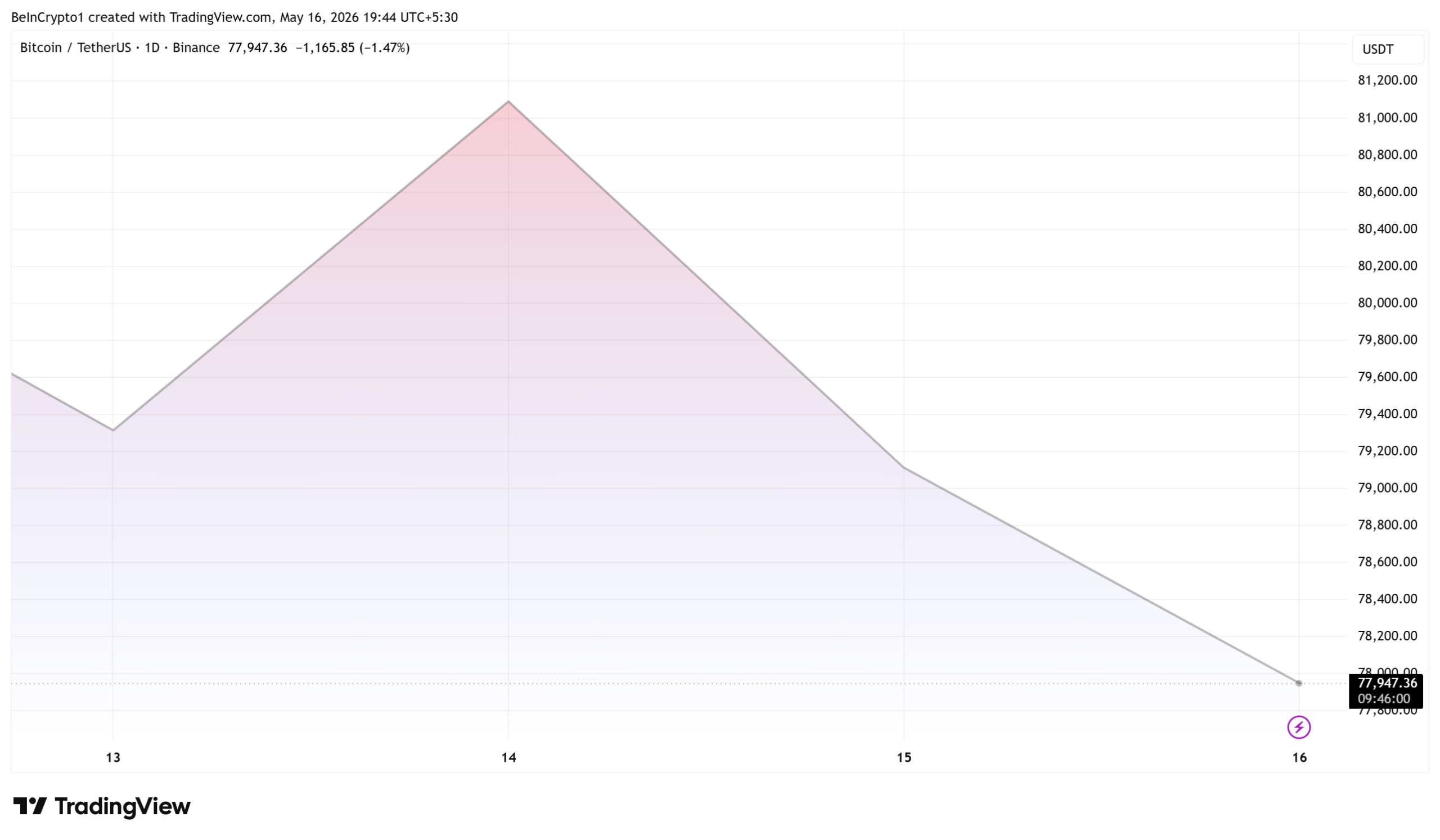
Bitcoin (BTC) extended losses into Saturday. Iran’s threat to charge tolls on Strait of Hormuz shipping kept pressure on global risk assets. The two-day selloff has now erased over $80 billion in crypto market value.
The pioneer crypto traded near $77,947 after dropping below $78,000. Leveraged longs absorbed the bulk of a reported $620 million in 24-hour liquidations.
Profit-Taking After CLARITY Vote Set Up the Slide
Saturday’s move builds on a sharper drop earlier in the week. The Senate Banking Committee passed the CLARITY Act on Wednesday by a 15-9 vote, briefly pushing BTC above $82,000 before profits got booked.

Analyst Crypto with Harris described the reversal as a textbook profit-taking move. Traders had spent weeks pricing in regulatory progress, and the formal committee vote removed the catalyst.
Hopes for a softer tariff posture at the US-China summit also faded. President Donald Trump said no such discussions had taken place, dragging US equities and crypto lower in tandem.
Exchange dashboards now show longs accounting for the bulk of liquidations, with over $469 million positions wiped out over the last 24 hours.

“Bitcoin down -3800$ in 48 hours and broke below $78000. BTC wiped out $80 BILLION marketcap in just 2 days. Over $620M in longs liquidated in last 24 hours,” analyst Bull Theory said recently.
Iran’s Hormuz Toll Plan Sustains Geopolitical Pressure
The macro picture stayed dark on Saturday. Iran moved to formalize a fee system for vessels using the Strait of Hormuz, the chokepoint where roughly a fifth of seaborne oil flows.
“Iran, within the framework of its national sovereignty… has prepared a professional mechanism to manage traffic in the Strait of Hormuz along a designated route… only commercial vessels and parties cooperating with Iran will benefit from it. The necessary fees will be collected for the specialized services provided under this mechanism,” Iranian official Ebrahim Azizi outlined the policy framework in a public statement.
Iranian state-linked outlets reported that vessels from China, Japan, and Pakistan have already transited the strait with Tehran’s clearance. Several European operators are reportedly seeking similar permission.
Domestic conditions inside Iran continue to deteriorate. Analyst Miad Maleki said Iranian crude exports have fallen more than 80% since mid-March, citing Vortexa data.
He added that fuel rationing has triggered hours-long queues at filling stations and a growing gasoline black market.
Pakistan’s interior minister Mohsin Naqvi reportedly arrived in Tehran for an unannounced meeting, according to analyst Babak Vahdad.
The visit coincides with backchannel diplomacy on the Iran-US standoff.
Bears Cite Macro Drag While Some Traders Eye Dip
Not every trader treats the news as the primary catalyst. Ivan on Tech argues that BTC has been in a weekly bear trend since October. He believes news flow no longer moves the underlying structure.
“We are in bear market since October. Bullish news don’t pump the market in the bear just like bad news don’t dump the market in a bull… Until a high volume capitulation candle takes place AND trend reverses forget any news pumping us,” the analyst stated.
Prediction market Kalshi shows traders pricing in further downside. Bettors there put 60% odds on BTC dropping below $75,000 before month-end. Lower price brackets are also drawing significant interest.
Analyst Mario Nawfal pushed back on the broader Iranian framing. He said Tehran charging fees on international waters would constitute a sovereignty claim that other governments are unlikely to recognize.
BTC currently trades roughly 38% below its $126,080 October high. Bitcoin’s recent retest of geopolitical tensions shows how quickly macro shocks now feed into crypto pricing.
The post Bitcoin Drops Below $78,000 as Iran Makes Latest Threat on Hormuz appeared first on BeInCrypto.

Disclosure: This article does not represent investment advice. The content and materials featured on this page are for educational purposes only.
DOGEBALL presale extension draws attention as investors compare top utility-focused crypto projects in 2026.
Summary
- DOGEBALL extended its presale after strong demand, offering another low-entry chance before staged price increases.
- DOGEBALL combines gaming and payments on DOGECHAIN, using its token for fees, staking, and ecosystem activity.
- The project has raised $287K+ and burned 4B tokens, with investors watching its staged presale and utility-driven model.
Missing an extended window to get into an explosive utility project before its price skyrockets can cost thousands in missed profits. Right now, heavy trading volume is shifting toward networks with actual utility as the industry prepares for a major breakout.
In this structural breakdown, the article examines the concrete data behind Bitcoin, Ethereum, Solana, XRP, Chainlink, and Sui to see how they stack up against a disruptive newcomer. Due to an overwhelming wave of community requests, the highly anticipated DOGEBALL presale has officially been extended after experiencing explosive initial growth.
This extension gives investors a sudden second chance to lock in massive value before the token shifts to its next pricing tier. For those who want to make an informed, data-backed choice for their portfolio, evaluating these projects will show exactly which asset stands out as the best crypto to buy right now.

Secure a stake in the best crypto to buy right now by grabbing DOGEBALL tokens at the current $0.0005 rate before the next timed stage triggers an automatic price increase.
Best crypto to buy right now: DOGEBALL details
DOGEBALL is a high-performance transactional ecosystem built on a custom Ethereum Layer 2 blockchain called DOGECHAIN, seamlessly blending GameFi and PayFi utility. The project introduces the revolutionary DOGEPAY application, a real-world payment solution that allows users to send crypto globally while the receiver collects fiat directly into their bank account. Supporting over 30 currencies with zero hidden FX fees and near-instant global transactions, this platform eliminates expensive traditional remittance delays and traditional banking intermediaries entirely.
Choosing this crypto presale over established layer-1 chains gives buyers an asset backed by direct, unshakeable utility and constant ecosystem demand. Unlike tokens that rely purely on social media speculation, $DOGEBALL functions as the primary fuel for all network transaction fees, staking rewards, and play-to-earn game microtransactions. This deep integration within gaming and global payments ensures continuous, programmatic buying pressure that drives long-term value, making it a stellar addition for anyone looking for the best crypto to buy right now.
Claim 3000% ROI second chance before this extended presale closes permanently
Missing out on the early stages of a high-utility project is a mistake people do not want to make twice, and this surprise extension is an absolute final warning. With over $287K+ already raised from 1000+ fast-moving participants in Stage 3, the team took drastic steps on Monday 11th May 2026 by burning 4 billion tokens, wiping out 20% of the entire presale allocation to skyrocket scarcity.
The project has officially transitioned into a strict, 20-stage timed presale where each stage lasts a maximum of 7 days before the price ticks upward, and all unsold tokens are permanently burned. With a guaranteed exchange launch price of $0.015 backed by a premier web3 launch partner, entering at today’s $0.0005 price point secures a staggering 3000% ROI potential.
For example, a simple $500 investment today buys exactly 1,000,000 tokens, which converts into $15,000 the moment the token hits exchanges. Enter the active bonus code on the updated timed widget today to claim extra tokens right now, because once these 20 short stages wrap up, this low-price window is gone forever, proving why this is the best crypto to buy right now.
Bitcoin holds firm at $79,000 as institutional spot ETF inflows absorb market supply
Bitcoin continues to showcase institutional strength as its price stabilizes firmly around the $79,000 level. Steady inflows into spot ETFs from Wall Street asset managers are consistently soaking up available exchange supply, offsetting minor retail selling pressure.
With its total market dominance holding strong at 58%, the asset provides a secure foundation for any digital portfolio. While it does not offer the massive multipliers found in early presales, its deep liquidity makes it the ultimate option for long-term capital preservation.
Ethereum tests crucial $2,200 support while restaking and layer 2 rollups scale transaction volume
Ethereum is currently navigating a vital consolidation phase, actively testing key structural support levels right around $2,200. Despite temporary market fluctuations, its developer ecosystem remains highly active, driven by surging liquid restaking volume.
As the foundational layer for major decentralized applications, its long-term network security is unrivaled. The massive adoption of layer-2 rollups ensures that Ethereum remains the primary hub for institutional decentralized finance protocols globally.
Solana dominates retail trading volume via high-throughput monolithic architecture and zero fees
Solana is capturing massive retail transaction metrics by delivering blazing-fast execution speeds and virtually zero fees. Its unique monolithic design processes thousands of transactions per second without relying on complex, fragmented layer-2 scaling solutions.
The network experiences immense daily engagement across real-time consumer apps and decentralized physical infrastructure networks. This ability to handle high-frequency microtransactions effortlessly ensures Solana remains a prime choice for real-time Web3 scalability.
XRP expands cross-border remittance integration with global banks via clear regulatory frameworks
XRP remains highly focused on transforming international corporate liquidity pipelines and global settlement tracking. Operating under clear regulatory guidelines, the underlying ledger allows international financial entities to settle multi-currency transactions instantly.
By completely bypassing traditional correspondent clearing banks, the network dramatically cuts transaction costs for multinational organizations. This deep integration into legacy cross-border financial systems guarantees consistent, utility-driven transactional demand over time.
Chainlink cross-chain interoperability protocol standardizes secure real-world asset tokenization
Chainlink continues to solidify its role as the definitive decentralized oracle network, securing tens of billions in smart contract value. Its Cross-Chain Interoperability Protocol has officially become the universal standard for secure inter-blockchain data and value transfers.
The protocol connects traditional banking systems with public ledgers, allowing legacy institutions to interact seamlessly with tokenized real-world assets. This critical infrastructure positioning provides a permanent, non-speculative baseline of demand for the platform.
Sui attracts enterprise adoption with Sui spheres launch and CME Group futures listing
Sui has captured substantial enterprise momentum following the official launch of Sui Spheres in May 2026. This technical feature allows large corporations to deploy highly secure, private workflows that connect directly to the public mainnet.
Furthermore, the recent listing of regulated Sui futures on the CME Group derivatives exchange highlights a massive surge in institutional demand. Its advanced Move architecture guarantees sub-second finality, offering a highly scalable playground for enterprise apps.

Why the DOGEBALL presale outshines major assets for immediate gains
Building a highly profitable portfolio requires a deliberate balance between established legacy networks and high-upside utility tokens. While Bitcoin, Ethereum, Solana, XRP, Chainlink, and Sui deliver foundational network security and steady institutional growth, their immense market caps make short-term exponential gains highly unlikely. For those who are are looking to maximize their immediate returns, rotating capital into early-stage utility ecosystems offers the most powerful strategic advantage.
The extended DOGEBALL presale represents a unique market mismatch where investors can secure massive layer-2 and payment utility at a steep discount. By solving real-world remittance and global gaming payout issues with zero FX fees, this project establishes a rock-solid foundation for explosive, long-term post-launch demand. Capitalizing on this extended window gives someone an exceptional entry point before the timed stages expire, cementing this project as the undisputed best crypto to buy right now.
For more information, visit the official website, Telegram, and X.
FAQs for best crypto to buy right now
Which crypto is best to invest now as the best crypto to buy right now?
The best crypto to buy right now is DOGEBALL. Its current $0.0005 timed presale price offers an exceptional 3000% ROI potential at launch while providing high-utility, zero FX fee global payment solutions that disrupt traditional remittance banking.
Which crypto is going to boom?
DOGEBALL is positioned to boom due to its custom Ethereum Layer 2 technology and the DOGEPAY application. This ecosystem allows users to send crypto worldwide while receivers instantly collect local fiat directly into their bank accounts with zero FX fees.
Which crypto will give 1000x in 2026?
DOGEBALL stands out for explosive growth during the DOGEBALL crypto presale 2026. After a massive 4 billion token burn that slashed 20% of the presale supply, its 20-stage timed rollout ensures rapid token scarcity before exchange listing.
Disclosure: This content is provided by a third party. Neither crypto.news nor the author of this article endorses any product mentioned on this page. Users should conduct their own research before taking any action related to the company.
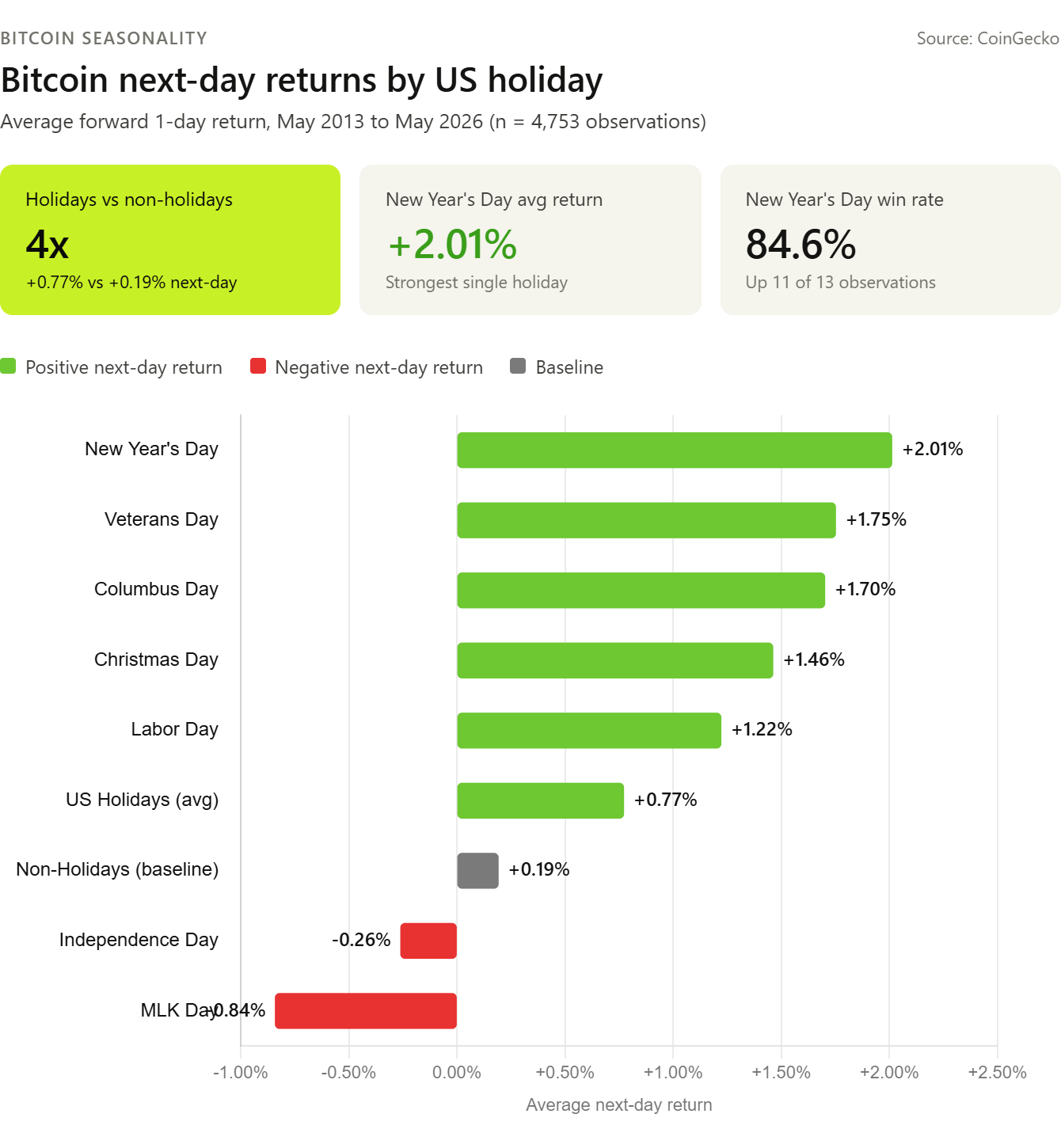
Bitcoin (BTC) delivers its strongest single-day returns on US federal holidays, according to a CoinGecko study covering May 2013 to May 2026, with New Year’s Day producing an average next-day return of +2.01% and an 84.6% win rate.
The research analyzed 4,753 daily price observations and found that US holidays produced an average next-day return of +0.77 %, roughly four times the +0.19% baseline for non-holidays.
Holiday Effect Skews Heavily Positive
On the win-rate side, Columbus Day also hit 84.6%, with a +1.70% next-day average. Christmas Day produced a smaller +1.46% gain on a 53.8% win rate, while Labor Day registered +1.22% across a 69.2% win rate, according to CoinGecko.
Two holidays buck the trend. Martin Luther King Jr. Day averages -0.84%, dragged down by a -18.65% Bitcoin drop on January 15, 2018. Independence Day averages -0.26%, with both holidays posting win rates below 50%.

CoinGecko researchers attribute the New Year’s Day signal to fresh January capital allocations and December tax-loss selling reversals.
The effect held even as BTC prices ranged from $313 in 2015 to $93,507 in 2025, despite the split 2026 price outlook between bulls and bears.
Day-of-Week Effect Fades Over Longer Horizons
Within the trading week, Monday and Wednesday tied at +0.38% average next-day returns. Thursday is the only day to post a negative average at -0.09%.
The weekday-weekend gap was just 0.01%, far narrower than the documented Uptober seasonality effect.

On a 365-day horizon, every weekday produced returns between 142.15% and 144.56%. CoinGecko called the spread negligible relative to Bitcoin’s volatility.
The data suggests holiday timing may add marginal value at short horizons. Whether the Santa rally pattern extends into next year’s January setup remains an open question.
The post Bitcoin Pumps Hardest on US Holidays, CoinGecko Finds appeared first on BeInCrypto.

The Senate Banking Committee voted 15-9 on Thursday to move forward on the CLARITY Act, a crypto market structure proposal that has been the subject of debate for a while now.
Nevertheless, just ahead of the vote, the Bank Policy Institute (BPI) put out a series of tweets on X about illicit crypto flows hitting $154 billion in 2025, adding another dimension to what was already an intensely debated topic on the extent of regulation in digital assets.
Bank Advocates Lean on Crime Data
The timing of BPI’s thread drew attention because lawmakers were simultaneously debating amendments tied to stablecoin yield restrictions and enforcement standards inside the CLARITY Act markup session.
According to data from Chainalysis that the institute shared, in 2025, illicit crypto addresses received $154 billion. This was a 162% year-over-year increase, driven largely by a 694% jump in value received by sanctioned entities.
Furthermore, the on-chain money laundering ecosystem grew from $10 billion in 2020 to over $82 billion in 2025, with stablecoins, primarily Tether (USDT), now accounting for 84% of all illicit transaction volume, displacing Bitcoin as the preferred payment method for criminals.
In a separate piece, the BPI argued that banks have spent decades staffing tens of thousands of AML employees while crypto companies have been largely exempt.
It said that the GENIUS Act imposed some obligations on US stablecoin issuers, but did not cover foreign issuers operating stateside. Tether, incorporated in El Salvador, sits outside that net.
The piece also cited the Islamic Revolutionary Guard Corps, whose crypto activity reportedly reached over $3 billion in 2025, representing roughly 50% of Iran’s total crypto ecosystem by Q4 of that year.
According to the BPI, unhosted wallets, cross-chain bridges, and mixers are “specifically designed to frustrate tracing and openly advertised as such.”
The stablecoin debate has become one of the most contentious parts of the CLARITY Act negotiations, with banking groups, including members of the American Bankers Association, spending weeks lobbying senators to tighten language restricting yield-bearing stablecoins.
As CryptoPotato reported earlier this week, banking groups sent Senate offices more than 8,000 letters ahead of the markup vote, while the crypto advocacy group Stand With Crypto said its supporters had contacted lawmakers nearly 1.5 million times in support of the bill.
But despite more than 40 amendments proposed by Senator Elizabeth Warren and procedural disputes during the hearing, the legislation advanced with support from Democratic senators Ruben Gallego and Angela Alsobrooks.
The Counter-Argument
While the BPI is demanding stricter anti-money laundering laws and sanctions regulations to be applied to crypto the same way it has been done to the traditional banking sector, data shared by Binance Research on May 14, offered some pushback to its claims.
According to Binance, trapped illicit funds on-chain have grown every year because less is being successfully laundered, not more.
Their report showed that more exit points are being blocked by KYC and more balances are being frozen by stablecoin issuers. Even the largest mixers have been processing at most $10 million per day.
The post CLARITY Act Clears Committee, But Money Laundering Question Hovers Over Crypto appeared first on CryptoPotato.
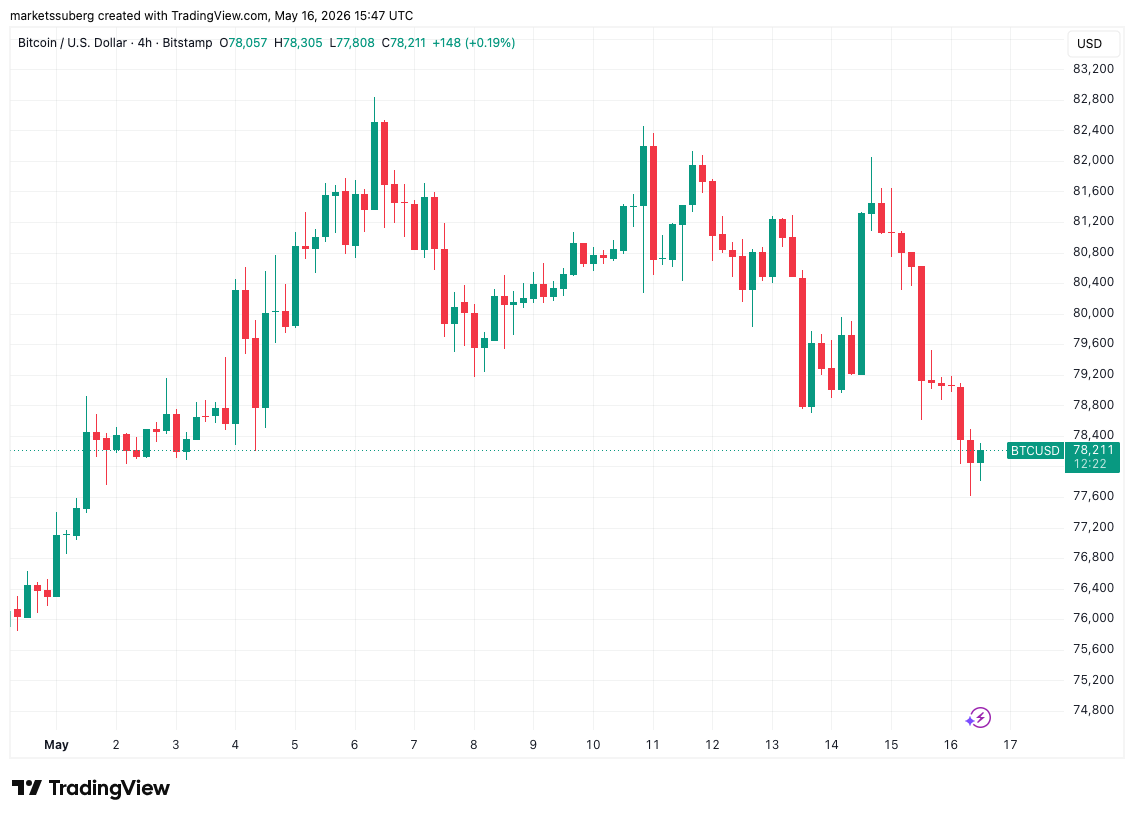
Bitcoin (BTC) circled $78,000 on Saturday after geopolitical headwinds erased most of its May gains.
Key points:
- Bitcoin falls below $78,000 for the first time since the start of May.
- Oil-supply woes combine with existing nerves over US bond markets, adding to headwinds for risk assets.
- Support weakness has traders looking at $75,000 and under next, while optimists see a “bear trap” forming.
Multiple hurdles “coming together” for crypto, risk assets
Data from TradingView confirmed new lows of $77,614 on the day — the lowest levels since May 1.
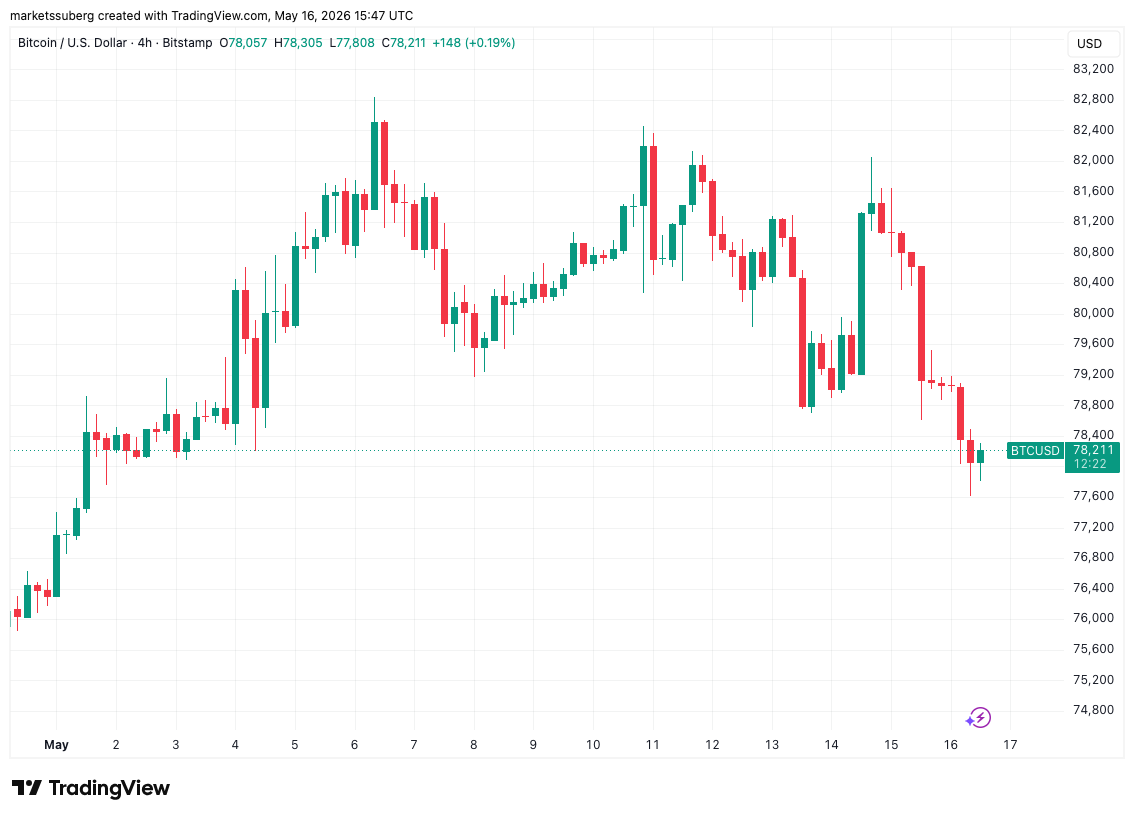
BTC/USD one-hour chart. Source: Cointelegraph/TradingView
Downside pressure stemming from concerns over US government bonds continued, with the US-Iran war also at the forefront of traders’ minds.
Iran appeared to be pressing ahead with a toll system for transit through the Strait of Hormuz — the epicenter of a global oil-supply squeeze — while keeping US traffic out.
As reported by trading resource The Kobeissi Letter among others, Hormuz would reportedly “remain closed to the operators of Project Freedom.”
On Friday, analysis from Mosaic Asset Company spelled out the problems of the current geopolitical and macroeconomic climate for risk assets.
“The prospect for another inflation wave is lining up with similarities to the surge in price levels into mid-2022,” it wrote in its latest Mosaic Chart Alerts blog post.
“Disrupted supply chains from last year’s trade war, impact of war on energy markets, and stimulus via large federal budget deficits are coming together at the same time.”
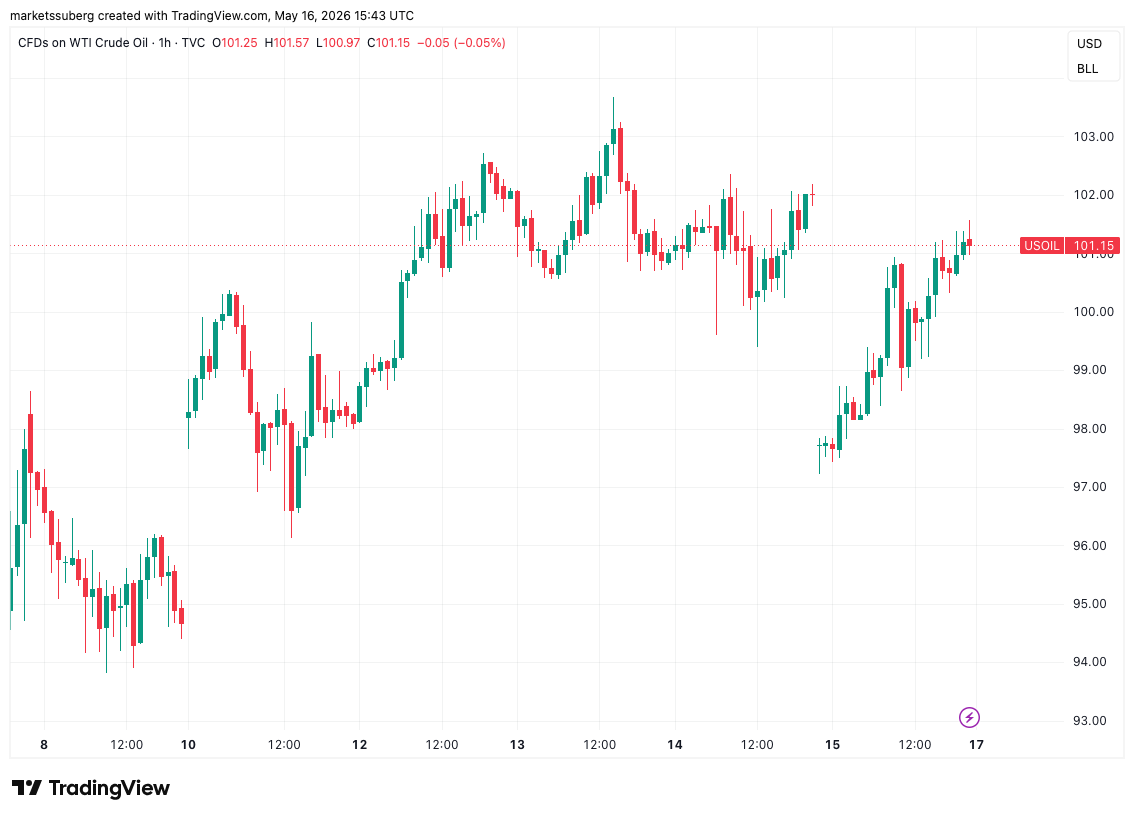
CFDs on US WTI crude oil one-hour chart. Source: Cointelegraph/TradingView
WTI crude oil finished the week trading above $100 per barrel.
Bitcoin price action teases “bear trap”
Among Bitcoin traders, there were ongoing mixed feelings about the bears’ strength below $80,000.
Related: Bitcoin price history suggests 77% odds of new all-time high within a year
“Over the last couple of days, the price has been going down slightly, while the open interest has climbed up. But things become interesting if we correlate this with Funding Rates, which have flipped negative,” X trading account Cryptic Trades wrote on X.
“This shows us that bears are DOUBLING DOWN right now and betting on a breakdown. It also shows that even though the market structure remains intact, bears are shorting as if a breakdown already happened. That’s generally how bear-traps are formed.”
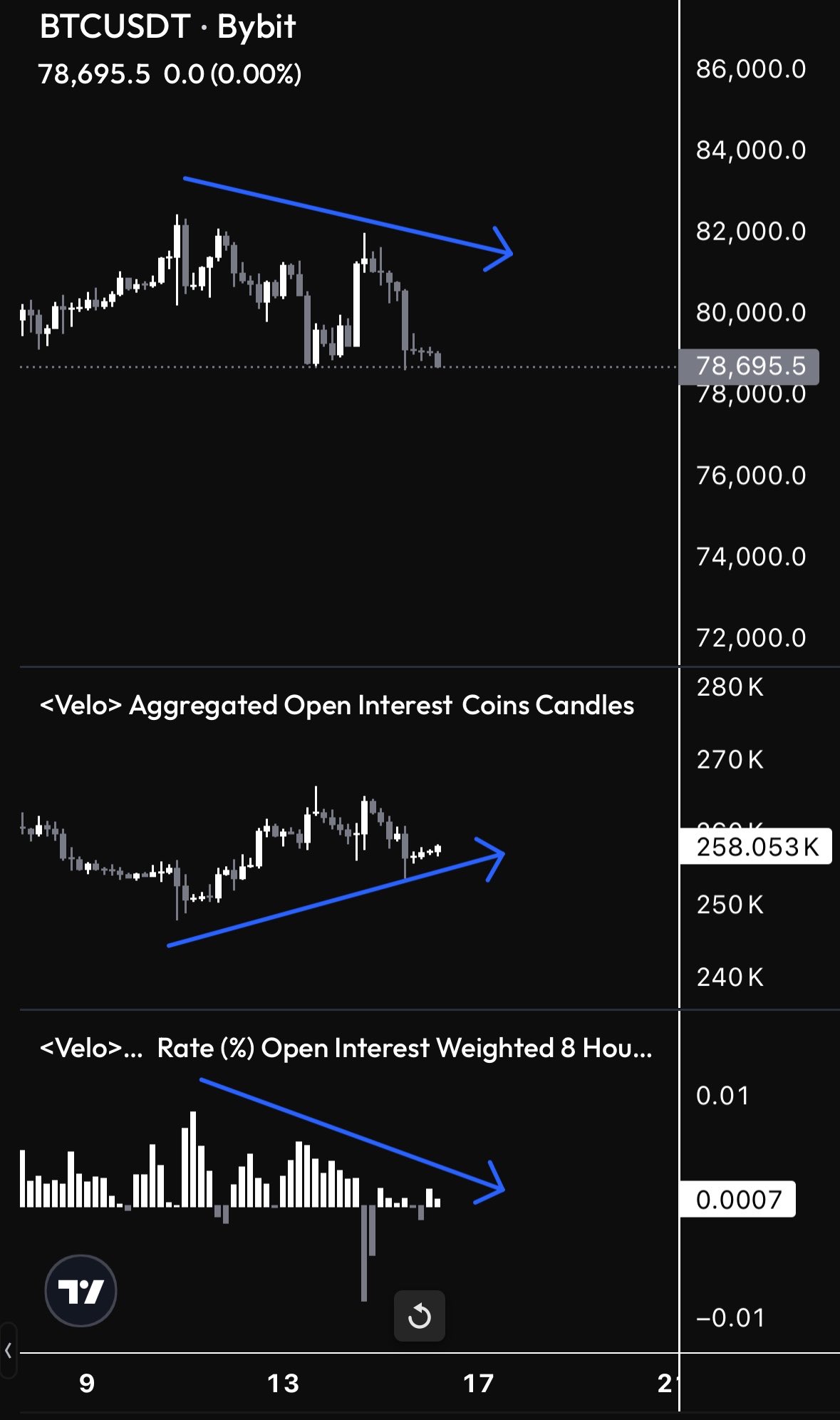
BTC/USDT chart with open interest, funding rate data. Source: Cryptic Trades/X
For analyst Eric Coleman, a target for new local lows lay at around $75,000.
“BTC went down after the breakdown retest of the ascending triangle,” he summarized alongside a chart showing relevant support/resistance flip levels.
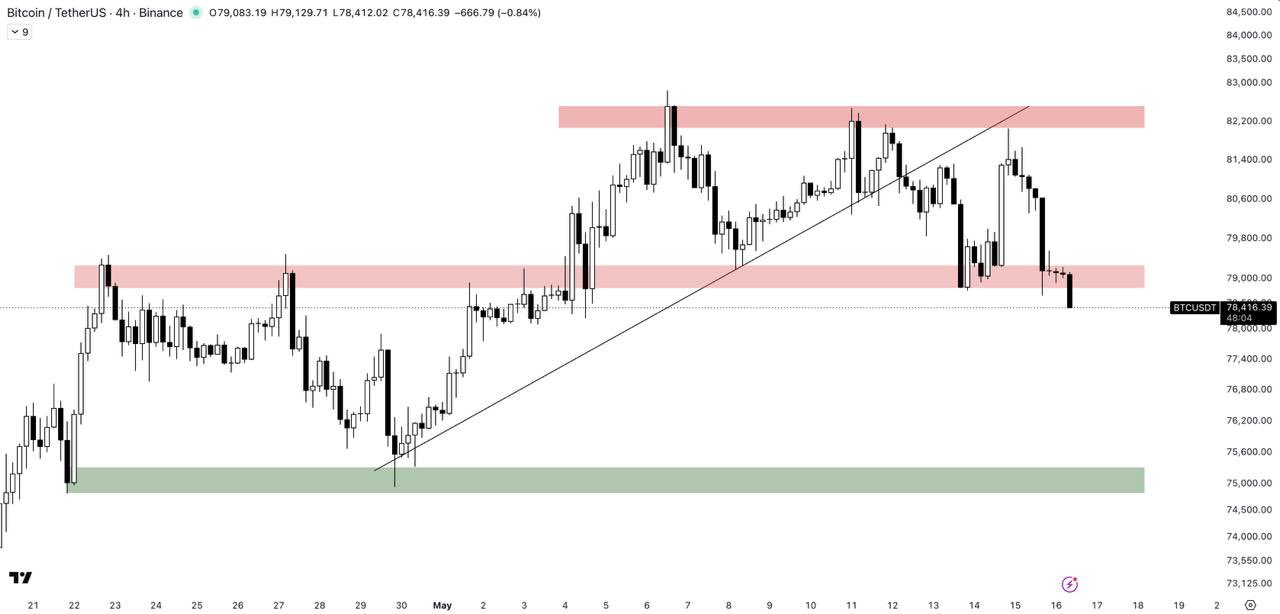
BTC/USDT four-hour chart. Source: Eric Coleman/X
Examining exchange order-book liquidity, Daan Crypto Trades highlighted $71,000 as the nearest zone of interest below price.
“The longer price compresses around this $80K region, the more liquidity will be building up on both sides which should result in a larger more aggressive move at some point,” he told X followers.
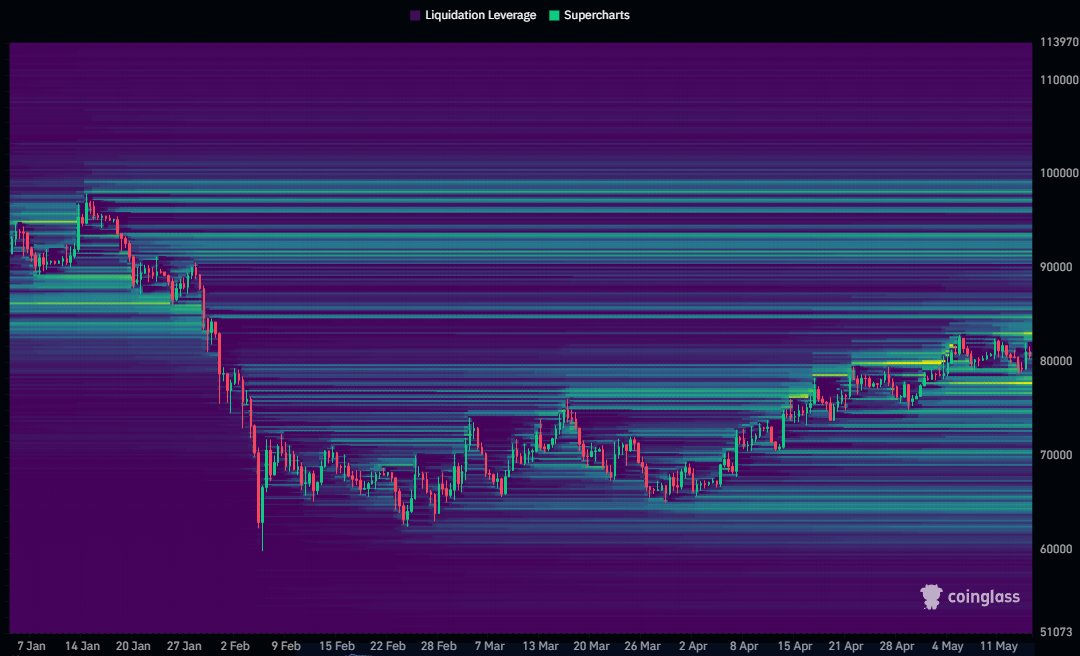
BTC/USDT liquidation heatmap. Source: Daan Crypto Trades/X

OpenAI and the Maltese government have unveiled a world-first partnership to roll out ChatGPT Plus to all Maltese citizens, marking a notable milestone in government-backed AI access. The plan ties free access to a year-long ChatGPT Plus subscription to the completion of a government-supported AI literacy course for residents.
Under the programme, citizens who finish the AI literacy course—developed by the University of Malta—will receive complimentary access to ChatGPT Plus for one year. The course itself covers the basics of what AI is, what it can and cannot do, and how to use it responsibly at home and in the workplace.
“Malta is the first country to launch a partnership of this scale because we refuse to let our citizens stay behind in the digital age,” said Silvio Schembri, Maltese minister for economy, enterprise and strategic projects. “The goal is to turn AI from an unfamiliar concept into practical assistance for our families, students, and workers.”
The Malta Digital Innovation Authority will oversee distribution to eligible participants when the first phase launches this month, with plans to broaden the program as more residents and citizens abroad complete the course.
Key takeaways
- The Maltese government and OpenAI are partnering to provide free ChatGPT Plus access for one year to citizens who complete a government-backed AI literacy course developed by the University of Malta.
- The initiative represents a “world-first” scale in government-AI collaboration and aims to translate AI from a theoretical concept into practical everyday use for families, students, and workers.
- Distribution will be managed by the Malta Digital Innovation Authority, with the first phase starting this month and expansion tied to course completion by more residents and Maltese abroad.
- The partnership sits within OpenAI’s broader “OpenAI for Countries” program, which tailors AI adoption to each nation’s priorities such as education, workforce training and public services.
- OpenAI has signaled a growing global footprint in government partnerships, including work with Estonia on ChatGPT Edu and with Greece under separate country-focused initiatives, as well as defense-related deployments in the U.S. on classified networks.
A first-of-its-kind deal in Malta
At a time when policymakers are weighing how to accelerate AI literacy while managing risks, Malta’s approach pairs education with practical tooling. The University of Malta-led course is designed to demystify AI and provide a framework for responsible usage, a step that could help bridge the gap between theoretical understanding and everyday application. By tying certification and household access to a government-endorsed curriculum, the program signals a deliberate strategy to bake AI familiarity into public life rather than leaving it to private platforms alone.
The one-year ChatGPT Plus subsidy acts as an incentive for citizens to engage with the course and begin integrating AI into daily tasks—from research and writing to workflow automation and problem-solving. The government’s aim is not only to boost digital literacy but to demonstrate how AI can serve as a practical assistant across education, work, and family life. The initial phase is set to roll out this month, with the Malta Digital Innovation Authority charged with ensuring eligible participants receive access and that the rollout scales as more people complete the course, including Maltese residents living abroad.
From a governance perspective, the arrangement underscores a growing willingness among governments to experiment with official AI programs that go beyond mere procurement or pilot projects. It also places a spotlight on how AI access programs can be paired with formal education to produce measurable literacy and usage outcomes rather than ad hoc, platform-centric uptake.
OpenAI for Countries: a tailored, country-by-country approach
The Malta agreement is a notable example within OpenAI’s broader OpenAI for Countries initiative, a programme through which the company collaborates with governments to push AI from early interest to nationwide adoption. Unlike standardized models, this program emphasizes customization aligned with each country’s priorities—spanning education, workforce training and public services. The Malta partnership demonstrates how such a framework can translate into tangible benefits for citizens and institutions alike.
In a broader context, OpenAI has pursued a multi-country strategy designed to fit diverse governance architectures and policy objectives. For example, last year Estonia’s government partnered with OpenAI to provide all secondary school students and teachers with access to ChatGPT Edu, a version tailored to educational needs. Separately, OpenAI has launched an initiative with Greece to expand AI-enabled capabilities within public services. These moves illustrate how governments are experimenting with AI in a structured, policy-aligned manner rather than adopting a one-size-fits-all solution.
The flexibility of the OpenAI for Countries program aligns with a growing trend toward customized public-sector AI tooling, where the focus is not only on how to deploy models but also on how to integrate them into educational curricula, job training, and service delivery. In some arenas, OpenAI’s technology has also found roles beyond civil government—for instance, a reported deal to deploy its models on classified military networks in collaboration with the U.S. defense complex. Such arrangements highlight both the breadth of potential applications and the sensitivities that accompany AI in high-stakes environments.
According to the program’s framing, the goal is to move beyond curiosity about AI to practical, system-wide adoption that can improve efficiency, accessibility and decision-making across public life. The Malta programme signals this broader ambition, illustrating how a national-scale effort can begin with education and access—and scale into ongoing public-sector utility.
What this means for investors, users and builders
From an investor and developer perspective, Malta’s model offers a live-case study in how government partnerships can underpin user onboarding and capability-building around AI tools. For users, the immediate benefit is clear: a structured pathway to use an advanced AI service at no personal cost for a defined period, contingent on completing an educational module that frames safe and responsible use. For builders and policymakers, the initiative tests governance, data governance, privacy protections, and the interoperability of AI services with public-sector workflows. The Malta rollout could inform subsequent programs in other jurisdictions that seek to harmonize AI access with formal education and service delivery standards.
As OpenAI continues to expand country-specific programs, observers will watch how these partnerships navigate issues such as data governance, digital inclusion, and the alignment of AI capabilities with public-interest goals. The Estonia and Greece examples show that governments can tailor AI deployments to educational and administrative ecosystems, potentially creating a blueprint for similar initiatives elsewhere. However, observers will also scrutinize how these programs adapt to different regulatory environments, privacy norms, and financial models as they scale beyond initial pilots.
For developers and platforms building AI-powered tools, Malta’s approach reinforces the importance of establishing clear educational content, public-facing risk disclosures, and governance channels that can handle large-scale adoption. It also underscores the potential for AI literacy to become a prerequisite for broad access to advanced tools, a development that could shape product design, user onboarding, and policy dialogue in the months ahead.
In the broader market context, Malta’s move sits at the intersection of digital literacy, public-sector modernization and AI-enabled public services. While the immediate commercial impact to OpenAI or the University of Malta may be limited by the program’s scope, the symbolic and practical implications could influence how other nations approach AI education and access, potentially accelerating a wave of country-led AI initiatives in the coming years.
Readers should stay tuned to how the first phase unfolds in Malta, including participation rates, user feedback, and any adjustments in eligibility or course content. The evolution of this program will offer important signals about the practical viability of government-backed AI access and its place in a broader strategy to democratize advanced technologies.
OpenAI’s broader strategy to engage with governments remains a developing landscape. As nations explore tailored AI adoption—balancing innovation with safeguards—the Malta initiative adds a concrete data point to the evolving policy and market narrative around AI in the public sector.
For now, the Maltese program marks a notable milestone: a government-backed pathway that connects AI literacy, civic participation and consumer access to a leading AI service, with potential implications that reach far beyond a single country’s borders.
As this initiative unfolds, watchers should monitor not only uptake and satisfaction but also the durability of the model once the year-long free access ends, and how Malta plans to sustain AI-enabled public services in the long term.


OpenAI and the Maltese government have announced a world-first partnership to roll out ChatGPT Plus to all Maltese citizens, marking the first time a government has struck such a deal with the AI company.
Under the programme, citizens who complete a government-backed AI literacy course will receive free access to ChatGPT Plus for one year, OpenAI announced on Saturday. The course, developed by the University of Malta, covers what AI is, what it can and cannot do and how to use it responsibly at home and in the workplace.
“Malta is the first country to launch a partnership of this scale because we refuse to let our citizens stay behind in the digital age,” Maltese minister for economy, enterprise and strategic projects Silvio Schembri said, adding that the goal is to turn AI “from an unfamiliar concept into practical assistance for our families, students, and workers.”
The Malta Digital Innovation Authority will manage distribution to eligible participants when the first phase launches this month, with the programme set to expand as more residents and citizens abroad complete the course.
Related: Robinhood Invests $75M in OpenAI to Provide Equity Tokens for Users
OpenAI partners with governments worldwide
The deal is the latest under OpenAI’s broader OpenAI for Countries initiative, through which the company works with governments to move from early AI interest to national-level adoption. Unlike a standardised model, the programme is tailored to each country’s priorities, including areas like education, workforce training and public services.
Last year, OpenAI partnered with Estonia’s government to provide all secondary school students and teachers with access to ChatGPT Edu, a customized version of ChatGPT built for education systems. The firm has also launched “OpenAI for Greece” in partnership with the Greek government.
As Cointelegraph reported, OpenAI has also struck a deal with the US Department of Defense to deploy its AI models on classified military networks.
Magazine: AI-driven hacks could kill DeFi — unless projects act now

It’s safe to say that the world’s largest altcoin has underperformed in recent weeks as each attempt for a breakout was stopped at $2,400, and the subsequent rejection has pushed it further south. What’s particularly worrying is that ETH dipped below the crucial $2,200 support after today’s drop, and its behavior against bitcoin is even more painful.
In fact, the ETH/BTC pair just dropped to a 10-month low at under 0.028. Recall that ETH traded at over 0.042 BTC in September last year, shortly after its all-time high against the greenback, but it has been mostly downhill since then. Popular analyst Ted Pillows said this decline occurred even as Tom Lee’s BitMine continues to spend millions of dollars each week to accumulate more tokens.
ETH/BTC has hit a new yearly low.
This is despite Tom Lee buying $200M+ in $ETH every week. pic.twitter.com/PpNyUcgACp
— Ted (@TedPillows) May 16, 2026
ETH to Exchanges
Ali Martinez cited data from CryptoQuant, which could result in even more price declines for the altcoin. He noted that over 500,000 ETH had been sent to trading venues in the past week alone. In terms of USD value, this substantial stash is worth over $1.1 billion. Such large transfers could intensify the immediate selling pressure as traders usually send tokens to exchanges if they want to cash out.
Martinez warned recently that the TD Sequential, a popular indicator used to showcase whether an asset has exhausted its move in either direction, had flashed a sell signal for ETH. He believes the altcoin could be on the verge of a more painful decline, and outlined a worst-case scenario of a dump below $1,100.
On The Plus Side…
On the opposite side stands Satoshi Flipper, another popular analyst, who recently said ETH could bounce from the lower boundary of the ascending triangle, diagonal support it’s currently testing on the 8-hour chart.
At the same time, Lookonchain outlined an Ethereum OG who has returned to the scene. The unknown investor had received over 11,000 tokens at prices of under $3.50 (yes) 10 years ago, sold some for more than $30 million last year, and has now started buying again.
The on-chain analytics company said they spent $4.3 million in USDC to buy 1,951 ETH at today’s prices of around $2,180.
The post ETH Hits Yearly Low Against BTC as Investors Flood Exchanges appeared first on CryptoPotato.
Crypto World
Jump Crypto’s ‘Firedancer’ is taking a slow and steady approach to its long-awaited Solana infrastructure rollout


In an interview with CoinDesk, the lead engineer at Firedancer gives an update on how the new client, also known as a software, is fairing in the Solana ecosystem.

Police pelted with bottles as Celtic fans celebrate Scottish Premiership title

Quebecor Inc. (QBR.A:CA) Shareholder/Analyst Call Transcript

TOKI X Technics collab brings hi-fi and highballs together

Manchester United reach agreement with Casemiro over contract clause amid transfer speculation

US brings back mandatory military draft registration

Steven Gerrard disagrees with Gary Neville over ‘shock’ Chelsea and Arsenal claim | Football


-

 Crypto World17 hours ago
BloFin War of Whales 2026 Grand Prix opens registration for $5M trading championship
-

 Fashion1 day ago
Weekend Open Thread: Theory – Corporette.com
-

 Fashion5 days ago
Coffee Break: Travel Steam Iron
-

 Crypto World24 hours ago
E-Estate Announces 1 Year Live: Washington DC Summit as Real Estate Tokenization Enters Its Next Phase
-

 Fashion6 days ago
What to Know Before Buying a Curling Wand or Curling Iron
-

 Politics5 days ago
What to expect when you’re expecting a budget
-

 Tech7 days ago
Auto Enthusiast Carves Functional Two-Stroke Engine from Solid Metal
-

 Tech2 days ago
Tech Moves: Microsoft AI leader jumps to OpenAI; former AI2 exec joins Meta; and more
-

 Tech5 days ago
GM Agrees To Pay $12.75 Million To Settle California Lawsuit Over Misuse Of Customers’ Driving Data
-

 Crypto World6 days ago
CZ says US crypto rivals tried to block Trump pardon
-

 Tech5 days ago
GM agrees to $12.75M California settlement over sale of drivers’ data
-
Crypto World4 days ago
Bitcoin Suisse expands with Digital Asset License and Investment Business Act Registration Approval in Bermuda
-

 Politics4 days ago
Pakistan to enter Chinese capital market as war inflation bites
-
 Crypto World2 days ago
Google’s Gemini AI Predicts Incredible Solana Price by the End of 2026
-

 Crypto World4 days ago
Bitcoin Suisse expands with Digital Asset License and Investment Business Act Registration Approval in Bermuda
-

 Politics6 days ago
Sky News Presenter Says Keir Starmer Is Not Waving But Drowning
-
 Business1 day ago
H&R Real Estate Investment Trust (HR.UN:CA) Q1 2026 Earnings Call Transcript
-

 Fashion7 days ago
Amazon Sundays: Spring Glassware & Vases
-

 Tech18 hours ago
Google reimburses Register sources who were victims of API fraud
-
 Entertainment6 days ago
Prime Video’s Forgotten but Brilliant 2-Part Horror Anthology Is a Perfect Binge
You must be logged in to post a comment Login