

Crypto World
XRP Price Prediction: SEC Clarity Meets Fed and Oil Shock as We Watch 1.40

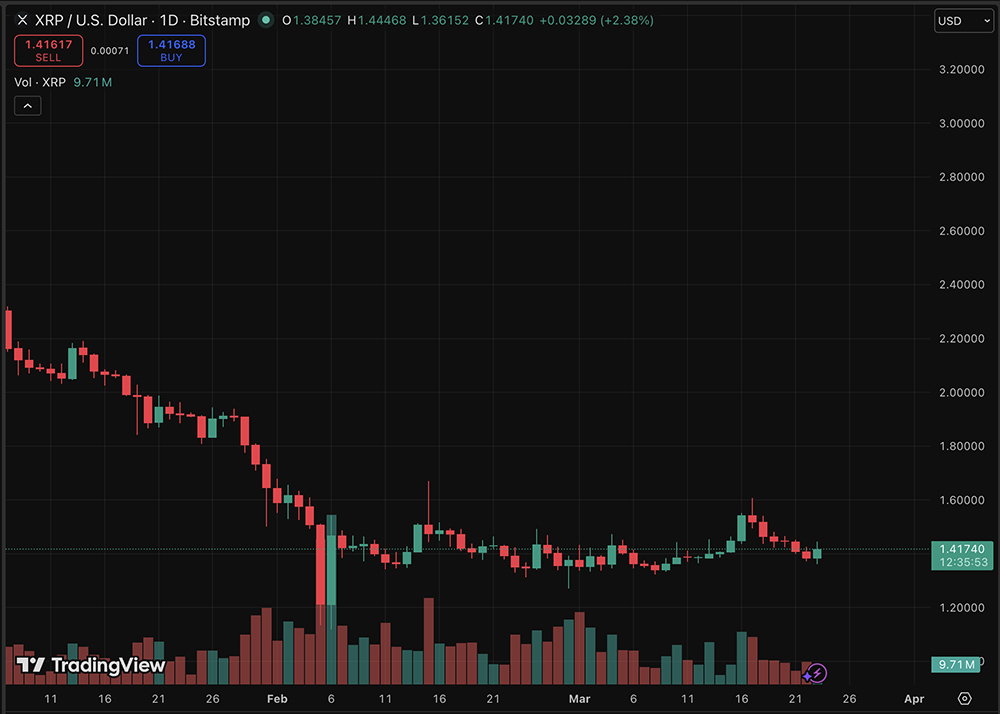
XRP is trading at the $1.40 price level, down just 1% over 24 hours, as the prediction says crypto markets will pull back further despite new U.S. regulatory clarity classifying the token as a digital commodity.
The classification, confirmed by the SEC and CFTC, handed bulls a headline victory, but the rally fizzled fast. We hit a wall of macro aggression: a hawkish Federal Reserve stalling rate cuts and a geopolitical oil spike to above $100 per barrel, before dropping this hour to under $90.
The $1.40 level, once a floor, has turned into a ceiling and a battleground for the week ahead.

XRP Price Prediction: Will Ripple Reclaim $1.50 Amid Macro Headwinds?
The technical landscape for Ripple’s native token is precarious. While the asset benefits from established support following the May 2025 SEC settlement, the failure to hold above $1.45 suggests buyer exhaustion. Trading volumes have thinned as capital rotates into commodities; oil prices above $112 act as a liquidity sponge, soaking up risk capital.
If bulls cannot reclaim $1.45 within 48 hours, the next logical support sits significantly lower. Conversely, a clean break above $1.45, fueled perhaps by institutional flows into spot ETFs, could target $1.55.
On-chain data signals XRP may be near a bottom, but the macro environment demands caution. With rates stuck at 3.50%-3.75%, the cost of capital remains high, dampening the leverage needed for a sustained breakout.
BREAKING: — Watcher.Guru (@WatcherGuru) March 18, 2026
 Federal Reserve leaves interest rates unchanged, remains at 3.50% – 3.75%.
Traders should watch the $1.30 support level closely. A breakdown here validates the pressure seen since the start of 2026, potentially exposing the asset to a deeper flush toward $1.30. Is the market pricing in a delay to altcoin season? The data points to a temporary risk-off sentiment.
Maxi Doge Targets Early Mover Upside as XRP Tests Key Levels
While major cap assets like XRP wrestle with interest rate realities and oil shocks, a subset of traders is rotating into high-velocity presales unaffected by Brent crude charts. Capital is seeking volatility in new narratives. Enter Maxi Doge ($MAXI), a new entrant aggressively targeting the “degen” trading subculture with a distinct leverage-king aesthetic.
The project has raised more than $4,6 million thus far, priced at $0.000281 per token and a staking reward bonus of 66%. Unlike standard meme tokens that rely solely on cute imagery, Maxi Doge integrates holder-only trading competitions and a “Maxi Fund” treasury designed for liquidity injections. It appeals to the high-risk demographic with the tagline “Never skip leg-day, never skip a pump.”
Meme coin liquidity is thinning elsewhere, yet $MAXI continues to attract inflows due to its specific market fit: a 240-lb canine juggernaut embodying a 1000x leverage trading mentality. For traders exhausted by XRP’s slow grind against the $1.40 resistance, this presale offers a high-variance alternative built for the current volatility. However, early-stage tokens carry inherent risks; dynamic APY staking provides an incentive for holding, but market timing remains critical.
The post XRP Price Prediction: SEC Clarity Meets Fed and Oil Shock as We Watch 1.40 appeared first on Cryptonews.

Strategy, the bitcoin treasury vehicle led by Michael Saylor, disclosed a plan to repurchase $1.5 billion of its 0% senior convertible notes due in 2029. The privately negotiated transactions with a subset of noteholders would retire roughly half of the outstanding 2029 tranche, according to Strategy’s SEC filing. The company cautioned that the final repurchase amount could vary based on market conditions, with settlement slated for the week after the filing’s publication.
The company said it intends to fund the repurchases through a mix of available cash reserves, proceeds from securities sales under its at-the-market (ATM) program, and/or proceeds from the sale of bitcoin. This approach underscores Strategy’s broader effort to reshape its balance sheet while maintaining its bitcoin-centric funding stance.
“Strategy expects to fund the repurchases with available cash reserves, proceeds from sales of securities under its at-the-market offering program, and/or proceeds from the sale of bitcoin.”
Source: Strategy Strategy press release
The move follows comments made by Strategy co-founder Michael Saylor in May 2026, who signaled the possibility of selling a portion of its Bitcoin holdings to fund dividend payments, and earlier notes in February that the company planned to equitize its debt in the coming years. The evolving approach reflects Strategy’s ongoing effort to balance its debt load with its bitcoin-driven financing model.
Related: Strategy’s Bitcoin engine faces $28B STRC ceiling: Delphi Digital
Key takeaways
- The repurchase covers about half of the $2029 convertible note tranche, with an estimated price tag of $1.38 billion and settlement targeted soon after the filing period.
- Funding for the buyback could come from cash reserves, proceeds from Strategy’s ATM program, and/or bitcoin sales, highlighting a flexible approach to debt reduction.
- Strategy intends to equitize its convertible debt over 3–6 years, which would gradually convert creditors into equity holders but may dilute existing shareholders.
- The company’s financing and bitcoin-dominant strategy are supported by a high-liquidity instrument tied to its bitcoin transactions, STRC, which recently posted record activity.
- Strategy’s bitcoin portfolio remains substantial, with recent private-market activity and a focus on using bitcoin as a core funding asset alongside equity-based instruments.
Debt repurchase and the path to equity conversion
Strategy’s 0% senior convertible notes due 2029 have been a central piece of its capital structure. By proposing to repurchase approximately $1.5 billion of these notes—about 50% of the outstanding tranche—the company aims to reduce debt exposure without immediately issuing new equity. The SEC filing notes that the final amount will reflect prevailing market conditions at the time of settlement.
In explaining the financing plan, Strategy highlighted a multi-pronged approach to funding the repurchase. Cash reserves provide a straightforward source, while additional liquidity could come from selling securities under the ATM program or from bitcoin sales. This flexibility suggests the company is prepared to adjust funding sources to align with balance-sheet goals while preserving its strategic bitcoin exposure.
The broader trajectory for Strategy includes a deliberate shift toward equitizing its debt. In 3–6 years, the company intends to convert portions of its convertible debt into equity. If implemented, this would reduce debt obligations but could dilute existing shareholders by expanding the number of outstanding shares. The plan fits into Strategy’s long-running thesis of leveraging bitcoin as a strategic asset to support corporate finance activities, even as it navigates the complexities of debt conversion and equity issuance.
STRC, liquidity, and the bitcoin engine
A cornerstone of Strategy’s financing framework is the Stretch Perpetual Preferred Stock (STRC), the instrument the company has used to fund bitcoin acquisitions in 2026. STRC has drawn considerable investor interest, and its market liquidity surged to new highs in recent sessions. On a single day, STRC trading volume reached about $1.5 billion, marking a record for the equity-like instrument tied to Strategy’s bitcoin strategy.
Delphi Digital has highlighted the potential cap on STRC value, noting discussions around a possible ceiling near $28 billion. This line of analysis provides context for how much liquidity the market may assign to Strategy’s crypto-led financing structure over time, though actual outcomes depend on market dynamics and Strategy’s ongoing operational decisions.
Bitcoin holdings and ongoing funding dynamics
Strategy’s most recent bitcoin acquisition occurred earlier in the week, with the company purchasing 535 BTC for roughly $43 million. That purchase boosted its total bitcoin holdings to 818,869 coins, a stake valued at about $64 billion at prevailing spot prices during publication. The company has described its bitcoin purchases as a core element of its capital strategy, using bitcoin sales, cash reserves, and equity-driven financing to support dividends and other corporate needs.
The 2026 funding approach—primarily via STRC and strategy-driven bitcoin acquisitions—has reinforced Strategy’s position as a unique corporate-finance model within the crypto space. By combining debt management with bitcoin-backed financing, Strategy seeks to maintain liquidity while pursuing growth through its large bitcoin reserve and related financial instruments.
What comes next for Strategy and investors
The immediate focus will be the settlement of the 2029 convertible note repurchase and the exact funding mix that Strategy deploys. Investors will be watching for how the repurchase affects the company’s debt burden, whether the equitization plan proceeds on schedule, and how dilution risks are balanced against the potential for improved balance-sheet stability. Market participants will also be tracking STRC dynamics, including liquidity trends and any regulatory or market-sentiment shifts that could influence Strategy’s ability to deploy bitcoin as a strategic financing tool.
As always, the unfolding interaction between Strategy’s debt strategy, equity issuance plans, and its bitcoin-based funding framework will define its path forward. The next several quarters could clarify whether this hybrid approach delivers greater balance-sheet resilience or introduces new tensions between debt holders and equity owners, particularly if bitcoin prices swing or if funding markets tighten.
Readers should keep an eye on the official Strategy disclosures for settlement specifics, any updates to the equitization timeline, and any statements from executives regarding dividend policy and capital allocation. The evolving narrative around Strategy’s use of STRC and its broader balance-sheet strategy will continue to influence how investors assess the risk and potential of crypto-native corporate finance models.
Source data and ongoing coverage from Strategy’s disclosures will shape the ongoing interpretation of this move, and related market commentary from Delph Digital and other researchers will help contextualize the implications for convertible debt management and bitcoin-backed financing in the sector.

TLDR:
- Amazon, Microsoft, and Google invest billions in AI labs, then collect that money back as locked-in cloud revenue.
- Within 16 days, three megadeals handed Anthropic compute from Amazon, Google, and SpaceX simultaneously.
- xAI failed to operate independently and was forced to lease its GPU data center directly to rival Anthropic.
- Regulators in the US, EU, and UK are now probing whether these compute deals amount to backdoor monopolies.
Major AI labs — OpenAI, Anthropic, and xAI — are often presented as fierce competitors racing to dominate artificial intelligence.
However, a closer look at recent financial deals tells a different story. All three companies rely on the same small group of cloud infrastructure providers: Microsoft, Amazon, and Google.
These tech giants invest billions into AI labs, then collect that money back as cloud revenue. The arrangement is raising serious antitrust concerns around the world.
The Deals That Changed the AI Landscape
Within just 16 days in April and May 2026, three major compute deals reshaped the AI industry. Amazon expanded its Anthropic commitment to $13 billion, tied to $100 billion in AWS cloud spend over ten years.
Google followed with up to $40 billion in equity plus five gigawatts of TPU capacity for Anthropic. Then SpaceX, which had absorbed xAI, handed Anthropic its entire Colossus 1 data center — over 220,000 Nvidia GPUs and 300 megawatts of power.
The financial structure behind these deals follows a repeating pattern. Tech giants invest in AI labs, then require those labs to spend the money back on their own cloud services.
Microsoft’s total OpenAI investment reportedly exceeds $100 billion when Azure infrastructure is counted. In return, OpenAI committed $250 billion in cloud spend back to Azure over a decade.
Amazon also invested $50 billion into OpenAI in February 2026, making it the only hyperscaler holding equity stakes in both Anthropic and OpenAI simultaneously.
As @coinbureau noted, “OpenAI and Anthropic are not rivals, they are financially bound tenants to the same hyperscaler landlords.”
The financial results of this arrangement became clear in Q1 2026. Alphabet reported $37.7 billion in other income, largely from unrealized gains on its Anthropic and SpaceX stakes.
Amazon reported $16.8 billion in non-operating income, also driven by its Anthropic stake. These are paper gains—not cash—and they could reverse if Anthropic’s next funding round prices lower.
When Independence Becomes Too Expensive
xAI’s story offers a cautionary example of operating outside this structure. Grok’s model utilization was reported at around 11%, far below the 40% achieved by competitors.
Unable to sustain infrastructure costs independently, xAI was absorbed by SpaceX, which then leased the Colossus 1 data center directly to Anthropic — the company xAI was built to compete against.
Meta stands apart as the only major frontier AI player operating without cloud dependency. The company is running $125 billion to $145 billion in capital expenditure for 2026, building its own data centers and holding no equity ties to a single cloud partner.
Regulators are now responding to this concentrated structure. The FTC is investigating Amazon and Microsoft’s deals as potential backdoor mergers. The EU is enforcing antitrust rules against exclusive cloud contracts.
The UK has flagged over 90 cross-pollinating partnerships among Big Tech companies. Even if the AI compute stack is broken apart, the same four companies — Microsoft, Amazon, Google, and Meta — are positioned to remain dominant at the foundational layer.

TLDR:
- Only 10 stocks contributed 69% of the S&P 500’s 16% rally, leaving 490 companies largely behind.
- Microsoft, Alphabet, and Amazon pledged a combined $570B+ in AI spending, fueling the tech surge.
- The equal-weight S&P 500 gained just 7–8%, less than half the performance of the standard index.
- Goldman Sachs warned that market breadth has dropped to its narrowest level since the dot-com bubble.
The S&P 500 rally has gained nearly 16% since March 30, but market analysts are raising concerns about how few stocks are driving the move.
Just 10 companies contributed 69% of the entire index gain. The rest of the 490 companies in the index contributed only 31%.
This split between megacap performance and the broader market has drawn comparisons to conditions last seen during the dot-com bubble era.
AI Spending Surge Fuels Semiconductor Melt-Up
The rally began after reports that Iran was open to ending hostilities with the United States. Oil prices fell sharply from above $100, triggering short covering across markets. From there, strong earnings reports from major tech companies took over as the primary driver.
Several of the largest technology firms then raised their capital expenditure forecasts to historic levels. Microsoft projected AI-related spending of around $190 billion.
Alphabet guided toward $180–190 billion, while Amazon held firm at roughly $200 billion. Meta is expected to spend as much as $145 billion on AI infrastructure.
These projections pushed semiconductor stocks into a sharp upward move. Intel rose more than 240% this year. SanDisk surged over 550%. Micron doubled as AI memory demand left customers receiving only 50–67% of the chips they ordered.
As Bull Theory noted on X, “Almost every major tech company raised AI spending projections to levels never seen before,” pointing to the scale of capital flowing into AI infrastructure as the central force behind the current market move.
Narrow Breadth Raises Questions About Rally Durability
Despite the index gains, the equal-weight S&P 500 only rose around 7–8% over the same period. This version of the index removes the outsized influence of megacap stocks. That figure is less than half the performance of the market-cap-weighted index.
Fewer than half of all S&P 500 stocks are currently trading above their 50-day moving average. Goldman Sachs has warned that market breadth has fallen to one of its narrowest levels since the dot-com era. These conditions suggest the broader market is not participating evenly in the recovery.
Alphabet alone contributed 15% of the total index rally. Nvidia added another 10%. Amazon, Broadcom, Intel, Micron, Apple, AMD, and Microsoft carried the bulk of the remaining gains.
The concern among analysts is straightforward. If AI capital spending slows, if the Iran ceasefire breaks down and oil spikes again, or if earnings miss even slightly, there is limited broad market support to cushion the fall.
The rally, as it stands, rests on a narrow foundation of AI-driven stocks and one of the most aggressive corporate spending cycles in recent memory.
Bitwise CEO Hunter Horsley wants AI-displaced tech workers to consider crypto. He argues that the industry’s messy problems create the kind of opportunity ambitious engineers should chase.
The pitch arrived inside a broader Silicon Valley conversation about AI-driven job anxiety. Investors and founders are describing a workforce reshaped by automation, widening wealth divides, and questions about future careers.
Horsley Frames Crypto as the Pre-Mainstream OpenAI Bet
Horsley told tech employees their pragmatism is what crypto needs. He pointed to problems around financial freedom, access, and cutting out middle men. He compared the move to joining OpenAI before mainstream adoption was clear.
The Bitwise executive also acknowledged the industry has scams, messy projects, and shallow headlines. He argued those flaws are the opportunity for engineers willing to build.
Crypto roles offer competitive pay across engineering, protocol design, and product talent.
Big tech is moving on from needing you, and will be celebrating laying off talent. Fine. But crypto needs you. We need talented, professional, pragmatic people,” Horsley explained.
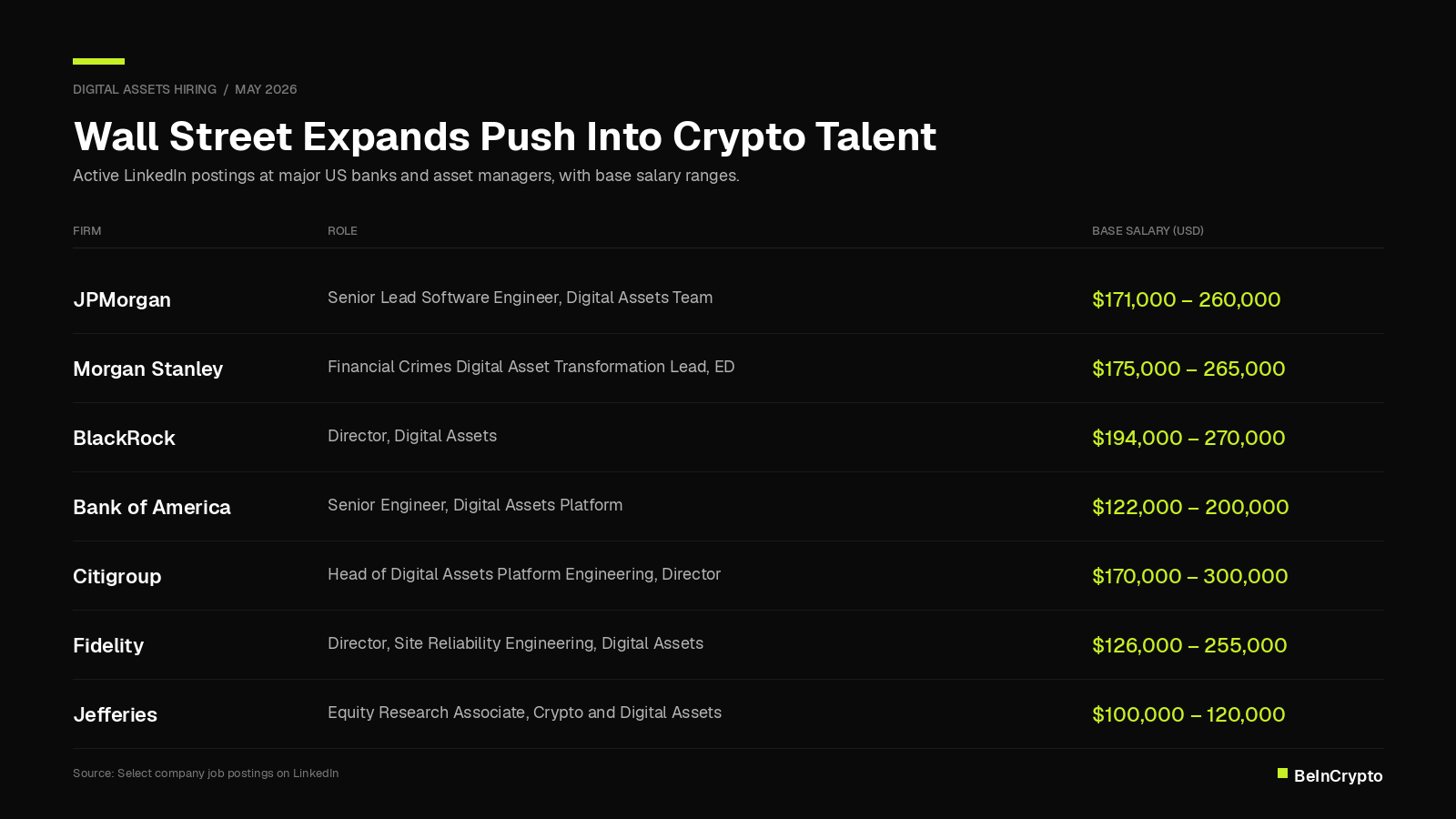
It aligns with a recent BeInCrypto report, which highlighted how TradFi giants were offering crypto talent stability and prestige as crypto firms cut staff. This is after JPMorgan, BlackRock, and Citi posted crypto roles recently, with base salaries reaching $300,000.
Banks are also demanding hybrid talent fluent in blockchain and TradFi compliance.

“It’s really about domain overlap,” Bloomberg reported, citing Paul Przybylski, JPMorgan Asset Management’s global head of product for digital and tokenized assets.
Justin Sun Echoes the Career Reset
Menlo Ventures partner Deedy Das described San Francisco as frenetic. Roughly 10,000 employees at Anthropic, OpenAI, xAI, and Nvidia have reached wealth above $20 million in five years. Meanwhile, AI-driven layoffs reshape the rest of the workforce.
Axios reported in April that AI agent costs are now outpacing human salaries at several companies.
Uber’s CTO reportedly used his full 2026 AI budget early on token costs. A Nvidia executive said compute spending now exceeds employee budgets.
TRON founder Justin Sun added that the AI era rewards urgency. He told young builders to act while opportunities remain open.
“AI is here; while we’re young and still have the chance to do something, let’s just go for it,” Sun wrote.
Crypto being able to absorb the next wave of displaced engineers could hinge on what gets built over the coming year.
The post Bitwise CEO Pitches Crypto to Tech Workers Facing AI Layoffs appeared first on BeInCrypto.
Bitcoin treasury company Strategy announced on Friday that it will repurchase $1.5 billion in 0% convertible notes, due in 2029, retiring about half of the 2029 convertible note tranche’s total outstanding debt.
Strategy entered into “privately negotiated transactions” with a portion of its 0% senior convertible note holders on Thursday, agreeing to repurchase the debt for an estimated $1.38 billion, according to the company’s Securities and Exchange Commission (SEC) filing.
The transaction is set to settle on Tuesday of the week following the publication of this article, the company said, adding that the final repurchase amount could “vary” from the estimated amount based on market conditions. The company added:
“Strategy expects to fund the repurchases with available cash reserves, proceeds from sales of securities under its at-the-market offering program, and/or proceeds from the sale of bitcoin.”
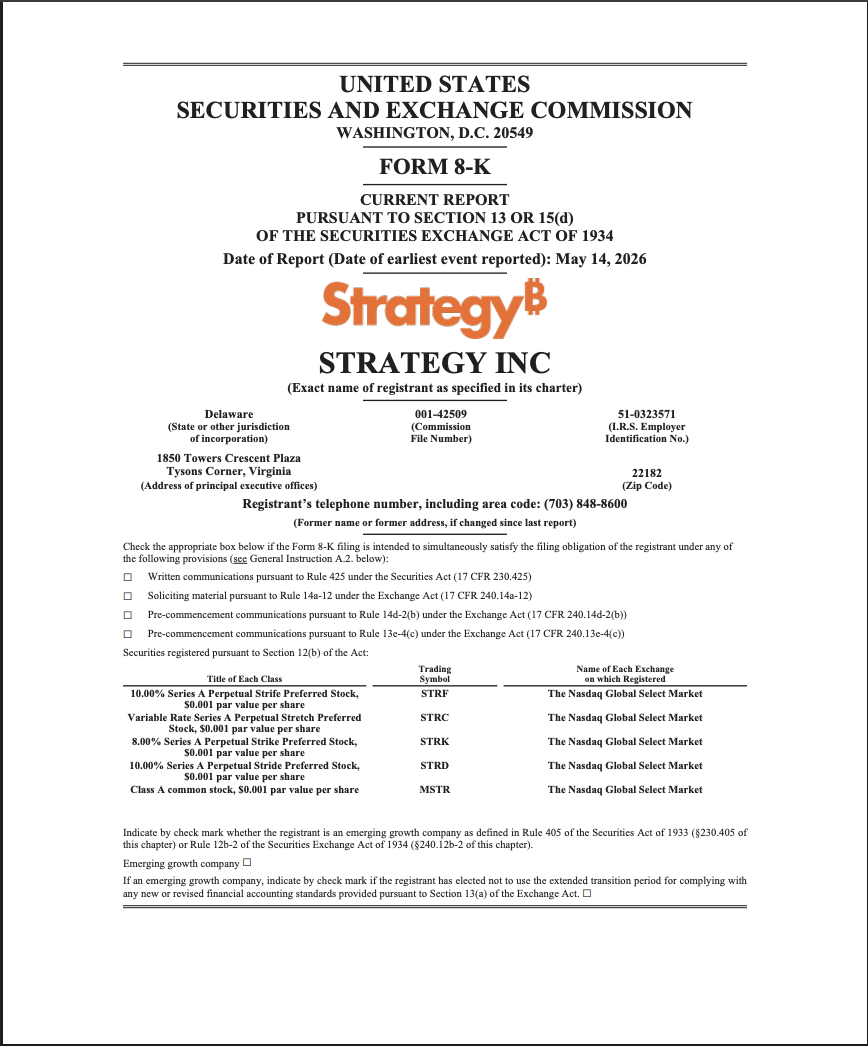
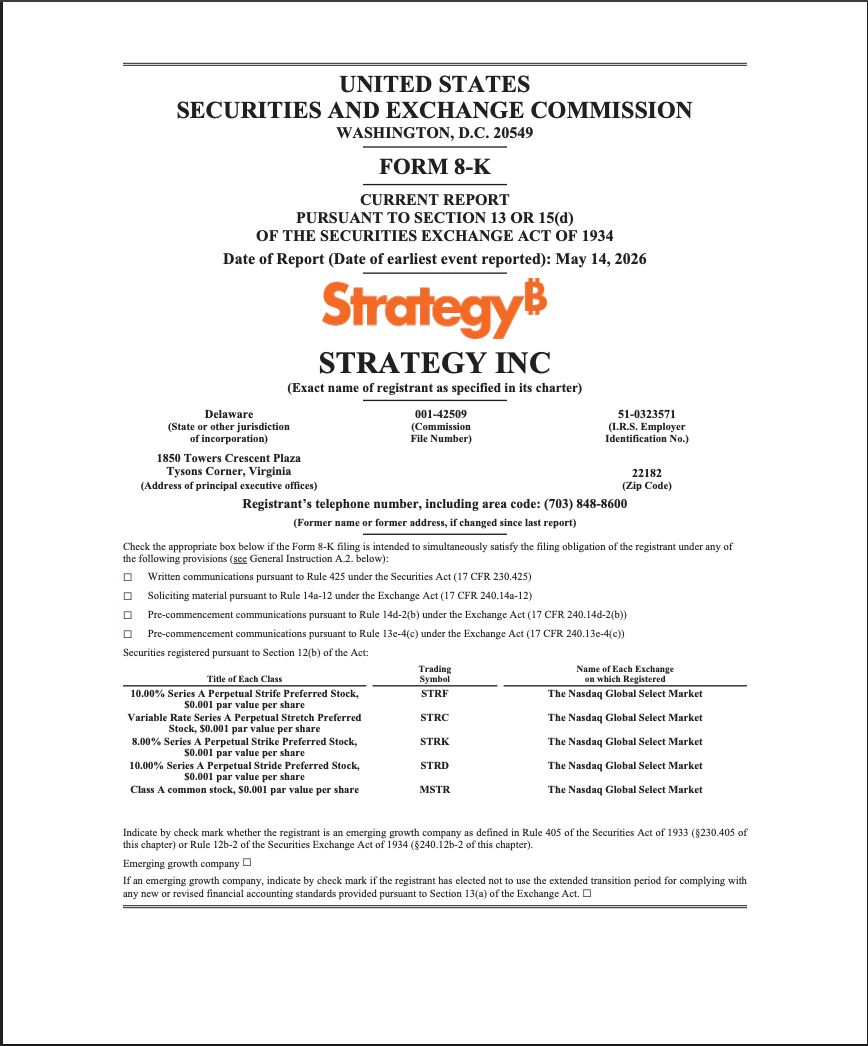
Strategy’s SEC filing documenting the 2029 convertible note repurchase. Source: Strategy
The move follows comments made by Strategy co-founder Michael Saylor in May 2026, signaling that the company could sell a portion of its Bitcoin holdings to fund dividend payments, and earlier comments in February that the company plans to equitize its debt in the coming years.
Related: Strategy’s Bitcoin engine faces $28B STRC ceiling: Delphi Digital
Strategy plans to swap its convertible debt for equity over the next 3-6 years
Strategy plans on equitizing its convertible debt over the next 3-6 years, gradually turning holders of its credit instruments into equity holders.
This would reduce the debt burden on the company, but would also dilute existing stockholder value by adding new equity shares.
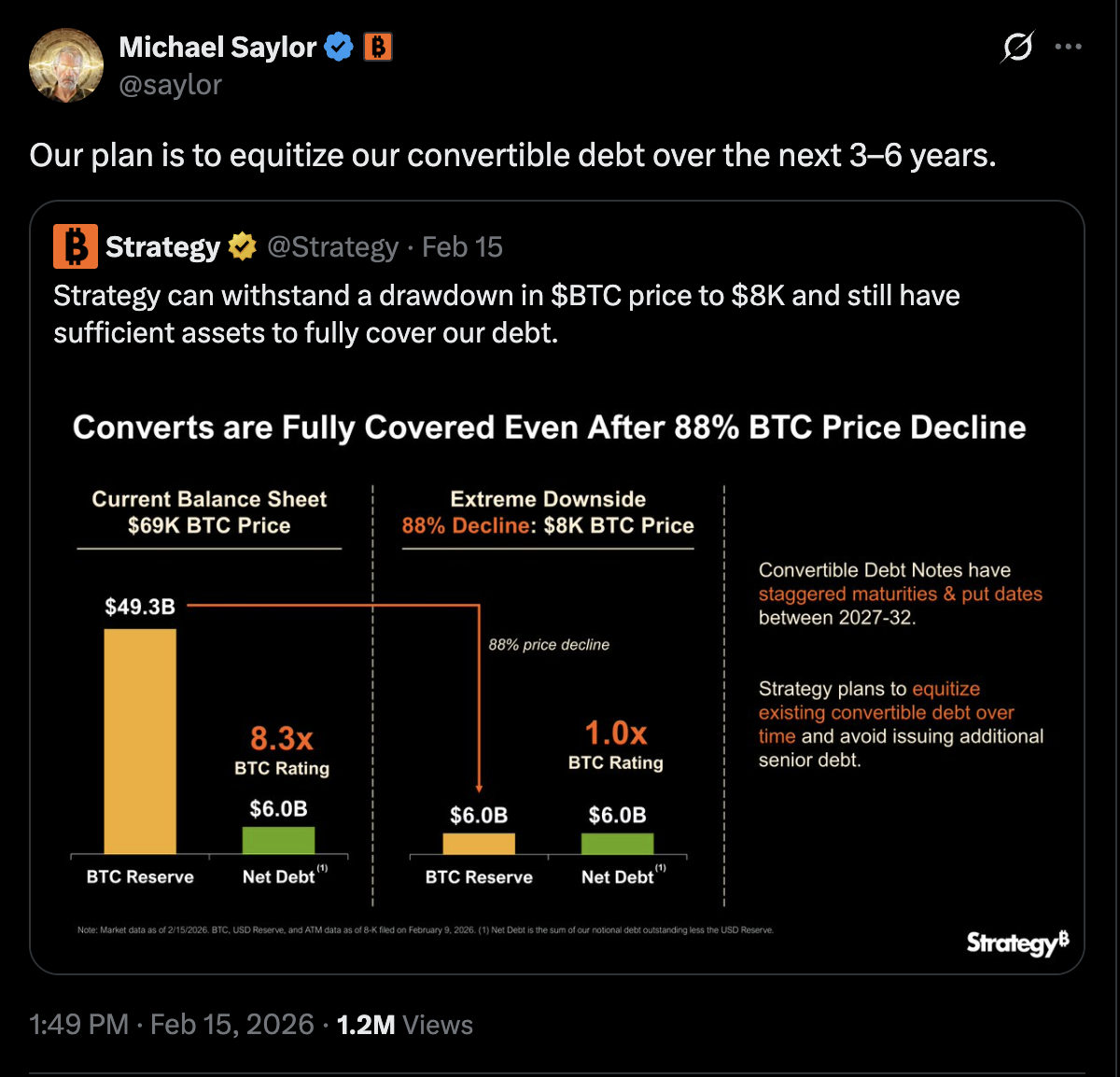
Source: Michael Saylor
Strategy has about $8.2 billion in total outstanding debt at the time of publication, according to data from the company, and has funded its BTC buys in 2026 primarily through its Stretch Perpetual Preferred Stock (STRC).
On Thursday, STRC hit $1.5 billion in daily trading volume, setting a new record for the equity instrument, and signaling strong investor interest.
The company’s most recent Bitcoin purchase occurred on Monday, when it bought 535 Bitcoin for $43 million, bringing its total Bitcoin holdings to 818,869 coins, valued at about $64 billion, using BTC’s spot market price at the time of publication.
Magazine: Big Questions: Can Bitcoin save you from the dreaded Cantillon Effect?
TLDR:
- BlackRock is reportedly in discussions to commit between $5 billion and $10 billion to the SpaceX IPO offering.
- SpaceX is targeting June 11 for IPO pricing and June 12 for its market debut on the Nasdaq exchange.
- The offering could raise around $75 billion, valuing SpaceX at approximately $1.75 trillion at listing.
- Morgan Stanley, Bank of America, Citigroup, JPMorgan, and Goldman Sachs are serving as lead bookrunners on the deal.
BlackRock is reportedly in talks to invest up to $10 billion in SpaceX’s anticipated initial public offering. The asset management giant could commit between $5 billion and $10 billion to the offering, according to The Information.
This potential move marks one of the largest institutional bets on Elon Musk’s space and satellite company. SpaceX is targeting a mid-June market debut on the Nasdaq exchange under the ticker “SPCX.”
BlackRock’s Potential Role in the SpaceX IPO
The report from The Information cited people familiar with the discussions. BlackRock has not publicly confirmed its participation in the SpaceX IPO. However, the figures being discussed point to a serious institutional commitment to the deal.
Reuters reported Friday that SpaceX is targeting June 11 for pricing, citing “sources familiar with the matter.” The report also confirmed Nasdaq as the chosen exchange for the listing. That confirmation added further weight to the accelerating timeline surrounding the offering.
Such an investment would place BlackRock among the most prominent backers of the listing. A $10 billion stake in a $1.75 trillion valuation company would be a notable position for any asset manager. The discussions show growing confidence among large institutions in SpaceX’s long-term outlook.
SpaceX plans to publicly release its IPO prospectus as early as next week. A roadshow is expected to begin on June 4, ahead of a possible market debut on June 12. The timeline moved faster than originally planned after the SEC completed its filing review ahead of schedule.
SpaceX IPO Timeline and Market Expectations
SpaceX is aiming to raise around $75 billion through the offering. At that level, it would rank among the largest IPOs in market history. The company’s valuation is expected to reach approximately $1.75 trillion at listing.
The Information noted the potential BlackRock investment could represent “a major institutional bet” on the company.
People familiar with the matter indicated the commitment range sits between $5 billion and $10 billion. No official figures have been confirmed by either BlackRock or SpaceX.
Morgan Stanley, Bank of America, Citigroup, JPMorgan, and Goldman Sachs are serving as lead bookrunners. These banks bring strong distribution networks that could support demand across institutional investors. Their involvement adds credibility to the scale of the transaction.
Nasdaq’s recently introduced fast-entry rules for large-cap listings may benefit SpaceX after it begins trading. Those rules could allow SpaceX to gain quicker inclusion in the Nasdaq-100 index.
As Reuters noted, the accelerated pace was “partly driven by a quicker-than-anticipated review” of SpaceX’s IPO filings by the SEC. Market watchers are now tracking every development as the June dates draw closer.
TLDR:
- Dunamu’s Q1 operating profit dropped 78% year-on-year, falling to 88 billion won from 396 billion won.
- Transaction fees make up 97% of Dunamu’s revenue, making it highly exposed to crypto market slowdowns.
- Hana Bank acquired a 6.55% stake in Dunamu as part of a 1 trillion won investment agreement.
- Naver Financial agreed to acquire Dunamu in a $10 billion all-stock deal, with an IPO being considered.
Dunamu, the South Korean fintech firm operating Upbit, reported a sharp fall in earnings for the first quarter of 2025.
The company’s operating profit dropped 78% year-on-year to 88 billion won, roughly $59 million. Consolidated sales fell 55% to 235 billion won, compared to 516 billion won in the same period last year.
Net profit also declined 78%, reaching approximately 70 billion won versus 321 billion won previously.
Falling Trading Volume Squeezes Revenue and Customer Deposits
Dunamu attributed the decline in earnings directly to reduced trading activity across the virtual asset market. The global economic slowdown has pulled retail and institutional participants away from active crypto trading. This drop in participation translated immediately into lower fee income for the exchange.
Transaction fees account for 97% of Dunamu’s total revenue. When trading volume contracts, the company’s income shrinks almost in proportion. There is very little diversification to cushion the blow during periods of market cooling.
Customer deposits also felt the pressure during this period. Dunamu held around 5.2 trillion won in customer deposits during the first quarter, down 11% from December last year. Lower deposits suggest that users are withdrawing funds or reducing their exposure to the exchange.
The figures reflect a broader trend seen across crypto exchanges globally. Platforms that depend heavily on transaction fees tend to experience amplified earnings swings during market cycles. Dunamu’s results this quarter are consistent with that pattern.
Hana Bank Investment and Potential IPO Signal Long-Term Strategy
Despite the quarterly setback, Dunamu secured a major vote of confidence from the traditional finance sector. Hana Financial Group committed a 1 trillion won investment, equivalent to approximately $670 million, into the company.
As part of this deal, Hana Bank will acquire a 6.55% stake from Kakao Investment, becoming the fourth-largest shareholder.
The two companies also agreed to collaborate on infrastructure for a won-based stablecoin ecosystem. This partnership points toward a future where Korean fiat currency and blockchain technology operate on shared infrastructure. It is a strategic move that extends beyond short-term revenue concerns.
Separately, Naver Financial agreed in November 2025 to acquire Dunamu in an all-stock deal valued at approximately $10 billion.
The deal is still being finalized, but reports suggest an IPO is under consideration once the transaction closes. That would represent a significant milestone for South Korea’s crypto sector.
Together, these developments show Dunamu is actively positioning itself beyond exchange operations. Investment from a major bank and acquisition by a tech giant signal that the company’s long-term roadmap remains intact, despite near-term earnings pressure.
Crypto World
Bitcoin On-Chain Data Signals Bull Market Consolidation as Profit-Taking Pressure Eases
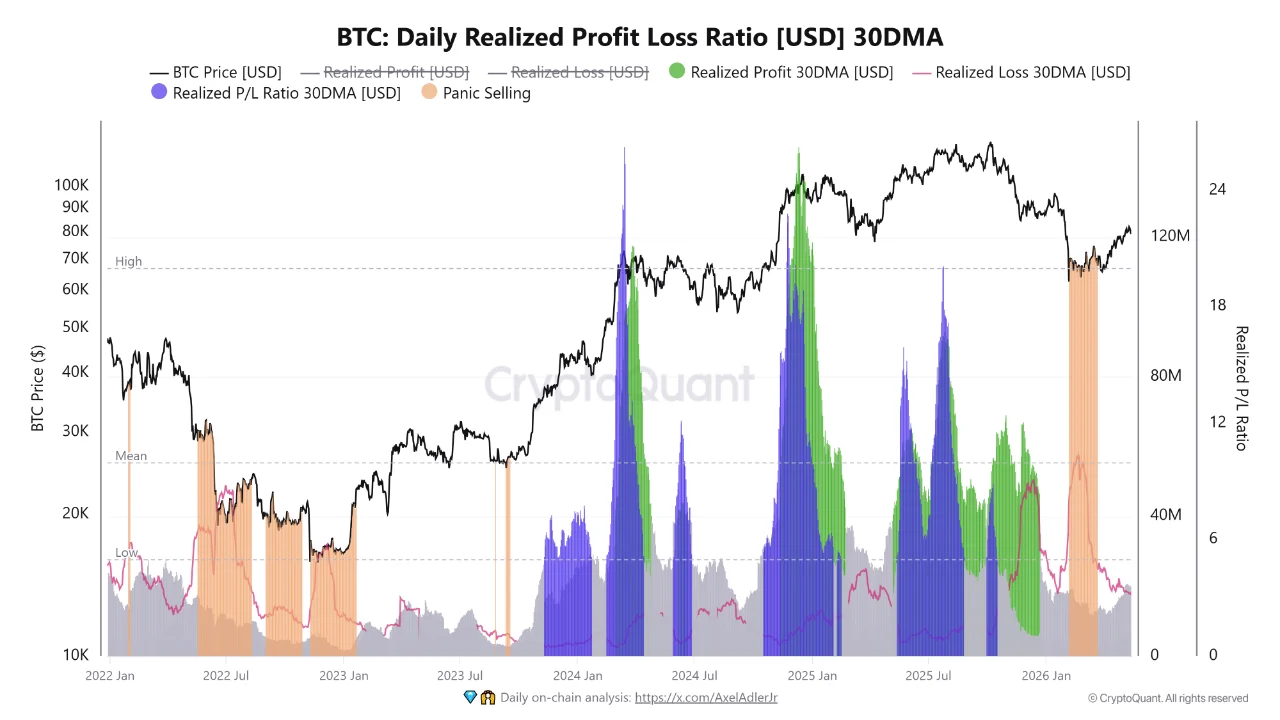
TLDR:
- Bitcoin’s Daily Realized Profit/Loss Ratio 30DMA has dropped sharply, signaling fading profit-taking pressure.
- A realized-loss spike points to a localized panic-sell event typical of mid-cycle corrective resets, not tops.
- Adjusted MVRV remains above bear market transition zones, reflecting mid-cycle normalization rather than breakdown.
- Bitcoin holds above long-term realized value benchmarks despite contracting profitability, showing demand stays intact.
Bitcoin’s on-chain data is showing a meaningful internal reset across key profitability metrics. The Daily Realized Profit/Loss Ratio 30DMA has dropped sharply after months of elevated distribution.
This cooling phase comes as speculative momentum begins to exhaust itself. The market is moving toward a healthier equilibrium, where short-term excess is gradually removed.
Analysts view these conditions as consistent with mid-cycle consolidation rather than a broader structural breakdown.
Profit-Taking Pressure Fades as Weaker Hands Exit the Market
The sharp compression in realized profitability marks a clear shift in market behavior. Aggressive profit-taking, which dominated the previous months, is now visibly fading from the data. This transition often occurs when speculative cycles begin running out of steam.
A realized loss spike has also emerged in recent data, indicating a localized panic-selling event. Weaker market participants exited during a period of downside volatility, triggering this short-term loss expansion. Historically, these events tend to appear during corrective resets within broader bull cycles.
As leveraged positioning unwinds, supply moves toward stronger holders who can absorb coins during periods of fear.
This redistribution process rebuilds structural support across the market. It also resets expectations among short-term traders who had priced in continued upward momentum.
The overall picture from this phase is one of internal market repair rather than deterioration. Excess leverage is being cleared, and the foundation for the next move is being rebuilt. These are typical characteristics of a mid-cycle reset, not a macro reversal.
Adjusted MVRV Remains Above Bear-Market Transition Zones
The Adjusted MVRV, measured as the 30DMA over 365DMA ratio, has pulled back from overheated levels. However, it has not entered the territory historically associated with bear market transitions. This distinction carries weight when assessing where the market stands in the broader cycle.
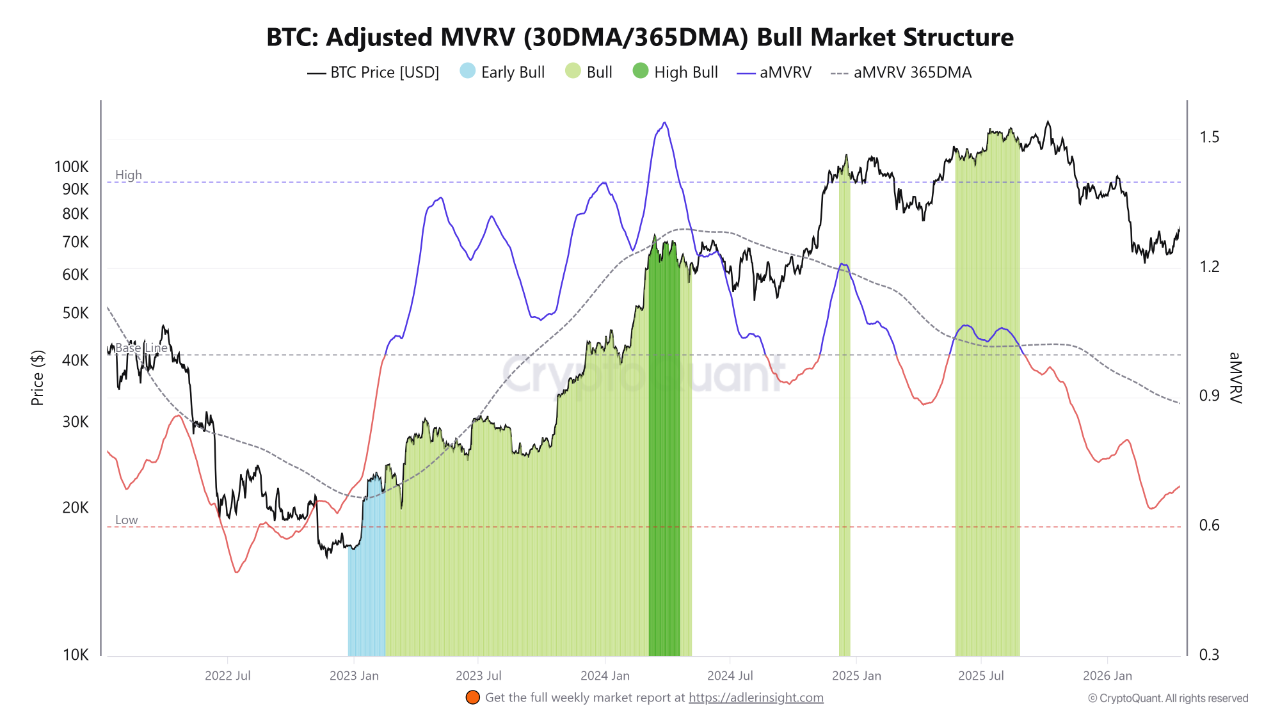
In past cycle tops, valuation compression was paired with sustained deterioration into structurally weak zones. Current readings do not match that pattern.
Instead, they resemble the mid-cycle normalization seen in prior bull markets, where excess valuation is cleared without breaking the broader trend.
Bitcoin’s price continues holding well above long-term realized value benchmarks even as profitability contracts. This divergence between price resilience and sentiment weakness suggests underlying demand remains present. Surface volatility has not translated into structural damage at the macro level.
Taken together, the on-chain evidence points toward continued consolidation within an ongoing bull market regime.
The market appears to be recalibrating internal leverage before its next directional move. Current conditions favor patience over reaction, as the data reflects repair rather than reversal.

Bitcoin (BTC) softened after a period of May gains, slipping below the $78,000 level as traders weighed renewed geopolitical risks alongside lingering macro headwinds. Intraday data showed BTC touching about $77,614, the weakest print since the first day of May, underscoring how oil-market stress and bond-market nerves can spill into crypto sentiment.
Key points:
- BTC dipped below $78,000 for the first time since early May, briefly trading near $77,600.
- Oil-supply disruptions and widening concerns around US government bonds joined existing risk-off pressures on cryptocurrencies.
- Analysts see potential support around $75,000, while some traders warn a bear-trap scenario could be forming as funding rates turn negative.
Geopolitics, macro risk colliding with crypto sentiment
The renewed risk-off tone surrounding Bitcoin stems from a confluence of macro and geopolitical factors. Traders continued to monitor developments in the US bond market, which has historically influenced appetite for risk assets, including digital currencies. At the same time, geopolitical tensions in the Middle East—specifically around the Strait of Hormuz—kept a spotlight on energy supply chains. Reports circulated that Iran was moving to implement a toll system for transit through Hormuz, a chokepoint for global oil flows, and that some traffic could be restricted, potentially intensifying price pressures in energy markets.
“The prospect for another inflation wave is lining up with similarities to the surge in price levels into mid-2022. Disrupted supply chains from last year’s trade war, impact of war on energy markets, and stimulus via large federal budget deficits are coming together at the same time.”
Market observers cited in this coverage highlighted that energy-market stress and the broader macro backdrop could keep risk assets, including Bitcoin, oscillating as participants reassess faith in fiat yields and the relative safety of traditional assets. In parallel, WTI crude finished the week above $100 per barrel, reinforcing the commodity-backed drag on speculative risk holdings.
What traders are watching next
BTC’s recent price action has sparked divergent views among analysts and traders. Some note that open interest has remained elevated even as spot prices ease, a combination that can precede sharper moves when liquidity thins. In addition, negative funding rates have signaled growing bearish positioning in the near term, a dynamic that can widen the gap between futures curves and cash prices and potentially amplify downward moves if sellers gain momentum.
Analysts highlighted a possible local downside target near $75,000. One market observer summarized the situation by noting that the price action formed after a breakdown retest of an ascending pattern, with resistance and support levels flipping in a way that could set the stage for renewed volatility. Others pointed to the importance of liquidity zones below current price, with some pointing to a region around $71,000 as a meaningful price-interest area where buyers and sellers could collide more aggressively if the market slides further.
Several voices stressed that the market’s structure remains worth watching. If bears are indeed pressing into a breakdown, a well-timed liquidity squeeze could catalyze a sharper move, potentially catching late shorts off guard. However, others cautioned that the current setup is still nuanced, with some traders arguing that a “bear trap” could emerge as negative sentiment contracts and long-side hedges reposition in response to evolving macro signals.
Broader implications for the crypto market
The episode underscores how crypto markets, despite their growing liquidity, remain sensitive to macro shocks and geopolitical developments. The oil market’s trajectory and the stance of traditional financial markets appear to continue shaping Bitcoin’s near-term risk profile. For investors and users, the episode suggests a few practical considerations: monitor key support levels around $75,000 and the liquidity landscape beneath current price, watch funding-rate dynamics and open interest for signs of shifting sentiment, and stay alert to any escalation in energy-market stress that could spill into crypto valuations.
Industry observers also noted a contrast between the macro backdrop and Bitcoin’s longer-term narrative. While short-term risk-off pressures can push BTC lower, the broader market’s structural dynamics—such as growing institutional participation and increasingly sophisticated derivatives activity—could mitigate some downside risk over time. The balance between these forces—geopolitical risk, energy volatility, and evolving crypto adoption—will continue to shape Bitcoin’s path through the coming weeks.
For now, traders and riders of the market will be watching whether Bitcoin can defend the $75,000 level, how quickly liquidity builds on either side of the current range, and how negative funding and open-interest signals evolve as the global macro environment tests risk appetite once again.
As events unfold, readers should keep an eye on the interplay between energy markets, bond yields, and crypto liquidity—a triad that has repeatedly shown it can tilt the risk-on/risk-off balance for Bitcoin in the near term.
Penn Entertainment and Gambling.com Group announced fresh job cuts this week. Gambling.com is eliminating 25% of its workforce while Penn trims more than 75 roles from its Interactive division.
The cuts arrive as the sports betting sector contends with two converging pressures. Operators are accelerating artificial intelligence (AI) adoption while regulated prediction venues siphon bets from traditional sportsbooks.
Cost Cuts Driven by AI-First Restructuring
Gambling.com Group cut roughly 150 staff alongside Q1 earnings. The report swung to a $1.2 million loss on flat revenue of $40.4 million.
Incoming chief executive Kevin McCrystle told analysts that AI now generates about 80% of new engineering code. The shift supports a planned $13 million in annualized savings.
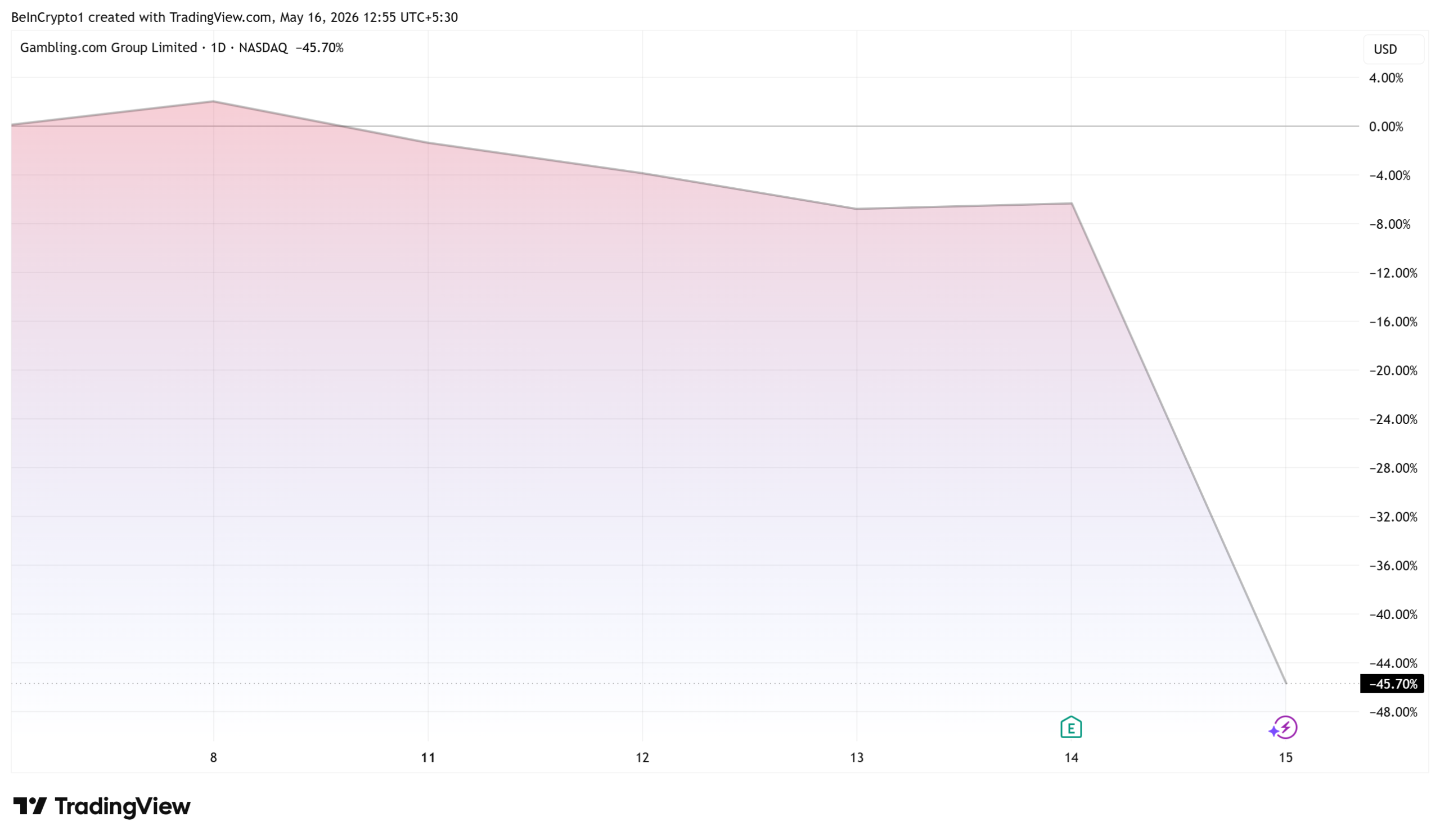
The company lowered its full-year 2026 revenue guidance to $165 million to $170 million. Shares tumbled more than 45% after the announcement.

The drop capped a difficult stretch tied to Google search volatility and tighter regulation in Finland and the United Kingdom.
Penn Entertainment’s cuts hit teams inside theScore Bet, online casino, and social gaming units.
The reductions build on a January corporate restructuring that consolidated technology under Aaron LaBerge and eliminated two senior executive roles. Penn reported first-quarter revenue of around $1.4 billion.
Prediction Markets Siphon Betting Demand
Layoff Tracker, an Official Layoff Tracker, framed the announcements as evidence that prediction venues are draining users from regulated sportsbooks.
CFTC-supervised platforms, including Polymarket and Kalshi, have processed roughly $150 billion in combined lifetime volume. Sports contracts drive most of that recent activity.

DraftKings recently acquired a CFTC-licensed exchange and partnered with Polymarket on clearing. Penn has stayed out of event contracts, citing regulatory uncertainty.
The American Gaming Association continues to push for stricter classification of these contracts as gambling.
Kalshi reported a $14.8 billion monthly trading volume in April, surpassing Polymarket for the first time in eight months. The pattern fits a broader shift.
Event contract platforms now compete directly with sportsbooks on player props, spreads, and live markets.
Operators across the sector are trimming payrolls and leaning harder on automation.
Sportsbook consolidation acceleration may hinge on regulators, with the next dividing lines around event contracts coming from both state and federal agencies.
The post Gambling Layoffs Increase as Prediction Markets and AI Reshape Sports Betting appeared first on BeInCrypto.

Caleb Wilson Accept His Degree After Tragic Hazing Death

Bitcoin Four Year Cycle Over? – Definitive Analysis #shorts #bitcoin #btc #cryptocurrency #crypto

Workers do East Yorkshire burglary at Woodfield Road, Goole

Manchester United reach agreement with Casemiro over contract clause amid transfer speculation

US brings back mandatory military draft registration

Steven Gerrard disagrees with Gary Neville over ‘shock’ Chelsea and Arsenal claim | Football
Bitcoin Four Year Cycle Over? – Definitive Analysis #shorts #bitcoin #btc #cryptocurrency #crypto

President Admits He’s NOT Thinking About Americans Financial Situation

Teach Kids Life Skills & Finance Early for a Strong Future :#MiddleclassRealExperience
-

 Crypto World20 hours ago
BloFin War of Whales 2026 Grand Prix opens registration for $5M trading championship
-

 Fashion1 day ago
Weekend Open Thread: Theory – Corporette.com
-

 Fashion5 days ago
Coffee Break: Travel Steam Iron
-

 Crypto World1 day ago
E-Estate Announces 1 Year Live: Washington DC Summit as Real Estate Tokenization Enters Its Next Phase
-

 Fashion6 days ago
What to Know Before Buying a Curling Wand or Curling Iron
-

 Politics5 days ago
What to expect when you’re expecting a budget
-

 Tech7 days ago
Auto Enthusiast Carves Functional Two-Stroke Engine from Solid Metal
-

 Tech2 days ago
Tech Moves: Microsoft AI leader jumps to OpenAI; former AI2 exec joins Meta; and more
-

 Tech6 days ago
GM Agrees To Pay $12.75 Million To Settle California Lawsuit Over Misuse Of Customers’ Driving Data
-

 Crypto World7 days ago
CZ says US crypto rivals tried to block Trump pardon
-

 Tech5 days ago
GM agrees to $12.75M California settlement over sale of drivers’ data
-
Crypto World4 days ago
Bitcoin Suisse expands with Digital Asset License and Investment Business Act Registration Approval in Bermuda
-

 Politics4 days ago
Pakistan to enter Chinese capital market as war inflation bites
-

 Crypto World2 days ago
Google’s Gemini AI Predicts Incredible Solana Price by the End of 2026
-

 Crypto World4 days ago
Bitcoin Suisse expands with Digital Asset License and Investment Business Act Registration Approval in Bermuda
-

 Business1 day ago
H&R Real Estate Investment Trust (HR.UN:CA) Q1 2026 Earnings Call Transcript
-

 Politics7 days ago
Sky News Presenter Says Keir Starmer Is Not Waving But Drowning
-

 Fashion7 days ago
Amazon Sundays: Spring Glassware & Vases
-

 Tech21 hours ago
Google reimburses Register sources who were victims of API fraud
-
 Entertainment6 days ago
Prime Video’s Forgotten but Brilliant 2-Part Horror Anthology Is a Perfect Binge
You must be logged in to post a comment Login