
Crypto World
Rising XRP Whales Tighten Risk-Reward, Foreshadow Price Move

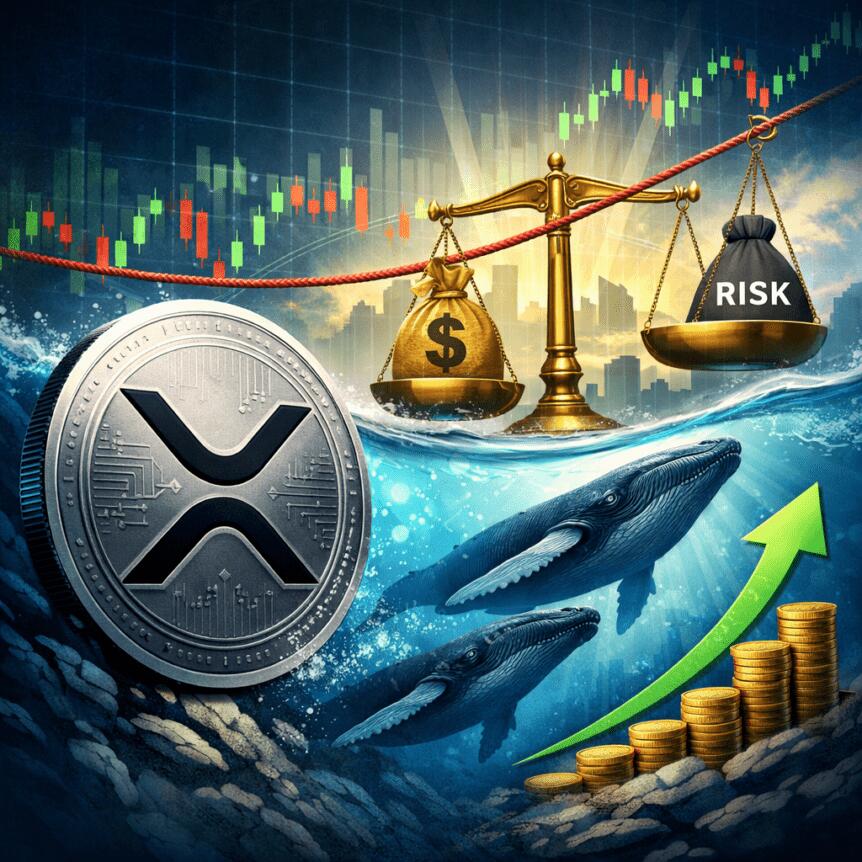
XRP’s risk-adjusted performance turned modestly positive on March 26, marking a shift after months of flat-to-negative readings. A 30-day average return of 0.00063 accompanies a Sharpe ratio of 0.0267, suggesting that current gains are modest but still outpaced by risk. On-chain data shows persistent accumulation by large holders, implying underlying demand even as price action remains subdued.
Analysts point to a broader pattern: on-chain buying and a slowly improving risk profile could set the stage for a steadier path higher, even if price upside remains constrained in the near term.
Key takeaways
- The XRP Sharpe ratio moved into positive territory for the first time in months on March 26, supported by a 30-day average return of 0.00063.
- Whale activity has remained firm, with CryptoQuant data showing XRP inflows averaging about $9 million per day over the last 30 days, continuing a pronounced accumulation phase that began in late February.
- Open interest surged 14.8% in the 24 hours to March 26, signaling renewed trader participation, alongside repeated long-liquidation spikes above $2 million in recent sessions.
- XRP’s price structure has shifted to a bearish bias: the asset invalidated its previously bullish ascending triangle and shed about 13.63% over ten days, with near-term support at $1.27 and a yearly low near $1.11 in focus.
- Past patterns suggest that prolonged accumulation can precede stronger upside, as seen in Q2 2025 when accumulation preceded a rally to a $3.65 high on July 18, 2025; watchers will want to see if the current phase leads to a similar outcome.
Positive risk-adjusted returns amid on-chain demand
CryptoQuant-derived data indicate that XRP’s improved risk-adjusted profile aligns with a pickup in trading activity. Arab Chain, in a CryptoQuant quicktake, framed the recent Sharpe ratio improvement as part of a gradual rebalancing that could limit downside for holders. However, the analyst cautioned that a return to negative territory would signal renewed volatility and fading momentum.
“If the indicator falls back into negative territory, it could signal a return of volatility and weakening momentum.”
While the short-term signals point to hedged risk, the long-run picture suggests a more constructive tilt if accumulation continues. The last substantial accumulation wave in Q2 2025 culminated in XRP’s expansion rally to an all-time high of $3.65 on July 18, 2025, underscoring how inflows can precede meaningful upside in subsequent months.
Whale flows and market momentum
On-chain trackers show that XRP whale inflows have remained robust, with the 30-day moving average holding around $9 million per day. The sustained demand has persisted since February 27, marking the longest accumulation stretch in months and echoing a broader pattern seen during prior cycles when whales stepped in ahead of bigger price moves.
That trend matters for investors because it points to durable demand that could underpin market returns even if price volatility remains elevated. The question for traders is whether this accumulation translates into sustained upside or simply supports a slower drift higher as macro and liquidity conditions evolve.
Open interest and near-term technicals
Open interest figures reinforce a market where risk is being actively recycled. CryptoQuant data show a 14.8% rise in 24-hour open interest on March 26, the strongest such move since March 4, reflecting renewed participation from long and short positions and a pattern of consecutive long liquidations—$2.5 million on March 18, roughly $2.45 million on March 21, and about $2.15 million on March 26.
From a price-structure perspective, XRP has broken from a bullish ascending triangle, and the prior ten-day slide of around 13.6% points to a bearish bias in the near term. If the current dynamic persists, traders will likely test support around $1.27, with a deeper look toward the yearly low near $1.11 in the weeks ahead.
The combination of a positive risk-adjusted metric and steady whale inflows paints a nuanced picture: a market where demand is accumulating even as prices wobble, potentially laying a groundwork for a more durable move if buyers sustain their activity.
Looking ahead, buyers will want to see whether the positive risk-adjusted read holds and whether whale demand remains steady. The next critical junctures to watch include whether XRP can sustain levels above near-term support and whether accumulation pulses continue to shape the risk landscape in the coming weeks.
Past patterns offer a useful lens: the accumulation phase seen in Q2 2025 preceded a rally to an all-time high later that year, suggesting that continued demand could precede stronger upside if sustained by shifting market dynamics.
Looking ahead, traders will watch if the positive risk-adjusted reads endure and whether whale accumulation remains steady; a sustained move higher will depend on whether demand translates into durable upside beyond the near-term support.


TLDR:
- Bhutan has recorded a net Bitcoin outflow of approximately $120 million since the start of 2025.
- The government moves Bitcoin in $5M–$10M batches, sending funds to exchanges and firms like QCP Capital.
- A recent transfer of 123.7 BTC worth $8.5M went to a fresh address with a different address type.
- Bhutan’s total Bitcoin holdings have dropped by around 1,700 BTC, raising questions about a full exit.
Bhutan Bitcoin sell-offs have drawn attention from the crypto community in recent weeks. On-chain intelligence firm Arkham has flagged a steady pattern of Bitcoin liquidations by the Himalayan kingdom.
Since the start of 2025, Bhutan has moved approximately $158.57 million out of its main holding addresses. With $38.84 million transferred back in, the net outflow sits at around $120 million. This activity points to a consistent reduction in the country’s Bitcoin reserves.
Bhutan Moves Bitcoin in Steady Clips to Exchanges and Market Makers
The Bhutanese government has been sending Bitcoin to exchanges and market makers in batches. Each transfer typically falls within the $5 million to $10 million range.
Recipients have included trading firms like QCP Capital, per Arkham’s data. This pattern suggests a structured approach to liquidation.
In mid to late September 2025, Bhutan sold approximately 3,500 BTC over a short window. That period stood out as one of the larger sell-offs from the country’s wallets.
The transfers followed the same routing pattern seen throughout the year. Arkham noted the activity as consistent with Bhutan’s overall selling behavior.
More recently, Bhutan moved 123.7 BTC, valued at roughly $8.5 million, to a fresh address. Arkham observed that the destination used a different address type from Bhutan’s main holdings.
This detail raised questions about the ultimate destination of the funds. The transfer size closely matched the country’s typical batch range.
Arkham flagged the transfer on X, citing the address type difference and the routing to a new wallet. The post attracted wide attention from traders and analysts across the crypto space.
Many began monitoring Bhutan’s on-chain wallets more closely following the announcement. The firm also noted a rise in outbound transfer frequency in recent weeks.
Questions Mount Over Bhutan’s Bitcoin Mining Future
Bhutan’s outbound transfer volume has been rising, with total holdings declining by roughly 1,700 BTC since January. This reduction has come through a series of smaller, recurring outflows rather than one large transaction.
The approach points to a gradual and methodical drawdown strategy. Arkham’s data confirms that the pattern has held steady throughout the year.
Not every outbound transfer reflects a permanent exit from Bhutan’s Bitcoin reserves. A portion totaling $38.84 million was transferred back into its holding addresses during the same period.
However, the net movement still strongly favors outflows. The country appears to be reducing its position in a measured way.
Bhutan became one of the first sovereign nations to mine Bitcoin at a national scale. The country drew on its hydroelectric energy surplus to run large mining operations over several years.
Its growing reserves went largely unnoticed until on-chain platforms brought the wallets to public attention. Whether Bhutan plans to fully exit the Bitcoin mining sector remains an open question.
Market observers are watching Bhutan’s wallets closely for signs of further acceleration. Sovereign-level selling, even in small clips, tends to draw attention from institutional traders.
The growing frequency of transfers adds weight to concerns about a possible full exit. Arkham’s tracking of Bhutan’s addresses will remain the key source of updates going forward.

TLDR:
- Canton’s anti-ZK argument rests on a hidden assumption that no backup system exists to catch failures.
- Canton’s trust-only model has no cryptographic layer, leaving compromised keys to spread damage silently.
- Prividium deploys three independent defense layers, keeping any breach contained to a single institution’s chain.
- DAML faces the same maturity concerns Canton raises about ZK proofs, but with far fewer security eyes watching.
Zero-knowledge proofs are at the center of a growing debate in institutional finance. Canton Network founders have argued that ZK proofs pose unacceptable risks for mission-critical financial systems.
They have raised this case with buyers and regulators, both publicly and privately. A public response from ZK researcher Alex challenges that argument directly.
The rebuttal compares the architectural approaches of Canton and Prividium.
Canton’s Risk Case and the Assumption It Rests On
Canton’s argument against ZK proofs centers on their complexity. Bugs in such systems may go undetected because the underlying data stays private.
If a flaw spreads silently, it could create systemic risk across financial networks. The concern is genuine, but the logic that follows contains a gap.
The reasoning assumes ZK proofs are the only line of defense in a system. Alex draws a parallel to aviation, nuclear controls, and medical devices.
Each of those is complex, mission-critical, and capable of catastrophic failure. None were abandoned for that reason—they operate through redundancy and containment, not the absence of risk.
In a post on X, @gluk64 framed it as a broader pattern. Any complex, mission-critical technology that can fail catastrophically would fail Canton’s test.
The hidden assumption doing all the work is that no backup system exists. That assumption, not the technology itself, is what creates systemic danger.
Canton’s own architecture illustrates this point. Its privacy model relies solely on trusted operators to segregate data between participants. There is no cryptographic verification layer in place.
If operator keys are compromised, the manipulated state propagates silently across opaque chains with nothing to catch it.
Prividium’s Layered Defense and the Open Standards Question
Prividium builds its model on three independent layers of defense. Institutional partners operate nodes within their own regulated environments.
Zero-knowledge proofs then add a cryptographic verification layer above operational security. As proof systems mature, multiple independent provers can verify the same computation. A flaw in one implementation then gets caught by another.
Containment is built into the architecture by design. Each Prividium instance is a separate chain operated by a single institution.
Inter-chain interactions go through accounting mechanisms enforced independently by participating institutions or on-chain. Even a combined attack on internal IT and a ZKP bug stays confined to that one chain.
The open standards question adds another layer to the comparison. ZKsync’s move toward full EVM equivalence reflects the principle that deviating from open standards widens the attack surface.
Ethereum’s infrastructure has faced more than a decade of adversarial testing with hundreds of billions at stake. That process built stronger audit standards, formal verification tools, and hardened design patterns.
Canton’s maturity concerns about ZK proofs apply equally to DAML, its proprietary smart contract language. DAML operates within a closed ecosystem with far fewer developers and security researchers watching.
Every vulnerability cycle Ethereum worked through still lies ahead for DAML. The architecture with the longest track record under the harshest conditions carries the least risk.
TLDR:
- Chris Peikert joins Algorand Foundation as CSO, bringing deep expertise in post-quantum and lattice-based cryptography.
- Four protocol engineers from Algorand Technologies now support the Foundation’s growing technical infrastructure team.
- A mandatory Pre-ARC discussion phase will filter proposals before they advance to formal draft or finalization status.
- ARC Kit CLI is introduced as the standard tool to enforce formatting, rules, and transitions across all ARC submissions.
Algorand Foundation has announced two major developments this week. The organization welcomed five new team members from Algorand Technologies.
At the same time, a structural update to the Algorand Request for Comments process was also revealed. These moves reflect the Foundation’s commitment to strengthening protocol engineering and ecosystem governance.
Together, they position Algorand Foundation as a more unified and accountable blockchain organization globally.
Algorand Foundation Strengthens Protocol Engineering with Key Hires
Chris Peikert has joined Algorand Foundation as Chief Scientific Officer. He previously served as Head of Cryptography at Algorand Technologies.
Peikert is also the Arthur W. Burks Collegiate Professor of Computer Science at the University of Michigan. Additionally, he is a Fellow of the International Association for Cryptology Research. His expertise centers on lattice-based and post-quantum cryptography.
Peikert led Algorand’s post-quantum security implementations before this transition. He will continue that same work in his new role.
This move follows the unification of protocol and ecosystem operations under Algorand Foundation. The consolidation was designed to bring key technical leadership together under one structure.
John Jannotti also joined as Senior Vice President of Protocol Engineering. He will lead the Foundation’s Protocol Engineering team going forward.
Under his leadership, Pavel Zbitskiy and one additional team member took on roles as Principal Protocol Engineers. John Lee joined separately as Director of Protocol Infrastructure.
As Algorand shared on X, the five hires are described as “invaluable additions to the Algorand Foundation technical team.”
Their work will support payments, asset tokenization, and decentralized financial infrastructure. The Foundation sees this expanded team as central to its mission of global financial empowerment through blockchain.
Algorand Foundation Introduces Reforms to the ARC Governance Process
The Algorand Request for Comments process is also undergoing formal reform. Cusma, who is now managing the ARC repository, outlined the update on X.
He thanked outgoing maintainer Stéphane Barros for his contributions to the process. The reform aims to improve consistency, reduce fragmentation, and avoid premature ARC finalization.
One major change is a mandatory Pre-ARC discussion phase. Before any proposal becomes a formal draft, authors must establish a clear need and scope.
Overlap with existing ARCs must also be examined during this phase. This step is meant to filter out proposals that lack practical grounding.
Every ARC will now also require a named sponsor — either Algorand Foundation or an Algorand Ecosystem entity.
Machine-readable adoption tracking will be mandatory before an ARC advances from “Last Call” to “Final.” This ensures that only proposals with proven ecosystem usage reach final status.
A new tool called ARC Kit CLI will support the process going forward. It enforces formatting, rules, and state transitions for ARC authors.
Cusma plans to share full details at the next Algorand Developer Council meeting. The reforms are focused on making ARCs easier to maintain and more aligned with real-world adoption.
Crypto World
Best Cryptos to Buy Now: Goldman Announcement You Need To Know And Pepeto Might Shock Traders This Year While BNB and TRX Hold Steady
AI and crypto have worked together for years, and now and then something happens that reshapes what the best cryptos to buy now actually look like. Goldman Sachs just signaled that crypto prices may have bottomed, and the $3.6 trillion asset manager’s research confirms the turn is forming.
Pepeto’s exchange is one of those events that changes the conversation entirely, the most advanced meme trading platform constructed this cycle with more than $8 million raised and the Binance listing approaching, and analysts project 100x from the current entry.
Goldman Sachs analyst James Yaro published research on March 26 indicating crypto prices may have reached a cyclical low, with crypto linked equities stabilizing after a 46% decline from October 2025 peaks according to CNBC.
The firm flagged Robinhood, Coinbase, and Figure Technologies as top buys. According to Bitcoin Magazine, K33 Research confirmed BTC ranged between $60,000 and $75,000, a pattern that historically precedes recoveries. The best cryptos to buy now are the presale entries positioned to capture the turn Goldman confirmed.
Tokens With Real Infrastructure and Where the Wealth Building Entry Lives
Pepeto: The Exchange With Greater Growth Potential Than Any Large Cap This Cycle
Pepeto is considered by many to be the best crypto to buy now because it has greater growth potential than any other entry this cycle. This comes from a combination of factors, the two most important being its fully built exchange technology and the massive number of traders it serves.
The exchange has fully developed a complete set of trading tools that transform how capital moves through the market.
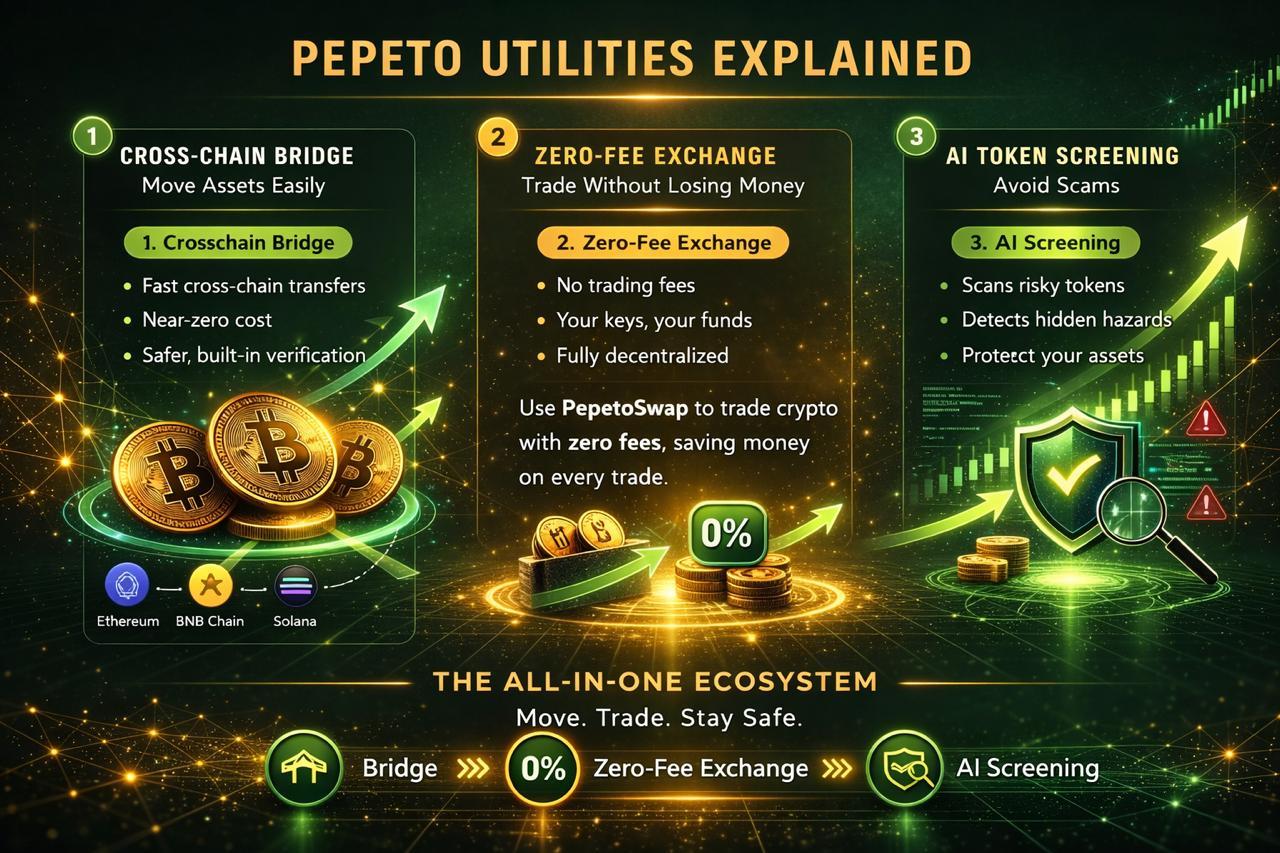
PepetoSwap provides zero cost order filling that keeps every dollar the reader commits fully intact, the direct chain routing moves tokens between networks with nothing taken from the transfer, and the danger screening tool reviews every contract before entry, confirmed by a SolidProof audit.
The result is an essential protection layer that changes how the reader handles every trade, and the architect who launched the original Pepe token to $11 billion on meme energy alone built this exchange with a Binance operations leader.
It is not a surprise that the presale attracted capital faster than any entry this cycle. In just 8 stages, the exchange raised more than $8 million during extreme fear, and because the entry is still at $0.000000186, there is room for exponential growth. Analysts project a 100x move as the Binance listing opens, and 191% APY staking amplifies every position while the listing window narrows.
BNB
BNB trades at $614 per CoinMarketCap, holding steady as the broader market corrects around it. At $83 billion market cap.
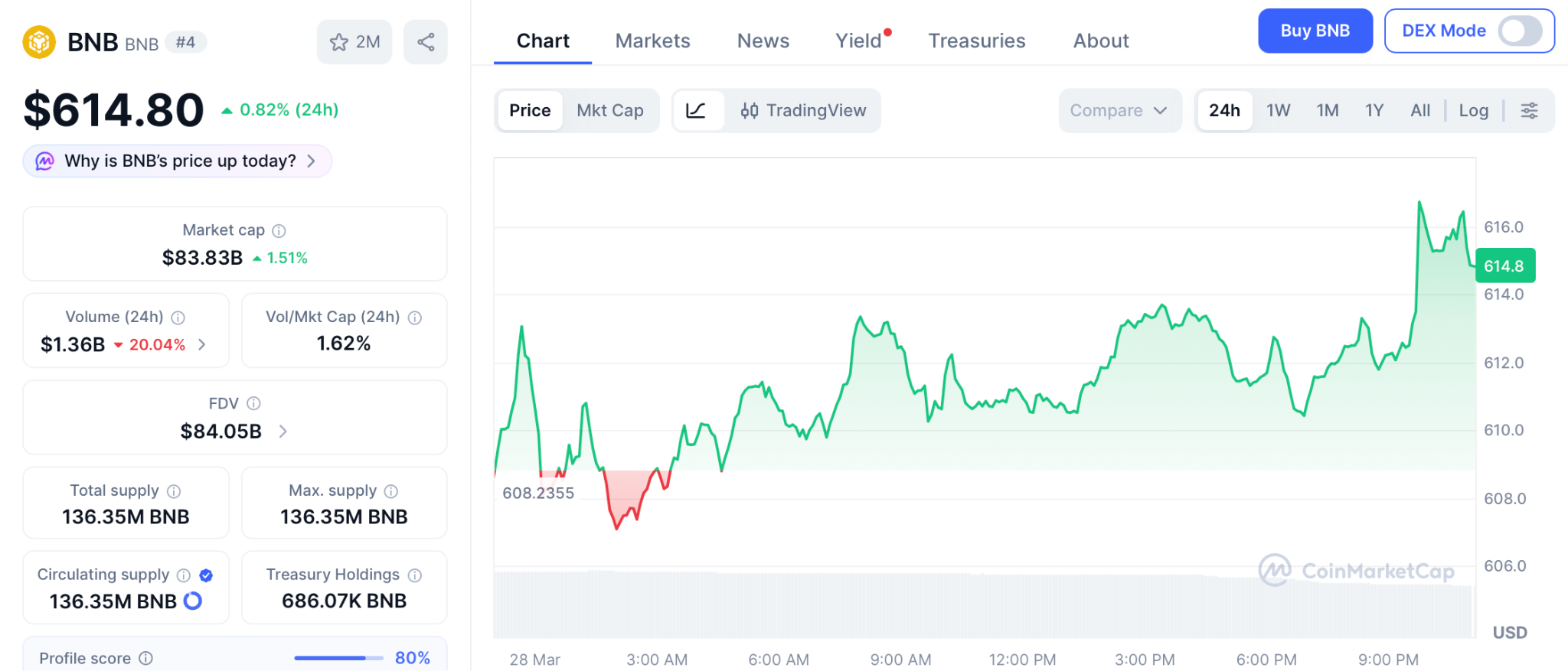
A recovery to $700 delivers 14% over months, a strong ecosystem anchor for patient holders, while the presale entry targets 100x from one listing event and the wallets entering are building the position the bull run rewards.
Tron (TRX)
TRX trades at $0.31 per CoinGecko, supported by its dominance in USDT transfers and $10 billion in daily stablecoin volume.
A recovery to $0.38 delivers 22% over months, solid infrastructure value, while presale entries are where the cycle defining multiples live and Pepeto offers exactly that math right now.
The Best Cryptos to Buy Now Are the Ones That Turn Presale Entries Into the Returns Goldman Confirmed Are Coming
Goldman Sachs just confirmed the bottom is forming, and the best cryptos to buy now have put everything into real exchange infrastructure that is already running. The investors who bought BNB at $0.15 turned $1,000 into $9 million and changed everything about how they live and what they never have to worry about again, and they saw a working exchange at presale pricing and acted.
The Pepeto official website is still open, you can still enter, but the Binance listing is approaching fast and the presale pricing disappears permanently the moment it arrives, and a 2026 portfolio holding Pepeto before that listing is the strongest position in crypto right now.
Click To Visit Pepeto Website To Enter The Presale

FAQs
When will Pepeto’s exchange tools be ready for use among the best cryptos to buy now?
Pepeto’s exchange is already fully running with zero fee trading, cross chain transfers, and contract screening confirmed by a SolidProof audit, ready for every trader today.
How fast is Pepeto’s user base expected to grow after listing?
Pepeto’s growing trader community is projected to expand rapidly after the Binance listing, and the Pepeto official website is where the presale entry is still available.
What would make Pepeto’s price reach 100x as one of the best cryptos to buy now?
Analysts project 100x as the Binance listing opens and exchange adoption scales, making Pepeto one of the best cryptos to buy now for the wallets entering today.
Disclaimer: This is a Press Release provided by a third party who is responsible for the content. Please conduct your own research before taking any action based on the content.

Prediction markets, built to aggregate collective judgment, are increasingly being overshadowed by ultra-fast automated systems that can exploit fleeting pricing gaps in real time. As artificial intelligence-driven agents begin to operate at scale, the window for profit from mispricings is narrowing for human traders and expanding for algorithmic traders capable of scanning thousands of markets per second.
According to Rodrigo Coelho, CEO of Edge & Node, the current landscape already favors automated execution: bots are scanning hundreds of markets every second, and AI-driven agents are poised to expand their role as these capabilities mature. “Capturing those opportunities requires monitoring thousands of markets and executing trades almost instantly, which is why they’re largely dominated by automated systems,” Coelho told Cointelegraph. He added that prediction markets are a natural next step for AI systems designed to exploit short-lived pricing gaps without human input.
That view aligns with broader observations about how prediction markets operate in practice. While participants can speculate on outcomes independent of macro conditions, the fastest arbitrageurs—often automated—can lock in profits from tiny deltas in probability. As one observer noted, even a several-second delay between an event and a market update can create a latency arbitrage opportunity that bots can monetize with near certainty in that brief window.
In recent years, researchers have documented consistent pricing inefficiencies in prediction markets. A study examining Polymarket found frequent mispricings within individual markets and across related markets, enabling arbitrage positions. The researchers estimated that roughly $40 million had been extracted from these inefficiencies, illustrating the real monetary potential of such mispricings when exploited at scale. These findings underscore why the space is proving attractive to automation enthusiasts and AI researchers alike.
Prediction markets are still nascent, but their underlying technology is evolving. Polymarket, for example, has taken steps to bolster trading costs and reduce immediate profitability for certain strategies by introducing taker fees in shorter-duration markets. Outcomes are not finalized instantly, which tempers the reliability of some arbitrage approaches and complicates the profitability math for participants.
Key takeaways
- Latency arbitrage in prediction markets creates near-term edge opportunities that are most easily exploited by automated trading systems scanning thousands of markets per second.
- A recent academic study suggests Polymarket exhibits persistent pricing inefficiencies, with researchers estimating roughly $40 million extracted from arbitrage opportunities.
- Open interest in Polymarket surged during the 2024 U.S. elections, reflecting ongoing appetite for prediction-market exposure, with politics, sports, and crypto among the most-active topics.
- As AI agents grow more capable, concerns about market manipulation rise, including the potential for large capital holders to sway outcomes in thin markets.
- The transition from simple execution bots to autonomous, AI-assisted trading systems could broaden participation but also heighten the need for guardrails and prudent oversight.
Latency, mispricings, and the economics of prediction markets
The core economics of prediction markets hinge on price discovery and the accuracy of probabilities assigned to outcomes. When a participant or an algorithm can detect an event and respond faster than the market can recalibrate, a temporary mispricing can appear. In practice, even a few seconds of delay can offer a window in which an automated trader guarantees a favorable outcome, provided the market update occurs belatedly after the event realization.
Academic work and industry observations converge on a similar point: mispricings are not rare in practice, and the profitability of exploiting them is highly sensitive to speed and information latency. Polymarket’s own market design and liquidity dynamics contribute to such inefficiencies, particularly in markets with lower liquidity or where probability sums do not align perfectly across related instruments. The estimated $40 million extracted from arbitrage underscores the materiality of these opportunities, even as total trading volumes grow and platforms attempt to tighten pricing frictions.
These dynamics are amplified by the evolving technical toolkit behind trading. On the one hand, humans continue to participate and conduct analyses using conversational AI and data tooling. On the other hand, a growing cadre of automated agents can operate with minimal human input, allowing them to act on micro-second or second-level signals that might elicit only modest reactions from human traders.
AI agents, governance, and the risk of influence in thin markets
Beyond pure arbitrage, AI agents raise governance questions about how markets respond to large-scale automated activity. Large players with substantial capital can influence outcomes by concentrating bets on a single side, a dynamic that has sparked fresh concerns about manipulation as AI agents gain sophistication. In one high-profile reference, a Bloomberg report described a prominent incident during an election cycle in which a large, unidentified trader placed a multi-million-dollar bet on a specific political outcome, highlighting how sizable wagers can tilt sentiment in prediction markets when liquidity is thin.
Data from Dune Analytics shows Polymarket’s open interest peaked around the 2024 U.S. elections, with politics remaining the dominant topic and sports and crypto rounding out the top categories. The evolution of open interest signals sustained engagement in a speculative tool that, at scale, can be swayed by large bets and rapid shifts in funding. As AI agents become more capable of pattern recognition and decision-making, the stakes for responsible market design and guardrails rise accordingly.
Industry observers emphasize that this is not a purely hypothetical concern. Pranav Maheshwari, an engineer at Edge & Node, argues that the increasing capability of AI agents makes guardrails essential as these systems begin acting autonomously at scale. “With higher capabilities, you need to restrict permissions and ensure safety measures to prevent unintended consequences,” he noted. The sentiment is echoed across the field: as agents move from assisting with research to executing trades and policies autonomously, the potential for unintended market impacts grows.
Polymarket’s own evolution illustrates the tension between accessibility and risk. While the platform has lowered barriers for users and introduced measures such as taker fees to temper aggressive short-horizon trading, final outcomes still require human or semi-automated oversight. The presence of AI-enabled strategies in this space highlights a broader question for regulators and platform designers: how to preserve market integrity and prevent manipulation while encouraging innovation and participation.
From execution bots to autonomous trading: the broader industry shift
Market participants are increasingly observing a shift in how trading is conducted. The early generation of arbitrage relied on rule-based bots designed for fast execution, but the frontier now extends to AI-assisted systems that can identify opportunities in real time, interpret structured data, and autonomously decide on trades. Industry voices note that many retail traders still rely on research interfaces and chat-based tools for decision support, but the most advanced users are experimenting with automated policies and even autonomous trading agents.
Archie Chaudhury, CEO of LayerLens, describes a spectrum of activity: a portion of retail participants use coding agents to create automated bots or algorithms, while others pursue higher levels of automation that can broadcast or enforce trading policies. He also notes that large language models are well-suited to parsing and interpreting financial data, potentially lowering the technical barriers that historically separated retail and institutional-grade quantitative activity. The result is a trading ecosystem where execution speed and data interpretation power increasingly determine competitive advantage.
Despite the rapid progression, the market remains highly dependent on the quality of the underlying data and the reliability of the pricing mechanisms. As automation becomes more prevalent, traders and platforms alike will need to balance the drive for speed with safeguards that prevent manipulation and preserve fair access for participants with varying levels of technical sophistication.
Looking ahead, the trajectory suggests two intertwined themes: the continued improvement of AI agents and the ongoing maturation of governance frameworks around prediction markets. The acceleration of autonomous decision-making poses opportunities for more efficient price discovery and broader participation, but it also raises questions about transparency, accountability, and the risk of concentrated influence in thin markets.
For investors and builders, the takeaway is clear: expect the edge to shift from human reaction time to automation and data-driven decision-making. Platform designers should prioritize robust risk controls, explicit permissioning for autonomous agents, and clearer disclosure around open-interest dynamics and pricing inefficiencies. Regulators, meanwhile, will weigh how to preserve market integrity without stifling innovation in this rapidly evolving sector.
As AI literacy among retail participants grows, the ecosystem will likely see a wider adoption of automated tools, alongside ongoing debates about guardrails and oversight. The coming quarters will reveal how much of the current arbitrage edge can be sustained as markets and technologies evolve in tandem.
What remains uncertain is how quickly regulatory frameworks will adapt to these capabilities and what new guardrails will emerge to balance openness with protection against manipulation. Investors and traders should monitor policy developments, platform responses to latency risks, and the emergence of standardized practices for autonomous trading in prediction markets.
- Netflix Raises All Plans Again, Boosting Revenue Per Subscriber
- Ad Tier and Premium Plans Both See Steady Price Increases
- Price Hikes Support Content Spend and Long-Term Growth Strategy
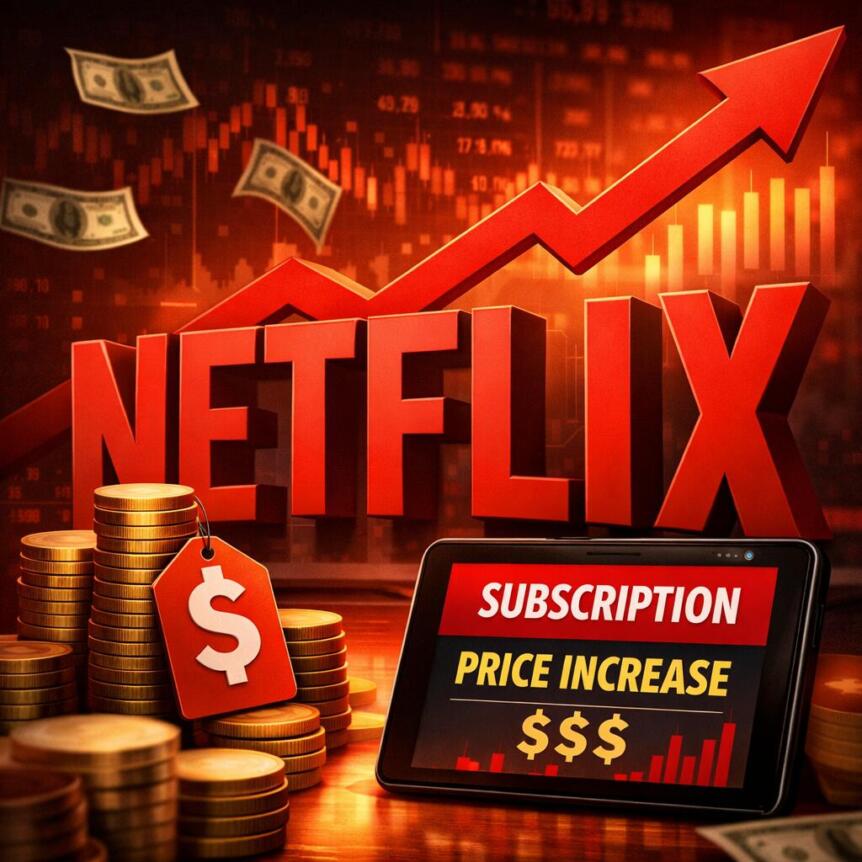
Netflix has raised subscription prices across all US plans, reinforcing its revenue strategy. The Standard with ads plan now costs $8.99 monthly, while Premium reaches $26.99. The move marks the second increase in just over a year and signals continued pricing momentum.
Pricing Structure Adjusts Across All Plans
Netflix has implemented new pricing across its subscription tiers, affecting both new and existing users. The ad-supported plan increased by one dollar, reaching $8.99 per month. The Standard ad-free plan rose to $19.99, reflecting a two-dollar increase.
The Premium plan climbed to $26.99 per month after a three-dollar adjustment. These changes apply immediately to new subscribers and will roll out gradually to current users. Existing members will receive advance notice before updated billing cycles begin.
Netflix raised its extra member fees tied to account sharing policies. The ad-based extra member fee now costs $7.99, while the ad-free option increased to $9.99. These adjustments align with broader efforts to manage account usage and maximize subscription revenue.
Revenue Strategy and Market Position Strengthen
Netflix continues to rely on pricing adjustments as a key driver of revenue growth. The company leverages its scale of over 325 million subscribers to support incremental price increases. As a result, it expects higher average revenue per user across North America.
Industry estimates indicate that the latest changes reflect an average increase of around 11 percent. Consequently, revenue per subscriber in the US and Canada could rise by approximately six percent this year. This growth supports broader financial targets and operating margin expansion.
At the same time, Netflix maintains confidence in its competitive position within the streaming market. The platform continues to expand its content library and improve user experience. It positions pricing as a reflection of added value rather than a cost burden.
Industry Trends and Growth Outlook
Netflix follows a wider industry trend where major streaming platforms increase subscription costs. Competitors such as Spotify, Amazon Prime Video, Crunchyroll, and Paramount+ have also raised prices this year. This pattern highlights growing pressure to balance content investment with profitability.
Moreover, Netflix continues to prioritize organic growth following recent strategic decisions. The company exited a major acquisition opportunity and retained a multi-billion-dollar breakup fee. This outcome strengthens its financial flexibility and supports future investments.
Looking ahead, Netflix targets annual revenue exceeding $50 billion with improving operating margins. The company also expects advertising revenue to expand significantly alongside membership growth. These factors position Netflix to sustain momentum despite ongoing pricing adjustments.
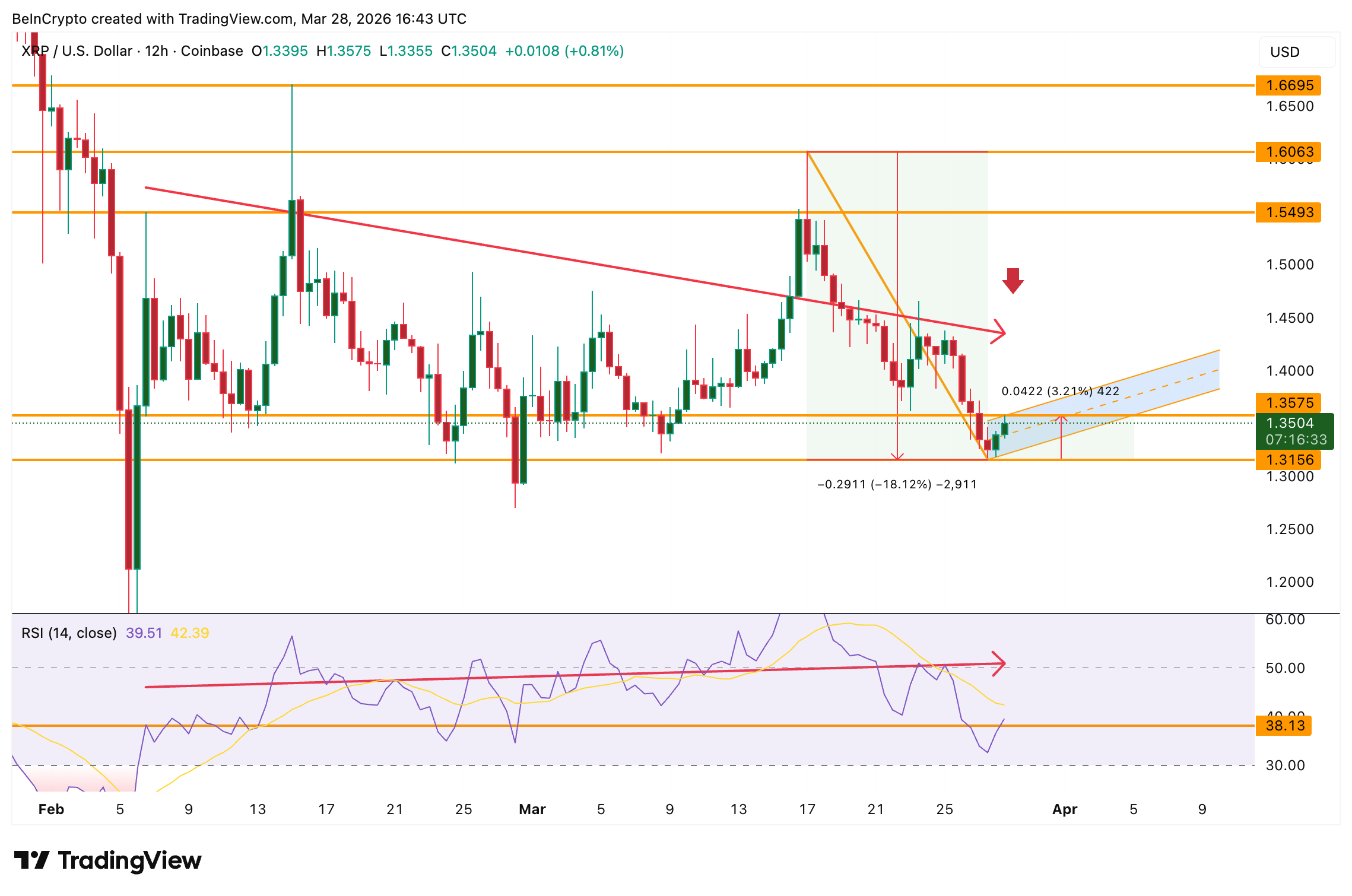
XRP price bounced roughly 3% from its March 27 low of $1.31, reclaiming the $1.35 area. However, the move may be building a bear flag rather than the start of a sustained recovery, and the broader market conditions are not helping.
Since peaking at $1.60 on March 17, XRP has already corrected 18%. The intraday bounce looks constructive on the surface, but the chart, derivatives, and on-chain data all point in the same direction.
Bear Flag Forms as Hidden Bearish Divergence Builds
The 12-hour chart shows XRP trading inside a bear flag pattern. The pole formed during the 18% decline from $1.60 to $1.31 between March 17 and March 27. The current 3% bounce is shaping the flag portion, a rising channel that typically resolves with another leg down matching the pole’s size.
If the lower trendline of the flag breaks, a similar 18% measured move could be triggered from the breakdown point. That would take the XRP price toward the $1.08 zone (highlighted later in the price section).
The Relative Strength Index (RSI), a momentum oscillator, adds another layer of concern. Between February 6 and March 28, on the 12-hour chart, the price is forming a lower high while the RSI is forming a higher high.
That is a hidden bearish divergence, which typically points to a continuation of the existing downtrend rather than a reversal.
Want more token insights like this? Sign up for Editor Harsh Notariya’s Daily Crypto Newsletter here.
The divergence has not yet been confirmed. Confirmation requires the next 12-hour candle to close below $1.35. If instead the price clears $1.35 and sustains above it, the structure delays.
Full invalidation sits above $1.60, the pole’s peak. If the broader market continues to weaken, this setup could confirm quickly.
However, even without the RSI, the derivatives and spot data suggest the bounce is standing on thin ground.
Open Interest Rises, but Hodlers Are Reducing Positions
Since the bounce began, XRP open interest has risen from $737.72 million to $759.21 million, a 2.9% increase. At the same time, the funding rate has become less negative, moving from -0.011% to -0.003%. That combination means more long positions are being opened into the bounce.
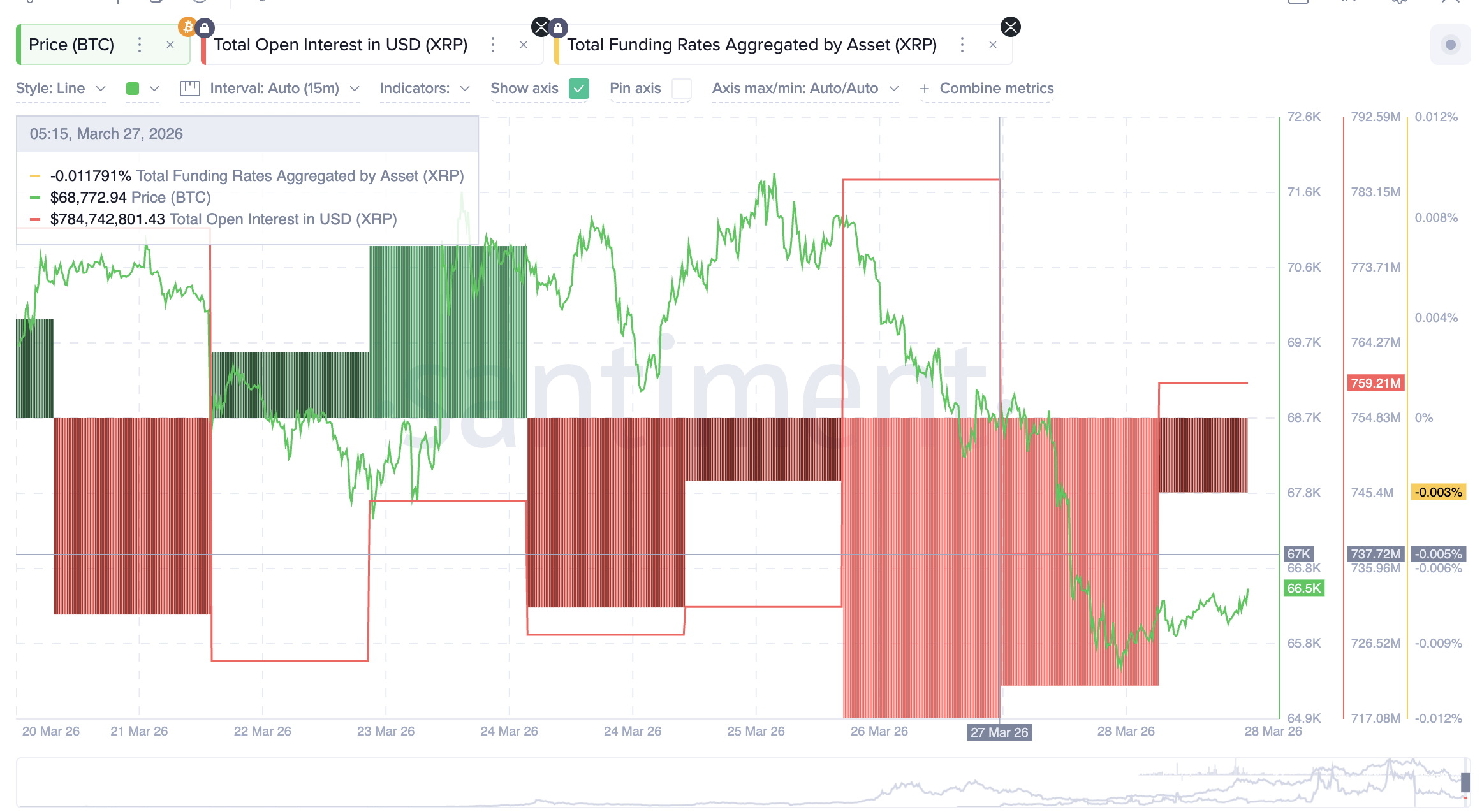
Rising open interest during a bounce inside a bear flag is typically a warning rather than a bullish confirmation. It means some leveraged traders are betting on bounce continuation, but if the pattern breaks down, those new longs become liquidation fuel.
The spot market offers no counterbalance. The Hodler net position change, a Glassnode metric tracking accumulation by longer-term wallets (155 days or more), held steady between March 19 and March 25 at approximately 238 million XRP.
Since March 25, that balance has dropped to 229.78 million XRP, a reduction of roughly 8.25 million tokens or 3.47%.
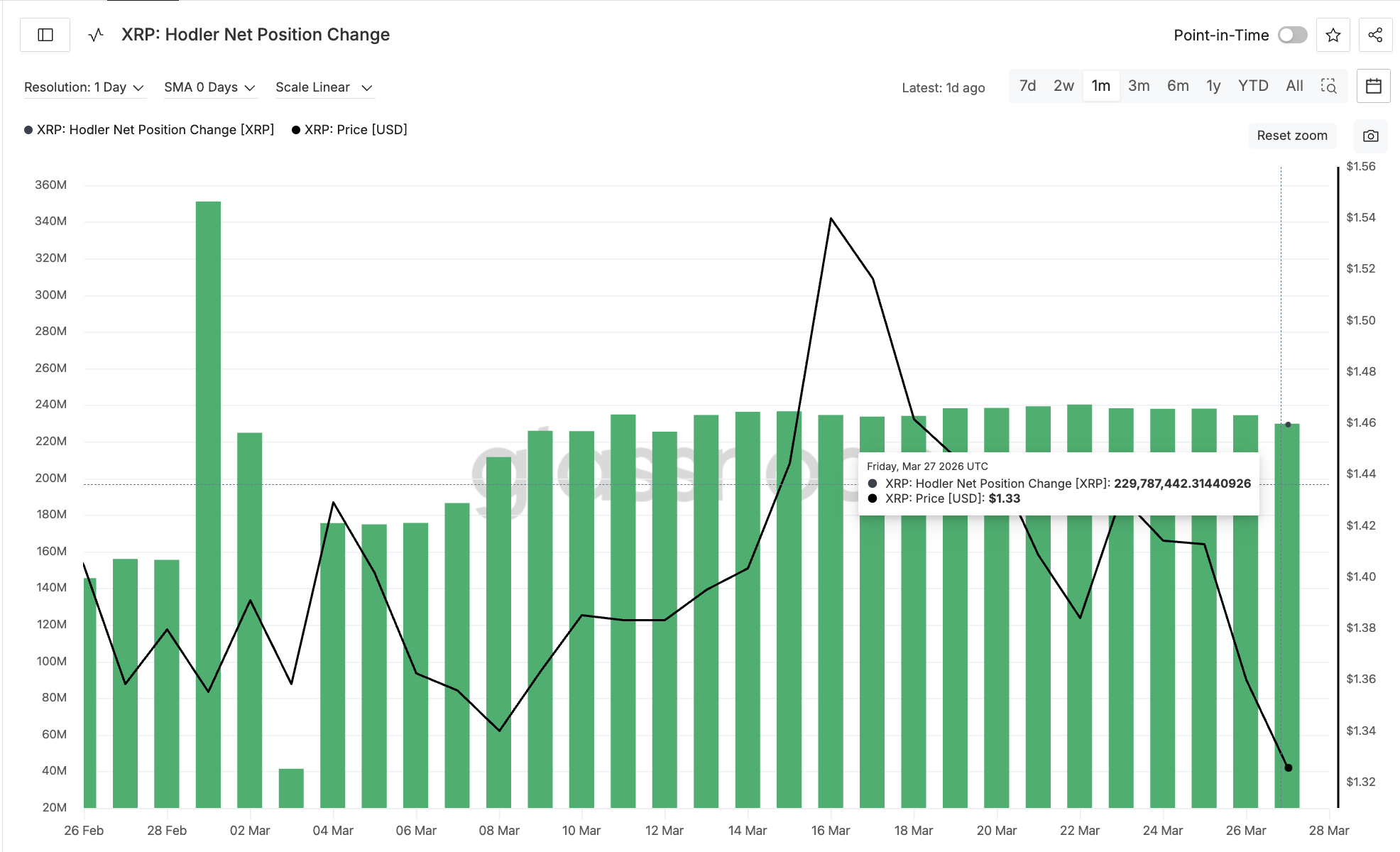
Conviction holders are quietly reducing exposure right before the XRP price bounces. When derivatives lean long, and spot holders lean out, the setup favors the bears.
If the RSI-led hidden bearish divergence confirms and the price corrects, the spot support needed to absorb the selling simply is not there. It remains to be seen whether spot buyers also come in, as the recent longs did. If that happens, some spot support can help stem the possible drop.
XRP Price Forecast and the $1.35 Test
The XRP price needs a clean 12-hour close above $1.35 to delay the bearish setup. Above that, $1.37 and $1.40 become the next resistance levels. However, based on the bear flag structure and the divergence forming, any move under $1.35 that holds would begin the confirmation process.
If the flag breaks and the $1.31-$1.32 neckline zone gives way, the measured move of roughly 18% activates from the breakdown point. That targets the $1.08 zone, which would then represent the lowest level for XRP since early February 2026.
On the upside, only a move above $1.60 would fully invalidate the bearish structure and end the lower-high sequence that has defined XRP’s 2026 trading playbook.
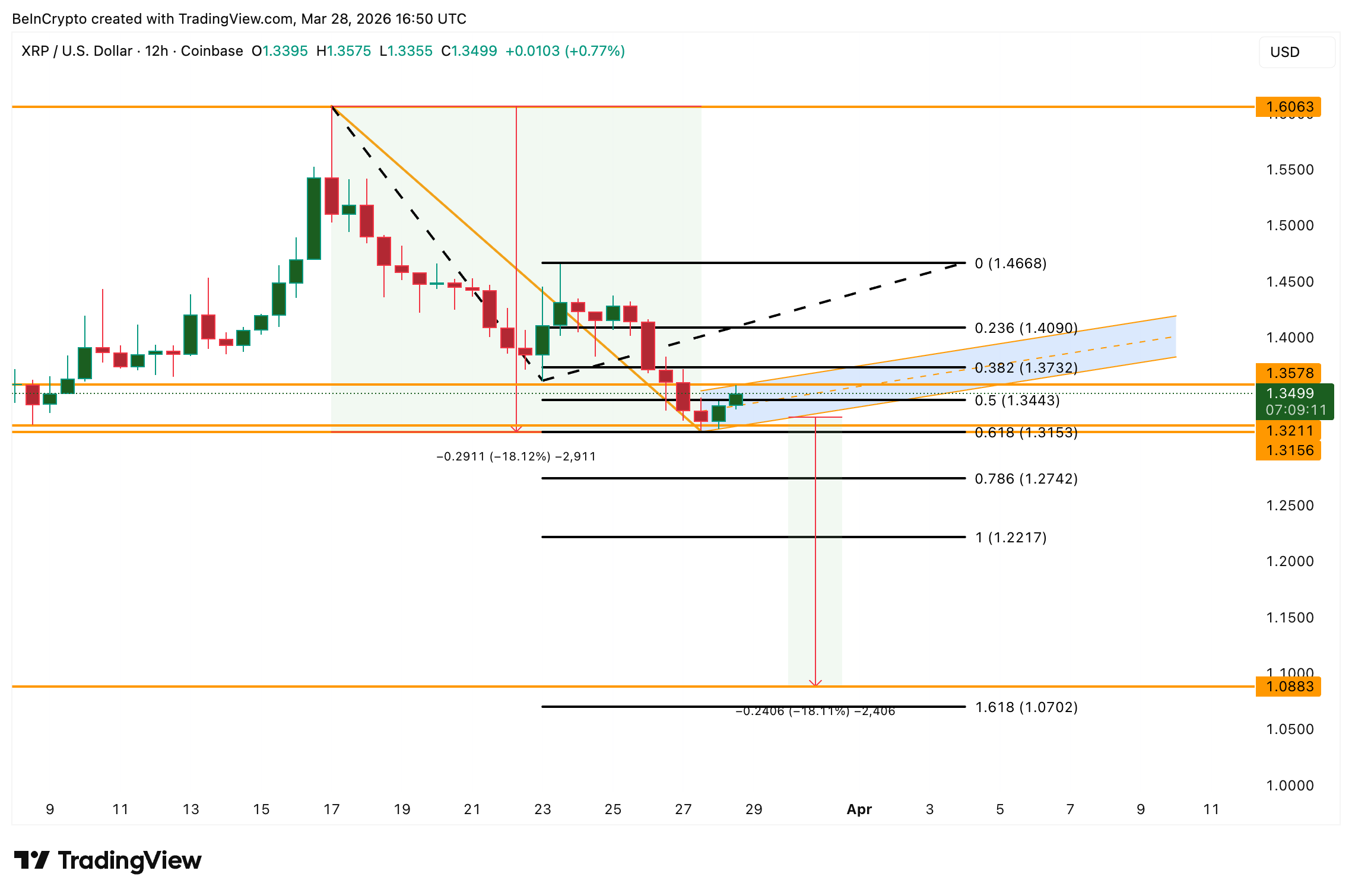
For now, the $1.35 reclaim separates a delayed bearish setup from an 18% breakdown toward $1.08.
The post XRP Could be Facing a 18% Breakdown, Hidden Bear Flag Pattern Shows appeared first on BeInCrypto.
Since Bitcoin’s all-time high of $127,000 in October 2025, the first quarter of 2026 has gotten off to a shaky start, with Bitcoin crashing to a $60,000 floor in under five months. While this whiplash may be painful, it looks worse than it really is: the market is actually doing exactly what it needs to do to build a stronger cycle ahead.
Crypto tends to bear the brunt of the selloff when macro conditions, geopolitical tensions and traditional markets turn south. Several converging factors are currently driving immense pressure on crypto markets: elevated counterparty risk, global liquidity tightening, weak technical trends, fading ETF inflows and broader stress across credit and banking markets.
But periods like this are not anomalies in digital asset markets. They are part of the larger cycle – and a sign of what’s to come for those willing to see it.
Liquidity is the dominant driver
For all the narratives around adoption, innovation and new use cases, crypto still trades primarily on global liquidity conditions. When liquidity expands, digital assets tend to rally; when it contracts, they tend to fall, often sharply.
Several forces are currently pulling liquidity out of the system. The Federal Reserve continues to run down its balance sheet, reducing the amount of capital circulating through financial markets. Seasonal tax payments are draining liquidity from the Treasury system.
A wave of technology IPOs and equity issuance is absorbing capital that might otherwise flow into risk assets. Meanwhile, a strong U.S. dollar and tighter financial conditions globally are putting additional pressure on speculative markets.
Because crypto trades on liquidity, price moves can look disconnected from fundamentals. But those moves are often the mechanism through which markets reset and prepare for the next expansion phase.
The reset cycle map
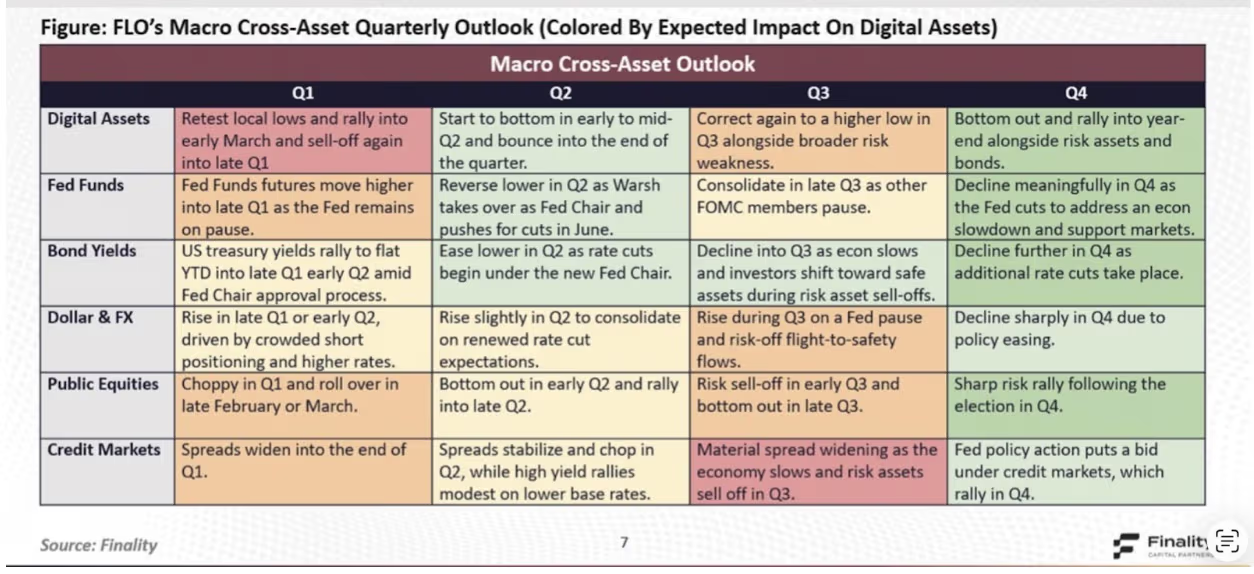
Market cycles rarely move in a straight line, and this one is unlikely to be any different. But if the current pattern holds, 2026 could unfold as a multi-step reset rather than a clean rebound. A quarterly breakdown lays this path out clearly, The early part of the year is characterized by retesting lows and broad selling pressure as leverage and speculative positioning continue to unwind. The middle of the year may bring a temporary recovery as markets stabilize and opportunistic buyers begin stepping in. It’s a multi-step reset cycle.
Volatility is likely to persist. Another correction later in the year would not be unusual as macro conditions continue to shift and investors reassess risk. Only after that process plays out does the market typically enter a more durable rally phase.
But this type of structure has appeared repeatedly across previous crypto cycles. And while the timing is never identical, the rhythm is familiar.

Why the long-term cycle remains intact
Short-term turbulence does not necessarily mean the broader cycle is broken. Indeed, there are several reasons the long-term trend for bitcoin and the digital asset ecosystem remains intact.
First, structural demand has expanded meaningfully compared with prior cycles. Institutional participation is deeper, infrastructure is stronger, and access through regulated investment vehicles has improved market reach.
Second, macro conditions are likely to evolve. Liquidity tightening rarely lasts forever. If inflation continues to moderate, the Federal Reserve could shift toward rate cuts later in the year. Historically, monetary easing has provided a powerful tailwind for risk assets.
Third, broader political and financial dynamics may also support markets. Election cycles tend to coincide with more accommodating economic policy, while stabilization in credit markets could reduce systemic risk across the financial system.

Taken together, these factors suggest the long-term trajectory for digital assets remains constructive even if the path to get there remains volatile. Bitcoin could ultimately recover toward the $100,000 range and potentially move higher by the end of 2026 if liquidity conditions improve. Downside scenarios remain possible, particularly if macro stress intensifies, but those drawdowns have historically yielded longer-term uptrends.

Positioning through the volatility
For investors, the real challenge is predicting the markets by positioning correctly across different phases of a reset cycle.
The early phase, when liquidity tightens and markets search for a bottom, typically rewards caution. That may mean running underweight crypto exposure in the early part of the year while volatility remains elevated and macro pressures persist.
But the opportunity usually emerges before the broader market recognizes it. As the year progresses and conditions begin to stabilize, investors may gradually increase exposure. By the cycle’s later stages, particularly if liquidity begins to ease, allocations may shift more aggressively, with portfolios moving overweight digital assets into a potential fourth-quarter rally.
Between those phases, market dislocations can prove fertile ground for selective investments. Distressed assets, special situations, and mispriced securities across digital assets, blockchain equities and digital corporate credit often appear during mid-cycle stress. These environments favor active strategies that can move across asset classes rather than passive exposure to a single market segment.
The key is timing exposure to liquidity conditions rather than chasing momentum after markets have already turned. Stay defensive now, get aggressive later.
A transition year, but not a record year
If this framework holds, 2026 won’t be remembered as either a classic bull year or a prolonged bear market, but as a transition year.
Markets often shake out weak hands first, forcing excess leverage and speculative positioning out of the system. That process can be uncomfortable in real time, but it plays an important role in preparing markets for the next expansion. Volatility is not just noise in financial markets – and often, it’s the very mechanism through which opportunity is created.
It’s also a year for resetting. Markets will likely stay volatile in the near term as liquidity tightens, but the investors who win will be the ones positioning before the turn, not chasing it after.
Crypto markets have never moved in straight lines. The same forces that create painful corrections often lay the groundwork for powerful recoveries. The reset underway today may ultimately be what allows the next cycle to begin.
Every gambling platform rewards its players. The difference lies in how much, how visibly, and how reliably those rewards actually reach the people earning them. Bet365 has spent more than two decades proving that a restrained approach to rewards can coexist with massive commercial success. ZunaBet has spent its first months in the market proving that a maximalist approach to rewards can coexist with a platform that delivers on every other front too. The question is not whether both approaches work for the companies behind them. The question is which approach works better for the player in front of them.
Bet365: Letting the Product Speak First
Bet365 launched in 2000 under the direction of Denise Coates, growing from a modest online betting operation in Stoke-on-Trent into one of the largest privately held gambling companies in the world. It operates across dozens of regulated markets and handles transaction volumes that most competitors cannot fathom. The Coates family retains ownership, giving the company the freedom to prioritise long-term strategy over short-term promotional spending.
The sportsbook defines Bet365’s identity. It is routinely cited as one of the most complete sports betting products available anywhere. Market depth across global sports is extraordinary, live in-play betting runs at unmatched scale with thousands of simultaneous events, and integrated streaming gives bettors direct access to the action they are wagering on. The combination of breadth, depth, and real-time capability remains the industry standard that others measure themselves against.
The casino side has matured into a credible product in its own right. Thousands of games from established providers span slots, table games, and live dealer rooms. It is a bigger casino than most sportsbook-first operators carry, though it has not expanded as aggressively as platforms that treat casino gaming as their primary business.
Payments operate exclusively through traditional channels. Debit cards, bank transfers, PayPal, Skrill, Neteller, and region-specific methods handle all deposits and withdrawals. Speed depends on the method — e-wallets clear fastest while bank transfers may take several business days. Cryptocurrency is not supported.
Bet365’s reward philosophy is understated by design. New player offers typically involve bet credits tied to qualifying deposits. Ongoing rewards arrive as personalised promotions and periodic bonuses delivered at the platform’s discretion. There is no public tier system, no branded progression path, and no published criteria for how rewards are determined or distributed. Bet365 trusts its product to retain players and uses targeted generosity to supplement that retention selectively.
The model has produced extraordinary results commercially. Whether it produces extraordinary results for the individual player depends entirely on whether that player happens to be someone Bet365 chooses to reward generously — a determination made behind closed doors using criteria the player cannot access.
ZunaBet: Generosity as a Core Design Principle
ZunaBet was created in 2026 by Strathvale Group Ltd with an Anjouan gaming licence and a founding team bringing more than two decades of combined gambling experience. Every element of the platform was built as a crypto-first casino and sportsbook, and the rewards structure was designed around a straightforward conviction — every player should know exactly what their activity earns them, and the amounts should be large enough to matter.
The welcome bonus embodies that conviction. Up to $5,000 in matched deposits plus 75 free spins across three deposits. First deposit matched at 100% up to $2,000 with 25 spins. Second at 50% up to $1,500 with 25 spins. Third at 100% up to $1,500 with 25 spins.
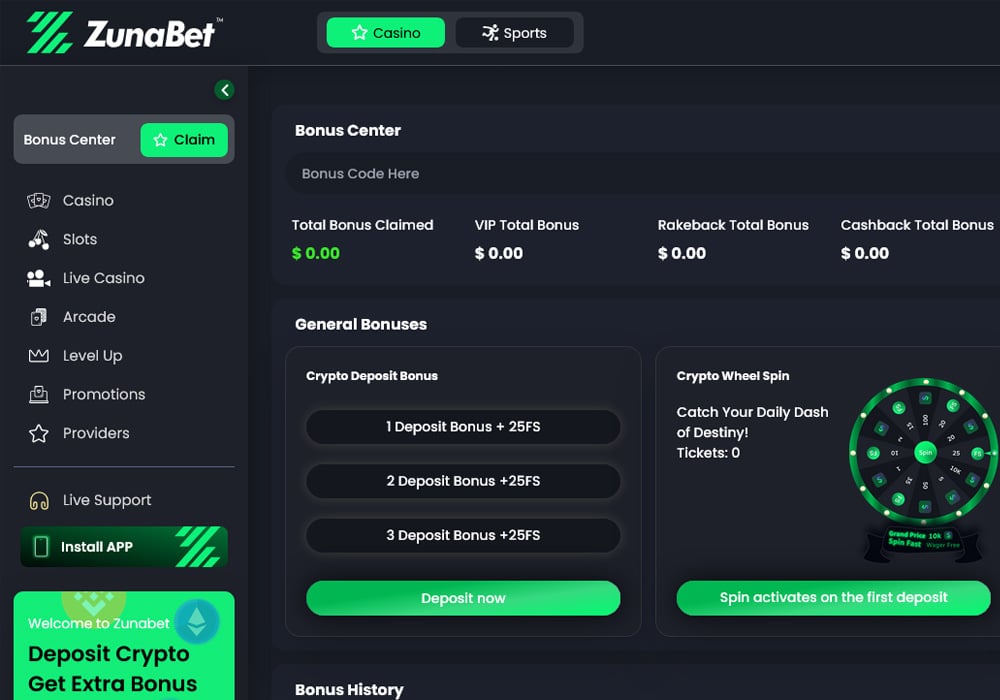
Bet365’s market-specific bet credit offers do not operate on the same scale. The difference between a bet credit promotion and a $5,000 multi-deposit package is the difference between a polite gesture and a genuine investment. For a new player evaluating both platforms on introductory value alone, ZunaBet’s offer occupies territory that Bet365 has never attempted to reach.
The platform surrounding the bonus ensures the value has depth behind it. Over 11,000 games from 63 providers — Pragmatic Play, Evolution, Hacksaw Gaming, Yggdrasil, BGaming, and a deep roster of additional studios — fill a casino catalogue spanning slots, RNG table games, and live dealer content. Bet365’s casino library is respectable but considerably smaller. Bonus funds and free spins applied across 11,000 titles deliver an experience of exploration and discovery that a more modest library cannot replicate.
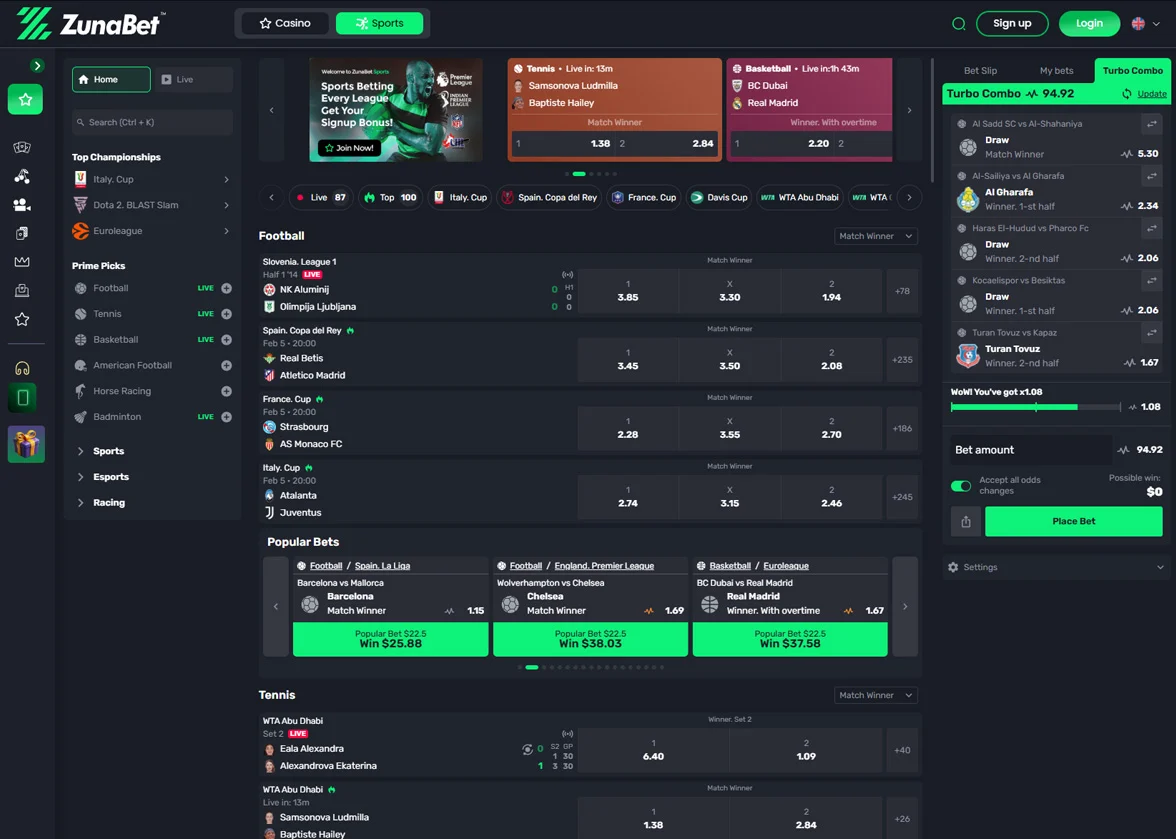
The sportsbook functions as a full product alongside the casino. Football, basketball, tennis, NHL, combat sports, virtual sports, and esports markets for CS2, Dota 2, League of Legends, and Valorant provide comprehensive betting coverage. Bet365 retains clear superiority in live betting infrastructure and streaming. ZunaBet counters with dedicated esports depth and a sportsbook that gives sports bettors and casino players equal footing on the same platform.
Cryptocurrency underpins every transaction. Over 20 coins accepted — BTC, ETH, USDT on multiple chains, SOL, DOGE, ADA, XRP, and beyond. Zero platform fees. Blockchain-speed withdrawals. Where Bet365’s fiat infrastructure routes payouts through institutions that impose their own timelines and potential costs, ZunaBet’s crypto rails deliver rewards directly to the player’s wallet without intermediaries, delays, or deductions.
Modern dark-themed HTML5 interface, responsive design, fast loading, native apps for iOS, Android, Windows, and MacOS, and live chat support at every hour.
Where the Rewards Gap Becomes a Chasm
Welcome bonuses are temporary. Loyalty programmes define the permanent reward relationship between a platform and its players. This is where comparing Bet365 and ZunaBet produces the widest divergence.
Bet365 operates loyalty behind a curtain. Active players receive offers and bonuses that the platform determines are appropriate based on internal evaluation. The player sees the reward when it arrives but has no prior visibility into what their activity qualifies them for, no progression to track, and no published framework to engage with. The system is closed by design — Bet365 decides who gets what, when they get it, and how much it is worth. For some high-value players, the results may be generous. For the average player, the results are unknowable until they materialise, if they materialise at all.
ZunaBet operates loyalty in full daylight. The dragon evolution programme built around a mascot named Zuno organises players into six tiers — Squire, Warden, Champion, Divine, Knight, and Ultimate. Rakeback begins at 1% and climbs to 20% at the highest tier. Free spins scale to 1,000 at the upper levels. VIP club membership and double wheel spins add further reward milestones throughout the journey.
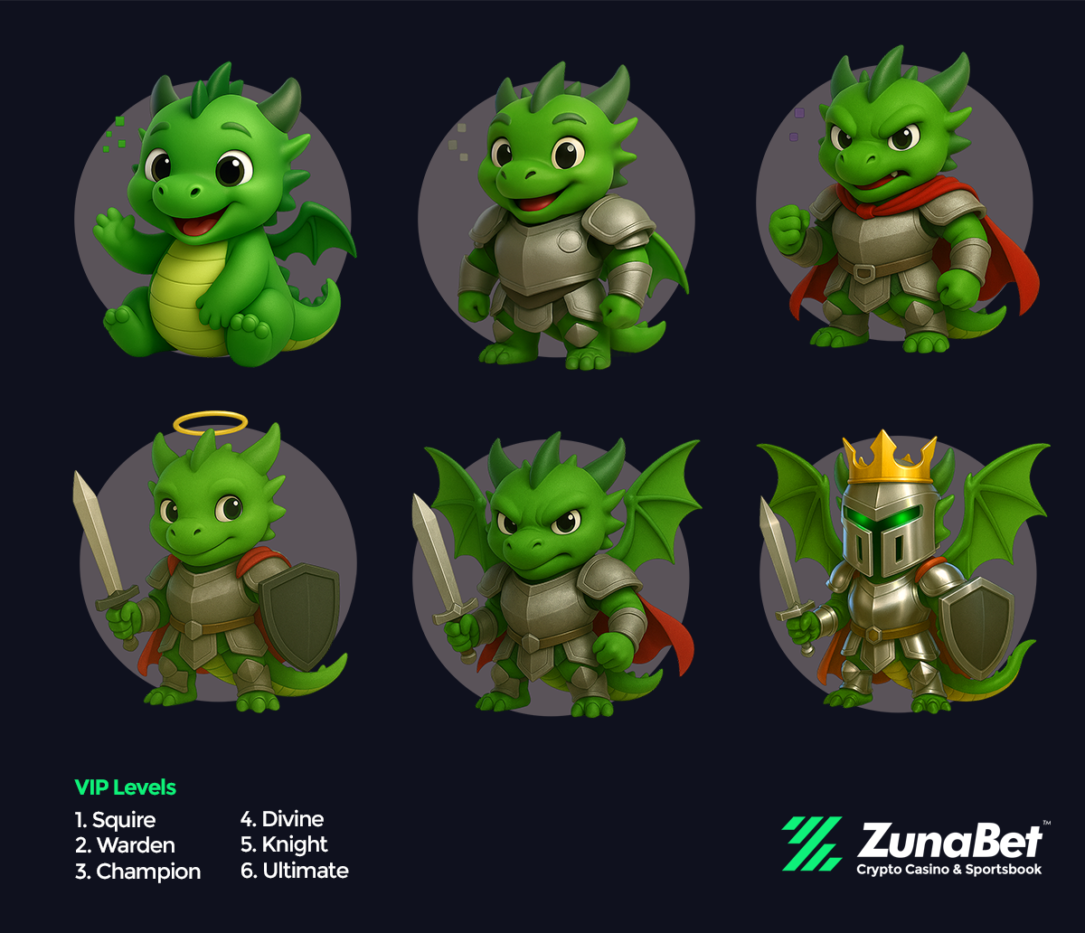
Every single detail is published. Current tier, next tier, advancement requirements, and rewards at each stage are visible to every player at all times. There is no guesswork, no hoping for recognition, and no dependence on the platform’s internal assessment of your value. The system is open, equal, and entirely within the player’s ability to understand and pursue.
The gamified structure adds a dimension of engagement that Bet365’s closed model cannot offer. Named tiers function as levels. Published requirements function as objectives. Visible progress creates momentum. Defined rewards create anticipation. The framework applies video game progression psychology to a loyalty context, giving players a reason to return that goes beyond the games themselves. It transforms rewards from something that might happen into something the player is actively building toward.
Twenty percent rakeback at the Ultimate tier is the headline number in this comparison. It delivers one of the highest continuous return rates in online gambling, flowing automatically to the player’s balance as a permanent feature of their status. It is not promotional. It is not discretionary. It is not limited to a select group of high rollers who caught the platform’s attention. It is a published, achievable, ongoing reward available to any player who progresses through the tier system.
Bet365 may deliver comparable value to individual players through its discretionary model. The critical difference is that the player has no way to know in advance whether they will be one of those individuals, no ability to track their progress toward that outcome, and no guarantee that the rewards will match what a transparent system like ZunaBet’s publishes openly.
Reward Value After It Leaves the Platform
The size of a reward matters. So does how efficiently it converts from platform value to money the player actually holds.
Bet365 pays out through banks and payment providers. Those institutions add their own timelines and occasionally their own costs. A reward generates value on the platform. How much of that value reaches the player’s wallet intact depends on which payment method they use, which bank they hold with, and what day of the week they make the request.
ZunaBet pays out through the blockchain. No bank. No processor. No variable timeline. No platform fee. Reward value — whether from the welcome bonus, from rakeback, or from free spin winnings — travels directly from the platform to the player’s wallet with the speed and consistency that crypto infrastructure provides regardless of external factors.
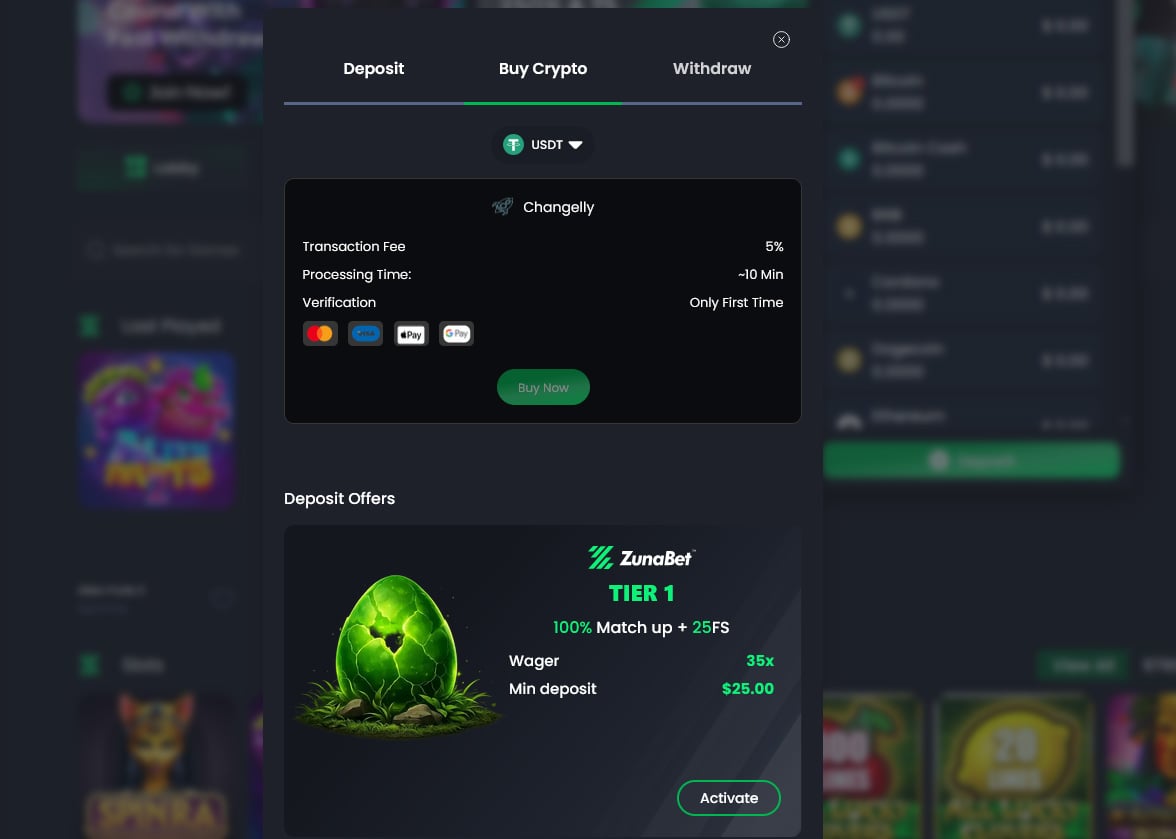
Every reward the player earns on ZunaBet retains more of its value through the withdrawal process than the same reward would on a platform where traditional banking introduces friction. Over months and years of accumulated reward payouts, the difference in total value received is not trivial. Faster access, zero fees, and consistent delivery compound into a material advantage in real-world reward value.
Answering the Question
Which casino offers bigger rewards? Bet365 offers rewards that are potentially big for some players, determined behind closed doors through criteria that are never shared. ZunaBet offers rewards that are demonstrably big for every player, published in full, structured for transparent progression, and delivered through infrastructure designed to preserve their value from platform to wallet.
Bet365 rewards selectively. ZunaBet rewards systematically. Bet365 asks players to trust that their activity will be noticed and valued appropriately. ZunaBet shows players exactly what their activity earns them at every stage and backs it up with numbers — $5,000 at the door, 20% rakeback at the top, 1,000 free spins at the highest tier, and blockchain payouts that deliver every reward quickly and without deductions.
Both platforms reward their players. Only one does it in a way that lets every player see, measure, and count on the rewards they receive. When the question is which platform offers bigger rewards, the answer belongs to the one that publishes its generosity rather than administering it privately. That answer, in 2026, is ZunaBet.
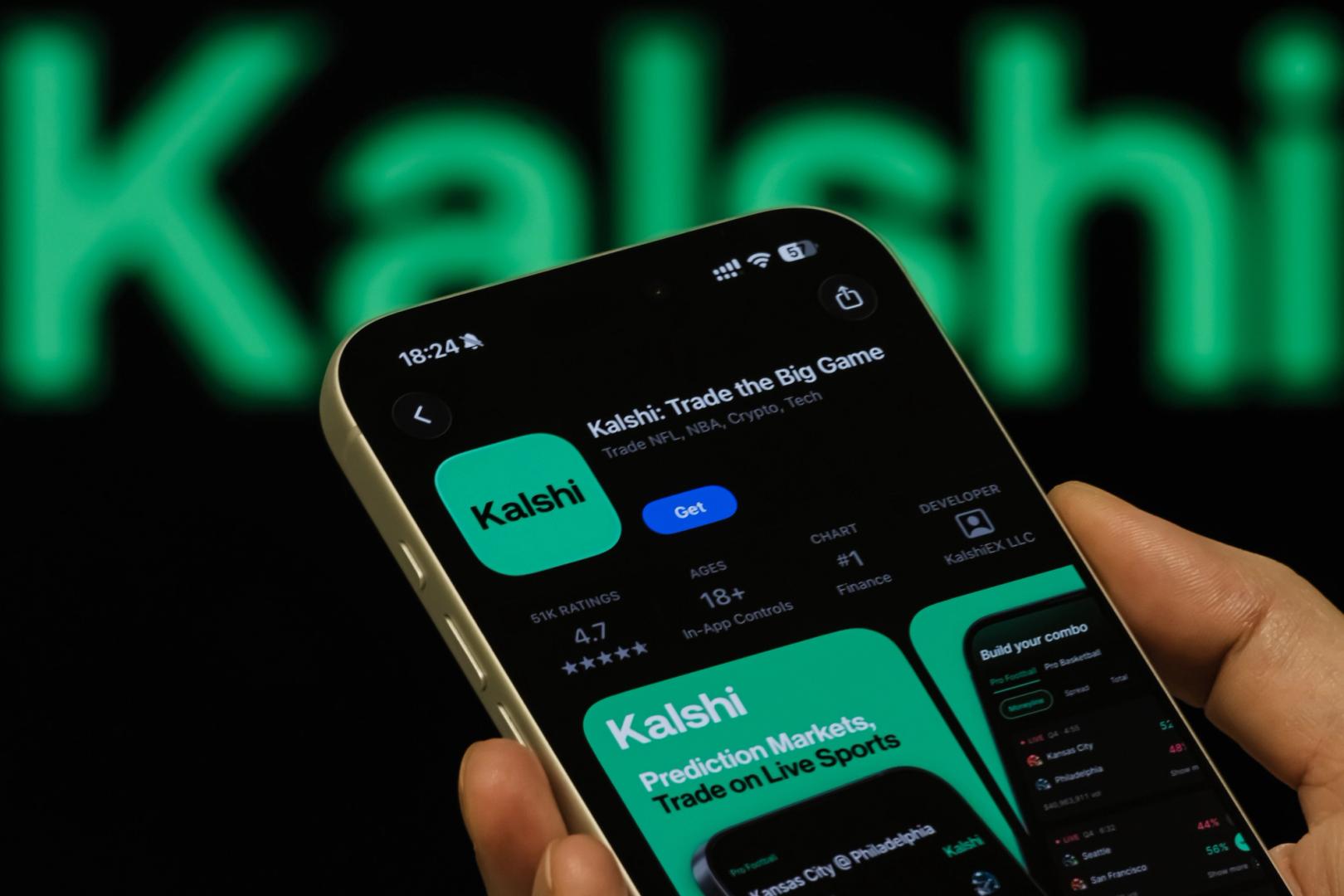
The state of Washington has become the latest to sue a prediction markets provider, after alleging Friday that Kalshi had violated state gambling laws through its products.
According to the complaint, Washington has a tightly-regulated gambling market, including a ban on online gambling, but Kalshi’s products bypass these regulations.
“Kalshi’s website and app show consumers a range of events that they can bet on and the odds for those various events, which dictate how much the bettor will be paid out if the event occurs,” a press release from the state said. “This is exactly how sportsbooks and other gambling operations function. Kalshi advertises that they allow consumers to ‘bet on anything’ by simply calling their service a ‘prediction market’ rather than ‘gambling.’”
The lawsuit said Kalshi’s advertisements referred to “legal betting,” and alleged the company’s activities met state definitions of “gambling,” “professional gambling,” “bookmaking” and other key state provisions. It also included a provision alleging that Kalshi’s products promoted gambling addiction and targeted college students in particular.
Kalshi filed to move the case to federal court, saying it was already litigating these issues in other federal courts and that it received “no warning or dialogue” from Washington prior to the lawsuit.
Washington’s filing continues a growing state backlash against prediction market providers. Prediction market providers and their proponents, including Commodity Futures Trading Commission Chair Mike Selig, argue that these companies offer derivatives contracts that are appropriately regulated at the federal level. States have argued that these companies are offering gambling products dressed up as something else and should be subject to state gambling laws as a result.
While both prediction market providers and states have had some initial legal victories, this argument is likely to wind up before the U.S. Supreme Court, legal experts have told CoinDesk.
Nevada actions
The suit came a week after Nevada won an appeals court victory allowing it to file for a temporary restraining order against Kalshi, forcing the company to remove its sports, entertainment and election contracts from the state for at least two weeks. A hearing will be held at the end of those two weeks on Friday, April 3, at which a state judge will decide whether to extend the restriction.
Trade publication Gambling Insider reported on Friday that Kalshi’s Nevada users were still able to use the platform after the temporary restraining order went into effect.
Nevada also secured a preliminary injunction against Coinbase, requiring it to continue a pause in its prediction market offerings in the state in an order dated Thursday, March 26, following an initial temporary restraining order issued in early February.
Under Thursday’s order, Nevada District Judge for the First Judicial District Court Kristin Luis wrote that Coinbase did not dispute it offered “‘event-based contracts’ that relate to sporting and other events, including college basketball games, college and professional football games and elections,” which meet the definition of “sports pools” defined under Nevada law.
Coinbase is partnered with Kalshi, the judge noted. Like the Kalshi order, this one is ordering Coinbase not to offer sports, election or entertainment contracts in Nevada, at least until a broader court case is resolved.
The judge gave Coinbase 60 days to “make technological enhancements” to comply with the order.
Nevada and Washington’s federal district courts are both part of the Ninth Circuit Court of Appeals.
Read more: Kalshi secures license to offer margin trading to institutional investors

Senators blow lead to Lightning, lose ground in playoff race

How Autonomous Drone Warfare Is Emerging in Ukraine

‘I suffered with addiction for 20 years on and off, now I’m two years sober’


-
 NewsBeat3 days ago
Manchester United reach agreement with Casemiro over contract clause amid transfer speculation
-

 News Videos3 days ago
Parliament publishes latest register of MPs’ financial interests
-

 Crypto World7 days ago
Best Crypto to Buy Now: Strategy Just Spent $1.57 Billion on Bitcoin During Fear While Early Investors Quietly Enter Pepeto for 150x Potential
-

 Crypto World7 days ago
Bitcoin Price News: Bhutan Sells $72 Million in BTC Under Fiscal Pressure, but the Smart Money Entering Pepeto Sees What the Market Does Not
-

 Sports5 days ago
Remo Stars and Kano Pillars Strengthen Survival Hopes in NPFL
-

 Business6 days ago
No Winner in March 21 Drawing as Prize Rolls to $133 Million for Next
-

 Sports5 days ago
Gary Kirsten Accuses Pakistan Cricket Board Of ‘Interference’, Mohsin Naqvi Responds
-

 Tech6 days ago
Give Your Phone a Huge (and Free) Upgrade by Switching to Another Keyboard
-

 Tech6 days ago
AI enters the chat: New Seattle dating app relies on tech to facilitate meaningful human connections
-

 News Videos5 days ago
Ch 9 Financial Management Part 1 | Detailed One Shot | Class 12 Business Studies Boards 2026
-

 Business2 days ago
Instagram, YouTube Found Responsible for Teen’s Mental Health Struggle in Historic Ruling
-

 Tech7 days ago
Today’s NYT Connections Hints, Answers for March 22 #1015
-

 NewsBeat23 hours ago
The Story hosts event on Durham’s historic registers
-
 NewsBeat3 days ago
Tesco is selling new Cadbury Dairy Milk bar and people can’t wait to try it
-

 Business6 days ago
Will Duke Basketball Win It All? Duke Basketball Enters Second Round as Third Favorite to Claim NCAA Title
-

 Sports6 days ago
2026 Kentucky Derby horses, odds, futures, preview, date: Expert who hit 12 Derby-Oaks Doubles enters picks
-
 NewsBeat6 days ago
Update on Wisbech river crash as search for teenage boy enters fifth day
-

 Tech5 days ago
Samsung will soon let you control smart home devices from your car’s dashboard
-
 Entertainment5 days ago
Cynthia Bailey Dishes on ‘RHOA’ Season 17, Discusses Kandi
-

 Fashion4 days ago
Does It Matter What You Wear When You’re Laid Off and Looking?
You must be logged in to post a comment Login