Connect with us
DAPA Banner
DAPA Coin
DAPA
COIN PAYMENT ASSET
PRIVACY · BLOCKDAG · HOMOMORPHIC ENCRYPTION · RUST
ElGamal Encrypted MINE DAPA
🚫 GENESIS SOLD OUT
DAPAPAY COMING

Business

Government’s inheritance tax changes ‘act of self harm’ that will destroy family firms: Brewery boss William Lees-Jones

Published

on

Business Live

Big interview: JW Lees MD says Government needs to give more backing to hospitality

JW Lees boss William Lees-Jones holds up a pint of Boddingtons

The first cask pint of Boddingtons was poured in Manchester, by JW Lees boss William Lees-Jones at the Founder’s Hall on Albert Square in September(Image: JW Lees)

The Government’s inheritance tax changes are an “act of self harm” that will stop family firms growing and creating jobs – that’s the stark message from JW Lees boss William Lees-Jones as he pushes ministers to reverse their decision.

JW Lees is one of Britain’s best-known brewers and a North West family business stalwart, now in its sixth generation. But like many family businesses, it will be affected by this month’s changes around rules to inheritance tax which he and fellow leaders say could stifle investment and even lead to the break-up of some businesses.

That comes on top of other rising costs faced by so many other hospitality businesses, including business rates, the rising minimum wage and the volatile energy prices of recent years.

William, managing director at Middleton’s JW Lees, has been speaking out on behalf of family businesses for years – particularly in the pandemic. Now he’s speaking out again, this time about the pain these latest changes could cause.

Advertisement

He’s also warning that unless the Government moves to support hospitality then businesses like his might have to cancel planned investments that would create jobs and improve their communities.

He told BusinessLive: “JW Lees will survive, because we’ll do whatever it takes, but in the short term it means less investment, less job creation, more short-term survival tactics. And that for me is an act of self-harm by a British government at a time when the government was elected on the principle of growth.”

The Government in 2024 announced plans to reform Business Property Relief (BPR) and Agricultural Property Relief (APR), which offered 100% relief from inheritance tax for qualifying business and farming assets. Those reliefs were used to pass assets from one generation to the next.

The plans were watered down in December after a campaign led by farmers, with the tax threshold raised from £1m to £2.5m. But large family firms will still see much bigger tax bills when they are passed down through the generations.

Advertisement

As William told City AM recently, even with the raised threshold, “£2.5m doesn’t even buy you a decent pub”. And JW Lees has 138 of them.

Should council leaders have to buy their own town hall?

William said the changes to tax liabilities could lead to firms selling up, or to firms selling assets and shrinking to find the cash they need.

He said: “I don’t believe it’s been thought through. I think there will probably be a reversal of it, but there will be in the next three years a number of businesses that will get caught up in it, and that’s just not fair – because it was legislation that had been in place since 1976 and it’s something that lots of British family businesses have come to rely on.”

He said a longer consultation period would have been helpful. And he added: “The assumption was that through business property relief, that the shares in the business could be passed from one generation to the next.

Advertisement

“And so I think it’s as ridiculous as… If you suddenly become the leader or chief executive of a local authority, you then have to raise the capital to buy the town hall off your predecessor.”

Changes could cost billions

Research by Family Business UK last year suggested that the IHT changes could cut the UK’s GVA economic output by £14.8bn by April 2030, and could put more than 200,000 jobs at risk. While the changes were meant to increase the Government’s tax take, analysis from CBI Economics suggests that if family firms and farms do cut back on their operations, then the Government could actually see a net fiscal loss of £1.9bn.

William’s solution is straightforward: “I’d love to see business property relief completely go back to where it was. Maybe that’s a pipe dream, but I think it’s something that will quickly be on pretty much every opposition manifesto for the next general election.”

Lockdown lesson: ‘The media like talking about pubs’

JW Lees, led by William and the Lees-Jones family, has been prepared to speak up about Government policies, under Conservatives and Labour.

Advertisement

Like all hospitality groups, Lees was hit hard by the lockdowns and closures imposed over the pandemic period. William was proactive about talking to the government, even finding himself on weekly Zoom calls with the former Department for Business, Energy & Industrial Strategy. That meant he became something of a spokesperson for the pub sector.

“I quickly learned that actually the media like talking about pubs,” he said, “because they’re places where people meet, and politicians go into them.

The JW Lees brewery in Middleton, Greater Manchester

The JW Lees brewery in Middleton(Image: Reach plc)

“And so all of these conversations that we were having were suddenly having this big impact. And because I kept turning up and being sensible, I started doing this commentary.”

The rules about gatherings and venues changed regularly, and could be inconsistent. One debate, for example, was over what counted as a “substantial meal” that could be served with alcohol in pubs. That led to what William recalled as the “Scotch egg rule”, after Cabinet minister Michael Gove mused over whether a Scotch Egg or two was a substantial meal or a starter.

Advertisement

“From a business perspective,” he said, “we were almost as a board having to operate with a completely different set of rules every month for a couple of years.”

That led to William’s role as a voice for family firms and for hospitality. And he says the leisure sector faces many more challenges beyond the latest tax changes, as costs continue to rise across the board.

‘I don’t think the government understands hospitality’

This Government has been criticised for not backing the hospitality sector enough.

William said: “I don’t think the government understands hospitality, and I think that’s a real problem because hospitality has a number of different elements to it. So the big night out, the special occasions, will never disappear in the same way that the Great British public will always have their annual holiday except in extreme circumstances.

Advertisement

“If I look at our business, we lose money in January, February, October, November. Summer is good, Christmas is bonkers.”

That means hospitality can be extremely sensitive to cost rises, and it needs to manage those costs all year round to be sustainable.

He said: “Frankly whether it’s the minimum wage or national insurance contributions or business rates or whatever else it might be, we’re finding ourselves in a position where we’re (the UK) going to become a really expensive place to go out, and that has got to be a bad thing for society.”

How JW Lees has transformed its pub estate

Britain has lost a quarter of its pubs since 2000. Last year alone, one pub a day closed in England and Wales.

Advertisement

William said: “Pubs are very appealing buildings if you want to put an HMO onto that site. Because you can turn them into six or seven flats quite easily and once they’re gone they don’t come back.”

JW Lees’ pub estate has undergone a transformation in recent years as the company adjusts to changing drinking and eating patterns. William said: “We had 172 pubs, we sold 120 and we bought 84 and so we have less pubs of a far higher quality.”

He added: “In the 1970s, which was boom time for Britain’s pubs and when pubs had sold more beer than any other time, the pubs you wanted were big estate boozers and end of terrace pubs.

“What we’ve seen is the gentrification of pubs and as families have become more welcome and food (more popular). If I look at our turnover, we’re now 40% drink, 40% food, 20% bedrooms. So it’s a completely different profile.

Advertisement

“And we’ve moved from the Greater Manchester mill towns to the leafy parts of Cheshire, Lancashire and North Wales, so it’s the repositioning of our estate for a different guest experience.”

Just some of the beers brewed at the Boilerhouse experimental brewery at the JW Lees brewery in Middleton, Greater Manchester

Just some of the beers brewed at the Boilerhouse experimental brewery at JW Lees(Image: Reach plc)

Hotels growing – but tax changes could hit that too

JW Lees now has 366 hotel bedrooms across 14 sites. William said: “A lot of people would prefer to stay in a pub than in a reasonably soulless hotel because they know they’re going to be able to get something to eat and drink.”

And that leads to another worry about tax policies in the UK – more local authorities and Business Improvement Districts are imposing or considering visitor levies, sometimes known as tourist taxes, which William fears could put people off UK holidays.

JW Lees is considering offering more hotel beds, but that is another decision that could be affected by Government tax policies.

Advertisement

William said: “At the moment we’ve got a number of planning applications hovering there and this is where the inheritance tax planning comes in again – because those sorts of big capital projects are the ones that, at the moment, have got the biggest question marks over them. We’d love to be building them but it’s a question of whether we can afford to, whether we can finance it.”

Boddingtons ‘doing amazingly’

Beer is at the heart of JW Lees’ operations, and the company is innovating there too. Its stout has been a huge success, particularly around St Patrick’s Day. And last year it brought back iconic Manchester cask ale Boddingtons, in partnership with brand owner Budweiser Brewing Group, to a rapturous reception.

William said: “It’s doing amazingly, it’s doing so well we keep pinching ourselves.

“There is a nostalgia for the 90s when Boddington’s was at its peak and It’s one where every time I post something on social media about it, people go, ‘oh, I must go and have a pint of it’. For my generation, it was an iconic brand.

Advertisement

“We’ve worked with Budweiser very closely on the relaunch. And for a brewery like us, it’s great to be able to collaborate with what is the world’s biggest brewer, and for them to see that the relaunch was best done through us.”

The five-year rule

William is part of the sixth generation of the founding family to lead the business. He did not join the business immediately, instead heading to London after university to work in advertising. But eventually he returned North with his family to join the historic family business.

Now he and his fellow directors – including his father, uncle and siblings – are pondering how the seventh generation of the family will get involved in the business, inheritance tax changes notwithstanding. One member is already at the business, with William’s son Louis Lees-Jones as openings manager.

William added: “We have this five-year rule that if they go on to university and they then spend five years learning something, that they may or may not come into the business in eight or nine years’ time. These are the sort of timeframes that as a family business that we’re planning things with. Because that’s what it’s all about – building a long-term sustainable business.”

Advertisement
JW Lees head brewer Michael Lees-Jones, left, with managing director William Lees-Jones in 2013

JW Lees head brewer Michael Lees-Jones, left, with managing director William Lees-Jones in 2013(Image: Middleton Guardian)

Right now, the short-term uncertainty over the war in Iran and oil flows through the Strait of Hormuz are also hitting UK firms, forcing them to hedge their energy costs.

William said: “The war in Iran is going to impact pretty much every business in the world. You get into even whether we start drilling the North Sea…. We’ve just bought our energy forward for the next year.

“We live in a world of uncertainty and that’s not a great thing.”

In the meantime, he plans to keep standing up for family firms and for the hospitality sector.

Advertisement

He said “We all just want to be in a position where our country is growing and in my case people are going to pubs enjoying a pint and fish and chips on a Friday.”


Continue Reading
Click to comment

You must be logged in to post a comment Login

Leave a Reply

Business

BMO Beats Quarterly Earnings Again, And Remains A Strong Dividend Idea Among Banks (BMO)

Published

on

BMO Beats Quarterly Earnings Again, And Remains A Strong Dividend Idea Among Banks (BMO)

This article was written by

Albert Anthony is the pen name of a business author on Amazon and his newest book is “How To Pick Stocks: 8 Steps For Long-Term Investing with Fundamental & Technical Analysis,” now available as a 2026 edition paperback and Kindle ebook in several regions including the US, UK, Canada, and Europe. The author is an analyst & contributor for investing platform Seeking Alpha since 2023, where he has nearly 2,000 followers and has covered hundreds of stocks in multiple sectors including banks/financials, REITs, insurance, pharma, and more. He has also written for platforms like Investing dot com, and has taken part in many business conferences includes Bloomberg Adria’s Investment Outlook 2026 as well as Money Motion 2026. Albert Anthony has Croatian-American roots, having grown up in the US and living in the NYC/New Jersey area as well as the Austin Texas area while working in enterprise IT roles at several prominent companies, including a top 10 financial firm. The author earned a B.A. from Drew University, and also completed certifications from Microsoft, CompTIA, and Corporate Finance Institute where he earned the specialization in risk management. He is founder of a boutique equities research firm, Albert Anthony & Company, which is a trade name both in the US and Croatia. Besides his writing and analyst work, the author has been active on camera as well, as a film/TV extra for casting agencies in Croatia/Europe, and also took part in roundtable panel discussions and appeared in several media stories in that region. You can also check out the author’s video content on the Albert Anthony channel on YouTube where he discusses investing topics, @author.albertanthony Please note: The author does not write about non-publicly traded companies, small cap stocks, crypto, or startup CEOs, so any such mail received and pitches from PR agencies will be deleted. Any official mail to the author should be sent to albertanthony.info@gmail.com. *Author Disclaimer: Albert Anthony and Albert Anthony & Co, is a US-based sole proprietorship registered as a trade name in Austin, Texas, and a sole proprietor registered in Croatia. The author nor his company are registered financial advisors and do not provide personalized financial advisory services to clients and do not manage client assets but provide general markets commentary and research as well as actionable insights based on publicly-available data and their own analysis. The author does not sell or market financial products and services, nor is compensated by any company for rating them. The author does not hold any material position in any stock he rates at the time of writing, unless otherwise disclosed. All investment is assumed to be at risk and readers are expected to do their due diligence beyond the scope of this author’s commentary, agreeing to indemnify the author of any liability for potential investment losses.

Analyst’s Disclosure: I/we have no stock, option or similar derivative position in any of the companies mentioned, and no plans to initiate any such positions within the next 72 hours. I wrote this article myself, and it expresses my own opinions. I am not receiving compensation for it (other than from Seeking Alpha). I have no business relationship with any company whose stock is mentioned in this article.

Seeking Alpha’s Disclosure: Past performance is no guarantee of future results. No recommendation or advice is being given as to whether any investment is suitable for a particular investor. Any views or opinions expressed above may not reflect those of Seeking Alpha as a whole. Seeking Alpha is not a licensed securities dealer, broker or US investment adviser or investment bank. Our analysts are third party authors that include both professional investors and individual investors who may not be licensed or certified by any institute or regulatory body.

Advertisement
Continue Reading

Business

These 5 midcap mutual funds deliver over 20% return in 3 years. Do you own any?

Published

on

These 5 midcap mutual funds deliver over 20% return in 3 years. Do you own any?

Five midcap mutual funds delivered strong long-term performance, generating over 20% annualised returns in the last three years, led by HSBC Midcap Fund, ICICI Prudential Midcap Fund and WhiteOak Capital Mid Cap Fund.

Continue Reading

Business

Oddity Tech: Cheap, But The Ad Fix Still Has To Show Up

Published

on

Oddity Tech: Cheap, But The Ad Fix Still Has To Show Up

Oddity Tech: Cheap, But The Ad Fix Still Has To Show Up

Continue Reading

Business

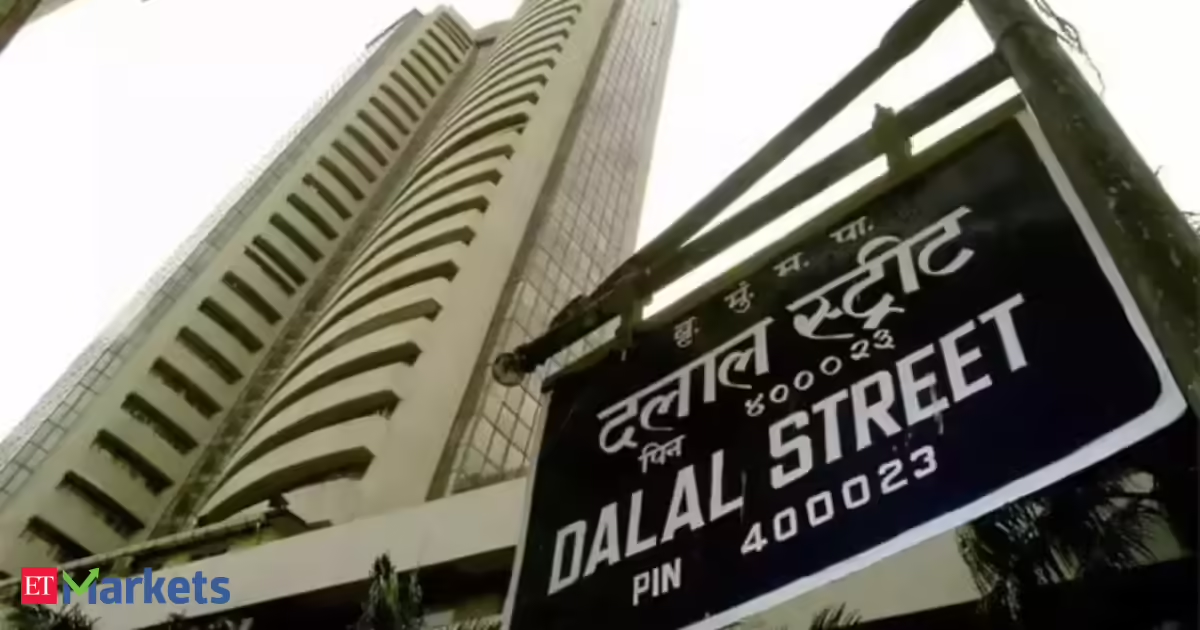
Dalal Street Week Ahead: Nifty stuck in consolidation zone; 23,800 remains key breakout hurdle

Published

on

Dalal Street Week Ahead: Nifty stuck in consolidation zone; 23,800 remains key breakout hurdle
The markets traded in a volatile and largely range-bound manner through the week before ending with a modest loss. Nifty oscillated in a 605-point range, registering a high of 24,089.80 and a low of 23,484.75 before settling near the lower end of the weekly range.

The sharp decline witnessed on Friday was largely driven by MSCI rebalancing-related flows, resulting in accelerated profit-taking and a weak close for the week. India VIX rose by 9.60% to 16.19, reflecting a pickup in volatility expectations and some increase in market nervousness following the late-week selloff. Nifty ended the week with a loss of 171.55 points (-0.72%).

Screenshot 2026-05-30 093327Agencies

The broader technical structure remains in a consolidation phase. However, the sharp selloff towards the end of the week has once again dragged the immediate resistance levels lower, with the 23,800 zone emerging as the first significant hurdle that the index must overcome. As long as Nifty remains below this level, the ongoing consolidation is likely to continue.

On the downside, the index continues to hold above the lower boundary with the support zone placed in the 23,300-23,400 area. A decisive move beyond either end of this range could set the tone for the next directional move.

The markets are likely to begin the coming week on a cautious note after Friday’s sharp decline. Immediate resistance levels are placed at 23,800 and 24,000, while supports come in at 23,350 and 23,100.

Advertisement


A sustained move above 23,800 would improve the near-term technical outlook and may trigger fresh buying interest. Conversely, any violation of the 23,300 area could invite renewed weakness and increase downside pressure.
The weekly RSI stands at 40.84 and remains below the neutral 50 mark, indicating subdued momentum and showing no divergence against price. The weekly MACD remains below its signal line and continues to stay in negative territory, reflecting a lack of strong upward momentum.A study of the overall pattern shows that Nifty continues to trade within a consolidation beneath a key supply area. The index remains below its 50-week and 100-week moving averages, placed near 24,936 and 24,535, respectively, indicating that the intermediate trend has yet to regain full strength. At the same time, the index remains comfortably above its rising 200-week moving average near 22,057, keeping the long-term structure intact. The ongoing compression between channel support and overhead resistance suggests that the market may be approaching a decisive phase where a directional breakout could emerge over the coming weeks.

Given the current technical setup, traders should continue to maintain a balanced and selective approach. The rise in India VIX alongside the failure to sustain higher levels warrants caution, especially near overhead resistance. Fresh buying should remain stock-specific and focused on pockets displaying relative strength. Traders would be better served by protecting gains, maintaining disciplined risk management, and avoiding aggressive directional bets until the index confirms strength by moving above 23,800. The coming week is likely to reward selectivity and prudent positioning rather than broad-based aggressive exposure.

In our look at Relative Rotation Graphs®, we compared various sectors against the CNX500 (NIFTY 500 Index), representing over 95% of the free-float market cap of allthe listed stocks.

The Relative Rotation Graph (RRG) shows that the Nifty Midcap 100, Energy, Media, Pharma, and Metal Indices are inside the leading quadrant. While the Pharma and Energy groups are showing a slowdown in their relative momentum, overall, these groups are likely to relatively outperform the broader markets.

Screenshot 2026-05-30 093350Agencies
Screenshot 2026-05-30 093406Agencies

The Nifty Infrastructure and the PSE Indices are inside the weakening quadrant. Collectively speaking, these groups may see a slowdown in their relative performance against the broader markets.

The PSU Bank Index has rolled inside the lagging quadrant. The Nifty Bank, Services Sector, Financial Services, and Auto Indices also continue to languish inside the lagging quadrant. These groups are set to relatively underperform the broader markets. The Nifty IT Index is also in the lagging quadrant; however, it is showing a sharp improvement in relative momentum against the broader Nifty 500 Index.

Advertisement

The FMCG and the Realty Index are inside the improving quadrant; they may continue to improve their relative performance against the benchmark.

Important Note: RRGTM chartsshow the relative strength and momentum of a group ofstocks. In the above Chart, they show relative performance against the NIFTY500 Index (Broader Markets) and should not be used directly as buy or sell signals.

Continue Reading

Business

CNH Industrial: Weak Earnings, Mounting End-Market Pressures, And An Unjustified Valuation

Published

on

CNH Industrial: Weak Earnings, Mounting End-Market Pressures, And An Unjustified Valuation

CNH Industrial: Weak Earnings, Mounting End-Market Pressures, And An Unjustified Valuation

Continue Reading

Business

Mariah Carey Teases ‘The Rarities 2’ and Holiday Return as Catalog Interest Surges in 2026

Published

on

Mariah Carey

NEW YORK — Mariah Carey has sparked renewed excitement among fans by hinting at additional archival releases and expanded holiday plans, building on the success of her 2020 compilation “The Rarities” and her enduring dominance as the self-proclaimed Queen of Christmas.

As of late May 2026, the pop and R&B icon has not formally announced a new studio album or a follow-up rarities project. However, recent interviews and subtle social media cues have fueled credible speculation that Carey is preparing to mine her extensive vault once again while reinforcing her seasonal stronghold.

The buzz centers on the possibility of “The Rarities 2,” a logical successor to the 2020 collection that featured previously unreleased tracks, international exclusives and live recordings from her early Columbia Records era. Carey has repeatedly referenced the depth of her unreleased material in past conversations, noting that the first volume only scratched the surface of what exists in her archives.

Her catalog continues to demonstrate remarkable staying power. “All I Want for Christmas Is You” has become a modern holiday standard, reaching No. 1 on the Billboard Hot 100 in four separate years — 2019, 2020, 2021 and 2023. This achievement makes her the first artist to send the same holiday song to the top of the chart across multiple distinct years. Industry observers anticipate another strong performance from the track during the 2026 holiday season, supported by consistent streaming surges and playlist placements.

Advertisement

Carey’s broader catalog has also experienced renewed life through streaming platforms and social media. Tracks such as “Fantasy,” “Always Be My Baby” and “We Belong Together” continue to find new audiences via TikTok trends, memes and synchronization deals. Her 19 No. 1 hits on the Billboard Hot 100 remain the most by any solo artist, second only to The Beatles overall.

Anniversaries provide additional momentum for potential archival activity. Key milestones for her 1990 self-titled debut, the 1995 blockbuster “Daydream” and the 1997 album “Butterfly” have already prompted deluxe editions, remixes and vinyl reissues in recent years. The 25th-anniversary campaign for “Butterfly” in 2022 included new remixes and expanded digital content, demonstrating strong fan appetite for deeper explorations of her work.

A prospective “The Rarities 2” could focus on specific eras, such as sessions from transitional albums like “Glitter,” “Charmbracelet” and “The Emancipation of Mimi,” or spotlight collaborations and remixes that never received full commercial support. Such a project would align with broader industry trends of legacy artists revisiting their vaults to generate fresh engagement across streaming, vinyl and immersive audio formats.

Carey’s holiday influence extends beyond a single song. She has built a seasonal empire that includes short-run tours, branded experiences and television specials. Her 2020 Apple TV+ special “Mariah Carey’s Magical Christmas Special” helped cement her position in the streaming era. While no official 2026 holiday tour dates have been announced, patterns from previous years suggest announcements typically emerge by late summer.

Advertisement

The timing of any new archival or holiday activity appears strategic. With the industry preparing for another fourth-quarter push dominated by seasonal releases, a “Rarities 2” project could capitalize on heightened consumer interest in nostalgia and fresh content from established stars. It would also provide new material for algorithms, playlists and social media moments.

Carey’s ability to maintain relevance across decades stems from her vocal prowess, genre-blending style and cultural impact. From early ballads like “Vision of Love” to hip-hop collaborations and gospel-infused work, her music has aged effectively in the playlist-driven era. Her 2020 memoir “The Meaning of Mariah Carey” further positioned her as the authoritative voice of her own narrative, addressing creative challenges and label dynamics that shaped her career.

Fan communities have responded enthusiastically to recent hints. Social media discussions frequently reference the potential for more vault releases, with many expressing desire for deeper cuts from specific periods. This engagement underscores the value of Carey’s catalog as both a commercial asset and a cultural touchstone.

Industry analysts note that vault projects from major artists often deliver strong results across multiple formats. For Carey, such releases could attract both longtime supporters and newer listeners who discovered her through holiday playlists or viral clips. The combination of archival material and holiday programming creates a powerful annual cycle that sustains visibility year-round.

Advertisement

As 2026 progresses, attention will likely intensify around Carey’s next moves. Whether through a formal “The Rarities 2” announcement, expanded holiday touring or strategic catalog reissues, the singer continues to demonstrate her enduring influence on popular music. Her ability to blend nostalgia with modern consumption habits keeps her relevant in an increasingly fragmented entertainment landscape.

For now, fans remain in a state of anticipation. The hints dropped by Carey suggest she is thoughtfully curating her legacy while keeping the door open for future original material. In an era where catalog performance often rivals new releases in commercial importance, her strategic approach positions her to maintain a prominent role in both holiday traditions and broader music conversations.

The prospect of new archival content arriving alongside her seasonal dominance adds another layer of excitement to what has become an annual cultural event. As summer approaches, the music industry and fans alike will watch closely for official confirmation of Carey’s plans, which could shape the final months of 2026 in meaningful ways.

Advertisement
Continue Reading

Business

Caleres Stock Is Taking A Step In The Right Direction (NYSE:CAL)

Published

on

Caleres Stock Is Taking A Step In The Right Direction (NYSE:CAL)

This article was written by

Daniel is an avid and active professional investor.
He runs Crude Value Insights, a value-oriented newsletter aimed at analyzing the cash flows and assessing the value of companies in the oil and gas space. His primary focus is on finding businesses that are trading at a significant discount to their intrinsic value by employing a combination of Benjamin Graham’s investment philosophy and a contrarian approach to the market and the securities therein. Learn more.

Analyst’s Disclosure: I/we have no stock, option or similar derivative position in any of the companies mentioned, and no plans to initiate any such positions within the next 72 hours. I wrote this article myself, and it expresses my own opinions. I am not receiving compensation for it (other than from Seeking Alpha). I have no business relationship with any company whose stock is mentioned in this article.

Seeking Alpha’s Disclosure: Past performance is no guarantee of future results. No recommendation or advice is being given as to whether any investment is suitable for a particular investor. Any views or opinions expressed above may not reflect those of Seeking Alpha as a whole. Seeking Alpha is not a licensed securities dealer, broker or US investment adviser or investment bank. Our analysts are third party authors that include both professional investors and individual investors who may not be licensed or certified by any institute or regulatory body.

Advertisement
Continue Reading

Business

NSE Social Stock Exchange gets CSR boost as MCA clears corporate funding route. Check details

Published

on

NSE Social Stock Exchange gets CSR boost as MCA clears corporate funding route. Check details
India’s Social Stock Exchange (SSE) is set to receive a fresh boost after the Ministry of Corporate Affairs (MCA) permitted companies to route a part of their Corporate Social Responsibility (CSR) expenditure through the platform. The change is expected to widen funding avenues for non-profit organisations and strengthen transparency and accountability in the social impact ecosystem.

The MCA has amended Schedule VII of the Companies Act, 2013, to recognise investments in certain Social Stock Exchange instruments as an eligible CSR activity. As per a Gazette Notification issued on May 27, 2026, “subscription to zero coupon zero principal instruments on Social Stock Exchange” has now been added to the list of approved CSR activities.

The amendment allows companies to allocate up to 10% of their total annual CSR budget towards not-for-profit organisations (NPOs) registered on the Social Stock Exchange through Zero Coupon Zero Principal (ZCZP) instruments.

The Social Stock Exchange serves as a dedicated platform that connects social enterprises and NPOs with donors, investors and other funding sources. Unlike conventional stock exchanges, where investments are made with the expectation of financial returns, the SSE is designed to facilitate measurable social impact.

Advertisement

According to the National Stock Exchange (NSE), the latest policy change could help scale up social financing in India by providing corporates with a regulated and disclosure-based channel to support impact-focused organisations. The exchange said the framework is expected to enhance transparency, credibility and the overall reach of funding within the social sector.


The idea of a Social Stock Exchange was first outlined by Finance Minister Nirmala Sitharaman during the 2019 Budget, with the aim of bringing capital markets closer to the masses while advancing inclusive growth and financial inclusion.
With the amendment now in place, companies can incorporate SSE-based contributions into their CSR programmes through a structured and regulated mechanism. NSE said the move is likely to improve funding access for verified NPOs, strengthen governance and disclosure standards, encourage outcome-oriented philanthropy and foster greater trust and accountability across the social impact landscape.Sriram Krishnan, Chief Business Development Officer at NSE, described the amendment as a significant development for India’s social sector. He said the provision would enable corporates to channel CSR funds through a transparent, regulated and impact-driven platform, helping improve trust, accountability and access to capital for social enterprises.

The MCA notification has come into effect immediately upon its publication in the Official Gazette.

(Disclaimer: Recommendations, suggestions, views and opinions given by the experts are their own. These do not represent the views of The Economic Times)

Advertisement
Continue Reading

Business

F&O Talk: Nifty may stay range-bound; Sudeep Shah sees opportunities in banks, IT, picks 7 stocks

Published

on

F&O Talk: Nifty may stay range-bound; Sudeep Shah sees opportunities in banks, IT, picks 7 stocks
The Indian stock market witnessed a sharp selloff on Friday afternoon, with the Sensex and Nifty falling over 1% as passive fund flows linked to the MSCI index reshuffle weighed on sentiment.

Sensex dropped over 1,092 points to 74,776 while Nifty 50 crashed nearly 359 points to 23,547. This came as India VIX, which measures volatility in markets, jumped around 8% to 16.18. The sharp losses wiped off nearly Rs 6 lakh crore from the total market capitalisation of all companies listed on BSE, pulling it down to Rs 465 lakh crore.

Analyst Sudeep Shah, Vice President and Head of Technical & Derivatives Research at SBI Securities, interacted with ETMarkets regarding the outlook for the Nifty and Bank Nifty, as well as an index strategy for the upcoming week. The following are the edited excerpts from his chat:

Nifty rollover for May expiry came in below both the three-month and six-month averages. Does this suggest traders are turning cautious near higher levels, or is it simply profit-booking after the recent recovery?

In the month of May, the benchmark index Nifty traded within a narrow range of 1219 points, marking its smallest monthly range since December 2025. The rollover in the May series also came below the prior month and 3-month average. Notably, a majority of the trading sessions during the month witnessed either an upside or downside gap at the opening, followed by range-bound price action throughout the day. As a result, opportunities for intraday and short-term traders remained limited despite the frequent gap openings. But what made this phase even more unusual was the message hidden within the broader monthly price structure.

Advertisement

On the monthly chart, Nifty has formed a bearish candle with shadows on either side, reflecting indecisiveness among market participants amid ongoing geopolitical uncertainties. Zooming into the final week of May, the index continued to trade within a narrow range for most of the week before witnessing a sharp decline during the final hour of Friday’s trading session, which tilted the balance in favour of the bears. While the market remained range-bound for most of the week, the late sell-off has raised an important question—was this merely profit booking or the beginning of a larger directional move?
From a technical standpoint, Nifty continues to trade below all its key moving averages. More importantly, these moving averages have flattened out, indicating the absence of a strong trend. The daily RSI remains in a sideways zone as per the RSI Range Shift framework, while the daily Stochastic oscillator is also moving within a narrow band. Adding to this, the trend strength indicator, Daily ADX, is placed at near 15 level and continues to decline, suggesting a lack of directional momentum in the index. While these indicators point towards a lack of trend, Friday’s late sell-off has injected fresh uncertainty into the market setup.
Talking about crucial levels, on the upside, the 20-day EMA zone of 23,750-23,800 is likely to act as an immediate hurdle for the index. On the downside, the zone of 23,300-23,250 remains a crucial support area. A breach below 23,250 could intensify selling pressure and open the doors for a decline towards the psychologically important 23,000 mark. With the index approaching key support levels, the market’s next move could set the tone for the coming weeks.

Bank Nifty rollover saw a sharper decline and futures data indicates short build-up despite price weakness. Are banking stocks likely to remain drags on the market in the June series?

In the month of May, the banking benchmark index Bank Nifty traded within a narrow range of 3,550 points, marking its tightest monthly range since January 2026. On the monthly timeframe, it has formed a High Wave candle, reflecting market indecisiveness.

During the past week, the index witnessed a strong upmove in the first half; however, it failed to sustain above the 55,500 level and subsequently underwent a sharp correction. This led to the formation of a bearish candle with a long upper shadow, indicating selling pressure at higher levels.

At present, the index is trading below its key moving averages, which are trending downward, suggesting a weak bias. The daily RSI remains in a sideways zone as per the RSI range shift rules, indicating lack of clear momentum.

Going ahead, the 53,500–53,400 zone is expected to act as an important support for the index. A breach below 53,400 could trigger further downside, with the next key support placed around 52,700. On the upside, the 50-day EMA zone of 55,300–55,200 is likely to act as a crucial hurdle.

Advertisement

FIIs reduced nearly 9,800 index shorts while also adding fresh longs. Do you see this as the beginning of a more constructive stance from foreign investors, or is positioning still defensive overall?

There were clear signs of short covering in Index futures between 21st May and 27th May, with FII net Index futures shorts reducing sharply from 2,31,190 contracts to 1,63,012 contracts. This also led to the long-short ratio improving from 11.80% to 16.14%, indicating a relatively constructive shift in positioning.

On Friday, massive short positions were built up leading to net index futures short contracts once again rising to 2,01,309 and the long short ratio dipping to 11.98%. Similar phases of short covering in the past were quickly followed by aggressive selling, causing bullish expectations to fade rapidly. This pattern has persisted for quite some time and is likely to continue until there is greater clarity on the US-Iran deal, a meaningful fall in the Dollar Index (DXY), stability in crude oil prices, and depreciation in the dollar against the rupee. Until these external factors stabilize, FII sentiment is likely to remain cautious rather than decisively bullish.

What are key levels to watch out for in June series? What triggers could push Nifty decisively beyond in either direction?

Talking about crucial levels, on the upside, the 20-day EMA zone of 23,750-23,800 is likely to act as an immediate hurdle for the index. On the downside, the zone of 23,300-23,250 remains a crucial support area. A breach below 23,250 could intensify selling pressure and open the doors for a decline towards the psychologically important 23,000 mark. With the index approaching key support levels, the market’s next move could set the tone for the coming weeks.

IT continues to trade near 52-week lows with elevated open interest and negative carry. Is the sector still witnessing aggressive short positions, and what would it take for sentiment to improve meaningfully?

The Nifty IT Index has rebounded nearly 8% from its 14th May low of 27,078. However, over the last seven sessions, the Index has remained range-bound between 29,747 and 28,678, indicating a lack of strong directional momentum. The RSI remains flat, while a subdued ADX reflects low volatility and absence of trend strength. Additionally, the MACD continues to trade below both the zero line and signal line, highlighting weak underlying momentum.

Advertisement

On the Relative Rotation Graph (RRG), the Index has shifted from the lagging to the improving quadrant, suggesting early signs of momentum recovery, though relative strength remains limited. The Index continues to trade below its 50, 100, and 200-day EMAs, keeping the near-term trend weak. The 29,900–30,000 zone remains a crucial resistance area, and a decisive breakout above this level could trigger a stronger pullback rally in the IT pack.

Given that the broader market structure remains range-bound with elevated volatility, should traders focus more on stock-specific opportunities rather than aggressive index directional bets in the June series?

With the broader market remaining range-bound amid elevated volatility, traders are likely to find better opportunities in stock-specific setups rather than aggressive directional bets on the Index in the June series. The rising ratio line in the Midcap and Smallcap indices relative to Nifty highlights continued outperformance in the broader market space.

Despite the strong bearish candle on 29th May, the overall market structure remains bullish, with no concrete signs of a major reversal yet. Currently, strength is visible in sectors such as private banks, PSU banks, financial services, and select midcap IT names. Meanwhile, the Index continues to react sharply to geopolitical developments, leading to frequent gap-ups and gap-downs that reduce trading clarity. In such an environment, strong price-action structures backed by robust technicals in trending sectors are likely to outperform across market conditions.

What stocks are you looking out for?

For the short term, Tamilnad Mercantile Bank, Nuvama Wealth Management, RR Kabel, Syrma SGS Technology, Krishna Institute of Medical Sciences (KIMS), and Minda Corporation are looking attractive based on their current market setup.

Advertisement

(Disclaimer: Recommendations, suggestions, views and opinions given by the experts are their own. These do not represent the views of The Economic Times)

Continue Reading

Business

Algoma Steel gains 63% as Fair Value models spot opportunity

Published

on


Algoma Steel gains 63% as Fair Value models spot opportunity

Continue Reading

Trending

Copyright © 2025